9 Black Shutters House Exteriors That Are Not Really Black

Add us as a preferred source to see more stories on Google.
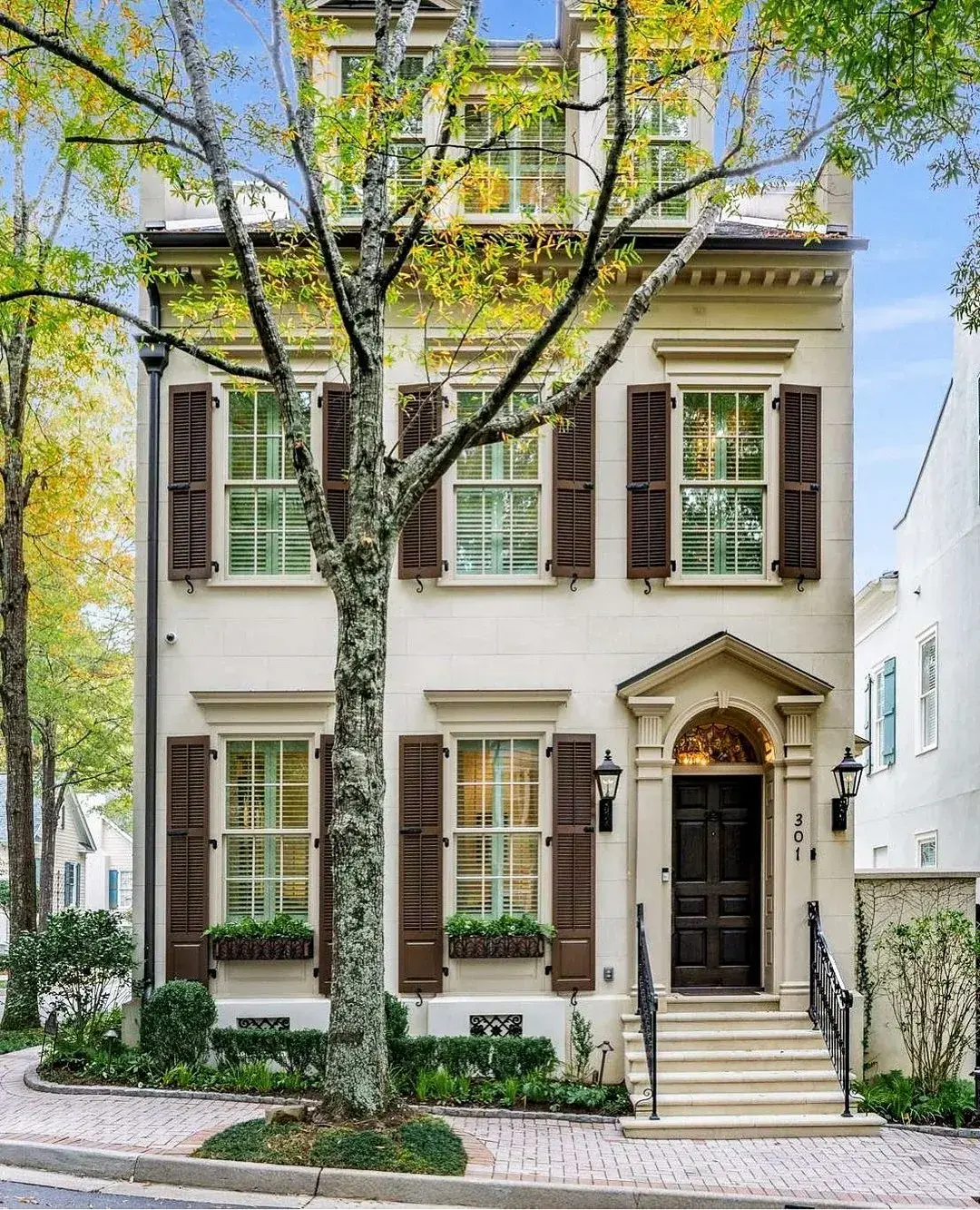
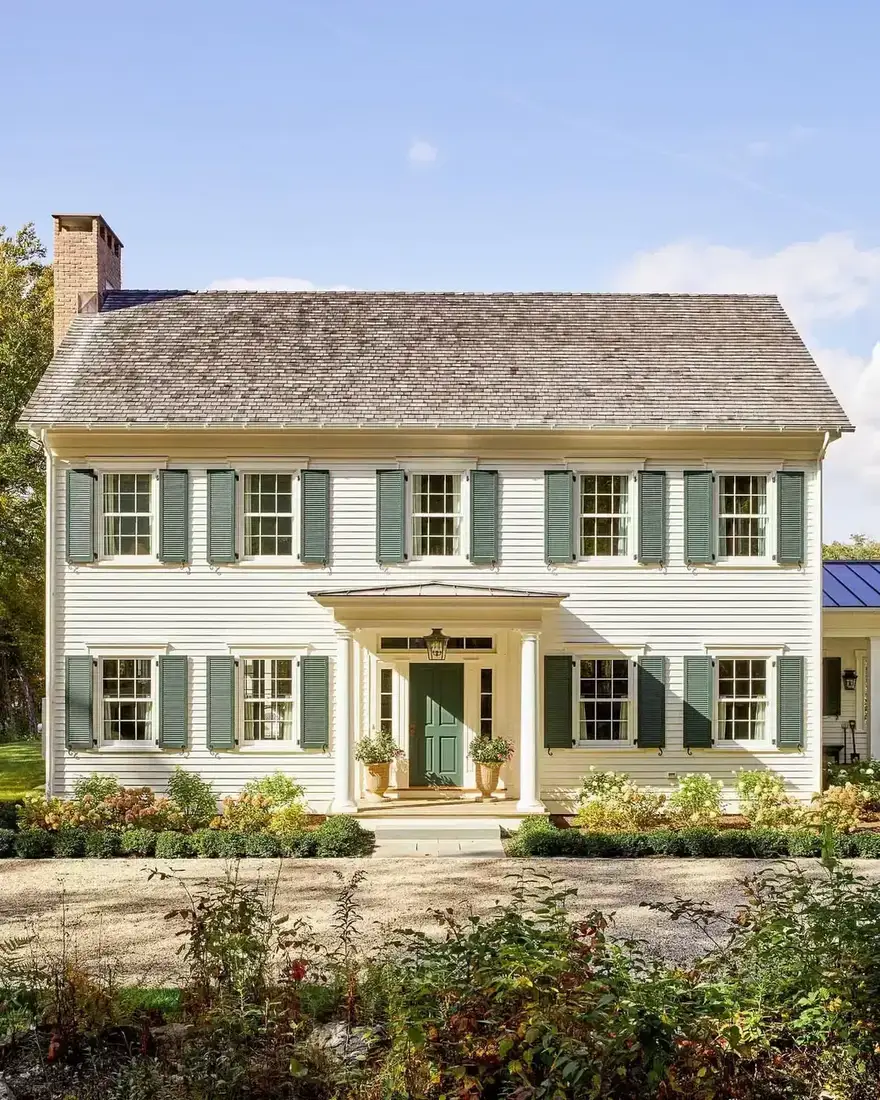
Look at the shutters on the house below and then look again. They are not black.
They are a deep warm brown, close to bitter chocolate, and against cream render they read as rich instead of a dark void. The window boxes are painted the same colour, and so is the front door.
This is the usual case. A great many of the facades filed under “black shutters” are dark brown, bronze, or a near-black green, and copying them in a true jet black is why so many houses end up looking harder than the photograph did.
Which not-quite-black
The right one depends on what the house is made of, because the shutter sits against that material all day.
| House | Shutter colour | Why |
|---|---|---|
| Cream render or stucco | Dark brown, bronze | Warm against warm; brown has depth |
| Warm red brick | Black-green, dark bronze | Cools the brick without fighting it |
| White clapboard | Soft black, charcoal | Crisp; true black works here if anywhere |
| Grey or buff stone | Near-black, dark grey-green | Picks up the cool in the stone |
| Pale yellow or ochre | Bottle green, dark brown | The historic pairing |
Names worth knowing: Farrow & Ball Off-Black No.57 and Railings No.31 for the soft black end, Little Greene Jack Black for something deeper, Benjamin Moore Onyx 2133-10 for a warm near-black, and Farrow & Ball Tanner’s Brown No.255 or Little Greene Bronze Red for the brown end. Trade exterior satin tinted to any of these does the same job at a fraction of the price and holds up perfectly well.
The hardware is not decoration
Look along the edge of each shutter in that photograph and you will see the hinges, and beside each one an iron holdback pinning it flat to the wall.
Those are shutter dogs, sometimes called tiebacks. They exist to stop an open shutter banging in wind. They cost very little, and they are the single clearest signal that a shutter is a piece of working joinery instead of a decorative panel.
Fit them even on shutters that will never close. A pair of shutters with no visible hinges and no dogs reads instantly as applied, and that reading is what makes a facade look cheap from the pavement.
Styles: the S-shape and the rat-tail are the two most common, and either is correct on most houses. Cast iron, black, at around £15 to £40 a pair in 2026. Hinges should be visible pintle-and-strap, not concealed.
Proportion, which matters more than colour
Worth repeating because no amount of paint fixes it. Each shutter leaf should be half the width of the window opening, so a closed pair covers the glass exactly, and the full height of the opening.
Standard decorative shutters are frequently sold at one width regardless of window size, which is why so many houses have two narrow strips with an obvious gap between them.
Mount tight to the window casing, not spaced out on the wall. The gap between shutter and frame is the second giveaway after width.
And check the louvres slope down and out, so rain sheds instead of collecting. Upside-down louvres are common on cheap shutters and obvious once you know to look.
Material, and what it costs
Painted timber looks best and needs repainting every five to eight years depending on exposure. Cedar and accoya are the usual species, and they are worth the premium because they move less.
Composite has improved considerably and is the sensible compromise: it holds paint, it does not rot, and good ones are indistinguishable from timber at normal viewing distance. Expect £150 to £400 a pair in 2026.
Vinyl is the one that reads plastic from the road, largely because it comes in those fixed narrow widths and has a slightly glossy surface that timber never has.
Where to skip shutters entirely
Windows that would not physically accept a correctly sized pair, which includes most modern picture windows and anything arched.
Bay windows, where there is nowhere for a shutter to sit. And any elevation where fitting them would mean going undersized, because no shutter at all is considerably better than a wrong one.
White shutters on a white wall prove the point by failing
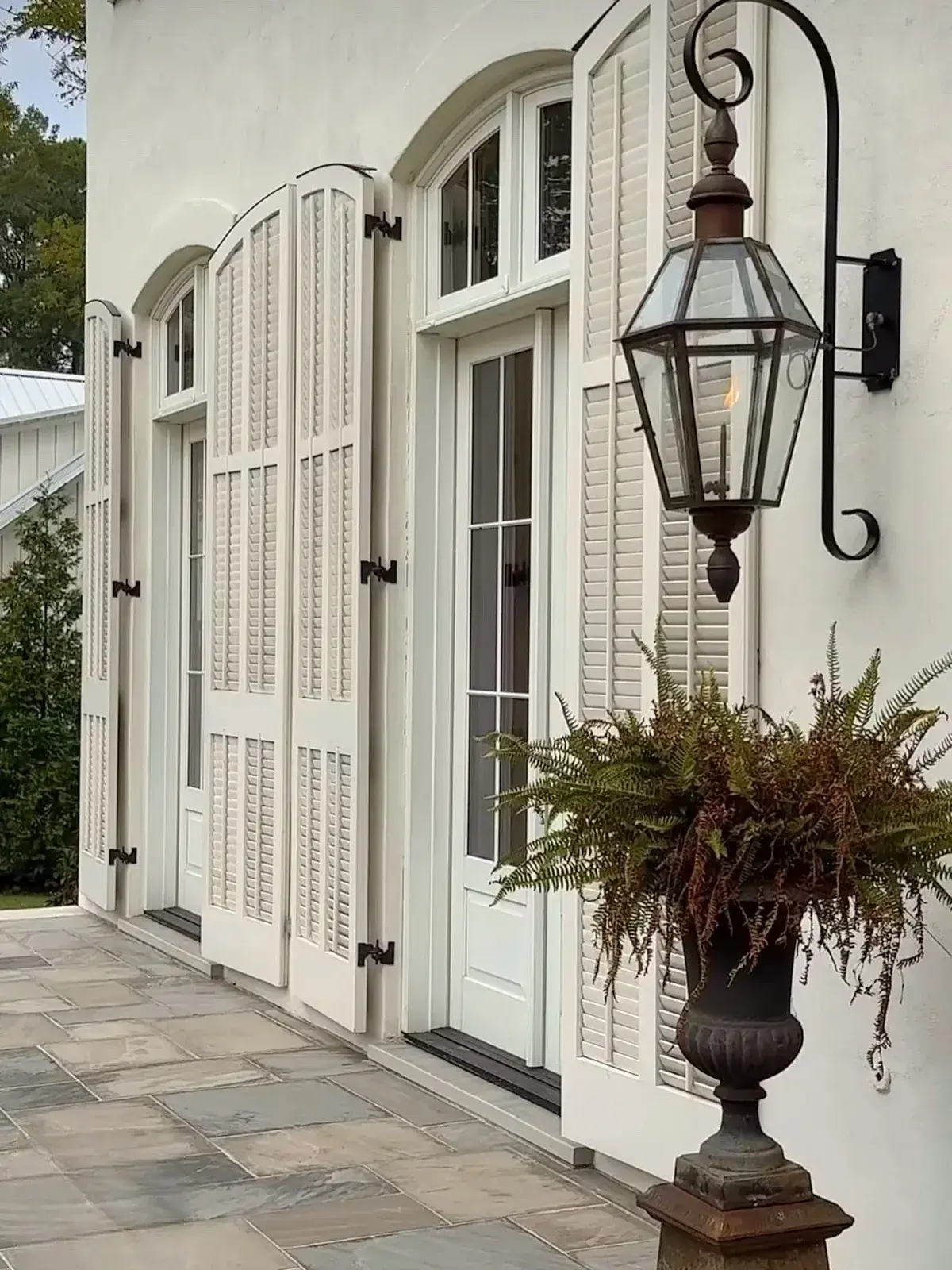
This is the control sample. White shutters on a white wall, same paint, same value, and the facade loses the one dark anchor the whole premise needs.
Stand on the stone paving and the leaves disappear. The arch tops are well made, the louvres are fine, the pintle hinges are correctly set at four points, and none of it registers because there is no contrast to read. The large copper lantern and the fern in the urn do more work from three metres away than the shutters do from the street.
Order matters here. The shutter is not the place to be polite. If the wall is pale, the leaf has to be dark, otherwise it is just extra joinery that catches dirt and gives spiders a home. A shutter that does not darken the wall should not be on that wall.
If you have a pale render and want this look, keep the hardware detail but change the colour. The same leaf in Farrow & Ball Railings No.31 or Little Greene Jack Black, hung on the same strap hinges, would cut a line either side of each door and the whole elevation would settle. Budget for repainting off-white shutters more often too. White shows mildew first on a sheltered wall, and the wall here is sheltered, so expect a soft wash every year.
Blue-grey shutters that borrow the ironwork instead of fighting it
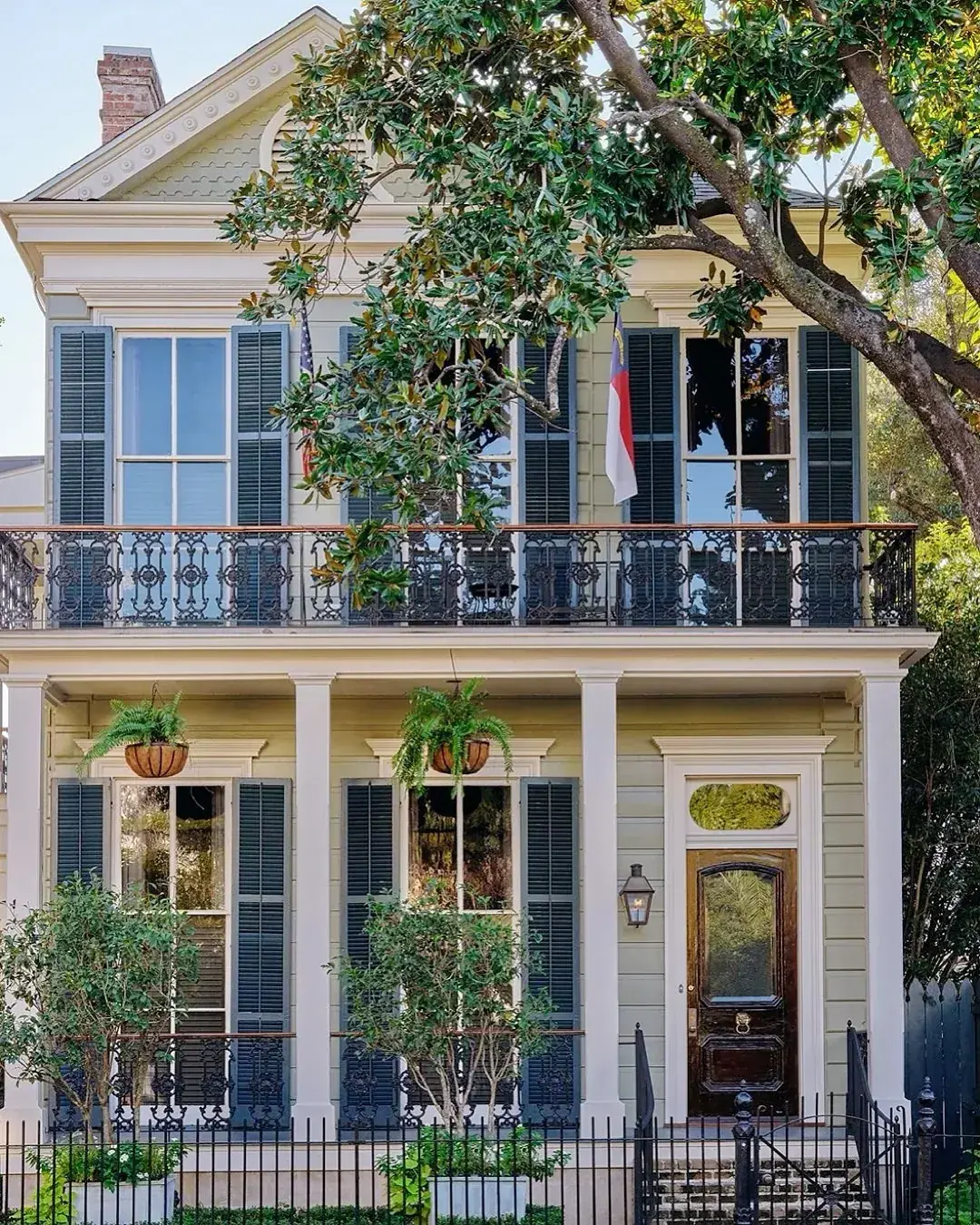
Two storeys, four windows above and four below, each flanked by a pair of blue-grey louvred leaves. The balcony between them is wrought iron, black, with a dense filigree that already carries a lot of dark.
That blue-grey is doing a job a true black could not do on this wall. The render is a pale yellow cream, warm. A jet black leaf would look hard and new. This blue-grey, close to Farrow & Ball Hague Blue No.30 or Benjamin Moore Hale Navy HC-154 in a darker mix, softens the edge while still reading as dark from the pavement. It picks up the iron without copying it.
Fixing is the thing to copy. Each leaf sits tight to the casing, full height, no gap of bare render between frame and shutter edge. On a masonry front like this, that means fixings into plugs in the brick, not screws into render. Screws into render alone pull out within a few seasons, and in a coastal city with wind they go quickly. Use 316 stainless pintles in 2026 at around £20 to £45 per leaf set, plus S-shaped dogs at £15 to £40 a pair, and bed the plugs in mortar.
Skip this colour if your roof is already a cool grey. Two cool darks and a warm wall argue.
Black shutters that actually fit the windows they flank
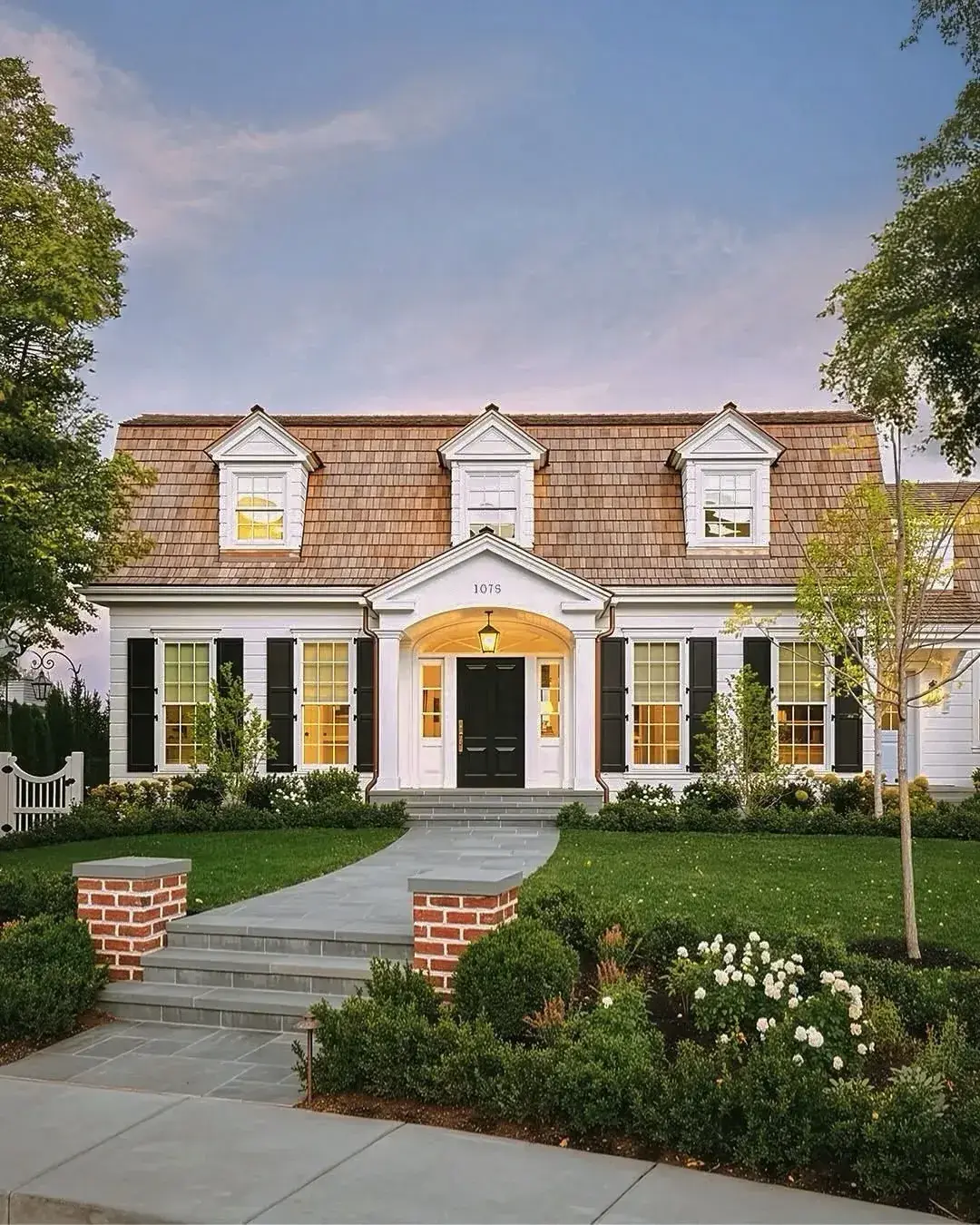
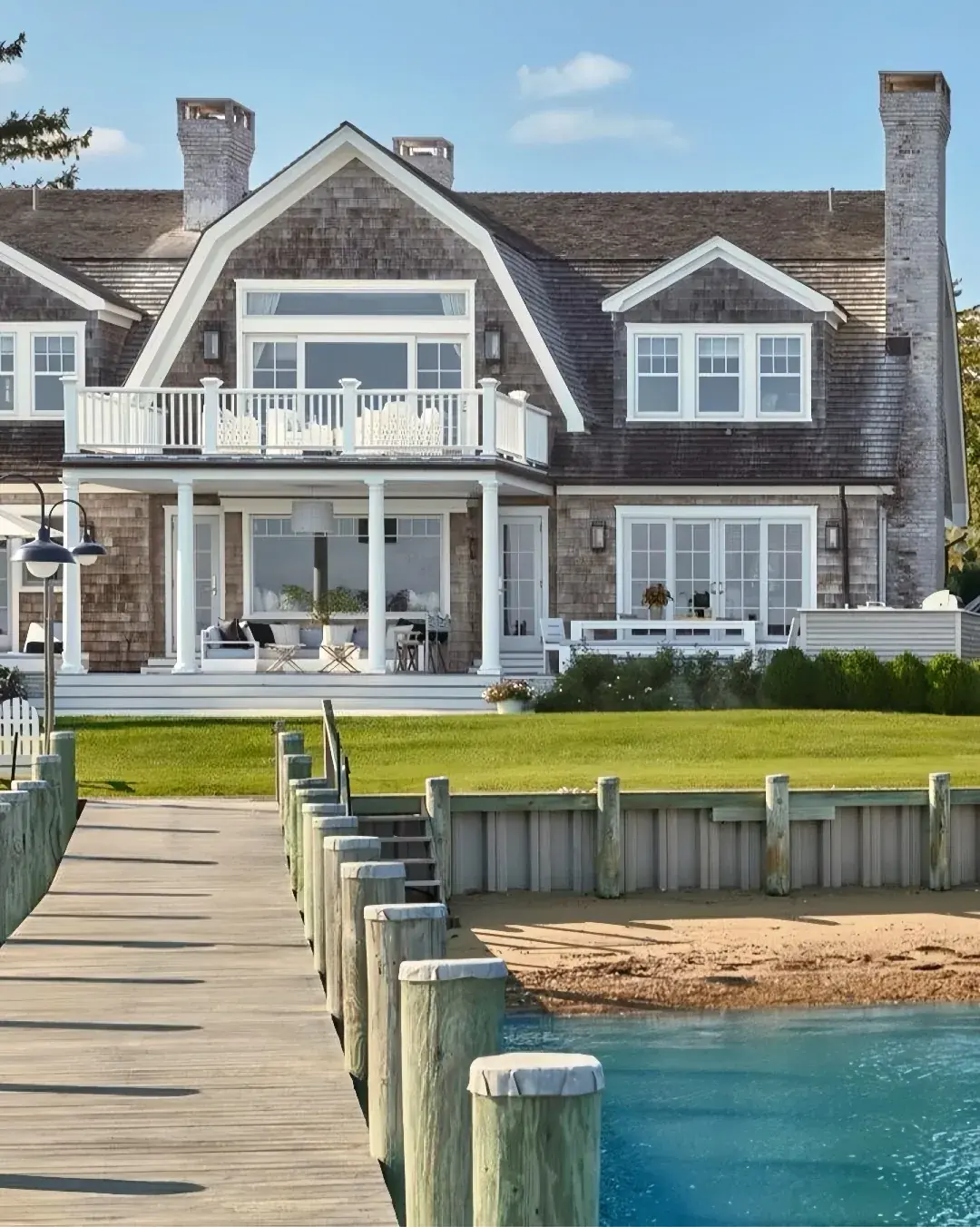
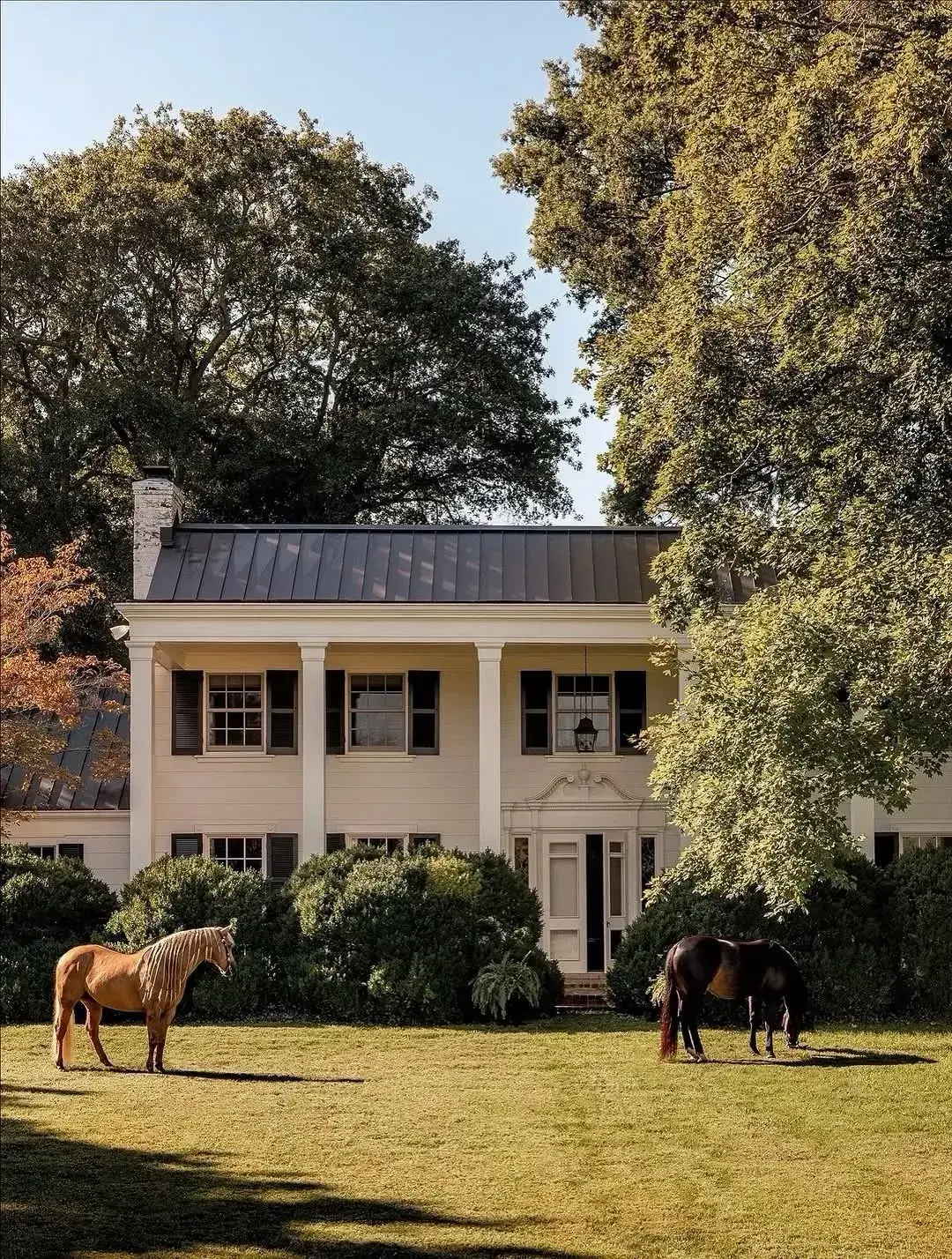
Four ground floor windows, each with a pair of black leaves, a central portico with a black door, and a gambrel shingle roof above with three dormers. The dormers have no shutters, and that is correct.
Check the fit. Each leaf would cover half its opening, and each leaf runs casing to casing in height. The spacing is tight to the frame, the louvres face down and out, and the shadow line behind the leaf is visible, which tells you the leaf stands off the wall on hinges.
The black does not float. The door, four pairs of leaves, and the bronze rainwater goods repeat the same value down the front, so the eye reads one system. Two pairs would look mean. Six would be fussy. Four is the count that suits this width.
Cost and sequence: a joiner will hang a pair on casings for £150 to £350 in 2026 depending on access, half a day for a pair. Paint first, hang after, not the other way round. Shutters painted in place trap paint under the hinge strap, and the strap then holds water against end grain. Hang, then touch in. Use a breathable exterior satin like Dulux Weathershield or Johnstone’s Trade Aqua Satin, £45 to £85 for 2.5 litres in 2026, tinted to your off-black.
Leave dormer cheeks alone. They are narrow, the flashing is stepped, and a leaf there covers lead work.
When planting hides the shutter you paid to hang
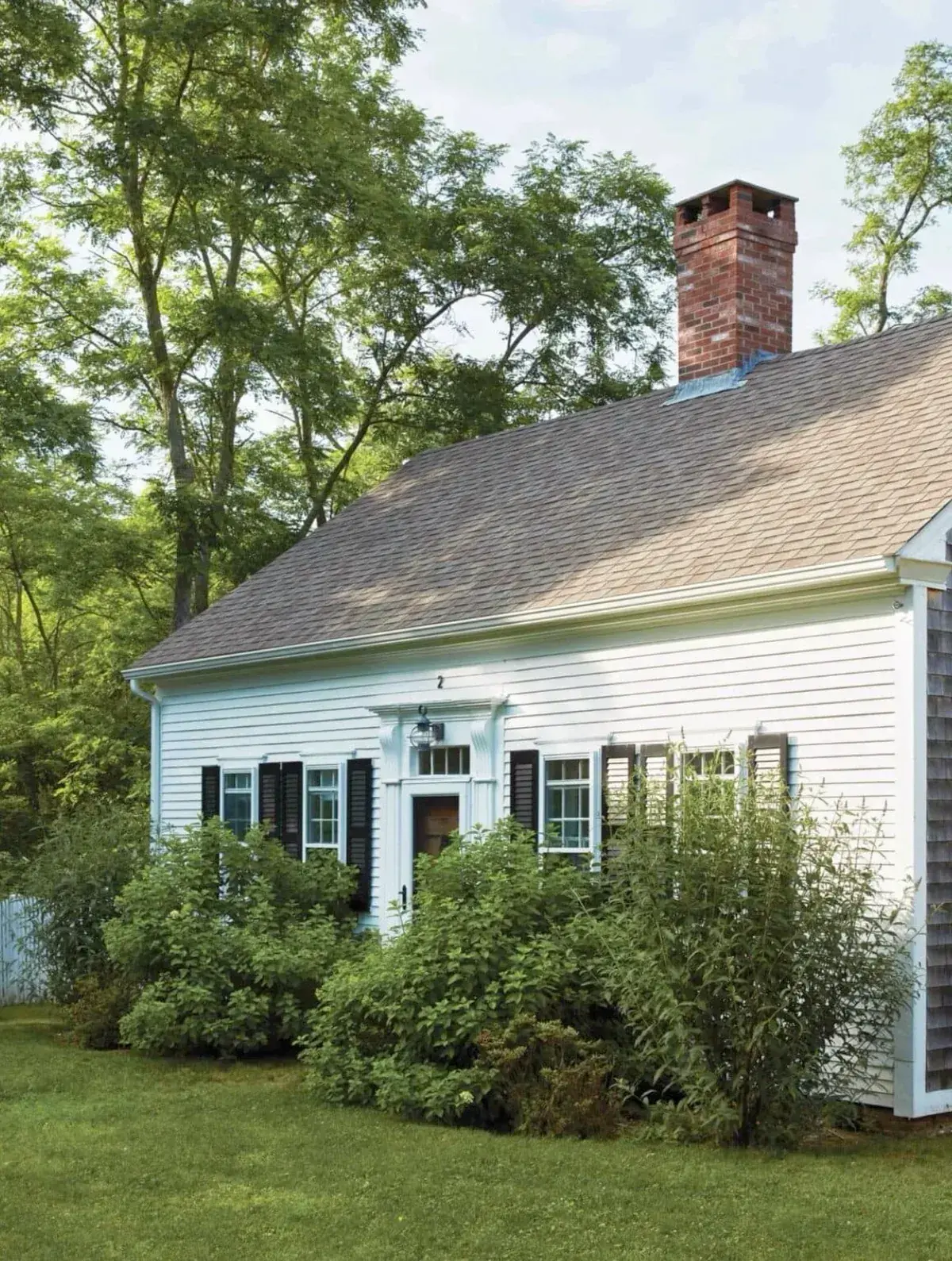
The same black leaf on a small cottage, but the shrubs have swallowed the lower half. From the lawn you see three windows, six leaves, a door with a pediment, and a lot of green.
Cutting back is not cosmetic. Shrubs touching clapboard hold damp against the finish through winter, and shrubs covering shutters hold damp against the shutter back. The back does the rotting first because it never sees sun. I have lifted leaves like these and found the rear face soft while the front still looked painted.
The fix is not to remove the planting. It is to give it clearance. Keep beds 400 to 500mm off the wall and keep shrub height below sill level. The leaves here look correctly sized, narrow because cottage windows are narrow, but no correct size reads correctly when half the leaf is behind foliage.
Hardware is hard to see in this shot, which is its own warning. If you cannot see hinges and dogs from the path, the street cannot either. Choose a dog with enough throw to hold the leaf clear of the wall even after a few years of growth, and fix it into framing, not into the clapboard skin. Surface screws in timber cladding work loose as the boards move.
A light trim in late summer and a soft brush of the leaves at the same time costs nothing and extends the repaint cycle by a year.
Two black leaves on a gambrel gable do the work of four
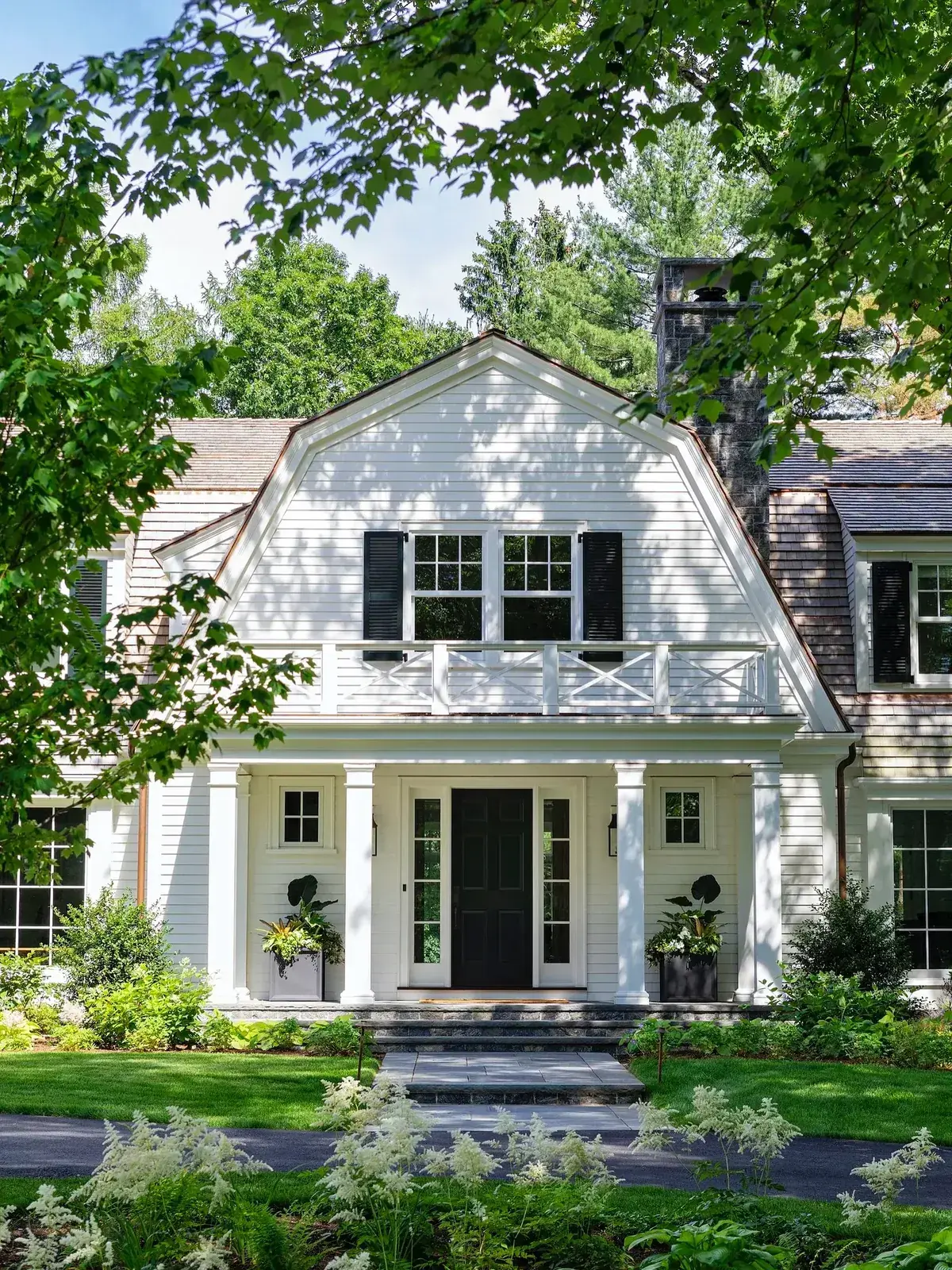
Upper gable with a paired double hung, two black leaves outside it, an X-rail balcony below, and a columned portico over a black door. Only one pair on this whole upper front.
That restraint is why it works. The gable is large, the clapboard is uniform, and dappled shade breaks it up. Two leaves at the peak give the eye a dark to hold without dividing the wall into stripes. Had this front carried black leaves on every window, it would read as bars.
Look at the leaf width against the paired window. The pair together act as one opening, so each leaf is sized to half of that combined width. That is the detail most suppliers miss when they sell single-window shutters for a mulled pair. The result is two thin strips that could never cover the glass. These look like they could, and that is the test.
Fixing into a gable like this wants care. The wall is timber frame with clapboard over, so a long screw into just the board holds nothing. The pintle needs to hit stud or a solid backing block. If in doubt, open a small section inside and add one. The cost of a proper backing is trivial against the cost of a leaf that tears out in the first proper blow. A pair of composite leaves here runs £180 to £420 in 2026, a pair of timber leaves £350 to £850, so the fixing is a small part of a larger spend.
The planting and the stone chimney do the rest. Leave them.
Dark shutters above and beside a porch that already has weight
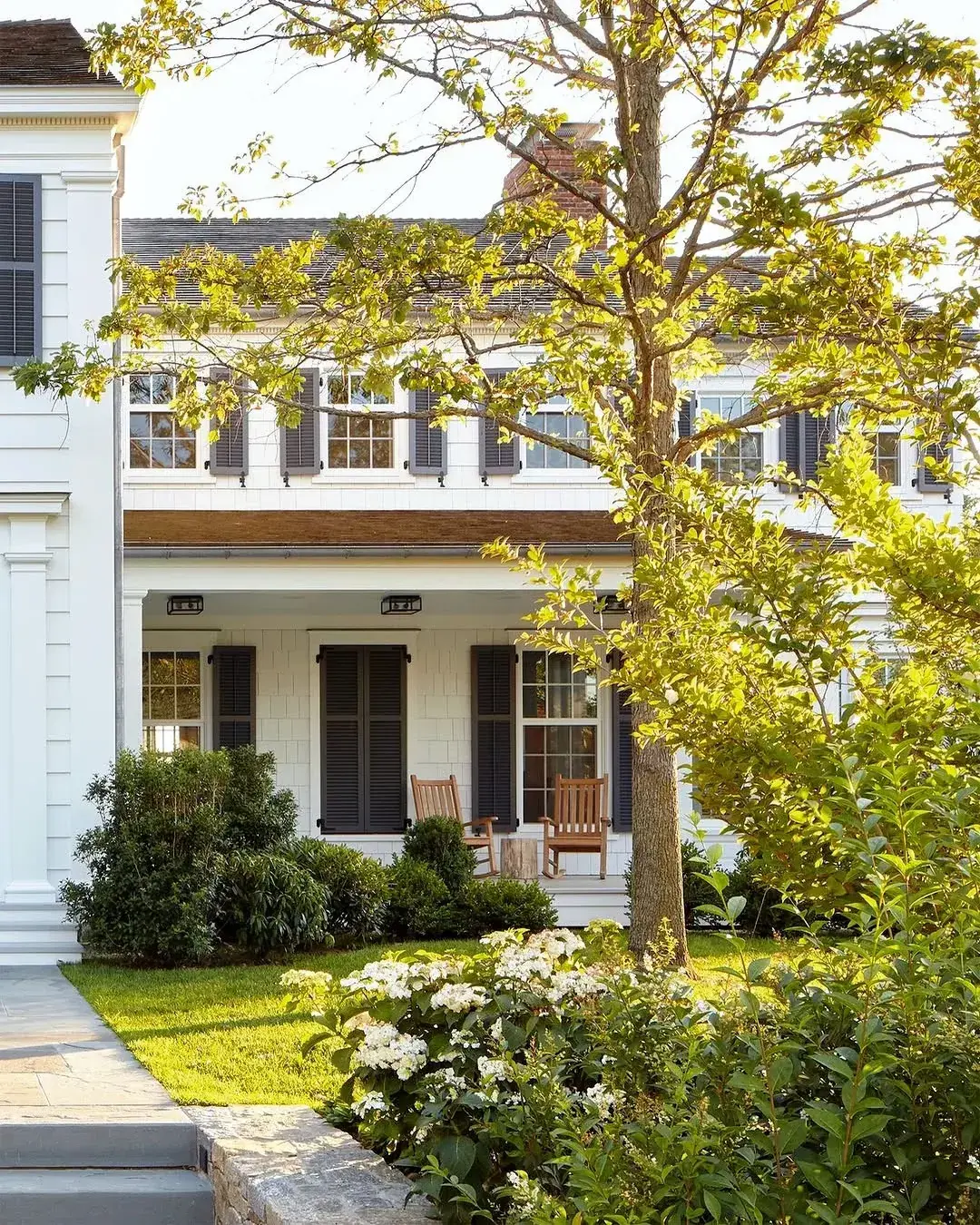
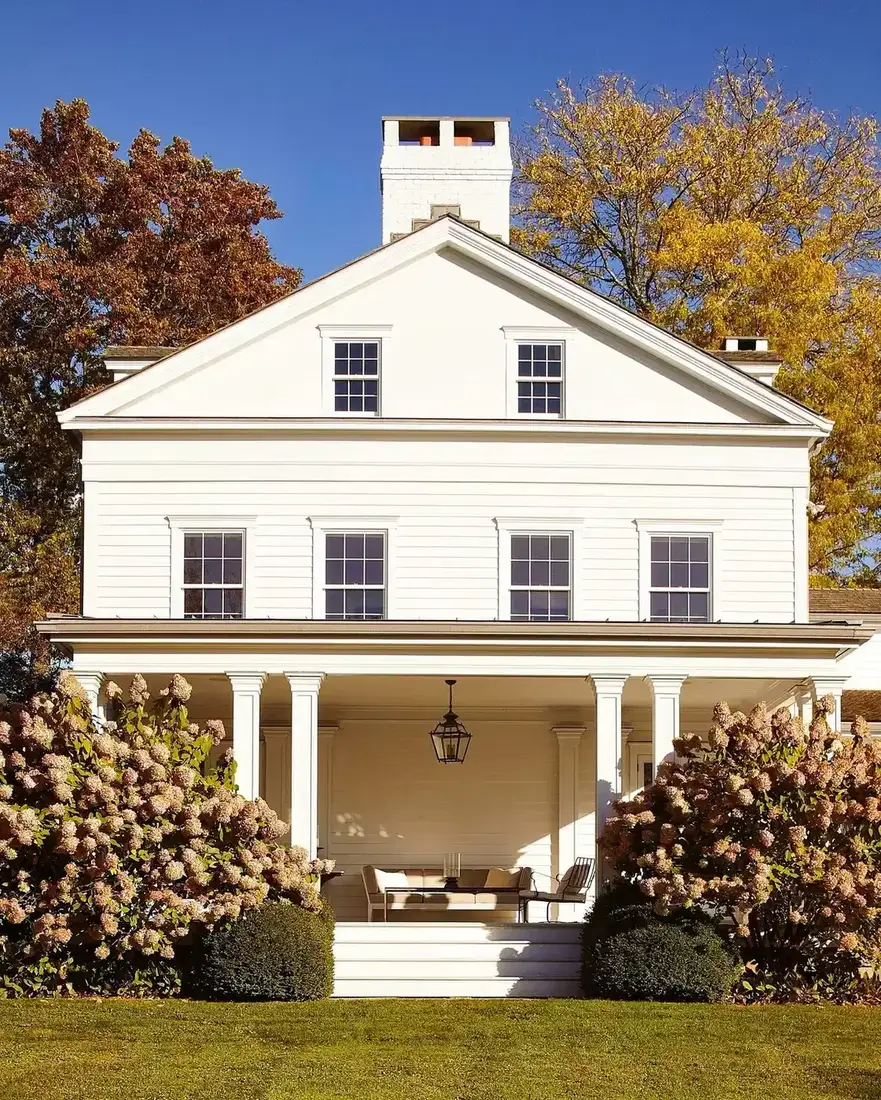
Five upper windows with dark leaves, and below a porch with two more pairs flanking the seating. White shingle, a porch roof extension, two timber rocking chairs, hydrangeas in the foreground.
The upper leaves carry the ridge. The lower leaves frame the porch opening instead of each window individually. That is a useful distinction on a house where the porch is the facade. The porch gives depth, shadow, and a dark ceiling line; the shutters give edge.
Notice the tone of the dark. It is a soft charcoal, not jet, close to Little Greene Jack Black with a touch of grey or Benjamin Moore Wrought Iron 2124-10. On white shingle that reads as black from the gate but without the glare black gives at noon. Against the timber chairs and the green border it sits calmly.
Hardware is not visible at this distance, which is fine on a porch where the leaf is already sheltered. Shelter changes maintenance. Leaves under a porch roof stay cleaner and repaint interval stretches towards eight years, where exposed gable leaves want five. That difference is real money across a whole house.
Leave the porch floor and the hydrangea border alone in one respect: do not pile mulch against the porch skirt. Keep the skirt 150mm clear of grade and keep the bed off the cladding. A level floor that holds water softens boards in three winters. A bed that touches the wall does the same from the side.
Pale blue shutters that are too light to anchor anything
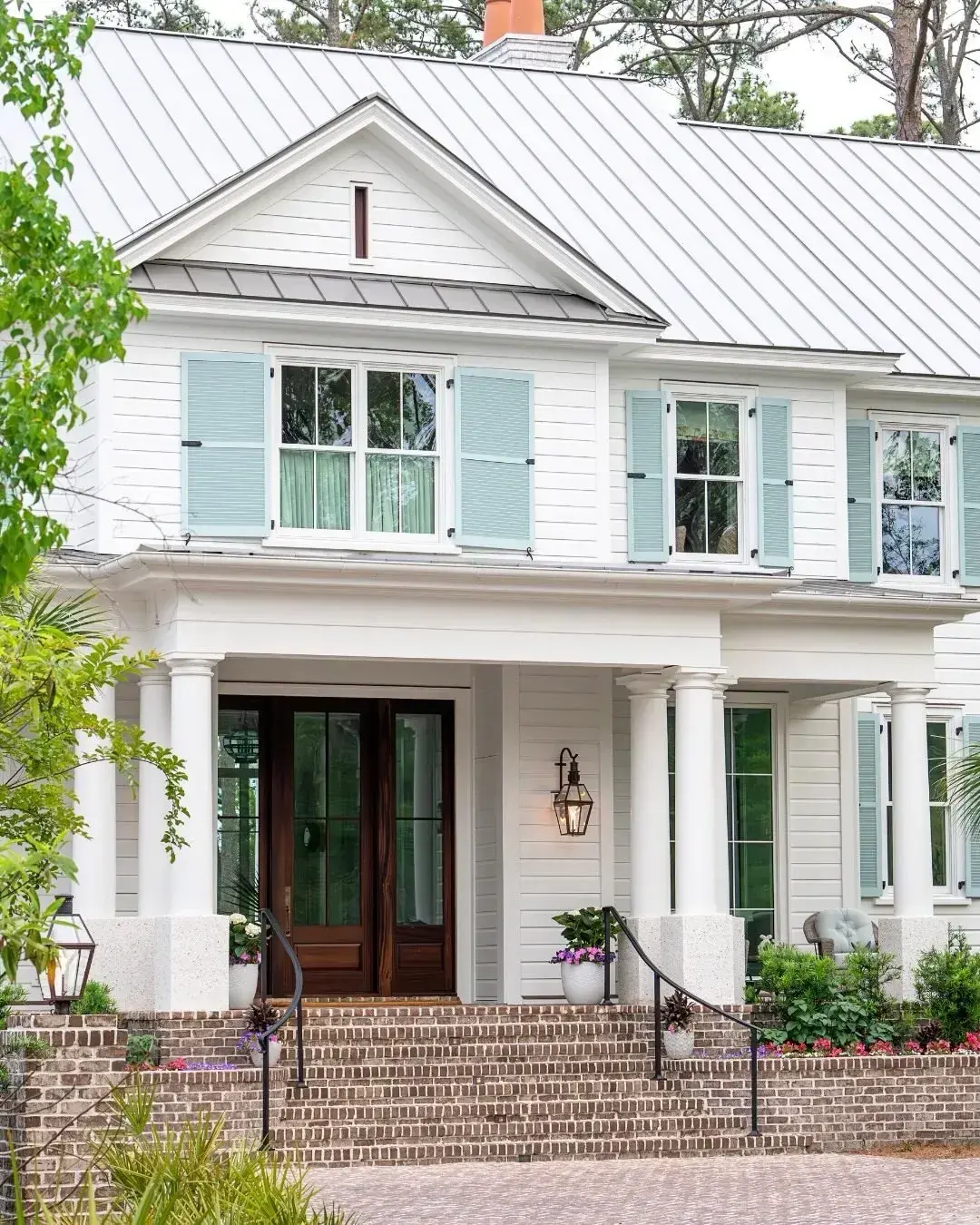
White house, standing seam metal roof in pale silver, four upper windows with pale aqua shutters, brick steps below, dark double doors with a lantern beside them.
As a shutter this blue is too light. From the drive it reads closer to the white wall than to the dark doors. The one dark anchor this front owns is the entry, and the shutters do not help it. They add colour, they do not add weight.
If the brief is black shutters as anchor, this picture is the caution. A darker blue-grey, the same family but two shades deeper, would tie to the roof shadow line and to the door glazing bars and the whole front would settle. The pale version floats.
Practical note: pale blues chalk faster than off-blacks, and they show the underlying primer where a dark holds a scuff better. Repainting pale shutters on a south facing wall in 2026 will come around sooner. Expect £120 to £280 per pair to repaint fitted leaves, two coats over sound primer. Do the whole elevation in one go. Blacks drift between batches and a shutter painted a month later shows the joint.
The metal roof is worth naming. Standing seam in coated steel runs £120 to £220 per square metre fitted in 2026, aluminium higher and better near salt. Keep the roof as it is. Fix the shutters first and see if the roof needs any attention after. Most houses need only one dark decision, and here it should be the leaves.
A low ranch at dusk that still holds its darks
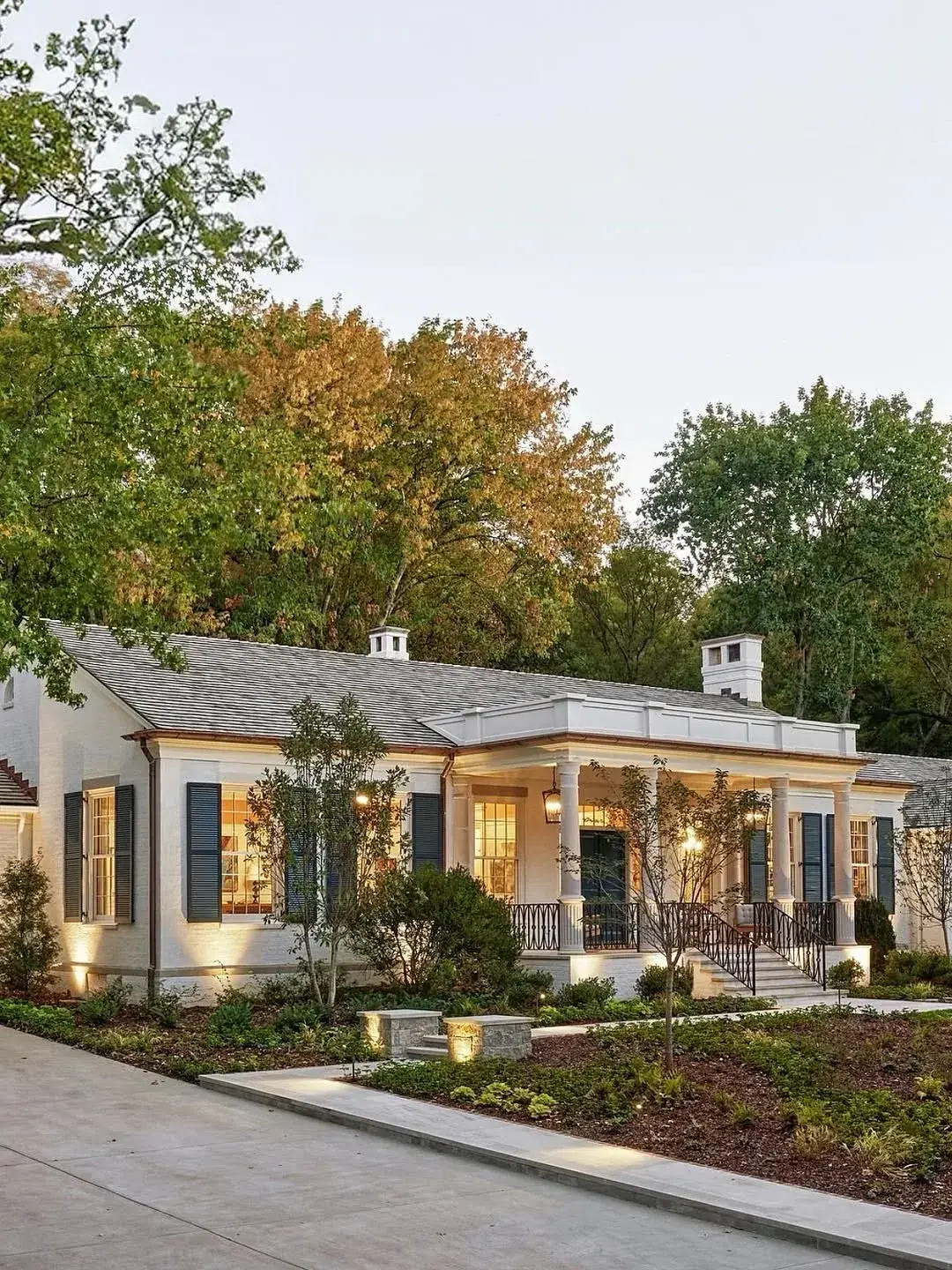
Long, low, white, at dusk. The windows glow warm, the wall washers light the base, and the dark shutters still read.
That is the handover worth planning. By day the door is the dark. After dark the glass turns to mirror and interior light takes over, and the shutters inherit the job of being dark. Four leaves in a near-black or deep blue-black against lit glass hold the contrast the door surrenders to reflection.
The shutters here sit tight to the casing, full height, and each pair looks wide enough to cover its opening. The colour is a deep blue-black instead of true black, close to Farrow & Ball Railings No.31 or Hague Blue No.30 after dark, which keeps depth under warm 2700K light. A true black under warm uplighting can go dead.
Fixing at dusk matters more than by day. Leaves that are not held with dogs bang in evening wind, and a ranch with a long eave funnels wind along the wall. Fit dogs. Use two screw points per hinge into a plug in masonry or into stud, not into sheathing alone. A leaf that pulls out takes paint, render, and the next leaf’s paint with it.
Budget note for low houses: scaffolding is lower, so hanging cost per pair falls slightly, but access is still the cost. Allow £150 to £350 a pair for fitting in 2026 as earlier, and uplighting at £60 to £150 per fitting in 2026 if you are adding it. Keep the beam off the shutter face itself. Light the wall, not the leaf, or the leaf loses its dark.
Frequently Asked Questions
Which dark actually reads as black from the pavement?
Most facades that photograph as black are dark brown, bronze, or a blue leaning near-black. A pure jet looks flat in shadow and sharp against cream render. Choose a brown or blue dark that keeps depth when the sun leaves it, then test the board in shade before buying the tin.
How do I know if the leaf will look right before I drill?
Cut a cardboard template at half the window width and hold it beside the opening. If the closed pair would meet in the middle and reach head to sill, the size is honest. Standard catalogue leaves are often narrow for every window to save timber, so check your template against the packet figure.
Do shutters need real hinges and holdbacks if they never move?
They need the look of them to read as joinery. A visible pintle strap at top and bottom plus a small S or rat-tail dog that pins the leaf off the wall gives shadow, air gap, and the signal the street reads as real. Both fixings are around £15 to £45 per leaf or per pair in 2026.
Where should I leave the wall bare?
Leave arched heads, full height glass, bay returns, and narrow dormer cheeks without leaves. Those openings cannot take a leaf that would cover half the glass at full height, so any leaf there will be undersized. A bare opening is quiet; a wrong leaf is loud for years.
What material is the least trouble long term?
Painted timber looks best and wants fresh coats every five to eight years. Good composite holds paint, does not rot, and costs £150 to £400 a pair in 2026, which makes it the pragmatic choice on exposed or coastal walls. Thin vinyl comes in fixed narrow widths and reads as plastic from the road.
Will a dark shutter make a small house look smaller?
A dark leaf does not shrink a wall; it gives the wall an edge. A short front with narrow windows wants narrow leaves that still meet the half width rule. Keep the wall and trim one white, keep the leaf dark, and let the contrast do the scaling.
In order
- Choose an off-black matched to the wall: brown on cream, blue-black on warm brick, soft black on white clapboard.
- Test the sample board in shade, where the shutters sit most of the day, and view it at noon.
- Size each leaf at half the window width and the full casing height, and skip windows that cannot take that size.
- Fix with visible pintle hinges and S or rat-tail dogs, into framing or masonry plugs, not into render or cladding alone.
- Check louvres slope down and out, and that the leaf stands off the wall enough to cast a shadow.
- Keep siding and trim one colour, and let the dark leaves, door and lantern carry the contrast as a family.
- Keep planting below sill height and clear of the wall so leaves and cladding dry after rain.
- Paint the whole elevation in one batch and one sitting, because blacks show any batch line.
This article may contain affiliate links. We may earn a commission at no extra cost to you.