10 Bathroom Lighting Ideas: Why Backlit Mirrors Leave Faces Dark

Add us as a preferred source to see more stories on Google.
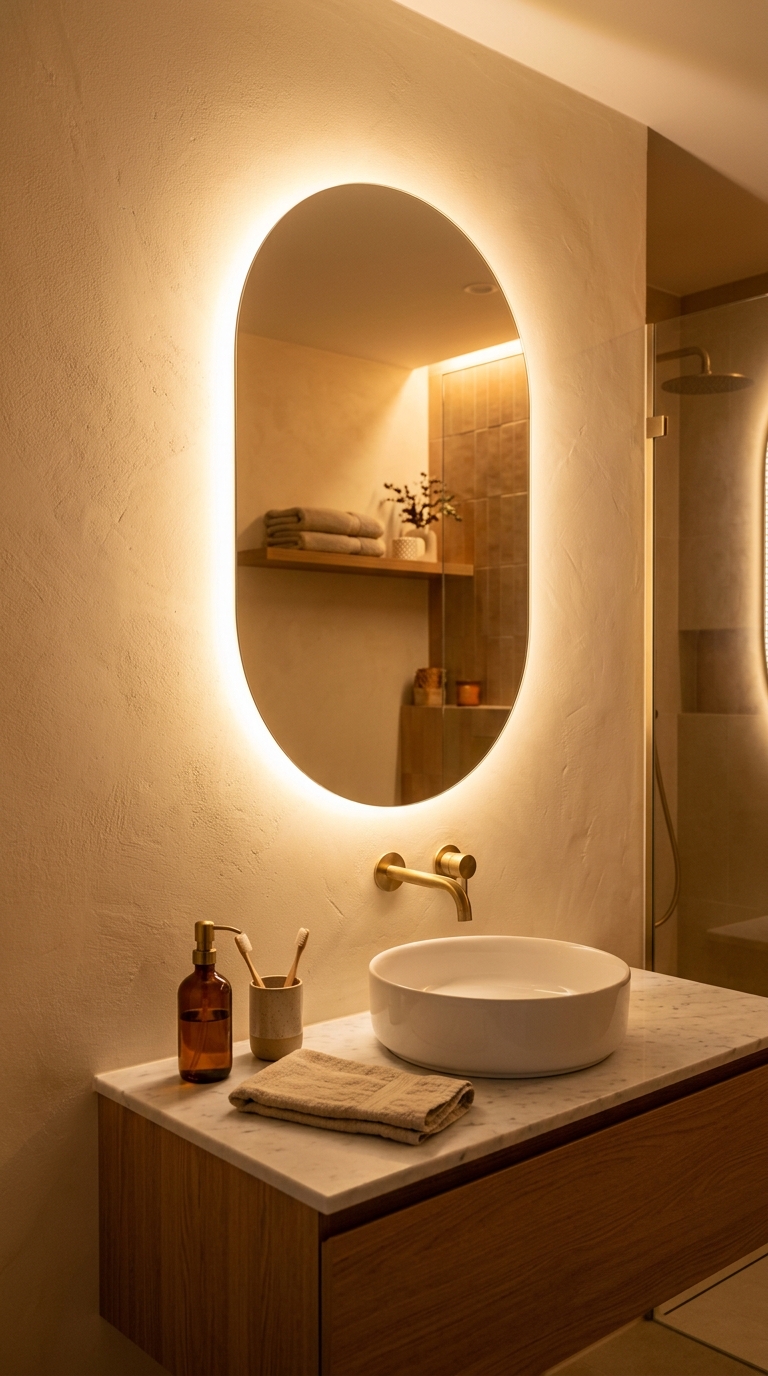
The mirror below is doing something specific, and it is worth naming before you buy one.
The light is coming from behind the glass and landing on the wall. That is what makes the halo, and it is genuinely lovely: the plaster glows, the brass warms up, the whole room softens. Look at what it is not doing, though. Nothing is throwing light forward onto a face standing at that basin.
A backlit mirror is atmosphere. It is not a working light, and in a bathroom with no other source you will be putting in contact lenses by the glow of your own silhouette.
Why the ceiling light is the problem
Most bathrooms have one downlight, roughly above where you stand. That is the worst possible position.
Light from directly overhead falls on the brow, the nose and the chin, and leaves everything underneath them in shadow. It is the same direction of light used to make people look sinister in films, which is why so many people quietly decide they look terrible in their own bathroom and fine everywhere else. The room is not unflattering. The angle is.
Light arriving from in front, at about the height of your own eyes, fills those shadows instead of casting them. That is the entire principle, and everything below follows from it.
What to put either side of the mirror
Two sconces, one on each side, mounted at around 1.6 to 1.7 metres from the floor, which puts them near eye level for most adults. Space them wide enough to clear the mirror rather than crowding it.
Choose a fitting with a diffuser: opal glass, fabric, or anything that hides the bulb itself. A bare bulb at eye level is a glare source, and it will annoy you every morning. The shade in that photograph is doing this job quietly.
If the wall genuinely will not take sconces, which is common in a narrow room, a mirror with front-facing illumination around its perimeter does the same work. What does not do the same work is a single strip above the mirror, since that is the overhead problem again in a smaller package.
Bare glass against frosted glass
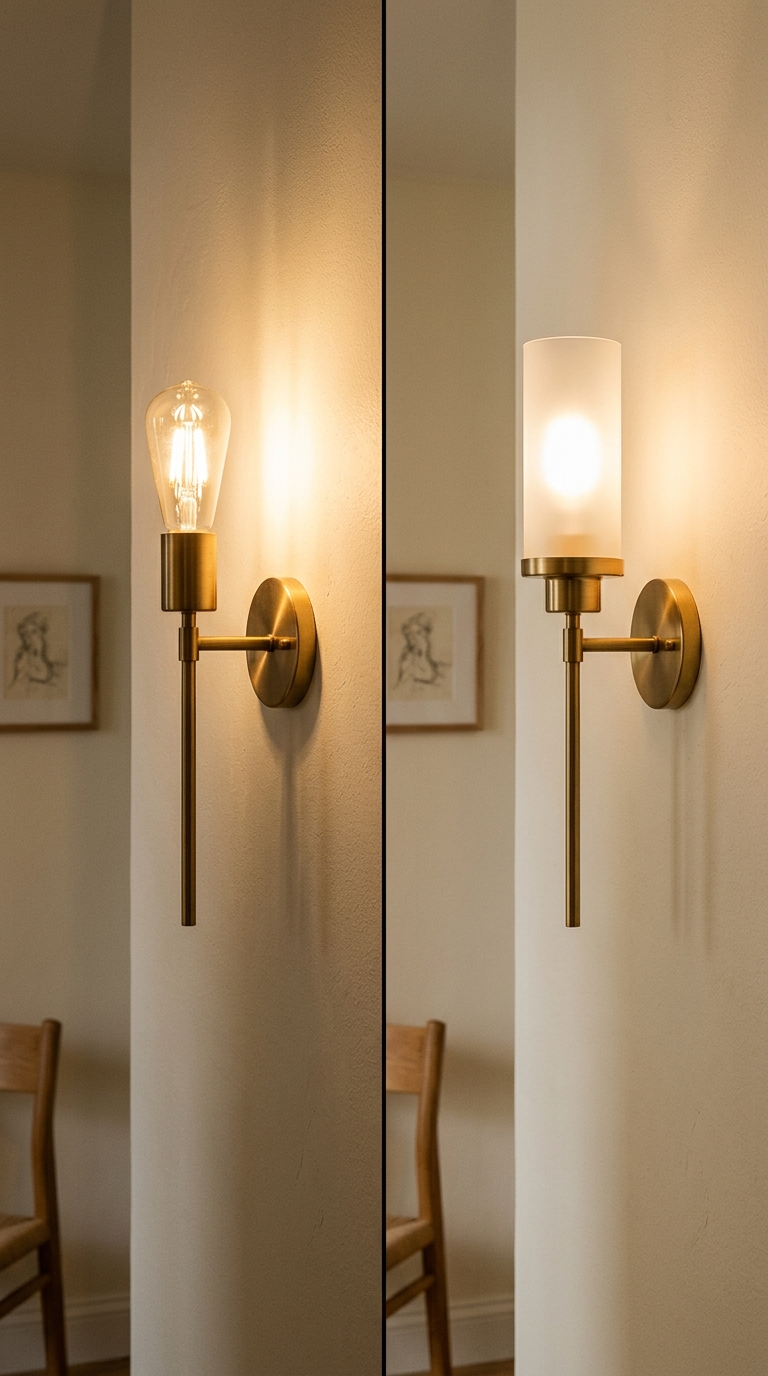
The split in this photograph tells the whole story in one fitting. On the left the filament sits exposed, throwing hard points of brightness that the eye cannot help following. On the right the same brass arm carries an opal cylinder, and that light spreads into a soft wash across the plaster.
Because the fitting sits at face height, that difference lands directly on skin. Exposed glass at eye level creates glare and sharp contrast across the cheek and the brow, which is why make-up looks patchy under it. Frosted glass removes the point source while keeping the warmth, so the face reads evenly without squinting.
Original BTC and Astro Lighting both sell this type of opal sleeve sconce, with prices around £70 to £140 each in 2026. Pooky and Industville cover the same look for around £45 to £110 each in 2026. Buy the diffuser version for either side of a mirror, and keep the bare filament for a hallway where nobody looks closely.
Twin sconces flanking a small mirror
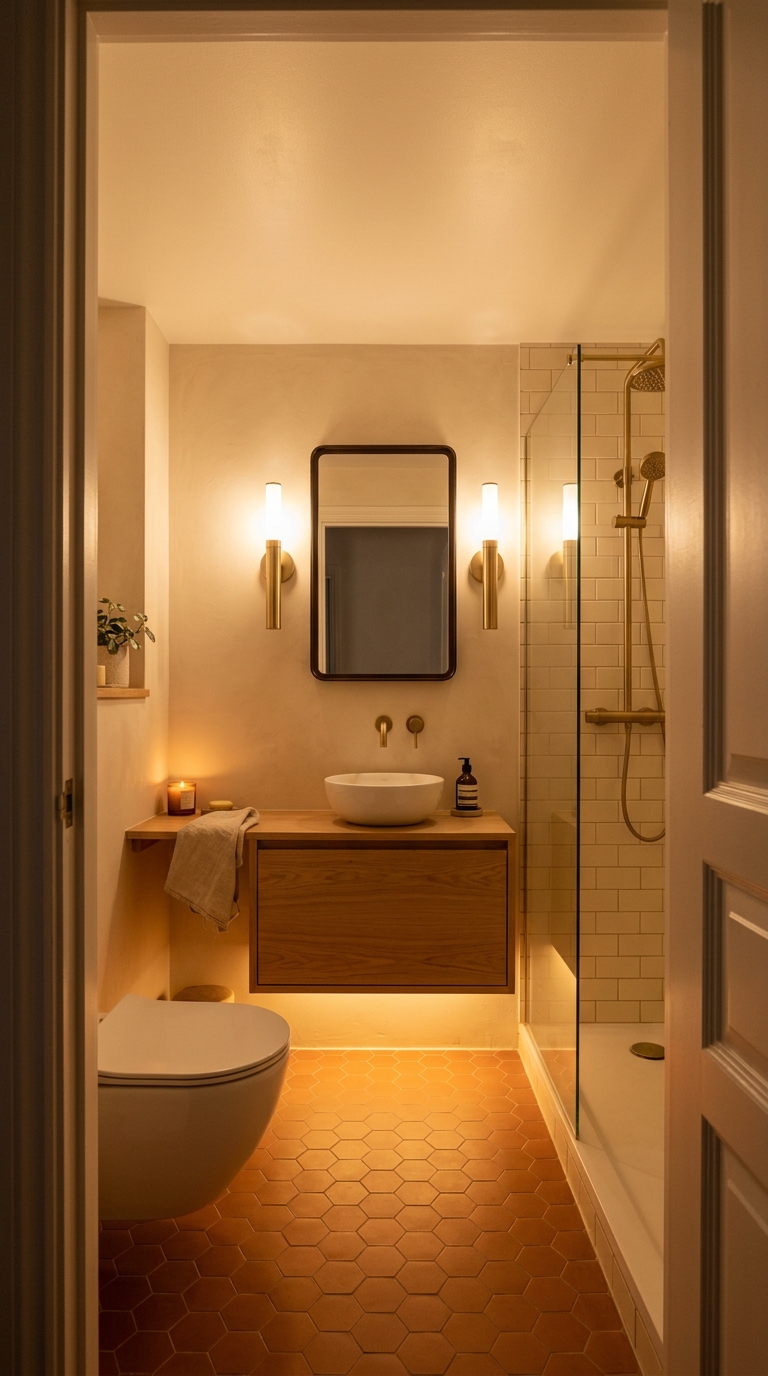
This narrow ensuite gets the main decision right. A dark framed mirror hangs central, with a slim vertical sconce on each side at face height, both in brass with a pale shade. The pair throws light forward from two directions, so shadows under the eyes cancel out.
The surrounding choices support that pair. Oak on the floating vanity warms under 2700K light, the terracotta hex floor bounces an amber tone back up, and the low strip beneath the vanity adds a second glow that keeps the lower half of the room from going dark. A candle on the side ledge shows the evening setting, with the sconces turned down.
For a room this size, two compact sconces plus one low strip are enough. Similar brass tube sconces run £40 to £95 each in 2026 from Garden Trading and John Lewis own label. Keep both shades identical, keep bulbs matched, and the small room reads calm.
When downlights do all the work
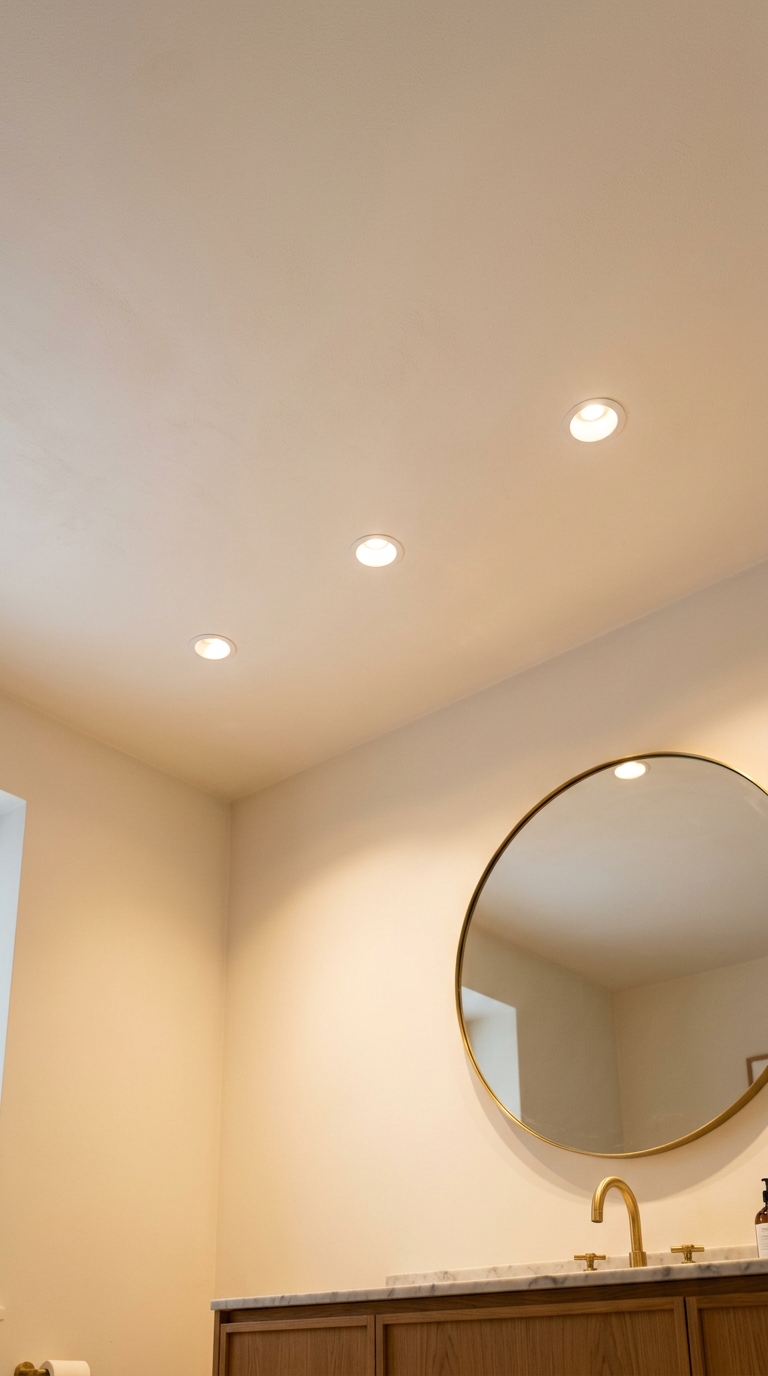
Three recessed spots cross a white ceiling above a round brass mirror, and the photograph shows their limit clearly. The ceiling itself is bright, the mirror glass catches two hard reflections, and the wall beneath stays comparatively flat.
The issue is direction, because light from above models the face downwards. Brows shade the eyes, the nose shades the mouth, and no amount of extra spots fixes that geometry. A third downlight only makes the top of the head brighter while the shadows beneath deepen, which flatters nobody at seven in the morning.
Downlights still earn a place for cleaning and for general brightness, which is why most bathrooms keep them. Treat them as the utility circuit on their own switch, in warm white around 2700K, and add the face light separately. Varilight dimmer plates suit this split for around £25 to £55 in 2026.
What to actually buy
Sconces first, since they are the part that has to be right.
| Budget | Where to look | Roughly |
|---|---|---|
| Premium | Davey Lighting, Original BTC, Astro Lighting | £150 to £400 each |
| Mid | Pooky, Industville, Garden Trading | £60 to £140 |
| Budget | John Lewis own-label, IKEA SKURUP | £20 to £45 |
Check the IP rating on the box rather than the listing text. IP44 is the usual minimum beside a basin, and anything closer to a shower needs more.
For bulbs, the ones worth paying for are the high-CRI ones. Tala and Soraa both make dimmable warm LEDs at CRI 95 or above, at roughly £12 to £20 a bulb. Philips MASTER sits around £8. Supermarket own-brand LEDs are typically CRI 80, which is where make-up starts looking like a different colour at the front door.
Colour temperature, and the one number that matters
Warm light, around 2700K, in every fitting in the room.
| Temperature | Reads as | Sensible use |
|---|---|---|
| 2700K | Warm, close to an old bulb | Bathrooms, bedrooms, evenings |
| 3000K | Slightly crisper warm | Acceptable if 2700K is unavailable |
| 4000K | Cool, office-like | Garages and utility rooms |
| 5000K+ | Daylight, very blue | Clinical, and unkind at 7am |
Mixing temperatures is the mistake that catches people out. A 2700K sconce beside a 4000K downlight makes the sconce look yellow and dirty rather than warm, and the eye reads the whole room as slightly off without being able to say why. Buy every bulb in the room at once, in the same temperature, and keep a spare.
The second number is CRI, which describes how accurately a light renders colour. Look for 90 or above where you are getting dressed or applying anything to your face; below about 80, skin tones and make-up simply do not look like themselves.
Cove glow that lifts the ceiling
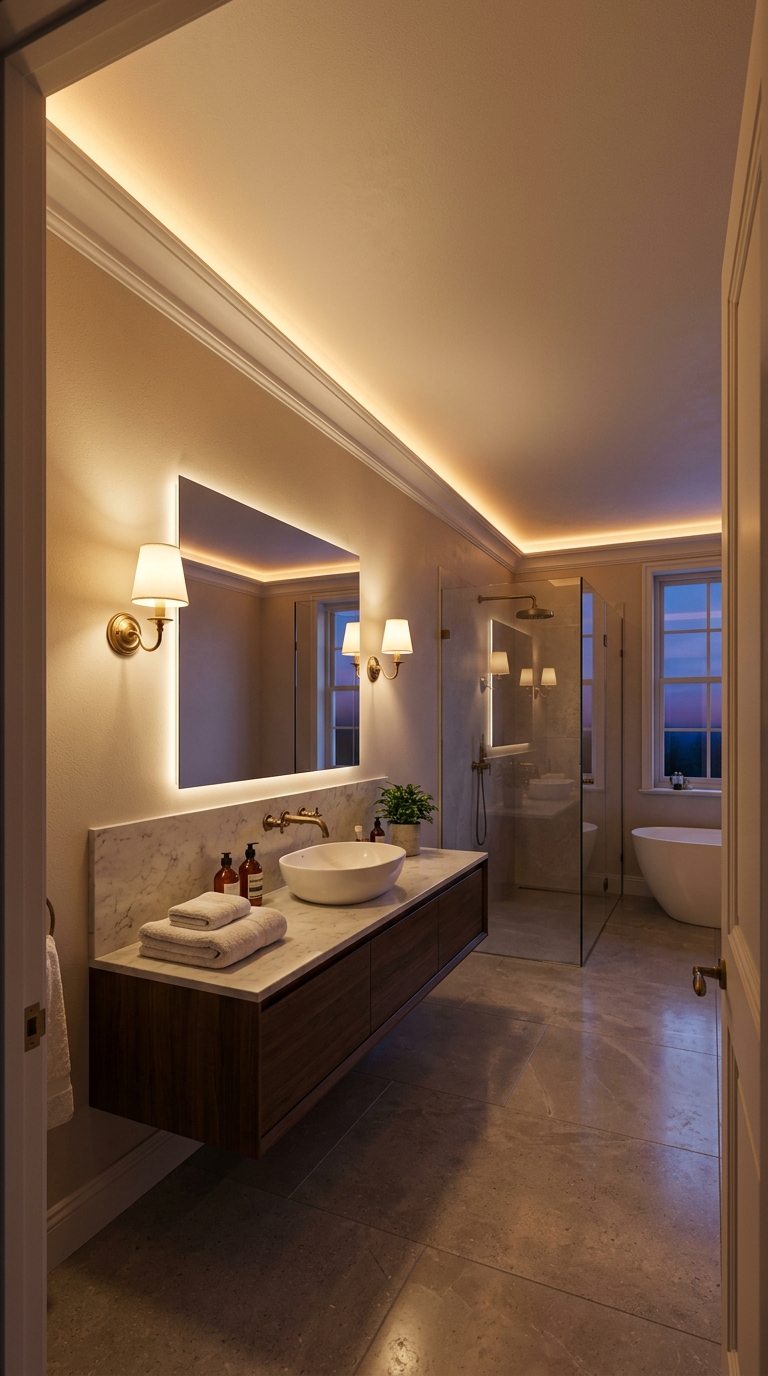
Here the ceiling carries its own light. A hidden LED line runs the perimeter behind the cornice, washing the plaster with a continuous warm band that makes the whole ceiling feel higher. Nothing visible demands attention, which lets the mirror wall do the talking.
That mirror wall combines two face-height sources, because the rectangular glass carries a backlit edge while small fabric sconces sit further out. The combination matters: the halo softens the wall behind, while the shades push usable light forward onto a face. The freestanding bath and the glass shower at the far end stay secondary, lit only by spill.
Cove kits with a warm 2700K strip and a compatible driver run £35 to £85 for a bathroom length in 2026 from Philips and IKEA. Put the cove on a separate dimmer from the mirror pair, since the evening version of this room is cove only.
Niche light that works after dark
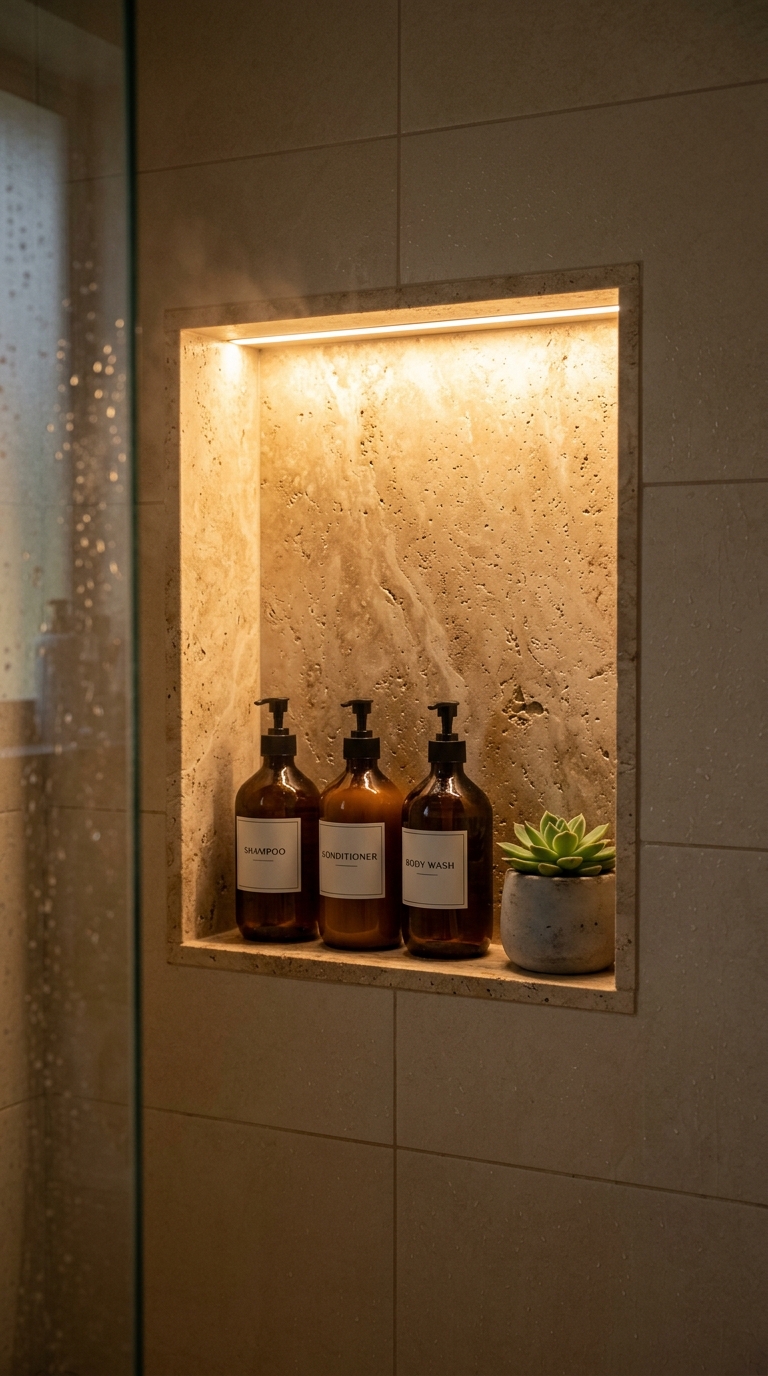
A travertine niche glows from a slim LED set into its top edge. Three amber bottles line up beneath it with a small potted succulent at the end, and the stone behind picks up every bit of warmth.
The reason this small light carries such weight is contrast. In a dimmed bathroom the eye goes to the brightest rectangle, so a lit niche reads as a deliberate display while the surrounding tile falls back. It also puts usable light where hands actually are, around shampoo and soap, without needing a bright ceiling spot in the shower.
Anything inside a shower needs a higher water rating than a basin sconce, and the box should state suitability for wet zones. Waterproof LED profiles for niches run £18 to £42 in 2026 from Astro Lighting and HiB. Keep the colour at 2700K so bottles and skin share the same amber cast.
Under-vanity glow for the night
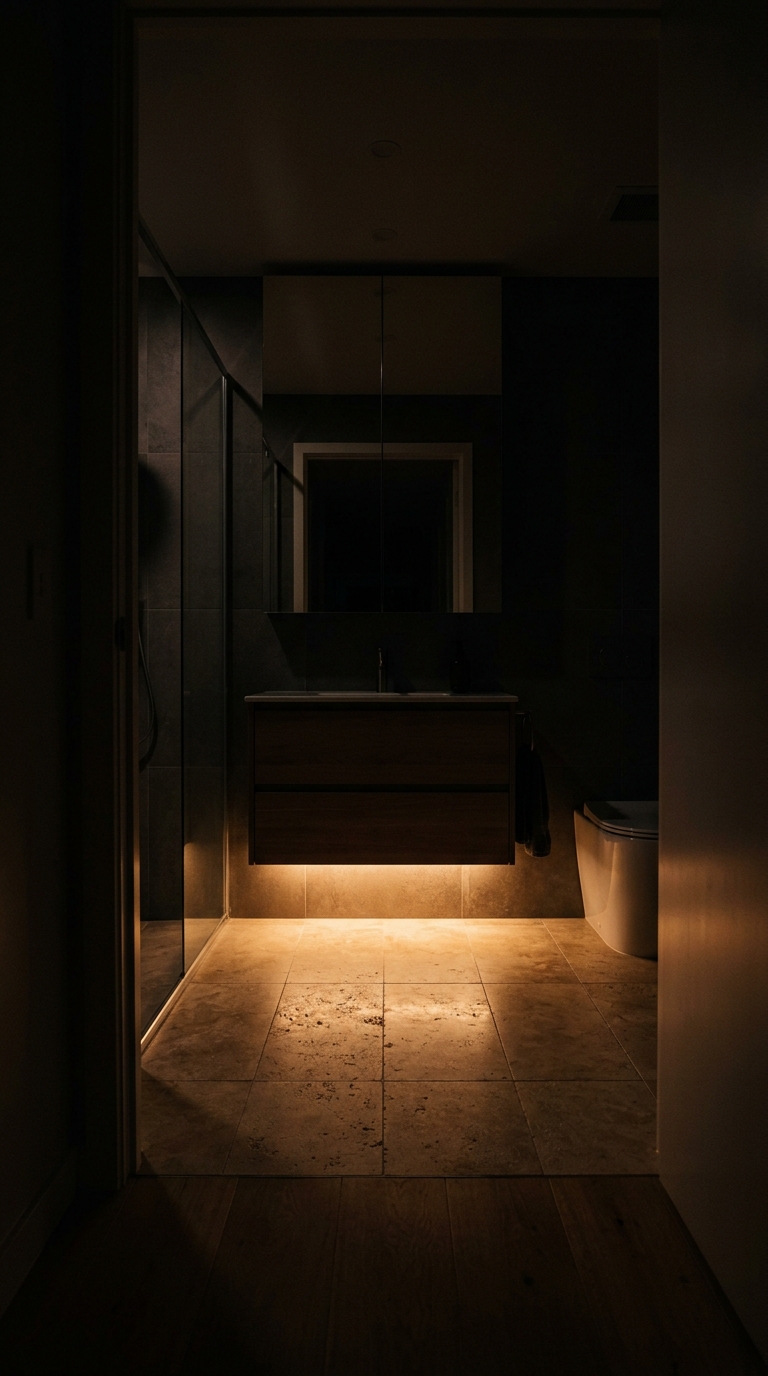
Shot through a doorway at night, this bathroom is almost dark except for one band. A warm strip beneath the floating vanity throws an amber pool across the stone floor, outlining the route without lighting the whole room.
That low position is the principle, because light near the floor wakes the brain far less than light at eye height. For anyone getting up in the night, a motion linked strip under the unit gives enough to move safely while the mirror lights stay off. The dark walls above absorb the rest, so the landing outside never gets a hard spill.
Self adhesive warm strips with a motion sensor plug run £15 to £32 in 2026 from Philips and IKEA. Mount the strip set back from the front edge so the source never shows, and keep it warm to match the daytime sconces.
Candlelight and the lowest setting
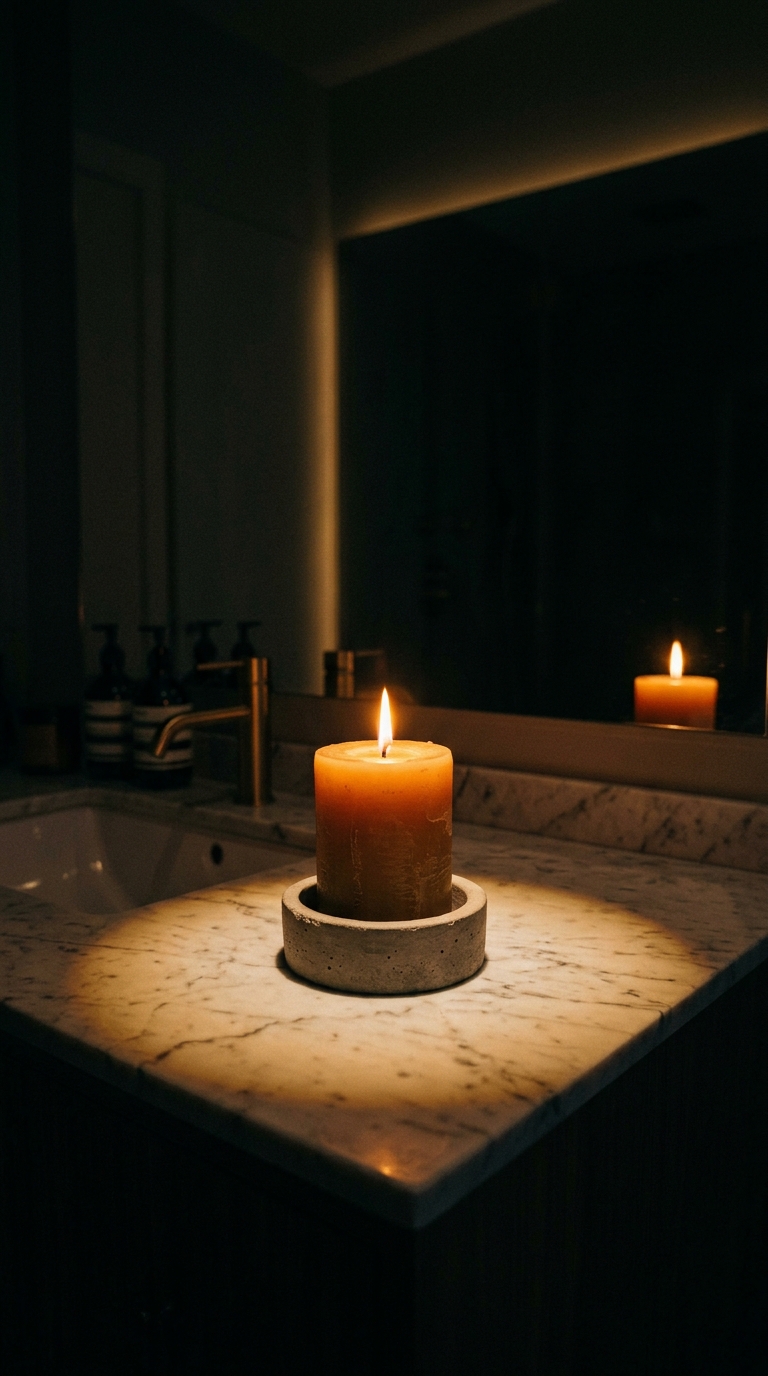
A thick amber candle burns on a marble basin top in a concrete holder, throwing a tight pool across the veining. Behind it a mirror edge leaks a thin warm line, just enough to show the glass without lifting the room.
No LED reaches this colour, because flame sits far below 2700K and flickers. That movement is why a bathroom with sconces dimmed low plus one candle feels settled in a way dimmers alone never quite manage. Marble helps, since the polished top spreads the pool further than timber would.
Treat this as the fourth layer, an addition to the sconces instead of a stand-alone source. Stoneware and concrete holders run £12 to £28 in 2026 from Nkuku and Garden Trading. Keep the flame clear of towels and blinds, and never leave it burning out of sight.
Scenes instead of switches
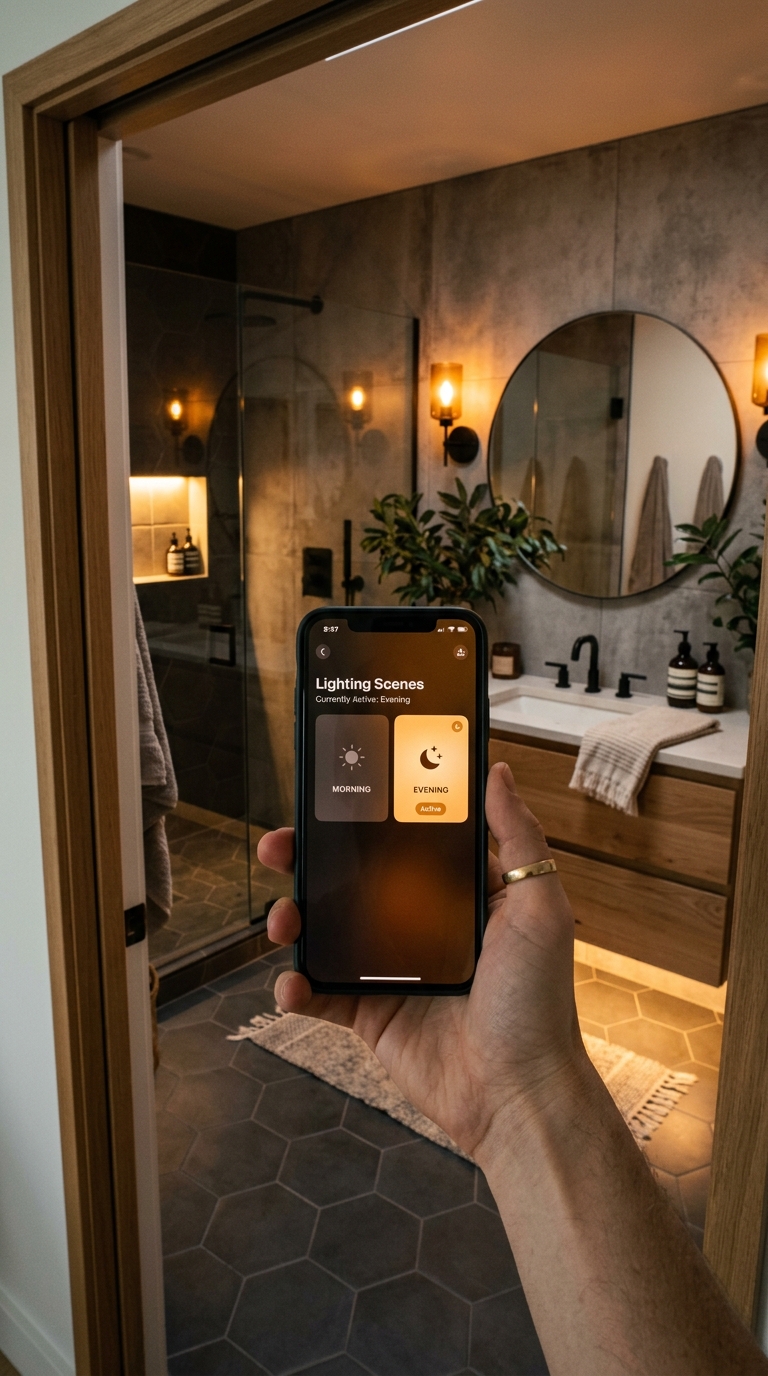
A hand in the doorway holds a phone showing two presets, morning and evening, with evening active. Behind it the bathroom demonstrates why presets help: round mirror, brass sconces, lit niche in the shower, and a low glow beneath the oak vanity all running together at low level.
Separate circuits only get used when control stays simple, because nobody wants four switches at midnight. A two scene setup covers most households, with a bright mirror pair plus soft fill for daytime and a low mix of niche and under unit for night. In this image the phone replaces a wall of plates, since morning and evening sit on two buttons.
Smart dimmers and scene plates from Lutron and Varilight run £45 to £120 per circuit in 2026, while Philips Hue bathroom lamps sit around £14 to £24 a bulb in 2026. Name the scenes plainly, and the household will actually use them every day.
Pendant that charms and does not flatter
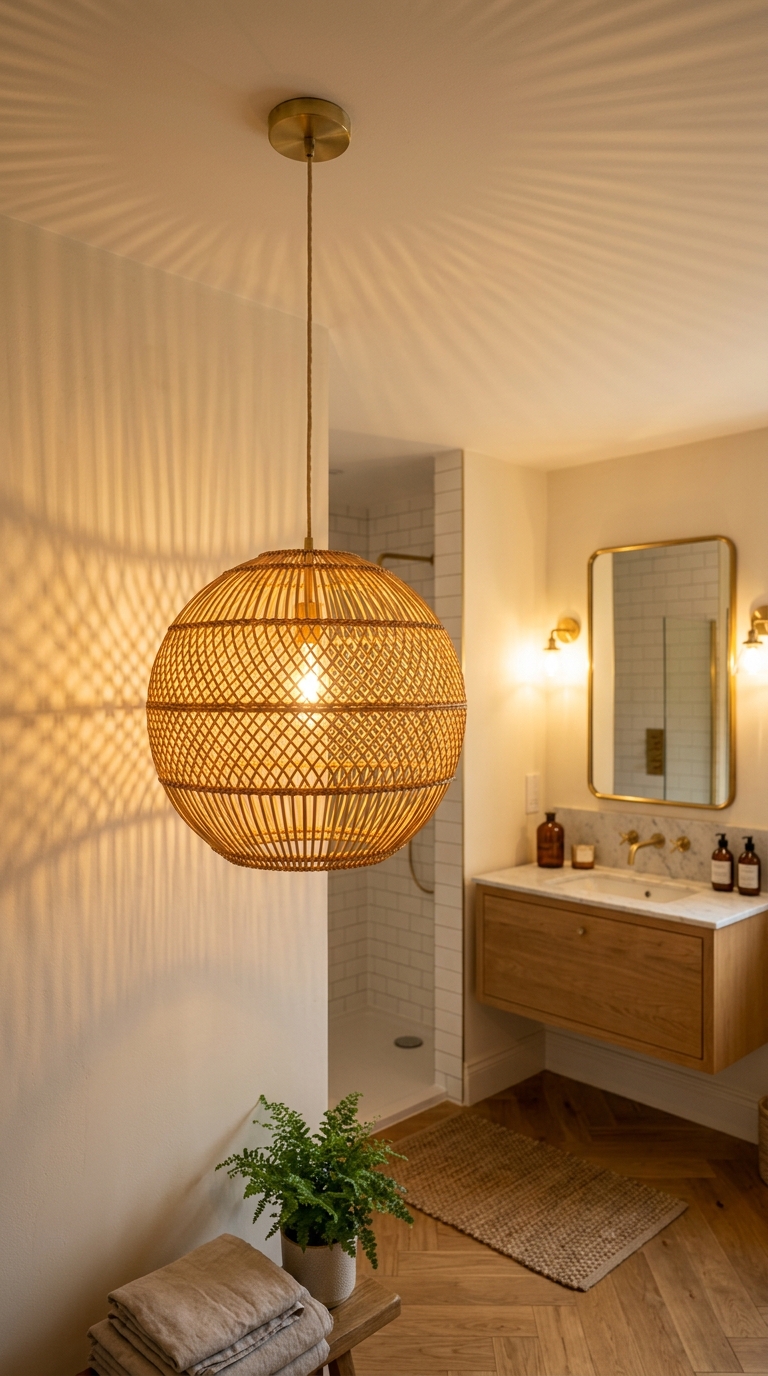
A woven rattan globe hangs central, throwing latticed shadows across the ceiling and the wall. The oak vanity behind still relies on its own brass sconces flanking a rectangular mirror, with a fern and folded towels softening the lower half.
The pendant photographs beautifully, which explains its popularity, yet it cannot light a face. Its source sits above and behind anyone at the basin, and the weave breaks the output into pattern instead of an even wash. In a bathroom governed by face-height light, that makes it decoration, with the mirror sconces left to do the working light.
There is still a place for it in a large room used mainly by day, where texture matters more than grooming. Similar rattan globes run £70 to £160 in 2026 from Nkuku and Made. If one goes in, keep the mirror sconces as the working pair and treat the pendant as the daytime extra.
Layer it, then separate the switches
A bathroom wants three things available and rarely all at once: the sconces for the mirror, something soft and low for evening, and enough general light to clean by.
The low layer is the one people skip and then love. A strip under the vanity, a small light inside a niche, or a plug-in lamp if the wiring allows, gives you a bathroom you can use at two in the morning without waking yourself fully. It is also what makes a room read like the photograph above rather than like a showroom.
Dimmers on the main circuits, if the fittings are dimmable, do the rest. Check the driver is compatible before buying; LED fittings that flicker on a dimmer are usually mismatched rather than faulty.
Where this does not apply
Bathrooms with a genuinely good window facing anywhere but north. If you mostly use the room in daylight, the mirror lighting matters far less, and you would do better spending the budget on a decent blind that diffuses rather than blocks.
Also, anything within reach of a shower or bath has a zone rating attached to it, and that is not a styling question. Wiring in a bathroom is notifiable work in most places. Choose the fittings yourself and have someone qualified put them in.
Frequently Asked Questions
What bulb tone suits a bathroom mirror best?
An amber leaning white near 2700K keeps complexions natural and lets oak and brass glow. Cooler whites turn tile chalky and tire the eyes early. Where precise colour matters, a high rendering lamp around CRI 90 or better repays the extra pounds.
Can a glowing mirror replace wall lights?
A halo alone throws its output at the plaster, which softens the room while the cheeks stay shaded. Side lights at face height fill that shade, so the pair together does the job neither manages solo. In a tight room, a mirror with forward facing lamps can stand in for sconces.
Where should side lights sit?
Roughly at eye height, clear of the glass edge, with a frosted or fabric cover over the lamp. Bare filaments at that level cause squinting. One above the frame recreates the ceiling problem on a smaller scale.
What rating is needed close to water?
Fittings beside the basin usually carry IP44 on the carton. Near the bath or inside the shower the requirement steps up, so read the zone marking before ordering. Mains work in wet rooms belongs with a qualified fitter.
How do I keep the room usable at night?
Run a low strip beneath the floating unit or inside the recess on a motion trigger, and leave the mirror pair off. The floor picks up enough amber to walk by. Bright ceiling spots at 2am wake the whole house.
Are dimmers still useful with warm bulbs?
Warmth without control stays stuck at one mood. Separate dimmers let the mirror pair run bright for daytime tasks and low for an evening soak. Check lamp and driver compatibility first, since mismatched pairs flicker.
The order to do it in
- Get light onto your face from the front at eye level before anything else.
- Choose 2700K for every bulb in the room, with a CRI of 90 or above.
- Add a low evening layer under the vanity or inside a niche.
- Put the layers on separate switches so you can use them apart.
- Check the zone rating for anything near water, and have it fitted properly.
This article may contain affiliate links. We may earn a commission at no extra cost to you.