9 Farmhouse Exterior Colour Schemes Where Two Colours Win

Add us as a preferred source to see more stories on Google.
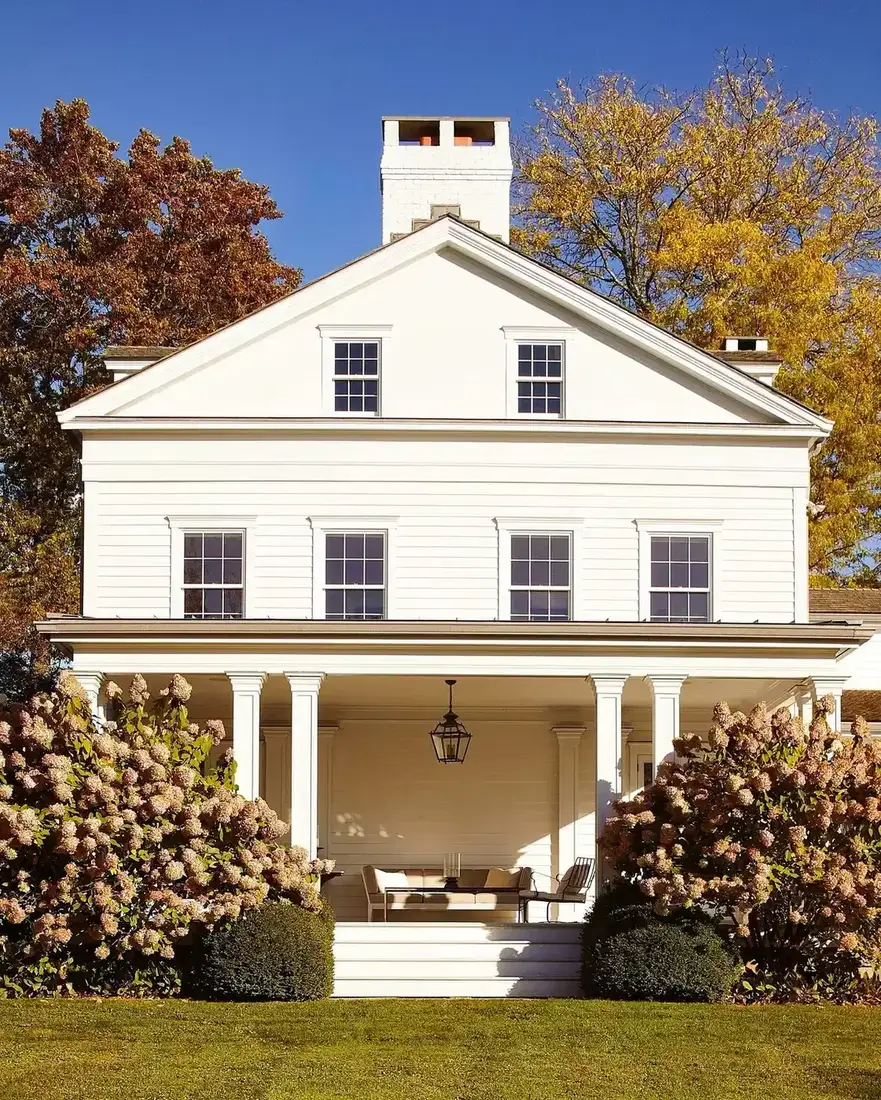
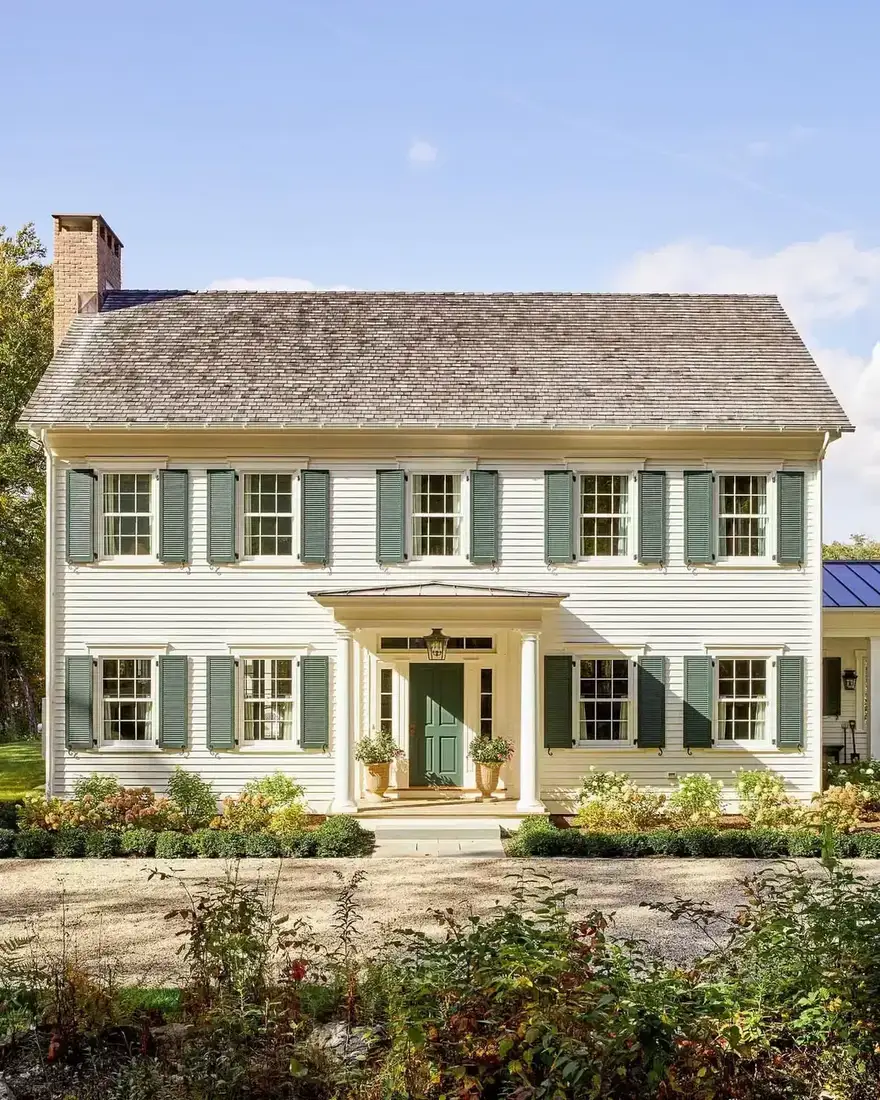
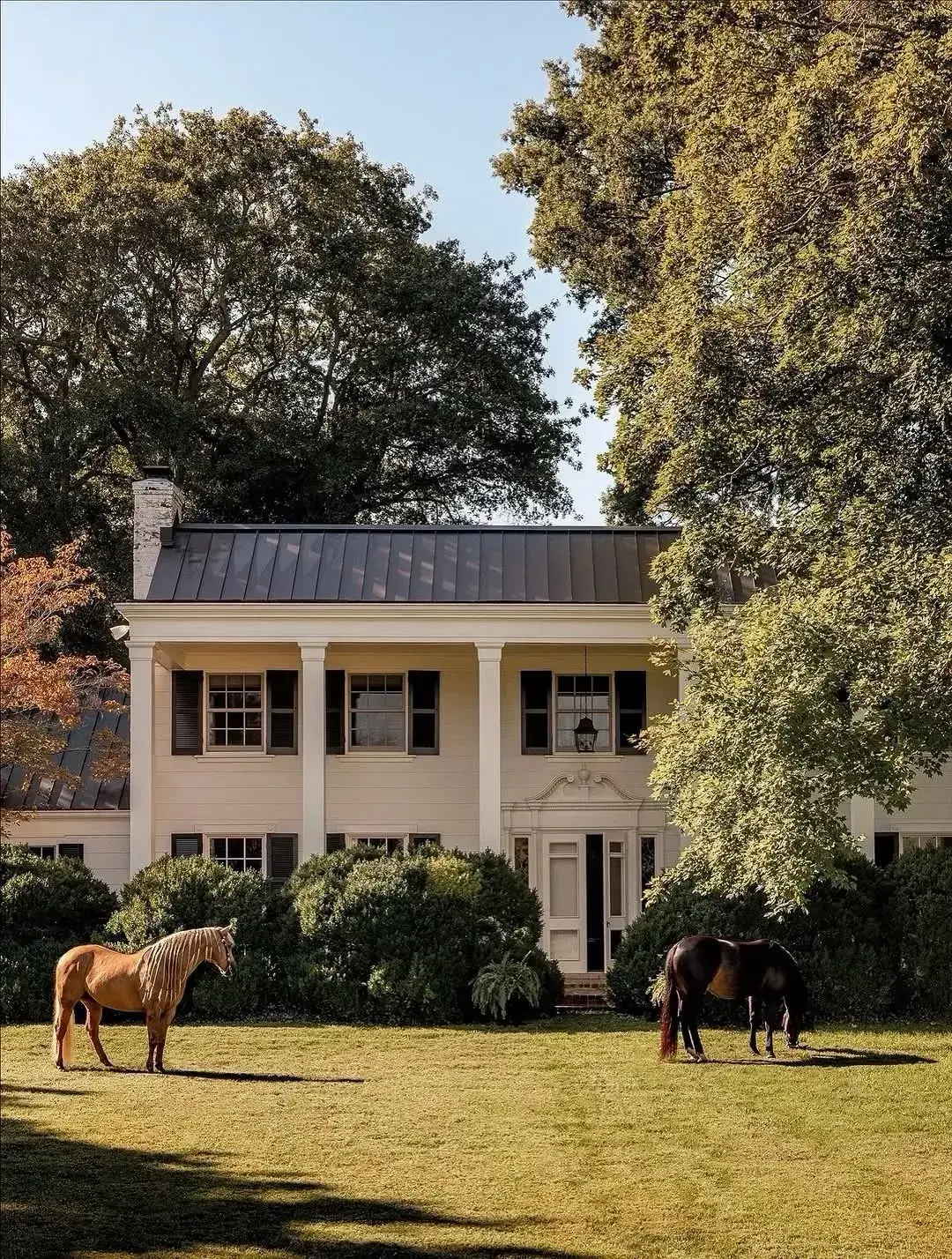
Count the colours on the house below. There are two, and one of them is only on the windows.
Clapboard, corner boards, window casings, the pediment, the columns, the porch ceiling and the chimney are all the same white. No picked-out trim, no contrasting frieze, no shutters at all. Every bit of contrast in that facade comes from the window sash, which is painted dark.
Most houses do the opposite. Body colour, a second white for trim, shutters in a third, and a door in a fourth. That is four decisions, each made separately, and they rarely agree with each other from the road.
Why one colour reads better
At any distance beyond the garden gate, the eye stops resolving detail and reads shapes and masses. A facade painted in one colour reads as a single clean mass with openings in it. A facade with picked-out trim reads as a diagram of itself.
It also solves a problem most people do not know they have. Two whites on one building will not stay looking like two deliberate whites. They weather at different rates, they take light differently depending on the plane they are on, and within a few years one of them looks dirty relative to the other.
One colour, applied to everything, ages as one thing.
The sash is where the contrast goes
The windows in that photograph show what dark sash is doing. It draws the glazing bars, it makes the opening read as a window and not as a hole, and it gives the whole elevation rhythm because the windows are regularly spaced.
Painted white, those same windows would half-disappear into the wall and the house would look blank.
This is also the cheapest change available on most houses. It is a few hours per window and a litre of paint, against repainting an entire elevation.
Blacks that work on sash: a soft black or very dark charcoal instead of a true jet black, which can look hard against warm white. Farrow & Ball Off-Black No.57 and Railings No.31 are the two most used in 2026, with trade exterior satin tinted to near-black at £28 to £55 per litre doing the same job for less.
Very dark green and very dark brown are the traditional alternatives and suit older houses, particularly against cream, not white.
If you want more than two colours
Add the door, and stop there.
A door in a saturated colour against a one-colour house is a single confident gesture. It works because everything around it is quiet. The same door on a house with contrasting trim and shutters becomes the fourth thing competing for attention.
| Body | Sash | Door that works |
|---|---|---|
| Warm white | Soft black | Black-green, deep red, or leave it white |
| Cream | Dark brown | Bottle green, ox blood |
| Pale grey-green | Near-black | Black, or a deeper version of the body |
| Soft grey | Charcoal | Navy, forest green |
The shutters question is separate and worth answering honestly: if your windows would not physically accept a correctly proportioned pair, you are better off without them. Undersized decorative shutters are the single most common way a good facade is undone.
An open field shows what a grey roof does for warm white
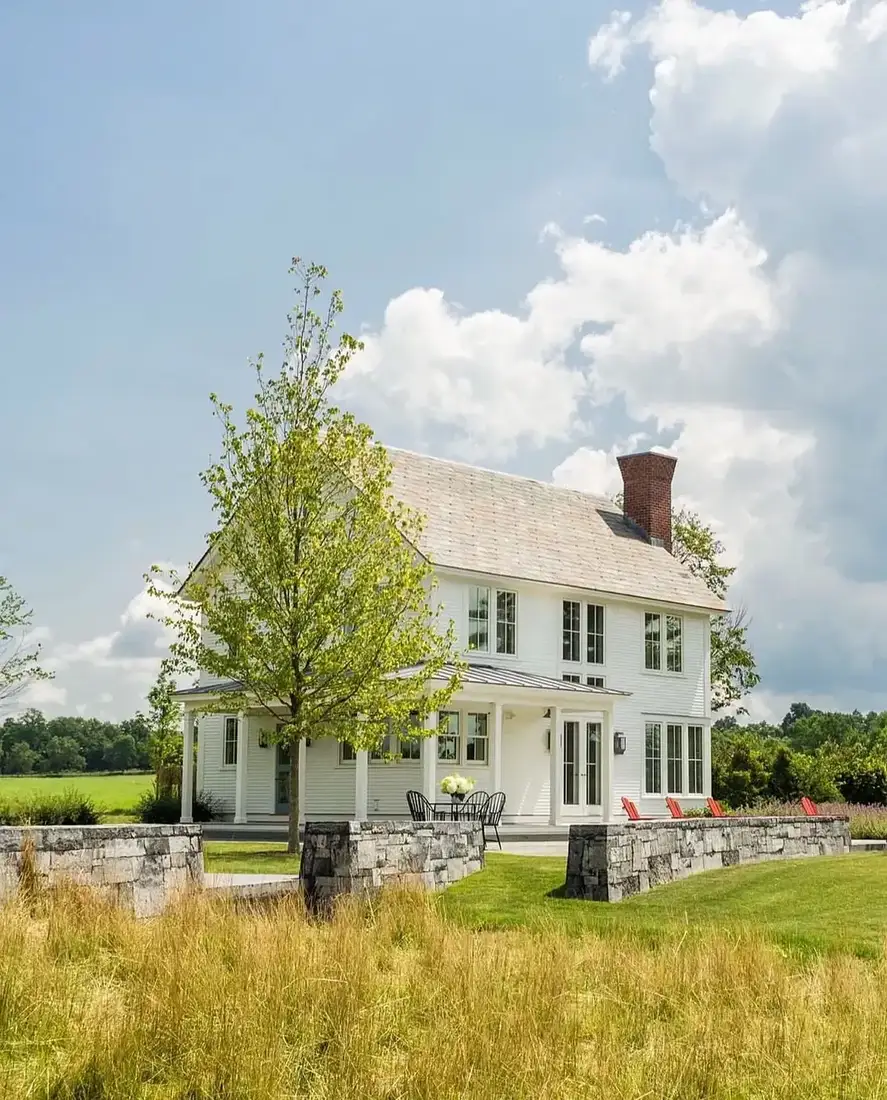
This house sits in an open field with nothing to hide behind. Two storeys of white clapboard, a light grey shingle roof with a red brick stack, a low stone wall in front, and a young tree that has not yet learned to throw any real shade. The white here is not brilliant white. It is a warm off-white with a little yellow in it, close to Benjamin Moore White Dove OC-17 or Farrow & Ball Pointing No.2003, both sitting around LRV 84 to 86 in 2026. That range matters. LRV is light reflectance value, the number from 0 to 100 printed on the chip. For a big outside wall you want 80 to 90. Above 90 a sunlit elevation glares and loses shadow. Below 80 it stops reading as white at distance.
Check the undertone before you worry about the chart. Hold the chip against plain printer paper. If the chip looks creamy or slightly dusty next to the paper it is warm; if it looks cleaner and brighter it is cool and it will read cold outside. The red Adirondack chairs on the terrace are a useful warning. Warm white takes that red gracefully. A cool blue-white would make the same chairs look harsh.
The roof is doing the anchoring. Pale grey shingle reads darker than the walls but not black, so the house has a lid without the hard snap of metal. That suits an open site where a black roof can look too graphic. The stone wall in front does quiet work too, repeating the grey in a rougher texture and giving the eye a mid tone before the lawn.
If you are repainting a house like this in 2026, budget Dulux Weathershield Smooth Masonry at £32 to £58 per 5 litres for the body, and a masonry stabiliser on bare render first, then two coats. Skipping the stabiliser saves £40 and costs the topcoat within two winters. That is a false economy that shows on the first damp spring.
Red brick proves the rule in negative
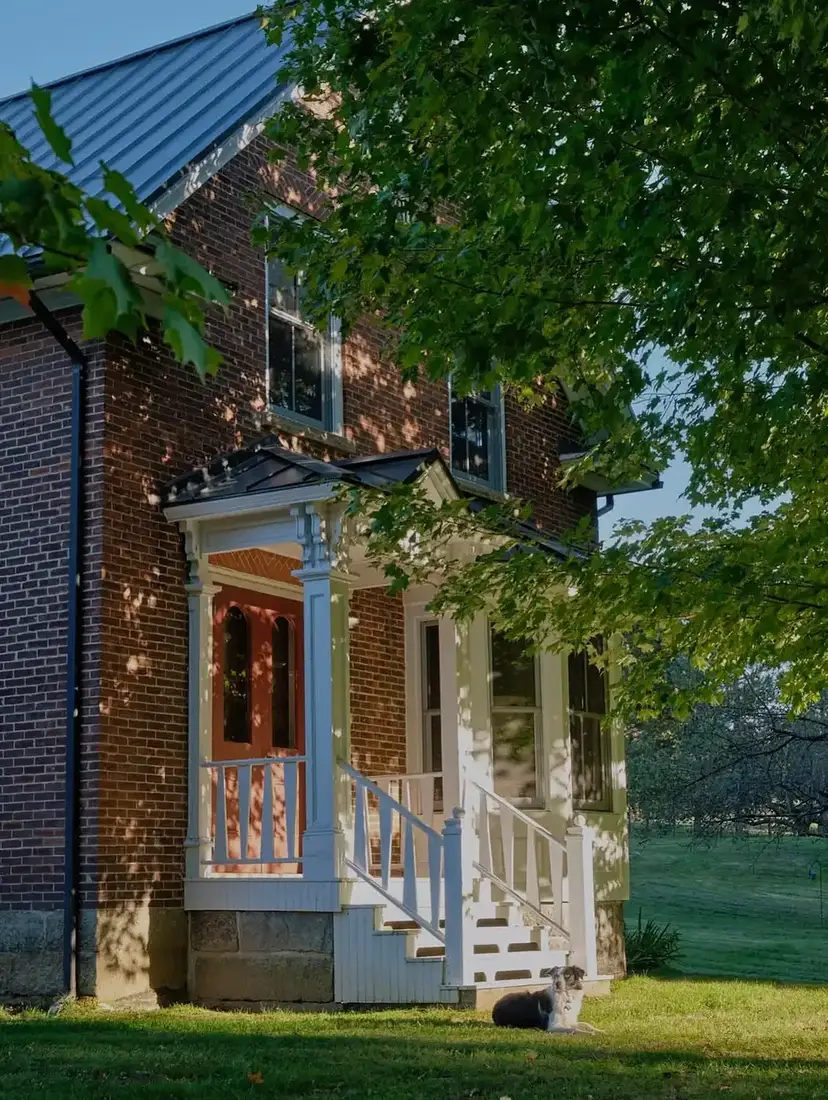
This is not a white house and that is why it is useful. Dark brick, white porch steps and columns, a muted red door, and a dark metal roof under tree shade. The colour positions are reversed, which shows exactly why a white house with a pale roof fails. Here the dark brick supplies the mass and the white trim supplies the edge. Flip it, pale walls with pale trim and no dark anchor, and the building disappears against a grey sky.
Look at where the white sits. It is on the porch, not on the field of the wall. That porch reads as a light slot cut into a dark mass, with the red door as the second colour in a very small area. It works because the palette stays to two families: brick and white, with red as a single accent on the door.
For a white farmhouse this is the cautionary note. Do not paint brick white to make it match. Painting soft brick outside is largely irreversible. The paint traps vapour, the brick cannot dry, and the face blows in frost. If the brick is the warm element that makes the white work, leave it. Repoint old brick in lime mortar, not Portland cement, at £45 to £95 per square metre in 2026, and leave repointing of a chimney to a mason. Cement mortar is harder than the brick it surrounds, so the brick spalls first.
If you need white where there is brick, whitewash or limewash at £20 to £38 per 5 litres is the more breathable route, but expect to recoat every three to five years. That maintenance is the honest price of the look.
One blue repeated beats four colours argued
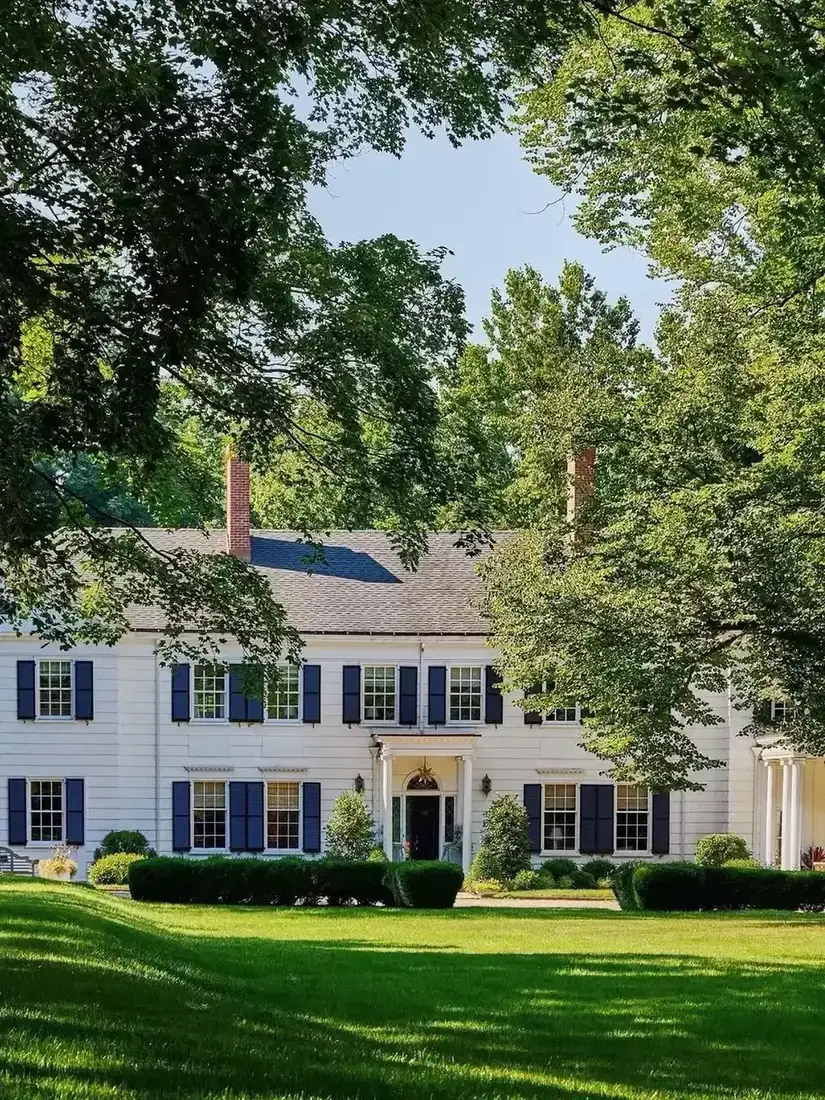
A long two-storey front under trees, white clapboard, dark blue louvred shutters on every window, a central portico with a fanlight, and a green lawn running without a break to the wall. The colour decision here is disciplined. Walls, trim, corner boards and soffits are one warm white, and the shutters are one blue everywhere they appear.
The windows repeat without variation. Two shutters per opening, same blue on ground and first floor, no third colour sneaking in on the door or the roof trim. That is why the front reads as one house instead of a row of ideas. A single accent repeated reads as intention. Three different darks read as leftovers.
That blue is deep but not black, near Farrow & Ball Hague Blue No.30 or Benjamin Moore Hale Navy HC-154. It leans warm, with a little grey in it, which keeps it soft against a creamy white. A hard primary blue against brilliant white would shout and then cheapen the whole facade.
The scheme also respects light. Warm white plus blue shutters behaves in both sun and cloud; cool white plus black can go stark in full sun and flat on a grey day. If you are sampling in 2026, paint boards not cards, lean them against the wall, and view them north and south. A board is 300mm square minimum, two coats over primer, and about £12 in sample pots, not £3,000 in regret.
Composite louvred shutters to this pattern run £180 to £420 per pair supplied in 2026, timber higher. If the budget is tight, paint the sash dark first. Sash paint at £28 to £55 per litre plus a day on a ladder does most of what shutters do for a fraction of the cost.
When glass and stone replace shutters
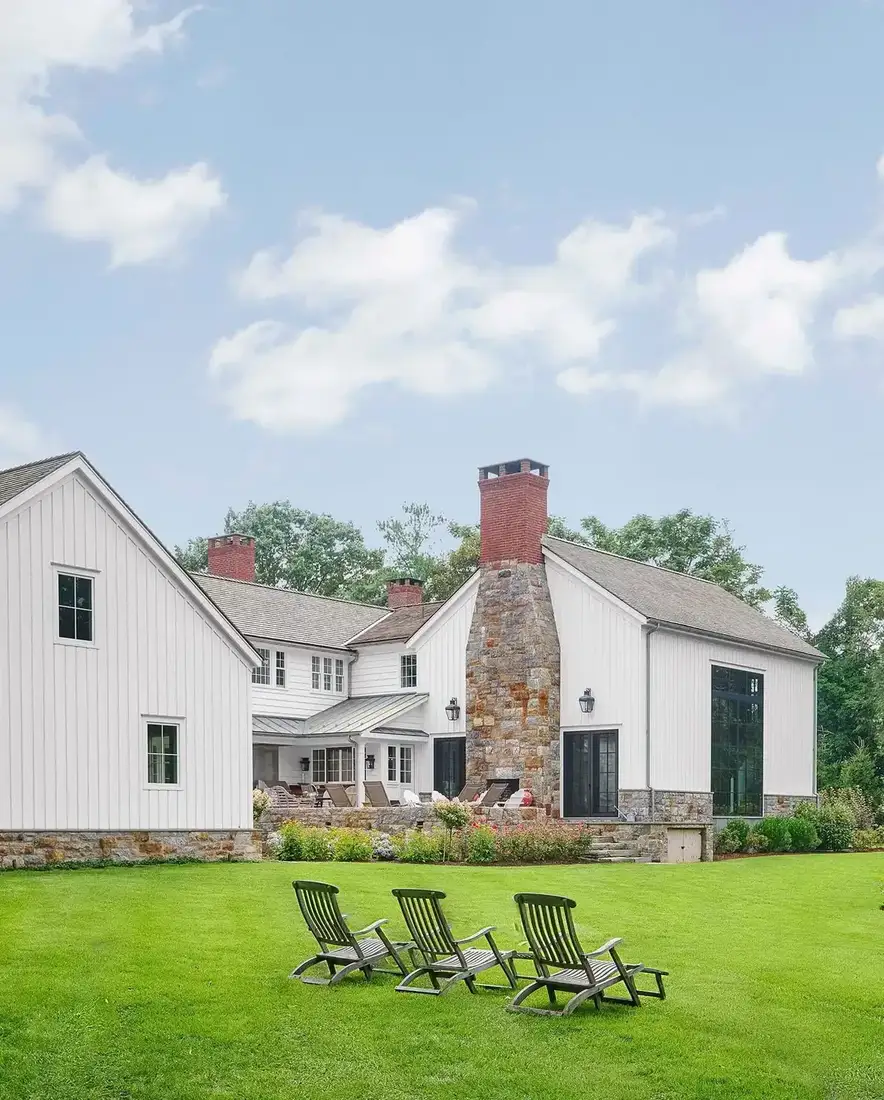
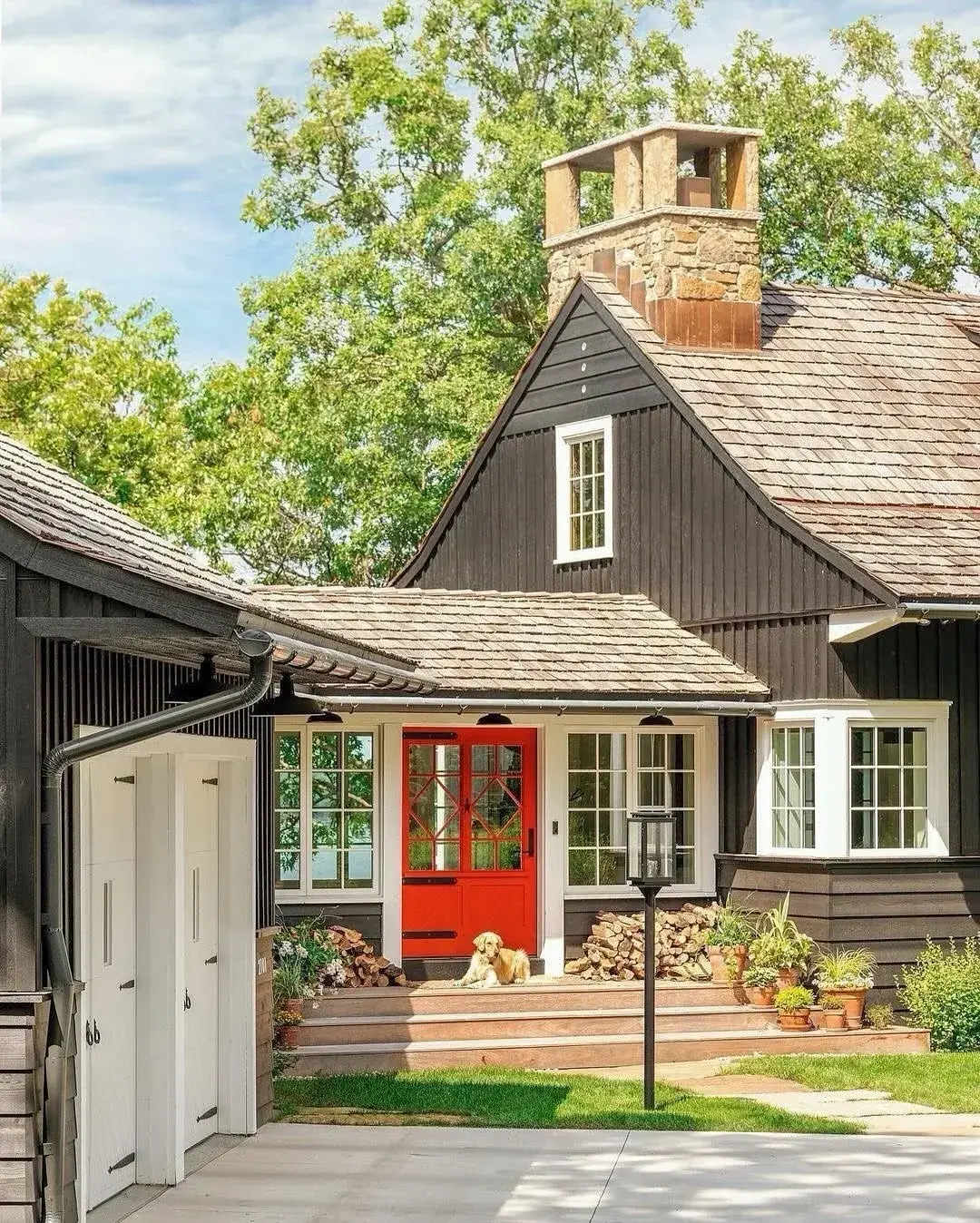
No shutters here, and fitted ones would look stuck on. The cladding is vertical board and batten, the chimney is full-height rough stone, and the gable at the right is mostly dark framed glass with a stone base. A louvred leaf beside a floor to ceiling pane has nothing to cover. It would be half the height of the glass or twice the width of the frame, and either way it reads as a prop.
The colour work is instead between board and stone. Smooth white boards against rough stone in buff and grey give the wall its weight without paint. The boards are almost certainly one warm white from eaves to base, including the batten caps, which keeps the vertical lines clean. The stone supplies the variation, so the white can stay simple.
Notice the dark frames on that large window. Bronze or near-black, they draw a crisp edge where board meets glass, and that line does the anchoring shutters would have done. If you have large fixed glass in 2026, specify the frame colour early. Repainting aluminium on site rarely matches factory coat, and it peels at the mitres within a few years.
The roof is pale grey shingle again, darker than the walls, lighter than black. That mid value lets the stone read darker than the roof without fighting it. If you repoint stone like this, ask for lime, not cement. Cement holds water and blows the face off soft stone in winter. Lime at roughly £18 to £30 per 25kg bag in 2026 moves with the wall and lets it dry.
Keep the lawn open here. Dense planting hard against board and batten holds moisture behind the batten and paints fail from below in three winters.
Painted brick wants a softer white than clapboard
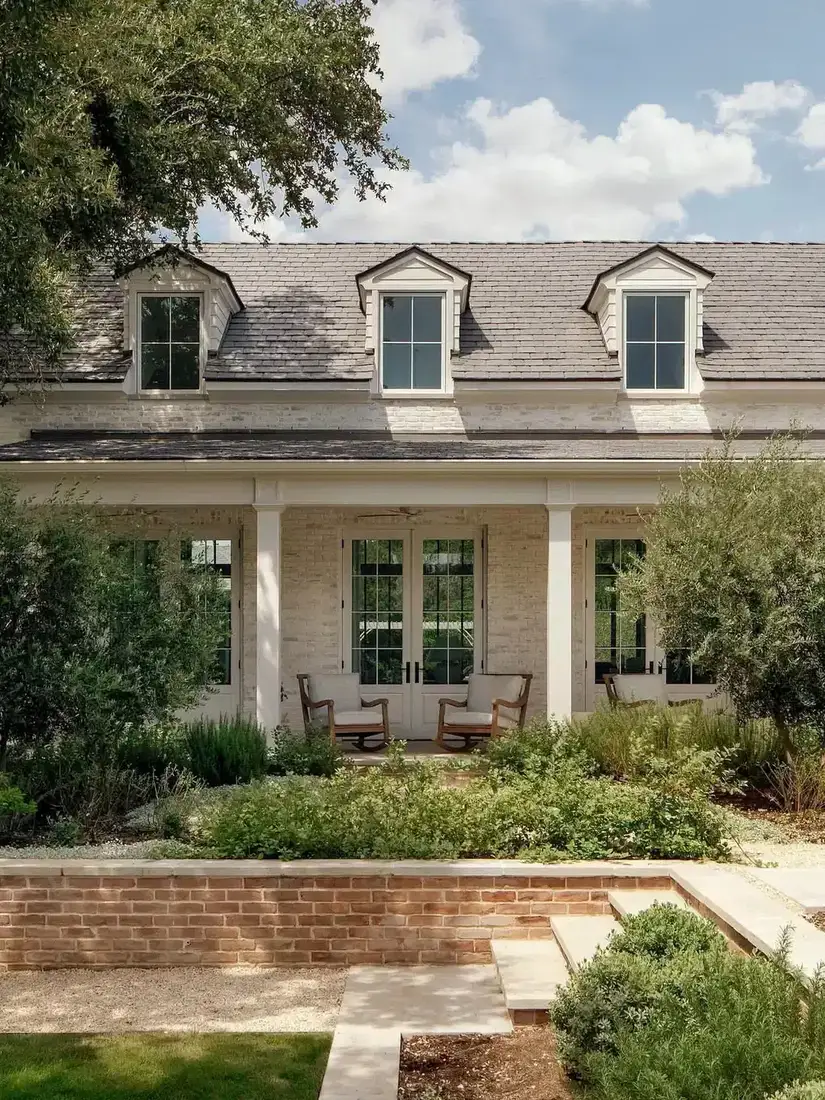
White painted brick under a dark grey shingle roof, dormers above, a porch with paired columns, full height French doors. The brick reads as off-white, not chalk, with the mortar lines faintly visible, which softens the whole surface.
Brick texture changes the colour choice. A flat white on smooth clapboard can glare; on brick the shadow in each mortar joint knocks the LRV down a point or two without changing the tin. So you can use a slightly creamier white on brick than you would on timber and still read white from the road. Farrow & Ball Wevet No.273 or Little Greene Loft White 222, both around LRV 84 in 2026, behave like this. Brilliant white, around LRV 92 to 94, looks manufactured on brick and makes the mortar look dingy.
Look at the porch. Posts, beam and porch ceiling are the same white as the walls, so the shadow does the modelling. The dark roof gives the house a firm lid, then the porch throws a second dark band where the wall is deepest in shade. That layering is what stops a white brick house reading as a single bright box.
Work sequence matters here. Start with the roof decision. A dark roof plus warm white is the most forgiving combination on brick. If the roof is staying pale grey, keep the white even softer and add one dark door, not dark shutters, or the contrast fights the roof.
For painted brick in 2026, use a breathable masonry system: stabiliser on bare brick, then Dulux Weathershield or Sandtex at £32 to £60 per 5 litres. Avoid sealed gloss on exterior brickwork; it blisters by the second winter because vapour cannot pass. Plan on a soft wash, not a jet wash, every one to two years. Jet washing drives water into the bed joints and lifts the coating.
A cape with dormers needs no extra contrast
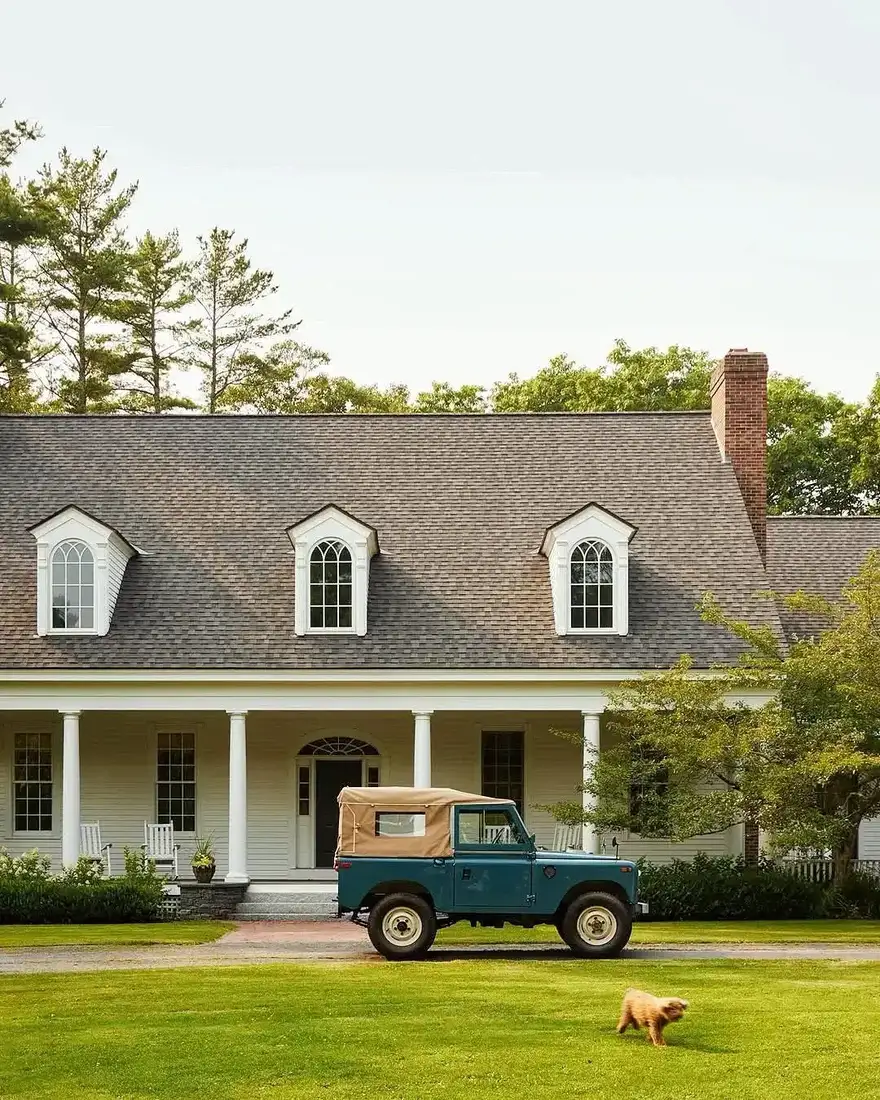
Symmetrical cape, three gabled dormers in a grey shingle roof, a deep porch on white columns, French doors with a fanlight, hydrangeas along the base. Count the decisions. Walls, trim, porch and dormer faces are one white; the roof is grey; the door is dark. Three values, not four colours.
The white here looks warm and slightly creamy in shade, which is exactly what a grey roof wants. A blue-white against this brown-grey shingle would sit badly, the two would disagree on temperature and the facade would look chalky. A warm white near Benjamin Moore Cloud White OC-130 or Sherwin-Williams Alabaster SW 7008 at LRV 82 to 86 in 2026 sits with the shingle because both have a touch of yellow in them.
The dormer cheeks have no shutters, which is correct. A leaf hung on a dormer cheek is 250mm wide with nowhere to fold back. It covers flashing instead of glass, water gets behind it, and the cheek rots from inside while the paint still looks sound. Step flashing in lead or coated steel under the shingle, not mastic, is what keeps dormers dry.
The porch lanterns are the small dark points that finish the scheme without paint. Two black lanterns tight to the door casing, plus the dark sash on the ground floor windows, give the white enough punctuation. Exterior lanterns in powder coated steel or bronze run £80 to £220 each in 2026; cheap pressed steel rusts at the seams within two winters near the coast. Put 2700K bulbs in them, not 4000K, otherwise the porch lights up cold and the white goes hard after dark.
If you add shutters to a cape like this one, leave the dormers alone. Shutters belong on the first floor only, where the openings are tall enough to size the leaf correctly.
Cedar makes the white choice for you
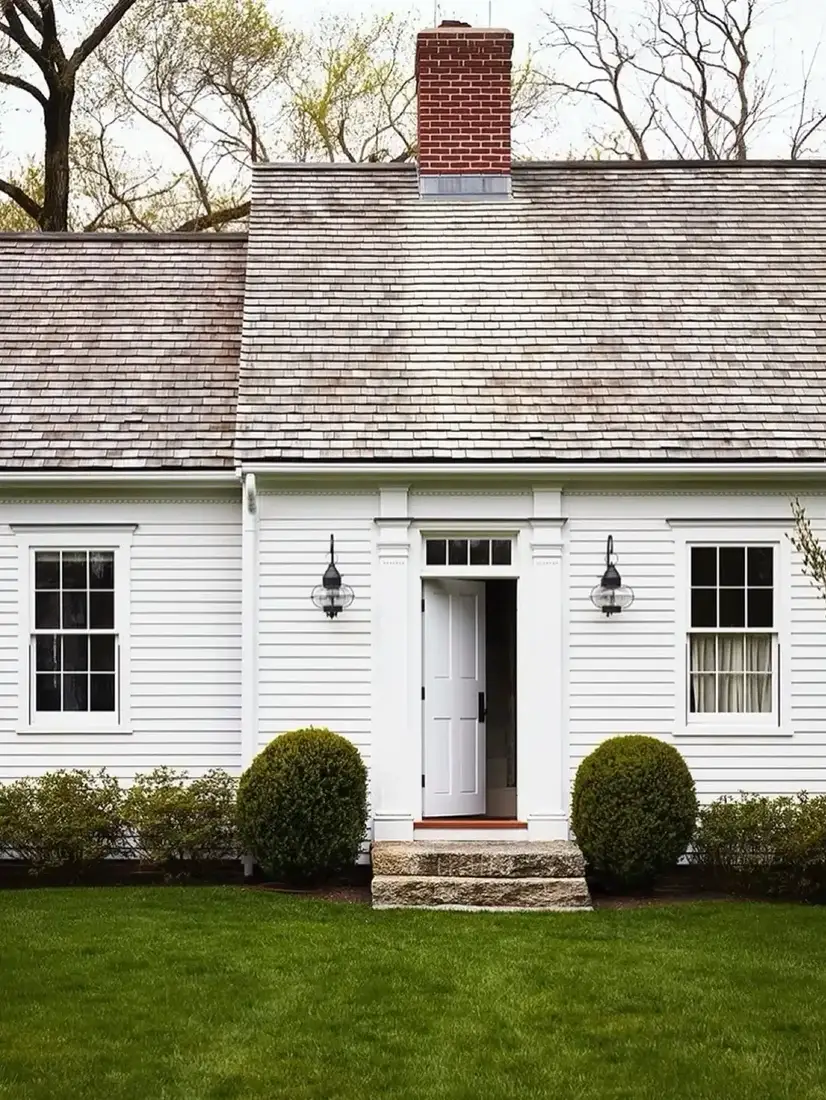
A compact clapboard house with a cedar shingle roof weathered to brown-grey, a tall red brick stack, two boxwoods, and two black lanterns either side of a white door with a transom. The roof brings the warmth, so the white must follow.
Cedar shingle starts honey and weathers to a soft brown grey within two winters. That warmth pushes a cool white into looking blue, which is why this house wants a creamy warm white and not a crisp one. Little Greene Portland Stone 77 or Farrow & Ball Wimborne White No.239 at LRV 83 to 87 in 2026 sit well against cedar; Farrow & Ball All White No.2005 at LRV 91 plus would glare beside it.
The whites on the door and casing match the siding. They are the same as the siding, handled as one thing, so the red brick and the cedar can be the warm notes without competition. The black lanterns are the only hard dark, and they sit where the eye lands.
Undertones are where most schemes slip. Hold your chip against the cedar sample, not just against paper. A yellow-cream warms with cedar; a grey-white fights it. If the two look like they belong to the same family, they will behave together in sun and in shade.
Treatment cost note for 2026. Cedar likes to breathe. Do not seal new cedar with film-forming varnish. If you must coat it, use a breathable stain such as Sadolin Classic or Sikkens Cetol at £40 to £70 per litre and accept that the colour will soften within a year. That softening is the roof settling into the palette, not failing.
Dusk and a red barn carry a plain range
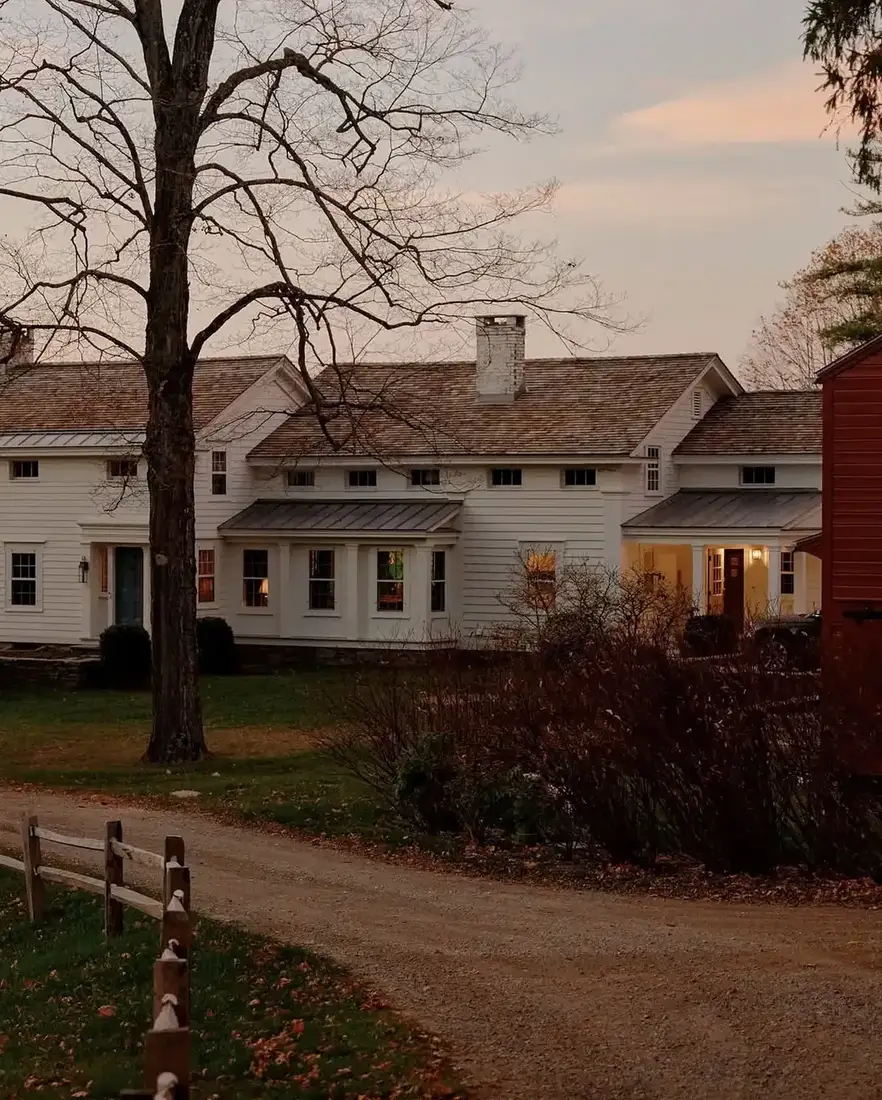
Evening, bare branches, a gravel lane, and a long white range with small horizontal windows up high. The interior is lit, the windows glow warm, and a red barn sits at the right edge cutting a deep red plane against the white.
This is the second-building trick that makes a simple white scheme look finished. White walls, pale grey roof, one warm light inside, one saturated barn beside it. The barn does the dark anchoring the main house has not needed to. In daylight that barn reads as the dark note; at dusk the windows do.
The palette stays tight. Walls and trim are one white, roof is grey, barn is red, interior light is warm amber. No shutters, no second white, no fussy trim colour. The house is plain and it is better for it, because the composition gives it everything it lacks on its own.
The warm interior colour matters after dark. 2700K lamps inside make white weatherboard look honeyed through the glass; 4000K lamps turn it to cold white and the house looks vacant even when it is not. If you see this photograph before you choose the exterior, note how the white looks creamier at dusk than at noon. That shift is normal; test your sample at both times before buying.
Barn finishes for 2026: rough sawn timber takes breathable acrylic such as Dulux Weathershield Exterior or Sandtex at £32 to £60 per 5 litres. Sealed gloss on rough sawn blisters by year two because vapour cannot escape. Plan the barn and the house together, not separately. The barn is part of the colour scheme whether you intended it or not.
Whites worth knowing by name
| Budget | Colour | Reads as | LRV 2026 |
|---|---|---|---|
| Premium | Farrow & Ball Pointing No.2003 | Warm bone, the classic choice | 84 |
| Premium | Little Greene Loft White 222 | Slightly grey, suits stone settings | 83 |
| Mid | Benjamin Moore White Dove OC-17 | Soft and forgiving in most light | 85 |
| Mid | Sherwin-Williams Alabaster SW 7008 | Creamy, very widely used | 82 |
| Trade | Dulux Weathershield Smooth Masonry, tinted | Durable, far cheaper per litre | Tint to taste |
For the sash, Benjamin Moore Onyx 2133-10 or any trade exterior satin tinted near-black does the same job as the premium options for considerably less. Allow £28 to £55 per litre for trade satin in 2026, and a litre per three to four windows depending on glazing bar count.
Brilliant white is the one to avoid, particularly on a rural house. It is a manufactured colour, it glares in sun, and it makes everything around it look dingy.
Warm off-whites suit timber and older buildings; slightly grey off-whites suit newer builds and stone surroundings. Test large: a sample the size of a sheet of paper tells you almost nothing about how a whole elevation will behave.
Check it in the actual orientation too. A north elevation and a south elevation of the same house, in the same paint, will not look like the same colour, and that is normal, not a mistake.
Frequently Asked Questions
Which white stays soft on a big outside wall?
Choose a warm off-white with a light reflectance value of 80 to 90, leaning to yellow or greige, not blue. Test it against plain printer paper; a creamy or dusty look beside the sheet signals warmth. Brilliant whites above 90 tend to glare in sun and go cold under cloud.
How do I know the undertone will suit my roof?
Hold the paint chip and a roofing sample together in daylight. Cedar and brown-grey shingle sit best with a creamy, yellow based white; a charcoal or black metal lid can carry a slightly greyer white. If the two chips look as though they share the same warmth, they will usually behave once painted.
What gives a white house its definition from the road?
One dark anchor that reads at scale, most often the roof, stone base, or large dark window frames. White with white trim plus a pale cover loses its outline and can vanish on an overcast day; a single darker element, kept consistent, holds the form.
Should body and architraves be different whites?
For most farmhouses, keep them the same. Two close whites weather to mismatched surfaces and look grubby at noon. Save the contrast for sash, shutters, or the entrance door where it is intentional and easy to maintain.
How many accent colours can the exterior carry?
Keep it to two in total, with the sash counted as one. A door in a deep red, green, or near-black works because the surrounding wall stays quiet. Adding shutters, door, and frame each in separate hues creates competition, not clarity.
How often does pale cladding need washing?
Expect a gentle clean every one to two years, sooner on sheltered north faces. Use low pressure with a suitable solution, keep planting about 450mm off the wall so air moves, and avoid high pressure jets that force water into boards and lift the coating.
In order
- Use one colour for siding, trim, corner boards and porch together.
- Paint the window sash dark, and judge the house before deciding anything else.
- Pick a warm white around LRV 80 to 90; favour one that reads creamy beside printer paper, not stark.
- Let the roof be the dark anchor; a pale cover needs a darker sash or door instead.
- Add a coloured door only if it still wants one, and keep it the sole extra hue.
- Skip shutters entirely unless you can fit correctly proportioned pairs.
- Choose an off-white, not brilliant white, and test it large on the real wall.
- Wash gently every one to two years and keep planting clear of the cladding.
This article may contain affiliate links. We may earn a commission at no extra cost to you.