13 Black Front Door Ideas: Every One Needs a Black Frame

Add us as a preferred source to see more stories on Google.
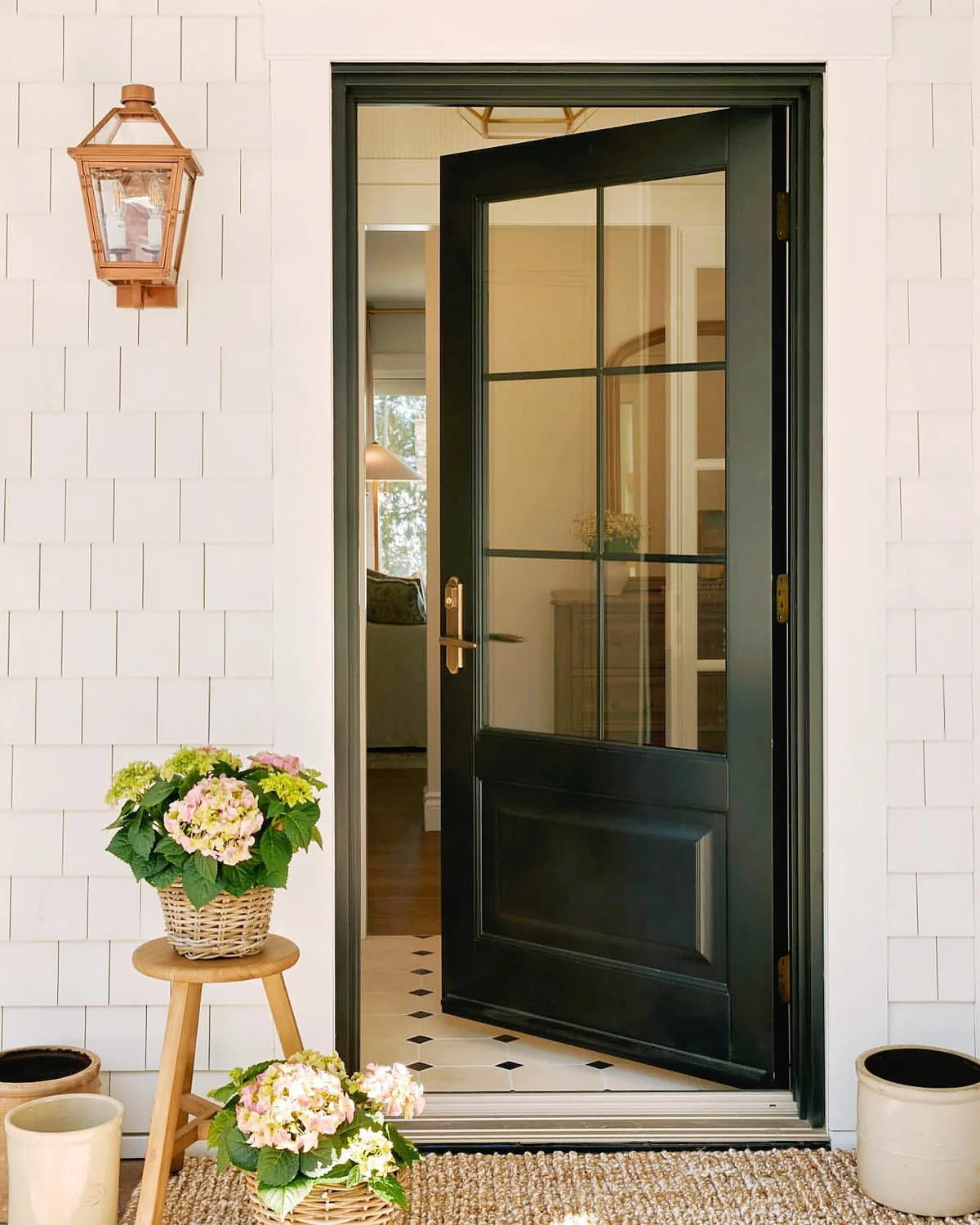
Most black front doors are painted, hung back up, and look slightly wrong for reasons the owner cannot name. The door below shows why.
The frame is black too. So is the casing around it, the stops the door closes against, and the edges you see when it stands open. The white shingle runs right up to that black, and the whole opening reads as one shape cut into the wall.
Paint only the door and leave a white frame around it and you get a black rectangle sitting inside a white rectangle. The eye reads the white as a border, the door as a panel, and the whole thing as an afterthought.
Which black
There is no single black, and the difference matters more on an exterior than anywhere else because the door sits against daylight.
A true black looks hard and flat against white siding, particularly in full sun. Most doors that photograph well are a very dark charcoal, a black-green or a black-brown. Off-blacks carry some depth even at midday, and they sit better beside brick and timber.
Whatever you pick, take a sample outside and look at it against the actual wall at two times of day. A colour chosen indoors under a bulb will not be the colour you get.
If there are shutters on the house, they should share the undertone. They do not need to be the identical paint, and on older houses they often were not, but a black-green door with a true black shutter looks like a mistake rather than a choice.
Which paint, by name
Blacks that hold depth outdoors rather than going flat:
| Budget | Colour | Reads as |
|---|---|---|
| Premium | Farrow & Ball Off-Black No.57 | Soft black with a grey-brown base |
| Premium | Little Greene Jack Black | Deeper, very slightly blue |
| Mid | Benjamin Moore Onyx 2133-10 | Warm near-black, forgiving |
| Trade | Dulux Weathershield Satin, tinted | Hard-wearing, widely stocked |
| Trade | Johnstone’s Trade Aqua Satin | Water-based, low odour, fast recoat |
Farrow & Ball Railings, which is a blue-black, is the other common choice and suits grey or blue-toned brick better than warm red.
For hardware, Armac Martin and Croft sit at the top at £80 to £200 for a handle set; Rejuvenation and Corston occupy the middle around £40 to £90; and plain unlacquered brass or satin black sets from general marketplaces run £15 to £30 and are perfectly adequate on a door.
Satin, and why
| Sheen | On a front door |
|---|---|
| Flat or matt | Chalks in sunlight, marks around the handle, hard to wipe |
| Eggshell | Acceptable in shade, still marks |
| Satin | Wipes clean, hides surface flaws, reads rich from the path |
| Gloss | Shows every dent, ripple and filler repair |
Gloss is the traditional choice and it is unforgiving. On a new door with a perfect face it looks superb. On a forty-year-old door that has been filled twice, it maps every repair, and the harder the sun hits it the worse it gets.
Satin is the safe answer for almost every real door.
Preparation decides how long it lasts
A front door takes more weather than any other joinery on the house, and more handling.
Sand back to a sound, dull surface. If the old coating is failing, take it off rather than painting over it; a new film on a lifting one will lift with it within two seasons. Fill, sand again, and prime bare timber, particularly end grain at the top and bottom edges.
Paint the top and bottom edges. Almost nobody does, because you cannot see them, and they are exactly where water gets into a timber door and swells it. A door that sticks in winter and frees in summer has usually got unpainted edges.
Use an exterior paint, not interior trim paint on the basis that it is under a porch. Two coats, thin, with a proper drying interval between them. Rushing the second coat is the most common cause of a finish that stays soft and marks under the door furniture.
Hardware, and how to not overdo it
One finish, repeated. In that photograph the handle set, the hinges and the lantern are all the same warm metal, and nothing else competes.
Unlacquered brass and copper darken with handling and weather, which most people want without knowing to ask for it. Lacquered finishes stay bright for a year or two, then wear through in patches exactly where hands go, which looks like damage. Satin black or oil-rubbed bronze avoids the question entirely and suits a black door well.
Scale is the thing people get wrong. A front door handle should look substantial; interior-sized hardware on an exterior door reads mean from the path. If you are fitting a long escutcheon plate, hold it against the door before drilling and stand back at the gate.
The honest caution about south-facing doors
A black door in full sun gets hot. Surface temperatures well above ambient are normal, and on a timber door that means more movement, more paint stress and a shorter interval before it needs redoing. On a composite or uPVC door it can void the warranty, and some manufacturers specifically exclude dark colours for that reason.
If the door faces the sun for most of the day, use a quality exterior paint rated for dark colours, expect to recoat sooner, and check the warranty before you paint anything that is not timber.
When the whole cabin is black
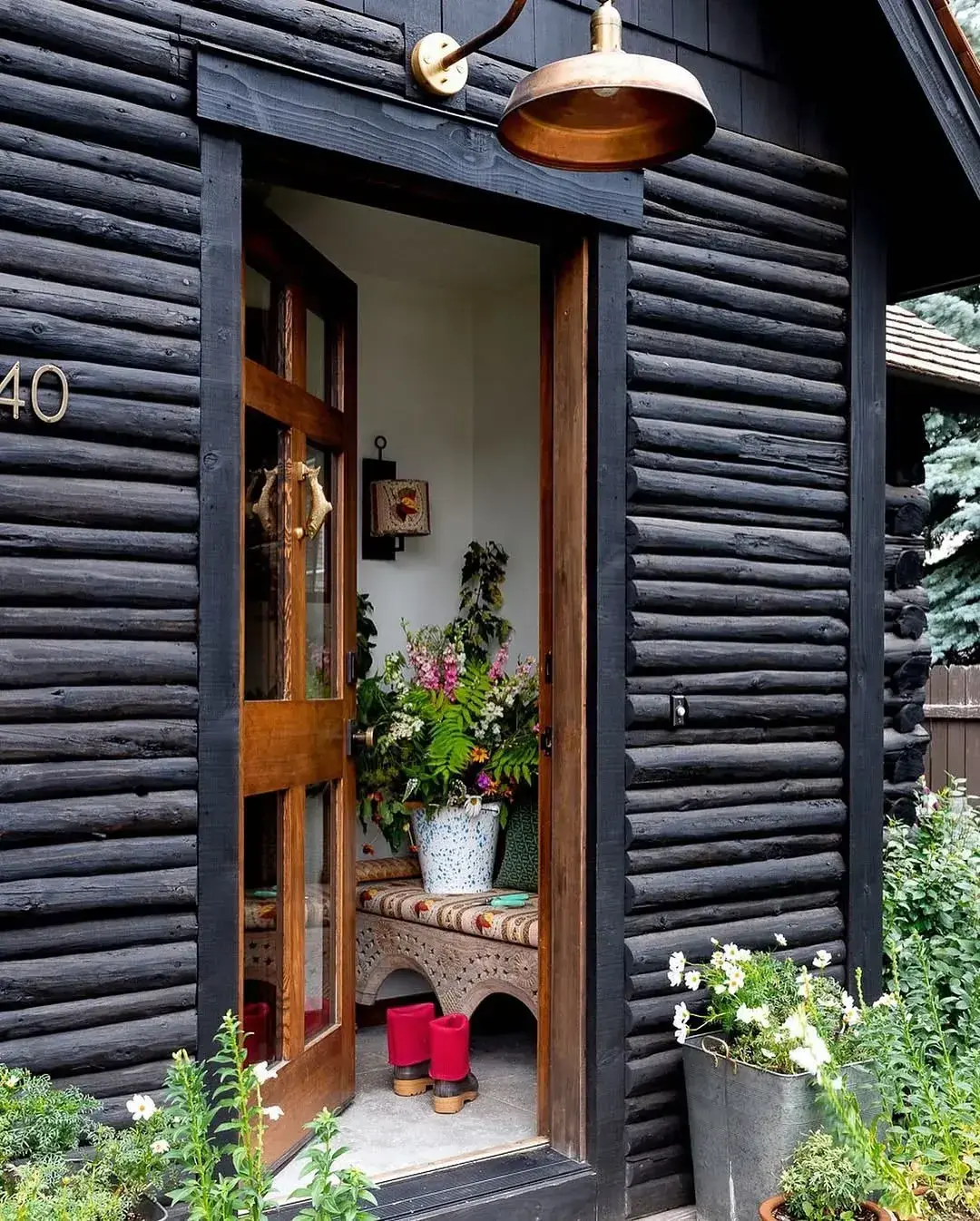
The logs are stained near black, the casing is black, and the door standing open is warm timber with glazing. A copper dome shade hangs over it. Brass figures read 40 on the wall. Red boots and cut flowers fill the entry behind the glass.
Black is the house here, so the door cannot be the darkest thing on the front. The contrast arrives from the timber leaf, the copper and the green planting instead. That inversion is the whole lesson. On a pale house black is the accent. On this one the pale and warm notes are the accents, and they have to work harder because there is so little of them.
Order of operations matters more than usual. Stain the logs first, live with them for a week, then decide whether the door stays timber. Stain stripped back to bare log is a miserable job across ribbed faces, so treat the first coat as permanent. An opaque exterior wood stain in black runs £35 to £60 for 5 litres in 2026, and a cabin front takes several tins. The copper barn shade in this size lists at £90 to £220 in 2026. Solid brass numerals cost £15 to £40 a digit in 2026, fixed with pins and a dab of sealant behind each one.
Glazed double doors on brick
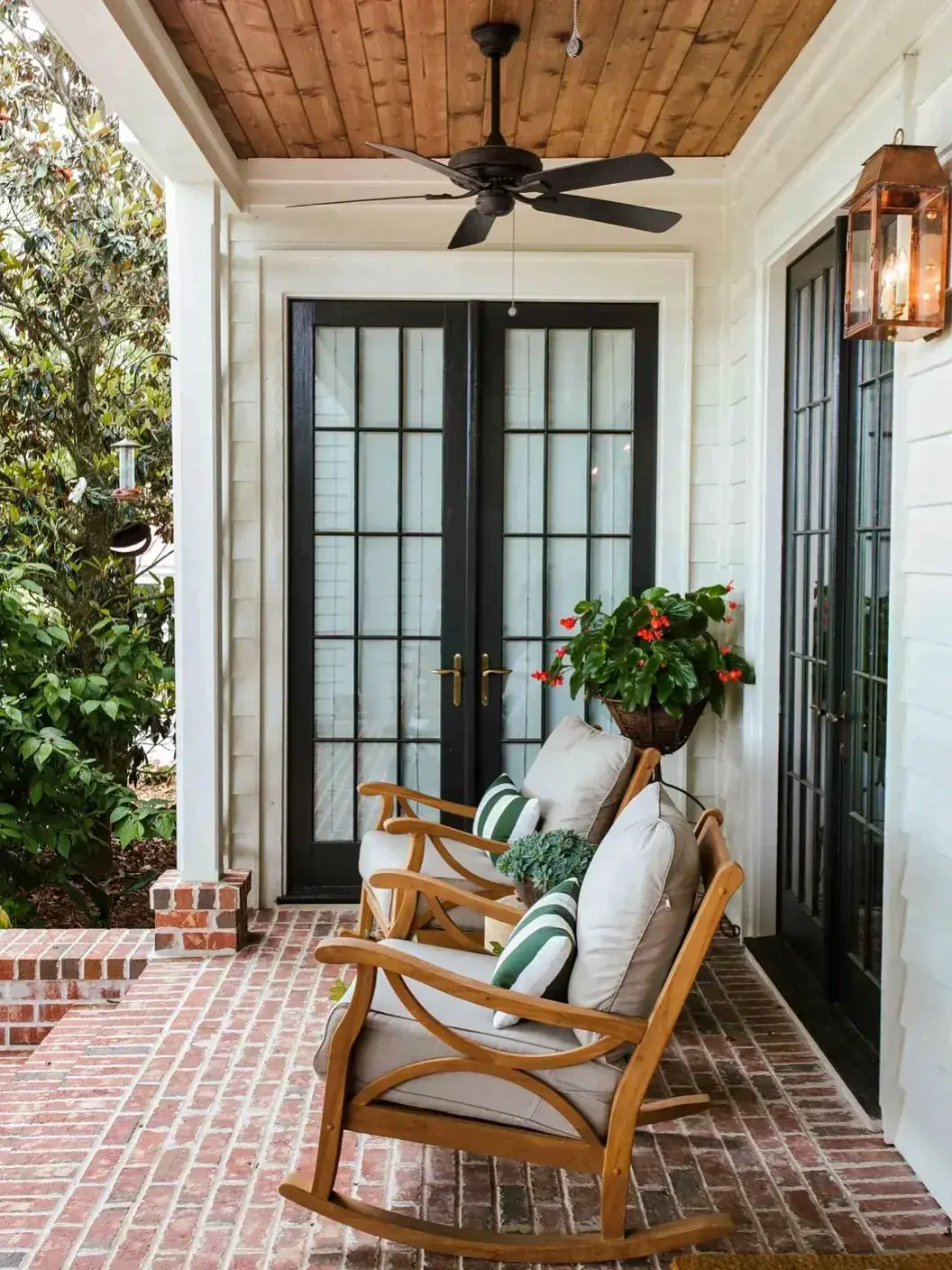
Two black leaves, fully glazed with bars, brass levers on both. Brick underfoot, a boarded timber ceiling above, a black fan turning under it. A copper lantern burns on the right. Two timber rockers with striped cushions face out past a hanging basket of red flowers.
Glass is doing structural work in this picture. Two solid black leaves on a shaded porch would read as a wall. The glazing breaks them into reflections and borrowed daylight, so the black stays a door. Count the repeated dark notes: doors, fan, lantern. Three is the limit. The brick and the timber do the warming, and the green cushions stop the porch feeling like a corridor.
Paint sequence for a glazed pair: beads out first, glass masked, bars brushed before the stiles, both leaves finished in the same sitting. Glazing bars fail first because water sits in the rebates, so bed the beads properly and back prime them before fixing. A copper lantern of this pattern lists at £120 to £280 in 2026. Hang it at head height beside the opening, not above it, or the light grazes the brick and never reaches faces.
Black trim, not just a black door
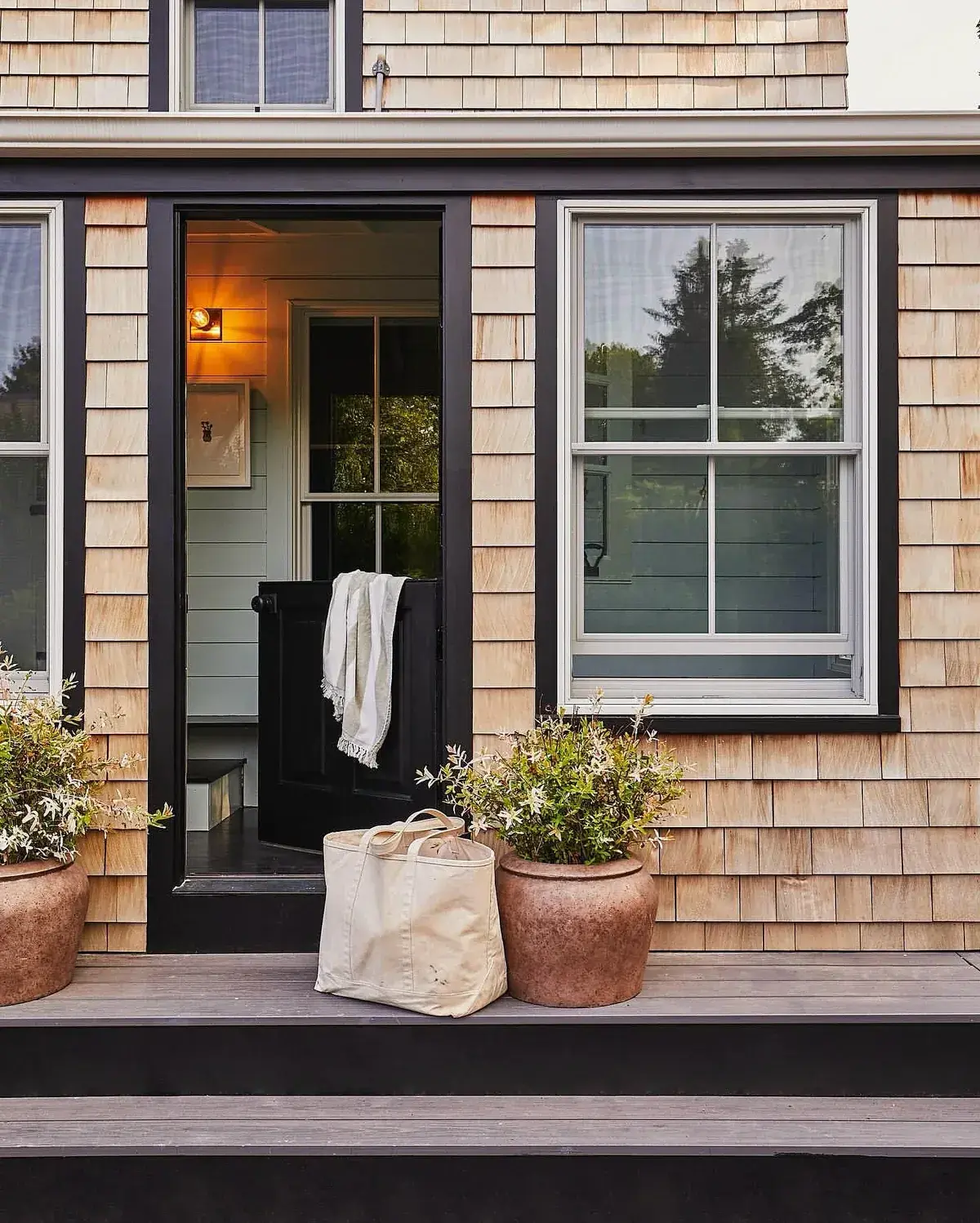
Weathered cedar shingle, and a black frame wrapping a door and a window as one unit. The door stands half open with a striped throw over it. Two terracotta pots flank the step. A canvas tote sits between them.
The trim is the anchor here as much as the door. One black line runs around door and window together, which turns two holes in the wall into a single composed opening. Had the window kept a pale frame and only the door gone black, the pair would argue. The pots do the softening that black always needs beside timber. Terracotta against near black is an old pairing and it still works, because the orange is the only warm note for metres.
Buy one tin and paint the whole opening in one day: door, casing, window trim, step riser. Blacks drift between batches, and two tins mixed a month apart show a line at the joint nobody can unsee. Basic terracotta pots in this size list at £12 to £35 each in 2026. Leave them unsealed outside; sealed ones spall in frost when water gets behind the sealer.
One black door between white sidelights
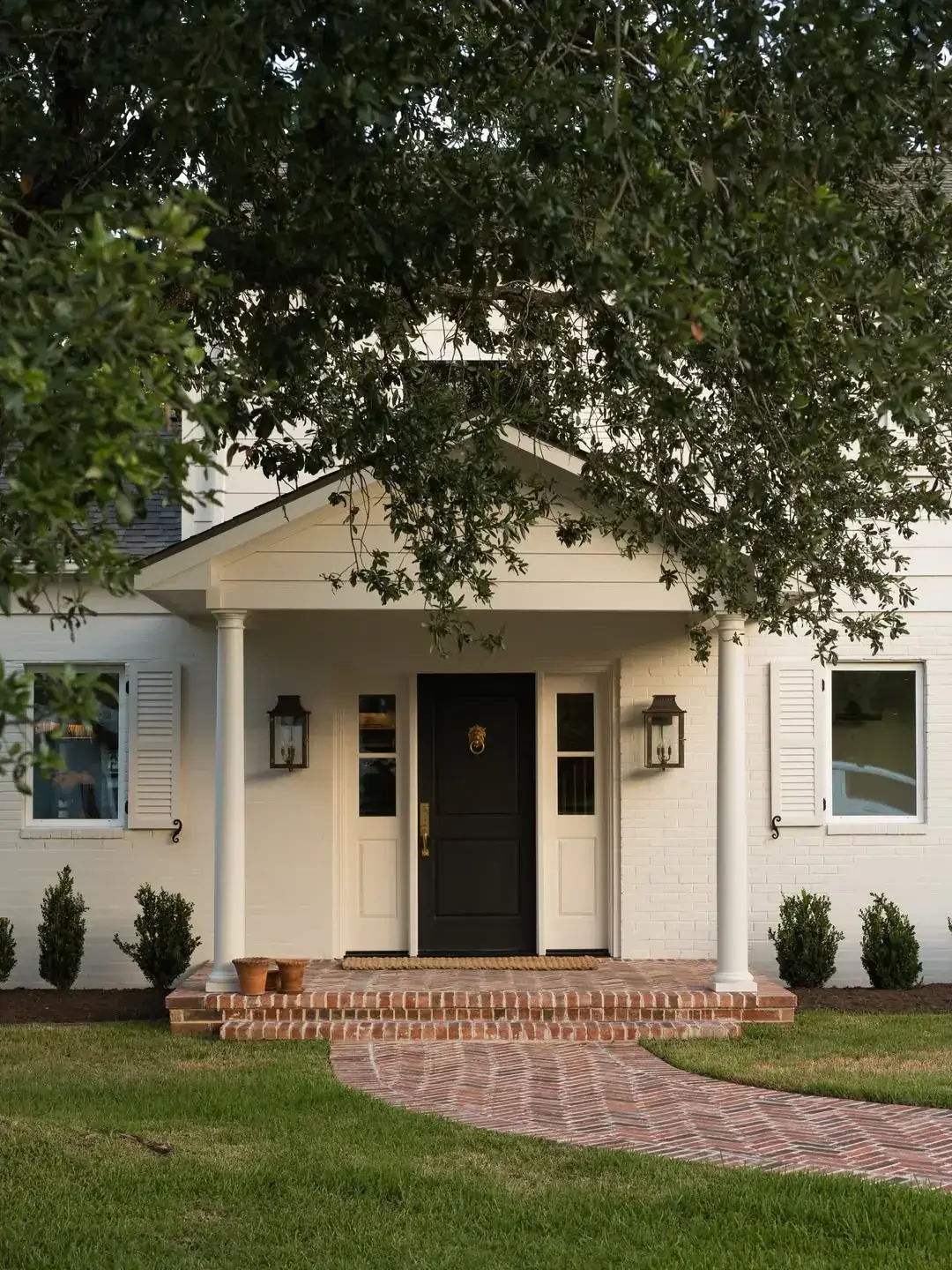
Cream painted brick, a black six-panel door, white sidelights with glazing bars on both sides, twin black lanterns. A herringbone brick path curves in past clipped cones. Two small terracotta pots wait by the step.
Keeping the sidelights pale is the decision that makes this front. A black door with black sidelights would be a dark slab three times the width; black between white reads as a door with daylight on both sides. Symmetry does the rest. Two lanterns, two sidelights, two cones. The black sits in the middle as the single dark note, which is why the front feels calm instead of heavy.
Warm the brick choice toward the mortar, not the door. Cream mortar wants a neutral or faintly warm black. Benjamin Moore Wrought Iron 2124-10 or Farrow & Ball Off-Black No.57 both sit well here. A 2.5 litre tin of premium exterior satin lists at £60 to £98 in 2026 and covers a door with most of the tin left for the gate. Fix lanterns with proper wall plugs into mortar joints, never into the brick face, which spalls when it blows.
Shutters that share the door colour
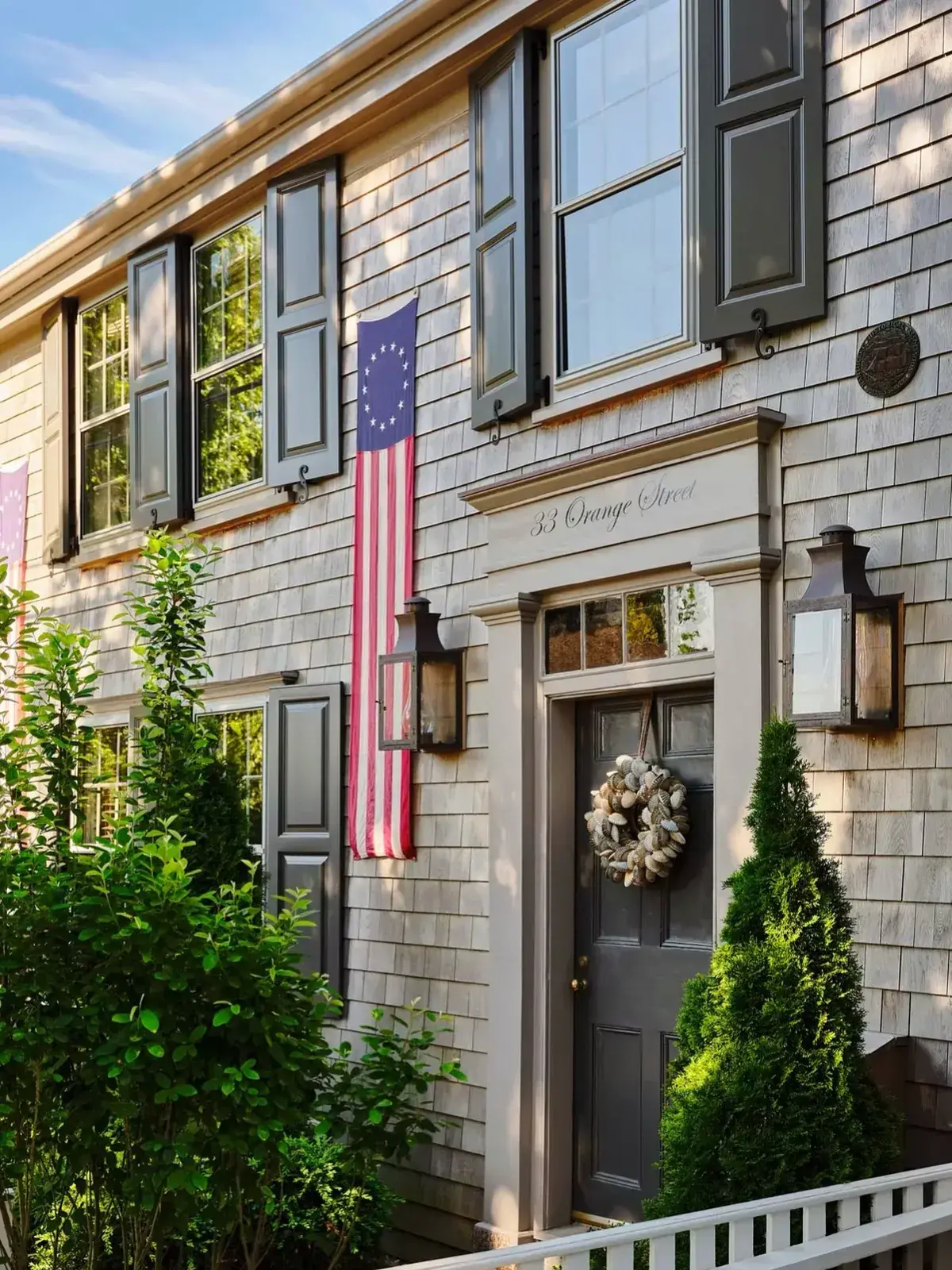
Weathered grey shingle, a dark panelled door with an oyster shell wreath, grey louvred shutters above and beside, a stone surround lettered with the street number, twin black lanterns tight to the frame.
The shutters and the door are in the same family, and that agreement carries the facade. Grey shingle forgives almost any dark, which is exactly when people stop checking and land two near blacks that fight. Hold a shutter sample against the door sample in daylight before either tin is opened. The wreath earns its place by softening a formal door without adding colour. Shell, bone and linen all sit with black; anything bright would shout.
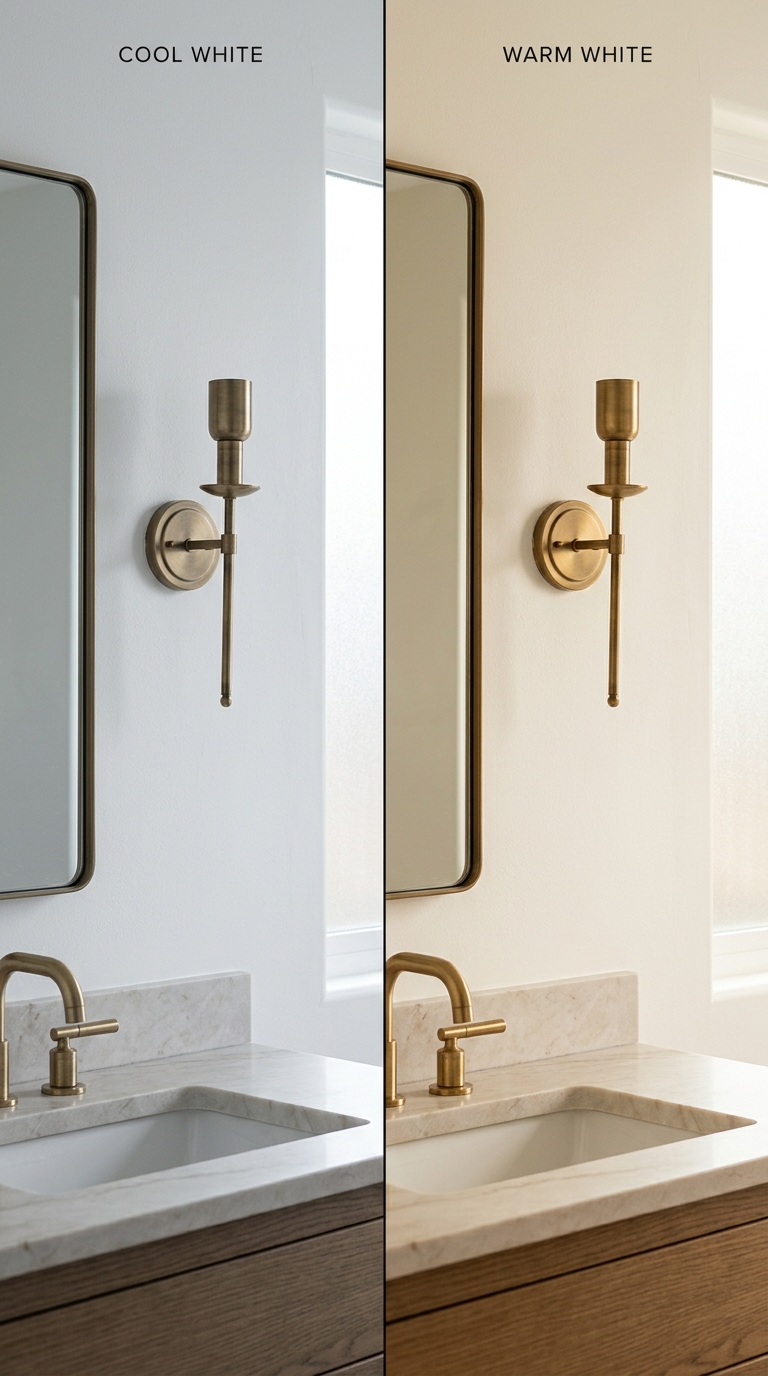
Oyster shell wreaths list at £25 to £60 in 2026 depending on size. Hang the wreath from a ribbon looped over the door top. A screw through a panel is a water path into the timber. The twin lanterns flanking the surround want warm bulbs around 2700K; cool white turns grey shingle steely after dark and flattens the door to a hole.
The black green end of black
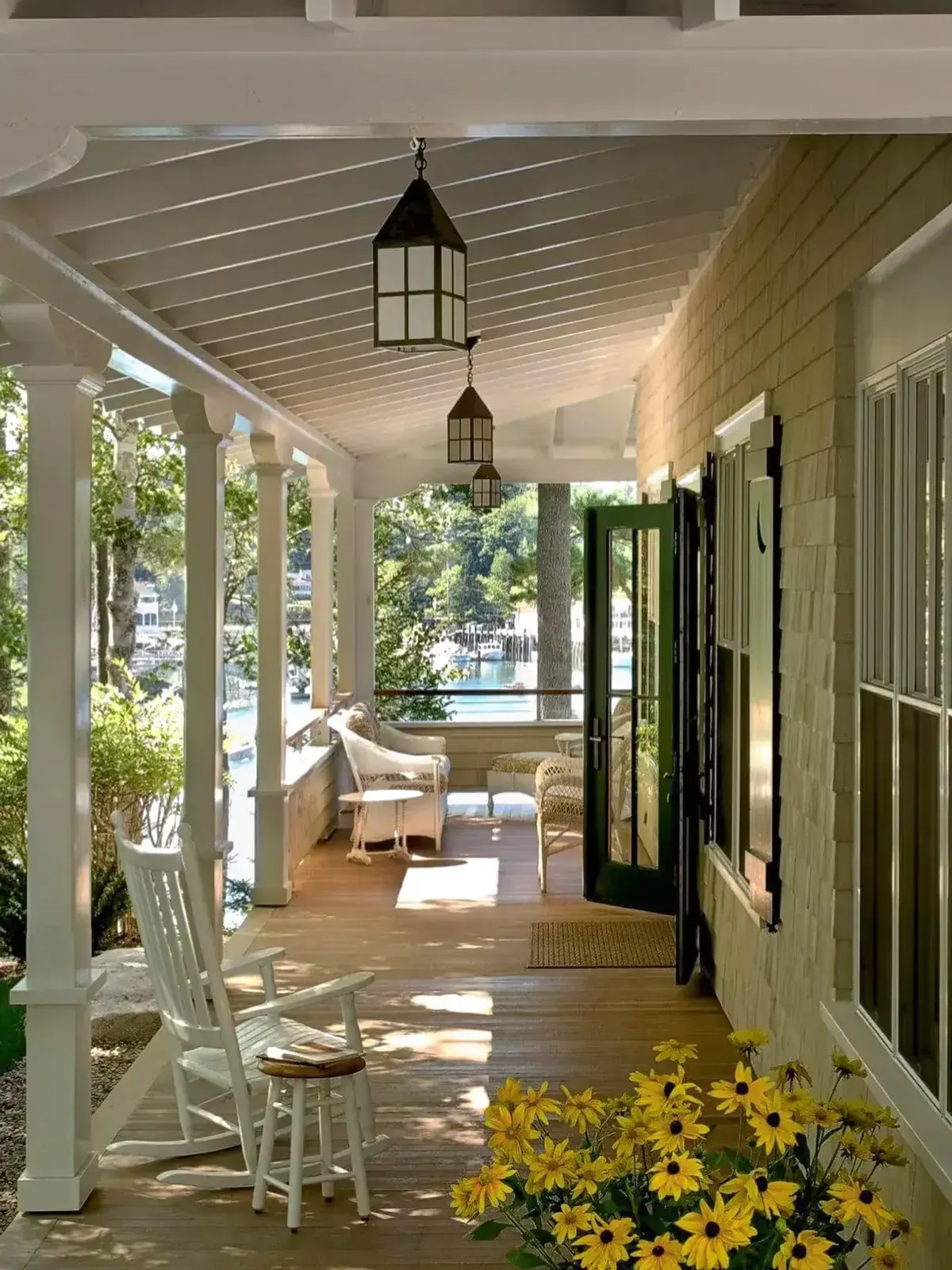
A long porch under a white boarded ceiling, three black pendant lanterns in a row, white columns, wicker chairs at the far end. The glazed door standing open leans visibly green. Yellow black-eyed Susans fill the foreground.
Call this what it is: a black-green photographed in shade, where it reads darker than the tin suggests. For houses wrapped in green foliage that cast is an asset, because foliage throws green reflections onto everything and a neutral black picks them up unevenly. A door that starts slightly green absorbs the reflection and still reads black from the path.
The white casing does quiet work around that door, holding a crisp line between green paint and pale shingle so the dark never sinks into the wall at dusk. Farrow & Ball Studio Green No.93 or Little Greene Obsidian Green get close in exterior satin. Three pendants down a porch want wiring on one switched circuit with the drops cut equal, or they hang like a staircase.
Sunlight exposes the undertone
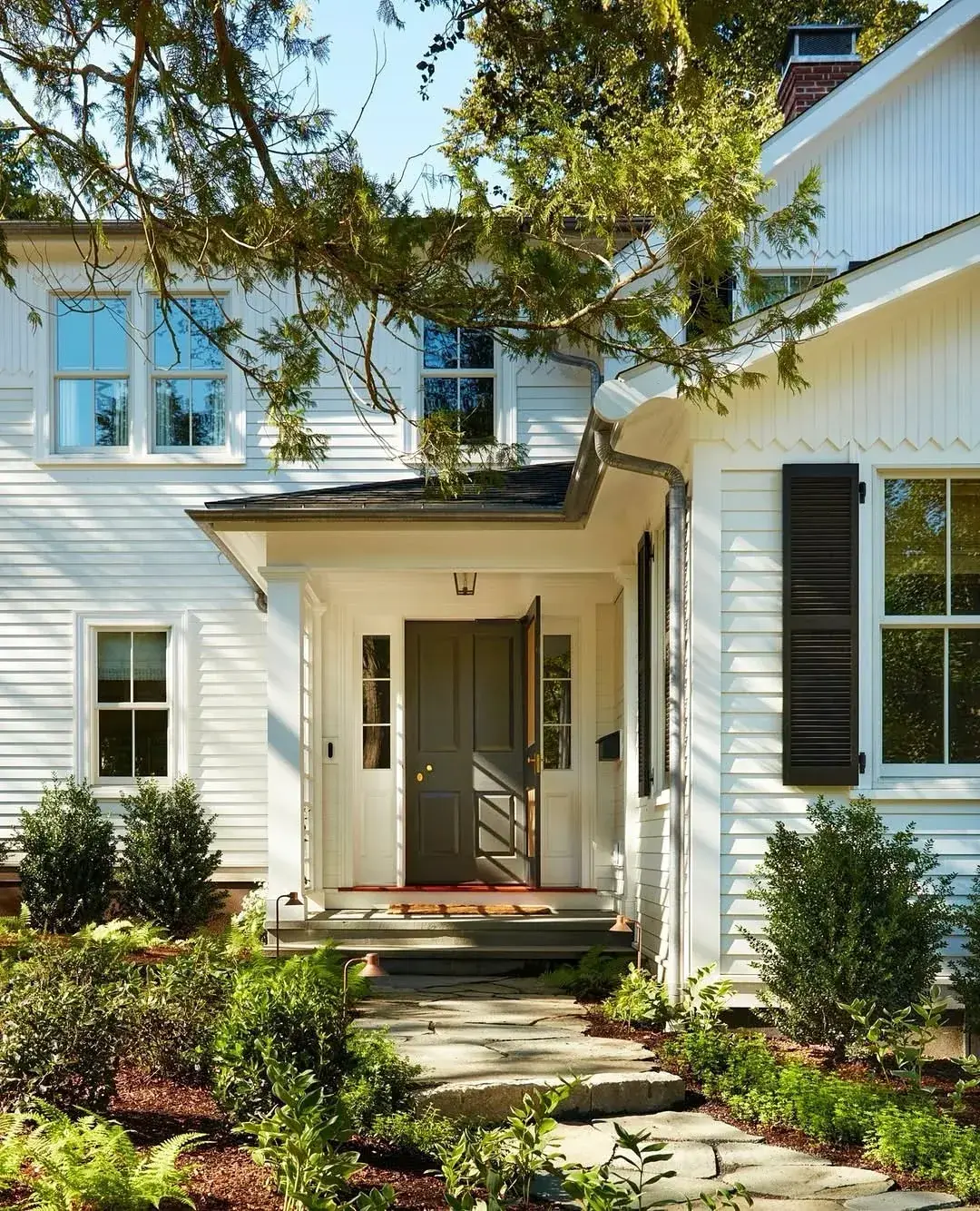
Full sun on white clapboard, a dark door standing ajar, black louvred shutters, a dark roof line above. A stone path leads in past deep borders. Box balls and ferns crowd both sides of the step.
Judge black at noon on a front like this, because noon is when the undertone shows. The door in this light leans olive, and that olive is what ties it to the green planting and the weathered stone. A blue-leaning black in the same sun would sit colder and fight the borders. Sun is the honest viewing light; shade flatters every black and showroom light flatters most of them.
Planting this close to paint needs an air gap. Clipped box holds damp against a finish and drips onto it after rain, which shortens any coating by seasons. Keep foliage a hand width off the paint and the door stays cleaner too. Young box plants in 3 litre pots list at £15 to £30 each in 2026. Mulch the bed, not the step, because mulch piled against timber casing rots it from the ground up.
Shutters hold the dark after dusk
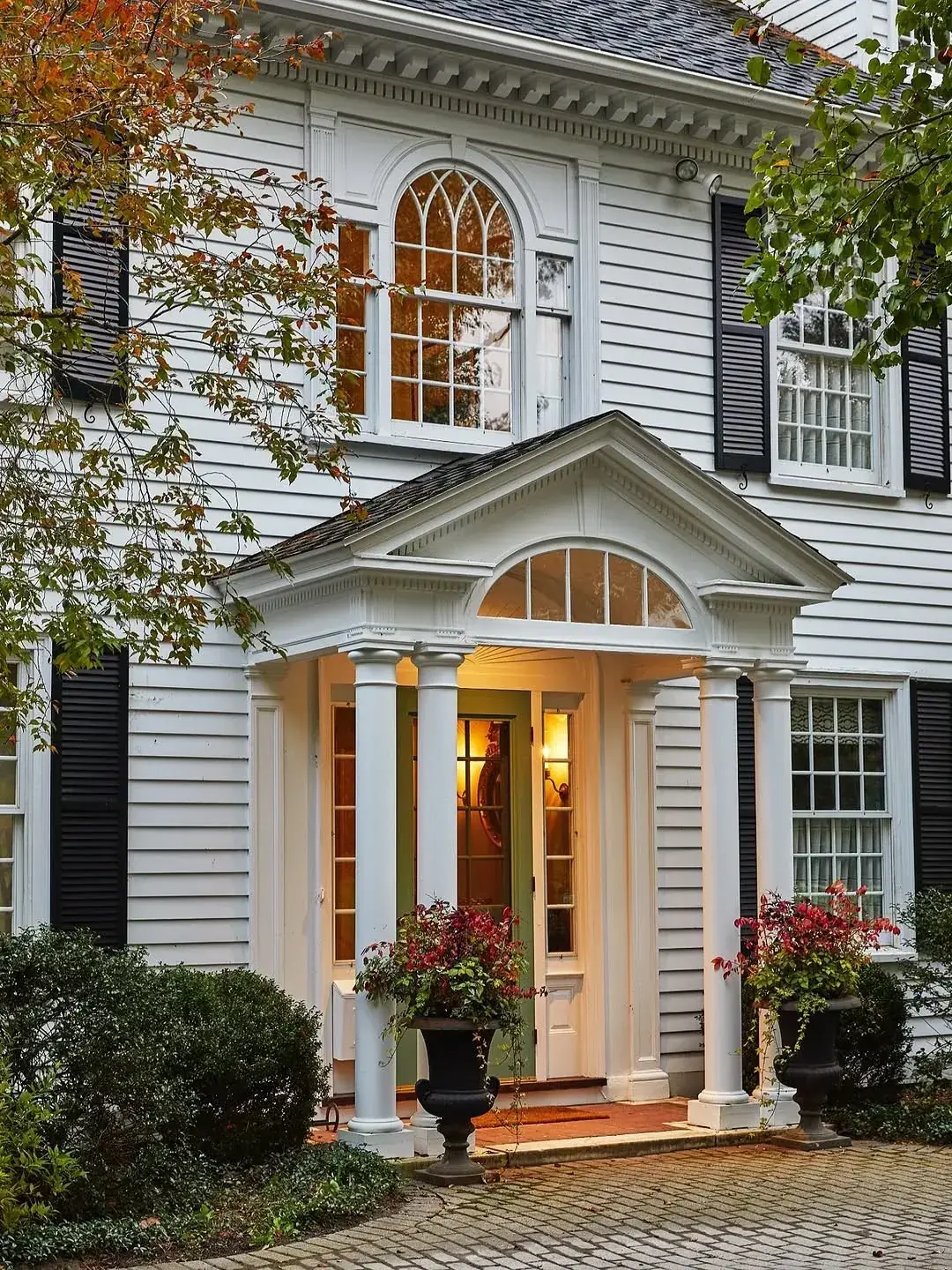
A columned portico at dusk, black louvred shutters on white clapboard, a fanlight glowing warm over the door, sidelights lit from inside. Two dark urns with red planting flank the columns. Cobbles underfoot.
After dark the door glass turns to mirror and the interior light takes over, which is when the shutters inherit the job of being black. Four black shutters on a white facade hold the contrast the door surrenders to reflection. Plan that handover: the door is the daytime anchor and the shutters are the night one, and both need the same undertone family or the handover jars.
Urn planting wants height and one strong colour. Red against black and white is the traditional answer and it still works, because the red is the only saturated note for metres. A pair of cast stone urns in this scale lists at £40 to £120 in 2026 before compost and plants. Drill a drainage hole if the casting lacks one; drowned roots in October are the usual cause of a bare urn by Christmas.
One black chair instead of a set
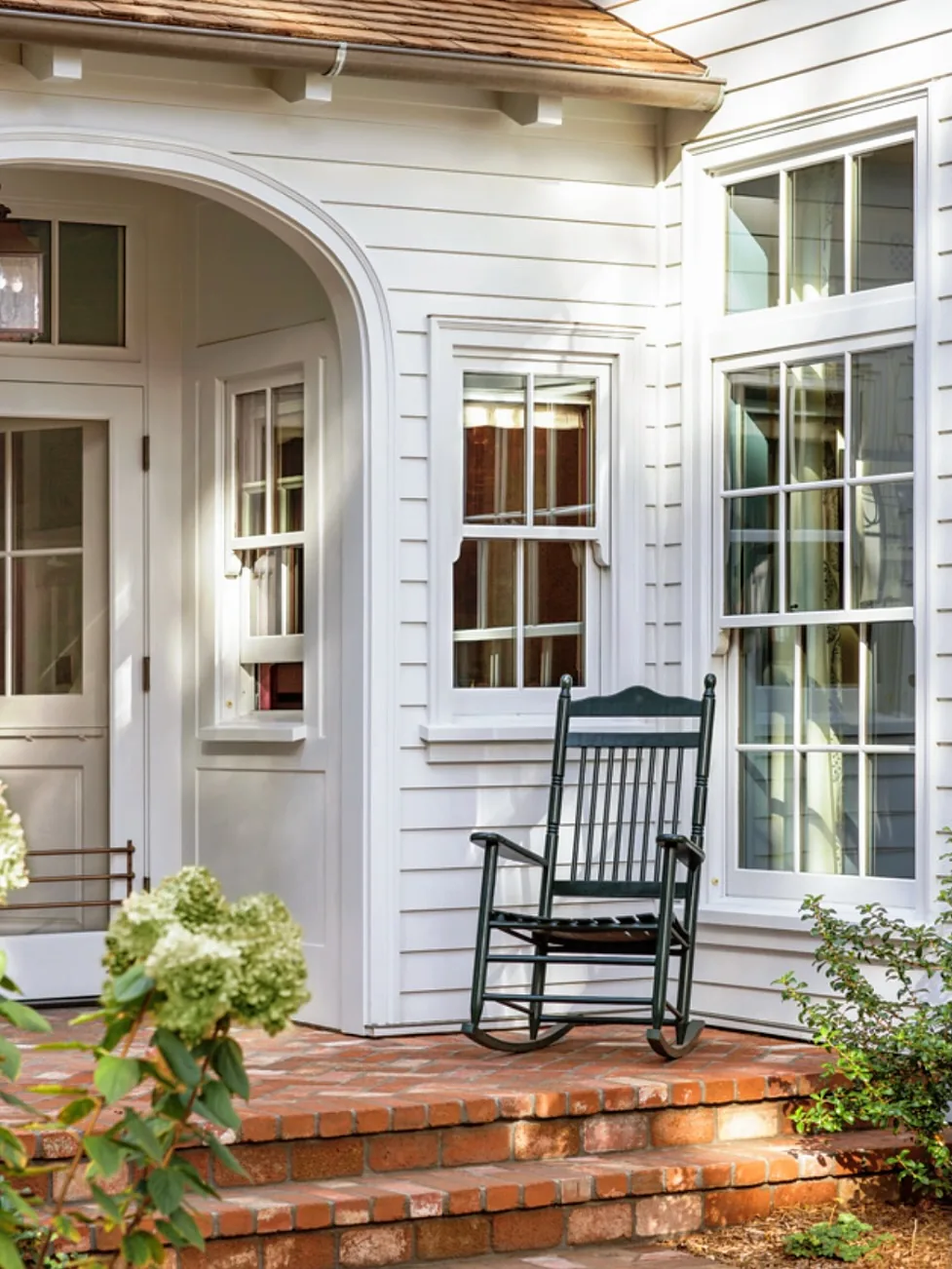
No door in this frame at all. A black rocking chair on brick steps, tall white windows behind, white clapboard, hydrangea heads softening the left edge.
This is the echo rule at its strictest. One black seat repeats a black door somewhere out of shot, the way a period ends a sentence. The brick steps and the green leaves do the rest of the talking. Had the chair been white it would vanish into the siding; had there been four black chairs the porch would chant. The single dark shape is what gives a pale porch its composure.
Buy the chair after the door colour is fixed, not before, because matching a door to existing furniture reverses the hierarchy. Slatted timber reads best in black since the gaps break the surface into lines of light instead of one flat slab. A solid-seat exterior rocker in hardwood lists at £150 to £400 in 2026. Oil the runners yearly; a rocker that drags gets dragged inside and never comes back out.
Black furniture needs texture
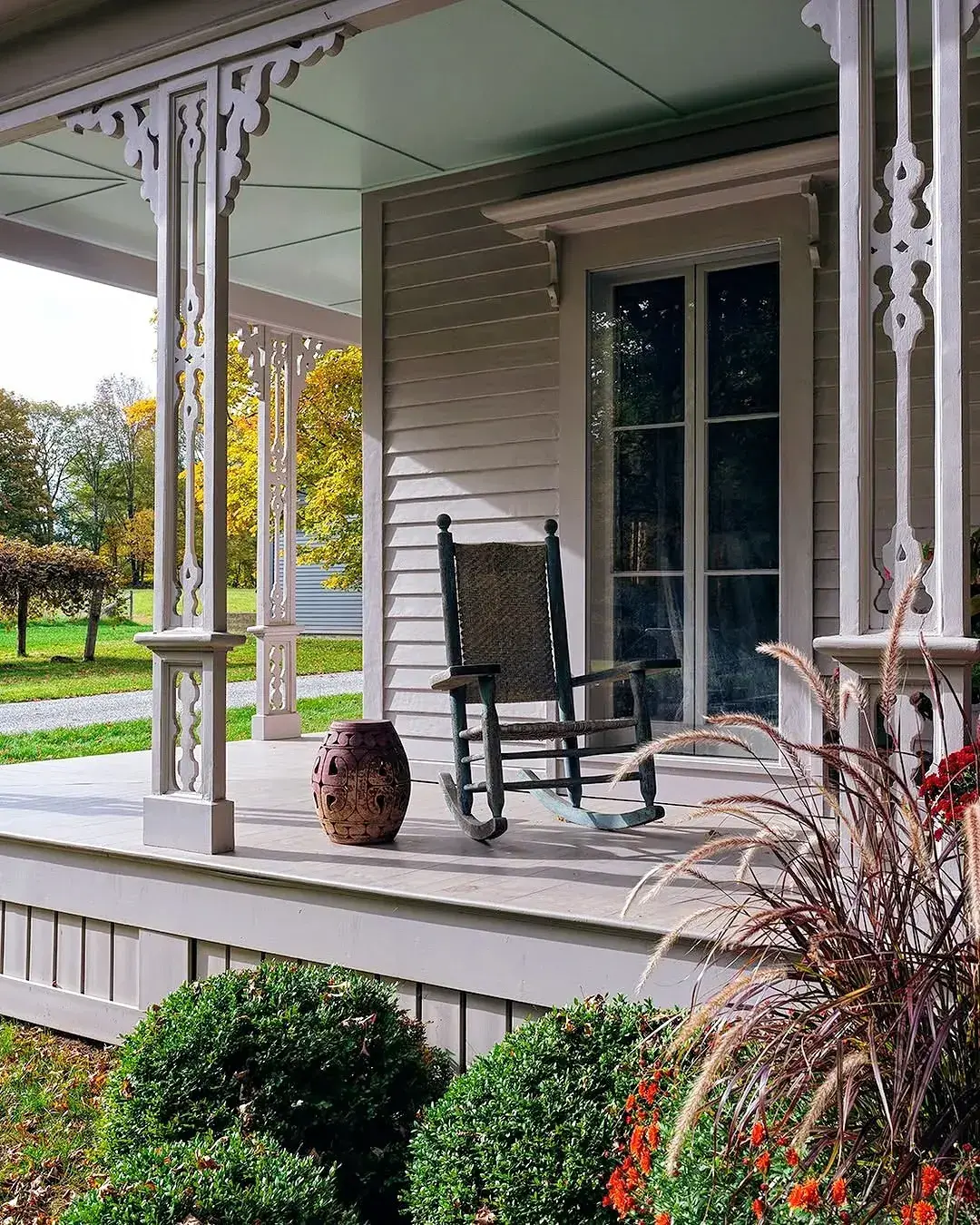
Fretwork posts, a grey boarded wall, a black rocker with a woven rush back, a pierced copper stool beside it. Grasses and red flowers crowd the foreground. The door is out of frame again; the black furniture is the subject.
Rush and slats are what stop black furniture reading flat. A woven back catches light across every strand, so the chair holds its shape in shade where a solid black seat would melt into one silhouette. The copper stool beside it does the warming a black chair always wants. Two dark notes plus one warm metal, and nothing else competes.
Exterior black on furniture wants a different system from doors. Use an exterior eggshell or a dedicated garden furniture paint, never masonry paint thinned to stretch it, which chalks off onto clothing within a season. A 750ml tin of exterior eggshell lists at £25 to £45 in 2026 and coats two chairs. Store cushions inside; foam left out grows the green film that eventually colonises the frames too.
Amber glass and a climbing vine
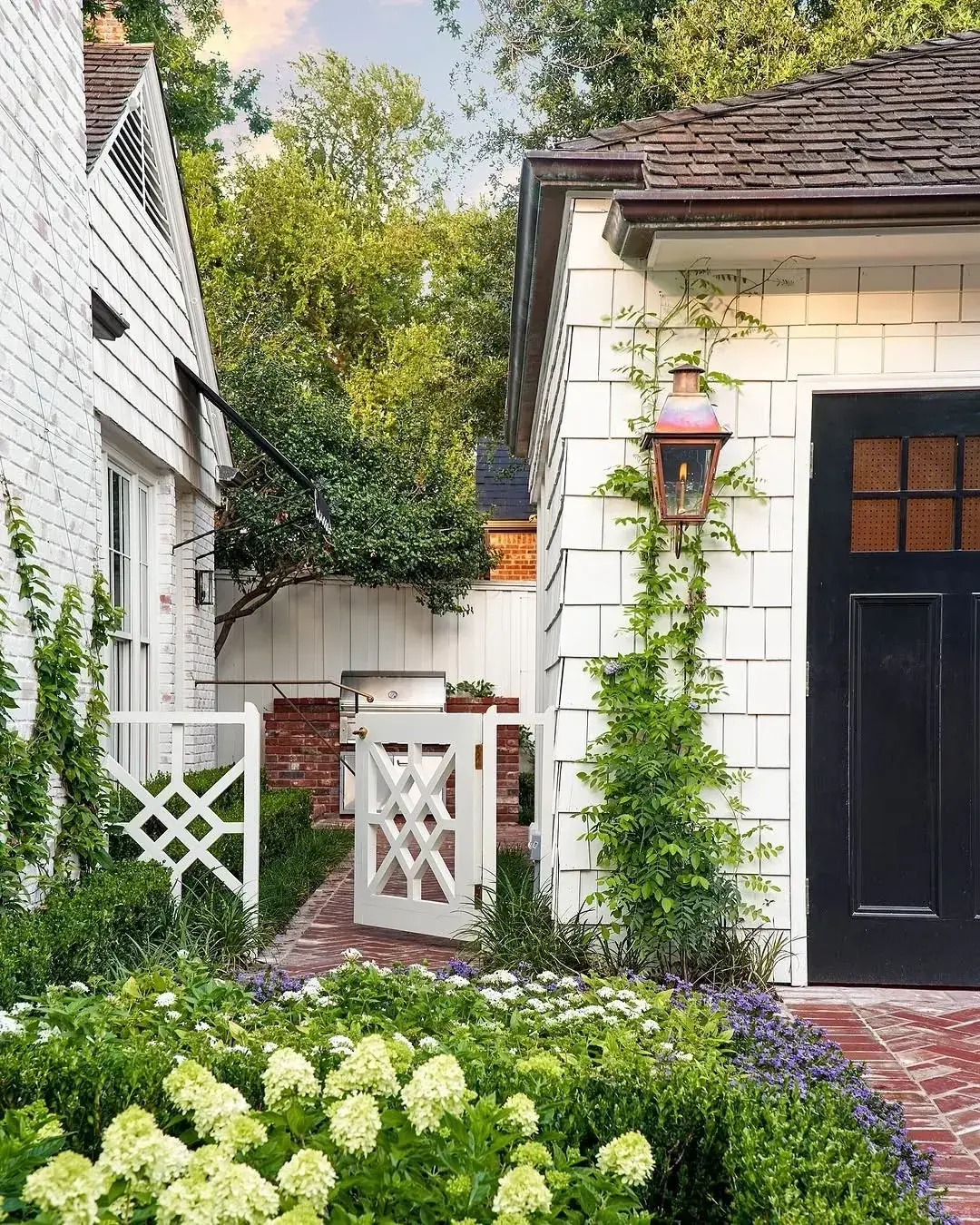
White shingle, a black panelled door with amber glazed bars across the top, a copper lantern burning beside it, a climber threading up the wall. A white lattice gate stands open onto brick. Hydrangeas and violet planting fill the beds.
Amber glass warms a black door the way no paint can. Clear glazing on black shows the dark hall behind and deepens the slab; amber bars throw honeyed reflections back at the path and the door glows instead of absorbing. The vine wants management, not removal. Growth trained on wires a finger width off the shingle dries after rain; growth plastered to the paint holds damp and lifts the film.
Copper beside black is the metal pairing to copy. Chrome cools black and brass can shout; copper glows amber at dusk and lends that warmth sideways to the paint. A young climbing clematis in a 3 litre pot lists at £12 to £25 in 2026. Fix training wires with vine eyes driven into mortar joints, spaced to keep stems off the finish.
Paint the gate with the door
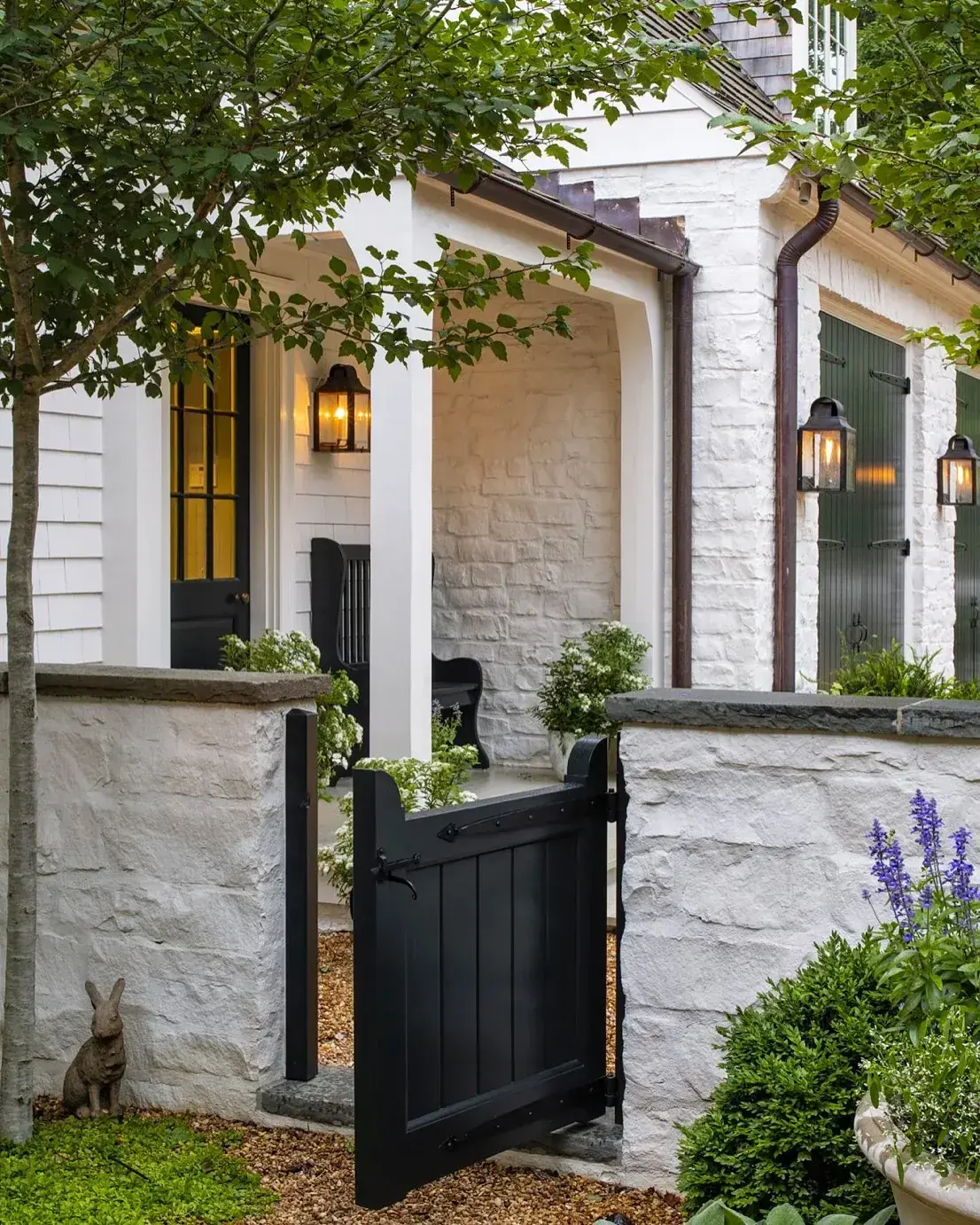
A whitewashed stone wall, a black board gate standing open, a black glazed door behind it, bronze lanterns lit on both sides. A stone rabbit sits in the bed. Violet spikes rise beside a pale planter.
Gate and door share one black, and the entry reads as a single decision from the lane. Two near blacks at an entry this small would look like a supply problem. Whitewashed stone is the wall that most needs the dark: without it the whole front glares white and the planting has nothing to push against. The bronze lanterns sit warmly beside the black without copying it, which is the correct call; hardware in a second finish should relate, not clone.
Paint gate and door from the same tin in the same week. A made-to-measure ledged and braced softwood gate in this size costs £250 to £600 in 2026 before ironmongery. Hang it on proper tee hinges with the heel clearance set before painting, because a gate that drags strips its own bottom edge down to bare timber within a month and rots from there.
Frequently Asked Questions
Will a dark door work if my walls are not white?
Cream, pale render and weathered timber all give a near black enough contrast to anchor the front. Mid tone brick and grey render are harder partners, since the leaf then floats without a backdrop. Where the wall is already deep, a timber finish or a saturated colour generally settles better.
Must the shutters be the identical tin as the door?
The undertone family must agree, even where the tins differ. True black shutters with a blue leaning leaf jar in daylight. Test boards of both held together outdoors, and buy the trim from one batch so the joints never show a line.
Which coating forgives an old leaf best?
Exterior satin hides filler, dents and lap marks while wiping down easily. Mirror gloss belongs on new sprayed timber and maps every repair on older joinery. Dead flat chalks in sun and scuffs around the knob within months.
Does a sun facing leaf blister or warp?
Heat builds fast on a dark face, so south and west aspects stress both film and timber and shorten the cycle between repaints. Sealed edges, thin coats and a vented storm panel all help. Check cover terms before coating composite or plastic leaves, since several makers exclude dark shades.
How do I stop the entry looking gloomy?
Glazing in the leaf borrows daylight, and an oversized lantern with a warm bulb lifts shade far better than a small cool one. Twin fittings beat a single where the facade allows symmetry. Pale sidelights and casing keep the dark framed instead of swallowing it.
What upkeep does the finish actually need?
A seasonal wash with mild soap clears pollen, salt and hand grime before it dulls the film. Chips get dabbed promptly since pale primer flashes through dark paint from the street. Keep a labelled jar of the mix, because fan decks retire shades without warning.
In order
- Bring the casing, the stops and every edge into the same black as the door.
- Choose an off-black and test it outdoors against the actual wall.
- Use exterior satin rather than gloss or flat.
- Take the door off, lay it flat, and paint the top and bottom edges.
- Pick one hardware finish and repeat it on the lantern and hinges.
- If it faces the sun all day, check the warranty before going dark.
This article may contain affiliate links. We may earn a commission at no extra cost to you.