13 Rustic Home Decor Ideas That Let the Building Do the Work

Add us as a preferred source to see more stories on Google.
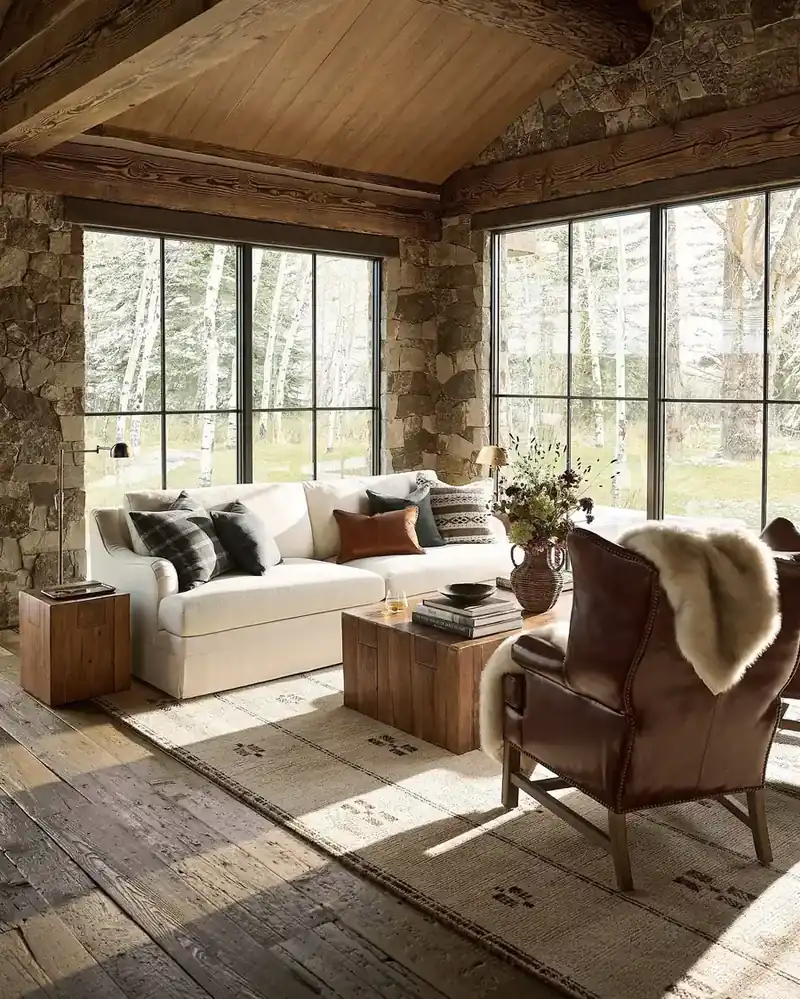
The sofa in the room below is completely plain, and it is the most important decision in the photograph.
Cream, loose-covered, no pattern, no trim, no visible frame. Against stone walls, a reclaimed timber ceiling, exposed beams and rough-sawn floorboards, it is the only smooth thing in the room.
Put a plaid sofa there instead, add an antler chandelier and a carved sideboard, and the same room becomes a lodge. Same building, same view, entirely different result.
Where the roughness should live
Sort every surface in the room into one of two groups, and keep them separate.
Rough, and it is the building: stone, exposed timber, reclaimed boards, brick, lime plaster, unglazed terracotta. These are permanent, they were there before you, and they are what people came for.
Smooth, and it is the furniture: plain upholstery, a simple table, a flat-weave rug, unfussy ceramics.
The failure is putting rough in both groups. The building is already saying rustic at full volume, and repeating it in the furniture is not emphasis; it is noise.
The plain sofa is doing the hardest job
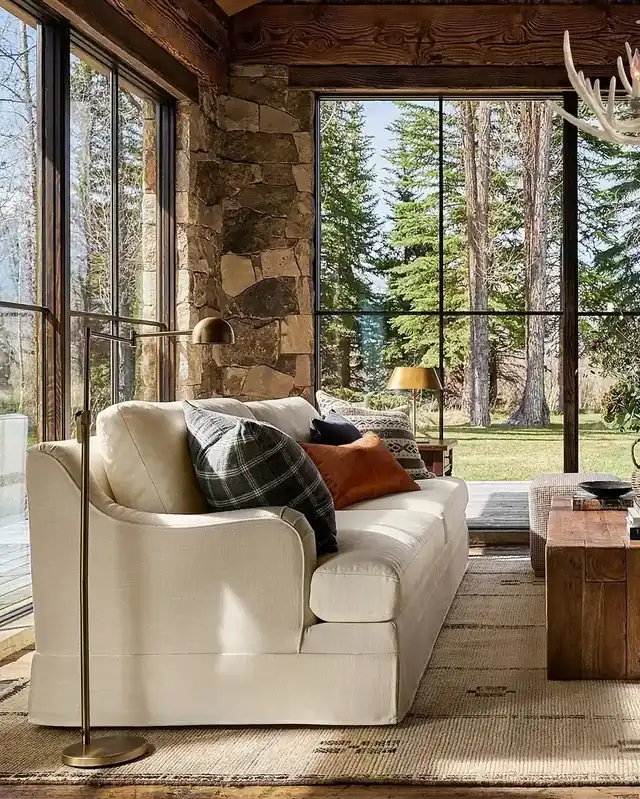
The sofa above is a loose cover in a single flat colour, and that is the whole reason it sits easily in a room built of stone.
A tight, tailored sofa against a stone wall reads as office furniture that arrived by mistake. A loose cover softens the outline and takes the eye off the joinery. The skirt also hides the feet, which matters more than it sounds: legs lift a sofa off the floor and make it lighter, and in a room this heavy, lighter is not always what the room wants.
Seat height is the measurement that decides whether a plain sofa looks generous or mean. Aim for 450mm from floor to the top of the seat cushion, with a back around 800mm. Below 420mm the sofa looks low and casual, which suits a barn and sits oddly under a 2.4m ceiling.
For the cover, a washed linen union in oatmeal creases and relaxes as it is sat on; a poly-cotton keeps its shape and reads flat. Sofas and Stuff and Loaf both sell loose-covered sofas from about £1,200 to £2,500, and IKEA EKTORP covers run £150 to £400 if the frame is already in the house.
The one leather chair
There is exactly one obviously rustic piece of furniture in that room: a brown leather wing chair with a sheepskin over it.
One is the right number.
It gives the eye something aged to land on, it relates to the timber overhead, and it stops the plain upholstery reading as a showroom drop-in that happened to be delivered to a stone house. One genuinely old thing does a great deal of work in a room full of new soft furnishings, and it does not have to be expensive; it has to be old.
Two or three and it tips. A leather sofa, two leather chairs and a leather ottoman in a stone room is a hunting lodge, and it is considerably darker to sit in than people expect.
The same applies to antiques. One old piece in a rustic room is a pleasure. A room furnished entirely in old pieces, inside a building that is itself old, gives you nowhere modern to rest.
Two leather chairs are one decision
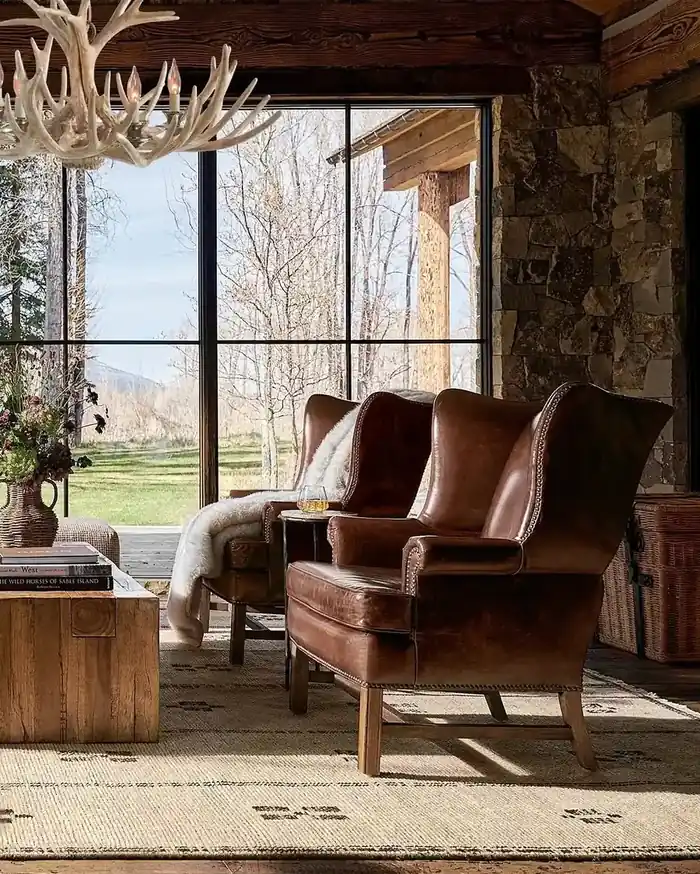
Two cognac wingbacks face the view, so the rule about one leather piece needs a qualification.
A pair is not repetition. Two chairs that match each other read as a single idea, because the eye groups them before it starts counting. What tips a room is three different leather things: a sofa, a chair, and an ottoman, each in a slightly different brown, each asking to be looked at separately.
These two also carry the only themed object in the shot, the pale antler chandelier overhead. It works because there is exactly one of it. An antler chandelier, a carved bear and a pair of snowshoes on the wall is a lodge; one antler chandelier above two plain chairs is a decision.
Wing chairs want a seat 480 to 500mm high and a back that clears the shoulder, and they need 900mm of floor behind them if they are going to be pulled out. Secondhand wing chairs at auction run £150 to £600, and the leather on an old one is usually better than anything new at that price. New cognac wingbacks start around £700 and climb past £1,800.
The leather here is a warm mid-brown with visible grain and a soft sheen. An aniline-dyed hide gets you that, and it will darken where hands and elbows land. A corrected, pigment-coated hide stays even and can look like vinyl by year five.
| Hide type | What happens over ten years | Chair, new (2026) |
|---|---|---|
| Full aniline | Darkens, marks and softens; scars stay visible | £1,400 to £2,800 |
| Semi-aniline | Colour holds; light patina at the arms | £800 to £1,500 |
| Corrected and pigmented | Uniform and flat; can read as vinyl | £400 to £900 |
| Bonded or split | Surface lifts at the seams by year three | Under £400 |
A table made from the building
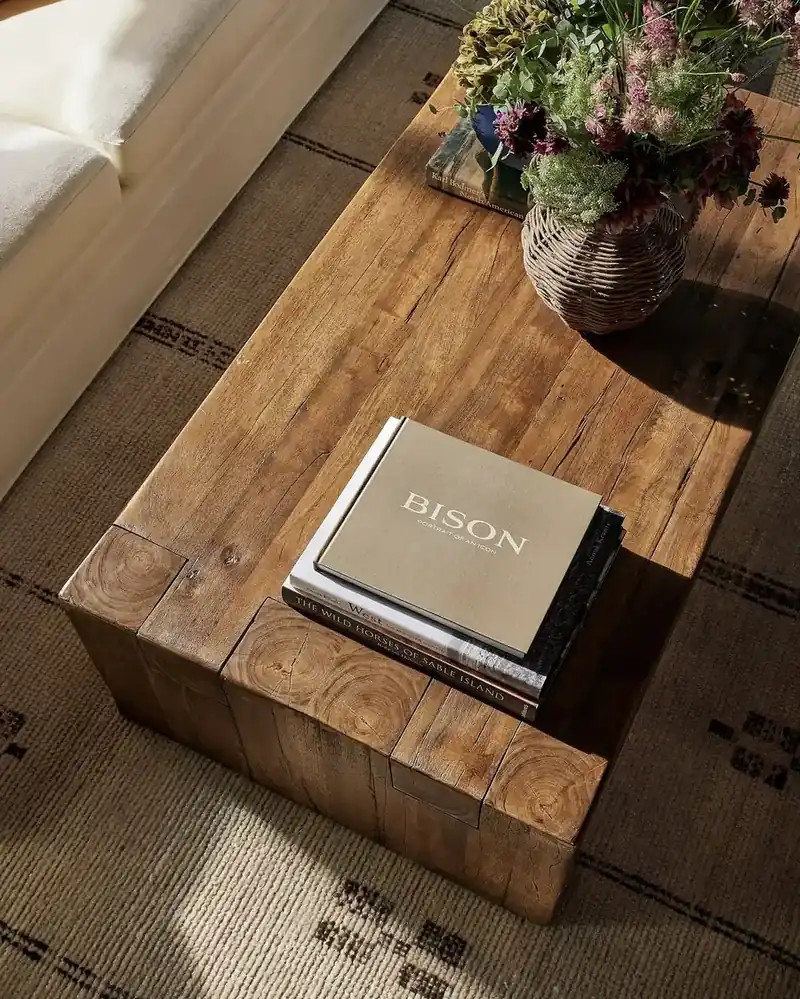
This is the closest a piece of furniture gets to being part of the architecture: a coffee table built from stacked blocks of reclaimed pine, laid end-grain up, with the saw marks and the growth rings still on show.
It works because it is the only rough thing below eye level. The rug beneath it is a flat weave with a dark broken stripe, the sofa arm at the left is smooth cream, and the table supplies all the texture the seating area needs. Put a rough oak bench beside it and the two compete.
The styling is two books, one jug of dried stems, and a great deal of empty timber. That empty half is what lets the grain read; a full surface would bury it.
The practical side matters. End-grain blocks are sections of solid pine, usually around 100mm square, glued and dowelled into a slab. They move with the seasons, so the maker has to finish all six faces or the block cracks along a glue line within a year. Reclaimed pine is cheap and soft; a table this size takes roughly £60 to £150 of timber and a weekend, or £200 to £600 from a maker who has already learned the cracking lesson. A coffee table sits at 400 to 450mm, and this one is at the lower end, which suits the low sofa.
The banquette, and the seating under the beams
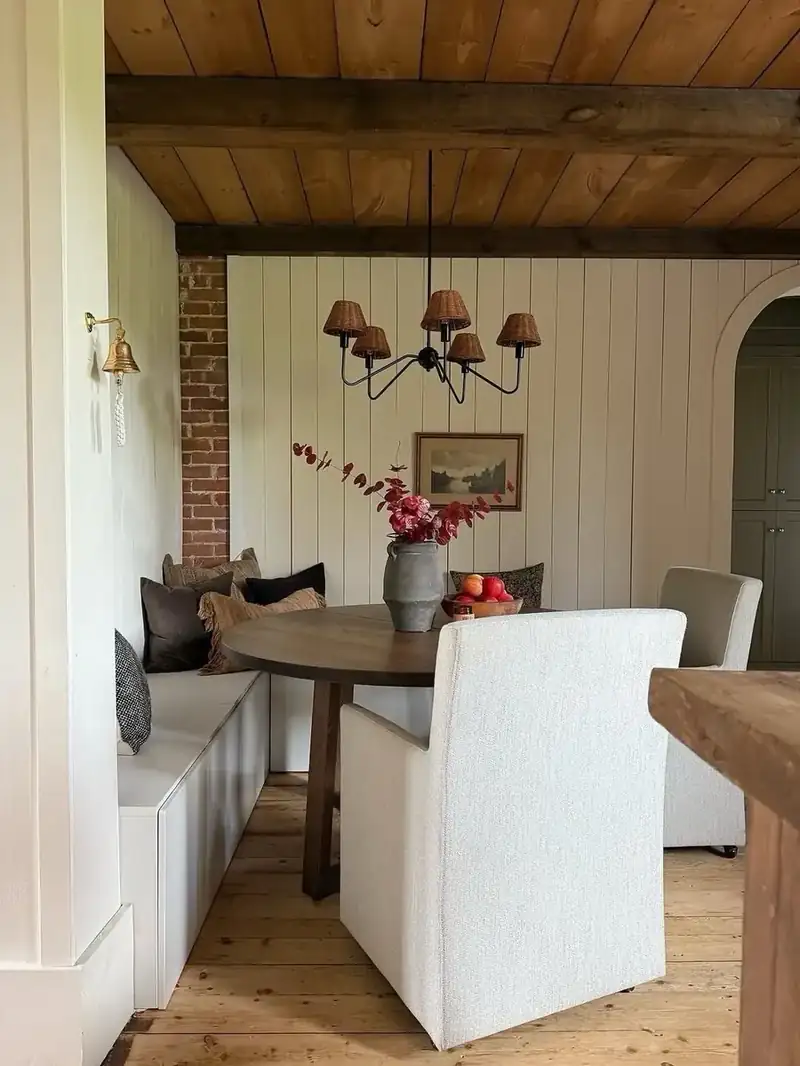
Look at the bench before the ceiling. A built-in banquette runs along the panelled wall, painted the same off-white as the wall itself, with a grey seat cushion and a scatter of cushions that are deliberately not matching.
The reason a banquette reads calm in a room like this is that it removes chair backs from the sightline. Four loose dining chairs around a table give you four vertical shapes and four sets of legs; a bench gives you one long horizontal, and the eye stops working so hard. That is the whole argument for building one in.
The numbers are fixed by the body. Seat height 450mm, seat depth 450 to 500mm, table top at 750mm, and 600mm of table edge per person. Get the seat height wrong by 50mm and every meal is eaten with the shoulders up.
Two slipcovered chairs complete the setting, and they are the same move as the sofa: plain, pale and smooth, so the panelling and the brick can be the texture. A joiner builds a bench like this for £800 to £2,500 depending on the size, and the cushion in a linen union over 100mm foam runs another £150 to £400. A banquette cannot be moved, and it fixes where the table sits, so tape the footprint on the floor for a week before committing.
The kitchen keeps its colour quiet
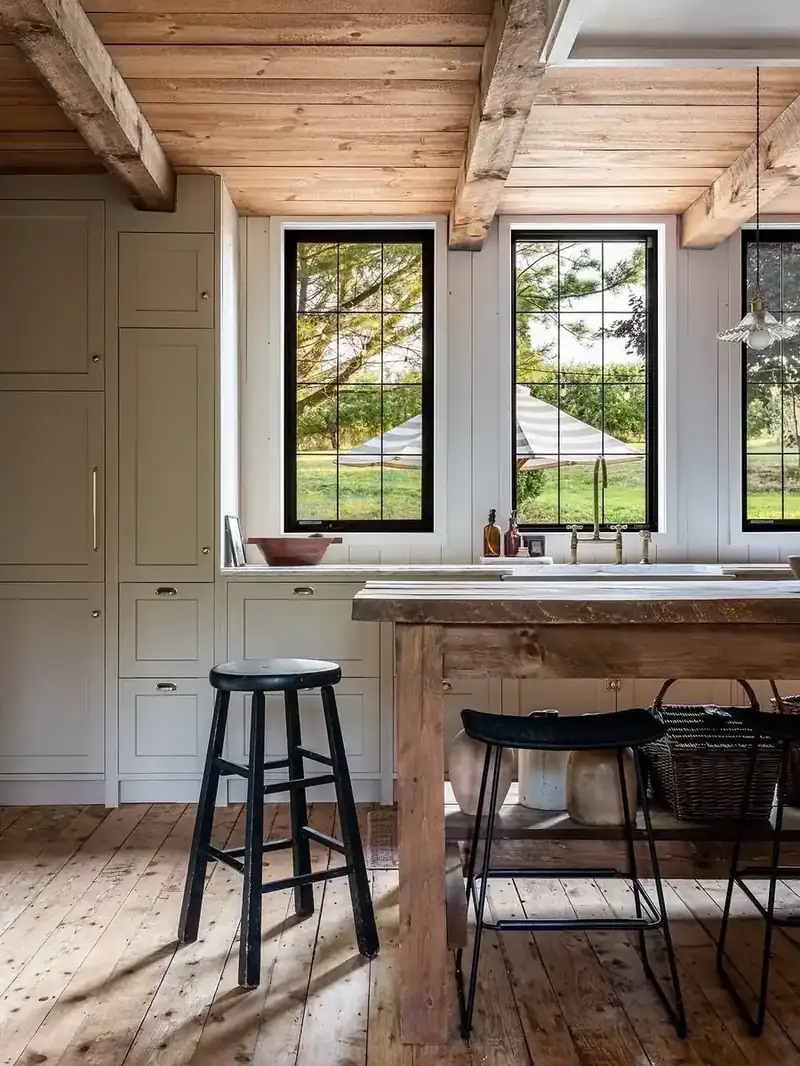
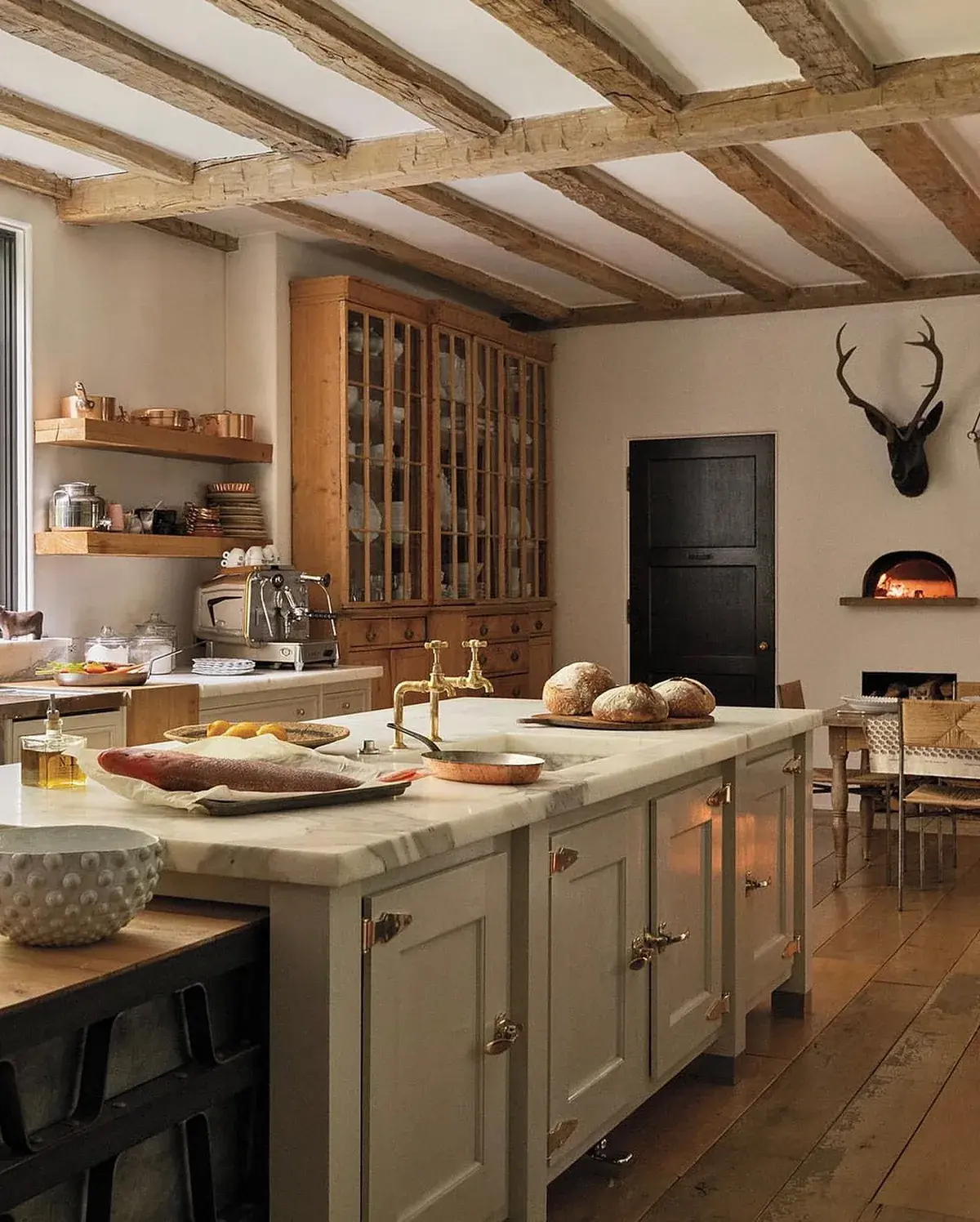
A rustic kitchen does not need a rustic island. This one is timber, thick and pale, standing on a lower shelf that holds two stoneware crocks and a wicker basket, and everything around it has been kept smooth.
The cabinets are a soft grey-green, the splashback is white tongue-and-groove, the windows are black-framed, and the only metal in the shot is brass. That restraint is why the timber reads as the point instead of as one more brown thing.
A top of 60 to 80mm is what gives the island its weight. Below 40mm it looks like a worktop on legs. End-grain butcher block in oak or elm runs £250 to £450 per square metre, and at this thickness a 2.4m run wants a leg or a steel flat bar under the middle, because solid timber sags slowly and quietly.
Farrow & Ball Mizzle No.266 and Little Greene Portland Stone 77 are both in the right family for the cabinets: pale, slightly dirty, green rather than blue. A clean white cabinet beside this island makes the timber look grubby by comparison.
The black stools are the practical note. At a 900mm island the stool seat sits at 650mm, and a backless stool tucks away completely, which matters when the island faces the room.
The textiles
Muted, and in a narrow range. The cushions in that photograph are a soft check, a grey stripe, a rust leather and a woven wool, and every one of them is quiet.
The rug is an antique flat weave, faded to the point where the pattern reads as texture rather than as a design. That is the right kind of pattern in a rustic room: old, muted, low contrast.
What generally fails is a new rug with a strong pattern. Against a stone wall it competes, and the stone wins, so the rug simply looks busy.
Sheepskin is the acceptable indulgence and works best draped rather than laid; one is charming and four is a costume.
Colour
Almost every colour in a rustic room has already been chosen by the materials. Stone is grey or buff, timber is honey or grey-brown, leather is cognac, and none of it came off a chart. The decorating decision is only how much to add on top, and the answer is very little.
Colour belongs in the things that age. An unglazed terracotta pot chalks as it dries, a copper pan dulls from orange to brown, cloth-bound books fade along the spine, and a rust leather cushion darkens where it is sat against. These shift on their own, so the colour is never quite the same twice, which is what the timber and the stone are doing anyway.
A saturated colour in a fixed place is the thing to avoid. Paint a wall a strong green or blue and the material behind it stops being visible; the room loses the surface it was built on and gains a decision. Joinery is the exception, because there the paint is the material. Farrow & Ball Green Smoke No.47 and Bancha No.298 both sit at the right depth for panelling beside pine, whereas a clean, saturated green against that timber looks like a shop window.
Where a wall must be painted, match it to what it stands beside. Lime plaster in the tone of the stone, or a pale board colour on a panelled wall, keeps the surface reading as material. It also leaves the room with no colour scheme to go out of date, and a house you intend to keep is the better for that.
The reading chair, and what is draped over it
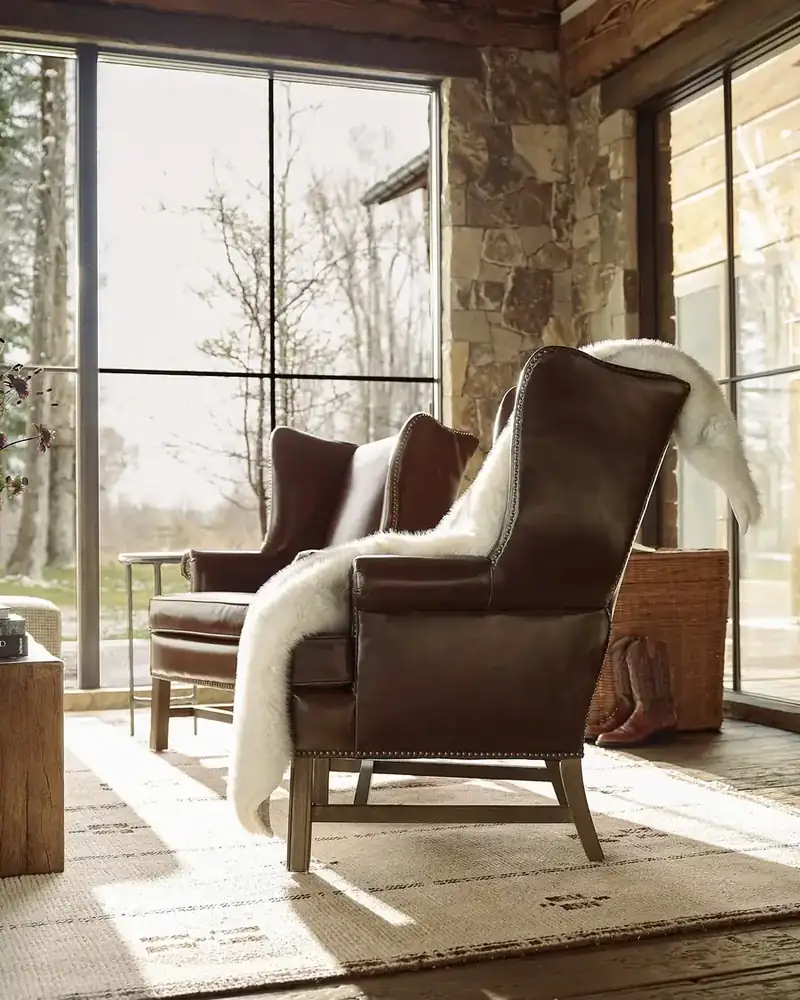
The throw is the point of this photograph, not the chair. A cream shearling is folded over the back of a dark leather wing chair and left to fall down the seat, and it is the only soft surface in the frame.
Look at where it sits. It covers the back and the seat, the two places the body actually touches, and it is not draped over an arm or thrown on the floor. A single sheepskin, roughly 90 by 60cm, is too small for a wing chair and slides off; a throw of 130 by 170cm covers the back and the seat with enough left to tuck. Real shearling costs £80 to £250 depending on the size of the fleece. The polyester version at £25 pills into a mat within a season, and it is the one place in this scheme where the cheap option is obvious.
The two chairs here are the same pair idea as before, in a darker brown. The eye reads them as one thing because they are identical, which is the trick that lets two leather chairs behave like one.
The window is doing the rest. Winter light through bare trees is cold and flat, and the cream fleece and the pale rug are what stop the room going grey with it. Sheepskin wants a shake and a cool wash once a year; put it in a hot machine and it becomes a felted rectangle.
Three cushions, three materials
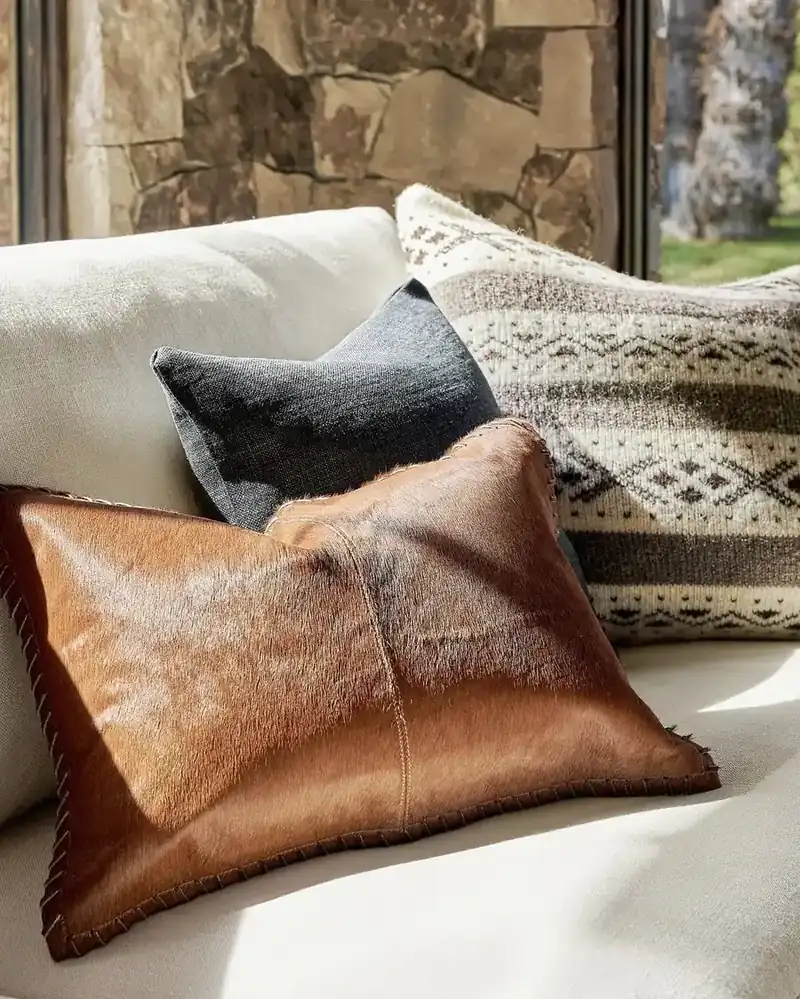
Three cushions, three different surfaces, one narrow range of colour. The front one is hair-on-hide in cognac, whipstitched along the edge, with the spine of the hide still visible down the middle. Behind it sits a charcoal linen square with a slubby weave. Behind that, a cream and brown knit with a banded geometric pattern.
The reason it works is that nothing here matches. Same palette, three textures, so the eye gets variation without a second colour entering the room. Buy three cushions in the same fabric and the sofa looks like a showroom display; buy three in different colours and it looks like a jumble.
A 500mm square cover in washed linen runs £25 to £60; a wool knit £40 to £90; hair-on-hide £60 to £180. Cushions look full at 500mm with a 550mm insert, and a feather and down insert holds a crease where a fibre one goes round. In a house with a cat, skip the hair-on-hide: it sheds, it cannot be washed, and claws lift the surface in a single afternoon.
The stone behind the sofa in this shot is what the cushions are answering. Every texture on the sofa is soft and every texture on the wall is hard, which is the whole arrangement in one image.
Two ottomans and one tray
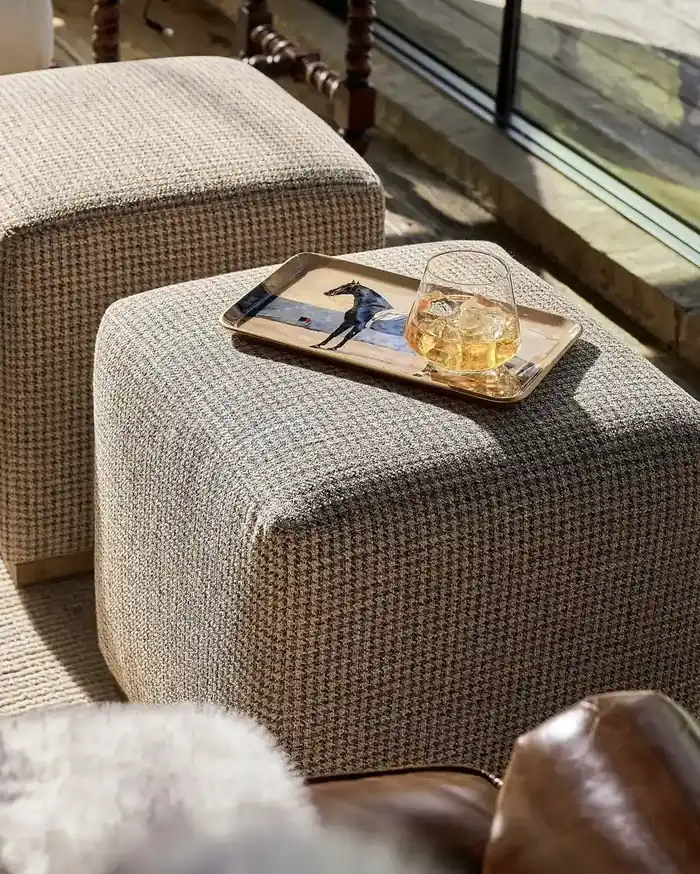
A coffee table is not the only answer. Two square woven ottomans are pushed together here to make one low surface, with a metal tray holding a glass and a printed horse on top.
The reason a soft pair beats a hard table in a room like this is that the room already has stone, timber and glass; another hard rectangle adds nothing and gives the shins something to find. Two 500mm ottomans side by side give a surface of about 500 by 1,000mm, which is a small coffee table by any measure. Leave 400 to 450mm between the sofa and the near edge and it is comfortable to reach.
The tray is doing more than it looks. It turns upholstery into a table without introducing another material, and it contains the spill. Use one, or the glass rings the fabric and the weave holds the mark. Woven ottomans in a bouclé or houndstooth run £80 to £250 each; a vintage brass tray £20 to £80.
Pale woven upholstery and red wine do not belong together, and anyone who eats in this room should think about that before ordering. A dark weave or a removable cover is the practical version of the same look.
The white piano is the plain thing
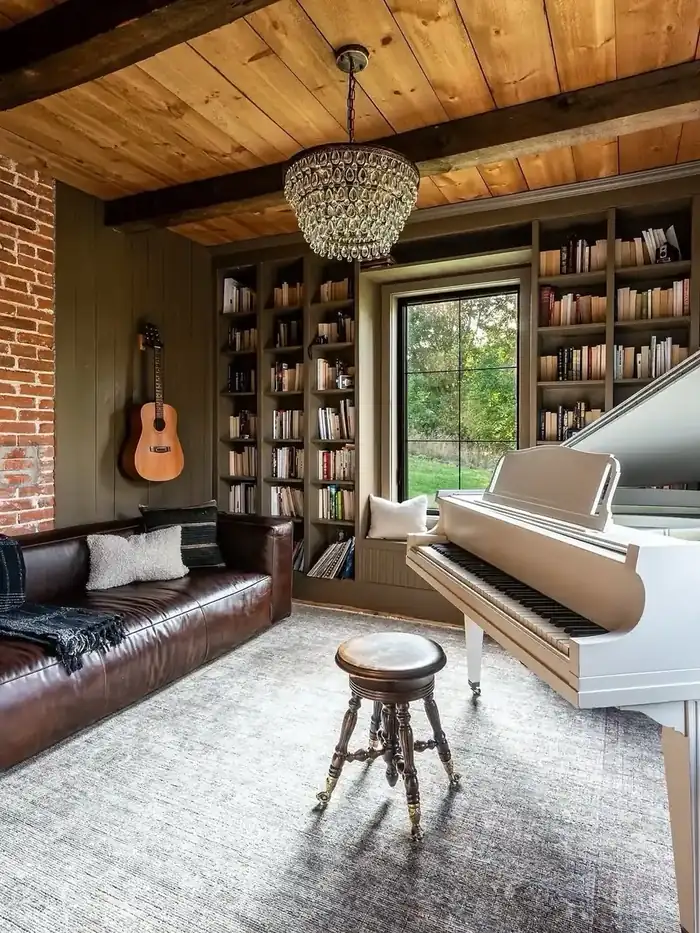
A white grand piano in a room with a knotty pine ceiling and a leather sofa should not work, and it does, for the same reason the cream sofa works in the first image. It is the smooth object. Every other surface here is wood, brick, leather or paper, and the piano is the one thing that reflects.
The olive panelling is the only colour, and it runs from the walls into the bookcases so the joinery disappears into the paint. Farrow & Ball Olive No.13 or Little Greene Invisible Green 27 would get you close to that green: dark, yellow-based, and unbothered by the timber around it.
The bookshelves are the cheapest texture in the house and they are genuinely full, which is the only way they read as a room and not a set. A bay window seat wants a top at 450mm; the rug beneath the piano is 2.4 by 1.7m, and a grand needs about 1.5m of floor and 2m clear at the keyboard.
Hard surfaces plus a piano means a lot of sound bouncing off pine and leather, so the rug is not decoration. Without it, a room like this is loud in a way that photographs never show.
The entry sets the register before you are inside
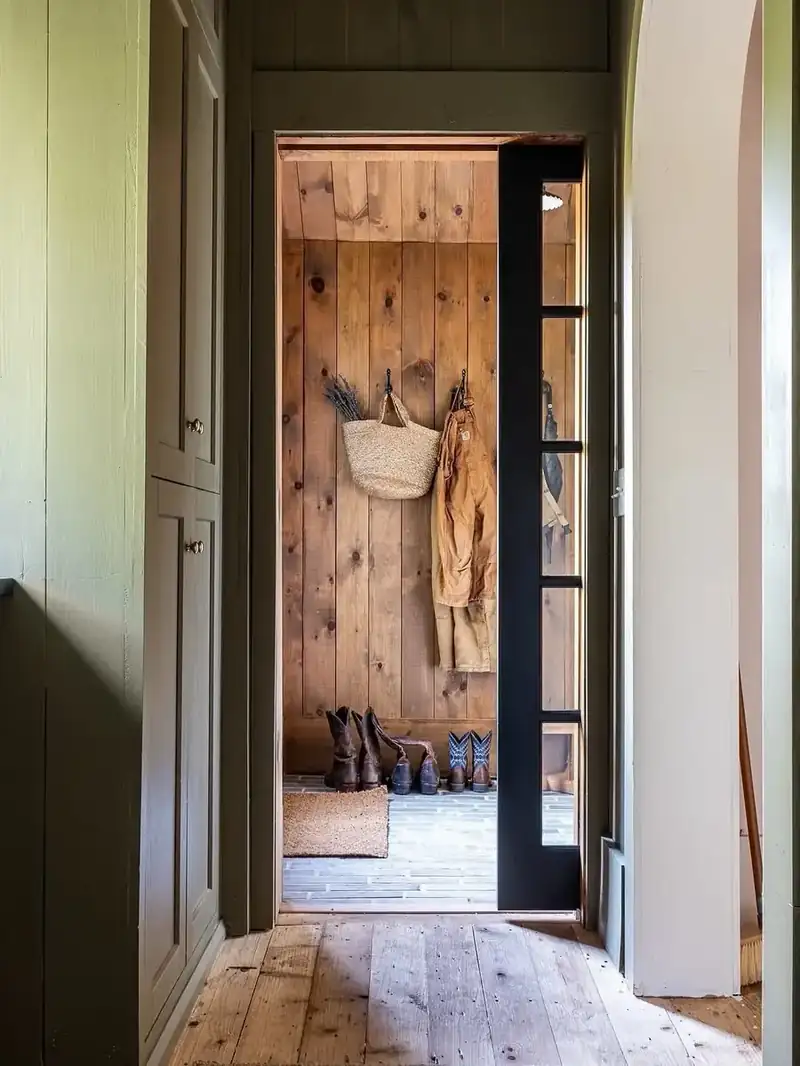
The mudroom in the doorway is the part of the house that proves the rest of it. Knotty pine boards, a row of black iron hooks, a straw basket, a canvas jacket, and boots left on the boards.
Everything on that wall is holding something. The basket carries the shopping, the jacket is a working coat, and the boots are worn at the toe. That is the whole decoration, and it is why the room reads as a house and not a styling exercise.
Hooks want to sit at 1,700mm for adults and 1,200mm for children, spaced 150 to 200mm apart, and there should be two fewer than the family needs so that the wall keeps some grain on show. Black iron or aged brass hooks cost £4 to £12 each. A coir mat at 750 by 450mm takes the worst of the weather, and a shallow boot tray stops the boards going grey at the threshold.
Pine marks. A mudroom floor without a mat and a tray is a floor you will be sanding within two years, and the entry is the one place in a rustic house where the practical answer and the beautiful one are the same answer.
The house itself, seen from the road
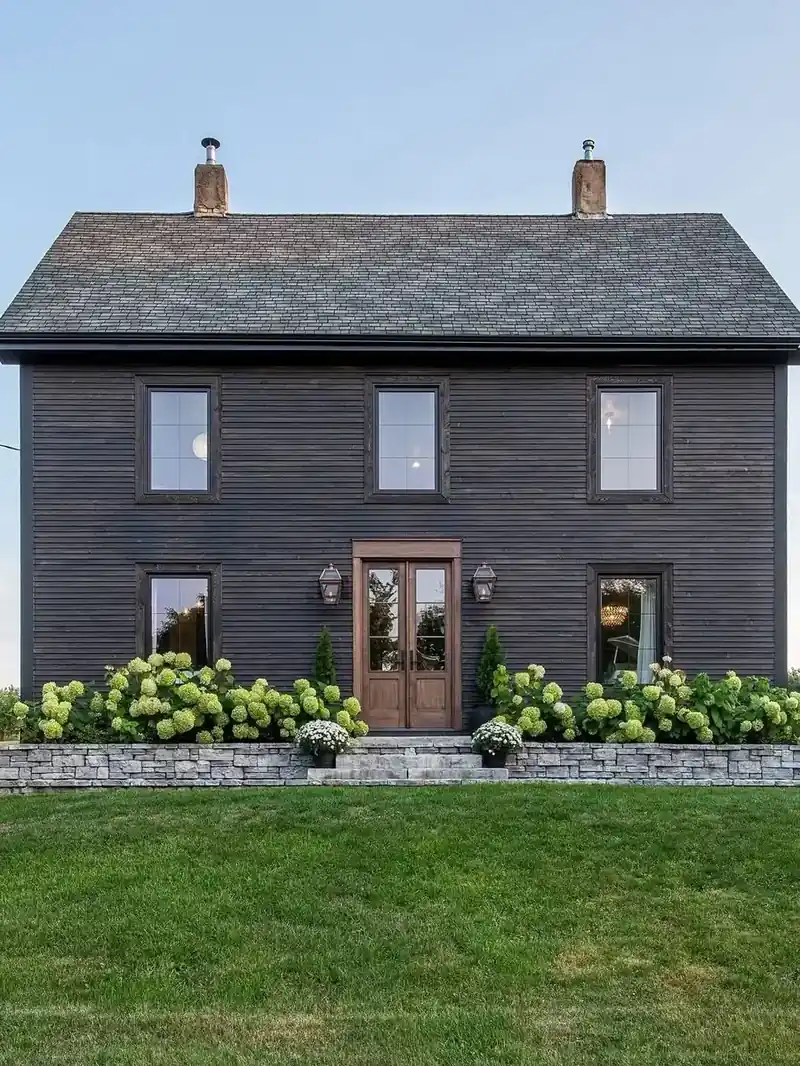
This is an exterior, and it belongs in the argument for one reason: the register does not stop at the front door. A house painted almost black, with a grey shingle roof and a timber door, is making the same decision the living room makes when it keeps the sofa plain and the walls rough.
The palette is doing the work. Two colours and a material: near-black boards, grey roof and stone, and one warm element in the oak door. That single warm note is what stops the whole thing reading as severe, and it is the exterior version of the one leather chair.
A low stone wall at 450 to 600mm gives the planting something to sit against, and the lime hydrangeas repeat the grey of the stone so the two read as one material. Farrow & Ball Off-Black No.57 or Little Greene Lamp Black 228 are the family for the boards; both are softer than a true black and hold up better on timber.
A dark facade shows every mark, every cobweb and every streak of green algae, and on a south wall it gets hot. Budget a repaint every eight to ten years, and site the hydrangeas where they get shade for part of the day or the leaves scorch.
The gravel room under the string lights
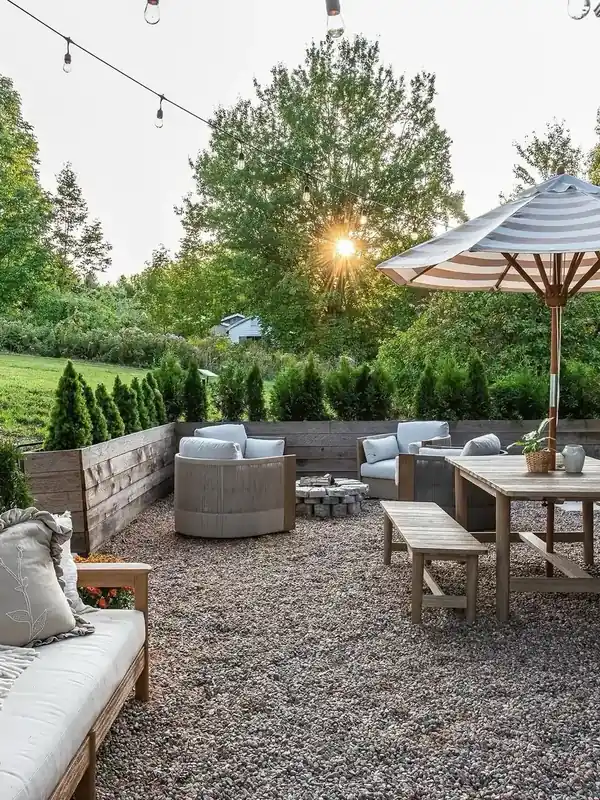
The last image is outside as well, and it is the clearest proof of the argument: an outdoor room built on the same principles as the indoor ones, with a soft floor, quiet furniture, and one thing that draws the eye.
The floor is pea gravel, and it is doing the job a rug does indoors. It marks out the seating area without a hard edge, it drains, and it is the cheapest floor you can lay. Loose gravel at 10 to 20mm, laid 50mm deep, sits over a woven membrane and 100mm of compacted MOT Type 1; skip the sub-base and it ruts and sinks within a season.
| Layer | Depth | What it does |
|---|---|---|
| MOT Type 1 sub-base | 100mm, compacted | Stops the gravel sinking and rutting |
| Woven weed membrane | Single layer | Keeps roots out without going boggy |
| Pea gravel, 10 to 20mm | 50mm | The wearing surface; stays loose underfoot |
| Timber edge | 300 to 400mm high | Holds the level and doubles as seating |
The string lights are 2700K bulbs on a catenary wire, which is the difference between warm light and the blue-white of a cheap kit. A fire pit wants 1.5 to 2m of clear ground and a non-combustible base, and the seating wants to be close enough to feel it.
Gravel is not for everyone: it is loud underfoot, it migrates into the house, and it is unwalkable in bare feet on a hot day. Where it works, it costs very little and it looks like it has always been there.
Where this does not apply
None of this transfers to a modern box, so it is best to know that before buying stone-effect wallpaper.
In a new build the walls are plasterboard, the ceiling is flat and the floor is laminate, so the building supplies no roughness at all and the whole arrangement reverses. The furniture has to carry the texture the architecture lacks: a wool rug with a visible weave, a rough oak table, a linen cover with some slub in it, baskets, unglazed ceramics. A cream sofa against white plasterboard has nothing to push against. It stops reading as restraint and becomes an ordinary sofa.
Small rooms are the other problem. Stone and exposed timber read as weight, and weight needs floor to sit in. Under about 20 square metres, a rough stone wall and a dark beamed ceiling begin to press down, and the honest answer is one rough surface, not four.
Then there is the question of newness. Patina is the entire mechanism here: leather darkens at the arms, oak silver-greys, lime plaster chalks where a hand rests. If those marks would annoy you, this is the wrong direction, and a clean-lined room with one good chair will serve you better.
Frequently Asked Questions
Does a rustic room need exposed stone or beams?
No. The building only has to be rough in one or two places, and a lime-plastered wall or a wide-plank floor will do it. What matters is that the roughness is part of the structure and not something carried in through the door.
How many leather pieces can one room take?
Work to a pair at most, and let them match. One chair is a nice accent; two that are identical read as a single piece of furniture. The trouble starts with a third, in a different brown, that asks the eye to compare.
What colour should the upholstery be in a rustic room?
Oatmeal, ivory, or a warm pale grey, in a fabric with a visible weave, and lighter than the timber around it. A dark or patterned sofa reverses the balance and makes the room read as heavy.
How do I keep rustic from turning into a theme?
Keep every accessory that could be called themed down to one, and keep the palette narrow. If the walls, the floor and the ceiling are already doing the talking, the furniture and the objects should be answering quietly.
Can I use a bright colour in a rustic room?
In one movable object, yes, and the smaller the better. A bright note that can be picked up and put down reads as a choice; the same colour spread across a fixed surface reads as an error, because it hides the material underneath it.
Is gravel a sensible floor for a seating area?
On level ground, with a membrane and a compacted base under it, yes. It drains, it takes a fire pit, and nothing else marks out a seating area so cheaply. Without that base it shifts underfoot, and on a slope it will not stay put.
To start
- Decide whether the building or the furniture carries the roughness, and let only one of them do it.
- Keep the largest upholstered piece plain, pale and loose-covered, with the seat at about 450mm.
- Allow one aged leather piece, or one matching pair, and stop there.
- Let a single themed object, such as an antler chandelier, stay the only one in the frame.
- Keep textiles muted and low contrast, and let an old flat-weave rug supply the pattern.
- Give colour one small object to live in and let the materials do the rest.
- Carry the same palette and materials out to the entry, the facade, and the seating area in the yard.
- In a modern box, reverse all of it: the furniture has to supply the texture the building lacks.
This article may contain affiliate links. We may earn a commission at no extra cost to you.