11 Built-In Bookshelf Living Room Ideas: Closed Storage Below

Add us as a preferred source to see more stories on Google.
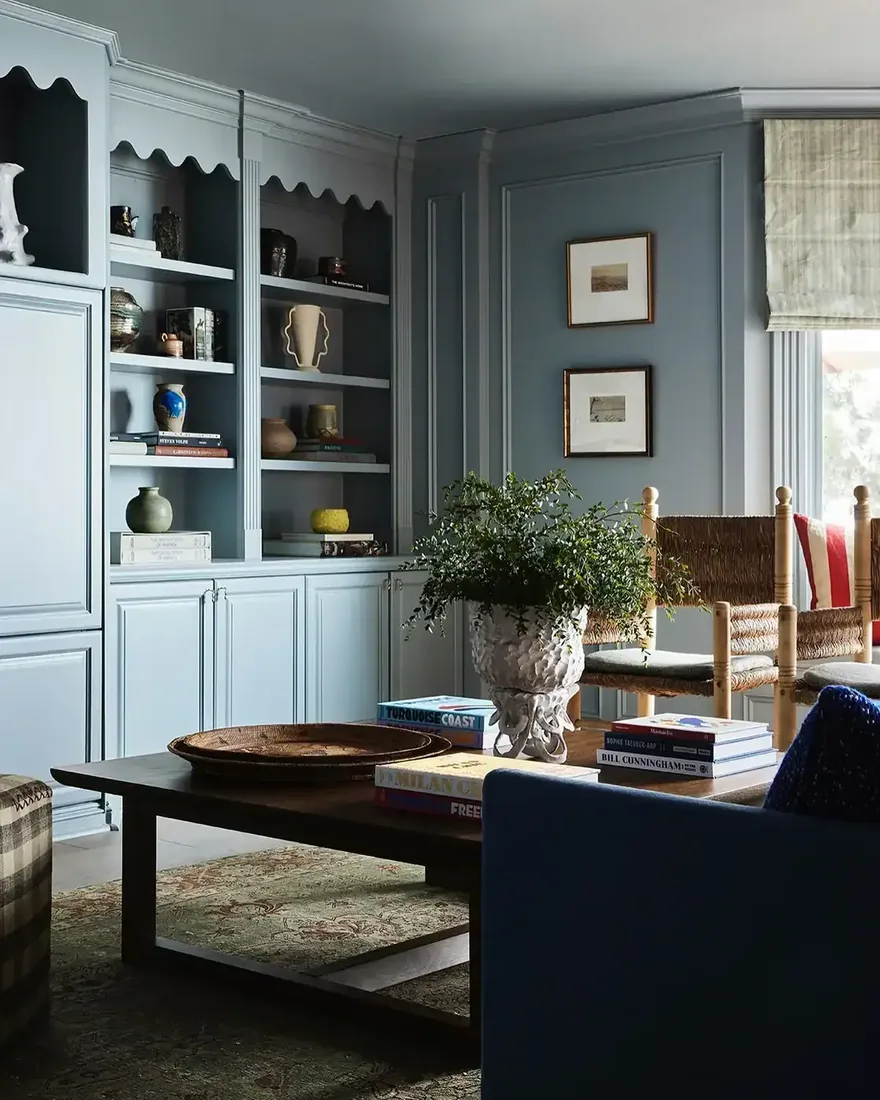
The useful thing in the run below is the bottom half, which is the part people cut from the budget.
Open shelves from about waist height up, and solid cupboard doors below. Everything on display is there because it looks well; everything else is behind a door at knee level where nobody is looking.
Build the same run in open shelving throughout and within a year the lowest two shelves hold chargers, unopened post and a box of cables. That is not a discipline failure. It is what living rooms do.
Where to split it
Around 900mm from the floor, which is roughly counter height and roughly where an armchair back sits.
Below that line, things are hard to see into and awkward to reach, which makes it exactly right for storage and exactly wrong for display. Above it, everything is at eye level and worth looking at.
The cupboard section also gives you a ledge. A solid top at 900mm across an alcove is a lamp shelf, a drinks surface or somewhere to put a bowl of keys, and it costs nothing extra because the carcass is already there.
If the room genuinely has no other storage, take the closed section higher, to about 1100mm. It looks heavier and it works better.
Paint the whole thing the wall colour
Shelves, shelf backs, cupboard doors, the frame, the surrounding wall and ideally the cornice, all in one colour.
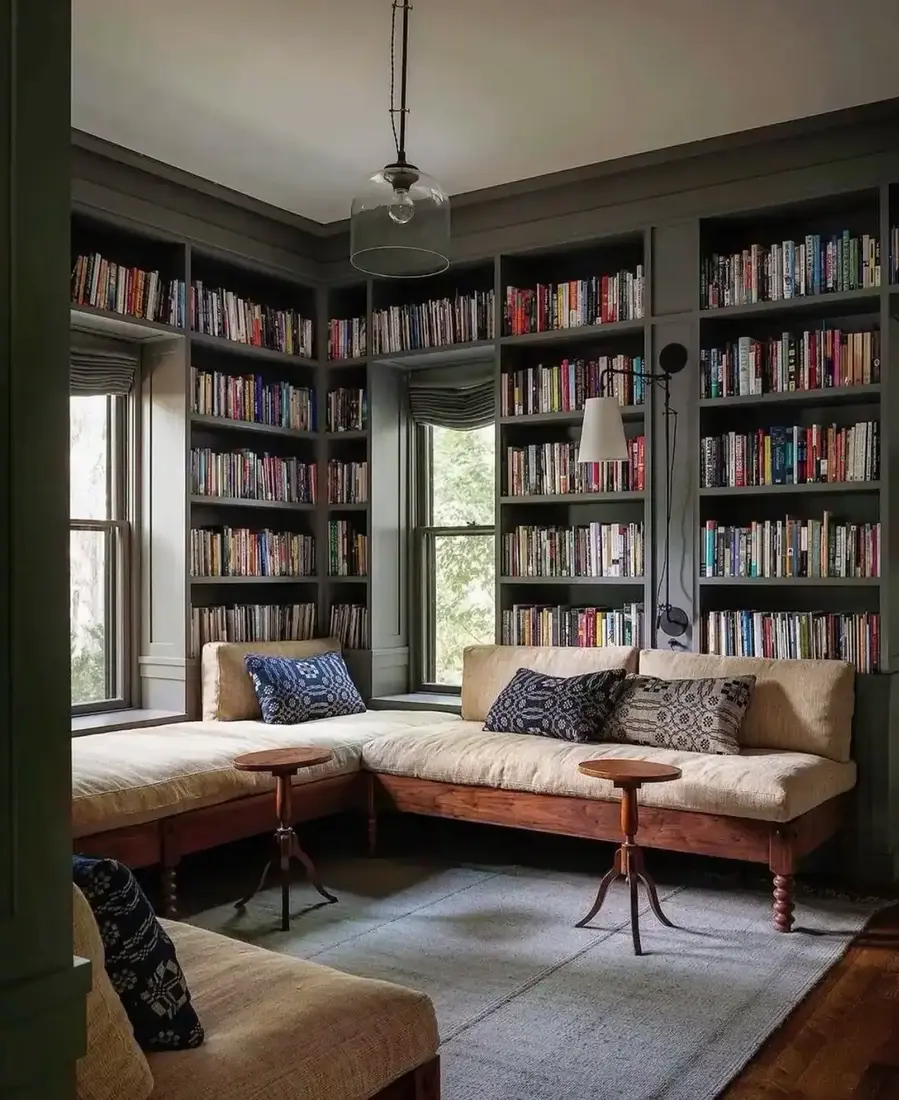
The effect is that the joinery stops being furniture standing against a wall and becomes part of the wall itself. The shelves recede, and what sits on them comes forward. In the room above the colour also runs onto the adjacent panelling and the ceiling, so the whole end of the room reads as one piece.
The alternative, white shelves against a coloured wall, draws a bright grid and makes every bay a frame that demands composing.
Eggshell rather than matt. Shelf edges and cupboard doors get handled constantly and matt marks within months.
Colours that suit this treatment are the deeper, slightly greyed ones: Farrow & Ball Green Smoke No.47 and De Nimes No.299, Little Greene Juniper Ash 115, Benjamin Moore Amherst Gray HC-167. Trade eggshell tinted to match costs a fraction and wears better.
Dimensions that matter
| Element | Sensible size |
|---|---|
| Shelf depth for books | 250 to 300mm |
| Shelf depth for objects and baskets | 350 to 400mm |
| Shelf spacing, books | 300 to 330mm |
| Shelf thickness, painted MDF | 25mm minimum |
| Maximum span without support | 800mm at 25mm thick |
| Split height, cupboard to shelves | 900mm, or 1100mm if storage is short |
Shelf sag is the most common regret. A 25mm painted MDF shelf spanning a 1.2m alcove will bow visibly within two years once it is full of books, and it cannot be fixed afterwards without rebuilding. Either keep spans under 800mm with a central divider, or use 30mm stock with a hardwood lipping on the front edge.
The detail that makes it look made
Look at the shaped valance along the top of each bay in that photograph. A scallop, in this case, though a simple arch or a plain deep fascia does the same thing.
That detail is what separates joinery from a bookcase. It closes the top of the run, hides the shadow gap against the ceiling, and gives the eye something to finish on. It costs very little on top of the carcass work and it is the first thing a joiner will leave out if you do not ask.
The other detail to specify is scribing the whole run to the wall. Old walls are never straight, and a gap of a few millimetres running up one side is the thing that makes built-ins look bought.
Where this is the wrong answer
Rented flats, obviously. And rooms you might reconfigure, since built-ins fix a layout permanently and are expensive to remove.
Freestanding alternatives worth knowing: a pair of tall cupboards with shelving above, or a modular system like the Vitsœ 606 at the top end, are both genuinely good and they move with you.
Cost, for reference: a joiner-built alcove run typically starts around £1,500 to £2,500 per alcove in the UK including painting, and rises quickly with detailing. That is the number that decides most of this.
Dark timber that does what deep paint does
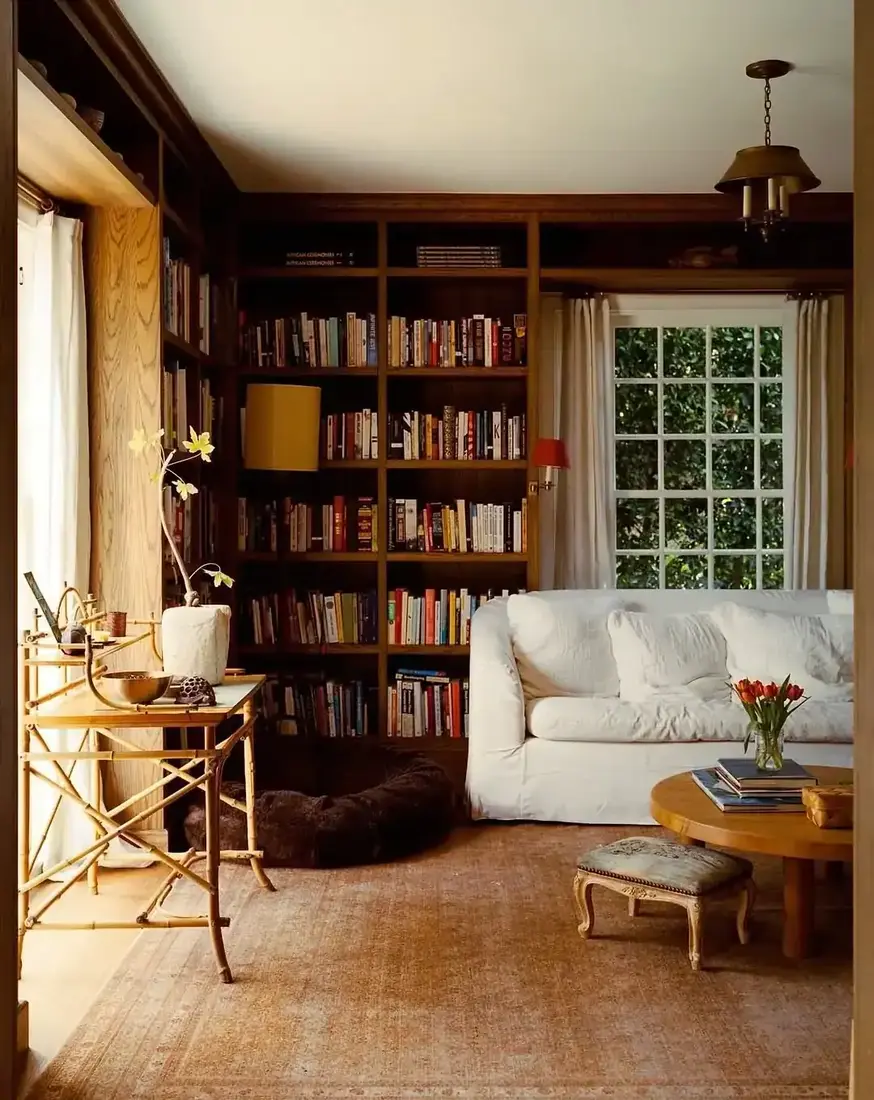
The eye reads this room before it reads the books. Floor to ceiling timber, three bays to the left of the window and three to the right, all stained to a deep brown that absorbs shadow. The shelves, their backs and their uprights are one colour, which is why the whole wall reads as a single volume rather than a grid. White behind brown would have striped it.
That is the same principle that governs painted joinery. Paint the back panel the same colour as the shelves, and the box holds together. Leave it white and the unit fragments, because the back becomes a frame behind the books. The timber here makes the point without paint at all, and it is a useful check for anyone tempted by white everywhere because white feels safer.
Deep tones also make a shallow alcove read deeper, because shelf shadow and paint sit closer in value and the back appears to recede. These bays are not deep, yet the backs do not advance towards you. The books then read as colour, which is the third piece. On dark shelves mixed spines look intentional because the background quiets contrast. On white the same mix can look cluttered, and you would have to edit strictly to keep it calm. Here the spines do the colour work and the timber does the quiet.
Lighting matters more here than in a pale room, because the colour absorbs light. A small lamp on the left at around 2700K, and a pair of shaded wall lights either side of the window, wash the backs evenly. Without them the alcoves would read as holes after dark. Satin or eggshell on painted joinery, not gloss, is the finish that lets this work in paint. Gloss shows every brush mark on a large flat, and under a picture light it ripples.
To get this look in paint rather than stain, try Farrow & Ball Studio Green No.93 or Little Greene Obsidian Green 216, both of which hold depth under warm bulbs. Trade eggshell tinted to match runs £55 to £85 per 2.5 litres in 2026, against £95 to £125 for the branded tins. A stained oak alcove of this size fitted in oak runs £2,800 to £4,500 in 2026, so painted MDF at £1,500 to £2,500 remains the practical route for most houses.
The same room again, and why the twin matters
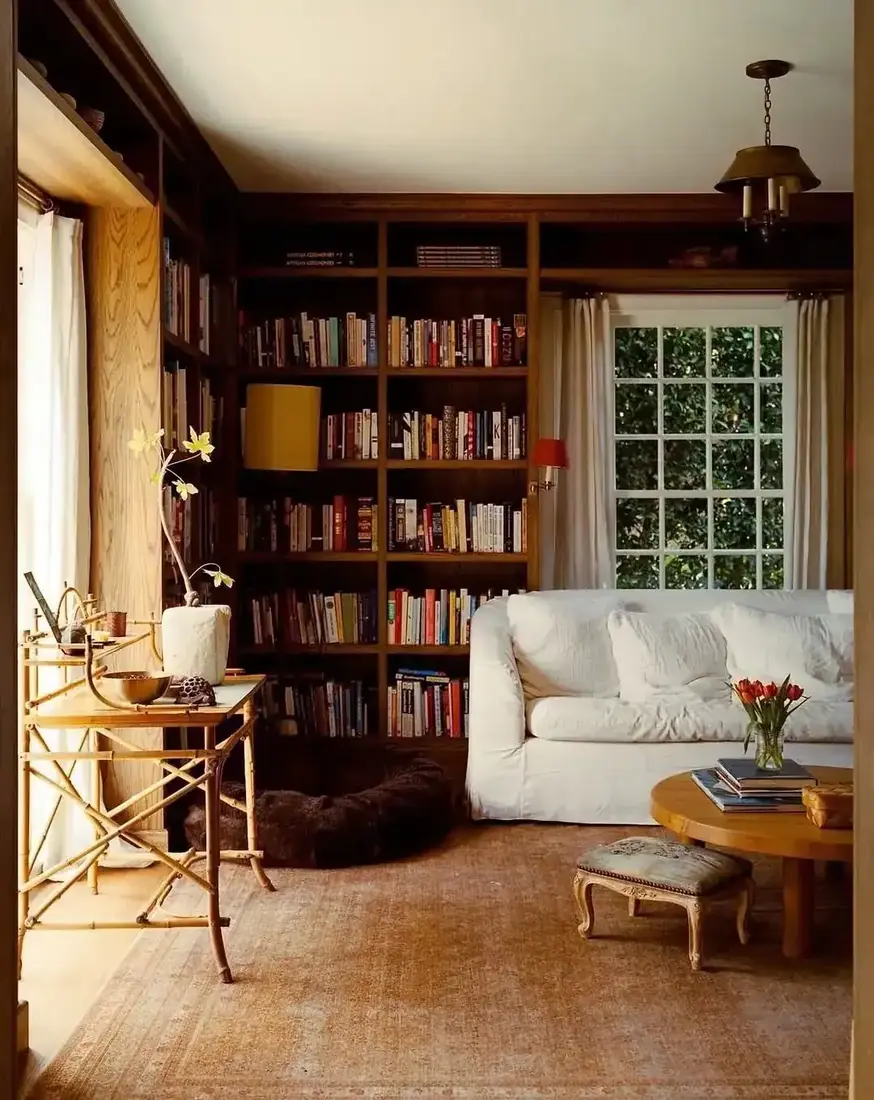
This is, to most eyes, the same room as the one above, photographed from the opposite side. The same dark timber wall, the same window at the far end, the same sofa and round table. The fact that two files hold what looks like one room is worth noting, because it doubles the evidence for the colour decision rather than splitting it.
What you can take from this second view is how the deep joinery behaves as architecture. The wall reads flat because the timber is one tone from skirting to cornice. There is no white trim cutting it, no contrasting back, no bright grid demanding that each shelf be composed. The white sofa in front then has somewhere to sit, because the wall gives it a background that is darker than it is.
The principle generalises. Whether the deep tone is stain or paint, the back must match the shelves, the finish should be satin or eggshell, and the light inside the alcove must be allowed for at the wiring stage. Add a shelf light later and you chase a cable down a surface you just paid to finish. Warm light around 2700K keeps timber amber rather than grey, and it keeps painted deep blues and greens from going dull after dark.
If you are costing this in paint instead of timber, a pair of 300mm profile picture lights over the bays costs £120 to £260 per fitting in 2026, and the electrician’s first fix for them adds around £150 to £300 to the joinery job. That is small against the cost of the carcass, and it is the part people add too late, after the walls are closed.
White shelves framing a doorway, and the colour they rely on
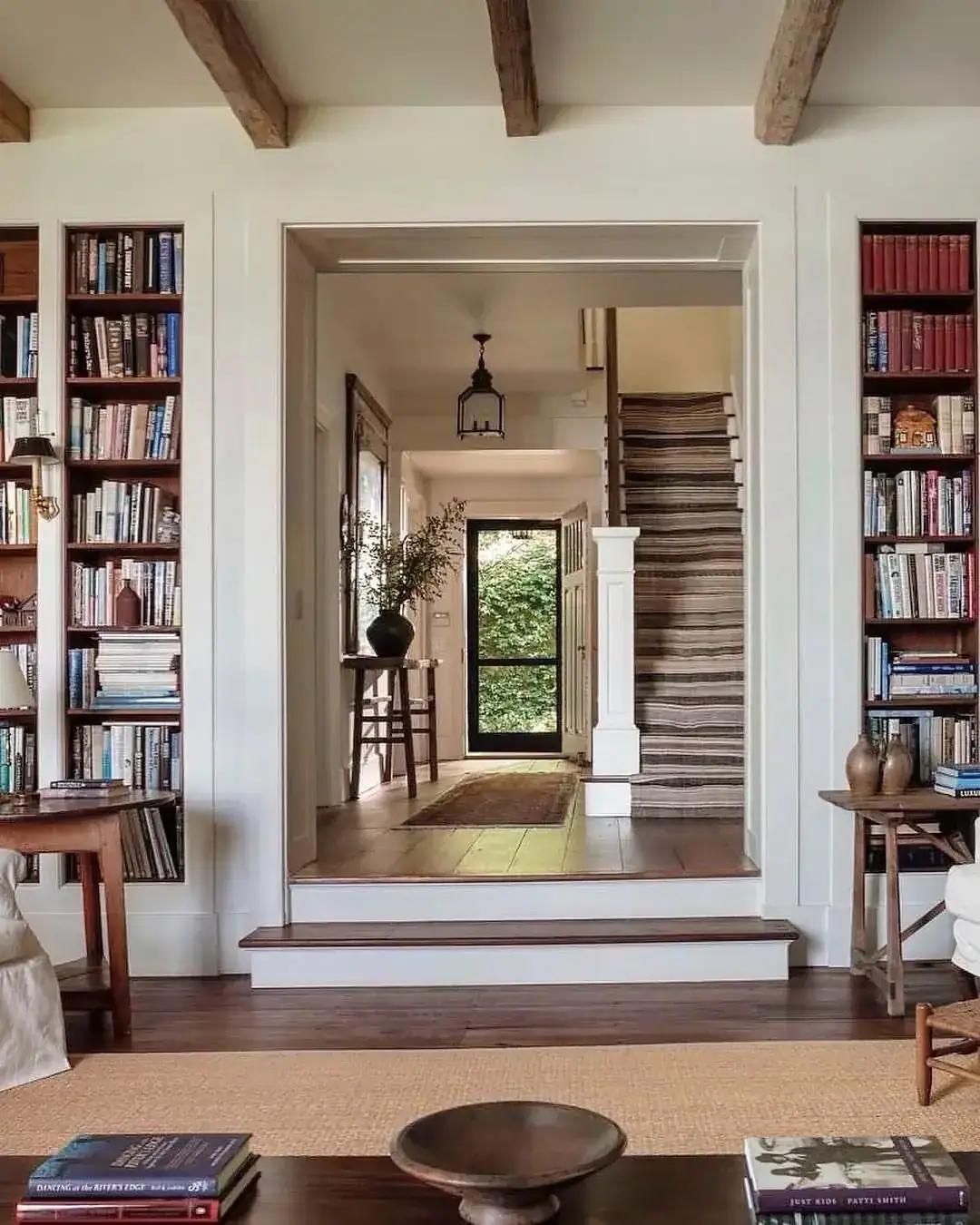
Here the joinery does the opposite. White shelves flank a broad opening onto a hall, with two tall narrow bays either side. Walls, shelves, trim and risers are all white, so the joinery disappears in the way white joinery always does when it sits on a white wall. It is not a flaw in this room, because the books supply all the colour the wall would otherwise provide.
Look at the spines. Packed tight, mixed, slightly uneven in height, with one bay running red to white and the other more varied. On a dark shelf that mix would read as collected. On white it reads busier, and the room relies on the warm timber floor, the striped stair runner and the hall beyond to stop the white from feeling flat. The hall does a lot of work here, its timber boards and the dark-framed glass door giving the eye a place to go.
The lesson is not that white is wrong, but that it leans heavily on other surfaces to do the work deep colour would do itself. A deep painted alcove makes a shallow recess read deeper because shadow and paint are close in value. White does the opposite and exposes every inch you do not have, so you must give it something else: a dark floor, a patterned runner, a view through.
If you have this arrangement and want the joinery to lead instead of vanish, painting the shelves and their backs in a single deep colour would change the wall entirely. Farrow & Ball De Nimes No.299 or Little Greene Juniper Ash 115, both greyed blues, would mark the bays as architecture, and would let the books read as intentional colour and not clutter. Eggshell at £60 to £90 per 2.5 litres in 2026, applied after a proper knotting and priming, is the surface that keeps brush marks out of sight on a wall this large.
A corner where white works because the books are many
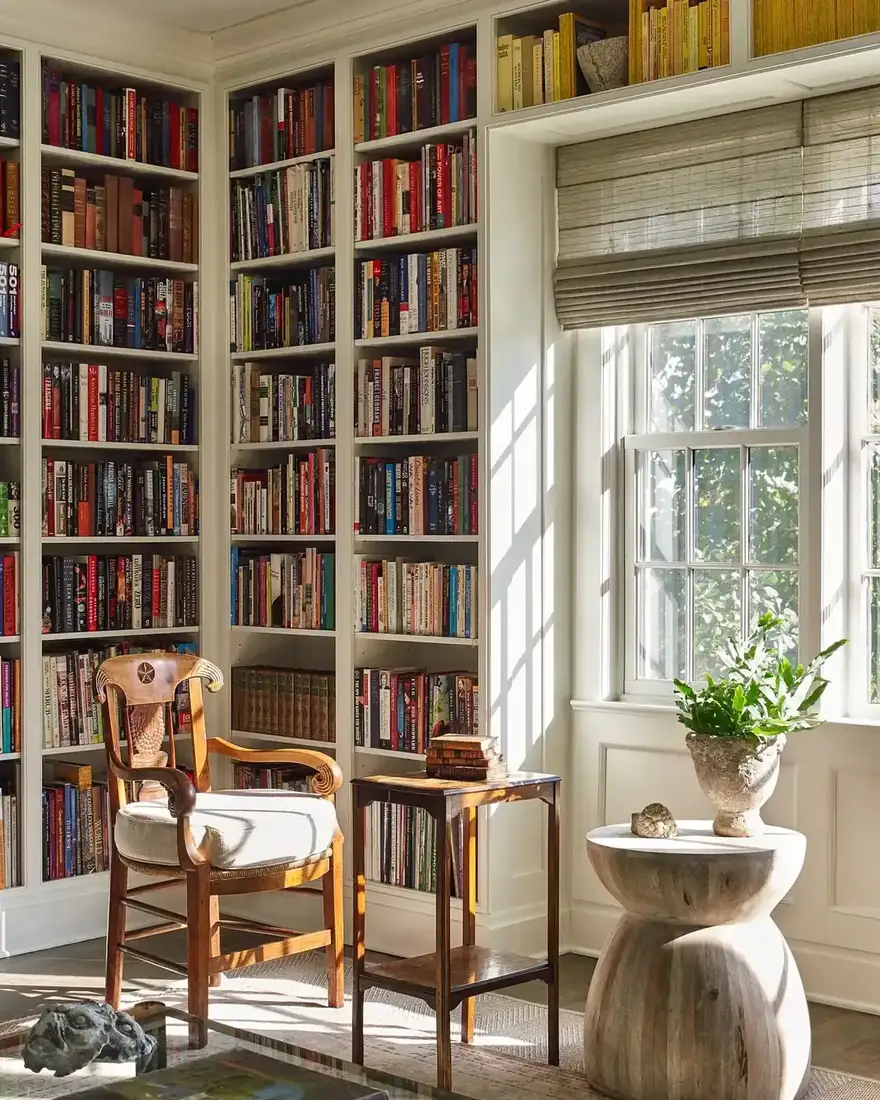
White walls and white joinery turn a corner into a library, but only because the shelves are packed. From skirting to cornice, every bay holds spines, with a few stacks laid flat and a yellow run along the very top. The joinery, as in the last room, has made itself invisible, and the books have become the only pattern the eye meets.
That works here for two reasons that do not scale to a sparser room. First, there are a great many books, so the colour the books provide is continuous across the whole corner. Second, the light is strong and from the side, raking across the spines from a tall window with a linen Roman blind. Direct sun fades cloth and paper faster than people expect, so keep it filtered, yet the brightness stops white alcoves reading as holes.
The argument for deep colour still holds, even when white happens to succeed. A deeper hue over the shelving and the back panel would have made the same corner read as furniture over storage, and the mixed spines would have looked more settled because dark paint absorbs contrast. The principle was laid out at the start: coat the back panel in the shelving colour and settle for satin or eggshell instead of gloss, and remember that books supply the colour.
If you like this packed look and want it in deep paint, budget for light. Deep shelves absorb it, so you need warm light inside the joinery as part of the build, not as a clip-on lamp afterwards. A slim LED bar tucked under each shelf head, wired to a single switch, runs £25 to £45 per length in 2026, while a hardwired picture light over the top costs more but throws a softer wash. Painted joinery with lighting planned at first fix costs less than retrofitting.
A walnut bar where an open bay would be clutter
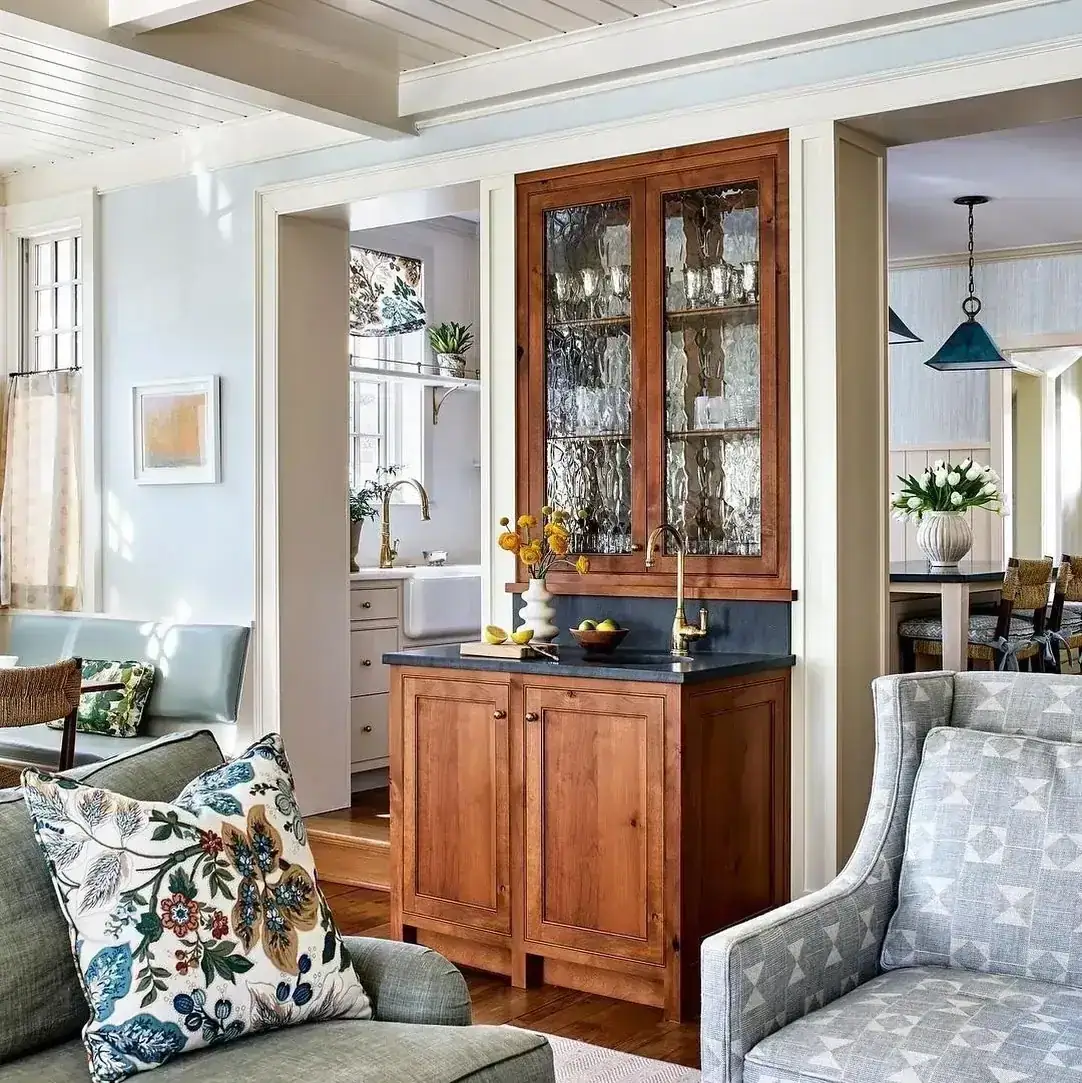
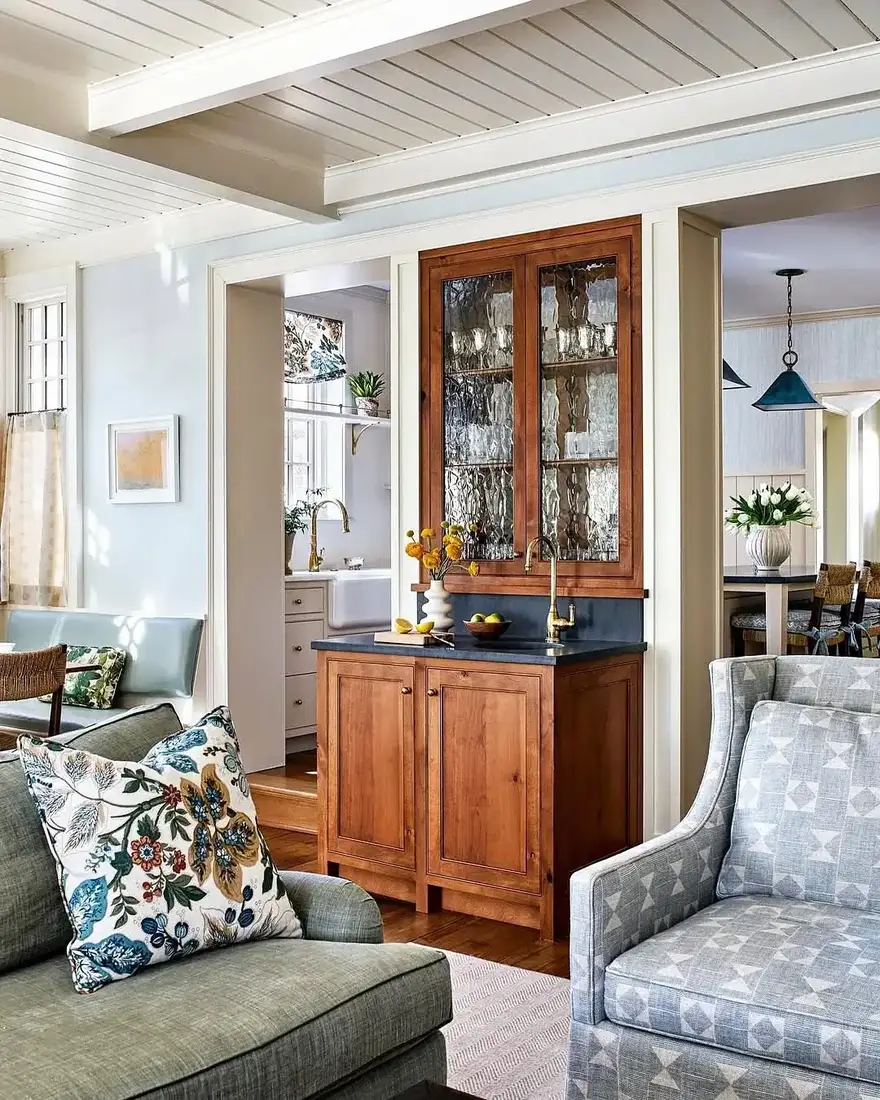
Not every bay should be open. Between a sitting room and a kitchen, a walnut bar cabinet with reeded glass doors, a brass mixer and a dark stone top shows where a closed bay earns its keep.
The joinery follows the same rule, even though the shelves are behind glass. The timber is one tone through the doors, the carcass and the counter. There is no white back fragmenting the unit. Where glass makes the back visible, the reeded texture softens reflection and keeps the interior from reading as a bright void. On large painted planes the finish choice is satin or eggshell before gloss, for the same reason: gloss on a big flat shows every mark and every roller edge when light rakes across it.
This is the bay people add after the open shelves are full and the lowest two shelves have become the drawer. One closed bay with solid doors below and glass above gives you a place for the bottles, the glasses and the bits of paperwork that make open shelving look like a shop if you leave them out. Because the doors are the same deep tone as the surrounding wall, the run stays calm.
Cost helps set expectations. A bar cabinet of this type, with a stone top and a reeded glass upper, typically runs £3,000 to £6,000 fitted in 2026 including the tap and waste, against £900 to £1,600 for a simple painted MDF alcove with open shelves alone. Eggshell or satinwood paint for the surrounding joinery runs £45 to £75 per litre in 2026 for trade, which is why painters steer you away from gloss on big planes; the cheaper finish is also the right one.
A vaulted white wall that lets white vanish on purpose
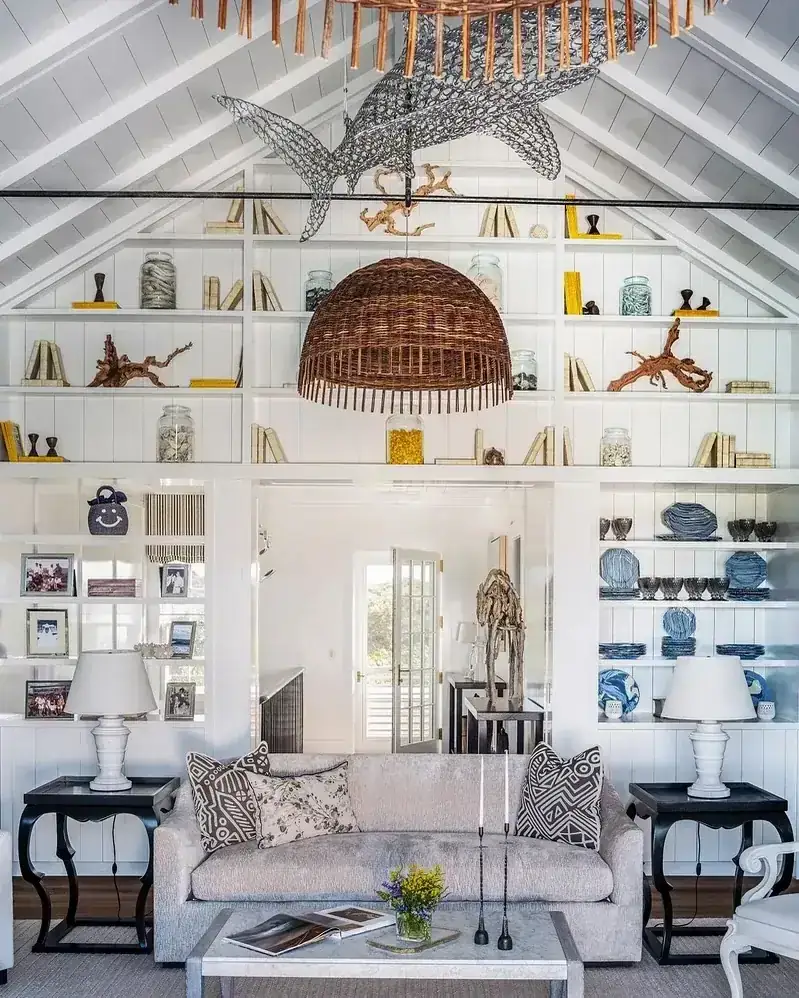
A white room made from a loft, with shelves running into the apex and bracketing a central opening. Every surface is white: walls, shelves, backs, ceiling, trim. Of all the rooms here, this one most clearly shows what the angle has been about. White built-ins disappear into the wall, which is the opposite of what most people building them want. Painting them a deep colour would have turned them into a feature you see from the hall. Left white, they become texture.
There are two ways to use that. If you want joinery to lead, paint it deep and match the back, retain a soft eggshell or satin and wire in warm light so the colour absorbs shadow instead of swallowing it. If you want shelves to be a quiet texture, white is honest, provided you leave a lot of air and keep the objects sparse and pale. Here the shelf load is deliberately thin: a few books laid flat, a glass jar, a piece of driftwood, a stack of blue plates. Each shelf is perhaps a third full, which reads as breathing room instead of emptiness, because the vault itself supplies scale.
Price and maintenance push the same way. White eggshell on MDF needs no special primer beyond a good stain block and cleans with a damp cloth. Deep blues and greens need careful cutting in and show dust sooner, yet they hide shelf shadow better. Paint at £55 to £85 per 2.5 litres in 2026 is the small part of the bill. The joinery behind it decides the number: a floor to apex run like this, even in white MDF, typically prices at £2,000 to £4,000 per side fitted in 2026, before objects.
A window seat that should have been the same colour as its shelves
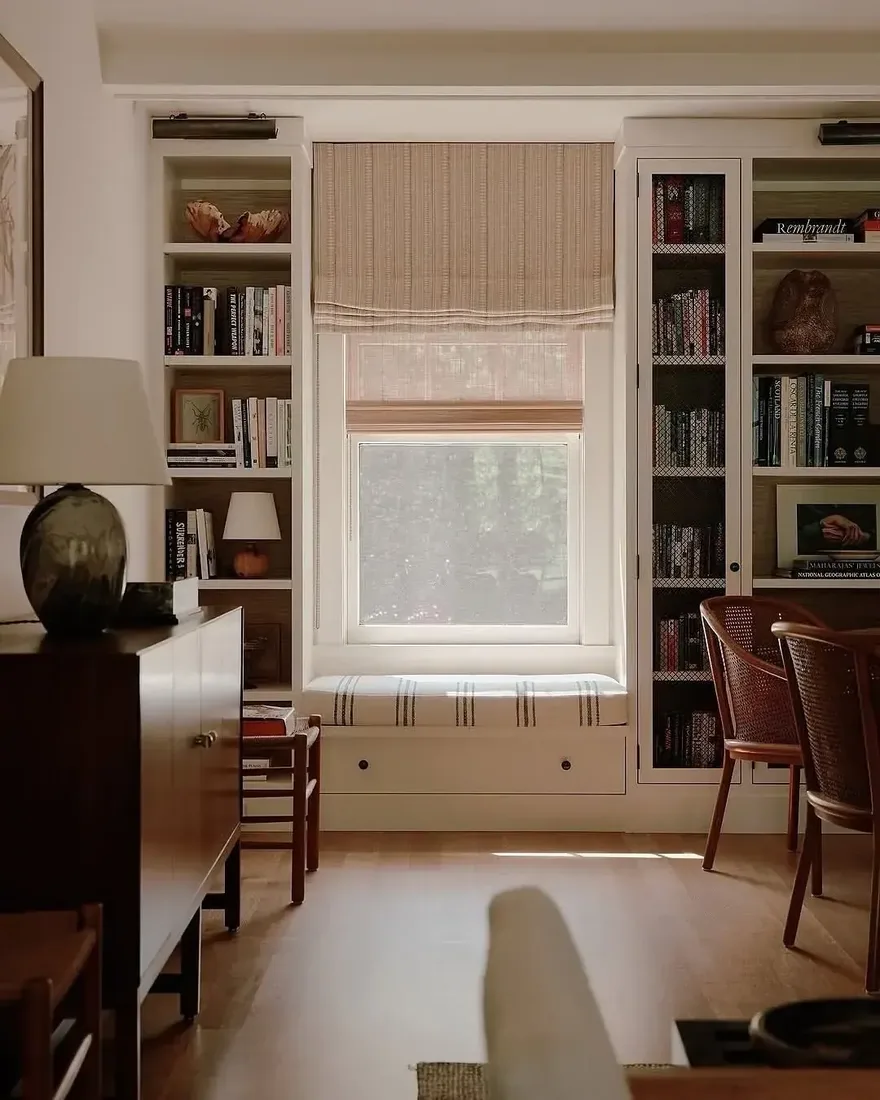
A window between two book walls, with a striped cushion and storage below, and a pair of glass-fronted bookcases to the right. The whole run is white, which keeps the corner calm and bright, yet it also flattens what could have been architecture. A deeper colour across the shelves and the window reveal would have made the seat feel as though it were cut from the wall and not placed in it.
That depth illusion is one of the supplied facts, and it matters most in a shallow alcove. When the back panel and the shelves are the same deep colour, their values sit close together and shadow stops announcing how thin the recess is. White does the reverse. It lights the back and tells you exactly how shallow it is, which is why a window seat in white often needs a textile or blind to do the work deep paint would do.
Look at what the image gets right regardless of colour. The seat cushion lifts off the base with a dark piping, the blind in natural linen filters over blocks, and the glass doors to the right keep one bay closed where dust and disorder would otherwise show. The books are pushed forward so spines sit in a consistent line, which gives a shadow line along the front edge, and the shelf backs, being white, are at least consistent with the shelves.
For a deep-joined version, choose satin or eggshell and avoid gloss on a surface this large, since gloss would show every brush mark along the sill and seat front. Little Greene Paint Collection eggshell tinted to a colour like Marine Blue 95 or Farrow & Ball Inchyra Blue No.289 reads deep without going black, and both sit well with the timber floor seen here. Budget around £70 to £110 per 2.5 litres in 2026, with another £150 to £300 for a joiner to scribe the seat to walls that are never straight.
Pale blue shelves that carry a cottage because the palette stays low
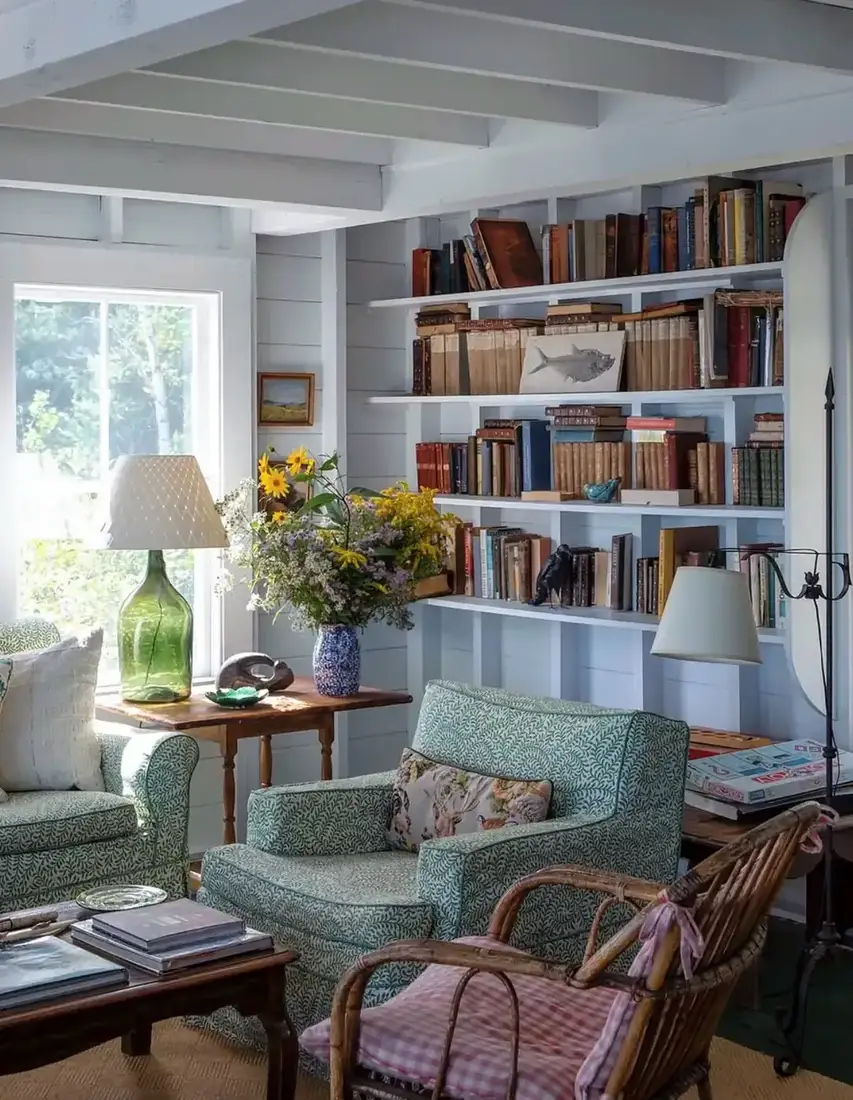
Open shelves painted a very pale blue, almost white, run the length of a low cottage wall under a beamed ceiling. Books fill them in mixed stacks, with a fish print propped on one shelf and a small turquoise bowl on another. Two green patterned armchairs and a rattan chair sit in front, with a green glass lamp and a jug of sunflowers on a side table. It is a room that succeeds on textiles and flowers before on joinery.
The shelves show the companion rule to deep colour. Books read as colour, and on a pale background their variety is more exposed. Here the spines are mixed blues, reds and creams, and against pale blue they can look a little scattered because contrast is high. The same mix against a deep shelf would look intentional, since the background would absorb difference and let the group behave as one colour block. That does not make this room wrong, but it explains why the eye settles on the chairs and flowers instead of the shelves.
Lighting again matters more than it seems. Pale shelves bounce what light there is. Deep shelves absorb it, so any future repaint in a deeper tone would need warm light inside the bays. In a cottage used after dark, a pair of small warm lamps either side of the shelves does more for the books than any reordering. Aim for bulbs around 2700K, which keep cream paper warm, against the 4000K cool whites that turn it grey.
To keep the cottage palette, deeper alternatives that still feel seaside are Little Greene Celestial Blue 101 or Benjamin Moore Van Deusen Blue HC-156, both of which let mixed spines sit more quietly. Eggshell at £55 to £85 per 2.5 litres in 2026 over a shellac primer on old timber is the surface that will not flash or scuff along the front edge.
A wall of books cut by French doors, and a television hidden in it
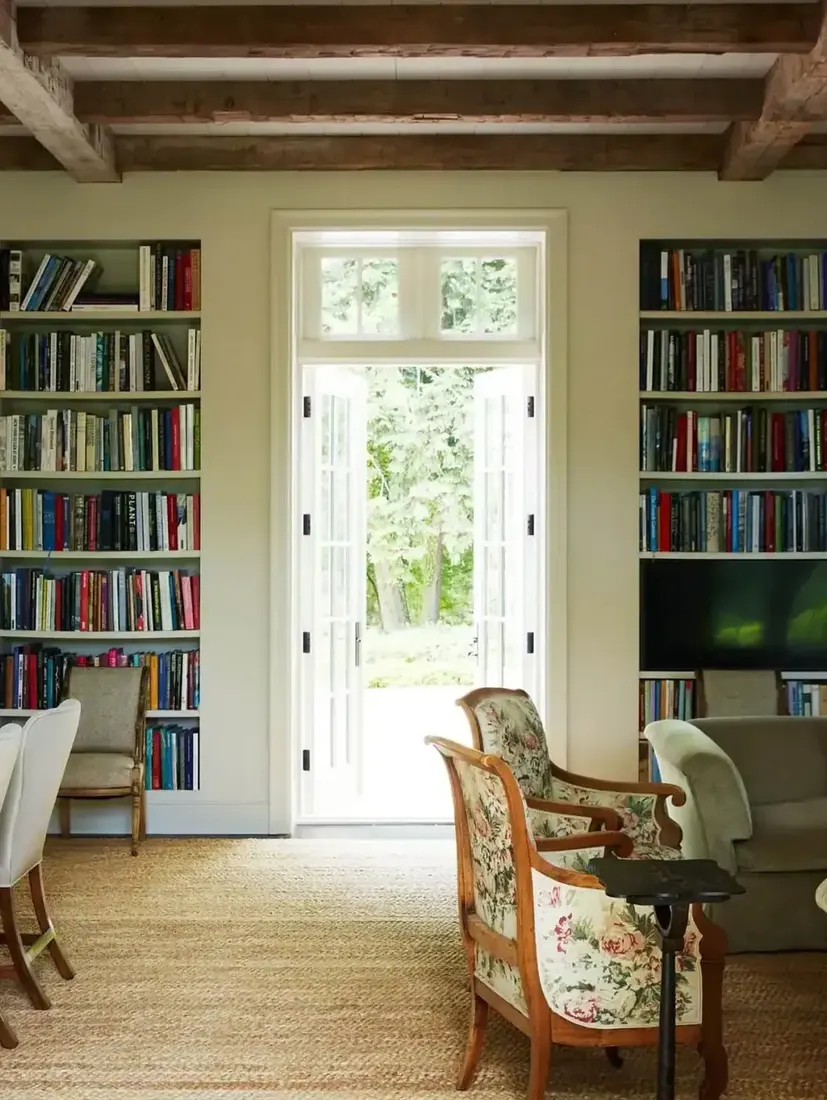
Two full-height white built-ins bracket a set of glazed French doors, with a television set into the right-hand run. The hall outside is bright, the sisal rug inside is pale, and the floral armchairs echo the books without matching them. It is a useful picture to read after all the deep-painted ones, because it asks the question white always asks.
Look at the television bay. The screen sits where books would be, and the shelf lines around it keep going, which integrates it instead of apologising for it. On a deep painted wall that integration would be stronger, because the dark interior would make the black glass read as part of the joinery and not as a hole cut in white. The same rule still applies: the back should be coated in the same deep tone as the shelving, and a soft eggshell or satin keeps the large plane from flashing, while lighting inside the bays matters more on dark paint. A low warm bar tucked under the shelf above the screen would have kept the bay legible after dark.
There is a second lesson in the doors. A wall of shelves can close a room. Breaking the run with a doorway or glazed opening keeps the volume legible, and the shelves either side read as framing over bulk. That is why the French doors help, and why keeping the shelving to the depth of the chimney or wall, before pulling it forward, keeps the wall reading flat.
In cost terms, adding a television bay adds little beyond the joiner’s cut-out and a cable path, around £120 to £280 in 2026 if planned at first fix, but adding it after the shelves are painted means cutting into a finished surface that gloss would have already shown up. Another reason thin high gloss is a poor choice on a large fitted run.
The dark freestanding shelves that turn joinery into a feature
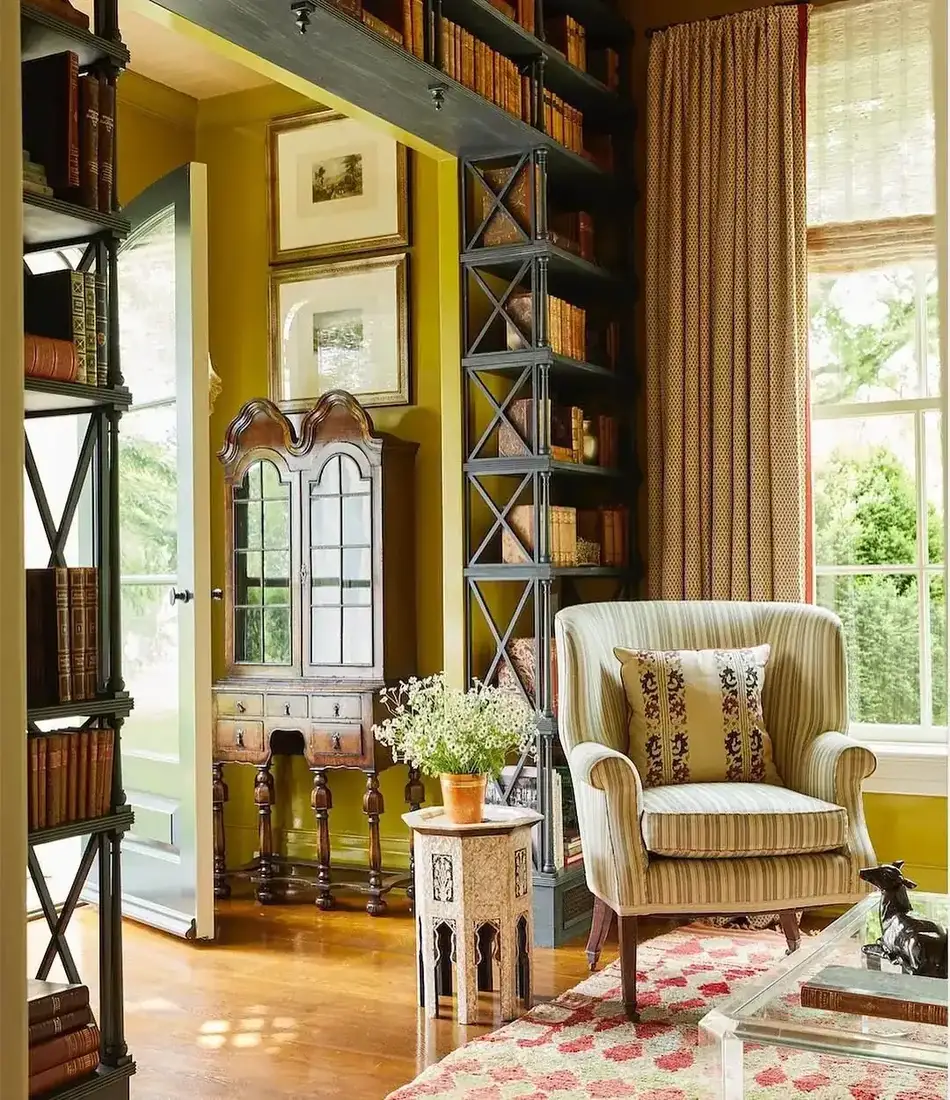
A dark freestanding run, almost charcoal blue, with X-bracing forming diamonds along its side, runs across a doorway and carries books on every level. Beyond it a mustard wall holds a glazed bureau and a striped armchair with an embroidered cushion. The contrast is the point. The dark shelves are not trying to vanish. They lead.
This is the angle stated at the outset, seen most plainly here. White built-ins disappear, painting them deep turns joinery into a feature, and it is the decision you make too late, after the white ones are in. That bar of dark shelves reads as architecture you notice from the next room, not as storage against a wall. Because its back and shelves are one colour, the unit holds as a single piece, and the thin diamonds of the X-bracing read as structure against decoration.
Finish and light complete it. On a surface this large and dark, satin or eggshell softens reflection and lets the colour sit. Gloss would have shown every brush mark and roller edge, and under the picture lights beyond it would have rippled. Inside, deep colour absorbs light, so the shelves borrow from the bright window to its right and from the warm lamps on the tables. In a less well-lit corner you would wire light into the joinery itself.
If you want this depth in a paler house, a colour like Farrow & Ball Hague Blue No.30 or Little Greene Deep Space Blue 207 gets close, and both hold under warm 2700K bulbs without going purple. Budget for eggshell at £95 to £125 per 2.5 litres in 2026 for the branded tin, or £55 to £85 for a trade match. A freestanding run of this type, unjoined to walls, often costs £2,000 to £5,000 in 2026 depending on bracing and glass, yet still disturbs less plaster than a full fitted alcove.
Frequently Asked Questions
Are dark built-ins harder to live with than white?
Dark joinery brings forward what you place on it and lets a shallow recess feel more generous, while white tends to make the same gap feel thinner. The trade is that you must plan warm light into the bays, so the niche does not read as a hollow after dusk.
Do I need to colour the back wall of my shelves?
Coating the interior panel to match the uprights and shelves keeps the box together. A pale back inside a darker unit slices the alcove into stripes and makes the fit look less considered.
Which sheen hides flaws best on large shelving?
Go for eggshell or satin. On a broad plane a high shine picks out every roller edge and sanding mark once a lamp grazes the surface, while a softer finish remains washable for a living room.
Will mixed books look messy?
A varied collection behaves better against a deeper background, where contrast is absorbed. Against a pale ground the same row can appear scattered, so you would need to group hues far more strictly.
How do I keep dark shelves from looking dim?
Wire light into the structure from the start, using a low warm bar under the shelf above or a picture light over the top. Deep paint soaks up illumination, so the alcove benefits from its own source instead of borrowing from the ceiling.
Can I mix open shelves and closed doors in one run?
A single closed bay, finished in an identical deep shade to the open ones, hides the untidy bits and lets the rest stay honest. It reads as furniture and not as a wall of display, and it prevents the lowest shelves becoming a dumping place.
Before you commission
- Put closed cupboards below the 900mm line and open shelves above, so display sits at eye level and storage sits where it is hard to see.
- Paint shelves, backs, cupboards and the adjoining wall in one eggshell colour so the joinery reads as architecture, not furniture.
- Make the back panel match the shelves, in satin or eggshell over high gloss, because gloss marks every brush stroke on a large flat in 2026.
- Keep unsupported spans under 800mm or lip the front edge, and ask for one adjustable, deeper shelf for the tall piece you have not yet bought.
- Plan warm light inside deep alcoves from the first fix, since dark paint absorbs illumination and a late add-on chases cables through finished work.
- Include a shaped fascia at the top and have the run scribed to the wall, because old walls are never straight and a shadow gap gives the game away.
- Use books as colour: on a deep ground a mixed row looks collected, on white it can look cluttered without tighter grouping.
This article may contain affiliate links. We may earn a commission at no extra cost to you.