11 Stone House Exterior Ideas: Pick Colours From the Stone

Add us as a preferred source to see more stories on Google.
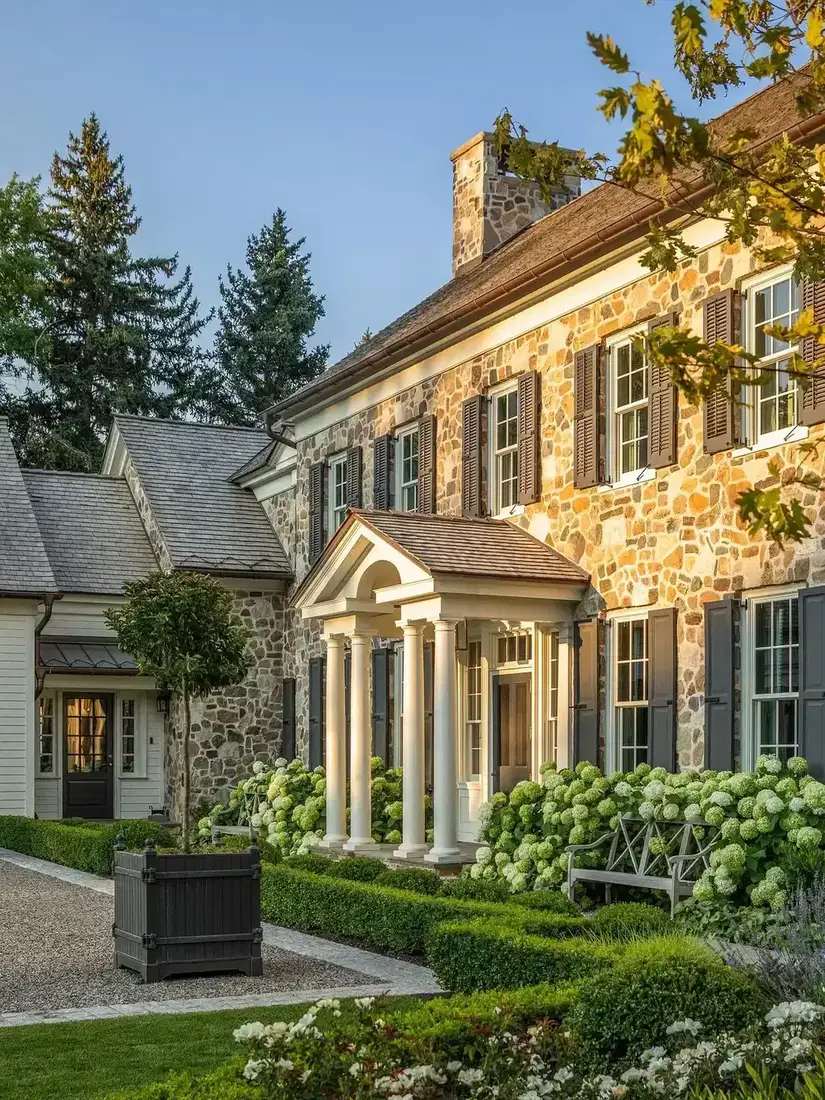
You do not get to choose the main colour of a stone house. It was quarried, and it is staying. Everything else follows from that, which narrows the decisions usefully.
Look at that wall properly. There is gold in it, tan, grey, rust, and a few near-black stones. Fieldstone is not a colour; it is a collection of them, and any trim colour has to live alongside all of it.
Now look at the shutters. They are a muted brown-olive, and that tone is already present in the wall. They read as belonging rather than as being applied. The white on the portico works for the opposite reason, which is that white belongs with everything.
How to choose the colour
Stand at the wall on an overcast day and find the three tones that keep recurring. On most fieldstone that is a warm grey, a tan or gold, and something browner.
Paint your trim in one of those, a few shades deeper. A colour taken from the stone and darkened reads as intentional. A colour picked from a chart in a shop reads as applied, even when it is objectively pleasant.
What tends to work:
| Element | Sensible range | Why |
|---|---|---|
| Shutters | Olive, brown-black, dark grey-green | Deep enough to read at distance |
| Window frames | Off-white, cream | Lightens the openings |
| Door | Black-green, deep brown, bottle green | One accent, related to shutters |
| Porch and columns | White or off-white | Neutral against a busy wall |
| Gutters and downpipes | Match the stone, or black | Should disappear |
Bright white is the common misstep. Against warm stone it looks stark and, by contrast, makes the wall look grubby. An off-white with a little yellow or grey in it sits far better and does the same brightening job.
Cool greys are the other one. They are everywhere in paint ranges at the moment, and on warm fieldstone they read slightly blue and slightly dead.
Colours that come up repeatedly on stone: Farrow & Ball Light Bronze No.298 and Bronze No.297 for shutters, Little Greene Olive Colour 72 for a softer version, and Farrow & Ball Pointing or Benjamin Moore White Dove OC-17 for joinery. Exterior eggshell in those colours runs roughly £48 to £88 per 5 litres in 2026. For lime mortar, St Astier, Singleton Birch and Lime Green are the usual suppliers at roughly £12 to £20 a 25kg bag in 2026.
The pointing matters as much as the paint
Same rule as brick, and the stakes are similar.
Old stone walls are built with lime and need to stay that way. Cement is harder and far less permeable, so trapped moisture leaves through the stone face instead of the joint, and in frost that takes the surface off. On sandstone and limestone the damage is quick and obvious; on harder stone it is slower and shows up in the mortar failing repeatedly instead.
The joint profile is also a visual decision, and a bigger one than people expect. A flush or slightly recessed joint lets each stone read separately. Proud ribbon pointing, where the mortar stands over the stone edges, is the single fastest way to make a handsome wall look wrong, and it holds water besides.
Ask for lime, ask for a sample panel, and ask to see the joint profile before the whole elevation is done. A 1:2.5 lime putty to sharp sand mix suits most old walling, raked out 25mm and brushed back, and left a fortnight to firm up.
Do not clean it
Pressure washing stone removes the patina, opens the surface, and on softer stone takes material with it. The wall will then weather faster and unevenly, and it will look worse in five years than it did before.
Biological growth on a north wall is normal and mostly harmless. If it genuinely needs removing, a soft brush and a proprietary biocide applied and left to work does it without damage. A 5 litre concentrate runs roughly £18 to £32 in 2026 and treats a large elevation. Chemical cleaning and grit blasting both belong on a specialist’s quote, not a weekend.
Additions and what colour they should be
Most stone houses have grown. That white clapboard wing in the photograph is a later addition, and it has been painted rather than clad in matching stone.
That is usually the right call. Matching new stone to old is difficult and expensive, and a near-miss looks worse than an honest difference. A painted timber addition reads as a separate, later, humbler building, which is what it is.
If you do extend in stone, source locally and expect the new work to look obviously new for a decade or more. Nothing ages it convincingly, and products that claim to are mostly staining it.
A low cottage where the roof outweighs the walls
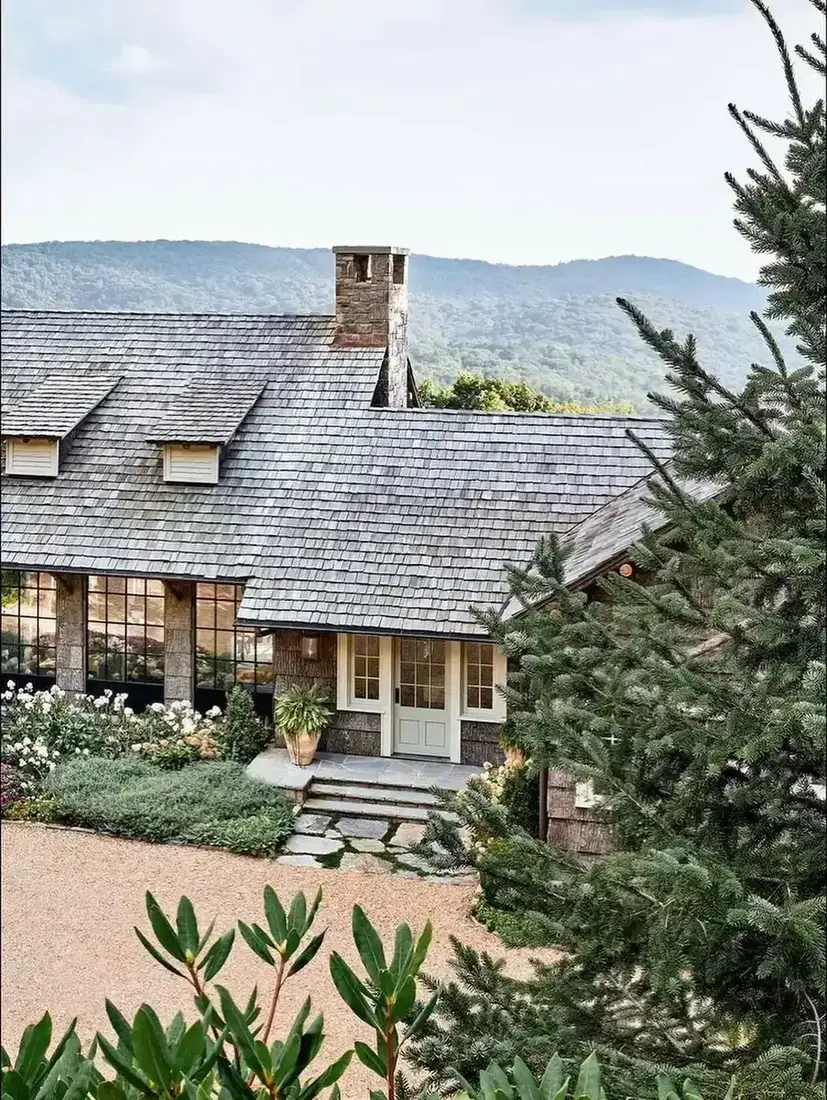
In this image the roof is the largest surface. Broad grey shingles run unbroken over low stone walls, with a stone chimney rising through the slope and two small dormers tucked under the eaves. The walls sit low under all that weight, and the gravel drive runs straight to the door.
That balance is the lesson. Full stone from ground to eaves gives the cottage mass, and the cool grey roof keeps the temperature of the whole building down. The door and dormer cheeks are painted a pale off-white that matches the mortar, so the openings read as gaps punched in stone instead of trim fixed onto it.
Fix the roof first. Scaffold goes up once, so stonework and slates share it. Repoint failed joints in lime and leave sound joints alone. Farrow & Ball Pointing No.2003 or Benjamin Moore White Dove OC-17 gets that joinery colour, and exterior eggshell in either runs roughly £48 to £88 per 5 litres in 2026. The stone itself wants nothing except a soft brush.
Golden stone with white dormers and grass at the kerb
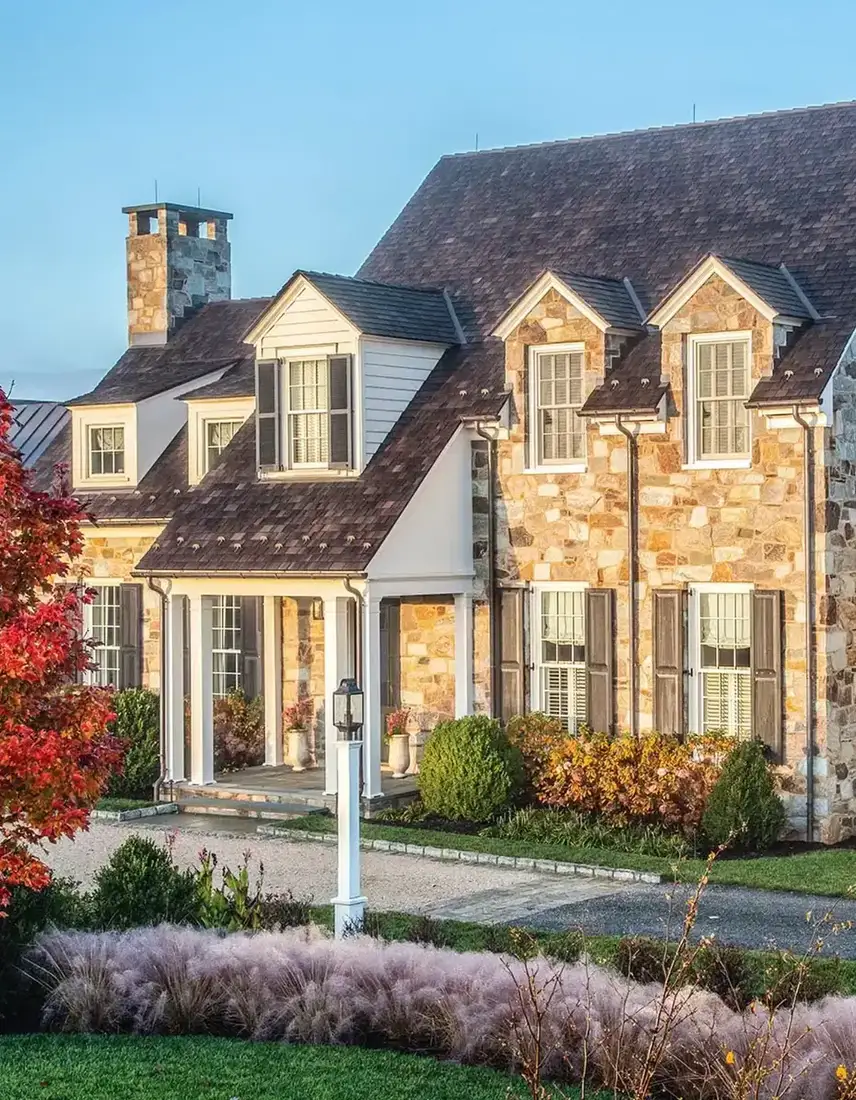
See the dormers first. White cheeks and small gables sit proud of the golden fieldstone, with brown louvred shutters on the stone below and black downpipes dividing the elevation. Pink ornamental grass runs along the gravel edge in front, with a white lamp post at the kerb.
White dormers do heavy work on a full stone front. They break the mass at roof level and pull the eye up, which stops a long stone elevation reading as a single brown block. The shutters were taken from inside the wall, a dark umber already present in the fieldstone, so they settle instead of shouting.
Match the rainwater to the shutters. Black aluminium or coated steel disappears against dark shutters, while white plastic gutters cut a bright line across stone and never stop showing. Keep the gravel warm buff, roughly £40 to £90 per tonne in 2026, and keep a collar 300 to 450mm wide along the base, 40mm deep over membrane, so splashback never marks the lowest courses.
Dark boards over pale granite with water at the foot
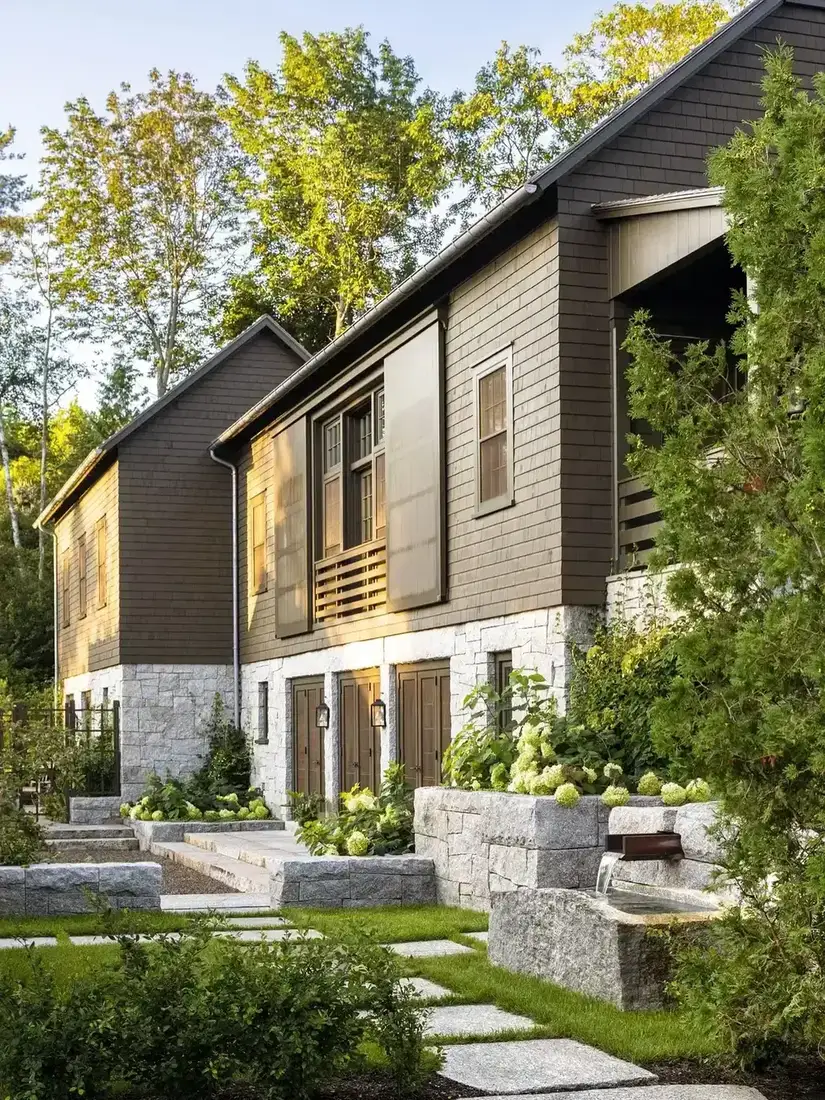
That wall changes material at first floor level, and the change is honest. Dark brown shingles above, pale granite ashlar below, with the stone running a full storey to the ground. Wide granite steps and retaining cheeks lead down past a small bronze spout that pours into a stone basin.
This is the one partial stone image in the set, and it earns its place by showing how stone should meet ground. The base is a full volume with its own copings and steps, not a thin band glued on. The granite is tight jointed and pale, so the dark timber above has something solid to sit on.
Treat the junction as maintenance, not decoration. Keep soil and mulch off the granite, keep the spout discharge clear of the face, and repoint in lime where joints have opened. Sawn granite steps and walling of this type run roughly £70 to £150 per square metre supplied in 2026, with the solid treads costing most. Never blast the granite clean. The grey skin is the weathering layer, and removing it opens the stone to faster soiling.
Honey limestone with firewood built into the wall
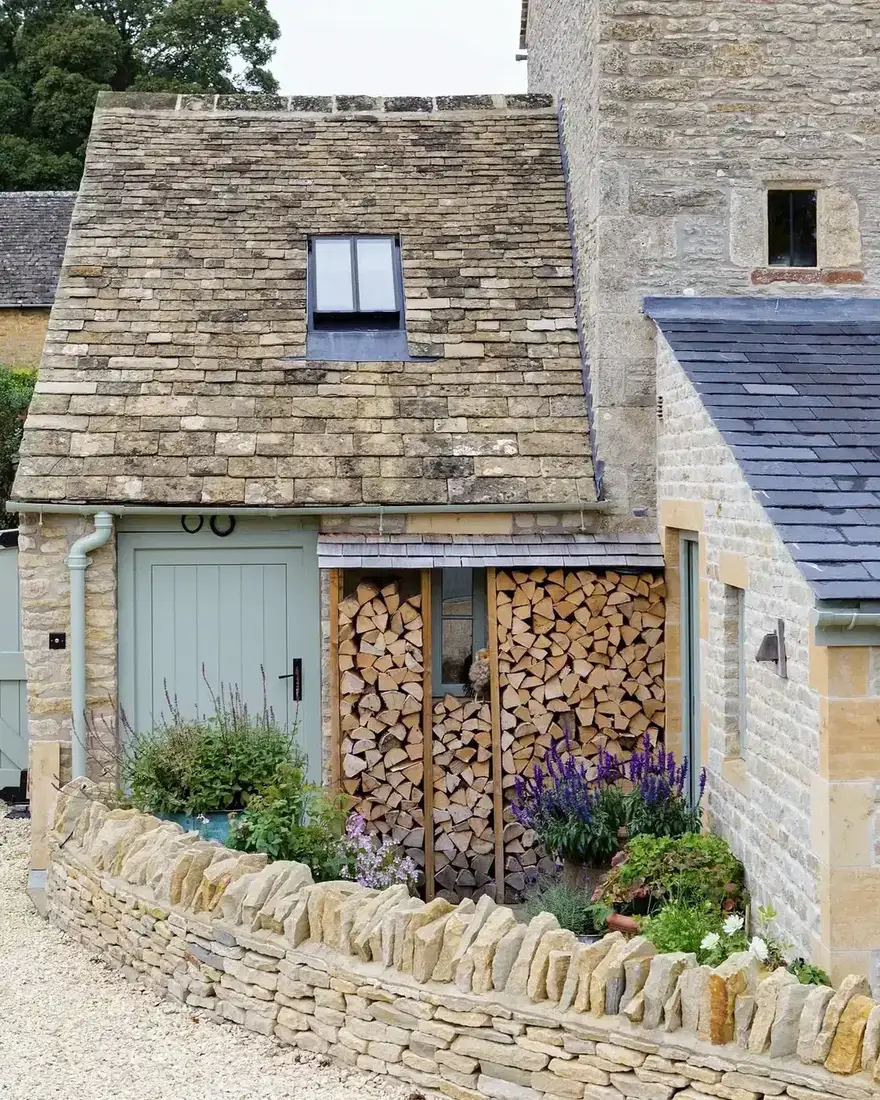
The log store is the detail to copy. Honey limestone walls rise full height to a stone slate roof, and under the eaves an open bay holds stacked firewood floor to ceiling. A pale sage door sits beside it, with a dry stone wall curving past in the foreground.
Building fuel storage into the masonry keeps a working elevation tidy. The logs stay dry under the eaves, air moves through the open front, and there is no tarpaulin or lean-to arguing with the stone. The door colour sits inside the wall, a soft green grey that reads quiet against honey limestone.
Cutting that opening is structural. The bay needs a sound lintel and the jambs want proper quoins, so price a mason before a carpenter. Little Greene Olive Colour 72 or Farrow & Ball Lichen No.19 gets that door colour, with exterior eggshell roughly £48 to £88 per 5 litres in 2026. Keep the coping on the garden wall sound. Open joints there let frost in, and a rebuilt coping costs more than the log store saved.
Rubble stone with one bright blue decision
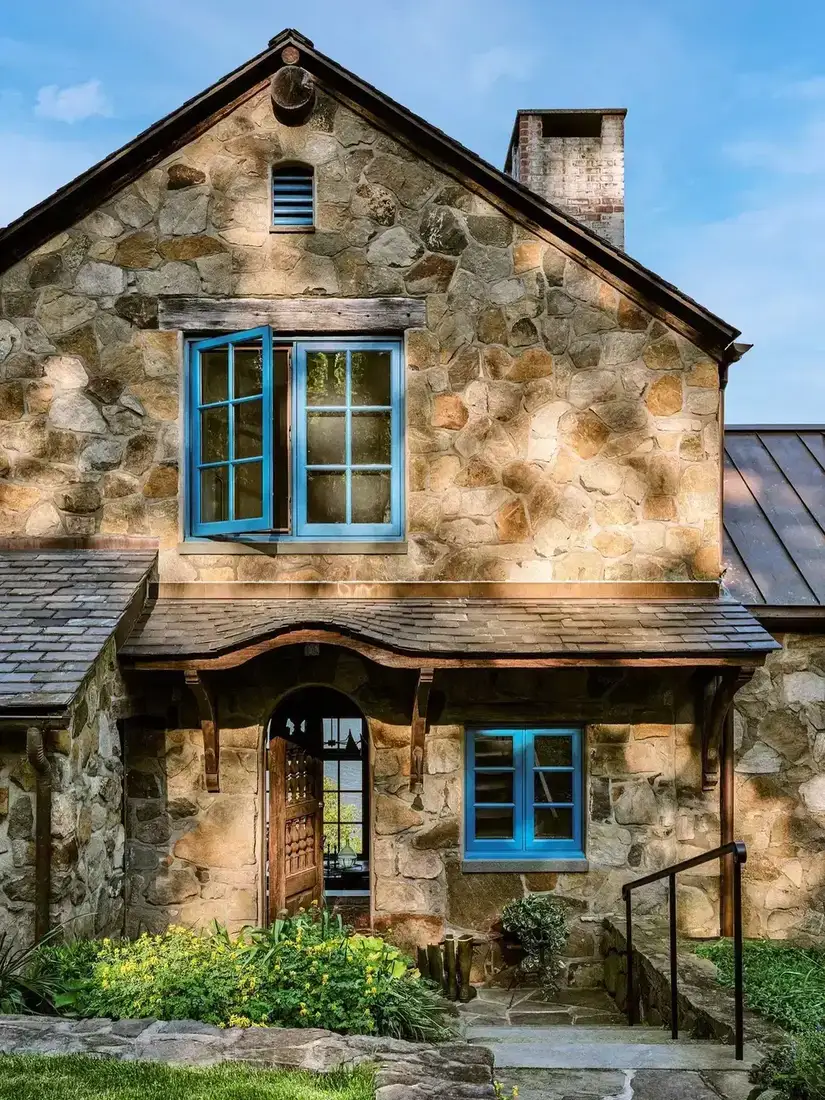
From this gable the blue does all the talking. Mixed rubble runs full height to the ridge, with a bright turquoise casement open at first floor and a smaller matching pair beside an arched oak door below. A curved slate hood on timber brackets shelters the entrance.
One strong colour is enough on rubble. The wall already carries a dozen tones, so a single accent in blue reads as a decision while two or three would read as clutter. The oak door stays unpainted, which matters, because timber and blue and stone is already a full palette.
Sample the blue on a dull day. Bright joinery shifts hard between sun and cloud, and stone houses are mostly seen under cloud. Farrow & Ball St Giles Blue No.288 or Little Greene Marine Blue 95 sits in this family, at roughly £48 to £88 per 5 litres in 2026. A bespoke oak ledged and braced door of this type runs roughly £1,200 to £2,500 supplied in 2026, ironmongery on top. Check the slate hood flashing where it meets the stone. That joint is the leak point, and leadwork there is a job for a roofer, not sealant.
Pale ashlar with an arch and shutters left open
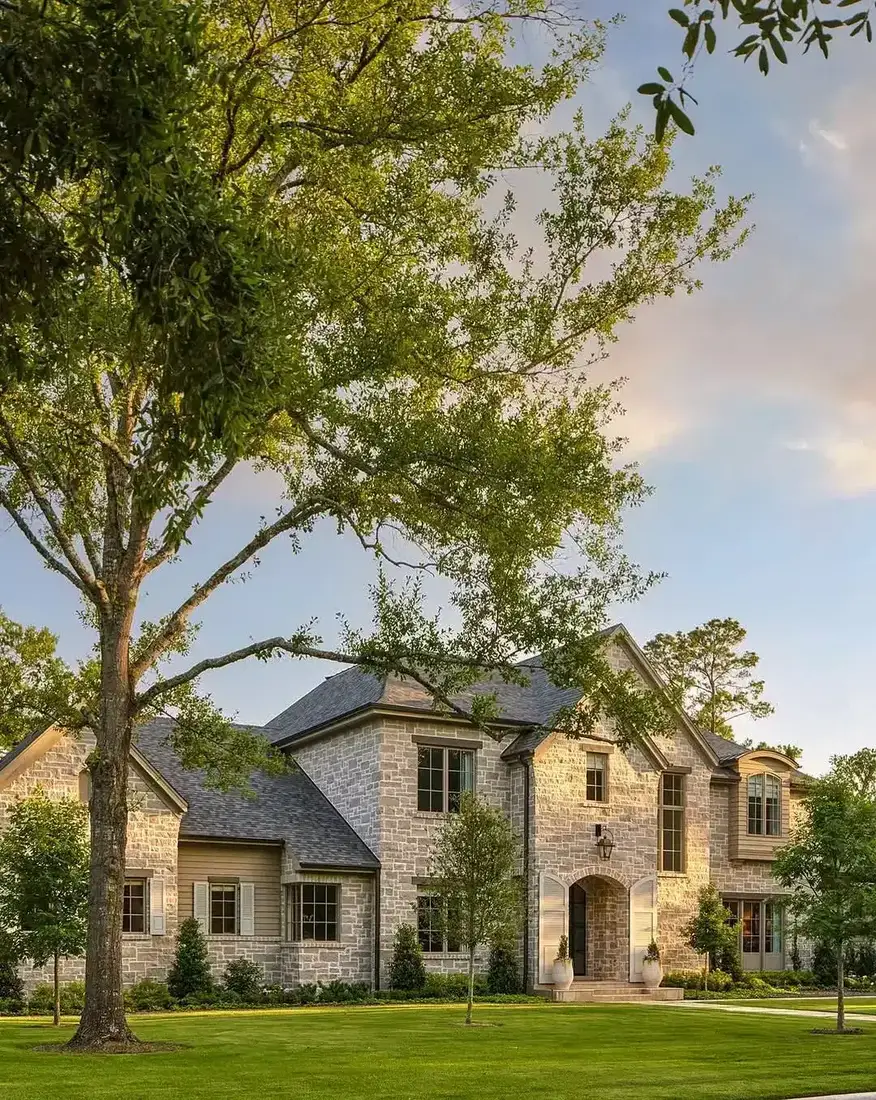
Pictured here is restraint. Pale coursed limestone runs full height across a symmetrical front, with a slate roof above and an arched doorway at the centre. Open white board shutters flank the arch, with stone urns each side and a wide lawn running to the drive.
Symmetry lets pale stone stay calm. The arch gives one curve, the shutters give two verticals, and everything else repeats quietly. The joints are tight and pale, so the wall reads as one surface instead of a pile of blocks.
Keep new work in the same temperature. A warm off-white for the shutters suits pale limestone; a cold blue white makes the stone look dirty by comparison. Ashlar repointing in lime runs roughly £80 to £140 per square metre in 2026 where access is straightforward, more once scaffold wraps a gable. Hold planting back on a gravel margin so the lowest courses stay dry and ladders can reach the gutters. The ground should fall away at 1:40 with soil kept 150mm below internal floor level.
A white front with stone steps and a dark arch
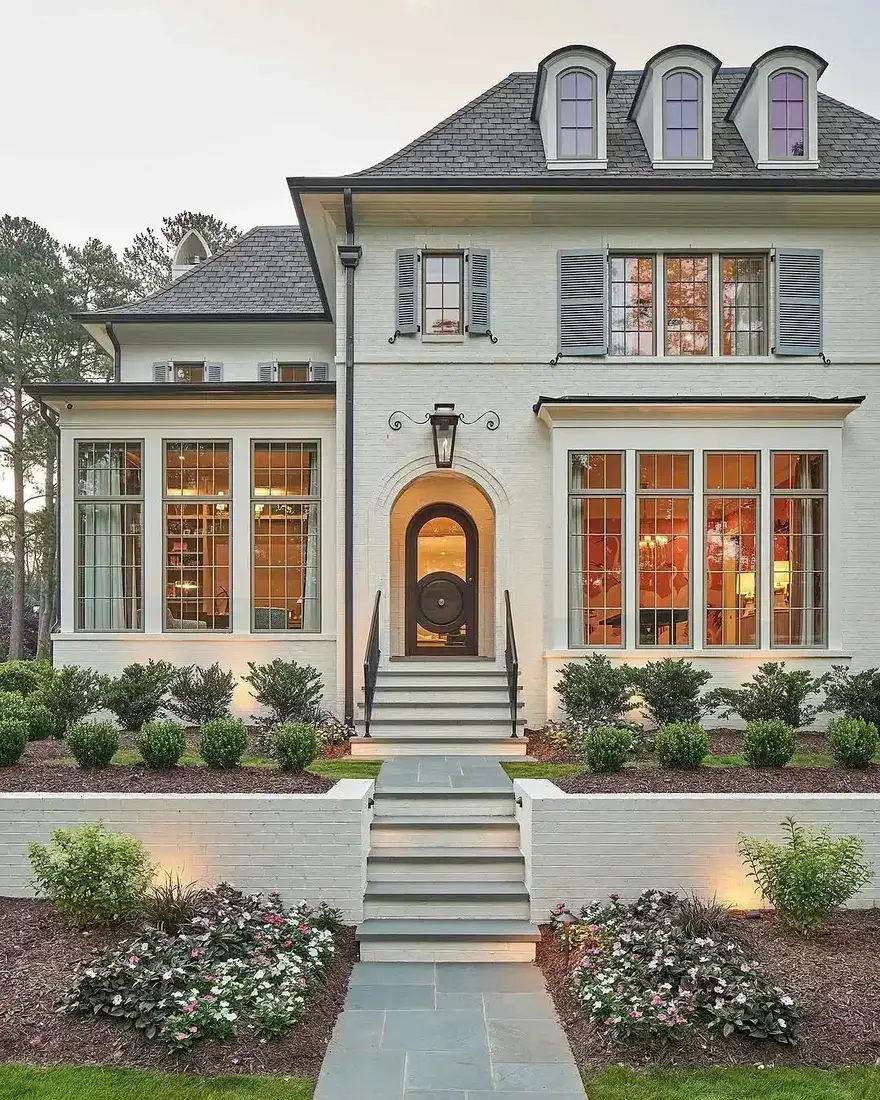
This front reads white, not stone. Painted brick or render covers the elevation, with a dark arched door set in a pale arch, grey louvred shutters above, and wide slate steps running down between white retaining walls. The stone in the frame is in the steps, the kerbs, and the garden walling.
The filename talks of limestone, but the eye sees paint, and that mismatch is useful. Paint on old stone is close to irreversible. It seals the face, traps water behind the film, and then fails in sheets. Stripping it back risks the arrises and the pointing with it. A front already painted is best maintained as paint.
If this is your position, spend on the hard parts. Keep the slate treads brushed and lichen free by hand, keep shutters sound, and keep soil off the retaining walls. Exterior masonry paint in white runs roughly £50 to £95 per 5 litres in 2026, and grey shutter paint in Farrow & Ball Manor House Gray No.265 or similar runs roughly £48 to £88 per 5 litres in 2026. Do not aim a jet washer at the steps to save an afternoon. The slurry drives into the joints and the pointing pays for it.
Buff rubble with black glass and gravel to the door
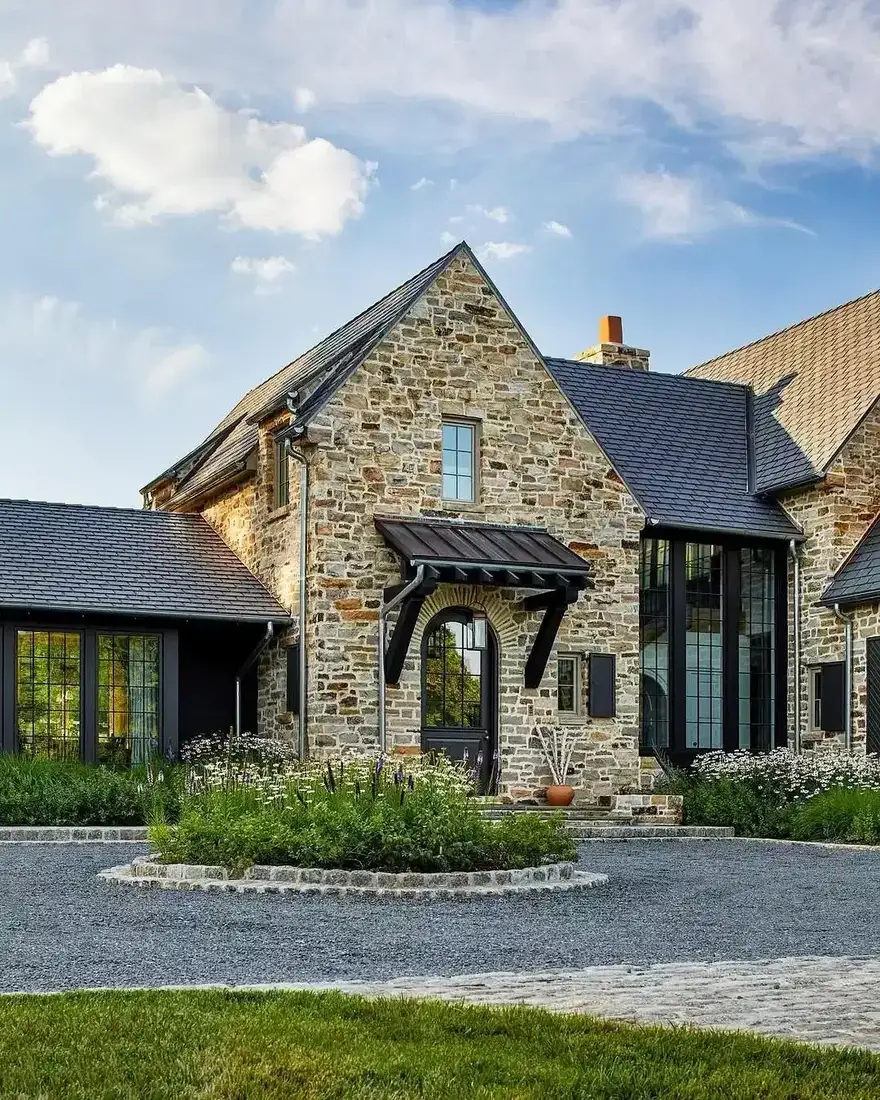
The stone here runs from ground to gable without a break. Buff rubble fills the whole gable end, with slim black windows and a tall glazed bay to one side. A small metal canopy on brackets shelters an arched glass door, and dark gravel runs up to the walls, edged in stone setts.
Black glass is the quiet choice on buff stone. The frames read as shadow lines, so the eye stays on the masonry instead of counting windows. The canopy repeats the black, which ties the entrance to the glazing in one move.
Order the openings before the finishes. New lintels and cills go in first, then pointing, then paint. Steel-look aluminium windows of this type run roughly £900 to £1,600 per window supplied in 2026, with the glazed gable priced as curtain walling. Gravel in a warm buff runs roughly £40 to £90 per tonne in 2026. Keep the canopy flashing dressed into the joints, not surface fixed, or water will track behind it within two winters.
Mixed rubble with steel glass and a red tile roof
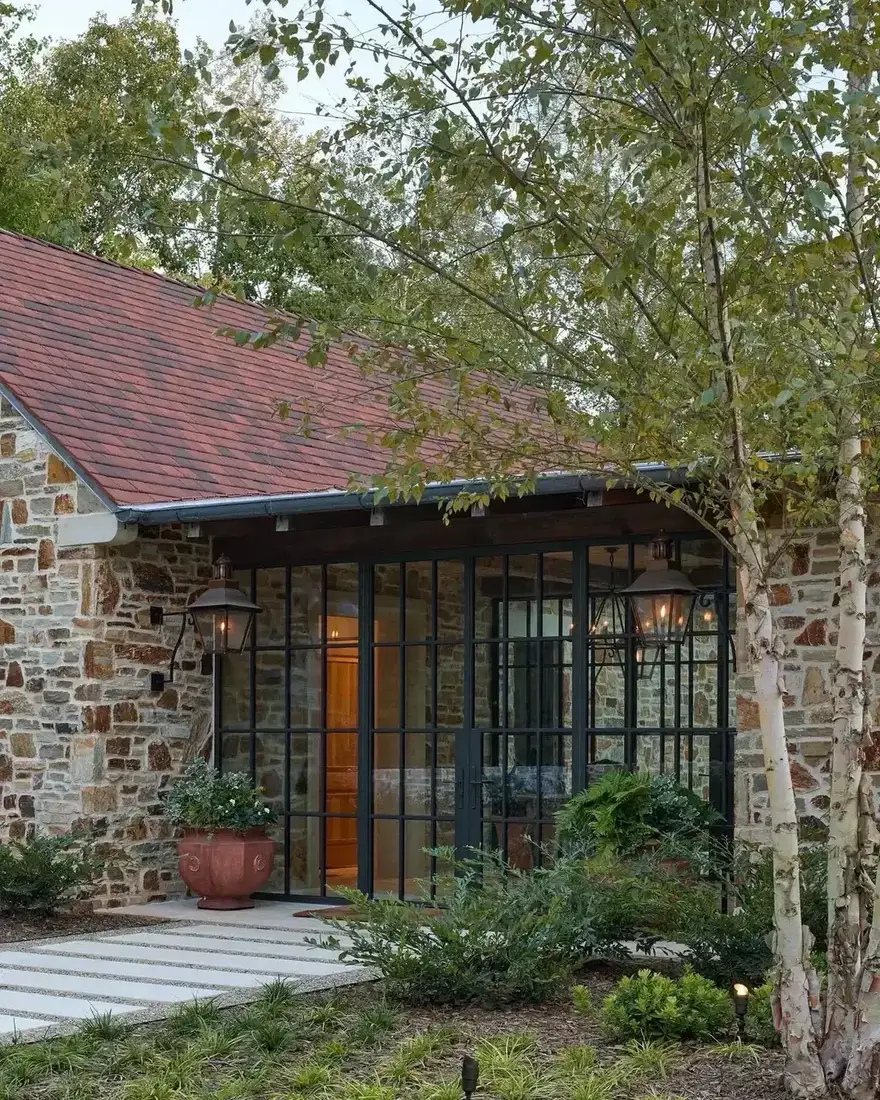
That roof sets the temperature. Mixed brown and grey rubble fills the wall, with a full height wall of black steel glazing set into it and a red clay tile roof overhead. Two lanterns flank the glass, a terracotta pot sits by the door, and white birch stems frame the corner.
Warm stone takes a warm roof. The red tiles pull the browns forward, and the black glazing gives the contrast that stops it turning muddy. After dark the lanterns do the same job, provided the bulbs stay warm.
Fit 2700K warm white lamps, not cool white, and keep fittings rated for exterior use. Steel-look glazed doors of this size run roughly £2,000 to £4,500 per set in 2026. Clay plain tiles run roughly £60 to £110 per square metre supplied in 2026. Keep the birch stems clear of the face so leaves never bank against the stone, and keep pots off the wall head where drip marks the joints.
Grey gables behind water and clipped hedges
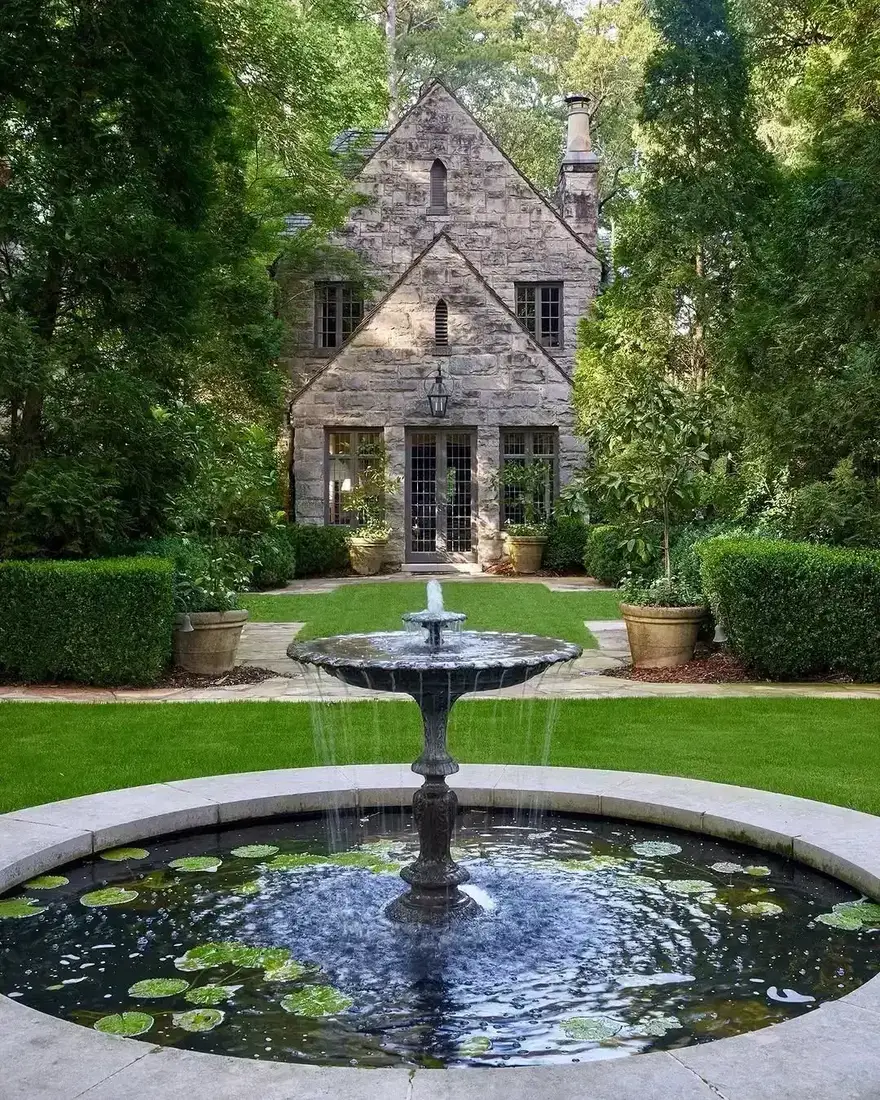
The house sits behind the water. Twin grey ashlar gables rise full height through trees, with stone mullions and a central lantern over French doors. A large fountain basin fills the foreground, with clipped hedges and stone pots lining the lawn.
Clipped evergreen is doing the calming. Grey ashlar already carries a lot of joint shadow, so the low hedges give the eye one level green line to rest on. The fountain keeps the air damp, which deepens the grey, and that is a legitimate look as long as it is chosen.
Keep the maintenance loop in mind. Hedges want cutting twice a year, gutters want clearing where trees overhang, and splash from the basin must never reach the wall foot. Exterior uplights in warm white run roughly £80 to £180 each in 2026, and a small fountain pump replacement runs roughly £120 to £280 in 2026. In this frame the wall base stays visible and dry behind the lawn, which is exactly how grey stone wants to sit.
Mortar and cleaning choices
| Choice | What it does to old stone | Use it when |
|---|---|---|
| Lime mortar | Softer than the stone, so water leaves through the joint | Any house built before about 1930 |
| Cement mortar | Harder than the stone, pushes water out through the face and causes spalling | Modern stone only, never on old walls |
| Flush or slightly recessed joint | Stone reads first, mortar recedes, joint sheds water | Almost every traditional wall |
| Ribbon pointing | Raised band over the face, looks wrong and traps water | Never |
| Soft brush and water | Removes surface dirt, keeps the weathered skin | First and usually only choice |
| Pressure washing or blasting | Strips the outer skin, so the stone soaks up water faster | Avoid on anything old |
Frequently Asked Questions
Can full stone walls be painted over?
Painting seals the face and holds damp inside the masonry. Moisture then forces the coating off in sheets and leaves green staining within. Maintain existing paint where it is already there, and leave bare rubble and ashlar alone.
Which mix should repointing use on older houses?
A lime based mortar, since it stays softer than the surrounding masonry and lets vapour pass. Cement sets harder than most sandstone and limestone, which drives frost damage into the block faces. Always insist on a dried trial panel first.
Is jet washing safe for a stone front?
It harms old work by removing the dense outer skin built up over decades. Once that layer is gone the surface absorbs rain faster and soils unevenly. A soft brush with water, plus patience, clears most growth.
What trim suits mixed fieldstone best?
Tones pulled from the wall itself, deepened a step or two. Off-white joinery with an olive or brown-black shutter sits quietly on warm rubble. Stark blue greys usually clash because the masonry runs warm.
Do dark frames work against pale limestone?
Yes, because slim black glazing reads like a shadow gap and lets the masonry lead. Keep the roof in the same temperature family and the glass will settle. Bright white plastic frames often look harsh beside uneven ashlar.
What should sit at the foot of the wall?
A free draining strip that throws rain clear and lets air move. Warm buff gravel suits most rubble and ashlar, while dark tarmac deadens the base. Keep soil, mulch, and planting clear of the lowest courses.
In order
- Find the three tones that recur in your stone and take your trim from those.
- Use off-white instead of brilliant white, and keep cool greys off warm fieldstone.
- Specify lime for any repointing, with a dried sample panel and an agreed joint profile.
- Leave the wall unwashed; patina is not dirt, and blasting ruins the skin.
- Paint later additions instead of attempting to match old stone.
- Match the roof temperature to the stone, then let frames and doors follow.
- Hold soil and planting clear of the base on gravel so the wall can dry.
This article may contain affiliate links. We may earn a commission at no extra cost to you.