12 Coastal Shingle Cottage Ideas: Shingle Wraps Curves Throughout

Add us as a preferred source to see more stories on Google.
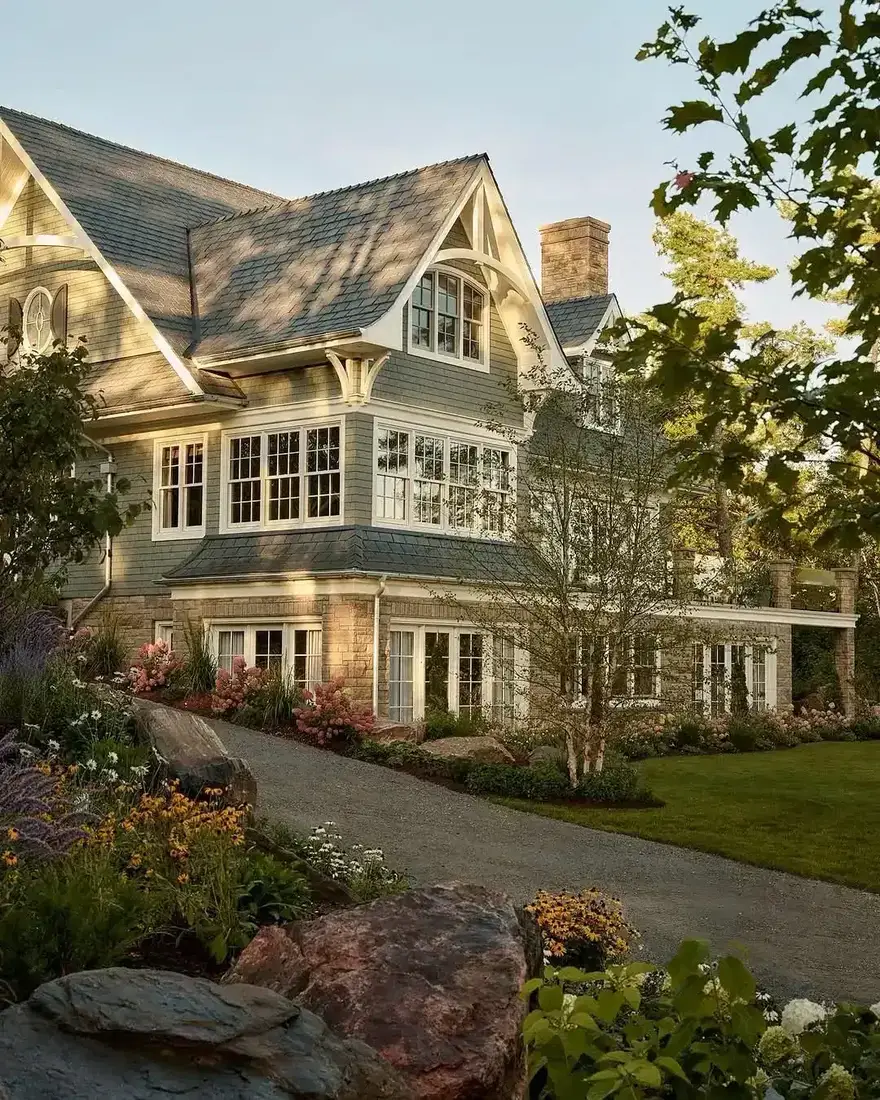
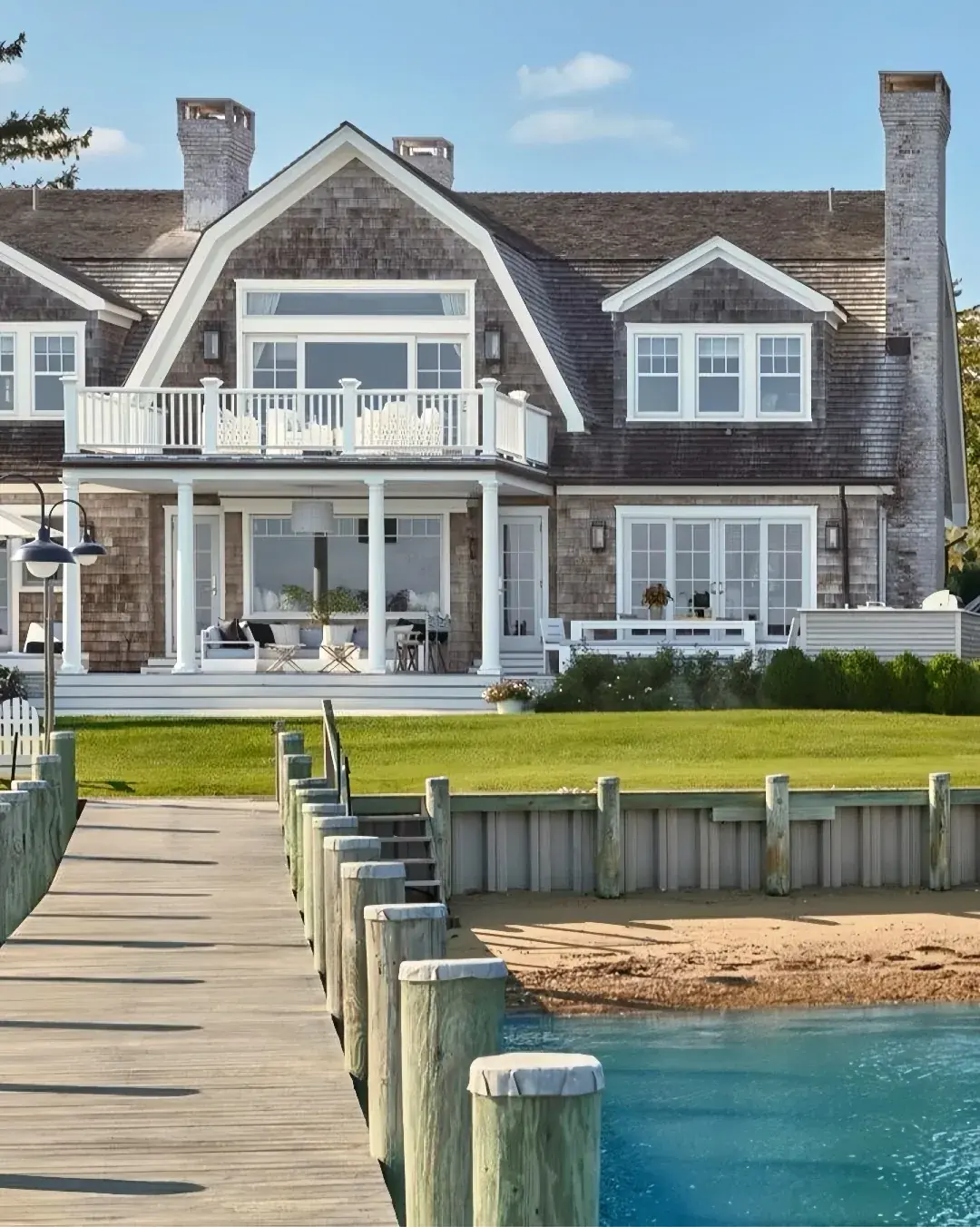
Look at the roof over the bay window on the house below, where it curves down and away from the wall.
The shingle goes round it. Not up to it and then stopped with a flashing, but over and round, following the curve as one continuous surface.
That is the reason Shingle Style exists. Every other cladding is boards, and boards are straight, so a building made of them is made of flat planes meeting at corners. Shingle is thousands of small pieces with no joints between courses, which means it can turn anything: a bay roof, a tower, an eyebrow dormer, a swept eave.
The fixings, which is the coastal part
Salt air is aggressive, and it finds the metal before it finds the timber.
Galvanised nails are zinc-coated steel. The zinc sacrifices itself to protect the steel, which works well inland and works badly in salt air, where the coating is consumed within a few years. After that the steel rusts, the head fails, the shingle drops, and a brown streak runs down the wall from every nail.
Those streaks are the thing you see on coastal shingle houses that have gone wrong, and they are not cleanable. The rust is in the timber.
| Fixing | Suits | Rough cost per kg in 2026 |
|---|---|---|
| Hot-dip galvanised ring shank | Inland only | £6 to £9 |
| Stainless 304 ring shank | Moderate exposure | £18 to £25 |
| Stainless 316 ring shank | Marine, within sight of water | £28 to £40 |
| Copper | Traditional, very exposed | £45 plus |
Simpson Strong-Tie and Maze Nails both list a 316 shingle nail; in the UK, Owlett-Jaton and Tacwise stock 304 and 316 ring shanks in the 32mm and 38mm lengths a cedar shingle wants. Budget roughly 4kg of nails per 100 square metres of wall at standard exposure.
Against £90 to £160 per square metre to re-shingle in 2026, the £200 or so extra that 316 adds to a whole house is not a decision to dwell on.
The same applies to every other piece of metal on the building: flashings, gutter fixings, vents, and hinges. A stainless-nailed wall with galvanised flashings above it will still streak.
What the curves are for
Once you know shingle can turn, the openings on a Shingle Style house make sense.
Bay windows with their own curved or swept roofs, as above, where the shingle rolls over the top and down the sides. Boards would need a trim at every change of direction.
Eyebrow dormers, where a roof lifts into a low curve over a window with no vertical sides at all. These are almost impossible in any other cladding.
Round towers, where the wall itself is a cylinder.
Swept eaves, where the roof flares out near the bottom rather than stopping in a straight line.
If a shingled house is flat everywhere with square windows, it is a house clad in shingle rather than a Shingle Style house, and that is a perfectly reasonable thing to be. The curves are an option the material offers.
The stone base
That house has stone to the first floor and shingle above, which is the classic arrangement and an honest one: stone where the building meets the ground and takes the weather, a lighter skin above.
It also solves a coastal problem. Salt spray and driven rain hit the lower wall hardest, and stone does not mind. Shingle at ground level in an exposed position deteriorates faster than the same shingle two storeys up.
If stone footings are beyond the budget, the useful version is a double starter course at the bottom of the shingle run and a generous drip detail, so water leaves the wall rather than wicking into whatever is below.
Exposure in a windy place
Exposure is how much of each shingle is left showing, and in an exposed coastal position it should be less than inland.
On a standard 450mm western red cedar shingle, 190mm of exposure is the usual sheltered figure and 165mm is the sensible coastal one. That sounds like a small change and it is roughly 15 per cent more shingles and 15 per cent more labour across the elevation.
The extra overlap is what keeps driven rain out. A supplier quoting an unusually cheap job on a seafront house has often stretched the exposure to 200mm or more to save material, so ask for the figure in millimetres in writing before comparing two quotes. Otherwise you are comparing different walls.
The side passage shows what clearance should look like
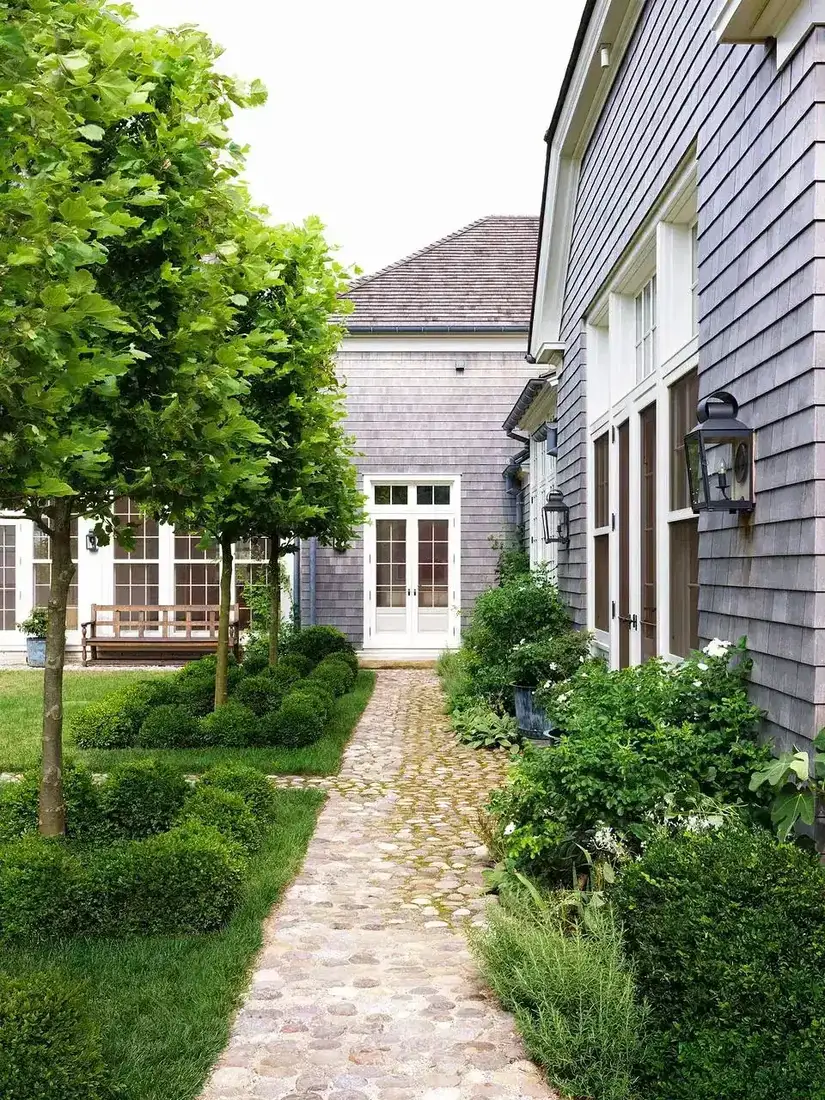
This passage is the textbook for keeping the base course free of soil, and for what bare cedar looks like when it has had time.
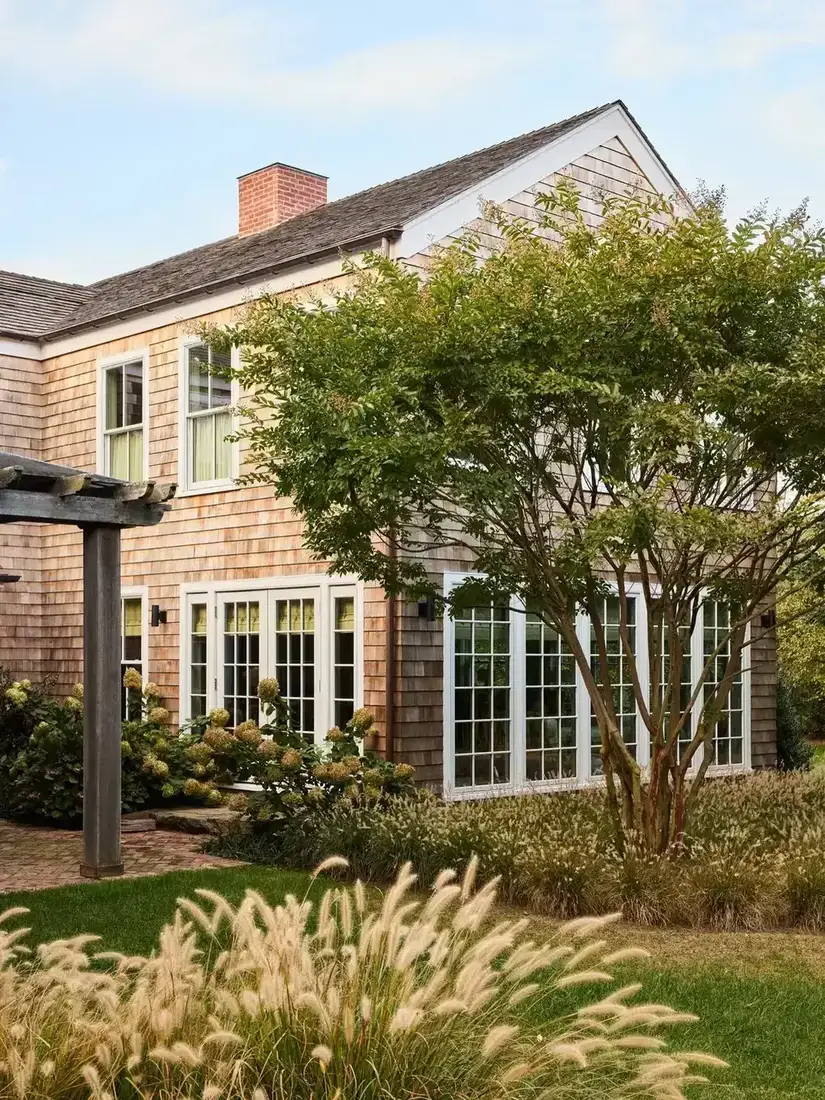
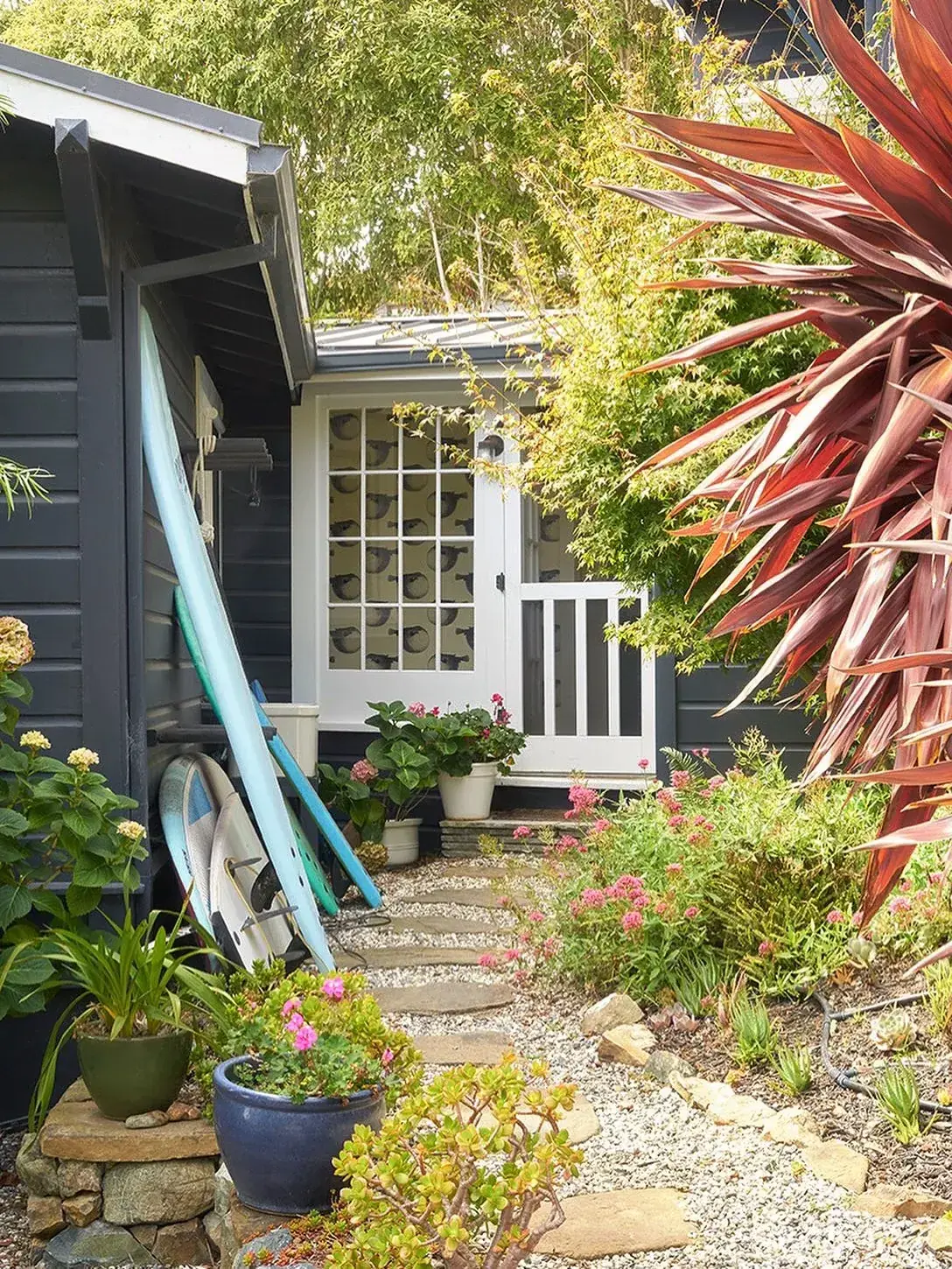
The foot of the right hand wall tells you the detail to copy. A cobbled path runs hard to the base, no soil or bark touches the shingles, and the planting sits in a disciplined line to one side. Keep that low course open so splash can drain and air can dry the wall after rain. Soil or mulch piled to the courses wicks water upward, and the bottom two courses darken within one winter. Hold planting about 450mm back, keep mulch below that shadow gap, and sweep leaves before they sit and hold damp.
Now look at the wall itself. This is untouched cedar worked by sea air and sunlight across several seasons. The classic silver appears quickest on coastal elevations, but any bare wall gets there if you leave it. The tone here is even, with slight variation between shingles that grey stain never manages. A tin of grey stain coats every shingle the same, so the field reads flat. Weather leaves each shingle a touch different, which is why this passage looks alive and a stained copy looks painted.
Check the fixings too. No rust tears. That is stainless steel doing a quiet job. Lanterns are mounted on standoffs, not tight to the shingle, and every screw through cedar should be the same grade. A galvanised screw in a stainless wall will still bleed brown. A hose, a soft brush, and a proprietary biocide at about £12 to £20 in 2026 will lift green where shade holds damp. Never use a pressure washer on cedar. It furs the surface and the next crop of algae takes hold faster.
A raised house with two greys on one front
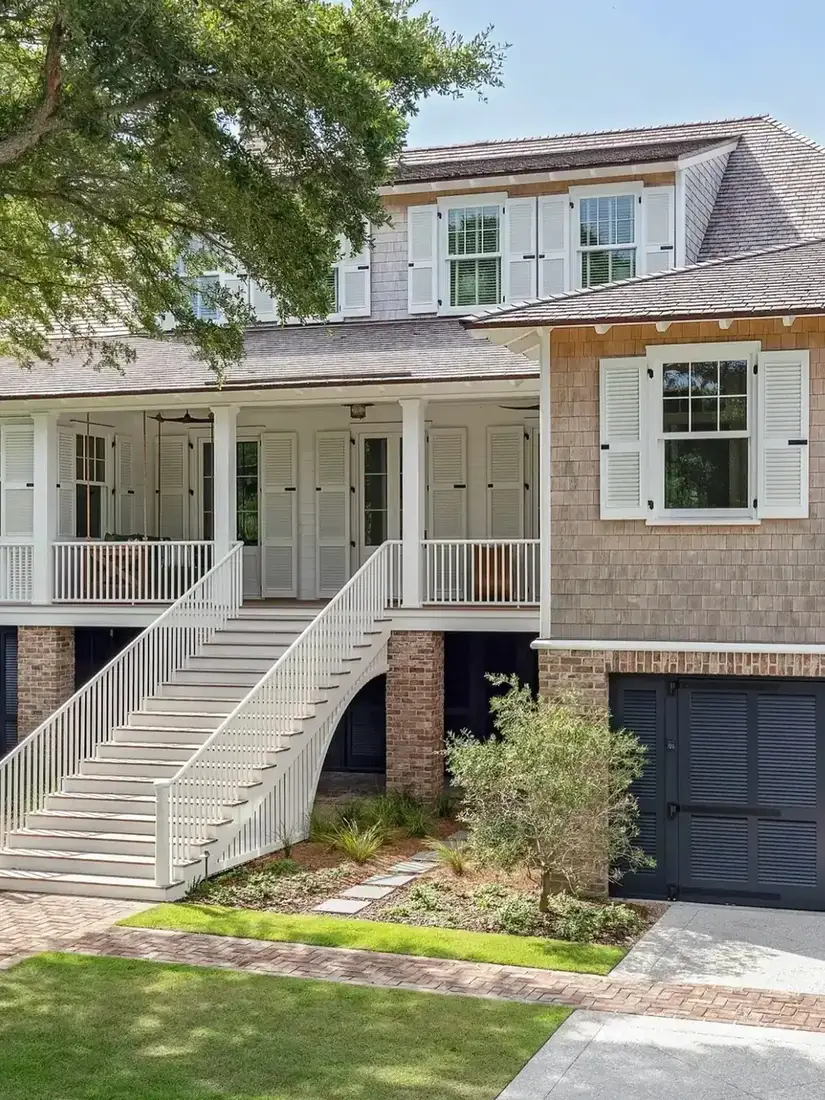
Stand back and read this front in two halves. The main block under the gable is already pale silver grey. The right wing under the lower roof, and the lower right wall above the dark garage doors, is still warm tan. Same house, two stages.
That is early weathering looking uneven. Sunlit elevations lighten first, sheltered faces follow, then the tones settle together. The tall left side catches more sun and wind; the right wing sits lower and more shaded by the porch roof. The lag is normal and the cure is patience. Do not reach for grey stain to force a match. Stain will make both walls the same flat grey for one season and then weather differently underneath. Bare cedar converges on its own if you let it.
Order of operations matters here. Before you fix the colour, fix the water. This house gets it right by lifting the timber clear of the ground on brick piers. That gap is the bigger version of the base clearance rule. Pier, air, then timber. No soil contact, no wicking, no paint needed at the base. Where a full stone plinth is beyond the budget, at least hold the shingle 150mm clear of finished ground and keep the detail open so air moves.
If you cannot wait for the tan to catch up, a bleaching oil will give an even grey straight away. It is a decorative finish, not a protector, so it buys you a tidy photograph without adding protection. Cabot bleaching oil sits around £55 to £85 for 5 litres in 2026, enough for roughly 20 to 30 square metres depending on porosity. Use it to even the field, not to seal it, and still detail the base and the fixings as though no coating existed.
Why green shutters on silver work
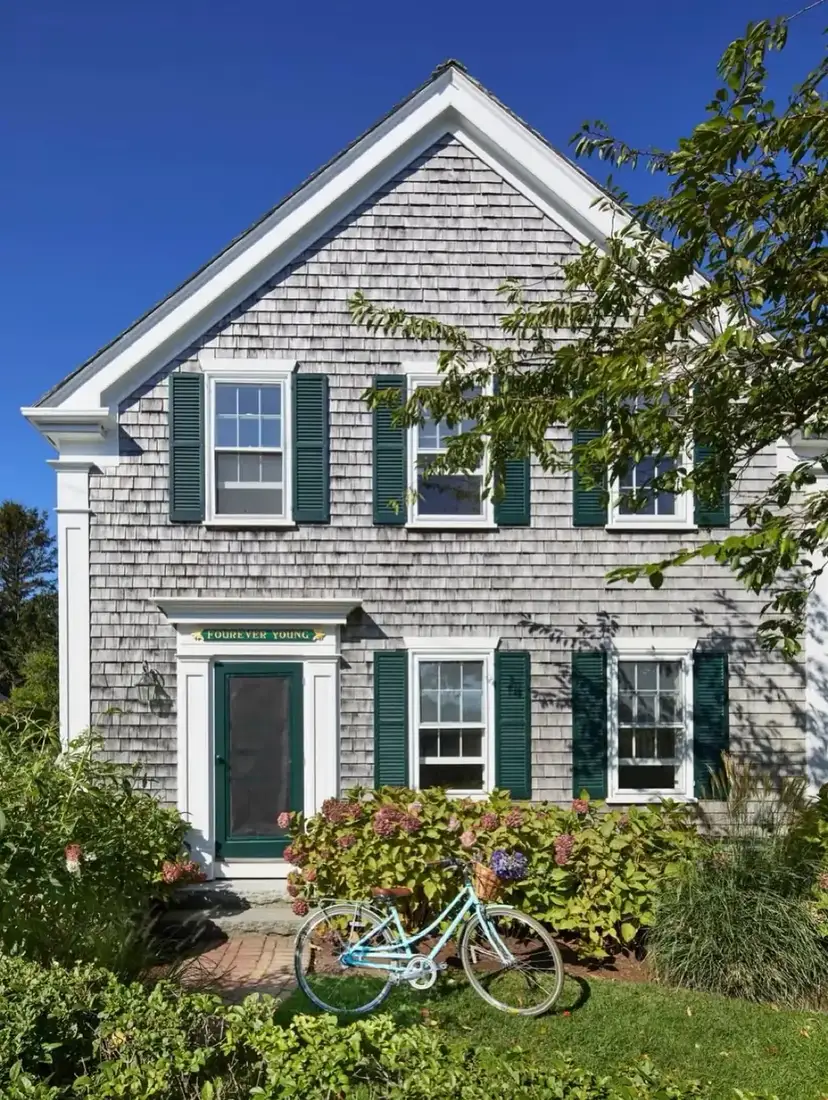
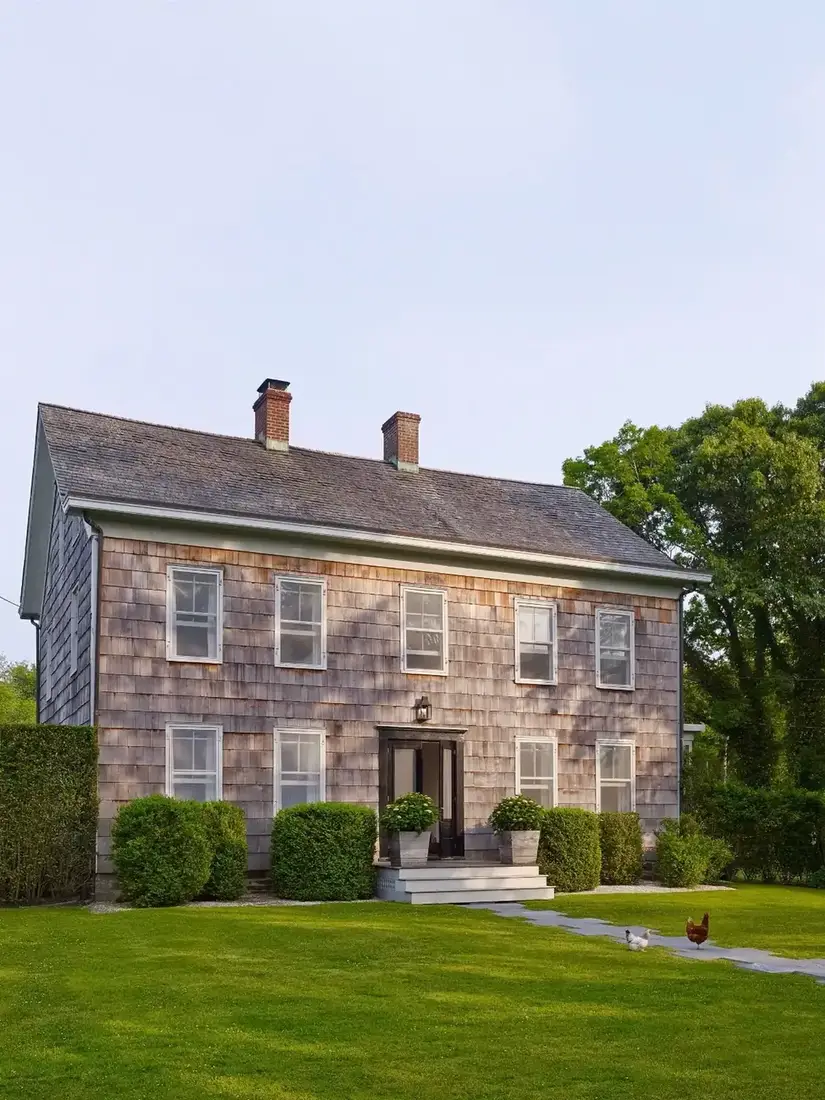
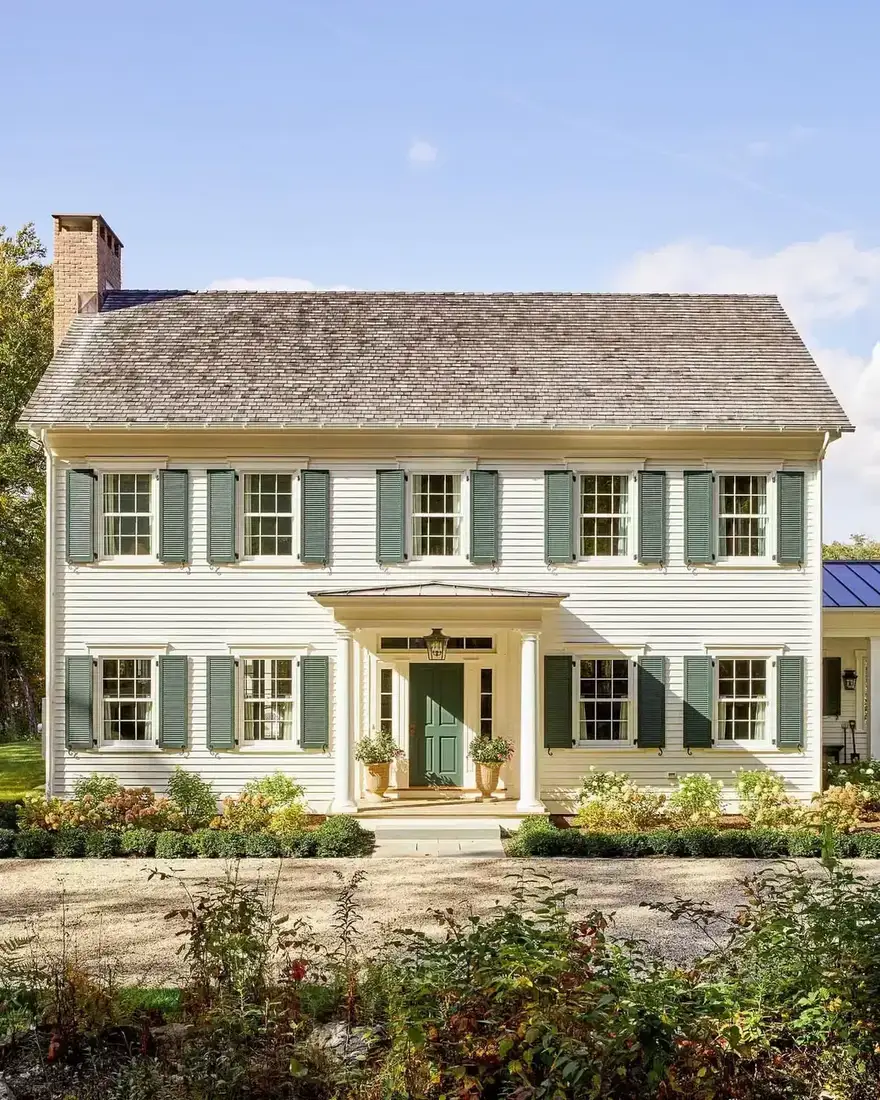
This saltbox owns its shape because the white trim draws it. White corners, white window frames, a white door surround with a small pediment, all against a field of silver grey that would look unfinished without them.
A light edge next to weathered grey is what gives the silver its meaning. Cedar alone, even a perfect silver, reads as a house waiting for paint if nothing picks it out. The fix is simple and cheap. Keep the trim white, keep it consistent, and let it be the bright line the eye follows. The green shutters work here because they are the only strong colour after white. Cedar is a warm grey brown neutral, so it carries a bolder door or shutter than a painted house can, but one colour does it. Two or three strong colours on a small gable fight for attention.
The grey here is bare timber left alone and weathered by salt and sun. Compare it in your mind to a tin of grey. A coating sits flat on the face because it covers each shingle identically. First, it has no variation between courses. Second, it has no depth in the grain. Weathered cedar keeps both. If the evenness in this photo tempts you to buy it in a tin, ask for a stained sample and hold it next to this image. The sample will look like a photograph of the wall, not the wall.
For trim paint in 2026, a 2.5 litre tin of Dulux Weathershield exterior or Sadolin Superdec runs about £40 to £60, with Farrow & Ball exterior and Benjamin Moore Arborcoat in the £70 to £90 band for the same volume. Prime all faces before fixing, including the back, because shingles butt into trim and that joint is hard to repaint later.
Thick shakes hold brown longer than thin shingles
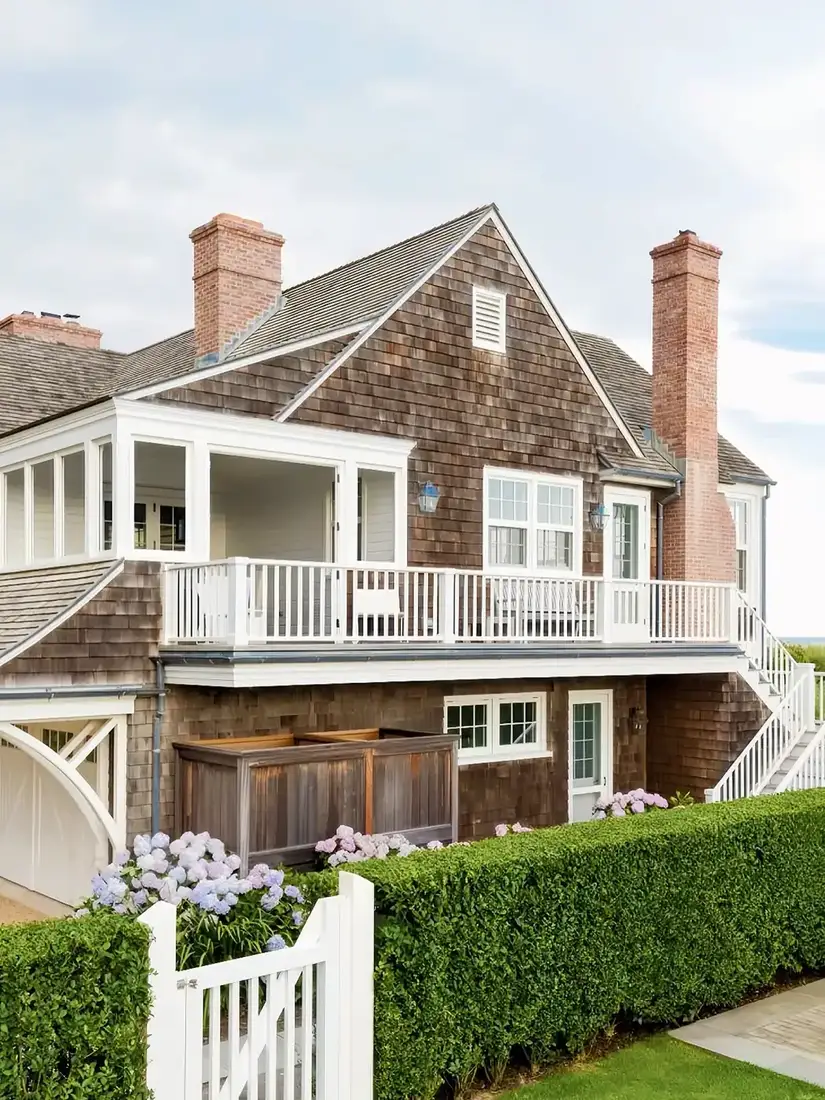
The difference between a shake and a shingle is how it is cut, and you can read it here from the hedge.
These courses are thick, ragged, and throw a deep shadow at each butt. Shakes are split, not sawn, so they are irregular, heavier, and rougher than sawn shingles which are smooth and uniform. That cut changes drying. A thick shake holds water longer after rain than a thin shingle. Fix shakes tight to sheathing with no gap and the backs stay damp. That is where rot starts, out of sight.
Build a ventilated gap behind the cladding: battens hold the courses off the wall, air enters at the bottom and leaves at the top, and both faces dry. The detail roughly doubles the life of the wall compared with direct fixing. It costs little at first fix stage and cannot be retrofitted without stripping the wall, so put it on the drawings.
The colour here is still brown, not silver. The south and west walls on an exposed house like this silver in roughly two to five years, but thick shakes and shaded lower courses lag. That familiar silver from untouched cedar and coastal air still arrives, only slower where the timber is thicker and the wind less. Do not force it with a grey stain to match the neighbour’s silver house. A shake wall stained grey loses the very texture you paid for. Stainless fixings again are non negotiable at this scale. Maze Nails or Simpson Strong-Tie 316 ring shanks in 32mm and 38mm run about £28 to £40 per kilogram in 2026, with 304 at about £18 to £28. On a house this large, the extra for 316 is a few hundred pounds against a re-cladding cost of £90 to £160 per square metre in 2026. Specify it before the first course goes on.
The lakeside porch that still answers to salt logic
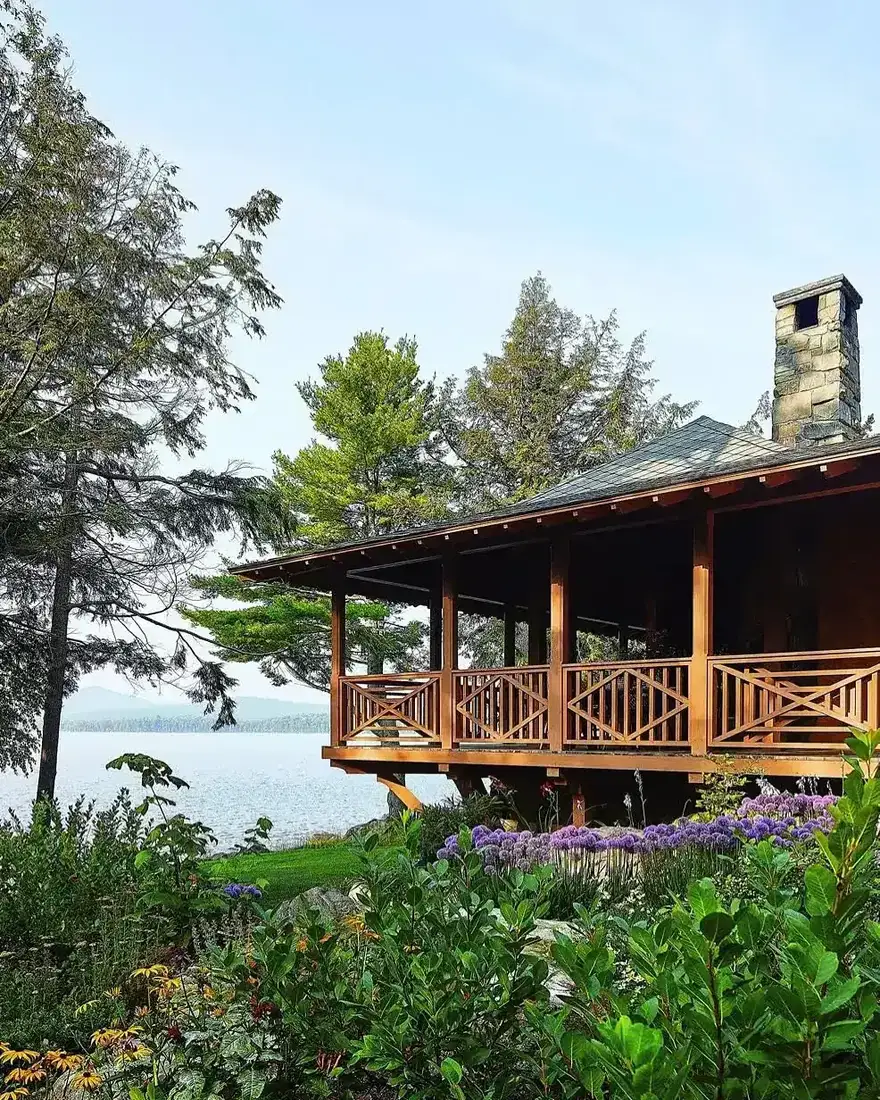
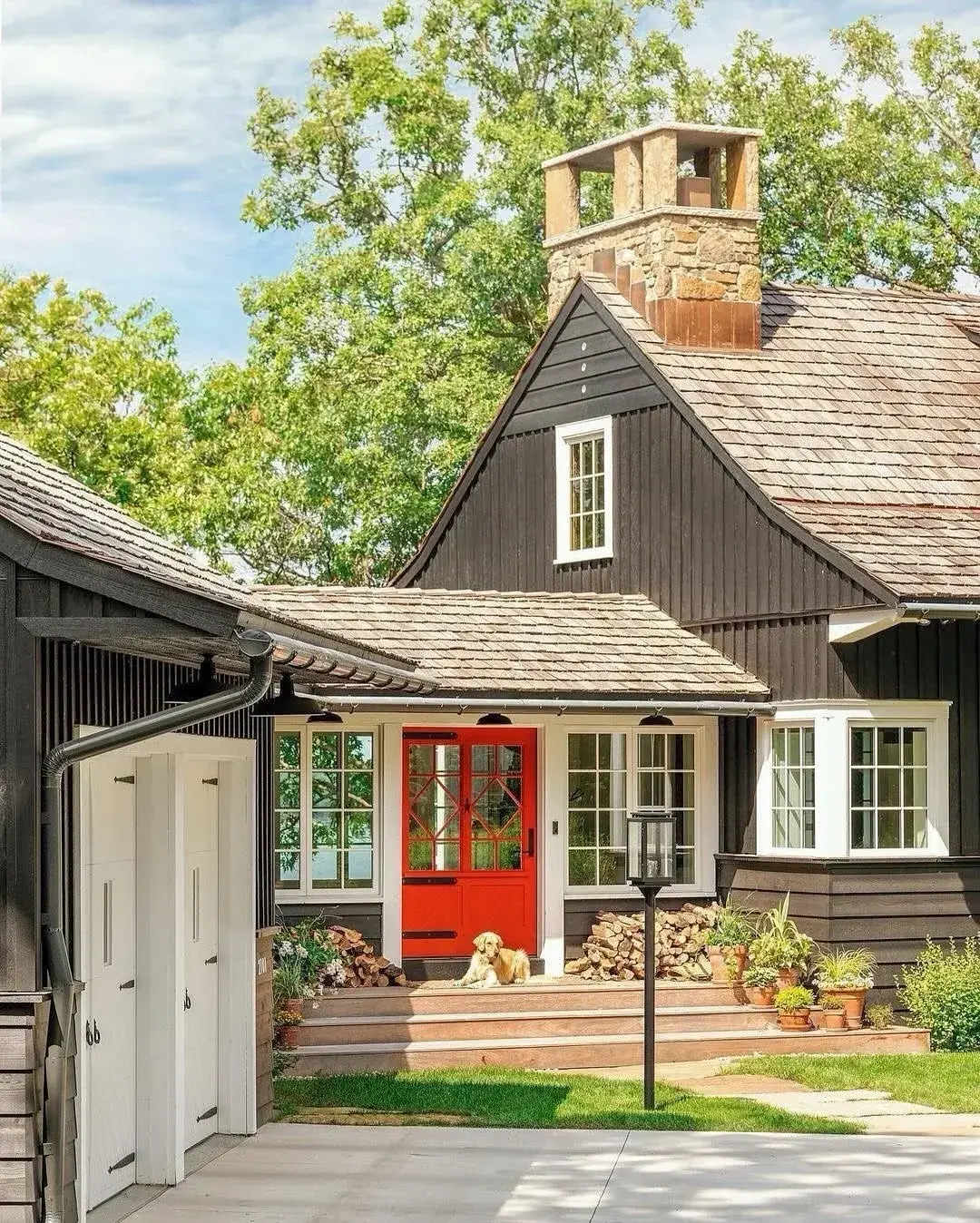
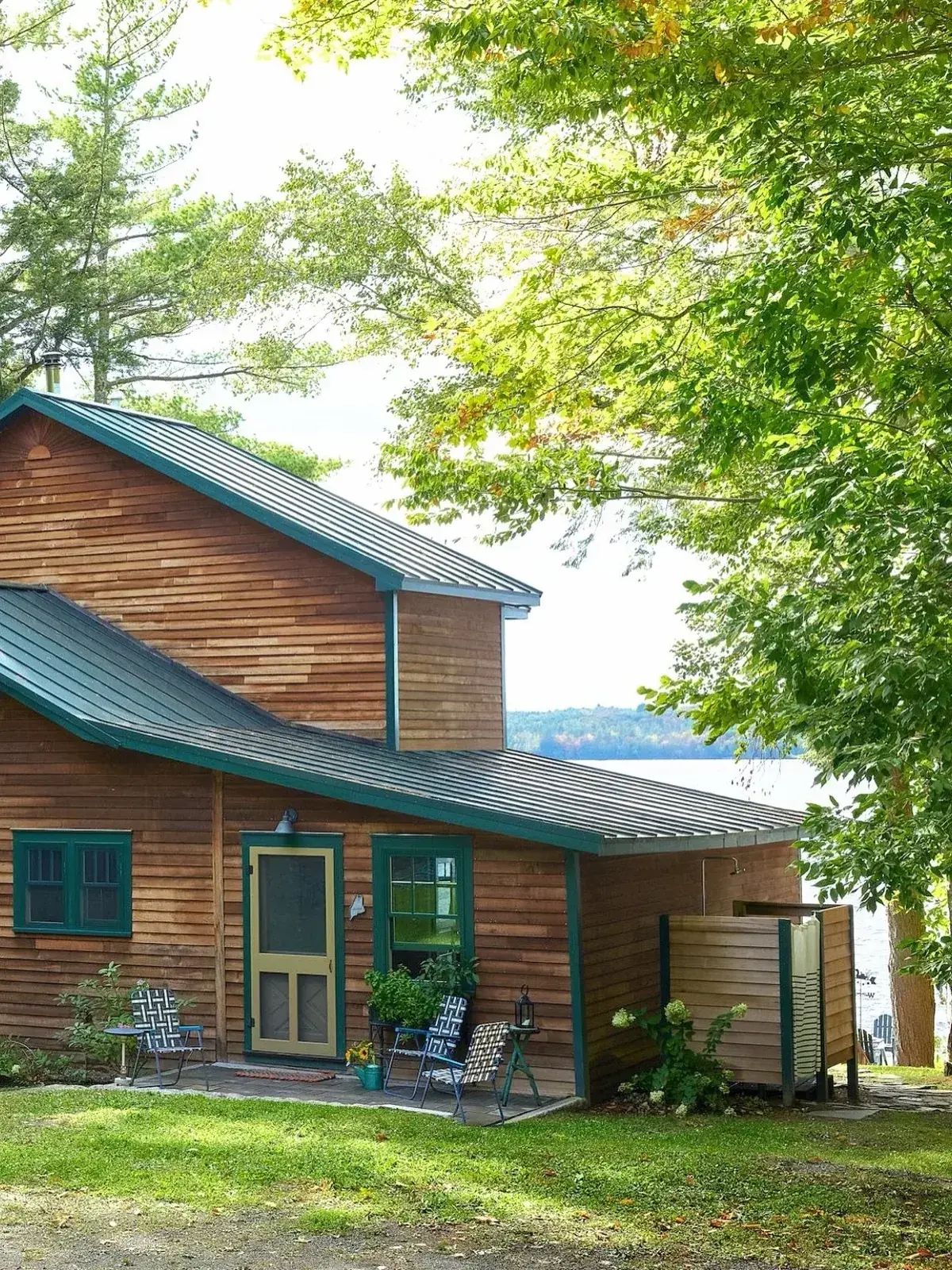
There is no shingle wall in focus here, which is the point. The cottage sits over a lake, not the sea, and the deep porch with its cross braced rails faces water on a sheltered plot.
Inland walls still silver without salt, only slower and with more early patchiness because sunlit planes lighten before sheltered ones. Coastal elevations silver quickest because they get more sun, more wind, and salt in the air. Here the same timber and the same need for clearance apply, even without the coast. Keep that lowest course open, keep the lakeside planting forward so wind dries the wall, and keep the porch floor open below so air moves. The alliums and shrubs in front belong a step out from the plinth, not hard to the cladding.
A bleaching oil gives an even grey quickly if you cannot wait for inland silver, but name what it is and what it is not. It is a decorative finish that evens tone in weeks, not a preservative that replaces detailing. You still ventilate behind the boarding, still specify stainless, still keep soil and leaf litter off the base. Maibec and No.1 Blue Label Certigrade cedar sit in the £90 to £160 per square metre supply range in 2026; Cabot bleaching oil around £55 to £85 for 5 litres sits beside them as a colour decision, not part of the build up.
Failure here is not dramatic. It is leaves on the porch edge, hoses left to soak the base, and pots held tight to the wall all summer. Sweep the edge, lift pots for a brush, and check that the bottom course still shows a shadow line. That line means the wall still dries.
A white fence that repeats the trim and finishes the silver
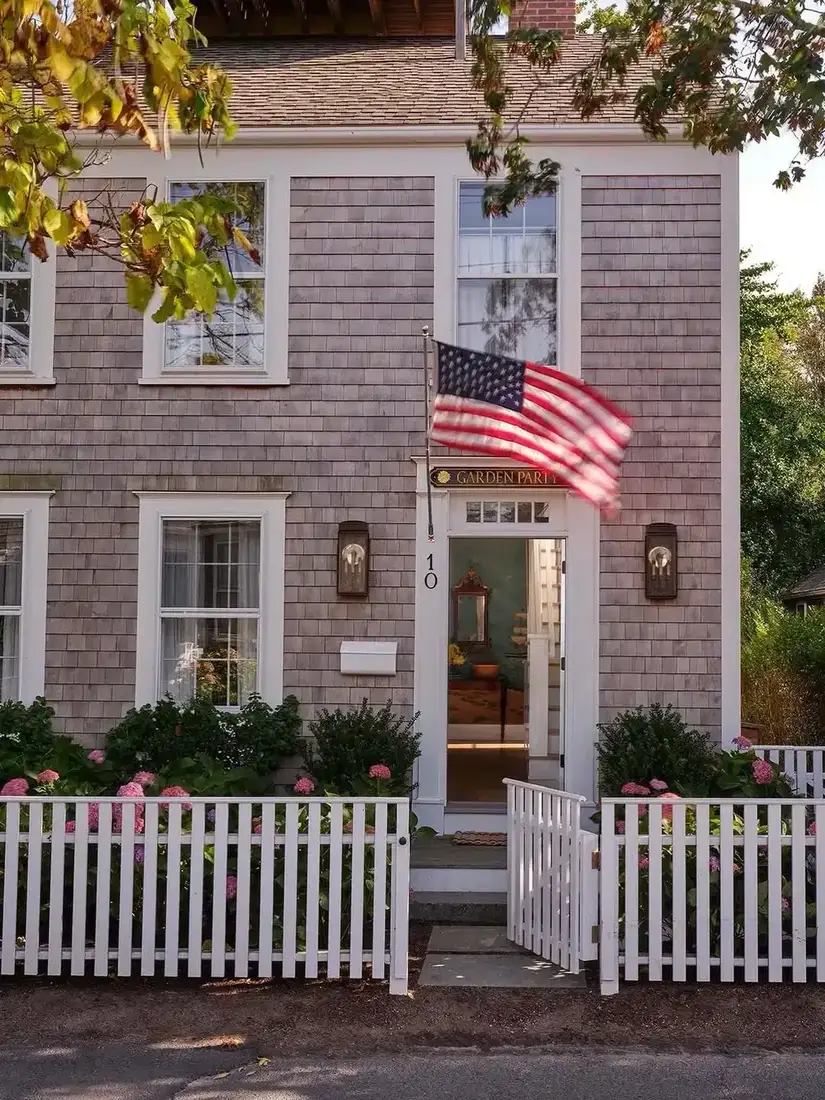
This street front reads as settled because everything pale repeats white. White trim at windows, white door frame, white picket fence and gate, white stone path. The silver grey shingles sit in the middle as a calm field.
Look at the fence line and then the window frames. Same colour family, same paint sheen, same crisp edge. White trim makes silvered cedar read as style rather than as neglect, and a fence in the same white extends that read to the kerb. Without that, cedar alone can look unfinished even when the silver is perfect. The rule is simple. Use one white and use it everywhere at the front.
Count the lanterns and the hydrangeas too. Two wall lights flank the door, one each side, which keeps symmetry on a symmetrical cottage. The pink hydrangeas mass under the windows, not against the wall itself, so the courses behind them still see air. Keep box hedging trimmed and hold beds about 450mm off the wall where the shingle gets splash. That gap lets you inspect the bottom course for soft spots without pulling plants.
The grey here is not from a tin. It is bare timber weathered by salt and sun, levelled after the early patchy phase. Coastal plots like this one get there in two to three years; sheltered streets take closer to five. Grey stain would give you this tone on day one and then ask for recoating every few years when it scuffs at the butts. Bare silver asks for nothing after the detailing is right. If immediate evenness matters for a listing photograph, bleaching oil will even the tone in one season around £55 to £85 for 5 litres in 2026, but understand it as colour, not structure.
Paint is not weather and this blue makes the point
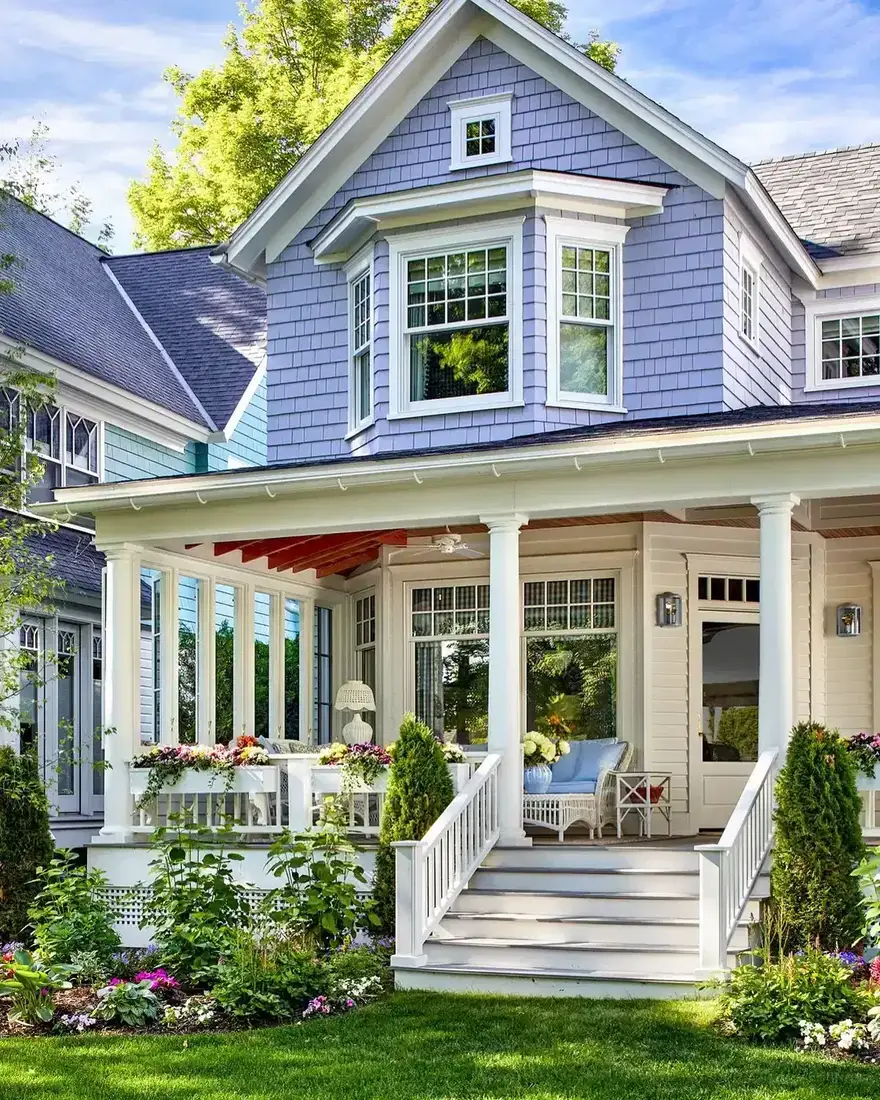
This Victorian wears its shingles as background for joinery, not as weathering to admire. The field is periwinkle blue paint, even coat, every course the same, with white trim, a bay above and a deep porch below.
The grey in the coastal cottages you want is not paint and not stain. Bare timber left alone turns silver with early unevenness that later settles. Paint or solid stain sits on the surface and looks flatter because it coats every shingle identically and fills the grain. Here the blue does that correctly, because the aim is colour, not silver. On a house intended to silver, that same flatness disappoints. If you hold a grey stain chip to this blue house, you see the difference: the chip is monochrome, the weathered cottage has variation.
Treat this as a different build up. A painted shingle wall still needs a ventilated gap behind it so the timber dries, still needs stainless nails so the paint does not tear brown, and still needs that lowest course open so splash does not lift the film. Solid colour stain such as Benjamin Moore Arborcoat or Dulux Weathershield solid stain runs about £60 to £95 for 5 litres in 2026, with premium ranges a little above, and sunny elevations call for a wash and recoat sooner than shaded ones. Bare cedar silvered as in the other photos has no recoat cycle at all.
If the pale blue porch ceiling tempts you, note how it repeats the white trim without matching it. A soft off white on the ceiling bounces light onto the front door. That bounce matters on a porch this deep.
Pink shows the orange year you must wait out
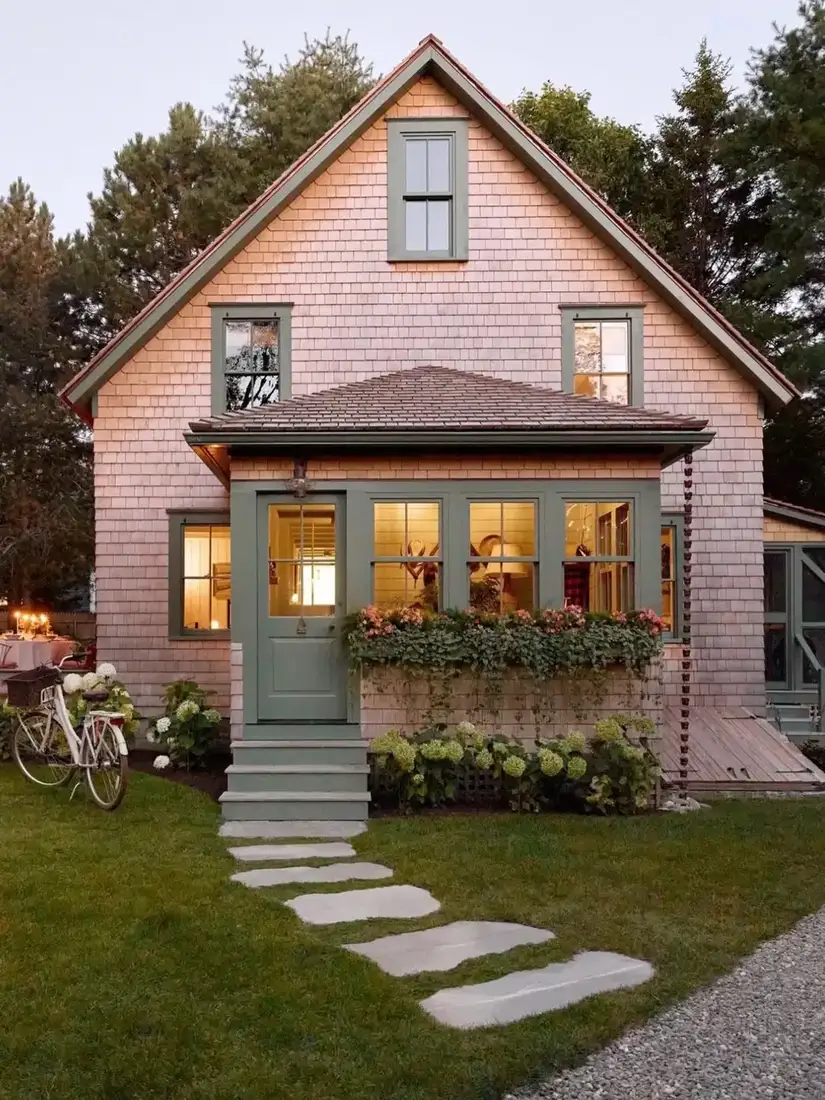
This cottage is new. The walls are honey pink, the gable points warm, and the sage green door and trim look newly painted.
Fresh western red cedar glows that pink honey for one season while the surface extractives wash. Then sun and rain pull tannins down the wall in stripes, the field goes orange brown, then tan, then silver. Two to five years to an even grey in most positions, with sunny and coastal walls fastest. The pink in this photo is not a fault to fix. It is the start line.
Order decides whether you live with that. Decide the finish before the scaffold comes down: bare to silver, bleached to even grey now, or stained to a chosen colour. Each is a different maintenance future. Bare to silver asks for detailing, not product. Bleaching oil gives an even grey in weeks as a finish choice, not a preservative. Stain commits you to a recoat cycle every five to eight years, which on a small cottage runs about £1,500 to £3,000 for the two weather elevations in 2026. Pick once and stop sampling.
The detailing is already right here. A stone slab path runs to the steps with grass between, not soil to the wall. The window box sits on a shingle plinth that throws water clear, and the planting below is low enough to keep the bottom course visible. Keep that shadow line open. Hold the hydrangeas forward, keep mulch low, and let the pale pink take its time toward silver.
A shingle roof that proves silver is not only for walls
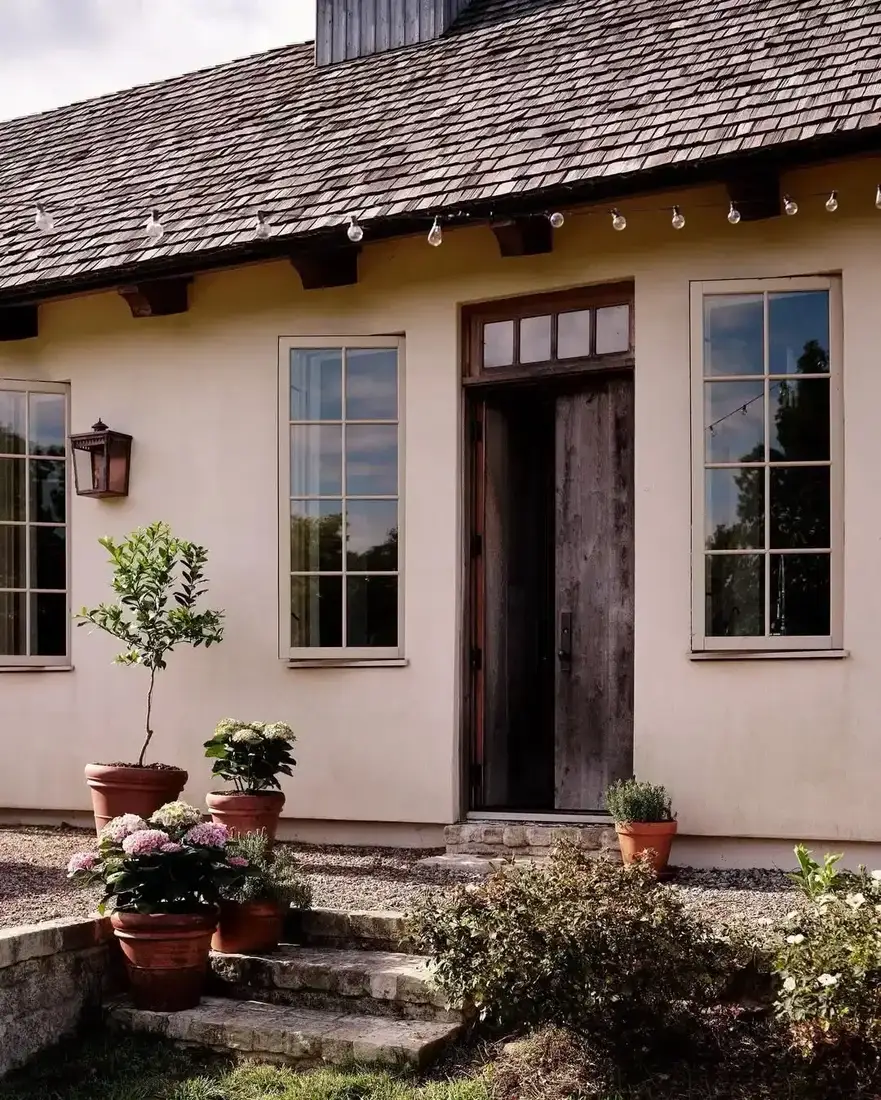
The shingle here is not on the wall at all. The walls are pale lime render, the shingle is the roof, and the timber door has already gone grey on its own.
A shingle roof silvers the same way a wall does, only faster on the weather slope. Salt and sun work the exposed pitch, while the ridge stays a touch darker. That familiar silver from untinted cedar and coastal air does not care whether the timber is vertical or pitched. Leave it bare and it arrives. Force it with grey stain and the roof reads as painted, flatter, and more uniform than a weathered field should.
Look at the gravel at the foot and the pots. Even at roof height the bottom edge rule has an echo. Keep the eaves clear of leaf fall, keep the gutter shingle course open so air moves under the edge, and keep festoon lights clipped to stand offs rather than nailed through the butts. Every fixing through cedar wants to be stainless. Owlett-Jaton and Tacwise 304 and 316 ring shanks in 32mm, or copper clouts for a traditional gauge, sit in the £18 to £40 per kilogram band in 2026 depending on grade.
If even tone from day one matters, bleaching oil again gives it evenly and quickly, but on a roof it chalks faster under sun than on a wall. On pale stucco like this the contrast is already bright enough without help. Let the roof go silver, keep the render pale, and let the terracotta do the colour.
Logs and shingles want the same air behind them
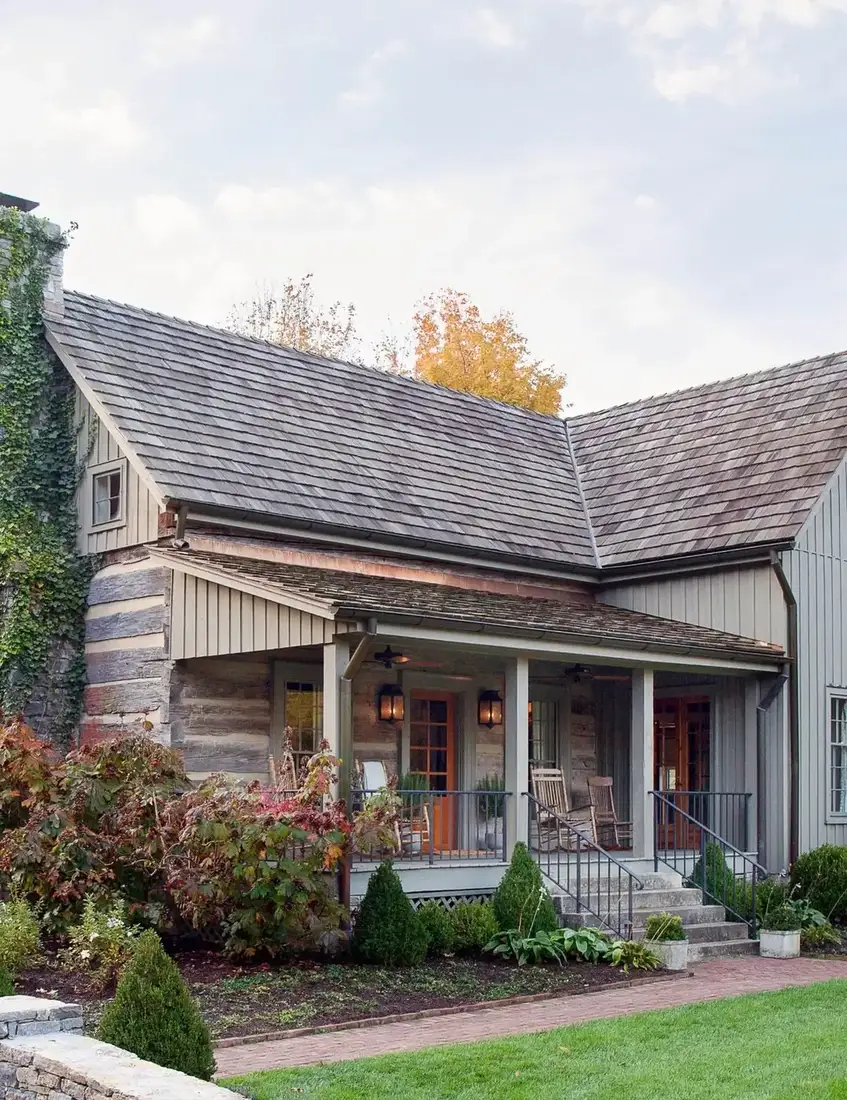
Logs below, shingles above, board and batten to the side. The grey roof field ties them together, and it is the only grey not painted. Ivy climbs the stone chimney to the left, autumn leaves sit thick in the beds, and the covered porch runs its depth along the front.
Shingle roofs that sit tight on solid sheathing rot from behind. The timber needs air. Ventilation behind the cladding, and a ventilated batten void behind a shingle roof, let both faces dry after rain. Fixed directly to board, either fails early, shows as cupping where edges curl, and the only fix is stripping. Build the gap in before the first course.
Keep the bottom edge clear as well. Here the porch roof keeps rain off the log wall, but leaves collect along the drip line. Sweep them. Ivy looks charming on stone and holds damp against log and shingle alike; pull it back so a hand passes between leaf and wall. The same applies to the boxed shrubs along the brick path. Hold them short so the wall behind stays dry, and keep the stone chimney base clear of soil so splash does not sit.
The roof tone that arrived here cost nothing beyond time. Bare shingle roofs lighten quickest where sun strikes, shaded valleys stay darker a season longer, then the field settles. That lag lasts longer inland and resolves faster near salt water. Grey stain would make the whole roof the same flat tone at once and hide the log texture you came to see.
Sage and gravel show the trim rule on a quieter palette
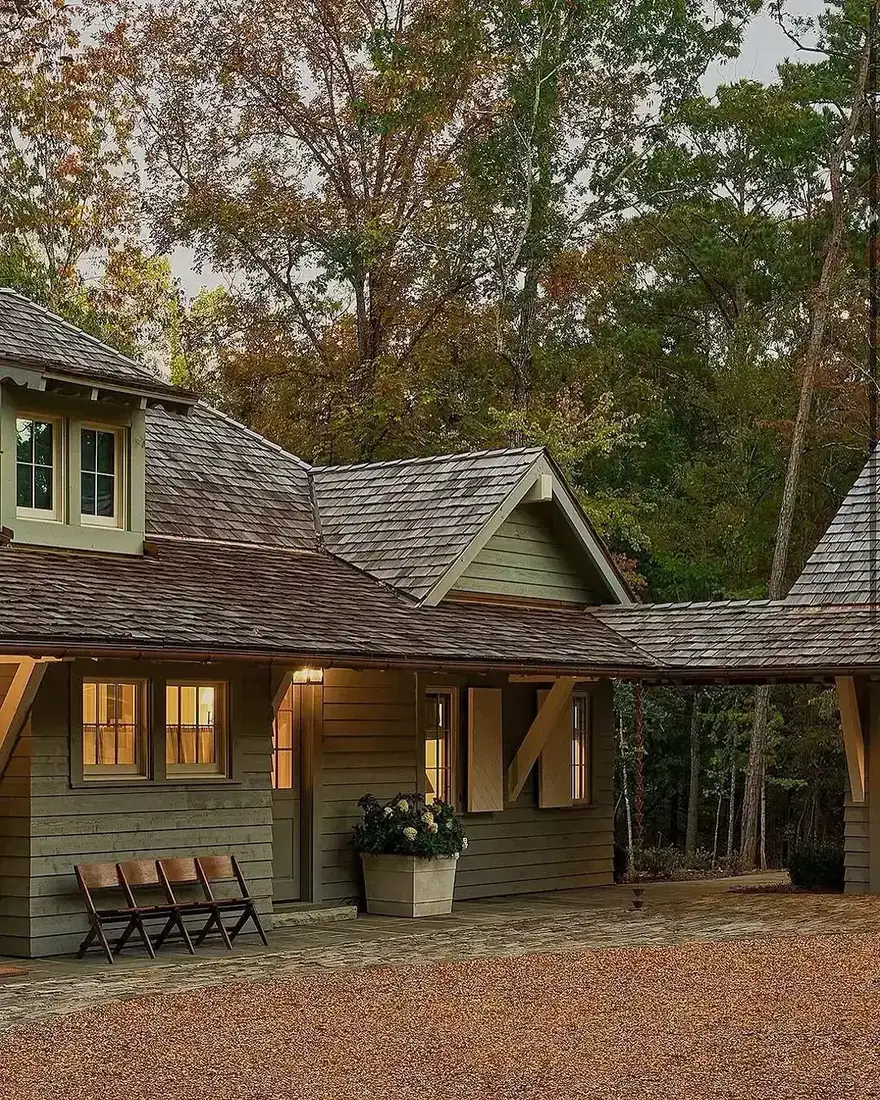
Sage like this reads calm because the joinery does the drawing and the field stays plain. The roof is cedar shingle, already soft grey brown and on its way to silver, the walls are sage boarding, and the breezeway roof ties to a carport over gravel.
This is not bare silver; it is a painted shingle and board house. Treat it as the companion lesson: the same detailing rules apply whether the field is silver or sage. Bottom course clear, white or pale trim consistent, air behind the cladding, stainless fixings.
Look at the courtyard. Stone paving under the breezeway, pea gravel beyond, a large planter and three simple chairs. The gravel is the stone base by another name. It throws splash away from the timber and keeps the wall foot dry, which is exactly what a bottom course needs. A tarmac or concrete apron tight to the wall would hold water and push damp into the timber. Gravel drains.
Evening light helps tell you whether the palette works. Sage against paling shingle and warm interior bulbs reads as one family. Farrow & Ball Lichen, Dulux Weathershield sage greens, and the equivalent Sadolin Superdec tones sit in the £40 to £70 for 2.5 litres in 2026 band, with premium exterior eggshell a little more. Keep the door and window frames in a single white, and the slight shift of the shingle as it silvers further will still sit easily. That shift is variation, not patchiness, and it is the very thing grey stain flattens.
Frequently Asked Questions
Is that soft grey a stain I can buy?
No. It is what happens when untreated cedar is left to the elements. Sunlight with sea air bleaches the timber, most quickly where the coast is close, while a grey wash from a tin coats every piece identically and reads noticeably flatter than the real thing with its small shifts between courses.
My new wall looks blotchy after a few months, should I coat it?
Expect early mottling. Faces that get direct light pale ahead of sheltered ones, then the two even out across the seasons if you hold off. Adding a coating to mask the stage traps a uniform tone that will later weather oddly beneath. Let the timber settle on its own.
What does a bleaching oil actually do?
It tints fresh wood toward a pale even grey within weeks. Consider it colour, not defence. Moisture behaviour does not change, so the assembly still wants stainless nails, a clear ventilated void behind the courses, and a foot that stays free of earth and planting so air reaches the back.
Why is a pale trim so crucial alongside weathered grey?
Without a light edge, even a fine silver can look like an interrupted job. A consistent crisp white around openings, corners, and fascia gives the elevation its line and signals intent. One white throughout does the job; several competing whites create restlessness.
How do I keep the foot of a shingle wall in good order?
Keep earth, bark, and dense shrubs away from the lowest shingles so splash drains and both sides dry. Gravel or paving at the base works best. Set planting roughly 450mm off the wall, keep any top dressing below the air gap, and clear fallen leaves before they pin moisture to the boards.
Does timber still turn grey away from the sea?
Yes, simply later and with more early variation. Seaside elevations shift quickest, inland faces follow over a longer arc, often three to five years to a settled tone. Faces toward the sun still lead and shaded ones follow. The same trio of pale trim, open foot, and stainless fixings governs the outcome.
In order
- Decide on a bare to silver route before the scaffold comes down; add bleaching oil only if an even grey cannot wait, and treat it as colour not protection.
- Specify stainless nails, grade 316 within sight of salt water, and match flashings, vents, and gutter fixings to the same grade.
- Keep a ventilated gap behind shingle and shakes so both faces dry, and keep the lowest course well above soil with planting set about 450mm off the wall.
- Reduce exposure to around 165mm in windy coastal positions and get the figure in writing before comparing quotes.
- Use crisp white trim consistently to give the silver its definition, and hold the palette to one strong colour beside the grey.
- Never pressure wash cedar; use a soft brush and a biocide and expect sunlit faces to lighten before sheltered ones, then settle together.
- Use shingle for what boards cannot do where it fits: bays, eyebrow dormers, towers, and swept eaves, with stone at the base where the wall meets the weather.
This article may contain affiliate links. We may earn a commission at no extra cost to you.