8 Porch Planter and Hydrangea Ideas: Glazed Pots Suit Hydrangeas Only

Add us as a preferred source to see more stories on Google.
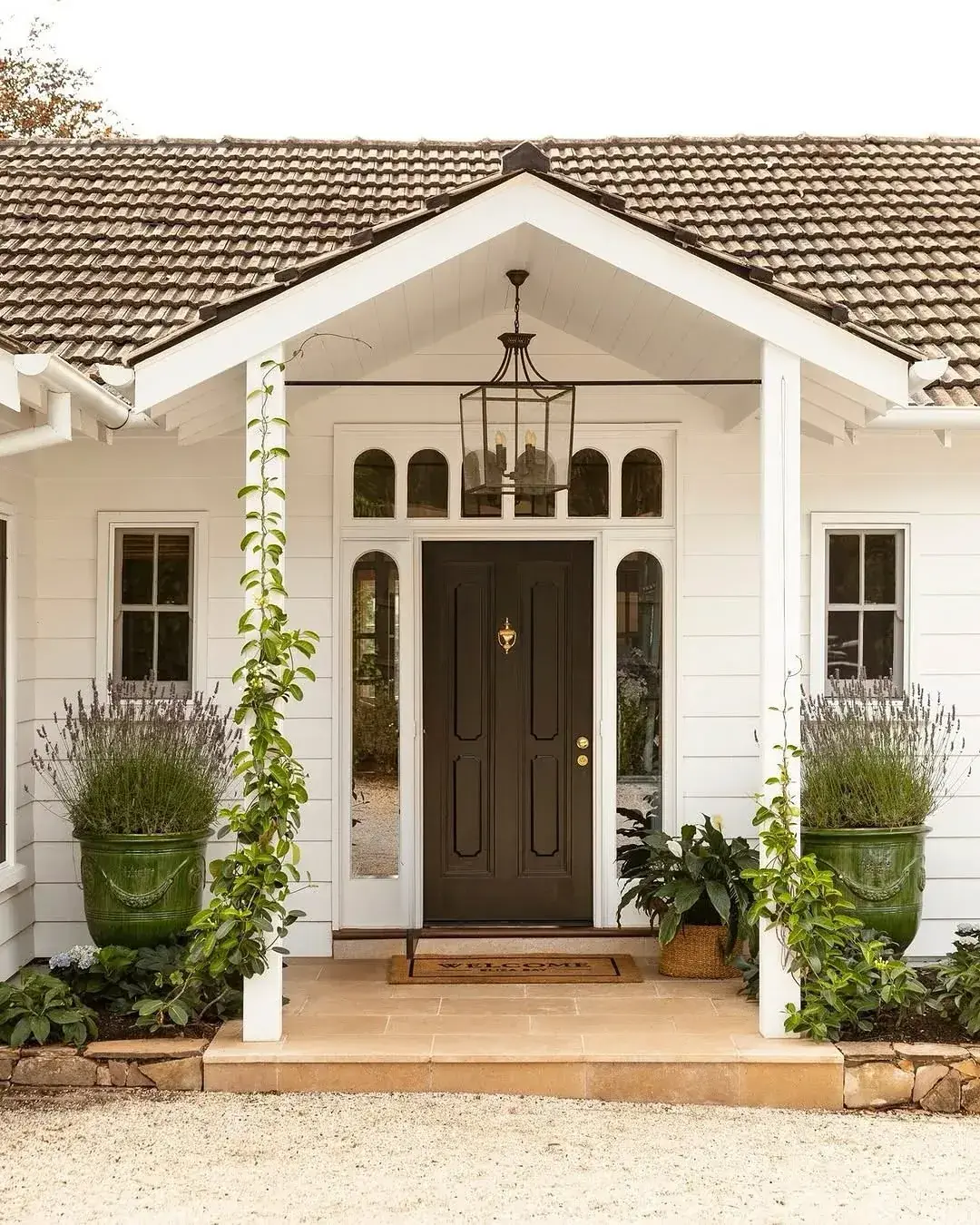
The planters below are handsome, matched, well placed, and holding the wrong plant for the pot.
That is lavender, in glazed ceramic, under a deep roof overhang. Lavender comes from dry hillsides and wants sharp drainage, poor soil and as much sun as it can get. A glazed pot holds water in, and the overhang keeps the rain off and the light down.
It will look well for a season, go woody in the middle by the second, and be replaced by the third. That is not bad gardening so much as a pot and a plant that were chosen separately.
Match the pot to the plant
| Plant | Pot | Why |
|---|---|---|
| Hydrangea | Glazed or plastic | Thirsty; terracotta dries too fast |
| Fern, hosta | Glazed | Want steady moisture |
| Box, yew, bay | Either | Tolerant; glazed is easier in summer |
| Lavender | Terracotta | Needs to dry out between waterings |
| Rosemary, thyme | Terracotta | Same, and they resent wet roots |
| Olive | Terracotta | Wants sharp drainage all year |
| Pelargonium | Terracotta | Flowers better kept slightly lean |
Every pot needs a drainage hole, and glazed pots are the ones most often sold without one. A decorative cachepot with no hole will kill almost anything within a month, and the symptoms read as underwatering, so most people add more water and finish the job.
Pot feet or a couple of tiles under the base. Standing water underneath stains a porch floor and, in a frost, can crack the pot.
Hydrangeas either side of a door
The combination people actually want, and it works, with three conditions.
Size. A mophead in a container wants at least 40cm across, and preferably more. Smaller and the compost dries so fast in July that you will lose flowers however diligent you are.
Shade. Hydrangeas want morning sun and afternoon shade. A porch with a deep overhang on a north or east elevation is close to ideal. A south-facing doorstep in full sun is a losing position.
Water. In summer, daily, and sometimes twice. This is the commitment, and it is the reason most porch hydrangeas look sorry by August.
If the blue matters, use ericaceous compost and top-dress it every spring, because ordinary multipurpose sits near neutral and the flowers drift to pink within a season or two. White varieties ignore all of this and stay white, which makes them the genuinely low-effort choice.
Hydrangea paniculata, in its compact forms, is the easier plant: it tolerates more sun, flowers on new wood so pruning is forgiving, and its colour does not depend on the compost.
The trouble with pairs
A matched pair either side of a door is the most demanding arrangement in the garden, because its entire effect depends on the two halves staying the same.
One plant grows faster than the other, or one gets more sun, or one dies. The moment that happens the symmetry reads as broken rather than relaxed, and a single pot flanked by a gap looks considerably worse than two mismatched pots would.
Look at the two pots in the photograph: both lavender, both clipped to the same mound, and holding that match is a yearly job. Plants forgiving enough to keep a pair for years are clipped box, though check for blight locally first, yew, bay, which needs bringing in through hard frosts, and dwarf pittosporum. All are slow, tough and easy to replace like for like.
Plants that will not hold a pair reliably: lavender, anything short-lived, and anything flowering, because the two will not come into bloom together.
Winter, which decides the pot
Frost does two things to a container. It expands the wet compost, which pushes outwards on the pot, and it gets into the clay itself.
Terracotta must be frost-proof rather than frost-resistant, and the difference is real. Cheap terracotta spalls and splits in a hard winter, usually at the rim. Glazed stoneware is generally more durable, and the green pots in that photograph are the sort that last decades.
See how those green pots sit directly on the stone? Raise every pot off the ground for winter and check the drainage hole is clear, because a container full of frozen water is the commonest way a good pot dies.
Box mounds and a white pot by the step
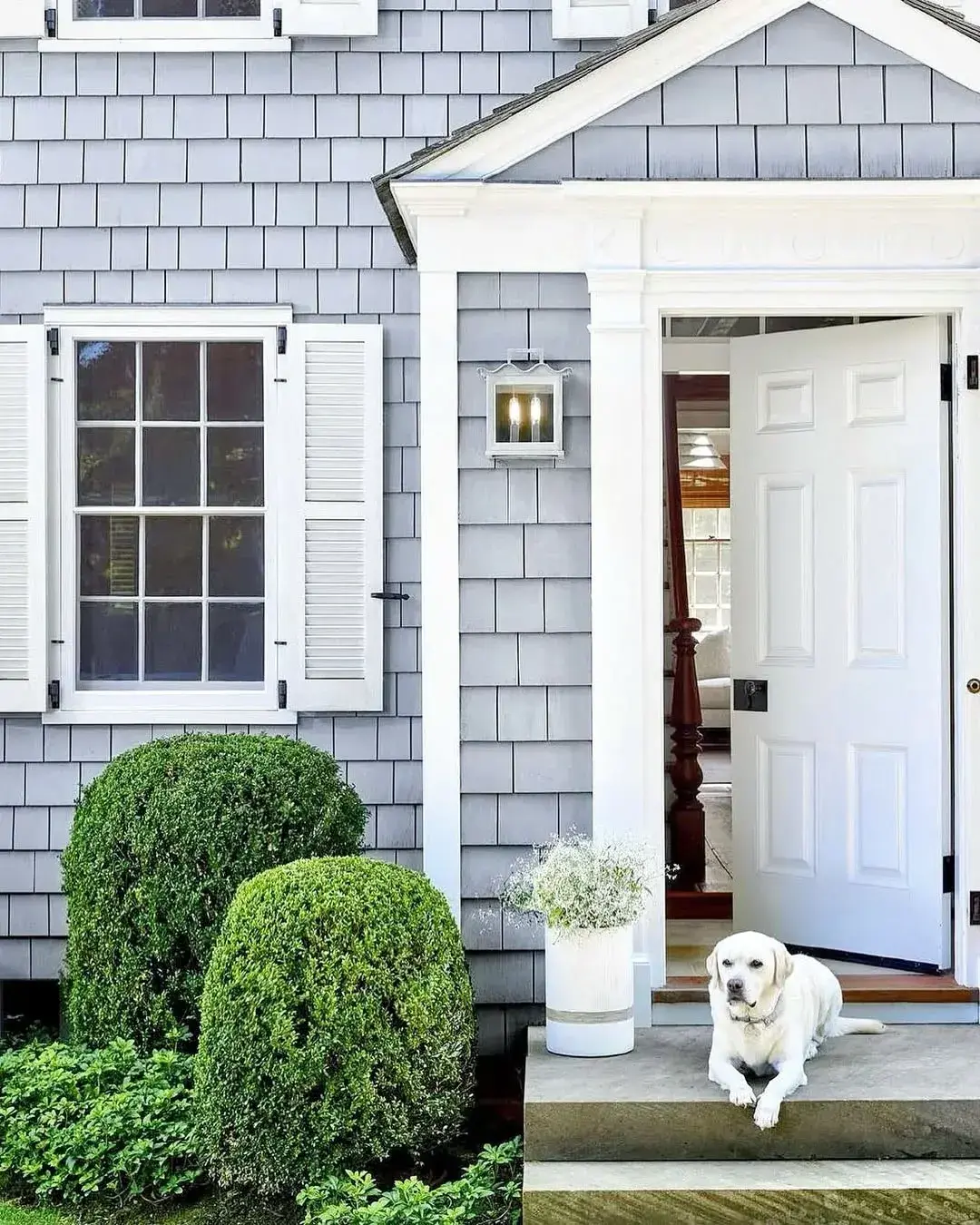
In this image a grey shingle porch carries two dense box mounds in the bed with a tall white pot of airy white flowers on the step. Look at the mounds first. Box keeps that tight surface because buds break readily from older wood after clipping, so one shear in early June plus a light tidy in late August keeps the dome closed.
The bed matters here. Those mounds sit in open ground with far more soil around the roots than any porch pot provides, which explains the even colour from top to base through high summer. A Buxus sempervirens of similar size in a 35cm pot would need water every hot day; the same plant in the ground coasts for a week.
The white pot shows the complementary move. A tall container of this type, usually fibre-clay or glazed ceramic at £35 to £80 in 2026, lifts a short season of pale flowers to eye level beside the door. Plant it with John Innes No. 3 mixed roughly half and half with multipurpose, since the loam holds nutrients through the season while the peat-free fraction keeps the weight down.
Position is kind here: bright open shade off an east-facing front suits both subjects, with direct sun for part of the morning and the house shading the step after midday. Check for box blight locally before buying, because bare patches from blight ruin a pair faster than any watering lapse, and plants are indifferent to the symmetry humans had in mind.
Standards and hedging along a brick path
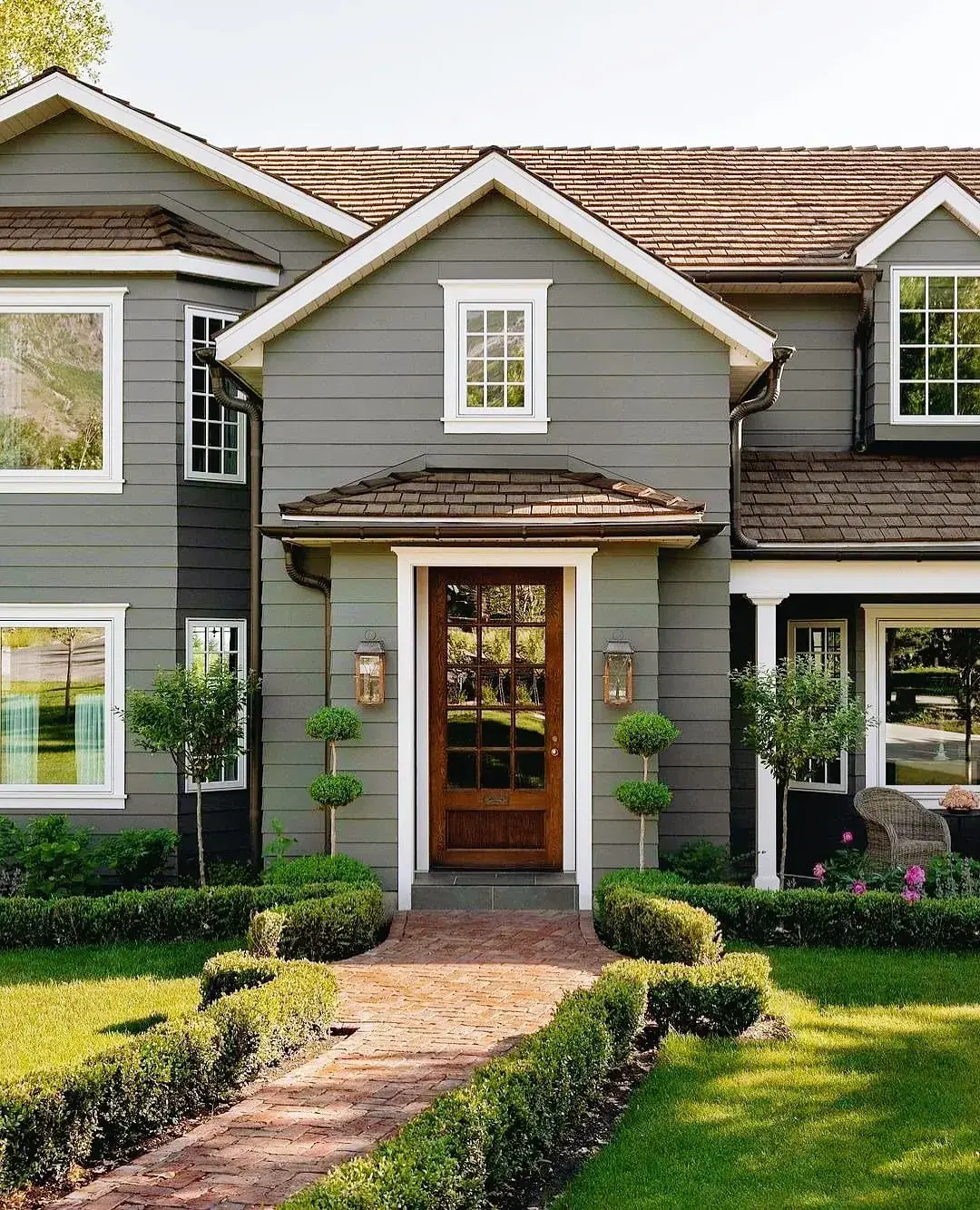
That narrow gabled front uses height where width is missing. Two slim standards with ball heads stand each side of a glazed timber door, and low hedging runs the brick path out to the street.
A standard works by putting the leaf volume on a clear stem, so the eye reads height without the spread that would block the path or the windows. The mechanism underneath is the same as the mounds above: Buxus or Ilex buds break after clipping, provided the cut happens while new growth is still soft, generally from late May into June in most British gardens.
Hedging along a path looks tidy and behaves competitively. Roots of a clipped edge take water from the same zone as anything planted beside them, which is why a newly planted standard within a metre of hedging needs its own watering through the first two summers. Bark mulch 5cm deep helps, kept clear of the stems.
Pots can borrow this exactly. A pair of Ilex crenata standards in frost-proof glazed pots of 40cm or more, at £45 to £110 per pot in 2026, gives the same vertical accent where nothing can go in the ground. Ilex crenata is the safer buy where box blight is established locally, and the nursery label should say so.
Cut stems on a potting bench
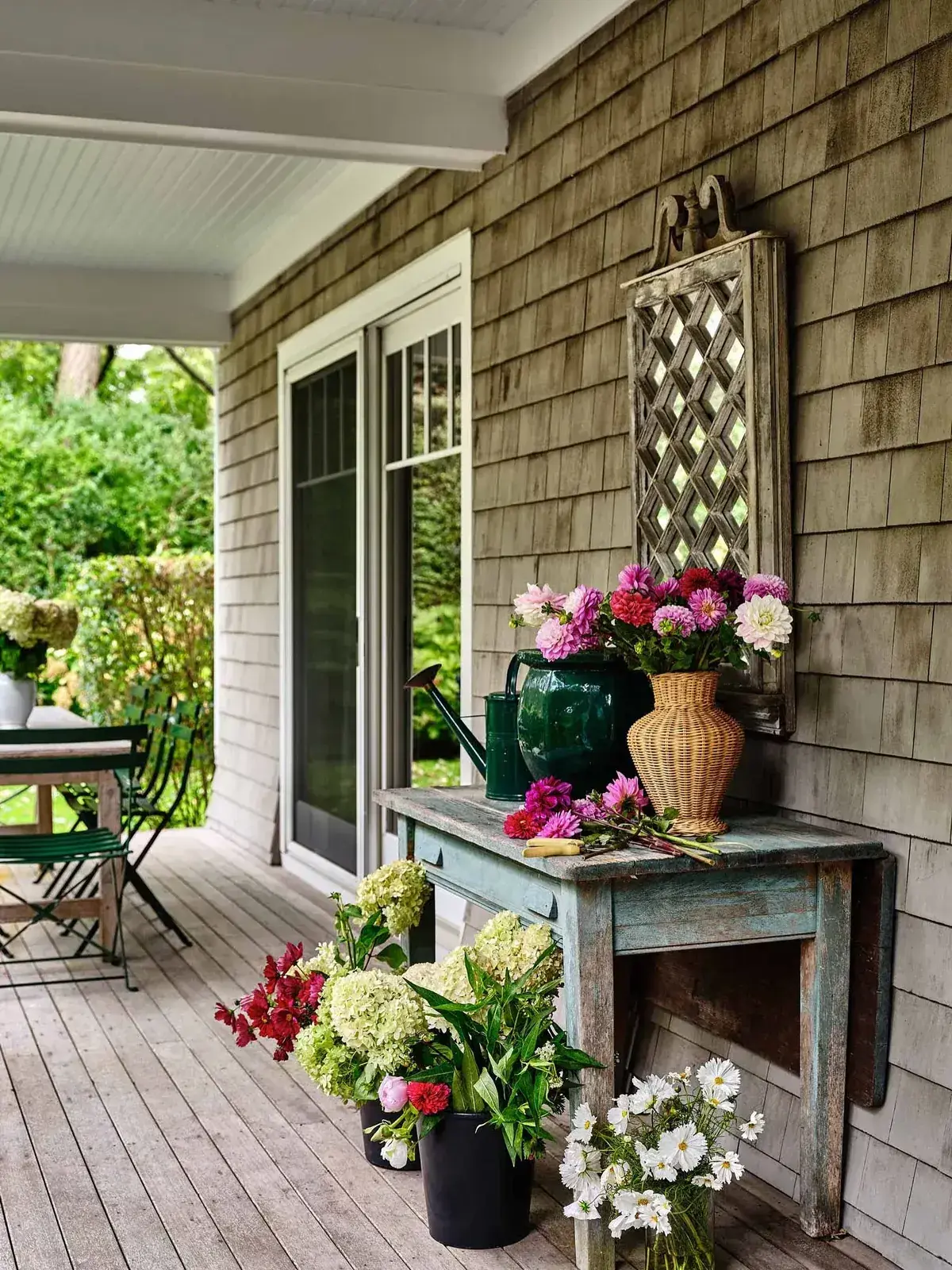
Pictured here is a weathered bench on a shingle porch loaded with buckets: pink dahlias in a green jar and a wicker vase above, pale Hydrangea paniculata heads with cosmos and white daisies below, plus a watering can and secateurs.
Cut stems fail through air, not lack of charm. Once cut, air enters the xylem and blocks uptake, which is why buckets filled before cutting, with stems recut under water where practical, keep dahlias standing for days longer than an empty jar carried round the garden. Cool porch shade then slows respiration through the afternoon, and that half day of cool is measurable in vase life.
Dahlias themselves run on removal. Plants deadheaded every few days from July to the first frost keep pushing buds, and heads left to set seed switch the plant off within a fortnight. Published conditioning recipes promise much and prove little, so plain deep water plus a cool bench remains the honest method.
For the porch, treat this as staging rather than planting. An enamel can of the type shown runs £20 to £40 in 2026, and two 10-litre buckets of water on a shaded bench hold a whole picking morning without drama. The hydrangea heads below, cone shaped and greenish white, also dry well enough for winter jars if cut as they stiffen in September.
Paniculata loose in a sunny border
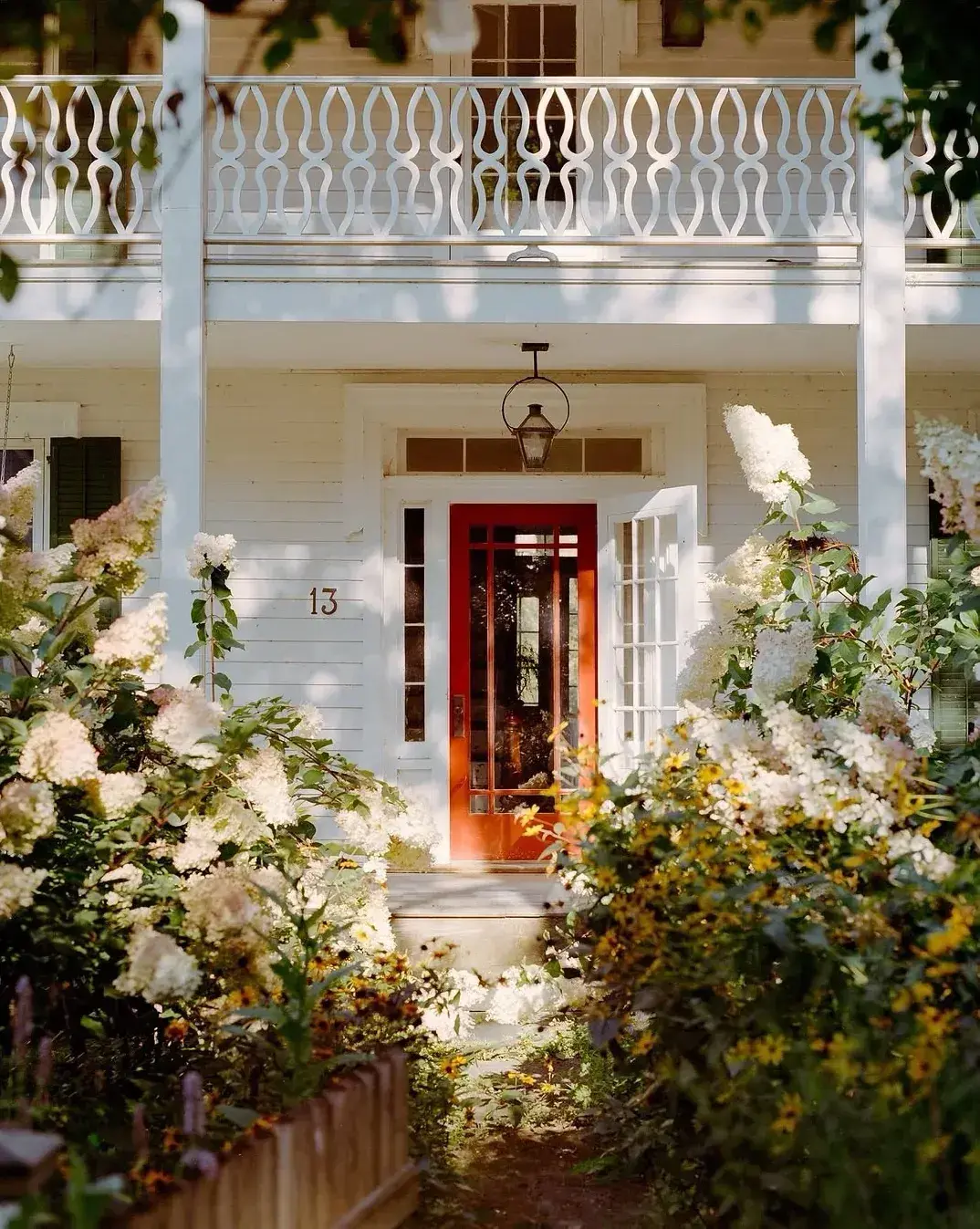
In that picture a white house with an orange glazed door disappears behind billowing white cones and yellow border flowers. Notice how the shrubs mass forward over the path without hiding the door colour entirely.
Cone heads of this type behave like Hydrangea paniculata, which flowers on wood made in the current season. The mechanism decides the calendar: buds form after spring growth starts, so a late frost rarely removes the display and hard pruning in March still leaves flowers by August. That is the opposite of mophead types on old wood, where one cold night or one hard cut costs the year.
Sun tolerance follows the same split. Paniculata holds its foliage through full morning sun where a bigleaf mophead scorches by July, which explains why this sunny border looks unstressed in high summer. Soil volume does the rest, since roots in open ground reach moisture no 40cm pot can store.
To echo the look in containers, choose a compact paniculata such as Little Lime types in a 45cm frost-proof pot, John Innes No. 3 with a bark top dressing, and budget £12 to £25 for a 3-litre plant in 2026. Flower colour stays creamy white whatever the compost pH, so skip the aluminium chemistry entirely here.
Mopheads and ferns by a coastal porch
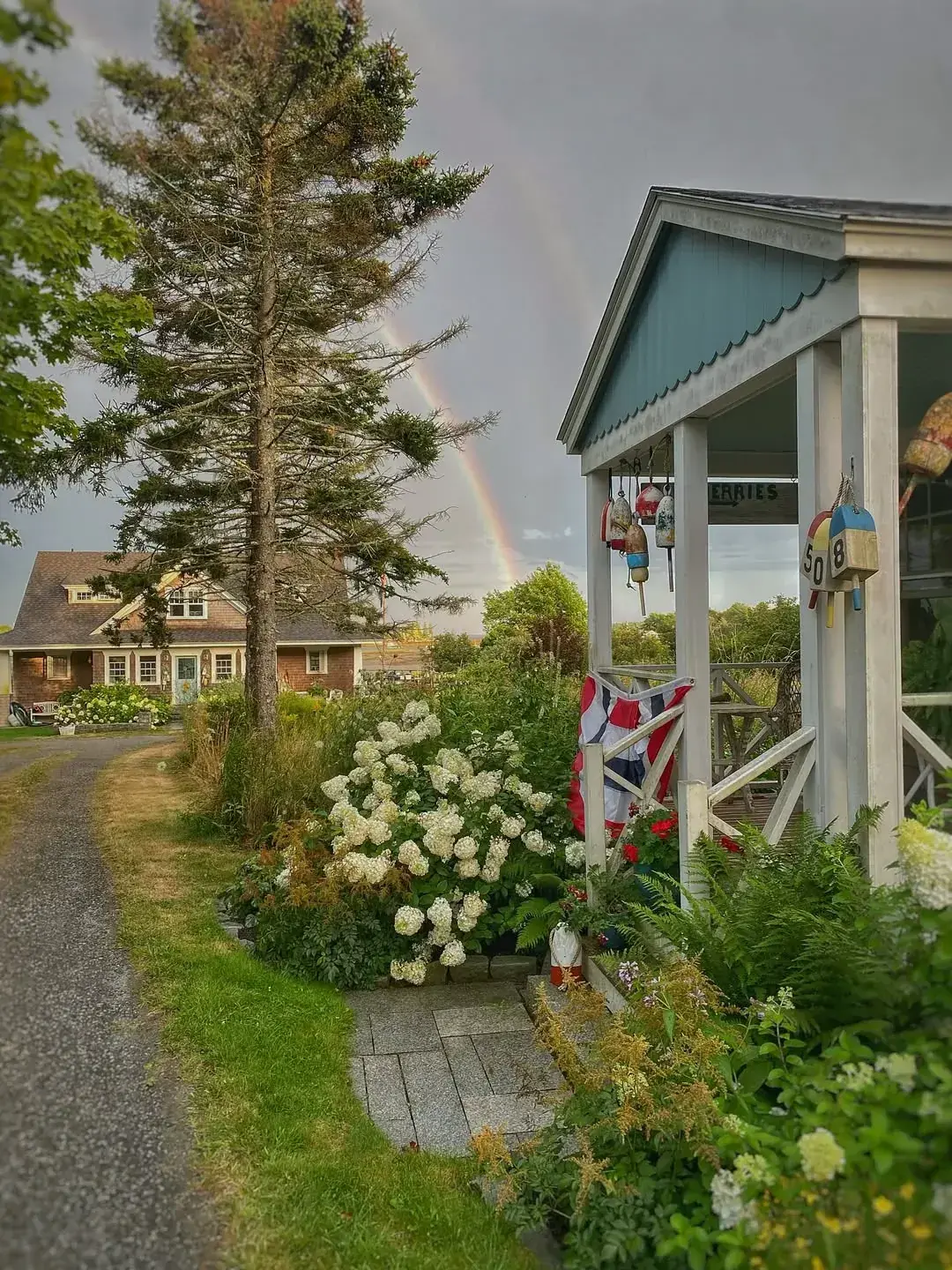
This coastal porch tells a wind story. White mophead bushes mound beside a stone path in full leaf, ferns fill low pots by the rail, and washing-line buoys hang overhead.
Mopheads of this rounded type behave like Hydrangea arborescens, the North American species behind Annabelle types. Flowering on new wood gives the same forgiving calendar as paniculata above, with cutting back in March and flowers from midsummer. Cold hardiness is strong, which suits an exposed site, though trial data on salt spray tolerance is thin and observed plants do better with a hedge or building breaking the wind.
Wind itself is the mechanism to respect. Moving air strips moisture from large leaves faster than roots in a pot can replace it, so shelter plus mulch decides August condition more than feeding does. In this image the house flank and neighbouring shrubs provide that shelter, and the stone path radiates gentler heat than tarmac.
For pots in similar positions, a 3-litre arborescens at £14 to £28 in 2026 suits a 40cm glazed container that holds moisture, with crocks over the hole and pot feet beneath. Ferns alongside want the same steady damp, which is why glazed suits them too, and both appreciate morning brightness with shelter after midday.
A fern in dry shade under a porch roof
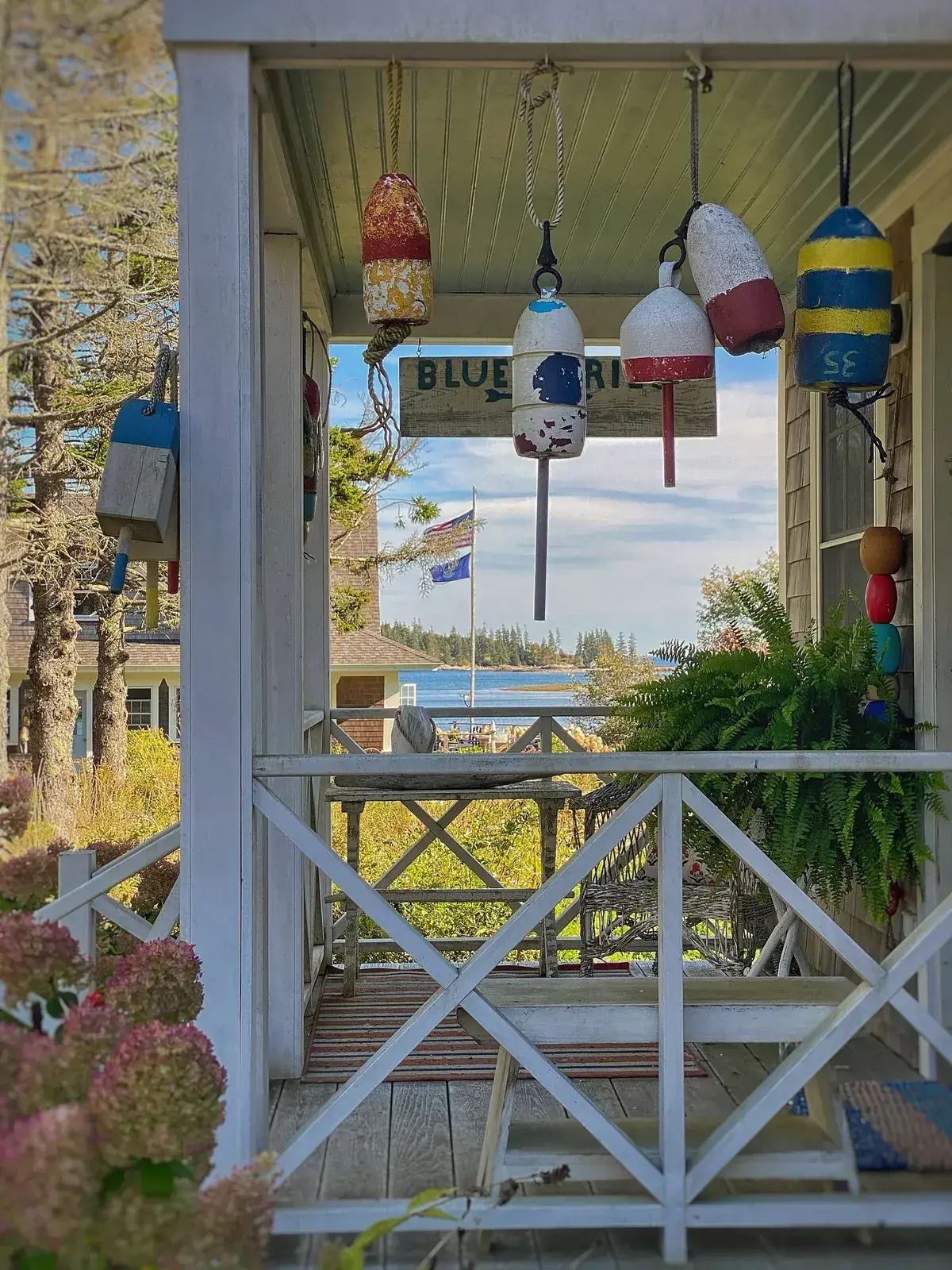
Under a white railed porch roof, five painted buoys hang from the soffit while a large Boston fern fills a pot to the right and drying pink hydrangea heads sit in the foreground. See what the roof is doing. It keeps rain off the bench, the floor, and the rootballs alike, so everything green here runs on hand watering even in a wet week.
A Nephrolepis exaltata of this size carries hundreds of fine leaflets with a large combined surface, and transpiration from that surface never really stops while the air moves. The mechanism is simple: shade lowers leaf temperature, steady compost moisture keeps cells turgid, and the plant stays full. Intermittent soaking followed by full drying gives brown edge within a fortnight, which reads as neglect but is really physics.
Practical care follows. A 17cm Boston fern costs £8 to £18 in 2026 and wants a glazed or plastic pot with a drainage hole, peat-free houseplant compost with added bark for air, and water before the top dries fully. Reduce feeding from October to March to roughly quarter strength monthly, since growth slows with the light.
The drying heads in the corner carry their own lesson. Leaving mophead flowers to stand through winter gives structure for months after colour ends, and cutting back can wait until March buds swell. This fern is not frost hardy, so it comes inside before the first frost while the hydrangeas outside keep their skeleton show.
Evergreen bones behind a white gate
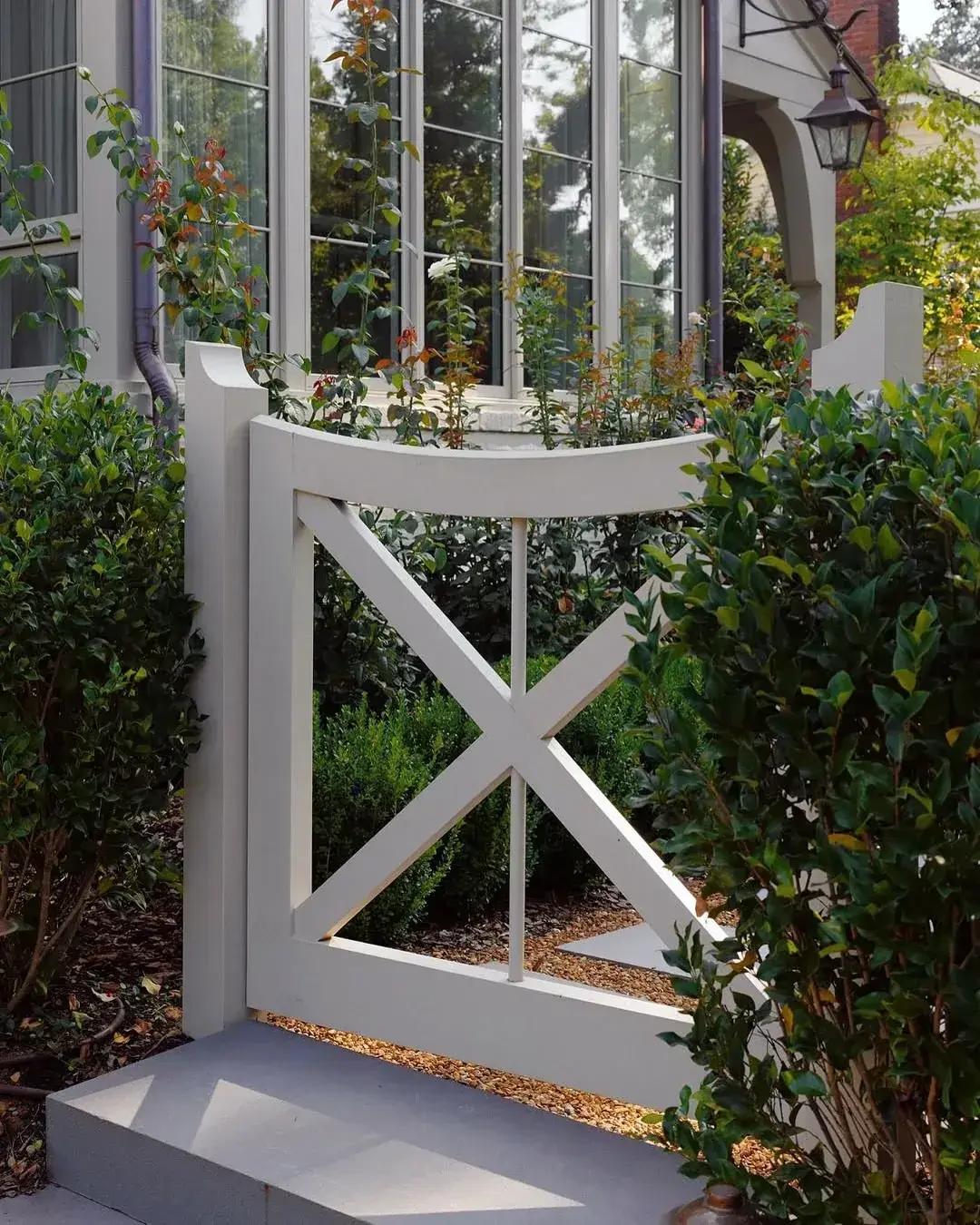
The last image has no hydrangea in it, which is rather the point. A white crossbar gate stands between tall box hedges, with roses climbing behind and tall windows above.
From November to March, when hydrangeas are bare sticks and annual pots sit empty, hedges of this type carry the whole front. Small box leaves clip to a clean face, and the faces hold through frost, snow, and short days without further work. Roses behind contribute nothing in winter and everything from June, which is the correct division of labour.
Density brings its own risk. A tightly clipped hedge holds humidity inside the canopy after rain, and prolonged damp favours box blight where spores are present locally. The remedy is airflow: clip to flat faces rather than puffy shapes, clear fallen leaves from the base in autumn, and avoid overhead watering in the evening.
Where blight rules box out, Ilex crenata Japanese holly gives a similar small leaf at roughly £10 to £20 for a 2-litre plant in 2026. For porch pots, the same winter-first rule applies: one slow evergreen in John Innes No. 3, pot feet beneath, drainage hole checked clear before the first freeze. Seasonal flowers then dress bones that already work in February.
Frequently Asked Questions
Which containers suit leafy plants that drink heavily?
A glazed or plastic pot keeps compost damp for longer, so hydrangeas plus ferns settle well in it. Open terracotta dries through its walls and fits Mediterranean subjects better. Every decorative holder still needs a hole underneath, with feet lifting the base clear.
How big should a pot be for a mophead bloom?
Start at 40cm across and go larger where the step allows, since compost volume sets the watering interval through July. Cramped roots dry before midday in heat, and no feeding routine rescues that. One generous tub, 40cm or more across, beats three small ones that each need daily water through July.
Where do hydrangeas flower best around a house?
Brightness early with shelter later suits bigleaf kinds, so an east-facing aspect close to ideal. Full afternoon blast scorches buds and bleaches colour by midsummer. Paniculata and arborescens accept stronger light than mopheads, which is why the sunny border above looks unstressed in August.
Why do matched doorstep pairs collapse?
Symmetry shows every difference, so one side growing faster or getting more light reads as breakage at once. Slow clipped evergreens hold the match longest, and a spare kept round the back covers losses. Flowering subjects rarely peak together, so the two sides sit out of sync for weeks each summer.
How is blue encouraged without a soil battle?
Begin with a test, then use ericaceous mix for container bigleaf types and refresh it each spring. Aluminium sulphate shifts suitable varieties toward blue over a season, and garden lime holds pink. White blooms stay white regardless, which removes the chemistry chore.
What keeps the threshold handsome in February?
Permanent evergreen structure does the work once hydrangea stems stand bare. Clipped box, Japanese holly, dwarf conifers, and hardy ivy hold shape through frost. Frost-proof pots raised on feet survive the freeze that splits cheap clay.
Where to start
- Choose the pot material for the plant: glazed for thirsty, terracotta for dry.
- Check every pot has a drainage hole, including the decorative ones.
- For hydrangeas, use a pot 40cm or wider, in morning sun and afternoon shade.
- For a matched pair, plant something slow and tough, and buy a spare.
- Specify frost-proof rather than frost-resistant, and raise the pots for winter.
- Cut paniculata and arborescens in March, leave mophead old wood until buds swell.
- Put evergreen bones in first, then dress with seasonal flowers for summer.
This article may contain affiliate links. We may earn a commission at no extra cost to you.