9 Halloween Window Painting Ideas, All Painted as Silhouettes
Add us as a preferred source to see more stories on Google.
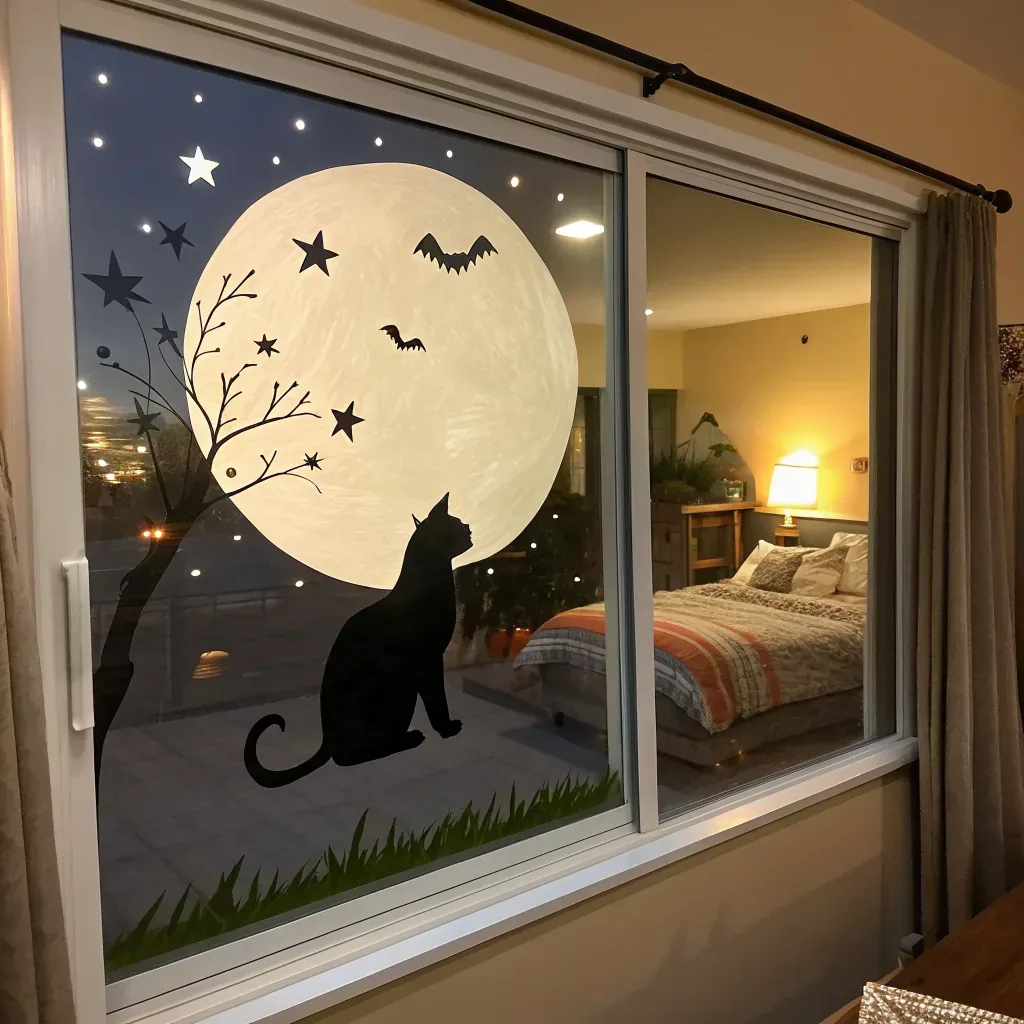
That window took about two hours and roughly four pounds of paint, and the person who did it did not need to know how to draw.
Look at the cat. There is no face, no fur, no shading. It is a flat black shape. The branch is a flat black shape. The bats are flat black shapes, and two of them are basically a wide M.
Everything readable in that window is a silhouette, and silhouettes are forgiving in a way that drawn detail never is. Get the outline roughly right and your brain fills in the rest. Get an eye slightly wrong on a drawn cat and it looks unsettling in the wrong way.
The moon is not decoration
It is the thing that makes the black read.
Black paint on clear glass disappears against a dark street at night and against bright sky in the day. Put a big pale shape behind it and every silhouette that overlaps it snaps into focus. That is why almost every good window painting has a moon, a lit window, or a wash of pale colour somewhere.
Make it bigger than feels sensible. The one in that photograph takes up most of the upper half of the pane, and it still works because everything else is restrained.
Three colours, no more
Black, cream, and one accent. In that window the accent is a bit of green grass along the bottom and that is it.
The temptation is to add orange, purple, more green, some white highlights. Every colour you add makes the shapes harder to read from the pavement, which is the only place anyone will see it from. Restraint here is not an aesthetic preference; it is what makes it legible.
Inside or outside the glass
Inside, almost always.
Outside gets rained on, and even the paints that survive it streak. Inside, nothing touches it until you decide to remove it, and you are working in the warm with a cup of tea rather than up a ladder in October.
The one thing to know about painting inside: at night with the room lights on, it reads beautifully from the street, which is what you want. During the day, from inside, you are looking at dark shapes against bright light, so it reads as a silhouette from your side too. Some people love that; some find the living room gloomy. Paint a window you do not sit and stare out of.
Bats need a sky, not a moon
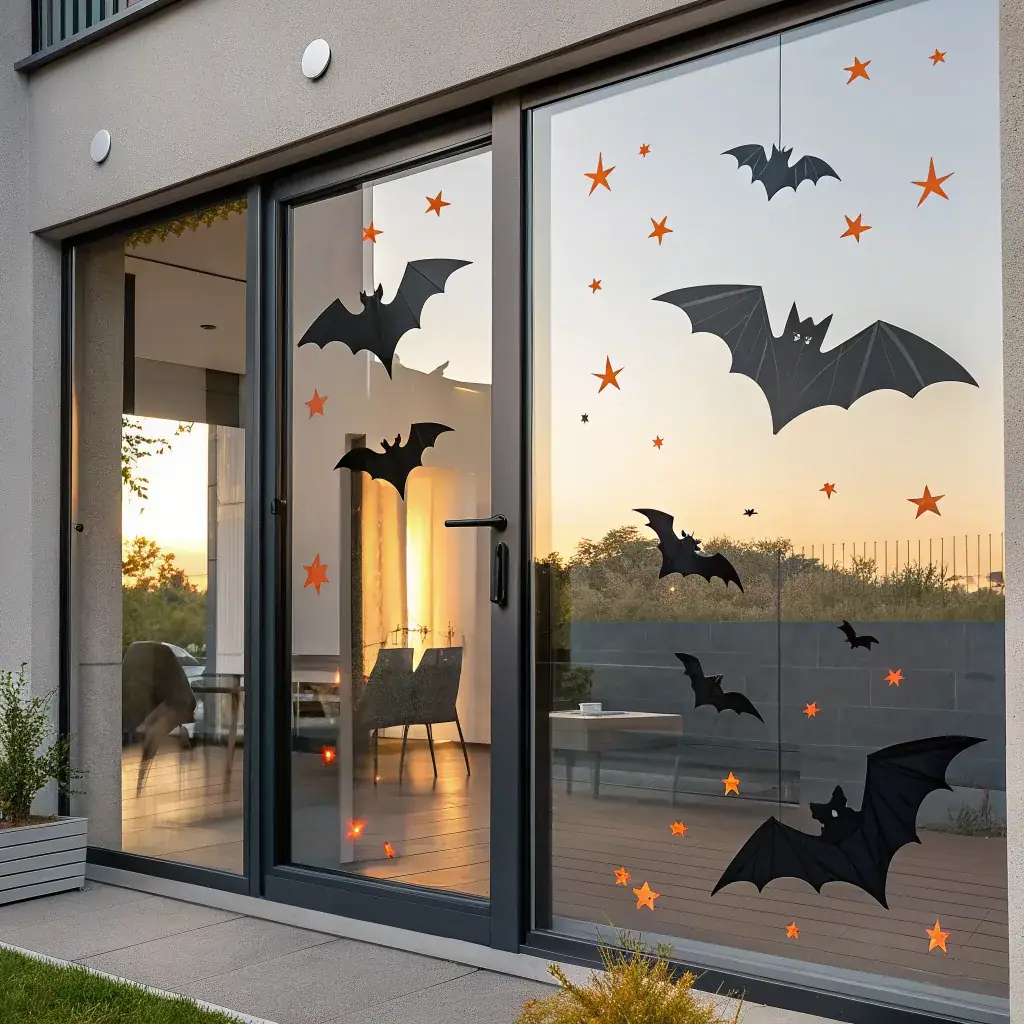
Count the bats in that glass and you get eight or nine, at four or five different sizes, dropping from the top right to the bottom left. The stars are orange instead of white, and there are about 10 of them.
There is no moon anywhere, and the bats still read. The pale shape behind them is the sky itself, the last of the light and the reflections sitting in the glass. On a window that bright, black already has something to sit against.
So the moon rule is a contrast rule. Give the black something lighter to cross and it works; if the glass is already light, you do not need to paint anything behind it.
Two things stop this looking like a sheet of stickers. The bats vary in size, and the stars are small and sparse. A 60ml bottle of black acrylic from The Works covers that whole door with paint to spare, and one Uni Posca in orange does the stars.
It is a glass door, so you are working at full height. 40 minutes with a stepladder and a 12mm flat brush, plus a cup of tea at the bottom of the ladder.
The contrast does not have to be black
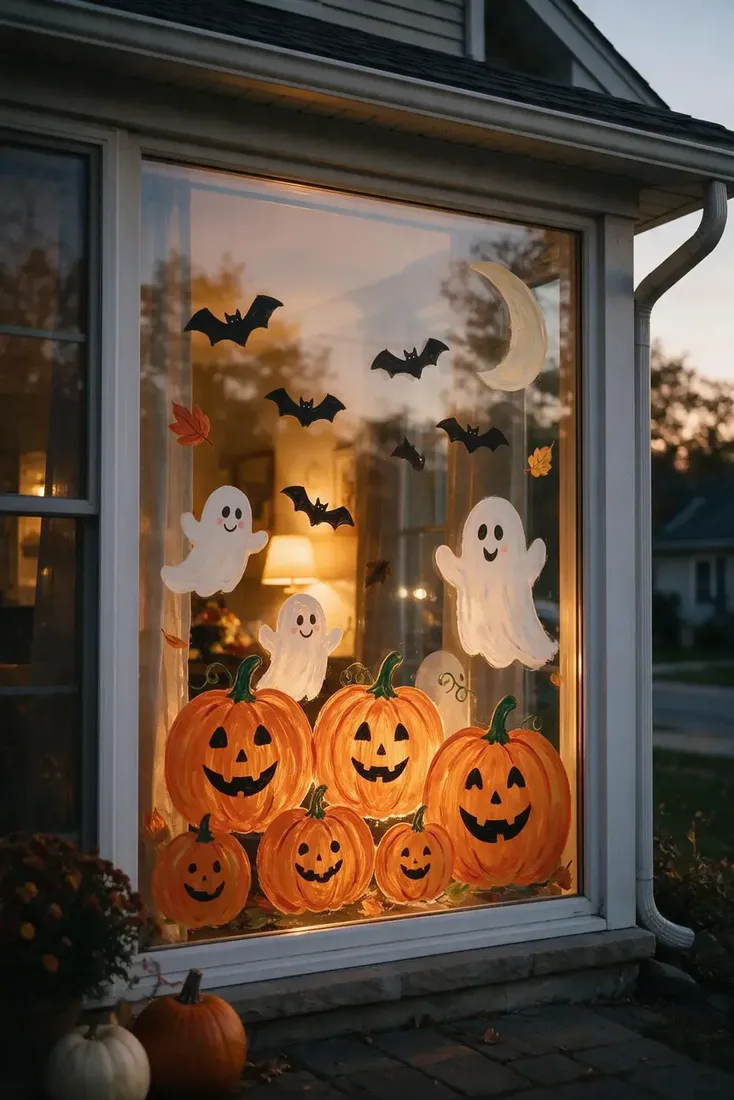
Look at what is carrying that window. A row of orange pumpkins with black triangle faces along the bottom, three white ghosts above them, five small bats, a thin crescent moon in the top corner, and a scatter of painted leaves.
The bats are the only true silhouettes in the frame and they are the smallest thing there. Everything else is white or orange, and it reads because the room beyond is lit warm. The lamp and the glow are doing the job the moon does in the black cat window at the top of this page.
White ghosts on a lit window are a silhouette the other way round, and they are no harder to paint than the black ones. The contrast is the thing; the colour of the shape is not.
The one detail I would copy is the crescent. It is a thin sliver, about a hand’s width across, and it still registers as a moon from the pavement because the shape is unmistakable. You do not need the big disc every time, and the small version is quicker anyway.
The pumpkins are the slow part. Faces take two minutes each, the bodies take 20, and they want two coats over glass. Daler Rowney System3 in white, about £3 to £5 for 150ml in 2026, does the ghosts in a single pass. Do the pumpkins first, leave them 60 minutes, then float the ghosts in.
When the panes are small, paint less
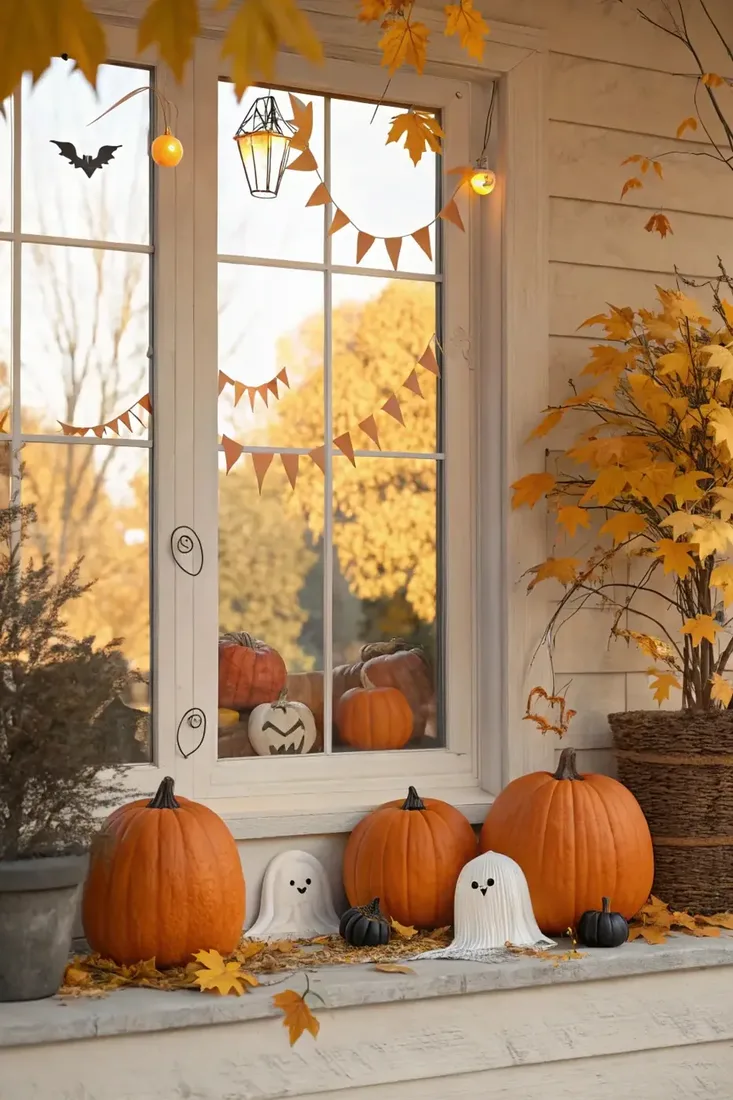
This porch is mostly not painted, and that is the point of it. On the glass there is one black bat, two small white ghosts drawn with a black outline, a string of orange bunting and a lantern. Everything else you are reading as Halloween is real: orange pumpkins on the sill, two white cloth ghosts, a few mini black ones, leaves.
The window is divided by glazing bars into six panes, which normally makes painting miserable, because every shape gets chopped into pieces. Here it works because each painted shape is small enough to sit inside a single pane. The bat lives in one pane. Each ghost lives in one pane.
If your window has bars, do that. One shape per pane, no scene, and let the sill carry the rest. Real pumpkins cost about £3 each in October and take no drying time at all.
I would hang the bunting on the frame instead of painting it. Garland across a painted window is one more thing to work around when the paint comes off in November.
What to actually buy
| Medium | Cost | Removes with | Honest verdict |
|---|---|---|---|
| Acrylic craft paint | £1 to £2 a bottle | Warm water, plastic scraper | Best all round; what I use |
| Posca paint pens | £3 to £4 each | Warm water, some scrubbing | Excellent for outlines and small shapes |
| Window chalk markers | £8 to £12 a set | Damp cloth | Streaky over large areas |
| Washable kids paint | £3 a bottle | Wipes off | Runs down the glass while wet |
| Glass paint, proper | £6 plus | Solvent | Permanent. Do not |
Acrylic craft paint is the answer for almost everyone. A bottle of black and a bottle of cream covers a large window with plenty left over. Apply it a little thicker than feels necessary; thin acrylic on glass looks patchy when light comes through it, which on a window is always.
A cheap flat synthetic brush for filling, and a small round one for edges. Do not buy a set.
The moon can be the whole pane
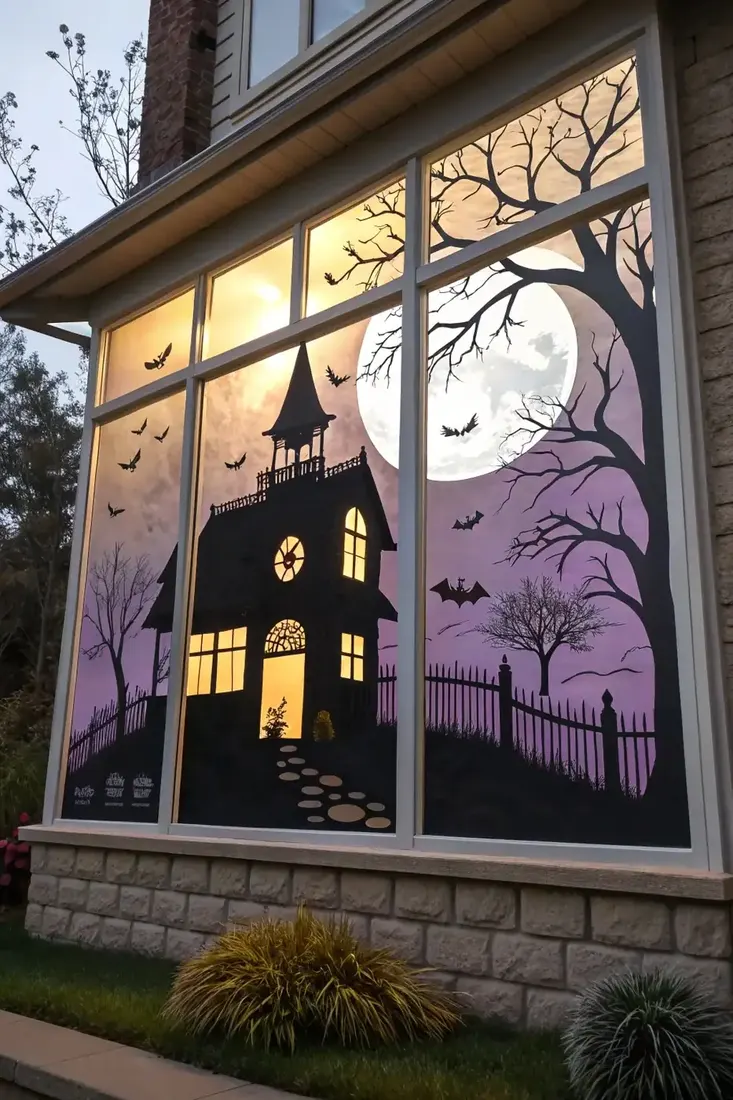
Most of that glass is purple. The sky is a wash that runs edge to edge across four panes, the moon sits inside it, and the house, the trees, the fence and the bats are all flat black on top.
This is the moon idea taken to its limit. If a pale shape makes black read, then make the whole window the pale shape and the silhouettes get the easiest background available. The house itself is still nothing but an outline with yellow rectangles for windows, and a beginner can manage that.
Two costs, and both are real. The wash is the slow part, easily 3 hours on its own across a 2.4m run of glass, and it wants two coats with 20 minutes between them so the brush marks do not show against the light. And a window painted edge to edge stops being a window. The room behind this one will be dim for as long as it stays up.
I would do the house, the moon and the trees on clear glass and skip the wash. Same silhouette, one evening saved, and you can still see out.
There is something small printed in the bottom left corner of that pane. Whatever it is, wipe it off before you photograph the window.
A web is lines, and lines are easy
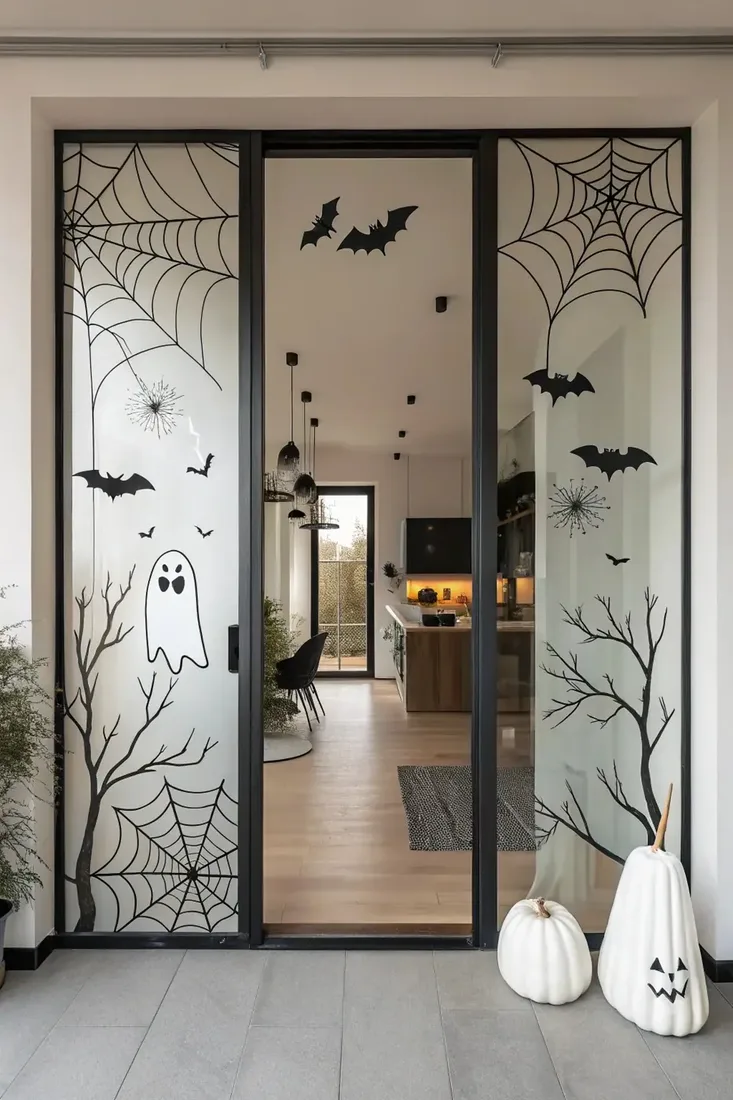
A spider web is the best value shape on this page. Four or five straight lines out from a corner, then four or five curves joining them, and you have something that reads as a web from across the room. There is no drawing in it at all, which makes it the first shape I would hand to anyone nervous about a brush.
What is shown here goes further than I would. There are big webs in both top corners, another along the bottom, thin bare branches climbing the sides, small bats, two ghosts and a couple of seed heads. It is a lot. It holds together because the room on the far side is pale and brightly lit, so every thin black line shows.
I would paint one web, in one upper corner, and stop. Thin lines are the whole effect, and thick ones look like a doodle. Use a size 2 round brush or a Posca PC-1M for this, not a flat; you want a line about 1mm wide, and a flat brush will not hold that on glass.
15 minutes for one web, and another five if you want a spider sitting in it. The white pumpkins on the floor are the one thing I would keep.
Removing it afterwards
This is the part people worry about and it is genuinely easy. Soak a cloth in warm soapy water, lay it over the paint for a few minutes, then take it off with a plastic scraper or an old bank card. It comes away in sheets.
A metal blade works faster but will scratch the glass if you catch it at the wrong angle, and on double glazing you can damage the seal if you get near the edges. Plastic, and patience.
The one surface to avoid entirely: any window with a film on it, whether privacy film, solar film or a frosted overlay. Paint will lift the film with it.
Where I would not bother
Textured or patterned glass, because the paint sits in the ridges and looks muddy from outside. Very small panes divided by glazing bars, since the bars cut every shape into pieces. And any rented flat where the window is old and the glass might be historic, where honestly a paper silhouette taped up will do the job with no argument at the end of the tenancy.
The window I would not paint at all
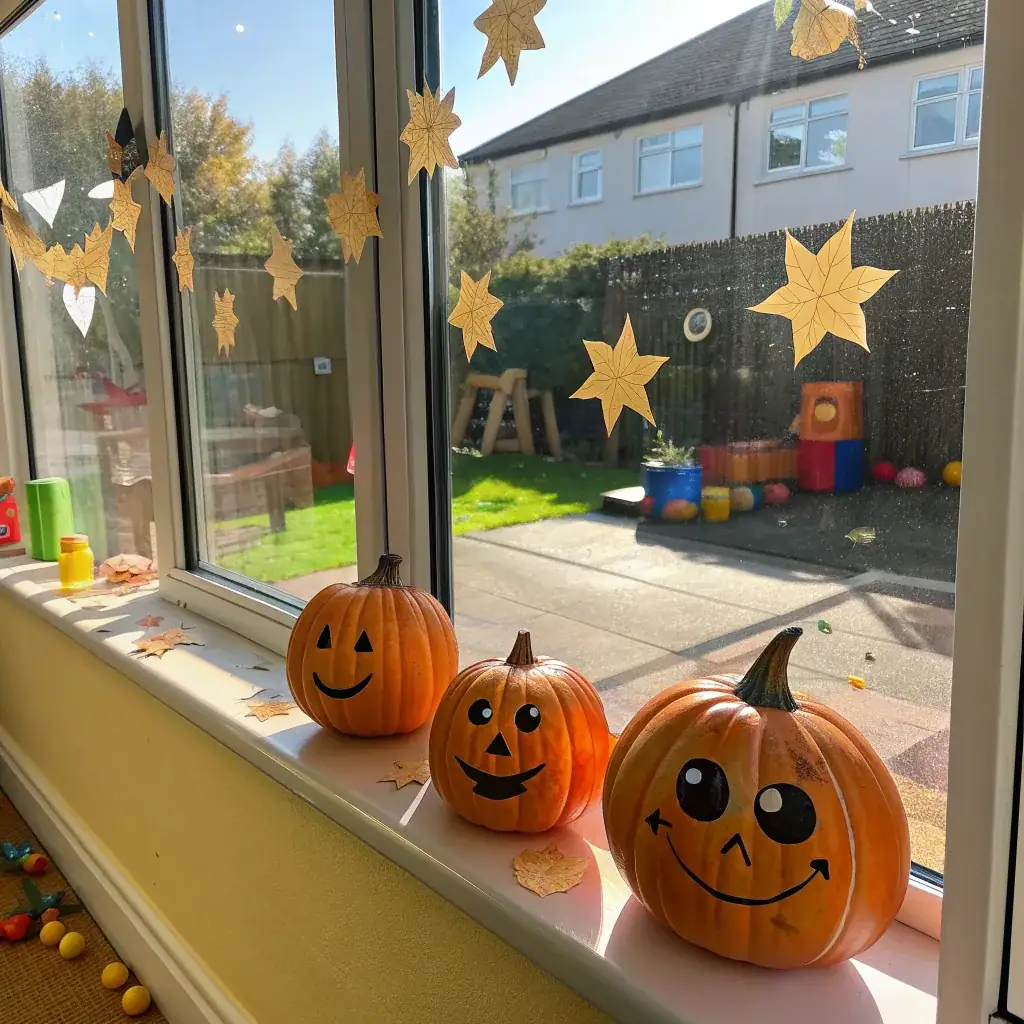
Almost nothing in that photograph is painted on the glass. The maple leaves and the little ghost sit proud of the pane with a shadow under each one, which is what paper taped up looks like. The three pumpkins along the sill are real ones with faces drawn on in black marker.
I am putting it in because it is the honest answer for a young child’s room, and it costs about £9: three pumpkins, a black marker, a pack of paper leaves. Nothing to dry, nothing to scrape, and the whole thing can be rearranged or thrown away without touching the glass.
The silhouette argument survives here too. The little dark bat and the ghost are flat shapes with no interior detail, and that is what makes them read. A drawn witch with a hat, a face and a broom would not, at any size.
If you do want paint in a child’s room, choose the window nobody sits and looks out of. A playroom or a landing, not the bedroom. My own attempt went on a bedroom window and stayed there until February, because nobody wanted to be the one to take it down.
Paint it for eight o’clock, not for noon
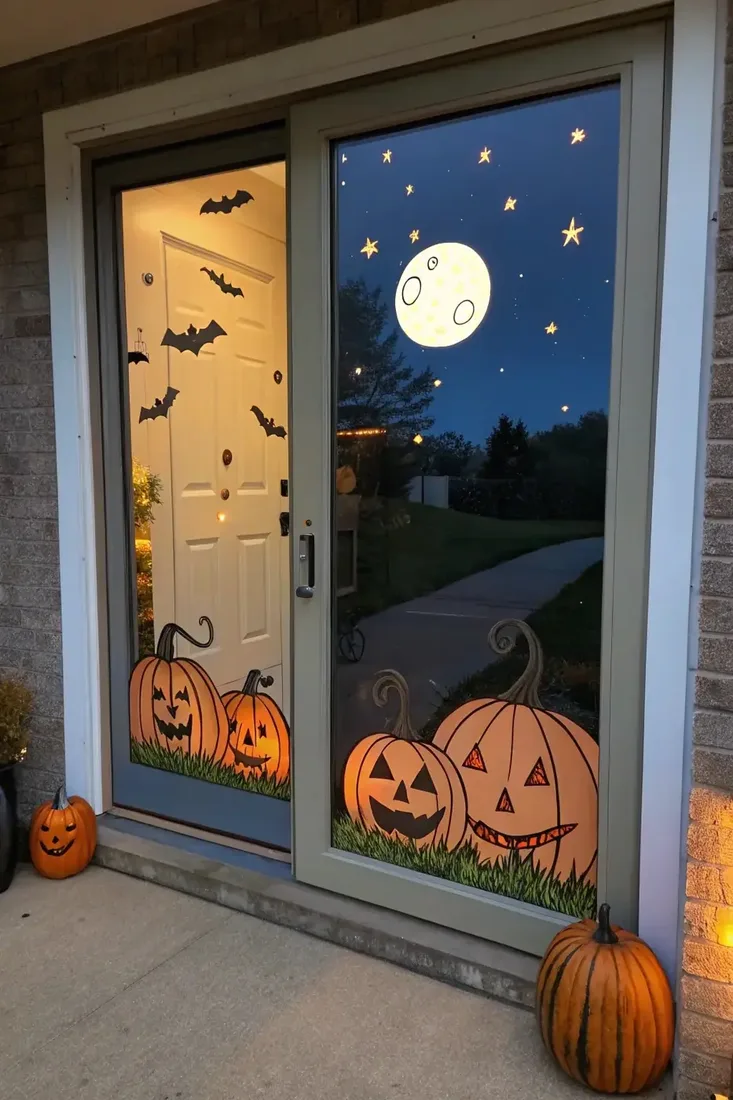
That door is photographed at dusk, and it tells you which half of the design is doing the work. The black bats on the sidelight almost disappear into the glass, because at night there is nothing pale behind them. The cream moon, the gold stars and the orange pumpkins are what you see.
This is where the silhouette rule runs out, and it catches people out on front doors. Black on a dark window at night is invisible. A silhouette needs light behind it, and in October the light behind your door glass is a hallway lamp.
So build a front door the other way round. Pale shapes first: a moon about 250mm across, roughly a dinner plate, some stars, and pumpkins low down where they catch the hall light. Then a few black bats for the daylight hours, when the glass goes bright and the black starts to read.
Check it at eight in the evening with the porch light on before you call it finished. Daylight will flatter it either way, so the evening check is the one that counts.
Black is the accent, not the design
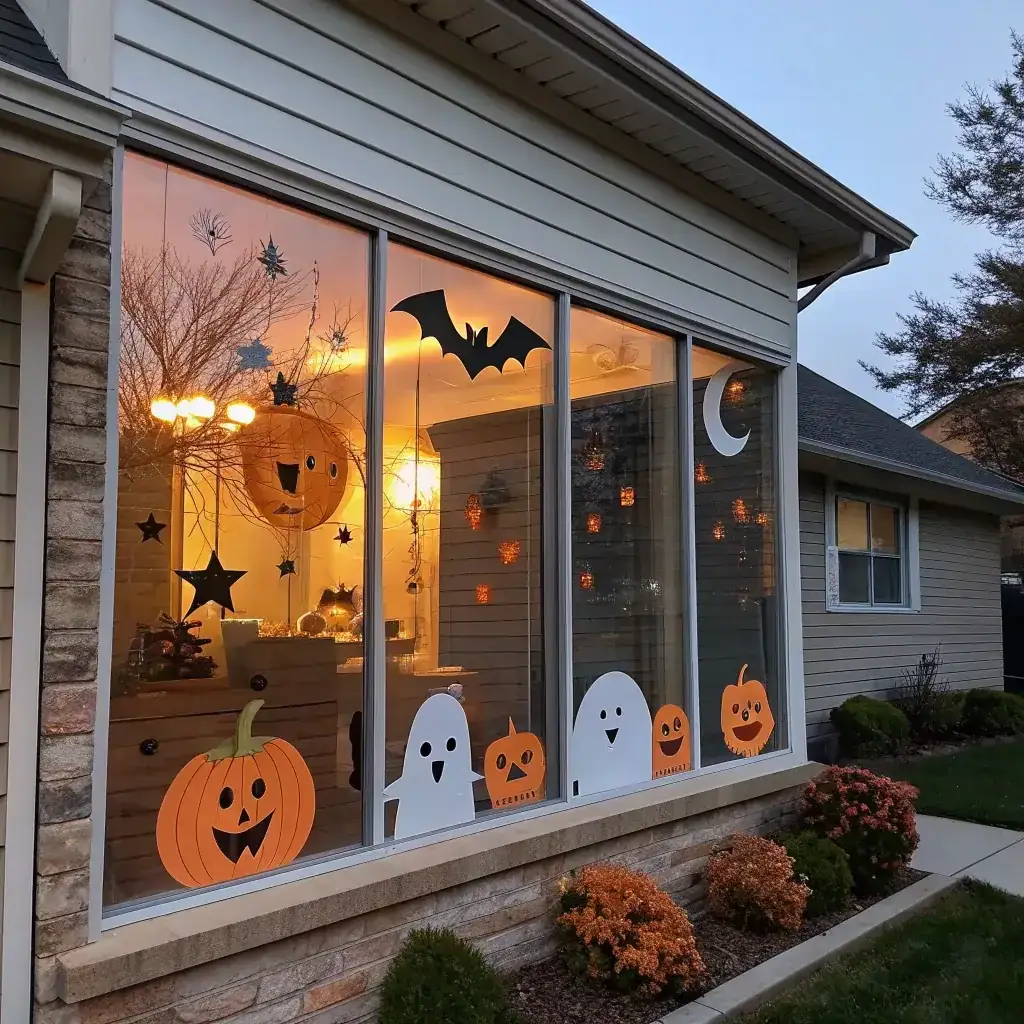
Count the black in that window. A bat, the faces on the pumpkins, a few stars, and that is about it. The rest is white ghosts and orange pumpkins, sitting in front of a room lit warm with string lights and a ceiling fan turning.
This is the mix I would live with for six weeks. The ghosts and pumpkins are friendly enough to leave up through October without anyone asking when they are coming down, and the single black bat is the thing that reads from the road in daylight, when the white shapes wash out.
Size matters more than colour here. That bat is the largest shape on the glass, and the ghosts are all slightly different from each other, which is why the window looks arranged instead of printed. Five ghosts the same size would read as wallpaper, so vary them.
One bottle of white, one of orange, one of black, about £3 to £6 for the three in 2026. If you are painting a single window this year, paint this one, and start with the bat, because it is the only shape that has to be right.
Getting started
- Paint silhouettes: flat shapes on a pale ground, which need no drawing skill at all.
- Give the black something to read against, whether that is a moon, a lit room or a bright sky.
- Keep to black, cream and one accent, and leave the middle of the glass clear.
- Use acrylic craft paint, applied thicker than feels right, and work on the room side of the glass.
- Vary the size of bats and webs; that is what stops a shape reading as a sticker.
- For a small child’s room, tape paper shapes up instead of painting anything.
- Remove with warm soapy water and a plastic scraper, never a metal blade.
Frequently Asked Questions
Do I need to be able to draw to paint a window for Halloween?
No, as long as you keep to flat shapes. A bat is a couple of curves and a body, a ghost is one outline with two dots, and a web is straight lines joined by arcs. Shading and faces are what need a steady hand, and none of that carries to the pavement anyway.
Why does almost every design here have a moon or a lit window?
Because black glass at night shows nothing at all. The moon, a lamp or a sunset gives the dark shapes an edge to sit against, and without one the pane looks grubby from the road. Any light source will do it, painted or real.
How do I paint a window that is split into small panes?
Give each pane one shape and nothing more. A bat in this pane, a ghost in that one, and leave the bars alone. A scene painted across glazing bars arrives in pieces and never looks deliberate.
Will acrylic craft paint come off a window in spring?
Yes. Soften it with warm water and washing-up liquid, leave the cloth sitting on the glass for a few minutes, then lift it with a plastic scraper or a bank card. Metal blades scratch, and any pane carrying privacy or solar film should be left alone, because the paint takes the film with it.
What is the quickest design for a first attempt?
A single bat, or one web in a corner. Either is a few minutes of painting and needs one colour, so there is very little to get wrong. Add the moon and the pumpkins on a second evening, once the first shape looks right.
Can I do this with a three-year-old?
Tape paper shapes to the glass and hand over a marker. A pack of leaves plus a few pumpkins with drawn faces costs under £10, needs no drying time, and leaves the glass untouched. Save the paint for a room they do not sleep in.
This article may contain affiliate links. We may earn a commission at no extra cost to you.