11 Marble and Stone Countertop Kitchens: Edge Thickness Beats Colour

Add us as a preferred source to see more stories on Google.
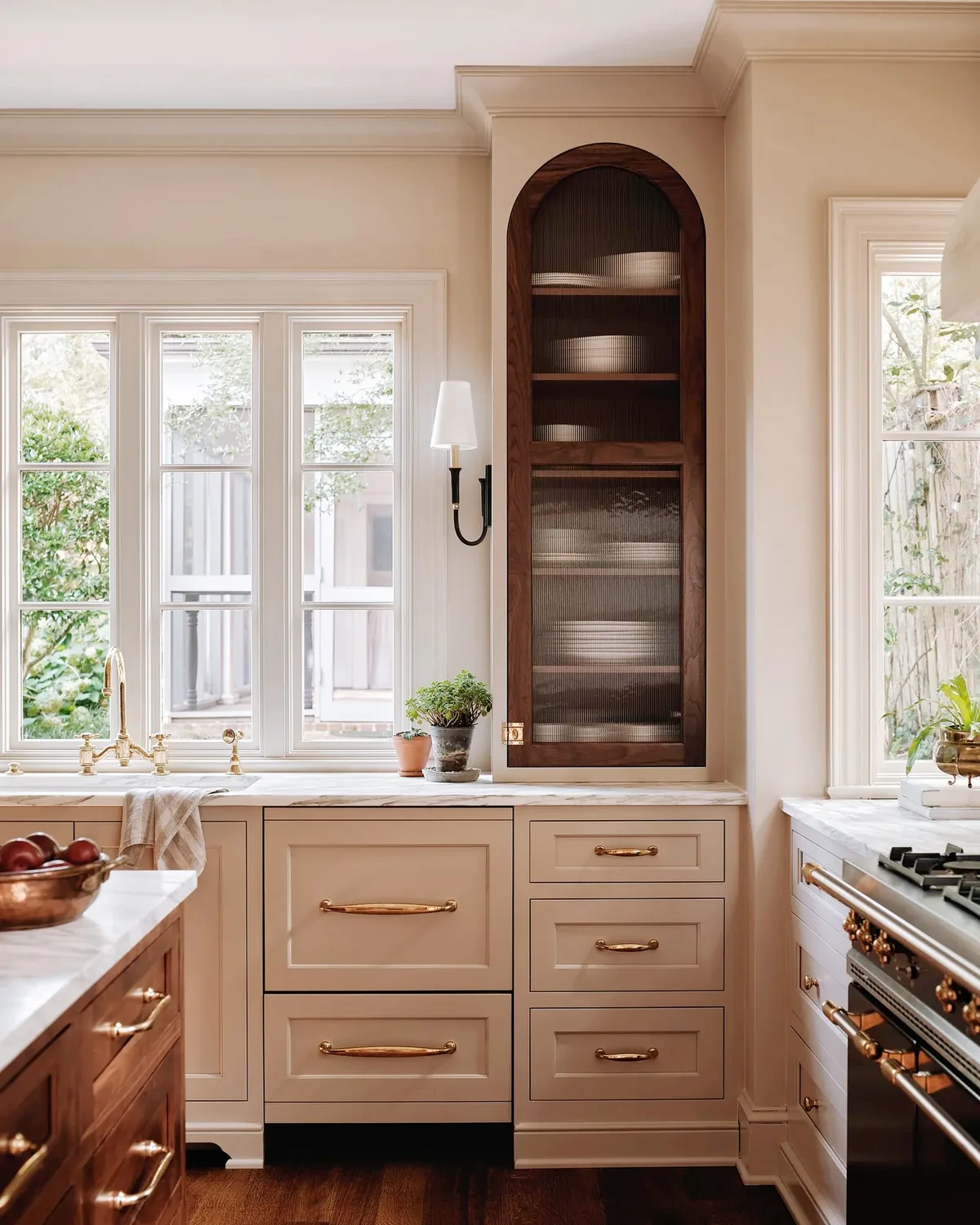
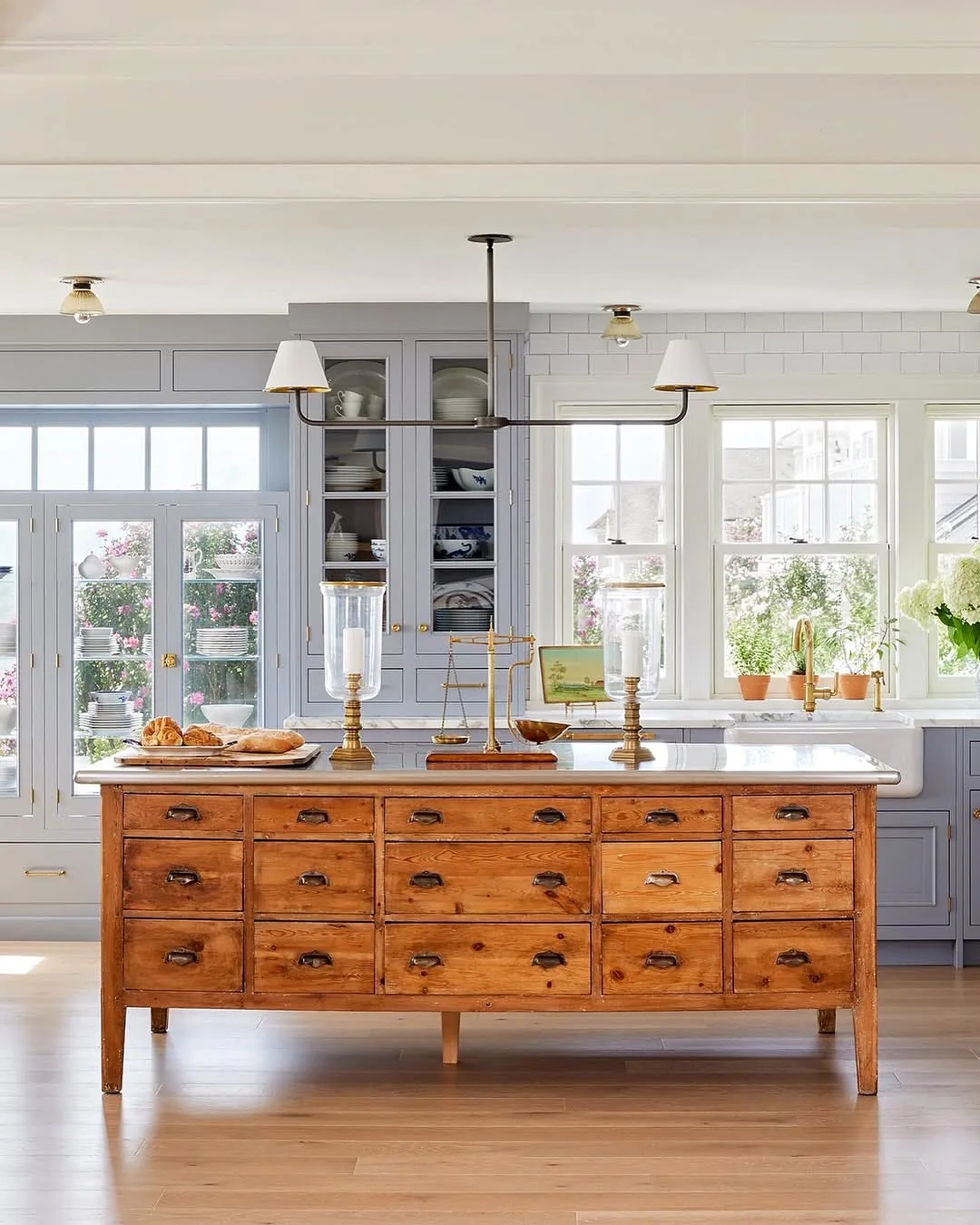
The worktops below are a warm white marble, and the thing worth noticing is how thin they are.
A slim slab with a plain eased edge, sitting quietly on the cabinets and not announcing itself. The cabinetry, the arched walnut cupboard and the brass are carrying the room; the stone is the background.
Take the same marble and mitre it down to a 60mm apron and the worktop becomes the loudest thing in the kitchen. Neither is wrong. They are very different rooms, and the decision is usually made by a fabricator asking a question nobody has thought about.
The edge options
| Profile | Reads as | Note |
|---|---|---|
| 20mm eased | Light, quiet, slightly modern | Slab thickness; cheapest |
| 30mm eased | The comfortable default | Slab or laminated |
| Mitred 60 to 100mm | Substantial, traditional | Laminated; the join must be invisible |
| Bullnose | Dated in most kitchens | Was everywhere in the 1990s |
| Ogee | Formal, heavy | Suits grand rooms, wrong on shaker |
A mitred apron is made by cutting the slab edge at 45 degrees and bonding a strip underneath, so a 20mm slab presents as 60mm. The join has to be invisible and the veining has to run round the corner, which is skilled work and the reason it costs considerably more.
Ask to see a previous mitred edge before committing. A bad one shows a hairline seam along the whole run, and it is the first thing you will look at every morning.
Honed, almost always
Honed is matt, polished is shiny, and in a kitchen the difference matters far beyond the look.
Marble etches. Lemon, vinegar, wine and most limescale removers all dissolve a microscopic layer of the surface, leaving a dull mark. On a polished surface that mark is a clear matt patch and it is instantly visible. On a honed surface, where everything is already matt, an etch is barely detectable.
Honed marble still stains, so it still needs sealing, and sealing needs repeating annually or so depending on the product.
Neither finish makes marble a low-maintenance stone. Honed makes it a liveable one.
The genuine alternatives
This is where people get confused, because two products have almost the same name and are entirely different things.
Quartz is engineered: crushed stone in resin, made in slabs, completely non-porous, never needs sealing, and does not etch. It also does not look convincingly like marble at close range, because the veining is printed rather than geological, and it can scorch under a hot pan.
Quartzite is natural stone, and it is genuinely hard. It looks like marble, it does not etch because it is silica rather than calcium carbonate, and it is the answer for anyone who wants marble and cannot live with the maintenance. Taj Mahal and Mont Blanc are the two most commonly specified. It costs more than marble to fabricate because it is harder to cut.
Be careful with names in a stone yard. A good deal of what is sold as quartzite is dolomitic marble, which does etch. Ask for the lemon test on an offcut.
Slab selection
Worth saying because it is where most of the actual value sits.
Choose your own slabs at the yard rather than ordering by name. Two slabs of the same marble can look entirely different, and the veining has to be laid out against your particular kitchen: where the island falls, where the run breaks, which end is visible from the door.
Ask the fabricator to photograph the slab with the cut lines marked before anything is cut. Dramatic veining running the wrong way across an island is not recoverable.
Marble up the wall, not just along it
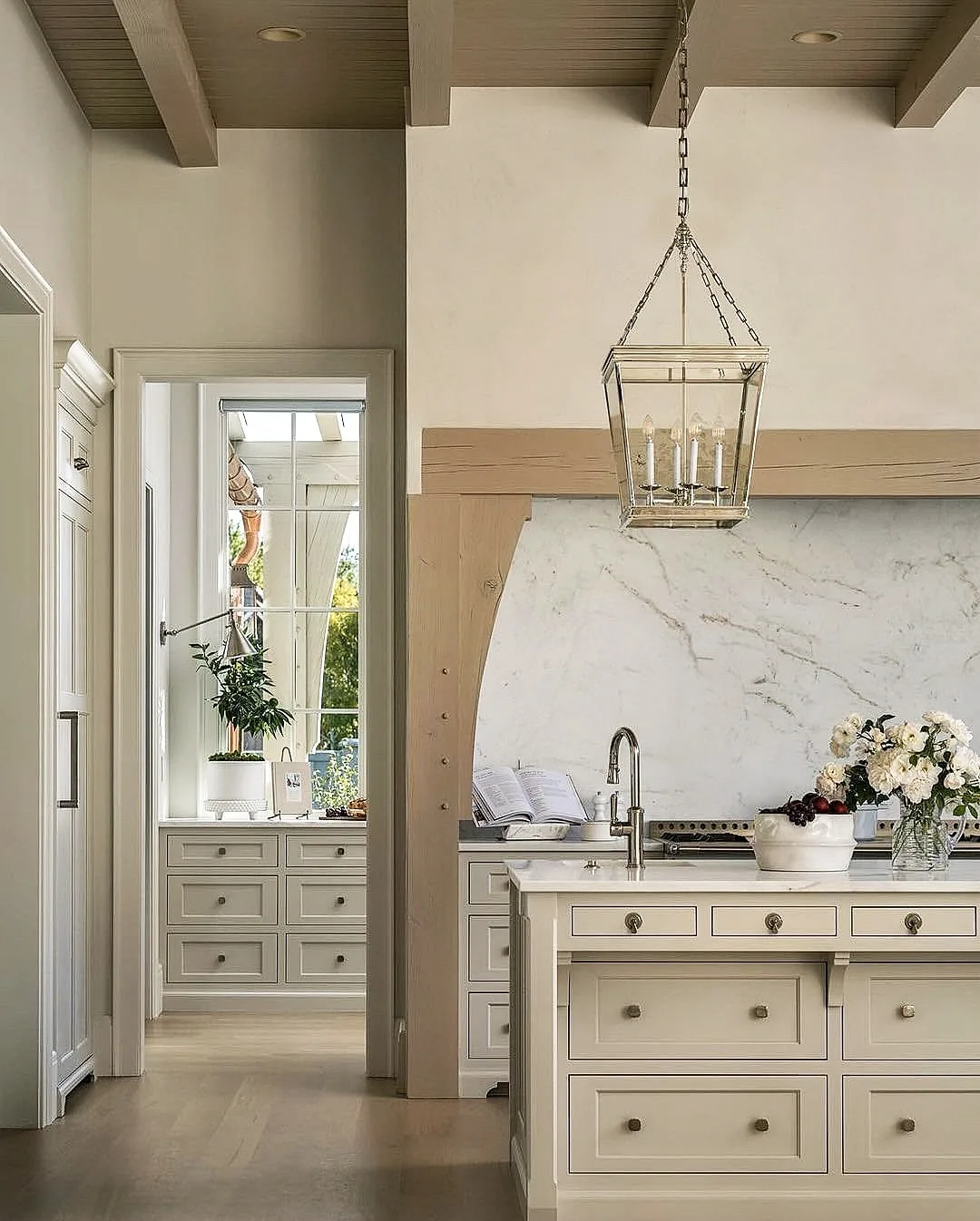
The eye goes to the wall here before it goes to the worktop, which is the point. A full height slab of soft grey veined marble runs behind the range, framed by a pale oak beam and jamb, with the island worktop in front of it in the same stone.
Vertical stone behaves differently from horizontal stone, because almost nothing acidic sits on a wall. Splatter wipes off, and a polished finish up there survives in a way it never would on a counter. That is why the combination works: matt, honed marble where the chopping happens, and a smoother slab where the cooking is only looked at.
What to copy is the restraint around it. The cabinetry is a warm off white, something like Farrow and Ball Pointing or Wimborne White, with small dark knobs that do not compete. The lantern in aged brass or nickel hangs in the void, clear of the island, so the stone gets the clear view. Adding a full height slab splashback like this to the stone order typically meant £900 to £1,800 above a standard upstand during 2026, fitted, because the sheet is large and the cut outs are slow.
When the floor is the stone
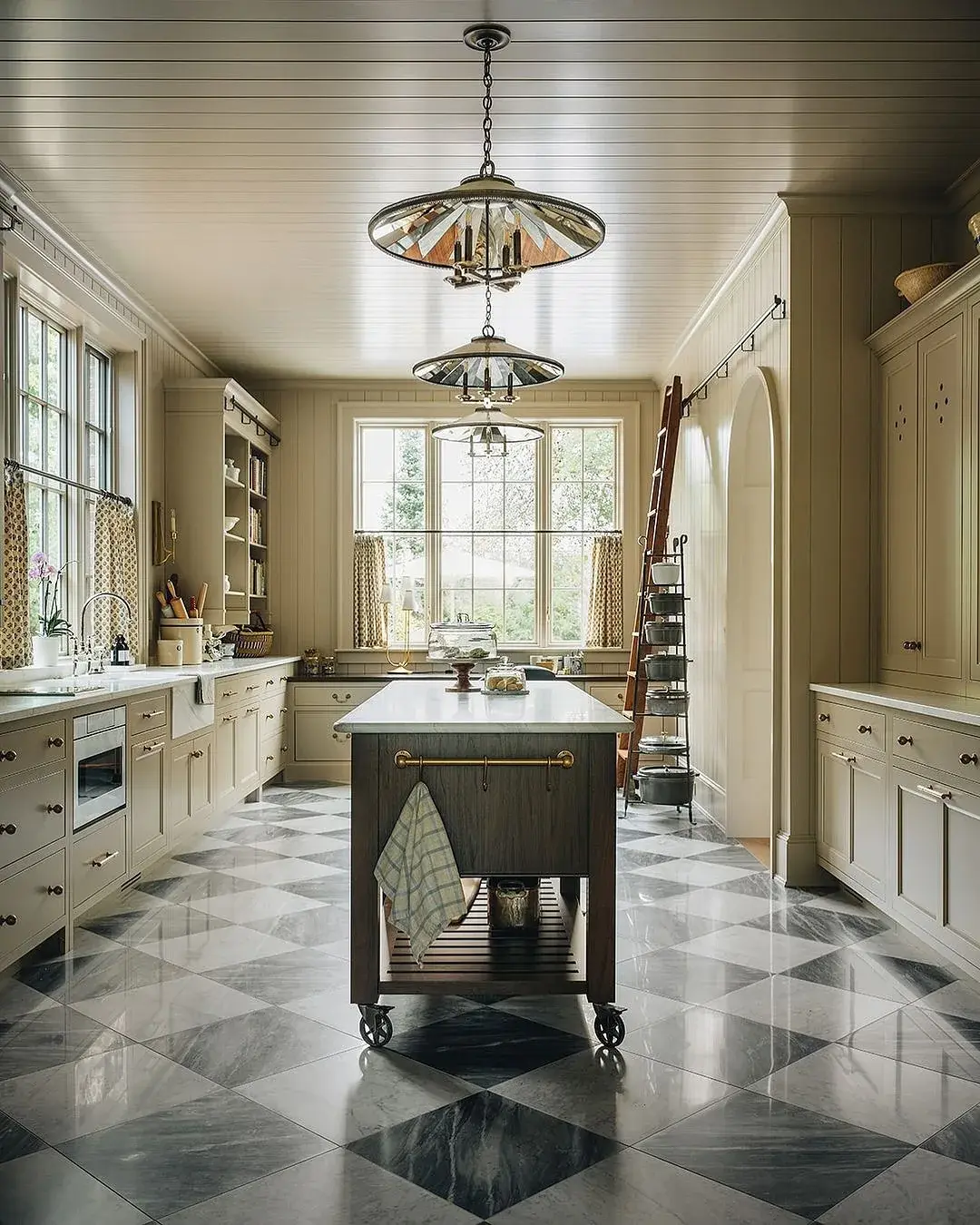
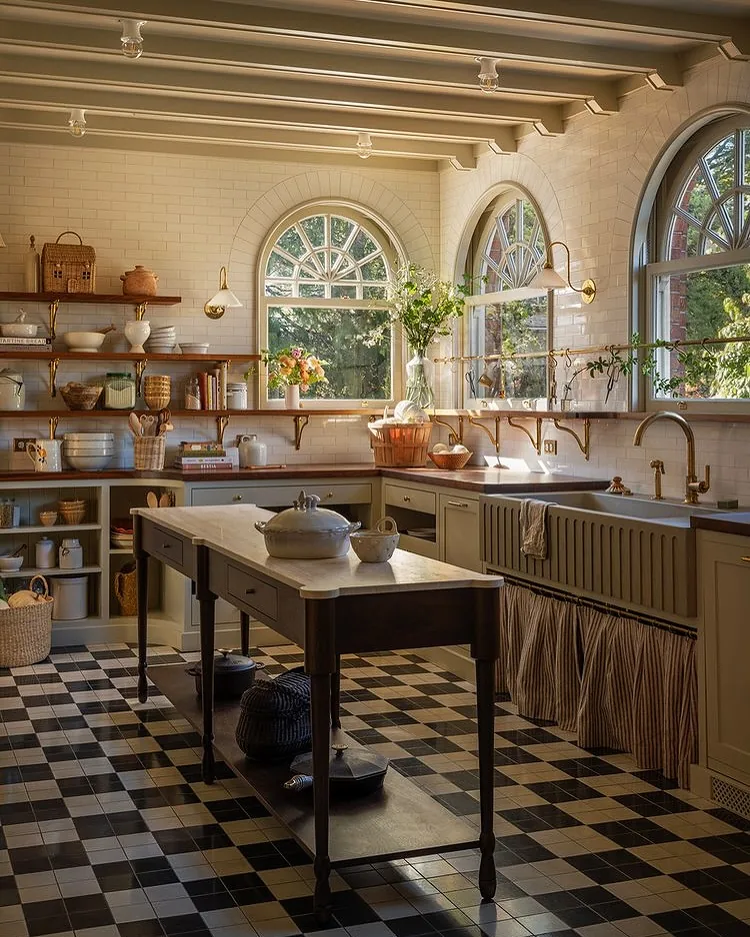
Here the marble is underfoot, in large chequered squares of grey and white, polished to a reflection. The island is a dark stained timber trolley with a plain white top, and the perimeter worktops are equally quiet.
The principle is one loud stone per room. A chequered marble floor is already a great deal of pattern, so the worktops have to withdraw. The plain white island top is doing exactly that, and the room is calmer for it. Reverse the decision, with a veined worktop over a veined floor, and the two patterns argue across the narrow galley.
Floors also age differently from counters, which matters for the patina question. A polished marble floor dulls along the walking lines within a couple of years, and in a galley that reads as use, not damage. For tiles in this format, 2026 lists asked £120 to £260 a square metre for supply, laying extra, and a honed tile hides traffic far better than the polished one shown. Mandarin Stone and Diespeker both list chequered marble tiles in these grey and white combinations.
A dramatic splashback with a quiet island
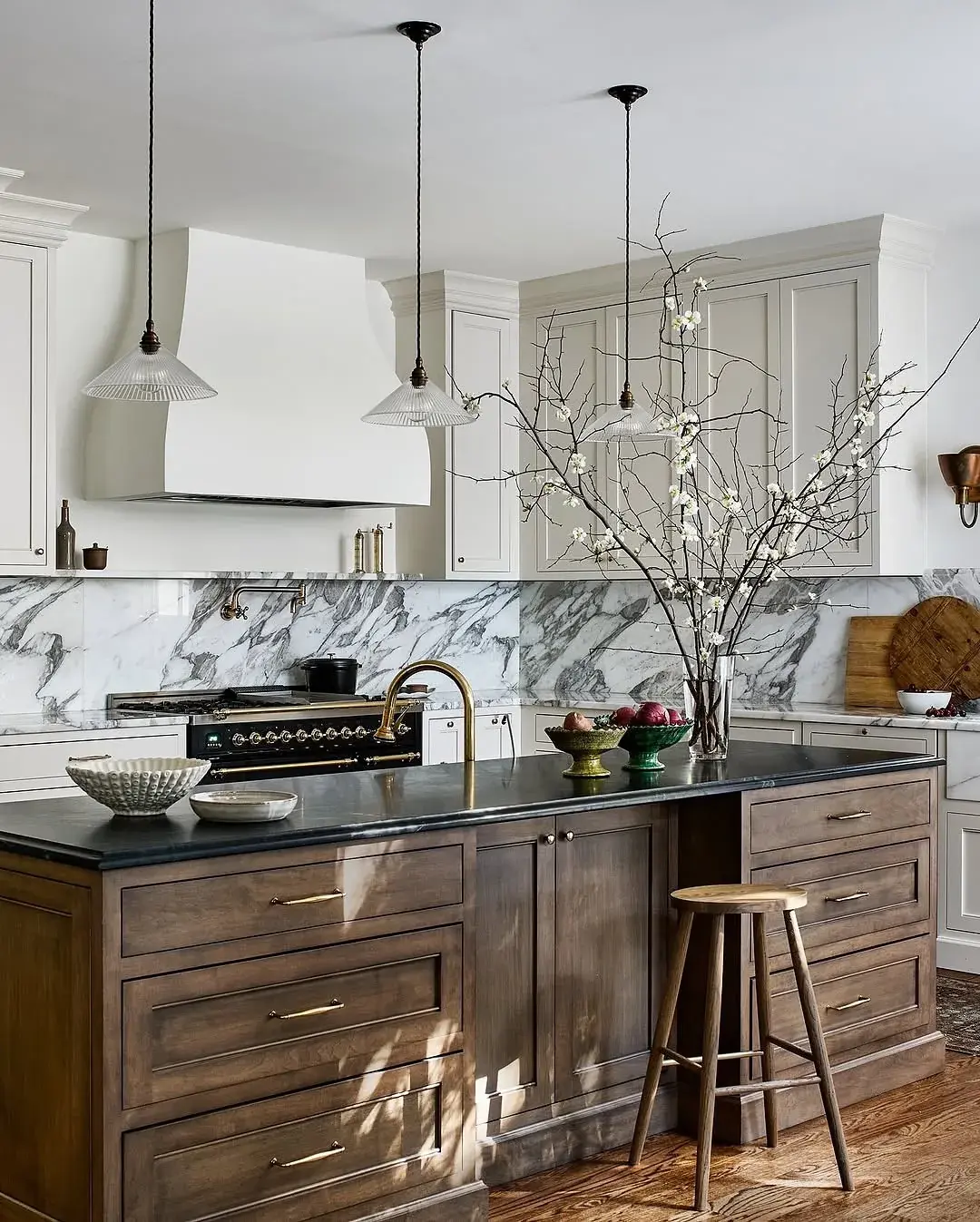
The splashback is Arabescato or a stone very like it, white with strong charcoal veining that runs across the whole wall behind the range. The island answers with the opposite: a near black honed top, probably soapstone or honed granite, on a weathered timber base.
This is the pairing to learn. Strong veining needs a plain neighbour, and black honed stone is the calmest neighbour marble has. The dark top also takes the daily punishment, since the island is where food lands, bags get dropped, and homework spreads out. Soapstone ignores lemon, vinegar, and heat in a way marble never will, which is why it suits the working surface while marble takes the wall.
Look at the brass tap against the dark island. Unlacquered brass spots and dulls in the same gradual way, so the two materials age on the same terms. A black island top in soapstone came in at £500 to £900 a square metre, made and installed, on 2026 quotes, where Carrara marble sat at £400 to £800, and soapstone wants mineral oil at the start instead of yearly sealer.
Chequered green marble underfoot
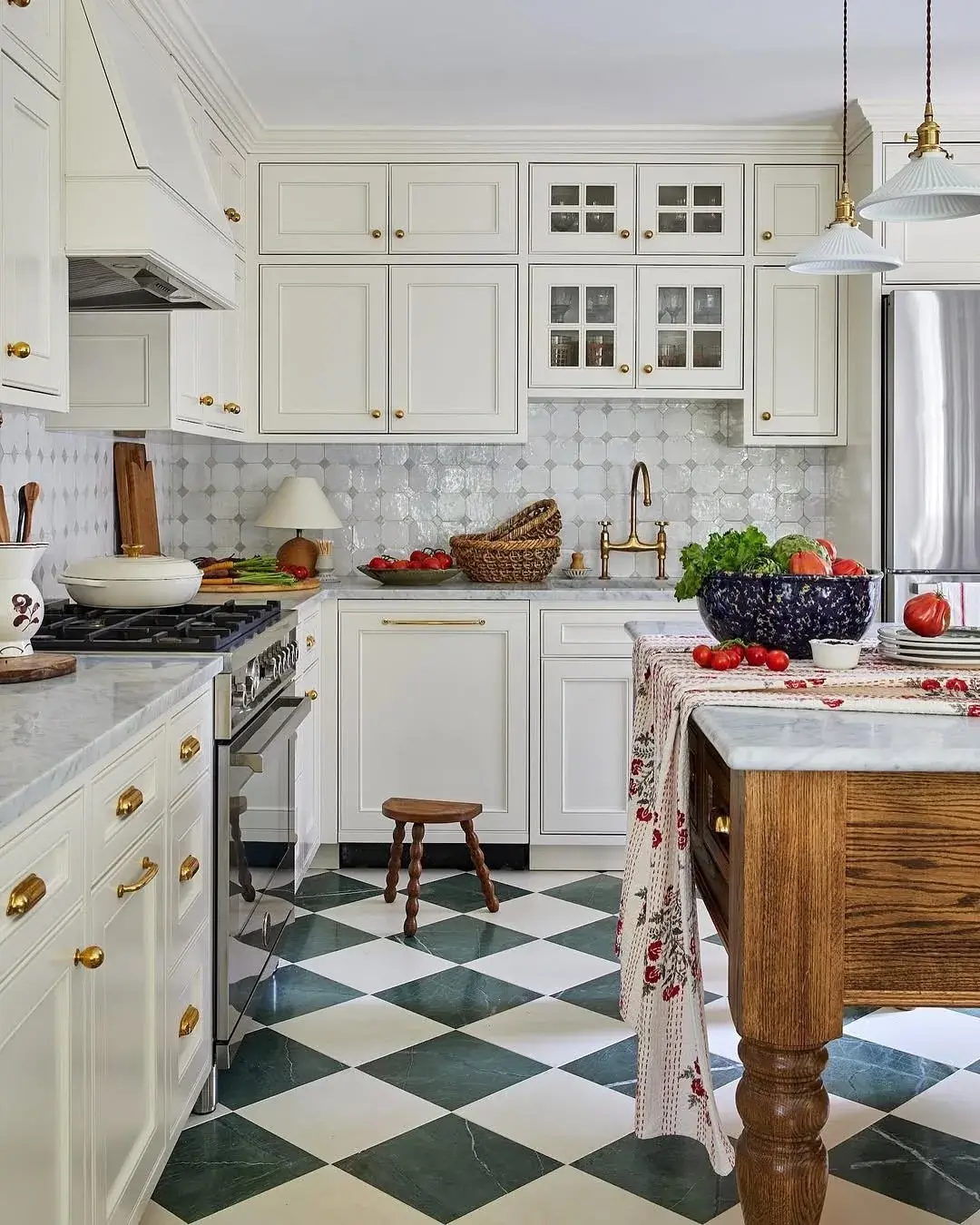
A second chequered floor, this time in deep green and white, which changes the stone decision completely. Green marble floors, Empress Green or Verde Alpi types, throw colour up onto everything, so the worktops here are correctly plain: a quiet white marble with soft veining in a honed finish.
The eye reads the floor first because it is the only saturated thing in the room. That is the governing relationship. White cabinetry with brass cup pulls, a zellige style splashback in white, and a small timber island end with a turned leg all sit back and let the floor carry the pattern. If the worktops had strong veining as well, the room would have two competing decorations at different heights.
Green marble needs honest pricing. The tiles alone were listed at £140 to £300 a square metre through 2026, and a chequered lay costs more to fit than a straight one because every corner has to meet. The worktop marble wants a warm white sealer, such as Dry Treat or Lithofin products, reapplied yearly, because tomato and turmeric find pale stone fast.
Timber cabinets with a thin marble run
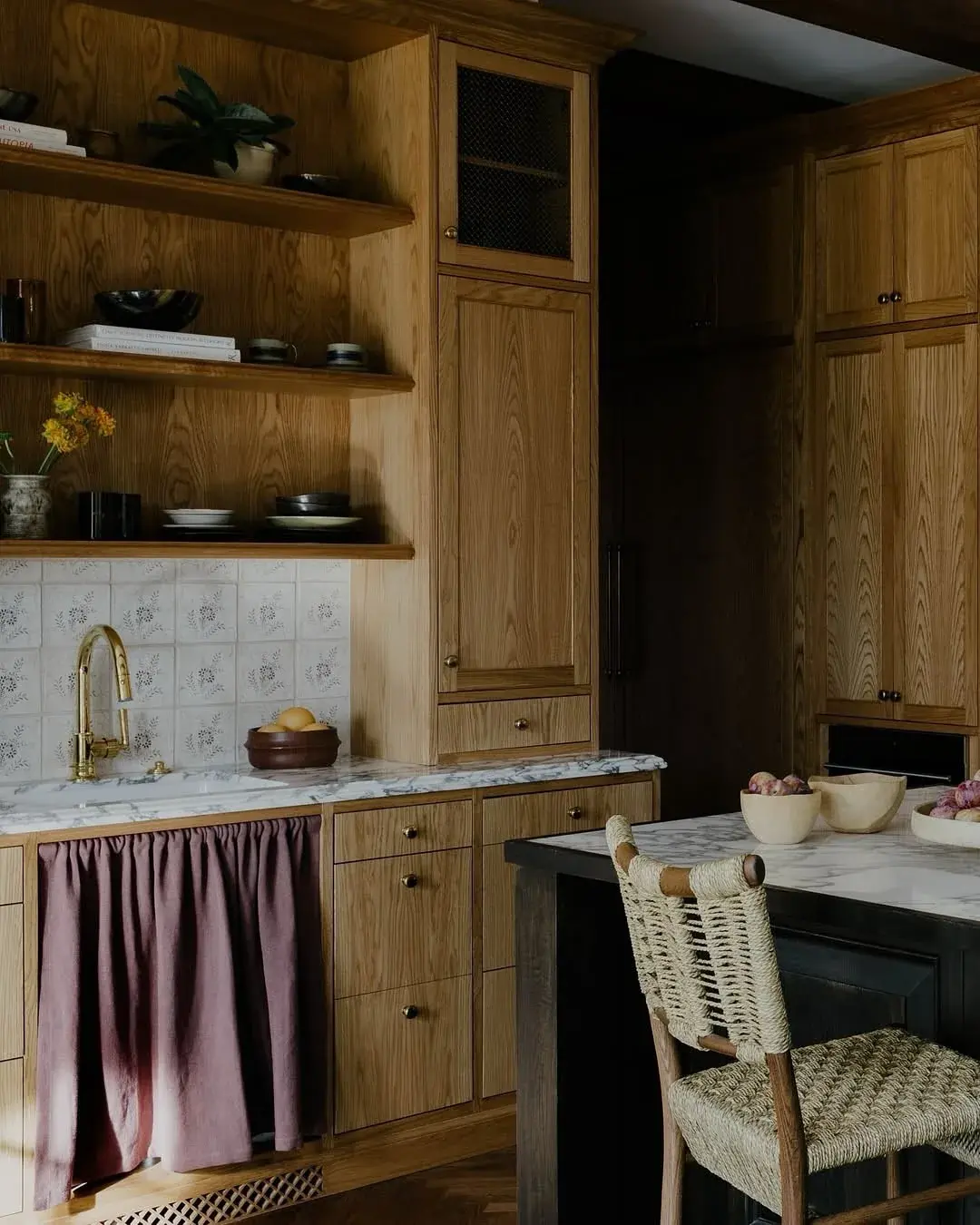
Oak everywhere, from the open shelves to the full height cupboards, with a thin white marble worktop running beneath and a mauve linen curtain under the sink. The island repeats the marble at sitting height with a woven stool tucked in.
Timber rooms need quiet stone, because oak already supplies grain, colour variation, and movement. The marble here has only a faint grey vein, which is exactly right; a dramatic Calacatta would fight the oak on every run. The thin edge matters too. A 20mm eased profile keeps the stone subordinate to the joinery, where a thick mitred apron would set up a rival.
Colour temperature decides whether this pairing works. The oak is honeyed, so the marble needs warmth in it, a white with a little yellow in it, not a blue grey Carrara. At 2700K the two sit together; under a cold 4000K downlight the marble would read icy against the timber. Worktops in this quiet Carrara grade were quoted at £400 to £700 a square metre, installed, across 2026. Take an oak door front to the yard when choosing, because memory flatters both materials.
Soapstone where the work happens
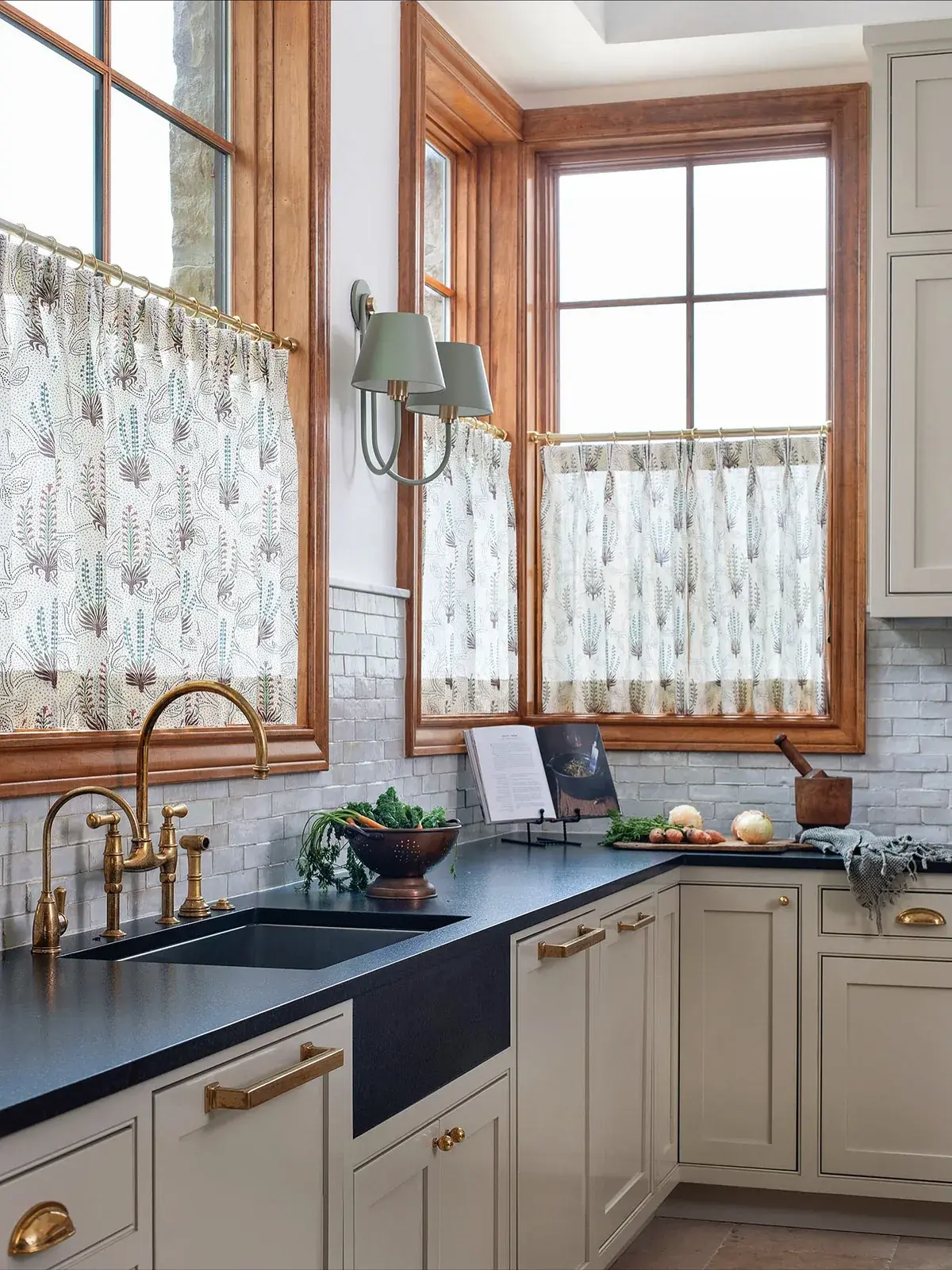
This corner is the hardest working stretch in the whole set: a deep sink, brass bridge taps, chopping boards, vegetables, and daylight from two timber windows. The worktop is dark soapstone, with the sink cut from the same stone so the whole run reads as one trough.
Soapstone is talc based, which gives it the soft matt touch and the indifference to acids that marble lacks. Lemon, wine, and vinegar leave no etch because there is no calcium carbonate to dissolve. Scratches happen, since the stone is soft, but they sand out with fine paper and blend back with oil. People who want an unmarked worktop should still not choose it, because oiled soapstone lightens and darkens unevenly for months, but people who cook daily often prefer honest wear to anxious polishing.
The surround shows how to warm a dark stone. Small white brick tiles, patterned cafe curtains on brass rods, and honey coloured window frames keep the corner from reading heavy. With an integrated sink cut from the same sheet, expect £550 to £950 a square metre all in, at the rates fabricators gave in 2026; the sink cut out is the dear part.
A small marble corner that is mostly styling
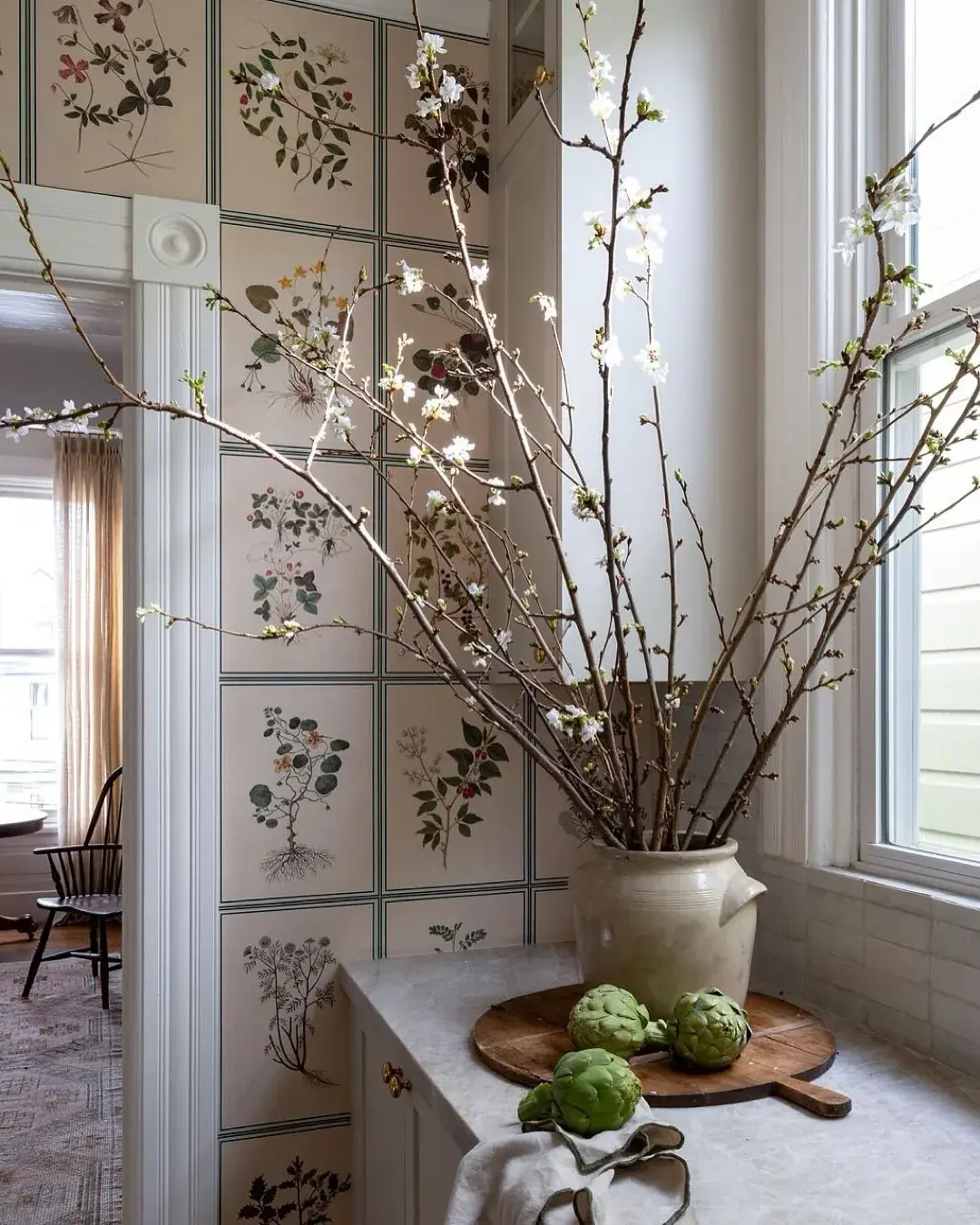
The smallest run of stone in the article, a short length of pale marble beside a window, dressed with a crock of blossom branches, artichokes on a timber board, and a linen cloth. The wall is lined with framed botanical prints in a grid.
Small runs punish marble disproportionately, because every spill lands in the same square metre, yet they are also the cheapest place to use it. A corner like this is often covered by a yard remnant, £150 to £350 to take away in 2026, where a full slab would be absurd. Honed is still the finish, since the window light is direct and would show every polished etch by spring.
What matters here is the board. A thick timber board that lives on the stone permanently, as this one does, takes the cutting and the wet flower stems, and the marble underneath stays presentable. The botanical grid above does the decorating, which frees the stone from having to perform. Where the stone is minor, let something else be major.
Polished everywhere, and what that commits to
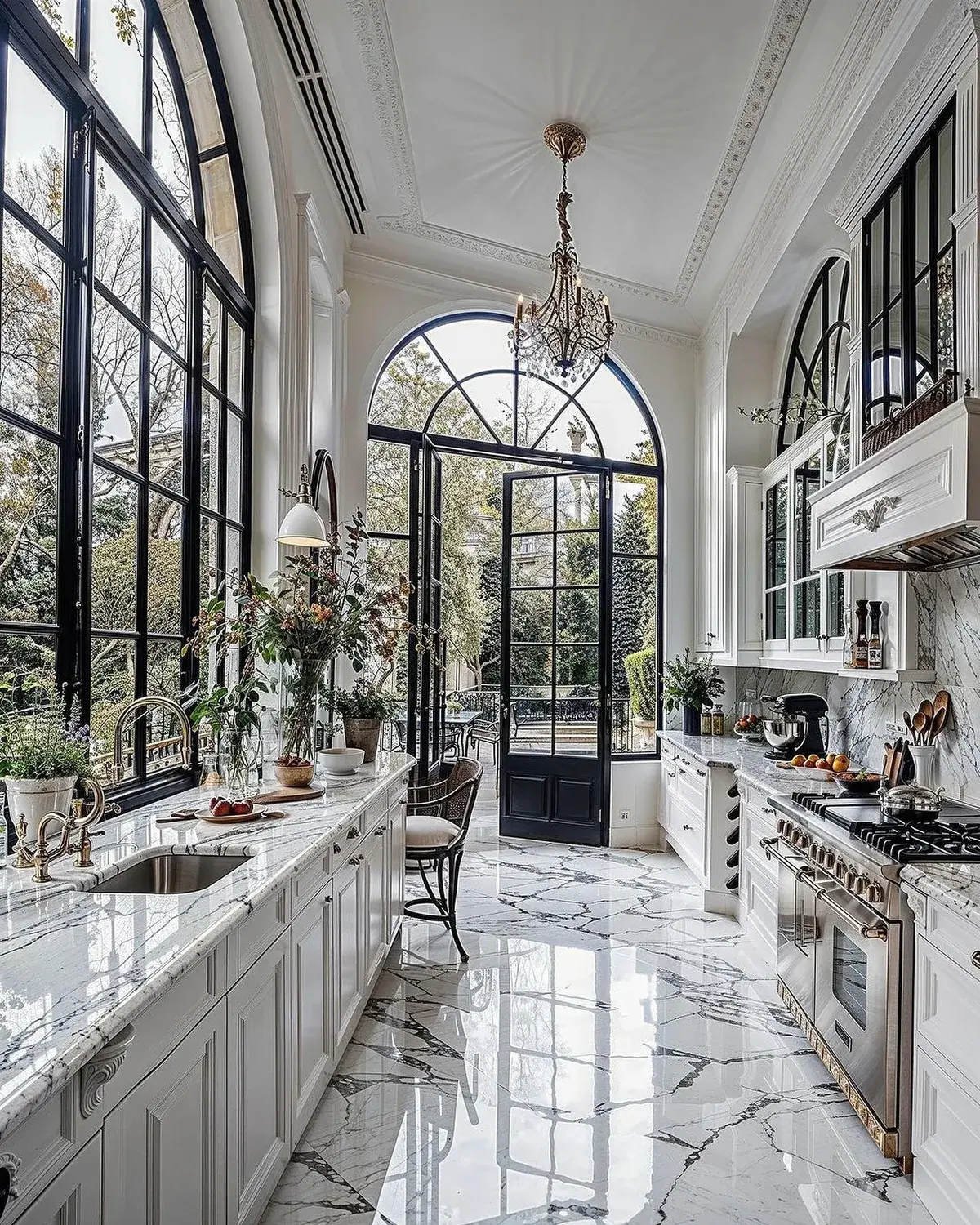
Worktops, splashback, and floor all in polished white marble with strong grey veining, inside a tall glazed room with black framed doors, a chandelier, and brass taps. Daylight floods from two sides, and the stone reflects it back.
The light is the reason this works visually and the reason it is demanding to live with. Polish multiplies daylight beautifully, which a tall white room wants, but every etch and every water spot shows under exactly that light. A kitchen that faces the garden and cooks daily will mark polished marble within weeks, and the marks sit at eye level in sunshine. People who want unmarked stone should not choose this combination at any price.
Anyone set on the look with less anxiety should price quartzite in a similar veining, such as Macaubas or a soft grey quartzite, with quartzite near £600 to £1,100 a square metre installed in 2026 and the marble equivalent nearer £450 to £850. Book matched slabs need viewing at the yard with the cabinet and floor samples present, because veining this strong decides the room on its own.
Green veining doing the decorating
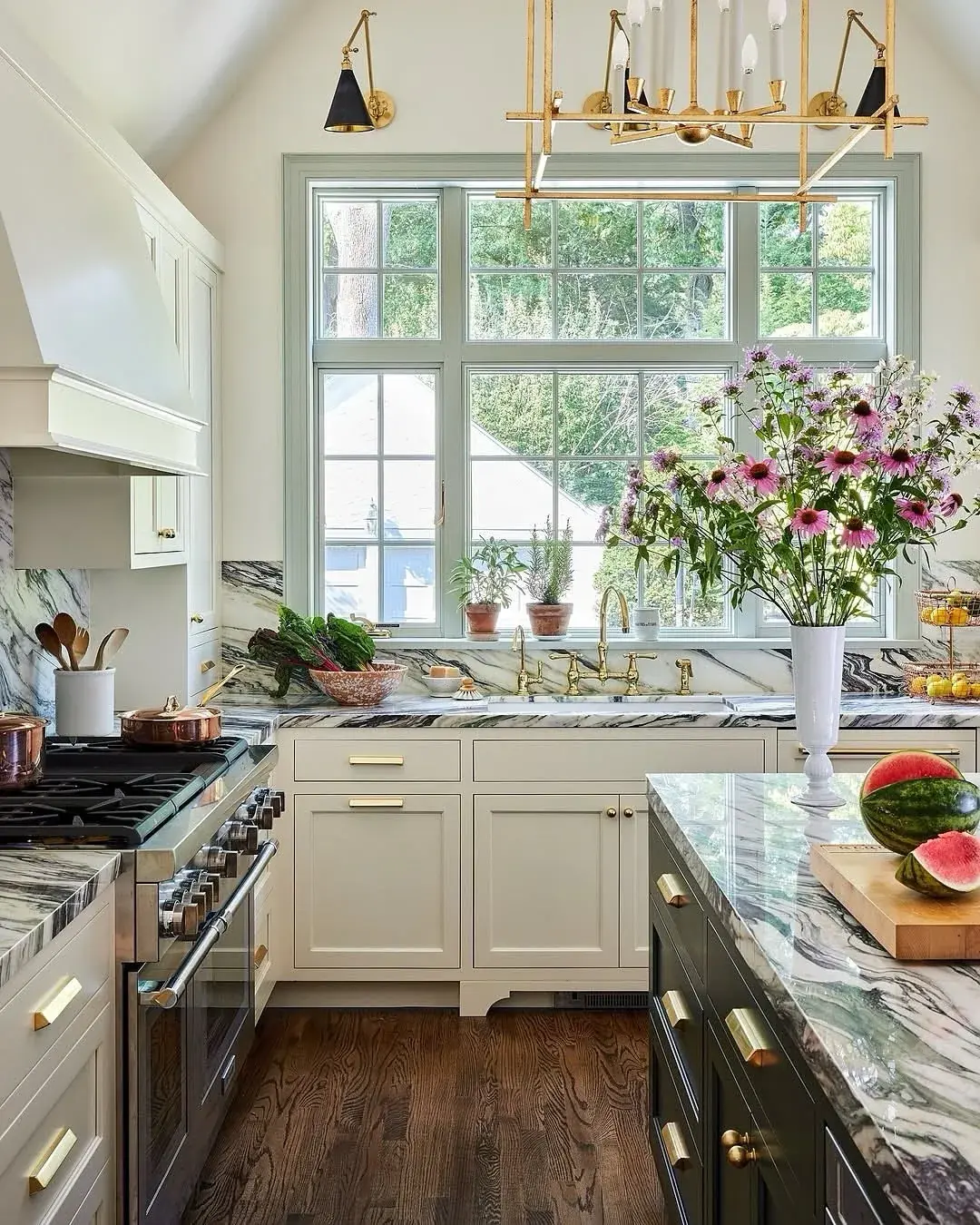
Cream cabinets, a dark green island, and worktops in a green veined marble with sweeping grey and sage movement across both the perimeter and the island. Copper pans, a watermelon on a board, and pink coneflowers complete a room where the stone is the wallpaper.
Strong veining follows the same rule as strong wallpaper: plain things beside it. The cream paint, the quiet window wall in pale green grey, and the solid island colour give the marble space to move. Two stones would have crowded it; one stone repeated twice holds it together. The copper is doing thermal work too, throwing warm reflections onto a cool stone so the room does not read chilly.
Before ordering, confirm what the stone is. Much of the green veined material sold as quartzite is a dolomitic marble that etches like one, so the lemon test on an offcut is not optional. Genuine green quartzite was changing hands near £650 to £1,150 a square metre, fitted, in 2026. If the sample dulls overnight under lemon, price it and treat it as marble, with honed finish and yearly sealing, and decide whether the veining justifies the upkeep.
Thick white marble beside a range
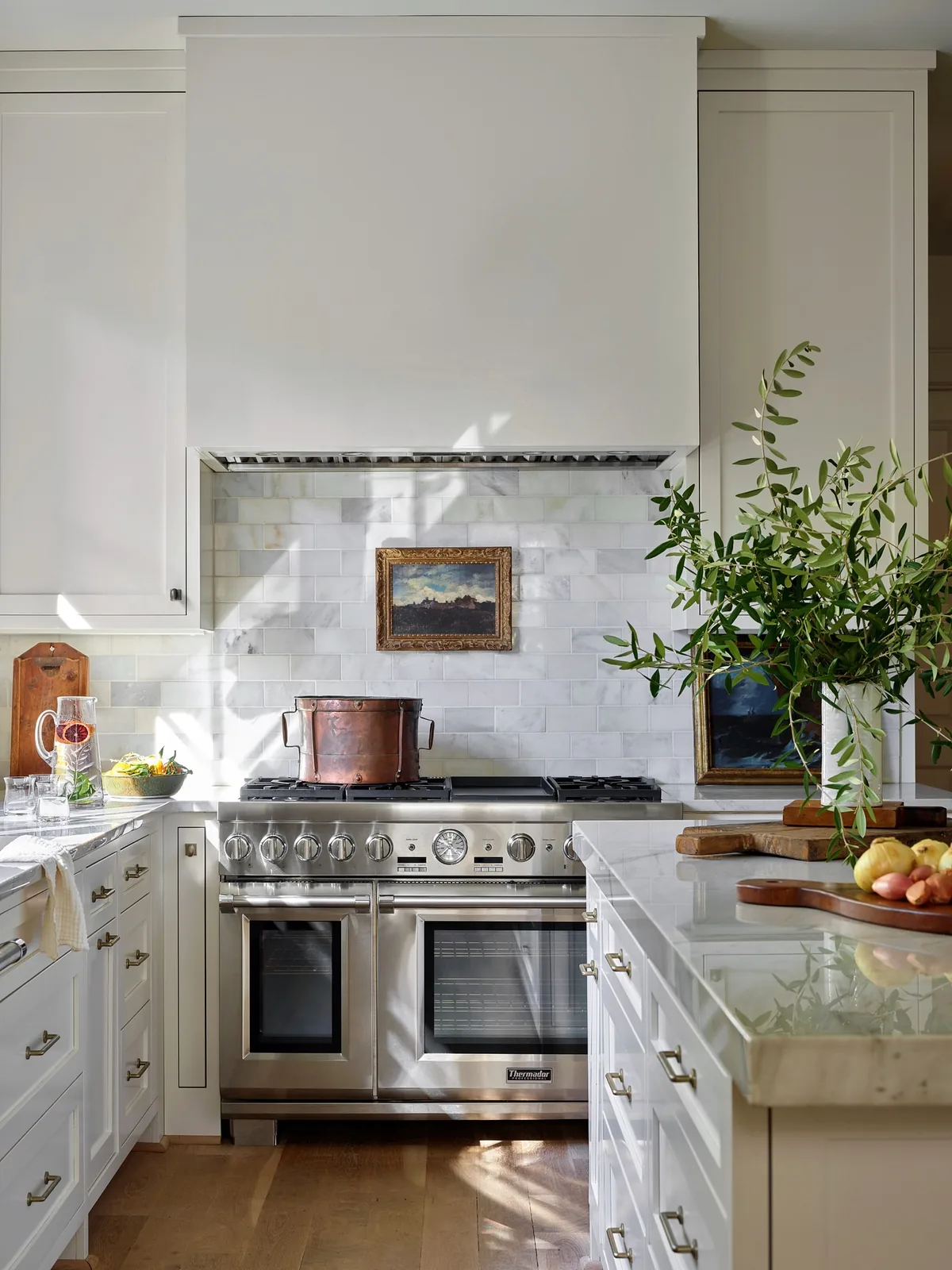
A white range cooker under a plain plaster hood, a splashback of white marble brick tiles, and a thick white marble island top with a softly rounded edge. A copper stockpot sits on the range, with timber boards and fruit on the island.
Tiles against slab is the comparison to take away. The splashback tiles bring grout lines, which chop the surface into a grid; the island slab brings one calm sheet. Both are marble, but they read differently because the joints decide the texture. Tiles suit the wall behind a range, where heat, splatter, and a future cracked tile all argue for small replaceable pieces. The slab suits the island, where a calm uninterrupted sheet shows food at its best.
The island edge is the thickness question from the opening applied. This is a 40 to 60mm profile with an eased or bullnose softening, which suits the formality of the range and the panelled cabinetry. Marble brick tiles were £80 to £180 a square metre to supply in 2026, fitting extra, while an island slab of the same family sat in the familiar £400 to £800 fitted band. Seal the tiles as well as the slab, because grout stains faster than stone.
Stone choice by cook, at a glance
| Marble | Quartzite | Soapstone | |
|---|---|---|---|
| Behaviour with lemon and wine | Etches on contact | Shrugs most acids off | Ignores them |
| Finish to specify | Honed on worktops; polish only on walls | Honed or polished both work | Matt always; oil to even tone |
| Upkeep | Seal yearly; blot spills fast | Wipe and enjoy; seal rarely | Oil at start; sand scratches out |
| 2026 fitted band per sqm | £400 to £800 | £600 to £1,150 | £500 to £950 |
| Suits | Patina permission granted | Marble look with calm habits | Hardworking sink and range runs |
Frequently Asked Questions
Will sealer stop lemon and wine leaving marks on marble?
Sealer blocks soaking, not surface burn. Oil, tomato pigment, and red wine stay out of sealed pores, yet citrus juice dulls the polish the moment it lands. Reseal each year for the first benefit and accept the second as part of owning the stone.
Which surface suits a busy prep run, matt or gloss?
Matt, every time. A dulled patch disappears into a surface that is already flat, while the same patch glares against a mirror shine. Keep the reflective slabs for upright splashbacks and quieter spots where produce is displayed, not chopped.
I dislike visible wear. Should I pick Carrara or quartzite?
Pick quartzite, or leave natural stone alone. Carrara records every acidic spill within days, and fondness for the ageing surface is a precondition. Silica based slabs give a comparable veined face and stay calm under ordinary cooking.
Is dark soapstone difficult to keep presentable?
Less difficult than its colour suggests. Acids and heat leave it alone, and shallow knife lines fade after a rub with fine abrasive and a wipe of mineral oil. The awkward phase is the first few months, when oiled and unoiled patches dry at different rates.
Can hot pans and knives go straight onto the worktop?
Heat is fine on soapstone and quartzite with a trivet nearby, risky on quartz resin, and knives belong on timber everywhere. A board that lives out gets used; one stored in a cupboard gets skipped. Edge chips come from dropped cast iron, not from careful slicing.
How do I approve slabs without clashing the cabinets?
View shortlisted slabs in daylight with a door front and a floor offcut beside them. Ask the yard to mark cut lines and photograph the layout before saws start, so strong veins fall where the room can carry them. Showroom spots flatter everything and should not decide the purchase.
In order
- Decide edge thickness and profile early; it changes the room more than the stone does.
- View a previous mitred edge in person before choosing one.
- Specify a honed finish on any marble worktop.
- If the maintenance is a problem, look at quartzite rather than quartz.
- Choose your own slabs and approve the cut layout before fabrication.
- Grant patina permission before ordering marble; without it, choose quartzite or soapstone.
- Keep one loud stone per room and let the other surfaces withdraw.
This article may contain affiliate links. We may earn a commission at no extra cost to you.