12 Open Shelving Kitchen Ideas: One Wall, Not All Four

Add us as a preferred source to see more stories on Google.
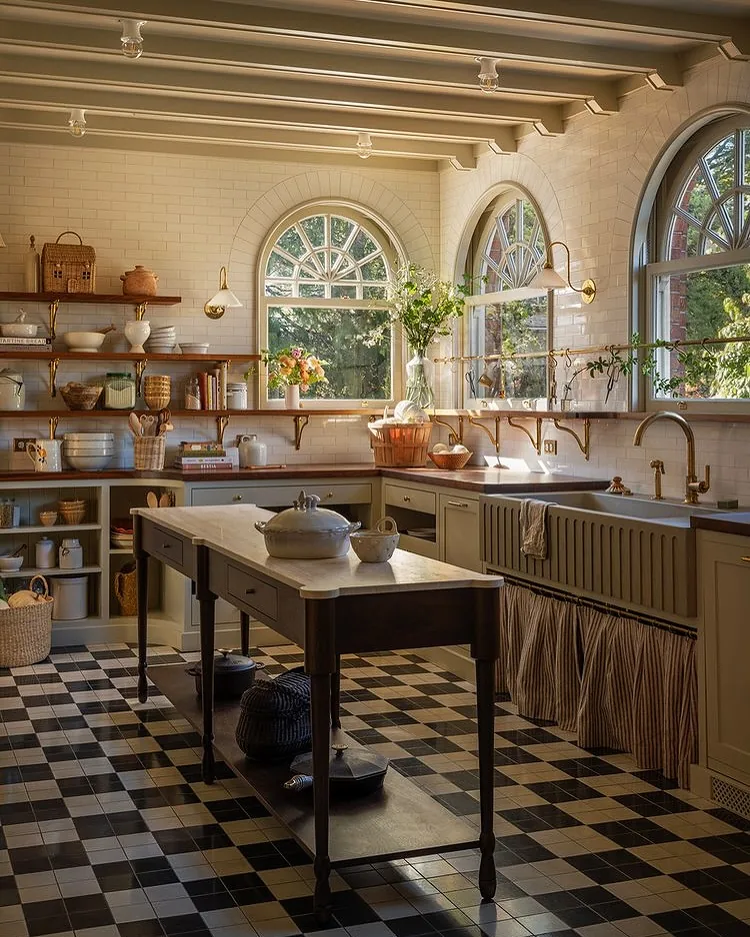
Open shelving usually gets proposed as a whole-kitchen decision, and that is where it goes wrong.
Look at where the shelves actually are in that kitchen. One wall, on the left. Everything else is closed base units with no uppers at all, and the run under the window has nothing above it but tile.
That restraint is what makes the shelves work. They are a feature in one place rather than a system imposed on the whole room, and the eye gets somewhere to rest between them.
What goes on them
Things you use, in one colour family.
Every item on those shelves is either cream ceramic, natural basketware or wood. There is no decorative object anywhere, and that is why a completely full shelf still reads calm. The palette does the tidying that empty space usually has to do.
This is also the honest entry requirement. Open shelving asks you to own matching crockery, or at least crockery in one colour range. A shelf of mismatched mugs collected over fifteen years will look exactly like that, and no styling fixes it.
If your cupboards are currently a mixture, the cheapest route in is a set of plain white or cream stoneware and putting everything else behind a door.
The part nobody mentions: light them
There are picture lights above the shelves in that photograph, and they are doing a great deal of work.
An unlit shelf on a wall is a recess, and a recess reads darker than the wall around it. In a kitchen that means the one feature you built for looking at becomes the dullest part of the room after about four in the afternoon.
Options, cheapest first: a slim LED strip fixed under the front lip of each shelf, wired or battery; a picture light above the top shelf; or a pair of wall lights flanking the run. Warm, 2700K, dimmable if the wiring allows.
Brackets, boards and the span
The brackets in that kitchen are brass and deliberately visible, which suits a traditional room. Concealed floating brackets suit a modern one. Both work; a cheap-looking bracket on an expensive board does not.
For the boards, 40mm solid oak or ash looks substantial and holds up. Anything thinner than about 30mm looks flimsy once it is carrying plates, and will bow over a long span.
Keep spans under about 900mm between supports for a 40mm board carrying crockery. Beyond that the sag is slow, permanent and very visible against a straight tile line behind.
Fix into studs or use proper masonry anchors. Loaded shelving is heavier than people estimate: a run of everyday plates and bowls is easily 25kg.
Where not to put them
Above the hob. Grease travels further than you think and settles as a film that needs washing off everything, not just wiping. If you cook properly, this is a weekly job rather than an occasional one.
In a kitchen you cannot keep tidy. That sounds unkind, and it is simply the truth of it. Open shelving removes the option of shutting the door on a bad week.
Where there is no closed storage left. Somewhere in the room has to hold the plastic containers, the spare tins and the appliance you use twice a year.
The half-measure that often suits better
Glazed upper cabinets, or one open run between two closed ones.
Glass fronts give you the depth and the visible contents without the dust and grease, and they forgive a far messier interior than open shelves do. They are also the traditional solution, which is why they appear in most old kitchens where open shelving does not.
If the point is breaking up a wall of doors rather than displaying anything, that is usually the better move.
A glazed tower that forgives mess
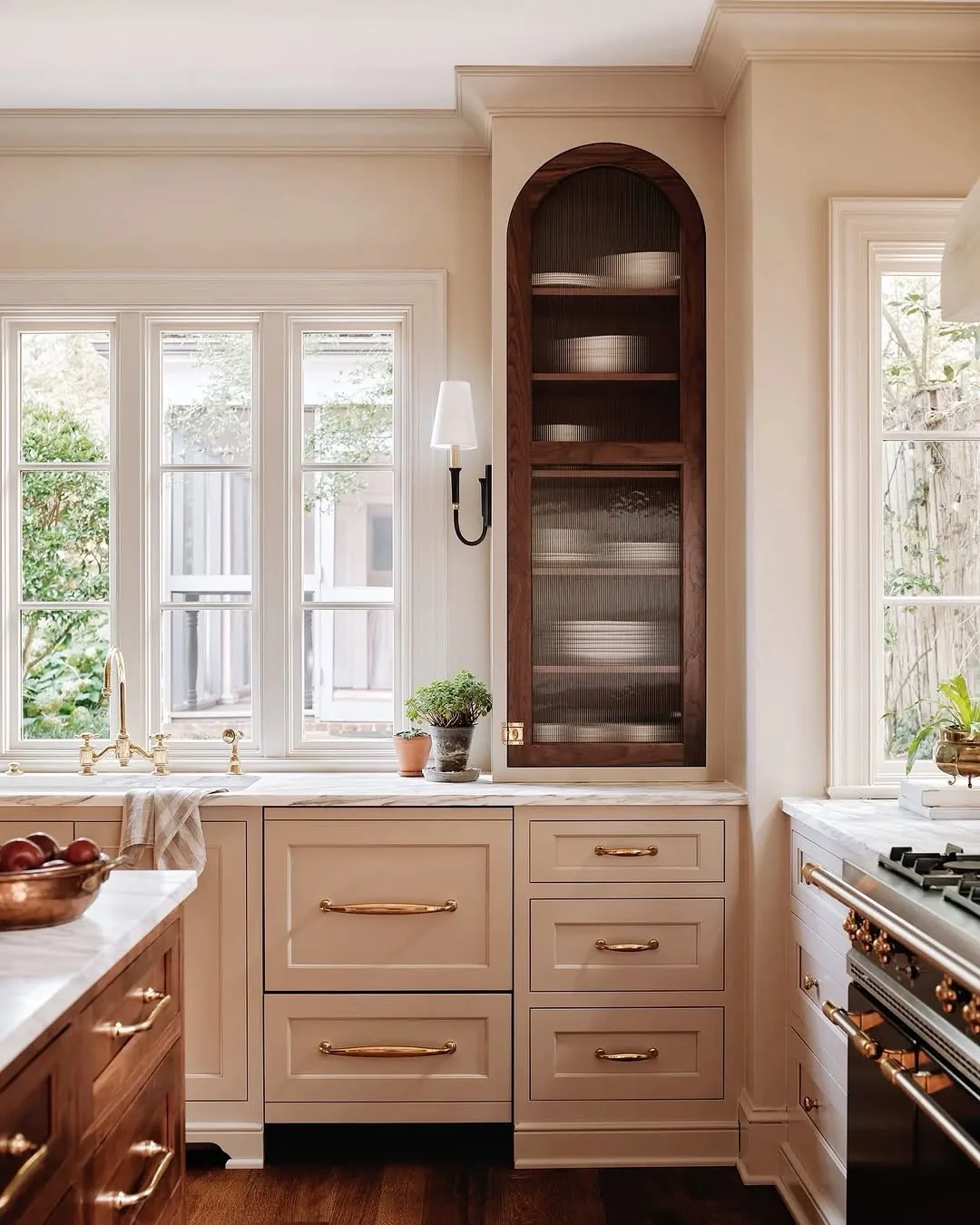
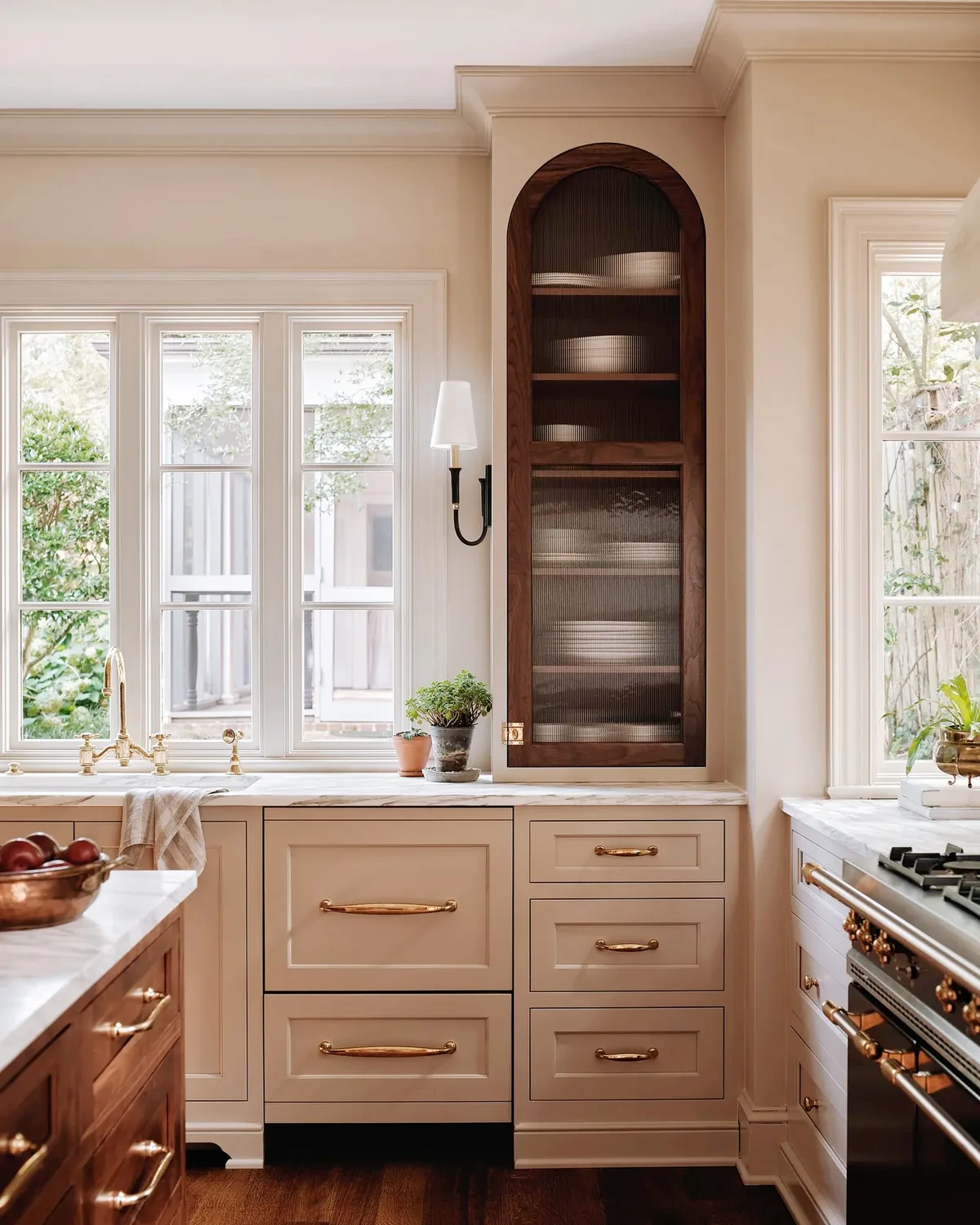
The half-measure above has a built form, and this tall case shows it. A narrow walnut tower with an arched top stands beside the window, glazed with reeded glass that blurs what sits behind it, which is exactly why glass forgives what open boards do not.
The eye goes to the dark timber frame first, because a vertical band of walnut against pale plaster always pulls focus before pale ceramics do. Behind the fluting, stacked bowls and plates lose their hard edges and read as bands of cream, so the ordinary stays present without demanding arrangement. That diffusion is the whole mechanism, and it explains why fluted fronts suit busy households where open runs fail within weeks.
Daylight from the window beside the case does the work the hero picture lights do electrically. The tower sits beside the sink run, well away from frying, which matters more than the joinery. Reeded inserts run £60 to £120 per door in 2026, with joinery extra, while brass bar pulls of the kind on the base units below run £12 to £28 each in 2026. The cream paint around it is a soft chalky white with yellow in it. Farrow and Ball Pointing or Little Greene Slaked Lime 105 get close.
A pantry doorway, not a kitchen wall
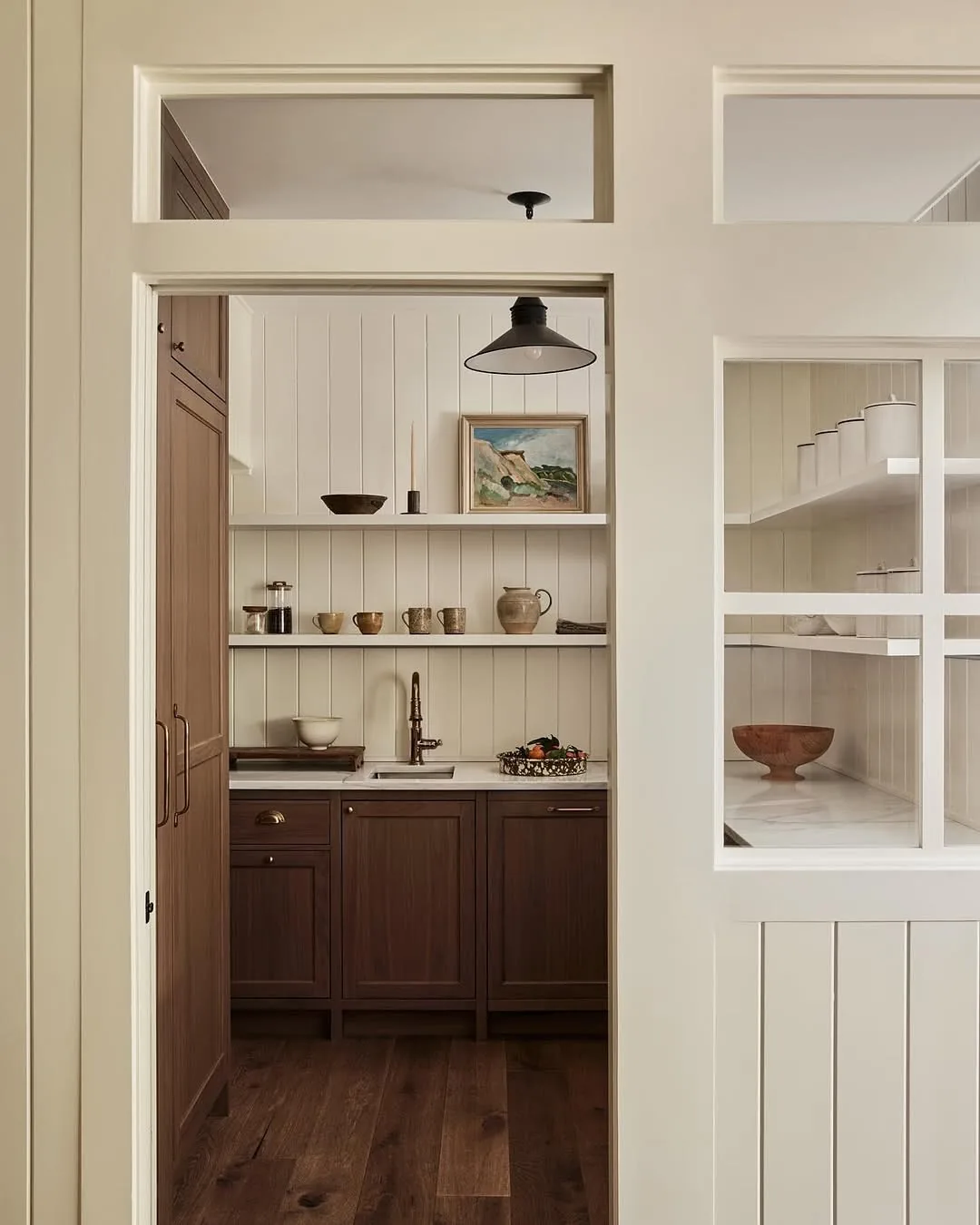
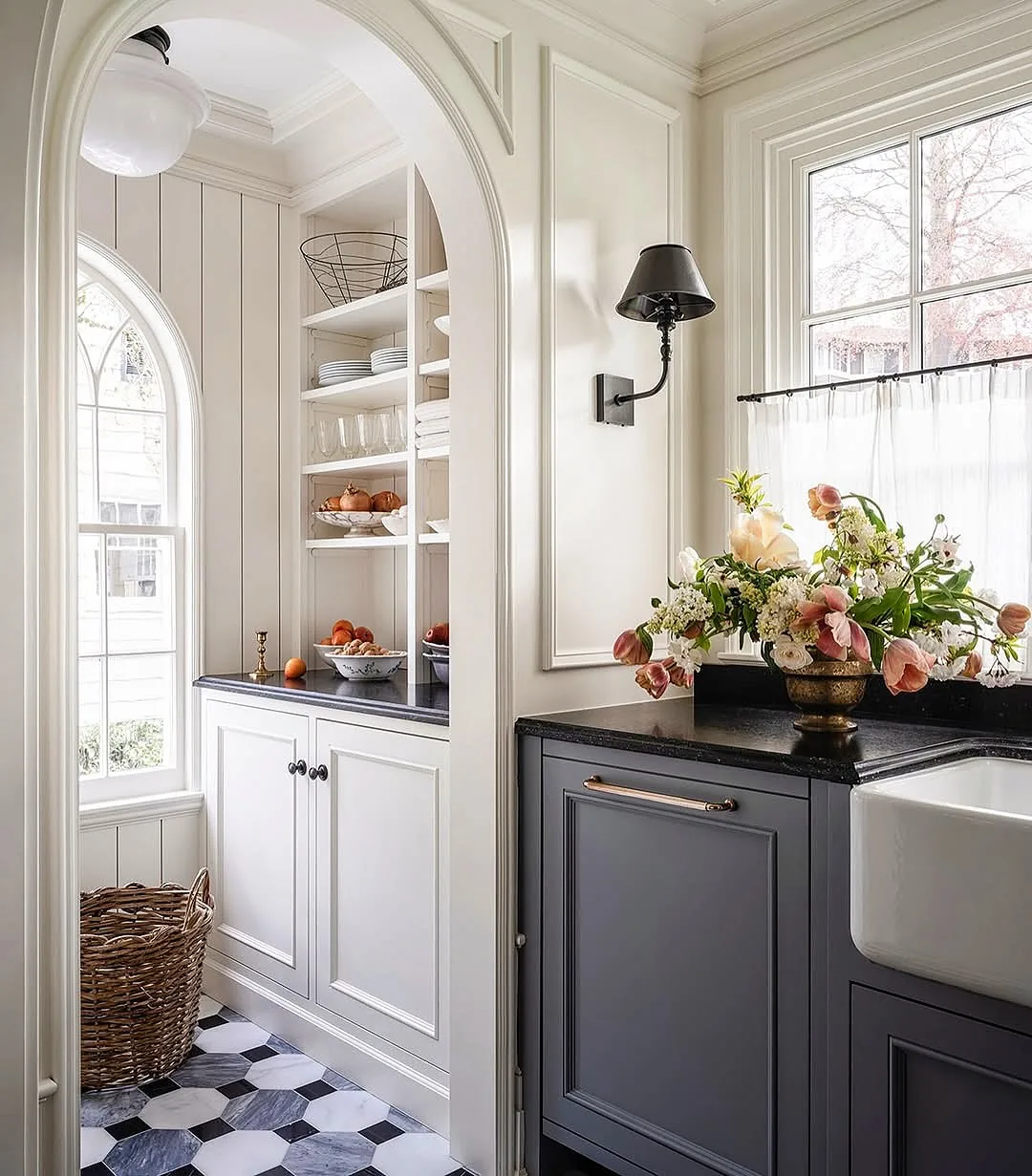
Pictured here is a secondary space, and the distinction decides the cleaning load. Shelves in a pantry or scullery never meet steam from a hob, because heat and grease stay in the main kitchen, which is why the white tongue and groove behind these boards still reads clean.
Two white boards sit over dark timber base units, holding stoneware mugs with a French press, a small jug collection and a bowl at the sink. The palette holds to brown with cream, and every piece looks lifted daily. A black pendant hangs over the run, and the doorway frames the view so the shelves read as a glimpse. A glimpse forgives fullness that a full wall would not, since the eye never rests on it long.
Tongue and groove panelling in moisture resistant MDF runs £25 to £45 per square metre in 2026, while enamel pendant shades of this kind run £40 to £110 in 2026. Dust still settles within a week on pieces left idle, so the arrangement follows the frequency rule. Daily mugs sit at hand height beside the tap, while the small painting and candlesticks above sit high where wiping matters less.
Hooks double a dresser wall
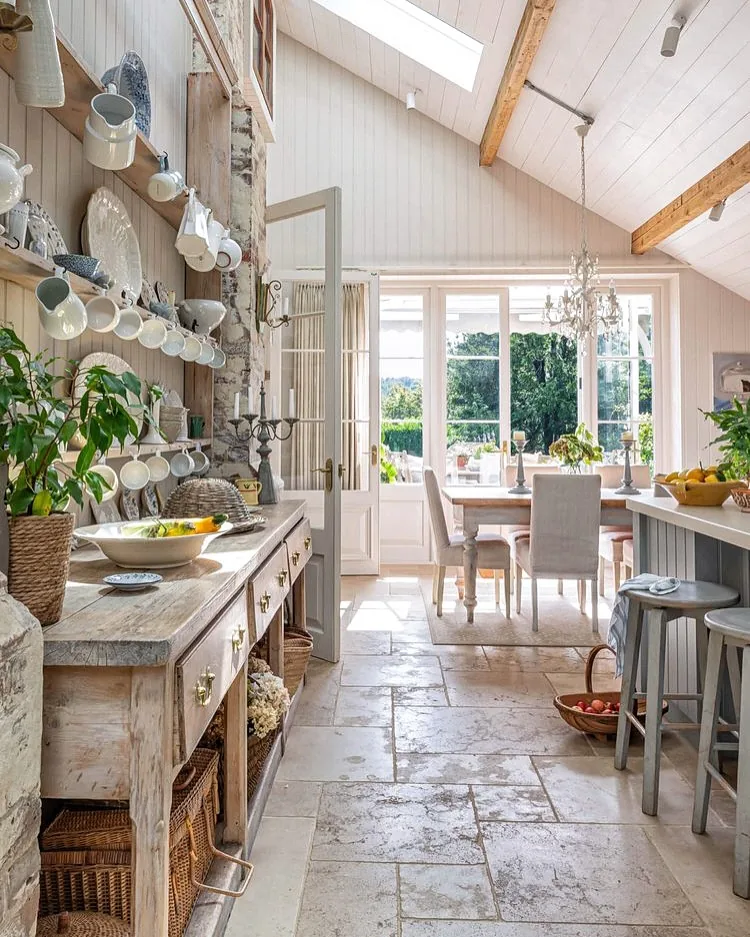
The capacity trick here sits underneath the shelf, not on it. Mugs hang by their handles from a rail fixed under the lowest board, which doubles the pieces per metre while the shelf surface itself stays calm, and that density is what lets a single dresser wall carry a whole household.
In that sunlit room the dresser runs the length of the wall, with plates stacked upright on two pale boards, jugs lined above and cups suspended below. All of it sits within white and cream, the matching crockery contract at full scale. If the same boards held fifteen years of mixed colours, the wall would read as jumble however neatly it was stacked, because the palette does the tidying here while spacing plays second.
A rooflight washes the wall, so no picture light is needed. Brass or iron mug hooks run £8 to £20 for a set of ten in 2026, and a limed oak dresser of this length from a joiner runs £1,800 to £4,000 in 2026. Hanging cups stay cleaner than standing ones while in rotation, since dust has nowhere to settle inside a cup that moves daily. Pieces left hanging for a month need rinsing, which returns to the cook daily test.
Spices in a shallow niche
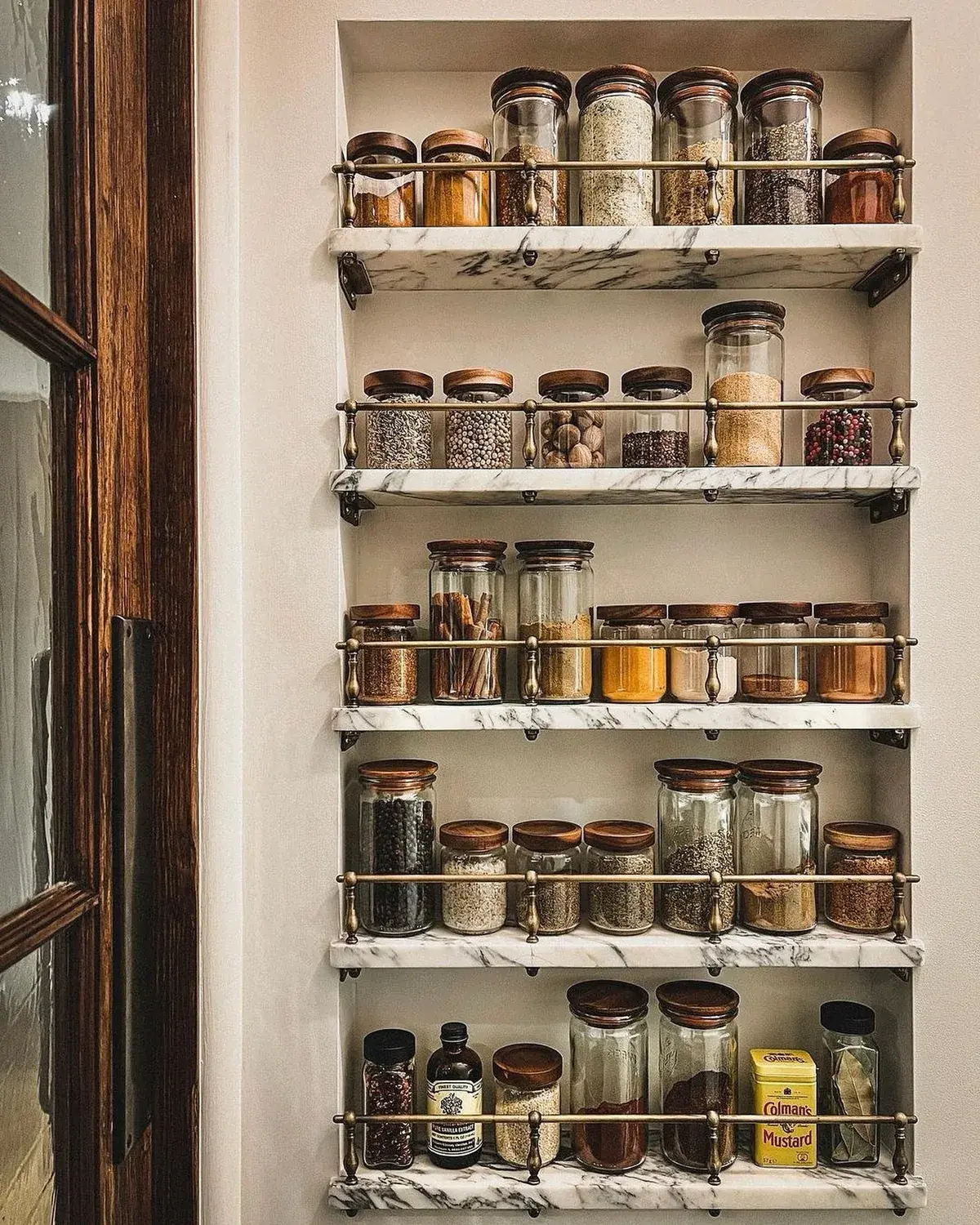
Uniformity does the tidying in this recess. Identical glass jars with timber lids stand in straight rows across five shallow marble shelves, and the eye groups the repetition and stops counting, which is why a niche this full still feels settled.
The shelves sit barely deeper than a jar, with a brass gallery rail on each level stopping falls. That shallow depth is the governing move: nothing hides behind, so nothing is forgotten, and wiping means lifting a row, which beats emptying a cupboard. The timber door frame beside the niche gives the scale. This is cupboard depth, not a room, and the smallness is what keeps it usable.
Glass jars with timber lids run £2 to £5 each in 2026, brass gallery rail runs £25 to £55 per metre in 2026, and marble offcuts for short shelves of this kind run £90 to £200 per shelf in 2026. Decanting suits cooks who buy pulses and spices in bulk and cook most days. Jars of rarely used seeds stale behind glass as fast as in packets, while their exteriors still ask for wiping, so keep daily spices low and high shelves for sealed preserves.
Marble shelves under a picture light
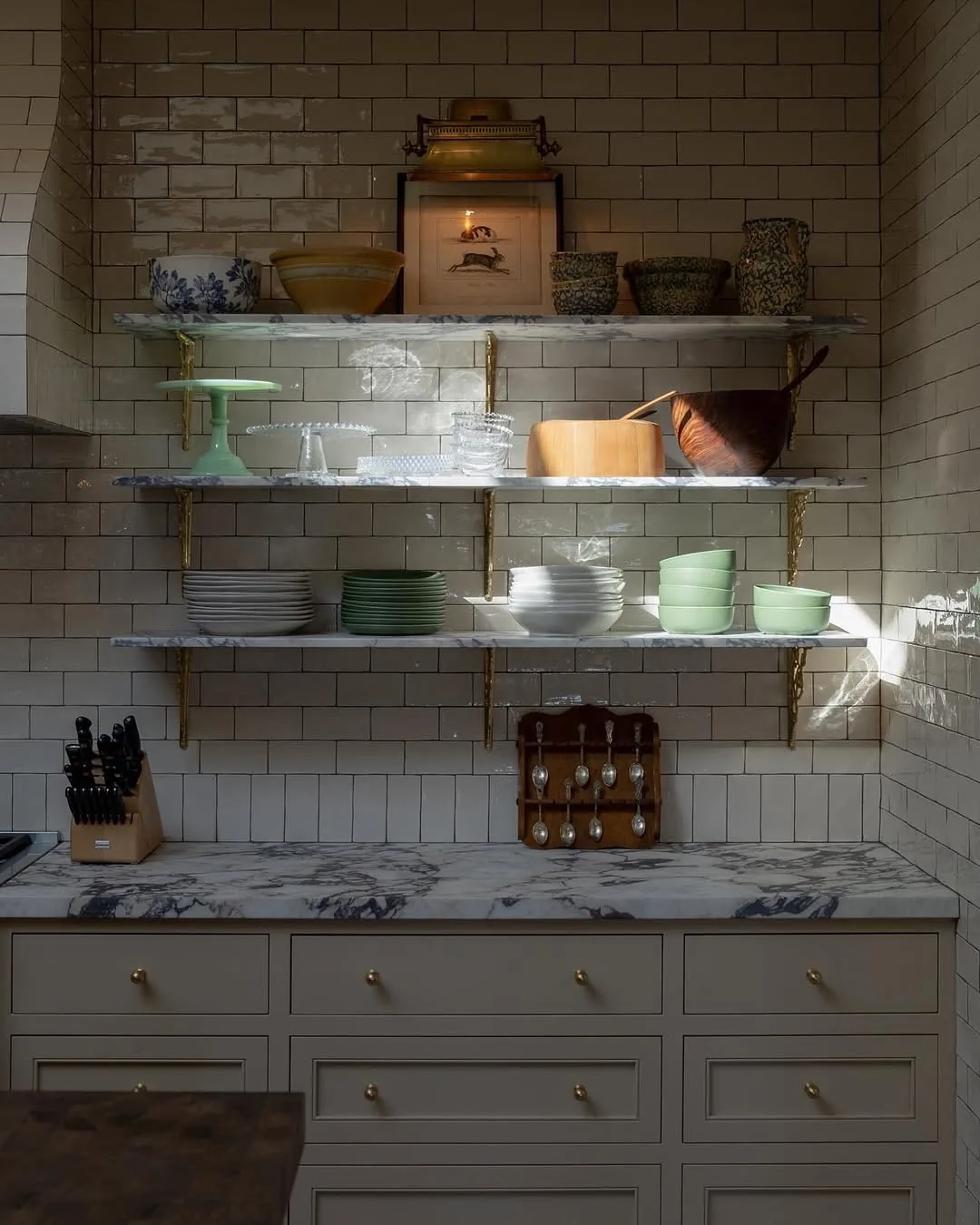
Heavy materials need visible support with light, or they read as gloomy. Three white marble shelves sit on brass brackets against cream subway tile, with a small brass picture light centred above the top board, and that combination is why the wall glows while unlit timber in a darker corner would not.
The lower board holds daily stacks in grey and green with white alongside at arm height, where grabbing beats opening doors. The middle board holds glass with a timber salad bowl, and the top board holds display with a framed print, which follows the frequency rule exactly. Sun from the left helps by day, while the picture light carries the evening, washing the tile so the shelves never become the dark recess the opening warns about.
Marble shelves of this length run £140 to £280 per metre in 2026, brass shelf brackets run £22 to £48 each in 2026, and brass picture lights run £70 to £180 in 2026. The knife block on the worktop points to prep work away from heat, which places the shelves outside the splatter radius. Stone beside a hob films within weeks however often it is wiped, so seal from day one and site away from heat.
Cookbooks below the worktop
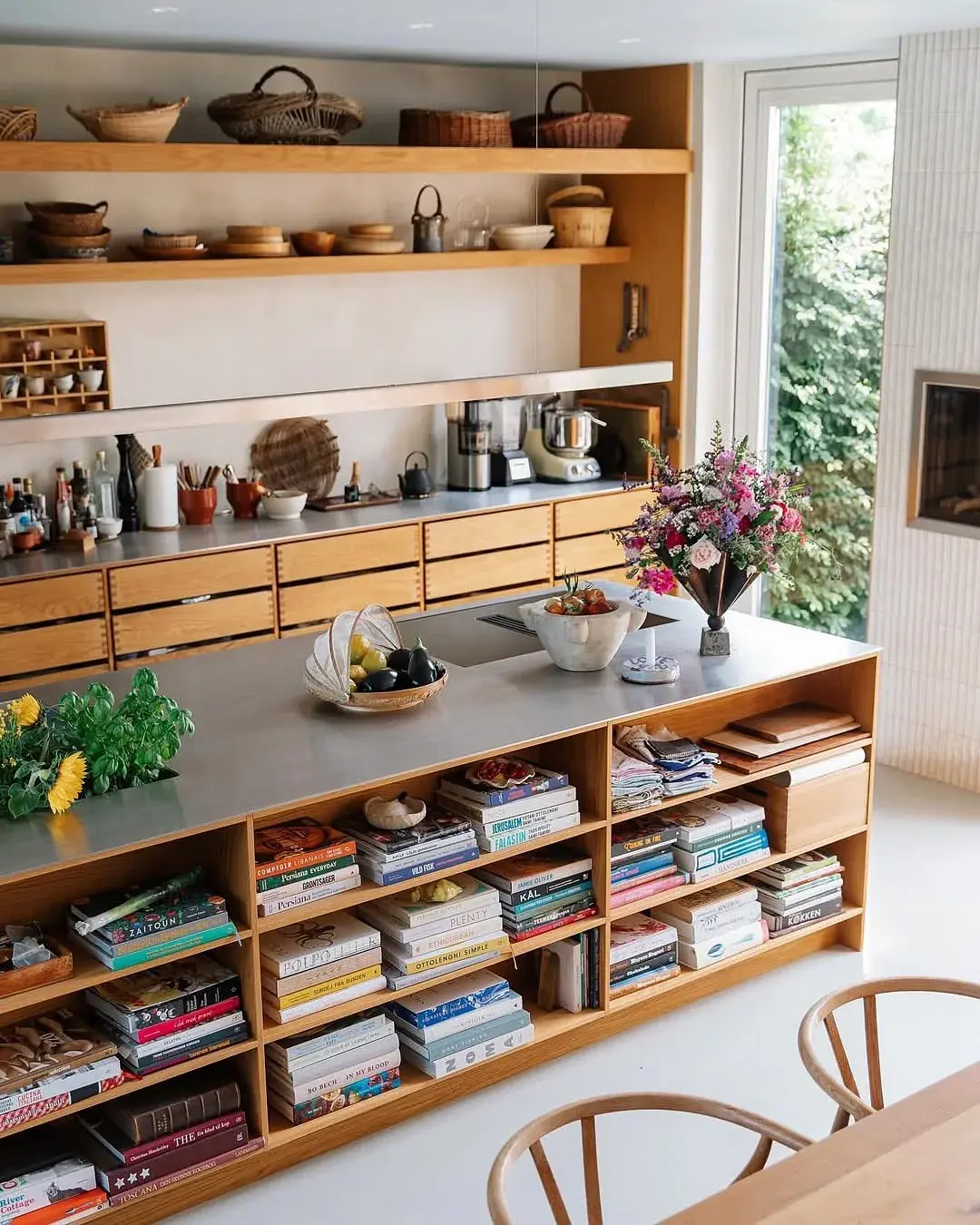
Paper and steam mix poorly, which is why the books here live low while baskets live high. Heat rises toward the ceiling, so shelves above a hob cockle pages within months, while open bays inside an island base sit in cooler air and stay usable for years.
The island base holds cookbooks spine out in shallow bays, with fruit and flowers kept to the steel top where work happens. Above, long oak boards hold baskets with bowls stacked beside small appliances. Timber ties wall to island so completely that full shelves read as one material decision, not as clutter, and the pale walls around leave the eye somewhere to rest.
Solid oak boards of that depth run £80 to £160 per metre in 2026, with brackets extra, while seagrass storage baskets run £14 to £32 each in 2026. Island book bays gather floor dust and ask for a quarterly pull out. Where frying without external extraction is routine, paper absorbs grease and the bay turns sticky, so the extraction question settles this one before joinery does.
A pantry that owns its fullness
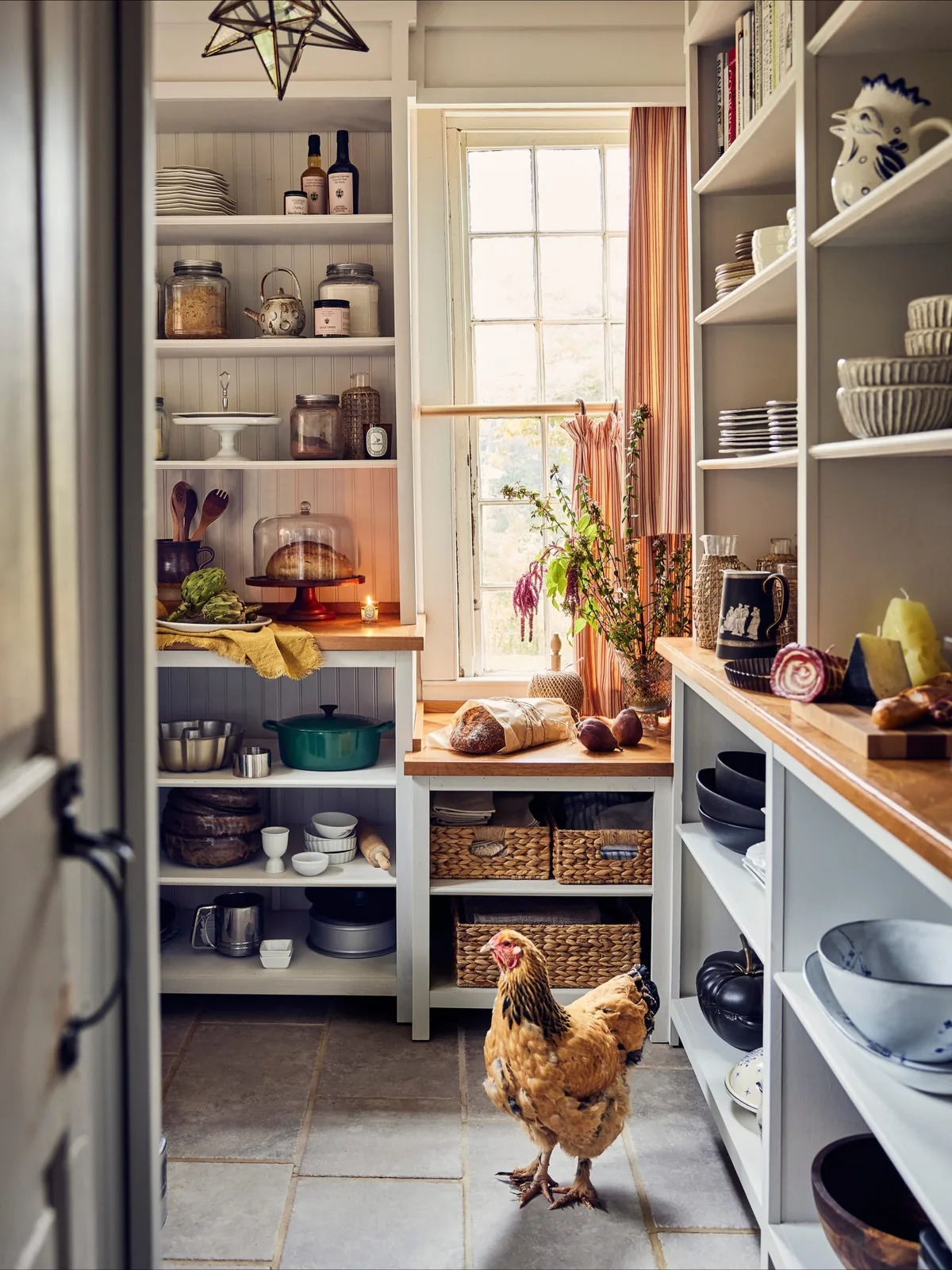
A small room forgives full shelves when everything turns over daily and the palette stays narrow. White boards with timber tops carry glass, cream ceramics with baskets, and the repetition across three walls is what stops the fullness reading as busy.
Shelves line the left wall with jars and a green enamel pot, the right wall with bowls and cheese boards, and the window wall with bread and fruit where daylight falls. That window break matters, because it splits the run and gives the eye rest, the one wall principle in miniature. Sealed jars sit high where they ignore dust, while daily bowls and the enamel pot sit low within reach.
Enamel cast pots of that kind run £60 to £140 in 2026, while woven storage baskets run £16 to £34 each in 2026. Daylight reveals dust that electric light hides, so sparse styling near the window earns its keep. This pantry suits a household that cooks most days. As display for rarely lifted pieces, the same shelves would film within a fortnight and ask for the weekly wipe the opening describes.
Daily use forgives colour
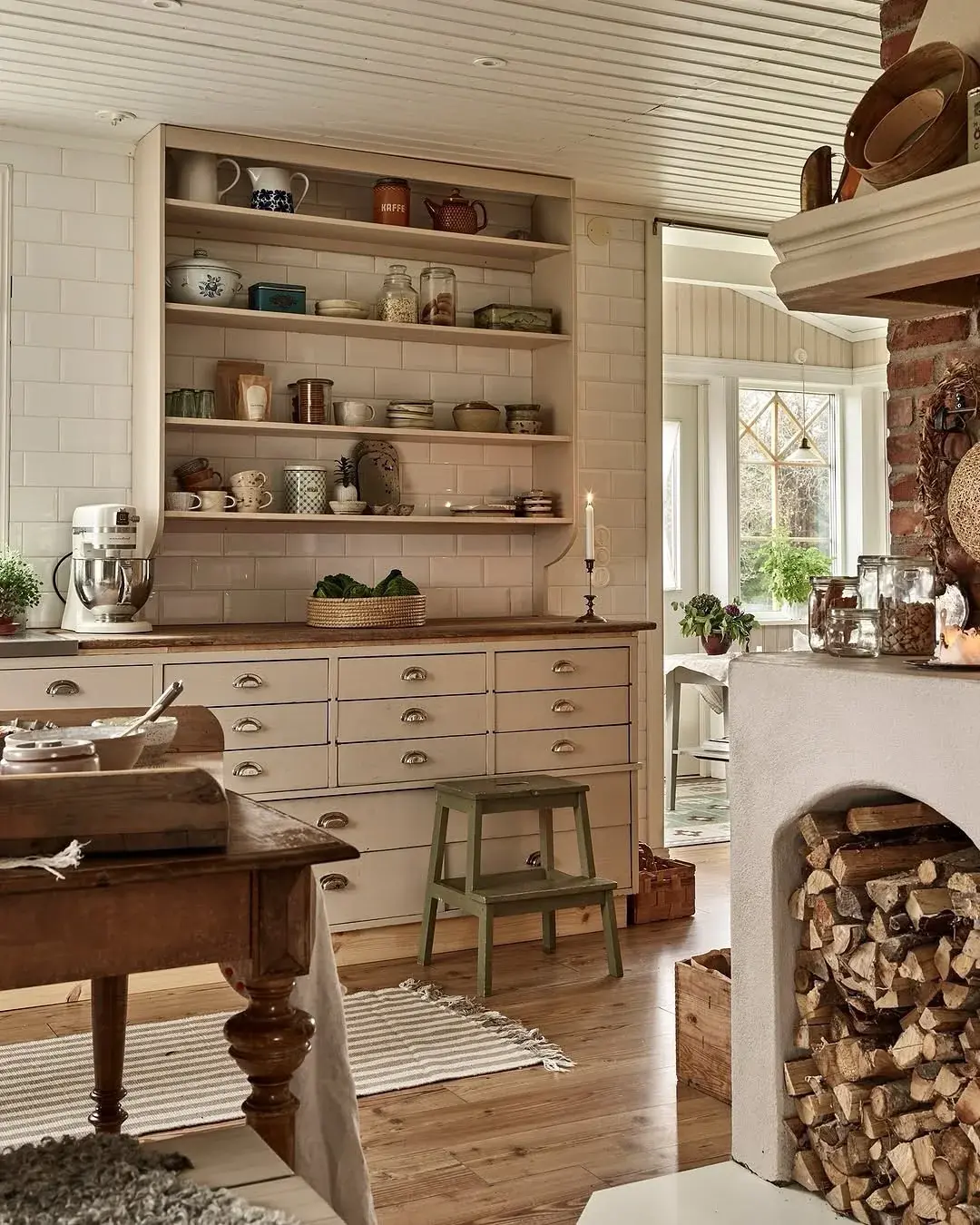
Frequency forgives what palette does not. These four pale boards carry a red teapot among cream with green and blue around it, and still read settled, because every piece looks lifted daily, which is the honest entry test restated.
The shelves sit low over a bank of cream drawers, within easy reach, with a stand mixer at one end and a woven tray of greens below. A brick hearth stacked with logs stands to the right and pulls the eye, which lets full boards recede into the background. White tile behind keeps the wall bright, so the mixed colours scatter instead of clumping.
The top board holds rarely lifted tins and the red pot, and that board will dust first, which is why daily pieces belong low as they do here. Paint of this kind, a warm white with a little stone in it, is close to Benjamin Moore White Dove OC-17 or Dulux Natural Calico. Stand mixers of the kind shown run £300 to £550 in 2026. Where frying is constant and wiping is resented by week three, mixed shelves of this kind become the messiest wall, and doors suit better.
Preserves on the top shelf
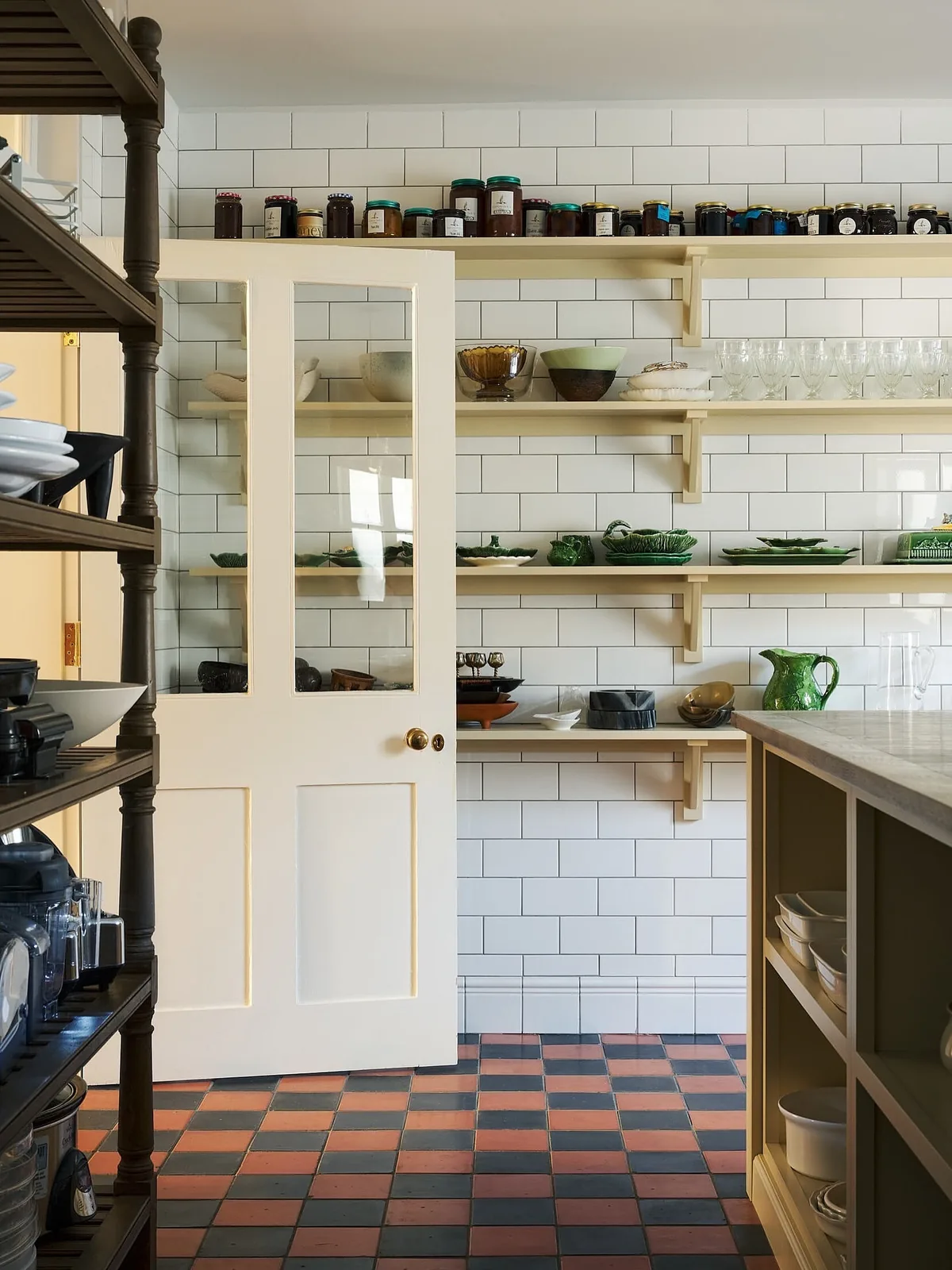
Sealed jars ignore dust, which makes the top shelf here the cleverest in the set. Rows of dark preserves with lids need no wiping inside, only an occasional wipe of glass, while open bowls below need rotation to stay clean.
Four cream boards sit on white subway tile, with preserves up top, glass with pale bowls on the next board, and green tableware with jugs below. Green repeats across plates and serving dishes, the two tone discipline, while the glazed door standing open gives the half-measure in built form. Visibility stays, dust drops, and the interior forgives a far less tidy arrangement than open boards would.
The terracotta with charcoal chequer floor anchors the room, because pattern underfoot steadies walls that are busy at eye level. Cream brackets and boards from a joiner run £400 to £900 for a wall of this length in 2026, while green stoneware plates run £6 to £14 each in 2026. Sited in a pantry away from the hob, the shelves do half the work by location. Moved over a range, the same arrangement would film within weeks.
Three short shelves, mostly empty
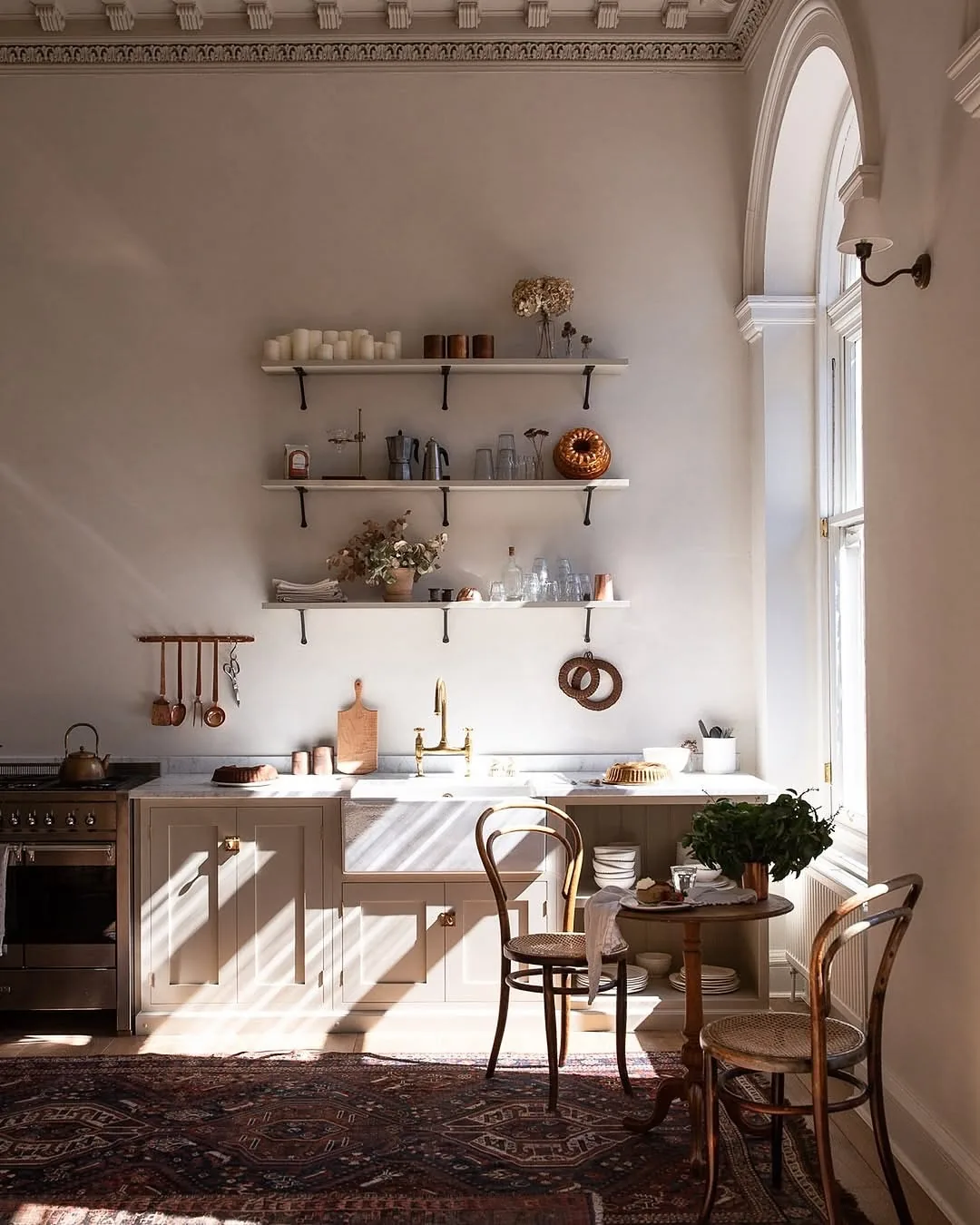
Empty plaster is the cheapest styling tool. Three short white boards with dark brackets hold a handful of pieces each, and the tall wall around them carries the rest, which is why dusting here takes minutes on a damp cloth.
Candles with glassware sit on the top board, a copper bundt with beakers in the middle, and folded linen with a small arrangement below. Copper pans hang from a rail over the sink, where steam passes but grease does not settle as it would over a hob. A tall arched window washes the wall from the right, so the unlit boards still read bright through the day, and a bistro table with bentwood chairs in front shows the height honestly. These are display boards above reach, not daily storage, and the sparseness admits it.
Cast iron brackets of that pattern run £12 to £26 each in 2026, while a brass or copper pan rail runs £30 to £70 in 2026. High display suits households that enjoy the ritual. As storage for daily plates, the height fails the reach test with the table blocking access, and lower boards near the sink would serve better.
Jars that seal against dust
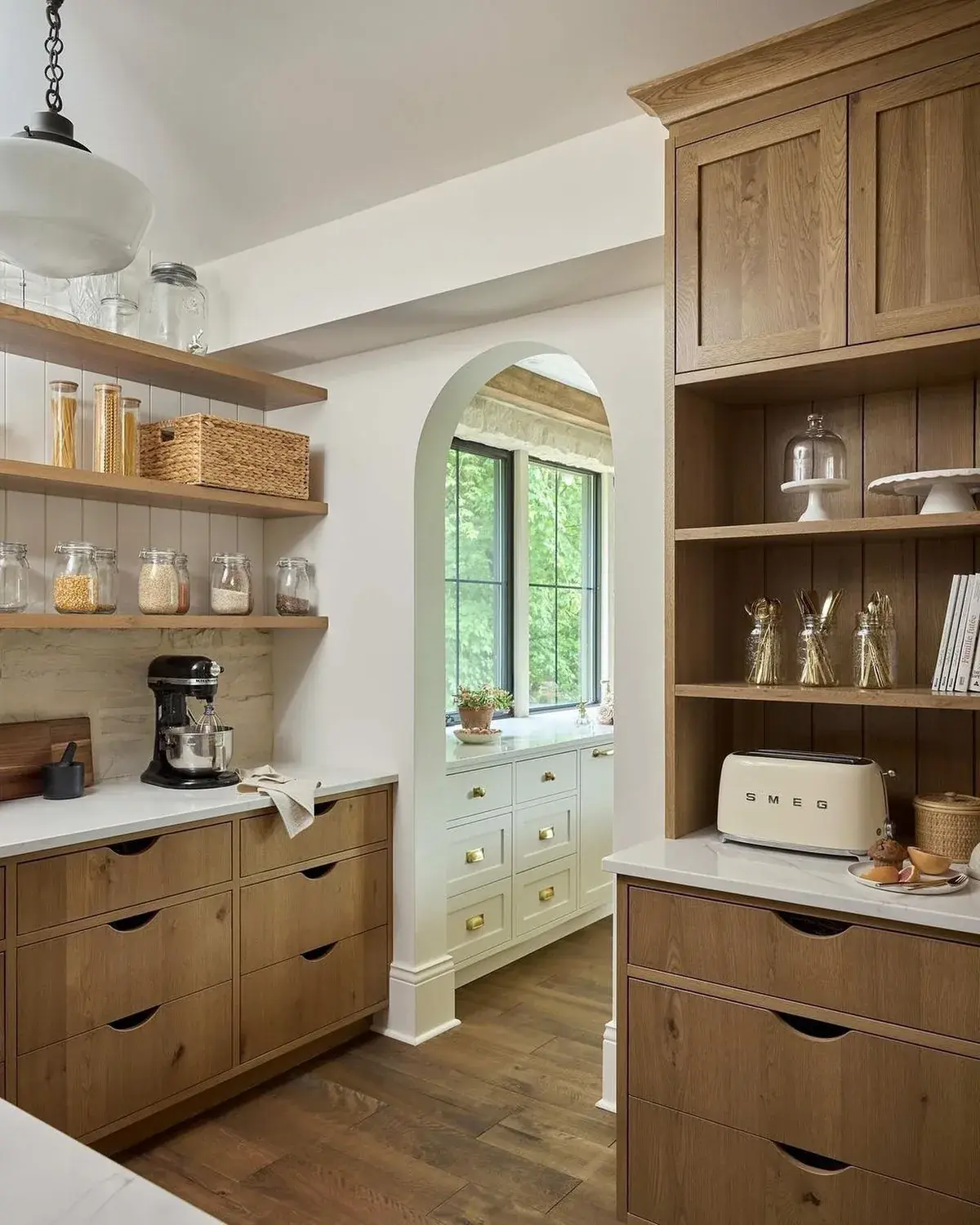
Glass with lids is the low upkeep version of the look. Dry goods behind glass need no wiping inside, only a quick wipe of jar exteriors, which takes seconds, so the arrangement gives the texture of open storage without the weekly negotiation.
Three oak boards sit on white tongue and groove, holding glass jars of grains with pasta, a woven basket and small bowls. Below, a stand mixer waits on a white worktop over oak drawers with cutout pulls. To the right, an oak dresser holds a cream Smeg toaster with cake stands under glass domes, which repeat the jar logic at larger scale. Cover what would dust. An arched opening frames the view beyond, so the shelves sit in peripheral vision, which forgives fullness that a straight on wall would not.
Smeg two slice toasters run £149 to £219 in 2026, while glass storage jars run £3 to £8 each in 2026. The arrangement suits daily cooking with a small set of staples in rotation. Jars of rarely touched grains stale all the same, while still asking for wiping outside, so the cook daily test applies to food as much as to crockery.
What the upkeep really is
| Shelf kind | Typical cost in 2026 | Cleaning load |
|---|---|---|
| Oak boards on brackets | £80 to £160 per metre, brackets extra | Weekly wipe, more near the hob |
| Marble boards on brass | £140 to £280 per metre, brackets £22 to £48 each | Weekly wipe plus sealing against stains |
| Glass jars with lids | £2 to £8 each depending on size | Wipe jars monthly, contents stay clean |
| Gallery rail in a niche | £25 to £55 per metre plus shelves | Fortnightly dust of jars and rails |
| Glazed tower or door | £60 to £120 per glazed door plus joinery | Monthly glass wipe, far less than open boards |
Frequently Asked Questions
Can open shelves work if I fry most nights?
They struggle beside high heat. Steam carries a fine film that settles on plates and jars, so boards near the hob film within days. Keep display on a distant wall or inside a pantry, and leave extraction running after cooking.
How do I stop the shelves looking messy?
Narrow the colours and leave gaps. Cream or white tableware in daily rotation reads calm even when full. Put sealed jars high, keep frequently grabbed bowls low, and move packets and plastics into cupboards.
Which materials cope best with kitchen air?
Timber with a hardwearing oil finish wipes easily, and marble suits coffee corners away from heat. Glass fronts soften the maintenance burden a lot. Unsealed stone beside heat marks quickly and then holds the mark.
Do I need an electrician to brighten the boards?
Not always. Battery LED strips under the front edge lift a dark recess for little money. Where wiring allows, a picture light above the top board or a pair of wall lights beside the run gives a steadier wash across tile.
What belongs behind closed doors instead?
Anything made of plastic, anything branded, spare tins and seldom used gadgets. Open boards earn their keep with beautiful or constantly used pieces. When bulk has no other home, shelves fill with overflow and the room feels untidy.
How can I trial the idea before ripping out cupboards?
Leave the uppers alone and fit a single board for a month. Style it honestly with existing plates and wipe it each week. When the routine feels easy and the board stays arranged, widen the scheme with confidence.
In order
- Pick one wall for shelves and keep closed storage everywhere else.
- Fill them with crockery you use, in one colour family.
- Add light: a strip under each shelf, or a picture light above.
- Use 40mm boards with supports under 900mm apart, fixed into studs.
- Keep them away from the hob, and consider glazed doors instead if you cook a lot.
This article may contain affiliate links. We may earn a commission at no extra cost to you.