10 Fall Window Painting Ideas: Skip the Fox, Paint the Border

Add us as a preferred source to see more stories on Google.
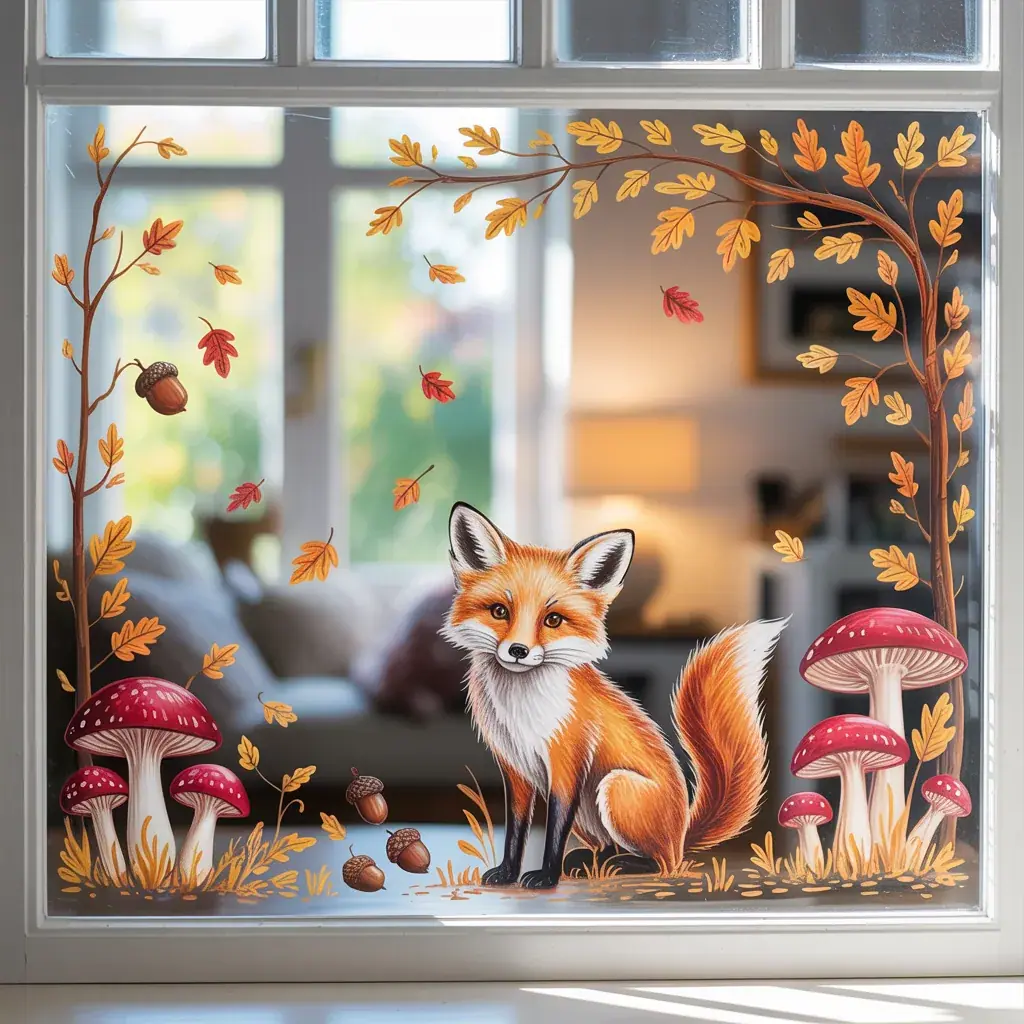
Let us be honest about the fox.
Look at what is actually going on there: graded shading down the flank, individual fur strokes on the chest, a white highlight in each eye, whiskers. That is an illustrator’s work. If you can already paint that, you are not reading an article about window painting.
Now look at everything around it. The branch is a brown line that gets thinner. The leaves are flat shapes in three colours. The acorns are an oval and a cap. The toadstools are a dome, a stalk and some dots.
All of that is achievable on a first attempt, and here is the part nobody says: the border is doing most of the work anyway. Cover the fox with your thumb and the window still reads as autumn.
This is the parent guide to the set. The canon is small: leaves, pumpkins, and harvest lettering, arranged so the centre stays clear. Four companions cover the special cases. Our easy fall window painting ideas teach the brushwork, our fall window painting ideas for kids split the job with small hands, our fall window painting ideas for classroom run a rota, and our fall window painting ideas for stores paint for the kerb. Everything below lives at home, on glass you look through every day.
Why a border beats a scene
Three reasons, and the last one is the one people discover too late.
It is forgiving. A leaf that comes out slightly wrong is one leaf among thirty. A fox that comes out slightly wrong is the whole window.
It reads at distance. From the pavement, detail disappears and shapes remain. A border of clear repeated shapes is legible from across the road; a carefully shaded animal turns to mush.
And it keeps your light. A painted-over window is a darker room for six weeks, and in autumn that is a real cost. A border leaves the glass working.
The three colours to buy
Burnt orange, deep red, and mustard yellow, plus a brown for the branches. That is it.
Autumn is a narrow palette and adding more weakens it. Mixing a bit of the brown into each leaf colour as you go gives you variation without buying anything extra, and variation is what stops a border looking like a stencil.
| What | Where | Roughly |
|---|---|---|
| Acrylic craft paint, 4 bottles | Hobbycraft, The Works, Amazon | £6 to £10 total in 2026 |
| Flat synthetic brush, 12mm | Any craft shop | £2 to £4 in 2026 |
| Small round brush, size 2 | Same | £2 to £3 in 2026 |
| Posca pen, black fine | Art shop or online | £3 to £4 in 2026 |
The Posca is optional but useful for acorn caps and leaf veins, where a brush gets clumsy.
Do not buy a set. Sets contain nine colours you will not use and one you will run out of.
The order to paint in
Branch first, as one continuous line. Load the brush properly and pull it in a single movement, thick at the base, thinner as it goes. Let it dry.
Leaves next, as flat shapes with no internal detail. Vary the size and the angle, and let some overlap the branch and some float free. Cluster them instead of spacing them evenly; real leaves bunch.
Small things last. Acorns, toadstools, a couple of drifting leaves in the open glass to link the two edges.
Veins and outlines at the very end, if at all. A border with no line work still looks fine; a border with line work added before the paint is dry looks smudged.
Paint on the inside of the glass. Weather never touches it, you work in the warm, and at night with the lights on it reads beautifully from the street.
White pumpkins on a dark door
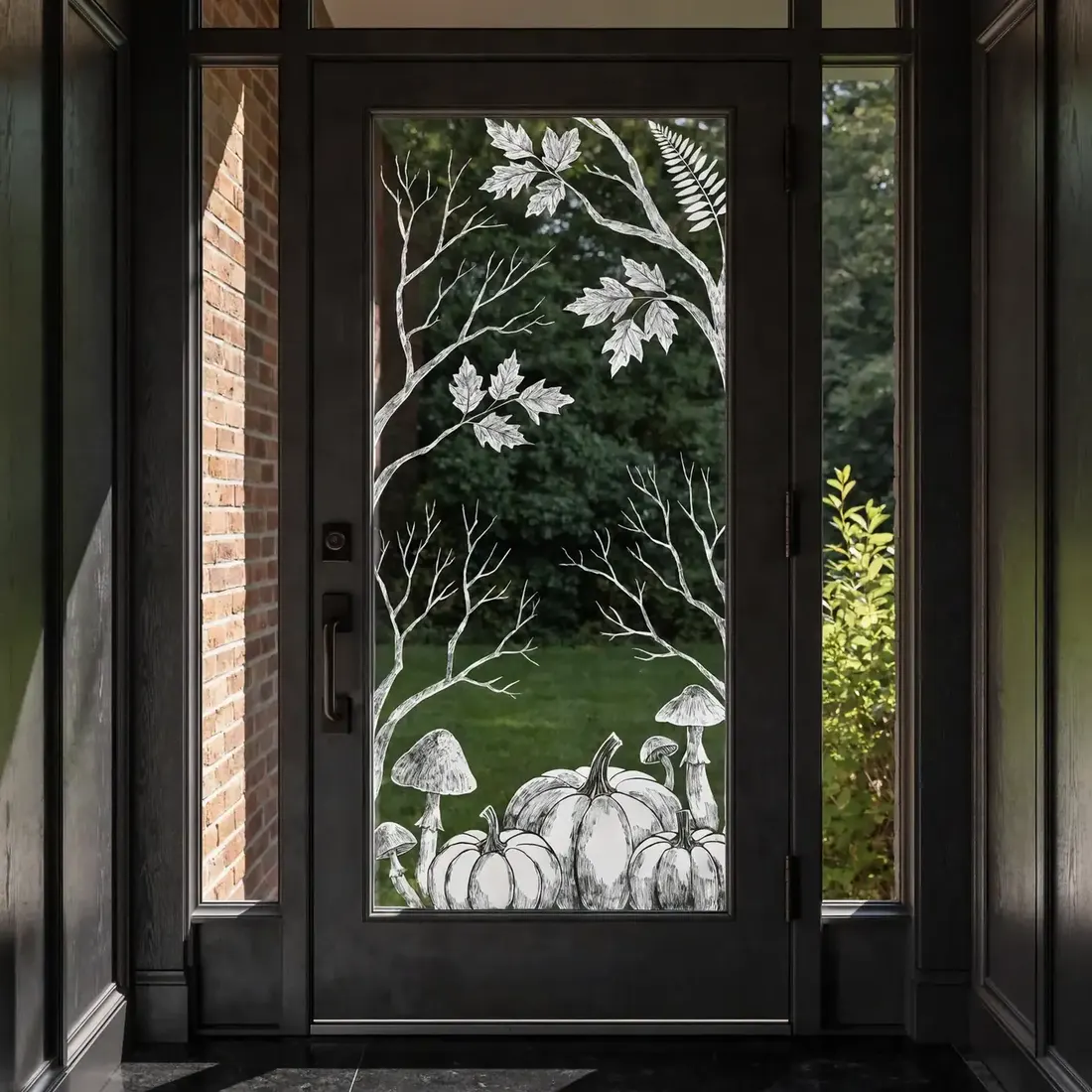
In this photo the glass is dark because the hallway behind it is dim, and that changes the whole colour logic. Orange would sink. White stands forward. Three pale pumpkins sit along the base, toadstools between them, bare branches rising each side with small leaves near the top.
The shading on those pumpkins is soft grey streaks over white, and that is the only modelling in the whole door. No outline around the branches. The trunks thin as they climb, which keeps them delicate. I tried this in orange first at my place and it vanished by four in the afternoon. White fixed it in one coat.
For a front door, white acrylic or a wide chalk marker both cover. A Uni Posca PC-5M in white costs £3 to £5 in 2026, and two pens do a door this size. Daler Rowney System3 in white, around £3 to £5 for 150ml in 2026, covers the pumpkin fills faster. Keep the centre of the pane clear at eye height so callers still see movement inside.
A scarecrow that owns its pane

This one is a single character, centred, with everything else kept low and small. A smiling scarecrow in green dungarees and a checked shirt stands on a post, two big pumpkins at its feet, sunflowers each side, loose leaves drifting above. Desks show through behind the glass, which tells you the paint stops where the light matters.
Characters work when they get the pane to themselves. The mistake is adding a barn, a fence, and a crow, and then wondering why it looks busy. Here the scarecrow is large, roughly the height of a toddler, so the face reads from the corridor. The leaves above are single strokes in yellow, rust, and brown. Nothing up there competes.
If lettering or small hands are involved, leave this one for the companions. Beginners who want the brush method should start with our easy guide. Anyone painting with a child should use the split in our kids guide, where the adult lays the shape and the child adds the face.
An arch that keeps the middle clear

From this picture, the room behind matters as much as the paint. A sofa, a lamp, and pale curtains show straight through the middle, while copper leaves crowd the top corners and trail down both sides. Mushrooms and acorns gather along the sill. A small fox stands low on the right, no bigger than a mug.
That taper is the whole skill. Heavy at the top, thinner as it comes down, nothing below halfway except the low band. The falling leaves in the centre are sparse, maybe thirty, each a single dab. They suggest movement without blocking the view. My first arch went all the way round at even thickness and looked like a picture frame from a discount shop. I wiped the bottom half off with a damp cloth and it improved at once.
Pebeo Vitrea 160 in warm tones costs £4 to £6 per 45ml in 2026 and glows when daylight comes through. One bottle each of amber, russet, and ochre does a window this size, with brown for the trunks.
Pumpkins along the sill in a kitchen
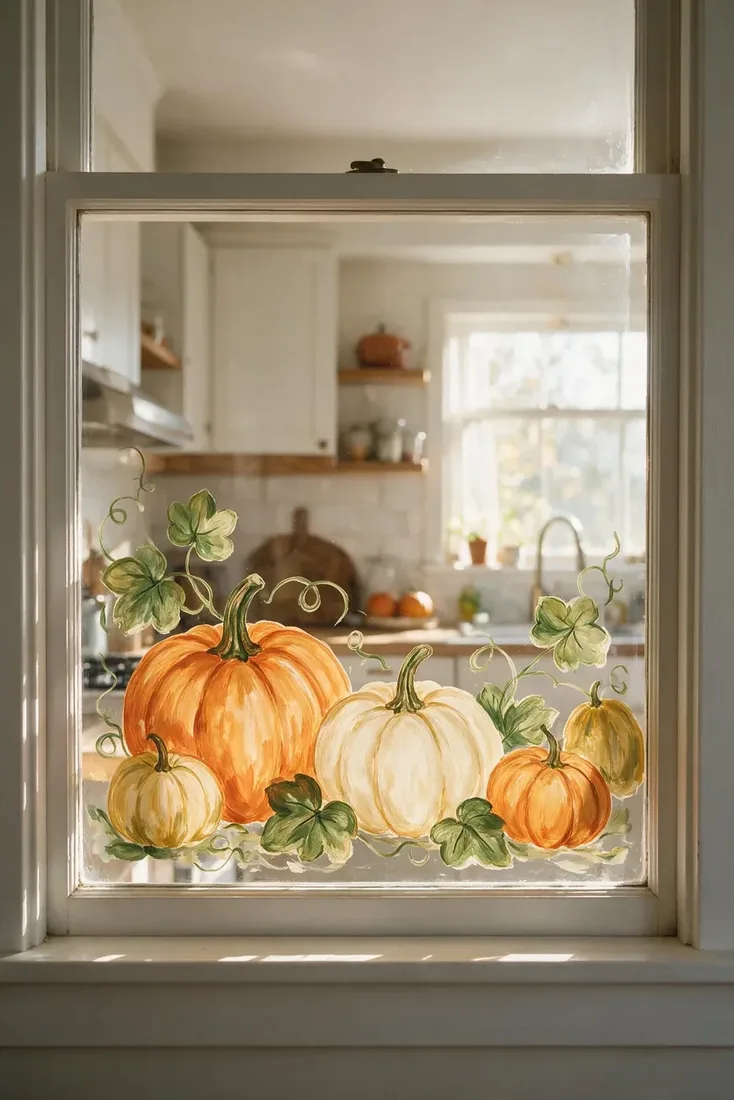
Look at where the paint sits here. Five pumpkins rest on the lower edge, cream and orange and pale green, with thin vines curling up each side. The worktop, the tap, and the shelves behind stay fully visible. Steam and cooking splashes never reach this high, which is why the sill suits a kitchen.
The vines do more than decorate. They link the separate pumpkins into one group, so the eye reads a patch instead of five objects in a row. Notice the leaves: sage green, darker veins, curled tendrils that take one flick of a small round brush. The white pumpkin in the middle is the brightest thing in the frame, and it stops the orange from turning heavy.
I painted mine while dinner simmered, about 90 minutes with drying. Acrylic craft paint from Hobbycraft or The Works, £6 to £10 for four bottles in 2026, holds on kitchen glass and wipes off later with warm soapy water. Keep washing up sponges away from the sill while it cures.
Leaves for a narrow pane

Tall side panes defeat scenes. There is no room for a pumpkin, let alone a scarecrow. In that narrow glass, two thin branches drop from the top corners and perhaps sixty small leaves scatter down the length. The sofa and the daylight beyond show through untouched.
Spacing carries this design. Leaves cluster near the branches, then thin toward the middle, then gather again near the base. That uneven drift is what reads as wind. Evenly spaced leaves read as wallpaper. I counted my gaps on the second try because the first looked too tidy. Stepping back three paces shows the thin patches faster than staring close does.
This is the fastest window in the set, one film long, and the cheapest. Two leaf colours plus brown, a liner brush, and a cotton bud for touch ups. An Edding 4085 chalk marker in ochre costs £3 to £5 in 2026 and suits anyone nervous with a brush, though brush paint gives softer edges.
Lettering that reads from the pavement
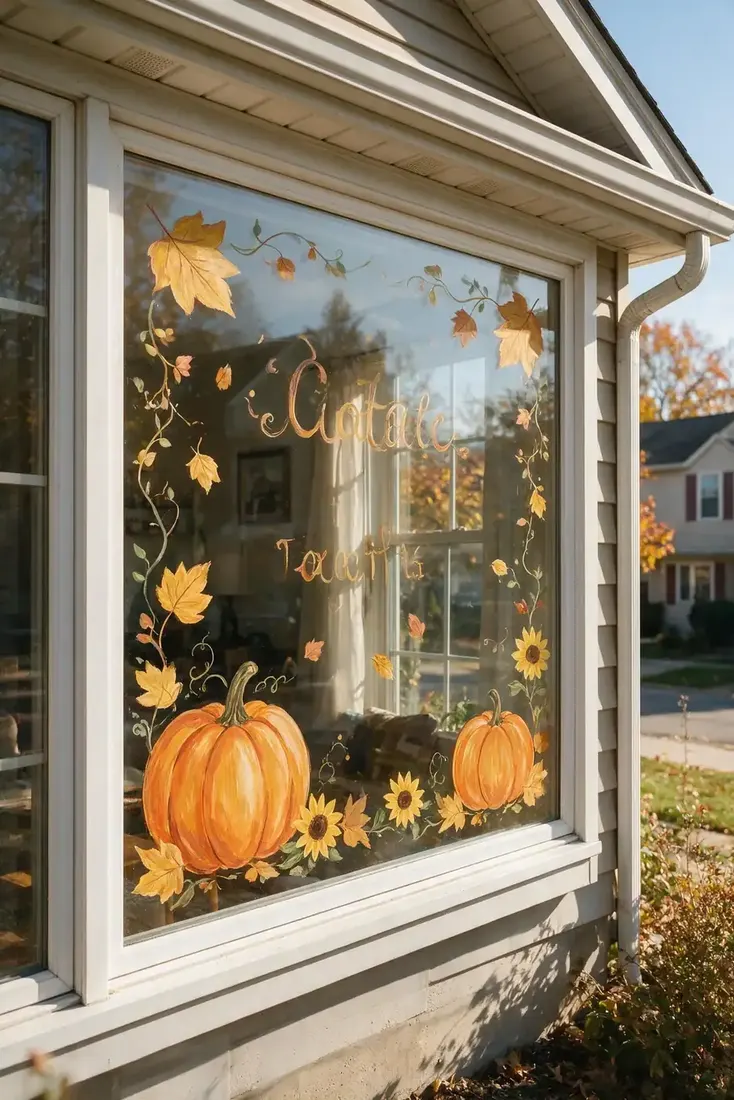
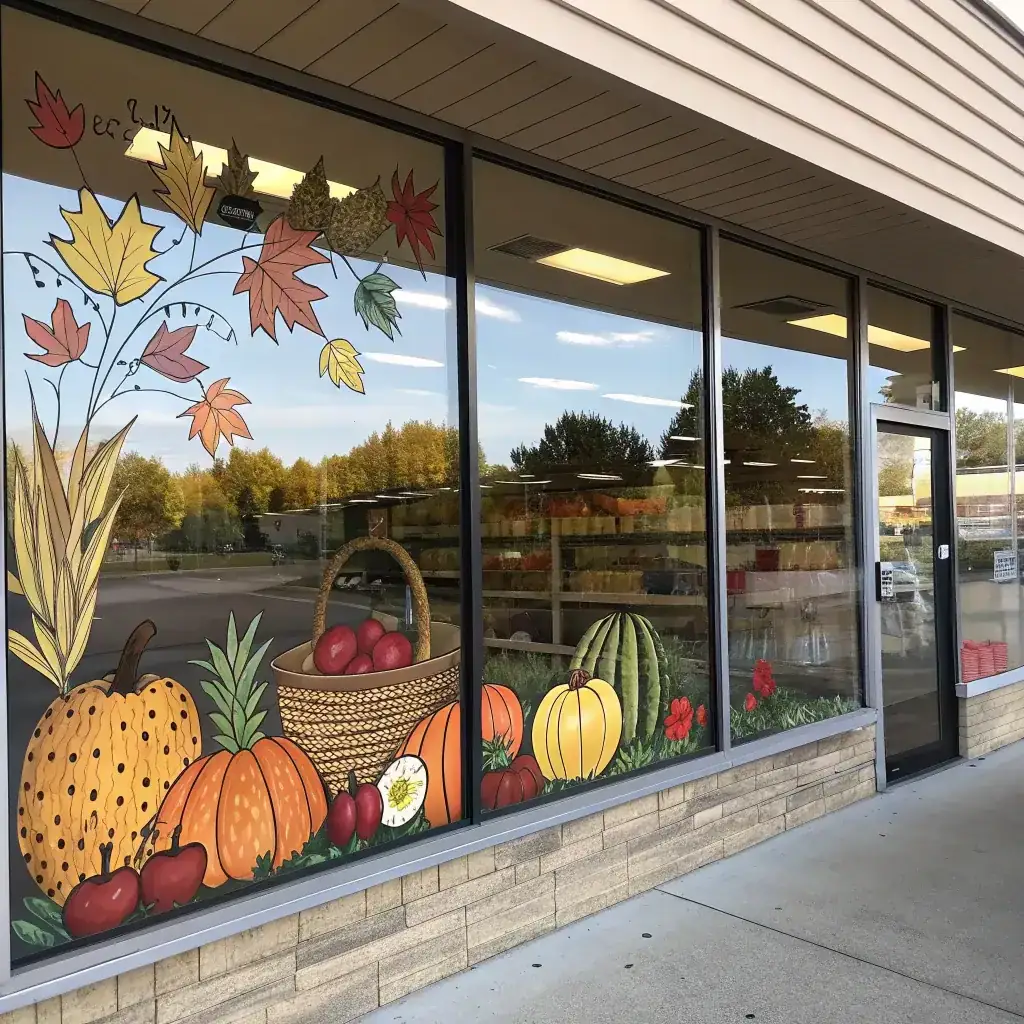
In this exterior view, gold script floats in the middle of the glass, pumpkins and sunflowers anchor the base, thin vines climb the edges. The house behind reflects in the pane, which is the point. This window has two audiences, and the one outside stands on the grass with the sun in their eyes.
Lettering needs air. The script here is large, looping, and surrounded by clear glass, so it holds at distance. Small leaves dot the vines without touching the words. The pumpkins below are simple ovals with segment lines, no shading to turn muddy in bright light. Sunflowers are yellow discs with brown centres, nothing more.
Paint the words first, then the pumpkins, then the vines. Leaves painted first always creep into the text. Sketch the phrase on paper at the same proportions, tape it outside as a guide, and trace from inside. A gold Posca or similar wide marker costs £3 to £5 in 2026, and tempera for the fills runs £12 to £20 for a small set in 2026.
Fine white stems when orange feels wrong
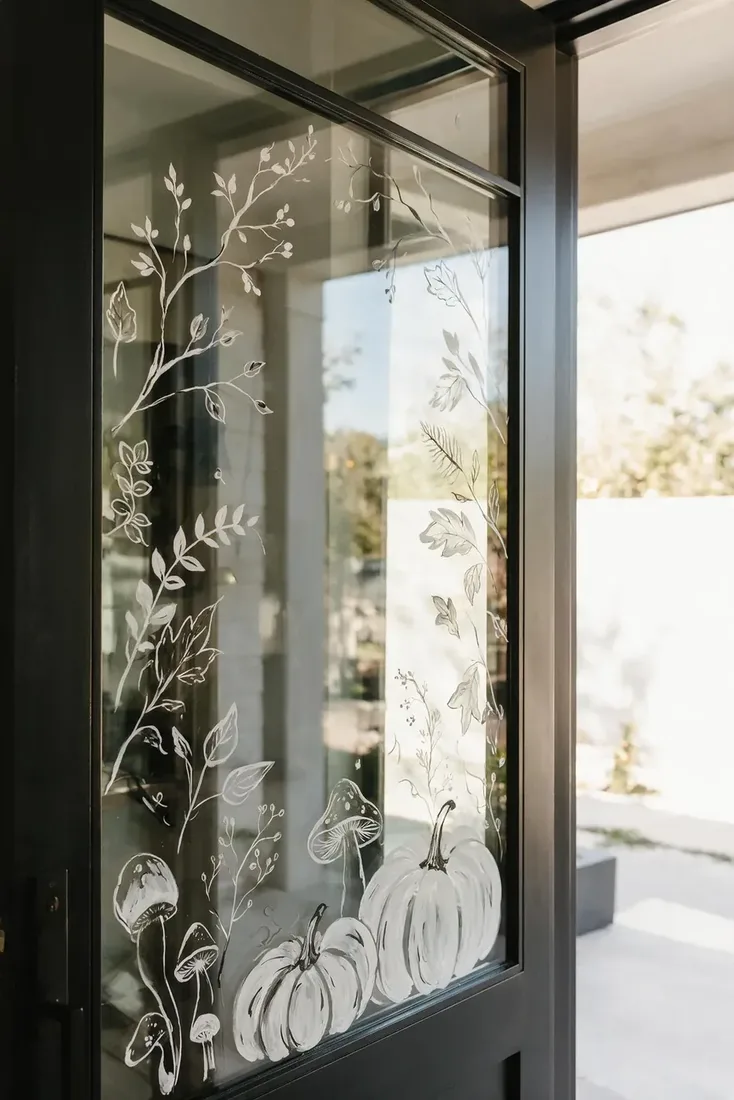
Pictured here is the quiet option. Two white pumpkins sit low on a black framed door, mushrooms beside them, and hairline stems with ferns and seed heads climb both edges. The hallway beyond stays visible. Nothing orange appears anywhere.
That restraint suits a modern frontage. Bright autumn colour would shout over black paintwork and stone. White line work sits back and lets the architecture talk. The one detail to copy is the varied stem weight: some lines are bold, some barely there, which stops the botany looking stamped on.
Outline work looks quick and is slow. Every wobble shows, and this door would take me a full afternoon with a fine nib, plus tea. White Posca PC-1M or PC-3M pens cost £3 to £5 each in 2026, and this design eats two whites. If the door gets condensation, paint inside and keep a cloth handy for the first night, since damp beads on fresh marker.
Happy fall lettering over white pumpkins
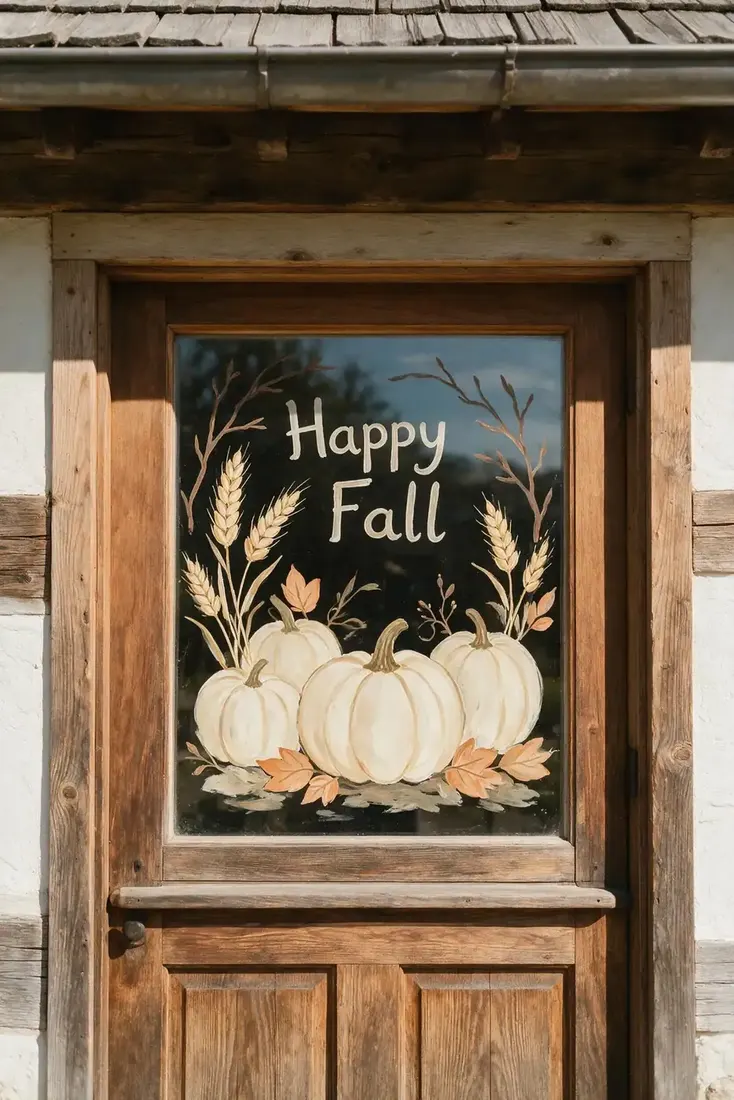
That door is small, dark, and timber framed, and the design respects it. Four cream pumpkins sit in a row along the base, wheat stems rise behind them, bare twigs frame the sides, and Happy Fall sits large in the middle in plain capitals. Orange leaves tuck at the feet.
The palette is the lesson: cream, wheat gold, and soft rust, nothing brighter. On dark glass, pale shapes glow without needing much paint. The wheat is six or seven straight strokes with short ticks for grains, and it reads perfectly from the step. The lettering is centred with space above and below, so it never fights the pumpkins.
Cream acrylic covers dark glass in two coats with 20 minutes between them. A 150ml tube of Daler Rowney System3 in white and one in ochre cost £3 to £5 each in 2026 and do this whole door. I learned to let the first coat go patchy and trust the second, instead of scrubbing wet paint to force cover.
Sunflowers and pumpkins in a sunny room
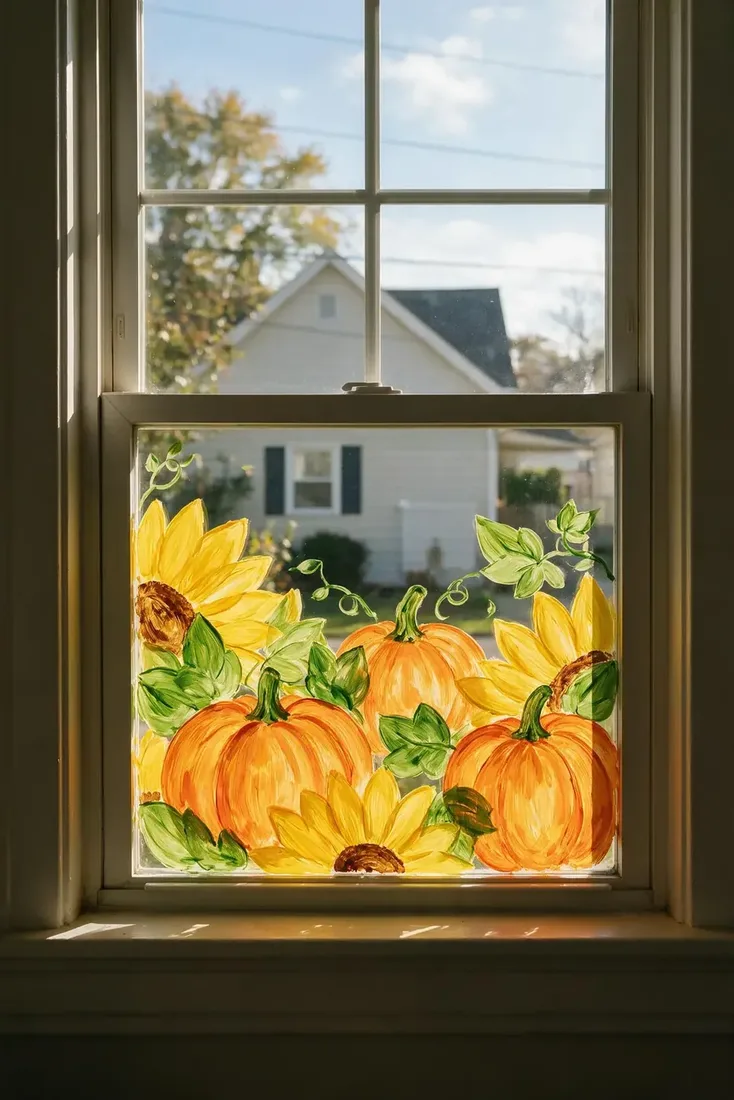
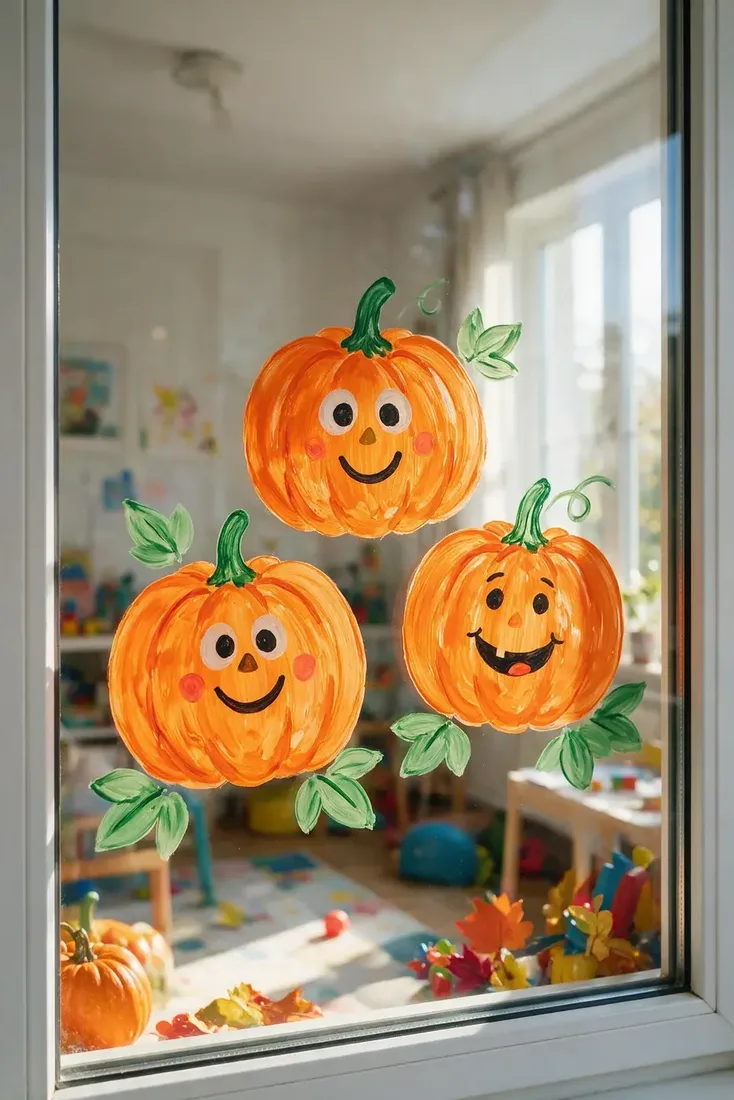
Shown here is the fullest window in the set, and it gets away with it because only the lower sash is painted. Three orange pumpkins pack the sill, sunflowers push in from the sides and below, green leaves fill the gaps. The upper sash stays completely clear, with houses and sky beyond.
Density works low down. At sill height, overlapping shapes read as abundance. The same density at eye height would block light and feel heavy. The sunflower centres are dark brown with yellow petals, the pumpkin ribs are darker orange strokes over a paler base, and the leaves are a fresh green that keeps the whole thing cheerful.
This one suits a living room or a front window where passers by look in. It takes an afternoon, around three hours with drying, and wants acrylic for cover. A small flat brush for the petals plus a round for the ribs is enough. FrogTape 24mm for a level baseline costs £7 to £9 in 2026, though I just sight along the sash bar and accept a slight wobble.
Getting it off
Warm soapy water on a cloth, laid over the paint for a few minutes, then a plastic scraper or an old bank card. It lifts in sheets.
Never a metal blade, particularly near the edges of double glazing where you can nick the seal. And never on a window with privacy or solar film on it, because the paint takes the film with it.
Where I would not do this
Rented windows with old or textured glass, where the paint sits in the ridges and looks muddy from outside. Very small panes with glazing bars, because the bars chop every shape into fragments.
And any window you actually sit and look out of. During the day, from inside, a painted border reads as dark shapes against bright light. Lovely in a hallway. Less lovely from the chair you read in.
Frequently Asked Questions
Which layouts keep the room bright?
Hold the centre clear and dress the edges. A branch along two sides, a low row of fruit, or a thin arch leaves daylight coming through. Full coverage dims the space for weeks, which feels heavy in October.
What supplies give a clean result on glass?
Acrylic craft pots cover large shapes fast, while chalk pens draw tidy stalks, faces, and words. Most homes manage with four bottles, a flat brush, a small round, and one white pen. Prices sit near £6 to £15 in 2026 for the basics.
How do I plan words on the pane?
Draft the phrase full size on paper, fix that sheet outside, and copy it from indoors. Paint the text before foliage, keep it brief, and hold leaves well away from the strokes so the message holds from the street.
Can newcomers get decent pumpkins?
Yes, with curved strokes and varied sizes. Pull each mark from the stalk downwards, overlap three shapes, and let the brush marks show as ribs. Flat filling looks dull and then needs extra shading.
How does the artwork lift off later?
Soften it with a warm damp cloth, then ease it away using a plastic blade or old card. Try a hidden corner first. Coated panes, films, and textured glass need extra care, and metal tools should stay in the drawer.
When should this come down?
Early November suits most homes, before the glass looks tired. White line work can stay longer since it reads as winter botany. Set the removal day when you start, so fading paint does not linger.
In order
- Frame the glass and hold the middle clear for light.
- Buy four bottles, not a set: orange, red, mustard, and brown.
- Lay the branch in one confident pull before leaves appear.
- Keep foliage as flat dabs, bunched at corners and thinning out.
- Rest pumpkins low on the sill with vines to join them.
- Trace words from a paper guide fixed outside, painted first.
- Work indoors and lift the paint later with warm water and plastic.
This article may contain affiliate links. We may earn a commission at no extra cost to you.