15 Cottage Exterior Ideas: Dark Cladding Stops the Twee

Add us as a preferred source to see more stories on Google.
Cottages get twee faster than any other kind of house, and the usual palette is most of the reason.
Cream walls, a pastel door, roses round the porch. Each element is charming and together, on a small building with low eaves, they tip into greetings card within about five minutes.
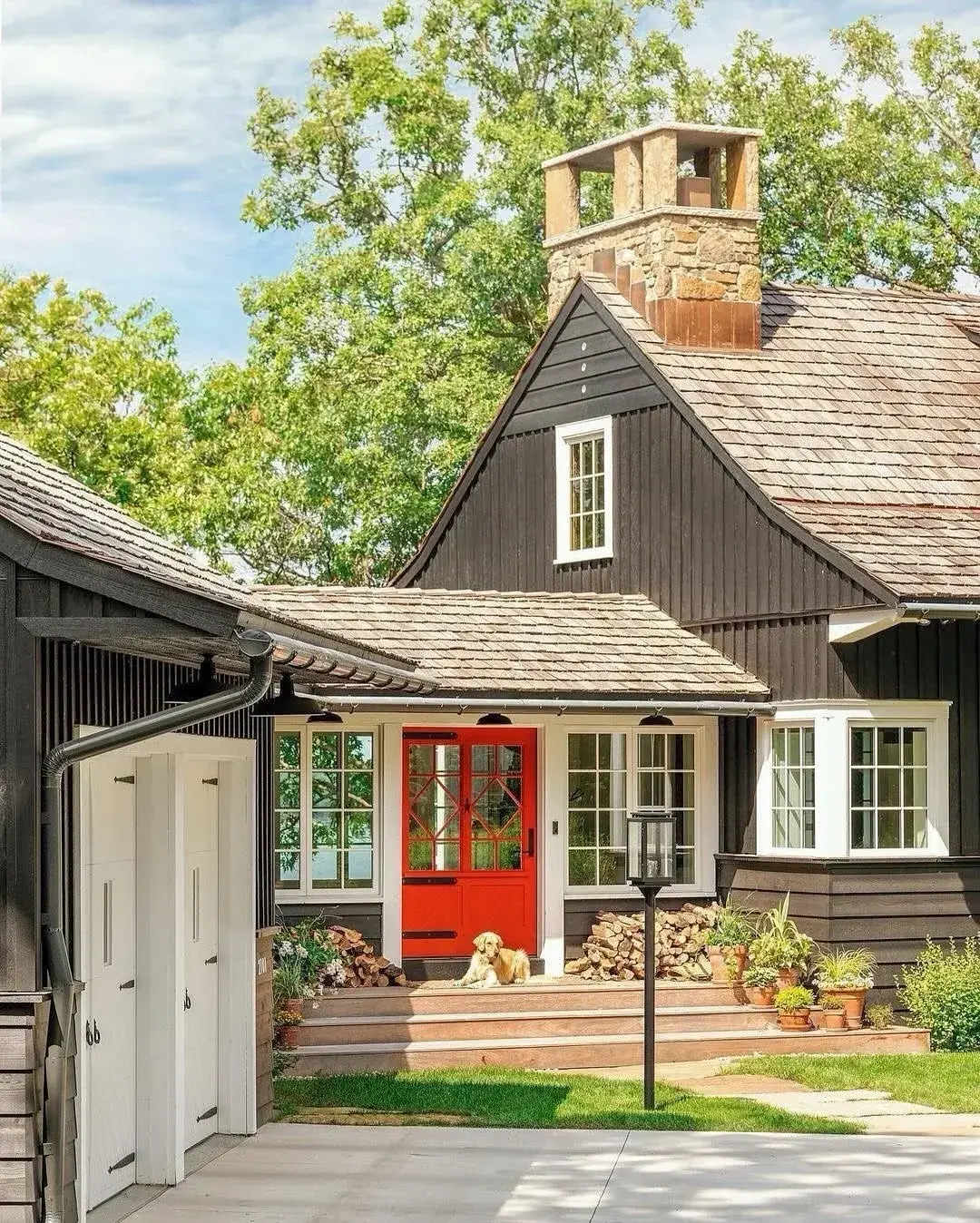
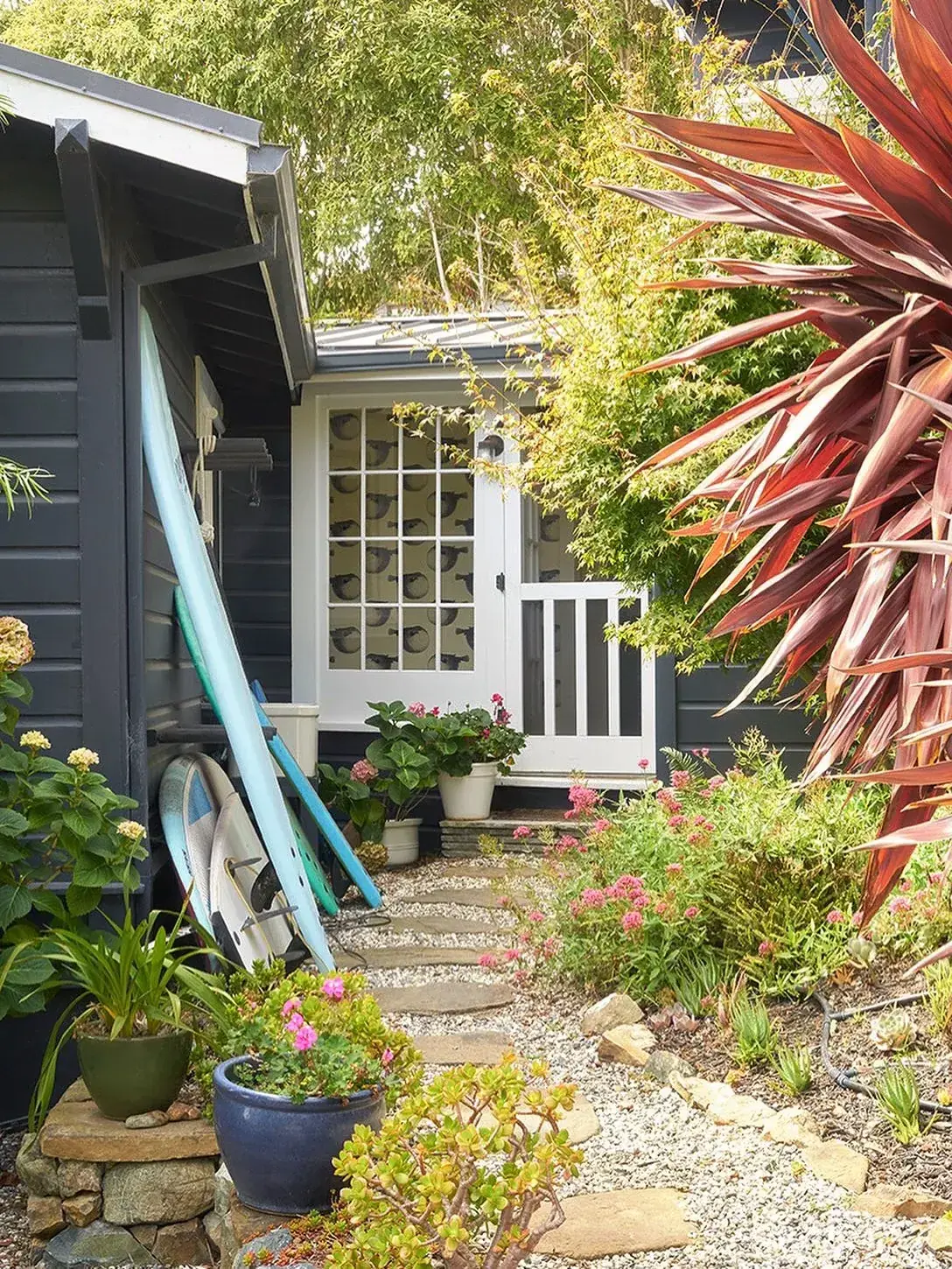
The cottage above has the same bones and none of that problem. Deep charcoal cladding, crisp white joinery, and the contrast between the two doing all the work.
Why the contrast has to be sharp
Look at how clean the edges are on that house. White door, white gate, white window surround, hard against near-black boards. No intermediate tone survives anywhere on that front.
That sharpness is what makes it read as a deliberate modern treatment. An old building simply gone dark with age looks different. Soften the trim to cream or grey and the effect collapses immediately; the whole thing goes muddy and reads as neglected.
So: a genuinely dark body, a genuinely crisp white, and nothing in between. If a third colour appears, put it on the door and nowhere else.
Which dark, and what to paint it with
| Budget | Colour | Note |
|---|---|---|
| Premium | Farrow & Ball Railings No.31, exterior eggshell | Blue-black, very deep |
| Premium | Little Greene Basalt 221 | Warmer charcoal |
| Mid | Benjamin Moore Wrought Iron 2124-10 | Soft near-black, forgiving |
| Trade | Sadolin Superdec or Dulux Weathershield | Opaque, hard-wearing, widely stocked |
| Stain | Osmo Country Colour, Sikkens Rubbol | Breathable, microporous, on bare timber |
The product matters more than the colour on cladding, and this is the part people get wrong.
Timber moves with the seasons, and it needs to release moisture from both faces. A film-forming gloss or a standard masonry paint sits on the surface as a skin; when the board moves, the skin cracks, water gets behind it, and within a few years the job becomes scraping, not repainting.
A microporous stain or an opaque woodstain lets the board breathe and fades gradually, so the recoat is a wash and a fresh coat, not a full strip. On a dark colour, expect to recoat every five to eight years on exposed elevations.
The heat problem, honestly
Dark timber on a south or west wall gets hot. Surface temperatures well above ambient are normal, and heat drives more movement in the board, more stress in the coating, and a shorter interval before it needs doing again.
It is not a reason to avoid dark cladding. It is a reason to buy a good coating rated for dark colours, to expect the sunny elevation to need attention before the others, and to make sure the boards are properly ventilated behind, with a drained and ventilated cavity. Boards fixed tight to the sheathing trap moisture from day one.
Fixed tight against solid sheathing, any cladding traps moisture and fails early, whatever colour it is.
The ground, which people forget
Gravel with stone stepping stones set into it, in that photograph. It is the cheapest hard landscaping that looks right at a cottage, and it costs a fraction of paving.
Two things make it work. The stones are irregular and laid at a comfortable pace, so feet land on stone, not gravel. And there is a hard edge, in this case dry-stone and timber, holding the gravel in.
Gravel without an edge migrates into the beds and the lawn within a season, and no amount of raking brings it back. A steel or timber edge costs very little and is the difference between a path and a mess.
Choose angular gravel at around 10 to 14mm. Angular pieces lock together and stay put, while rounded pea shingle rolls underfoot and ends up everywhere.
The planting
The planting in that photograph tells the second half: cordyline, succulents, pelargoniums, a Japanese maple, valerian self-seeding in the gravel. Nothing is pastel, and nothing is arranged in a border.
That is the other half of avoiding twee. Cottage planting tipped into rose-and-hollyhock territory is where the greetings card lives. Structural, slightly spiky, drought-tolerant planting against dark cladding reads modern, and it suits gravel and thin soil.
Let things seed into the gravel. Weeding back to bare stone removes the whole effect, and that looseness carries the design for most of the summer.
Bark walls want a calm door
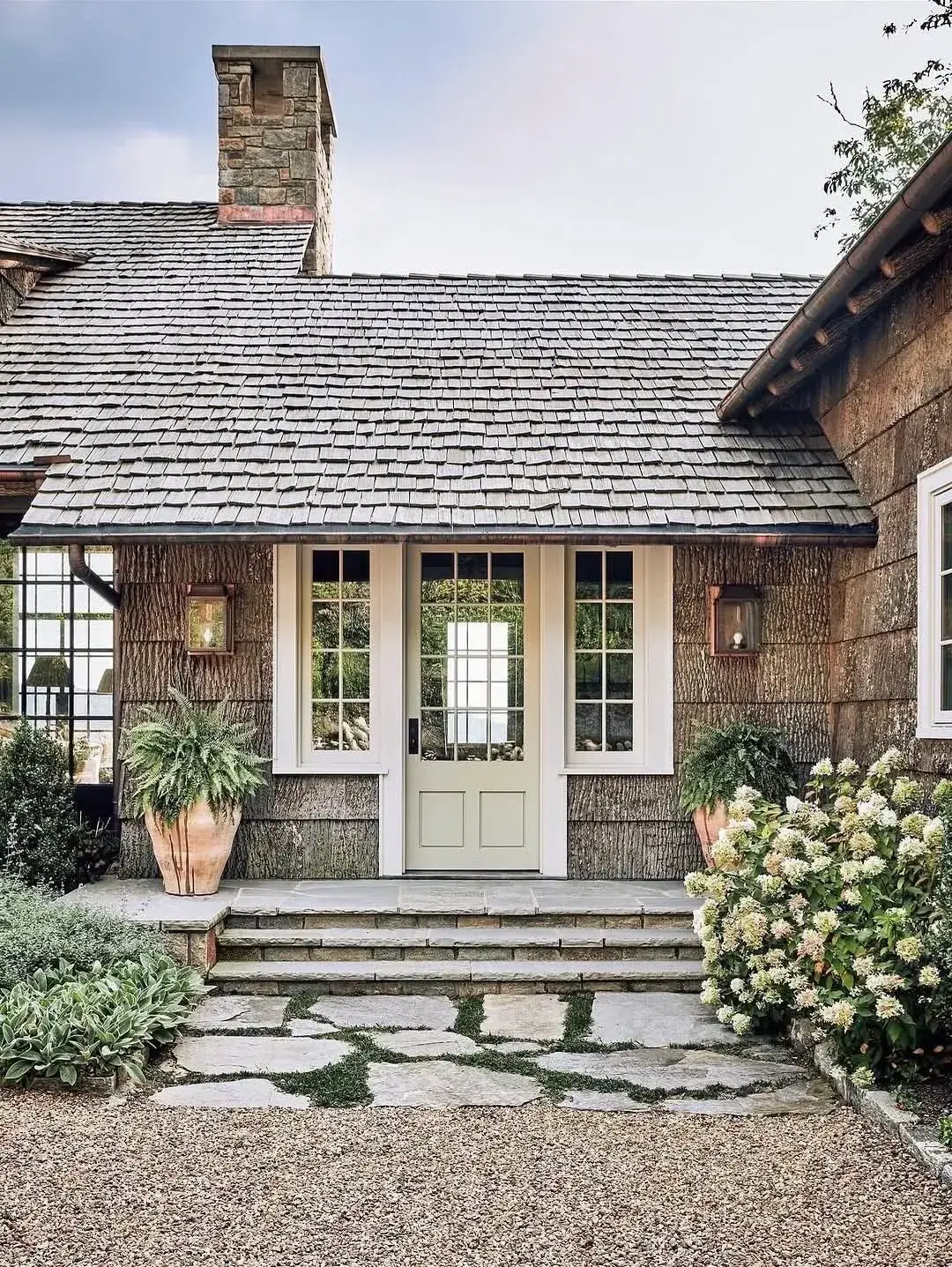
In this photo the walls are the loud part. Rough bark siding, grey shingle roof, stone chimney with copper flashing. That texture arrives before paint colour even registers, which is why the door must stay quiet.
The door understands that. Cream paint, half glass, flanked by narrow sidelights with white frames. Farrow & Ball Pointing No.2003 or Little Greene French Grey 113 would land close, at £28 to £46 per litre in 2026 for exterior eggshell.
Fix the sequence first. Roof and masonry get finished before joinery gets coated, because mortar splatter and scaffold knocks ruin fresh paint in an afternoon. The irreversible call here is the door width. Widening means cutting bark siding and reframing, so live with the opening that exists.
See the two copper lanterns. Keep them small and paired, and wire them on one circuit with a dusk sensor. Oversized lanterns shrink a cottage front faster than anything except the wrong fence, and a single sensor at £18 to £35 in 2026 saves daily switching.
A copper cap earns its keep on a bay
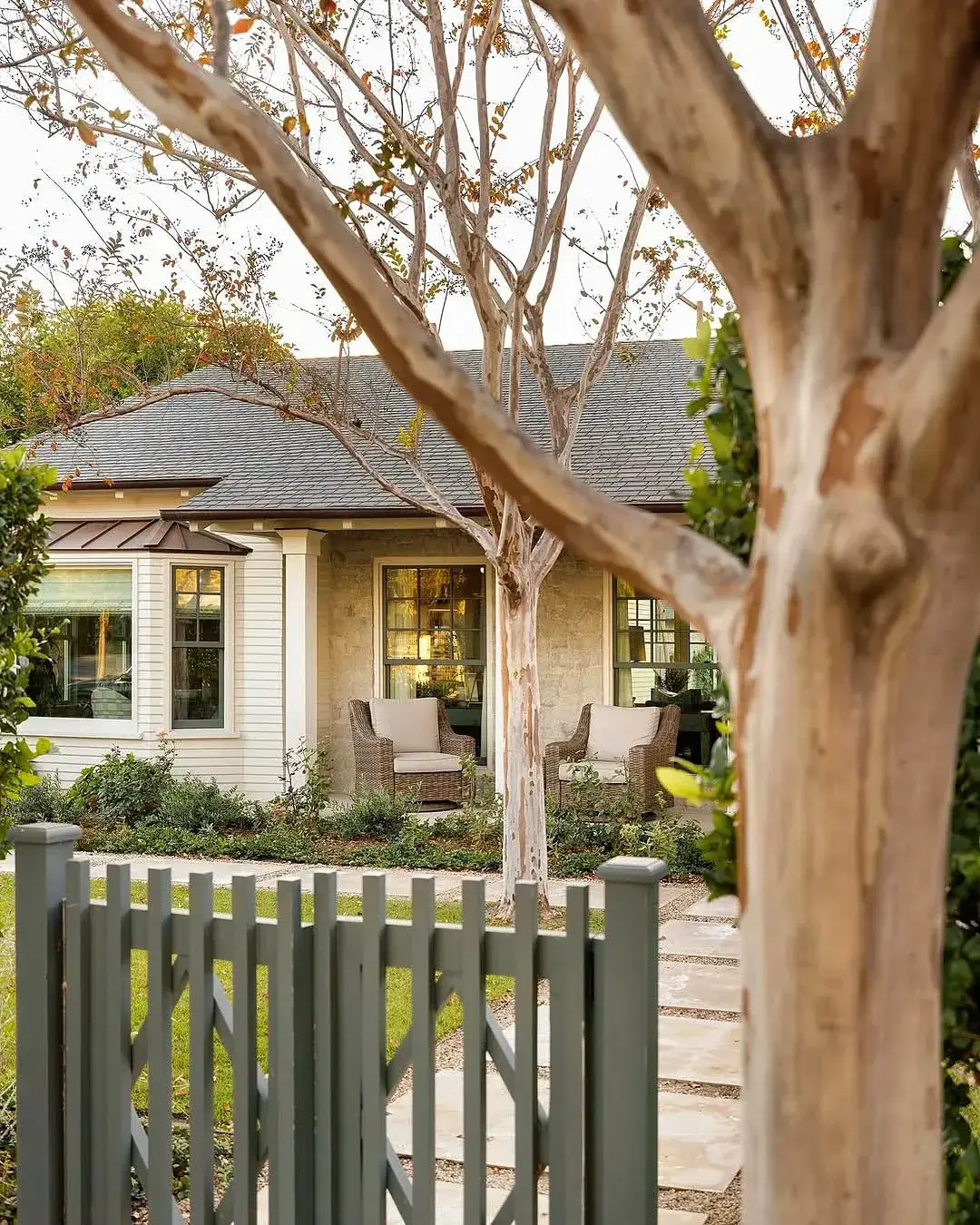
The gate sits forward in this shot. Grey green pickets, simple pointed heads, framed by smooth crepe myrtle trunks that do half the composition without asking for water.
Past it, the cottage front is plain weatherboard and stone. The one crafted moment is the copper roof over the bay. Standing seam, dull brown with age, tucked under the main grey shingle roof.
Order matters. Set posts and hang the gate true before touching the bay roof, because a gate that drags gets lifted and the latch never meets again. Budget £140 to £320 per square metre in 2026 for a small standing seam cap in copper, fitted, which is why this treatment suits a bay and never a whole roof.
The chairs behind read correctly because they are wicker and low. Two is enough. Leave this kind of porch open and swept, with one small metal table at most, since every extra seat blocks the window behind it.
Big trees stay, pots do the colour
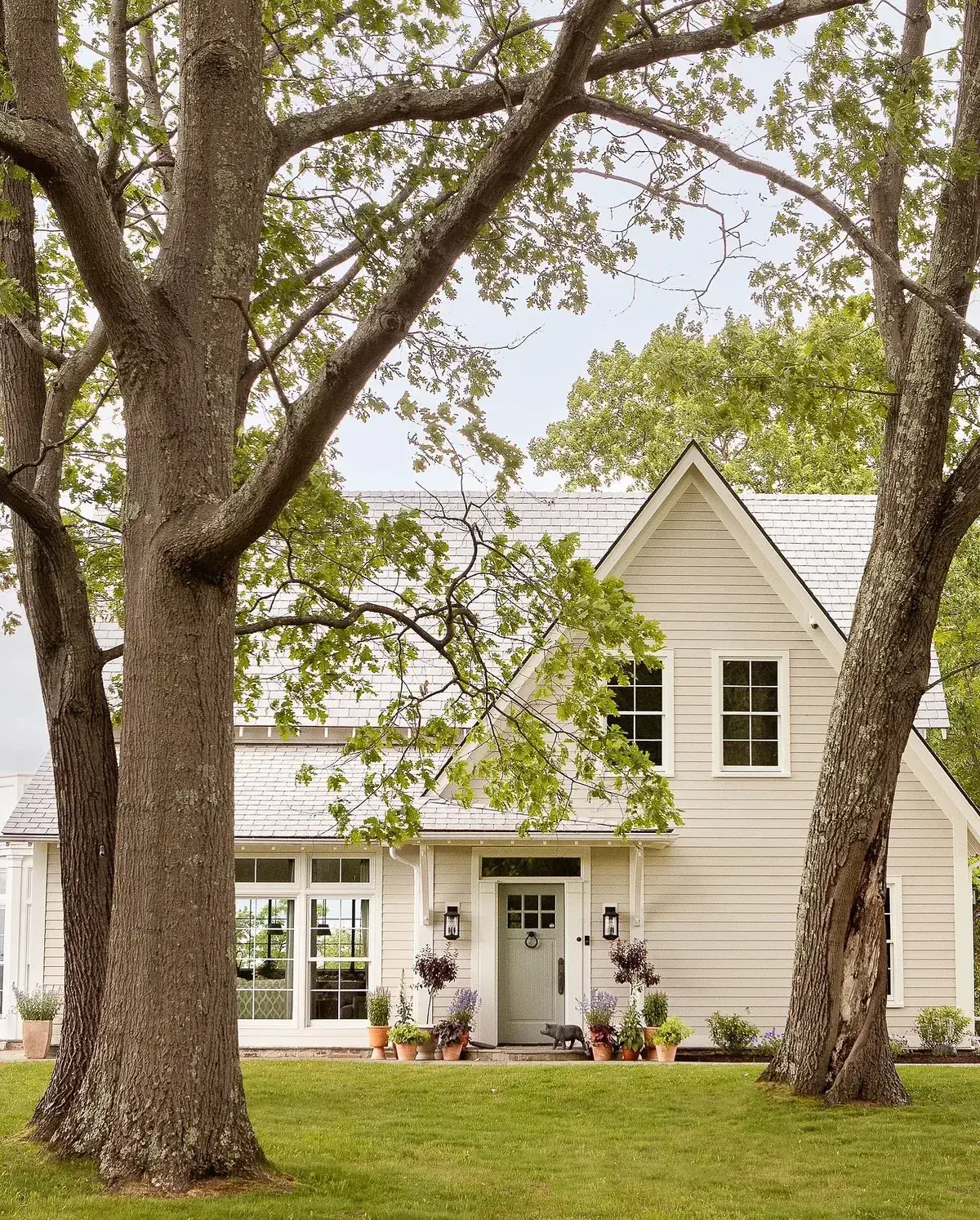
Two oaks own this front. Trunks thick as gate posts, canopy throwing the whole elevation into soft shade for most of the day.
Do not cut them back to get light to the door. The shade is the asset. Paint the house to suit shade instead, in a warm off white that holds up without sun. Dulux Weathershield in a pale stone or Johnstone’s Stormshield equivalent runs £32 to £52 for 5 litres in 2026.
Colour lives in the pots. Terracotta containers flank the sage door, planted loose with proof that containers forgive mistakes in a way beds do not. A cracked pot gets replaced in an hour. A bed dug in the wrong place takes a weekend to undo.
That door colour sits well under oaks. Farrow & Ball Green Smoke No.47 or Little Greene Aquamarine 138, exterior grade, at £30 to £48 per litre in 2026. Keep the lanterns black and small, one each side, or the wall starts to look dotted.
One warm door lifts a dark gable
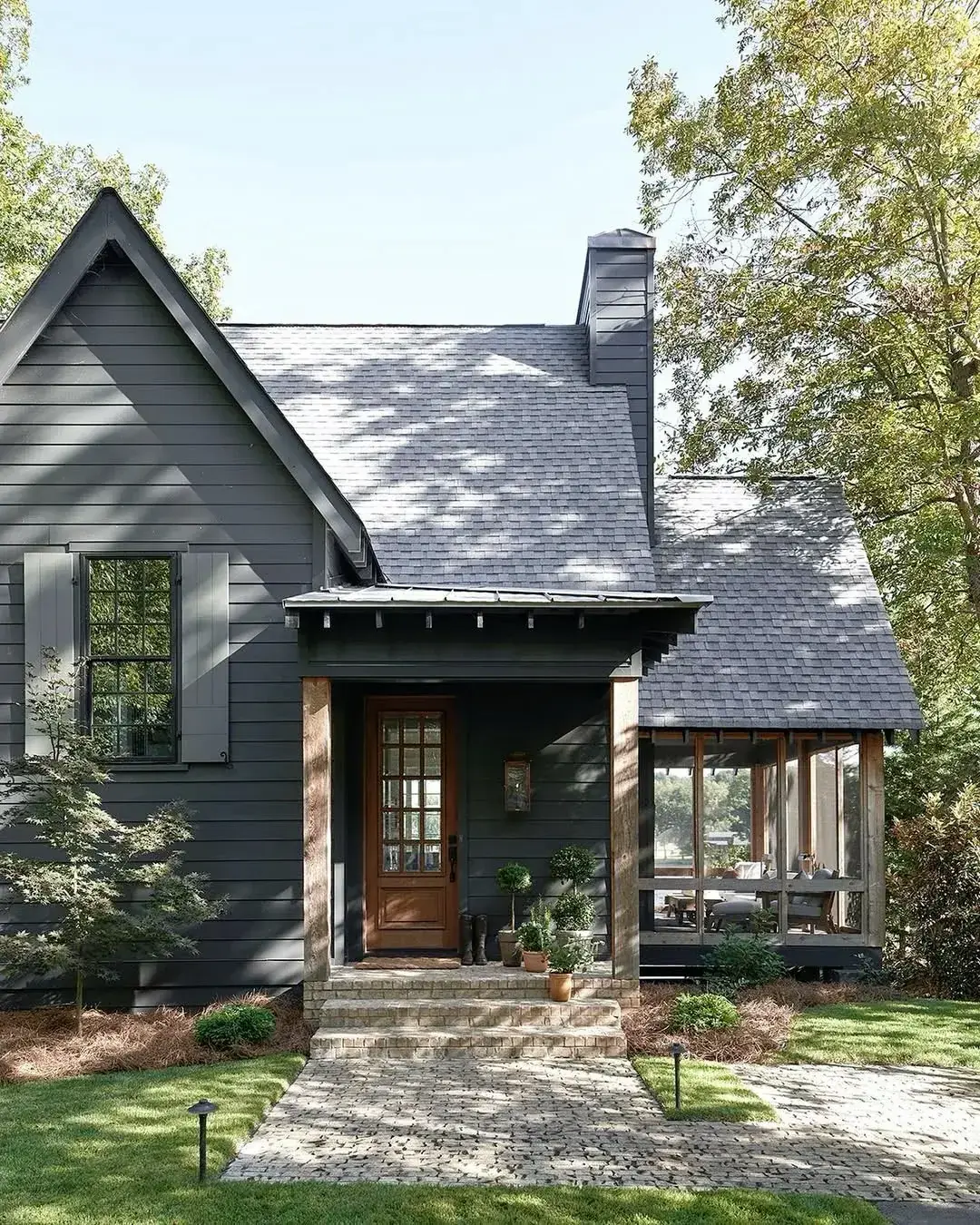
This gable is almost black. Grey boards, grey shingle roof, brick steps. In flat light that palette sits heavy, which is exactly why the warm timber door matters so much.
The timber door stops it. Mid brown oak with full glazing bars, catching the only warm reflection on the whole front. Osmo UV Protection Oil in oak or Sikkens Cetol HLS Plus in a similar tone costs £24 to £44 per litre in 2026, and both tolerate sun better than varnish.
Check the posts before admiring the colour. Raw oak uprights carry a shallow porch roof here, with exposed rafter tails and a simple boarded soffit. Probe the post feet with a screwdriver. Soft feet mean water is wicking up from the brick, and no stain fixes that.
The fix is a lead or stainless foot plate and a clear drip gap, fitted by a joiner in half a day. Leave posts buried in soil or mortar and rot starts in about three seasons, quietly, from the bottom up.
Clipped balls hold a grey shingle wall
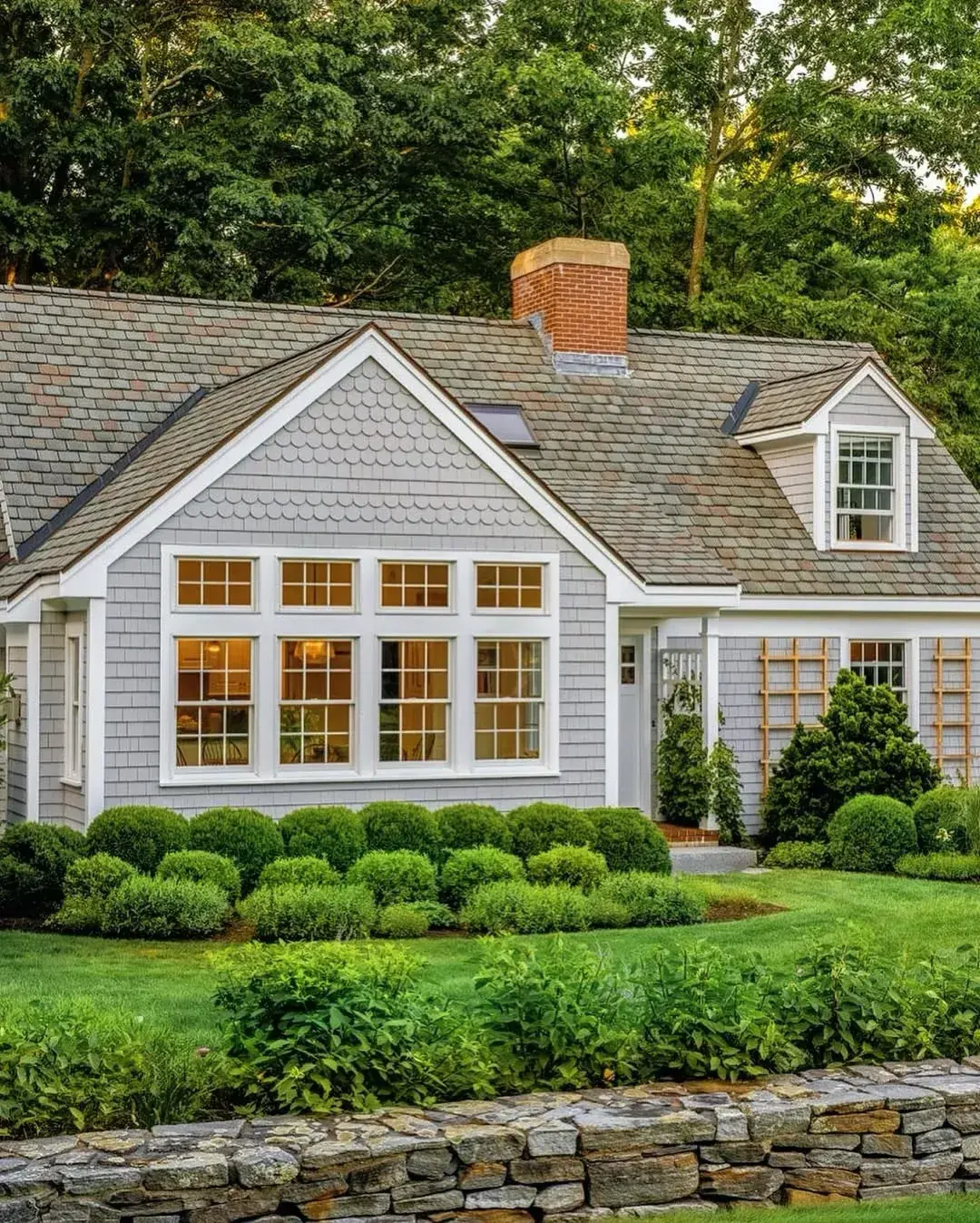
The window wall does the talking in that image. Eight panes of glass with white frames set into grey shingle, glowing amber from inside.
The planting refuses to compete. A run of clipped box balls in a single line, backed by taller yew, fronted by loose perennials. Box balls in 10 litre pots cost £28 to £55 each in 2026 from Crocus or a local nursery, and small ones catch up within two seasons.
Shear once in early summer and tidy again in late summer. Blunt shears tear leaves and the brown edges show for months, so sharpen or replace the blades first.
Notice the low stone wall in front. Dry stone with a rough cap, holding the bed back from the lawn. That wall is doing the edging job that timber does elsewhere, and it will outlast every timber edge on this page by decades, which is exactly why it costs more at the start.
Shutters must meet in the middle
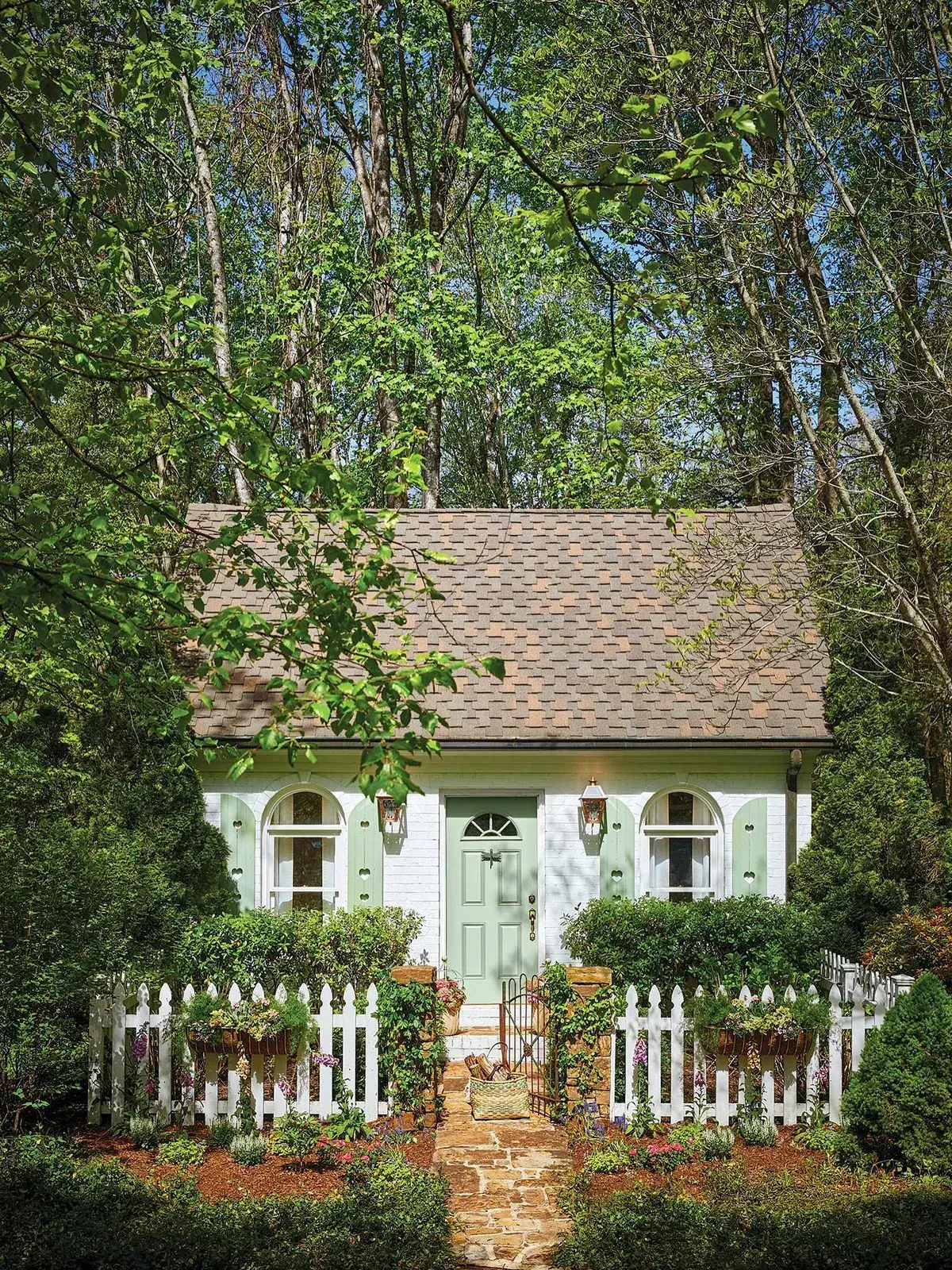
This front is tiny and every measurement shows. White painted brick, mint door, mint board shutters, white picket fence with hanging baskets either side of a narrow gate.
The shutters work because each one is close to half the window width. Closed, the pair would meet. That single test separates proper shutters from stuck on boards, and on a cottage the difference is visible from the lane.
Hang them on hinges with a shutter dog to hold them back, not screwed flat to the brick. Fixed flat boards trap water and stain the wall in streaks within two winters. Proper ironmongery from a specialist like From The Anvil runs £24 to £48 per set in 2026.
The fence is low and honest. Pointed pickets, one pedestrian gate, brick piers. Cuprinol Garden Shades in white or a similar exterior paint costs £18 to £32 for 2.5 litres in 2026, and a low fence like this needs recoating every three to four years to stay crisp.
One flag is a fixing job, not decoration
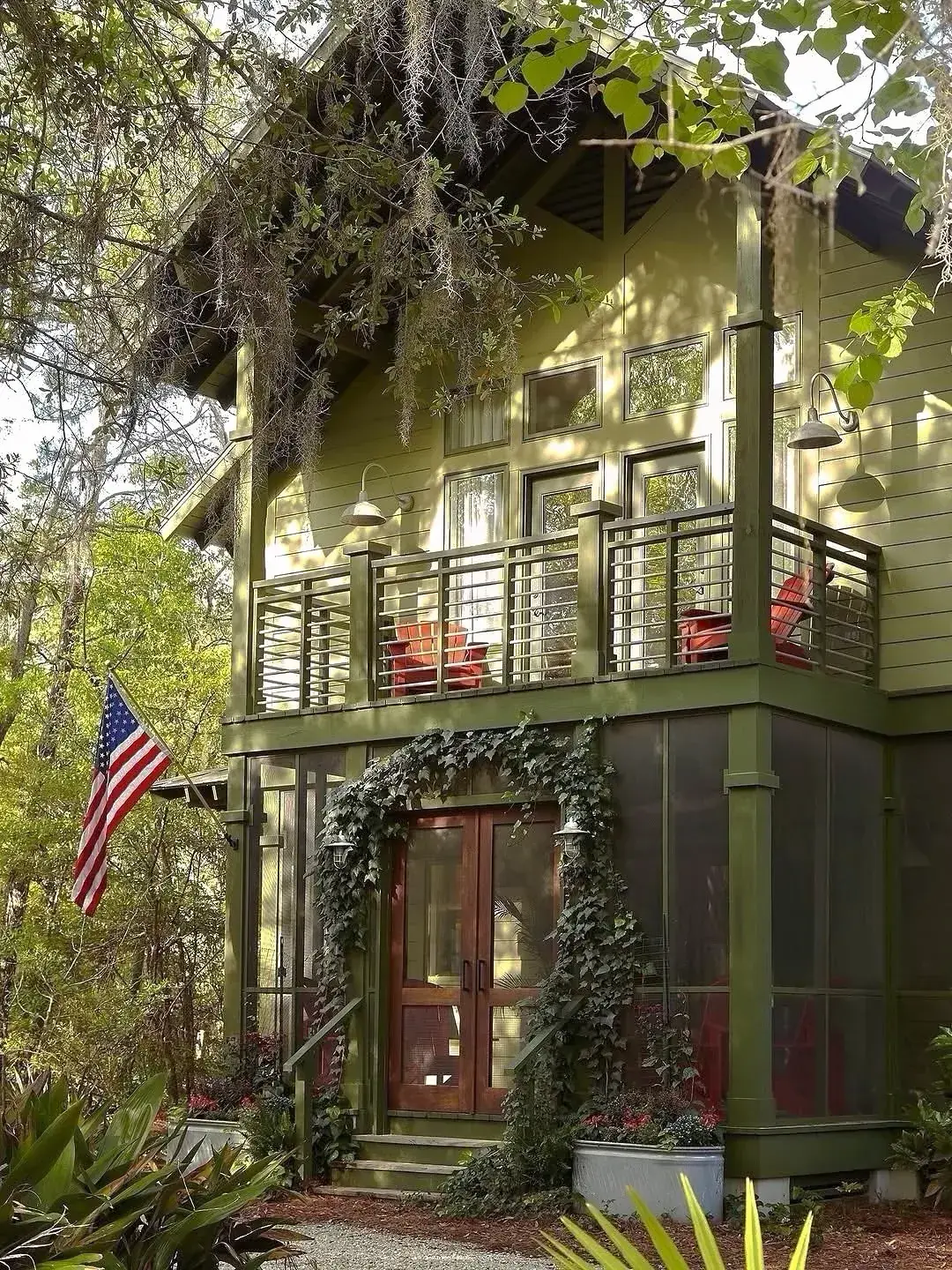
The flag pulls the eye first. Bracket mounted to the corner board, pole angled out over the path. Below it, a screened porch wrapped in ivy with timber French doors.
Treat the bracket as structure. Through bolt into solid timber or masonry with stainless fixings, not screws into cladding alone. A flag in wind loads a bracket hard, and screws in softwood work loose within a season. Simpson Strong-Tie SD screws or equivalent stainless wood screws cost £12 to £24 per box in 2026.
Above, the balcony rail is horizontal metal with chunky timber posts. Red Adirondack style chairs give the colour hit. Poly lumber versions hold colour without painting and run £130 to £260 each in 2026, while painted softwood needs yearly attention.
The gooseneck lights over the balcony doors are the detail to copy. One over each bay, aimed down. They wash the olive boards at night and make the balcony usable after dark, which a single bulkhead never does.
A limb can carry a swing if the tree is sound
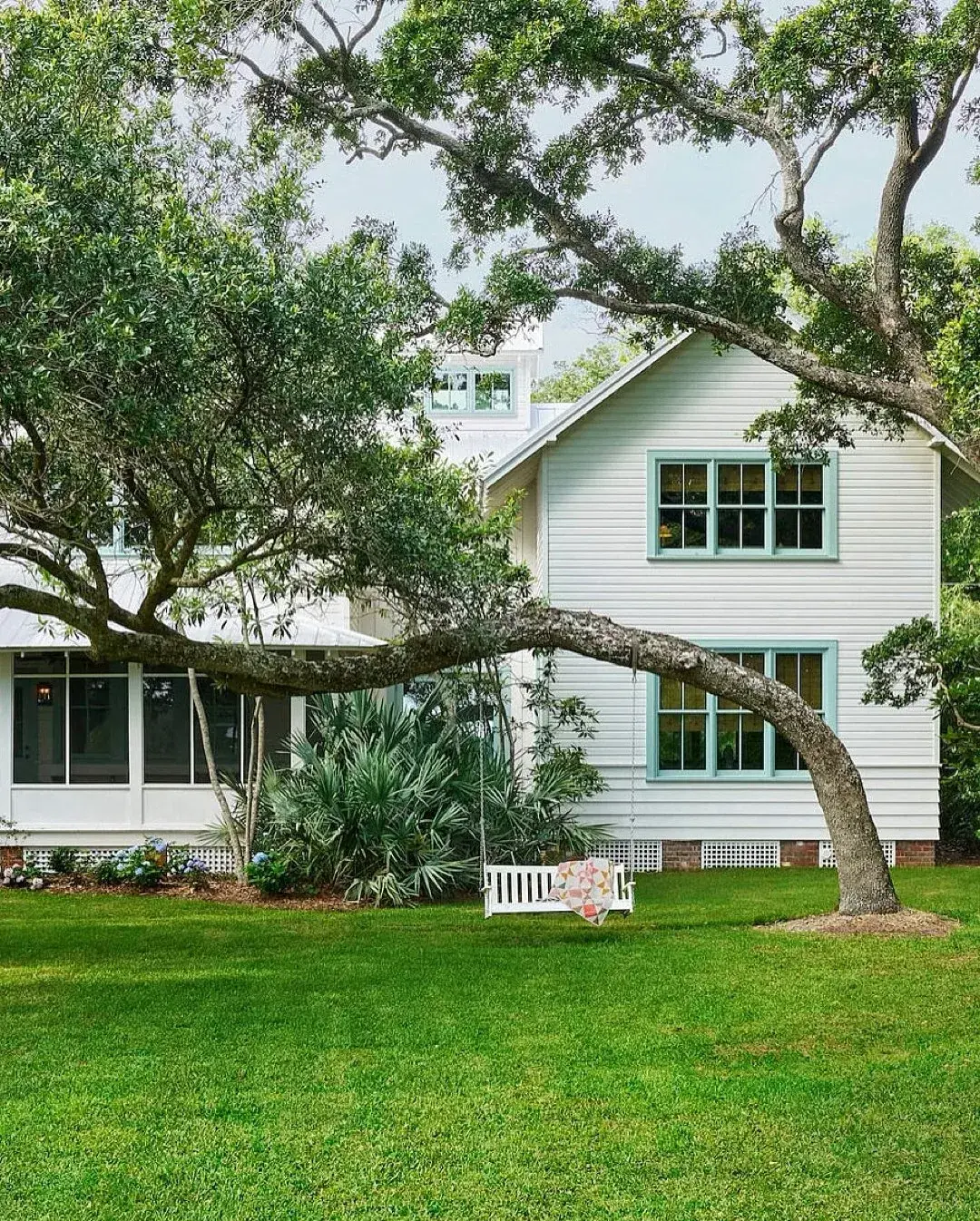
That swing hangs from a live oak limb, not from a porch beam. Thick rope over a curving branch, white slatted bench, quilt folded over the back.
Start with the tree, not the seat. Get an arborist to confirm sound wood and good union strength before drilling or slinging anything. A limb that looks strong and is hollow will drop a swing without warning. An inspection costs £90 to £180 in 2026 and takes under an hour.
Use flat rope slings around the limb where possible, fixed with marine grade stainless shackles. Bolts through living wood create entry points for decay. Proper swing rope from a chandlery runs £25 to £60 per side in 2026.
The house behind stays quiet for good reason. White boards, aqua window frames, brick plinth with lattice vents. Little Greene Aquamarine 138 or Benjamin Moore Wythe Blue HC-143 would give that trim tone, at £30 to £50 per litre in 2026. A third trim colour would crowd a front this narrow, so stop at two.
Tall porches need slim posts
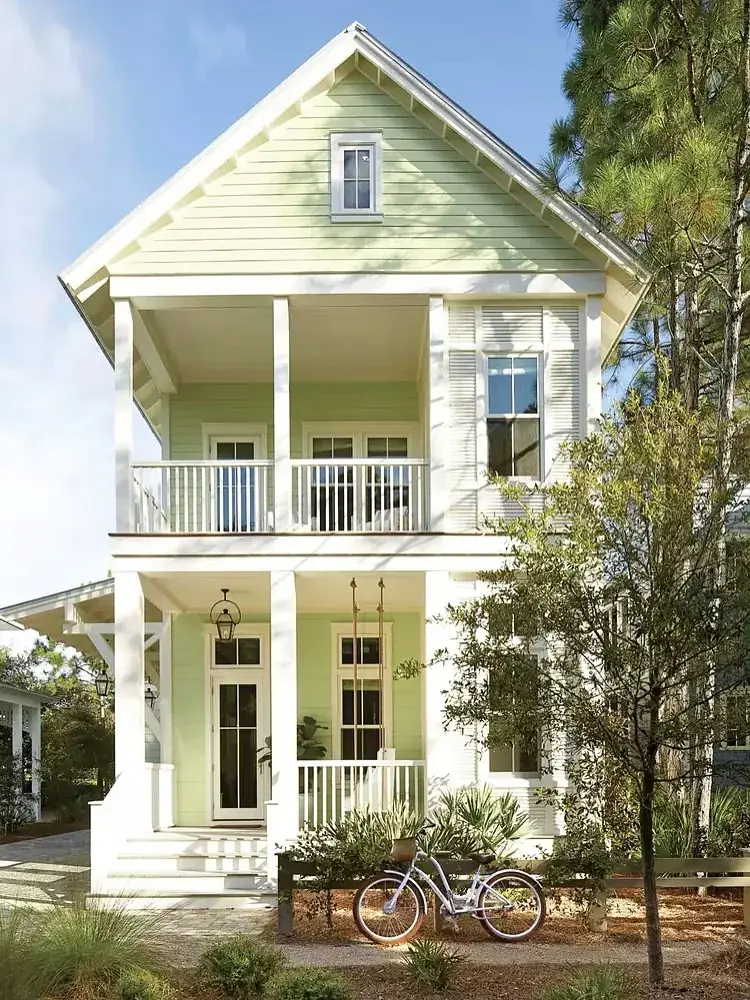
Two storeys of porch on a narrow gable. White columns, white rails, pale green boards. A bicycle leans against the front step planting.
The columns succeed because they are slim. Four on each level, square section, carrying a deep entablature without blocking the windows. Thicken them by half and daylight stops reaching the rooms behind, which defeats the whole porch.
Paint first, then protect the bases. Column feet rot where splashback wets them every time it rains. A coat of Zinsser AllCoat or Dulux Weathershield on all six sides before fixing, at £26 to £44 per litre in 2026, adds years.
Pictured below the porch, the bike marks the useful zone. Give everyday kit one bay by the steps, on gravel or a single slab, with a wall ring or ground anchor. A Sold Secure ground anchor costs £25 to £55 in 2026 and fixes with resin bolts in under an hour. Without that bay, bikes migrate across the front and the cottage starts to look like storage.
Low roofs want a chain, not a downpipe
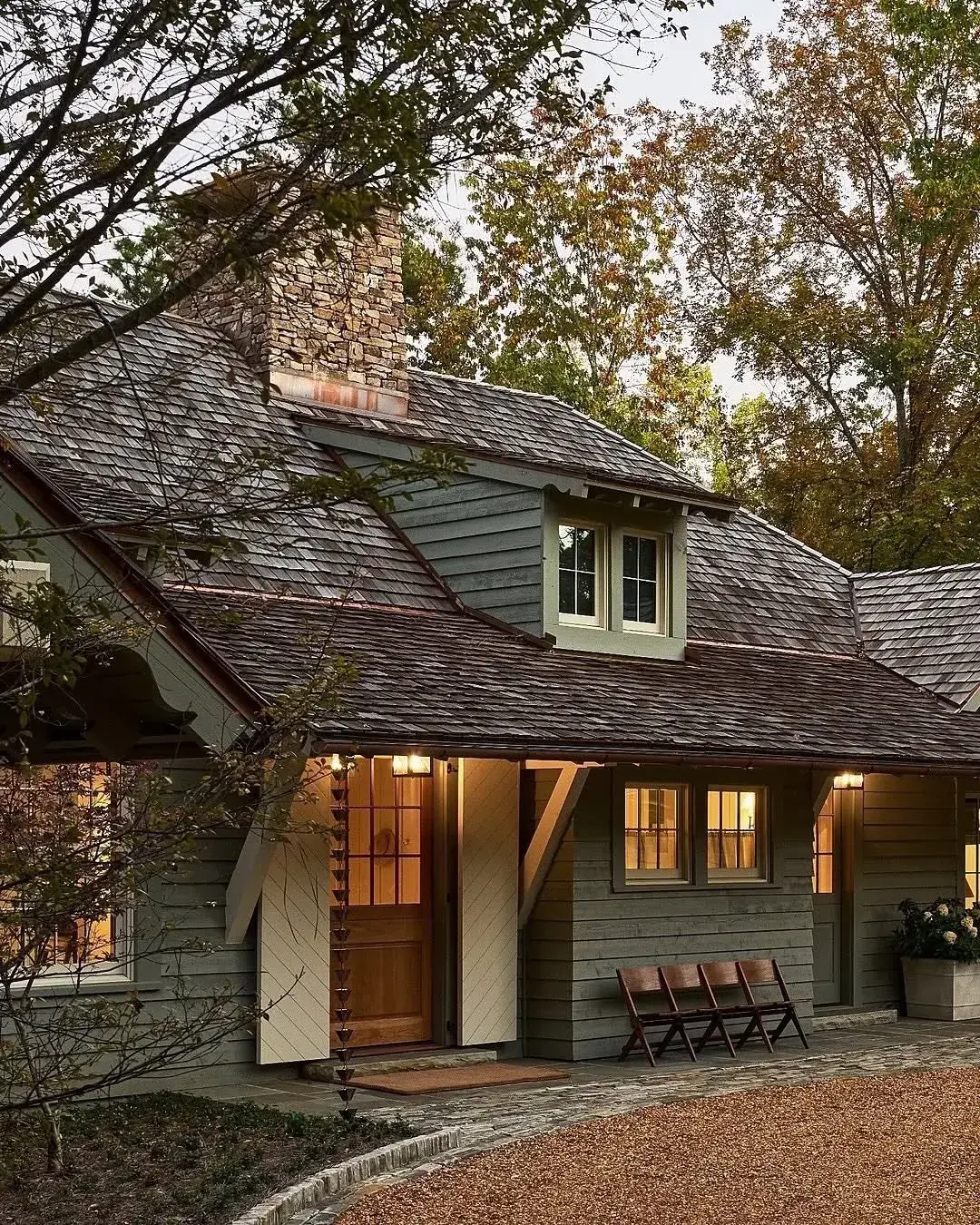
Dusk flatters this one. Warm windows under a low shingle roof that sweeps almost to the ground floor heads. Stone chimney, copper flashings gone dark, sage boards.
Look at the rain chain by the door. Linked cups carrying water from the gutter to the ground without a plastic downpipe cutting across the boards. Copper chains cost £45 to £110 in 2026 depending on length, plus a ground drain or pebble sump to stop splashback.
Chains suit cottages because the eaves are low and the drop is short. On a tall house wind throws the water everywhere. Here the fall is contained, quiet, and repairable with pliers.
The three folding timber chairs against the wall make sense on gravel. They stack, they move, they do not rot into lawn. Acacia or teak folding chairs run £60 to £140 each in 2026. Anything upholstered left out in this spot mildews within a month, however good the fabric claims to be.
A window box has to drain
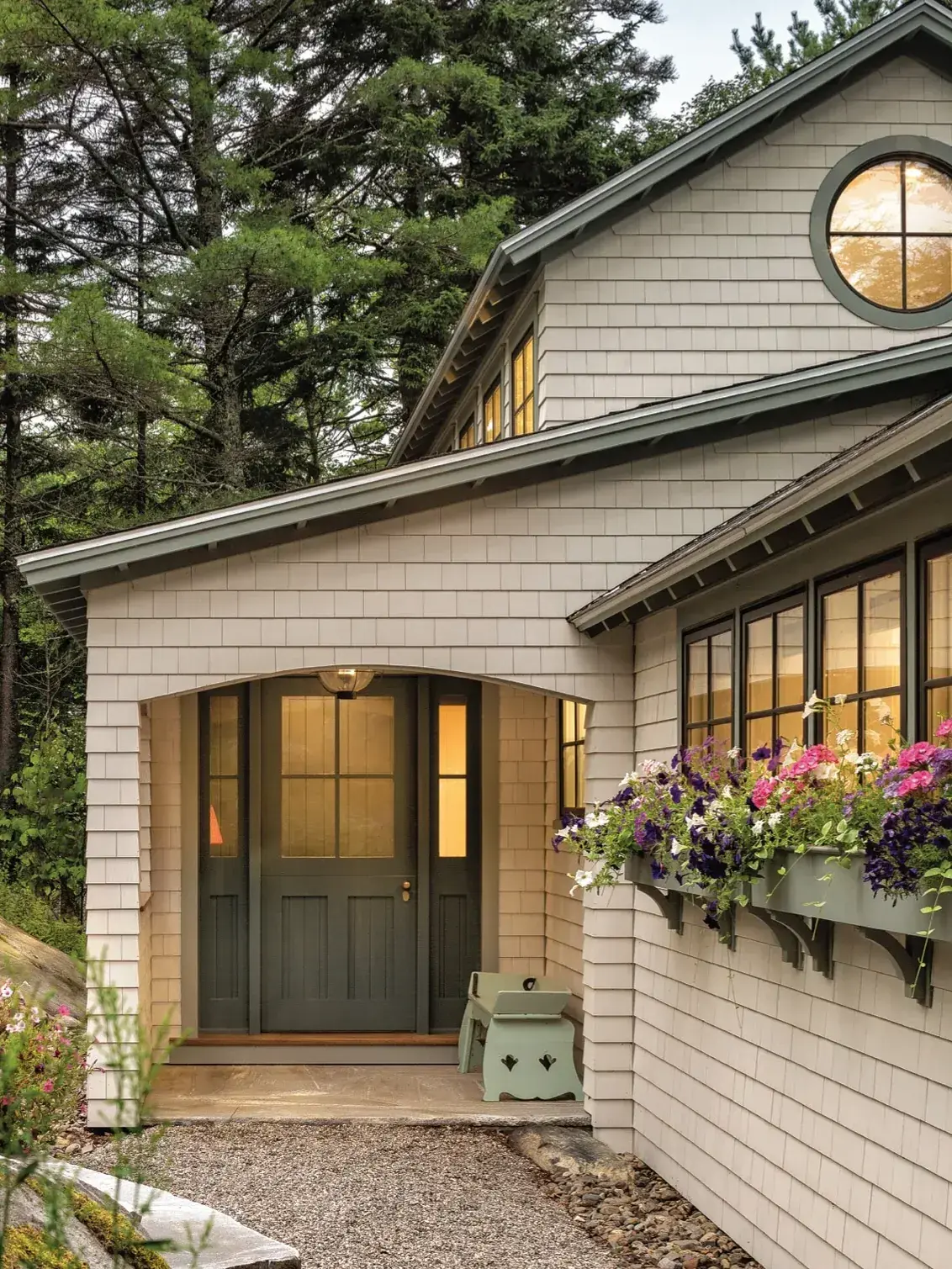
The door surround fills this frame. Sage panelled door with sidelights, arched porch head, lantern above. To the right, a long window box runs under black framed windows, packed with petunias in purple, pink, and white.
Boxes fail from the inside out. Drill drainage holes, line with a permeable membrane, and stand the box on small feet so air moves under it. A waterlogged box rots brackets and stains shingle in one season. Galvanised steel brackets with stainless screws cost £14 to £30 per pair in 2026.
Plant for succession, not for one photograph. Petunias peak, then stretch. Underplant with trailing lobelia or replace the display in late summer. A 500ml bottle of liquid feed costs £6 to £12 in 2026 and keeps a box flowering weeks longer.
From that picture, the round gable window is doing quiet work. One circle high up, sage trim, glowing at dusk. It centres the whole gable without adding another rectangular window to clean, and on a shingle wall a round opening needs a proper flashing kit fitted before the shingles go on.
| Fixing | Use on a cottage front | Price band in 2026 |
|---|---|---|
| Stainless 316 screws, 50mm | Gate hinges, shutters, coastal work | £14 to £28 per 200 |
| Hot dip galvanised ring shank, 50mm | Fencing inland, posts, rails | £9 to £16 per kilo |
| Resin anchor studs, M10 | Bike rings, handrails into masonry | £18 to £34 per kit |
| Copper nails, 32mm | Shingle repairs, small copper caps | £22 to £40 per kilo |
The smallest cabin wins by doing least
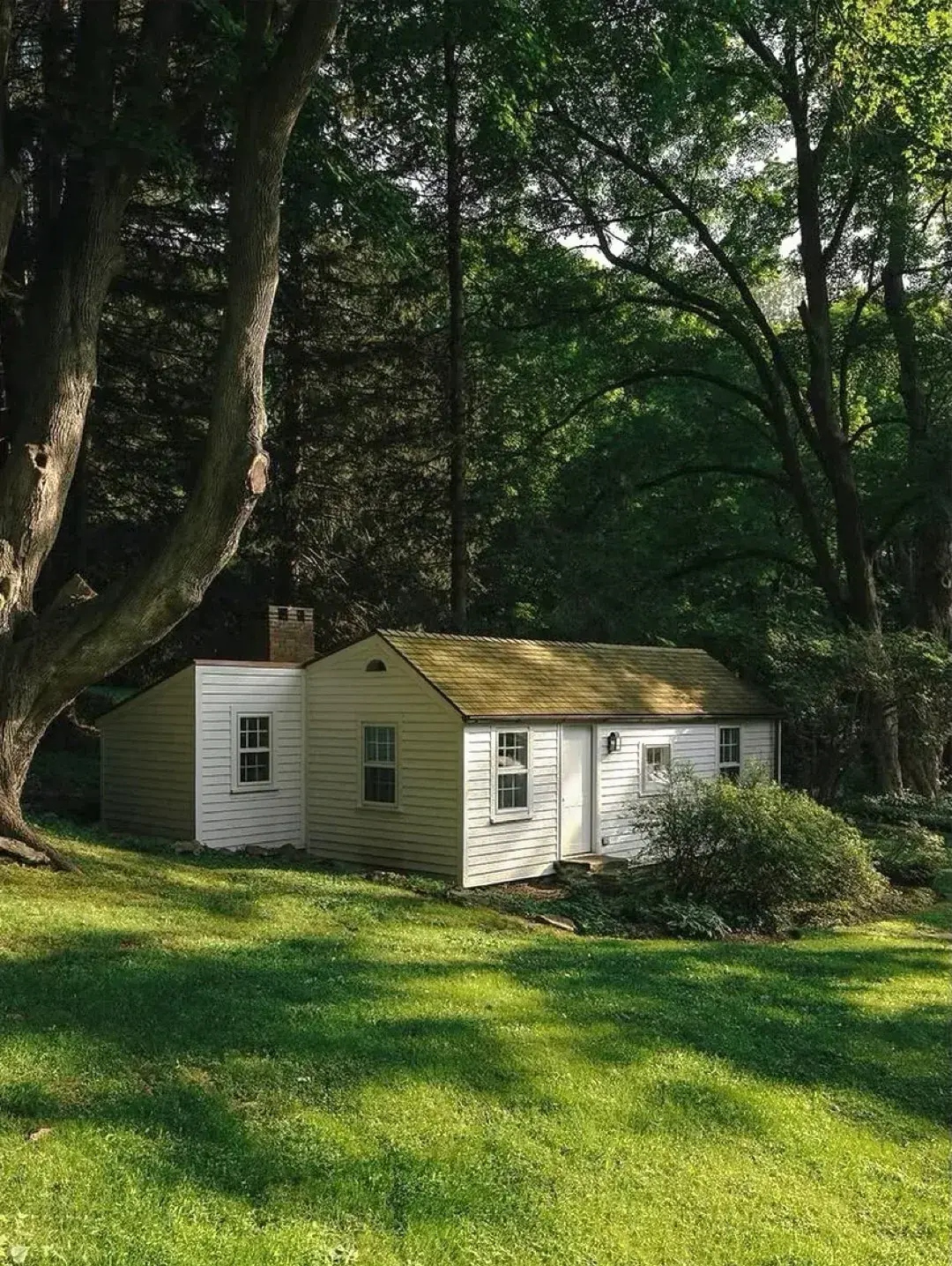
This is the smallest building on the page. White horizontal boards, plain white door, small six pane windows, mossy shingle roof. No porch, no shutters, no fence.
Do nothing first. On a cabin this plain, each addition removes more than it adds. The photograph proves it. One lantern by the door, one path to it, grass kept cut, and woodland doing the rest.
The maintenance order is short. Wash the boards yearly to remove algae, since shade and trees green up white paint within a year. Touch up the door and window putty before touching the field colour. A 5 litre tub of Dulux Weathershield or Johnstone’s Stormshield covers a cabin this size with paint left over, at £32 to £55 in 2026.
Skip this approach if the lane is busy or overlooked. A cabin with no boundary and no lighting works in woods. On a street it reads as unfinished, and a low fence plus one sensor light changes that without adding clutter, for under £120 in parts in 2026.
Frame a tiny porch like a gate
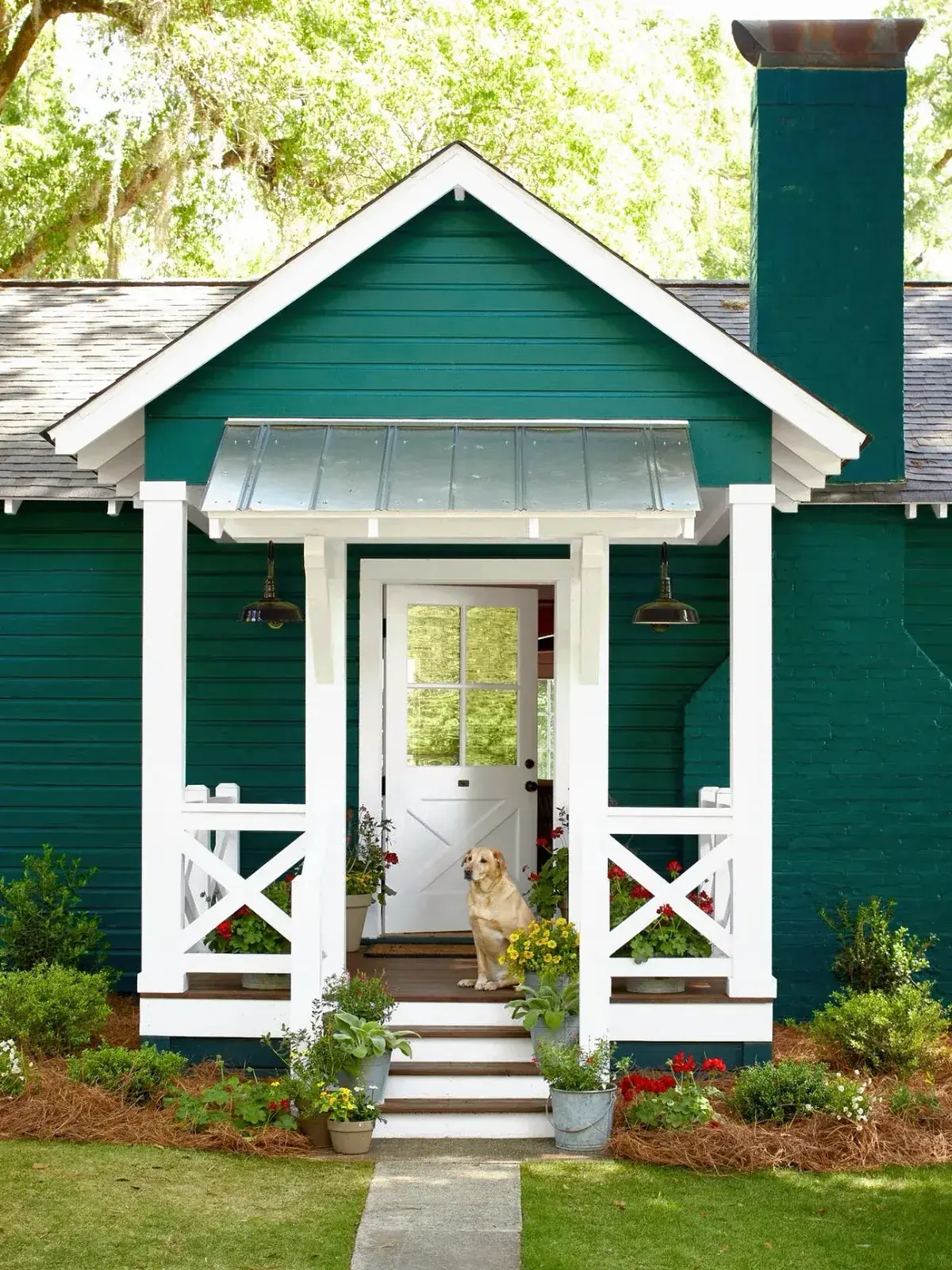
Teal boards, white porch frame, standing seam canopy over the door. Cross braced rails like field gates. A dog sits on the steps between pots of red geraniums and yellow violas.
The porch framing is doing gate work. Four slim white posts, X braces, white barge with exposed rafter tails. It marks the threshold without closing it in, which is exactly what a cottage of this size needs.
Paint the dark body first and the white frame second. Teal shades such as Farrow & Ball Inchyra Blue No.289 or Little Greene Marine Blue 306 need two full coats over primer on bare timber, at £30 to £50 per litre in 2026. White over teal needs the same discipline, or the dark bleeds through within months.
In that image the canopy is galvanised steel with a standing seam. Keep it dull and unpainted. Painted steel chips at the drips and rust shows through, while bare galvanised steel weathers to matt grey and asks for nothing, which suits a working porch.
Glass doors need a clipped edge
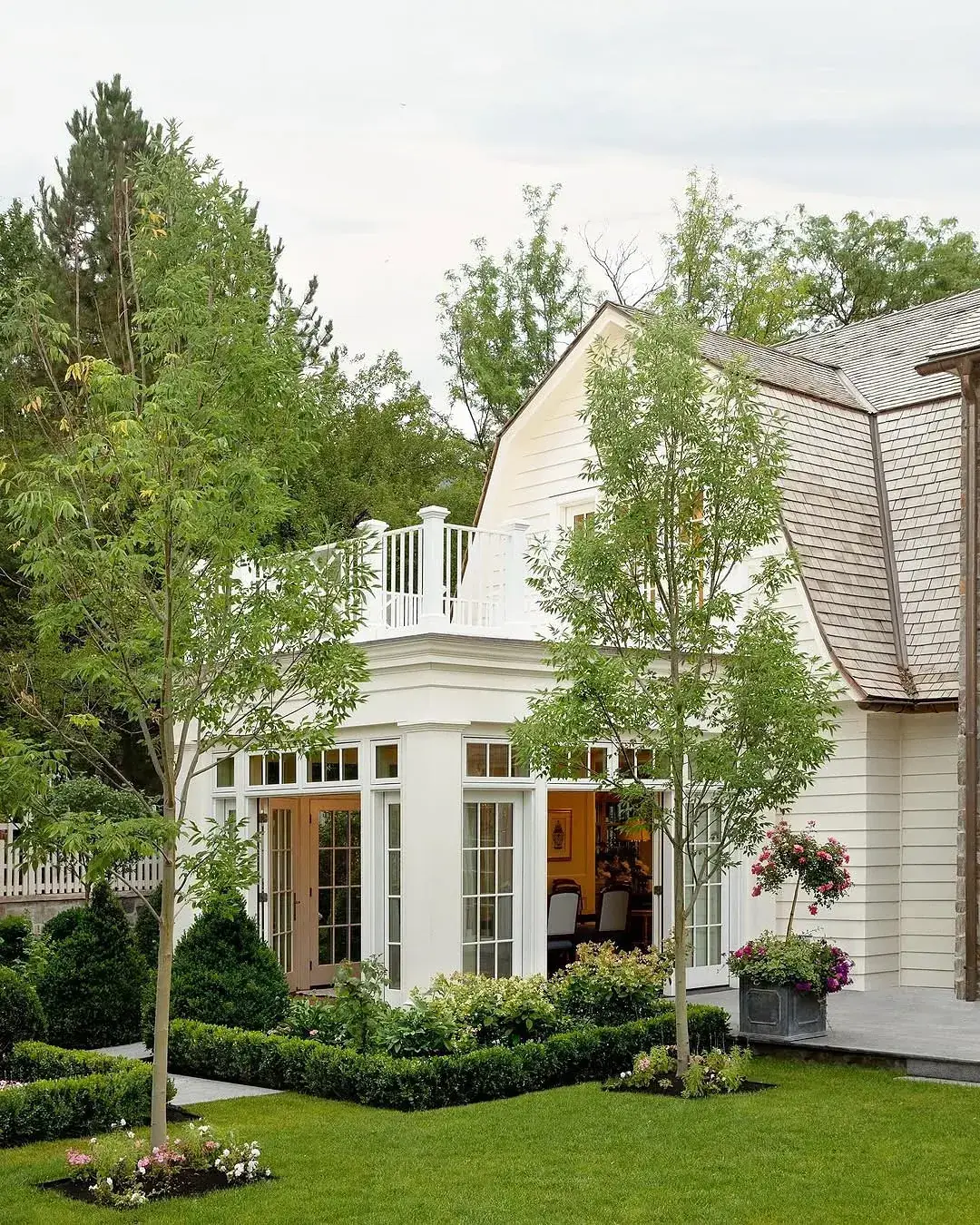
White boards, gambrel roof in shingle, tall glazed doors opening to the garden. The architecture is polite and symmetrical, so the garden has to hold a line.
The one detail holding it is the low box hedge. Clipped at knee height, squared, running the bed edge and returning the corner. Box plants in 2 litre containers sell for £9 to £18 apiece in 2026, and a run like this establishes in three seasons from small stock.
Clip with sharp shears and clear the clippings. Box blight spreads on dirty tools and wet foliage, so disinfect between plants and avoid overhead watering late in the day. Fail to do that and whole sections brown off in weeks.
Young trees frame the view without shading it yet. Stake low with a short stake and a buckle tie, not a tall cane lashed tight. A low stake lets the stem flex and thicken, while a tall rigid tie grows a thin trunk that leans the day the tie comes off, usually in year three.
Frequently Asked Questions
Which exterior paint lasts longest on old timber cottages?
Microporous woodstains outlive gloss on moving boards. Sadolin Superdec, Dulux Weathershield and Osmo Country Colour fade gradually and take a wash plus a fresh coat, while a hard gloss cracks and needs scraping. Dark shades on sunny walls always need attention sooner.
How can a small front garden look tidy without a full rebuild?
Give the path a firm edge, top up angular stone, and keep containers near the entrance where they can be moved. Clip one evergreen shape for winter structure. Those three jobs change the street view more than new furniture.
What gate suits a narrow cottage plot?
A low timber picket with a simple latch keeps neighbours friendly and frames planting. Hang it true on stainless hinges, paint all sides before fitting, and leave a gap beneath for gravel. Tall close boarded panels shade the door and shrink the whole elevation.
Where should colour go on a compact facade?
Put the strongest tone on the smallest area. A painted entrance, a window box, or two chairs carry brightness well. Keep cladding and trim to two quiet shades so the accent has room to register.
Is a porch swing practical in a windy or shaded spot?
Shade suits a swing, constant damp does not. Fix into solid joists with through bolts and load rated chain, never into trim alone. A tree hung seat needs an arborist check first, plus slings that protect bark.
Why is my cottage path spreading into the beds?
Loose stone without restraint always migrates. Fit steel or timber edging flush with the surface, use angular aggregate that locks, and top up yearly. Rounded pea gravel rolls underfoot and travels furthest.
In order
- Choose a genuinely dark body and a genuinely crisp white trim, with nothing between.
- Use a breathable microporous stain on timber, never a film-forming gloss.
- Make sure the cladding is ventilated behind, not fixed tight to the sheathing.
- Edge gravel paths and use angular gravel at 10 to 14mm.
- Plant for structure first, then let things self-seed into gravel.
- Size shutters to half the window and hang them on hinges with room to dry.
- Bolt flags, swings, and rails into structure with stainless fixings, not trim.
- Keep porches slim and low, with one bay for everyday kit and pots that move.
This article may contain affiliate links. We may earn a commission at no extra cost to you.