15 Colonial House Exterior Ideas That Only Work Symmetrical

Add us as a preferred source to see more stories on Google.
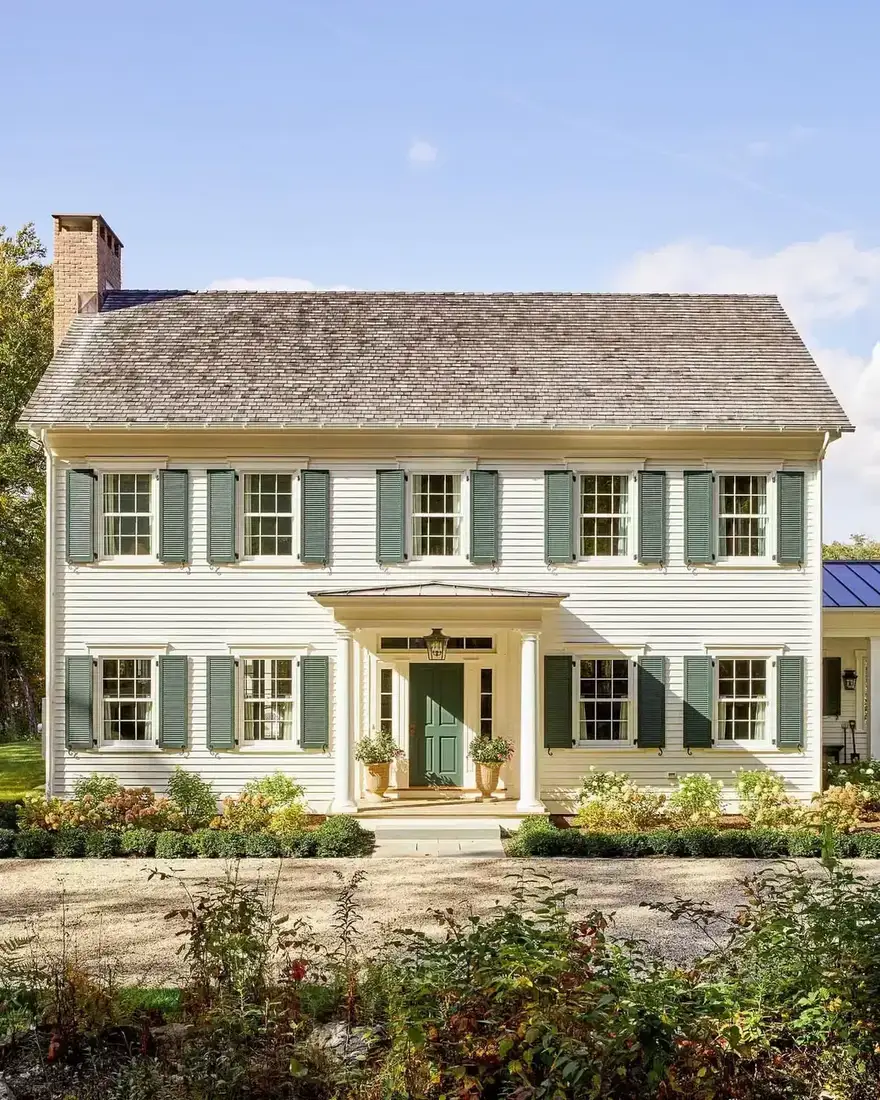
Cover half the house below with your hand and the other half tells you exactly what is underneath it. That is the entire style in one sentence.
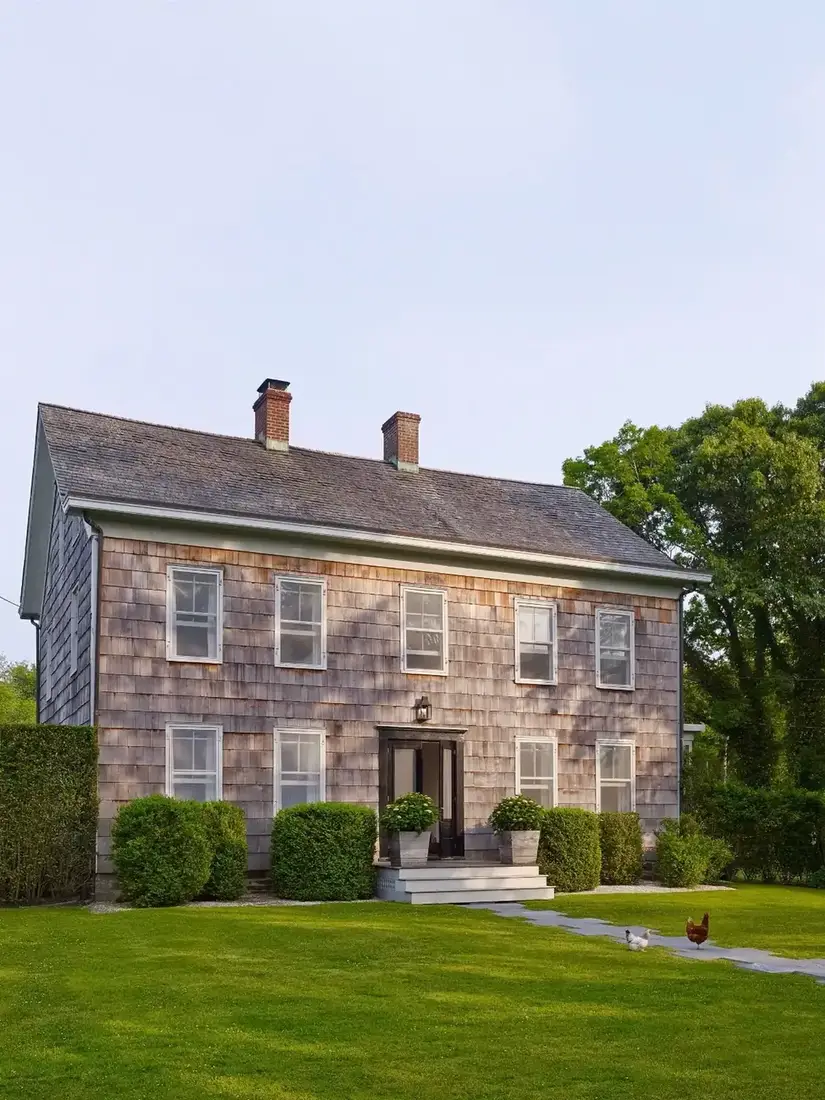
Five bays, door dead centre, two windows each side on both floors, evenly spaced. Everything on the left has a partner on the right at the same distance from the middle.
That balance is doing all the work. The colours are quiet, the detailing is modest, and the facade still reads as a properly designed building rather than as a box with holes in it.
The three ways it gets broken
Additions. Extending a colonial is normal and always has been; the trick is that the addition should sit back from the main facade or to the side, reading as a subordinate later building. Bringing it forward onto the same plane turns a five-bay symmetrical front into a lopsided seven-bay one, and no paint colour recovers that.
Replacement windows. Original colonial sash is typically six-over-six or twelve-over-twelve, taller than it is wide, with slim glazing bars. A modern unit in the same opening usually has fewer, thicker bars or none at all, and a chunkier frame. Even when the openings stay symmetrical, the windows stop matching each other if only some were replaced, which is worse than replacing all of them.
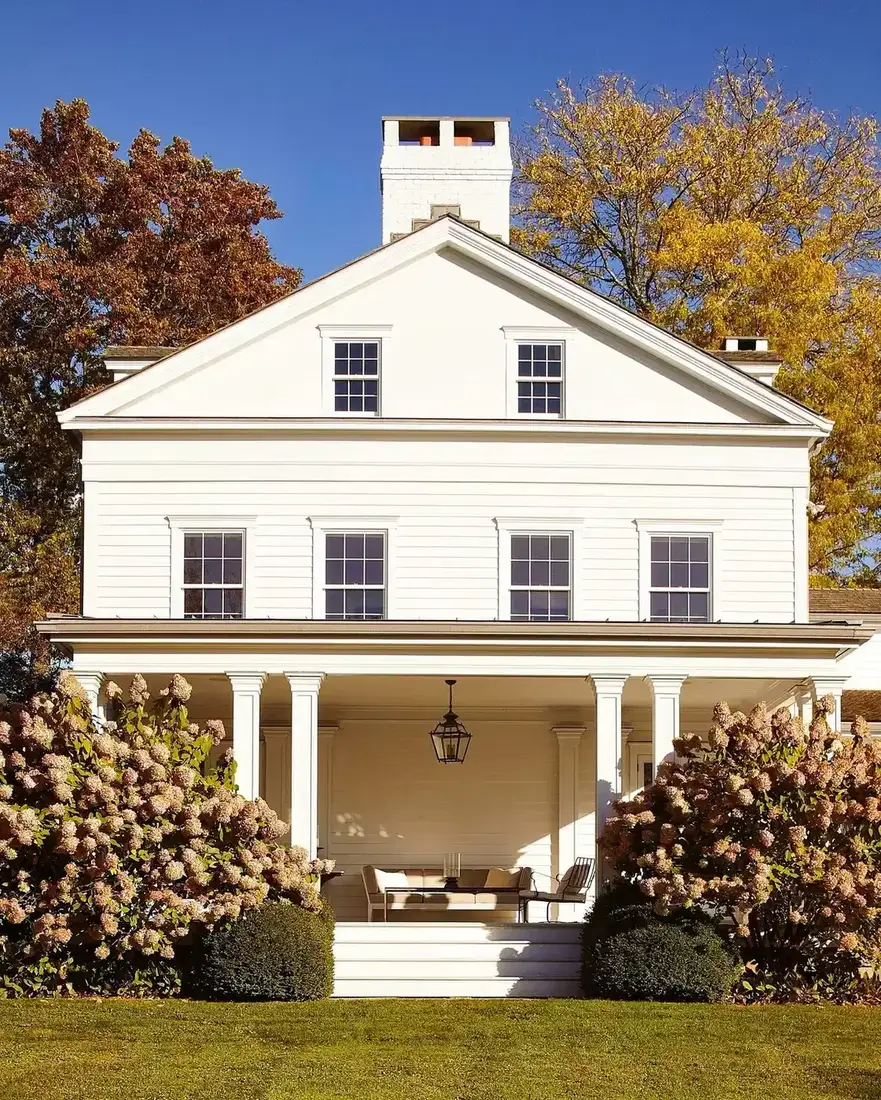
The portico. Look at how small the one in that photograph is. It covers the door, sits on slim columns, and has a shallow pediment. It is a hat, not a wing. The common mistake is a two-storey entry with heavy columns, which is a different and grander architecture bolted onto a modest house.
Shutters, and the small iron detail
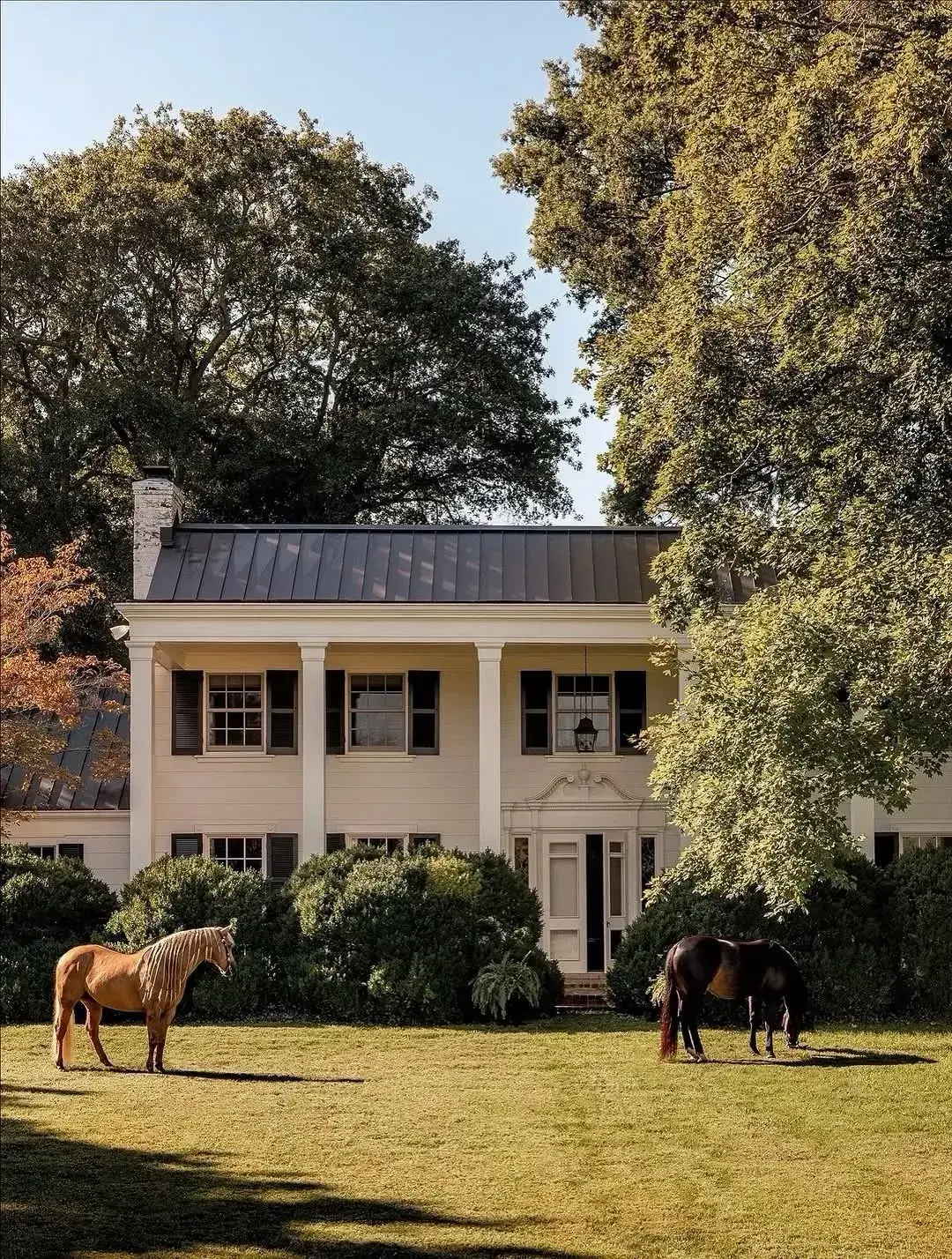
The shutters are sage green, and each leaf is half the width of its window, so a closed pair would cover the opening. That proportion is the same rule that applies to any shuttered house, so check it before buying.
The shutter dogs stand out here, the small iron holdbacks beside each shutter. They cost very little and they are the difference between shutters that read as working joinery and shutters that read as panels screwed to the wall.
Mount tight to the window casing with visible hinges, and check that louvres slope down and out, with the low edge facing the garden.
Colours that suit the period
Colonial palettes are muted, and that restraint is part of the style rather than an accident of old paint technology.
| Body | Shutters and door | Reads as |
|---|---|---|
| Cream or warm off-white | Sage green, bottle green | The most common, and the safest |
| Soft grey | Near-black, charcoal | Quieter, slightly more formal |
| Pale yellow ochre | Dark green, oxblood | Historically accurate, less common |
| White | Black | Crisp; can look stark on a small house |
Useful names: Farrow & Ball Lichen No.19 and Green Smoke No.47 for shutters, Benjamin Moore Kennebunkport Green HC-123 for a darker sage, and Farrow & Ball Pointing or Benjamin Moore White Dove OC-17 for the body. Trade equivalents tinted to match cost a fraction and hold up perfectly well outdoors.
Avoid bright white on an older colonial. It is a modern colour and it makes the muted shutter tones look dusty and accidental.
What to leave alone
The roof line, the chimney position, and the window openings.
Those three establish the proportion of the whole house, and changing any of them is expensive, permanent and rarely improves anything. A dormer added to a colonial roof at the wrong spacing is visible from the road forever.
If the house needs more light or more room, the honest answers are at the back or in a subordinate wing, where nobody is reading the facade.
Where this does not apply
Colonial revival houses built in the last fifty years, many of which were never symmetrical to begin with. There, the rules above are a guide rather than a duty, and the better question is simply whether the front reads as balanced.
Garages are the usual complication. An attached garage on the front of a house cannot be made symmetrical, so the practical move is to reduce its presence: paint the door the body colour rather than a contrast, keep the detailing plain, and let planting do the rest.
Dusk front with no shutters and a straight brick path
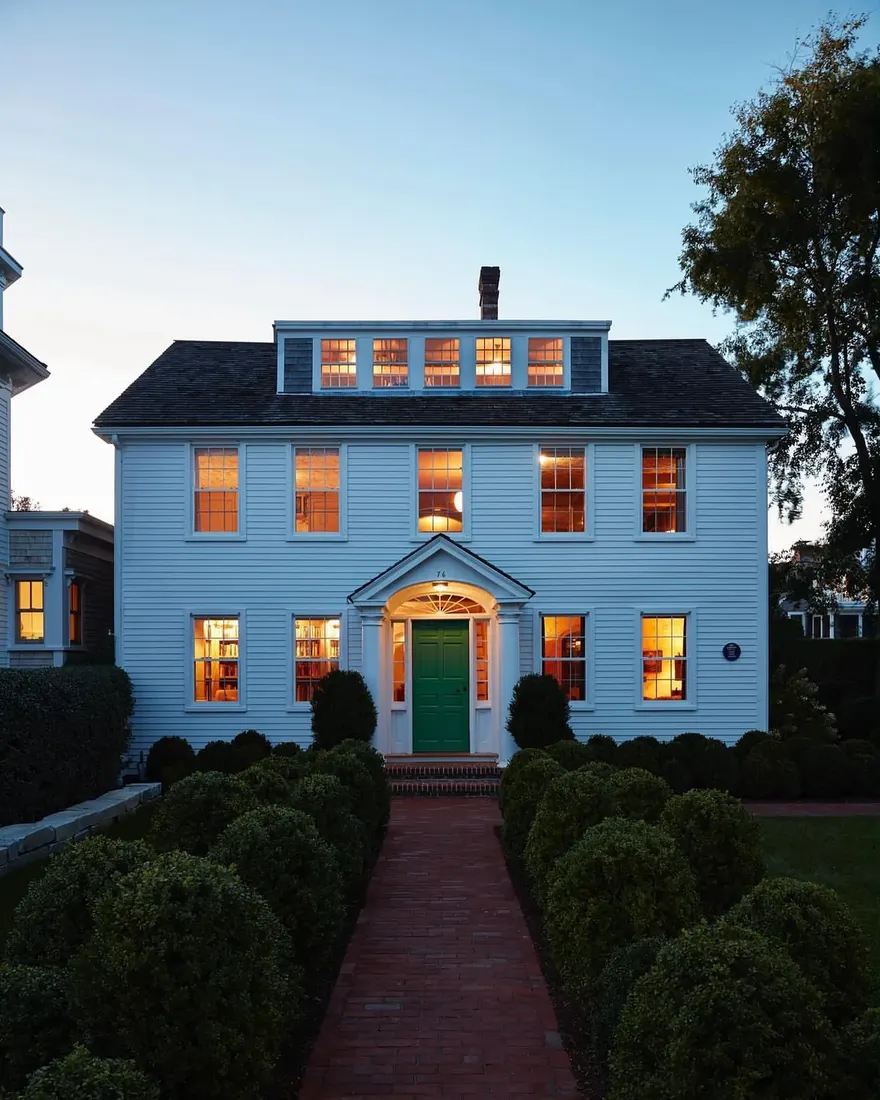
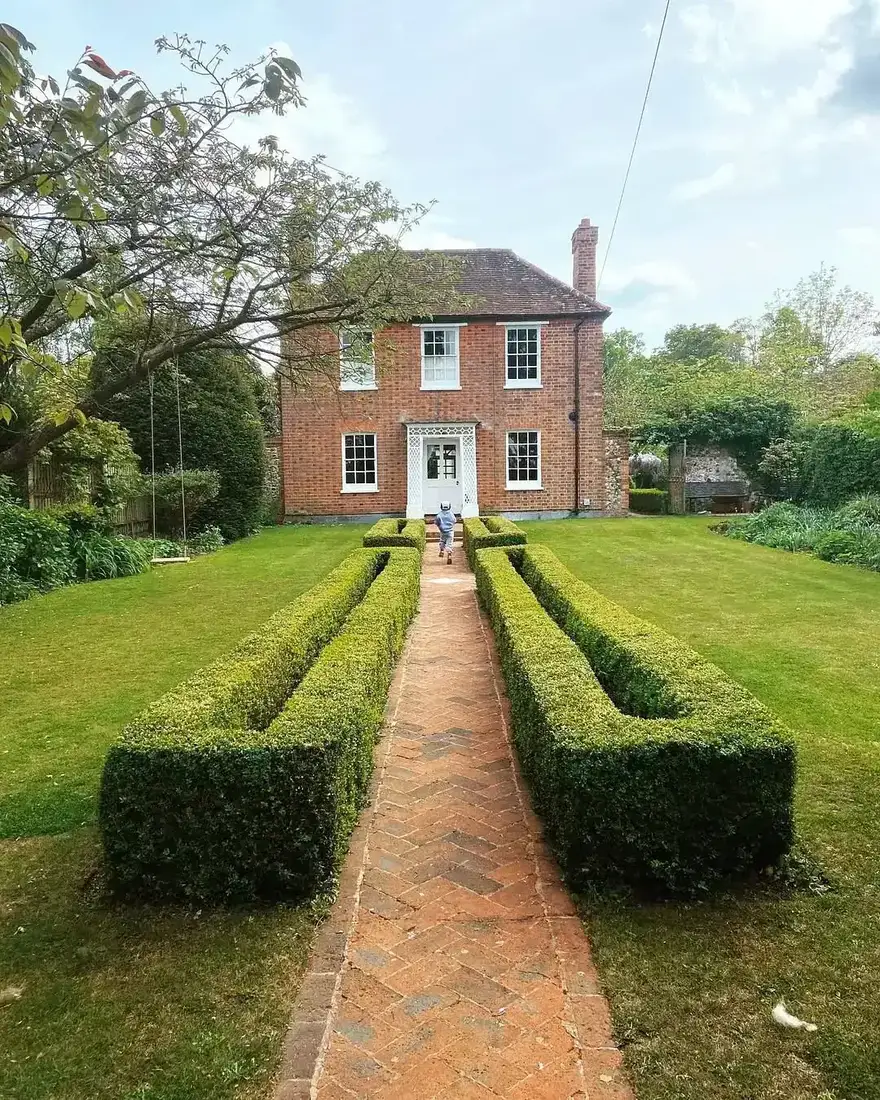
First fix the sequence. In this photo the path does the organising before paint or planting gets a say. It runs straight at the door, brick, flanked by clipped balls that match left to right. That is the centre line made walkable, and it costs nothing to get right.
Notice how the front skips shutters entirely. The windows are bare, with slim white casings on a pale blue-grey board. On a symmetrical front that reads calm. Fake narrow boards would have broken it. Leave them off if the openings sit close to corners or to each other.
The door holds the middle with a fanlight and a small pediment. Warm light from inside does the rest at dusk. The one detail that keeps it colonial is the dormer above lining through to the floors below instead of floating. Paint to copy that blue-grey: Little Greene French Grey 113 or Farrow & Ball Light Blue No.22, with Dulux Weathershield for the body in a coastal spot. Expect exterior joinery paint at £35 to £65 per 2.5 litres in 2026, and Buxus balls in 10 litre pots at £35 to £70 each in 2026.
Spanish front that still answers to the middle
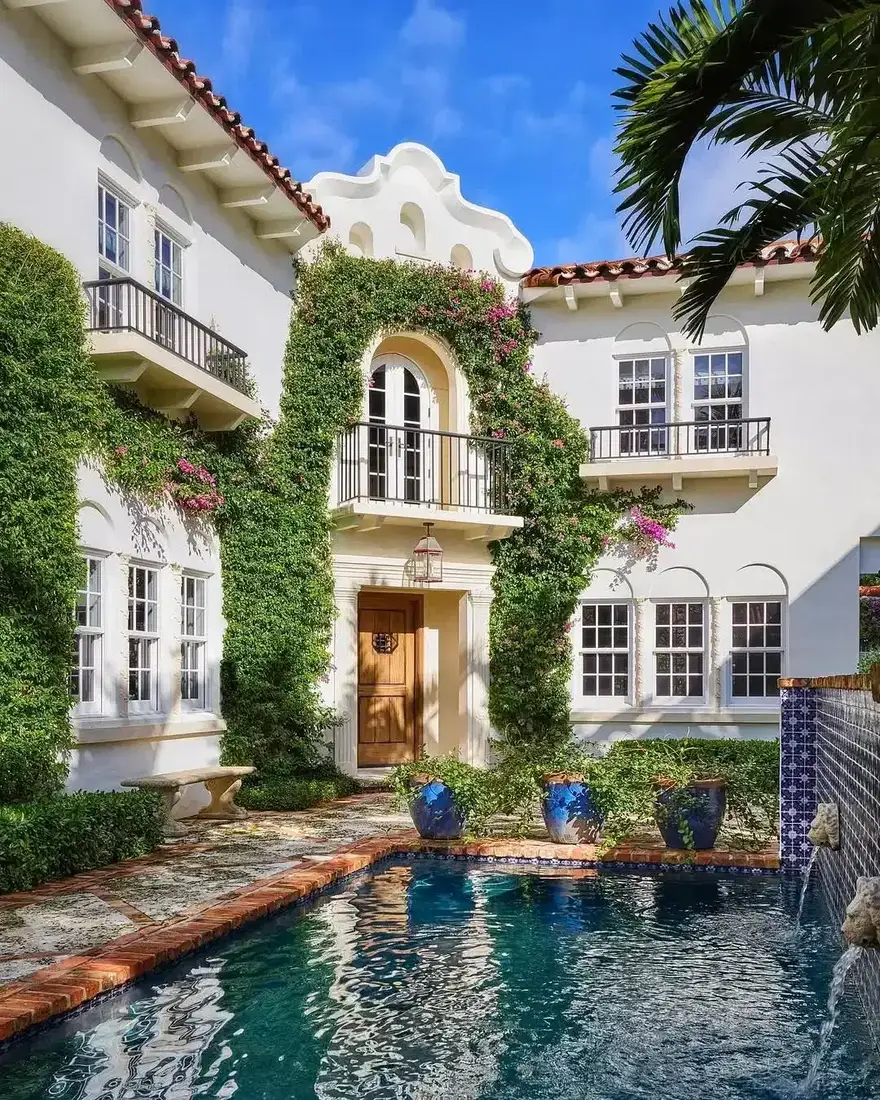
Different climate, same discipline. White render, red tile roof, and a door set dead under a balcony. The vines are loose but the openings balance. That is why the eye still finds a middle without being told.
Look at the three blue glazed pots by the water. They are doing the work lanterns do on a New England front. Three, matched, along the pool edge. One alone would read as missing its partners. Terracotta or glazed planters of that scale run £45 to £110 each in 2026 at garden centres and through Garden Trading.
The iron rails and the timber door keep the finish count low. Render, tile, timber, iron, planting, and nothing else competing for attention. Spanish work fails when the palette spreads into five or six finishes. If render needs recoating, Sandtex masonry paint in white runs £30 to £55 per 10 litres in 2026, and a tiled capping wants a lime-based mortar for repair, which is why coping work goes to a mason.
Black door with a lamp on each side
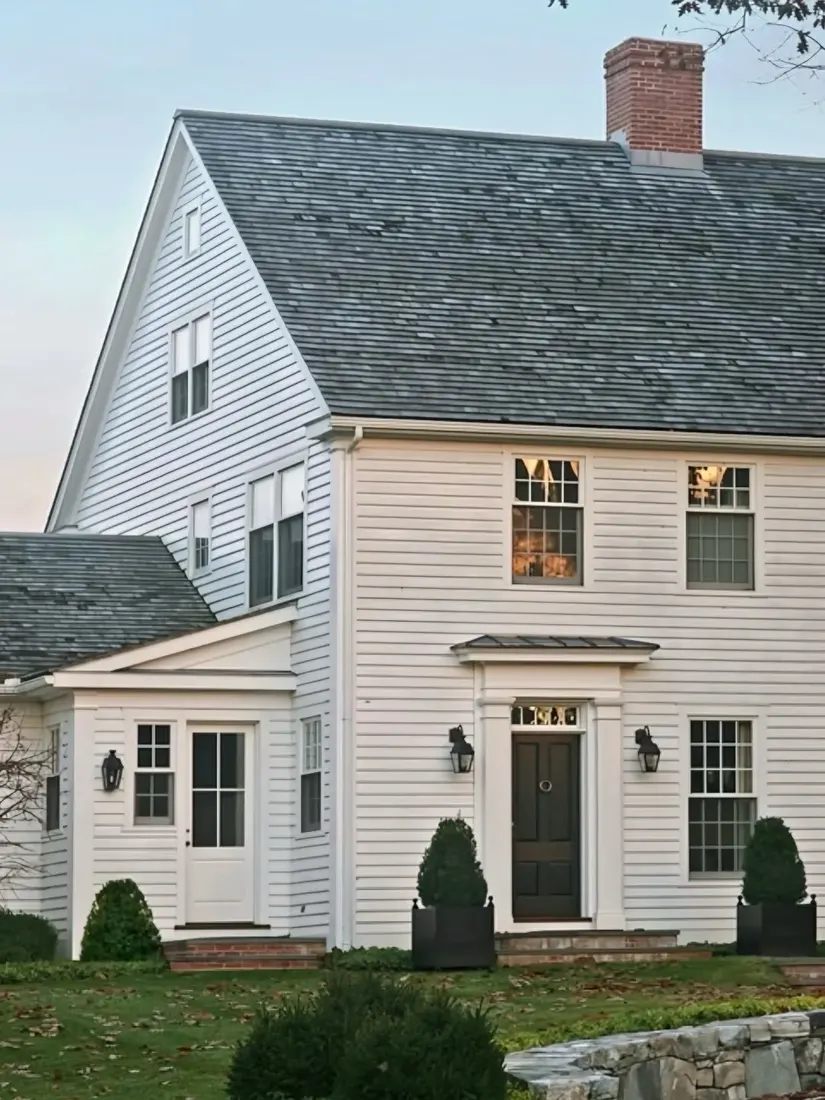
This is the paired lantern lesson in one frame. Black door, white surround, and a lantern on each jamb at the same height. The symmetry is unforgiving here, since one lamp higher than its twin shows from the pavement, so level both back boxes before ordering.
Fix electrics first. Before ordering fittings, get both cable runs in and both back boxes level. Swapping a single lantern later means filling render and repainting the whole bay. From this photo the housings read as cast aluminium with a matt black finish, the safe choice against white board. Similar bulkhead and lantern fittings run £60 to £140 per pair in 2026 through Jim Lawrence and Screwfix.
Pictured with two cone shrubs in dark planters, again matched. Fibre clay planters of that size run £50 to £95 each in 2026. The side wing sits back from the main face, which is the correct way to add. It reads as later and lesser. Bring it flush and the five-bay front becomes lopsided for good.
Small porch where the hedges do the mirroring
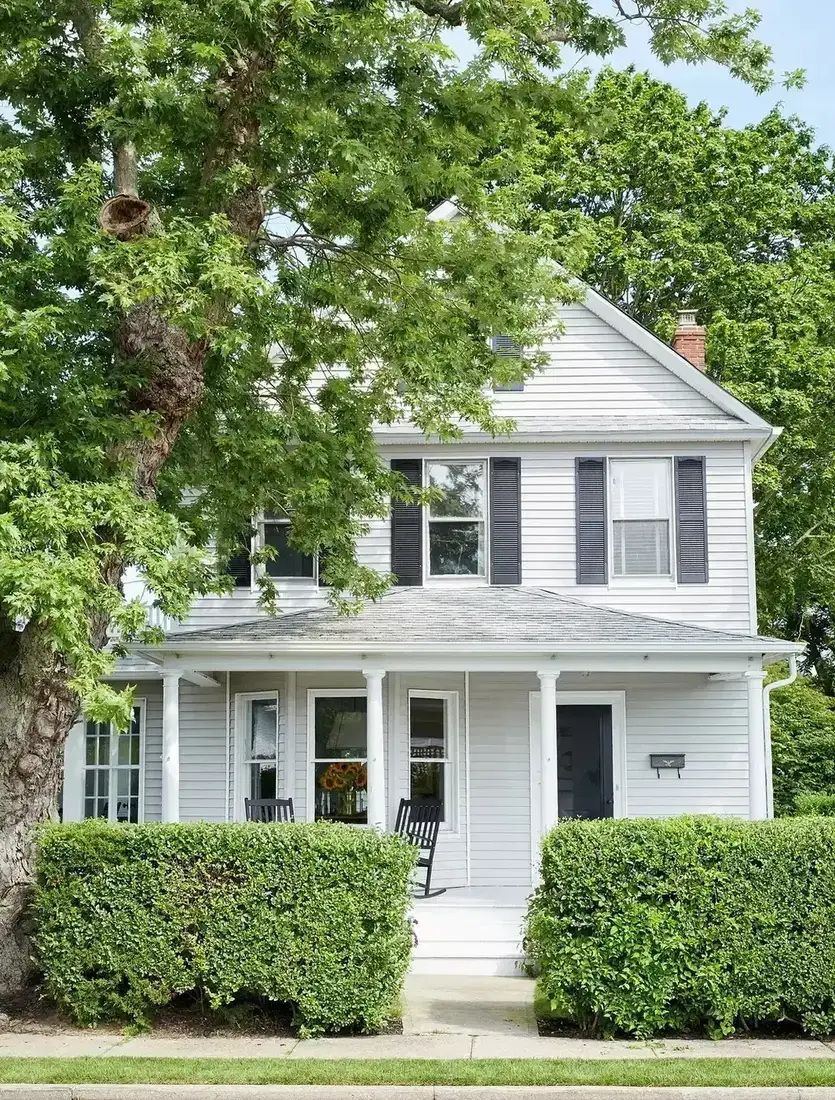
The house here is modest, almost cottage, with a full-width porch on slim columns. The mirror line survives because the hedges carry it. Two blocks of clipped hedging sit either side of the steps, cut to the same height. That is planting doing architecture.
See the shutters upstairs. They flank the upper windows only, black louvres against pale grey board. Downstairs has none, because the porch posts leave no room for a sensible pair. That decision is correct. Shutters on every opening regardless of space reads as a catalogue order.
In that image the rocking chairs sit back in shadow and do not interrupt the front. Keep porch furniture low. Tall pieces block the shadow line from the road and the facade loses depth. Cuprinol Garden Shades in Black Ash for chairs runs £22 to £38 per 2.5 litres in 2026, and a softwood porch floor wants Osmo Decking Oil at £35 to £60 per 2.5 litres in 2026, applied after sanding, since oil over greyed timber peels by spring.
Oxblood shutters and a door left open
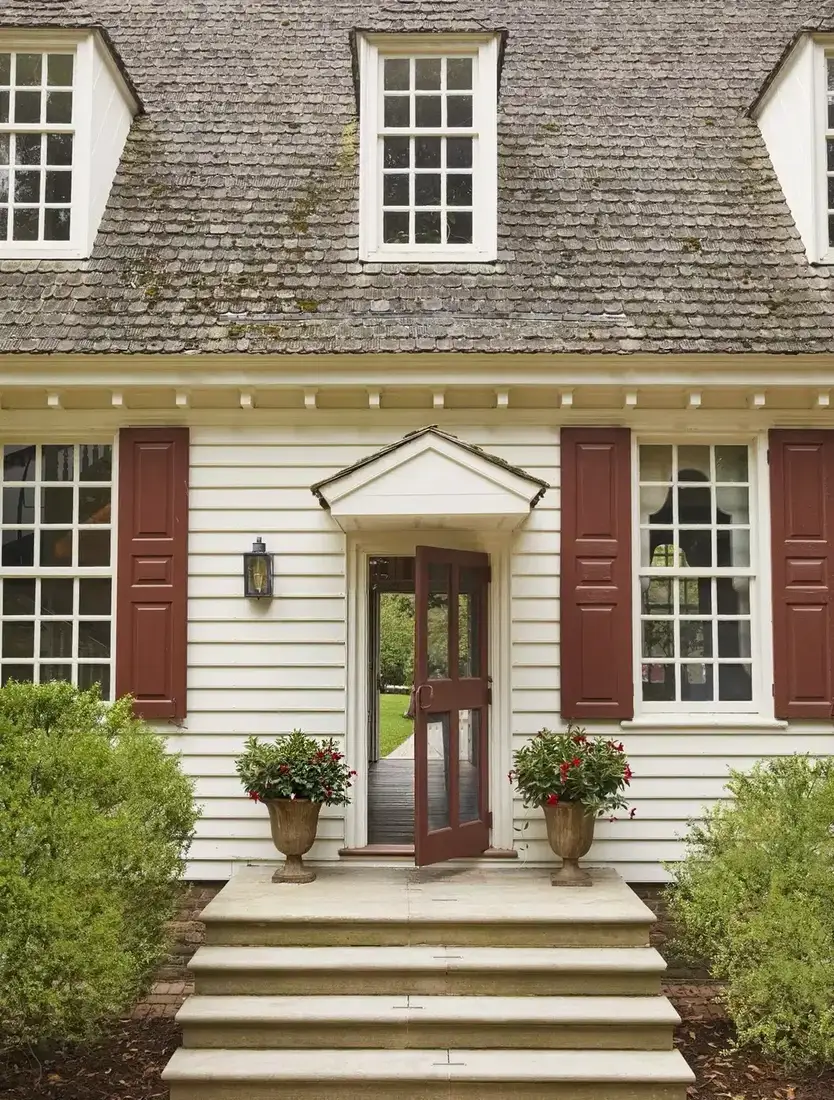
Close crop, useful because it shows construction. The shutters are solid panels, not louvred, in a deep oxblood red. Each leaf looks wide enough to cover its half of the window. That is the test. Narrow decoration boards beside a wide opening announce themselves at once.
Colours close to that red: Farrow & Ball Incarnadine No.248 or Little Greene Baked Cherry 14, with Farrow & Ball Pointing for the board. Do not copy the single lamp without the urns, since a lone fitting on a mirror front reads as if the other one fell off within a month.
Solid softwood shutters, primed, run £80 to £160 per pair in 2026, and hand-forged shutter dogs run £12 to £28 per pair in 2026, hung on hinges, since boards screwed flat to the wall read as applique within a year.
Grey roof that sets the shutter colour
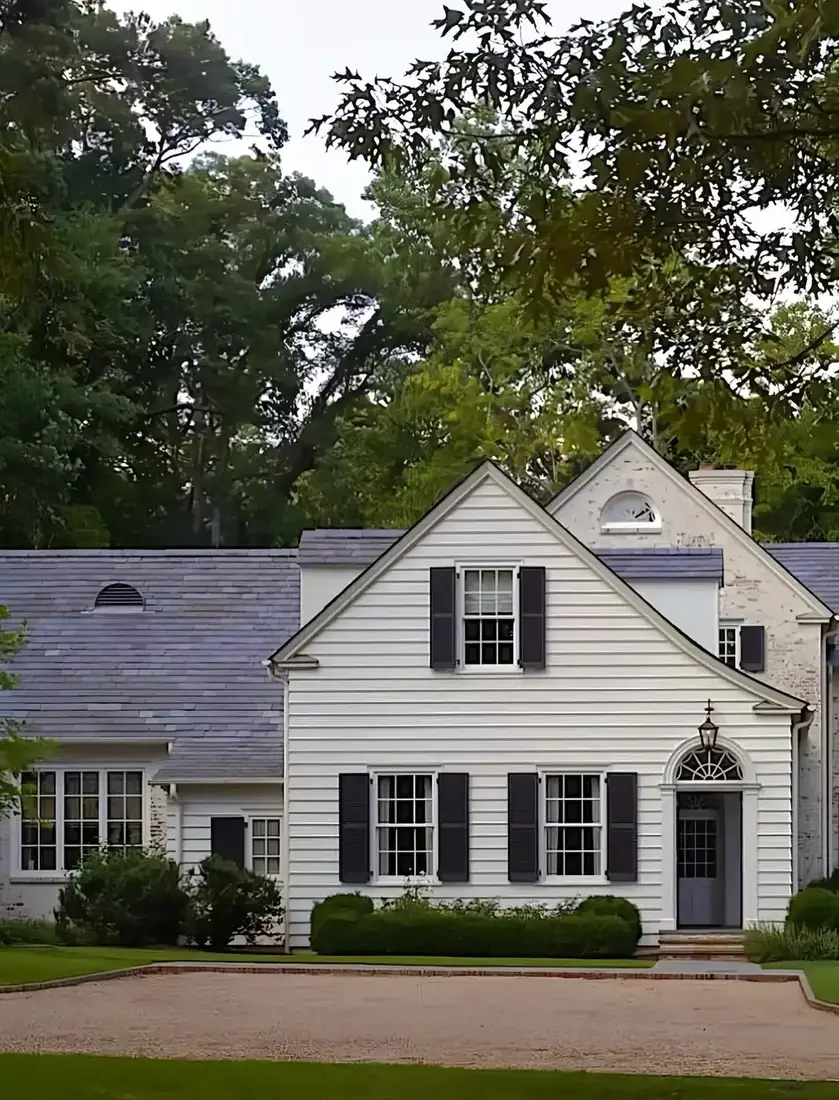
Take the shutter sample outside and hold it so roof, wall, and shutter sit in one glance. In this photo the black shutters sit comfortably under a weathered grey slate because both run cool. A warm brown shutter against that roof would fight it all day.
The front here is L-shaped, not a textbook five-bay, yet the entrance still holds a centre with an arched fanlight over a grey door and one hanging lantern. The gravel forecourt runs straight to the steps, so the arrival stays axial even where the plan is not. Cotswold chippings or Breedon gravel for that finish runs £90 to £150 per bulk bag in 2026.
Trim colours that stay safe against slate are black, white, and deep green. Warm mid-tones go muddy outdoors against pale board, which is the failure to avoid. Farrow & Ball Off-Black No.57 or Benjamin Moore Black HC-190 for shutters, with Sandtex in white for the body. If slates slip, call a roofer. Walking a slate roof without a ladder and a ridge kit breaks more than it fixes.
House seen through trees, still symmetrical
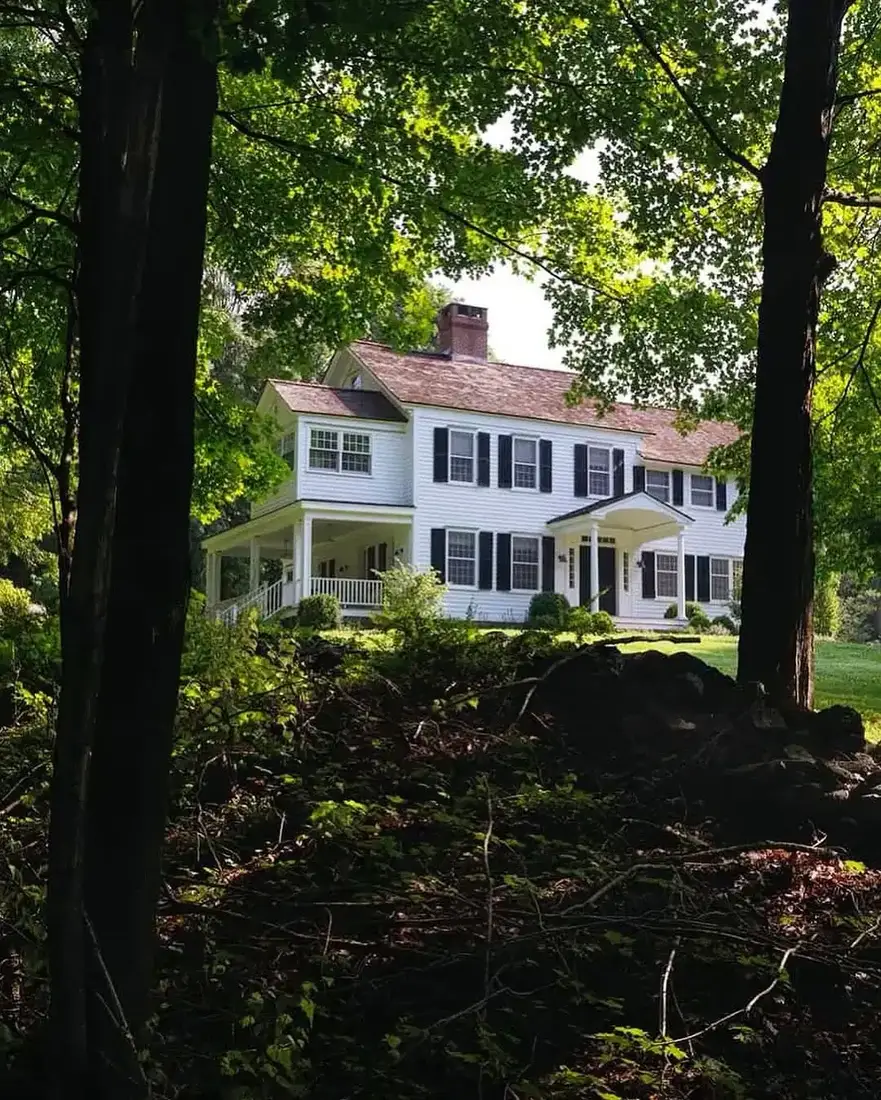
From this photo the house sits well back in trees, half hidden, and the mirror still reads. That tells you symmetry works at distance. The dark shutters mark each bay like ticks, and the small central porch marks the middle. Without that porch the front would dissolve into woodland.
Do not clear fell to reveal it. Dappled shade suits white board and the moss keeps the base dry. What needs doing is low: cut back saplings at ground level, keep the lawn edge crisp, and leave high canopy work to an insured arborist, since a hung limb over a drive is beyond ladders.
For the exterior, white board in shade wants a breathable coating. Sandtex or Dulux Weathershield in white costs £30 to £60 for 10 litres in 2026. Black louvred shutters to match those pictured run £90 to £170 per pair in pine in 2026, fixed on battens with a ventilated gap behind, since trapped water rots the cill within three winters and that repair dwarfs the shutter cost.
Grand porch with a balcony over the door
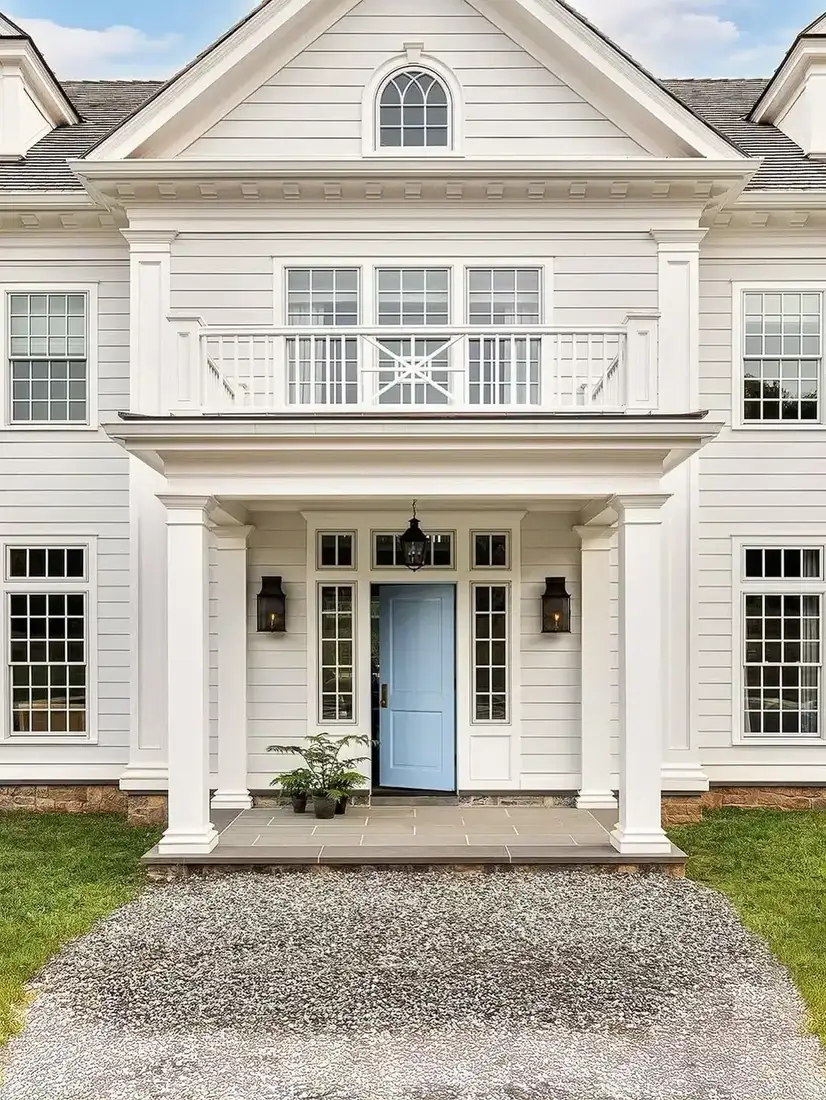
This is the portico mistake to avoid, done right. The porch is wide but it stays single storey, with square columns carrying a balcony that has a Chippendale rail. The door below sits dead centre, pale blue, with sidelights and a transom. The whole stack lines through: door, lantern, balcony rail, dormer window above.
Count the lamps. One hanging lantern on the centre line, plus a wall light on each side of the door. Three fittings, arranged symmetrically. That works. One alone would not. Spare the fussy brass. Matt black with clear glass suits the joinery and the stone flags.
The gravel arrives straight at the steps, which keeps the centre honest. Colours close to that door blue: Farrow & Ball Lulworth Blue No.89 or Little Greene Celestial Blue 101. Exterior eggshell for a front door runs £28 to £52 per 2.5 litres in 2026. Hang the centre lantern on the door axis, not the porch axis, and set out from the door centre, since porches built off the wall end up a little off and a little off shows a lot here.
Tall chimney and a porch read from the side
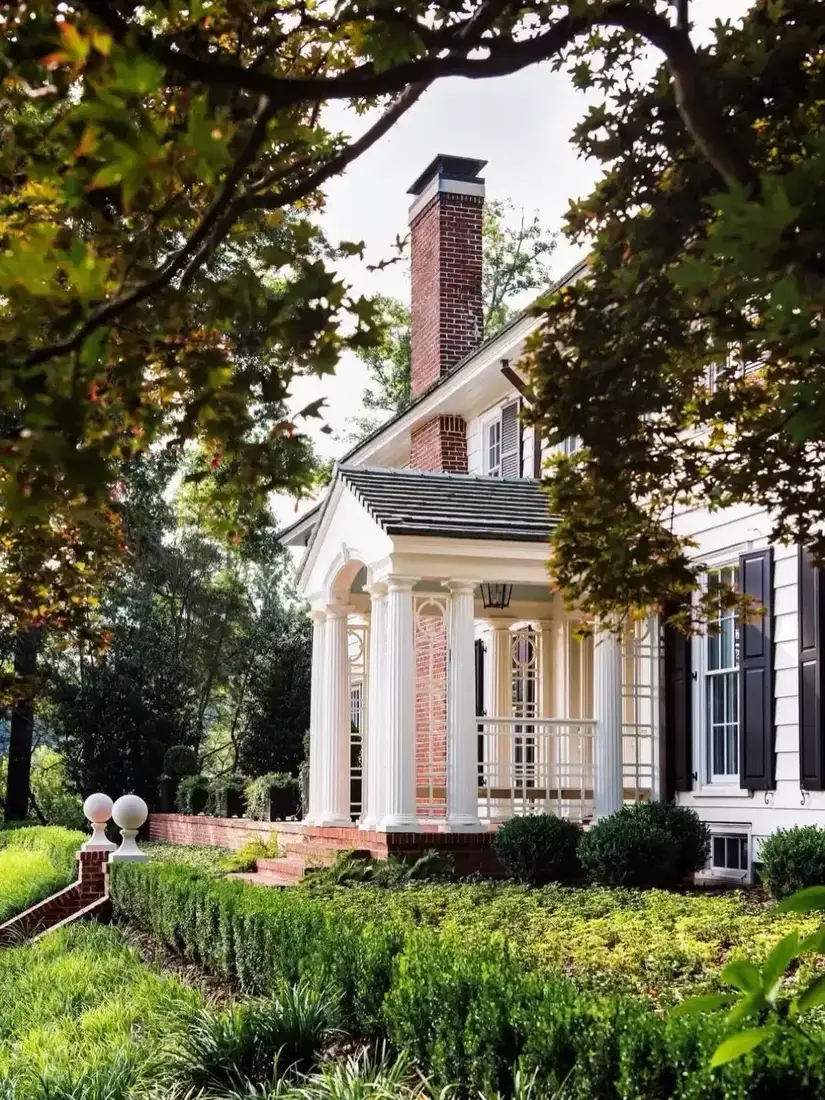
Side view, useful because it shows depth. The brick chimney runs full height, the porch roof has real thickness, and the columns stand clear of the wall with daylight behind them. Thin applied columns pasted to render would read flat from this angle.
Notice how the box planting steps down in height toward the front. That gradation keeps the porch visible instead of burying it. Clip Buxus sempervirens after the last frost and again in late summer. Two clips a year keeps the pair matched. Let one side run and the mirror goes within a season.
Brick and stone here want repointing in lime, not cement. Cement traps water and blows the face off soft brick within a few winters. A bag of natural hydraulic lime runs £15 to £28 in 2026, plus sand. Leave chimney flashing and lead work to a roofer. A leaking flashing tracks behind board for two years before it shows inside, and by then the repair is structural.
Twin chimneys and three dormers in step
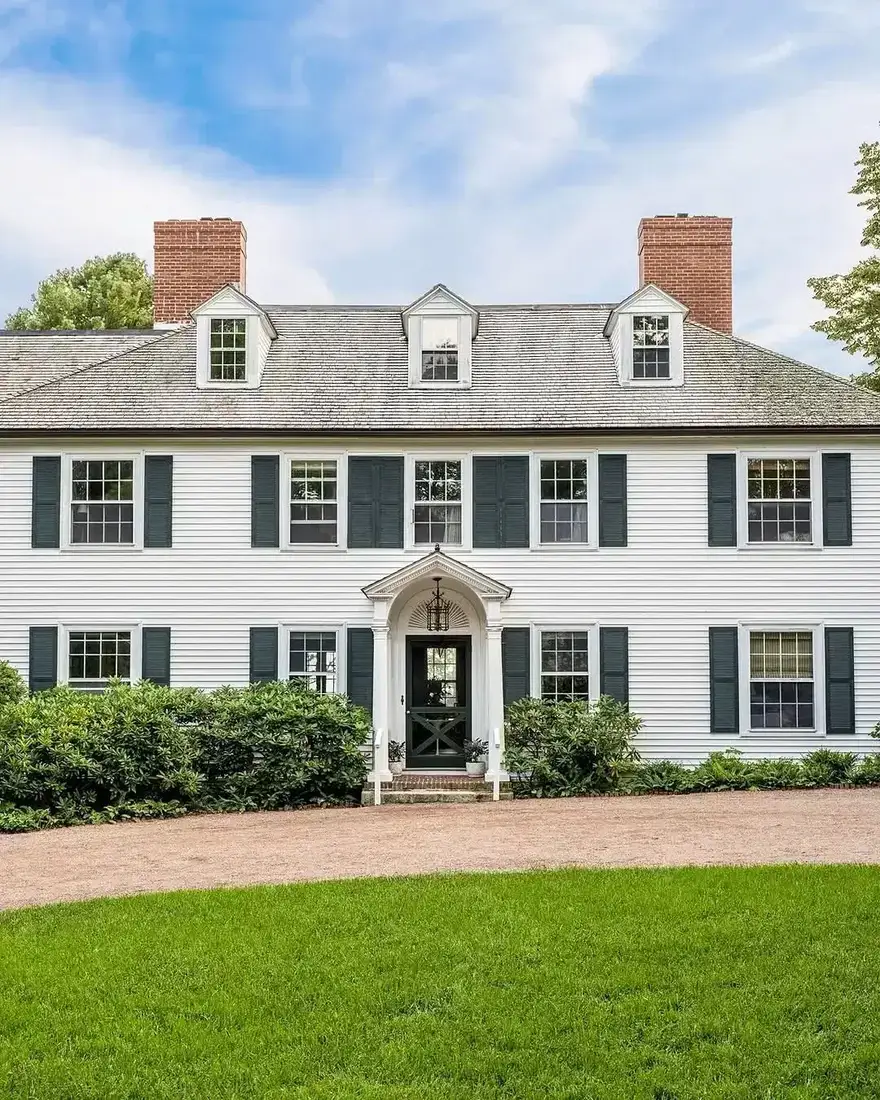
The textbook front. Twin brick stacks, three dormers, five bays below, shutters on every window that can take them. The dormers line through to the windows beneath. Roof and wall agree. That is the rhythm to protect.
Look at the shrubs crowding the base. They have outgrown their pair and started to meet across the middle. Cut them back hard and keep the door surround clear. If one of a pair dies, replace it. Letting the survivor spread across the centre undoes the symmetry faster than any paint choice.
The small pediment over the black door sits on the door centre, with a hanging lantern below it. That hanging point must stay central. Off by a hand and the whole front tilts. Farrow & Ball Off-Black No.57 for shutters and door, Farrow & Ball Wimborne White for the body, gets close to that finish. Exterior paint at £35 to £65 per 2.5 litres in 2026, with shutter repaint on a five-bay front taking a weekend for two coats if the boards are sound.
Pale shutters and a flat porch roof
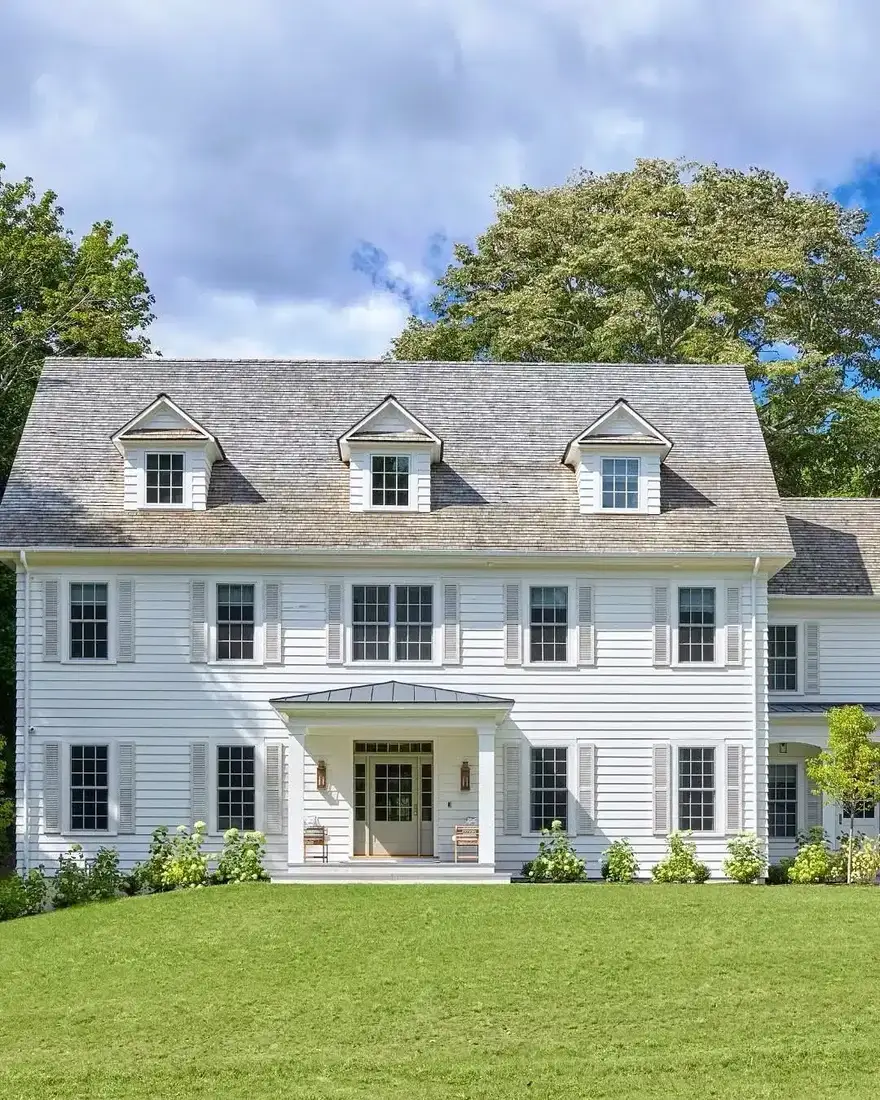
Same dormer count as the last front, different finish. Here the shutters run pale, almost the body colour, louvred, with a flat lead porch roof on square columns. The effect is quieter. Dark shutters mark each bay hard. Pale ones let the openings do the talking.
The wall lanterns sit either side of the sidelights, matched in height and projection. That pair matters more than their style, so keep both, since swapping to one large fitting would leave the entrance without manners. Powder-coated aluminium lantern pairs from Garden Trading and Jim Lawrence cost £70 to £150 in 2026.
The lawn runs straight to the steps with no edging fighting the axis. Mow the stripe toward the door, not across it. It sounds fussy and it shows from upstairs. For the pale shutter finish, Little Greene Slaked Lime 105 or Farrow & Ball Skylight No.205, with Dulux Weathershield on the body. Two thin coats beat one thick coat. Thick exterior paint alligators by the second summer.
Side view where the canopy still centres
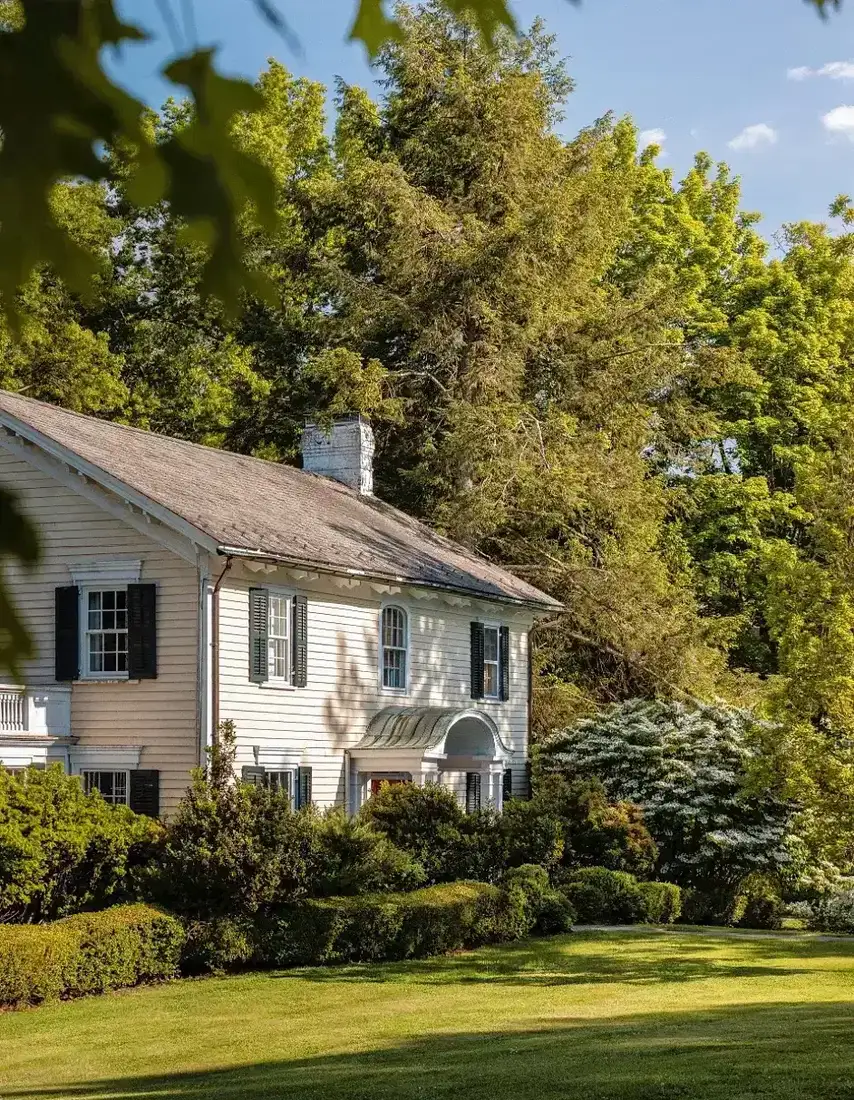
This frame is shot from the side, lawn first, house half turned away. The lesson is still central. The curved lead canopy sits over the door and the box hedge runs level beneath the windows. Even at an angle the middle holds.
That colour on the board is cream with yellow in it, not bright white. Bright white on an older front looks stark and makes green shutters read dusty. Cream lets the black shutters sit soft. Benjamin Moore White Dove OC-17 or Farrow & Ball White Tie No.2002 gets that warmth, with Farrow & Ball Studio Green No.93 for shutters. Masonry and timber paint in those lines runs £32 to £60 per 2.5 litres in 2026.
The downpipe on the corner is doing its job and staying quiet. Do not box it in, since boxed pipes trap condensation and rot the board behind them within two damp winters.
Big tree, round drive, and a door that stays put
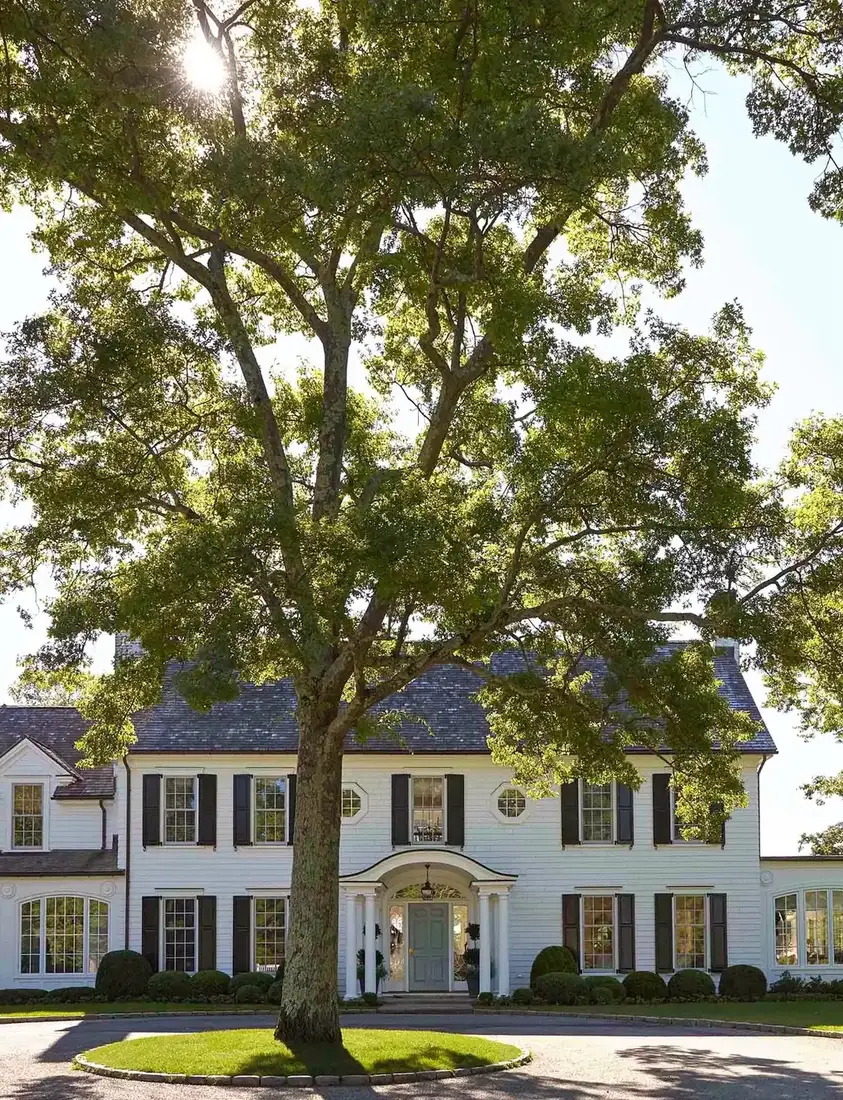
The oak owns the picture and the house still holds its line behind it. That works because the entrance stays central under a curved canopy, with round windows set symmetrically above. The circular gravel drive loops around the tree and returns to the door. The arrival is still axial where it matters: at the steps.
Do not lift the crown hard to show more house. A mature oak with a bad cut never recovers its shape, and the shade is protecting the paint, so get a survey before driving edging pins near roots, since compaction kills fine roots within one dry summer.
For the ground, Breedon gravel on a compacted sub-base runs £95 to £155 per bulk bag in 2026, plus timber or stone edging. The door here reads as a muted blue-grey with sidelights, close to Farrow & Ball De Nimes No.299. Clipped balls either side of the steps run £40 to £80 each in 10 litre pots in 2026. Buy the pair together from one batch, since mismatched nursery stock never quite matches, even after a year in the ground.
Side porch with sheds and a picket line
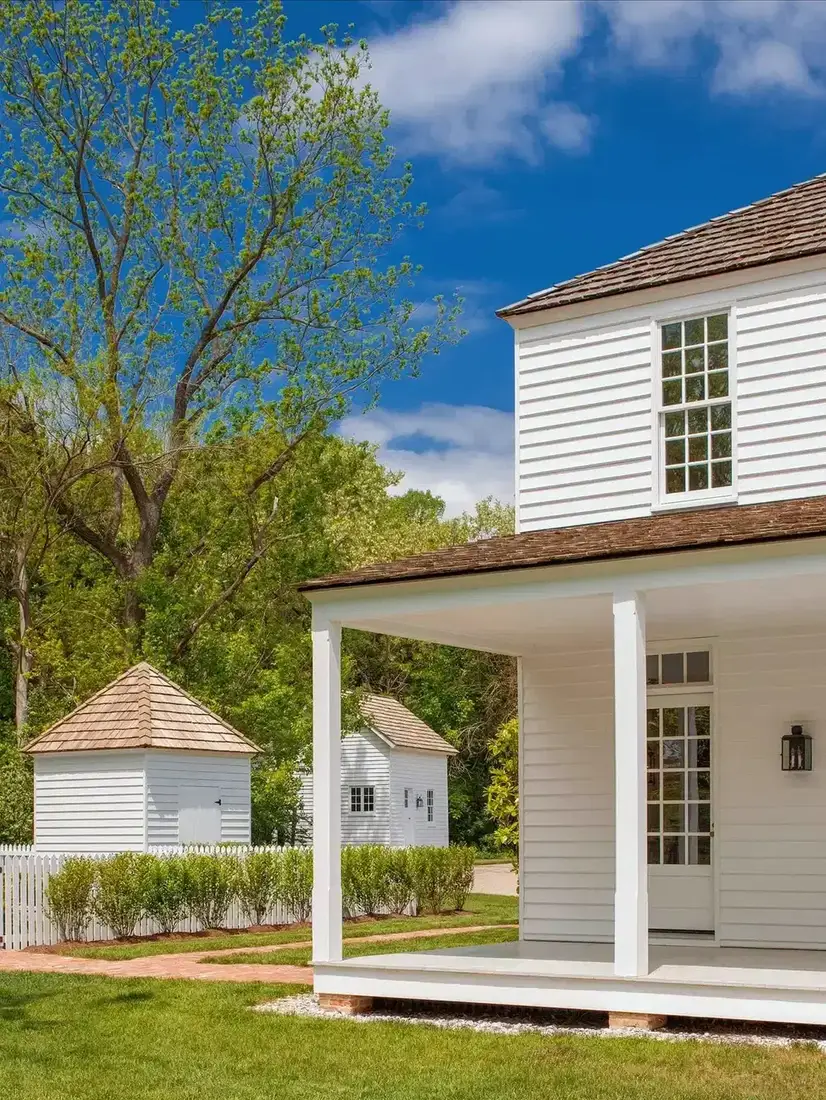
Last one, and it is about outbuildings. White side porch on square posts, two small sheds beyond, and a white picket fence tying them together. The sheds sit back and read as lesser. That subordination is what keeps the main front symmetrical even with extras on the plot.
The one detail that matters is the gate lining through to the door path. Fences and gates join the mirror whether intended or not. A gate set off centre drags the eye sideways before the house is even reached. Set the gate on the door axis first, then run the fence. Sawn softwood pickets and rails run £45 to £90 per bay in 2026 through Wickes and B&Q, plus Cuprinol Garden Shades in white at £22 to £38 per 2.5 litres in 2026.
The wall lantern by the glazed door is black, simple, and correctly single here because this is a side elevation, not the mirrored front. Singles belong on sides and pairs belong on fronts, and external wiring goes to an electrician, since a failed gland lets water track back into the house.
Frequently Asked Questions
How do I tell what is throwing my front off balance?
Stand on the path and take a straight photograph. Fold it down the door line on a phone. The side that will not meet its partner shows the fault, whether it is a lamp hung high, a shrub left to spread, or boards that sit narrow on a broad opening.
Do all openings need timber louvres?
No. Where a corner, pipe, or porch post leaves no space for a proper leaf, bare is calmer. A squeezed board looks contrived, while an uncovered window with a clean casing settles back into the boardwork.
Which trim shades stay safe outside?
Near-black, clean white, and deep bottle green hold steady through seasons. Mid earth shades often turn flat and chalky once fitted to pale weatherboard, so keep warmth in the body and leave the woodwork dark and crisp.
Must the walk run dead straight?
On a mirrored front, yes. The entrance marks the axis, so a wander or side step argues with the brickwork. A direct run to the steps usually lifts the whole elevation more than fresh paint.
What planting suits a mirrored elevation?
Matched shrubs, set as twins and cut alike, one each side of the steps. When a specimen fails, put in a fresh mate instead of letting the survivor colonise the middle and tip the composition.
Can a later wing sit on the same face?
Better set back or to the flank so it reads secondary. Flushing a new block with the old front stretches the bay count and the balance never recovers, however careful the joinery and paint.
In order
- Photograph the front square on and check what does not mirror.
- Keep additions set back or to the side, reading as later and lesser.
- Replace windows in matched sets, in the original proportion.
- Keep the portico small: a hat over the door, not a second storey.
- Size shutters at half the window width and fit dogs and hinges.
- Buy lanterns, urns, and shrubs in pairs, hung and cut to match.
- Bring the path straight to the door before spending on colour.
This article may contain affiliate links. We may earn a commission at no extra cost to you.