Plant Your Herbs Where You'll Actually Pick Them, Beside the Kitchen Door

Add us as a preferred source to see more stories on Google.
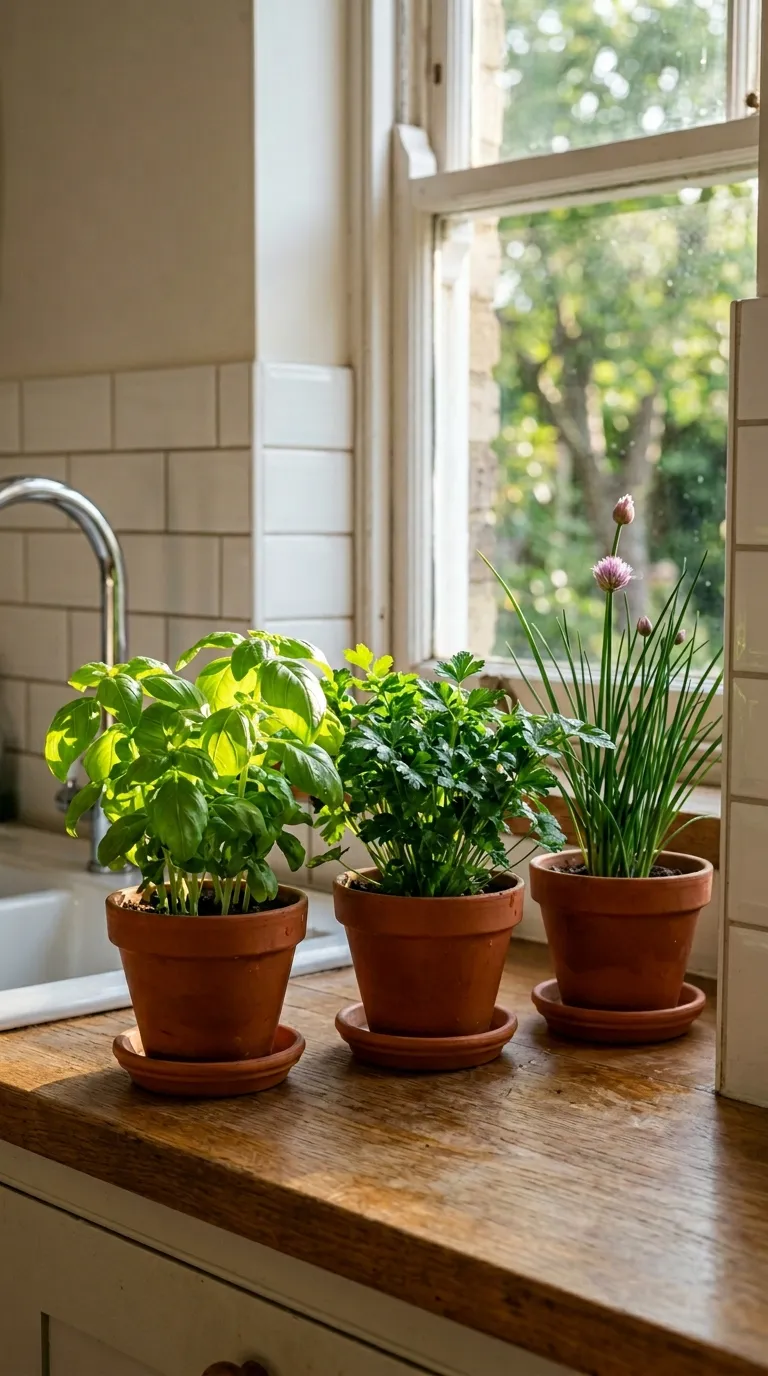
The basil in the photograph below is already struggling, and it is saying so quite clearly.
Look at the gap between its leaf pairs, and at how much bare stem there is near the compost. A basil plant with enough light stays compact, with leaves stacked closely together. One that is short of light stretches: it spends its energy on height rather than leaves, reaching for a brighter position it has not got. That stretching is called etiolation, and by the time it is visible the plant has been unhappy for two or three weeks.
The window here is lovely and the light is dappled through trees, which is exactly the problem. Parsley and chives are perfectly content in that. Basil is not, and if your basil looks like this one, light is almost certainly what it is short of.
A step by the door, not a bed at the end
Every pot in that image is within an arm’s reach of the threshold, and that is the design. The rosemary is carrying flowers, which tells you the step holds light for most of the day, and the hand coming in from the right is taking one sprig off the top of a plant that will branch below the cut.
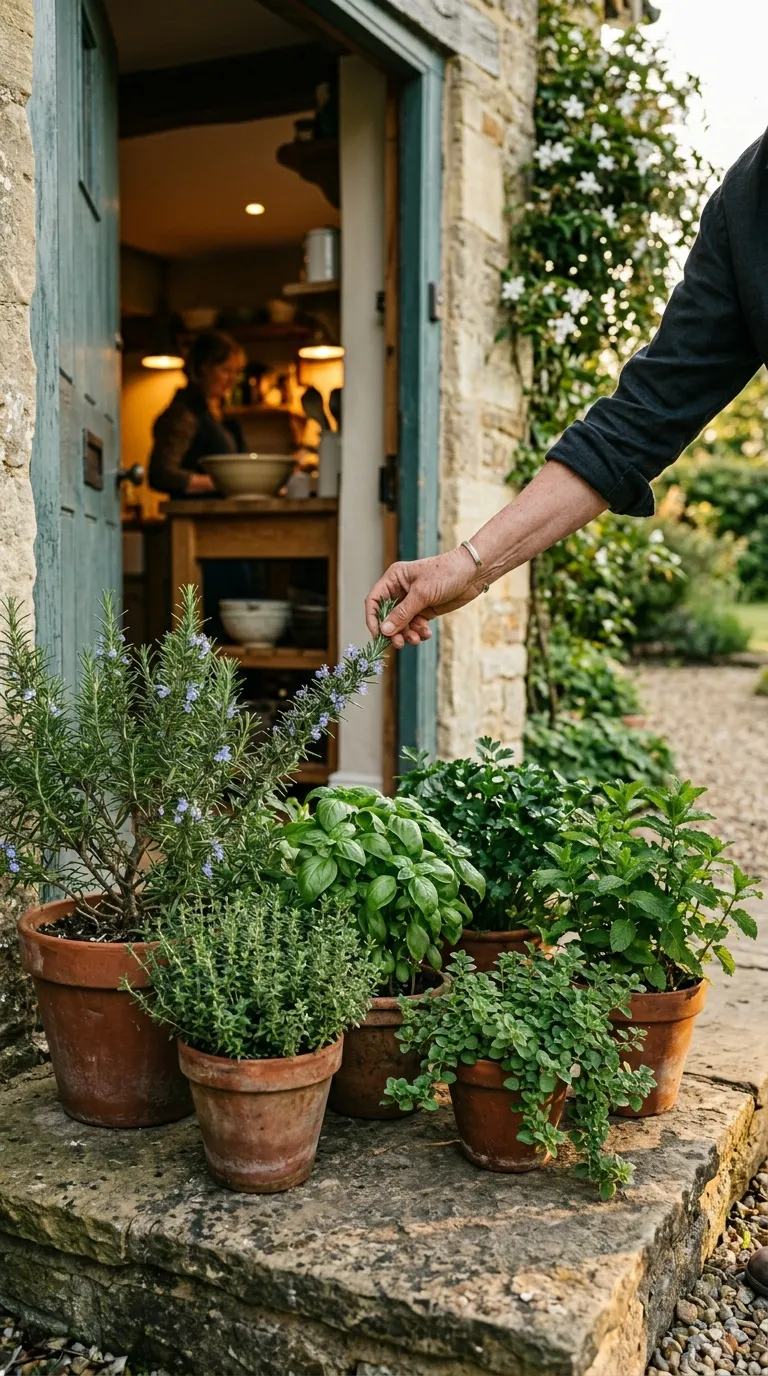
Nearness does more work than soil does. A herb in a bed 15 metres from the door gets noticed on Sundays. A herb on the step gets noticed four times a day, and each glance ends in a pinch, and pinching is what keeps a plant leafy instead of woody. You will pick more from six pots on a step than from a bed you have to walk to, and the plants will grow better for it.
A stone step is a microclimate as well. Stone absorbs heat through the afternoon and gives it back in the evening, so the roots stay warmer overnight than they would in open ground. The open sky delivers rain, which is the advantage and the risk both: a pot in a saucer on stone has wet feet from October to March, and that is how thyme dies. Lift your pots on 20mm feet and tip the saucers after rain.
What each of those three actually wants
They are grouped by how we cook, not by how they grow, which is where most of the trouble starts.
Basil is a tender annual from a hot climate. It wants the brightest sill in the house, ideally south facing, and it sulks below roughly 12°C, which includes a great many kitchen windows overnight in winter. It also dislikes drying out, so the terracotta it usually arrives in works against it.
Parsley is a biennial and far more forgiving. It grows perfectly well in an east or north-facing window, and it will keep going for well over a year before it flowers and turns bitter. When that happens the plant has not failed; it has finished.
Chives are a hardy perennial and, if we are honest, they would rather be in the garden. Indoors they grow thinner and flop. Outdoors they die back every winter, look dead, and come back reliably in spring, which catches people out annually.
The chives in that photograph are in flower, which most people read as a success. It is a transition. Once chives flower the leaves toughen and go slightly hollow in flavour, so it is worth cutting the flower heads off if you want leaves, or leaving them for the bees and accepting that you are growing an ornamental for a few weeks. They are edible in salads, and mildly onion-flavoured.
The pot is a decision, not packaging
Terracotta is porous. Water evaporates through the walls as well as from the surface, so the compost dries faster and the roots get more air. That is excellent for rosemary, thyme, sage and oregano, all of which come from dry hillsides and genuinely resent sitting wet.
It is less helpful for basil, parsley, coriander and mint, which want steady moisture. In terracotta on a warm sill you will be watering those most days through summer, and if you miss two days in a row you will usually lose the basil.
| Herb | Light | Pot | Honest verdict indoors |
|---|---|---|---|
| Basil | Brightest you have | Glazed or plastic | Hard. Treat as a few months, not forever |
| Parsley | Part shade is fine | Either, deep | Easy and long-lived |
| Chives | Bright, cool | Either | Survives; much better outdoors |
| Mint | Part shade | Glazed, on its own | Easy, but never share its pot |
| Rosemary | Full sun | Terracotta | Difficult indoors; wants outdoor air |
| Thyme | Full sun | Terracotta | Good if the sill is genuinely sunny |
Whatever pot you choose, it needs a drainage hole. A decorative cachepot with no hole will kill almost anything within a month, and the symptoms look like underwatering, so you add more water and finish the job.
For compost, a peat-free multipurpose is fine for the leafy herbs. Melcourt SylvaGrow is the one that consistently performs well in independent trials and is widely available. For the Mediterranean group, mix in roughly a third horticultural grit by volume to open it up.
One pot that does the lot, and where it fails
Volume changes the arithmetic. The dark green glazed pot in that image looks like it holds 20 litres or more, against the half-litre a supermarket herb arrives in, and a big body of compost dries slowly and evenly. A missed day in July costs a few leaves instead of the plant. A container you can leave for a weekend needs volume, which is the thing to buy.
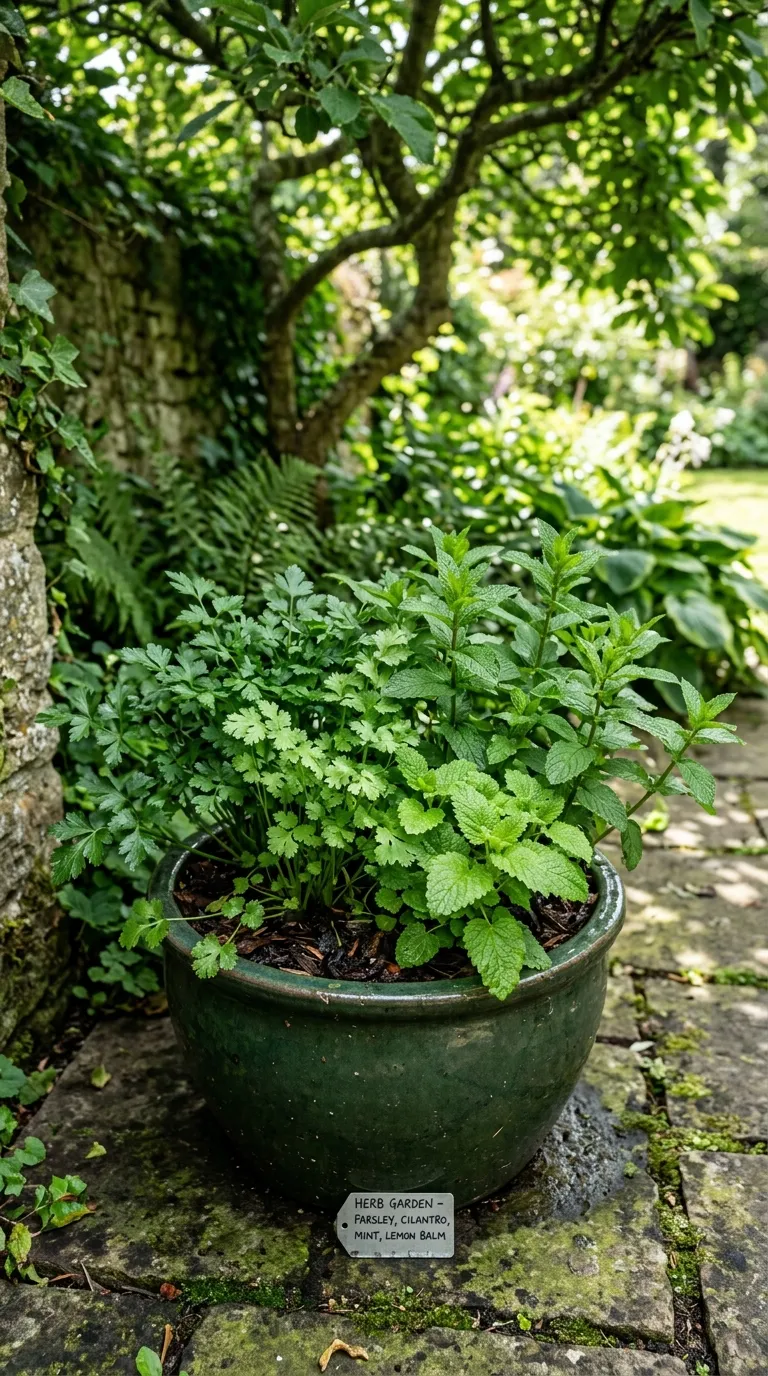
The glaze matters too. Water leaves a glazed wall only from the surface, where terracotta loses it all round, so a glazed pot in shade can go two or three days between waterings where a terracotta pot on a sunny sill wants attention daily. That suits what is planted in it: flat-leaf parsley and lemon balm both come from places with summer rain, and so do coriander and mint.
The awkward part is the label. Four herbs in one pot share one watering regime and do not want the same one. Coriandrum sativum bolts within weeks once the roots warm up, mint travels sideways on runners and shoulders the parsley out inside a season, and Melissa officinalis is the most aggressive plant in the frame. By autumn you are likely to be left with two survivors, and both will be the thugs.
Mint needs a pot of its own
Mint is the one herb where the container is not a preference. It spreads by stolons, stems that run just under the surface and root wherever they touch, so one plant can travel 60cm in a season. In open ground it knits into a mat and the parsley beside it loses. Mentha spicata, the spearmint sold as ‘Moroccan’, is the worst offender.
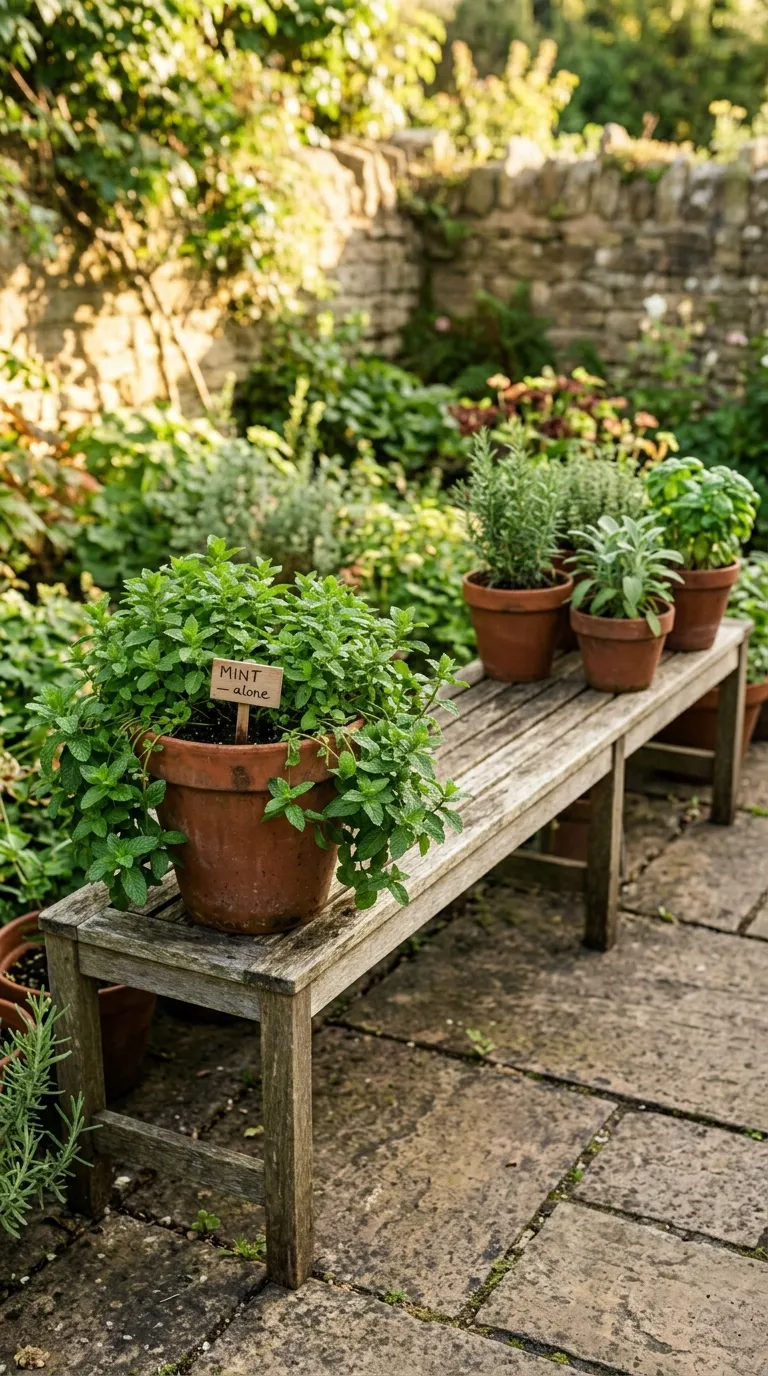
The white label on that bench is the idea in three words. A 25cm to 30cm pot holds mint comfortably and can be plunged rim-deep into a border, which keeps the runners where you can see them. Lift and split the rootball every second spring, because a potted mint fills its compost with root within two seasons and then sulks. Leave it to run in open ground and you will be lifting it out of the parsley bed for years.
Two things follow from how mint grows, and both affect where you put it. Mint likes moisture and tolerates part shade, so it crops in a north-facing corner, and it comes through a wet winter that kills thyme outright. In full sun in terracotta it does the opposite: it wilts by noon, and mint rust, Puccinia menthae, moves in on stressed leaves.
The dry group, and how to keep it dry
The four woody herbs share an origin, which explains nearly everything about keeping yours alive. They come from thin soils over limestone, where rain arrives in winter and almost none falls in July and August. Their roots run shallow and wide, which is why a wide bowl suits them better than a tall pot, and why a pot with a wet sump at the bottom kills them faster than a dry fortnight does. Choose a bowl you can lift, because you will be moving it under cover for winter.
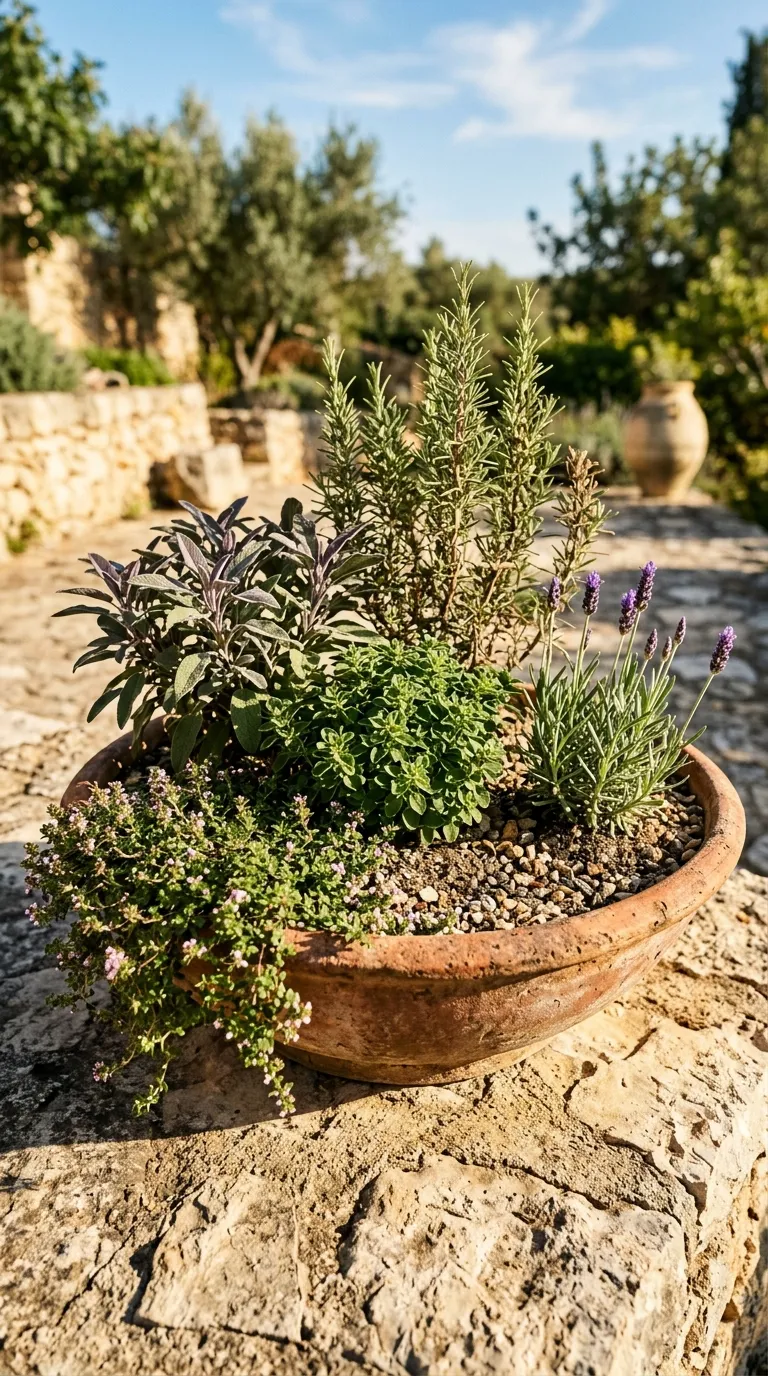
Full sun is not a preference for this group. Below about 6 hours of sun in summer, Thymus vulgaris goes leggy and Origanum vulgare loses the pungency that makes it worth growing. The aromatic oils are a response to heat and drought, so a plant grown soft in rich compost makes a great deal of leaf and comparatively little flavour. Feed rosemary through a summer and you trade flavour for leaf. Lean is the point.
The grit in that bowl is doing two jobs. Mix one part horticultural grit to three parts peat-free compost and drainage improves; spread 20mm of 4mm grit over the surface and the collar of the plant stays dry, which is where these herbs rot in a British winter. Salvia officinalis ‘Purpurascens’ is the least hardy thing in the frame, and winter wet is what takes it.
If the sill is genuinely dark
Some kitchens simply do not have the light, and no amount of care substitutes for it. This is where honesty serves better than encouragement.
If your kitchen faces north, grow parsley, chives and mint, and buy basil as a cut herb. Alternatively, a small LED grow light on a timer will keep your basil compact through winter. The evidence on specific spectrums for culinary herbs at home is thinner than the marketing suggests, but the broad finding is consistent enough: more light, closer, for longer hours produces sturdier plants. Twelve to fourteen hours, positioned within about 30cm, is a sensible starting point.
A trough under the window
That trough is doing something a windowsill cannot. It sits on the outside sill under an open casement, so the herbs get full light and moving air while staying 60cm from the chopping board. Chives are in there, along with flat-leaf parsley and basil, and Thymus serpyllum, the creeping thyme, is spilling over the front lip.
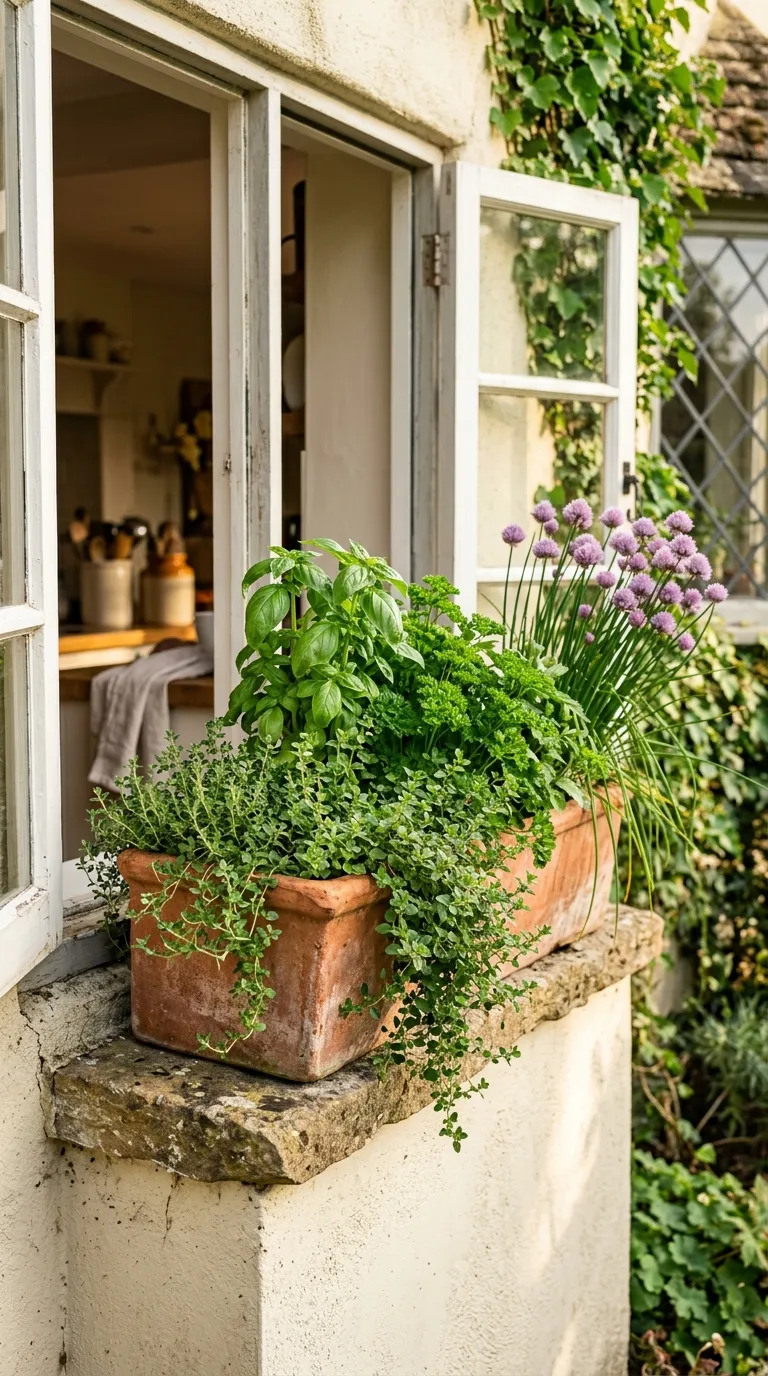
Troughs behave differently from round pots, and the shape is the reason. At 60cm long and 20cm deep, one holds enough compost to buffer a hot afternoon, but the ends dry before the middle does, so a single watering leaves the corners short. Water it in the morning, while your compost is still cool.
Two problems are visible in that picture. The chives are in flower, which means the leaves have already toughened. And the thyme wants to dry out while the parsley beside it wants to stay damp, so the two will never be equally content. You will water a trough more often than you expect, and the plant you care about most will still be the one that suffers. That is the compromise inside every mixed container, so decide in advance which one matters to you.
Pinching, and why basil answers it
Set this plant beside the stretched one at the top of the page and you can read what has been done to it. This is a bush: several stems, each branching twice, leaves stacked closely, and no bare stem above the compost. The difference is apical dominance.
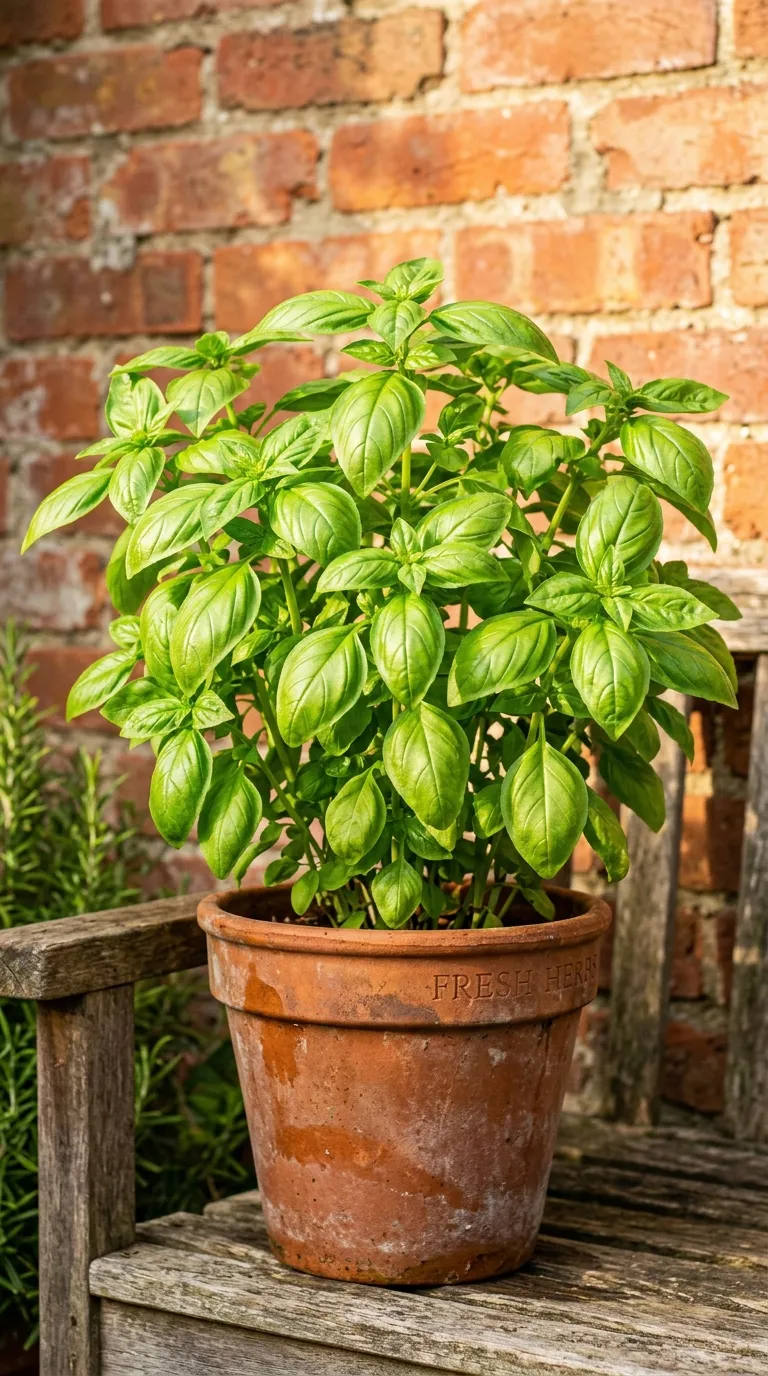
A growing tip produces auxin, which travels down the stem and suppresses the buds in the leaf axils beneath it. Remove the tip and the suppression leaves with it, so the two buds at the leaf pair below the cut wake up and extend. One stem becomes two. You can take that tip off with your thumbnail, and it costs the plant nothing. Pinch above a leaf pair every two or three weeks through summer and a supermarket plant becomes a bush that crops until the nights turn cold.
What it cannot do is keep going. Ocimum basilicum is a tender annual, and by late August it will be flowering whatever you do, with smaller leaves and a faint bitterness under the aniseed. The other half of the picture is the shrubby perennials, which build a woody framework over years and get cut back each spring. Rosemary and thyme are the obvious ones; sage and oregano work the same way. Annuals give you volume in one season. Perennials give you less, for longer.
Herbs on a wall, in a small space
A wall planter is a stack of different climates, and the labels in this one happen to be in the right order. The top shelf takes full sun and wind, so it dries fastest; each shelf below sits in the shade of the one above and catches the drips, so the bottom is the coolest and the wettest. Thyme and rosemary sit on the upper shelf, with parsley and oregano lower down, which is roughly what the gradient asks for.
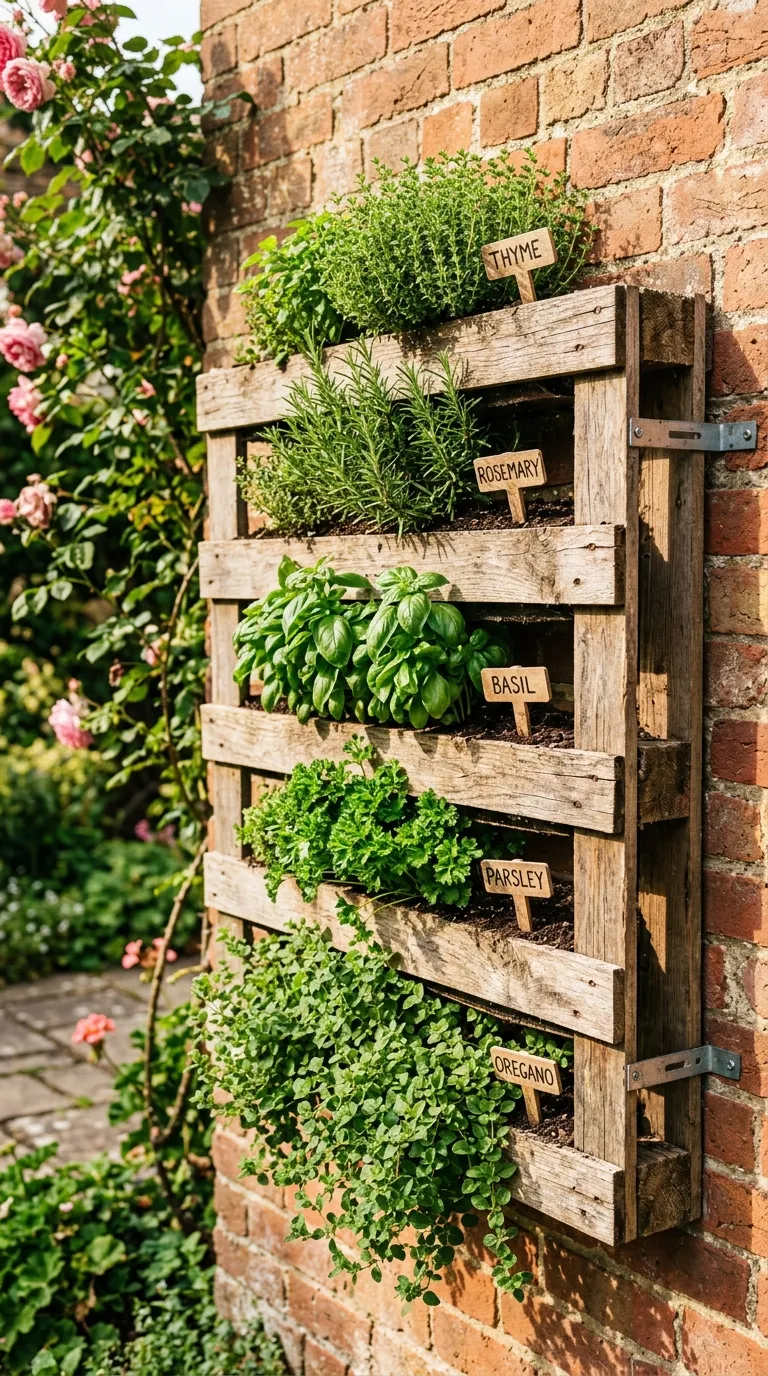
Two things decide whether it works. The first is volume, because each shelf holds perhaps 8 litres of compost and that is a thin reservoir on a hot day. A brick wall facing the sun radiates heat back into the pots well into the evening, so plan on watering daily in July and August. If you go away for a week in high summer, expect to lose some of it.
The second is the timber. Pallet wood is usually heat treated and carries an HT stamp; some is fumigated with methyl bromide and marked MB, which you do not want beside anything you eat. Fix the frame with M8 sleeve anchors into the brick, not plugs, because your fixings carry the weight of soaked compost, which is roughly twice what you would guess from looking at it.
The three-tread ladder
A ladder gives you three heights in the footprint of one pot, and unlike the wall planter above, it can be moved. That sounds trivial and is not: herbs in containers are largely at the mercy of a wall that never changes its angle to the sun, and a stand you can turn in October or shift 2m into the lee of the house keeps a rosemary going through a winter it would otherwise lose.
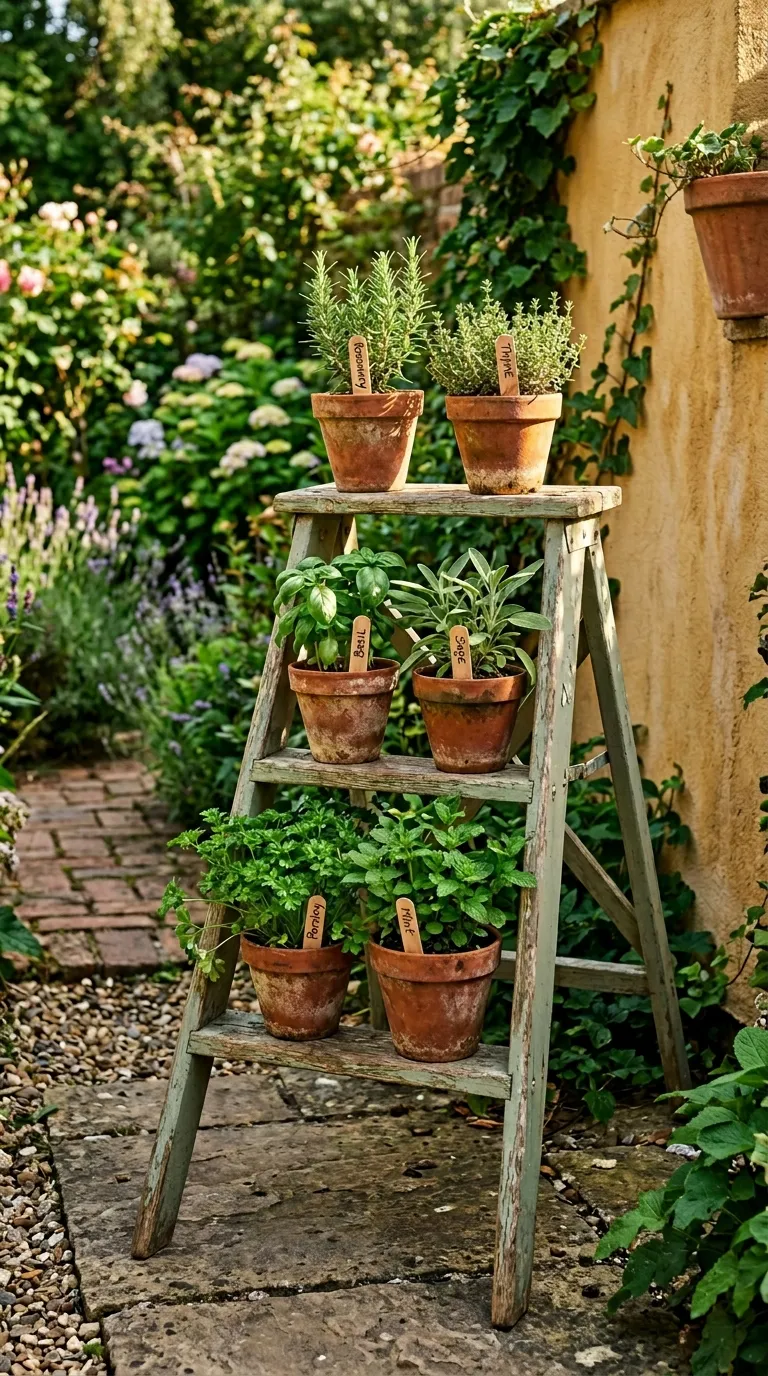
The treads repeat the same gradient. The top one is the most exposed, so Thymus vulgaris and rosemary sit there; the bottom tread is shaded by the two above it and takes their drainage, which suits mint and parsley better than anything woody. The labels are earning their place, because once the plants fill out a six-pot ladder is a green tower and you cannot tell sage from oregano at a glance.
A wooden ladder left out in the weather rots at the feet first. Stand it on two bricks or a paving slab, and treat the bottom 150mm of each leg with a clear wood preserver. Secondhand ladders turn up at car boot sales for £10 to £40; a new pine one runs £25 to £60, which is less than you would pay for three large terracotta pots.
The spiral, which is a microclimate in a circle
The spiral is the only structure here that answers two problems at once, and the mechanism is a gradient. Built up to about 90cm at the top and curling down to ground level, it gives the upper courses more sun, more wind and faster drainage, because water has to travel down through the stone before it reaches the base. The lower end turns back on itself and sits in the shade of the wall behind it, staying noticeably damper.
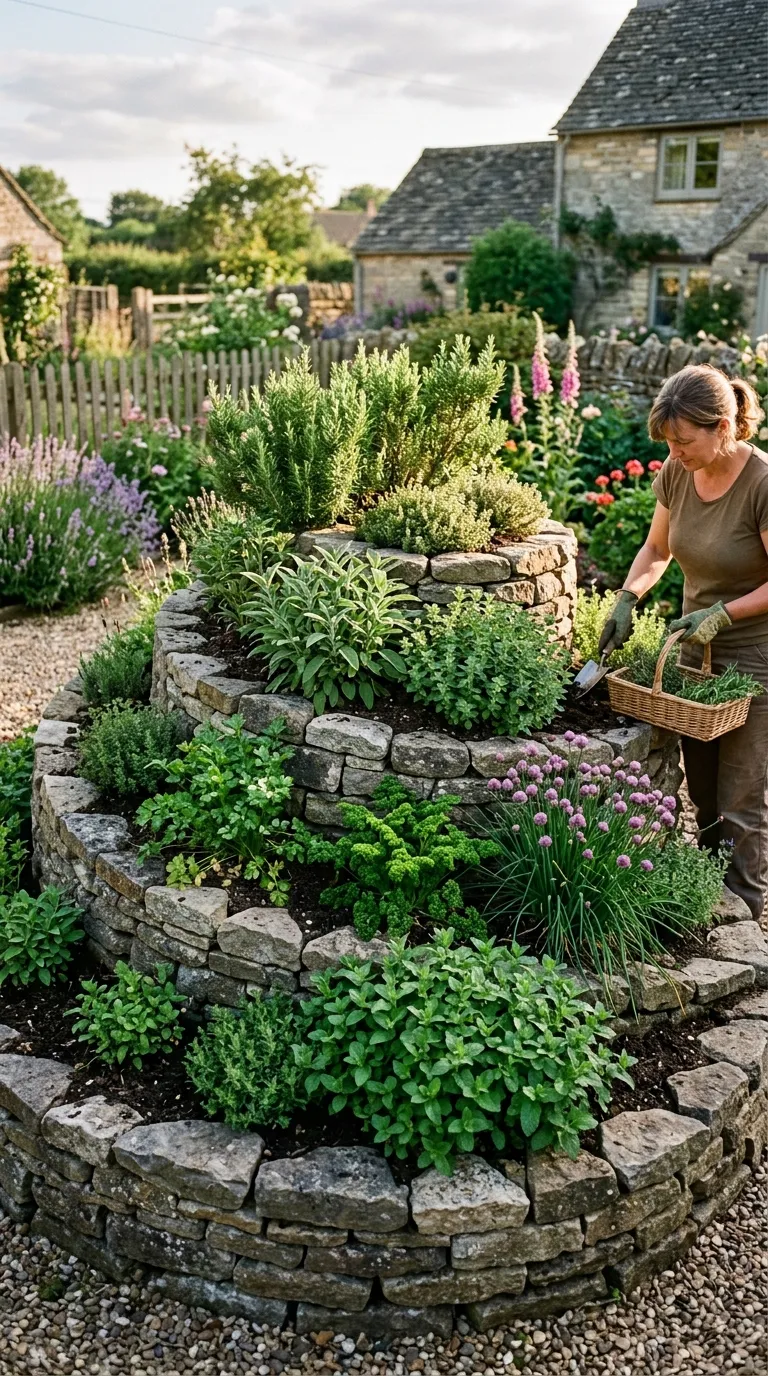
So the woody herbs go in at the top, where the mix is half grit and the roots are close to dry by evening. Mint and parsley go in at the bottom, and so do chives and chervil, where the compost is heavier and holds water. In the photograph the rosemary and the purple sage are high, the chives and oregano sit halfway down, and the mint and parsley are at the base.
Dry stone is the right construction. Limestone or sandstone laid without mortar drains freely, moves with frost, and lasts for decades. The honest cost is the building: a spiral 2m across takes a weekend and roughly 1 tonne of stone, and it cannot sensibly be built in stages. Put the herbs you use most at the bottom, where you will pass them on the way in.
Let them flower, at least once
Every plant in that border is a culinary herb, and every one of them is in flower. The pom-poms in the middle are chives, the purple spikes behind are a catmint, the blue flowers at the left are rosemary, and the low mat at the front is a flowering thyme. A butterfly is resting on one of the chive heads, which is the argument for allowing this.
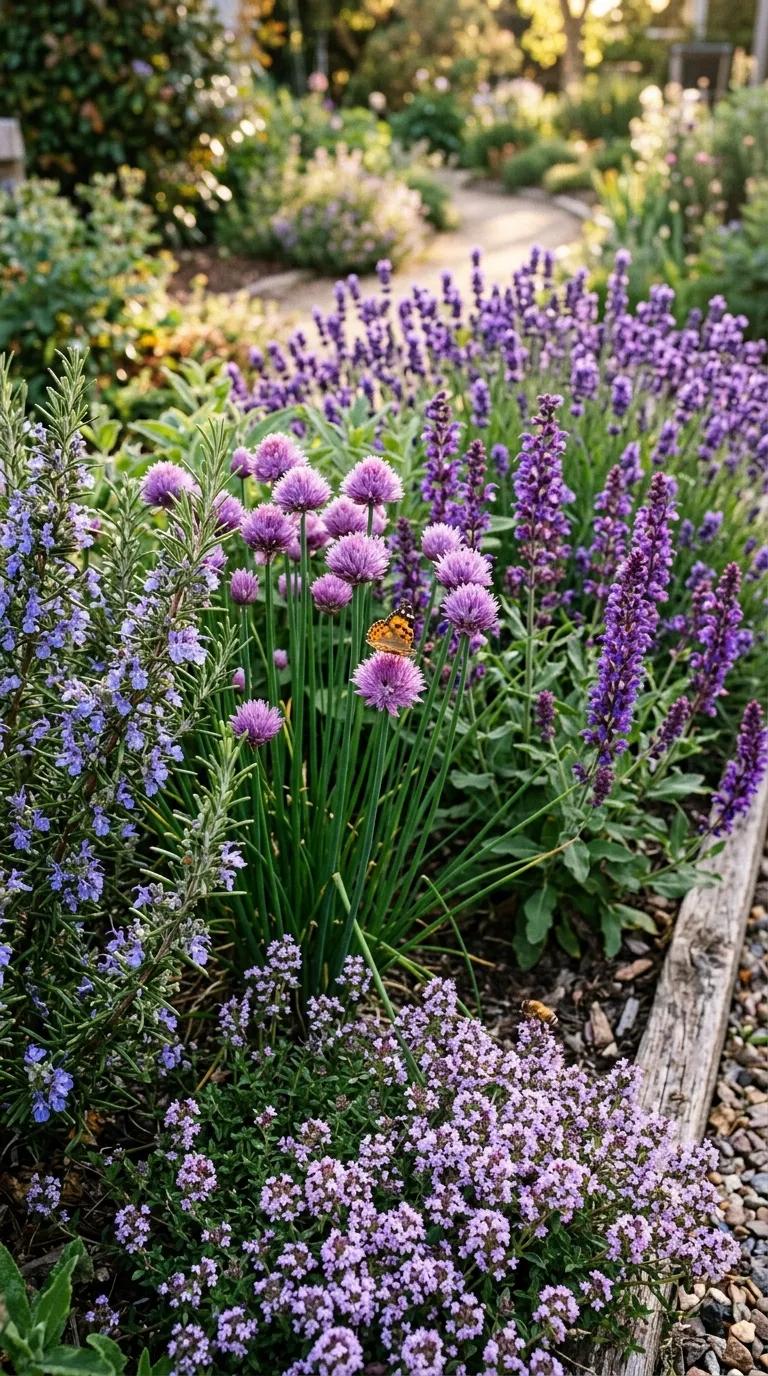
The mechanism decides when you cut. Flowering is a change of job: the plant stops building leaves and starts building seed. In chives, Allium schoenoprasum, the flower stalk is a leaf that has been reassigned, and the remaining leaves toughen and hollow out in flavour as the buds open. Thyme and oregano do the same thing more slowly across June and July.
The practical answer is to split the patch. Cut one clump of chives hard and leave the next one to open, and you get soft leaves for the kitchen and seed for next year’s plants at the same time. You can cut your chives hard in May; they are back in leaf within a fortnight. Your chives will forgive that, and a rosemary will not. Thyme and oregano take a trim straight after flowering and put on a second flush of leaf in August, which is the crop that carries you into autumn.
A wreath is a summer ornament
A wreath is a container, and a very small one. Under the thyme and the oregano there is a wire frame packed with sphagnum moss, and the plants are rooted into the moss with a handful of compost around each one. Volume is the whole story: a wreath this size holds less growing medium than a 9cm pot, spread around a metre of frame, so it dries from every side at once.
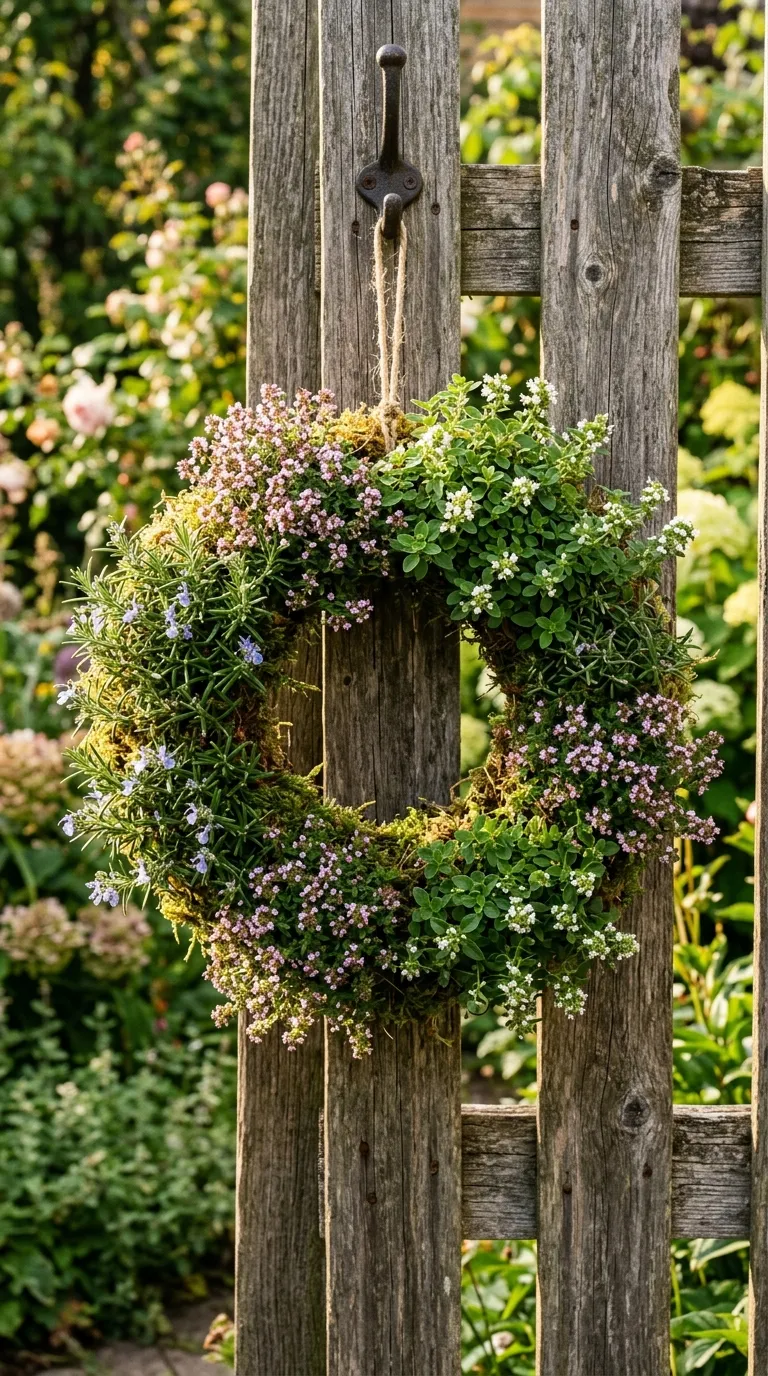
Watering follows from that. A can poured over the top runs straight off the moss, so a wreath is soaked instead, face down in a basin of water for 10 minutes, whenever your moss feels light. In a hot July that is every other day.
The herbs have to come from the dry group. Thyme and rosemary work; oregano and winter savory do as well. Anything wanting steady moisture fails in moss, and mint would be dead inside a fortnight. Hang it where it gets sun and moving air, because a wreath left in the damp grows mould instead of herbs. Hang it where you will see it, too, since a wreath you forget is a wreath you never water.
It is a summer ornament and a garnish supply, not a kitchen garden. If you want herbs you can cook from, plant a trough instead. Wire frames cost £5 to £15, and a planted wreath of this size runs £40 to £70 in 2026.
Frequently Asked Questions
Which herbs need full sun and which will take shade?
The woody herbs want the brightest spot available and ground that drains freely: rosemary and thyme first, then sage and oregano. Lavender wants the same treatment. Parsley and chives manage on half a day of sun or less, and mint and chervil are happy there too. Basil sits at the demanding end, wanting warmth and light together, and it is the first to suffer when either runs short. If your basil is stretching, that is what it is telling you.
Why does a supermarket basil plant collapse after a fortnight?
Usually because a dozen seedlings were crammed into one small pot and have nowhere left to grow. Split the clump into three or four, move each piece into a container of 15cm or more, and stand them somewhere bright. Cold does damage too, so a chilly sill overnight causes harm you will only see a week later.
Does mint really have to be kept separate?
In open ground, yes. It travels underground by stolons and will turn up among your parsley inside two seasons. A container settles it, and a 25cm pot is large enough to crop from; sink it to the rim in a border if you want it to look planted. If you plant it out in a bed, you will spend the next two summers digging it back out.
How often should herbs be cut?
Little and often beats one large harvest. Take the tips of your leafy herbs every week or so and they keep making side shoots, while leaving them alone until August gives tough stems and a plant that has already started to seed. Woody herbs are a different job: two or three cuts between spring and late summer is plenty, and the final one should be light.
Can herbs be grown on a north-facing windowsill?
Parsley and chives will cope there, more slowly than they would elsewhere, and so will mint and chervil. Basil and the Mediterranean group will not, and nothing compensates for the missing light. A small lamp on a timer for 12 to 14 hours, held about 30cm above the pots, is the workable substitute if basil matters to you.
How large a container does a herb plant need?
Larger than the one it arrives in. Give a single plant at least 20cm of width, and choose a 30cm pot or a 60cm trough where you can, because the compost swings less between soakings. Whatever you pick needs a hole in the base; a sealed decorative pot is the commonest reason a healthy plant is dead within a month.
Where to start
- Put the herbs on the route you already walk, because picking is pruning and a bed you pass daily gets cut.
- Group by water and light, keeping the woody herbs in full sun and grit and the leafy ones in moisture and part shade.
- Give mint its own 25cm pot, or plunge one rim-deep, and lift and split it every second spring.
- Keep containers at 20cm and up, since volume is what carries a plant through a missed watering.
- Take the growing tips out of basil every couple of weeks, and expect the plant to finish in autumn anyway.
- Feed the Mediterranean herbs sparingly, because rich compost dilutes the oils that make them worth growing.
- Cut some herbs to keep them leafy and leave others to flower, then trim thyme and oregano for a second flush.
- Lift pots onto feet and empty the saucers, since winter wet kills more rosemary than frost does.
This article may contain affiliate links. We may earn a commission at no extra cost to you.