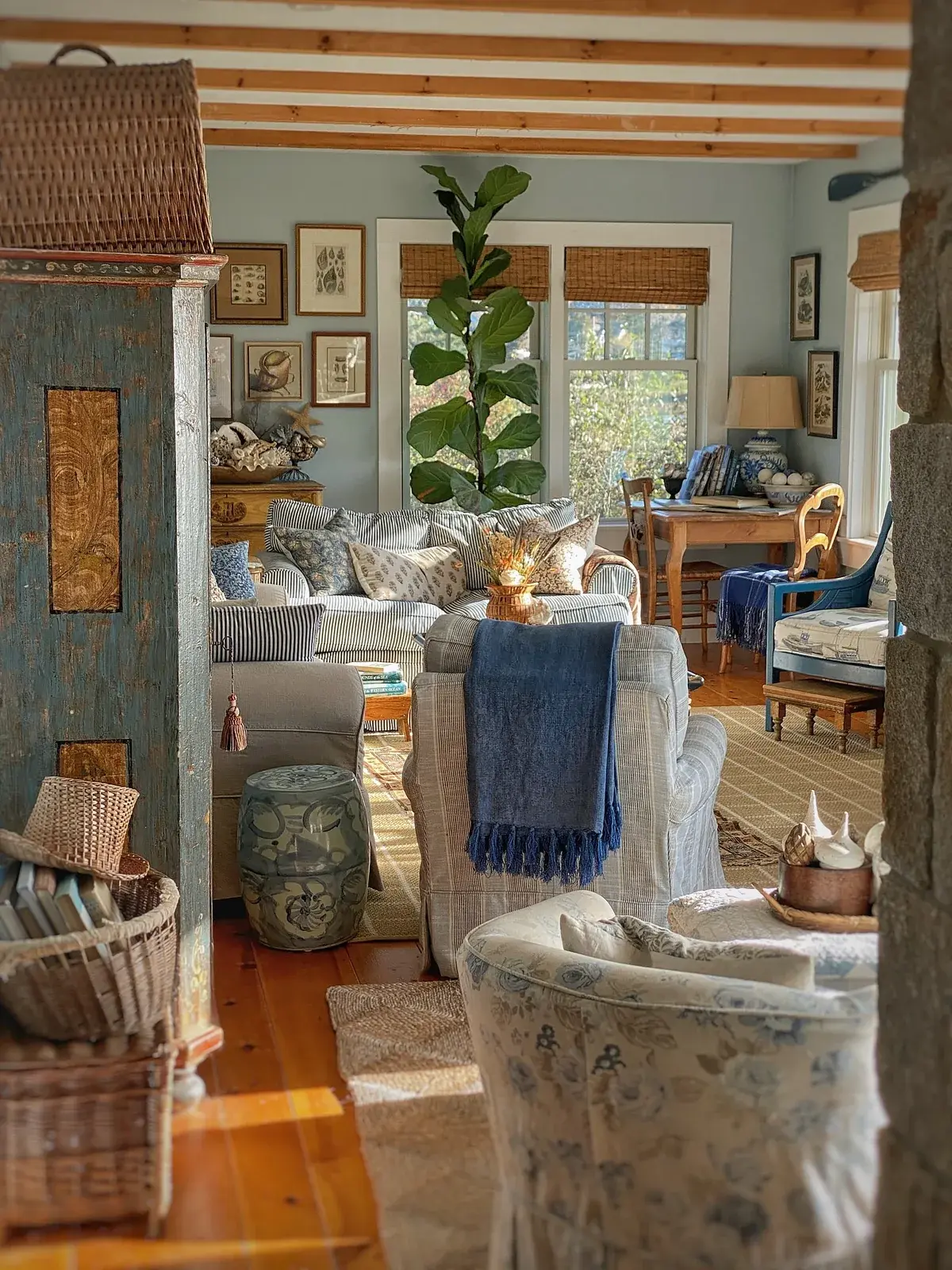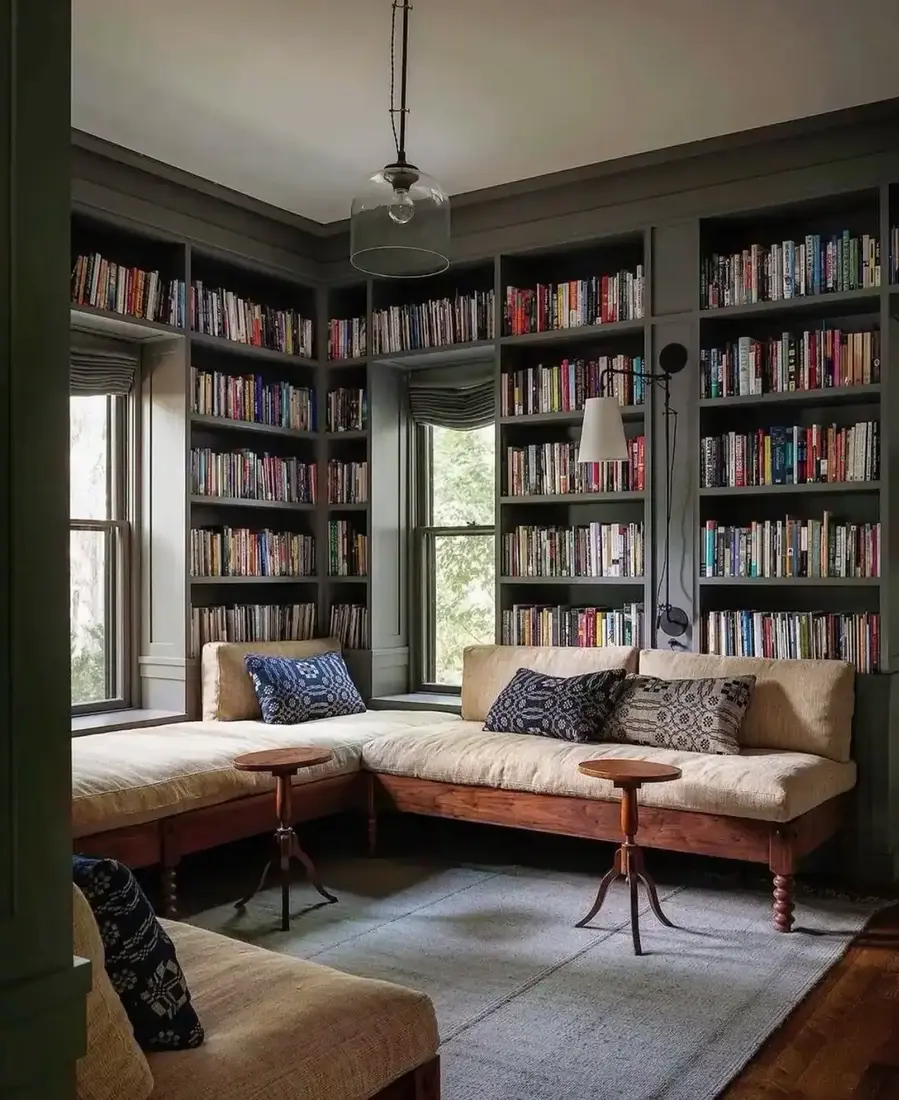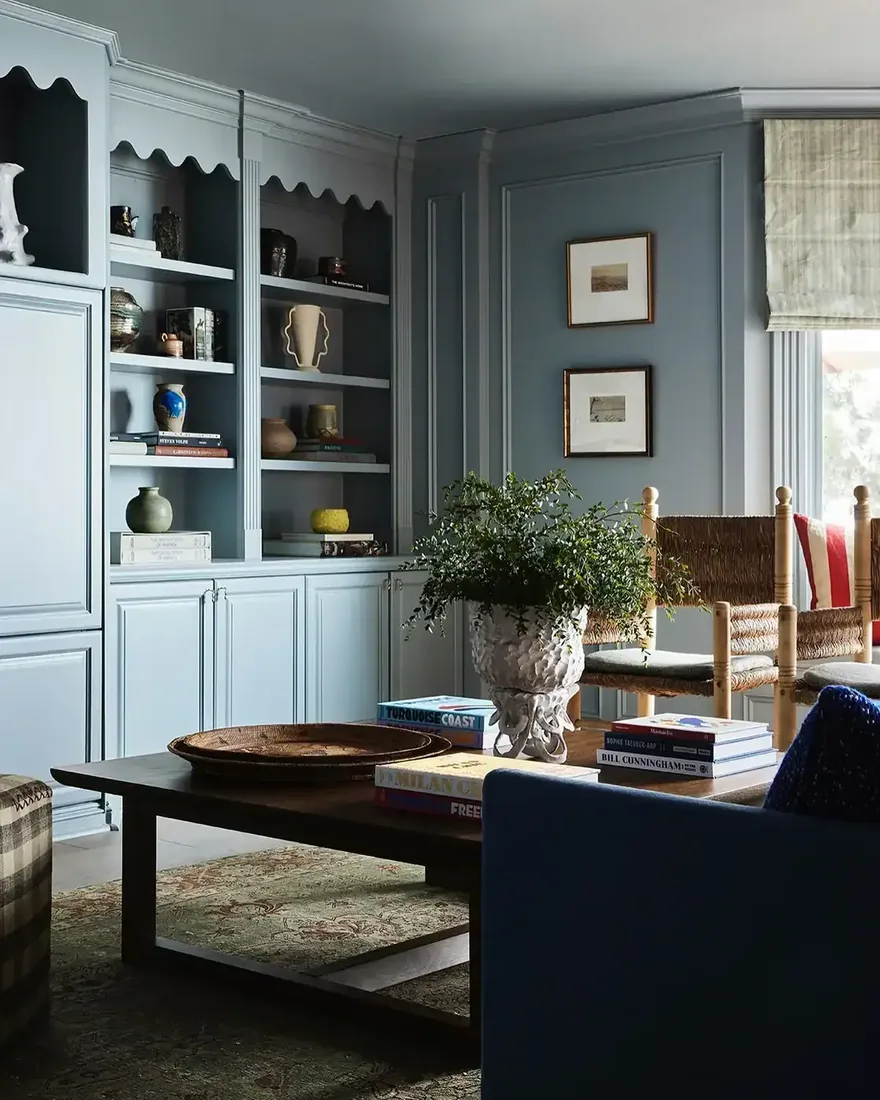
11 Coastal Living Room Ideas: Colour From the Water, Not Boards

Add us as a preferred source to see more stories on Google.
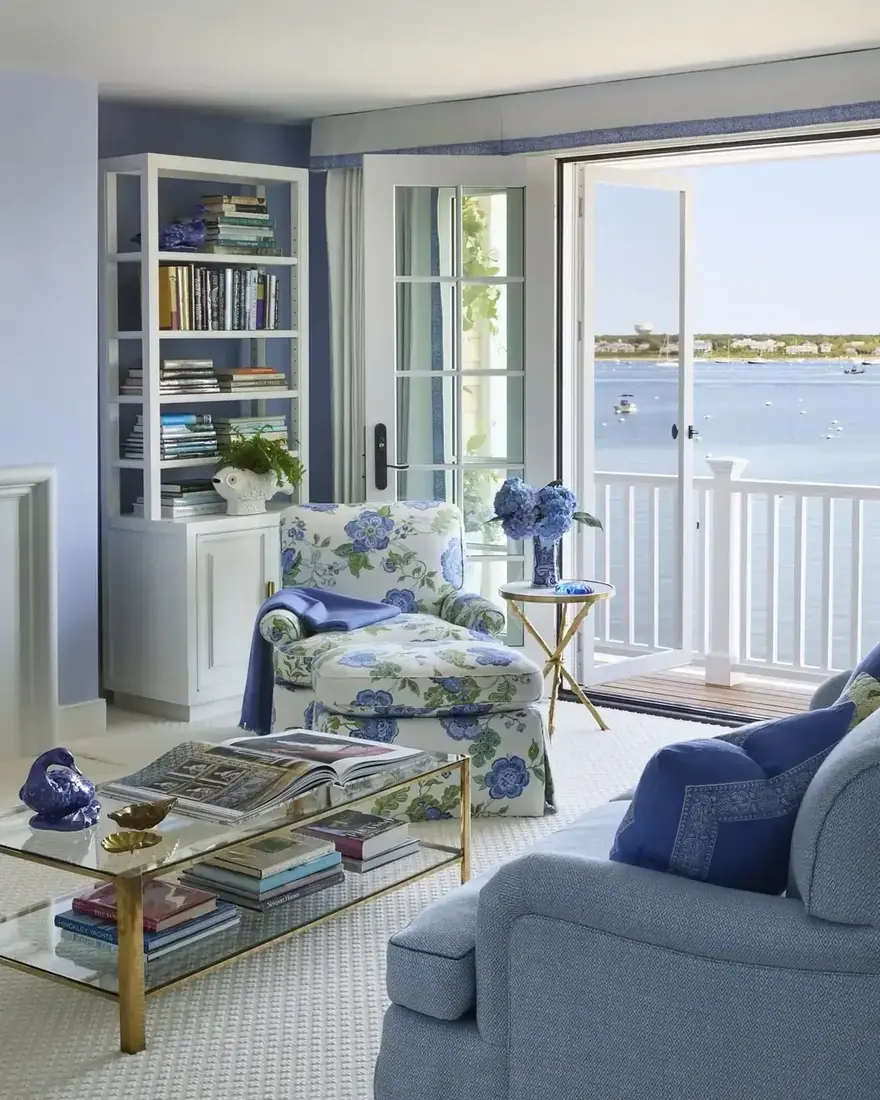
There is not a single anchor, rope, shell or piece of driftwood in the room below, and it is unmistakably a coastal room.
Look at the wall, then look through the open doors at the harbour. They are the same colour. That soft periwinkle, slightly violet, is the exact tone of the water on a bright grey day, and the room is holding it.
That is the whole method. Coastal is not a palette you buy in; it is one you take from what is outside the window.
The colour is softer than you think
Search for coastal and you get navy and crisp white. Look at actual water and you rarely get either.
Water in temperate light is mostly grey-blue, grey-green, or the slightly violet blue in that photograph. Saturated navy appears at dusk and in deep water, and pure white appears almost nowhere. A room painted in the internet version of coastal reads as a brand instead of as a place.
Colours that sit in the real range:
| Budget | Colour | Reads as |
|---|---|---|
| Premium | Farrow & Ball Lulworth Blue No.89 | Soft periwinkle, close to the room above |
| Premium | Farrow & Ball Parma Gray No.27 | Grey-blue, quieter |
| Mid | Benjamin Moore Palladian Blue HC-144 | Blue-green, very widely used |
| Mid | Little Greene Bone China Blue 88 | Pale, slightly grey |
| Trade | Dulux Mineral Mist | Soft grey-blue, inexpensive |
What is doing the work instead of props
Four things, and none of them is a shell.
Pattern in blue and white. The chintz armchair, the block-print cushion, the blue and white vase. These are the traditional coastal decorating language, and they predate the navy-and-rope version by two centuries.
Brass and glass. The coffee table and the side table are both brass with glass tops, and they disappear. In a room with a view, furniture that the eye can see through is worth a great deal.
A pale textured floor. The carpet is a looped white weave, which reads as sand without pretending to be it.
Nothing in front of the window. The seating faces or flanks the doors. Nothing tall, nothing solid, nothing interrupting the view from the main chair.
The inland version, honestly
Most people reading about coastal rooms do not have a harbour outside.
In an inland house, the colour-from-the-view method has nothing to draw on, and the palette becomes a theme. Themed rooms age quickly, and coastal has aged faster than most because it was done so heavily for so long.
The part that does transfer is the atmosphere, not the iconography: pale and reflective surfaces, plenty of white, open sightlines, natural fibre underfoot, and painted instead of polished timber. That reads as light and airy without announcing a seaside it does not have.
What does not transfer is the props. Rope, oars, driftwood signs, anchors and shells read as a gift shop in a terraced house, and they are the first thing anyone regrets.
If the blue is the appeal, use it because you like the colour, not because it signals the sea. A blue and white room is a perfectly good room anywhere.
Where the room gives itself away
Two tests worth applying to any coastal scheme.
Would the room still make sense with the curtains shut? If the answer is no, the view is doing all the work and the decorating is thin.
Is there a single object in it whose only function is to signal “seaside”? If yes, it is the thing to remove first.
A striped sofa that can carry the coast alone
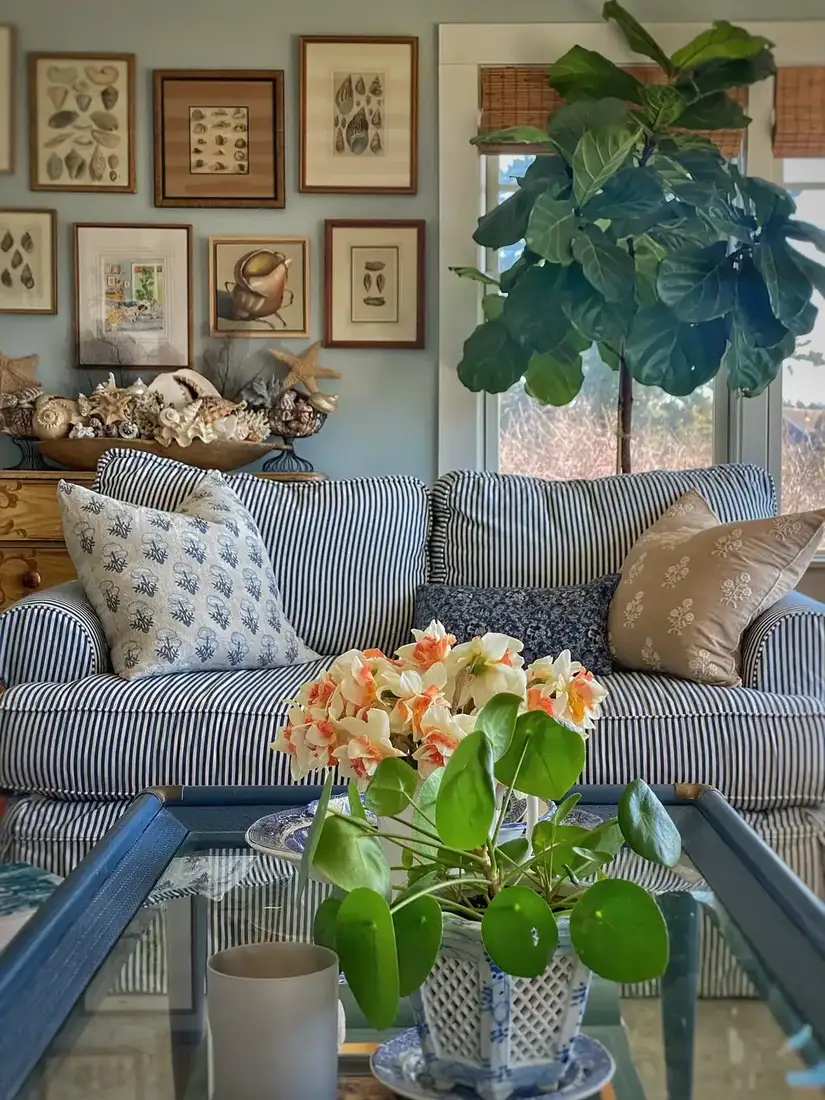
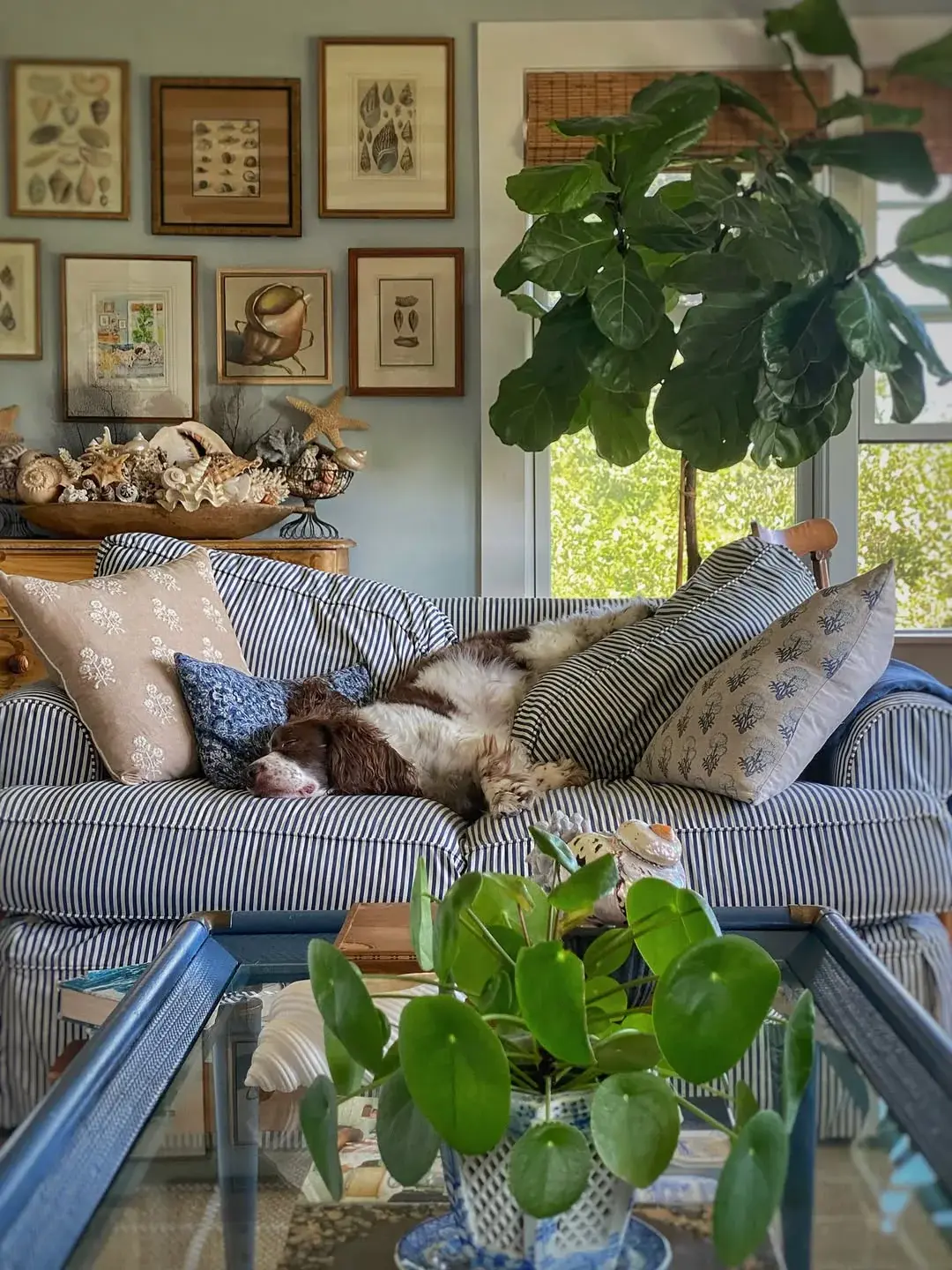
Look at this sofa before you look at anything else. A deep buttoned stripe in navy and white runs across the whole length, and it is the only large-scale pattern in the room. That matters, because stripes are the safest coastal signal. They carry no literal imagery, no boat, no shell, no anchor, and so they never tip into costume.
The wall behind holds seven framed shell and botanical prints, with a shallow pine chest underneath. The chest supports a single low wooden bowl filled with shells and coral, flanked by two small pedestal urns. This is the grouping principle in action. One collection displayed together reads as a decision. The same shells scattered across mantel, coffee table and bookshelves would read as clutter that never settled.
The floor stays quiet. A flat sisal covers it, the glass coffee table has a thin blue timber frame and brass feet, and the ceramics are all blue and white. The fiddle-leaf fig by the window adds green, which any coastal room needs, and the pilea on the table repeats the green lower down.
If this palette appeals, keep the wall paints to the same stripe family. Farrow & Ball Borrowed Light No.235 or Little Greene boneChina Blue Pale 182 sit close to the sofa’s blue, and both cost around £55 to £75 for 2.5 litres in 2026. A comparable striped sofa in a cotton ticking, from John Lewis or Maker & Son, is priced around £1,200 to £2,400 in 2026 depending on length.
One large gull instead of a dozen small hints
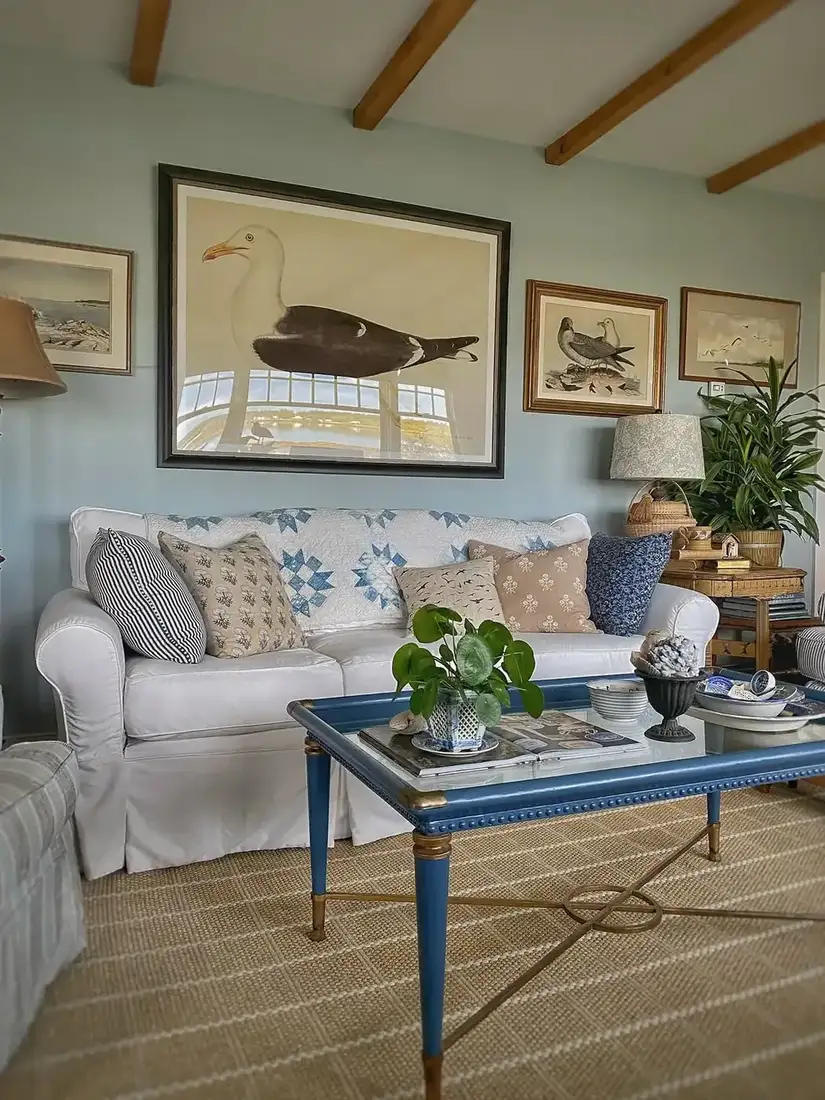
This room uses a single coastal element and it is enough. The enormous gull print above the sofa measures roughly poster scale, with the bird centred on a pale ground that reflects the harbour light visible in the glass. Because the print is one thing, one scale, one frame, it reads as art instead of decoration. The smaller bird prints to its right echo the subject without competing, because they are a fraction of its size.
The sofa beneath is plain white, with a quilted throw in a faded star pattern at the shoulders. The cushions repeat the discipline of a limited palette. Each mixes blue and warm sand, not turquoise, so the blues vary by depth instead of by hue. That variation is what keeps navy, mid blue and pale grey blue calm together. Introduce a clean turquoise here and the harmony snaps.
The blue tray table is the colour anchor at floor level. Its edge is painted denim, the top is glass, and the brass stretcher underneath catches light. A rattan table at the far end repeats the warm natural fibre, and the jute rug underfoot does the same across the floor. Brass and rattan together are the one warm neutral that keeps navy and white from chilling, and both appear twice, low and at eye level, which is why they feel structural.
Small rattan lamp bases of this sort are about £70 to £200 in 2026, and blue glass tray tables with brass frames are typically £250 to £600 in 2026 on Wayfair or Etsy.
When blue and white china becomes the whole room
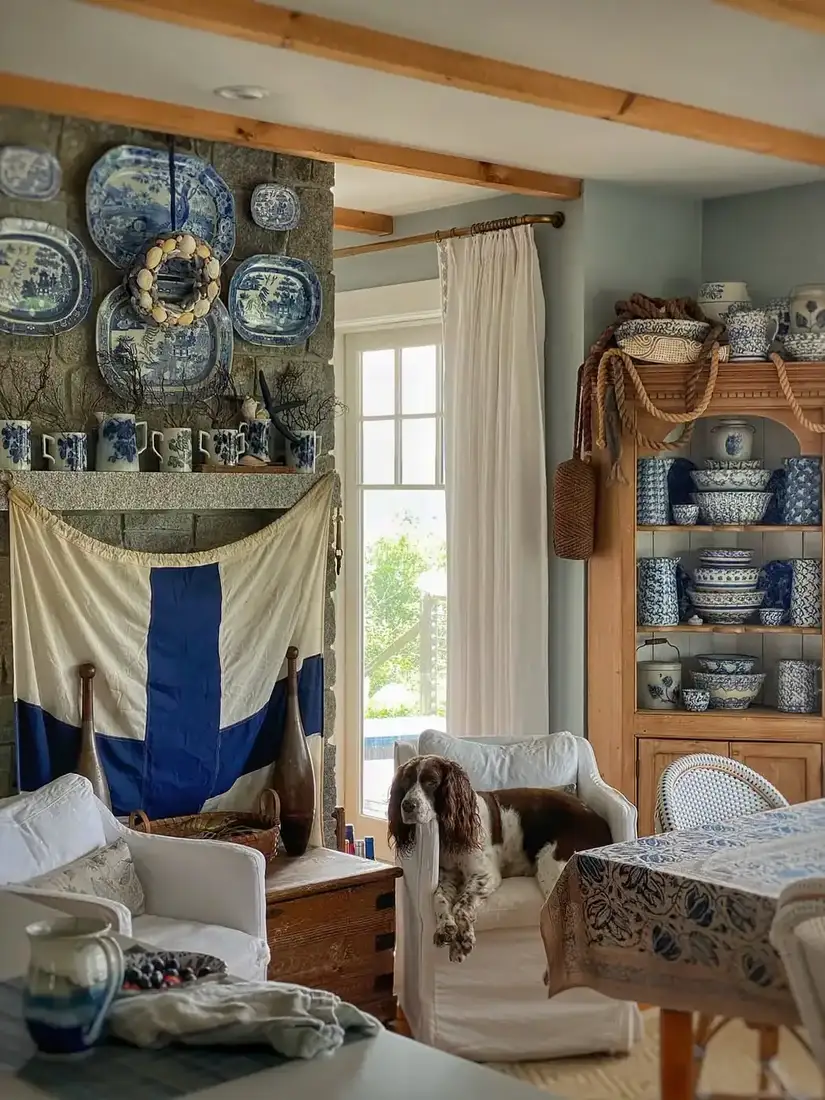
Count what is blue here before deciding whether you like it. Eighteen visible plates and platters on the stone, a dozen mugs on the mantel shelf, three shelves of bowls and jars on the pine dresser, plus a tablecloth in the same print. Every surface is carrying the same motif, which is why the eye has nowhere to rest. This is the opposite of the grouped-collection idea. Grouped reads as a collection; spread across three furniture planes it reads as a shop.
The stone chimney breast is handsome. It is rough granite with a speckled lintel, and it would need nothing more than a single wreath to feel coastal. Instead the wall is hung with overlapping transferware, a rope-framed flag is draped beneath, and coarse rope is looped over the dresser top with a fisherman’s basket hanging from it. Rope, at this quantity, is the fastest route to theme. One rope-trimmed mirror could hint. Here the rope is a pelmet.
There is a quieter version of this room to take away. Keep the dresser and perhaps three of the plates, chosen to vary in scale, and leave the stone bare. Paint the wall behind a soft grey green, such as Farrow & Ball Pigeon No.25 or Dulux Coastal Fog, around £45 to £65 for 2.5 litres in 2026. A reclaimed pine dresser similar to this changes hands for £400 to £950 in 2026, and sets of vintage blue and white bowls are often £15 to £40 each in 2026 at flea markets.
The same cottage, where the props pile up
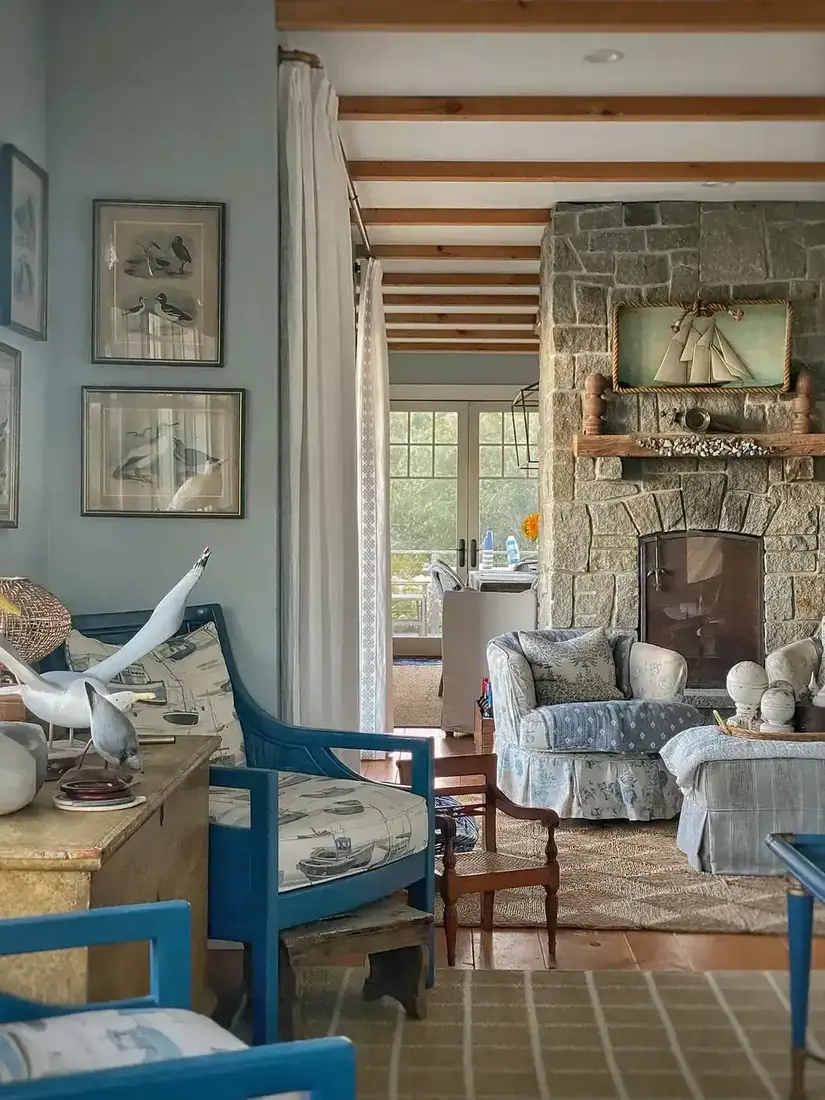
This and the next photograph are the same cottage seen a few steps apart, which makes them useful together. Here the stone fireplace dominates the right side, with a rope-edged ship diorama centred above the wooden mantel. The mantel itself carries a coral-encrusted garland, a brass-diving helmet shape, and a pair of dark buoys. Even the beams are doing coastal work, because they are exposed pine where the ceiling is otherwise plastered.
The seating shows the stripe principle done well despite the props. The armchairs are painted a saturated mid blue, with cushions in a soft grey-blue sailboat print. The fabric reads as coastal because it uses drawing, not emblems. A thin line drawing of a boat is pattern; a printed anchor is a sign. The footstool in the foreground is slipcovered in a faded ticking, which is the same idea at a larger scale.
What to copy is the textile choice. What to leave is the mantel load. Whitewashed brick or painted panelling would give the same beach feeling without a single object, yet this mantel chooses objects to do what texture could do. If you love one ship model, give it the whole mantel, with a foot of empty stone each side, and remove the rest.
Painted armchairs in this style are about £180 to £420 in 2026 for a pair at vintage dealers, while reproduction sailboat fabric is around £32 to £58 per metre in 2026 from Clarke & Clarke or Sanderson.
The same cottage, where the decoys gather
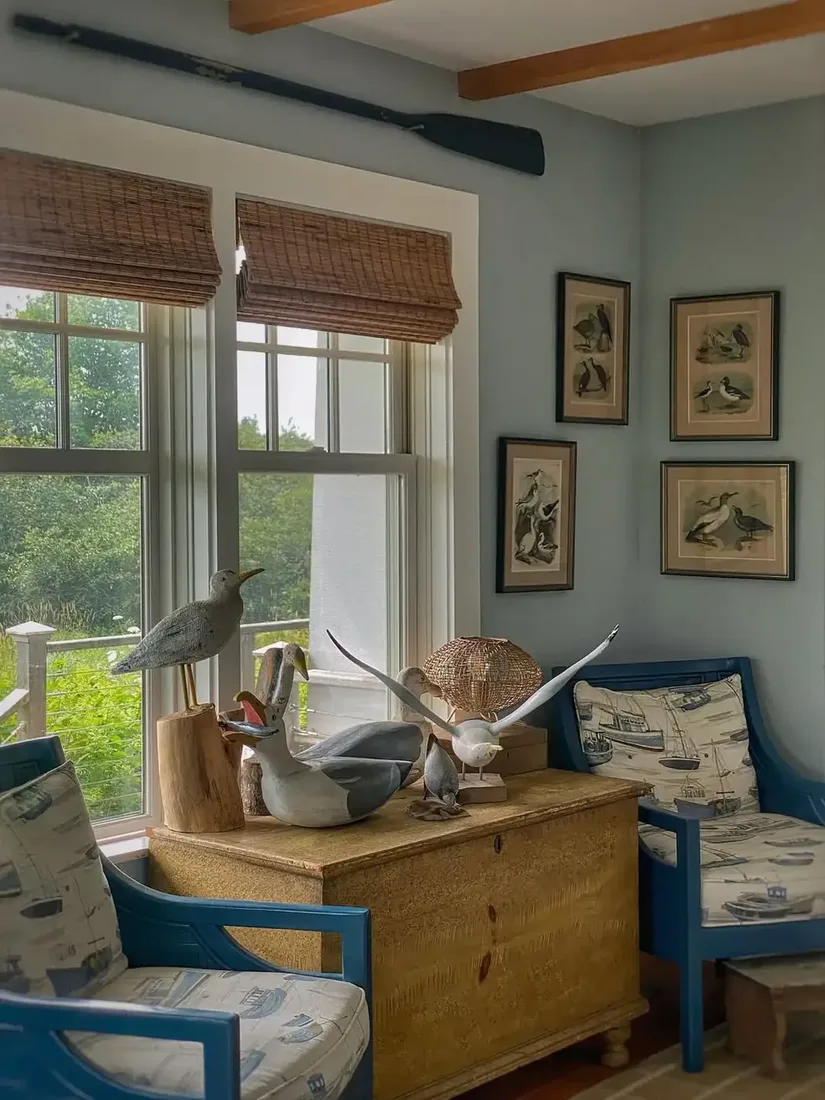
Step closer to the chest that separates the two blue chairs and the problem sharpens. Five carved birds stand on the pine top, from a small sandpiper to a gull with wings outstretched. A woven rattan lamp base and a stack of boxes sit behind them. On the wall above, four framed bird prints are hung in a grid, and a dark oar is mounted horizontally near the ceiling. Any one of these would pass the one-element test. Together they form a row, and the room starts to read as an exhibition.
This is where the rope and anchor rule helps as a filter. Rope, anchors and ship’s wheels are the fastest route to theme, so use at most one and make it small. The same thinking applies to decoys and oars. Keep the chest and perhaps one bird, or keep the oar and lose the flock. The bamboo shades at the window are already doing coastal work without being literal, because woven fibre and pale timber suggest the coast through texture instead of through symbols.
The blue paint on the chairs is close to Hydra Blue or Juniper by Little Greene, both around £55 to £75 for 2.5 litres in 2026. Woven roller blinds of this weight are about £40 to £120 per window in 2026 from Blinds 2go or Hillarys, and carved gulls vary wildly, from £25 to £180 each in 2026 at coastal antique shops, which is part of why collections grow too quickly.
Three blue pillows on a plain white base
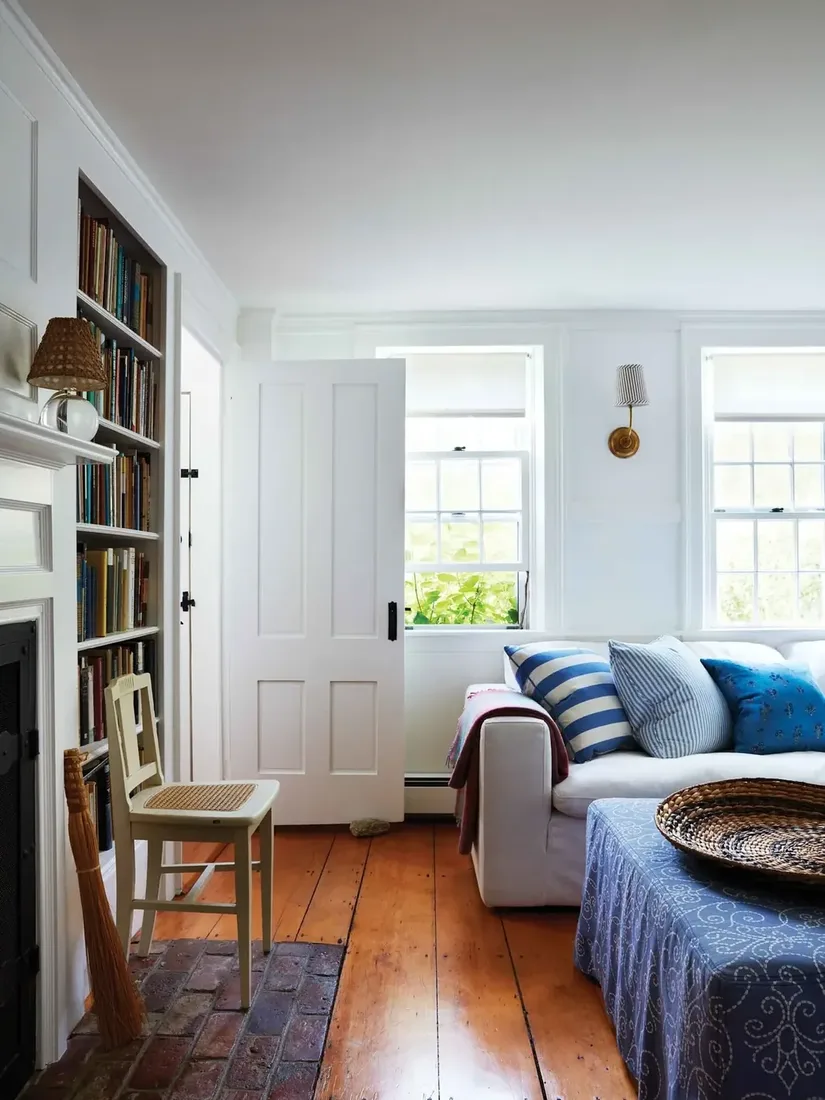
This narrow room shows the two colours plus white discipline at its clearest. The walls and sofa are warm white, not brilliant white, which is why the blues sit calmly. A cool white beside navy turns grey by evening; a warm white holds. The sofa carries three pillows, each a different blue pattern, each in the same depth of dye. One is a wide indigo ticking, one a narrow grey-blue stripe, one a small cream and blue block print. Because they share depth, they read as one family.
The floor does the warming. Wide pine boards, honeyed and unsealed, run the length of the room, with a brick hearth at the near end that gives a reddish brown note at foot level. That warm neutral is the reliable third colour with navy and white. Jute or sand linen would do the same work, but here timber does it.
Everything else stays plain. The ottoman is covered in a blue resist fabric with a woven tray on top, the walls are bare except for two wall lights in brass and striped glass, and the door is left open to the green outside. The room proves the angle: one coastal gesture, which is the blue on the sofa, inside an otherwise ordinary sitting room.
A slipcovered sofa of this shape is typically £900 to £2,000 in 2026 from Sofa.com or Loaf, while pine floor refinishing or pale oak boards are around £55 to £110 per square metre supplied in 2026.
A tree that borrows the harbour
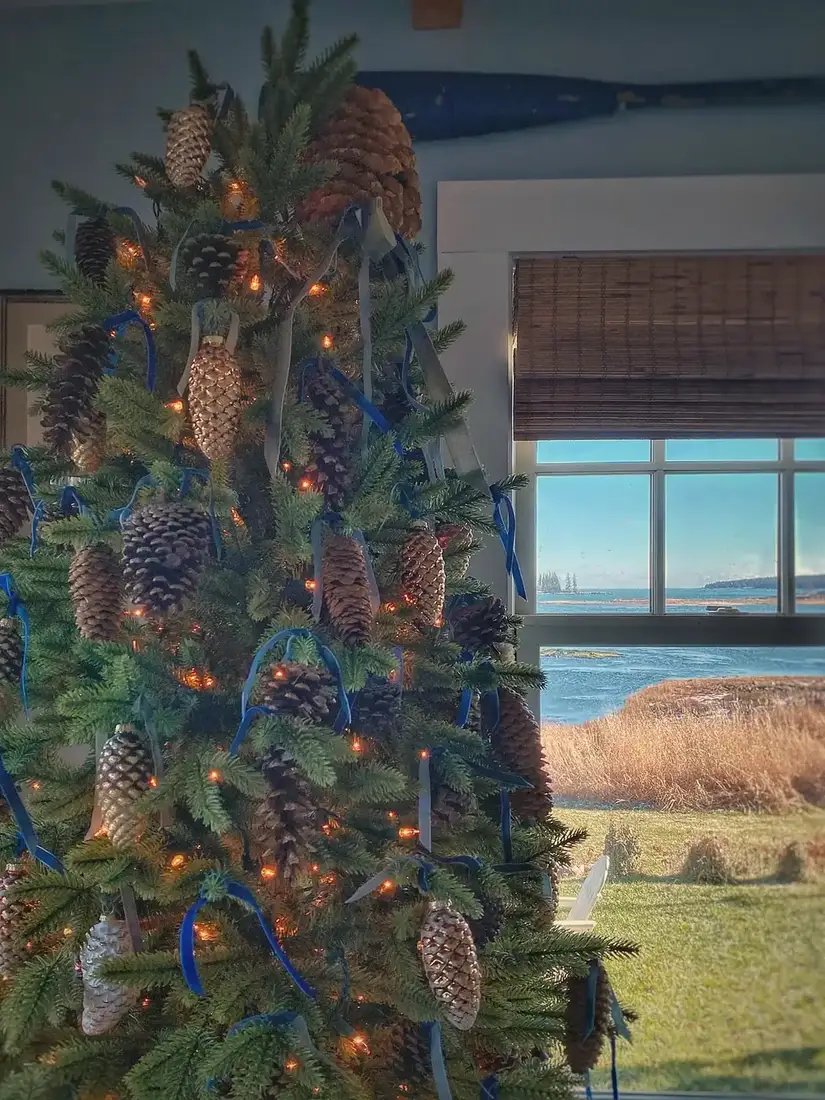
A Christmas tree lit with warm bulbs, dressed with oversized pinecones dipped in pale gold and tied with dusty blue velvet ribbon. The window behind it frames the coast itself, flat marsh, grey blue water and a distant tree-lined point under a pale sky. This is coastal decoration at its most honest, because the view is doing the coastal work and the tree is only borrowing its colours.
The ribbon is the key. It is the same grey-blue as the water outside, slightly desaturated, and it repeats at intervals down the branches. Because the tree uses one colour against green, it feels coherent; a second red or tartan ribbon would have pushed it toward a theme. The pinecones vary in size and finish, which gives the texture that keeps the tree from reading flat.
An artificial tree of this fullness, around 2.2 metres, is typically £180 to £450 in 2026, while large natural pinecones are about £12 to £28 for a bag of twenty in 2026 at garden centres. If you have a water view, matching ribbon to that water is a neat trick; without a view, keep the ribbon to a plain natural fibre and let the tree stand as a winter tree instead of a coastal tree.
Stripes by the water, nothing else competing
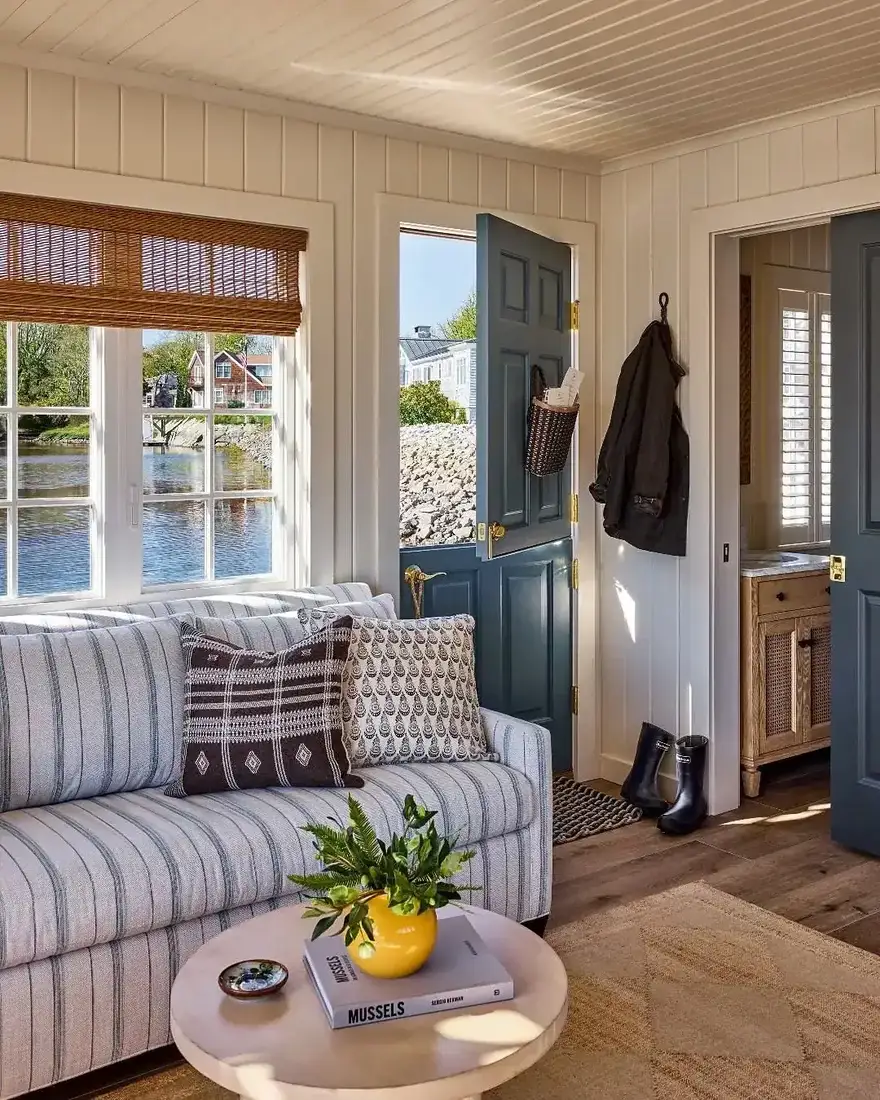
A compact sitting room that is all panelling and light. Vertical tongue and groove in warm white lines the walls and ceiling, the window looks directly onto a tidal inlet, and the door stands open to a stone causeway. The sofa is a pale grey and white ticking, almost quiet, with two pillows in block printed indigo patterns that are the only strong colour in the frame.
This is whitewashed texture doing the work that props often try to do. Painted panelling gives the feel without a single object, because its vertical lines and soft shadow already suggest a beach cottage. The woven bamboo blind at the window and the flat jute rug underfoot repeat the natural fibre in two places, which is enough to warm the palette. The round white table holds a yellow glazed pot with green ferns and a book titled Mussels, which is a small, witty, coastal note that does not advertise.
The restraint is what keeps it from reading as a set. There is no rope, no shell, no anchor, and the wellies by the door are just wellies, not decor. Hunter or Joules wellies are about £45 to £95 in 2026, and small bamboo blinds of this type are roughly £35 to £110 in 2026. A similar ticking-striped sofa, two metres long, is around £1,000 to £2,200 in 2026.
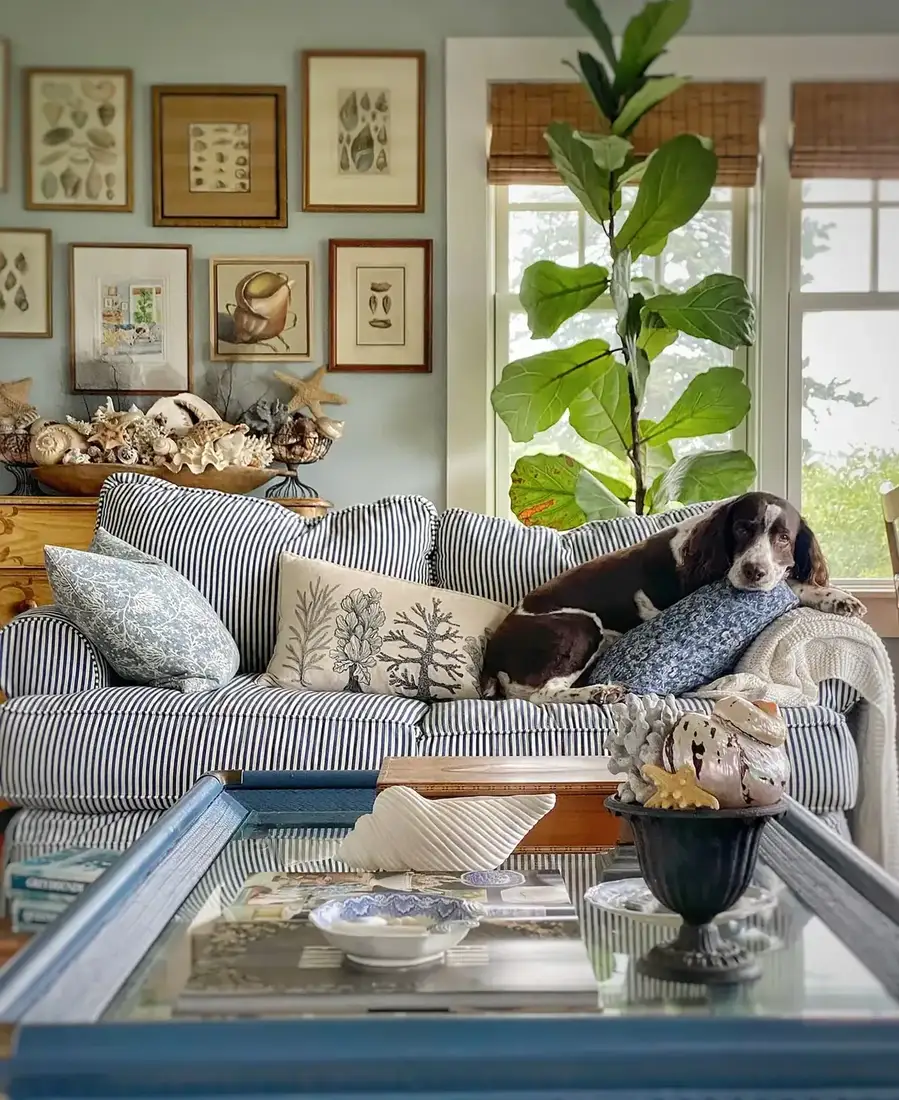
The same striped sofa with shells kept together
The twin of the earlier striped sofa photograph, taken a fraction lower and now with a springer spaniel draped over the arm. The room is identical: the same seven shell prints above, the same fiddle-leaf fig at the window, the same pine chest with its oversized bowl of shells and coral. Because the shells are heaped into one bowl on one surface, they satisfy the grouping test even though there are dozens of them. Grouped reads as a collection; spread across the coffee table, shelf and mantel they would read as beachcombing left out.
The coffee table in the foreground shows the other half of the discipline. It is a blue timber tray with a glass top, holding a single white conch, a shallow blue and white dish, and a low black urn filled with more shells. Three objects, not eight, and one of them is the shell group itself. That leaves half the glass empty, which lets the striped sofa beyond stay legible.
The blue here is again varied by depth. The sofa stripe is the darkest, the table frame is a mid denim, and the wall is a pale grey blue. Those three steps of the same hue are why the room feels layered instead of patched.
A fiddle-leaf fig of this height, around 1.5 metres, is about £80 to £220 in 2026 from patch or local nurseries, and shallow pine chests similar to this are about £180 to £480 in 2026 on Etsy or eBay.
Panelling and old beams can be the coast
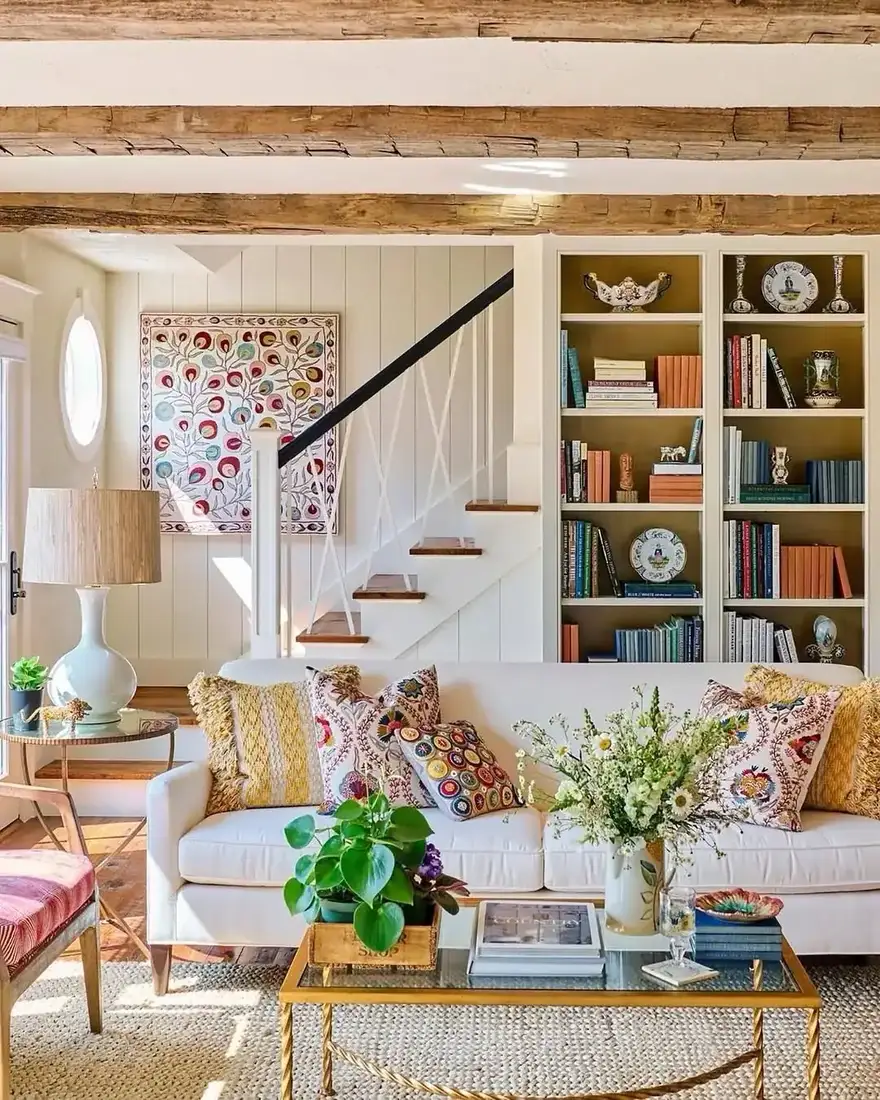
No water in sight, no stripe, no shell, and still the room feels coastal. Two rough hewn beams run across a white ceiling, painted panelling lines the walls, and the floor is a pale flatweave that reads as sand underfoot. This is texture as coastal signal, and it is the most durable kind, because it belongs to the architecture instead of things you have to dust.
The sofa is plain warm white, with four cushions in a Suzani-type print that mixes saffron, indigo, rust and sage. Those colours would clash in a grey-walled flat, but against white panelling and honeyed beams they settle, because the timber already holds the warm side of the palette. The brass coffee table with a rope-twist edge and glass top mirrors the earlier brass tables; it lets the rug show through and keeps the seating legible in a small room.
The staircase wall carries a large textile hanging in the same Suzani language, which gives height and pattern without adding another furniture colour. The bookshelves to the right are lined with books arranged by spine colour and a few pieces of blue and white china. The china is contained to one bay; it does not trail onto the mantel or the coffee table. Containment is the habit that keeps blue and white china from becoming the whole room.
Exposed beams are not a purchase, they are a discovery or a build choice, but a panelling job in MDF or timber is about £40 to £90 per square metre fitted in 2026, and a brass tray table of this type is around £280 to £650 in 2026.
Before painting
- Take the wall colour from the view, photographed at several times of day.
- Go softer and greyer than the internet version of coastal.
- Use blue and white pattern instead of nautical objects.
- Keep furniture low and see-through in front of the window.
- Inland, borrow the light and texture and skip the props entirely.
- Group a single shell or china collection together, never scattered.
- Keep the palette to two colours plus white, with one warm neutral to ground it.
Frequently Asked Questions
How do I stop a coastal scheme tipping into a theme?
Confine the seaside reference to one element and keep the envelope plain. A striped textile or a single gathered display can hint at the coast, while a bare white wall and pale timber stop the hint becoming a costume. When every shelf carries a beach find, the eye reads a shop.
Are stripes really enough to feel coastal?
Stripes are the quietest signal because they suggest sea and sky without depicting them. A ticking or a wide deckchair stripe in a shared blue depth does more than a set of maritime ornaments, and it leaves the rest of the palette calm.
I have a lot of shells and blue china, how should I show them?
Keep the whole gathering on one tray, bowl or shelf and leave surrounding surfaces empty. A dense cluster reads as an intentional collection, while pieces dotted around the room look like they never found a home.
We live away from the sea, what transfers and what does not?
Light walls, see-through tables, jute or sisal underfoot and painted panelling travel well because they describe airiness instead of location. Ropes, oars, anchors and signboards tend to feel like souvenirs when no tide is nearby.
Which blues and whites stay relaxed together?
Choose warm whites with a little cream, then vary blues by depth inside one family, for example pale grey blue with mid indigo. Avoid mixing turquoise and navy, which pull in different directions, and keep the count to two blues plus white for ease.
Do I need coastal objects at all?
Not necessarily. The colour of local water, or a simple vertical boarding in off white, can carry the reference. When the architecture supplies the texture, a plain palette and ordinary furniture are often sufficient.
This article may contain affiliate links. We may earn a commission at no extra cost to you.