7 Easy Fall Window Painting Ideas: Load Two Colours at Once
Add us as a preferred source to see more stories on Google.
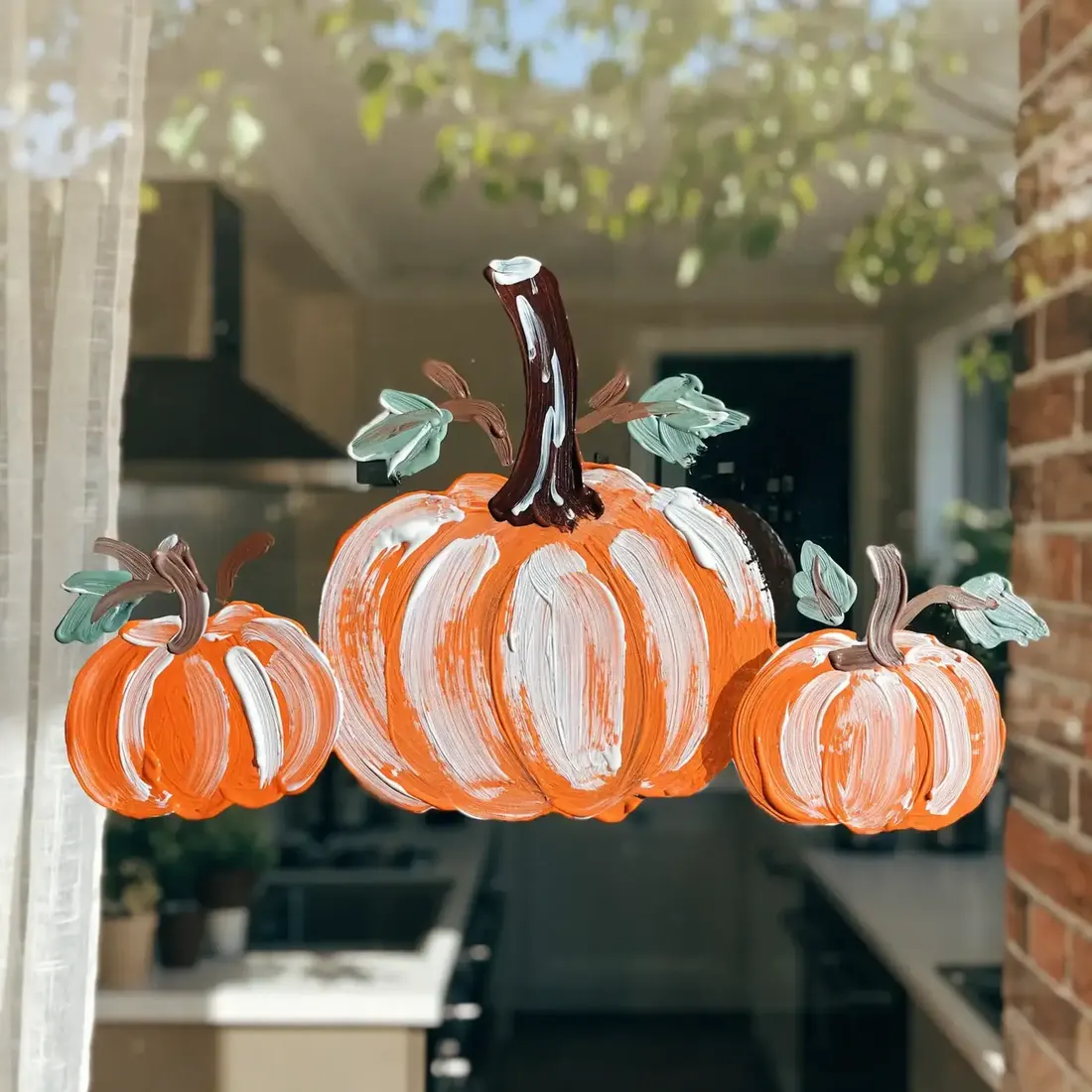
There is one technique in the window below, and it takes about ten seconds to learn.
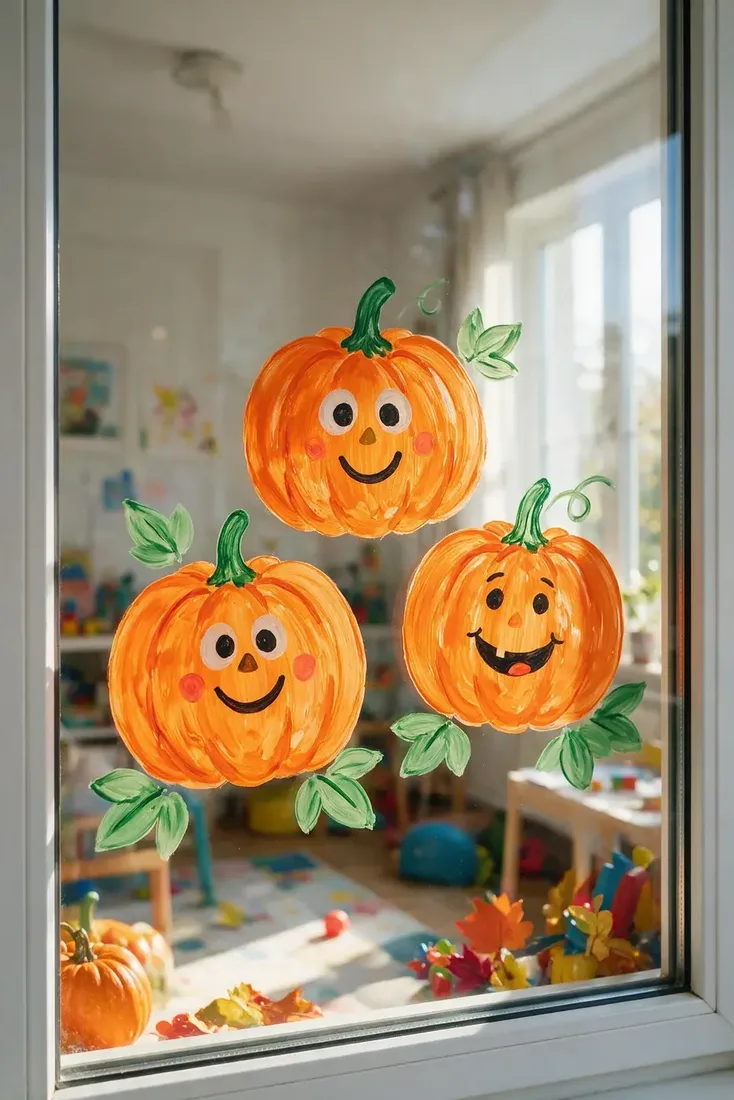
Look closely at the middle pumpkin. The orange and the white are not mixed. They are sitting side by side in the same stroke, streaking through each other where the brush dragged.
That is double loading, and it is what gives those pumpkins their curve. Paint one in flat orange instead and you have an orange blob that then needs dark lines down it and highlights on top before it reads as anything.
Doing it
Use a flat brush, 12 to 20mm. Squeeze orange and white out side by side on a plate rather than mixing them.
Touch one corner of the brush into the orange and the other corner into the white, without stirring. Then start at the top of the pumpkin and pull the stroke down and slightly outwards, following the curve of the body.
Do the outside strokes first, curving hard, then work inwards where the strokes are straighter. Look at the big pumpkin again and you can see it: the strokes at the edges bend sharply, the ones in the middle run almost straight down. That difference is the whole roundness.
Reload when the brush runs dry, keeping the same sides in the same colours. It is normal for it to get muddier as you go; that is what gives the lower part of the pumpkin its depth.
The stalk and the leaves
Stalk in dark brown, one thick stroke, with a single white line pulled down one side while it is still wet. Notice the stalk in the photograph: that one pale streak is the entire reason it reads as a cylinder rather than a brown mark.
Leaves in sage green, one stroke each, pointed at both ends. No outline, no veins. The tendrils are one curly line with the tip of the brush.
Keep the greens muted. A bright grass green next to burnt orange looks like a supermarket display; a grey-green looks like autumn.
The composition
Three, at different sizes, overlapping each other.
Odd numbers and varied scale read as a group. Three identical pumpkins spaced evenly across the glass read as wallpaper, and no amount of good brushwork rescues that.
See how the two small ones sit slightly lower than the big one, as though they are all standing on the same ground. Overlap them by a third or so.
Pumpkins low, leaves high
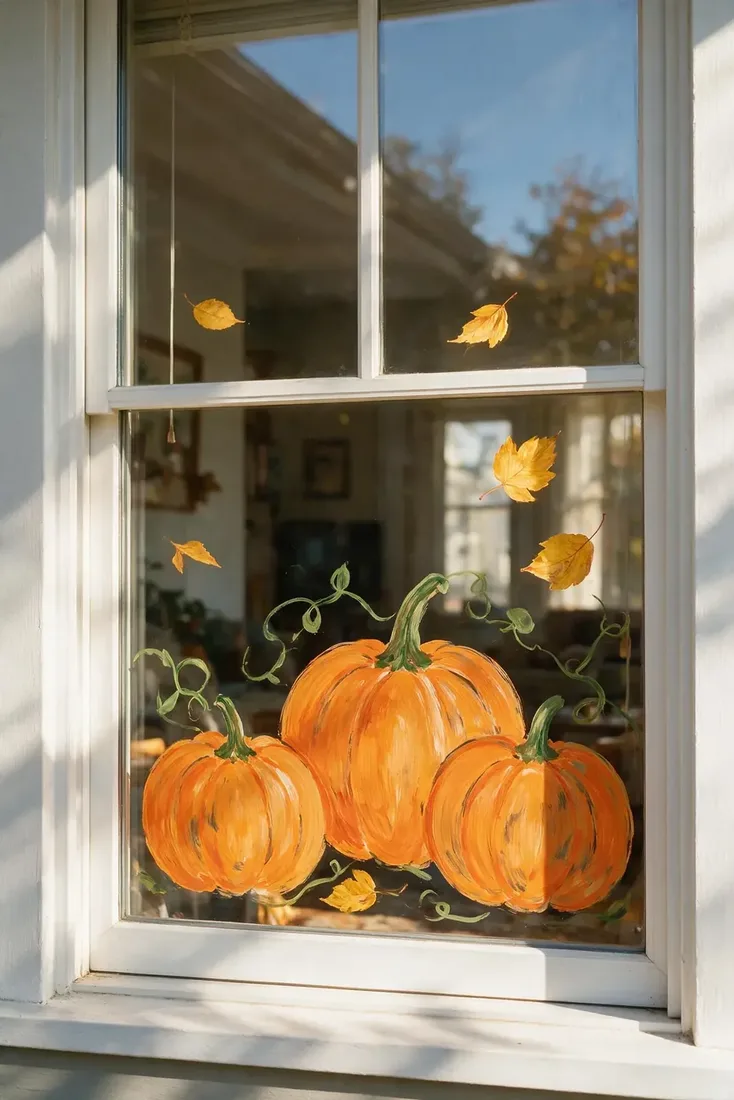
In this photo the group sits low on the pane and the top two thirds are almost empty apart from five small yellow leaves. That empty space is doing as much work as the paint, because the pumpkins read as settled and the leaves read as moving.
That colour in the pumpkins is a clear mid orange with the same white streaking from the opening technique, and the vines are thin green curls with almost no leaves on them. The one detail that lifts it is the way two tendrils cross in the middle, which stops three round shapes sitting like balls from the sofa across the room, which is where guests actually see it.
The same two tubes do this whole window. Mine took one Saturday morning, about two hours including the school run in the middle, and the only extra tool was a small round brush for the curls. A ProArte or Hobbycraft round in size 4 or 6 runs £2 to £4 in 2026, and it is the cheapest way to get lines that thin without fighting a flat that keeps blobbing on your glass.
Leaves falling corner to corner
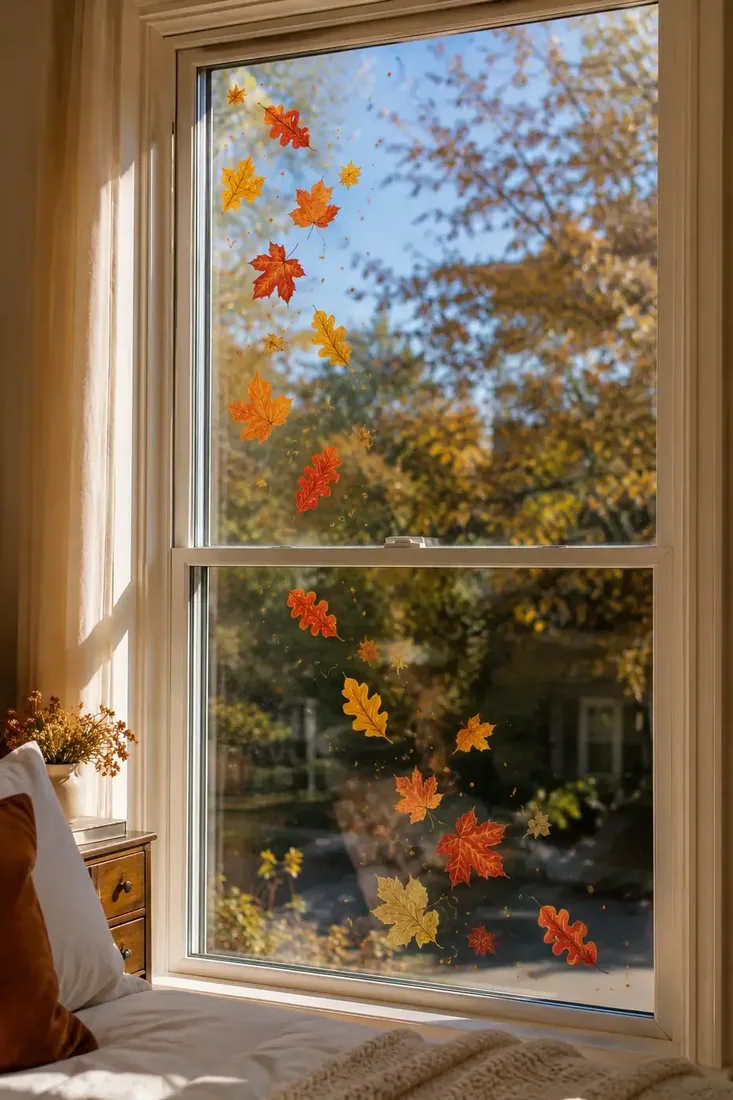
Look at the line the leaves make from the top left down to the bottom right, with wide gaps in the middle and a small cluster near the sill. Nothing is centred and nothing is even, which is exactly why it reads as wind caught mid gust.
That red is warm and slightly transparent, the yellow is soft, and the two sit together without any brown outline. The sheer curtain at the side shows how little paint is actually on the glass, since daylight still floods past it and the bedding below picks up the same tones.
This was the first one I let my niece try, because there is no correct leaf shape to get wrong, so your wobbly edge just passes as a real leaf. A set of Uni Posca PC-3M markers in warm tones runs £12 to £20 in 2026 and covers a window this size with plenty left, while a single Edding 4085 chalk marker in ochre costs £3 to £5 in 2026 for anyone testing the idea.
A border that leaves the middle clear
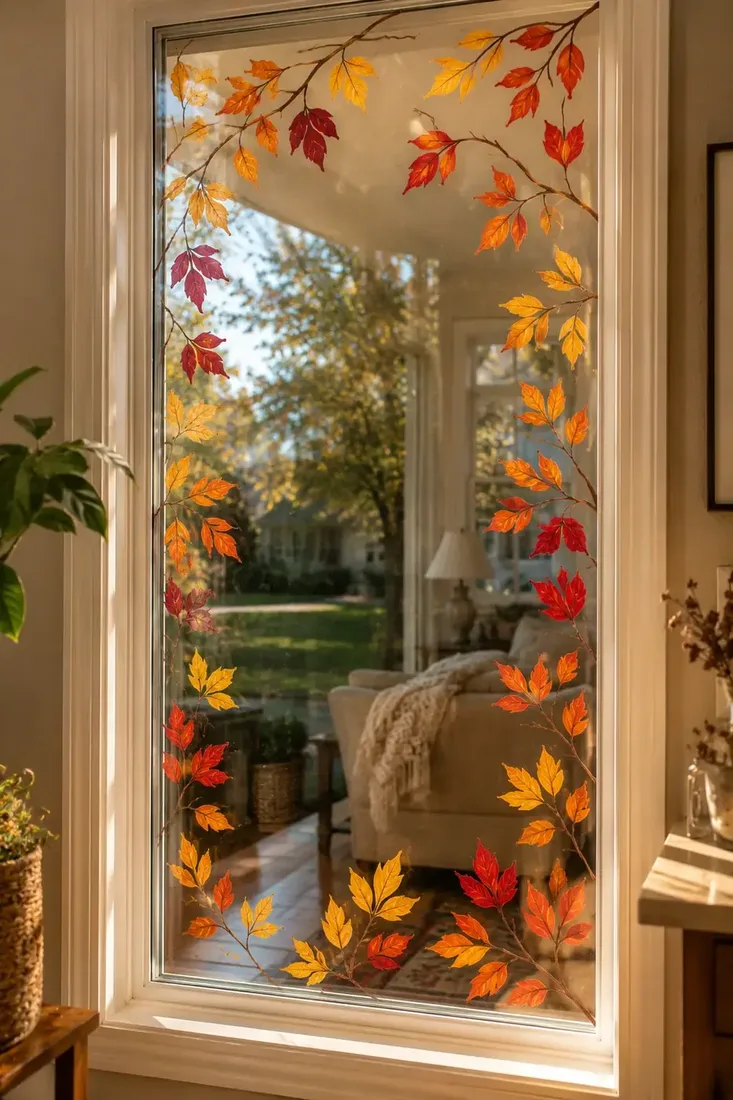
That frame of branches runs all four edges while the centre stays completely clear, so the room beyond still shows through and the sofa and lamp read as part of the picture. The branches are thin brown lines with leaves in red, rust, and gold clustered thicker at the corners.
The trick here is painting the corners heavy and the middles thin, which keeps the border from turning into a neat rectangle. I measured nothing on mine and just stood back after every third branch, since stepping back shows the thin patches faster than staring close does when you are mid branch.
A thin liner brush plus two leaf colours is enough, and Pebeo Vitrea 160 in HAB or similar warm tones costs £4 to £6 per 45ml in 2026 from most art shops. The whole border took me one film, two teas, and one trip back to the shop because a single brown runs out faster than expected.
One big sunflower with a small pumpkin
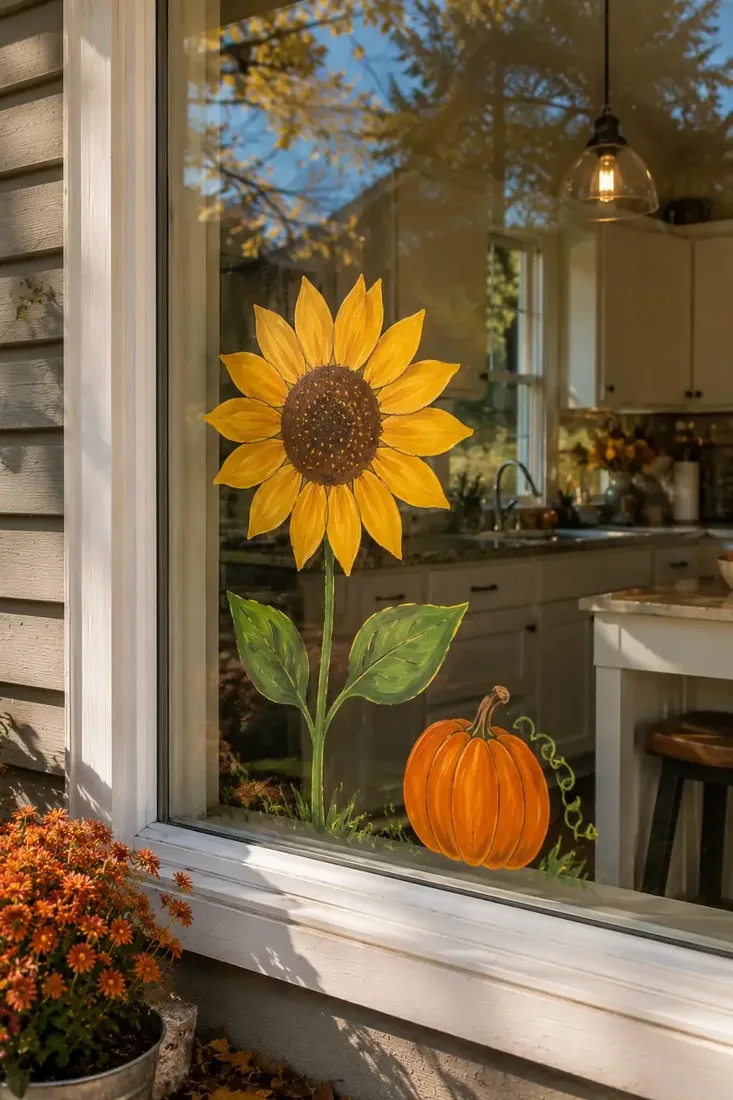
In that kitchen the flower head is nearly the size of a side plate, with straight petals around a dark centre, a tall green stem, two plain leaves, and one small pumpkin tucked at the base. Scale is the whole lesson, because small wobbles vanish once the shape gets this large.
That petal yellow is flat and warm with almost no shading, and the centre is a deep brown dotted with lighter specks that suggest seeds without any fiddly detail. The grass tufts at the bottom are three quick flicks with the tip of the brush, and they ground the stem so it stops floating when you look from outside.
My first sunflower was half this size and took twice as long, since every petal needed neatening. Going big cut my time to about 90 minutes including drying, and if you paint after lunch the low sun shows every miss, which actually helps. Daler Rowney System3 in Cadmium Yellow and Burnt Umber costs £3 to £5 per 150ml in 2026, which is plenty for two windows.
One face with three small bats
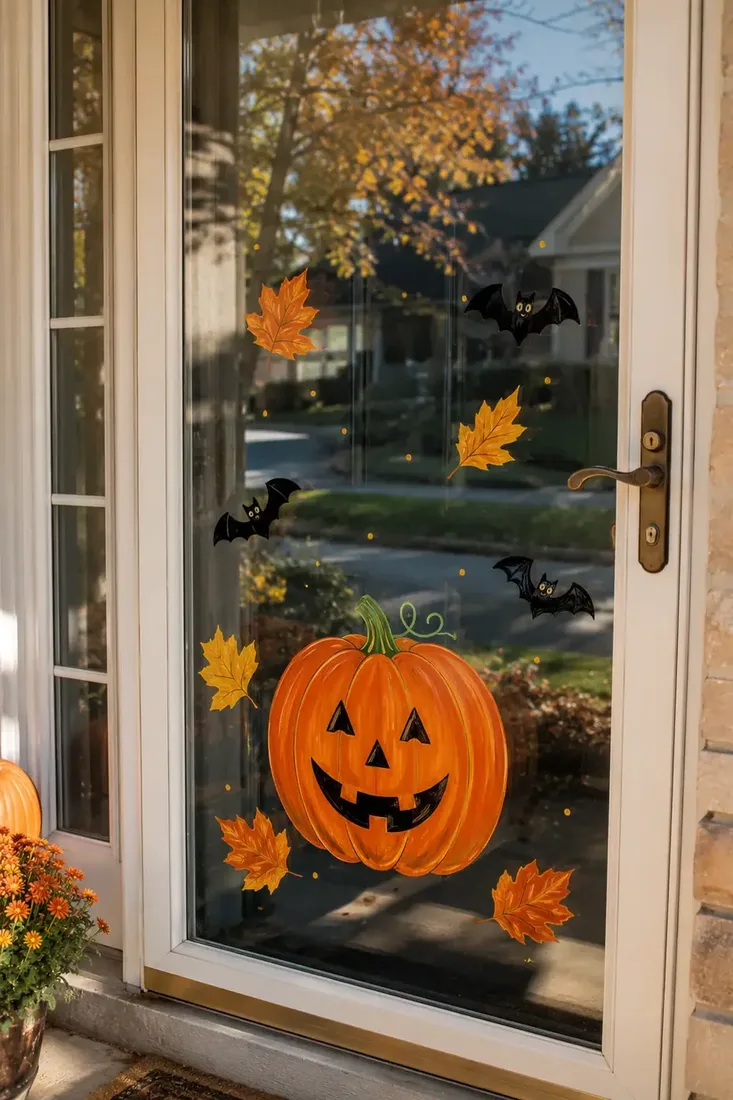
That pumpkin sits low on the door glass with triangle eyes, a triangle nose, and a wide grin, while three small black bats and five loose leaves float around it. The face does all the work, so the rest can stay sparse without looking unfinished.
That black is solid and matt against the orange, and the bats are simple silhouettes with two white dots for eyes and no other detail. The one thing to copy is keeping the black shapes small, because black paint shows every tremble and a big bat would wobble while a small one reads as neat from your doorstep.
Triangles are kinder than curves on glass, since your hand can brace and push straight for 20mm at a time. A Uni Posca PC-5M black bullet tip costs £3 to £5 in 2026 and draws the whole face without a brush, and my second bat still looked drunk so it became the one highest up where nobody looks closely.
Lettering with pumpkins top and bottom
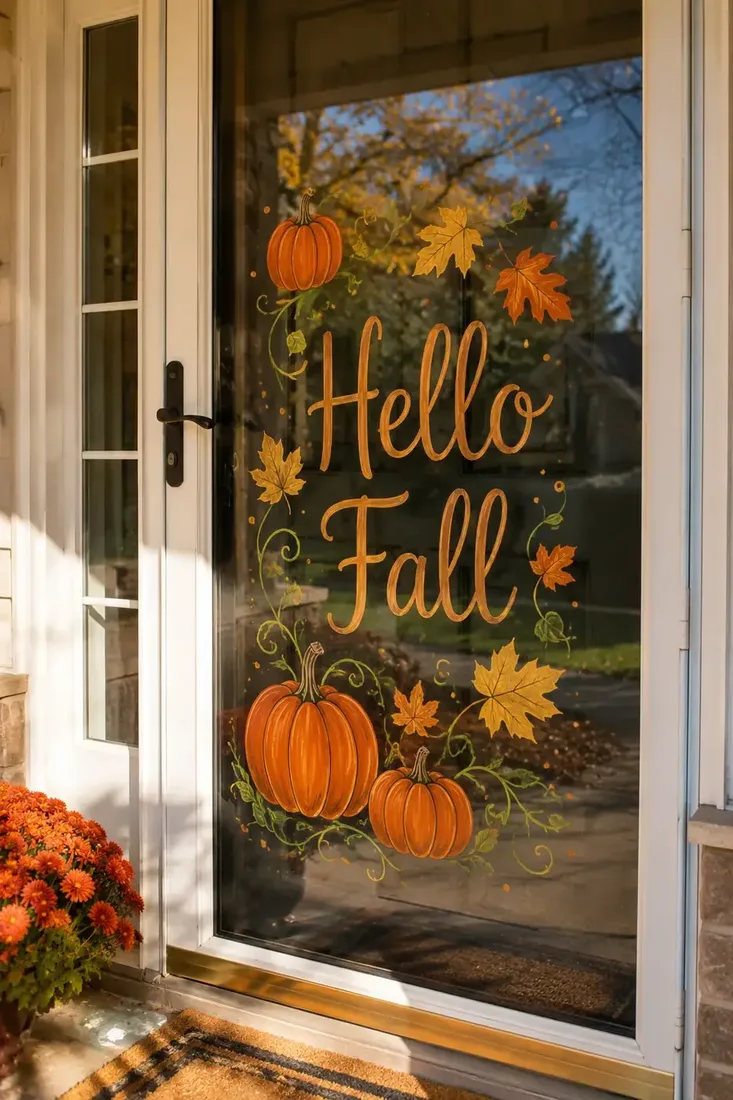
The words sit large and centred, with one small pumpkin above and two larger ones below, plus thin vines curling up the sides to fill the gaps. The lettering is the design here, and the pumpkins are just the frame that stops it floating.
That script is a warm ochre with thick downstrokes and thin upstrokes, dotted with tiny gold specks that read as sparkle from the step. The vines are the same double loaded green from the opening window, pulled thin so they decorate without competing with the words.
Lettering scared me until I sketched it on baking paper first and taped the paper to the other side of the glass as a guide, which gives you one confident pass instead of five nervous ones. An Edding 4085 in gold runs £3 to £5 in 2026, FrogTape 24mm for a level baseline costs £7 to £9 in 2026, and the whole door took an afternoon with the pumpkins already mixed.
What to buy
| Item | Where | Roughly |
|---|---|---|
| Acrylic craft paint, orange, white, brown, sage | Hobbycraft, The Works, Amazon | £6 to £10 for four |
| Flat synthetic brush, 12 to 20mm | Any craft shop | £2 to £4 |
| Small round brush for tendrils | Same | £2 to £3 |
Acrylic rather than washable kids’ paint, for this one. Double loading needs paint with enough body to hold two colours apart on the brush, and thin washable paint simply runs together and gives you a single muddy orange.
Paint on the inside of the glass. Weather cannot touch it, and it comes off later with warm soapy water and a plastic scraper.
Where it will not work
Textured or patterned glass, where the paint sits in the ridges and the streaking disappears into the texture.
Small panes divided by glazing bars, since each pumpkin needs a clear run of glass bigger than itself.
And any window with privacy or solar film on it. The paint will lift the film when you remove it, and replacing film costs considerably more than the paint did.
Frequently Asked Questions
Which design is best for a first attempt?
If your nerve is thin, go for the trio of round orange shapes with pale streaks through them. It needs only two paint tubes and one wide brush, it forgives shaky edges, and the group looks settled in under two hours.
Do markers or pots of paint suit a novice better?
Pots give soft blended pumpkin sides with little effort, while pens give crisp leaf edges and tidy writing. Most starters keep pots for big areas and grab a dark pen for stalks, faces, and curls once the base is dry.
How does the paint come off the pane later?
Work on the room side of the glass, then soften the artwork with hot soapy water and ease it away using a plastic blade. Glass without coatings or films cleans up fastest, so check a hidden corner first.
My outlines wobble. Should I fix them?
Leave them alone. Real gourds lean, foliage varies, and a second coat usually thickens the line and draws the eye. Step back three paces; if the shape reads clearly from where you stand, it is finished.
How do I get writing straight on the door?
Draft the phrase on paper at full size, tape that sheet on the outside as a guide, and trace calmly from indoors. Keep the wording brief, space the terms generously, and add small motifs only after the text dries.
What budget and time should I allow?
Expect £8 to £15 in 2026 for paint and a couple of brushes when the cupboard is bare, since most homes already own a plate and a jam jar. A trio or a leaf scatter fills an afternoon, while script plus motifs wants a second sitting.
To start
- Squeeze orange and white side by side and load both corners of one flat brush.
- Pull strokes from the stalk downwards, curving hard at the outside edges.
- Add a single white line down one side of the brown stalk while it is wet.
- Paint three at different sizes, overlapping, sitting on the same line.
- Use acrylic rather than washable paint, on the inside of the glass.
This article may contain affiliate links. We may earn a commission at no extra cost to you.