Home Decor

29 Small Bedroom Ideas That Turn Compact Spaces Into Calm Retreats

Discover 29 small bedroom ideas that make tiny rooms feel spacious, warm, and genuinely restful. Layout tricks, storage solutions, and styling secrets for bedrooms under 12 square meters.

Sarah Mitchell

June 26, 2026 · 18 min read

✓ Reviewed by editors
Table of Contents
  1. 01Part 1: Layout — Making the Floor Plan Work
  2. 021. Centre the Bed on the Widest Wall
  3. 032. The Bed Against the Wall — When You Must
  4. 043. A Bed Nook — Embracing the Smallness
  5. 054. The Door Swing — Reclaim the Space
  6. 06Part 2: Making the Room Feel Larger
  7. 075. Light Walls, Warm Tone — The Maximum Space Illusion
  8. 086. Floor-to-Ceiling Curtains — Instant Height
  9. 097. One Oversized Mirror — The Room Doubler
  10. 108. Furniture on Legs — All of It
  11. 119. Vertical Lines Everywhere
  12. 1210. A Continuous Floor — No Threshold Breaks
  13. 13Part 3: Storage — The Small Bedroom’s Greatest Challenge
  14. 1411. Under-Bed Storage — Hidden and Generous
  15. 1512. Floating Shelves Instead of Bedside Tables
  16. 1613. Wall-Mounted Hooks for Everything
  17. 1714. A Slim Wardrobe With Mirrored Doors
  18. 1815. Headboard With Built-In Storage
  19. 1916. The Closet Edit — Ruthless and Liberating
  20. 20Part 4: Furniture — Scaled, Slim, and Multifunctional
  21. 2117. A Low-Profile Bed Frame
  22. 2218. A Slim Desk Shelf — For the Bedroom That Must Also Work
  23. 2319. A Narrow Dresser — Width Over Depth
  24. 24Part 5: Lighting the Small Bedroom
  25. 2520. Wall-Mounted Sconces Instead of Table Lamps
  26. 2621. Under-Bed LED Glow — Navigation Without Waking
  27. 2722. One Warm Light Source — Sometimes Enough
  28. 28Part 6: Styling the Small Bedroom
  29. 2923. Clear Surfaces — The Most Powerful Visual Expansion
  30. 3024. One Piece of Art — Properly Scaled
  31. 3125. The Bed as the Room — Maximum Bed, Minimum Everything Else
  32. 3226. The Monochromatic Bed — Eliminating Visual Noise
  33. 33Part 7: Specific Small Bedroom Situations
  34. 3427. The Small Apartment Bedroom — Rental-Friendly
  35. 3528. The Small Bedroom for Two
  36. 3629. The Small Bedroom at Its Most Beautiful — Night
  37. 37Your Small Bedroom Was Never the Problem
— DisclosureThis article may contain affiliate links. We may earn a commission at no extra cost to you.
We sometimes earn a small commission when you buy through our links. It costs you nothing extra and helps us keep writing. Read our full policy →

Here is what nobody tells you about small bedrooms:

They can be better than large ones.

Not despite their size. Because of it. A small bedroom that is well designed has an intimacy that large bedrooms spend thousands trying to achieve. It cocoons you. It wraps around you. Every surface is close enough to touch. Every texture is close enough to feel. The warmth of the bedside lamp fills every corner without having to travel across a vast, heat-dissipating expanse.

The problem was never the size of your bedroom. The problem was that you were trying to make it function like a large bedroom — cramming in furniture that doesn’t fit, storing things that don’t belong there, leaving surfaces cluttered because there is nowhere else for things to go.

A small bedroom designed as itself — as an intimate, edited, purpose-built space for rest and nothing else — is one of the most satisfying rooms you can create. Every decision matters. Every object earns its place. And the result is a room that feels not compromised but concentrated.

These 29 ideas will show you how.

Part 1: Layout — Making the Floor Plan Work

In a small bedroom, the layout is everything. A few centimeters in the wrong direction can make the difference between a room that flows and one that frustrates.

1. Centre the Bed on the Widest Wall

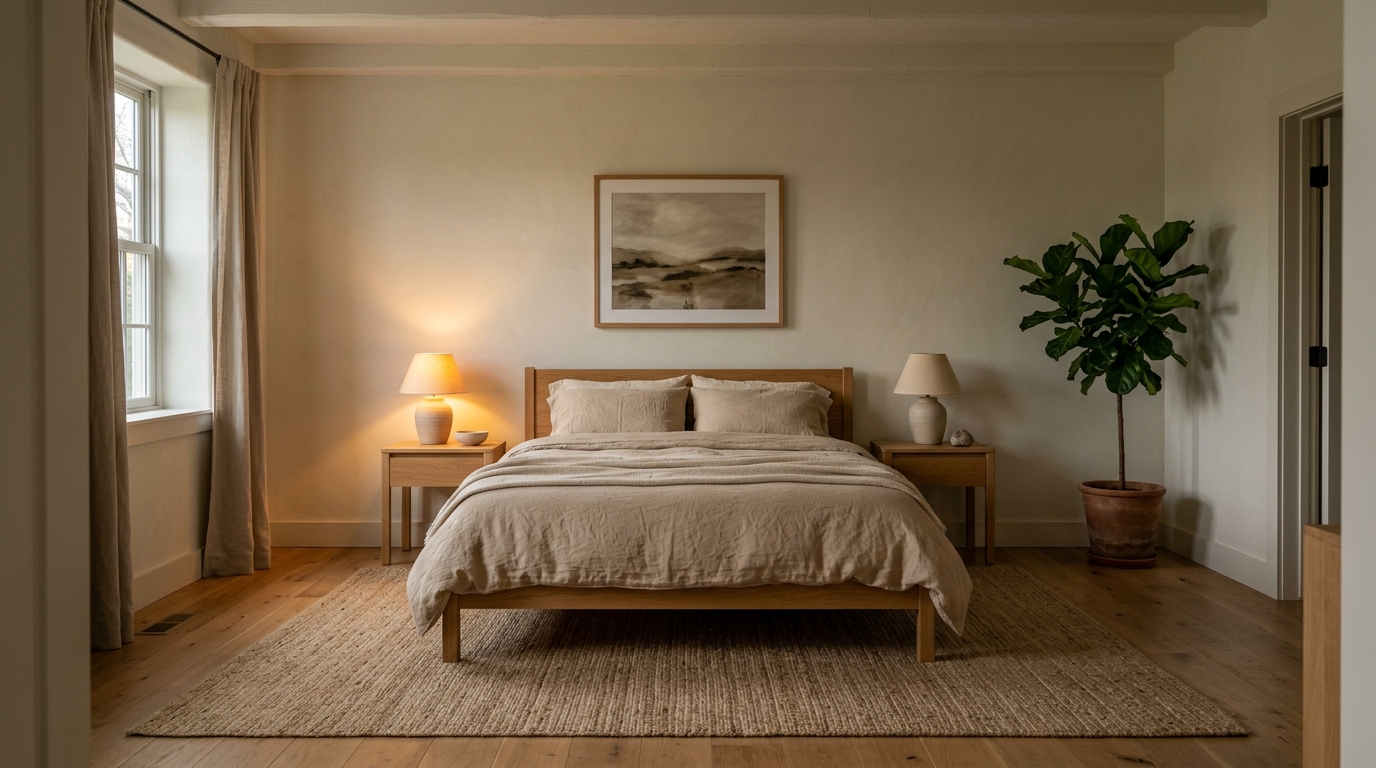
The single most important layout decision in a small bedroom is where the bed goes. In almost every case, the answer is: centred on the widest available wall, pulled slightly away from the wall behind it.

Centring the bed creates visual symmetry that makes the room feel ordered and calm. Even if only one side has a full bedside table and the other has a slim floating shelf, the centred bed reads as deliberate. A bed pushed into a corner reads as temporary — as though the room hasn’t been properly figured out yet.

If the widest wall has a window, consider whether the bed can sit below it. A low headboard beneath a window with curtains framing the bed from above creates a beautiful composition that uses the window as an architectural feature rather than fighting it.

Small bedroom with queen bed perfectly centred on the widest wall — symmetrical floating shelves on each side

2. The Bed Against the Wall — When You Must

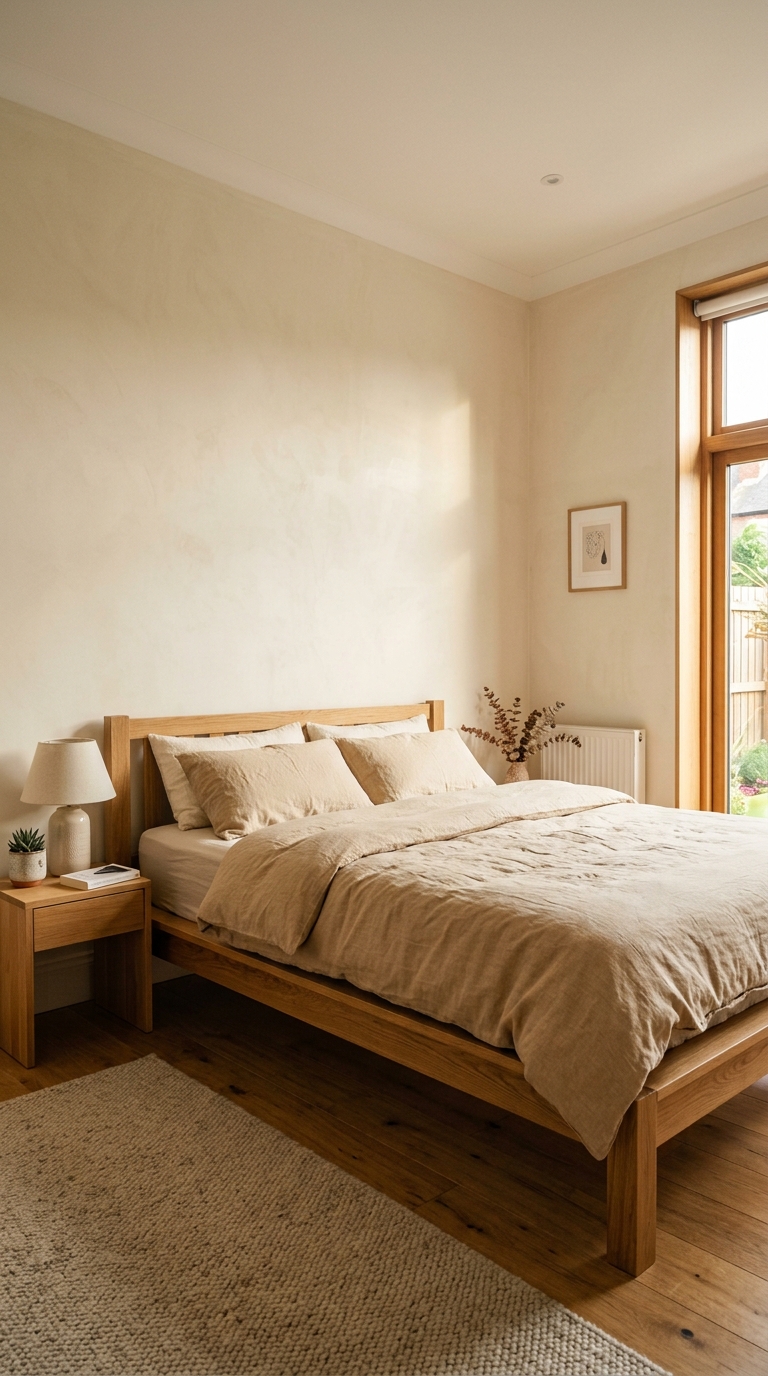
Sometimes a small bedroom is so compact that centering the bed leaves no functional path on one side. In these rooms, pushing the bed against one wall is the practical answer — and it can be beautiful.

The key is making the wall-side feel intentional rather than neglected. Run the bedding all the way to the wall with a clean tuck. Mount a floating shelf on the wall side at pillow height for a lamp and phone. Consider a padded wall panel or a cushioned headboard that extends the full wall width so the bed reads as built into the room rather than shoved against it.

The bed against the wall creates maximum floor space on the open side. Use that space well — a rug, a clear walking path, perhaps a slim chair — and the arrangement feels like a deliberate design decision.

Bed pushed against right wall as deliberate choice — open left side with brass mirror and walking path

3. A Bed Nook — Embracing the Smallness

In the smallest bedrooms — those under 8 square meters — stop trying to make the room feel bigger. Instead, lean into the smallness. Make the bed a nook. An alcove. A nest built into the room.

Position the bed with the headboard against one wall and one long side against another wall, creating an L-shaped enclosure around two sides of the bed. Add floating shelves on the wall side. Hang a pendant or sconce above. Layer the bedding generously so the bed fills the nook with warmth.

The nook bed feels protected and intimate — a reading cave, a sleeping cocoon, a space within a space. Children love this arrangement instinctively. Adults should rediscover it.

Bed tucked into corner as a deliberately cozy sleeping alcove with floating shelves and fairy lights

4. The Door Swing — Reclaim the Space

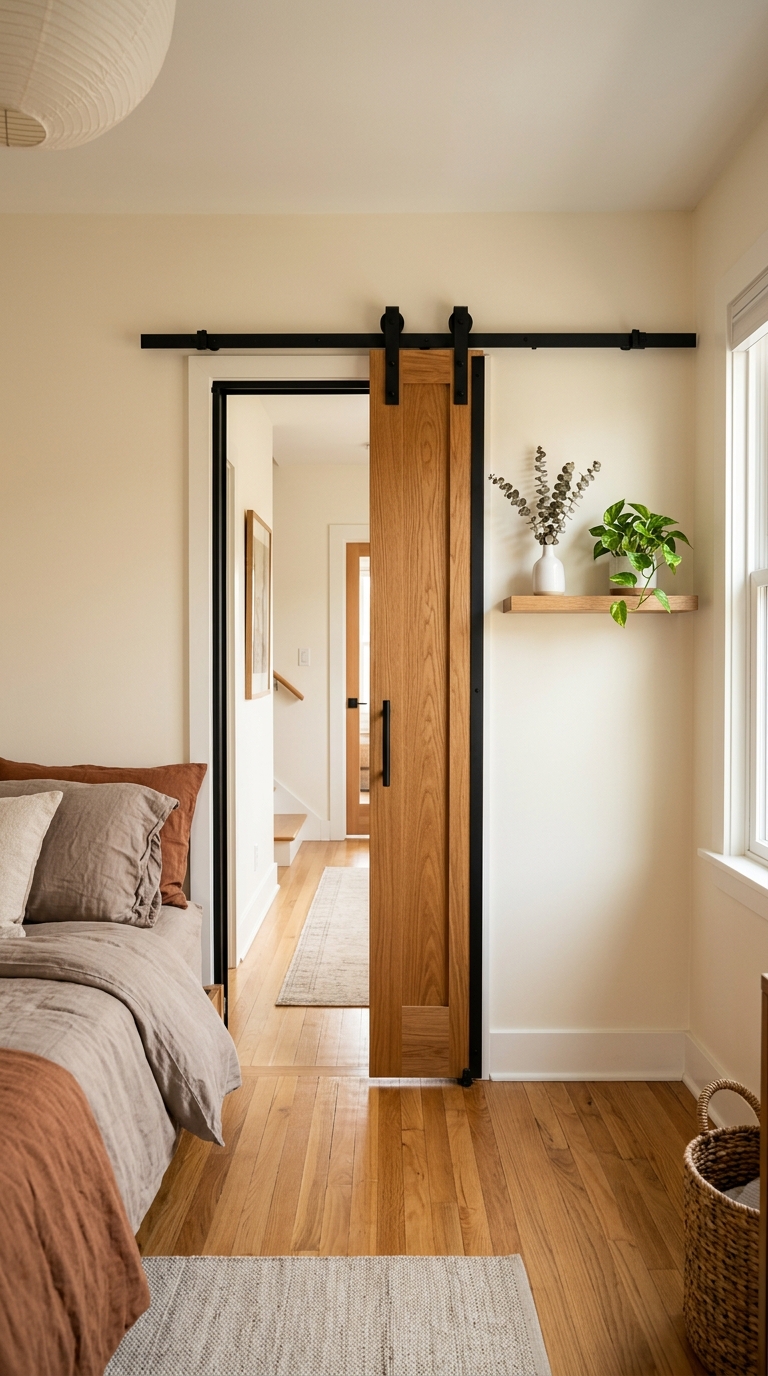
A standard bedroom door swings inward and claims a quarter-circle of floor space approximately 70cm in radius. In a small bedroom, that arc may represent five to eight percent of your usable floor area.

A pocket door that slides into the wall reclaims this entire area. A barn-style sliding door that runs along the exterior wall achieves the same result with simpler installation. Even reversing the door to swing outward into the hallway (if hallway space allows) recovers the floor instantly.

The recovered space is often enough for a small bedside table, a plant, or simply a cleaner entry into the room.

Slim barn-style sliding door in warm oak on matte black rail — reclaimed floor space beside doorway

Part 2: Making the Room Feel Larger

5. Light Walls, Warm Tone — The Maximum Space Illusion

Light-coloured walls reflect more light than dark walls. Rooms with light walls feel larger than rooms with dark walls. This is the single most reliable spatial illusion available.

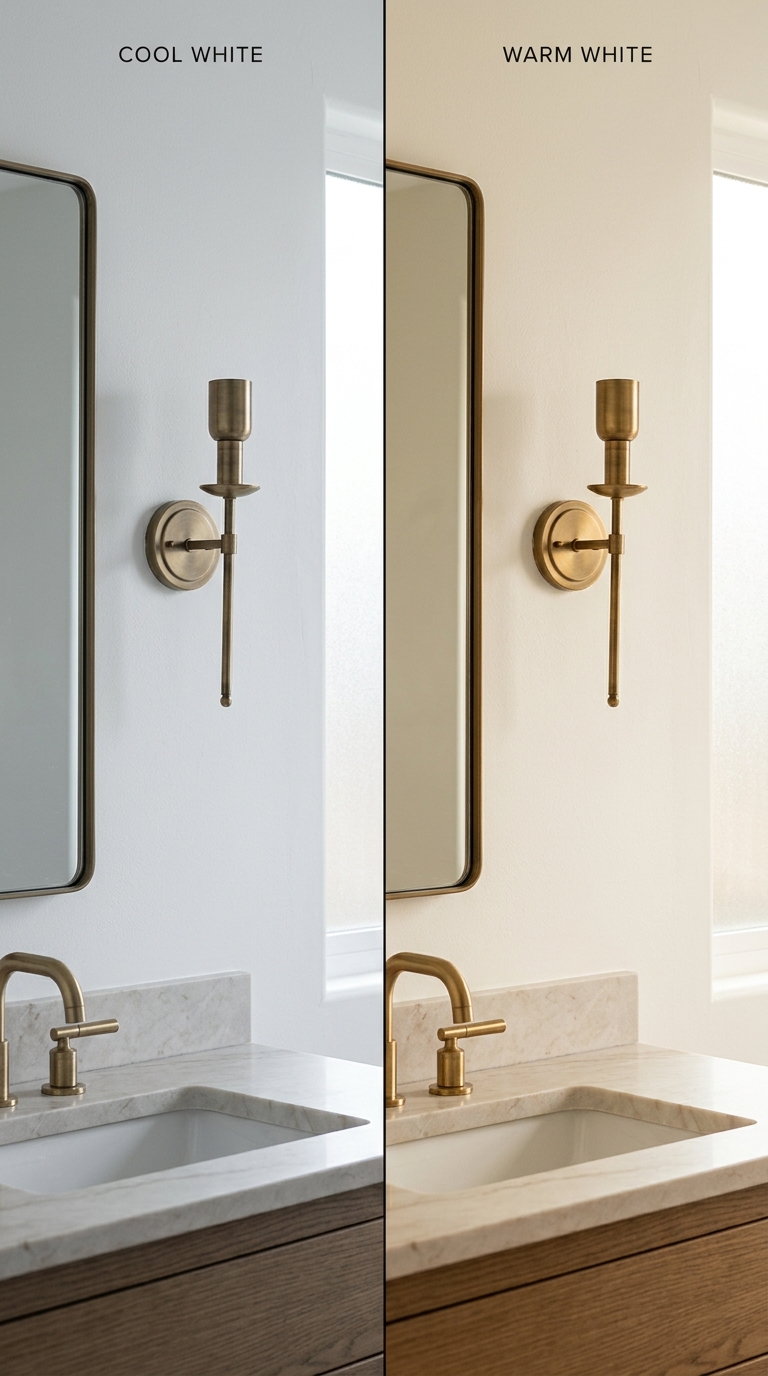
But the light colour must be warm. Cool whites and pale greys make a small bedroom feel clinical and exposed. Warm whites, soft creams, and the palest warm sand create the same spatial generosity while adding the warmth that a bedroom specifically requires.

Paint all four walls and the ceiling in the same warm white. The seamless colour wrap eliminates visual boundaries between surfaces and makes the room read as one continuous warm volume rather than a collection of separate planes.

Small bedroom with warm white walls and ceiling creating seamless light envelope and maximum space

6. Floor-to-Ceiling Curtains — Instant Height

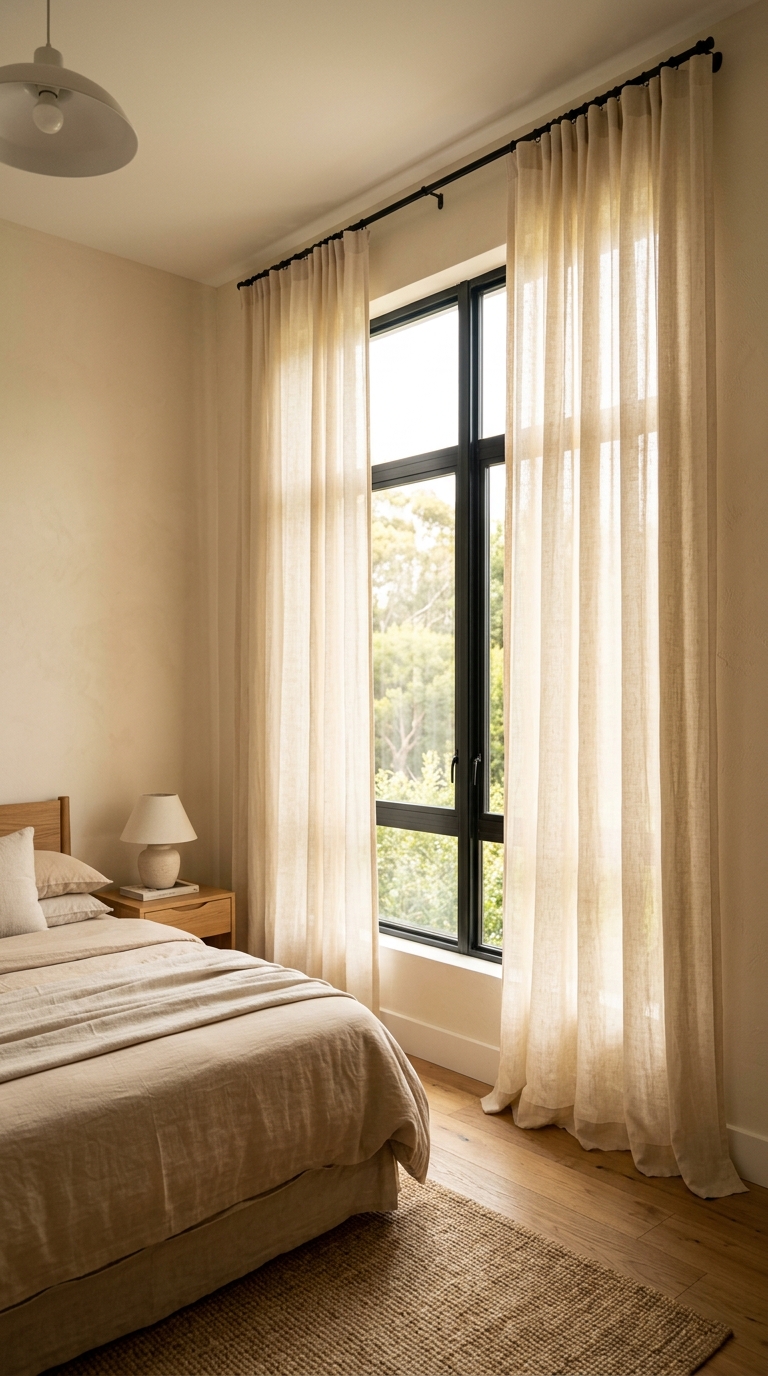
Curtains hung at ceiling height transform a small bedroom’s proportions. The vertical lines from ceiling to floor draw the eye upward and create the illusion that the ceiling is higher and the room is taller than it actually is.

Mount the rod within 5 to 10cm of the ceiling. Extend it 25 to 30cm beyond the window frame on each side so the curtains frame the window when open rather than covering the glass. Choose a sheer or lightweight natural linen in a tone close to the wall colour so the curtains integrate into the wall rather than contrasting with it.

The curtains should touch the floor with a 3 to 5cm puddle. The puddle adds softness and makes the curtain feel generous. Let them fall straight rather than gathered — in a small bedroom, heavy gathered curtains feel claustrophobic.

Floor-to-ceiling sheer linen curtains creating dramatic height — full 250cm drop from rod to puddle

7. One Oversized Mirror — The Room Doubler

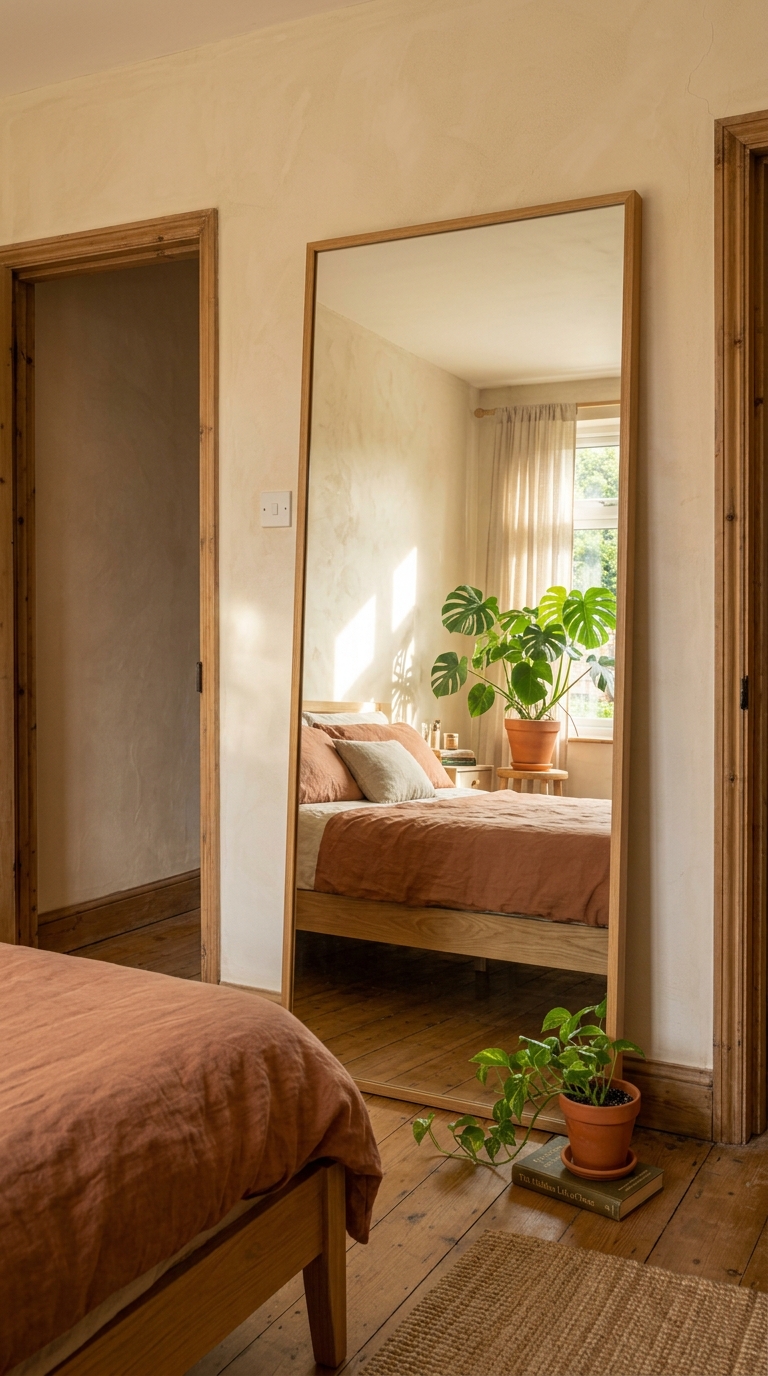
In a small bedroom, one large mirror does more for the perceived size of the room than any other single object. It reflects light, extends the visual depth of the space, and multiplies whatever warmth you have already created.

Place the mirror where it reflects the window to double the natural light in the room. A large round mirror approximately 90cm in a thin brass frame on the wall opposite the window. A full-length mirror in a slim oak frame leaning against the wall beside the door. An arched mirror leaning at a slight angle.

The mirror should feel almost too large for the room. In a small bedroom, an oversized mirror is never actually too large — it is always the right size.

Large leaning full-length mirror in oak frame — room reflected in glass doubling visual depth

8. Furniture on Legs — All of It

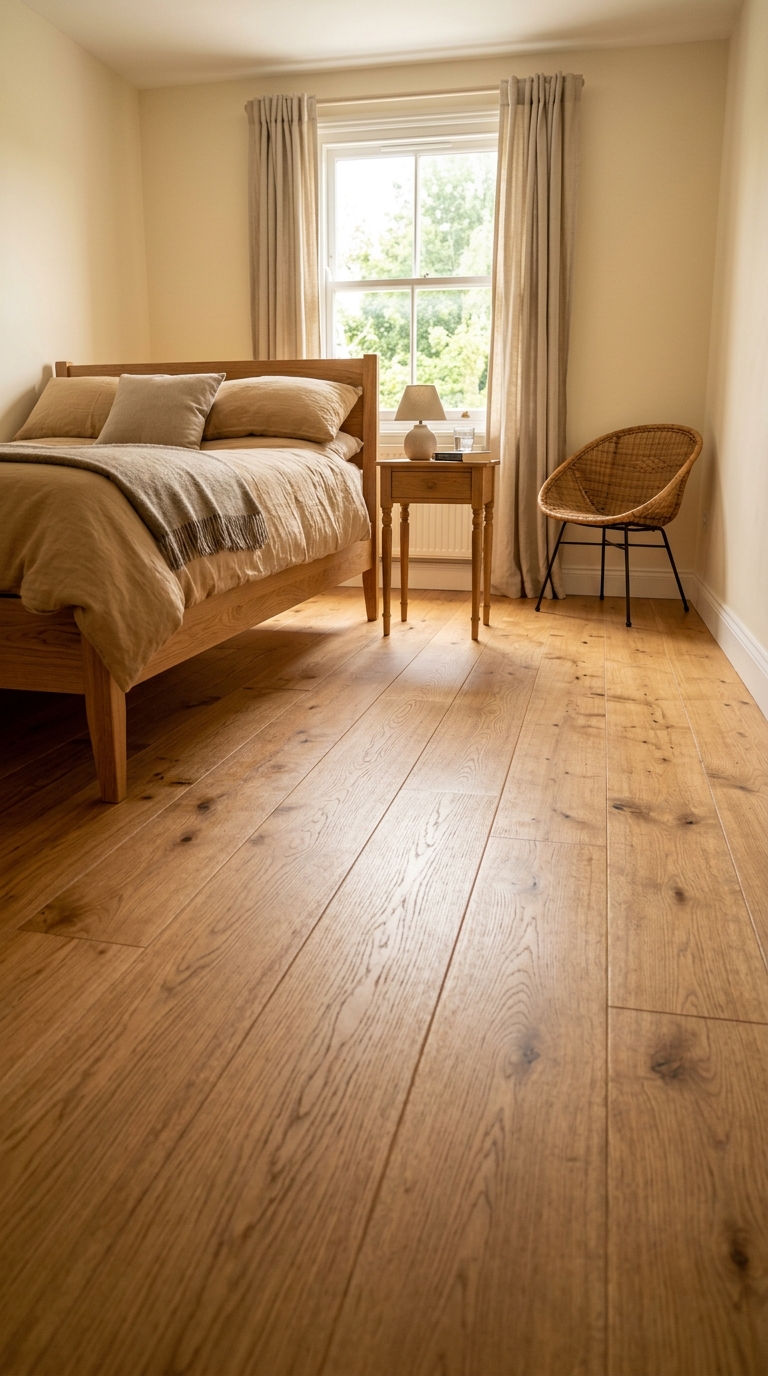
In a small bedroom, visible floor space directly correlates with perceived room size. Every piece of furniture on legs reveals the floor beneath it, and the eye reads continuous floor space as room size.

The bed on legs showing 12 to 15cm of floor beneath it. The bedside table on legs (or floating as a wall shelf). Any chair on slender legs. Any dresser on legs rather than sitting flat on the floor.

When the warm oak floor is visible beneath every piece of furniture, it flows continuously from wall to wall and the room reads as one unbroken floor plane rather than a series of furniture-blocked segments. The visual effect is immediate and significant.

Floor-level shot showing warm oak floor flowing beneath bed, bedside table, and chair — all on legs

9. Vertical Lines Everywhere

When a room is small, making it feel taller compensates significantly for its limited floor area. Vertical lines throughout the room draw the eye upward and create the illusion of greater ceiling height.

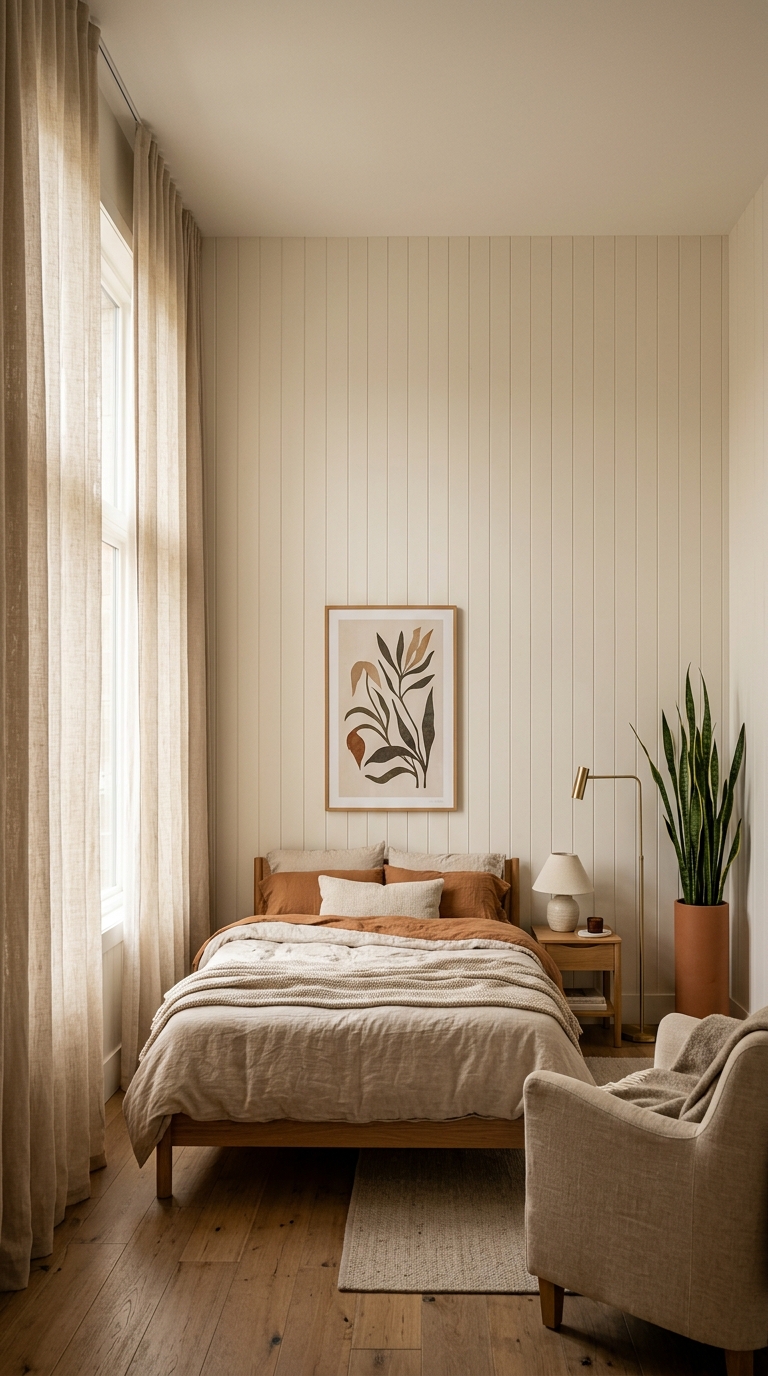
Floor-to-ceiling curtains. Tall slim plants rather than wide spreading ones. Vertical art in portrait orientation rather than landscape. Tall narrow shelving instead of wide low shelving. Even vertical tongue-and-groove panelling on the wall behind the headboard adds upward visual emphasis.

Every vertical element contributes to the room’s sense of height. Collectively, they transform a room with a standard 240cm ceiling into one that feels taller and more generous overhead.

Multiple vertical elements — curtains, tall plant, portrait art, floor lamp — drawing eye upward

10. A Continuous Floor — No Threshold Breaks

When the bedroom floor is the same material as the hallway floor — warm oak throughout, with no threshold strip or material change at the doorway — the visual boundary of the room extends beyond its walls. The eye reads the continuous floor as one space, and the bedroom borrows visual size from the hall.

If a continuous floor isn’t possible, choose a rug that doesn’t stop short of the bed. A rug that extends under the bed and beyond it on three sides creates an unbroken textile surface that unifies the room’s floor and prevents the fragmented look of a small rug floating in a small room.

Warm oak floor running continuously from hallway into bedroom with no threshold break

Part 3: Storage — The Small Bedroom’s Greatest Challenge

11. Under-Bed Storage — Hidden and Generous

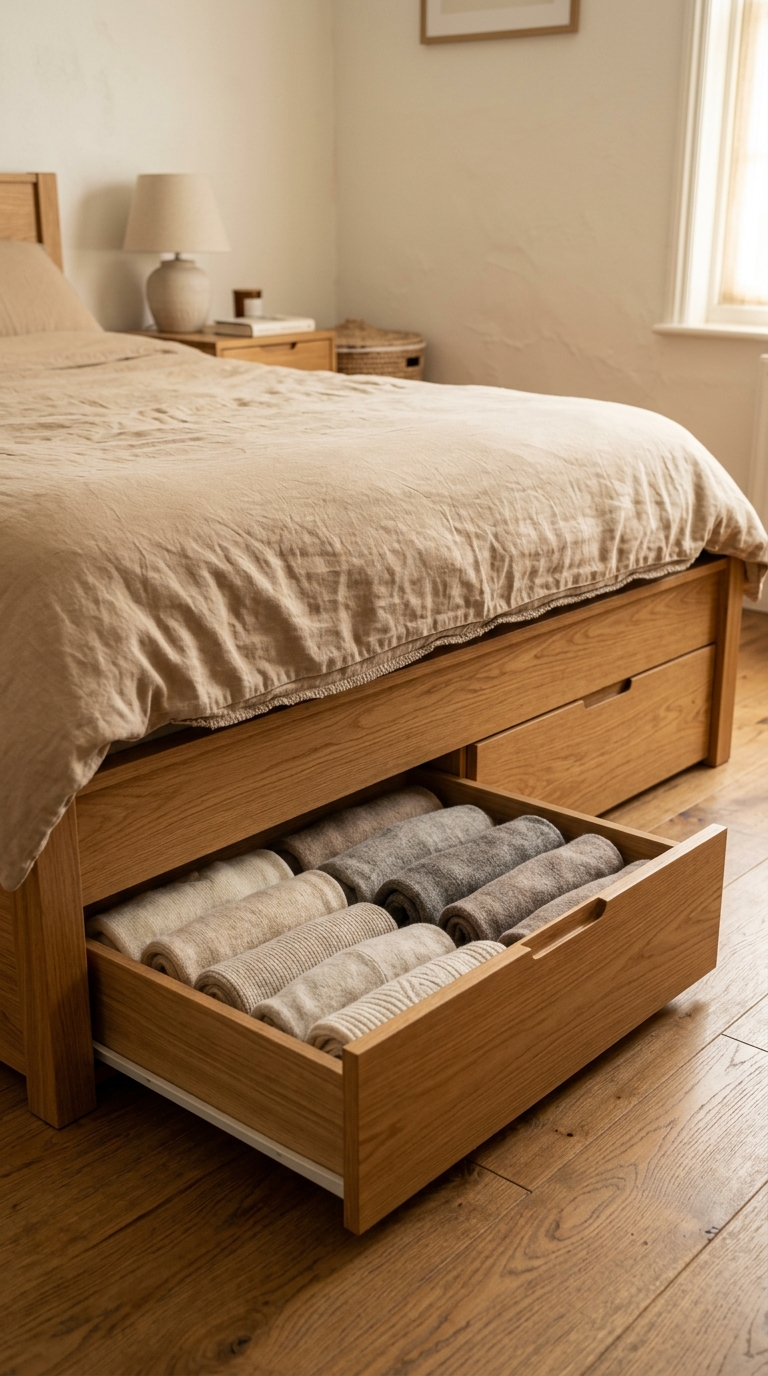
The space beneath the bed is the largest single storage opportunity in a small bedroom. A bed with 15cm of clearance beneath its frame can hide three to four low storage containers — enough for off-season clothing, extra bedding, or shoes.

Choose containers in materials that look good even when partially visible: woven seagrass boxes, linen-covered storage bins, simple wooden crates. If the bed has a frame that conceals the underside, any container works.

Better yet: choose a bed frame designed specifically with storage drawers built into the base. Two or four under-bed drawers provide significant concealed storage with no additional containers needed.

Oak bed frame with built-in storage drawer pulled open showing organized folded knitwear

12. Floating Shelves Instead of Bedside Tables

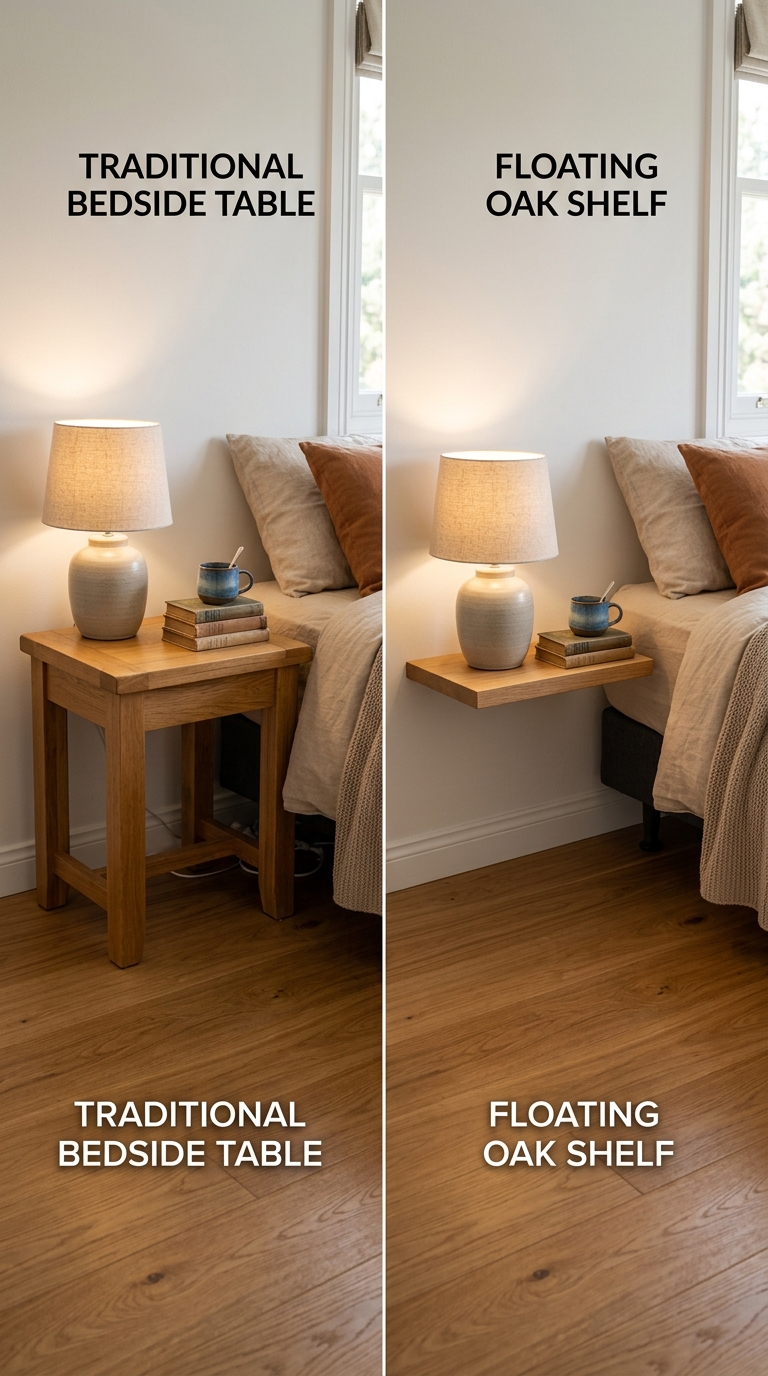
Traditional bedside tables occupy approximately 40x40cm of floor space on each side of the bed. In a small bedroom, that is 80cm of floor width consumed — potentially the difference between a comfortable walking path and an unusable squeeze.

Floating shelves mounted at mattress height provide the essential bedside surface — space for a lamp, a cup, one small object — while occupying zero floor space. The floor beneath the shelf remains clear and visible, contributing to the room’s sense of spaciousness.

Choose shelves in solid warm oak approximately 35 to 40cm wide and 20 to 25cm deep. Mount them with concealed brackets so they appear to float from the warm plaster wall.

Split comparison — traditional bedside table vs floating shelf showing dramatic floor space difference

13. Wall-Mounted Hooks for Everything

In a small bedroom, wall-mounted hooks replace furniture. A row of hooks behind the door holds tomorrow’s outfit, a dressing gown, a tote bag — items that would otherwise live on a chair or the floor.

A single hook beside the bed at the right height holds a sleep mask, a small bag, headphones. Hooks on the inside of a closet door hold belts, scarves, and accessories.

Choose hooks in materials that complement the room: brushed brass, matte black, warm oak pegs. Mount them at consistent heights for visual order. Three or four identical hooks in a row read as a design feature. Random hooks at scattered heights read as desperation.

Four matching brushed brass hooks in precise row — dressing gown, tote, scarf, one intentionally empty

14. A Slim Wardrobe With Mirrored Doors

A slim wardrobe — 50 to 60cm deep instead of the standard 65cm — saves 5 to 15cm of room depth, which in a small bedroom is genuinely significant. Combined with mirrored doors, the wardrobe serves double duty: concealed clothing storage and a full-length mirror that makes the room feel larger.

The mirrored doors reflect the room back at itself, creating the illusion of depth behind the wardrobe wall. If the wardrobe is placed opposite the window, the mirror reflects the natural light and effectively doubles the room’s brightness.

Choose a frameless mirror or a mirror in a minimal warm oak surround. The wardrobe should look like a wall of mirror, not a piece of furniture with mirrors stuck to it.

Floor-to-ceiling slim wardrobe with frameless mirrored doors reflecting the complete opposite room

15. Headboard With Built-In Storage

A headboard with built-in shelving or cubbies combines the headboard, bedside tables, and display storage into a single piece — eliminating the need for separate furniture on each side of the bed.

A solid oak headboard with two open cubbies at each end — each holding a lamp and a few small objects. A headboard with a narrow ledge along the top — deep enough for a phone, a book, a small alarm clock. A headboard with concealed compartments behind sliding panels.

The storage headboard is one piece doing the work of three, and in a small bedroom that consolidation is transformative.

Solid oak headboard with built-in cubbies holding lamp and objects — no separate bedside tables needed

16. The Closet Edit — Ruthless and Liberating

Storage problems in small bedrooms are almost never solved by adding more storage. They are solved by owning less.

A ruthless closet edit — removing everything you haven’t worn in twelve months, everything that doesn’t fit, everything that doesn’t make you feel good — typically reduces a wardrobe by 30 to 50 percent. The remaining clothes have room to breathe. You can see everything you own. Getting dressed becomes faster. The closet stops being a source of anxiety.

In a small bedroom, the closet edit has a secondary benefit: the emotional weight of excess possessions — even hidden ones — contributes to the room feeling heavy. When the hidden clutter is removed, the room feels lighter even though nothing visible has changed.

Edited closet with minimal curated contents — matching hangers, 40% empty space, breathing room

Part 4: Furniture — Scaled, Slim, and Multifunctional

17. A Low-Profile Bed Frame

A bed frame with a low profile — 25 to 30cm from the floor to the top of the mattress platform rather than the standard 40 to 50cm — makes the room feel taller by lowering the visual centre of gravity. More wall is visible above the bed. More ceiling space appears overhead. The room’s vertical proportion improves.

A low-profile solid oak platform bed with a headboard approximately 80cm tall (measured from the floor, not the mattress) creates the ideal proportion: low enough to improve the room’s height perception, high enough to lean against comfortably.

Low-profile oak bed frame — more wall visible above, room feels taller and more generous

18. A Slim Desk Shelf — For the Bedroom That Must Also Work

In many small apartments, the bedroom is the only space available for a desk. Rather than a full desk that consumes floor space and makes the bedroom feel like an office, a wall-mounted desk shelf provides a working surface that folds or sits flush against the wall.

A floating shelf approximately 80cm wide and 35cm deep mounted at standard desk height (75cm) provides enough surface for a laptop and a cup. When work is done, the laptop closes and stores, and the shelf reads as a simple floating shelf with a small plant and a candle — bedroom furniture, not office furniture.

Floating oak desk shelf in evening bedroom mode — candle, plant, chair tucked beneath

19. A Narrow Dresser — Width Over Depth

In a small bedroom, a standard dresser at 55 to 60cm deep projects too far into the room. A narrow dresser — 35 to 40cm deep with wider drawers — provides comparable storage volume in a significantly shallower profile.

The narrow dresser sits closer to the wall, preserving walking space and making the room feel less crowded. The wider drawers compensate for the shallower depth — clothing folds to fit the different proportion.

Choose a dresser in warm oak with a clean face — flat drawer fronts with concealed handles for a smooth unbroken surface.

Split comparison — standard 55cm dresser vs narrow 38cm dresser showing 17cm walking path difference

Part 5: Lighting the Small Bedroom

20. Wall-Mounted Sconces Instead of Table Lamps

In a small bedroom where bedside surface space is limited, wall-mounted sconces provide reading light and ambient warmth without occupying any table or shelf surface.

Sconces mounted approximately 15cm above mattress height on each side of the headboard create the same warm pools of amber light that table lamps provide, while leaving the floating shelves free for a cup, a book, and one small object.

Choose sconces with adjustable arms so the light can be directed for reading or angled toward the wall for ambient glow. Brass or warm metal finishes with linen shades maintain the room’s material warmth.

Two matching brass wall sconces flanking headboard — floating shelves free for cup and book

21. Under-Bed LED Glow — Navigation Without Waking

A warm LED strip beneath the bed frame serves as the ideal small bedroom night light. It illuminates the floor for safe navigation without lighting the room brightly enough to disrupt sleep or disturb a partner.

The warm glow — at 2700K or below — washes downward onto the floor, creating a soft amber pool around the bed perimeter. The light source is invisible from the bed. Connected to a motion sensor, it activates when feet touch the floor and deactivates automatically after a few minutes.

The secondary benefit: the under-bed glow makes the bed appear to float, which makes the room feel more spacious — a valuable effect in a small bedroom.

Small bedroom at night with warm under-bed LED strip — bed floating on pool of amber light

22. One Warm Light Source — Sometimes Enough

Not every small bedroom needs three light sources. Sometimes one — the right one — is all the room requires.

A single ceramic table lamp on a floating shelf beside the bed, with a warm linen shade and a 2700K bulb on a dimmer, can provide everything a small bedroom needs. At 100%: enough light to dress and find things. At 30%: warm ambient light for winding down. At 10%: the gentlest amber glow for the minutes before sleep.

One lamp simplifies. One lamp focuses. One lamp creates a single warm pool of amber in an otherwise dark room, and that singular pool is deeply intimate.

Small bedroom lit by single ceramic lamp — one warm pool of amber in otherwise dark room

Part 6: Styling the Small Bedroom

23. Clear Surfaces — The Most Powerful Visual Expansion

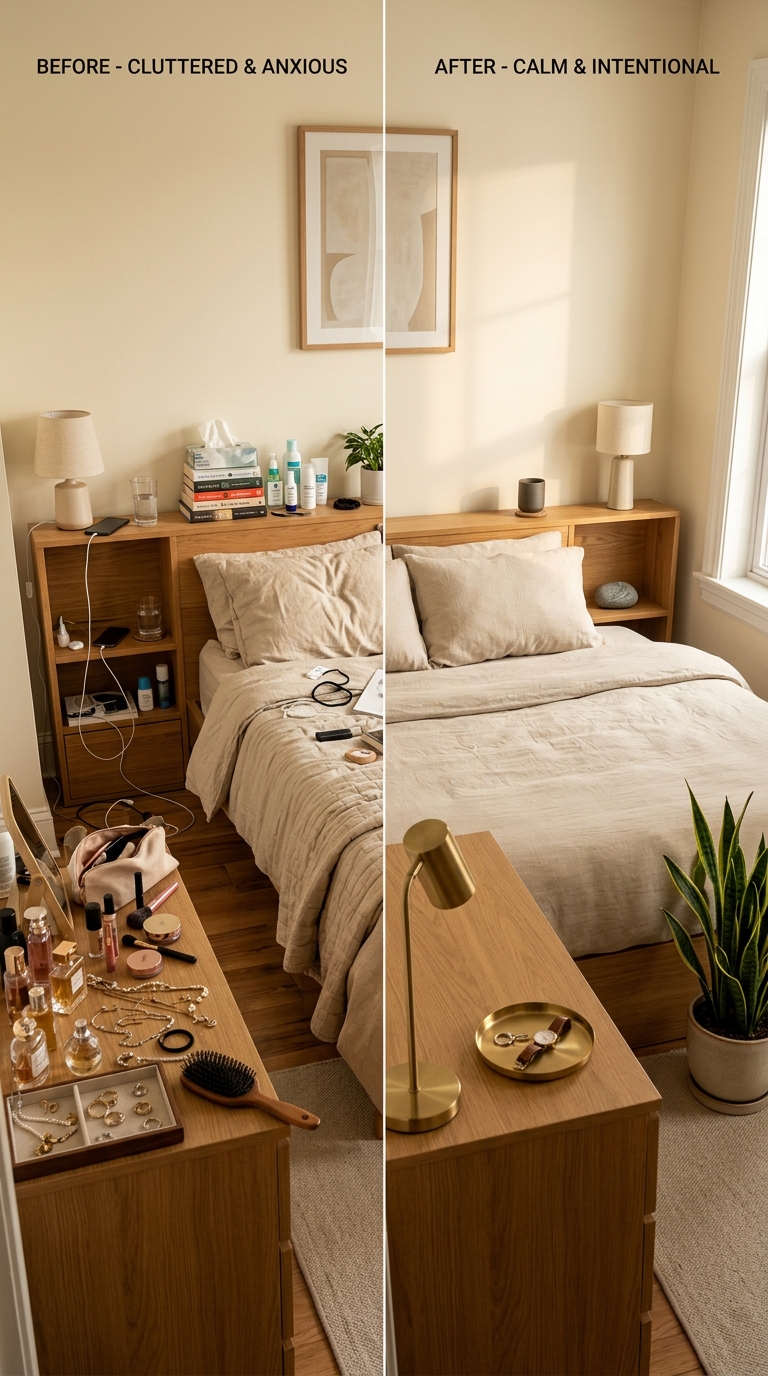
In a small bedroom, the state of your surfaces determines whether the room feels cramped or calm. Clear surfaces create visual rest. Cluttered surfaces create visual noise, and visual noise makes small rooms feel smaller.

Every horizontal surface should hold a maximum of three objects. The bedside shelf: a lamp, a cup, one item. The dresser top: a lamp, a tray, a plant. The windowsill: one small plant or nothing.

Clearing surfaces is not about minimalism for its own sake. It is about protecting the room’s sense of space. Every object added to a surface in a small bedroom has a disproportionate impact on the room’s perceived size. Edit accordingly.

Split comparison — cluttered surfaces vs cleared to three objects maximum — same room, different feeling

24. One Piece of Art — Properly Scaled

In a small bedroom, one piece of art above the headboard is the complete wall programme. No gallery wall. No collection of small frames. One piece — properly scaled, properly positioned — anchoring the room with intention.

The art should be at least two-thirds the width of the headboard. A single large abstract in warm neutral tones. A botanical illustration at generous scale. An oversized photograph in warm sepia tones. The single piece gives the room a focal point above the bed that makes the space feel designed.

Smaller art makes a small room feel smaller. Larger art makes a small room feel more confident.

Single properly scaled abstract artwork above headboard — 65% width, thin oak floater frame

25. The Bed as the Room — Maximum Bed, Minimum Everything Else

In the smallest bedrooms, the most liberating design decision is to stop fighting the bed’s dominance and embrace it. Let the bed be the room.

A generous queen bed in a 9 square meter room fills the majority of the floor space. Walking paths of 45 to 50cm on each side. The bed dressed in abundant linen with multiple pillows and throws. Floating shelves instead of tables. One plant. One piece of art. And that is the room.

The effect is not cramped. It is cocooning. The bed becomes the world. The narrow paths become intimate. The room feels like a sleeping cabin on a train or a captain’s quarters on a beautiful ship — compact, considered, and deeply satisfying.

Queen bed filling 70% of small room — maximum layering creating deliberate cocooning nest effect

26. The Monochromatic Bed — Eliminating Visual Noise

In a small bedroom, a bed dressed in multiple competing tones creates visual fragmentation that makes the room feel busier and smaller. A bed dressed in a single warm neutral tone — where sheets, duvet, pillows, and throw are all within one shade of each other — creates a single warm mass that the eye reads as one calm surface.

The monochromatic bed is not boring. It is profoundly restful. The texture variations between linen, bouclé, and knit provide all the visual interest the bed needs. The absence of tonal contrast lets the eye rest on the bed without needing to process colour relationships.

Choose one tone — warm cream, warm sand, or natural undyed — and dress the entire bed within it.

Completely monochromatic warm cream bed — six textures within one tone, deeply calming

Part 7: Specific Small Bedroom Situations

27. The Small Apartment Bedroom — Rental-Friendly

The rental apartment bedroom has additional constraints: no drilling large holes, no painting (sometimes), no permanent fixtures. Everything must be removable.

The rental toolkit: command strips for lightweight frames, tension rods for curtains inside the window frame, freestanding mirrors that lean rather than hang, furniture that functions without wall attachment, rugs that define the space over existing flooring, removable wallpaper or fabric panels for a feature wall effect.

Every element fully removable when you leave. Every element fully beautiful while you stay.

Beautiful rental bedroom with tension-rod curtains, leaning mirror, command-strip art, zero permanent fixtures

28. The Small Bedroom for Two

When two people share a small bedroom, the design must serve both without making either feel that their needs were an afterthought.

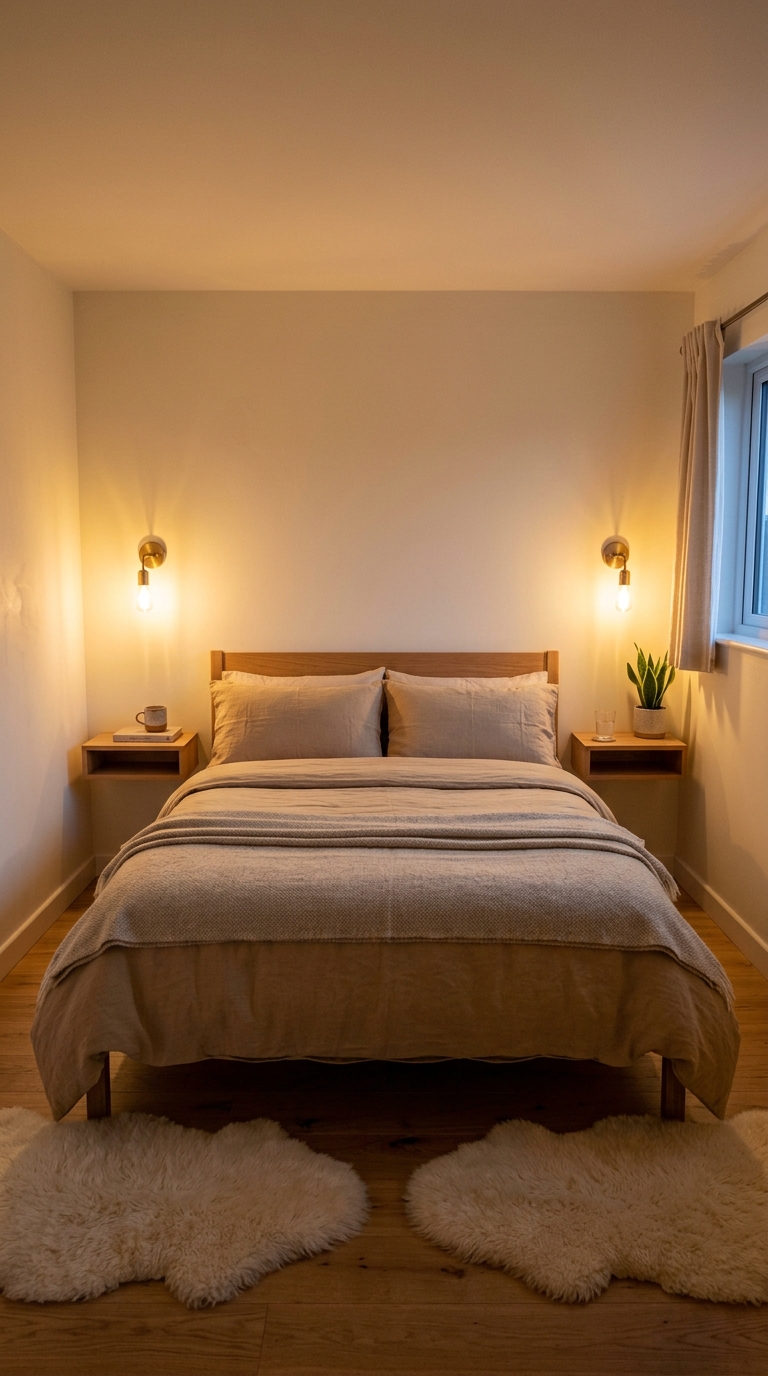
Each person needs: accessible bedside surface, a reachable lamp or sconce, enough space to get in and out of bed without climbing over the other person. The bed should be centred with minimum 45cm walking space on each side. Each side should have its own light source controllable independently.

The bedroom’s neutral palette and clear surfaces become even more important with two people — double the potential clutter, double the need for visual calm.

Symmetrical two-person small bedroom — each side with own sconce, shelf, sheepskin, independent light

29. The Small Bedroom at Its Most Beautiful — Night

The small bedroom reaches its peak beauty at night. The intimacy that daylight reveals as compact, lamplight transforms into cozy. The walls that felt close in the afternoon feel protective in the evening. The room that seemed small now seems exactly the right size — close enough to hold you, warm enough to keep you, dark enough to let you rest.

The well-designed small bedroom at 10pm: the sconces dimmed to 15%, one candle lit on the bedside shelf, the duvet turned back inviting you in, the chunky throw ready at the foot, the sheepskin rug glowing in the under-bed light, the curtains drawn, the world outside irrelevant.

This is a small bedroom. And it is exactly, precisely, perfectly enough.

Small bedroom at 10pm — sconces dimmed, candle lit, under-bed glow, sheepskin warm, world excluded

Your Small Bedroom Was Never the Problem

The room was never too small. The expectations were too large.

A small bedroom asking to be a large bedroom will always disappoint. A small bedroom asking to be itself — intimate, edited, warm, cocooning — will always exceed what you thought was possible.

Start tonight. Clear one surface. Turn off the overhead light. Turn on one warm lamp. Fold one good throw at the foot of the bed. Stand in the doorway and look.

The room has changed. Not because the walls moved. Because your relationship to the space moved. The small bedroom is not a compromise you live with. It is a sanctuary you design.

And the design starts with one simple decision: to stop wishing it were bigger and start making it beautiful.

Explore more on TheNestiora:

Cozy Bedroom Ideas · → Neutral Bedroom Ideas · → Small Living Room Ideas · → Small Bathroom Ideas

Written byHome Decor

Sarah Mitchell

Contributing Writer · The Nestiora

June 26, 2026
18 min read
— Thanks for reading

If this story was useful, share it with someone you'd like to read it too.

— The Letter

A letter, once a week. Read it with tea.

Weekly tips, tested picks, and seasonal inspiration — delivered free.

No spam. Unsubscribe anytime.