15 Blue Front Door Ideas: Pale Blue Needs a Sheltered Opening

Add us as a preferred source to see more stories on Google.
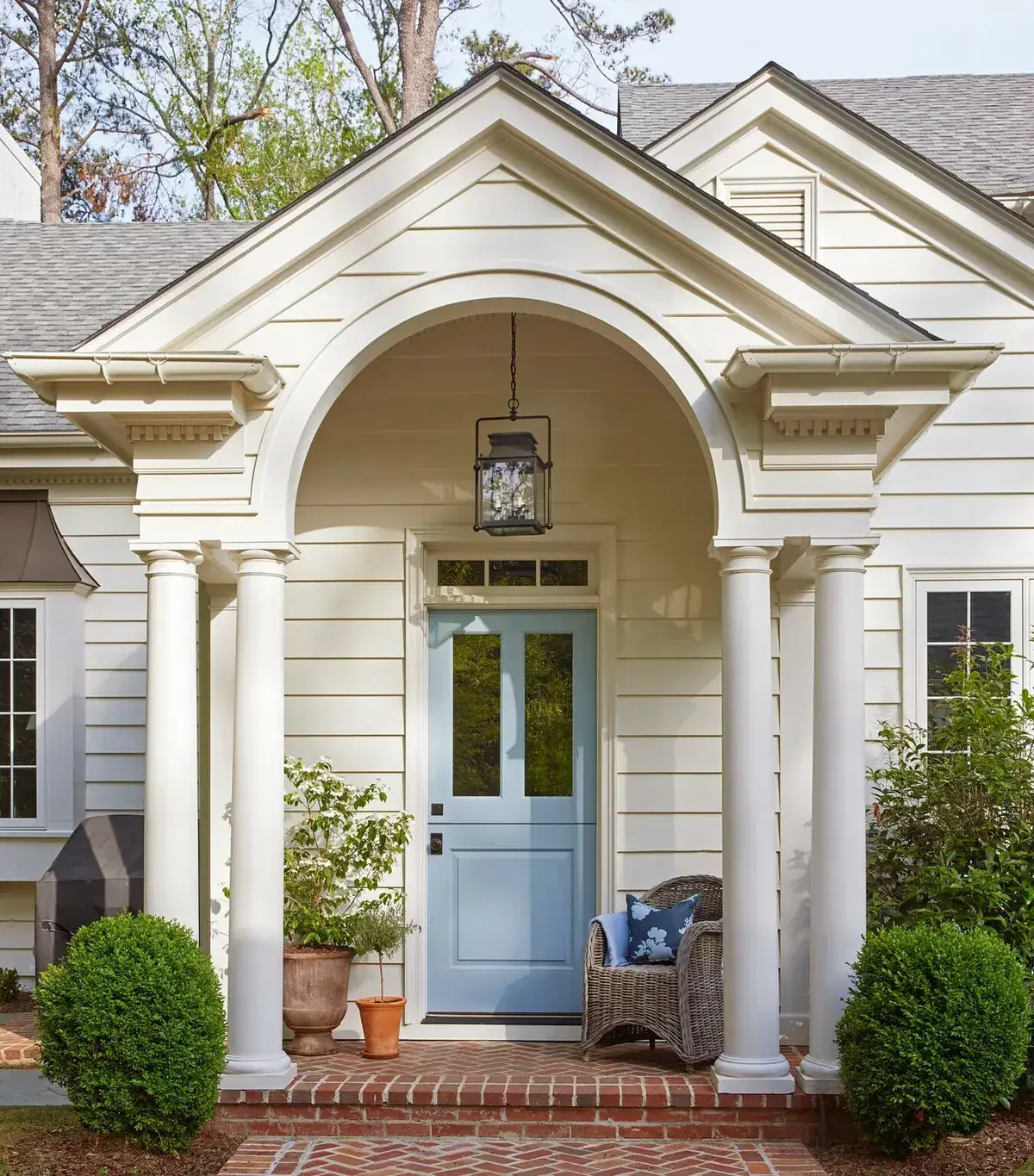
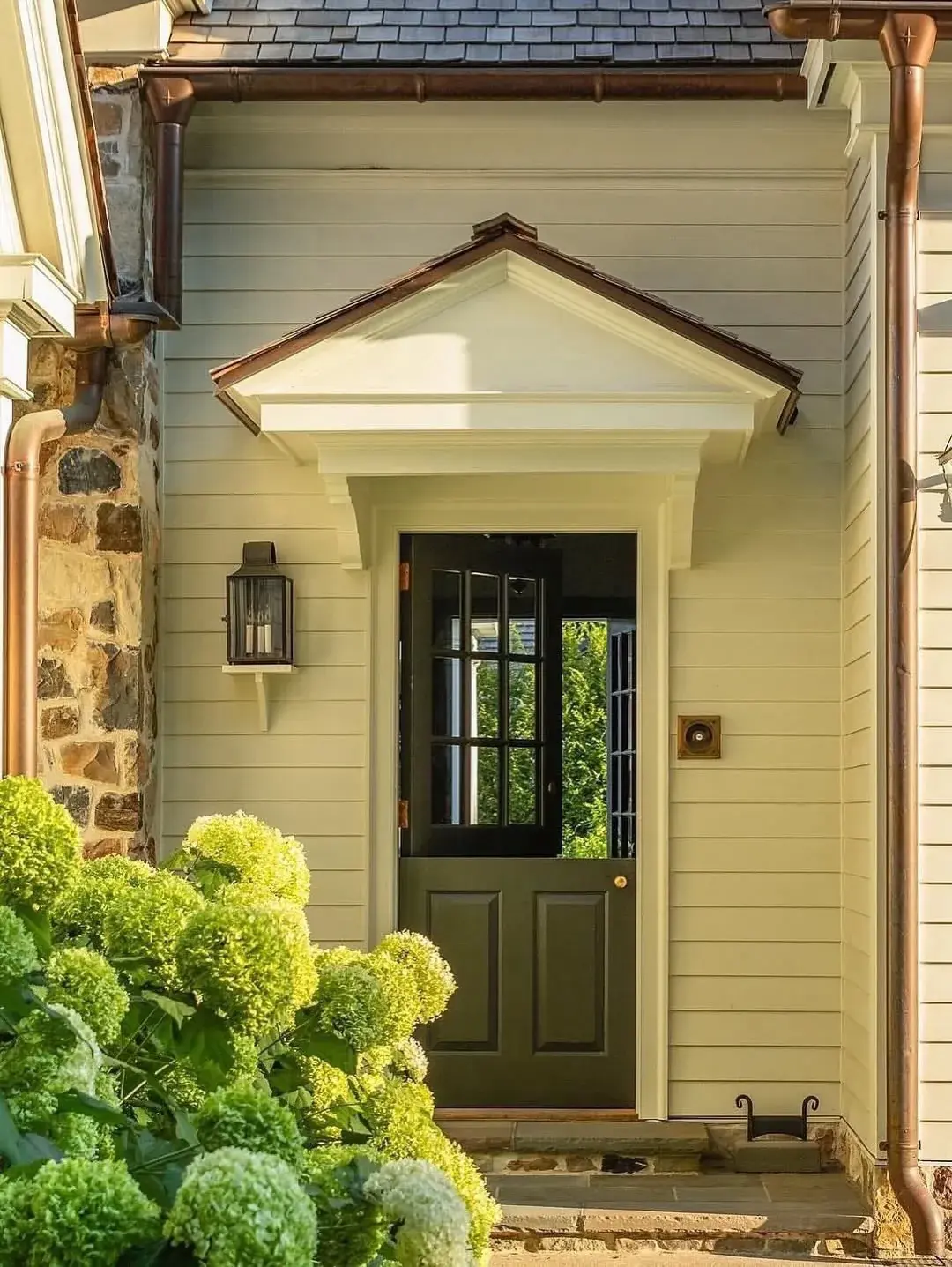
The blue on the door below is a soft grey-blue, and it is sitting about a metre back under an arched portico. Those two facts are related, which is why the shelter decides how long the shade lasts.
Pale blues are among the least durable exterior colours there are. The pigments that make a soft blue are fugitive in ultraviolet light, and on a door facing south with nothing over it, the colour drifts noticeably within a few years and unevenly within five.
Under that portico it gets almost no direct sun, and it will hold for as long as the paint film does.
Matching the blue to the wall
The door sits against the house all day, and the house decides which blues look considered.
| Wall | Blue that works | Why |
|---|---|---|
| Cream or warm white | Soft grey-blue, duck egg | Gentle contrast; neither fights |
| Crisp white clapboard | Mid blue, navy, slate | Needs weight against the white |
| Warm red brick | Deep slate, blue-green, navy | Pale blue goes chalky beside orange |
| Grey or buff stone | Stronger blue; more latitude | Cool wall carries a cool door |
| Rendered grey | Navy or blue-black | Anything paler disappears |
The pairing that most often disappoints is pale blue on red brick. The brick is warm and strongly coloured, and a soft blue beside it reads washed out and slightly cold, as though the door has weathered instead of been chosen.
Colours that get close
| Budget | Colour | Reads as |
|---|---|---|
| Premium | Farrow & Ball Parma Gray No.27 | Soft grey-blue, close to the door above |
| Premium | Farrow & Ball Stiffkey Blue No.281 | Deep navy; excellent in full sun |
| Premium | Little Greene Juniper Ash 115 | Grey-green blue, very quiet |
| Mid | Benjamin Moore Van Deusen Blue HC-156 | Classic mid blue, durable |
| Trade | Dulux Weathershield Satin, tinted | Hard-wearing, widely available |
For an exposed door, ask specifically for an exterior product rated for dark and saturated colours, and expect to recoat sooner than a cream door would need.
Satin suits any front door for the same reason it suits this one: gloss maps every dent and filler repair, and on an old door that is most of them.
The Dutch door, since that is what this is
Name it, because people save the picture without knowing what they are looking at. That door is split horizontally, so the top half opens independently while the bottom stays shut.
It is genuinely practical: air and light with the bottom shut, which suits households with small children or a dog, and it is the traditional arrangement on farmhouses for exactly that reason.
Two things to know before wanting one. It needs a proper weather bar and a rebated meeting rail, or rain runs straight in at the split. And it is significantly more expensive than a single door, typically half again, because it is effectively two doors with four sets of hardware.
Retrofitting a split into an existing door is possible and rarely pays, since the existing door was not built with the stiles to take it.
Preparation, which decides the lifespan
Sand to a sound dull surface. If the existing coating is failing, take it off instead of painting over it, because a new film on a lifting one lifts with it.
Prime bare timber, particularly the end grain at the top and bottom edges, which is where water gets in and where almost nobody paints.
Two thin coats with a proper interval between them. Rushing the second is the usual cause of a finish that stays soft and marks under the door furniture.
Lay the door flat if you can take it off, because every run and sag on a front door happens to a door painted while hanging.
Where to avoid blue altogether
Houses with a strong existing colour on the shutters or the window sash. A blue door beside black-green shutters is two decisions where the facade only has room for one, and the usual result is that neither reads as deliberate.
And very dark houses, where a pale blue door floats oddly. There a deep blue-black, or simply the same colour as the trim, generally looks better than introducing a contrast.
Pale ceiling blue that never touches the door
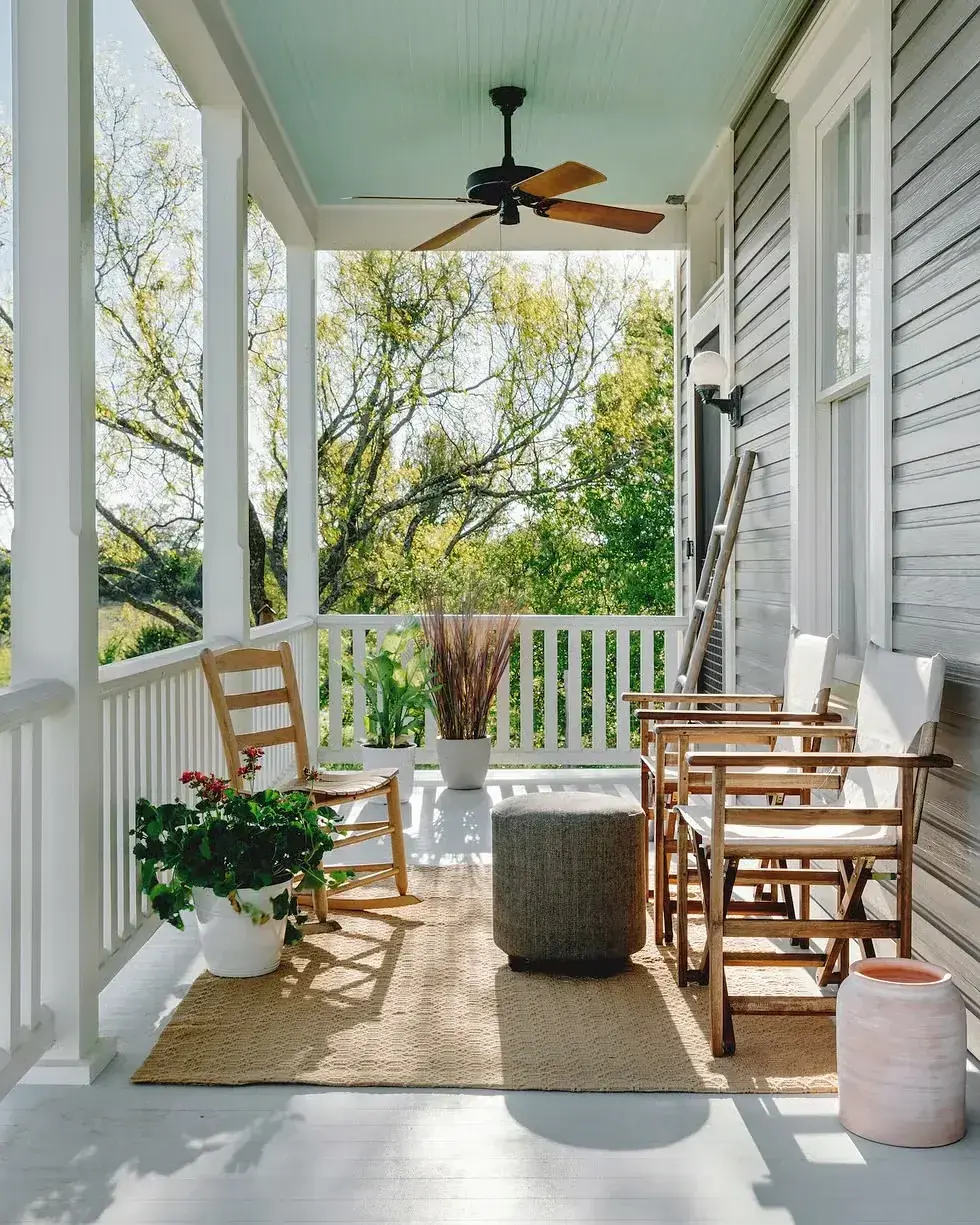
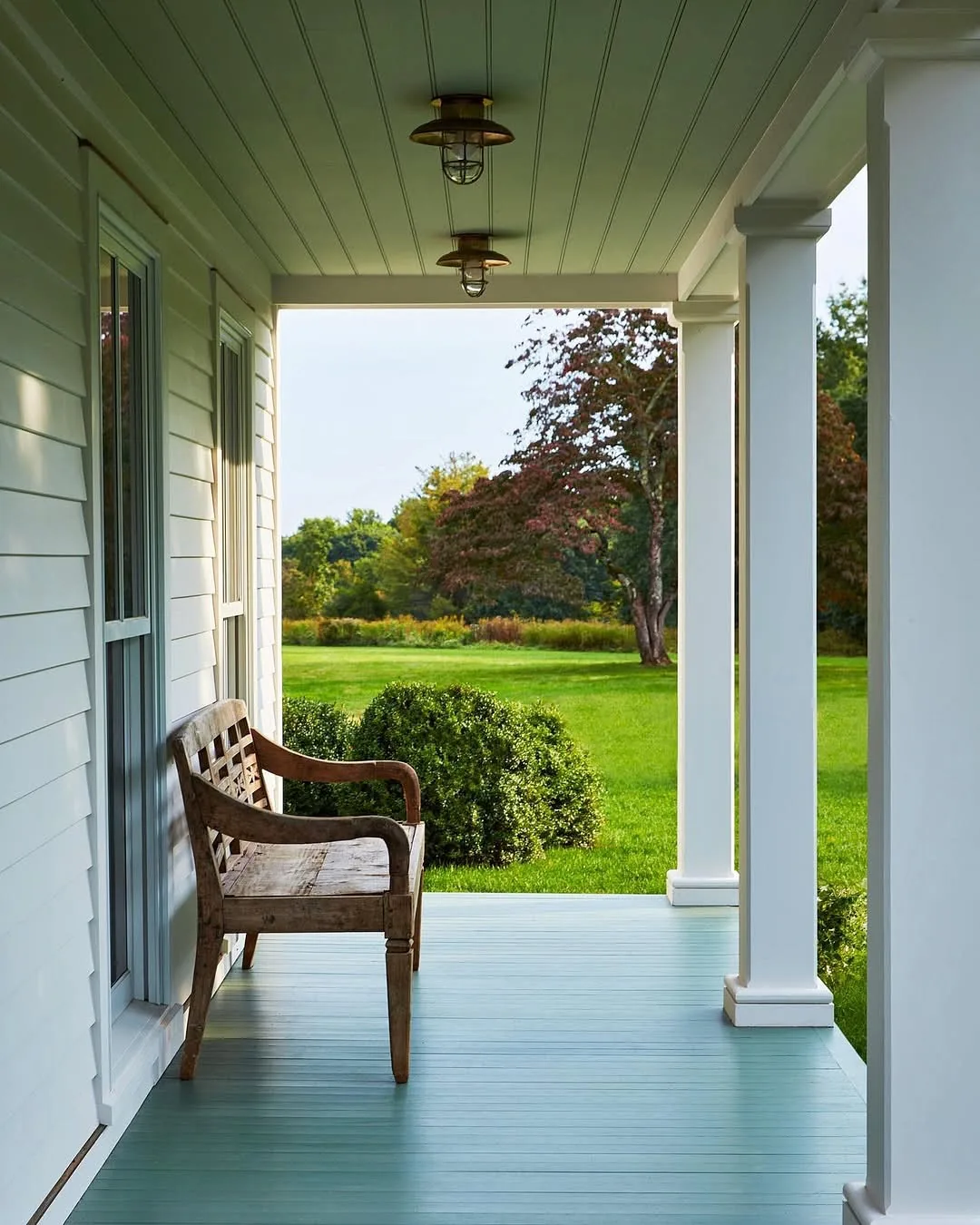
The blue above is on the ceiling, not on any door, and that sets the lesson for this porch. The boards overhead carry a thin aqua that reads almost white in full sun. The walls are pale grey clapboard. The columns, rails, and floor are white, which keeps the whole frame calm in shade.
This is the old haint blue habit from the American South, and it works because the ceiling sits in shade all day while the roof takes the ultraviolet and the rain. A colour that would bleach out on a door holds here for years. The fan below is black with timber blades. The rocker and the folding campaign chairs bring in cane, oak, and canvas, so the timber warms the cool paint.
Copy the ceiling if the porch feels low or dark. It lifts the gloom without adding a colour the house has to answer for, and that pale aqua sits well with grey siding and white trim in this picture.
For the tin, Farrow & Ball Lulworth Blue No.89 or Little Greene Celestial Blue 101 get close, thinned for a ceiling and finished in exterior eggshell. Shops charge £55 to £95 for 2.5 litres in 2026, which covers a porch ceiling twice with paint left over. Paint the ceiling before the walls, because drips travel down and not up.
Navy shutters and chairs against red brick
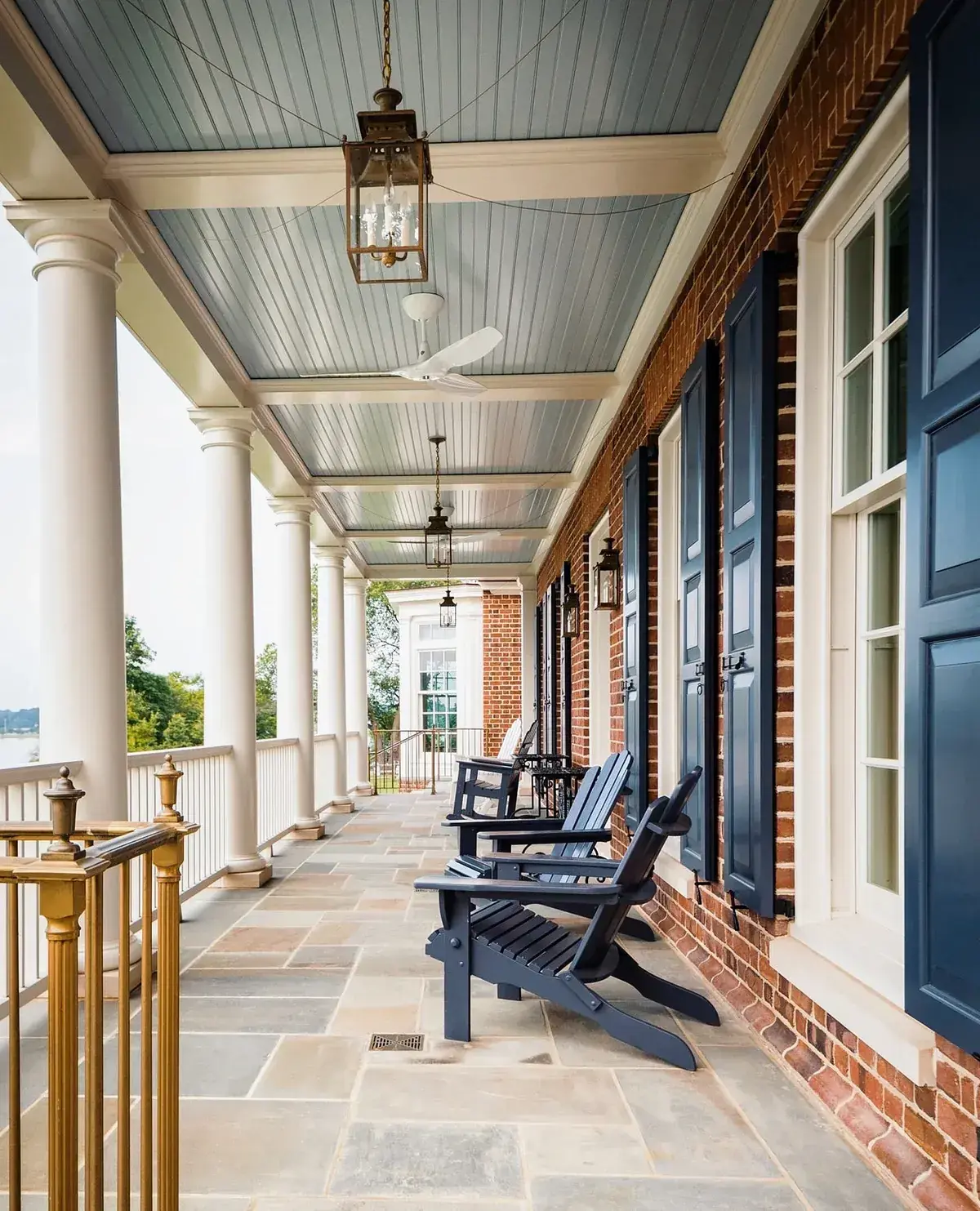
The brick wall above is warm orange red. Against it sit shutters and Adirondack chairs in a flat navy that holds its line from one end of the porch to the other. The ceiling carries the same pale blue as the last porch. The columns and beams are cream white, which stops the dark paint feeling heavy.
This is how navy behaves on brick. The warm wall pushes the cool paint forward, so the dark reads darker and cleaner than it would on grey. That contrast carries the whole elevation. The stone flags below stay neutral. The brass handrail at the near end adds one warm metal, which stops the entry feeling cold at dusk.
Take the lesson for a door on the same wall. A mid navy with a grey base sits calmly on red brick, while a green leaning teal starts to vibrate. Benjamin Moore Hale Navy HC-154 or Farrow & Ball Stiffkey Blue No.281 get close, in exterior satin. Tester pots cost £6 to £9 per 100ml in 2026, and two pots allow a proper test on opposite sides of the opening.
Paint shutters and chairs in the same family if both exist. Two different navies on one elevation look like a mistake when viewed from the pavement across the street.
Blue floor boards under hanging ferns
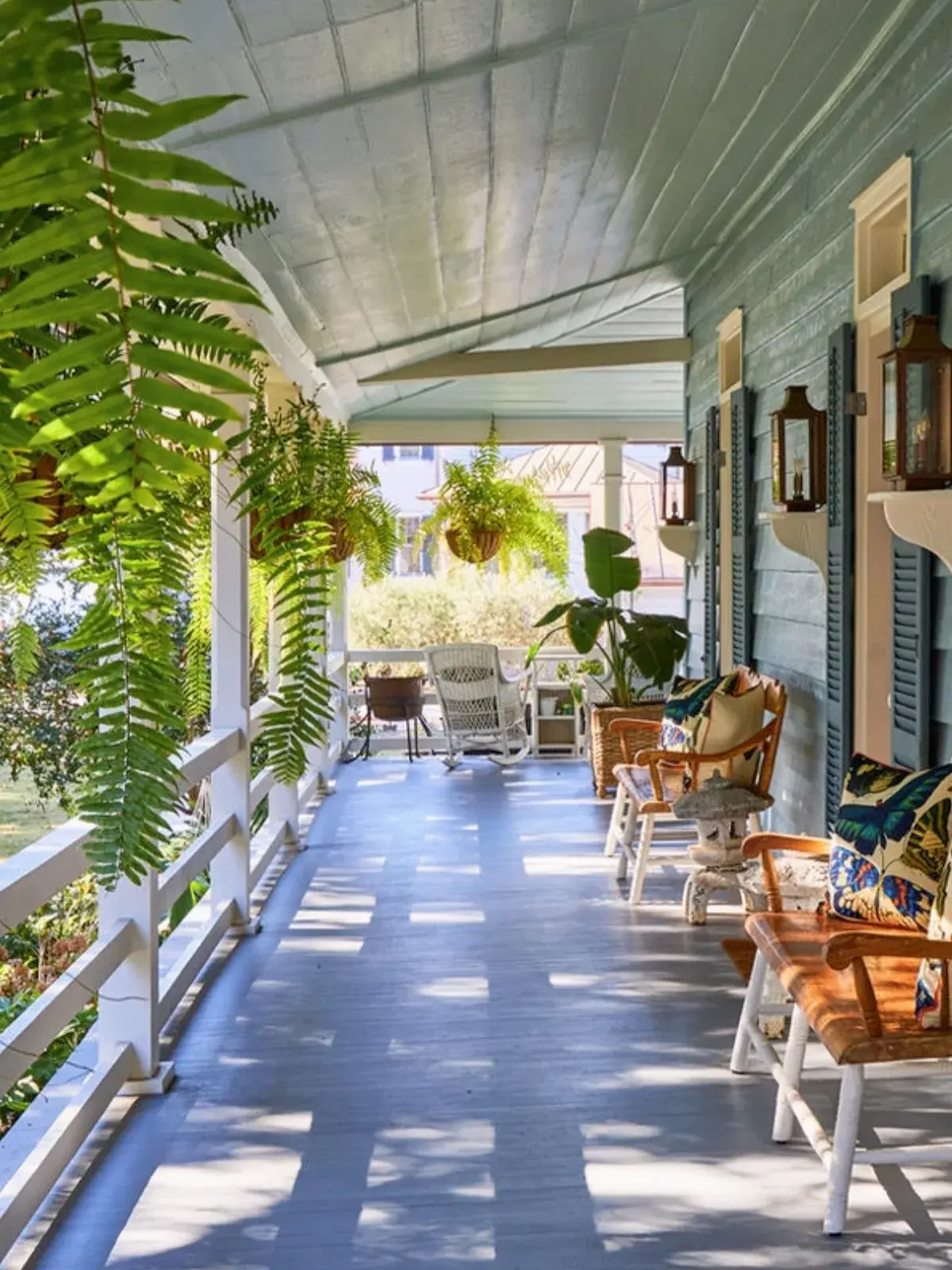
The floor below is painted a dusty mid blue, and the wall cladding matches it. White rails and posts cut the blue into bays. Ferns hang down into the light. Benches with patterned cushions sit to the right, where the shade runs deepest.
A painted floor takes more punishment than any door. Feet, grit, plant water, and sun scour it daily. That colour works because it is mid depth with grey in it, so scuffs and dust show less than they would on navy or on white. The gloss on the ceiling boards tells a second story: that sheen reflects daylight deep into a shaded porch, which is why the far end still feels bright at midday.
Do this only with a paint made for floors. Joinery satin looks fine for a month, then it scratches through to timber at the traffic line and the touch ups flash. A proper porch and floor enamel in a blue grey, such as Benjamin Moore Boothbay Gray HC-165 or Little Greene Juniper Ash 115, holds up far better. Budget £60 to £98 for 2.5 litres in 2026.
Scrub the boards clean and let them dry fully before coating, because damp timber blisters any film within one summer and the repair means starting over.
Coastal white rails with strong blue pots
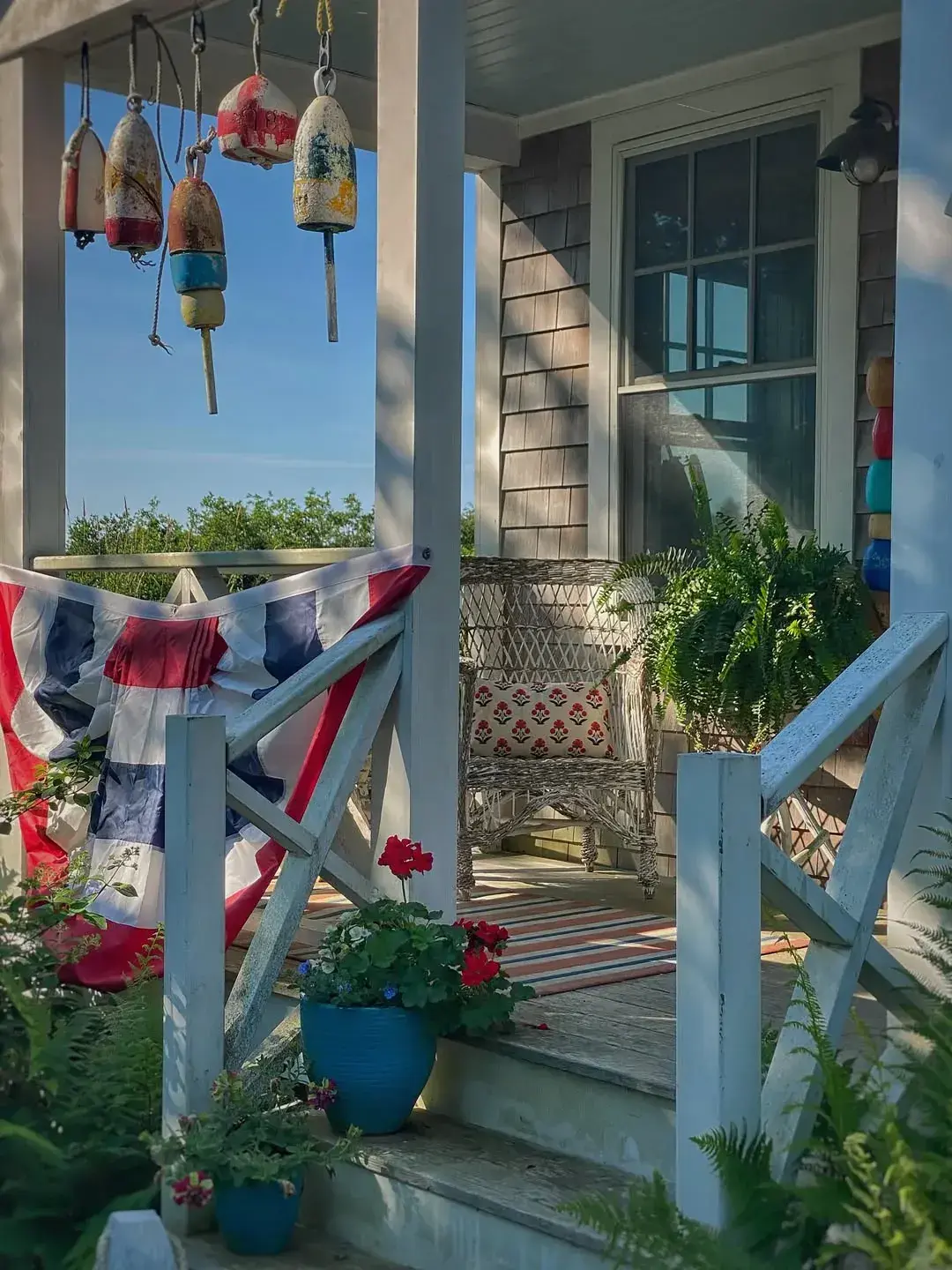
There is no blue door in this picture. The blue arrives in two saturated pots, a striped runner, and the bunting strung across white rails. The shingle siding behind is weathered grey brown. The wicker chair is bleached pale by sun, which tells how exposed the steps are.
This is the cheapest way to test a blue before committing. Those pots carry a clean marine blue with almost no grey in it, the sort of colour that looks brave on a 100ml sample. Against grey shingle that colour sings. Against white rails it stays crisp. The red flowers and the red in the bunting warm the whole arrangement, which is why the blue does not feel cold in context.
Use pots as the trial. Paint two terracotta pots in the finalists, plant them up, and live with them on the steps for a fortnight. Terracotta pots list at £12 to £35 each in 2026, and 750ml of exterior satin costs £25 to £45 in 2026. That test costs less than one door repaint and tells more than any fan deck.
If the pot colour tires after two weeks, the door in the same colour would have tired by October, when the light turns thin.
Teal shutters that frame white French doors
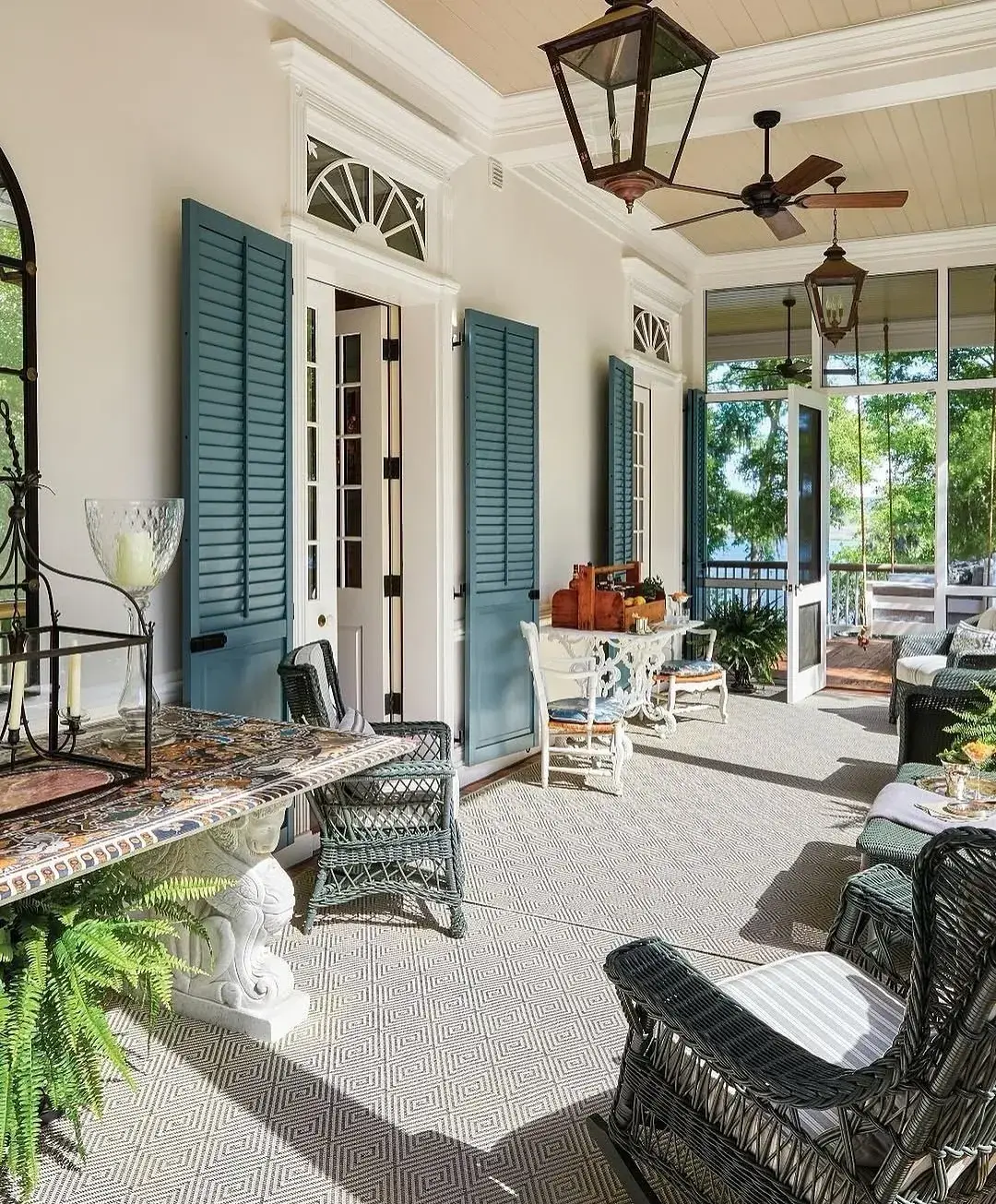
The shutters above are a dusty teal with grey in them, folded back against cream render. The French doors between them are white. Wicker chairs in dark green sit on a patterned rug. Lanterns hang from a boarded ceiling, which keeps the light warm.
This is the one echo rule done right. The teal appears on the shutters and nowhere else, so the white doors read as the opening and that colour reads as the frame. The mosaic table to the left carries red, ochre, and blue chips, which keeps the teal from feeling flat. The planting stays minimal, with one fern under the table softening the stone base.
For a house with cream walls, this teal family is safer than a clear navy. Cream is warm, and a warm wall wants a blue with some green or grey to settle against it. Little Greene Dock Blue 252 or Farrow & Ball Inchyra Blue No.289 get close in exterior eggshell or satin. Expect £35 to £60 per litre in 2026.
Hang the shutters on proper hinges with stays. Fixed flat against render, they read as decoration, while standing slightly off the wall on hardware they read as working shutters.
Dusty teal door on weathered shingle
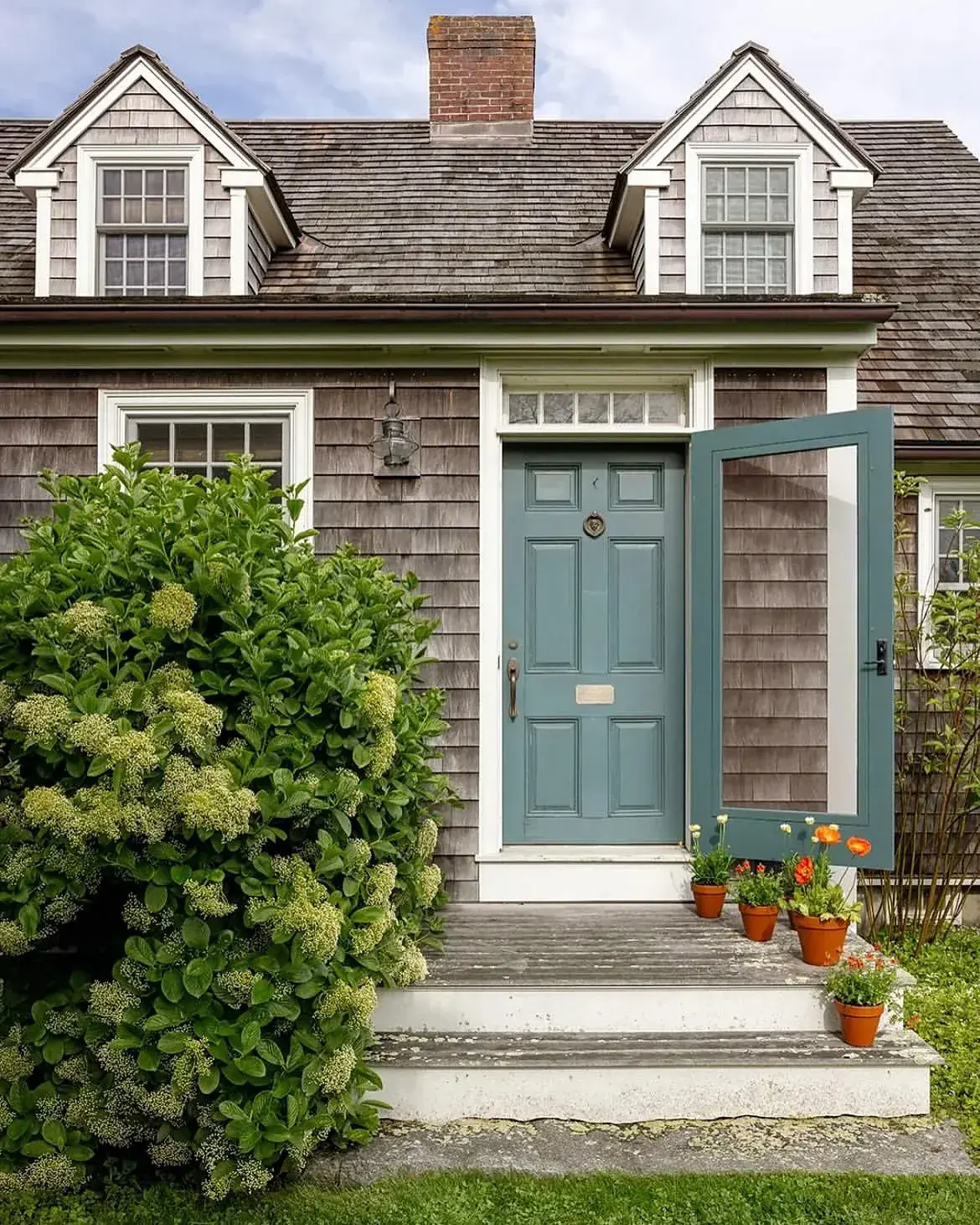
That cottage door is a dusty teal with a strong grey cast, set in weathered grey brown shingle with white trim. The outer screen door stands open. Hydrangeas crowd the left side. Terracotta pots line the right, which keeps the entry balanced.
Weathered shingle is the most forgiving background blue can ask for. The grey brown timber has almost no hue left, so it accepts green blues, grey blues, and true navies without argument. The white casing around the door does the lifting: it separates the teal from the shingle with a crisp line, which stops the mid depth colour sinking into the wall at dusk.
That screen door deserves attention. It is painted to match the main door, including the ironmongery side, which makes the pair read as one decision. The brass letterbox and lever add a warm note. Corston and Rejuvenation list solid brass letter plates at £45 to £110 in 2026, with matching lever sets at £40 to £90 in 2026.
Prime the screen door on all six faces. Thin framed screens twist with moisture faster than the main leaf, and the joints open first once water gets in.
Deep blue wall with white columns and a sofa
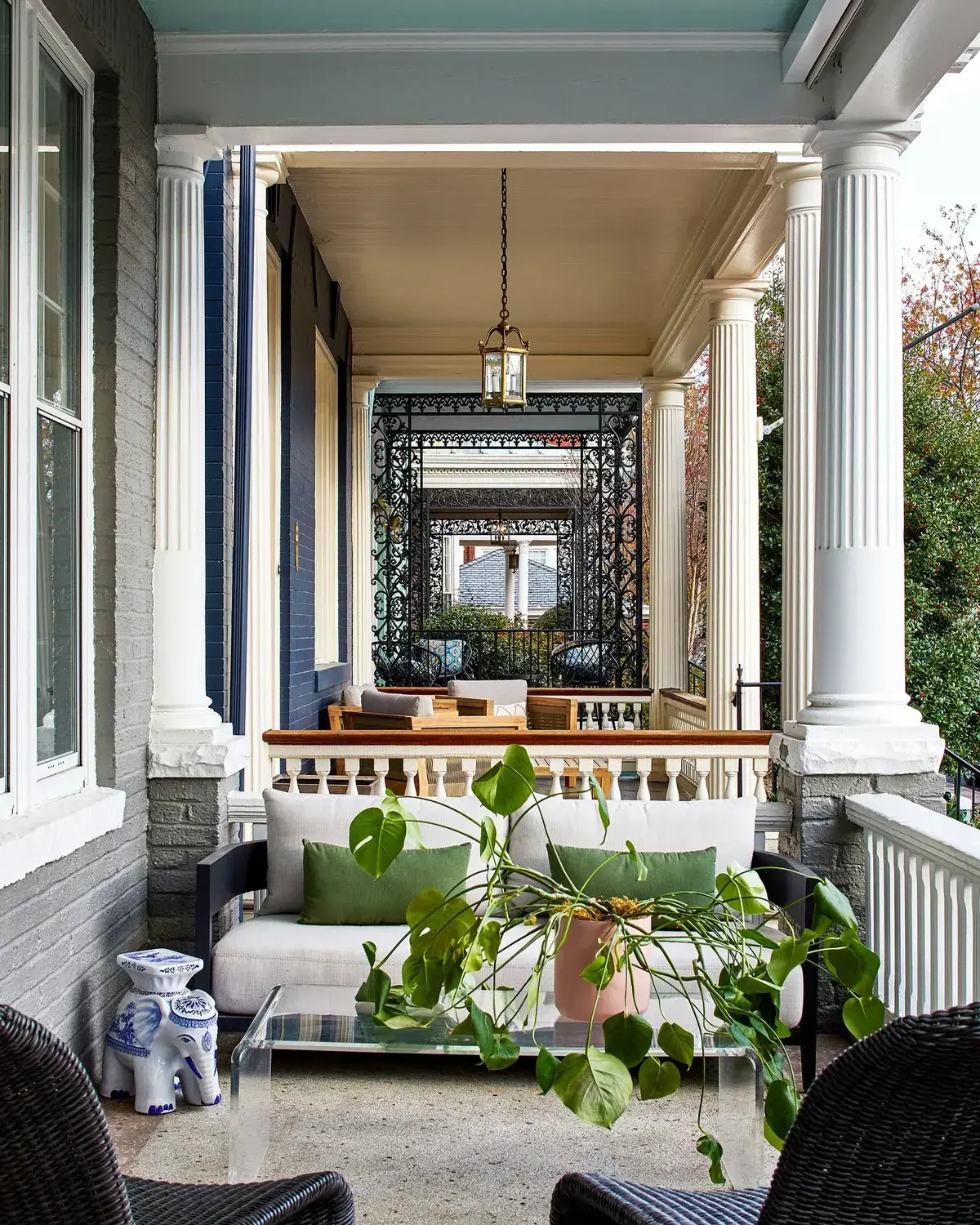
The wall to the left above is painted a deep ink blue, almost black in shade. White columns and rails punch out from it. A pale sofa with green cushions sits opposite. A blue and white elephant stool stands by the glass table, while a large monstera fills the foreground.
This is navy used as cladding, not as an accent, and the light decides whether it works. The porch here is deep and shaded, so the blue loses hue and goes dark for most of the day. The white trim carries it: without those columns, the wall would read as a shadow, and with them it reads as a deliberate colour choice.
Do not copy this on a sunless elevation unless the near black look is the aim. On a north facing porch under a full roof, a true navy behaves exactly like this wall from morning to night. Most owners expect the brochure blue and feel short changed. A dusty mid blue, such as Benjamin Moore Van Deusen Blue HC-156, keeps its hue in the same shade where navy goes black.
Test after dark with the lanterns on, because porch bulbs run warm and warm light flattens navy faster than daylight ever does.
Double doors in dusty blue on warm beige
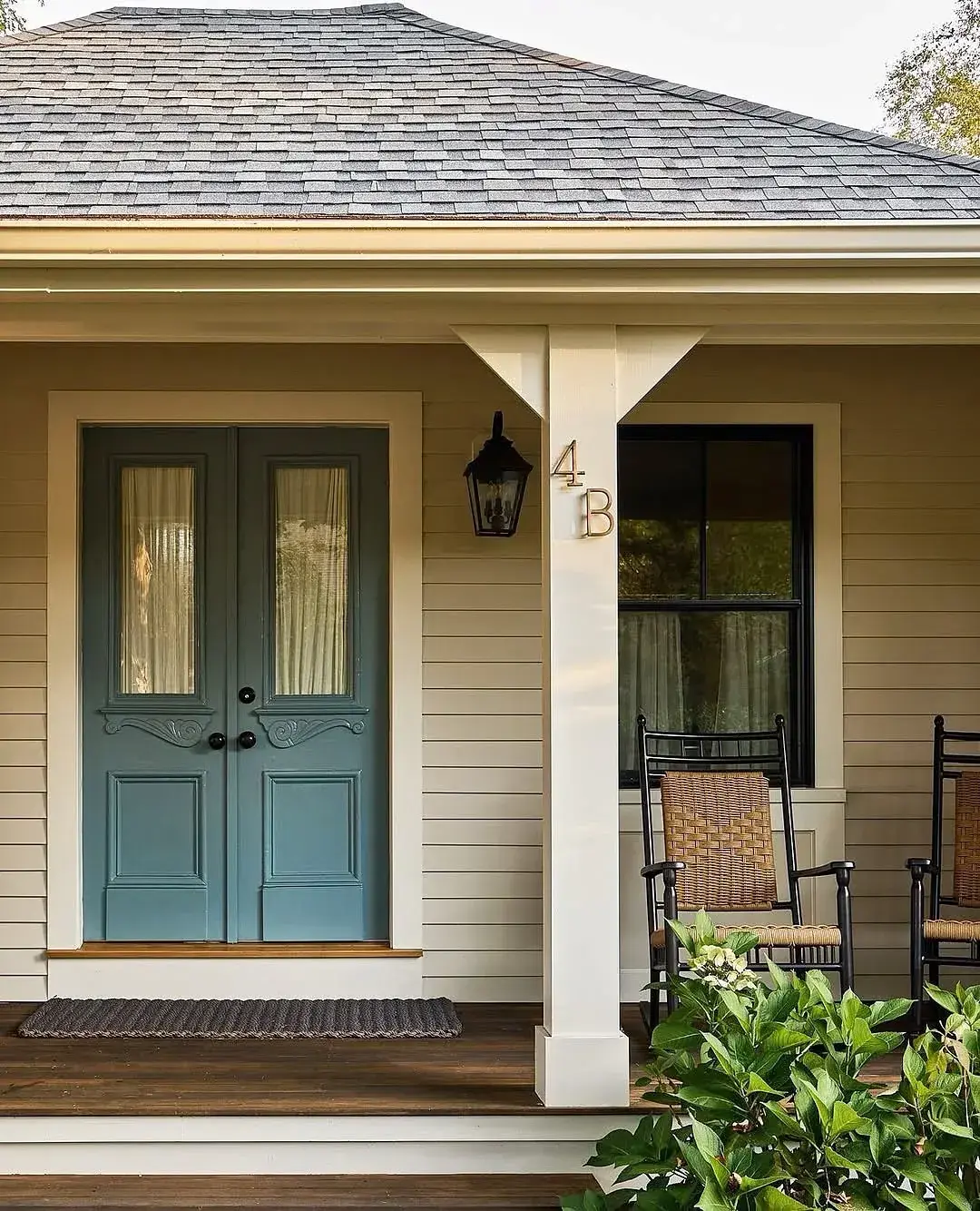
The double doors in this picture are a muted slate blue with green in it, set in warm beige clapboard with cream trim. Each leaf has a glazed top with a curtain behind. The ironmongery is black. A black lantern hangs beside brass house numbers, while rockers with cane seats sit to the right.
Beige is a warm neutral, and the cool door balances it. That temperature opposition is why the entry feels settled. A warm blue would have merged into the wall. A much darker navy would have punched a hole in a small facade, which is why this middle depth holds the centre so well.
Double doors double the painting and the hardware. Hinges, knobs, and bolts need to match across both leaves, or the eye catches the difference at once. Plain black steel sets list at £15 to £35 in 2026, while solid brass or bronze sets cost £60 to £140 in 2026. Buy both leaves from the same batch, because blues drift between batches and a pair that differs by half a shade never stops showing it.
Curtains behind the glass soften the entry from inside. Fit a slim blind or cafe curtain if the door faces the street and the hall stays visible.
Pale glass door on dark stained shingle
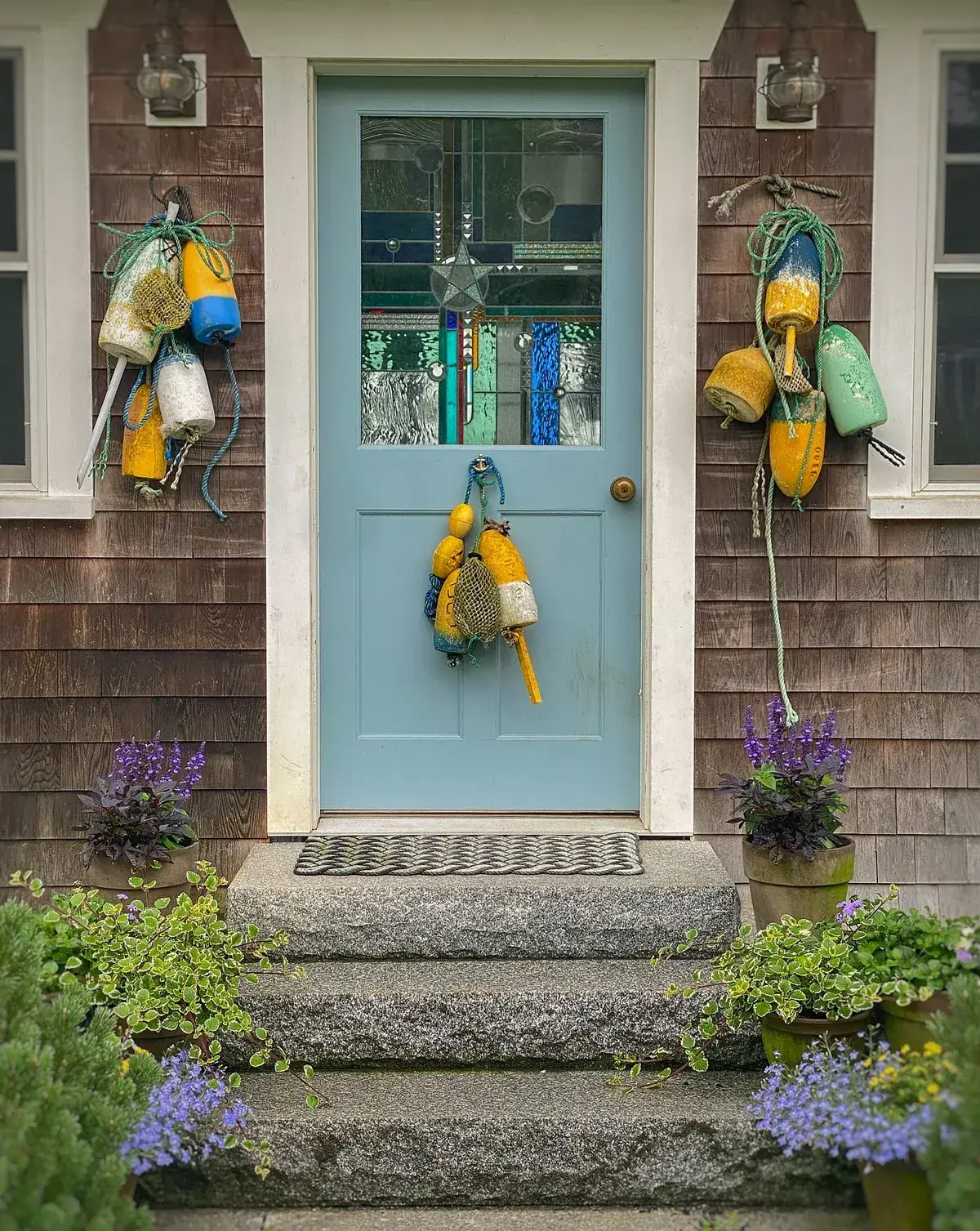
That glass door is a pale sky blue with a stained glass top light, set in dark brown stained shingle with white casing. Buoys hang on both sides. Granite steps lead up past pots of purple and green, which echo the glass.
Dark shingle is the reason this pale colour works. The near brown wall gives the light blue something to push against, so it reads fresh instead of washed out. The white casing helps again, framing the pale leaf with a clean edge. The stained glass in the top panel carries teal, cobalt, and green, which ties the door to the buoys and the planting beside the steps.
This is also the most exposed door in the set, with no porch roof and full weather plus salt air by the look of the rope and the paint wear on the buoys. A pale blue here needs washing each spring and a touch up most autumns, because grime and ultraviolet dull light colours first. Keep a labelled jar of the door paint on the shelf, since fan decks retire colours without warning.
For the mix, Farrow & Ball Lulworth Blue No.89 or Benjamin Moore Yarmouth Blue HC-150 get close, in exterior satin. Shops charge £25 to £45 for 750ml in 2026.
Near black navy that still reads blue
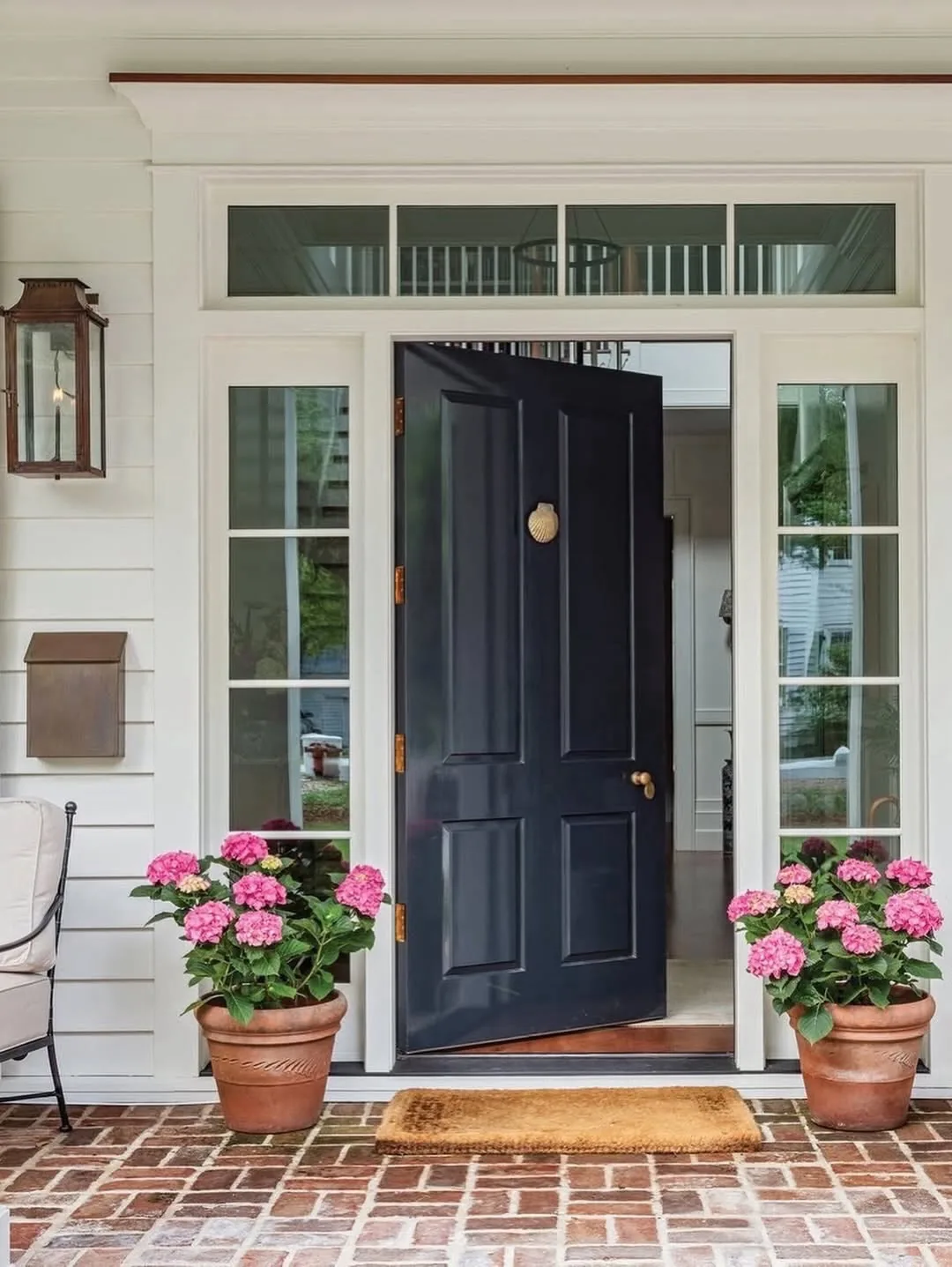
That navy leaf stands open on white clapboard, with a brick porch floor below and pink hydrangeas in terracotta pots on both sides. The paint is a blue black navy that looks black until daylight hits it. Sidelights and a transom in white frame the opening, while a copper lantern hangs to the left.
White is the background navy needs. The bright casing and sidelights hold the dark leaf apart from shadow, so the blue survives even on a dull day. The brick floor warms the entry, and the pink flowers do the same job as the copper: they lend warmth that the paint lacks. The shell knocker and brass knob add a second warm glint at hand height, which the eye finds at once.
An open door shows the edges, and the edges in this picture are painted. That detail matters more on dark colours, where an unpainted or white edge flashes with every movement. Paint the top, bottom, and hanging edges in the same coats as the faces, because bare end grain drinks water and swells the stile, which is why doors stick each winter and free each summer.
For the tin, Farrow & Ball Hague Blue No.30 or Benjamin Moore Hale Navy HC-154 get close. Expect £60 to £98 for 2.5 litres in 2026.
Glazed navy door between copper lanterns
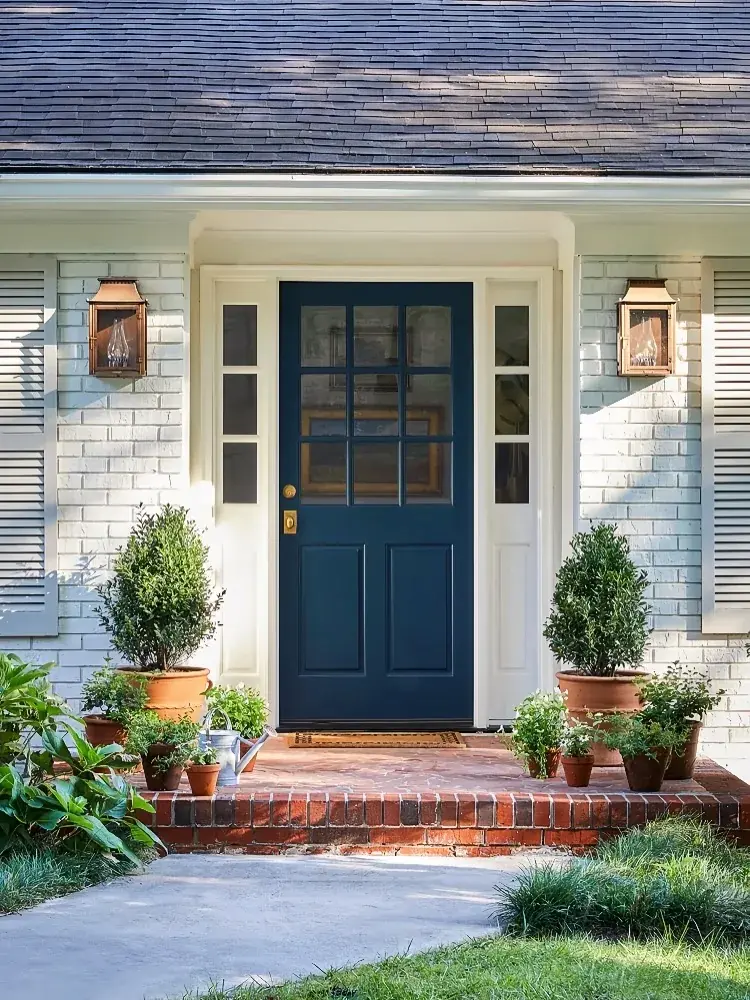
That glazed door is a true navy with nine panes over two panels, centred on white painted brick with white sidelights. Copper lanterns hang symmetrically. Clipped cones in terracotta pots flank the brick step, while the roof above is grey shingle.
Symmetry does half the work in this picture. Two lanterns, two sidelights, two cones. The navy sits in the middle as the single dark note, which is why it feels calm instead of heavy. The copper warms the navy in exactly the way chrome never does: the metal glows amber at dusk and lends that warmth to the paint beside it. The topiary cones add green structure without competing for attention.
Glazing changes the maintenance. Nine panes mean nine rebates where water sits and paint fails first. Bed the glass properly, back prime the beads, and seal the end grain before fixing. A glazed door left to a general handyman with interior acrylic starts to peel at the bars within two winters, so use exterior acrylic in satin and allow a full day between coats.
A pair of copper lanterns in this size lists at £120 to £280 in 2026. Topiary cones in terracotta cost £25 to £60 each in 2026.
Grey navy door seen from the gate
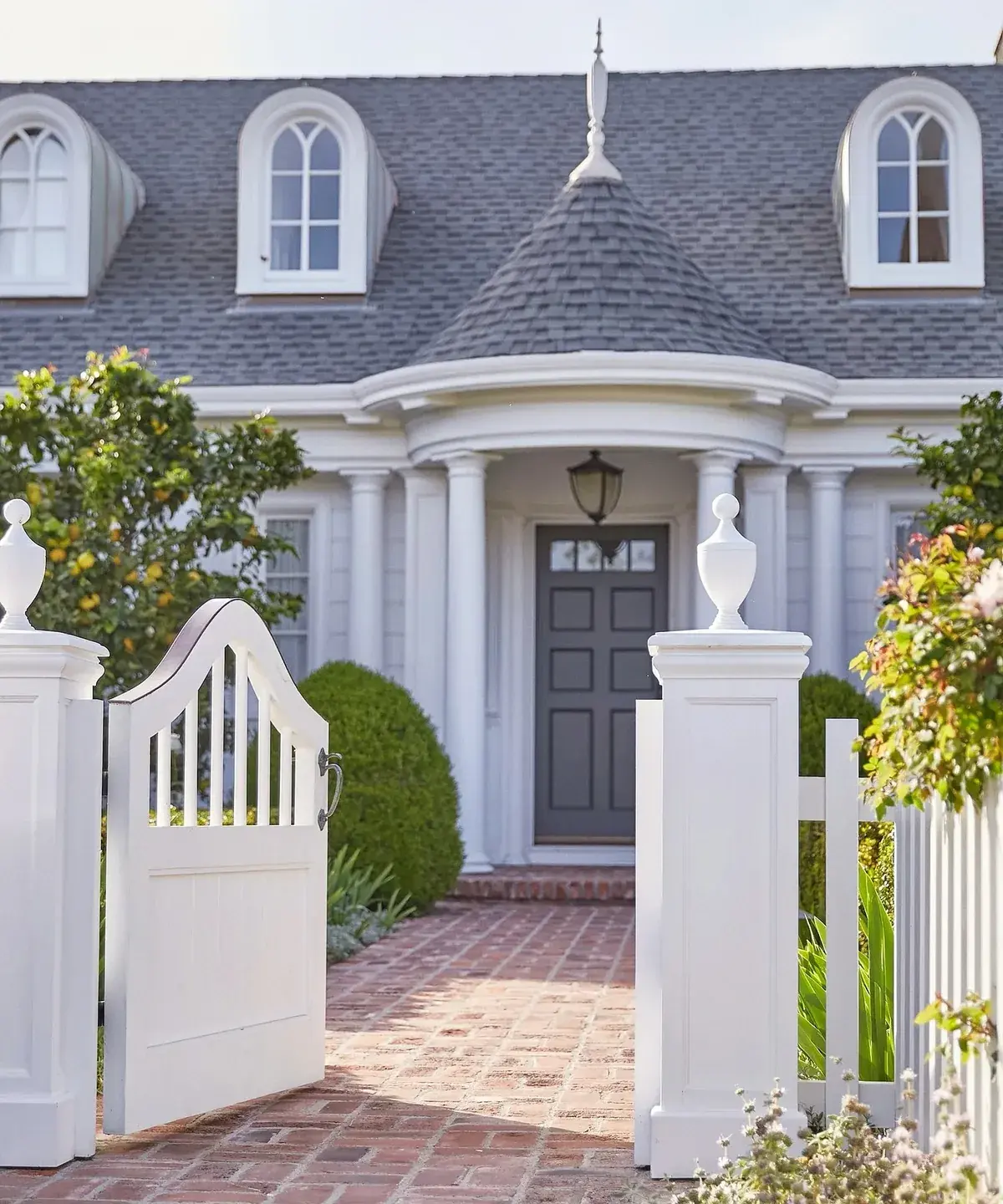
That distant door is seen from the gate, framed by white piers, white columns, and a brick path. At this distance that colour reads as charcoal grey with blue in it. The house is pale grey. The roof is grey shingle with white dormers, which keeps the whole view cool.
Distance desaturates colour. A navy that looks rich from six feet reads as grey from sixty, especially in bright sun. That muted reading suits the pale house and the white woodwork, and the entry still anchors the facade because it is the darkest shape in view. Judge every finalist from the pavement, not from the step: tape the sample to the door, walk to the gate, and look back, since the pavement view is the one visitors keep.
This is also the right blue for a house that already carries grey roofing and pale walls. A brighter marine blue would have shouted. A black would have hardened. This grey navy sits between them. Little Greene Juniper Ash 115 or Farrow & Ball De Nimes No.299 match it, in exterior satin. Sample pots list at £6 to £9 for 100ml in 2026.
Keep planting clipped back from the path. Yew and box throw shade and drip water onto paint, and constant damp shortens any coating within two seasons.
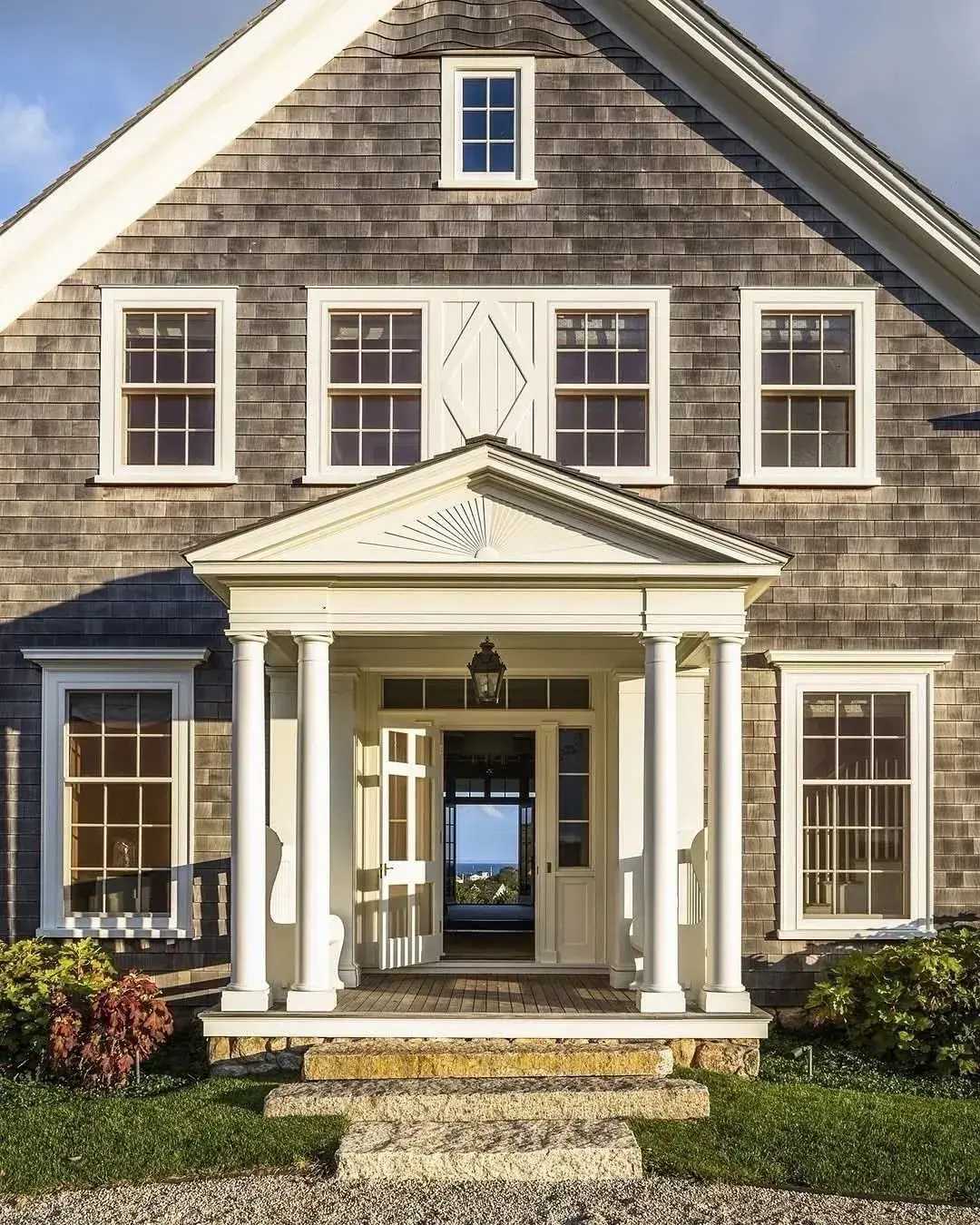
Navy shingle walls with a white entry
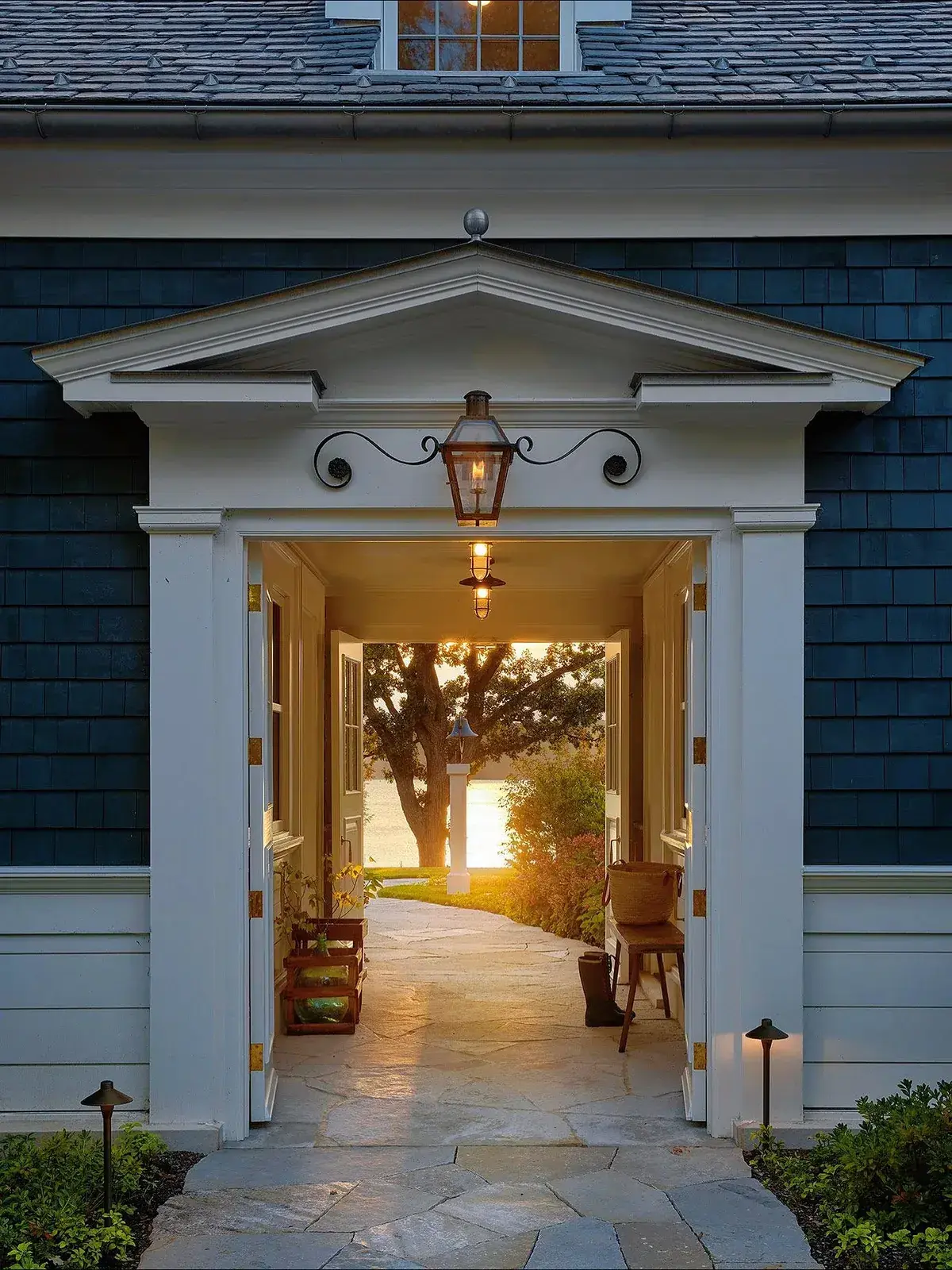
The walls in this picture are navy shingle, and the entry is white: pediment, columns, and open doors framing a sunset over water. A copper lantern burns under the pediment. Path lights line the stone walk, which leads the eye straight through.
This reverses the usual arrangement. The blue is the house, and the door is light. It works at dusk because the white entry glows while the navy walls recede, which is exactly what the photograph shows. By day the same house reads as a strong dark mass with a crisp opening, so the contrast does the work in all lights and not just the joinery detail.
Do not choose this without testing at night. Dark cladding under warm artificial light loses hue fast, and a navy wall can read as brown black under 2700K bulkheads. The lantern here is correctly sized: a generous copper fitting with clear glass, throwing light onto white trim instead of into the viewer’s eyes, while undersized lanterns leave dark walls unlit and visitors miss the step.
Navy shingle in a coastal exposure wants an exterior system rated for salt and sun, recoated on schedule. Budget £95 to £150 for 5 litres of premium exterior satin in 2026.
The same pale door dressed for autumn
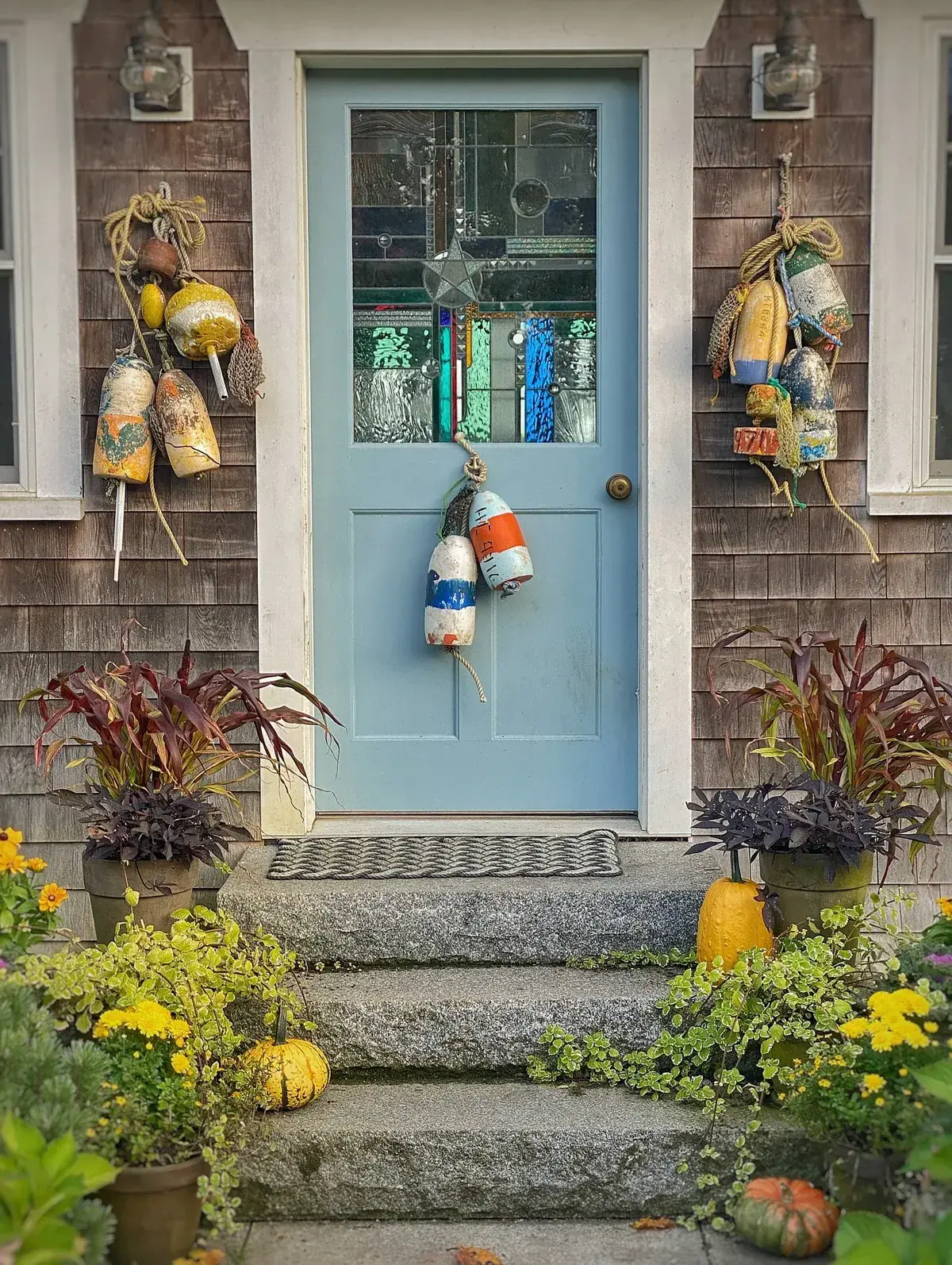
That autumn door is the same pale sky blue leaf shown earlier on dark shingle, now dressed for autumn with pumpkins, yellow violas, and dark cordyline in pots. The buoys hang in different positions. The granite steps and white casing are unchanged, which makes the comparison honest.
Two photographs of one door prove the colour holds across seasons while the dressing changes. The pale blue still reads clean against the dark wall. The autumn planting leans orange and gold, which flatters blue by opposition, while spring pots in purple and lime would do the same job from the other side of the wheel.
Granite steps are the unsung part of this entry. Stone does not move, rot, or need paint, and it drains between treads. Timber steps cup and hold water against the door frame, which is where rot starts, so if the steps are being rebuilt then stone or brick with a proper damp break outlasts any timber detail however well painted.
Wash this door each spring with warm soapy water. Pollen and salt film dull pale blue faster than any fading does, and twenty minutes with a soft brush restores the colour that was chosen on the day.
Frequently Asked Questions
Which blue lasts longest on an exposed door?
Deeper and more saturated mixes keep their hue far better where sun hits daily. Pale sky tones bleach and go patchy within a few seasons on a southern aspect, while navy and slate hold. Shelter changes the answer entirely.
How do I match a blue door to warm brick?
Pick a slate or true navy with a grey base and test it against the mortar as well as the brick. Green leaning teals tend to jar with orange masonry. White casing between wall and leaf helps the chosen shade sit apart.
Can a shaded porch still take navy?
It can, but expect the paint to read as near black for much of the day. That suits owners who want depth and strong contrast with white trim. Anyone hoping for a bright marine tone in gloom should move one or two buckets lighter.
What finish suits an old timber door?
Satin in an exterior acrylic system hides filler, dents, and brush marks while wiping clean. High gloss looks superb on new sprayed leaves and maps every repair on older ones. Floor paints belong on floors, not on joinery.
Do I need to coat the top and bottom edges?
Yes. End grain absorbs damp faster than any face, and unsealed edges swell, stick in winter, and lever the face coats off at the joints. Seal all six sides in the same system during the same job.
When should the door be washed and touched up?
Clean down each spring with mild soap to lift pollen, salt, and hand grime, then inspect chips in autumn before frost. Keep a small labelled jar of the mix for spot repairs, since colour cards get retired without notice.
In order
- Check how much direct sun the door gets before choosing a pale blue.
- Match the shade to the wall; pale on cream, deeper on brick and stone.
- Use an exterior satin rated for saturated colours.
- Prime and paint all four edges, including top and bottom.
- If you want a Dutch door, buy one built as one instead of splitting an existing door.
This article may contain affiliate links. We may earn a commission at no extra cost to you.