Stone Farmhouse Exterior Ideas: Let the Planting Set the Stone's Temperature

Add us as a preferred source to see more stories on Google.
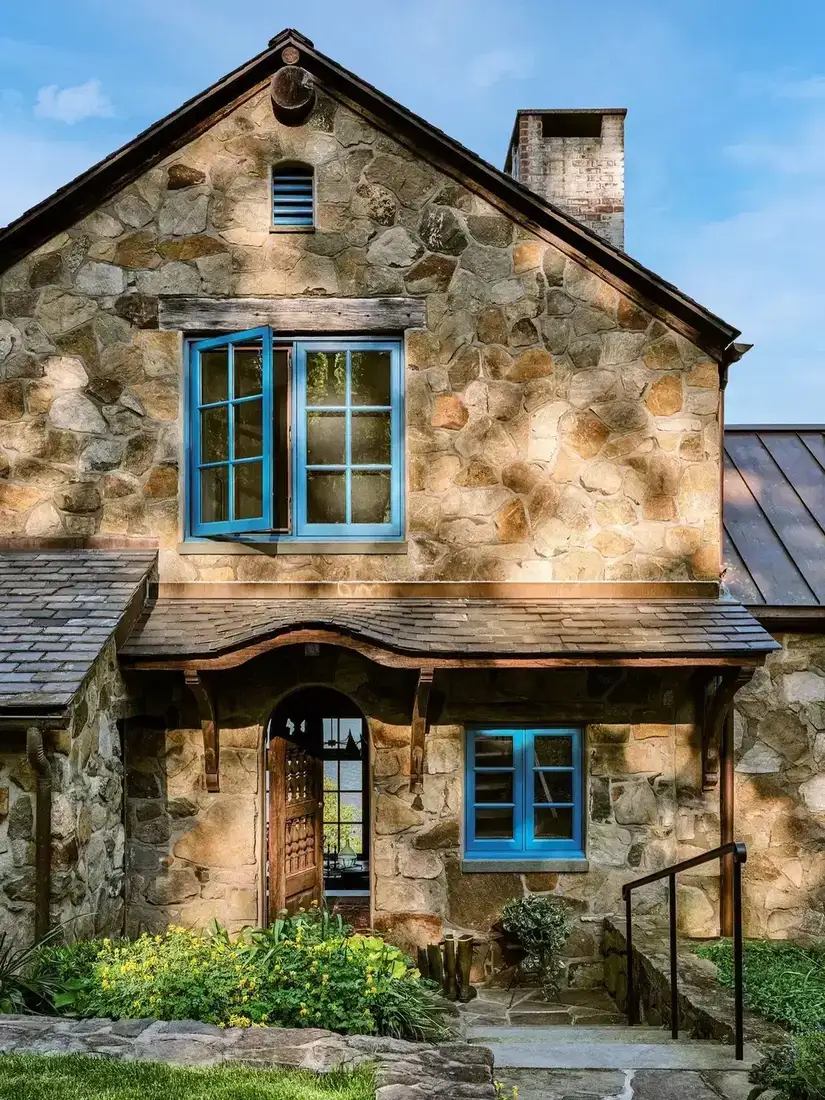
Your stone does not have a temperature of its own. It borrows one from whatever is growing against it.
The same grey limestone reads warm beside olive and lavender, and cold beside clipped yew. Nothing about the stone changed. The planting changed.
Most people choose plants by flower colour, then stand back and wonder why the wall looks dead.
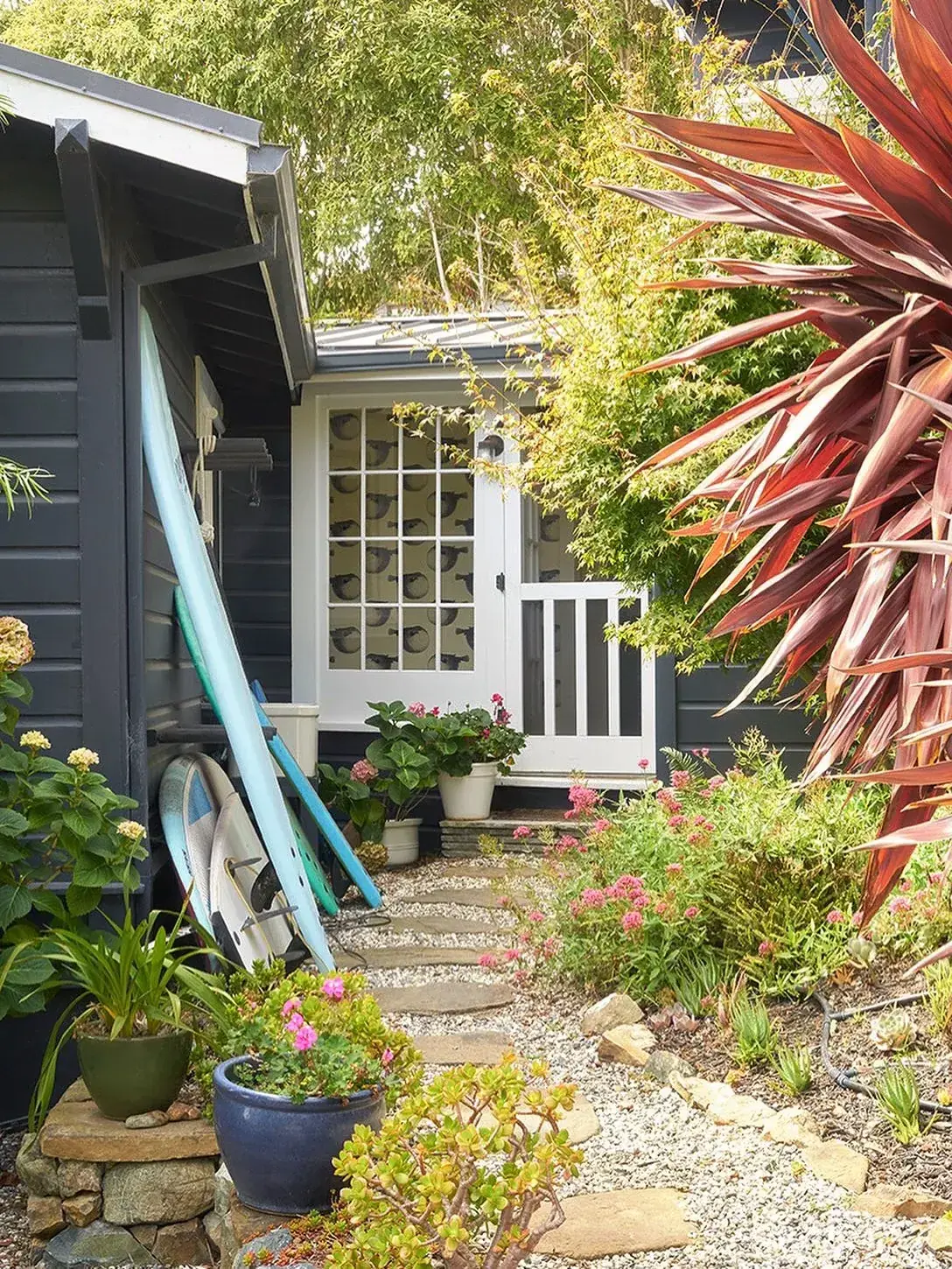
The cottage below gets it right. Honey rubble stone, turquoise joinery, and one froth of yellow-green along the base. Choose the neighbours first, and the stone settles by itself.
Blue hydrangeas are telling you the soil is wrong
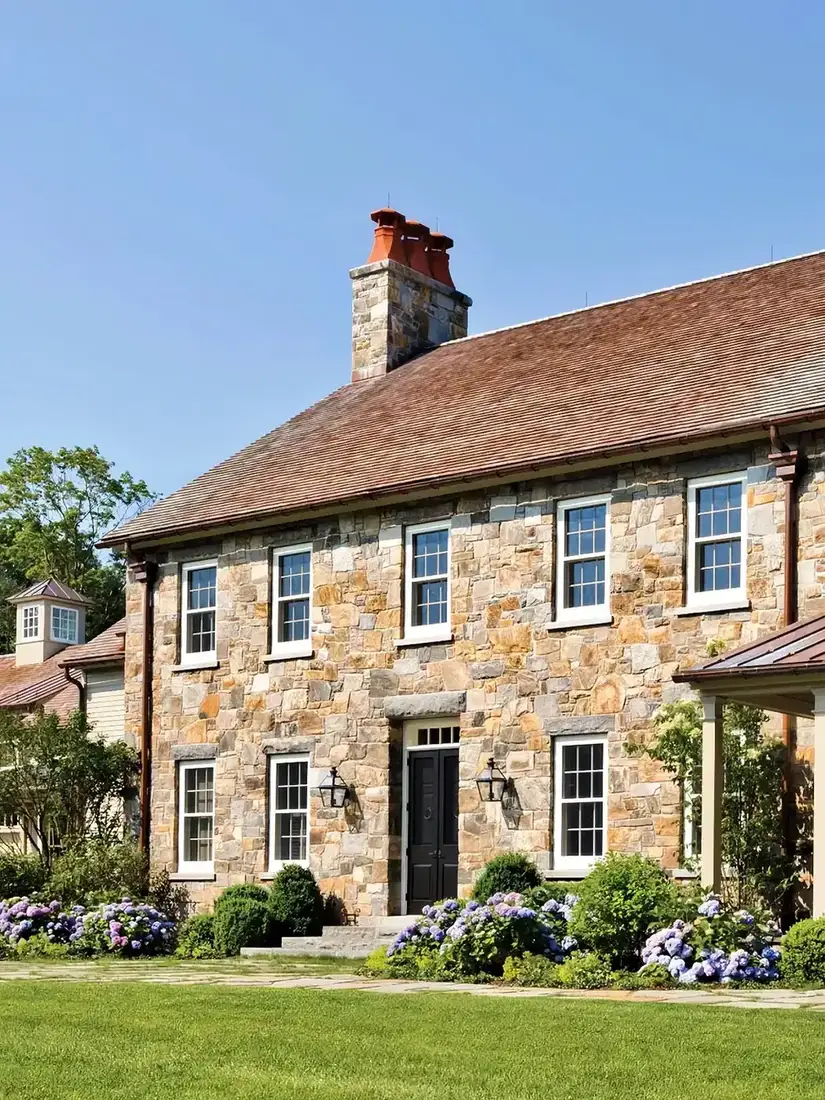
Two things in this photograph disagree with each other. The mortar between those stones is pale and lime-rich, which makes the strip of ground at the base of the wall alkaline. The hydrangeas along it are blue.
Blue mophead hydrangeas (Hydrangea macrophylla) only turn blue where aluminium reaches the roots, and aluminium is only available below about pH 5.5. Lime mortar sits near pH 8 and pushes calcium into the soil beside it. So either that bed is dosed with aluminium sulphate every year, or the soil is acid and quietly dissolving the mortar it sits against.
Rhododendron, Pieris japonica, Camellia, Kalmia, and Vaccinium all want acid ground, and all fade beside a lime-mortared wall: yellow leaves, no flower, and a slow decline across three or four seasons. The garden centre will sell you all five without asking what your wall is made of.
Hydrangea paniculata ‘Limelight’ and Hydrangea arborescens ‘Annabelle’ take alkaline soil without complaint, and both flower on new wood. Geranium macrorrhizum, Alchemilla mollis, and Nepeta cope with the lime and the dryness at a wall base.
Keep the mulch 300mm back from the stone. Soil heaped against the bottom course holds water in the wall.
Wisteria and ivy have to be held off the mortar
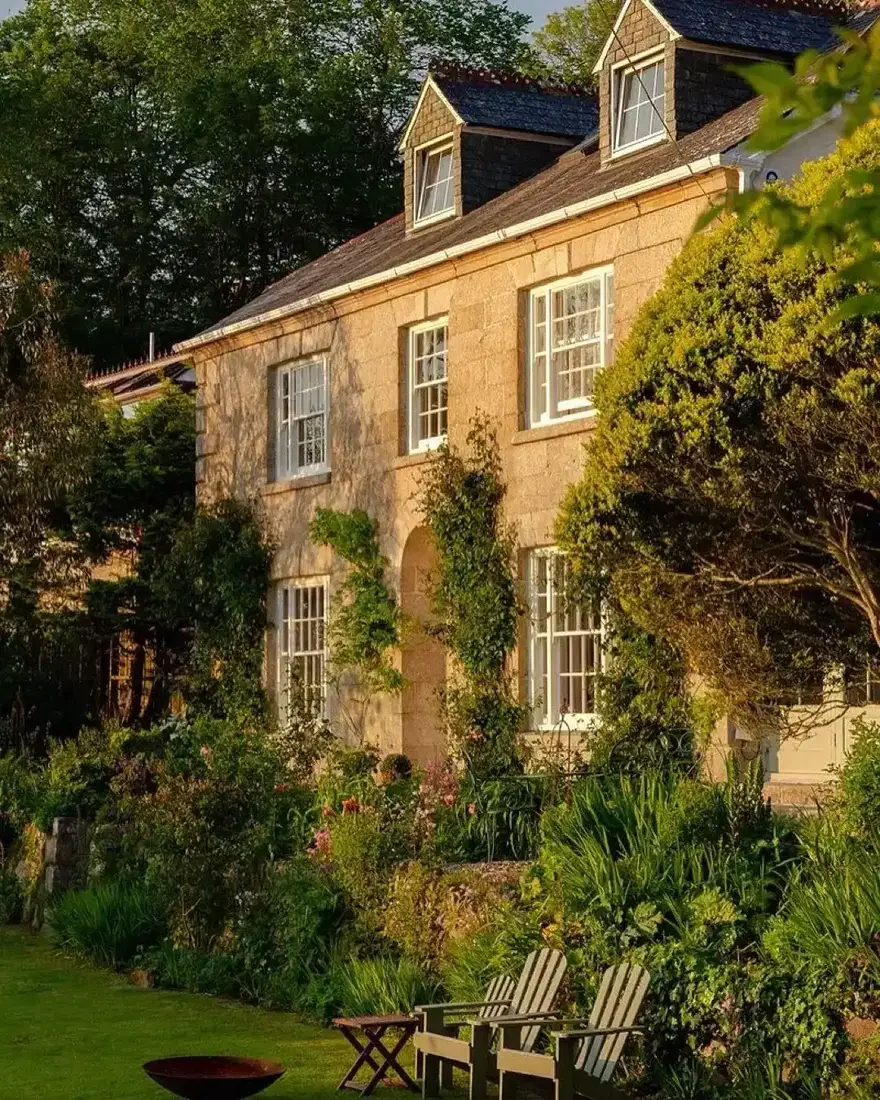
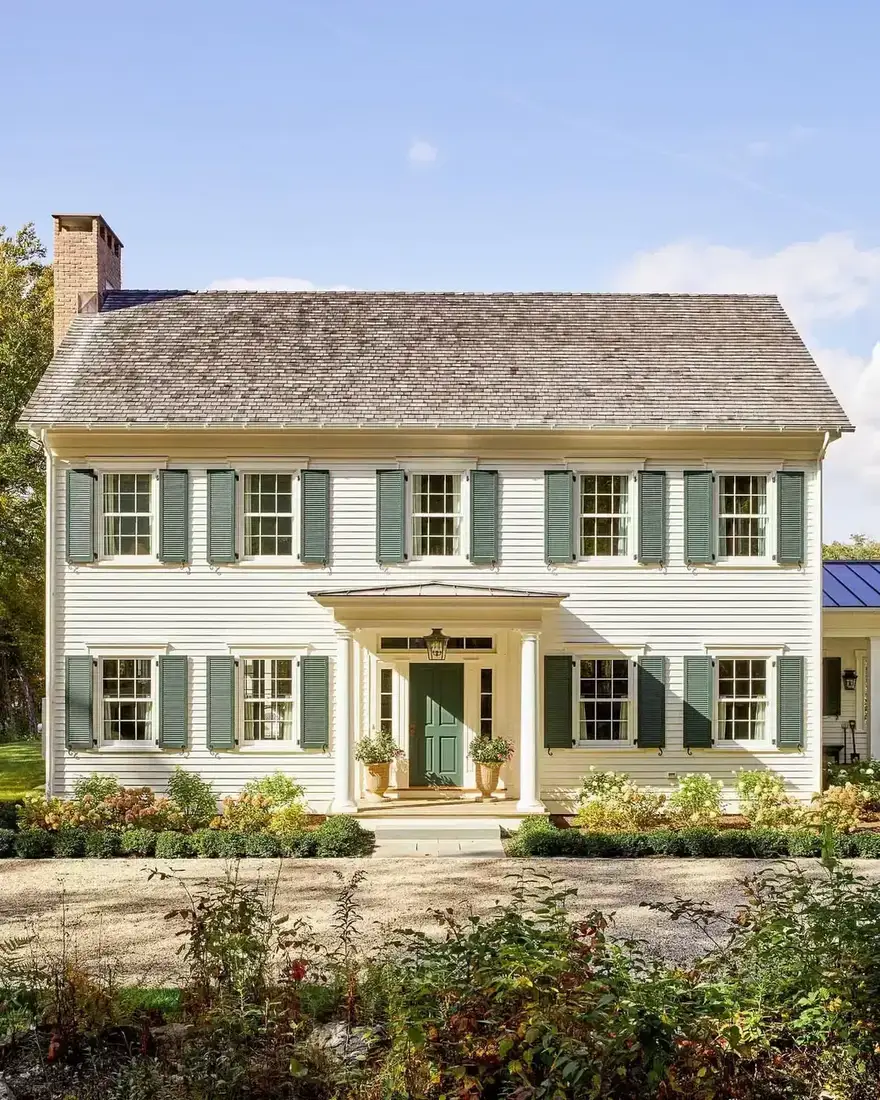
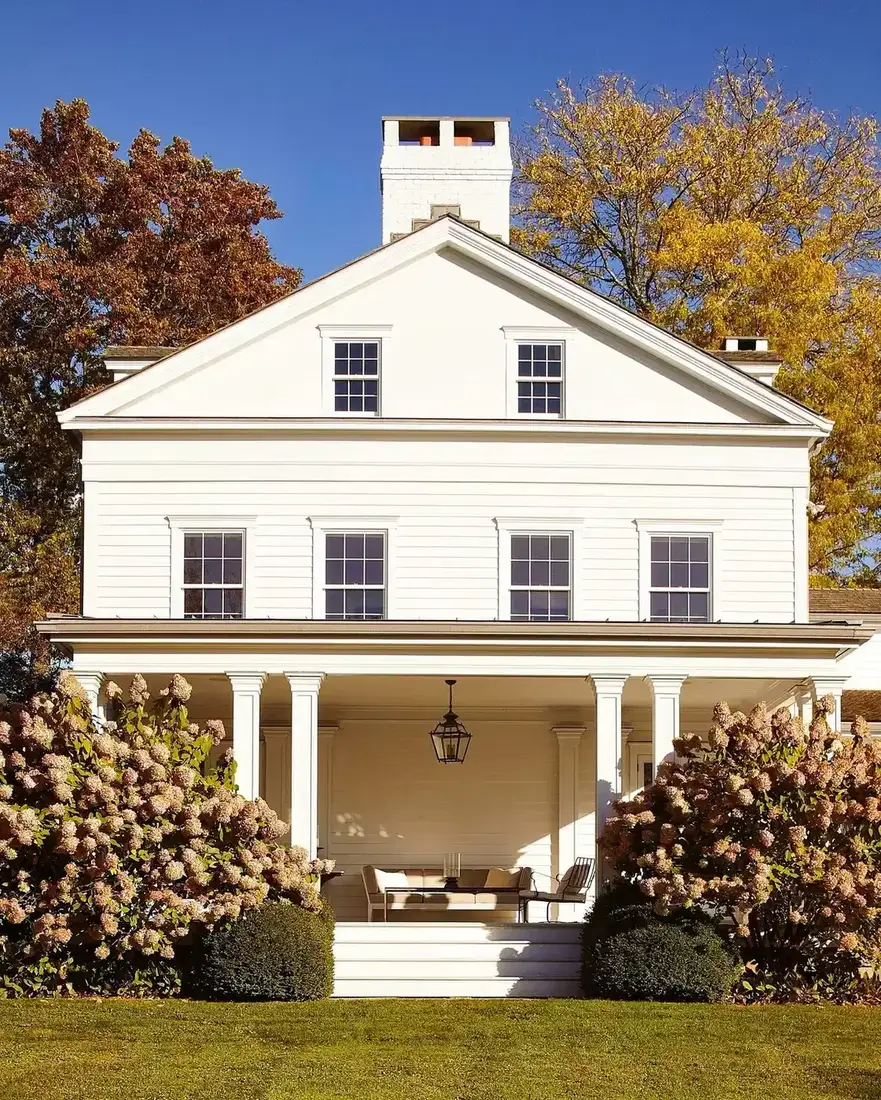
This Georgian front reads warm gold, and late sun on limestone deserves most of the credit. The useful thing in the frame is how thin the climber is.
The plant around that door arch is trained, not matted. There is daylight between the stems and the wall, and the leaves sit clear of the joints. That is the whole discipline, and it decides whether the wall needs repointing in eight years.
Wisteria (Wisteria sinensis and Wisteria floribunda) twines around whatever it can reach. A stem that starts at pencil thickness will pass 100mm across, and as it thickens it levers: it lifts gutters and prises open any joint it has entered. Train it on galvanised wire or a stainless steel cable system on 50mm standoffs, so the stems never touch the stone. Prune twice a year, the long whips in August and again in January down to two or three buds.
English ivy (Hedera helix) is worse. It sends aerial roots with adhesive pads into the mortar itself. Cutting it at the base and pulling while it is alive takes the mortar with it, so cut, wait a season for it to die back, then lift it off.
Parthenocissus tricuspidata and Parthenocissus quinquefolia cling by pads on the surface and do not root into the joints. They trap damp and mark soft stone, but they come away cleanly.
A deep border is what protects the base
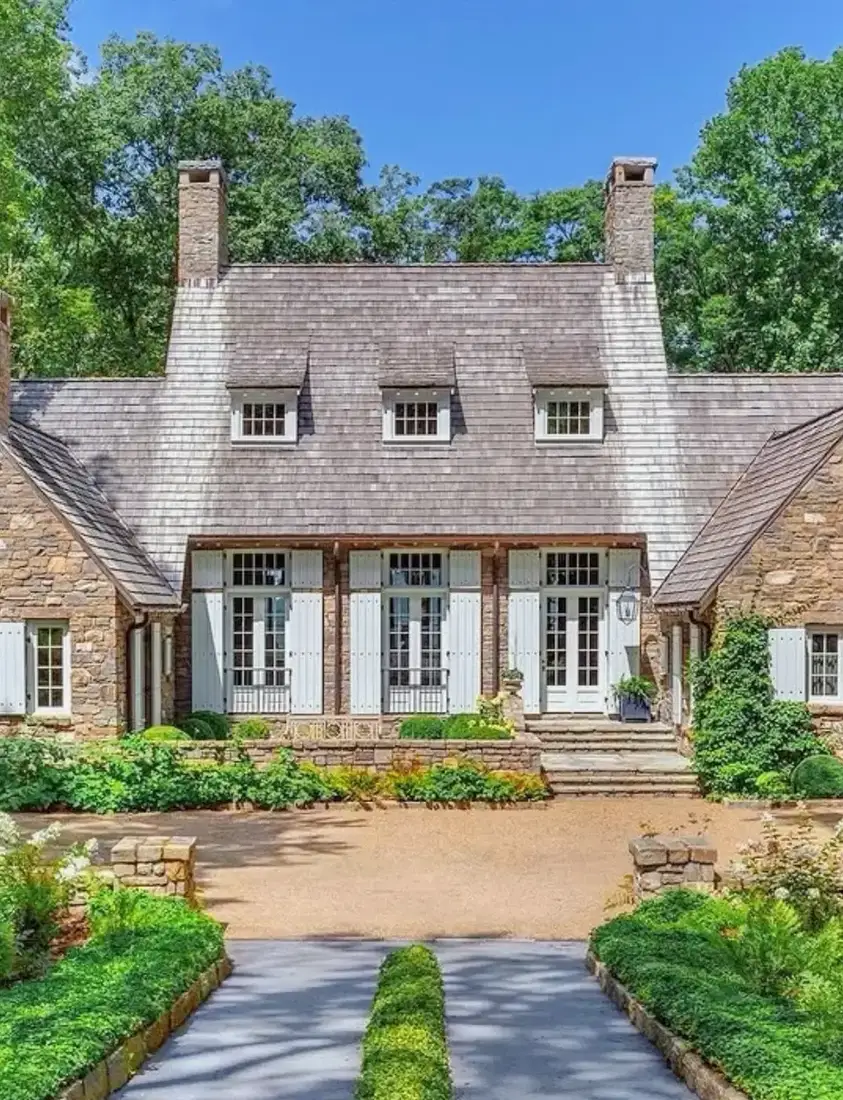
Look at the strip of ground between the wall and the lawn. It is not a flowerbed. It is a metre and a half of low planting doing a structural job.
The most useful thing you can put in front of a stone wall is depth. Soil and irrigation held hard against the face push damp into the stone and stain the lowest courses. A border 1m to 1.2m deep, planted and mulched, keeps the water where the roots are and leaves the bottom 300mm of wall free to dry.
The bed runs continuously along the base, the plants in it are low and dense, and the stone above the planting line is clean. Notice that the terrace roof overhangs the doors, so the wall beneath never takes direct rain.
Order of operations. Dig the border before you plant, not after. Set the finished soil level 150mm below whatever damp course the wall has. Lay a 100mm gravel collar along the wall inside the border, and plant behind that.
If the border is already in and the soil is piled against the stone, take a spade to it this autumn. Pull the mulch back 300mm, check the bottom course, and repoint anything that crumbles with lime, not cement. Cement is harder than the stone, so it spalls the face off as the wall moves.
Gravel at the foot does two jobs
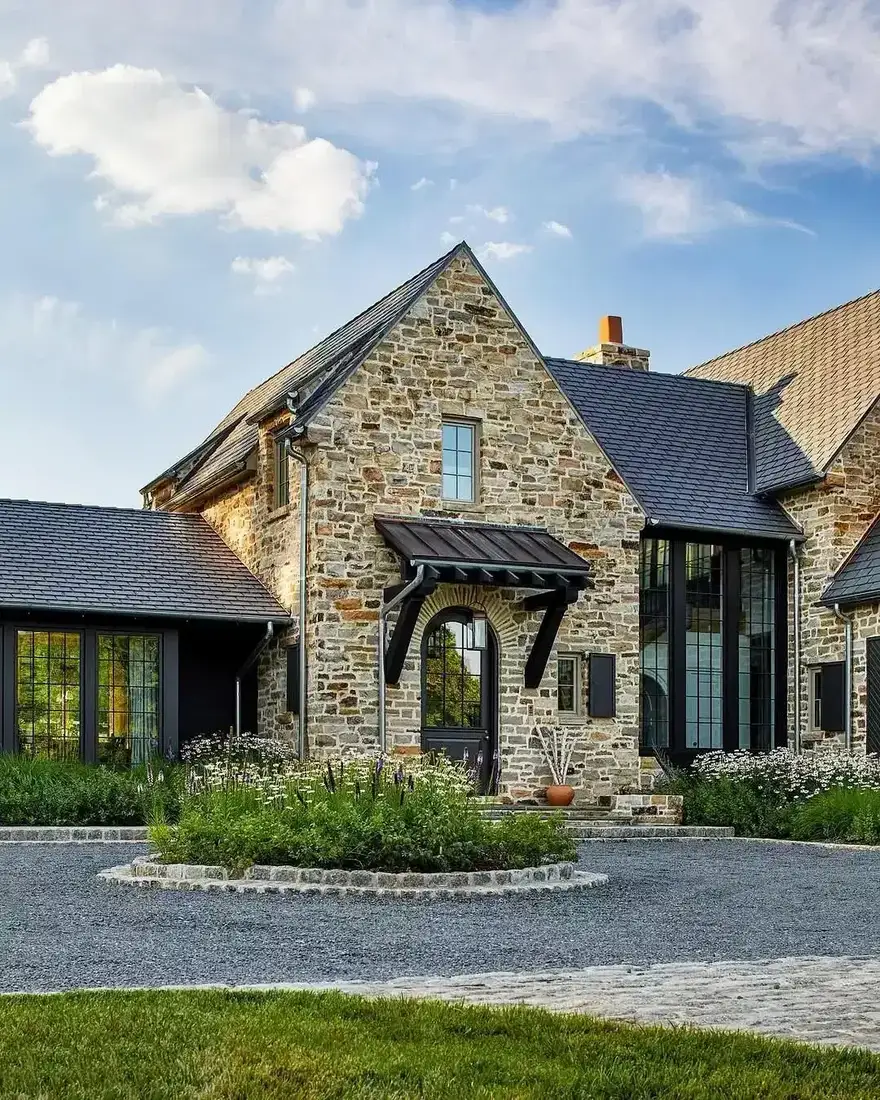
Two decisions are visible at the base of this house.
The first is the gravel, which runs right up to the stone in a warm buff. Warm gravel under grey limestone pulls the stone warmer; cold blue gravel under the same stone makes it look like a car park. Take a handful of wall stone to the merchant and hold it against the samples.
The second is the planting. That island bed sits out in the gravel, clear of the wall. Nothing is irrigated against the face, and nothing is heaped against the bottom course. Gaura lindheimeri ‘Whirling Butterflies’, Salvia nemorosa, and Nassella tenuissima in a shallow gravel bed give you the soft movement without the damp.
Gravel does a mechanical job too. Rain hitting bare soil or paving splashes up to 300mm up a wall and carries dirt with it, which is where the tide line at the base of an old stone wall comes from. A collar of 20mm angular limestone, 300 to 450mm wide, breaks the splash and lets the base dry.
Buy loose gravel for that collar, 40mm deep over a weed membrane. For a drive, use a self-binding gravel instead: 20mm stone mixed with dust at about 4:1, laid 75mm deep over geotextile. Either way it costs £40 to £90 a tonne.
Let the ground fall away from the wall
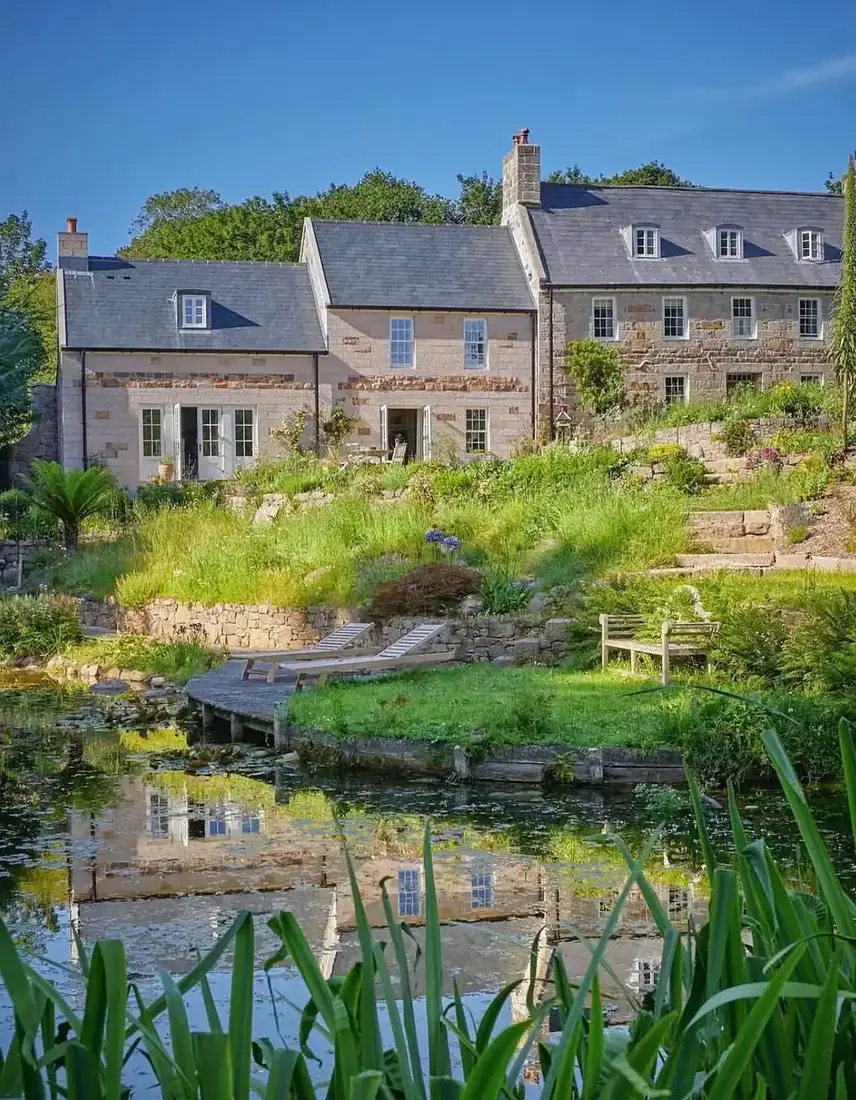
Everything in this photograph slopes downhill, and that is the most valuable thing about it.
The houses sit at the top, the garden steps down through retaining walls to a pond, and the water has somewhere to go that is not the base of the wall. If your ground falls toward the house, you have a permanent damp problem that no planting will fix.
Get the levels right first. The finished ground should fall away from the wall at about 1:40, which is 25mm in every metre, and the surface against the wall should sit at least 150mm below the damp-proof course. Where there is no damp course, as on most old stone, keep the soil two courses below the slate or lead at the window bases.
If the levels cannot be changed, cut a French drain: a 300mm trench, a perforated pipe at the bottom wrapped in geotextile, and 20mm clean stone over it, running to a soakaway or a drain. That is a weekend and around £120 in materials for a 10 metre run.
The pond is a separate matter. Water within a few metres keeps the air humid, which is why this stone reads cool grey. Iris pseudacorus, Carex, Ligularia, and Zantedeschia aethiopica all suit a wet foot, and their leaves hide the algae line.
Aspect decides which walls can take planting
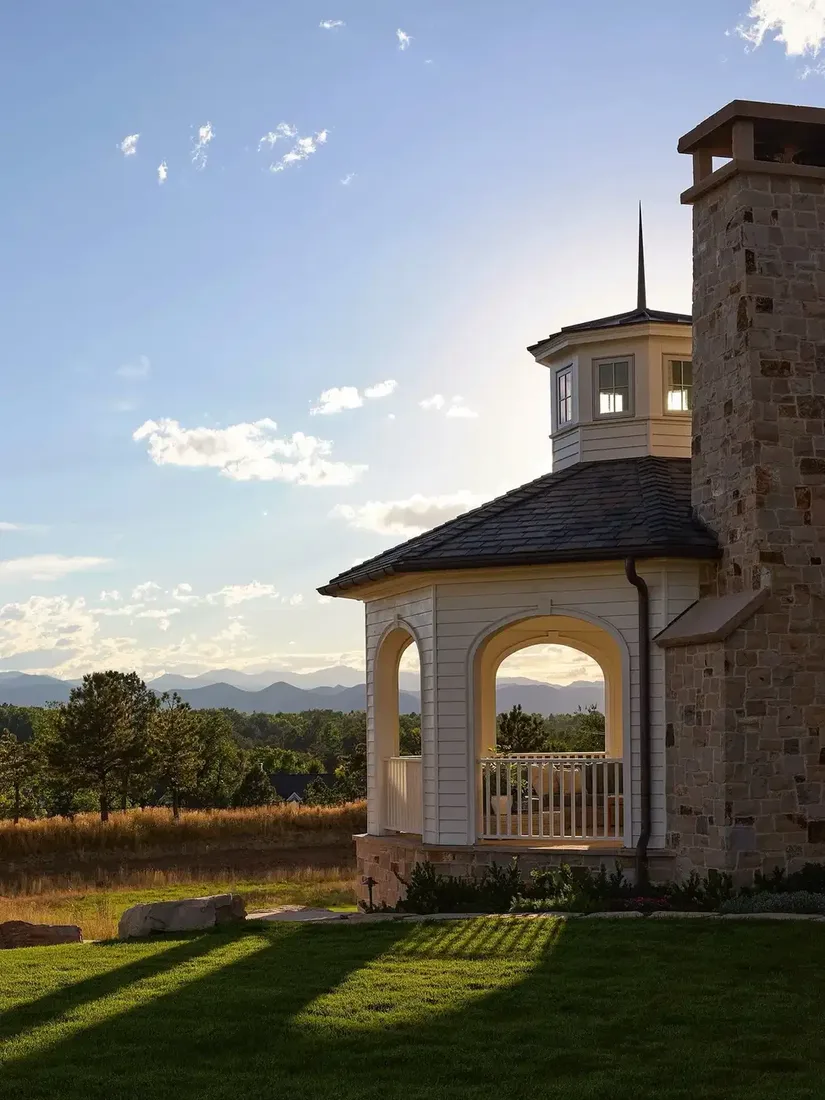
The stone in this frame is warm gold, and the light carries it. See the shadows: long and flat, which means a low sun on a west or south elevation. The planting is almost nothing.
That is a real option. A wall taking six hours of direct sun does not need a border, and the plants that suit it want the heat.
Aspect decides more about a wall than any planting choice does. A south or west facing stone wall bakes in summer, dries fast after rain, and stays dry, which is why the stone reads warm. A north or east wall never dries properly; it grows algae, it stays dark, and the same stone reads cold and slightly green.
Plant to the wall you have. On the hot side: Lavandula angustifolia ‘Hidcote’, Cistus, Teucrium fruticans, Phlomis fruticosa, and Stipa tenuissima, all of which want the drainage and the sun. On the cold side: Geranium macrorrhizum, Alchemilla mollis, Dryopteris filix-mas, and Hakonechloa macra, which tolerate shade and a damper foot.
Then leave the transition soft. Mown lawn giving way to unmown meadow, as here, is the cheapest edge in gardening and it suits a stone house better than a hard border line.
What a tree root does near a foundation
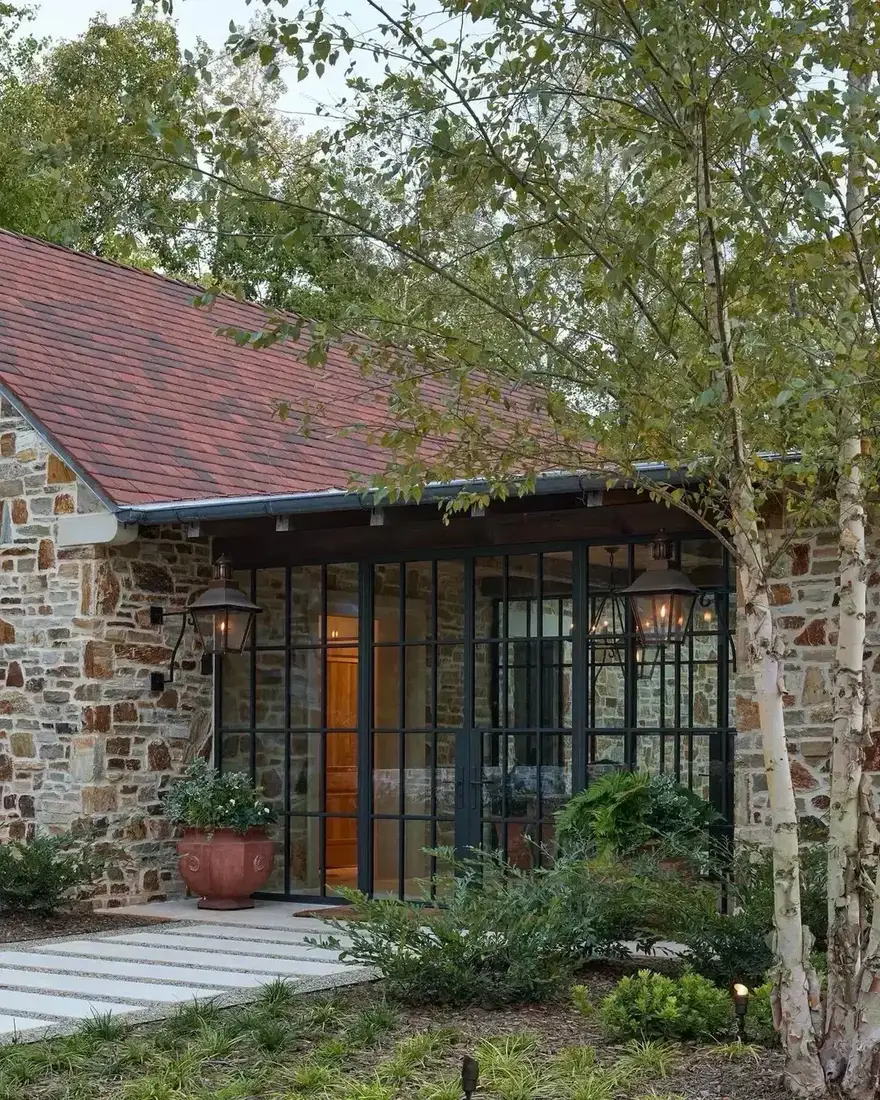
That multi-stem birch stands about a metre from the corner of the building, and the paving between it and the wall is the thing that will fail first.
Roots do not push foundations over. That is a myth. What roots do is dry the ground. On shrinkable clay, a thirsty tree pulls moisture out of the subsoil under and beside the footing, the clay shrinks, and the foundation settles unevenly. The crack then appears in the wall above, usually within two or three metres of the tree, and usually in a dry summer four or five years after planting.
Betula utilis var. jacquemontii reaches 8 to 12 metres. On clay, keep a tree at least its mature height away from a foundation. That is 8 metres for this one, roughly where the lawn starts. Shrubs work at a different scale: 1.5 metres is usually enough.
If the position is already chosen, put a root barrier in. A 600mm deep HDPE panel, sold in 1 metre sections at around £8 to £25 a metre, directs roots down and away. It has to go in before the tree does, because retrofitting one means digging out a mature root plate, which kills more trees than the barrier ever saved.
Birch is shallow-rooted, so the paving will lift before the wall cracks, which makes the paving your early warning.
| What | How far or how deep | Why |
|---|---|---|
| Border in front of the wall | 1m to 1.2m deep | Keeps soil and irrigation off the face |
| Gravel collar at the base | 300 to 450mm wide | Breaks the rain splash |
| Finished ground below the damp-proof course | 150mm | Stops water bridging into the wall |
| Fall away from the wall | 1:40, so 25mm per metre | Water leaves the base |
| Hedge clear of the stone | 400mm | Air moves, and shears fit behind it |
| Tree from a foundation on clay | Its mature height | Clay shrinkage, not root pressure |
| Cable standoff for a climber | 50mm | Air behind the stems, joints untouched |
Shade and leaf litter keep a wall wet
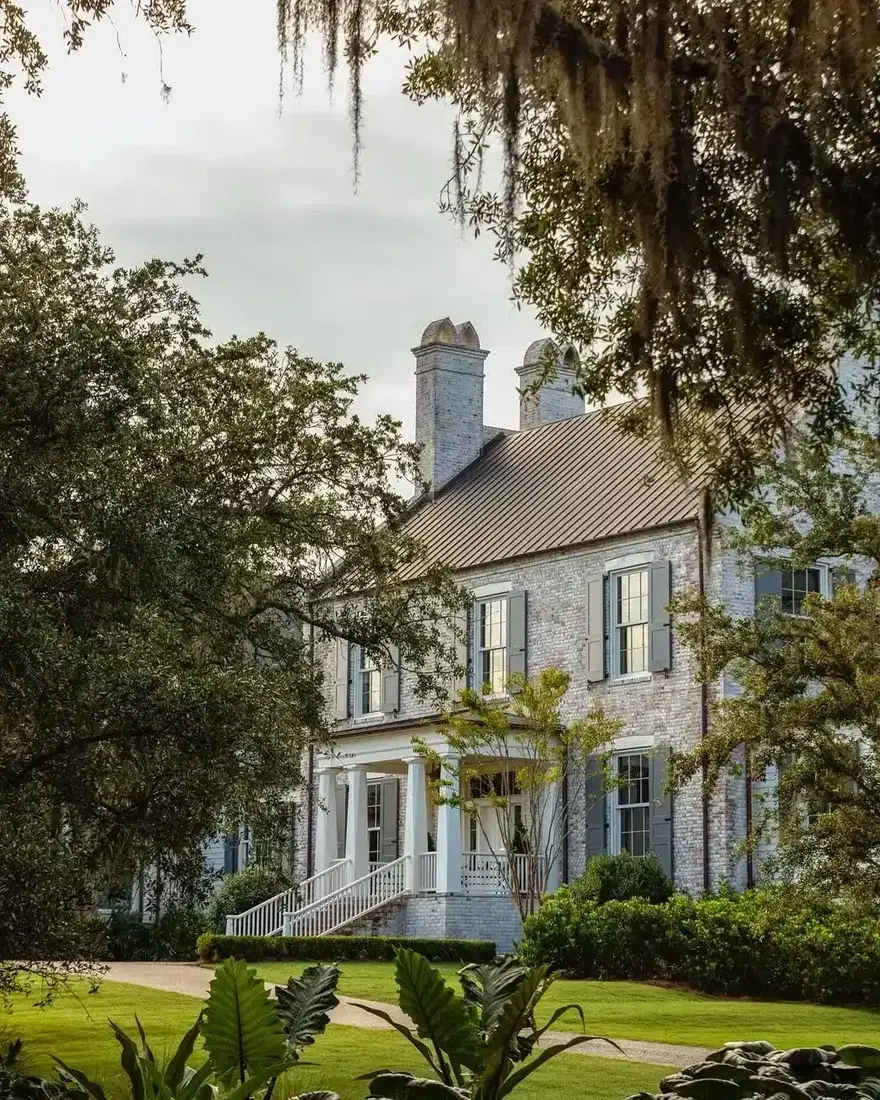
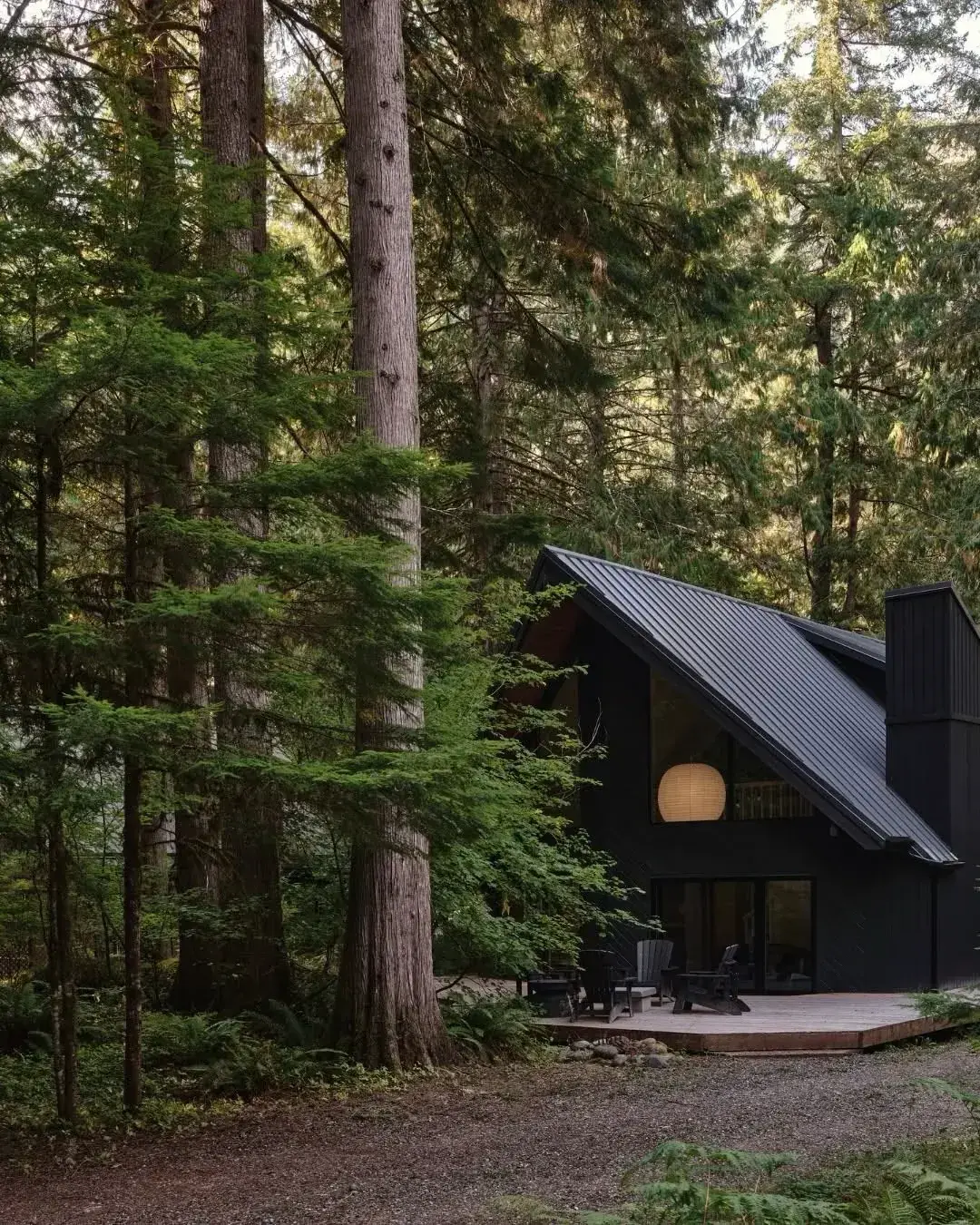
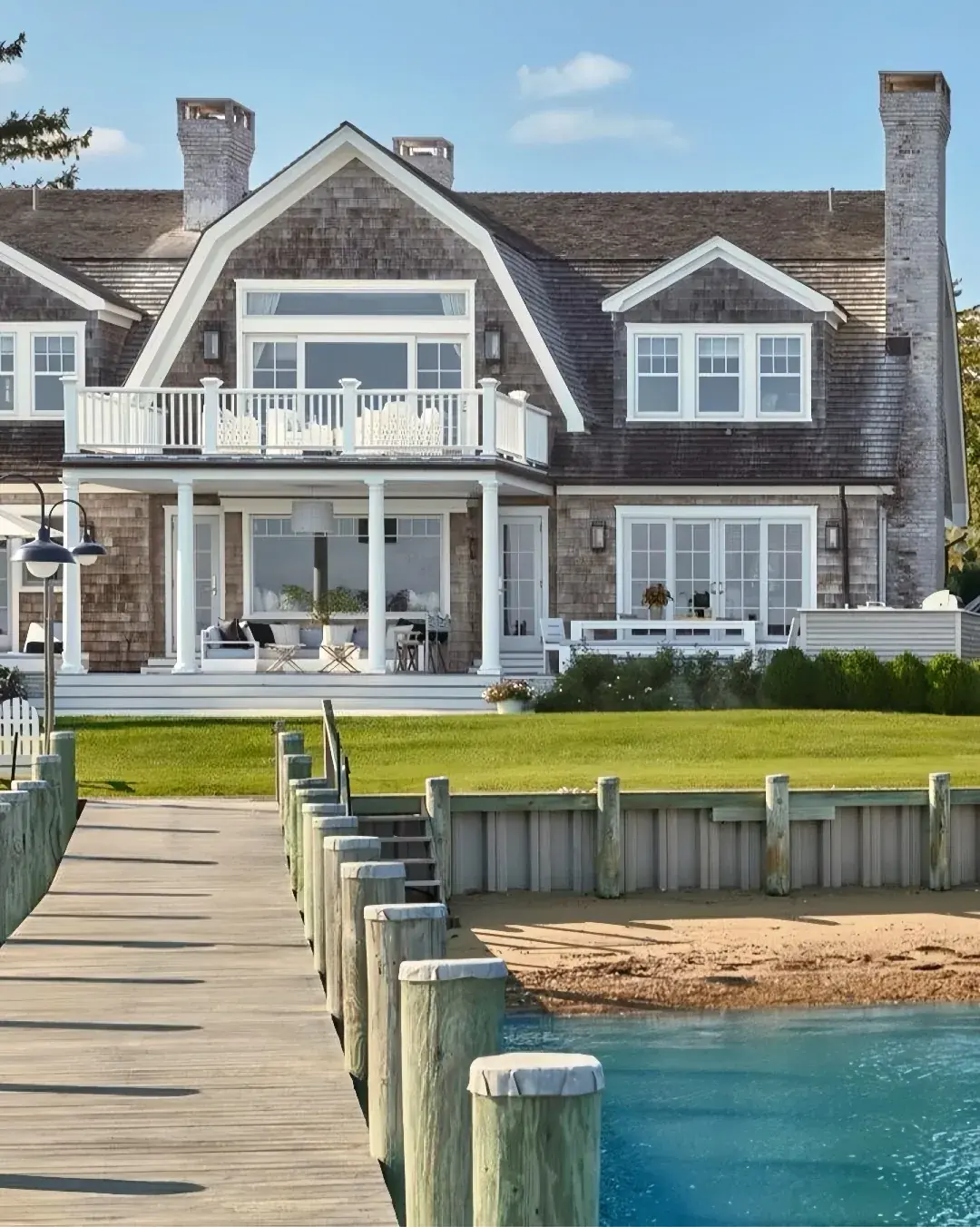
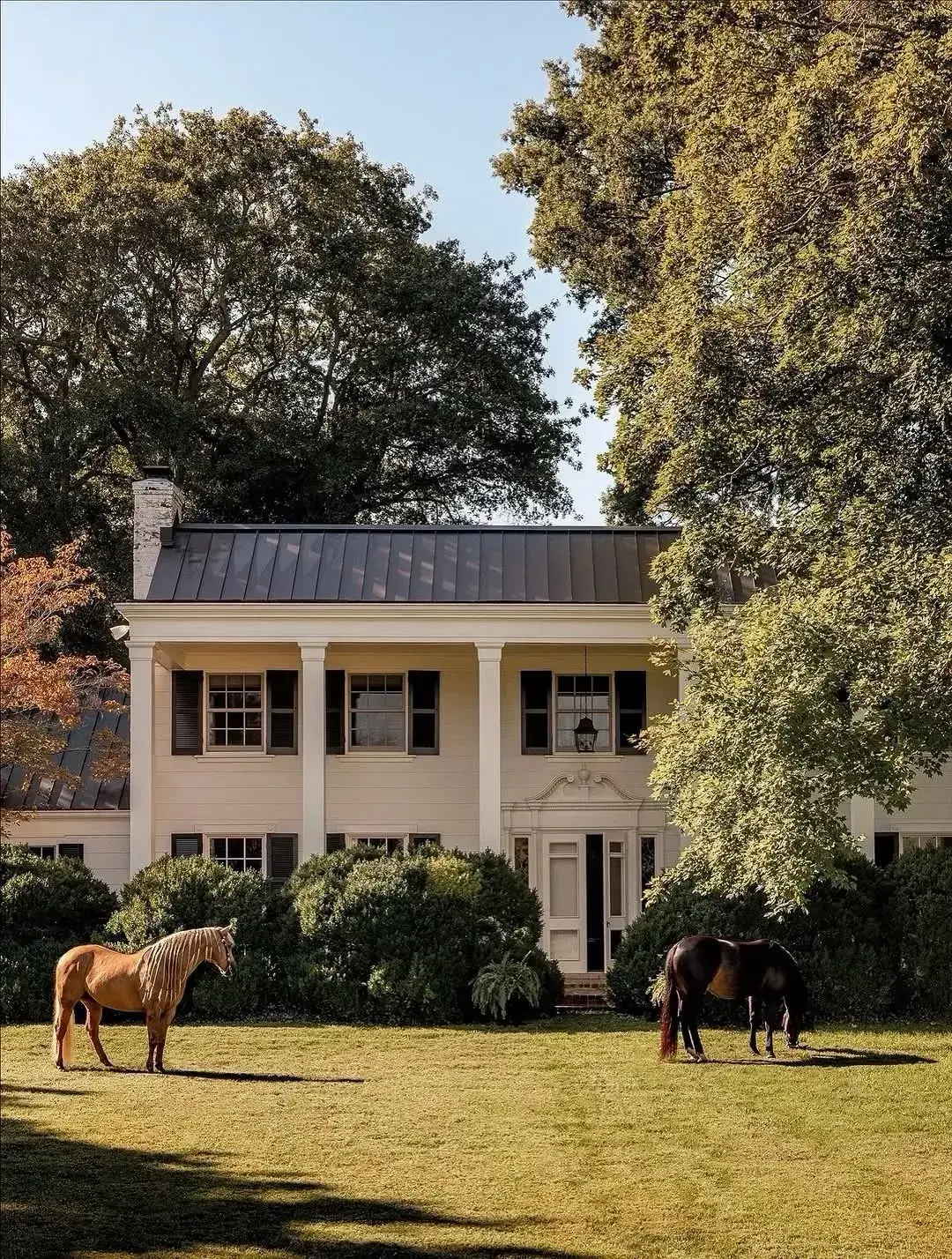
The oaks in this frame hang over the roof, and the wall underneath them never gets a dry day. The light is flat, the stone reads cool grey, and a clipped hedge runs along the base in permanent shade.
That combination is a maintenance schedule, not a look. A wall in deep shade dries far more slowly than one in sun, and everything that adds water makes it worse: Spanish moss (Tillandsia usneoides) holding rain, leaf litter banked against the bottom course, a gutter that overflows on the same spot every winter.
Three jobs, in this order. Clear the gutters twice a year, in late spring and late autumn, and check that the downpipe shoes discharge away from the wall. Keep a 150mm gravel margin between the mulch and the stone, so litter and soil cannot bridge into the joints. Then thin the canopy enough to let light and air reach the wall, which usually means taking out one or two lower limbs instead of a hard prune.
Plant for the shade you have left, not for the sun you wish you had. Sarcococca confusa, Fatsia japonica, Dryopteris erythrosora, Epimedium x perralchicum, and Pachysandra terminalis all cope with dry shade and alkaline soil. A sun-lover planted here will sulk for two years and then die.
One repeated green shape is what calms stone
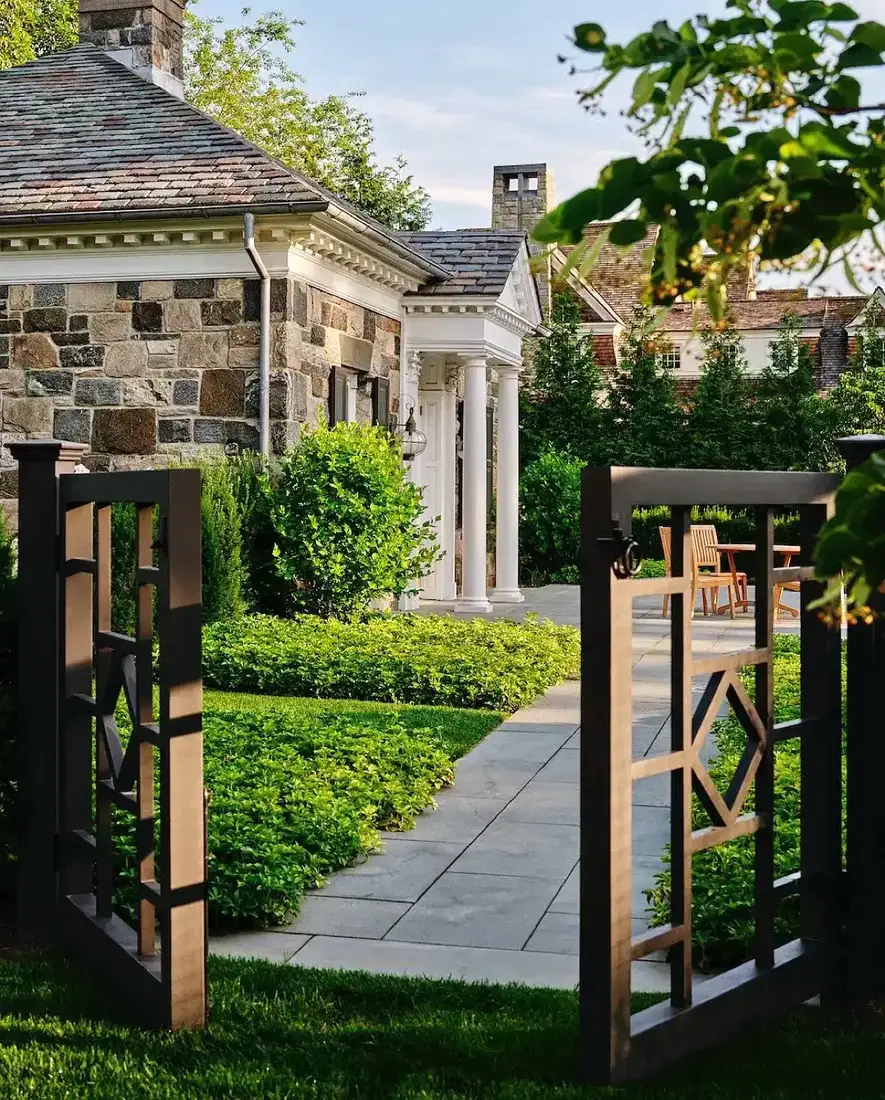
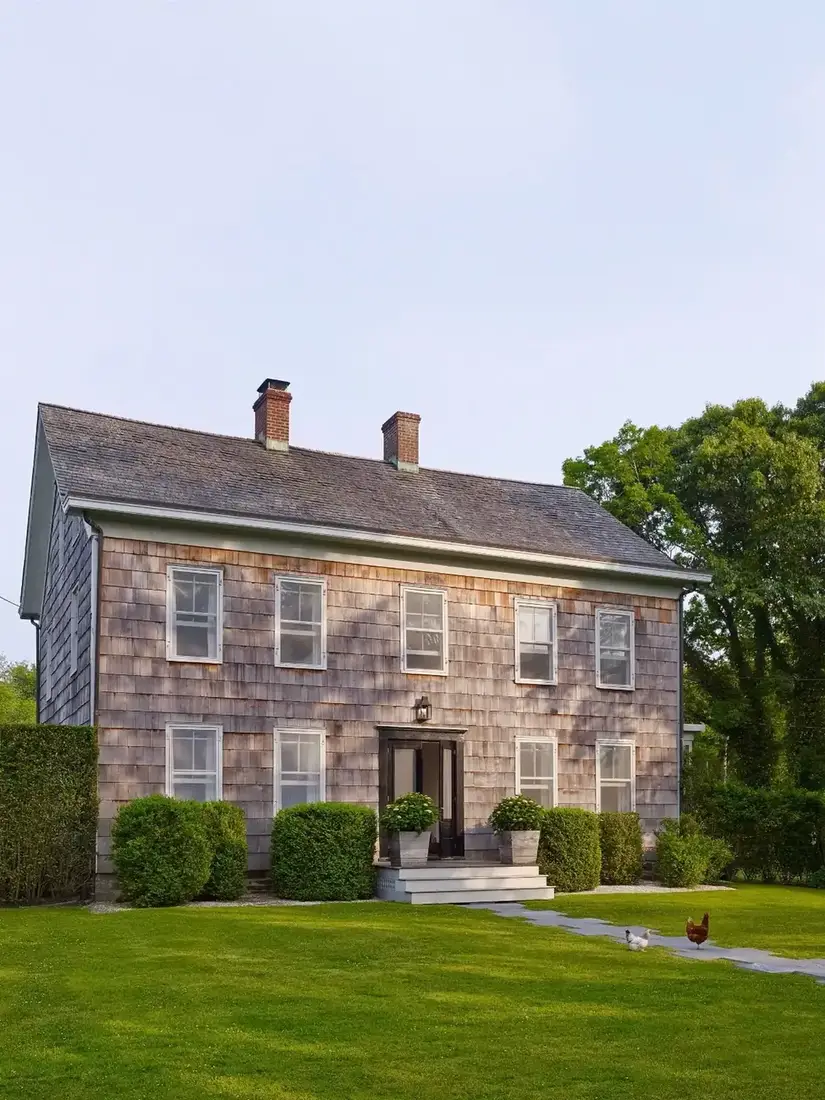
Count the greens in this photograph. The clipped hedging, the lawn, the shrub behind the gate, the trees behind the house. They are all the same green, and the hedging is clipped to one low height throughout.
That repetition is the whole trick, and it is why the stone reads calm. Stone is busy on its own: irregular coursing, colour variation, deep shadows in the joints. Add three flower colours and the eye has nowhere to rest. Repeat one green shape and the wall becomes the only textured thing in the frame.
Pick the plant you are going to repeat and commit to it. Buxus sempervirens is the classic, and it is also the one with problems: box blight (Calonectria pseudonaviculata) and box tree moth (Cydalima perspectalis) have made it a gamble in much of the country. Ilex crenata and Taxus baccata give you the same dark green block without that risk, and both take alkaline soil.
Two specs that matter. Keep the hedge 400mm clear of the wall, so air moves behind it and you can get shears in without scraping the stone. Clip with a slight batter, wider at the base than at the top, so light reaches the lower leaves. A hedge clipped dead vertical goes bare at the bottom within a few seasons, and there is no way back from that except replanting.
Give a tall wall a level line to sit on
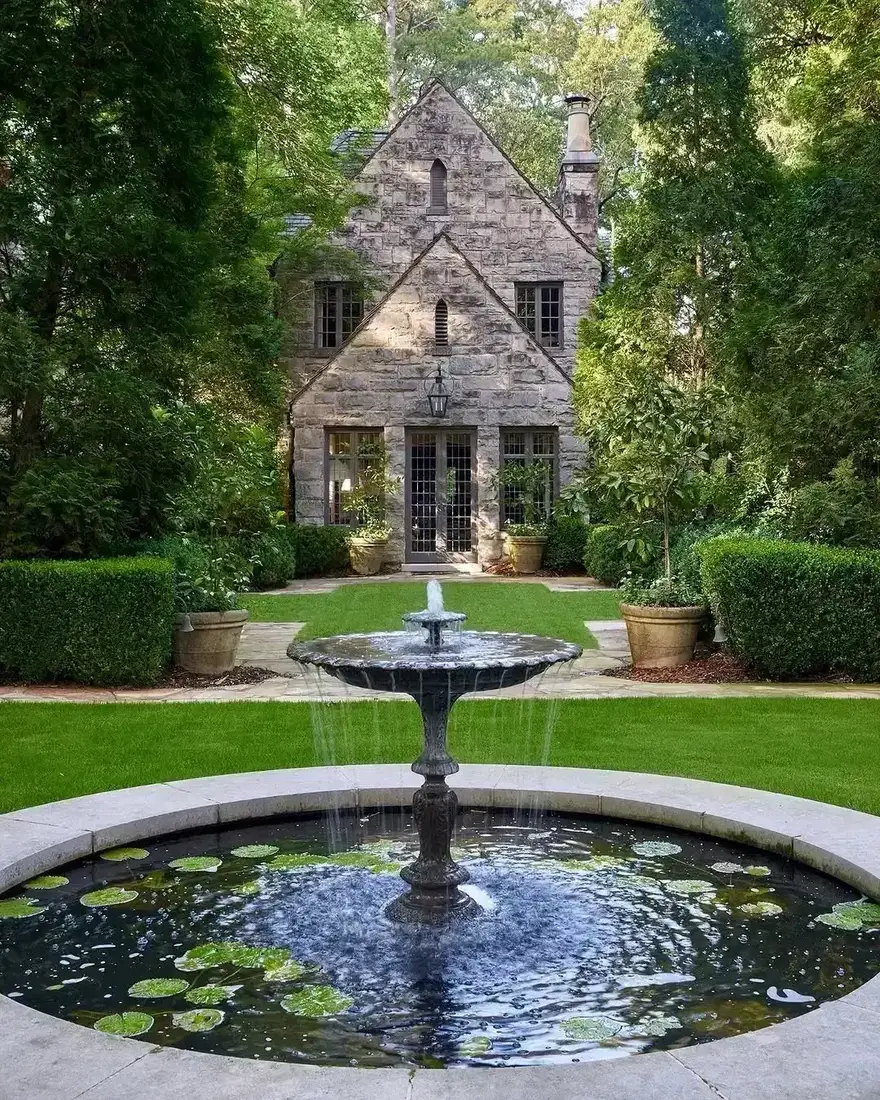
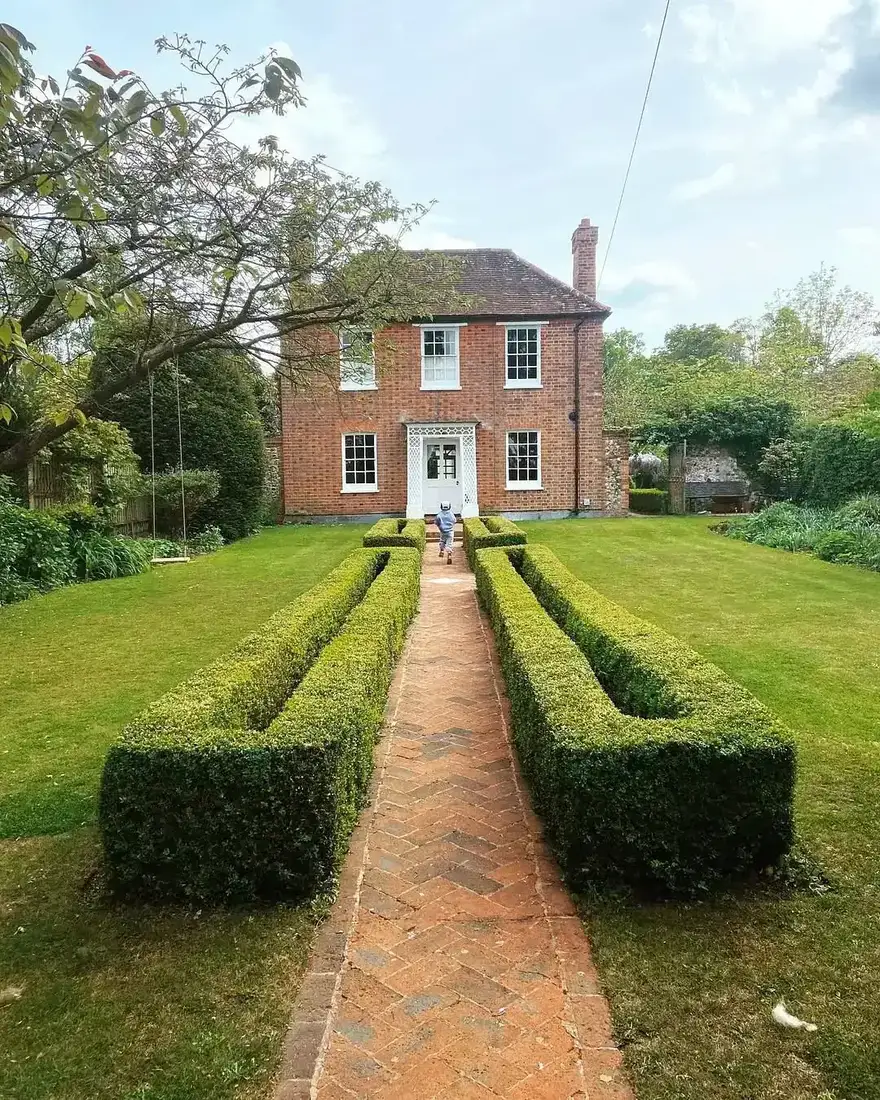
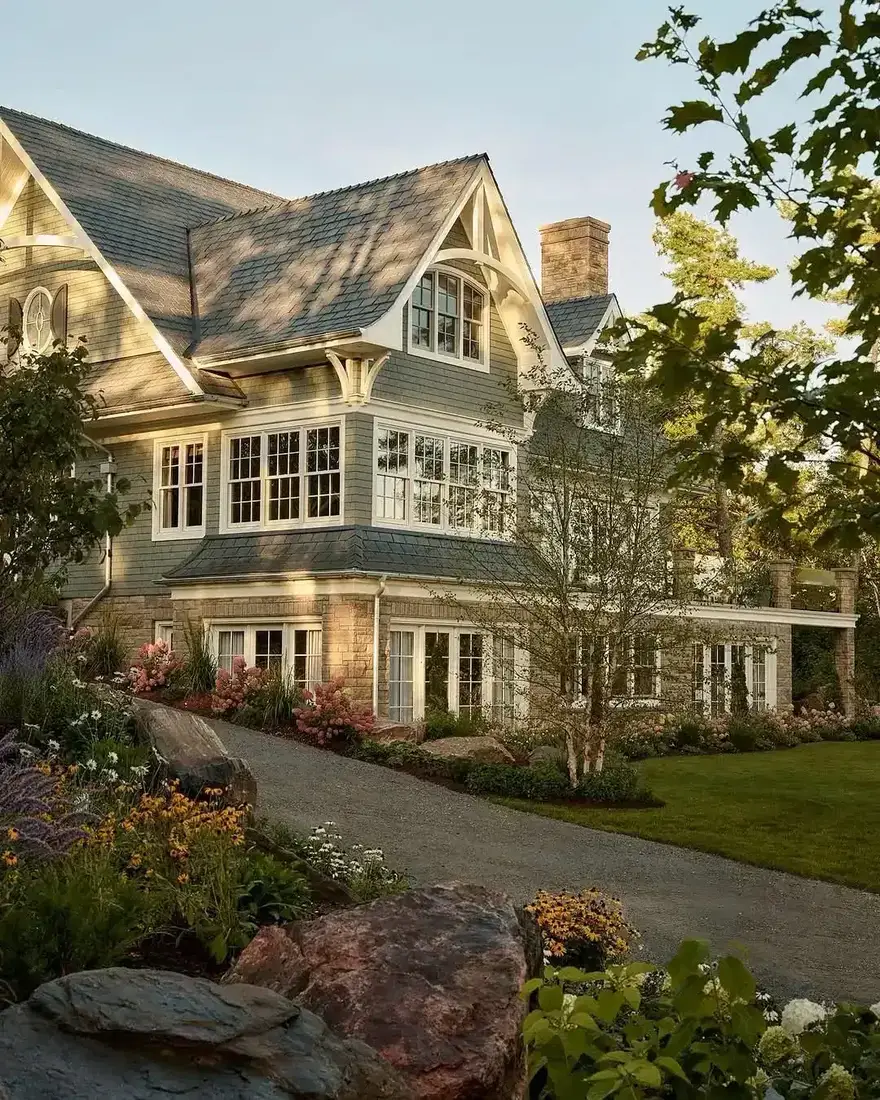
This is a tall, narrow, grey house with two gables, and it would feel as though it were leaning toward you were it not for the hedge.
The clipped blocks either side of the path draw a hard horizontal across the base at a constant height. That line stops a vertical wall from feeling top-heavy. It also hides the point where the wall meets the ground.
The stone here reads cool, and that is the light and the water, not the planting. A fountain a few metres away keeps the air humid, and the canopy behind keeps the whole garden in shade. Grey stone in shade is a legitimate look, and the only thing that will warm it after dark is the bulb: fit a 2700K warm white uplight, not a 4000K cool white, and keep it IP65 and on a timer.
If you want the same geometry without the box, Taxus baccata and Ilex crenata clip to the same block. Trim twice a year, in late May and early September, and hold the level with a line between two canes. Eyeballing a hedge line across four metres does not work; the error compounds along the run.
This is what sets the stone’s temperature
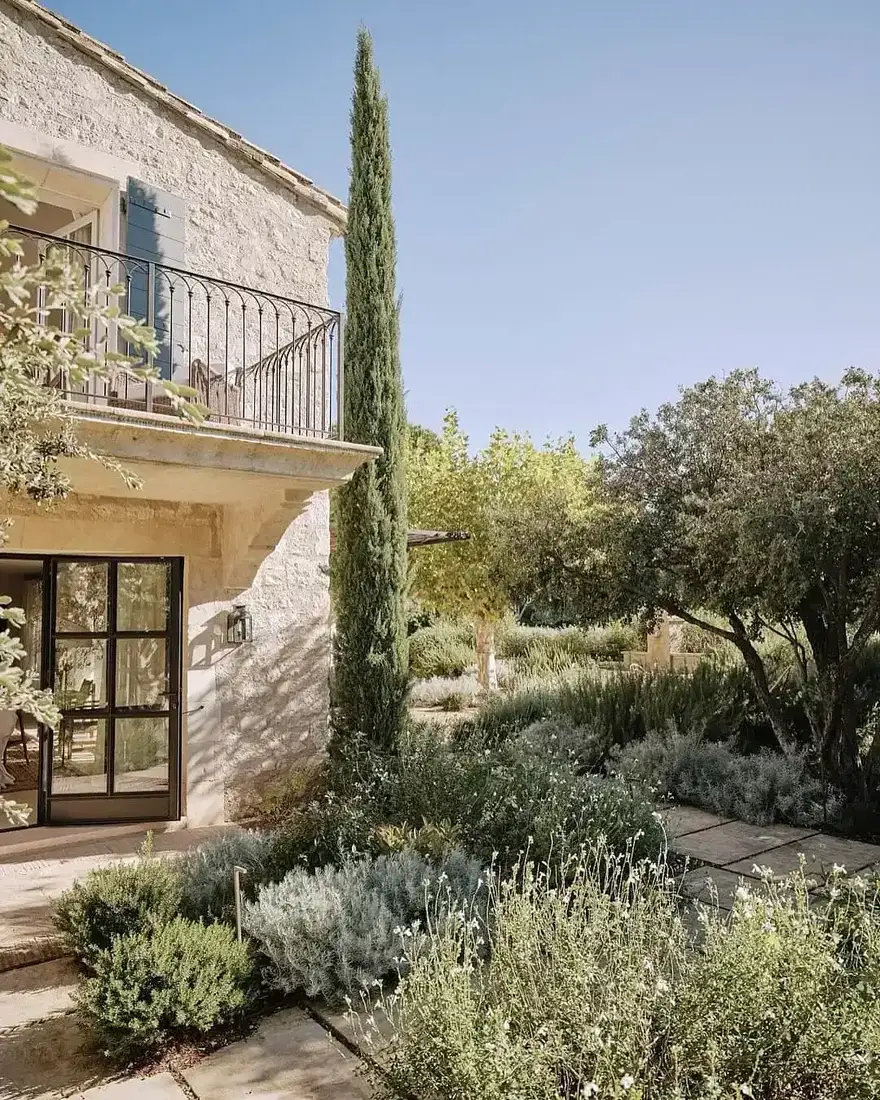
Pale limestone, hard sun, and the wall reads warm honey. Nothing about this stone is different from the cold grey walls earlier in this piece. The neighbours are different.
Olive (Olea europaea), lavender, rosemary, and santolina all carry a grey-silver cast, and that cast has yellow in it. Set against limestone, which also sits on the warm side of neutral, they reinforce it. Clipped yew and box are blue-green by comparison, and blue-green beside warm stone drags the stone toward grey. That is the whole mechanism, and it is why two houses built from the same quarry stone can look like different materials.
If you want this temperature, plant this palette. Lavandula angustifolia ‘Hidcote’ is the compact one at around 500mm; Lavandula x intermedia ‘Grosso’ is bigger and flowers later. Both need full sun, a pH of 6.5 to 7.5, and drainage sharp enough to keep their feet dry. Work 30% horticultural grit into the planting hole by volume, and set them 400mm apart for a hedge. Cut them back after flowering to 25mm above the old wood. Do not cut into the old wood itself, because lavender does not regrow from it.
One correction. That cypress stands roughly a metre from the wall. Cupressus sempervirens is shallow-rooted and thirsty, and it wants 2m. Move it, or accept a dry border and a damp wall.
| Plant group | Examples | Against lime mortar |
|---|---|---|
| Acid-lovers | Rhododendron, Pieris japonica, Camellia, Kalmia, Vaccinium | Fade over several seasons; need sulphur to grow |
| Silver and Mediterranean | Lavandula angustifolia ‘Hidcote’, Olea europaea, Santolina, Cistus | Happy at pH 7.5, but demand full sun and sharp drainage |
| Clipped evergreen | Buxus sempervirens, Taxus baccata, Ilex crenata | Tolerate the lime and hold a shape through winter |
| Climbing | Wisteria sinensis, Parthenocissus tricuspidata, Clematis armandii | Fine on cables 50mm off the stone, never in the joints |
Frequently Asked Questions
Which plants should I avoid against lime mortar?
Pieris, rhododendron, camellia, kalmia, and blueberry all need acid ground, and they fade slowly beside a lime wall. Blue mophead hydrangeas belong in the same group unless you dose the soil every year.
Can I grow wisteria on a stone house?
Yes, on a wire or cable system on standoffs, so the stems stay 50mm clear of the stone. Cut the long growth back in August, then again in January to two or three buds. Left alone, the stem thickens until it levers the joints apart.
Does ivy damage a stone wall?
English ivy does. Its aerial roots enter the mortar and hold water against the face, so pulling it off green takes the pointing with it. Boston ivy and Virginia creeper stick with pads instead, which stains rather than breaks.
How far from the house should I plant a tree?
On clay, at least the tree’s mature height from the foundation. A birch reaching 10 metres wants 10 metres. Shrubs are fine at 1.5 metres. Where the position is fixed, fit a 600mm deep root barrier before planting.
Should I use gravel or soil against a stone wall?
Gravel, in a collar 300 to 450mm wide. Soil and mulch hold moisture against the bottom course, and bare ground throws dirt up the face. Gravel breaks the splash and lets the stone dry.
What makes grey stone look warm?
Foliage with silver or grey in it and yellow underneath: olive, lavender, rosemary, santolina, cistus. Blue-green evergreens such as yew and box pull the same stone cold. Warm gravel and a 2700K bulb finish the job.
In order
- Test the soil beside the wall first; lime mortar makes that strip alkaline.
- Choose the climber and its fixing before the plant, because the cables go up first.
- Settle levels and drainage: a 1:40 fall, 150mm below the damp course, and a French drain where the fall cannot change.
- Dig the border 1m to 1.2m deep, and keep mulch 300mm clear of the stone.
- Lay a 300 to 450mm gravel collar along the base.
- Give a tree its mature height from the foundation on clay, and fit the barrier before planting.
- Pick silver and olive foliage for warm stone, and repeat one clipped green shape.
- Clip hedges twice a year, 400mm clear of the wall, with a batter.
This article may contain affiliate links. We may earn a commission at no extra cost to you.