9 Fall Window Painting Ideas for Stores: Keep the Glass Readable

Add us as a preferred source to see more stories on Google.
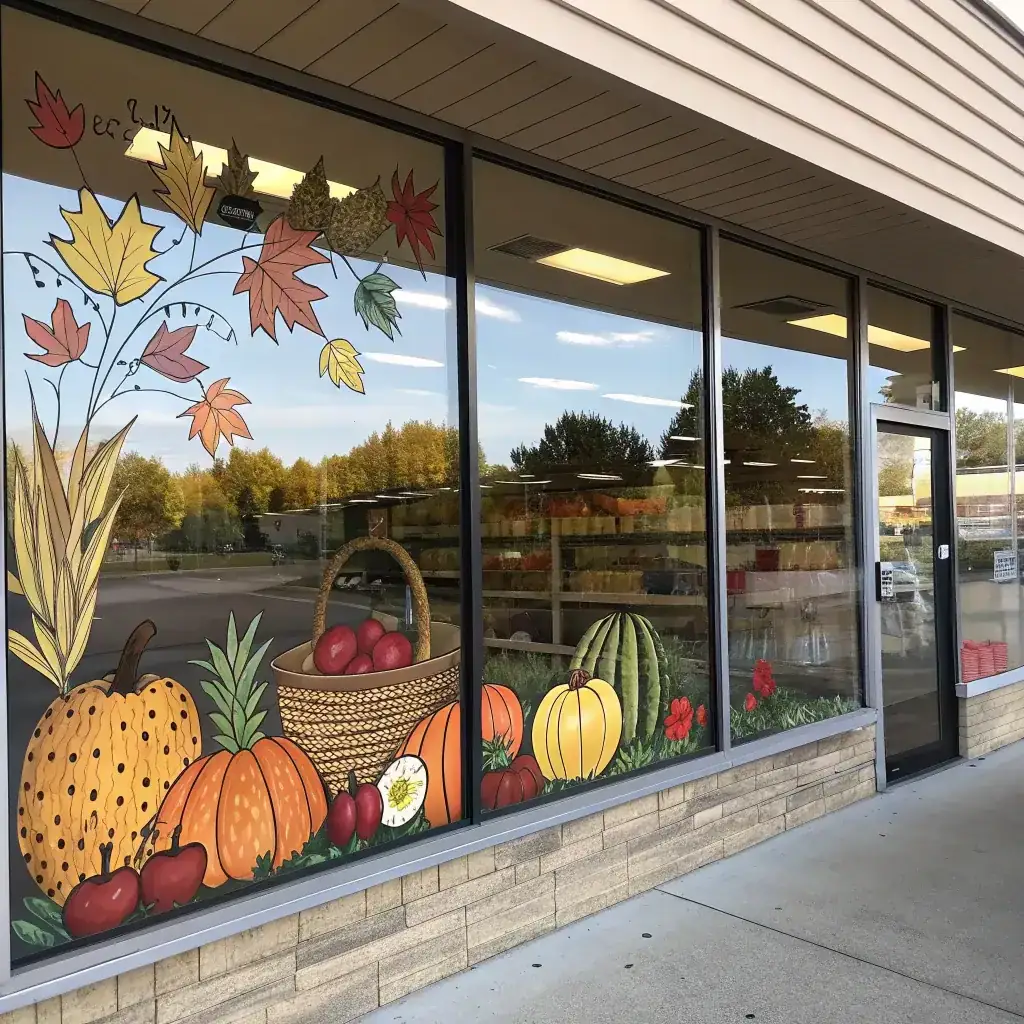
The shopfront below is painted, and you can still see straight into the shop.
Pumpkins and a basket cluster in the bottom-left, leaves trail up and across the top edge, and the middle of every pane is clear glass. The produce, the shelving and the lights inside are all visible, which is the entire reason the window is there.
Paint the whole thing and you have decorated your way to looking closed. It is the most common mistake in seasonal shop windows and it costs actual customers.
The composition that works
A weighted corner, a trailing element, and clear glass between them.
The corner cluster does the heavy lifting: in that window it is a group of pumpkins, a basket and some apples, all sitting on an implied ground line along the bottom of the glass. It reads as a single mass from a distance.
The trailing element, here leaves and a branch across the top, connects the panes and stops the bottom cluster looking marooned. It also frames the view into the shop rather than blocking it.
Then nothing in the middle. That is the part requiring discipline, because a blank centre feels unfinished while you are standing in front of it with a brush. From the pavement it is the reason the window works.
Design for distance
Look at the line work: everything is outlined in a dark colour and filled flat. No shading, no gradients, no fine detail.
That is deliberate. A shop window is read from across a road, from a moving car, and often at an angle. At that distance the eye resolves shape and contrast and nothing else, so a boldly outlined pumpkin reads as a pumpkin and a beautifully shaded one turns to a brown-orange smudge.
Keep the palette tight, four or five colours, and make the outlines genuinely bold. Anything thinner than about 10mm on a large window disappears.
Let the design run across the mullions rather than treating each pane as a separate picture. A composition broken into equal boxes reads as repeated wallpaper; one that crosses the frames reads as a mural.
What to paint it with
This is the part that differs from painting a window at home, because a shopfront is painted on the outside and has to survive weather.
| Medium | Holds up outside | Removal |
|---|---|---|
| Tempera window paint | Yes, designed for it | Water and a squeegee |
| Acrylic craft paint | Yes | Scraper; hard work at scale |
| Poster or kids paint | No; runs in the first rain | Trivial, because it has gone |
| Chalk marker | Streaks and washes | Damp cloth |
Proper window tempera is the trade answer. It is made for outdoor glass, it stays put in rain, and it comes off with water and a squeegee rather than an afternoon of scraping. Chalkola, Krylon and several sign-supply brands sell it, and a full set runs £30 to £60.
Acrylic works and it is genuinely unpleasant to remove from a large shopfront. Consider that before committing to it across six panes.
Whatever you use, clean the glass properly first. Paint over road film lifts in sheets, usually a fortnight in.
Tall stems that sell from the kerb

The stems in this photo do almost all the work. Three tall sunflowers stand on the right hand panes, with wheat and dry grasses rising between them, and the door and the left panes stay almost clear. Shoppers read the yellow discs from the opposite pavement while the interior lights and stock still show through the gaps.
That vertical habit suits a smart high street frontage. The painting never covers more than a third of any pane. It leaves eye level open, which matters when the display inside is doing the selling. The planters below repeat the same sunflowers in real life, so the painted stems and the living ones read as one scheme.
My first attempt at this looked fussy. I filled every pane with small blooms and seed heads, and from twenty metres it turned to beige noise. Two evenings of scrubbing taught me the lesson this window already knows. Fewer stems, taller, with space between them, which is why three strong shapes hold up for the full 6 weeks when traffic is moving.
For paint, large flat petals want a marker with a wide nib. Posca PC-5M runs £3 to £5 each in 2026, and a box of autumn tones costs £25 to £40. A full tempera set for the wheat and leaves costs £30 to £60 in 2026, and it survives 6 weeks of rain on outside glass. Allow 4 to 6 hours with two staff, including masking the door edges.
A pumpkin row with vines overhead
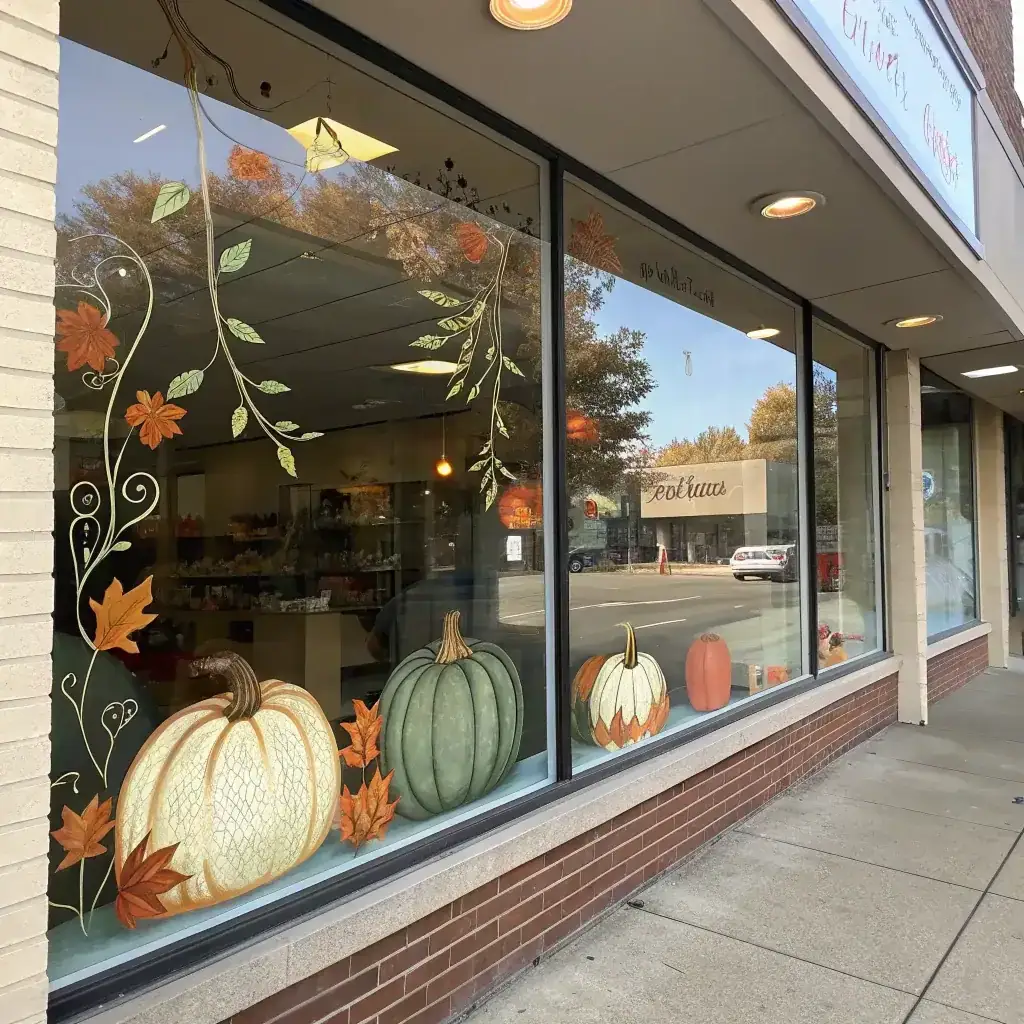
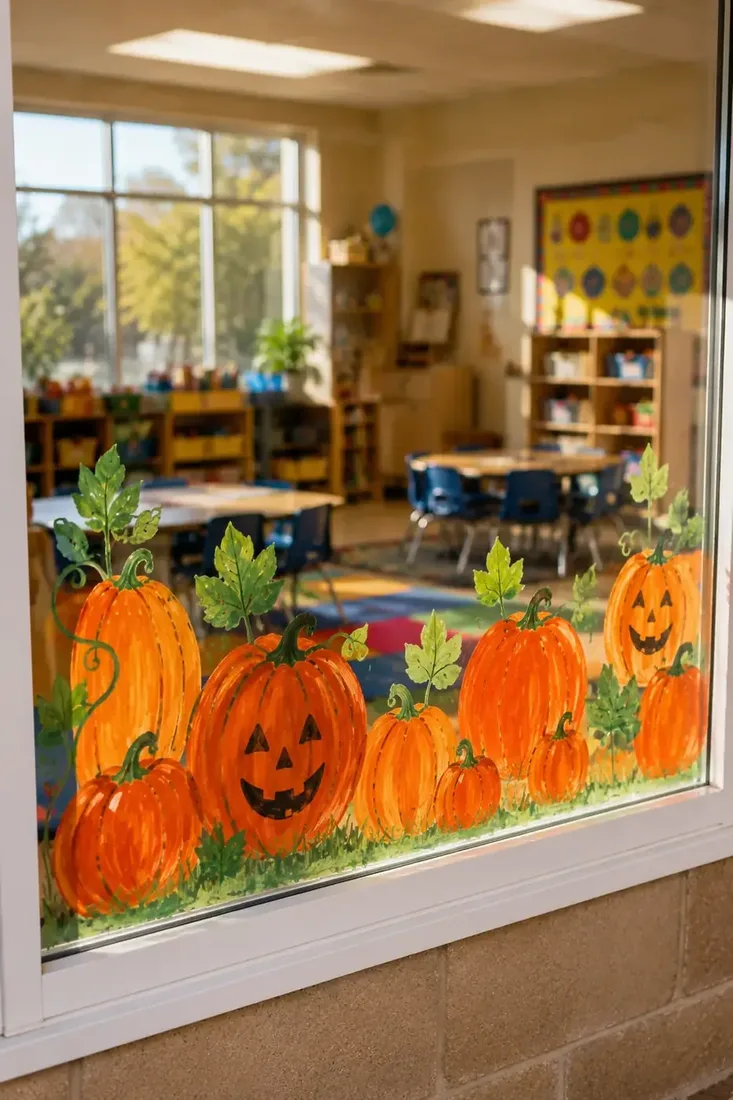
That low row of pumpkins is the stopping power here. Four fat shapes sit on the sill line, cream and sage and burnt orange, each outlined dark and filled in two coats. Above them, thin curling vines with small leaves climb the mullions and meet in the middle of the glass. The centre stays open enough to see the counter and the pendant inside.
Little paint is actually up there. The vines are single strokes with a leaf every hand width or so. They join the panes into one composition without blocking the view. The pumpkins carry the colour, the vines carry the connection, and nothing else competes.
This is a good one for a gift shop or homeware store where the window display changes weekly. Staff can leave the vines up for the full 6 weeks of the season and swap the table behind them. Painting the set takes an afternoon, around 5 hours for one confident painter, plus drying. Chalkola markers for the outlines cost £12 to £20 for a set in 2026, with tempera for the fills at £30 to £60 in 2026.
Skip this layout if the sill is narrow or cluttered, since the pumpkins need a clean base line to sit on.
Paint the menu, not just the season
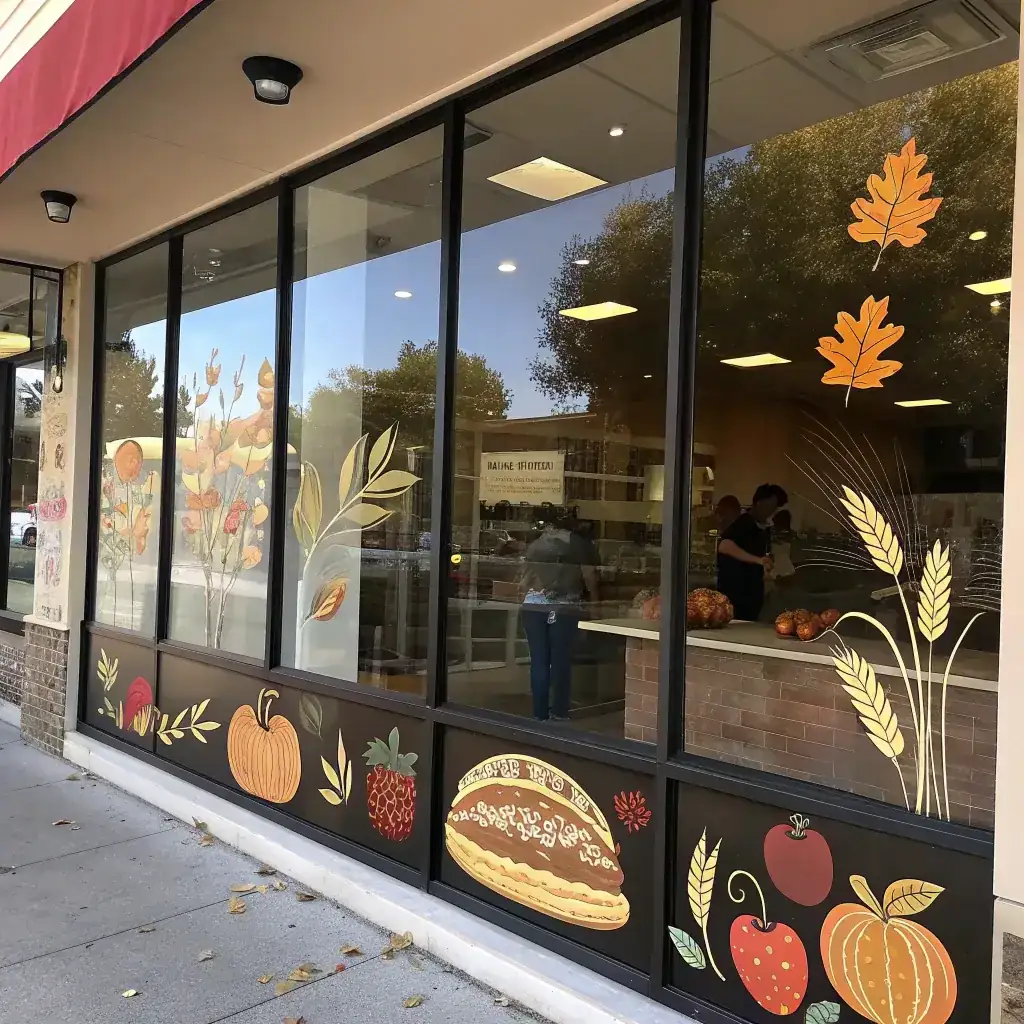
The clever move in this photo is where the food sits. The pie, the pumpkin and the apples are painted on the black stallriser panels below the glass, life size and dead centre, while the tall wheat and leaf sprays float on the clear panes above. Passers-by get the menu at hip height and the season at eye height, and the counter with real trays shows straight through between them.
The pie shows the level of detail to aim for. The lattice is suggested with six or seven cream lines, not drawn properly, and it reads perfectly from the pavement. That is the level of finish to aim for, since nobody stops to admire brushwork from across the road and each petal only needs two or three strokes.
For a bakery or deli this pays directly. Pick three items the shop actually sells in October and paint those. A full tempera kit in bakery tones costs £30 to £60 in 2026, and the black panels take 2 coats for cover. Budget one full day, around 7 hours, because the lettering board inside the window shows through and any wobble doubles visually. A local sign writer charges £150 to £400 for this size of frontage in 2026, including removal, which suits a short 6 week run when staff cover is thin.
Cups and steam that read as warm

The cups in this photo are enormous, and that is why they work. One large cup sits low on the right pane, two more float high on the left and centre, each with three curls of steam. Below them runs a low band of pumpkins and yellow leaves. The bar, the stools and the pendant lights inside stay visible through the middle of the glass.
Steam is the one detail to copy. A white cup outline alone vanishes against a bright interior, shown here clearly where the middle cup meets the window light. The curl above it still reads, because the eye picks up the wobble before the shape. Give every cup generous steam, taller than the cup itself, and keep it white and thick.
I once painted neat little cups with thin grey steam and wondered why nobody looked. The fix cost another morning and a second set of Posca markers at £3 to £5 each in 2026. Thick white steam, three strokes per cup, done with the arm not the wrist, pulled head turns from the bus stop through the rest of October.
Paint choice matters on a cafe frontage because of condensation and handling. Tempera holds for 6 weeks outside and wipes off the glass with water at the end of October. Chalk markers streak in rain and suit sheltered doorways only. A set of wide white markers plus autumn fills runs £25 to £40 in 2026. Allow 5 hours with drying between the 2 coats on the pumpkins.
Keep the name clear and dress the edges

The lettering is the focal point in this photo, and the paint knows it. SMALL INDEPENDENT BOUTIQUE runs in clean white capitals across the upper glass, untouched by leaves. The season sits low and high: pumpkins and cream daisies along the stallriser, scattered maple leaves on the white fascia above. The door and the sightline into the lit interior stay completely clear.
That separation is the lesson for any independent with a name to protect. Words need air. The one thing that ruins painted lettering is foliage tucked tight around it, because leaves and serifs merge at distance. Here there is a full hand width of clear glass around every word.
The palette stays tight to the brand. Cream petals, burnt orange pumpkins, olive stems. Nothing bright, nothing cartoonish. It matches the stone and black paintwork instead of fighting it. Farrow & Ball Pointing and similar soft whites get that fascia lettering colour in real paint, though on glass a Uni or Posca white marker at £3 to £5 each in 2026 does the same job for 6 weeks.
Time is modest. The low band takes 4 hours, the fascia leaves another 2 hours on a step ladder, and the lettering wants a steady hand or a chalk grid first. A full job fits in one closed day, roughly 6 hours including the ladder work.
White lines for a shop that cannot do orange
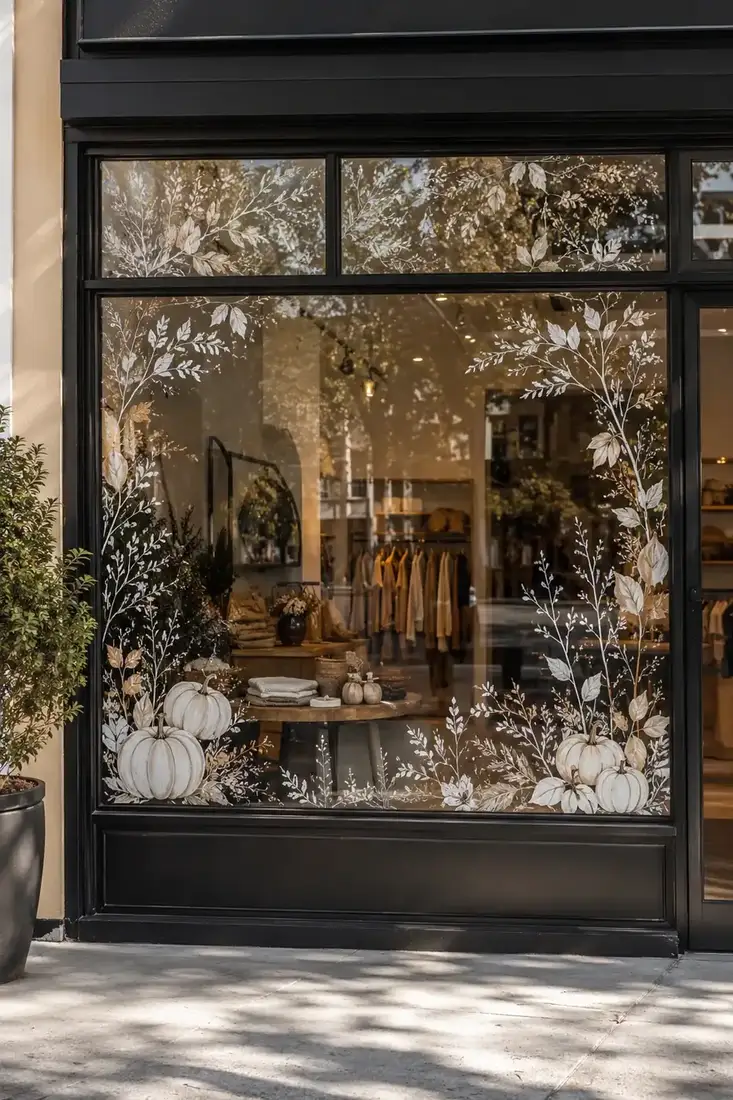
This frontage skips autumn colour entirely, and it looks more expensive for it. Fine white vines, ferns and seed heads climb both edges of the glass, with pale grey white pumpkins resting low on each side. The middle is empty. Rails of camel coats, folded knitwear and a round table show straight through, lit warm from inside.
Pictured against black frames, the white reads crisply from the kerb. It also photographs cleanly for socials, which matters when the shopfront does online work. Bright orange would have shouted over the stock, while this white line work sits quietly around it and leaves the knitwear to do the talking.
The trade off is time. Outline work looks quick and is slow, because every stem is visible and wobbles show. One window this size takes 6 to 8 hours with fine nibs, plus touch ups. I learned to charge myself properly for it after underquoting a salon job by half. White Posca or Uni markers cost £3 to £5 each in 2026, and this design eats two or three whites plus one pale greige. A pro would quote £200 to £400 in 2026 for a full surround like this, which reflects the nib hours.
Durability is good. White tempera or acrylic marker sits well on outside glass for 6 weeks and lifts with a blade and soapy water. Avoid it on filmed or coated panes, where any scraper work risks the film.
Flowers when pumpkins would look wrong
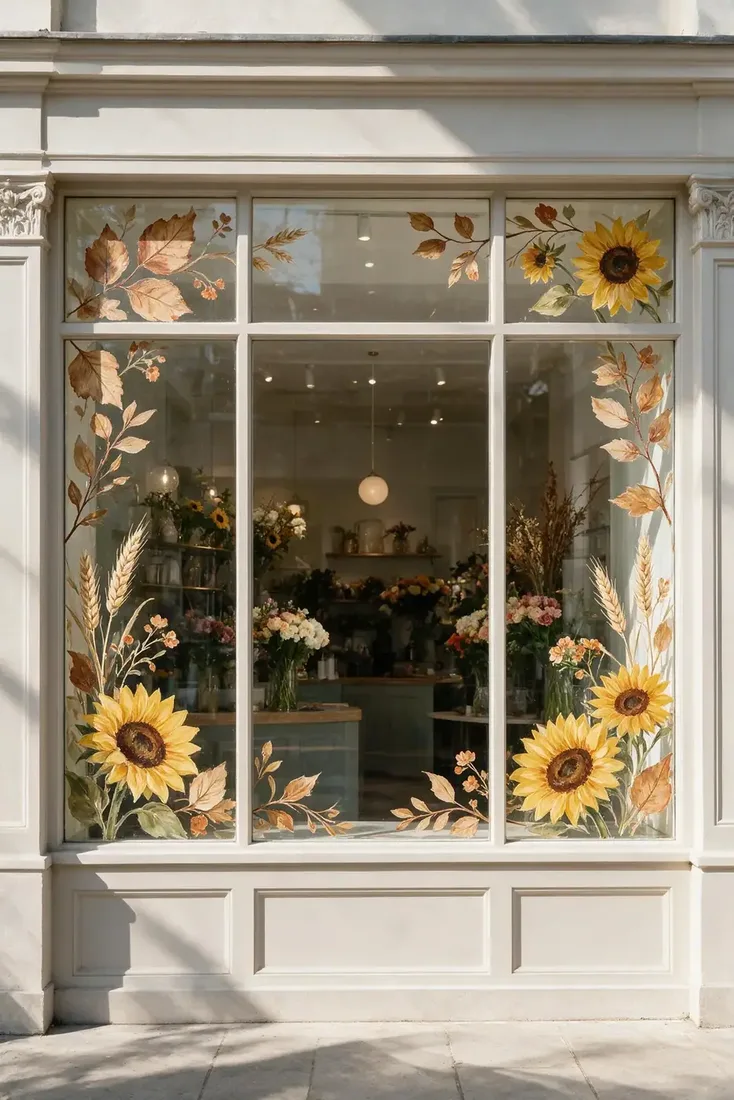
The frame in this photo is all sides, and the middle is all shop. Sunflowers anchor the two lower corners, wheat rises along the mullions, and brown leaves trail across the top panes. Through the centre, buckets of real blooms, a sage counter and a globe pendant do the actual selling. Painted flowers frame living flowers without copying them, which keeps the real stock as the focal point for the full 6 weeks.
That restraint suits a florist or salon. Pumpkins would drag the offer toward Halloween, which this business does not want. Sunflowers, seed heads and grasses read as October while staying neutral. The faded browns and mustards also sit clear of the fresh pinks and whites inside, so the real stock pops.
Colour matching matters less than tone here. Muted tempera tones, ochre and umber and soft green, cost £30 to £60 for a set in 2026 and cover in 2 coats. Bright craft acrylic looks loud beside real petals and chips harder at removal. For glass that must stay spotless, tempera removes with water and a squeegee in under 2 hours for a frontage this size.
Budget a day. The symmetry doubles the drawing time because each side must roughly mirror the other. Mark the centres with tape before paint comes out, then step back to the kerb after each side.
Make the words the biggest shape

The lettering dominates this corner window, as it should. Large cream script fills the centre pane at eye height, with fat orange and white pumpkins massed along the base and yellow leaves curling down from the top corners. Shoppers catch three words in one glance from the crossing, then notice the pumpkins second.
Below the script, the pumpkins are painted bigger than life. Each one is a simple oval with five or six segment lines and a short stalk. No texture, no shadow. At twenty metres that simplicity wins over accuracy every time. The small sunflowers tucked between them are dots with petals, nothing more.
Lettering at this scale needs planning. Draw the words on paper to the same proportions, grid the glass with low tack tape, and paint the letters first before any leaves go near them. Leaves painted first always creep into the text. A set of cream and orange tempera plus two wide white markers runs £30 to £55 in 2026. A sign writer charges £150 to £350 for wording this size in 2026, which is fair when the message must read perfectly for 6 weeks.
Keep the message to three or four words. Longer offers need a printed poster inside the glass, with paint as the frame.
Time, and whether to hire
A run like the one above is a full day for one person, and most of that is the fills rather than the drawing.
Professional window painters charge roughly £150 to £400 for a small shopfront depending on area and complexity, and they bring their own paint and remove it afterwards. For a seasonal display that stays up for six weeks, that is often better value than it sounds, particularly if the alternative is a shop owner spending a Sunday up a ladder.
If doing it in-house, sketch it on paper at the right proportions first and mark the corners on the glass with tape before any paint comes out.
The things that catch people out
The lease. A great many commercial leases restrict signage and glazing treatments, and some local authorities have rules about shopfronts in conservation areas. It is a ten-minute check and considerably cheaper than being asked to remove it.
Solar and privacy film. Painting over film means lifting the film off when you remove the paint. Check the glass before starting.
The angle of the sun. A south-facing window in low autumn sun is heavily reflective from outside, and the painting will read far less clearly than it does in the shade. Stronger contrast helps.
Frequently Asked Questions
How much glass should paint cover on a shopfront?
Leave most of it bare. A low band plus one corner keeps the interior in view, which pulls more people inside than full coverage. Shoppers need to see lights, stock and movement.
Which paints last on outside retail glass?
Tempera made for windows stays put through rain and lifts with water and a squeegee. Craft acrylic also survives weather but needs a blade to shift. Poster paint and chalk pens run or streak outdoors.
How do staff get lettering to read from the road?
Paint text first, keep it large, and hold foliage well away from the strokes. Three short words in cream or white beat a long sentence. A paper sketch gridded to the pane stops drift.
What works when orange clashes with the brand?
Cream line work or muted sunflowers with grasses give an October feel without bright pumpkins. Pale tones suit modern fronts, salons and studios, and the display shows straight through.
Should a small shop hire a sign writer?
Often yes for wording or large fronts. Expect £150 to £400 in 2026 including materials and clean off. In house suits simple repeats when a quiet weekday and a second pair of hands are available.
When should the display come down?
Set the removal day before starting, usually early November. Faded paint past its season signals neglect. Water and a squeegee clear tempera in 1 to 2 hours.
Before you start
- Leave the centre of the glass clear; paint the bottom third and one corner.
- Use bold outlines and flat fills, in four or five colours.
- Run the composition across the mullions rather than pane by pane.
- Use proper outdoor window tempera, on glass cleaned first.
- Check the lease, and check for film on the glass, before any paint comes out.
This article may contain affiliate links. We may earn a commission at no extra cost to you.