10 Blue and White Living Room Ideas: Something Woven at Every Window

Add us as a preferred source to see more stories on Google.
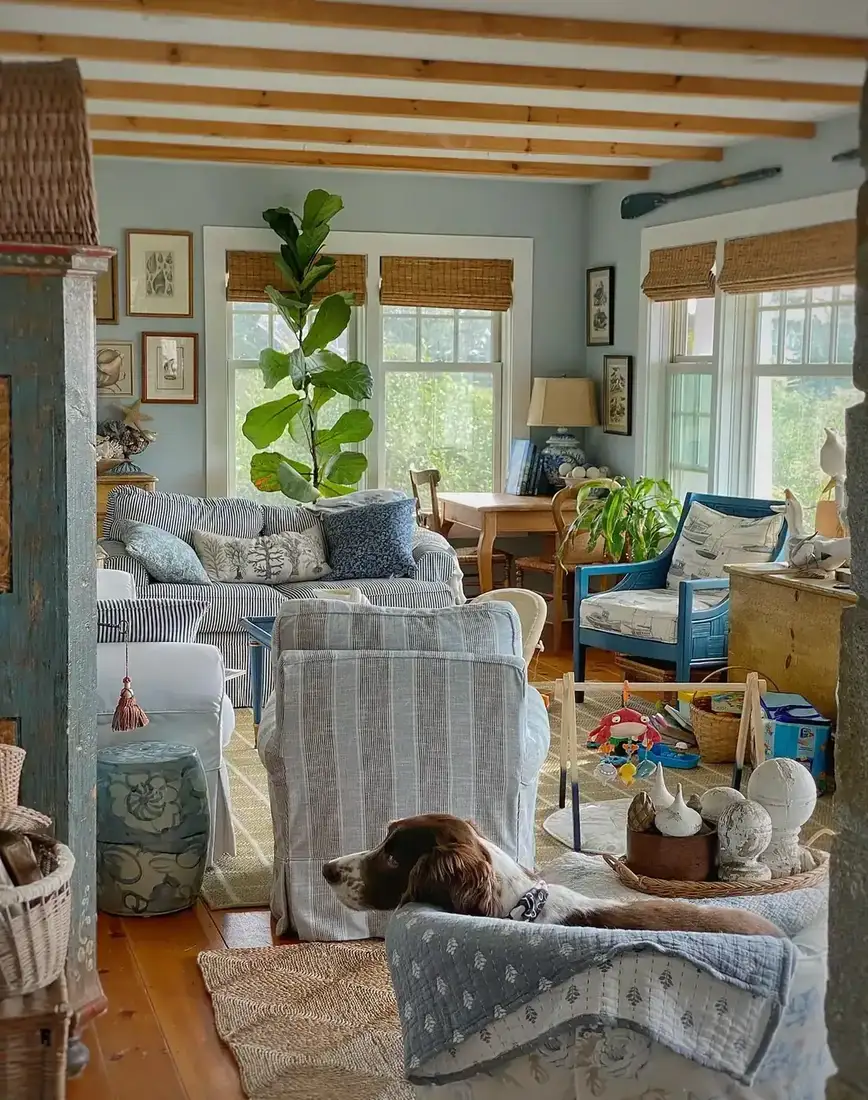
Count the windows in the room below, then count the woven shades. It is the same number.
Five windows, five shades in a coarse grass weave, all pulled to roughly the same height. Nothing else in the room is repeated five times.
That is not a coincidence and it is not decoration. Blue is a cold colour and white is a cold colour, so a room built from the two has no warmth in it at all unless something is added. Adding a brass lamp gives you a warm object in a cold room. Putting fibre at the window warms the daylight on its way in, so every blue in the room shifts before anybody looks at it.
What to hang
Woven wood shades, grass shades and matchstick blinds are the same family: reeds, bamboo or jute woven into a roll-up or Roman shade.
| Budget | Where | Roughly |
|---|---|---|
| Budget | IKEA Hoppvals or a cut-down matchstick blind | £20 to £40 in 2026 |
| Mid | Blinds 2go or Hillarys woven wood, made to measure | £70 to £150 in 2026 |
| Premium | Matchstick Shades or Everhem, lined | £200 to £400 in 2026 |
Fit them inside the reveal where the window has a decent depth, which keeps the architrave visible and lets the weave sit against the glass. Fit them outside where the reveal is shallow, and take them wider than the opening each side so no light gap opens down the edges.
Keep the drop consistent across a wall. In that room every shade stops at about the same line, and the eye reads them as a band of texture instead of five separate blinds at five heights.
And underfoot
Seagrass on the floor is doing the same job the shades are doing, from below.
It is the second largest surface in most sitting rooms, so a warm fibre there shifts the whole palette in a way a cushion cannot. Seagrass, sisal, and jute all work; seagrass is the one with a slight green cast that flatters blue specifically, and it is close to waterproof, which matters in a house with dogs.
Expect £30 to £70 per square metre in 2026 for a bound seagrass rug, and buy it larger than feels necessary. The front legs of every seat should stand on it.
The pattern rule
There are at least six different patterns in that room. A ticking stripe on the sofa, a wider stripe on the armchair, a small botanical print, a block print quilt, a chinoiserie garden stool, and a loose floral on the far chair.
It does not read as chaos, for two reasons.
They share a blue. Every one of those patterns is a soft, slightly greyed blue. Not one is a clear primary and not one is a true navy. If the blues agree, the motifs can do as they please.
The scales differ. A narrow ticking stripe, a medium print, a large open floral. Put three patterns of the same scale together and they vibrate; vary the scale and they settle into a hierarchy.
The paints that sit in that family are Farrow & Ball Borrowed Light No.235, Benjamin Moore Palladian Blue HC-144 and Little Greene Bone China Blue Pale 108. Any of them will get you the wall colour in that photograph, which is barely a colour at all.
What to leave out
Navy, mostly, at least in quantity. A true navy against white is a crisp, formal, slightly nautical combination and it is not the one in that room. Mixing the two approaches gives you a scheme that cannot decide.
And white white. The trim, the lampshade and the ceramics there are all a soft cream instead of a bright white, which is another quiet source of warmth and costs nothing to specify.
The same room, lamp lit
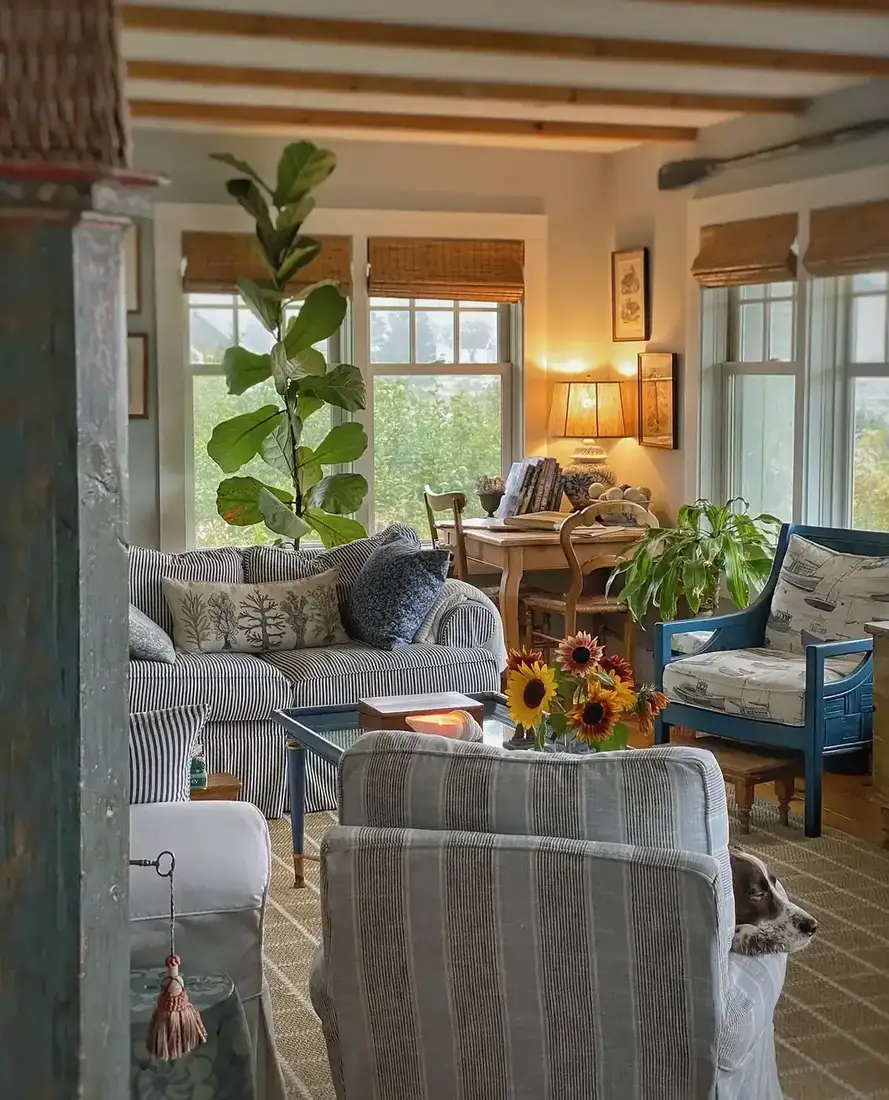
This is the twin of the opening photograph, same striped sofa and blue chair and grass shades, seen closer and later in the day. The difference is the lamp in the corner, with a linen shade throwing warm light across the pine table and the wall above it.
That warm pool is doing structural work. Blue and white alone has no warmth to lean against, which is why the scheme can feel flat by afternoon, and here the timber table low down and the lamplight at eye level give the palette somewhere to sit. Look at the picture frames above the table, all in thin honeyed wood, because they repeat the same warm note higher up and stop the table looking isolated.
The principle holds for any version of this room: one warm material, used twice, low and high. A pine side table costs about £80 to £200 in 2026, while a linen shaded lamp costs £60 to £180 in 2026 at Dunelm or John Lewis. The jute rug underfoot, which reads in this shot as a flat golden weave, carries the same warmth across the floor so the blue stripes never touch bare boards.
Rattan that is painted and still warm
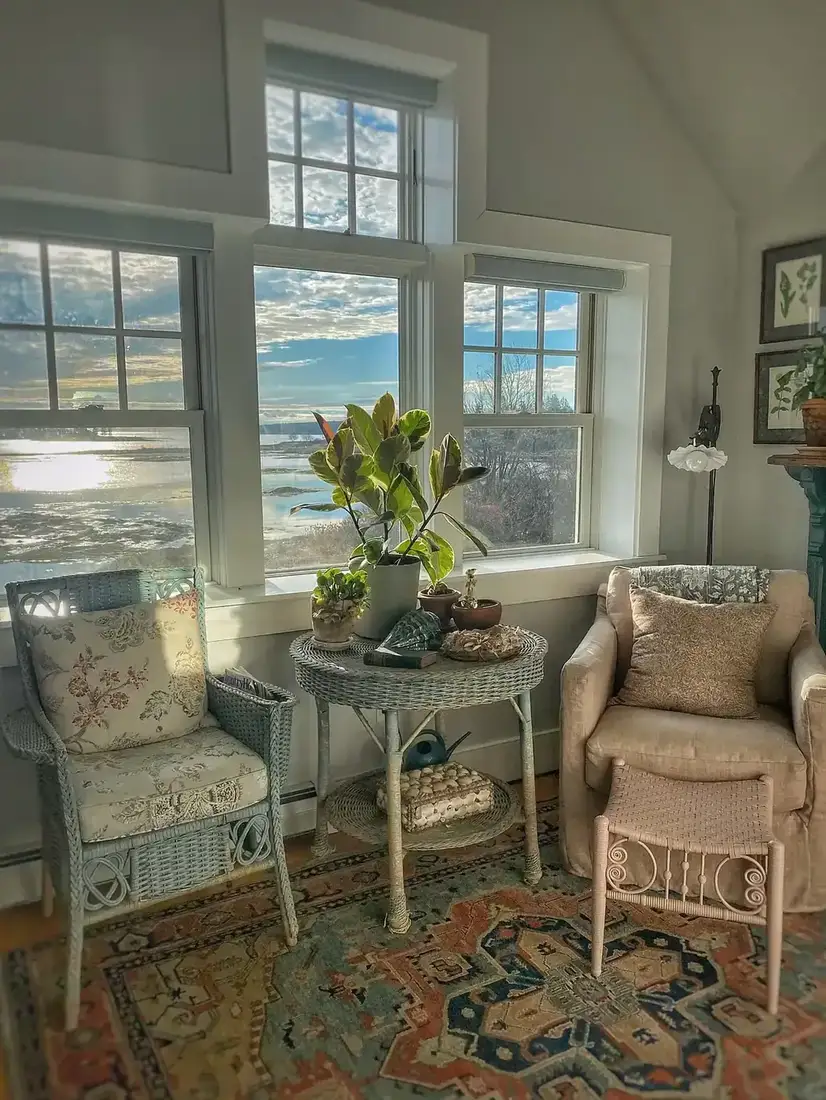
A corner with three windows, a wicker armchair painted a pale blue grey, a round cane table, and a linen covered chair facing it. The rug underneath carries rust, teal, and cream in a faded Persian pattern, and that rust is the warm note the whole scheme turns on.
Rattan stays warm even when it is painted, because the eye reads the weave before it reads the colour. That is why the chair and the table still soften the room although both are coated. In this room the effect is doubled by the plants on the table, since green against blue grey always lifts, and by the pink edged stool with its open scrollwork, which lets light through instead of blocking it.
Expect £120 to £300 in 2026 for a vintage wicker chair on Etsy or eBay. Small cane tables sit around £90 to £220 in 2026. The lesson to take is about placement: put the woven piece where daylight hits it, as here, because texture needs light to register and a rattan chair in a dark corner reads as brown furniture instead of warmth.
One plaid chair against dark timber
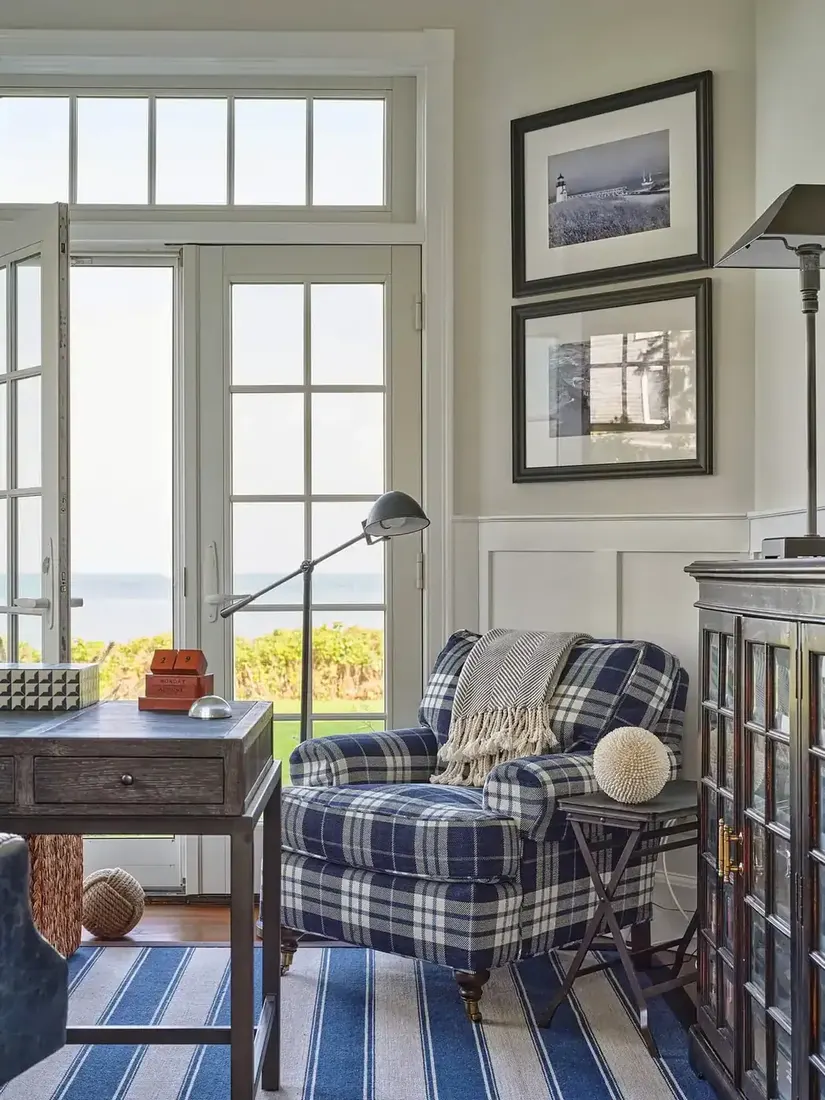
A single armchair in a large navy and white plaid, set beside a dark stained desk and a tall glazed cabinet in the same timber, with French doors to the sea behind. The rug under it is a wide blue and white stripe, and the throw over the back is oatmeal with a fringe.
The blues here work because they vary by depth instead of by hue. Navy in the chair, mid blue in the rug, pale grey blue on the walls: all one family, light to dark, which is why the eye moves easily instead of snagging. Navy with turquoise would fight, because the hue jumps sideways, but nothing here jumps. Warm whites hold the edges, since the trim and the ceiling read creamy beside the glass, and cool white would have pushed the whole corner grey.
That dark timber is the third colour, and it matters more than it looks. Desks and bookcases in that stained finish fetch £400 to £900 in 2026 at Wayfair, while wool plaid chairs in a close check fetch £500 to £1,100 in 2026. Without them the chair and rug would float; with them the blue has a frame. Notice the brass on the cabinet doors, because a small metal echo like that keeps timber from reading heavy.
Beams and bowls in a lake room
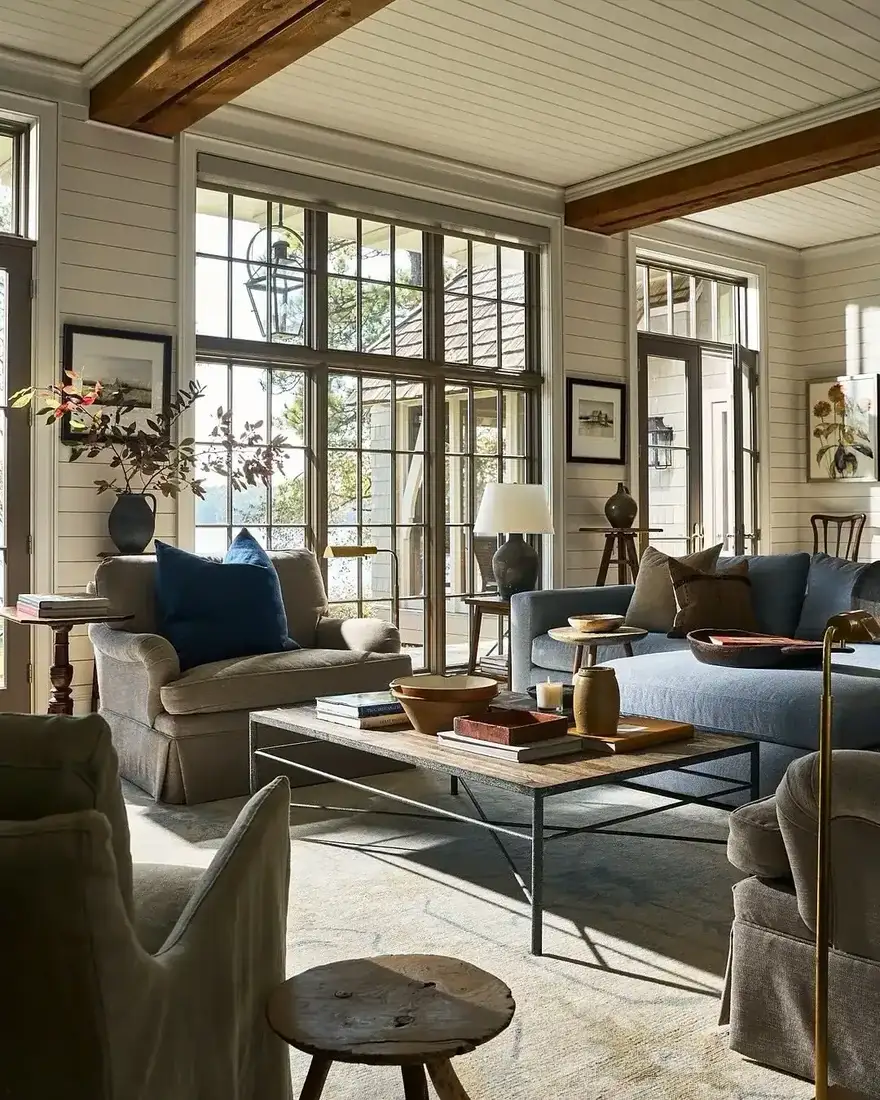
Shiplap walls in warm white, dark steel windows, exposed timber beams, and a long lake view. The seating is split between oatmeal slipcovers and one dusty blue sofa, with tan leather cushions and turned wood bowls on the table between them.
Blue and white alone reads flat, and this room avoids it by keeping the warm material overhead and underhand at once. The beams run the ceiling in rough honeyed timber, while the coffee table, the side tables, and the bowls repeat the same timber at knee height. Leather does the rest, since those tan cushions are the only saturated warm colour in the frame and the eye goes to them first.
Solid blocks of blue always feel heavier than pattern, which is why the single blue sofa works here and two would not. The oatmeal chairs around it give the blue space to breathe, and the rug underneath, a pale washed weave, keeps the timber floor from competing. Oak tables on that scale change hands for £350 to £800 in 2026, and turned oak bowls are £25 to £60 each in 2026 on Etsy.
Timber and stone against the lake
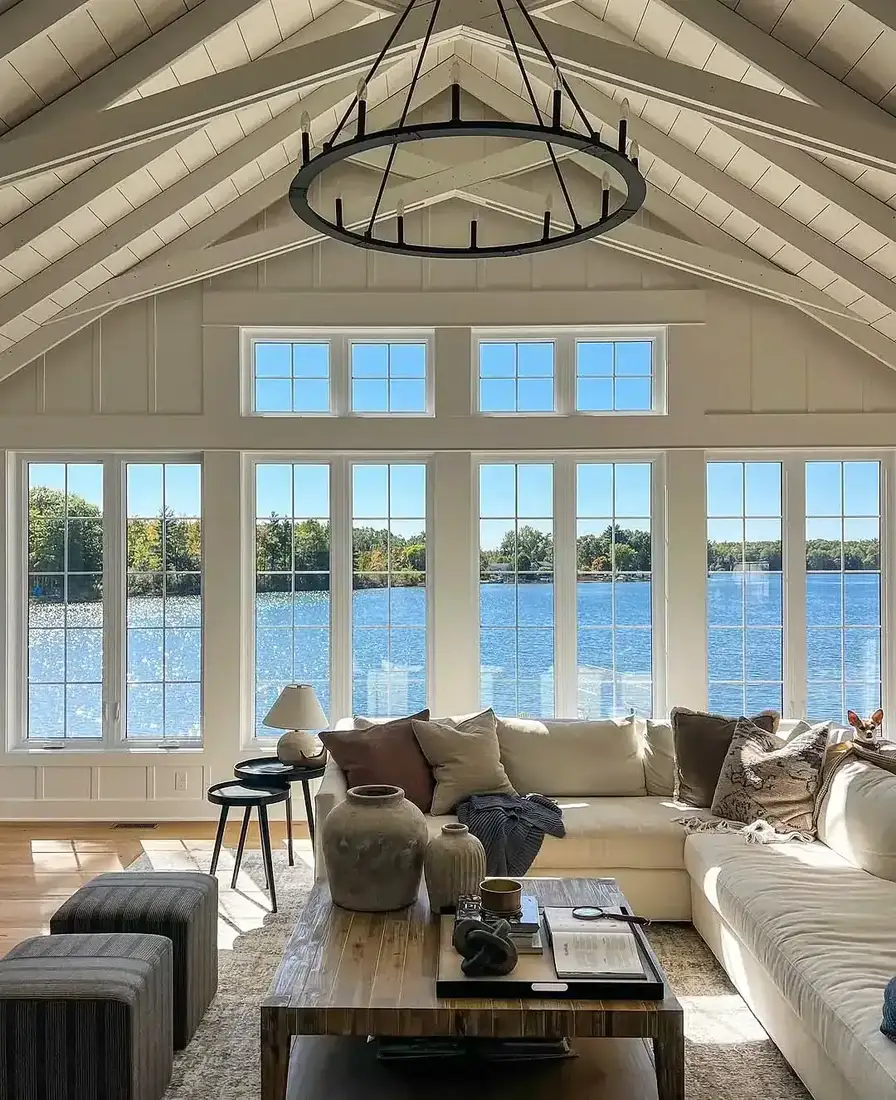
A vaulted room lined with windows onto open water. White sectional sofas, brown and oatmeal cushions, a chunky timber coffee table, large stoneware jars, and two small striped cube stools tucked at the side.
Natural texture is what stops blue and white looking like a bathroom, and this room is almost a demonstration. Jute underfoot, unfinished timber on the table, matt stoneware, and a linen-look weave on the sofas: every surface absorbs light instead of reflecting it, which is the opposite of tile. The third colour arrives as tan, in the leather cushions and the timber top, repeated twice so it feels deliberate.
Look at the jars on the table, because their cloudy grey glaze is exactly the halfway tone between the lake and the walls. Floor jars in stoneware list at £90 to £260 in 2026, and the timber tables behind them list at £300 to £700 in 2026. The small blue throw, folded over one arm, shows the depth rule in miniature: dusty blue with white, never bright, so it sits inside the scheme.
When blue walls meet red
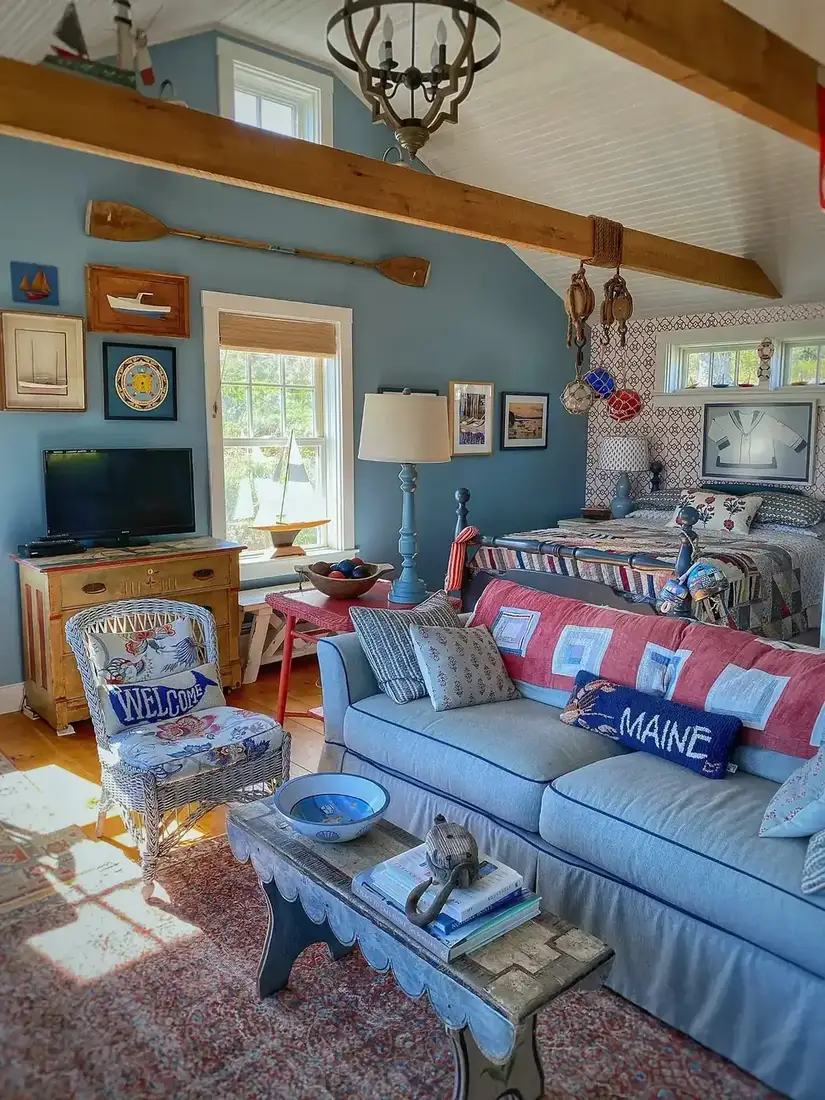
Mid blue walls, a pine dresser, a red painted side table with a blue lamp, a wicker chair with coastal cushions, and a pale blue sofa carrying a red quilt and a dark blue cushion stitched with white letters. Oars, framed prints, glass floats, and a ship model fill every spare surface.
The warm note is not in doubt here. Pine, wicker, and red all push against the blue, which is why the walls never feel cold although they cover four sides. In that sense the room proves the principle: wood, brass, and rattan give the palette somewhere to sit, and this one has all three. The problem is quantity, because every shelf adds another signal and the collection starts to read as a display.
Cressida’s caution applies. One coastal reference inside a plain room reads as character; a dozen reads as a theme that dates quickly and photographs better than it lives. On eBay, pine blanket chests ask £150 to £400 in 2026, and painted wicker chairs ask £100 to £250 in 2026. Anyone borrowing from this room in an inland house should take the pine and the wicker and leave the oars, the floats, and the lettered cushions behind.
Plaster walls as the warm note
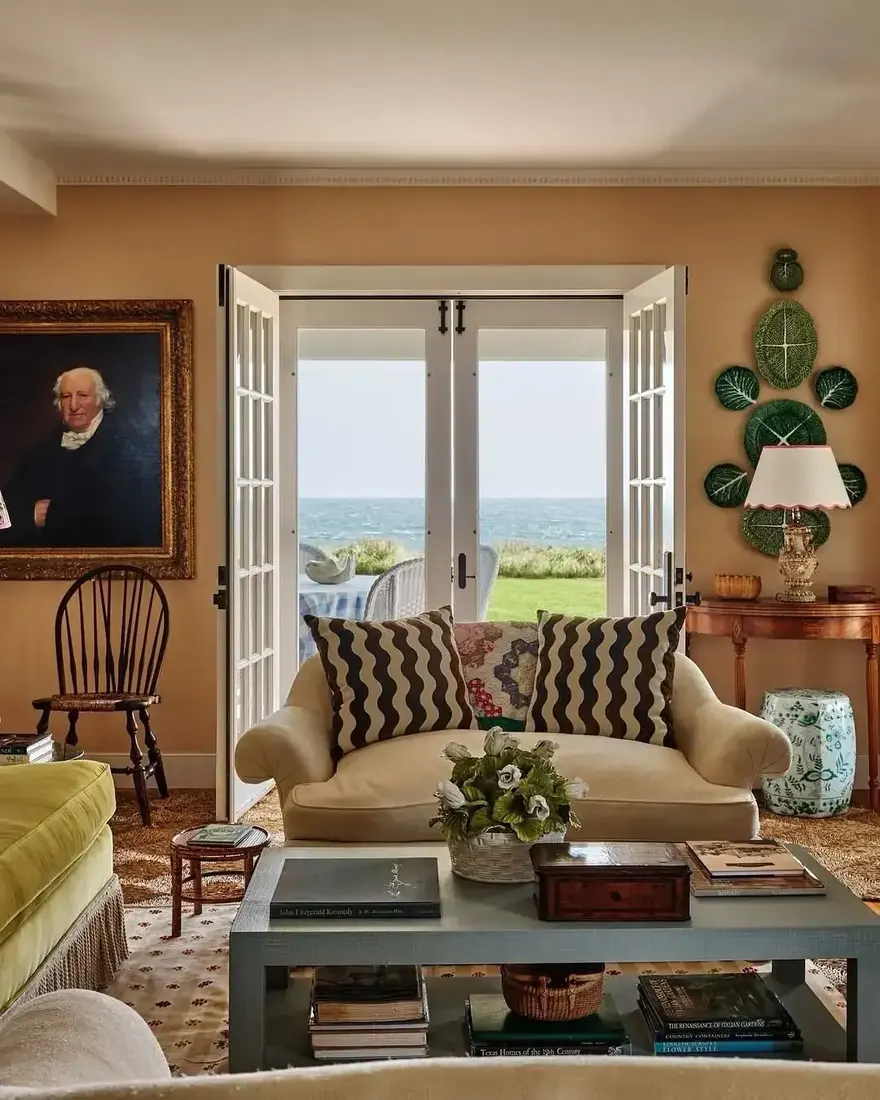
Plaster toned walls, tall French doors to the sea, a cream sofa with two large cushions in a brown and cream wave, a blue grey coffee table, and a mahogany side table with a porcelain lamp. A blue and white garden stool stands beside it, and green leaf plates climb the wall.
Here the third colour is the wall itself. That warm plaster, nearer peach than beige, wraps the whole room so the blue and white never have to warm themselves. It flatters the cream upholstery, it deepens the mahogany, and it lets the blue table sit in the middle as a cool note instead of the main event. Cool white walls would have turned the same furniture chalky; warm white keeps it honeyed.
Pattern carries the blue better than solid blocks, and the cushions show why. The wave is large, open, and confident, set against a small faded floral on the bench behind, so the scales never compete. Garden stools in blue and white ask £60 to £180 in 2026, and porcelain lamps with tapered shades ask £120 to £320 in 2026 at John Lewis. The rattan basket under the table repeats the warm fibre idea at floor level, quietly.
Nine frames make one warm band
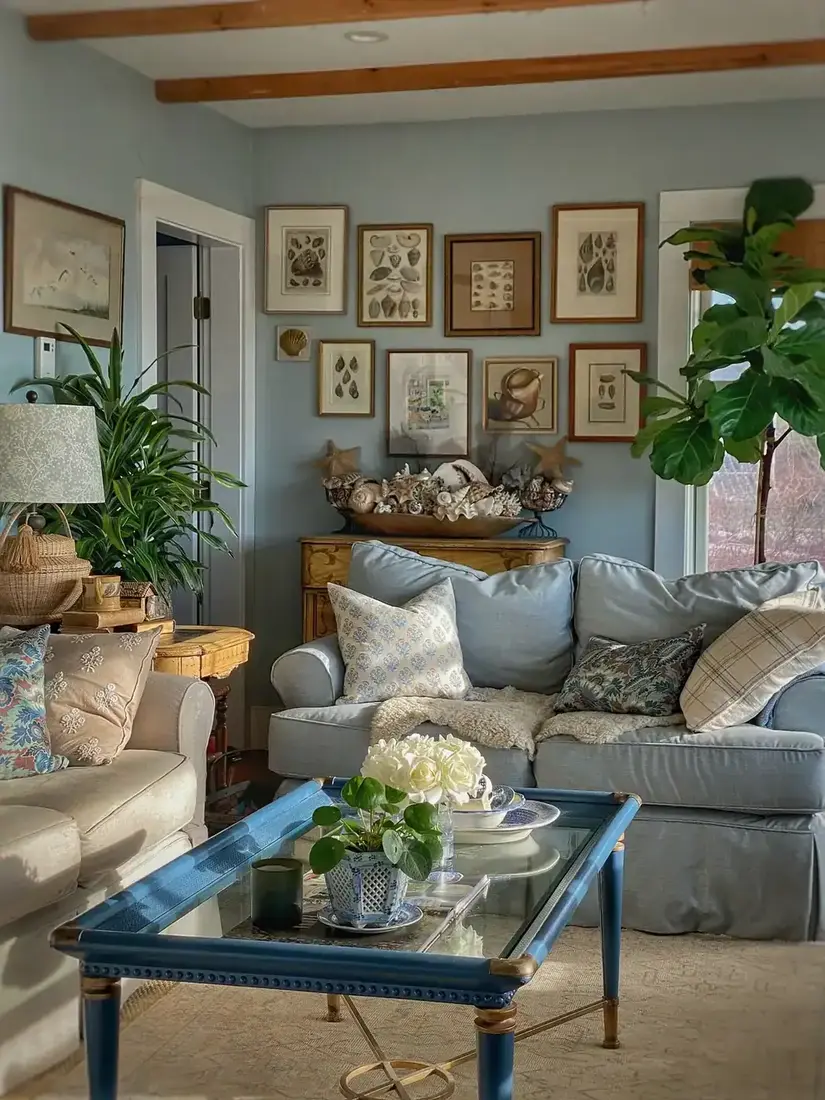
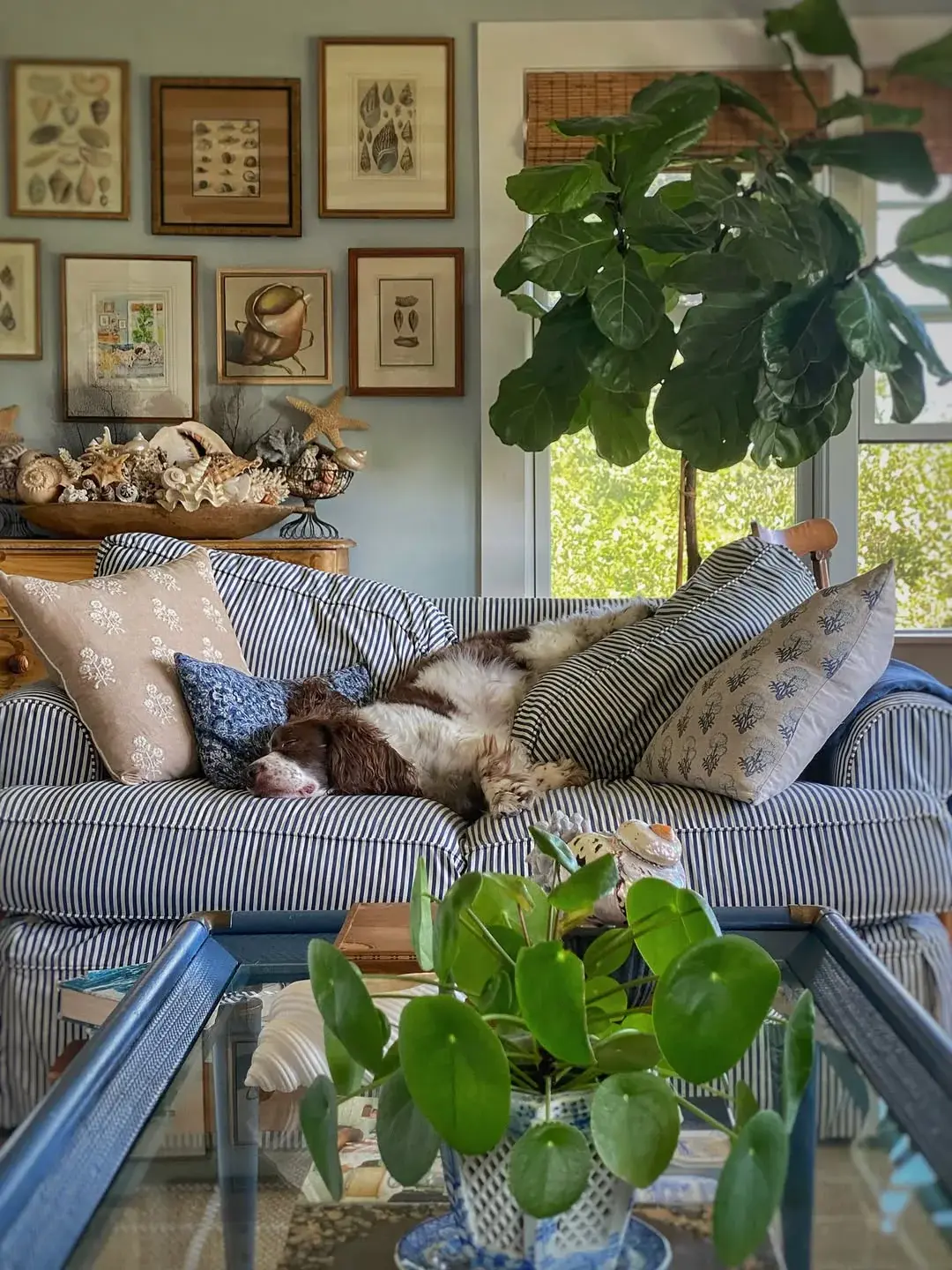
Pale grey blue walls, a pale blue sofa, and a gallery of nine shell and botanical prints in thin timber frames hung tight above a pine chest. In front, a blue glass coffee table with brass feet and corners, a rattan lamp on a bamboo side table, and a jute rug underfoot.
Count the timber frames, because that repetition is the heating system. One wood frame would vanish; nine in a grid read as a single warm panel that holds the whole wall. The brass on the table does the same job in miniature, with caps, studs, and a lower stretcher all glinting against the blue glass. Blue and white needs that metal or timber echo, otherwise the cool surfaces have nothing to reflect.
The blues vary by depth, from the deep table frame through the mid sofa to the pale walls, which keeps them in one family. Small rattan lamps of that type run £70 to £200 in 2026, and the blue glass tables run £250 to £600 in 2026 on Wayfair and Etsy. The bowl of shells on the chest is the part to skip if dusting matters, since it dates faster than anything else in the frame.
Decoys and navy chairs at dusk
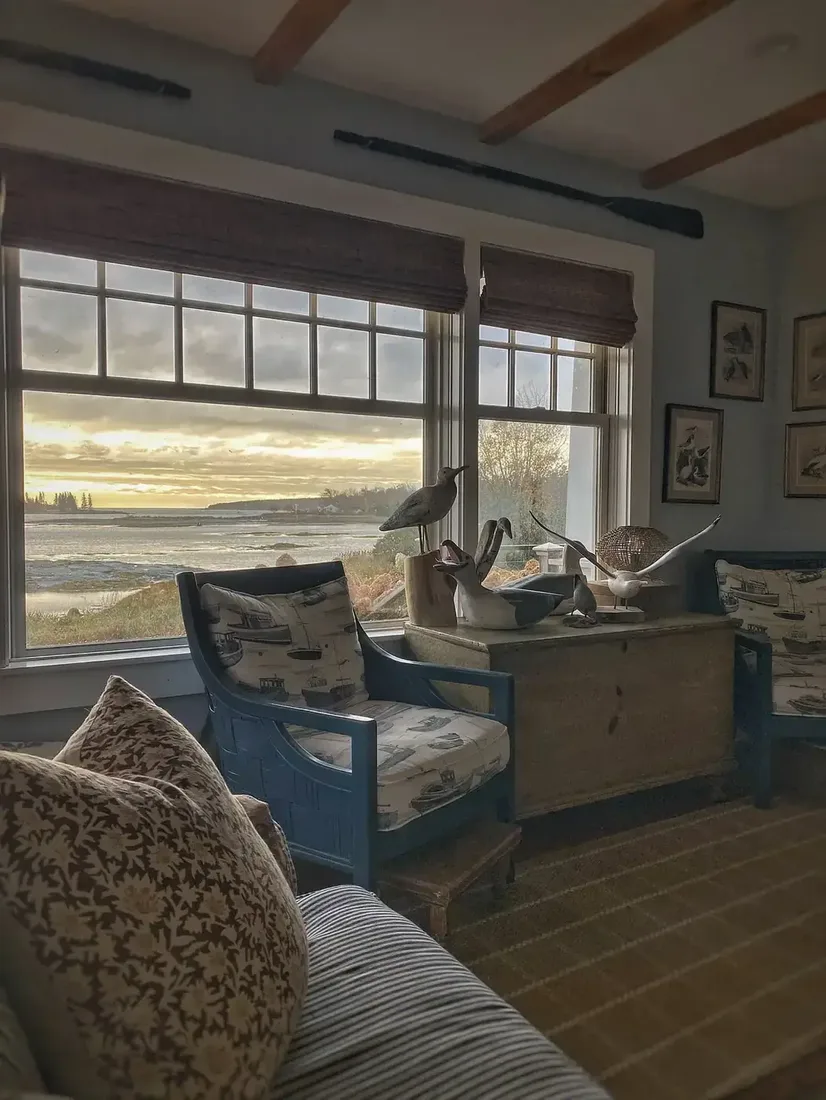
Low evening light through wide windows onto the water. Two armchairs painted deep blue with a cream boat print, a striped sofa in the foreground, a pine blanket chest topped with carved decoys and a woven lampshade, and a dark oar mounted high on the wall.
That oar and that chest are one warm line, high and low, in unfinished and honeyed timber. Without them the chairs and the striped upholstery would be blue on blue with white trim, handsome for a photograph and chilly to sit in. With them the eye has somewhere to rest between the blues, which is the entire argument for a third colour in a small amount.
Linen drum shades like those on the windows run £90 to £240 a blind in 2026 from Blinds 2go or Hillarys, and they warm the last daylight the way the grass shades do in the opening room. Pine blanket boxes run £150 to £400 in 2026 on eBay and Etsy. The decoys themselves divide opinion, and a plain bowl or folded throw would do the same job with less dusting, but the chest underneath is doing honest work whatever sits on it.
Frequently Asked Questions
Why does a blue and white scheme feel chilly?
Neither colour carries any heat, so the eye finds nothing to settle on. Bringing in timber, cane, brass, or tan leather gives the cool tones a companion and the whole space relaxes.
Which shade of white steadies blue?
One with cream or dust in it, the kind that looks soft beside a sheet of printer paper. A brighter, bluer white turns grey next to navy and makes dusk feel stark.
How can I combine several blues calmly?
Stay inside one family and shift lightness instead of leaning greener or purpler. A deep marine with a misty sky tone layers well, while marine with aqua argues.
Do solid blues or prints suit this palette better?
Prints lighten the load, since stripes and small motifs split the colour into rhythm. Large unbroken areas of marine feel weighty, so keep those for single pieces.
What stops the palette feeling like a washroom?
Matt fibres and raw timber, such as jute rugs, washed linen, and oak boards. Those surfaces soak up light and read domestic, unlike tile and chrome.
Where can warmth enter without repainting?
At the window and on the floor, which are the two largest surfaces. Grass blinds plus a big sisal carpet shift the temperature before cushions or art are touched.
In order
- Hang natural fibre shades at every window, not just one or two.
- Keep the drop level across a wall so they read as a band.
- Put a seagrass or jute rug down, large enough for the front legs of all seating.
- Choose patterns that share one greyed blue and differ in scale.
- Use a soft cream for trim and ceramics instead of a bright white.
- Add one warm material in two places, low and at eye level, and stop there.
- Let large pieces carry large motifs and small pieces carry small ones.
This article may contain affiliate links. We may earn a commission at no extra cost to you.