8 Beamed and Vaulted Ceiling Living Rooms: Paint the Beams Out First

Add us as a preferred source to see more stories on Google.
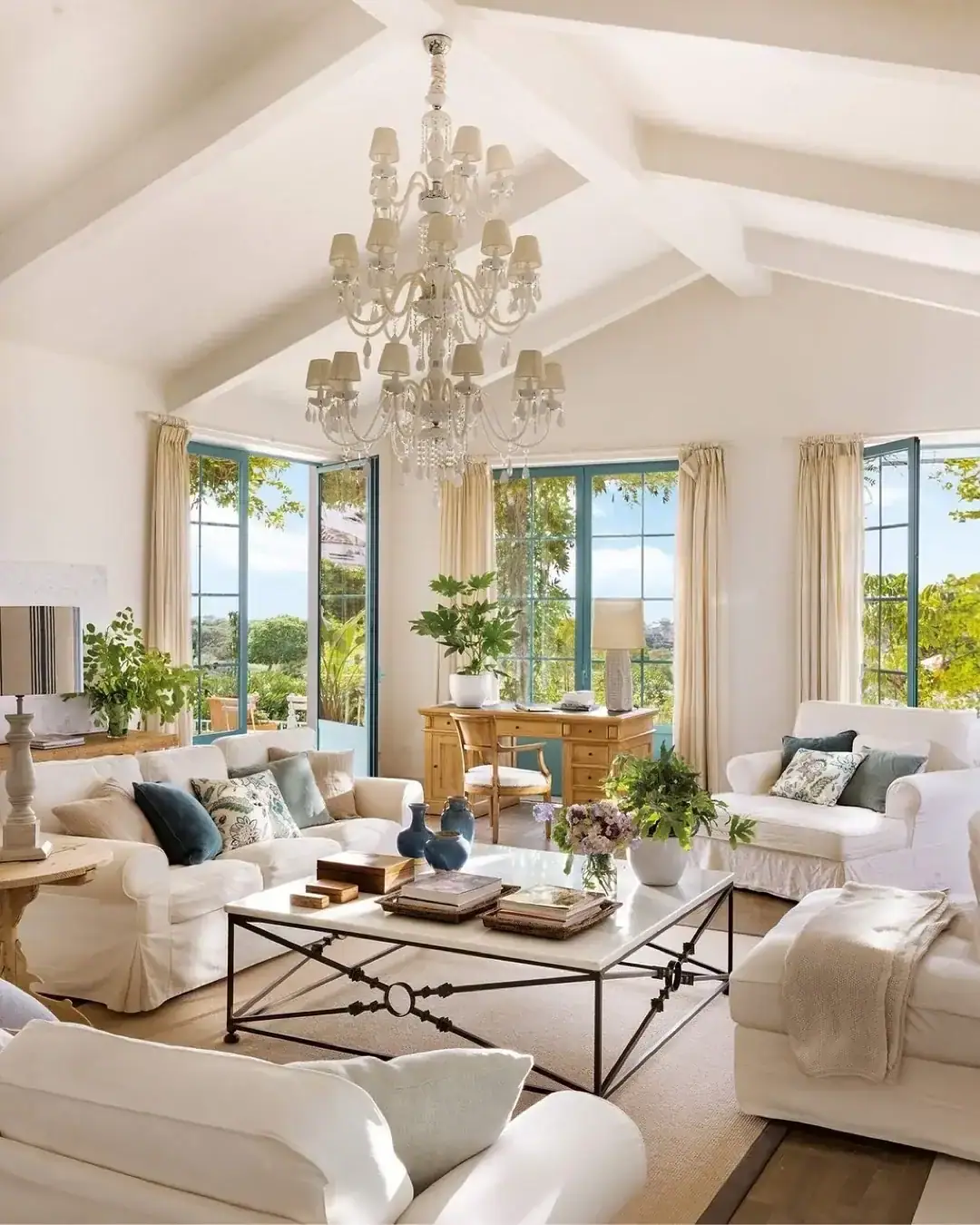
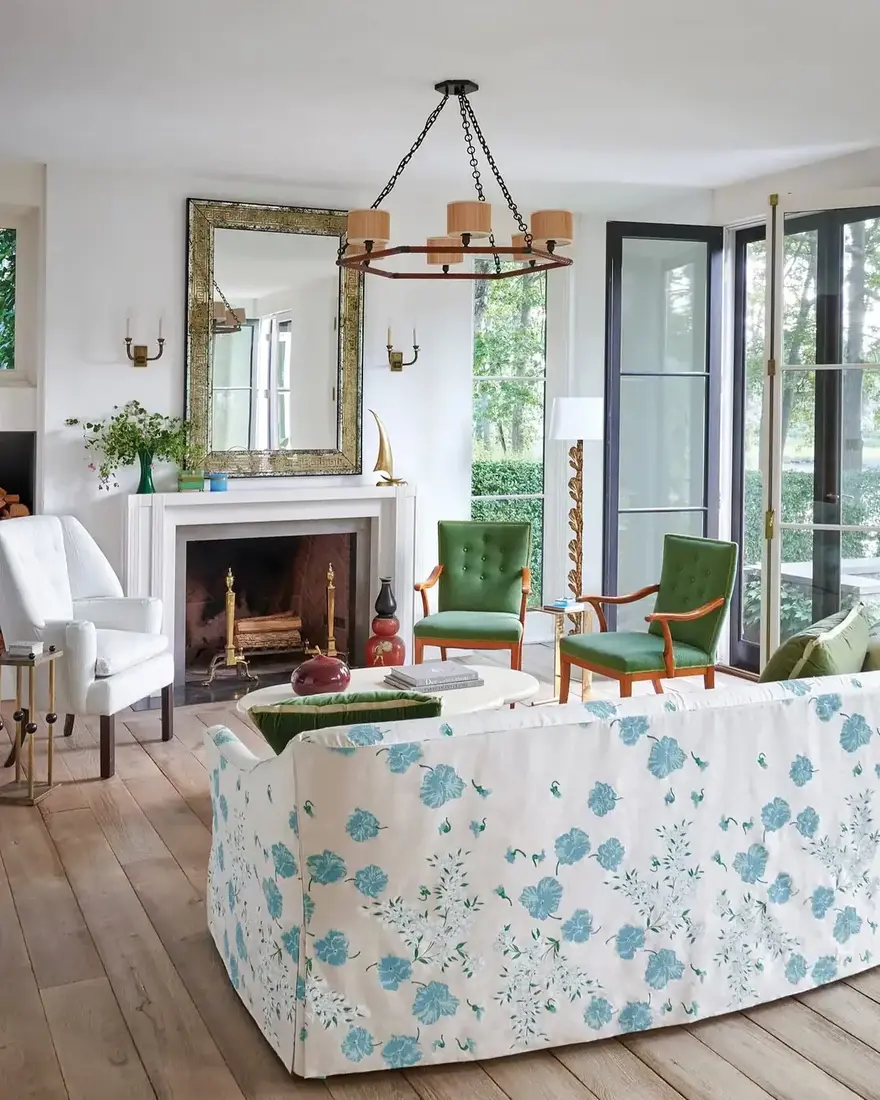
The beams in the room below are painted the same white as everything around them, and that is the decision carrying the space.
Stained them dark instead and the ceiling becomes a striped graphic: a series of hard lines marching up to the apex, demanding attention, and drawing every eye away from the people in the room.
Painted out, the same beams give rhythm and shadow without becoming the subject. The vault reads as one calm shape, and the room stays about the sofas rather than about the roof.
Dark beams, and when they are right
This is not a rule so much as a decision most people make by default and then regret.
Dark beams work when the timber is genuinely old, genuinely structural, and the room has other historic material to talk to: a stone fireplace, a flagged floor, plaster walls with some texture. In a sixteenth-century cottage, painting the beams out would be vandalism.
They work badly when the beams are new, when they are decorative box sections rather than structure, and when the rest of the room is modern. There, the contrast reads as costume.
A useful middle route on real old timber that has gone almost black: limewashing or dry-scrubbing it back to a softer grey-brown. That keeps the material honest and drops the contrast considerably. Liberon and Osmo both make suitable liming waxes at around £15 to £25 a tin.
If painting out, use the same colour and sheen on beams and ceiling. Farrow & Ball Wimborne White and Benjamin Moore Simply White OC-117 are the two that come up most often for this; a trade matt tinted to match costs a fraction and covers a large vault far more economically.
Bringing the light down
The chandelier in that photograph hangs well below the apex, in the zone where people actually are.
That is the whole move. A vaulted room lit from the apex has its light source so far away that everything below feels dim and the ceiling feels further still. A fitting hung low creates a visual ceiling at a comfortable height, and the volume above becomes a background rather than a void.
Rough guidance for a living room: the bottom of the fitting somewhere around 2.1 to 2.4 metres from the floor, which is roughly a standard ceiling height. Over a dining table it can come lower still, to around 750 to 850mm above the tabletop.
The fitting has to be big enough to hold that position. A small pendant hung low in a large vaulted room looks marooned. Either go substantial, or hang three or more smaller ones in a group.
And add other layers. Table lamps and floor lamps at seated height matter more in a vaulted room than anywhere else, because they are the only light near the people.
The acoustics, which are real
A vault is a large hard surface, often with nothing on it, angled to reflect sound back down into the room. Vaulted spaces echo, and speech gets tiring in them in a way people notice without identifying.
The soft materials in that photograph are doing acoustic work as well as visual: full-length curtains at every window, a sisal rug, upholstered sofas with loose covers, plenty of cushions.
If a vaulted room sounds harsh, the order to fix it is curtains first, then a large rug, then upholstery. Hard furniture, glass tables and bare boards all make it worse.
Where to stop the curtains
At the top of the window, not at the vault.
Chasing the apex with fabric is a common instinct and it makes the wall look like a marquee. The curtains in that room stop at a normal height and the wall above them is simply wall, which is correct and restful.
The same applies to art. Hang it at normal eye level. A picture hung high on a tall wall because the wall is tall is a picture nobody can see.
Pale beams on white boarding
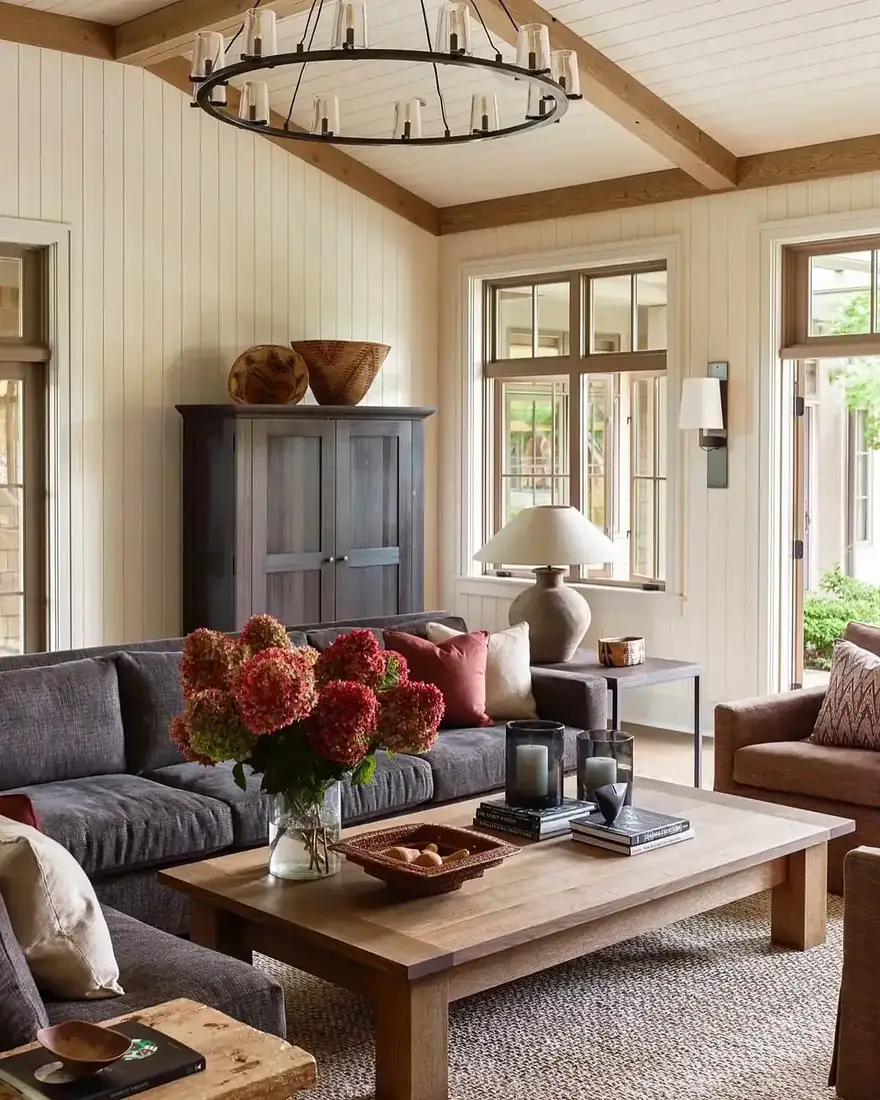
A vaulted sitting room behaves better when the walls do half the work, because the eye measures height against whatever runs up the wall beside it. In that room the vertical tongue and groove boarding climbs to the eaves without a break, so the height arrives in narrow boards the eye can count, which keeps a tall volume feeling joined and quiet.
Look at the beams against the boarding. They are pale oak, left unstained, and only a tone or two darker than the white around them, so the ceiling keeps its rhythm without turning into stripes. The proportion that governs it is the gap between timbers, which reads here as roughly twice the width of each beam, and that airy spacing is why the ceiling feels calm although the room is fully vaulted.
The dark grey sofa is doing the anchoring. Four pale walls plus a pale ceiling plus a pale floor need one mass near the ground, or the seating floats, and the charcoal upholstery supplies it in a single move. That is the principle to carry elsewhere: when the shell stays pale, the largest seat should go darker, by at least two shades, so the grouping has a base.
The iron ring pendant holds the centre at seated height, with small glass shades that read as candles once lit. Rings in blackened steel run about £180 to £450 in 2026 depending on diameter, and the glass shades matter because bare filament bulbs at eye level glare. For bulbs, choose warm white around 2700K from Philips or Sylvania, since cooler tubes turn pale oak greenish grey after dark.
| Beam finish | What the eye reads | Guide band in 2026 |
|---|---|---|
| Same white as ceiling | One calm vault, beams as shadow lines | £25 to £45 per litre for trade matt |
| Pale oak, clear oil | Rhythm without stripes, suits boarding | £30 to £55 for Osmo Polyx-Oil 750ml |
| Limewashed old timber | Softer grey brown, keeps character | £15 to £28 per tin for Liberon liming wax |
| Dark stain on new box beams | Costume stripes, best avoided | £12 to £22 per litre, plus regret |
Blue panelling when the vault is out of frame
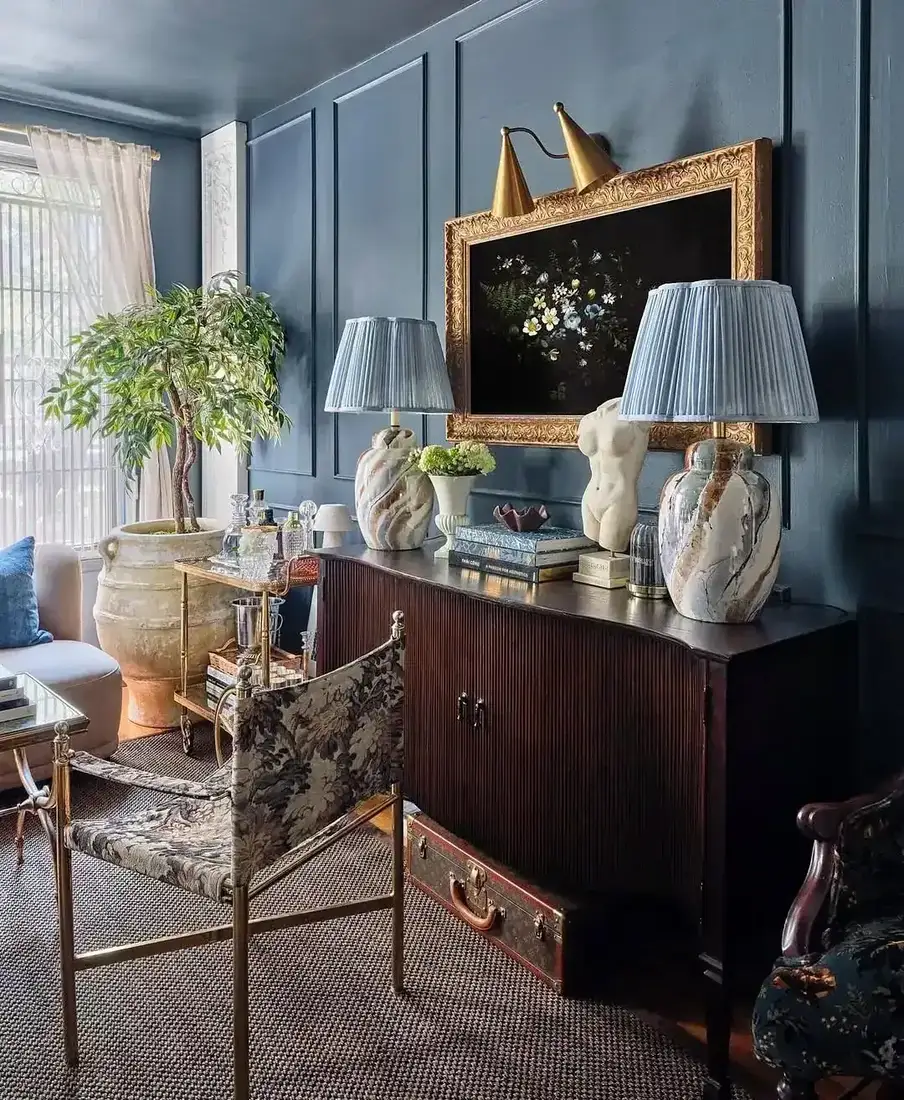
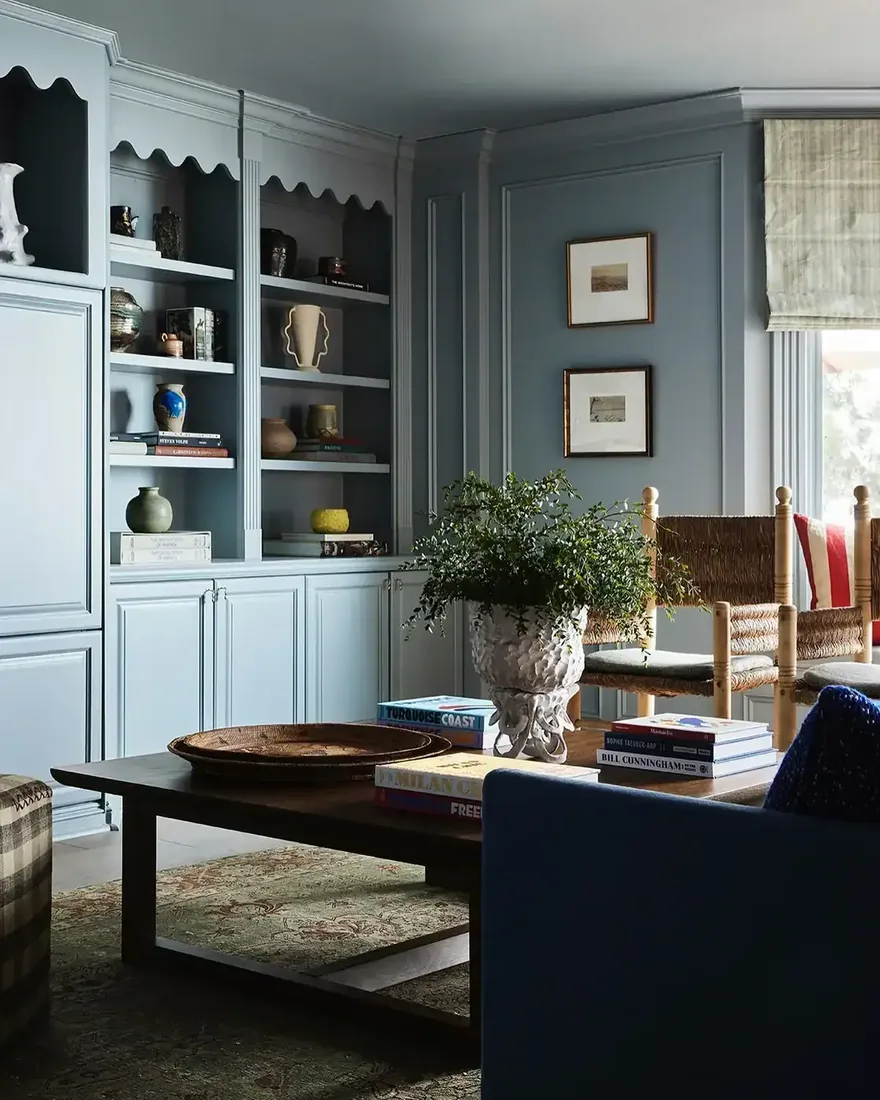
The vault is out of shot in this room, which turns out to be the point. A tall space is judged at eye level, because nobody stands in a living room studying the apex, and the dusty blue panelling here gives the eye a measured band to rest on, with stiles running floor to ceiling at even intervals.
That wall is doing the job beams do elsewhere. The panels break a large plane into bays roughly the width of the sideboard, so the furniture has a bay to sit in, and the gilt frame hangs centred on one bay, seated on joinery instead of floating on blank plaster. In a room like this the panelling should stop at the ceiling line of a normal room, near 2.4 metres, even where the vault continues above, since carrying it higher makes joinery look stretched.
Notice how the light stays warm against the blue. Two pleated silk shades in pale blue grey flank the painting, and the brass picture light above throws a narrow wash down the canvas, which keeps the blue from going flat after dark. Pleated shades in that size run about £60 to £140 each in 2026, and a brass picture light from Jim Lawrence or Hector Finch runs about £90 to £220 in 2026.
The fluted sideboard supplies the dark timber note without calling on the ceiling. Mahogany or stained beech with reeded fronts sits well against Hague Blue No.30 or Dock Blue 252, both of which carry enough grey to behave as neutrals, and the marble lamp bases lift the arrangement because stone against blue always reads cooler than timber against blue. Keep textiles faded here. A flatweave rug and washed linen cushions stop a saturated wall turning formal.
A double height room that still sits close
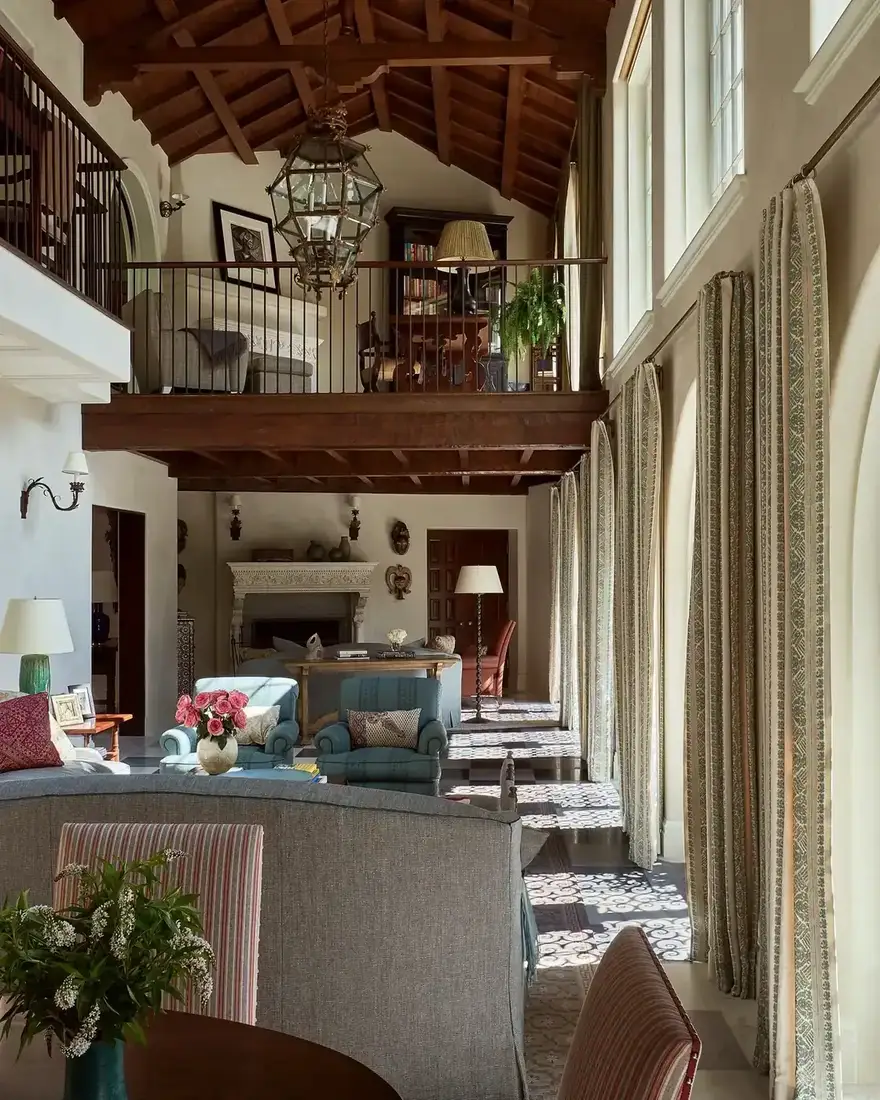
This is the tallest volume on the page, with a mezzanine gallery crossing one end and rafters climbing to a dark apex, yet the seating end feels close. The reason is that everything soft has been kept low and grouped, while the height is carried by only two elements: the full height curtains and the hanging lantern.
See the curtains first. They run from a pole near the gallery down to the stone flags, in a faded linen with a narrow green stripe, and that unbroken drop is the scale line the eye uses to measure the wall. The fabric pole sits well above the window heads, which is correct in a room this tall, because the curtains are there to dress the wall, with the opening simply cut into it, and linen at that drop runs about £40 to £110 per metre in 2026 from Colefax and Fowler or Lewis and Wood seconds.
The lantern hangs on a long drop into the middle of the height, with seeded glass and a bronze frame that reads almost black against the white plaster. Hung high it would be jewellery for the vault. Dropped to gallery level it becomes a ceiling for the seating below, which is the same move as the hero room, repeated at a grander scale.
One caution. A mezzanine rail plus tall glazing plus stone flags is a hard room, however soft the curtains look, so this arrangement needs a rug the size of the seating group and upholstery with texture. Without that, conversation at the far chairs carries and clatters.
Dark beams that work because the walls stay quiet
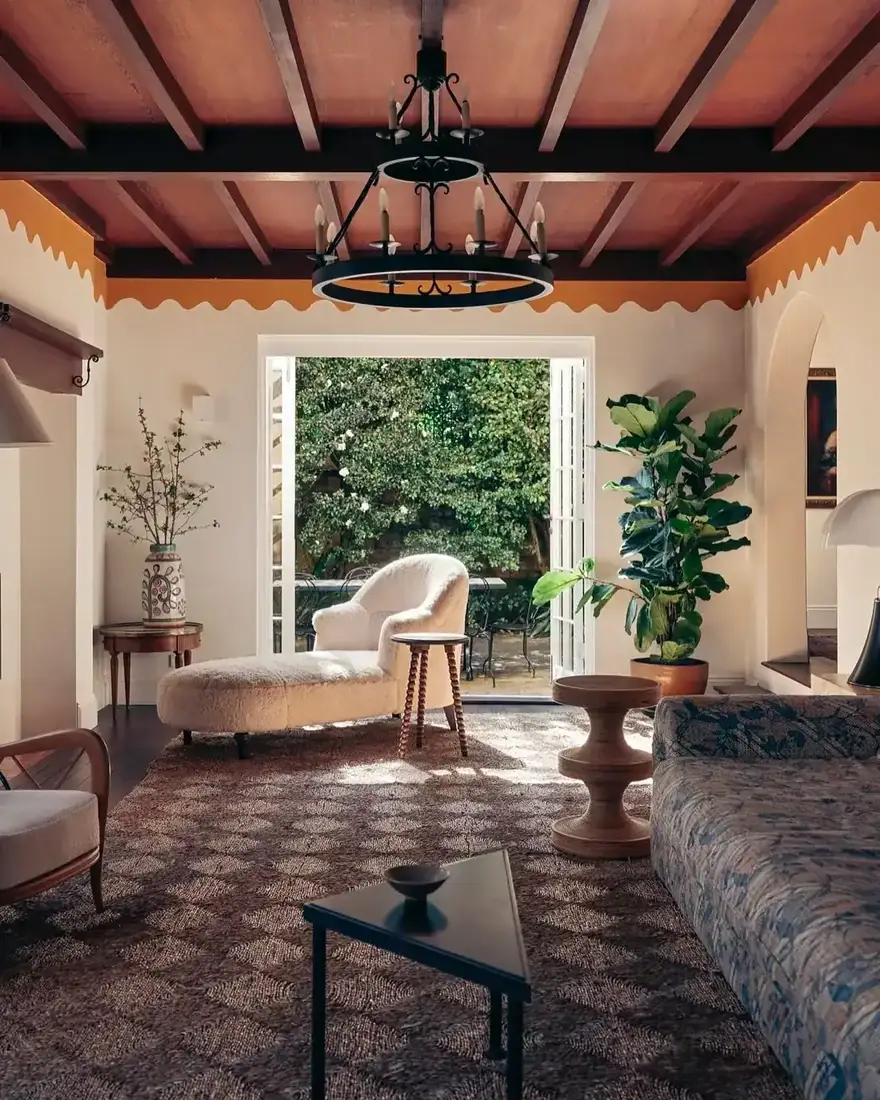
Dark timber overhead breaks the rule from the opening, and gets away with it, because the walls ask for nothing. Off white plaster, one scalloped ochre border at plate level, and doors thrown open to green: the ceiling can go dark when everything at eye level stays pale and plain, since the contrast budget is spent in one place only.
The boards between the beams are doing as much work as the beams. They are washed terracotta, a step down from white, which drops the ceiling a little and warms the light coming back down, and that warmth is why the boucle chaise reads creamy instead of grey in full daylight. Paint the boards white here and the dark beams would turn to bars. Keep them clay coloured and the whole plane reads as one timber ceiling.
The iron ring repays a second look. Six candle sleeves on a blackened frame, hung low enough to sit in the view of the doors without blocking it, which places conversation light where people recline while the joists sit dark above. Blackened steel rings of that diameter run about £200 to £500 in 2026, and candle sleeves want warm white filaments, since cool white inside a dark ceiling reads as a row of small torches.
The floor follows the same restraint. One large patterned rug in bark brown and stone, large enough to take the chaise plus the sofa edge, grounds the pale furniture so it does not drift on dark boards. A hand knotted wool rug in that scale runs about £400 to £1,200 in 2026, while a cotton flatweave copy runs about £120 to £300 in 2026.
Rough beams with everything else soft
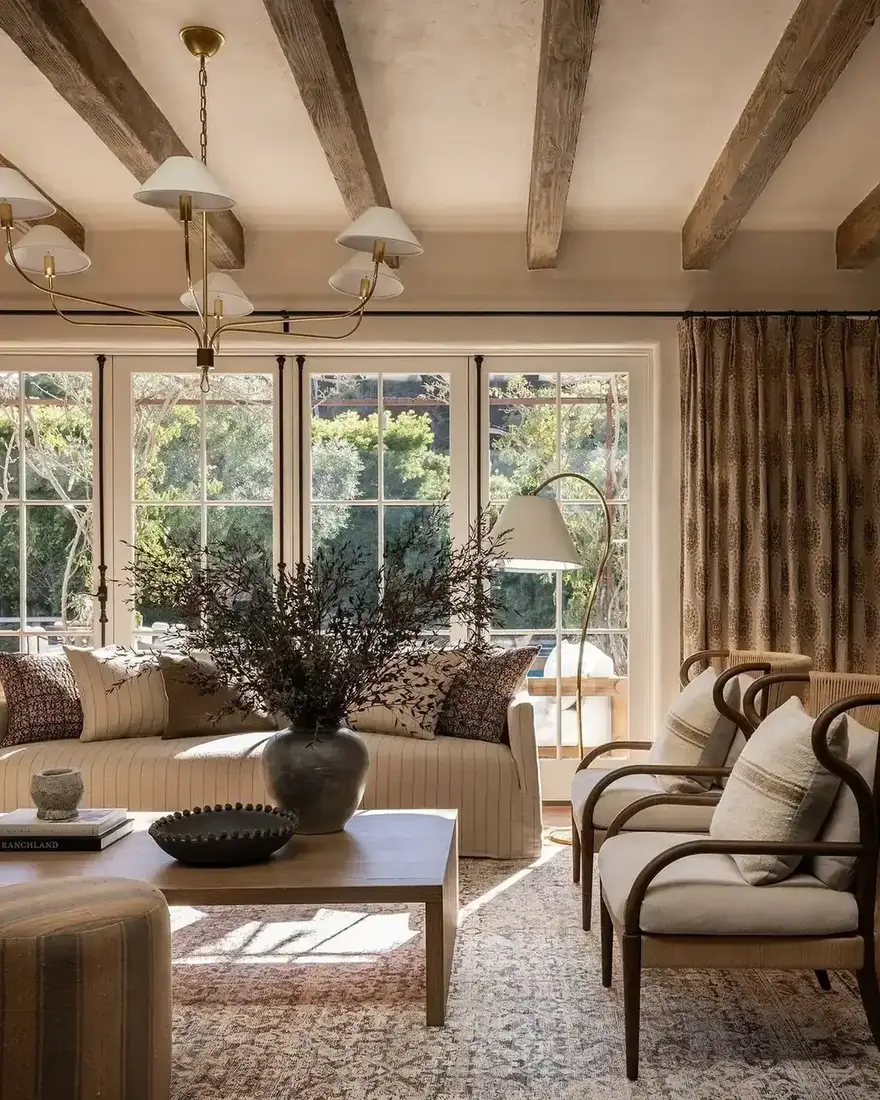
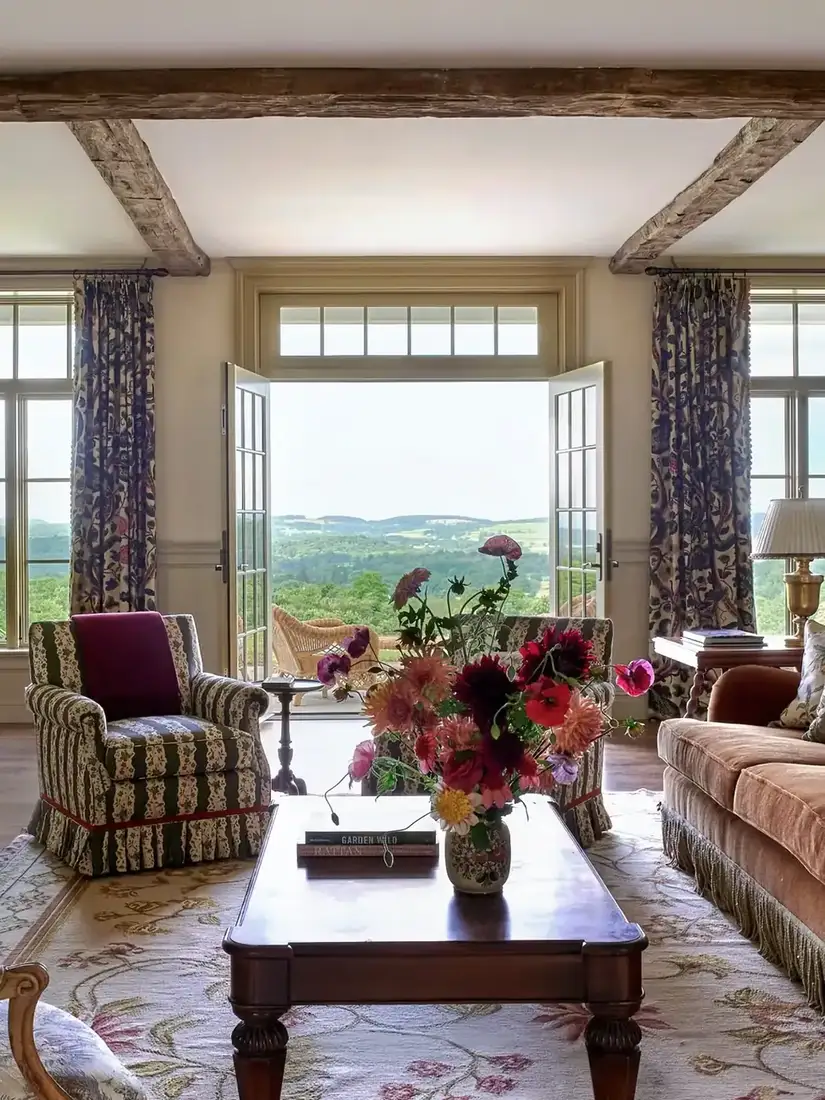
These are the oldest looking timbers on the page, rough sawn, grey brown, with the uneven edges of reclaimed oak, and the room answers them with softness everywhere else. Striped linen on the sofa, washed cushions in stone and bark, a faded rug underfoot: the principle is that rough overhead needs smooth at hand height, because two rugged textures in one small room start to argue.
In that room the plaster between the beams has been left warm white with a matt finish, which lets the grey timber stand forward without harsh contrast. The relation to watch is timber against plaster, not timber against furniture, since the ceiling is read first and the seating a moment later, and a chalky white with a little yellow in it keeps old oak looking silvered instead of dirty. Little Greene Slaked Lime 105 or Farrow and Ball Wimborne White No.239 get close, at about £45 to £85 for 2.5 litres in 2026.
The brass six arm chandelier hangs well below the beams, with parchment shades throwing light sideways onto faces, leaving the rafters to sit dark above the conversation. That sideways throw is the detail to copy, because uplight in a beamed room draws every eye to the ceiling, while cross light keeps attention at conversation height. Similar parchment six arm fittings run about £350 to £900 in 2026.
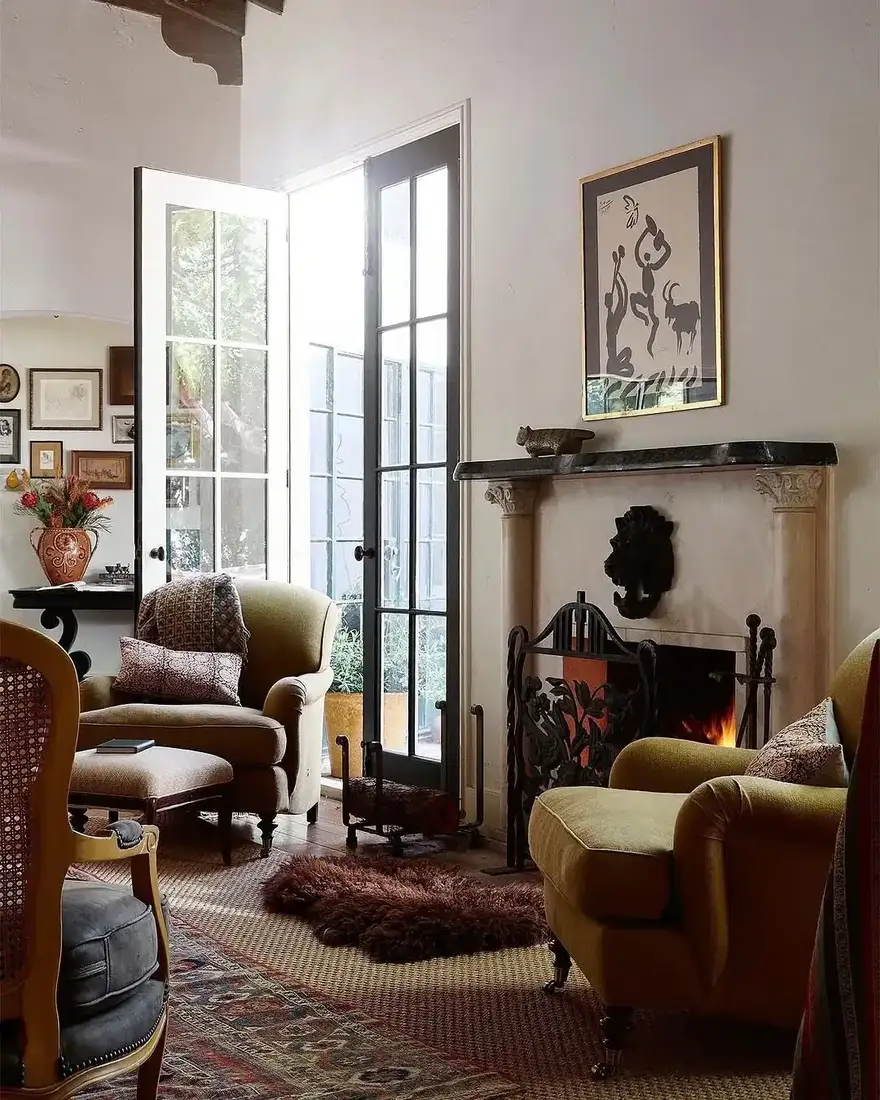
French doors along one wall supply the second softening. Daylight from two sides means the beams never go black in the middle of the day, and the patterned curtains in bark on cream can stay drawn to the reveals, since their job here is acoustic and visual warmth, both of which a glazed wall otherwise lacks. Full length interlined linen curtains in this register run about £90 to £200 per curtain in 2026.
Pictures at eye level under a vault
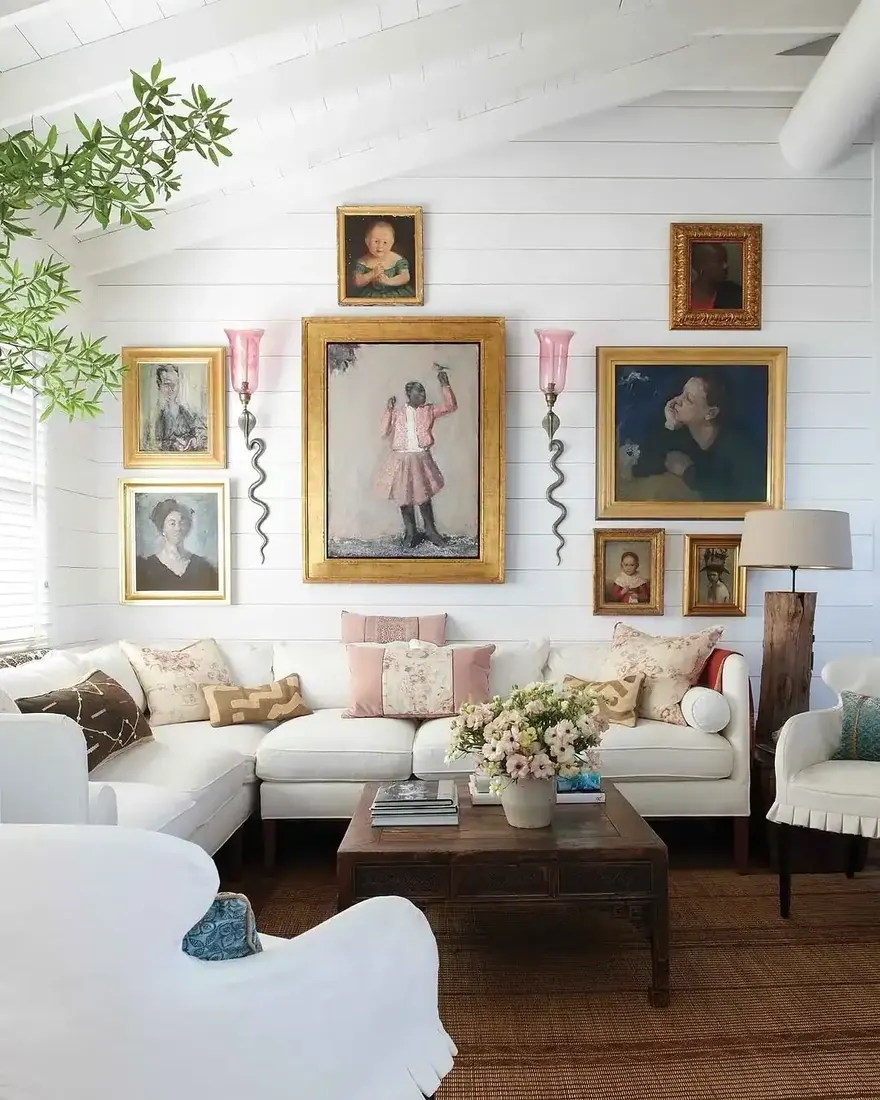
The vault here is white boarding that climbs out of frame, and the room ignores it entirely, which is a legitimate decision. Instead of dressing the height, the pictures form a dense band with its centre near standing eye level, so the wall reads as a gallery and the ceiling becomes a plain bright lid above it.
Count the frames before reading the portraits. Seven gilt frames, mixed sizes, hung with their middles between 1.4 and 1.6 metres from the floor, which is where pictures belong even when the wall continues another two metres up. The pink glass sconces sit at the same band, flanking the largest canvas, and their serpentine stems give the only verticals in the room, so the eye stops travelling upward.
That discipline is why the white sectional works. A pale corner sofa under a tall white vault can look beached, but with the gallery holding the wall behind it, the sofa sits inside a composed elevation, with the slope above reduced to a bright lid. The cushions carry the colour, in blush, ochre, and faded indigo, which is the right distribution, because one strong canvas plus scattered textile colour beats colour spread thinly across everything.
Gilt frames of mixed date turn up at auction and in salvage yards at about £30 to £150 each in 2026, and reproductions with a washed gilt finish run about £40 to £120 in 2026. Hang them as a group on paper templates first. Holes in shiplap are unforgiving, so cut paper templates for the whole group before lifting a drill.
A white truss that reads as structure
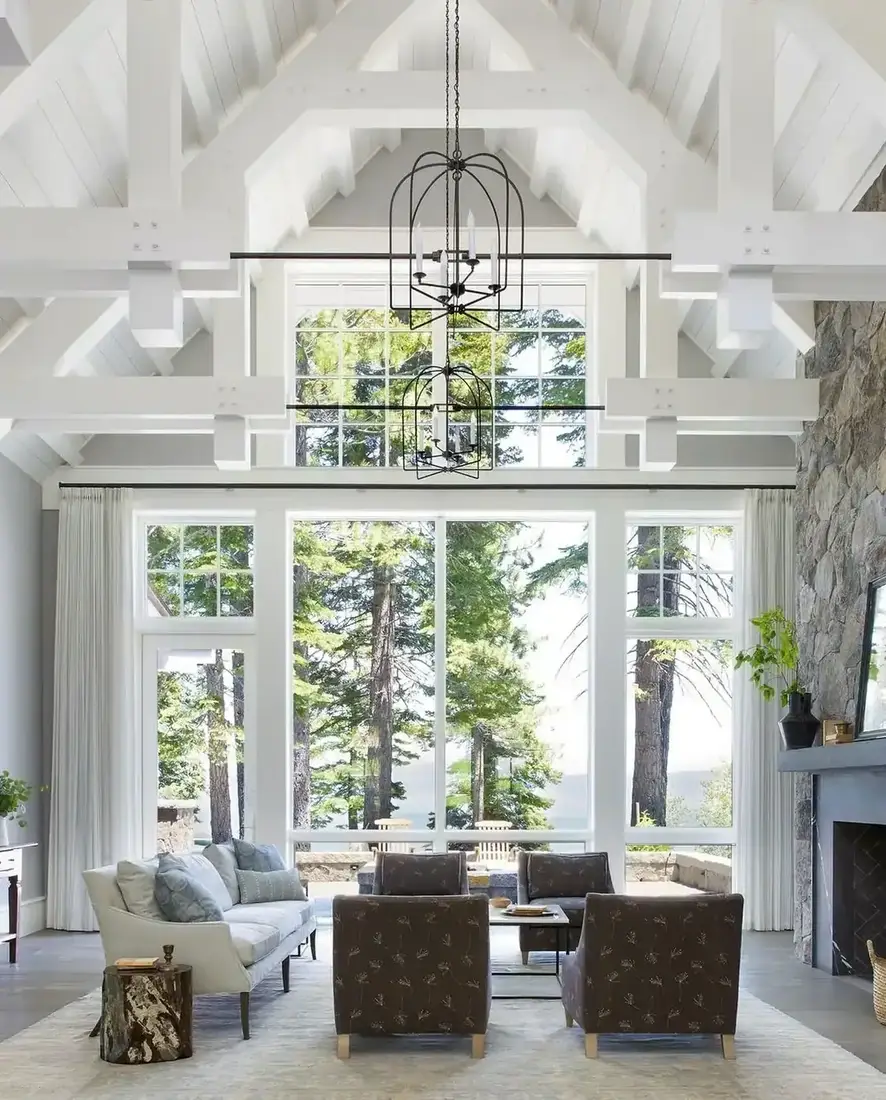
This is the most architectural ceiling on the page, with white painted trusses, purlins, and a collar beam forming an A over full height glazing, and the cleverness is that structure painted white still reads as structure. The members are deep enough to throw shade, with bolts visible at the joints, so the eye accepts them as holding the roof up, which applied strips never manage.
The stone fireplace supplies the contrast the all white shell needs. Rough grey rubble from floor to eaves on one wall gives the room a dark vertical to balance the bright glass opposite, and the dark floral armchairs repeat that weight at seating height, so the scheme has two dark notes answering each other across the rug. Without those, a white truss room of this height feels like a chapel nave, impressive and slightly chilly.
Notice the iron lanterns hung in a pair down the centre line, one behind the other, which draws the eye through the room toward the trees instead of up into the apex. Twin drops need their flexes cut to the same length, or the nearer fitting reads as a mistake, and blackened steel lanterns of that scale run about £250 to £600 each in 2026.
Glazing this tall needs curtains that actually close, or evening light turns the glass black and the room doubles visually. The ivory linen panels stacked at each side run on a bronze rail set at normal window head height, which keeps the fabric operable without chasing the gable, and washable linen in that weight runs about £50 to £130 per metre in 2026.
Where this does not apply
Rooms where the vault is the whole point: a converted barn, a chapel, anything with genuinely exceptional roof structure. There, the timber is the reason the room exists and painting it out would be perverse.
The test is simple enough. Would you buy the house for that ceiling? If yes, light it and leave it alone. If it is just a room that happens to have a high ceiling, the advice above holds.
Frequently Asked Questions
Is it better to paint beams to match the ceiling?
In most modern living rooms, yes. One pale finish across boards and timbers lets the slope read as a single calm surface. Keep dark stain for genuinely old frames with stone or flagged floors to answer them.
At what drop should the main pendant sit?
Judge from the seat, not the ridge. The base of the shade wants to hover near ordinary ceiling level, with lower settings above tables for meals. A cheap test rig on a flex confirms the spot before any holes are cut.
Why does conversation sound harsh overhead?
Slopes and hard floors throw voices back into the seating area. Start with full length drapes, then a generous carpet under the front legs, then textured covers. Glass tops and bare timber make the ring worse.
How should drapes be sized on tall walls?
Finish them at the window head and let the plaster above stay empty. Fabric chased to the apex reads as a tent. Art follows the same logic and belongs near eye level.
When can dark timber overhead succeed?
When walls stay pale and plain so contrast lives in one zone. Clay washed boards plus ivory plaster allow deep joists to feel warm. Pale rooms with one dark anchor each side of the rug hold the balance.
What steadies a gallery wall beneath a slope?
A tight band of frames centred near standing sightline, with sconces at the same line. Mixed gilt profiles suit white boarding. Paper templates prevent extra holes in the joinery, and filler on old boarding always shows.
In order
- Paint new or decorative beams the ceiling colour; leave genuinely old timber alone.
- Hang the main light around 2.1 to 2.4m from the floor, and make it substantial.
- Add lamps at seated height, which matter more here than in a normal room.
- Stop curtains at the top of the window rather than chasing the apex.
- Fix the echo with curtains, a large rug and upholstery, in that order.
This article may contain affiliate links. We may earn a commission at no extra cost to you.