14 Dark and Moody Kitchen Ideas: Never One Flat Black

Add us as a preferred source to see more stories on Google.
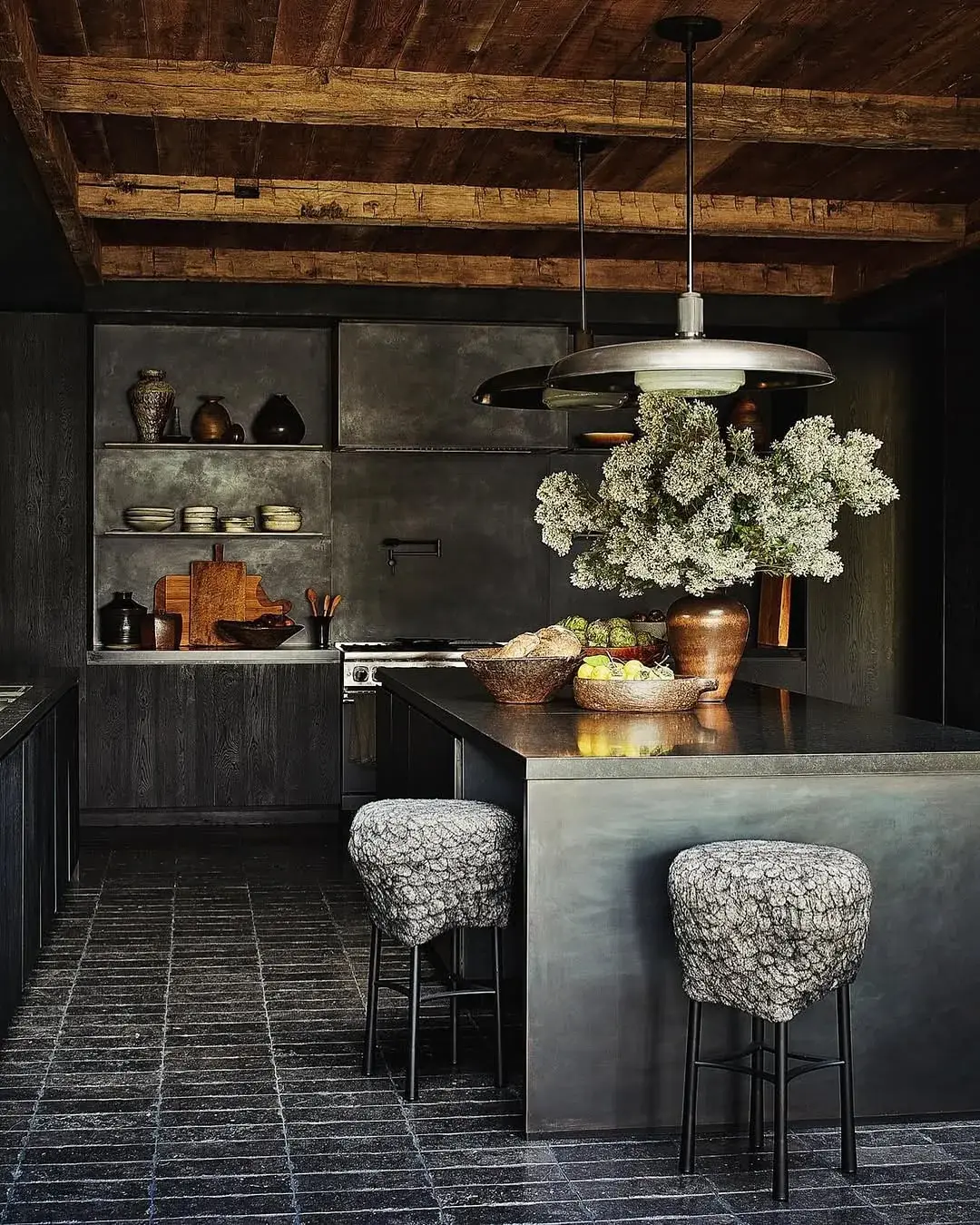
Nothing in the kitchen below is black, and the whole room is dark. That distinction is the entire subject.
Count the surfaces. Charcoal-stained timber on the cabinets, patinated metal on the island, a dark plaster or steel splashback, grey-black stone on the floor, rough sawn timber overhead. Five materials, all at roughly the same darkness, and every one of them different to the touch.
Paint all of that in a single black satin and you get a room with no edges, where the eye cannot tell where the cupboard ends and the wall begins. That is the cave, and it is what most dark kitchens turn into.
Vary the material, hold the tone
The principle is the same one that makes a neutral room work, run in the opposite direction. There, a single pale colour is carried by many textures. Here, a single dark value is carried by many materials.
A workable set, and you do not need all of it:
| Surface | Options |
|---|---|
| Cabinets | Stained oak, limed and dark-waxed timber, matt paint |
| Island | Patinated steel, concrete, dark stone, a contrasting timber |
| Splashback | Dark plaster, zellige, patinated metal, honed slate |
| Floor | Dark stone with visible variation, terracotta stained dark |
| Ceiling or a wall | Rough sawn timber, limewash, exposed brick |
The one to avoid is the same matt black paint on cabinets, island and walls.
It is the cheapest route to the look and the one that reliably produces the flat result. If paint has to do most of the work, at least change the sheen between surfaces: eggshell on the cabinets, dead matt on the walls, and the difference in how each catches light does some of what a change of material would.
Paints that hold depth rather than going flat: Farrow & Ball Railings No.31 and Off-Black No.57, Little Greene Basalt 221 and Jack Black, Benjamin Moore Wrought Iron 2124-10. For a limewash or mineral finish on one wall, Bauwerk Colour and Pure & Original both do very dark shades. Trade eggshell tinted to match runs a fraction of the price and wears better on doors.
The two elements that stop it being oppressive
Something warm and rough. In that kitchen it is the ceiling: sawn timber beams and boards, the only genuinely warm surface in the room. Without it, the whole thing would be cold as well as dark, and cold plus dark is where a kitchen stops being inviting.
It does not have to be a ceiling. A timber island top, open oak shelves, a butcher’s block or a run of terracotta all do the same job.
Something reflective. The two brass pendants are the only shiny objects in the room, and they catch and throw back every bit of light there is. Brass, antique mirror, glazed tile or polished stone all work. A dark kitchen in wholly matt finishes absorbs everything and gives nothing back.
Add one pale object as relief. The white hydrangeas on that island are doing more than decoration; they are the only light thing in the frame and the eye goes straight to them.
Light it like a working room
This is where dark kitchens are won or lost, and it needs deciding before the cabinets are ordered.
Pale surfaces bounce light around a room and do a lot of the work for you. Dark ones absorb it, which means every place you need to see has to be lit directly.
Under-cabinet lighting stops being optional. So does dedicated light over the hob, the sink and the main prep run. A single pendant over an island in a dark kitchen lights the island and nothing else.
Warm, 2700K, high CRI, and on dimmers if the budget allows so the room can go from working to atmospheric. That switch between the two states is most of the appeal of a dark kitchen in the first place.
What it is like to live with
Two honest points.
Dark matt finishes show fingerprints and dust more than pale ones, particularly around handles and on the fridge. Matt black is the worst offender; a slight sheen or a textured finish is considerably more forgiving.
And resale. A dark kitchen is a strong preference rather than a neutral one, and it narrows the field of buyers in a way a pale kitchen does not. If you will move within a few years, the compromise version is dark lower cabinets with something quieter above, which gives most of the effect and reverses easily.
Where it works best
Rooms with good natural light, oddly enough. A dark kitchen with a large window is dramatic; a dark kitchen in an already dim north-facing room is simply gloomy, and no amount of lighting fixes the daytime.
It also suits rooms with decent ceiling height and some architecture to show off. Dark surfaces emphasise form, so beams, arches and mouldings all gain.
Let black draw the lines, not fill the walls
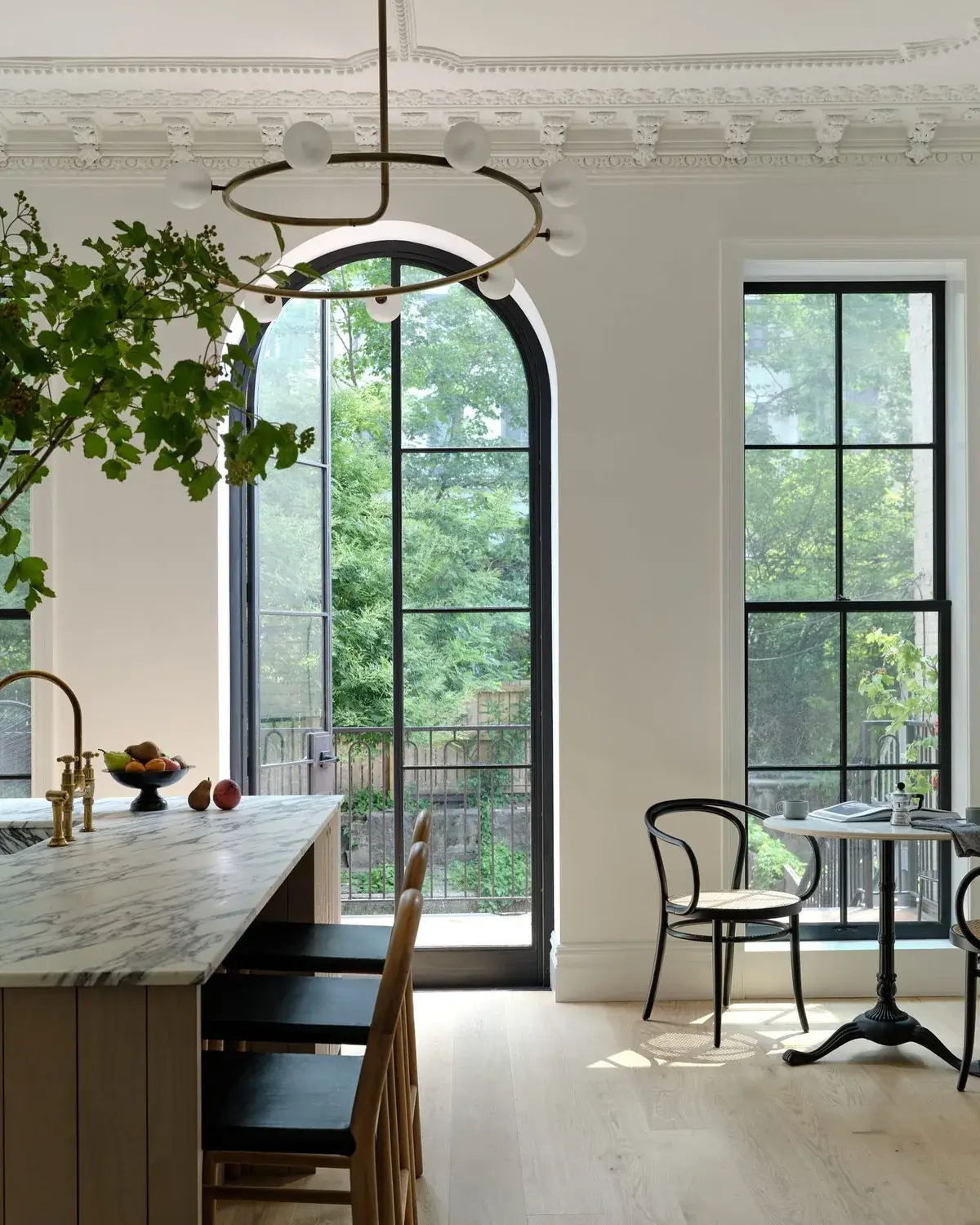
The eye reads edges before it reads surfaces, which is why this kitchen gets away with so little actual black. The arch is the darkest thing in the frame: tall steel framing with glazing bars and a door profile, all near black, and every element is line instead of area. From the doorway the room still registers as pale. Walls and island frontage stay white, while the floor lays pale timber underfoot.
Behind the arch sits the second decision. Green, out of focus, fills two tall openings, which means the garden is doing the work a pale splashback would otherwise have to do. Daylight arrives already tinted, and the white around it stays warm instead of stark.
Above the island hangs the warm counterweight. A ring with opal globes and brasswork burns warm enough to gild the marble, and that brass returns at the tap, so the metal appears twice and reads as choice. A bridge tap in unlacquered brass runs £250 to £600 in 2026, while a ring pendant with glass globes costs £300 to £900. Black aluminium replicas of steel windows run roughly £800 to £2,000 per opening in 2026, and at this scale the eye never finds the saving.
Put the dark on the floor and keep the walls quiet
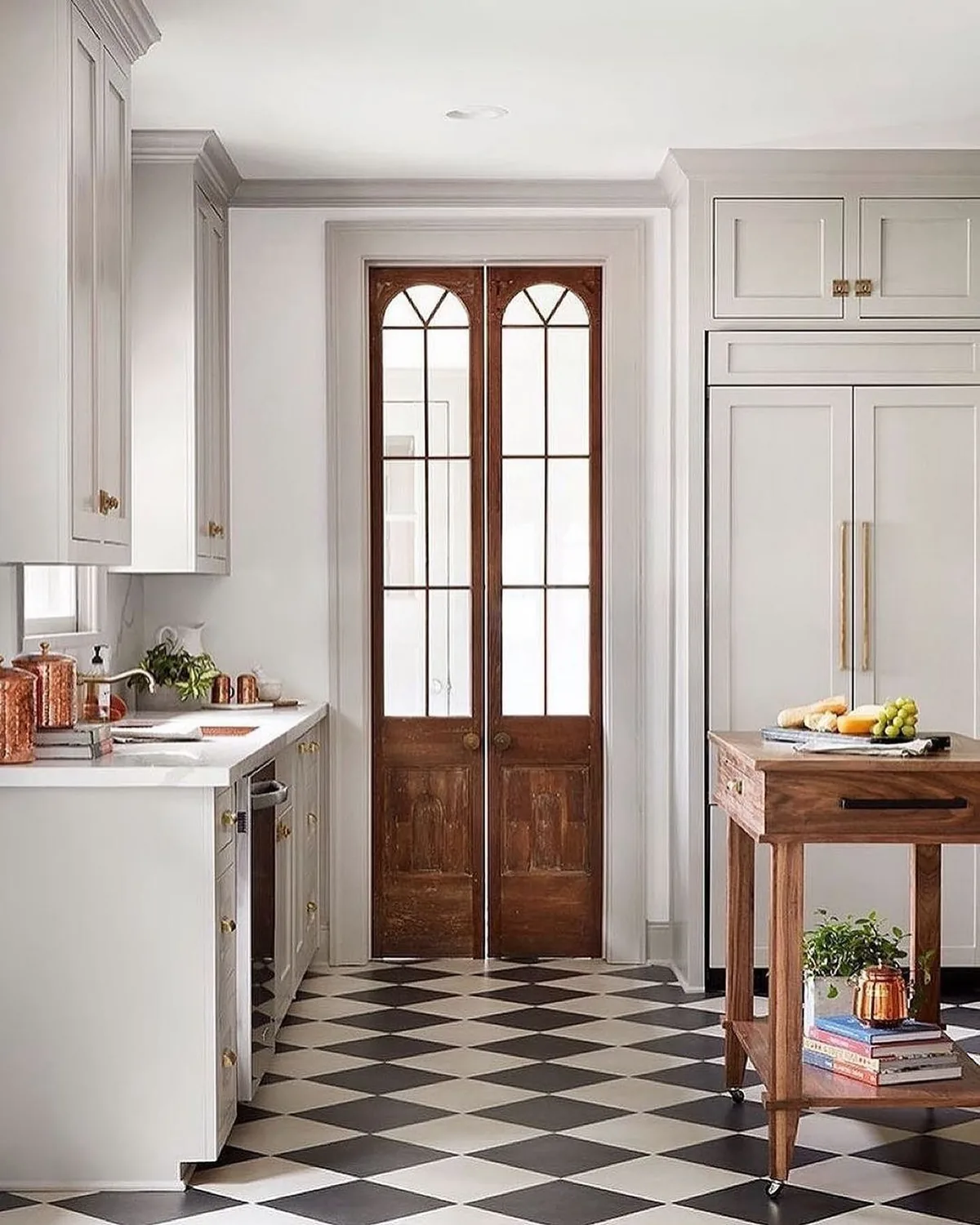
One loud plane per room is the governing deal here, and the floor has claimed it. Chequered black and white runs wall to wall, the boldest surface in the house, while the cabinets above stay flat and deliberately plain. Because the walls contribute nothing, the floor can contribute everything. Reverse the arrangement, with pattern on the walls and plain underfoot, and the room would argue with itself.
At the far end the dark returns vertically. Stained timber doors with glazing bars repeat the floor’s black at eye height, so darkness exists at foot level and at door level with calm between. That spacing is what keeps the pattern confident instead of shouty.
On the island sits the warming evidence. Copper pots with a copper tap, plus books and a plant: small and warm, all at or just above worktop height, which is where dark rooms need their anchors. Porcelain chequers in this style run £40 to £90 per square metre in 2026, against £150 upward for real marble, and the porcelain is the saner choice where lemon and vinegar land daily. Solid copper pans cost £80 to £200 each in 2026. One is enough to start the repetition.
Glaze the uppers so the dark gives back light
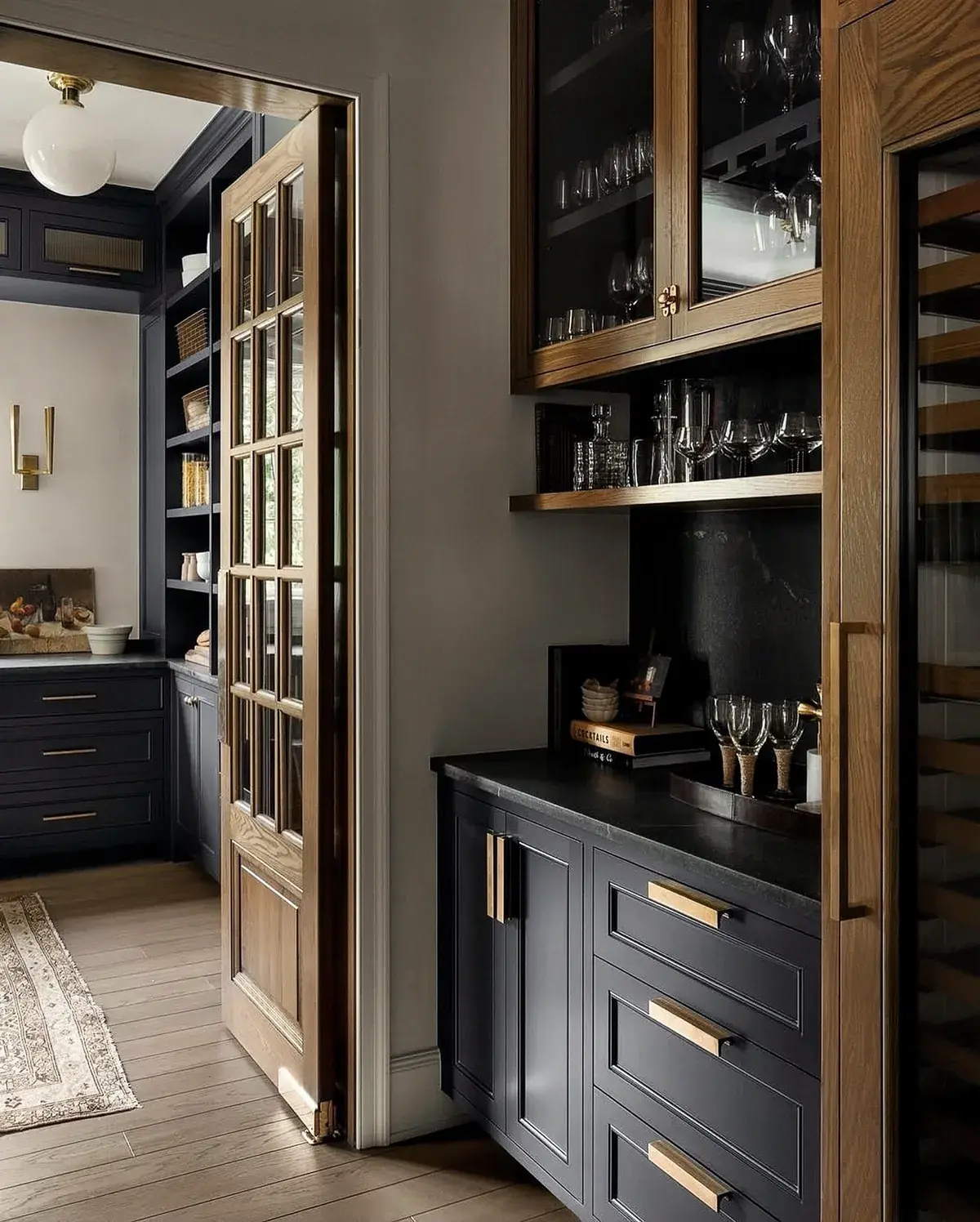
Solid dark wall cabinets press down on a room; glazed ones with lit interiors do the opposite, and this corner shows the mechanism plainly. The base units are near black, yet the wall above glows because glass and stemware return every bit of light they receive, helped by a lit shelf beneath them. Darkness below the worktop grounds the room, while luminosity above the worktop lifts it, which is exactly the split small kitchens need.
The brass pulls are the second lesson. Four wide bars at hand height catch lamplight across the dark fronts, so the hardware functions as lighting even with the lamps off. Keep one warm metal through pulls and tap, and carry it onto the fridge trim, because scattered finishes on dark joinery read as indecision within a week.
Through the glazed door, a back kitchen waits in cream, and that borrowed paleness matters more than it looks. Bar pulls in solid brass run £8 to £25 each in 2026. Lining a glass cabinet with a warm LED strip costs £15 to £45 per metre in 2026, and it is the cheapest glow in this entire article. For the carcass colour, Farrow & Ball Railings No.31 or Little Greene Basalt 221 get you close.
Keep black low where daylight does the lifting
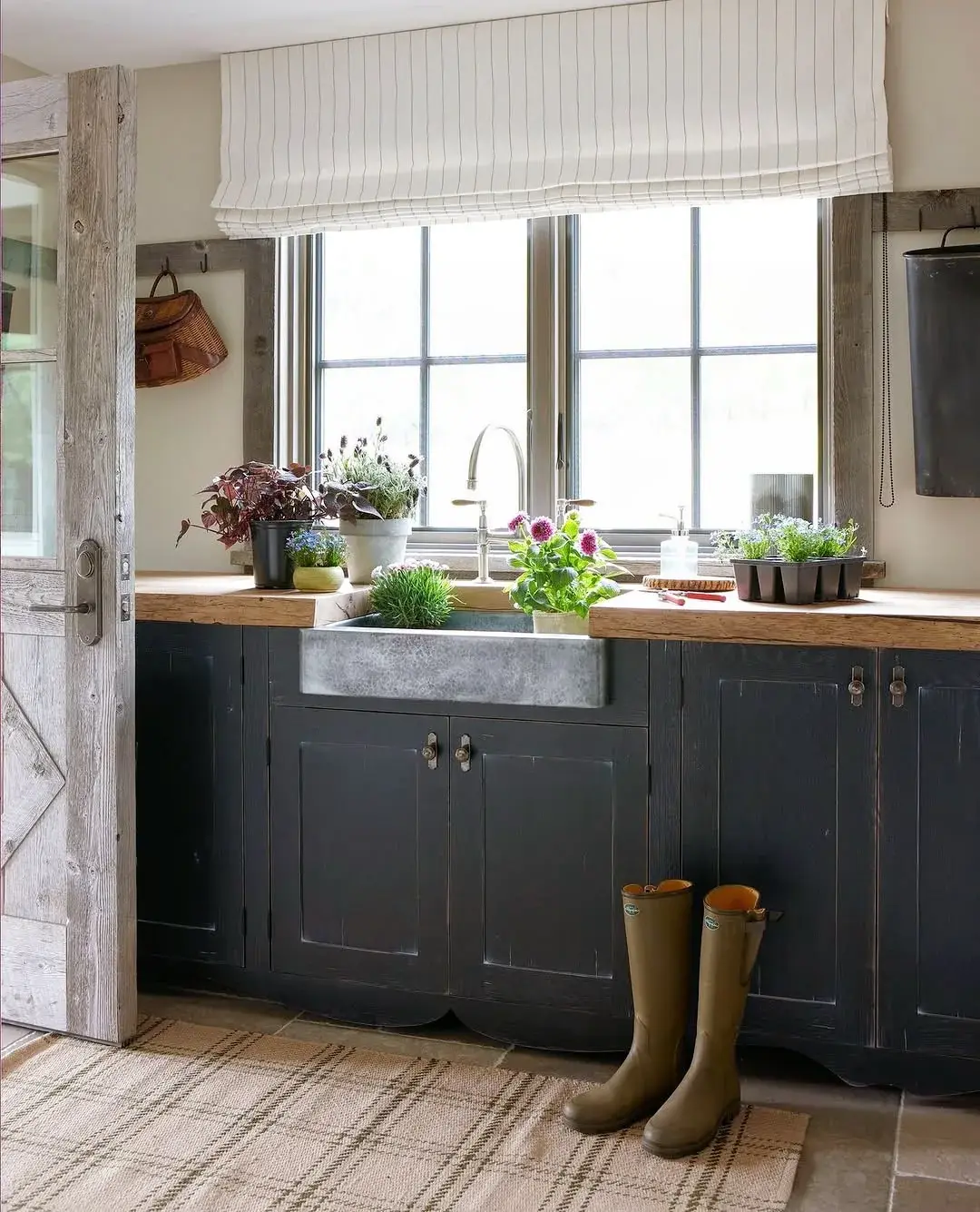
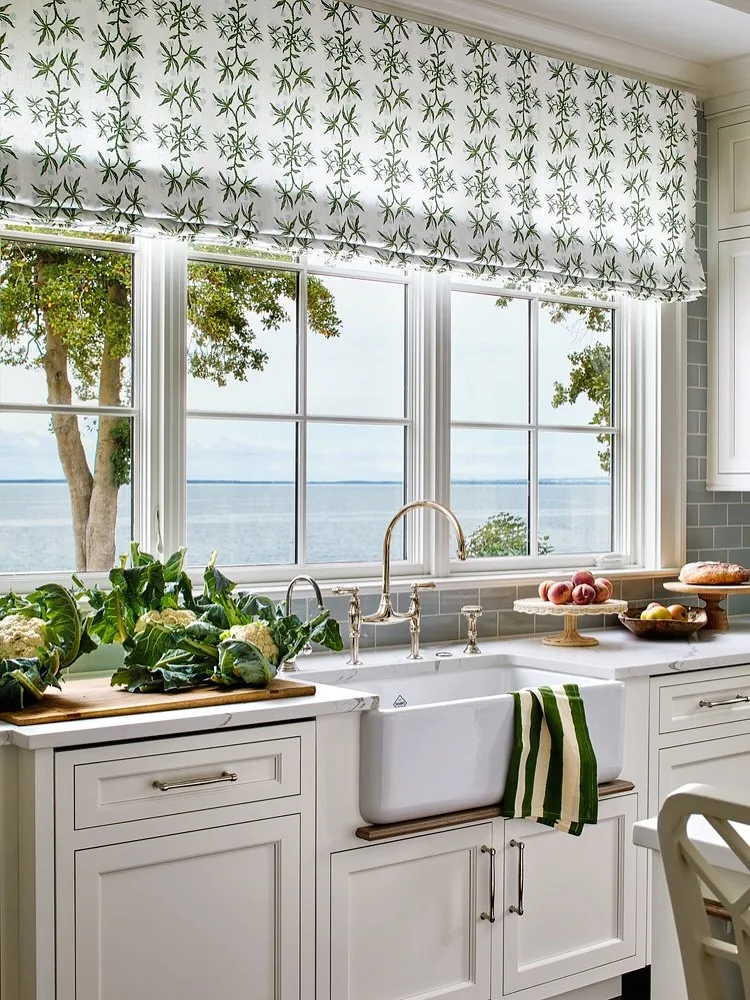
Black kept below the sill with a wide window above it is the most forgiving dark move in the book, and this wall is the proof. The lowers are near black, the tops are thick pale timber, and above the sink there is nothing but glass and sky. Because the brightest plane in the room sits directly over the darkest one, the contrast does the decorating and nothing else has to perform.
Along the sill runs the living relief. Pots of herbs and seedlings supply the one colour no paint provides, and they also prove the room sustains life instead of merely staging it. A striped roman blind softens the glass without stealing light, and the fabric reads warm against the black below.
Below, the honest details: boots on a checked rug, with a weathered door alongside. This is a working wall, and dark paint at boot height hides more than cream ever could. A fireclay farmhouse sink from Shaws of Darwen or a similar foundry runs £300 to £700 in 2026. Thick oak tops cost roughly £200 to £400 per square metre in 2026, and they want oiling twice a year, which is the whole maintenance contract stated plainly.
Make the island the dark object in a pale room
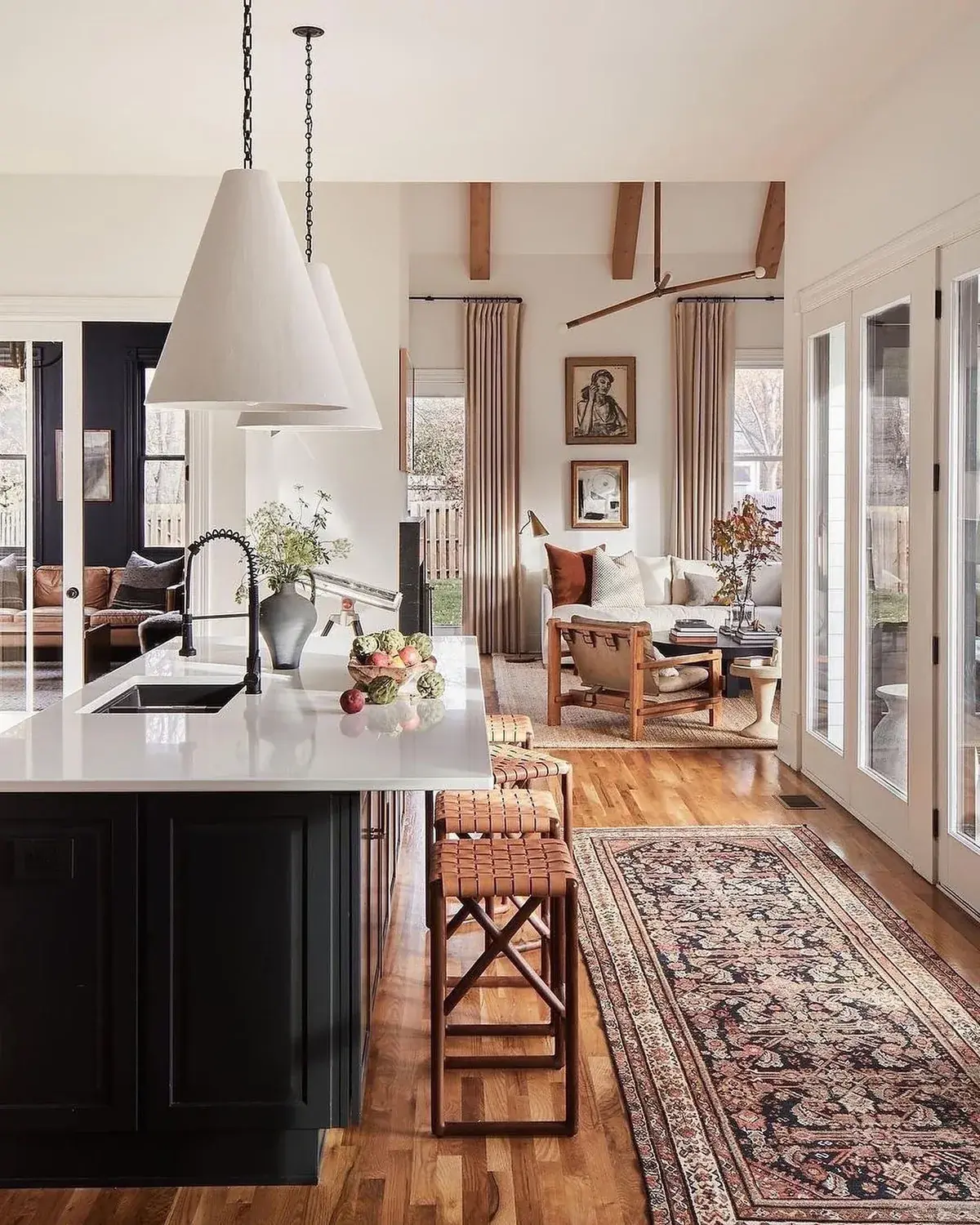
Where the whole room cannot go dark, one object can, and the island is the right object because an island is furniture while walls are architecture. Here a near-black island stands in a pale shell: white top and walls, an oak floor, daylight from two directions. Guests remember the dark centrepiece without living inside it, which is precisely the compromise the resale section above describes.
Above it, two plaster cone pendants pool light exactly where it is needed. Their shape matters as much as their glow, because a pale cone against a white ceiling disappears while its light does not, so the illumination reads as sourceless. Woven leather stools and an old rug supply the warm rough notes at floor level, and the sitting room beyond lends pictures and lamplight to the background.
Repeat the island tone once, on a pantry door or a range surround, so it reads as scheme instead of sample. Plaster cone pendants run £120 to £350 each in 2026. Counter stools in leather and timber cost £150 to £400 each in 2026. For the island colour, Benjamin Moore Wrought Iron 2124-10 or Farrow & Ball Off-Black No.57 get you close.
Spend the black on one appliance
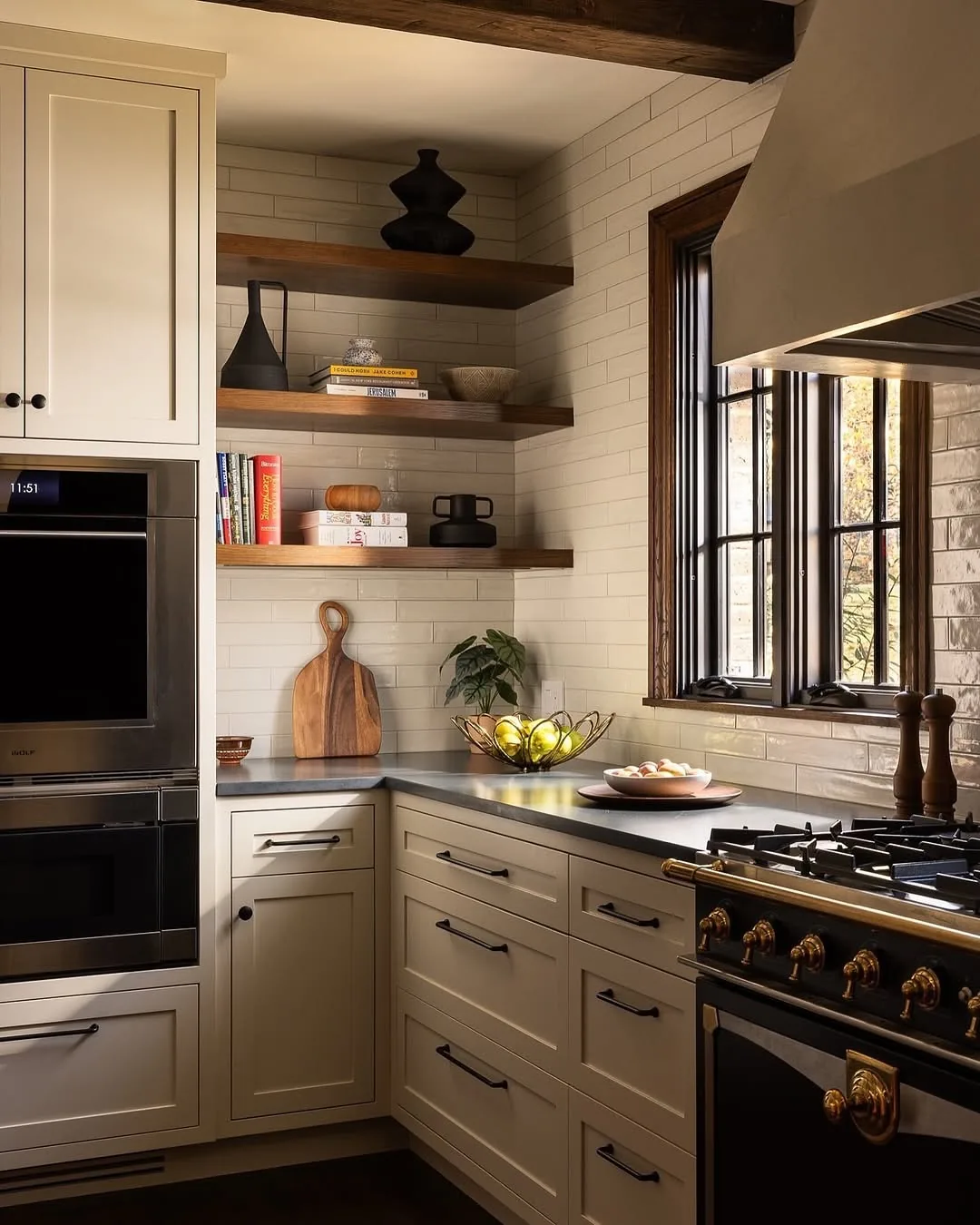
A cooker is furniture, which is why this kitchen breaks the usual rules and gets away with it. The black range with brass rails reads as an object that arrived complete, while a single black fitted island in the same room would read as a fitted kitchen that stopped halfway. The eye forgives one separate thing; it does not forgive one mismatched part.
Above the range, walnut shelves do the warming that brass begins. Three thick boards carry bowls and books, with one dark vessel among them, and because timber appears twice, at shelf level and on the chopping board, it counts as the repeated warm note without spreading. The zellige splashback behind them is the reflective element, its glaze catching lamplight tile by tile where matt paint would swallow it.
A 90 to 110cm range in enamel runs £2,500 to £9,000 in 2026 depending on maker and fuel. Rangemaster and Lacanche set the reference points. Walnut shelves on concealed brackets cost £150 to £400 per run in 2026. Handmade-look zellige runs £70 to £150 per square metre in 2026, and its variation between boxes is the point, so open three boxes and mix them or the wall stripes.
Borrow light from the next room
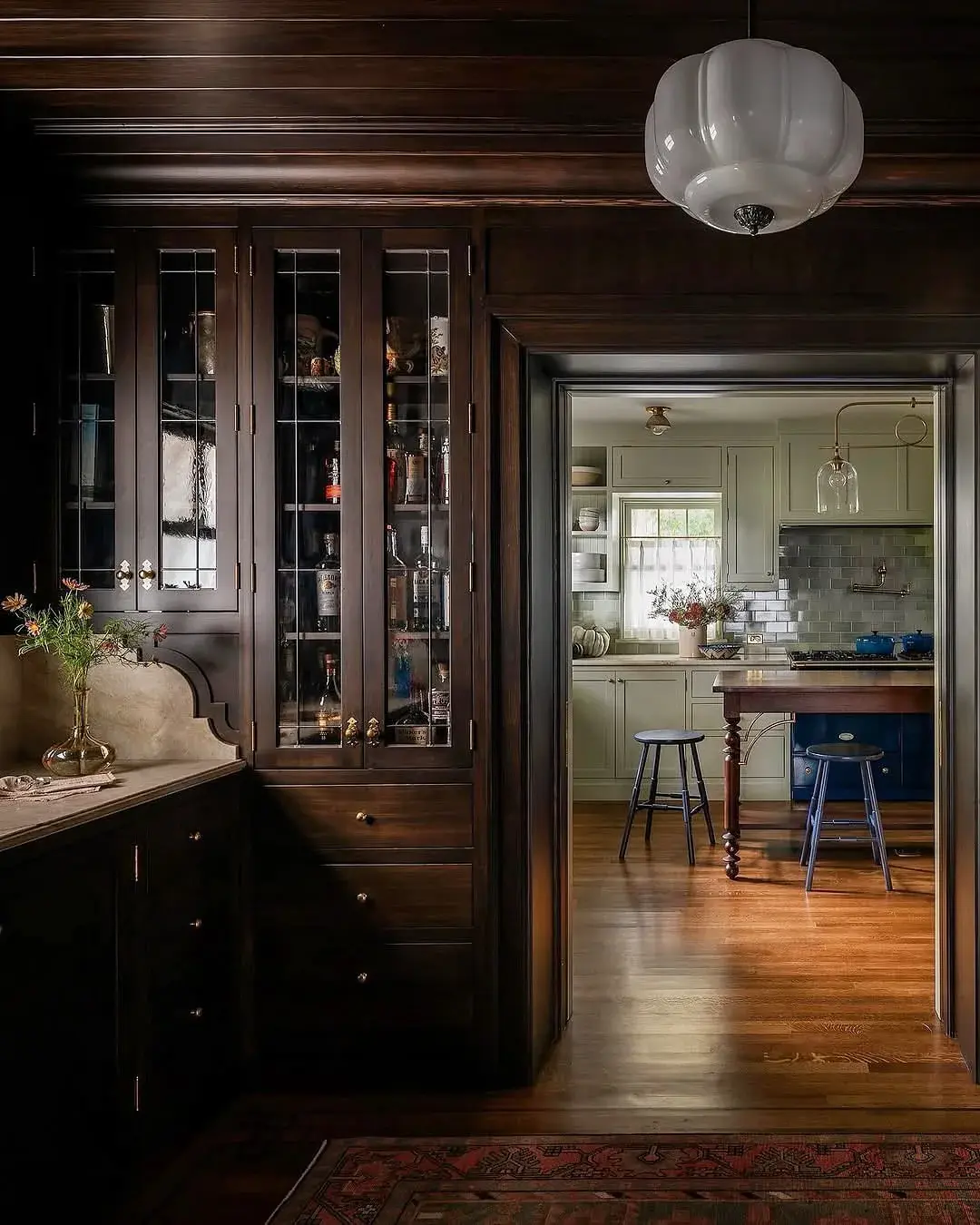
The darkest rooms in this article survive because of what stands beyond their doorways, and none more plainly than this one. Stained timber lines every surface, walls and ceiling alike, with glazed cupboards breaking the run, yet the whole corner glows, because an open doorway delivers a fully lit pale green kitchen as the view. Borrowed light is still light; the eye does not audit its source.
On the left, leaded glass doors glint instead of shining, which suits the register of the room. Their small panes break reflections into fragments, so the cabinet reads as texture instead of mirror. Above, a single opal globe burns at picture height, the warmest plane in the frame, and everything timber around it steadies into brown instead of black.
Underfoot, a flatweave runner stops the dark floor feeling like a stage set. Flatweave wool runners run £120 to £300 in 2026. Opal glass pendants from Original BTC or Jim Lawrence cost £150 to £400 in 2026. For the stained depth on the timber, Little Greene Jack Black 248 gets you close, layered over a brown base, never straight black, which keeps the grain legible.
Confine tall dark timber to one tower
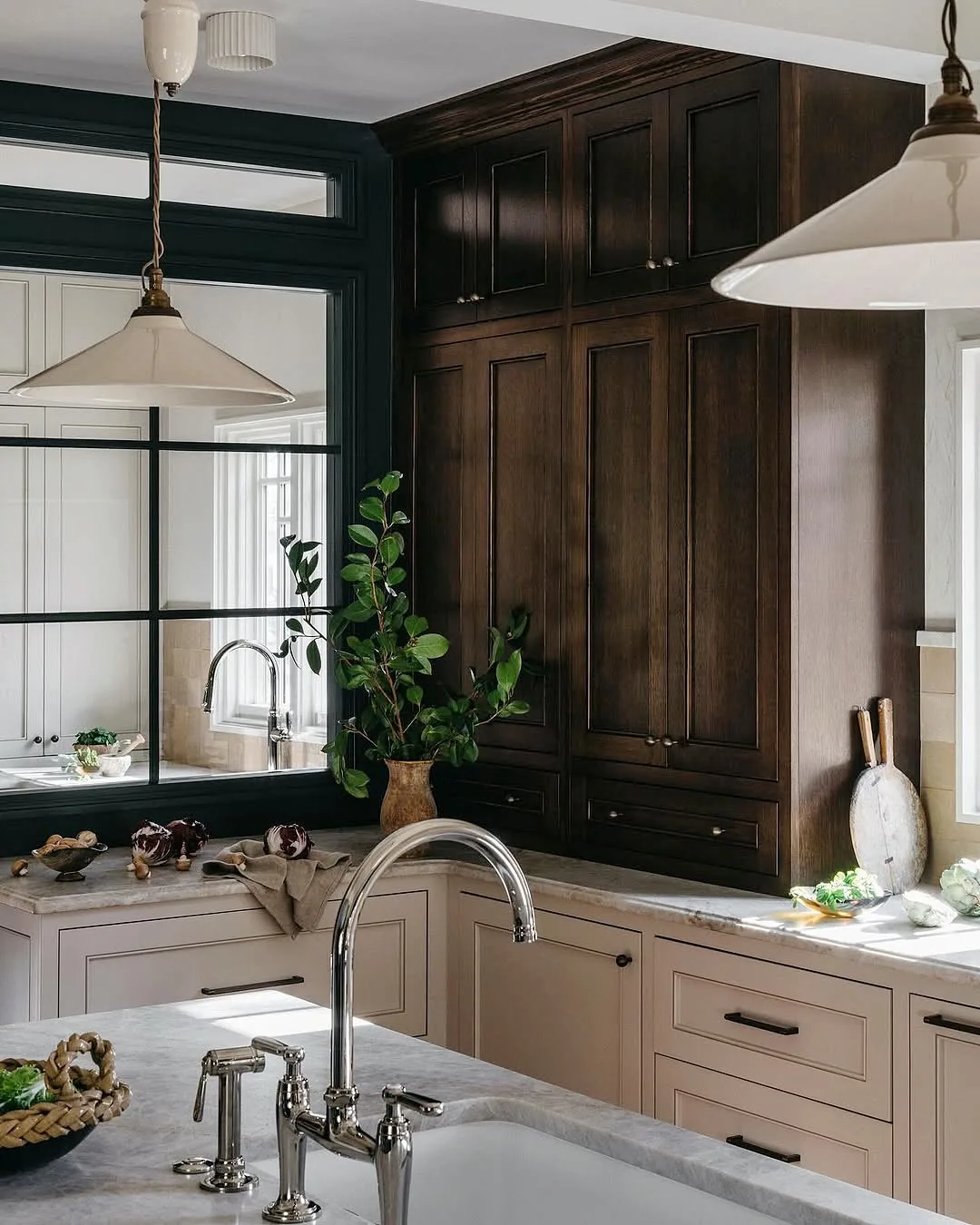
Height is where dark joinery turns oppressive, so this kitchen spends its height in exactly one place. A full-height walnut larder stands on the right, floor to cornice, while every other unit stays cream and low. Because the dark exists as one tower, not a run, it reads as furniture, almost as an heirloom, instead of as a dark wall.
Beside it, a black-framed interior window borrows light from the next room, and the borrowing is doing structural work. Without that glass, the tower would stand against blank plaster and loom; with it, the tower stands against daylight and settles. The enamel coolie pendants repeat the trick overhead in miniature, each one a small bright disc with a dark rim.
On the worktop, one green plant is the relief, and its position in full sun is no accident. Coolie pendants in enamelled steel run £100 to £300 each in 2026. A marble-topped island with a turned leg, in the manner of the foreground piece, costs £1,500 to £4,000 from a joiner in 2026. For the tower stain, a dark wax over fumed oak gets you close, and it forgives fingerprints better than any matt paint.
Light inside the glass, not only above it
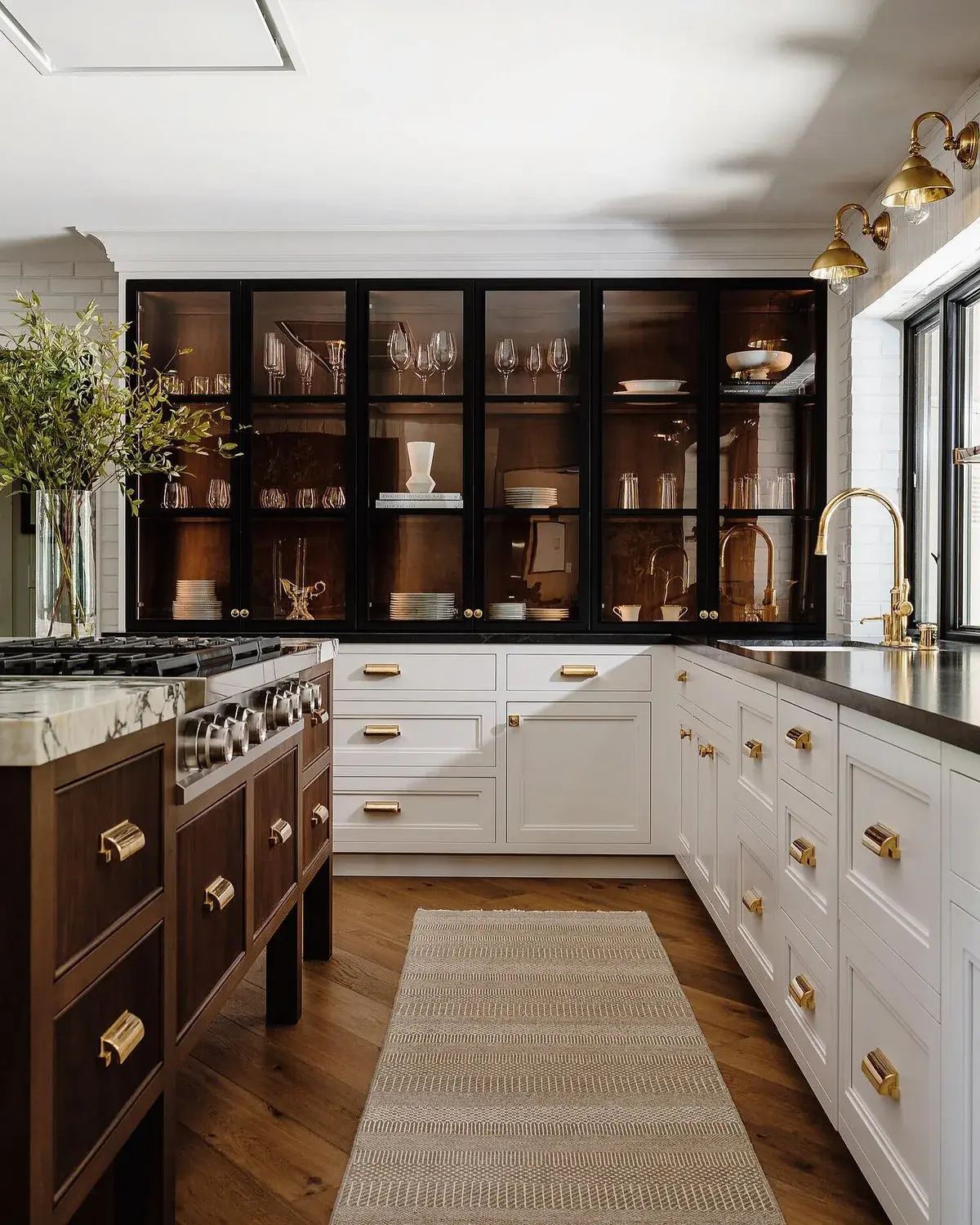
Glass wall cabinets only relieve a dark room if something inside them is lit, and this wall understands the assignment. Black-framed glazing runs the length of the room, and the shelves behind it carry cream ceramics and clear glass that catch the light from the window opposite. Unlit, those boxes would read as holes; lit by daylight and use, they read as lanterns.
Below the glass, the brass does its work at hand height. Cup pulls, a bridge tap and two shaded wall lights repeat one warm metal along the whole run, so the eye travels the length of the kitchen on a warm line. That low warm line is the detail to copy, because dark rooms are saved by light the hands can almost touch, not by light marooned at the ceiling.
On the right, the same brass returns at the window, which stops the metal reading as a kitchen-only decision. Brass wall lights from Hector Finch or Jim Lawrence run £90 to £220 each in 2026. Solid brass cup pulls cost £6 to £18 each in 2026, and the unlacquered versions will blotch within a year, which is the finish doing its job rather than failing at it.
Give marble the relief role
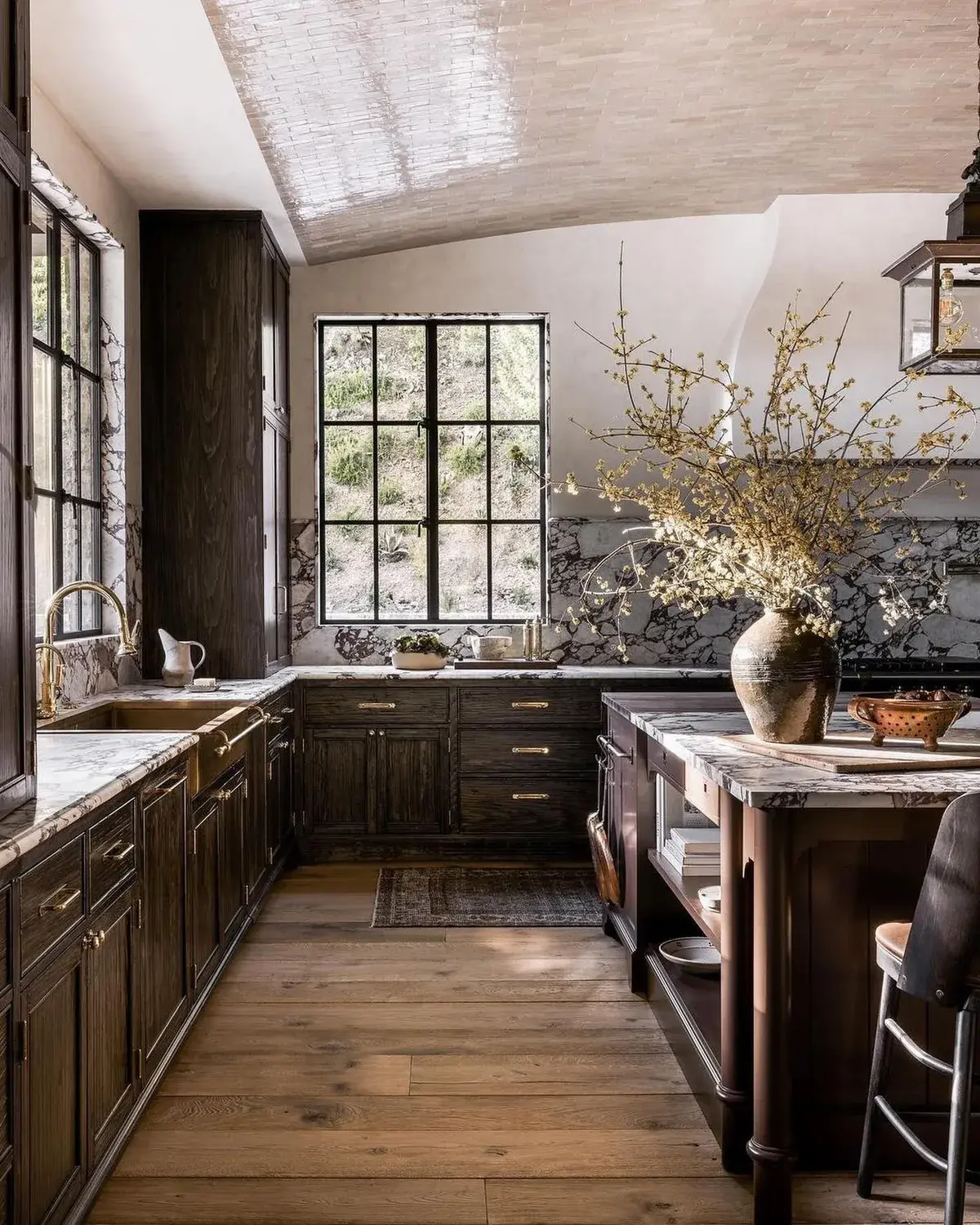
Where most dark kitchens ration their one pale surface, this one spends it generously, and the generosity is the scheme. Strongly veined stone covers both worktops and the full splashback wall, so pale movement rises from counter to ceiling behind dark stained cabinets. Because the stone carries all the pattern in the room, the timber can stay completely plain, and the two never compete.
The brass tap and rails are the warm points, small against the stone but placed exactly where the hands work, which is where reflective metal earns its keep. Black steel windows frame the green outside without apology, and the oak floor throws light back up into the joinery all day. Floors cover the most area in any kitchen, so their vote outweighs cabinets and walls combined.
Choose veined slabs at the yard with eyes on the actual stone, because two slabs of Calacatta Viola can look nothing alike. Fabricated and fitted, strongly veined marble runs £500 to £1,200 per square metre in 2026. Wide oak boards from Havwoods or a similar merchant cost £80 to £160 per square metre in 2026. One caution: marble beside a sink etches, and honed finishes hide the marks that polished ones advertise.
Panel the walls dark, then anchor them with lit stone
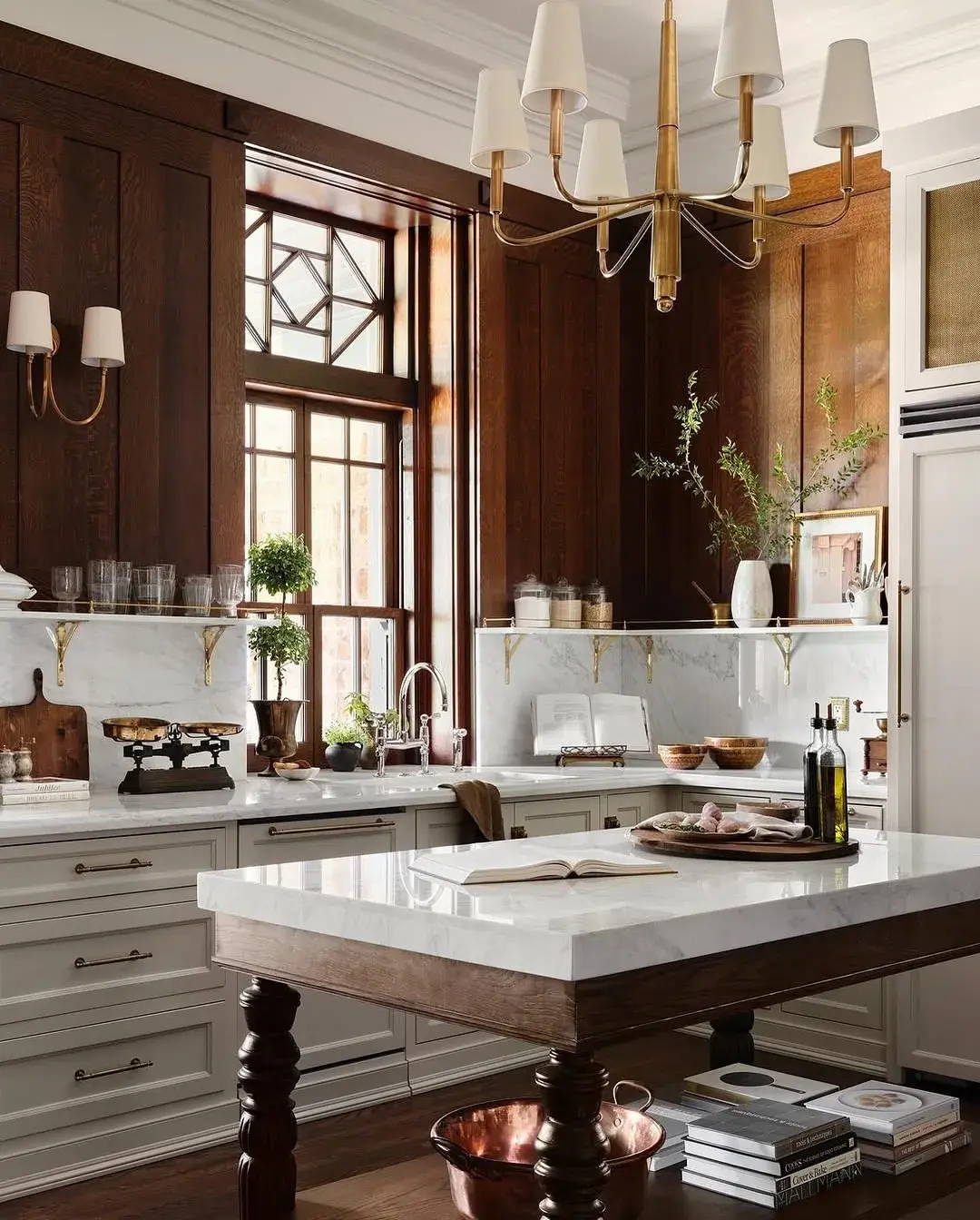
Full-height timber panelling is the bravest move in this article, and it holds because a lit horizontal runs straight through its middle. A marble splashback shelf at counter height, carried on brass brackets, catches daylight and lamplight along the whole working wall. Without that glowing line, the panelling would press down; with it, the dark reads as backdrop and the work reads as stage.
The brass chandelier and twin sconces do the rest of the warming. Six linen shades at two heights turn the timber from near black to brown wherever their pools land, which demonstrates the principle that dark walls need their light low and lateral, not stranded at the ceiling. Under the island top, books and a copper bowl keep the base from reading as a plinth.
Marble shelf brackets in solid brass run £30 to £80 a pair in 2026. A six-arm brass chandelier with linen shades costs £400 to £1,200 in 2026. For the panelling colour, Farrow & Ball Studio Green No.93 or Little Greene Urban Bronze 245 get you close, and both hold their depth after dark better than cleaner greens.
Restrict the dark to one working wall
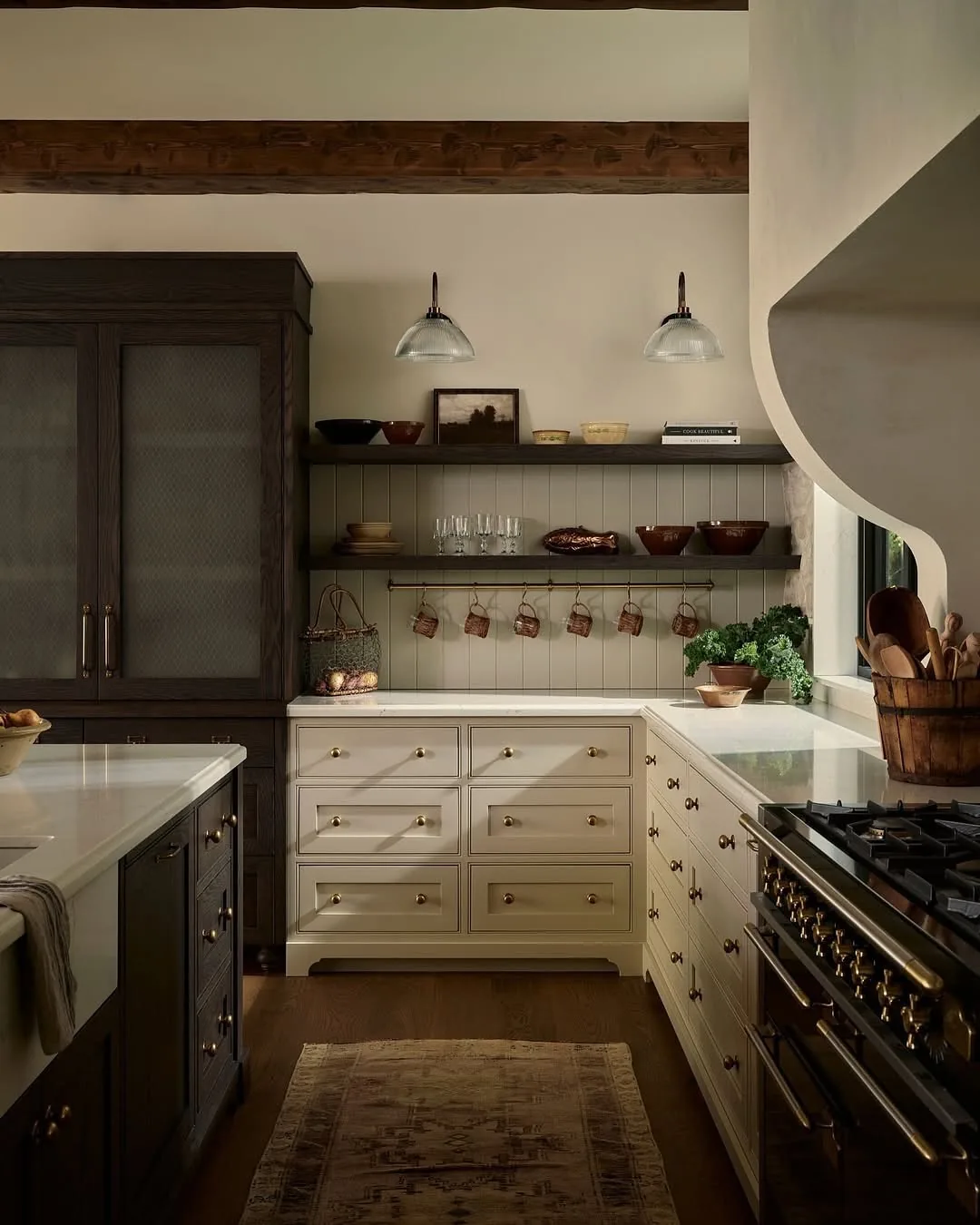
Concentration reads as decision, and this wall concentrates everything dark in the room onto one elevation. A tall stained cupboard and two open timber shelves share the back wall with a hanging rail in brass, while the side runs stay cream from worktop to ceiling. Because the dark never scatters, it never looks like a stain spreading.
On the rail hang copper mugs, each one a small warm reflector at chest height, with glass and bowls above them on the shelves. The arrangement works because it is used daily; open shelves of display-only objects in a dark finish would read as a shop. Two glass pendants light the shelf front exactly where hands reach, so the working plane glows while the cream sides fall back.
A solid brass hanging rail with hooks runs £40 to £110 in 2026. Seeded glass pendants cost £80 to £200 each in 2026. Copper mugs and small pans, £15 to £45 each in 2026, are the cheapest warm metal in the article, and they earn the shelf more than another row of bowls would.
Frame the view in black and let the garden lighten it
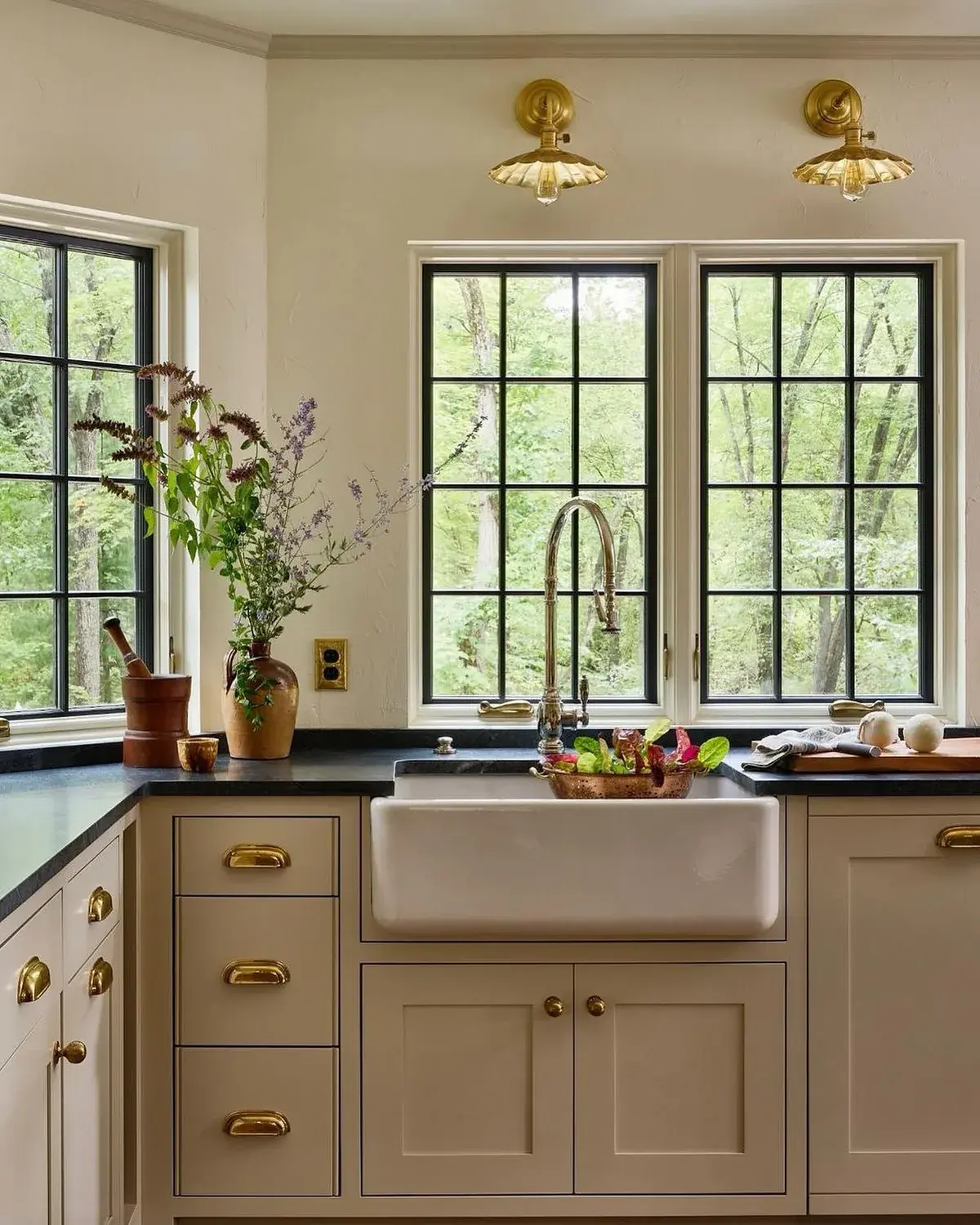
Here the black is all frame and no fill: window mullions with a thin worktop line, and sockets and switches to match. The view through the glass is the palest material in the room, green and out of focus, and it lightens everything it touches. In a kitchen with an outlook this good, the garden is a finish, and it costs nothing after the planting.
Below the windows, a white farmhouse sink is the relief object, the single brightest plane at working height. Its apron front catches the daylight full on, which is why the dark worktop line on either side reads as crisp instead of heavy. Two brass wall lights burn above at picture height, warming the cream wall and repeating the tap below, so the metal connects picture plane to worktop in one warm thread.
Brass wall lights of this pattern run £80 to £220 each in 2026. Dark honed worktops in soapstone or basalt cost £400 to £750 per square metre fitted in 2026. Aluminium copies of steel frames cost about £800 to £2,000 per opening in 2026, and slim profiles repay the outlay because each extra millimetre of glass pays the room back daily.
Frequently Asked Questions
Can a compact kitchen take near-black units?
It can, provided the deepest tone stays beneath the sill or on a single tall piece. Pale walls above, glass fronts with lit shelves, and one warm metal repeated through handles and taps keep the footprint feeling open. Full wrap coverage suits only rooms with generous glazing.
Which lamps flatter charcoal joinery after dark?
Warm white sources around 2700 kelvin with strong colour rendering, aimed at counters and shelves. A single ceiling fitting leaves faces and worktops in shadow. Cool daylight lamps turn the same fronts grey and flat.
What pale surface lifts a sunless scheme?
One luminous plane: veined stone across the tops, a marble shelf at counter height, or a white sink catching the window. Timber underfoot helps too, since floors return light upward all day. Two competing pale features argue; a single one settles.
Do matt charcoal fronts mark easily?
They show touch and dust sooner than pale paint, especially near pulls and around the fridge. A slight eggshell sheen or a grained timber hides daily wear far better. Wipe the busiest doors weekly and the finish stays calm.
Will a sombre kitchen narrow future resale?
Strong palettes attract fewer buyers than quiet ones, so weigh the timeline honestly. Lowers in a deep tone with pale uppers reverse cheaply and keep most of the drama. Whole-room saturation suits a long stay, not a quick sale.
Which metals sit best against dark cabinets?
Warm ones: brass, bronze and copper all throw light back into the gloom. Use a single family through pulls, rails and lighting so it reads as jewellery. Chrome and steel chill a dark palette and suit paler rooms better.
In order
- Choose four or five different dark materials rather than one dark paint.
- Include one warm rough surface, ideally timber.
- Include one reflective material to catch the light.
- Plan under-cabinet and task lighting before ordering anything.
- Avoid dead matt black on the surfaces you touch most.
This article may contain affiliate links. We may earn a commission at no extra cost to you.