Vintage and antique kitchen ideas: build the room around one real find

Add us as a preferred source to see more stories on Google.
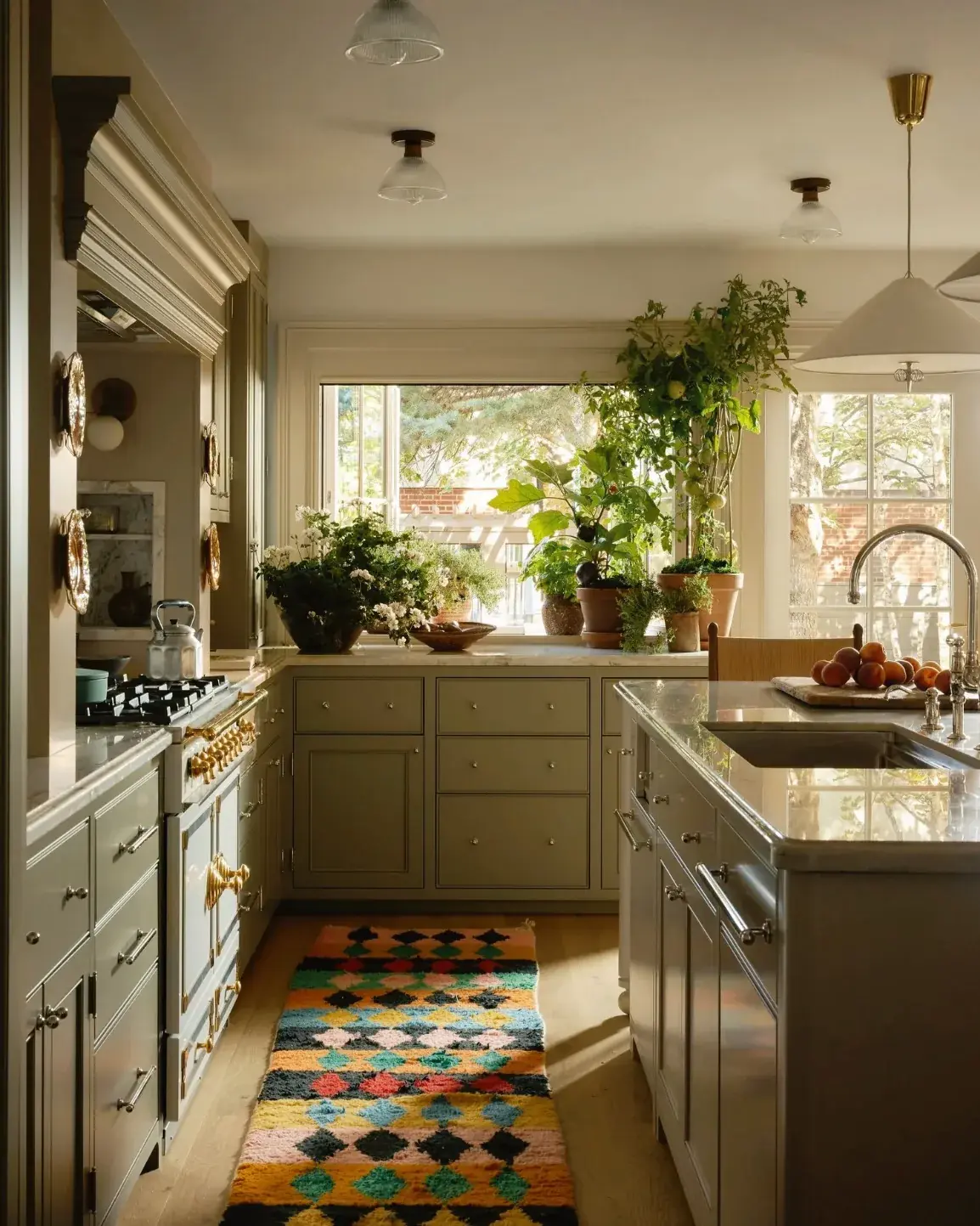
There is one genuinely remarkable object in the kitchen below, and everything else is deliberately quiet.
The range, with its heavy brass rails and trim, is a piece of furniture rather than an appliance. The cabinets around it are plain sage shaker fronts with simple nickel knobs. The worktops are plain marble. Nothing competes.
The other version of this kitchen buys distressed cabinet doors, reproduction aged brass handles, faux-antique pendants and a fake-patina tap, and ends up with a room that is entirely about looking old without a single old thing in it.
What to make the one thing
The range. The most common and the most effective, because it is large, central and genuinely functional. A restored Aga, Rayburn, La Cornue or Lacanche is a serious object. Secondhand and reconditioned is the sensible route; expect £3,000 to £8,000 for something good against £15,000 upward new.
A dresser. A freestanding painted or stripped dresser instead of a run of wall units. It gives a wall of the kitchen a different character entirely, and it moves house with you.
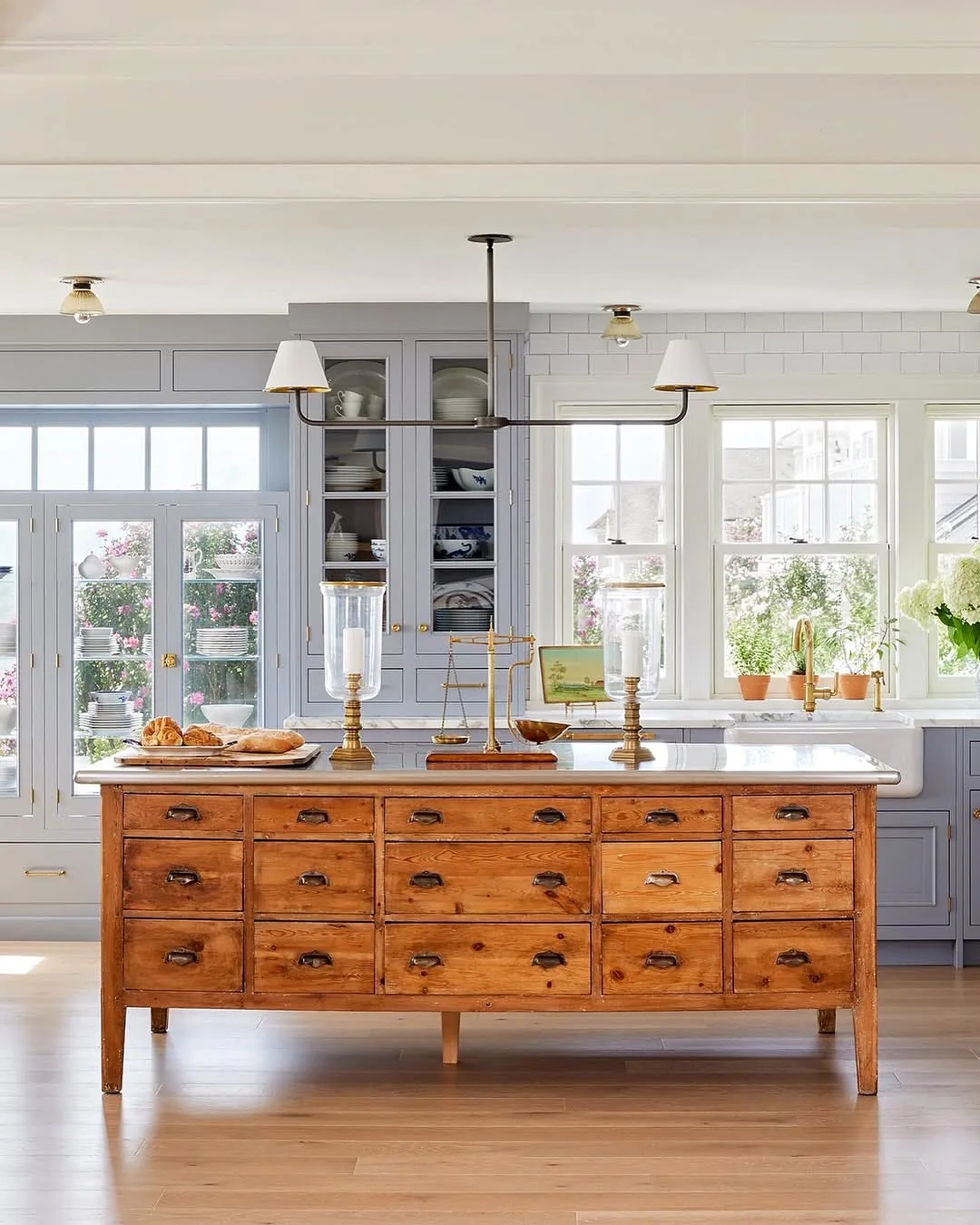
A butcher’s block or shop counter. As an island, as covered elsewhere on this site. Solid, worn, and better than any new island at the same money.
A collection. The copper moulds on the wall above are doing this: a genuine group of old objects, hung as a set rather than scattered.
One of those. Not all four.
What to keep modern
Everything you touch and everything that has to work.
Taps, appliances, extraction, sockets and lighting should all be contemporary and good. Reproduction period taps are frequently poor engineering wearing a costume, and an old fridge is an expensive way to have a fridge that does not work.
Cabinet fronts should be plain. A shaker door in a quiet colour is the right background for an antique; a distressed, crackle-glazed, deliberately chipped door is another object competing for the same attention.
Hardware plain and honest. Unlacquered brass and polished nickel both age genuinely over years of handling, which is a considerably better result than buying something pre-aged.
A new fridge can stand beside a real cupboard
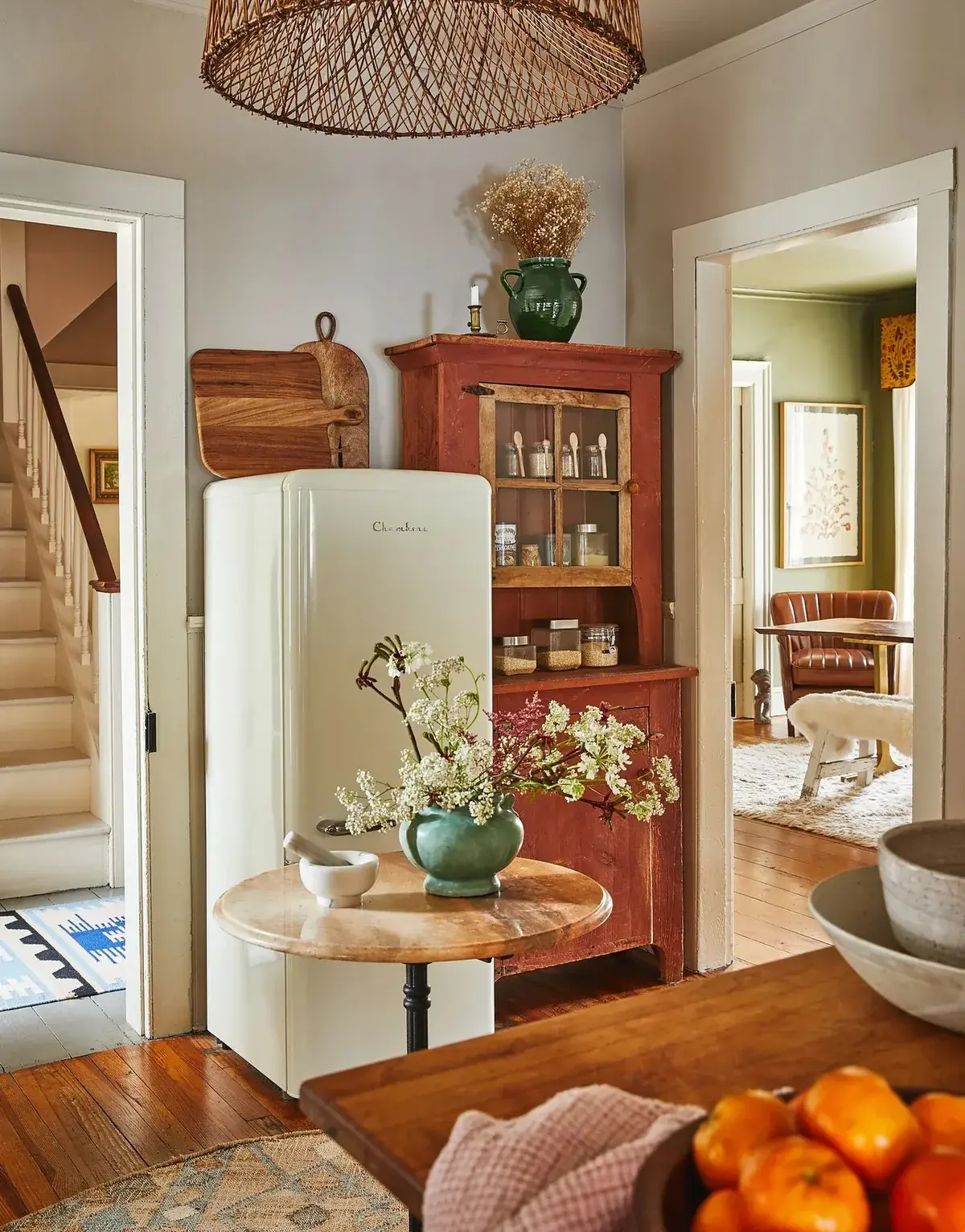
The fridge in the corner is new, and it is the only new thing in the frame. Cream enamel, a rounded top, a chrome latch, and a cursive badge above the door. It reads as period because the proportions are period: tall, narrow, hinged on the right, with nothing digital on the front. Smeg, Big Chill and Chambers all build that shape now, at £1,200 to £2,800 depending on capacity, and all three are shallower than a standard fridge, around 600mm against 700mm.
Beside it stands a cupboard painted a dull brick red, and that is the genuine antique you came for. The fridge is deferring to it, which is the arrangement the rest of this piece is about. The two objects are close in height, so the eye takes them as a pair, and the fridge is the paler of the two, so it recedes.
The round table in front is small, marble-topped, on a cast-iron column. It does the job an island cannot do in a room this narrow, and it gives you somewhere to put a jug down. A green-glazed jug holds cow parsley, a mortar sits beside it, and the surface is otherwise empty. Notice the latch: chrome, not brass, which is one of the few honest tells that the fridge is new.
One warning about the appliance, because it will cost you more than the purchase price. Retro models are expensive to run, since the insulation is thin and the compressor is small, so an A-rated modern fridge beats most of them by a wide margin on electricity. If you want the shape anyway, buy it knowing that.
The painted pine cupboard is the piece to buy
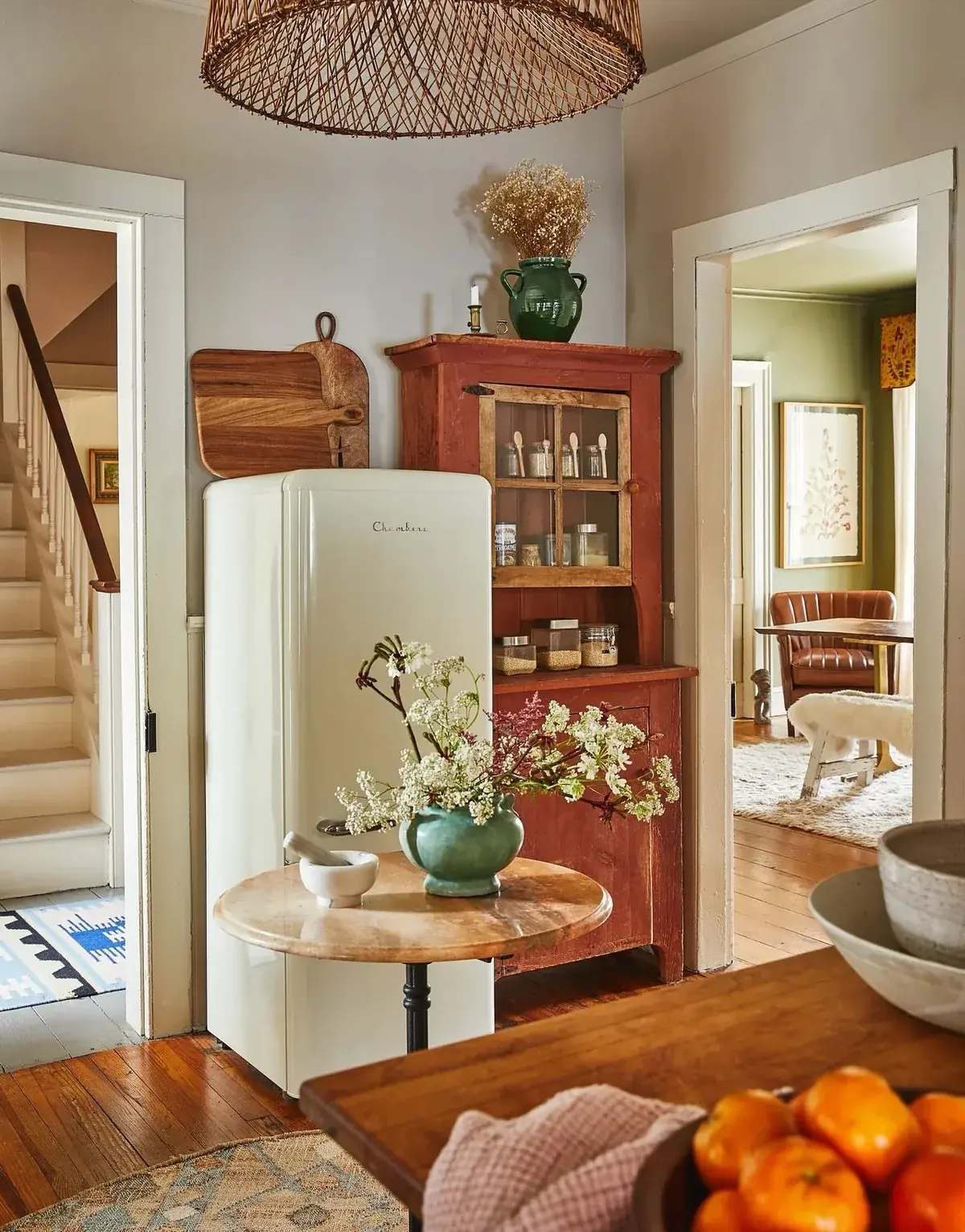
The cupboard is painted pine, not mahogany, and that is the first thing to establish. Look at the cornice: a stepped moulding, not a carved one, and feet cut from the same board as the sides. That is a farmhouse piece, made by a village joiner somewhere between 1840 and 1900, and painted from new, because pine was the cheap timber that wanted covering.
The upper half is glazed in two doors with six panes each, and the shelves hold spice jars in rows. Below sits a solid cupboard with a drawer above it. This is the milk-house dresser, and a complete one runs £400 to £1,200 at a salvage yard, or £150 to £400 if you are willing to re-glaze it yourself.
Two checks to run before you hand over money. Open both doors and count the hinges, because three per door means a heavy door, and original wrought-iron hinges with hand-cut screws should be kept. Then press the back panel with a flat hand; if it gives under you, the cupboard was stored damp and the boards have shrunk out of the frame.
The paint is thin and old, with the grain showing through. A flat oil eggshell will bury that in an afternoon, so if you repaint at all, do it last, and sand nothing back to bare wood first.
A wall of salvaged glazing, and what it costs
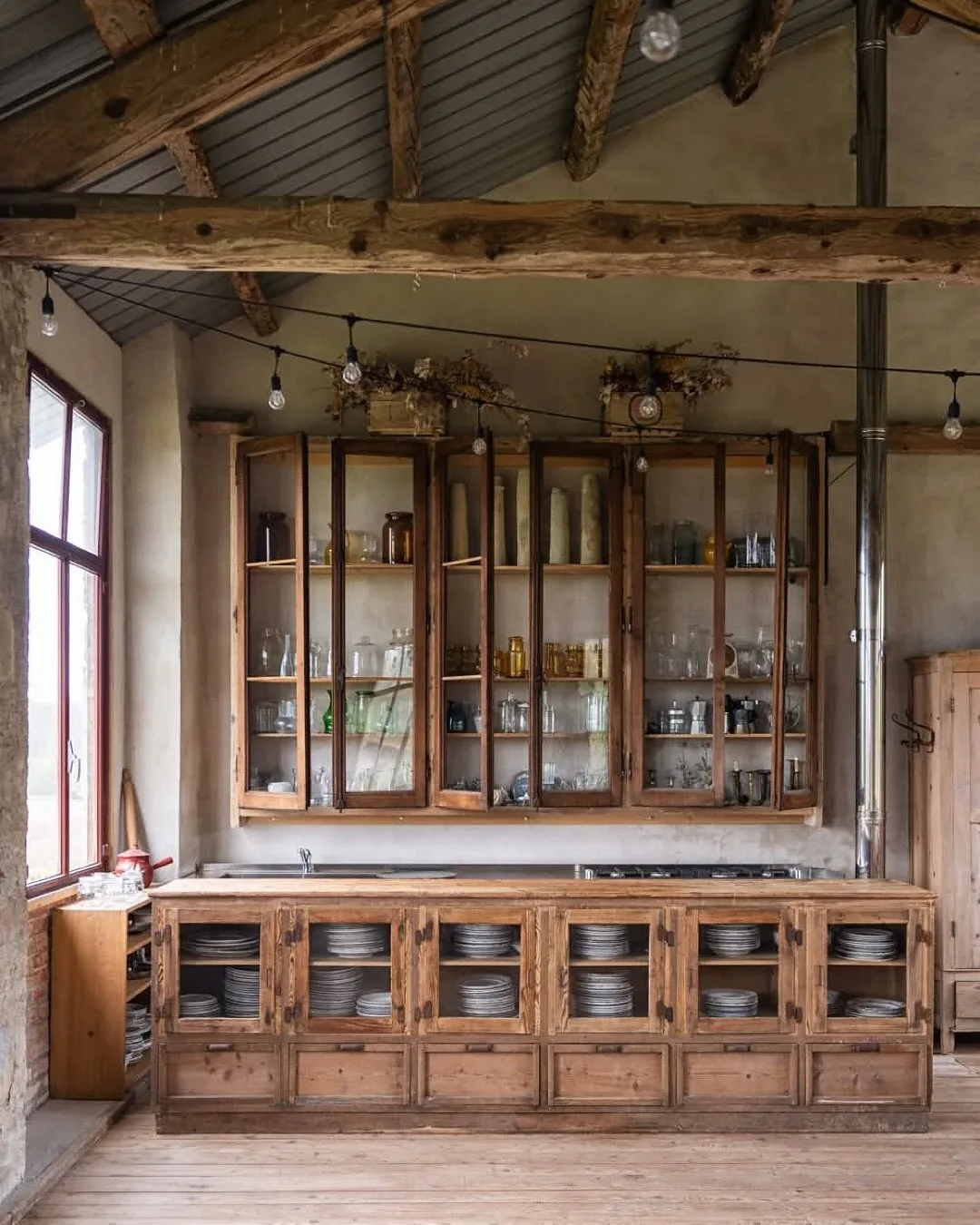
This is the idea at building scale, and it is the version that will test your budget. The two banks shown here cross the wall, packed with preserving jars and glassware, and beneath them a long run of timber cabinets with glass doors showing stacks of plates. The room is a barn, so the ceiling is corrugated sheet on exposed rafters and the flue rises through it in stainless steel.
The cupboards are old shop fitments, and they are the reason the room works. At this size the one find is not a dresser but a wall of them, bought as a single lot from a closing shop or a salvage yard. Budget £1,500 to £6,000 for a run that length, then expect to re-glaze part of it: old putty dries and lets go, and a pane drops out of a door the first hard winter after it is hung.
The flue is the other thing to settle early, before you order anything else. A cast-iron range burning solid fuel or oil needs its own lined flue rather than a shared chimney, and it wants 150mm of clearance to any combustible surface where a modern range wants 25mm. That distance decides where the cabinets can go, and it cannot be argued with afterwards.
The floor is wide reclaimed boards, and two facts govern them. Let the boards sit in the room, stacked and stickered, for two to three weeks before you lay them, because old timber moves with the humidity of its new home. Then check the thickness, because after a century of wear they are often only 18mm, which allows you one light sand at most; a second pass reaches the tongue.
Dark paint below, warm light above
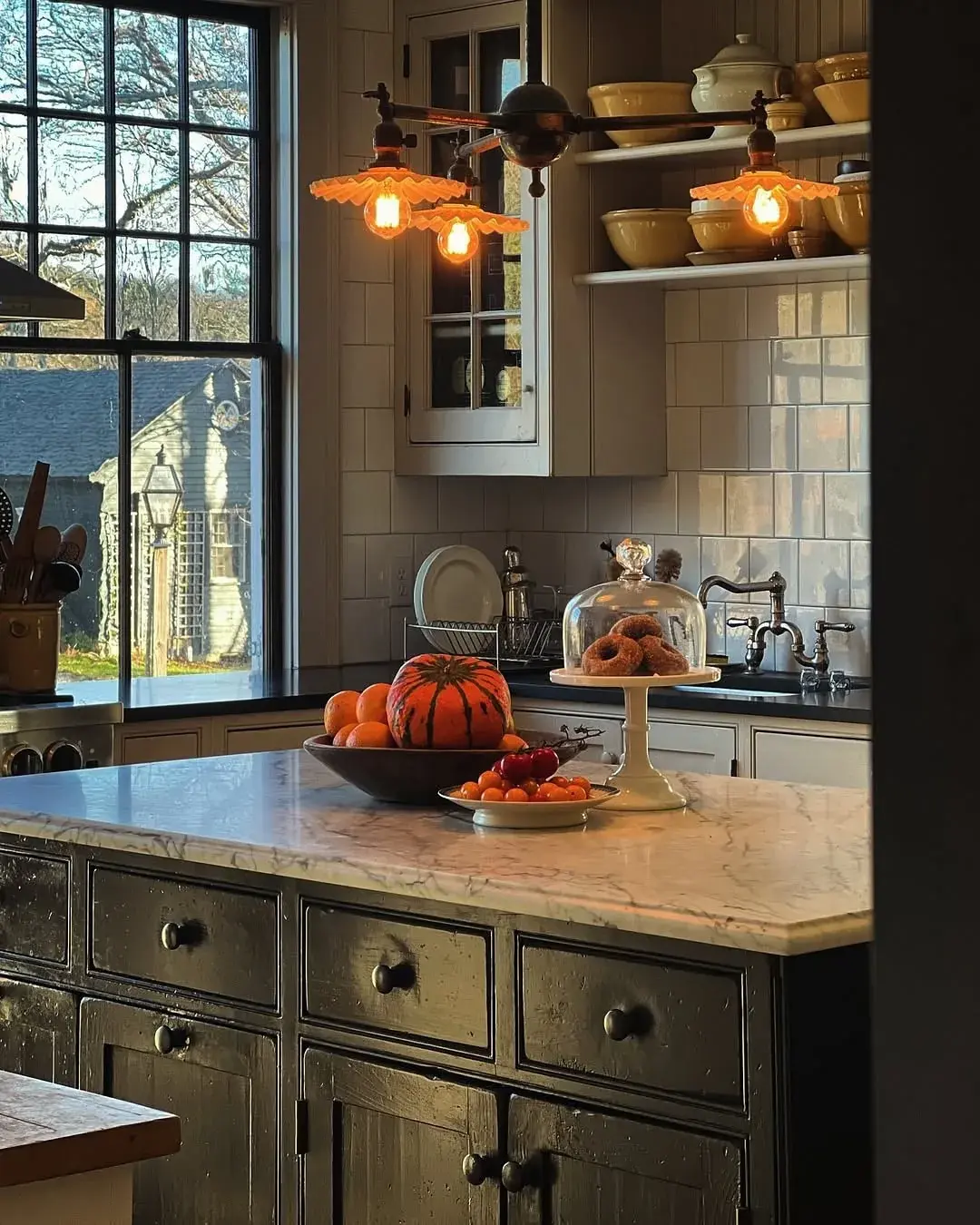
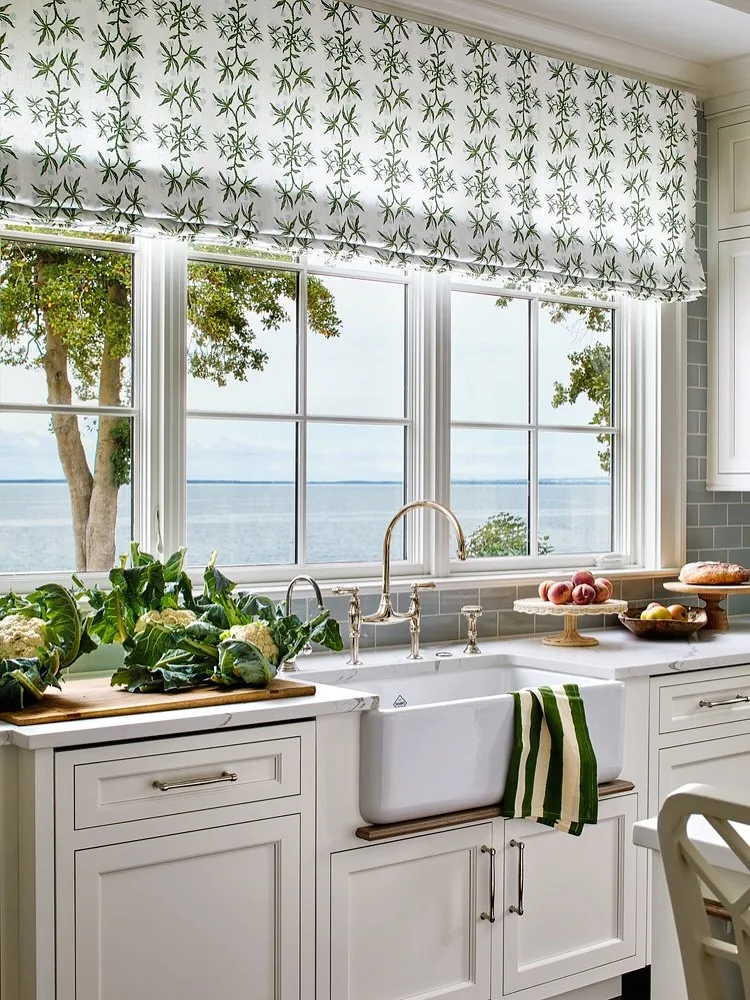
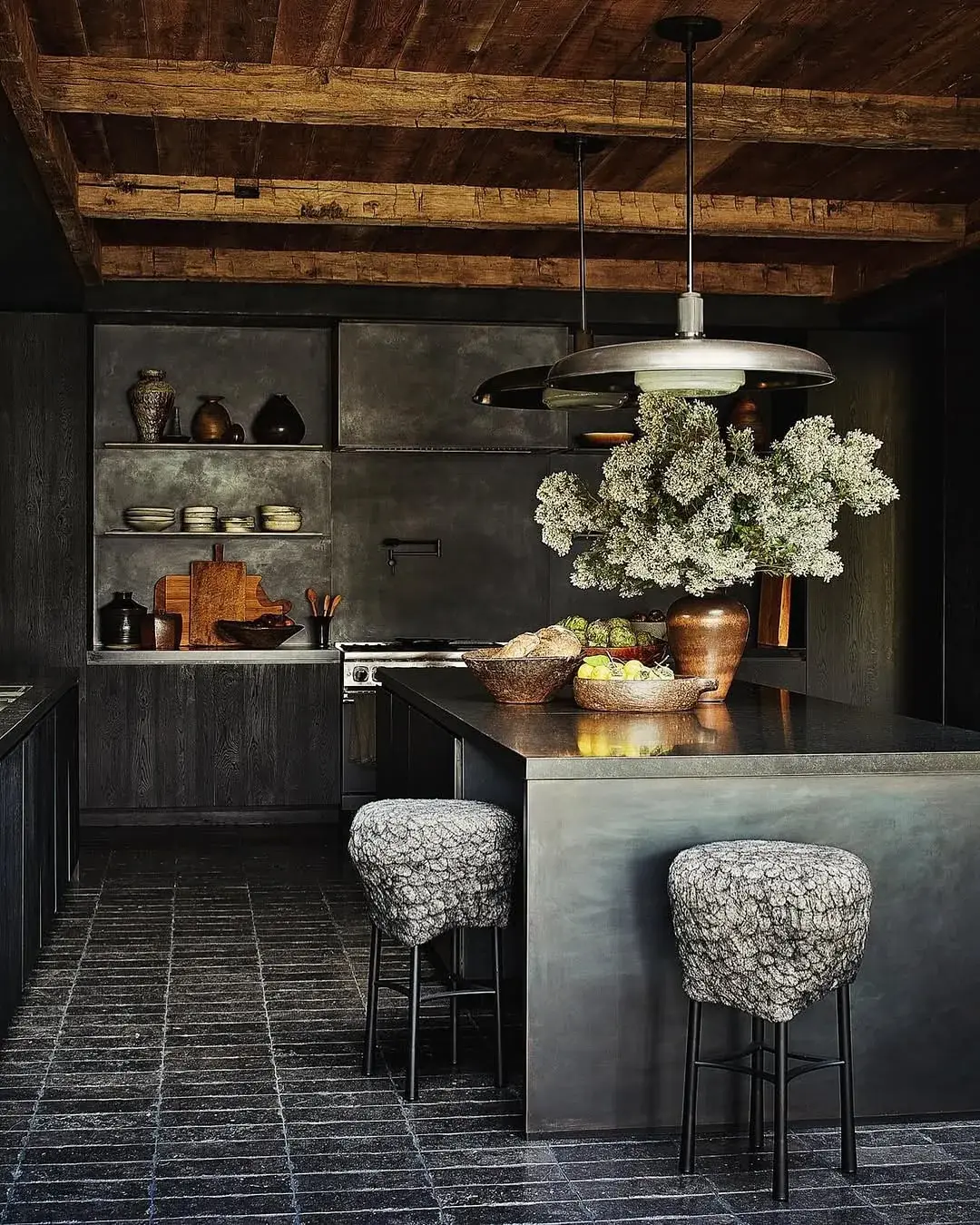
The base of the island is painted almost black-green with small black knobs, and the top is pale marble with heavy grey veining. That is the whole scheme: one dark surface below eye level, everything else light, and it is an arrangement you can copy at almost any budget.
The lights are the part I would take from this room. Two brass swing-arm sconces with ribbed amber glass shades, one either side of the window, and the bulbs inside them run warm, around 2700K, which is why the marble reads cream instead of grey. The same fittings with a 4000K bulb would turn the whole frame cold. Amber glass over a warm bulb doubles the effect, and it is the cheapest change you can make here.
The sink sits under the window, dark, cast iron or heavy composite, with a bridge tap in dark metal. This is where a butler sink earns its reputation. A white glazed fireclay one chips at the rim inside a year in a busy house, and it crazes and stains where tea and beetroot sit. None of that is a fault. It is the finish behaving as the finish behaves, and a chip that has been there 40 years reads as history where the same chip in a composite worktop reads as damage.
If a flawless sink matters more to you than the look, buy stainless steel and accept the compromise.
Built in or freestanding, the dresser does the same work
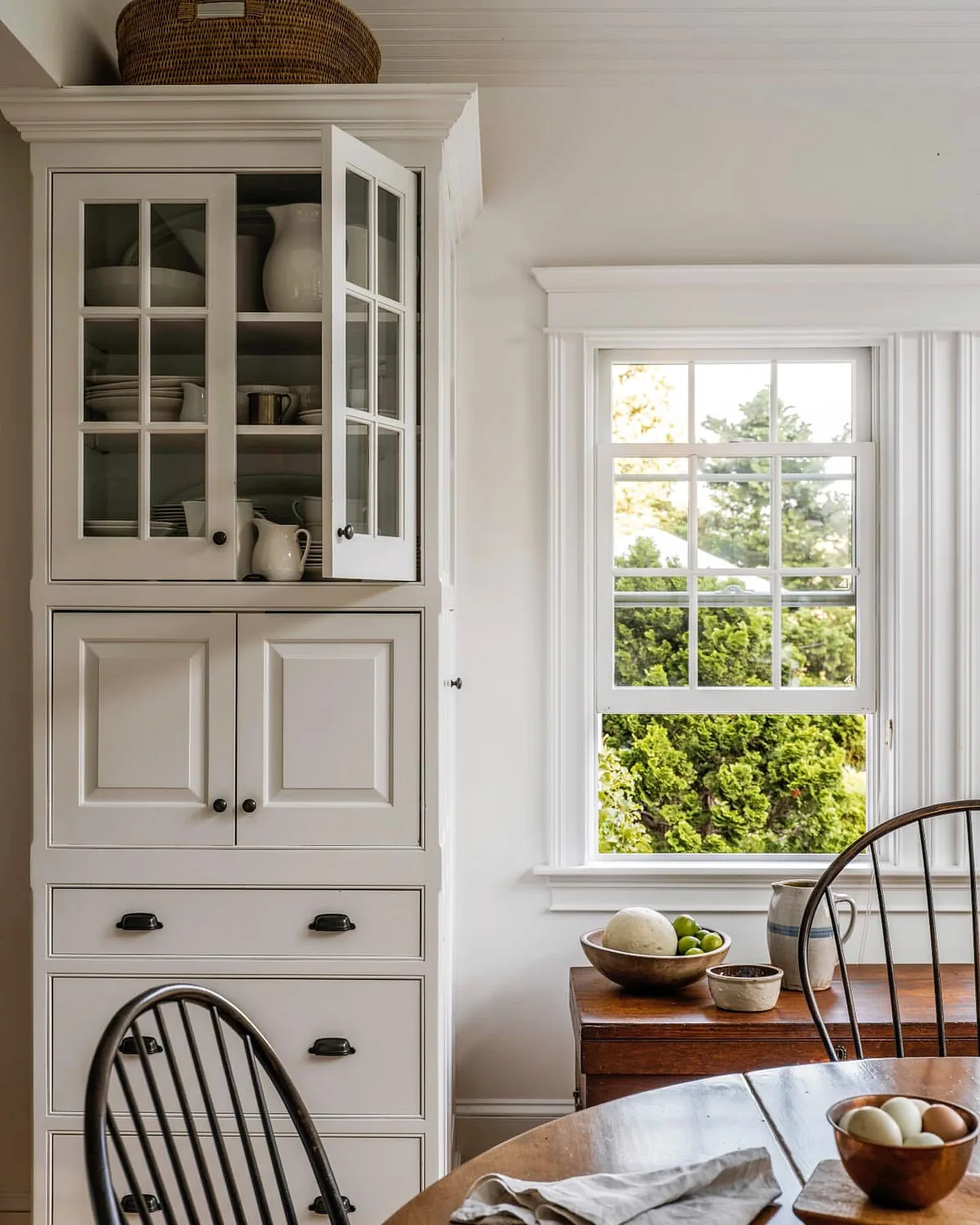
This cupboard is built in, floor to ceiling, glazed at the top, panelled in the middle, three drawers at the base, all in the same white as the walls. The handles are black iron, cup pulls on the drawers and small round knobs on the doors, and they are the only dark line you see from across the room.
The principle from the top of this piece, applied to joinery. Because the dresser matches the room, it stops being furniture and becomes architecture, which lets it run large without crowding anything you want to look at. A freestanding pine dresser in a contrasting colour does the opposite: it is an object in the room, and it consumes visual space as well as floor space.
Behind the glass there is ironstone, white jugs, plain plates, and nothing patterned. That restraint is what makes open shelving read as display instead of storage. One patterned jug among plain ironstone is a note; a shelf of patterned china is a jumble, and the eye stops reading individual pieces.
The one detail the frame gives away is proportion. The glazed section takes about a third of the height, the solid doors take the middle, and the drawers take the bottom, which is why a cupboard this big still looks light. Where the timber of a salvaged piece is poor, paint is your honest answer, and it hides a great deal. Farrow & Ball All White No.2005 or Little Greene Shirting 129 both sit at the warm end of white, and both hold over pine knots provided a stain-blocking primer goes underneath.
How to check a piece before you buy it
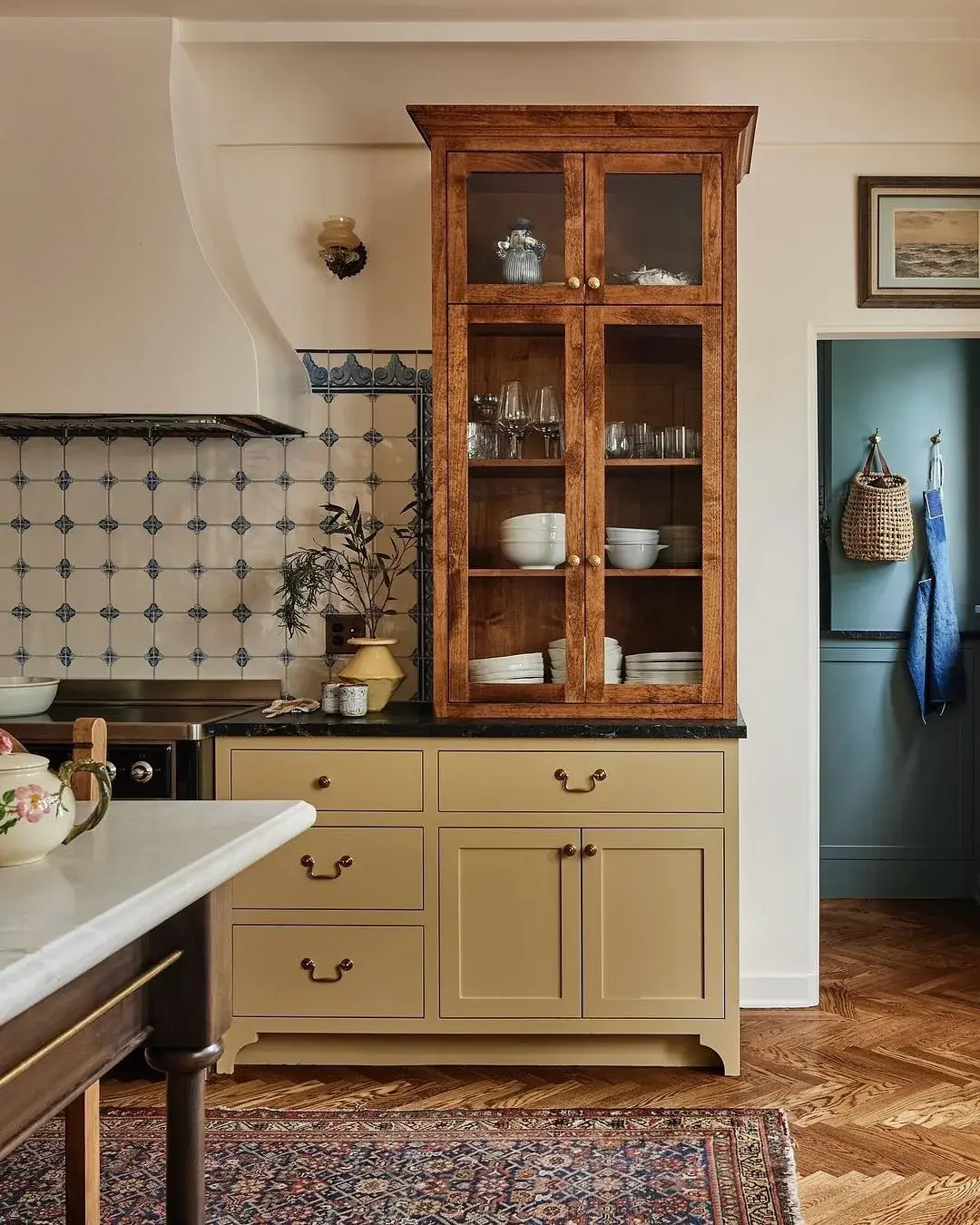
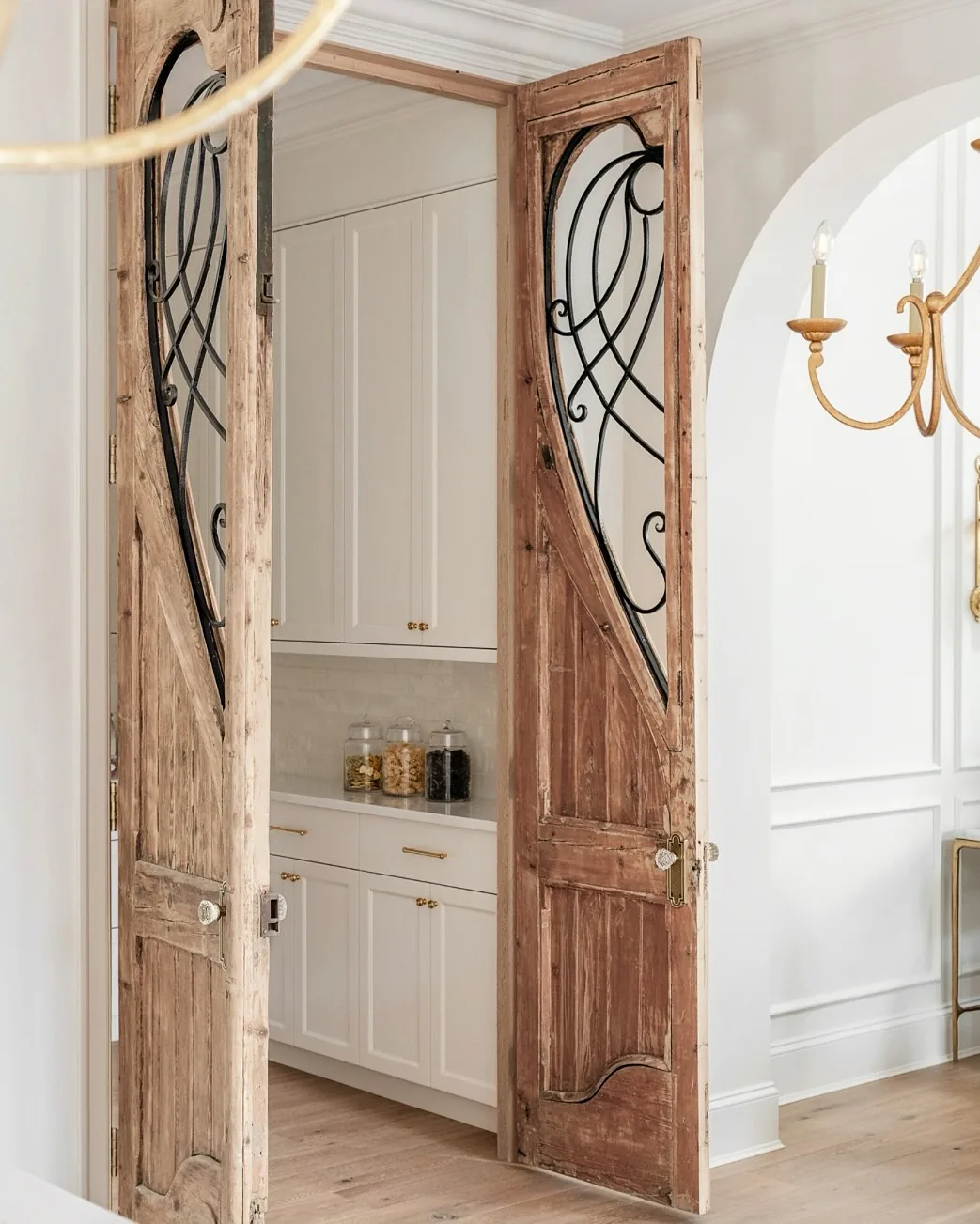
The tall cupboard on the right is the piece worth the journey. Figured walnut, glazed doors, brass knobs, and a cornice that overhangs the carcase. It stands on a plain base in soft ochre, which is the modern half of the arrangement, and the two halves are a century apart in age.
Five checks to run before you buy anything of that kind. See how the cornice projects past the sides: that overhang is original, and a replacement top usually sits flush. Then lay a spirit level across the top and look for daylight, which is warping. Press every joint where the sides meet the top, because a split there is a drying fault and it opens further in a heated room.
Search the underside and the back for worm. Small oval holes with fine powder beneath them mean live beetle, and that cupboard stays in the yard whatever the seller tells you.
Then open the doors. Missing handles cost little to replace, but a missing escutcheon usually means the lock has gone as well, and you will pay £40 to £150 for an antique replacement. Check that the shelves are original boards and not plywood, because new shelves in an old cupboard tell you it was repaired badly.
The blue-and-white tiles behind the range are the cheaper idea in the same frame, and a machine-made delft pattern in 150mm squares costs £40 to £90 per square metre.
The runner, which is the other idea here
A brightly coloured rag runner down the working aisle, and it is the only strong colour in the room.
Rugs in kitchens divide people, and the practical answer depends entirely on what the rug is. A Boucherouite or rag runner of the kind in that photograph is woven from cut cotton, washes in a machine, and costs £80 to £250. That is a rug you can cook on.
A fine wool or silk rug in the same position is a mistake, because it cannot be washed and it will be cooked on.
Runners also do something useful for a galley kitchen: a long line down the aisle emphasises the length of the room and gives the floor a direction. Keep it narrow enough that the cabinet doors clear it.
Where the line is
There is a difference between old and old-looking, and it is worth holding onto.
Old: a real range, a genuine dresser, worn copper, a secondhand table, an antique rug. These have history in them and it shows in the wear patterns, which are always more irregular than anything manufactured.
Old-looking: distressed paint, artificial crazing, fake patina, reproduction hardware aged in a factory, signs with words on them.
A kitchen can carry almost any amount of the first and very little of the second.
Frequently Asked Questions
What counts as a real antique in a kitchen?
Anything made before roughly 1940 that has been used hard and shows it. Age lives in the wear, which is never even, because a hand shaped the edges and a person pulled the same drawer for a century. Machine-ageing repeats its marks at regular intervals, and you will spot the pattern before you can say why it looks wrong.
How do I tell live woodworm from old flight holes?
Live beetle pushes out a pale frass and leaves holes with sharp edges. Holes from an infestation that ended decades ago are dark inside, and any dust around them is the room’s own dirt rather than the insect’s. A knife tip into a suspect hole settles it faster than any treatment bought in a panic, and it costs you nothing to try.
Will a salvaged sink connect to modern waste pipe?
Usually yes, with a trap adapter. The complication is the outlet height, because an old fireclay or cast-iron basin often has a shallow bowl and a low outlet, so the waste has to fall away over a shorter distance than a modern deep bowl allows. Check the outlet against the height of the soil pipe before you let anyone cut the worktop.
Do cast-iron ranges need different ventilation from modern ones?
They do. Solid fuel and oil throw out hotter, dirtier exhaust, so a dedicated lined flue is the normal requirement and it cannot share with an open fire. Clearance is the other difference. A modern gas range may sit 25mm from a cupboard, where an old one commonly needs six times that, so check the figure against your own room before you commit.
Can reclaimed floorboards be sanded back to new?
Once, and lightly. A century of feet takes a board down to around 18mm, and the tongue sits a few millimetres below that, so a heavy pass costs you the joint, not just the stain. A floor that has already been sanded twice is a floor to walk away from.
Are reproduction period taps and handles a mistake?
Not always, and the good ones are worth the money. The failure is cosmetic ageing applied in a factory, which wears uniformly, and no metal ages uniformly. Solid unlacquered brass or polished nickel costs more and dulls unevenly where hands actually land, which is the whole point of buying it, and you will only see the difference after a year of use.
To start
- Settle on one genuinely old object, then plan the rest of the kitchen around it.
- Keep everything functional modern and good: taps, appliances, extraction and lighting.
- Inspect any piece in person for warping, worm, split joints and missing hardware before paying.
- Give a solid-fuel range its own lined flue and 150mm of clearance.
- Let reclaimed floorboards acclimatise for two to three weeks, then sand them once only.
- Expect a fireclay sink to chip and stain, and read that as the finish ageing.
- Choose a washable rag runner, and let unlacquered metal dull on its own.
This article may contain affiliate links. We may earn a commission at no extra cost to you.