15 Farmhouse Sink Ideas: Depth Is the Spec That Changes All

Add us as a preferred source to see more stories on Google.
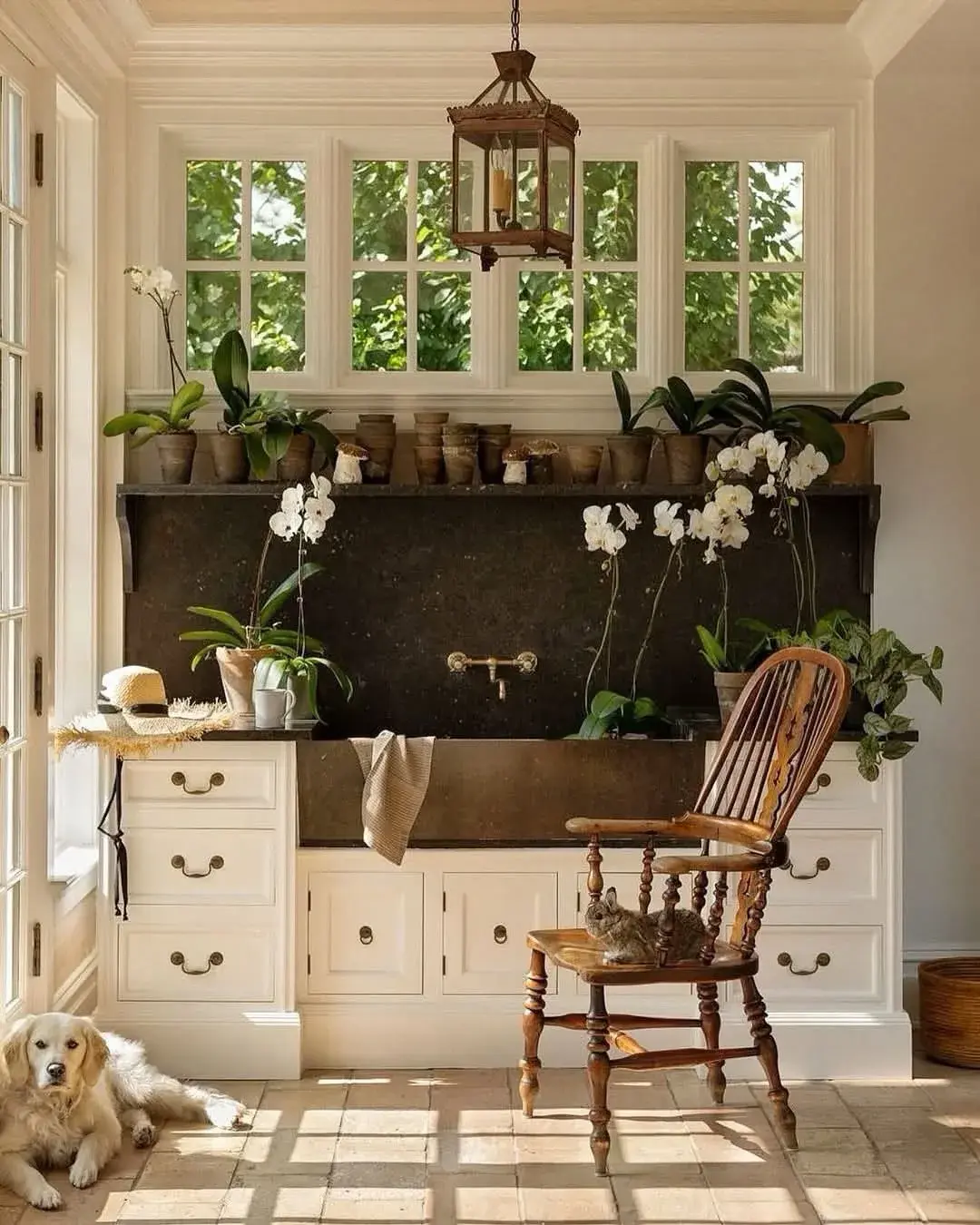
The sink below is carved from a single piece of dark stone, and the reason it works is not the material.
It is deep. Genuinely deep, in the way scullery sinks were, so that a stack of pans disappears into it and the mess is below the worktop line rather than sitting on it.
That is the whole appeal of this kind of sink, and it is the specification most people never check. Apron front sinks are sold on the front panel, which is the part you see, while the measurement that changes daily life is the one you cannot see in a photograph.
What depth actually buys you
A deep bowl holds a roasting tin flat, which a shallow one does not, and that single fact is the difference between washing up in the sink and washing up around it.
It also hides things. A sink with 250mm of depth keeps a day’s dishes below the worktop line, where a shallow one displays them to the whole room. In an open-plan kitchen that matters more than it sounds.
| Depth | Reality |
|---|---|
| Under 180mm | Splashes constantly; roasting tins will not fit |
| 200mm | Workable, common in smaller apron sinks |
| 220 to 260mm | The traditional Belfast range; suits most kitchens |
| Over 280mm | Excellent for cooking, hard on the back for long jobs |
There is a genuine trade-off at the deep end. A very deep sink means bending further, and for anyone with a bad back an hour of washing up becomes unpleasant. If that applies, 220mm with a good drainer beats 300mm.
The weight nobody plans for
A large fireclay apron sink weighs 40 to 60kg empty. Fill it and add wet dishes and you are comfortably past 100kg sitting on the front edge of a base unit.
A standard cabinet is not built for that. It needs a purpose-made sink base with a solid bearer across the front, or a timber frame built in. Retrofitting an apron sink into an existing run almost always means rebuilding that cabinet, and it is not a small job.
Stone sinks like the one above are heavier again, often 80kg or more, and usually sit on a dedicated masonry or timber stand rather than a cabinet.
Decide this before the kitchen is ordered, not after.
Material, honestly
| Material | Roughly | Character |
|---|---|---|
| Fireclay, white | £250 to £700 | The classic; chips crockery, stains slowly |
| Fireclay, coloured | £400 to £900 | Same, in greys and greiges |
| Composite | £200 to £500 | Warmer to touch, quieter, less traditional |
| Stainless apron | £300 to £700 | Practical, forgiving, less of a feature |
| Natural stone or slate | £800 upward | Beautiful; needs sealing, stays cold |
| Copper | £500 upward | Lives and patinas; needs specific care |
Bands are 2026 prices from high-street sheds and specialist merchants.
Shaws of Darwen and Belfast Sink Company sit at the traditional end; Villeroy & Boch, Blanco and Reginox cover the middle; and most large retailers now carry a serviceable own-label fireclay around £250.
The honest warning on fireclay: it is rigid and unforgiving. Glasses that would survive a stainless sink break in it, and thin china chips at the rim. A sink mat solves most of that and costs very little.
Stone and slate are gorgeous and cold, so water goes tepid quickly, and they need sealing on a schedule. Worth it if the room deserves it, not worth it for the look alone.
The tap decision comes with it
The tap in that photograph is wall-mounted, which frees the whole rear edge of the sink and removes the one part that collects limescale.
That has to be planned early, because the valve sits inside the wall. Where it is not possible, a tall bridge or pillar tap with a high spout keeps the clearance a deep sink needs. Check the spout height against the bowl depth; a standard tap over a 250mm sink leaves very little room to fill anything tall.
Where an apron sink is the wrong choice
Small kitchens with a single short run. An apron sink eats worktop either side and, at 600mm wide, takes a disproportionate share of a 2-metre run.
And rentals, or any kitchen you are not rebuilding. This is a fitted decision rather than a swap.
The sink that stays out of the photograph
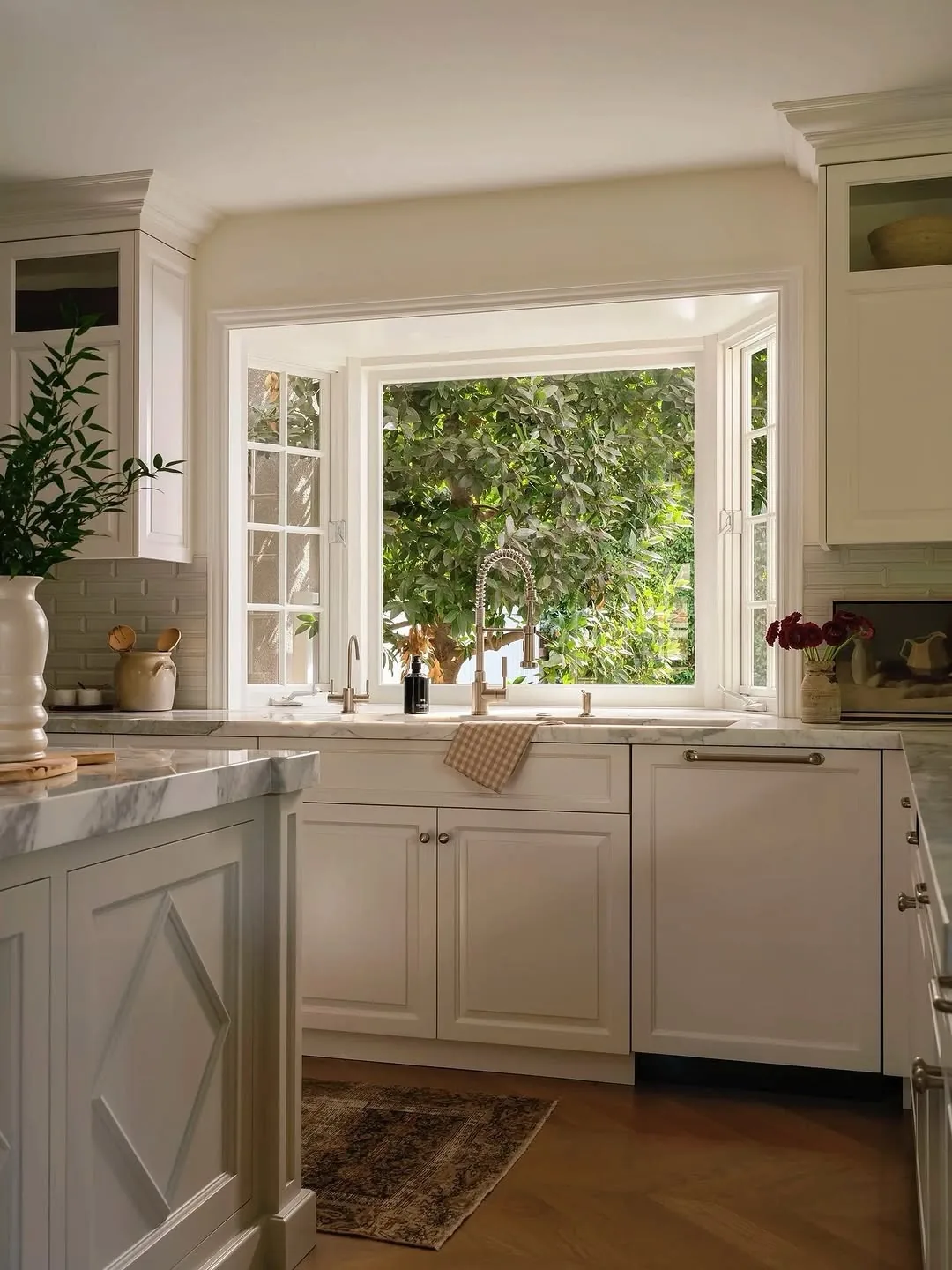
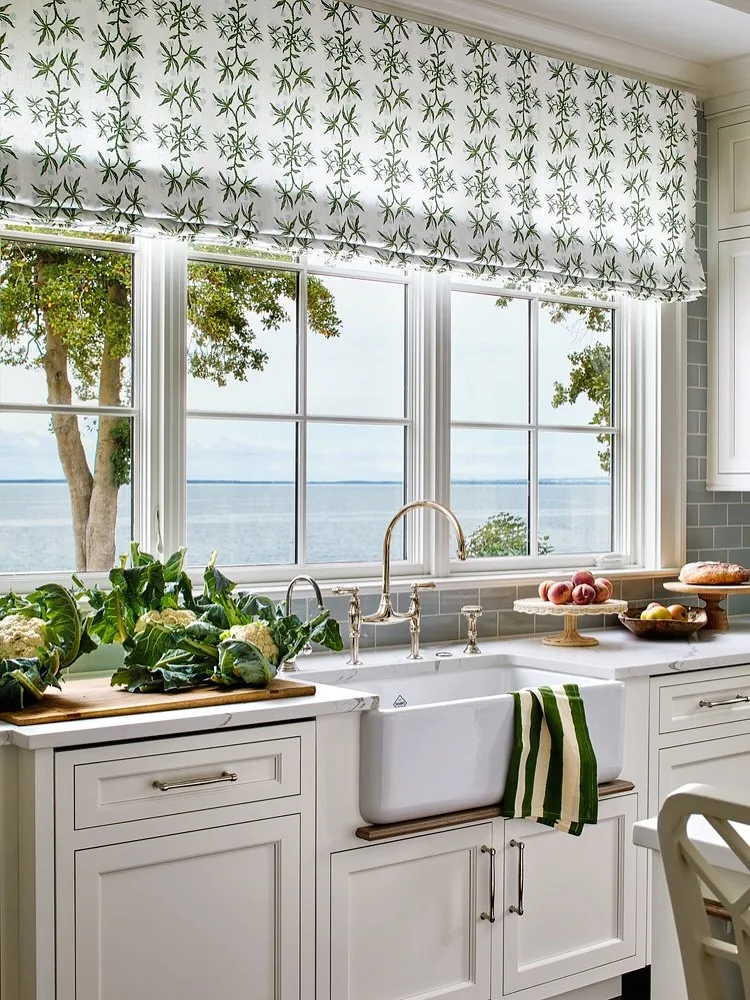
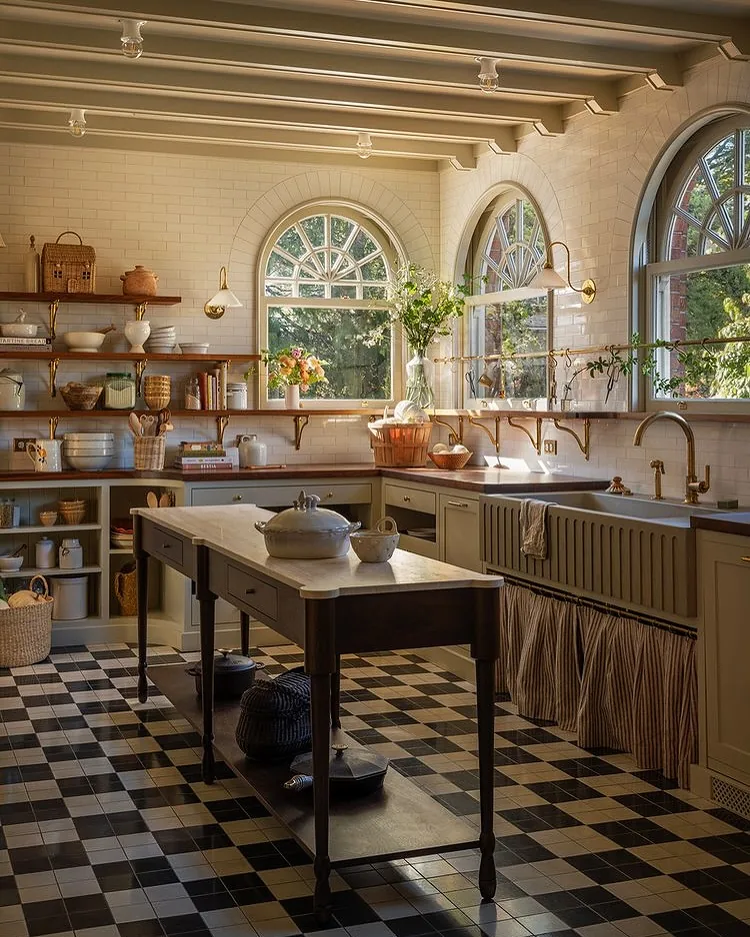
An apron sink is a front panel first and a bowl second, because the panel is what the eye reads from the doorway. In this kitchen the basin stays hidden behind plain shaker fronts, so the room reads calm and ordered, and nothing about it says farmhouse.
The room still teaches the apron lesson: without the panel, even a deep single bowl passes unnoticed. Look at where the stone meets the bay window: marble with a soft grey vein, white fronts with a cool undertone to match, and a tall coiled tap in brushed nickel with its rinse jet alongside.
The three-sided daylight is doing half the work here, which is why the cool whites sit together without fighting. A warm cream front under the same stone would argue with it all day. At 2700K the evening light flatters both materials, while under 4000K downlights the same pairing would read grey and cold, which puts the decision in the lighting, not the paint.
For anyone ordering this look with an apron front, the panel must sit proud of the cabinet line by a finger width. Flush it back and the shadow gap reads as a fitting error from across the room. Semi-professional taps of this type run £250 to £600 in 2026 from Franke, Blanco and Perrin & Rowe.
A curtain where the doors should be
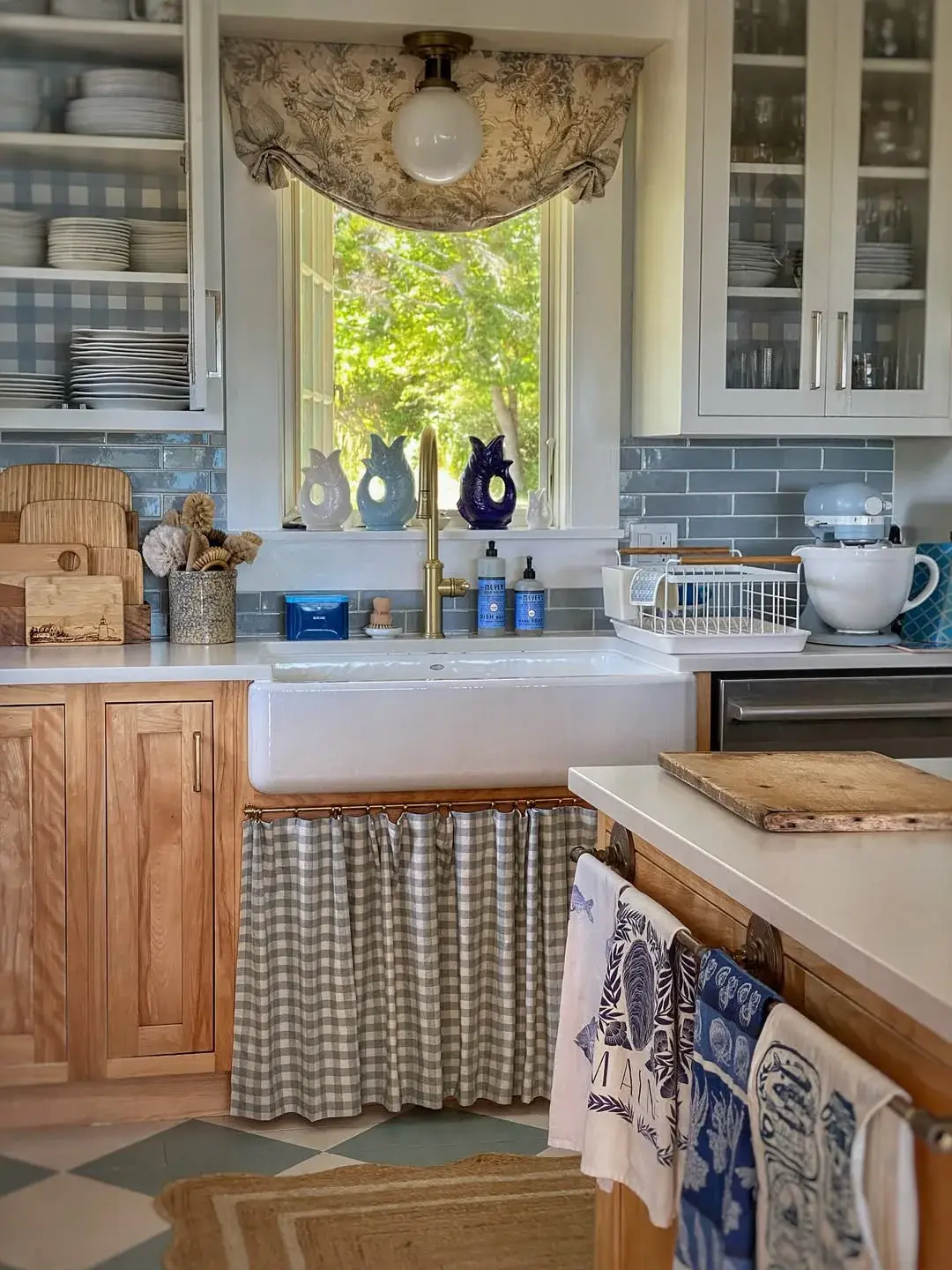
Under an apron sink the cupboard doors are usually false, because the trap, the waste kit and the support frame eat the space behind them. This kitchen stops pretending and hangs a gingham curtain on a brass rail instead.
The bowl is a plain white Belfast with a deep single chamber, set between pale timber cabinets under a window dressed with fish jugs and stacked boards. Notice how the curtain gives full-width access to everything underneath, where a pair of doors would give two narrow kneeling slots.
That blue glazed subway tile is the colour discipline of the room. Timber, white and one blue, with the brass tap and rail warming both. Farrow & Ball Pointing No.2003 or Benjamin Moore White Dove OC-17 would get a cabinet close to that chalky white, and both sit well against oak.
The honest condition is laundry, since a splash-zone curtain needs cotton that survives hot cycles. The whole arrangement comes to £30 to £80 in 2026.
Brass repeated until it reads as one decision
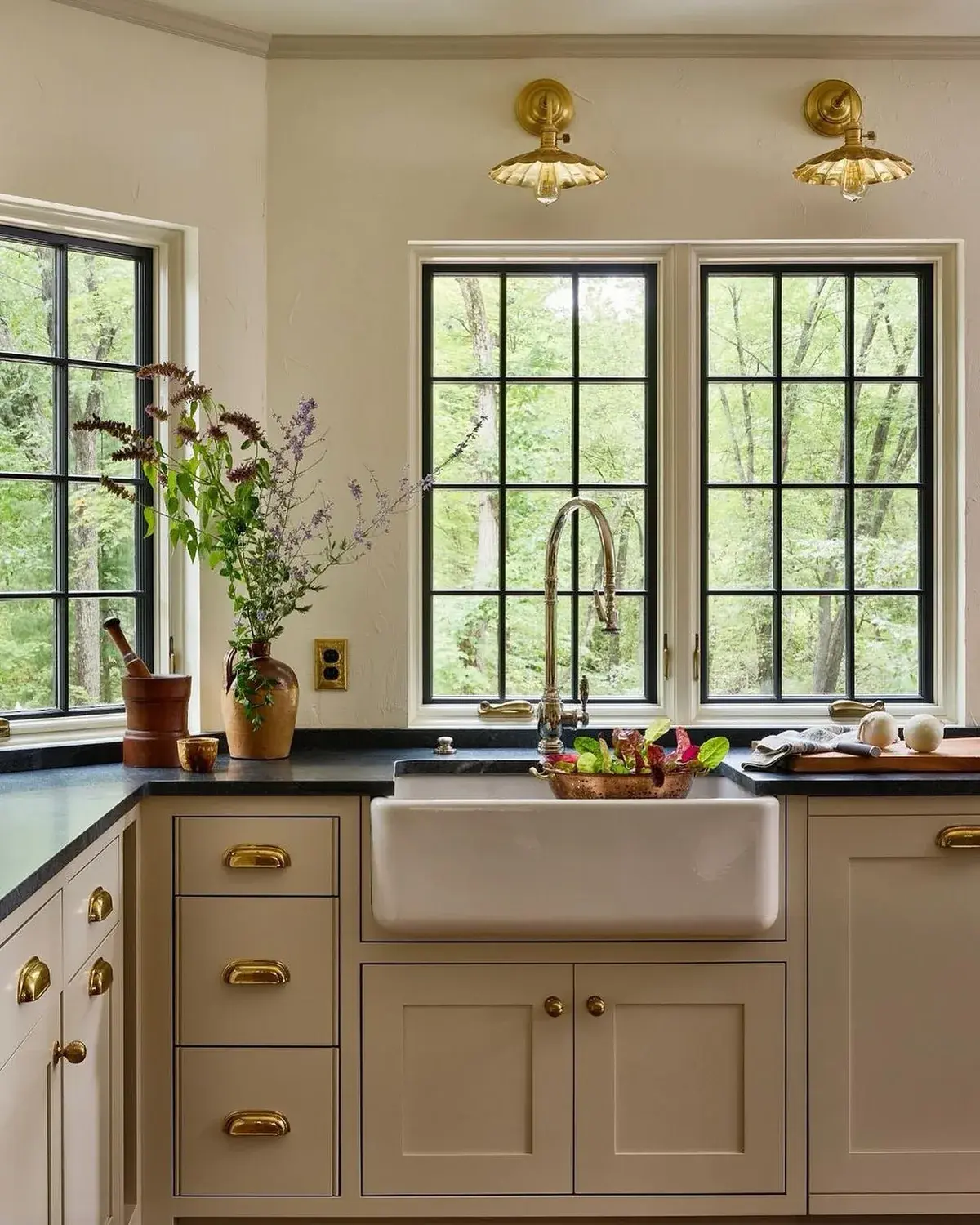
The apron here is plain white fireclay, centred under a pair of black-framed windows, and everything metal in the room is pulling in the same direction. The bridge tap, the cup pulls, the little knobs and the two shaded wall lights share one aged brass, which is why the wall reads settled.
That is the principle: one metal at the waterline, carried through the hardware, or the focal wall looks undecided. The pulls show it most clearly. Three drawers of the same brass, repeated without variation, do more for the room than any single statement fitting.
The dark honed worktop is doing the framing. A white apron against a pale top melts into the cabinets; against near-black stone it sits like a picture in a mount. The copper bowl of leaves on the sill repeats the warm metal without adding a new one.
Match aged brass to aged brass when extending this. Unlacquered brass dulls and blotches within a year, which suits cream cabinetry, while lacquered brass stays bright and can look stranded. Solid brass cup pulls cost £6 to £14 each in 2026, and a brass bridge tap of this pattern £180 to £450.
The washing-up bowl on the side
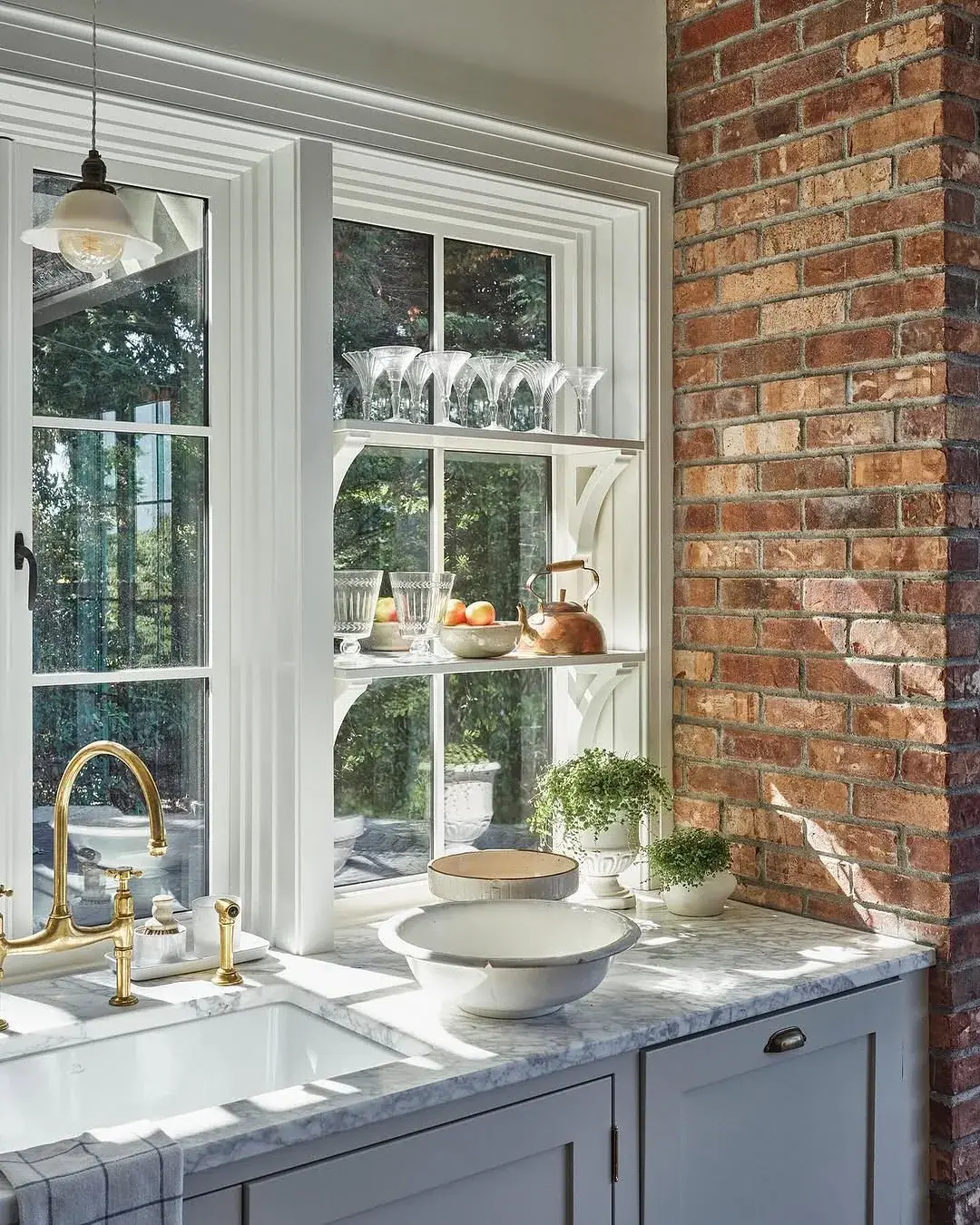
Divided bowls solve the soaking problem inside the sink. This kitchen solves it beside the sink, with a loose white bowl on the marble, and keeps the big chamber free for trays that lie flat.
See what the brick pier does for the composition. One warm vertical strip against grey-blue cabinets stops the whole wall going cool, and the window shelves with their glassware and copper kettle borrow the daylight. In this kitchen the sink wall is dressed like a still life, because the window gives permission.
The tap is a brass bridge with separate hand wheels, tall enough to fill the loose bowl under it, which matters more than the badge on the box.
Glass on a window shelf needs dusting, which is the only criticism available. Keep everyday tumblers there, since those get washed regardless, and put anything decorative further along the wall. Enamel washing-up bowls of this sort cost £15 to £30 in 2026.
A white apron set into dark stone
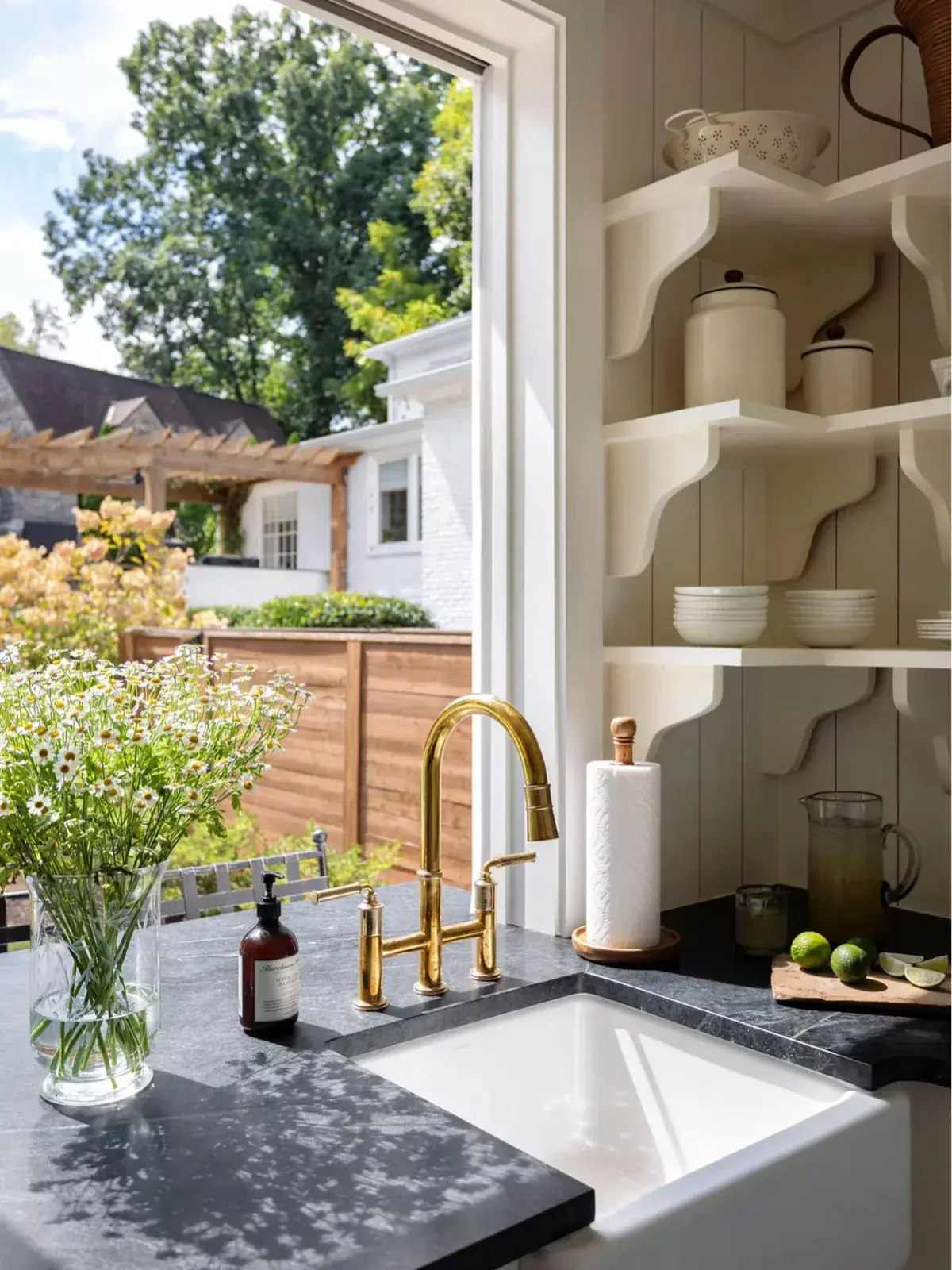
White fireclay against near-black stone is the highest contrast on this page, and it works because the stone carries blue instead of brown. Cool against cool, with the brass tap supplying all the warmth the picture needs.
The bowl shown here is a single farmhouse chamber dropped into a dark top, with a brass bridge tap behind it and open shelves of crockery and baskets rising to the right. Look at the shelf nearest the tap. Those are everyday plates and bowls, which is exactly what should live inside a splash zone.
Anything decorative on that shelf would spot within a week. Everyday china gets washed anyway, so the spray costs nothing. That distinction, between what gets used and what gets looked at, decides whether open shelving near a sink is practical or a maintenance hobby.
Honed granite of this depth runs £350 to £700 per square metre fitted in 2026, and the sink cut-out plus the tap holes are priced on top. A white apron in a dark top also hides the one thing dark tops show, which is the pale dust of daily life gathering round the rim.
When the apron is the stone
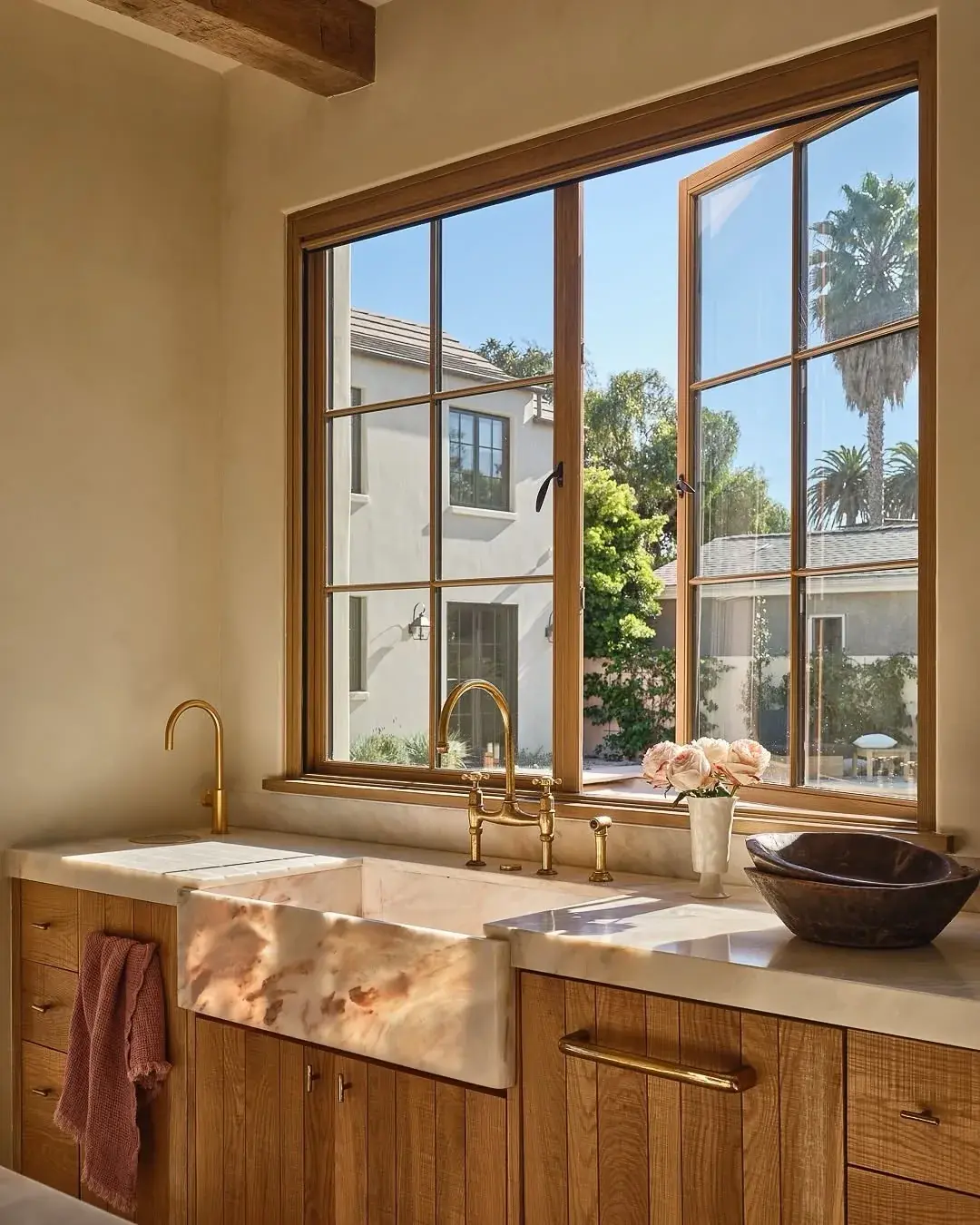
Most aprons are white fireclay with the worktop doing the talking. Here the positions reverse: the apron is pink-veined onyx, matched to the top in one continuous sweep, and the oak cabinets underneath stay deliberately quiet.
That reversal sets the rule for the whole wall. A veined stone apron is a picture, so nothing else gets to perform. The oak is straight-grained and clear-finished, the brass bridge tap picks up the pink in the stone, and the dark turned bowl on the sill echoes the windows. The pink linen at the left repeats the stone without matching it, which is the correct way to echo a loud material.
Stone of this type needs sealing on a schedule and it etches where lemon sits, so the maintenance is real and annual. Buy from the slab at the yard: samples lie about stone this variable.
Stone apron sinks start around £1,000 in 2026 and climb fast with rarity, against £300 to £700 for a Belfast fireclay of similar size. The premium buys a front that nobody else has, and a sealing routine that nobody should skip.
Copper in a working galley
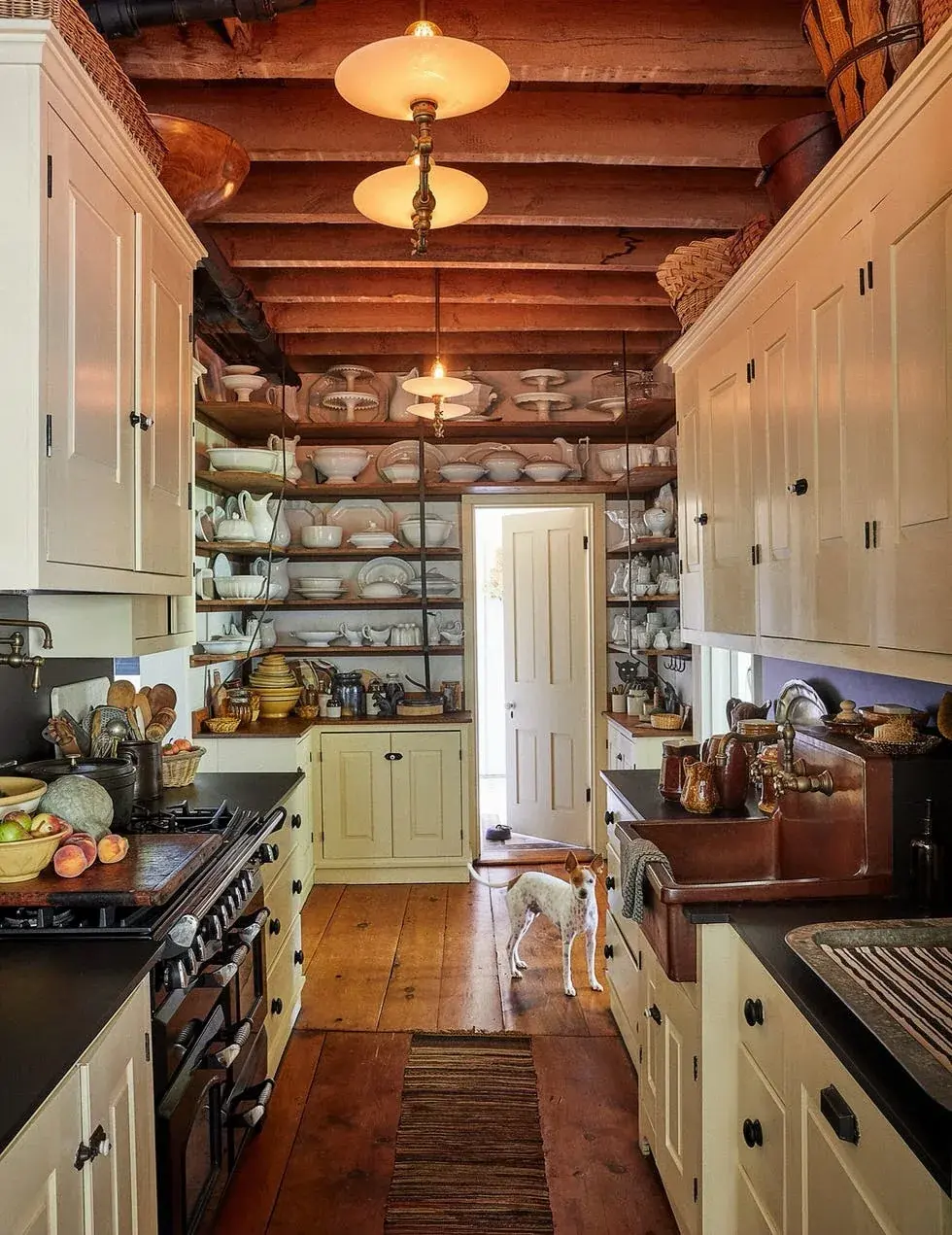
This is the hardest-working room on the page: a low-beamed galley with the range on one side, shelves of white china above, and a copper apron sink carrying the far end. Patina is the correct finish here, because a working sink never looks new for long and copper stops pretending.
Notice the apron corners, where the mottling gathers darkest. Hands, cloths and pan rims touch those corners a hundred times a week, and the metal records every one. Sealed copper calms this down; living copper tells the story. Both are honest answers as long as the choice is made before ordering.
Everything here shares one temperature with the copper, which is why the galley reads as a single decision down its whole length.
Copper apron sinks run £800 to £1,500 in 2026 depending on size and gauge. Acids spot the surface and scouring brightens patches, so the care stays at light wiping, and anyone wanting a permanently bright basin should choose brass instead.
An old brass tap over a plain white bowl
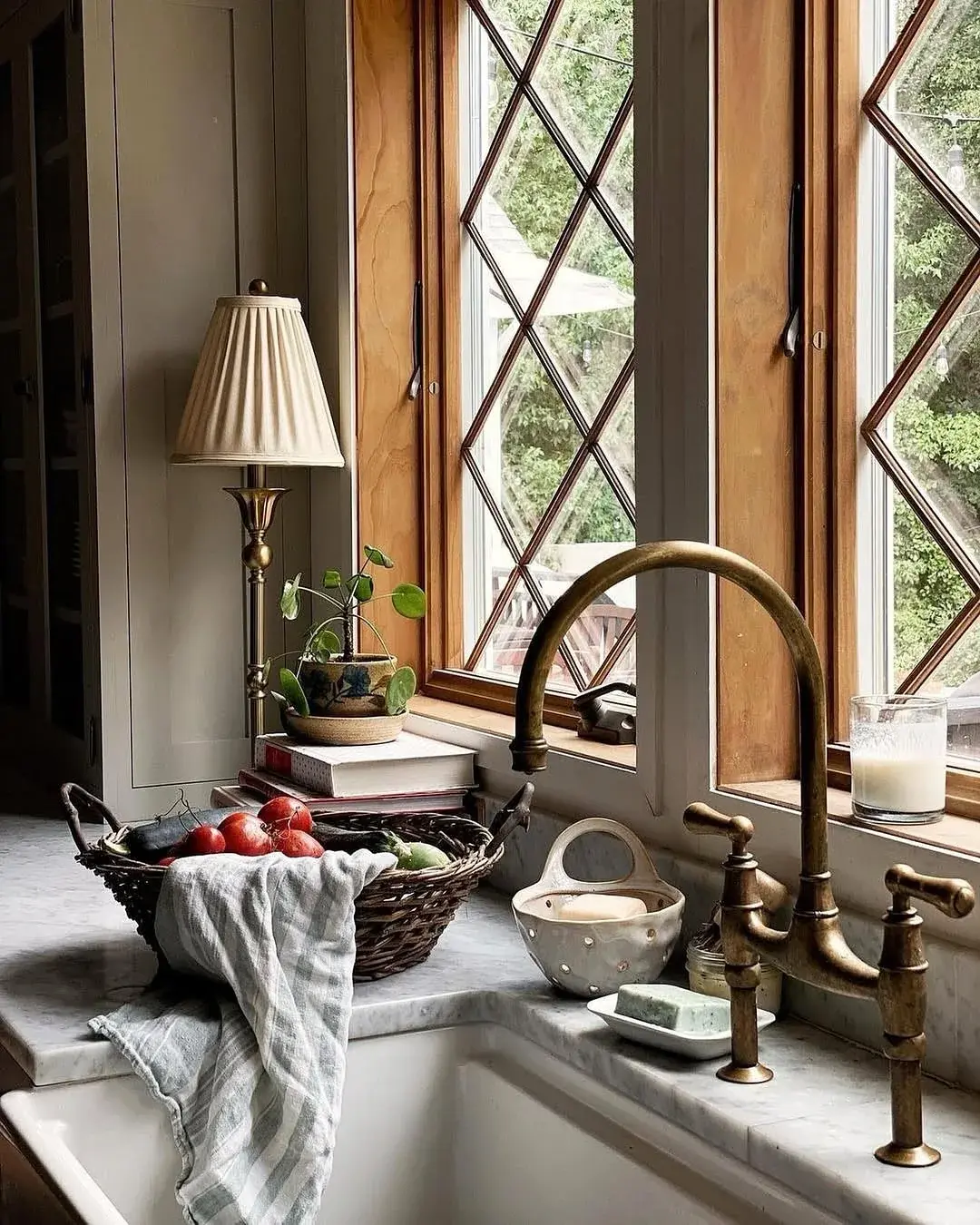
With a plain Belfast bowl the tap carries the entire style, so this is where the budget goes. The bowl in close-up is deliberately ordinary white fireclay, and the aged brass bridge above it does all the talking.
The bridge suits thick decks because its two pillars spread across the stone a handspan apart, where a single tall mixer concentrates its leverage on one hole. That is a small mechanical truth with visible consequences: two holes, properly spaced, wobble less over a decade of daily pulling.
The one detail that dates the picture correctly is the diamond leading in the oak windows. Aged brass belongs with that glass and with the marble top, in a way polished chrome never would. The table lamp on the left earns its place the same way, giving low evening light where washing up happens, as long as it sits clear of spray. Perrin & Rowe and Aston Matthews both cast in this register, and either would sit as easily here as the tap shown.
Aged-brass bridges of this pattern cost £200 to £500 in 2026 from makers such as Perrin & Rowe and Aston Matthews. Pair them with a sink grid from day one, since fireclay breaks what stainless would forgive.
The same logic outside, without the apron
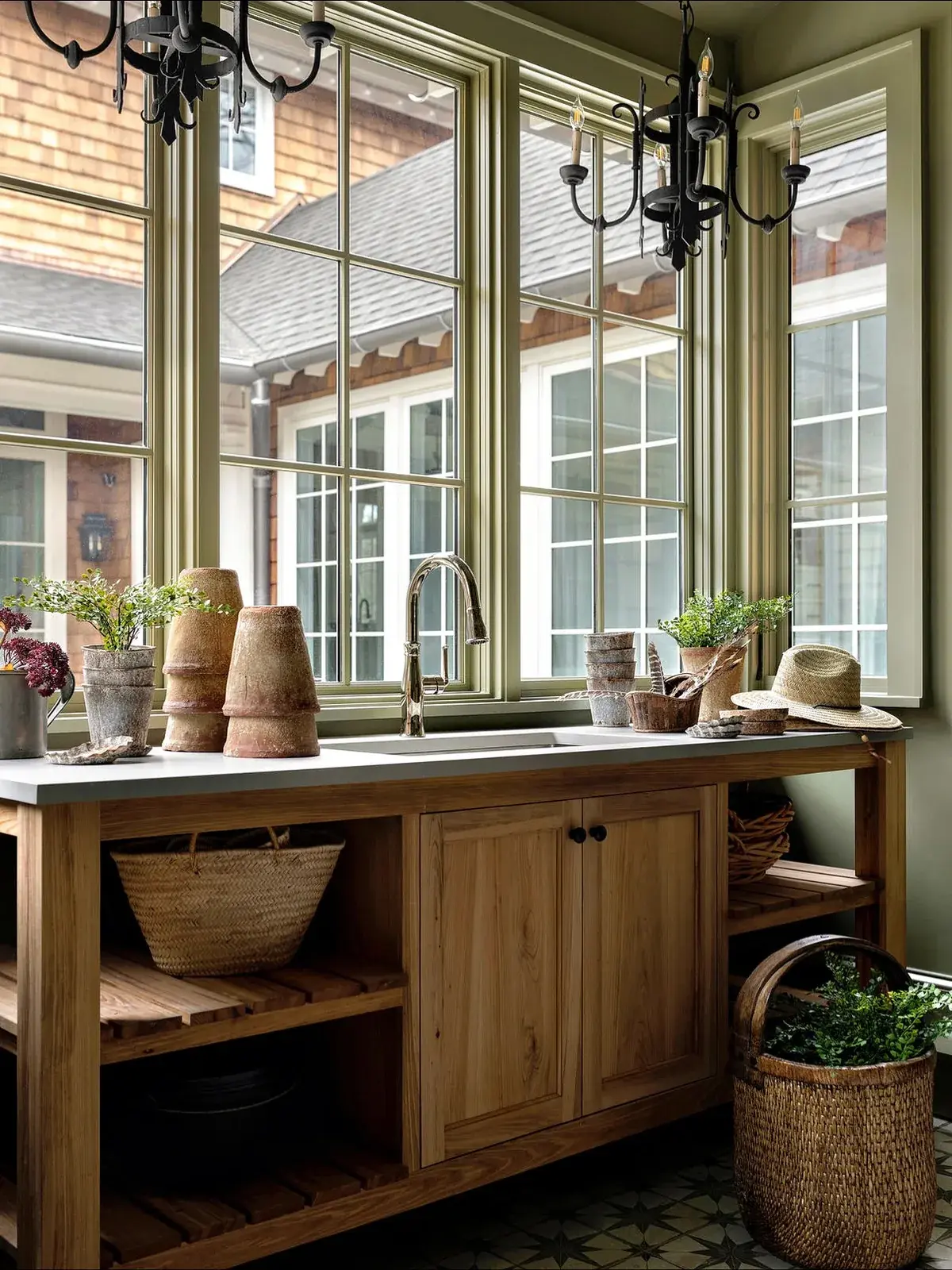
This is not an apron sink, and that is precisely the lesson. A freestanding oak bench under green windows carries a simple inset bowl with a modern pull-out tap, because outside is where fireclay chips and frost finds the crazing.
The rules travel even where the panel does not. The bench is built like furniture, with a solid frame taking the load to the floor. The bowl is stainless, which forgives dropped secateurs and cold nights. The drainer runs back to the bowl with a visible fall, so water never sits on the timber.
In this space the planting does the decorating: terracotta stacks, woven baskets and a straw hat on the bench end. None of it minds humidity, which is more than can be said for the glazed jugs on a kitchen sill.
Use exterior oil on the timber and re-coat yearly. Inset stainless bowls of this size cost £80 to £200 in 2026, and the pull-out tap suits the job because it rinses pots, boots and watering cans that would never fit under a fixed spout.
Metal on metal, and one temperature
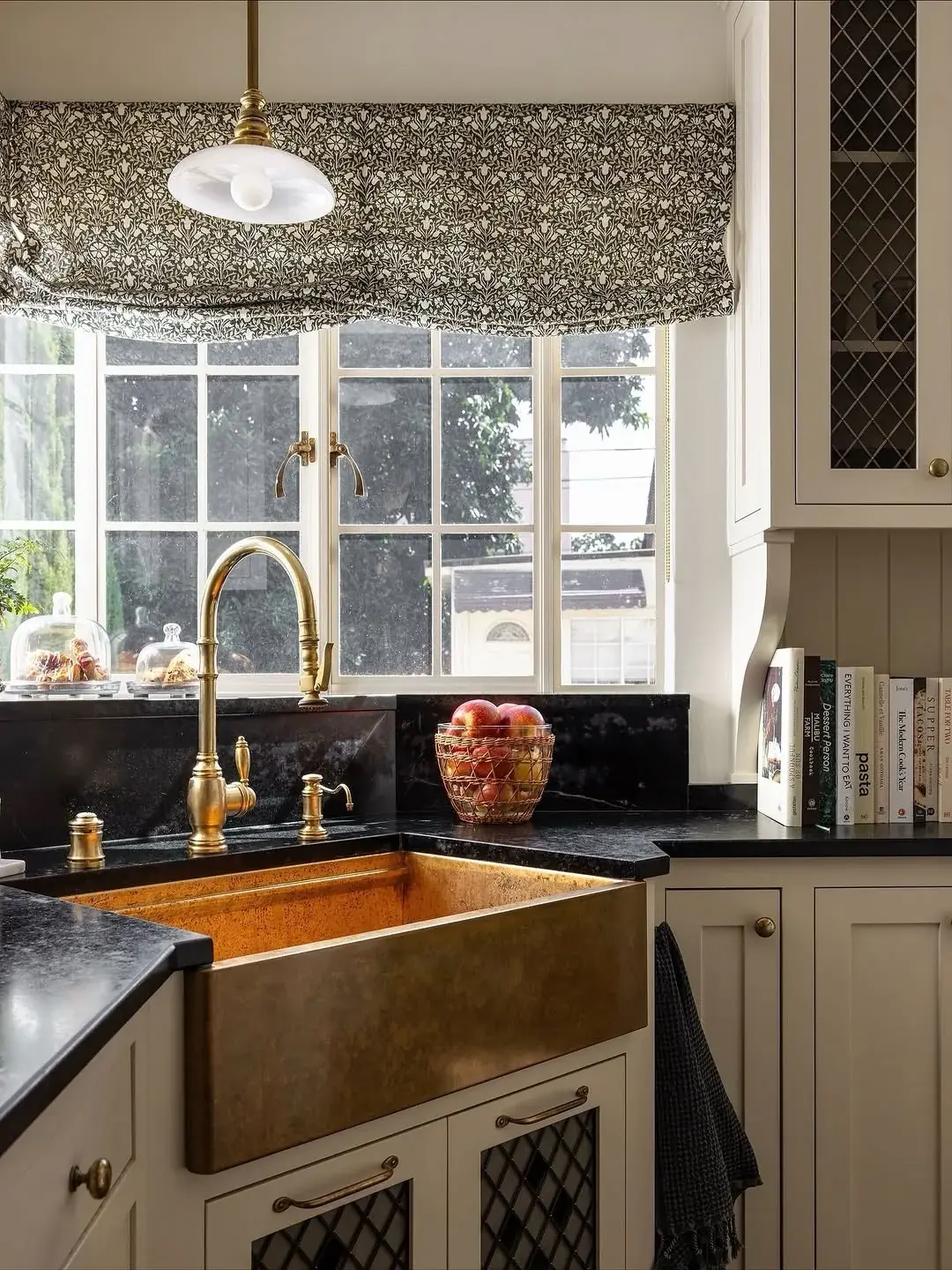
A metal apron needs a tap in the same family, or the sink reads as a sample that escaped the showroom. Here the hammered apron glows under the window, and the brass tap, the side rinse and the cupboard knobs all hold the same warm note against black granite.
The blind hem sits well clear of the splash zone, which is the first thing to verify. A roman blind lifts fully out of spray, where a curtain would hang in it, which makes this the correct textile for a window directly behind a deep bowl. The small pattern keeps its distance from the hammered metal instead of arguing with it.
That finish shows every drip as it dries, so keep a soft cloth under the sill and use it little and often.
Hammered brass and copper aprons sit between £900 and £1,600 in 2026, and unlacquered brass taps to match run £150 to £400. Lacquered brass stays bright with less wiping, and reads cooler, so let the room choose the lacquer.
What the old steel sink gets wrong
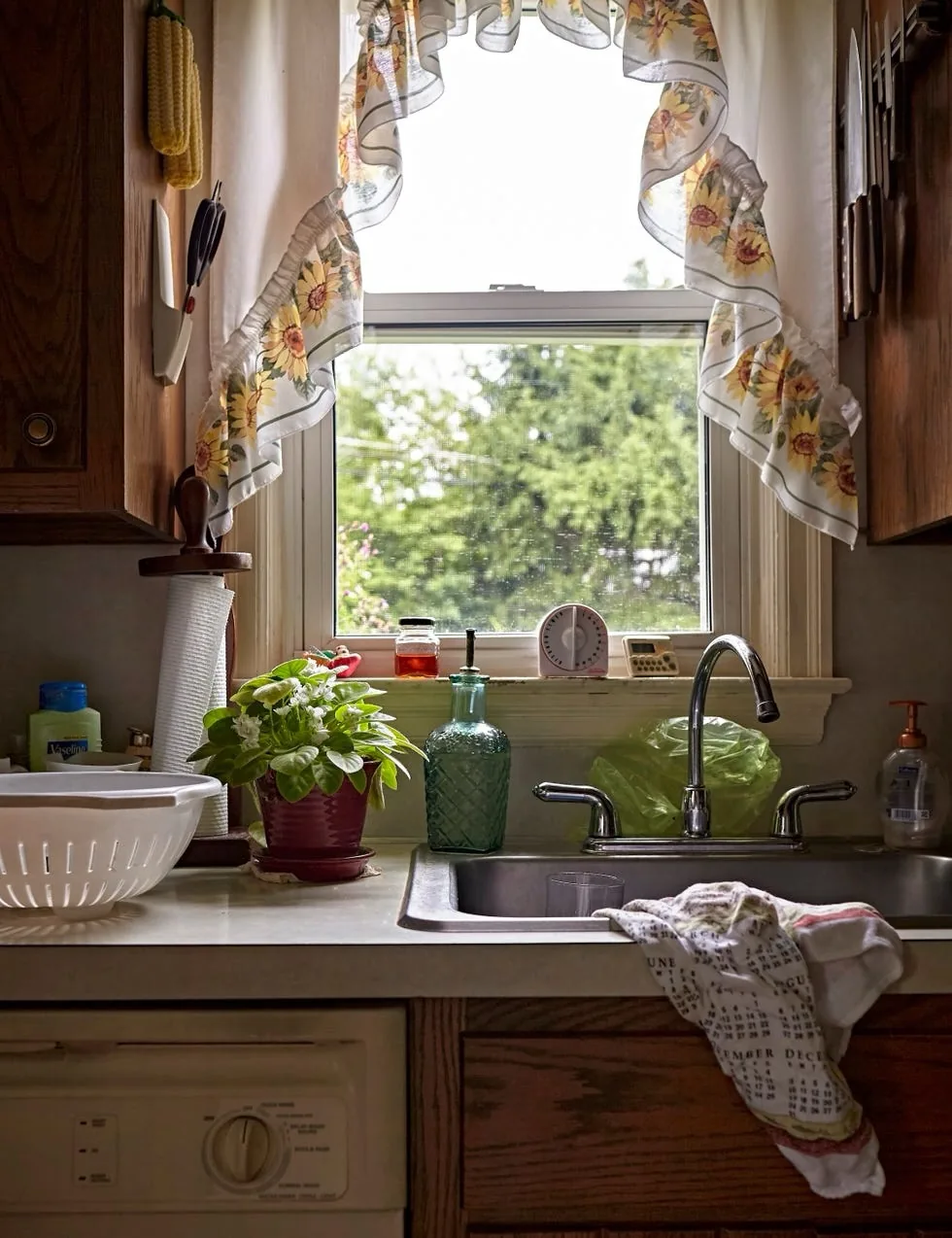
This is the only sink on the page nearing retirement, and it deserves kindness: a pressed stainless double under sunflower curtains, with a crowded sill and a tea towel over the rim. It has washed up for decades. The case for replacing it is comfort, not virtue.
Notice the sill first, because it lists the irritations in order. The low mixer leaves no room for a tall pot, the shallow chambers splash, and the double divide halves exactly the space a roasting tin needs. Depth and a taller tap answer all three, which is the whole argument of this article in one photograph.
A tall single-lever mixer transforms the daily experience for £80 to £220 in 2026, fitting the existing holes while the cabinet fund grows.
Keep the curtains if they delight. A sink window is allowed its ruffles, and the new white bowls photograph no better than this one does with evening sun on the glass.
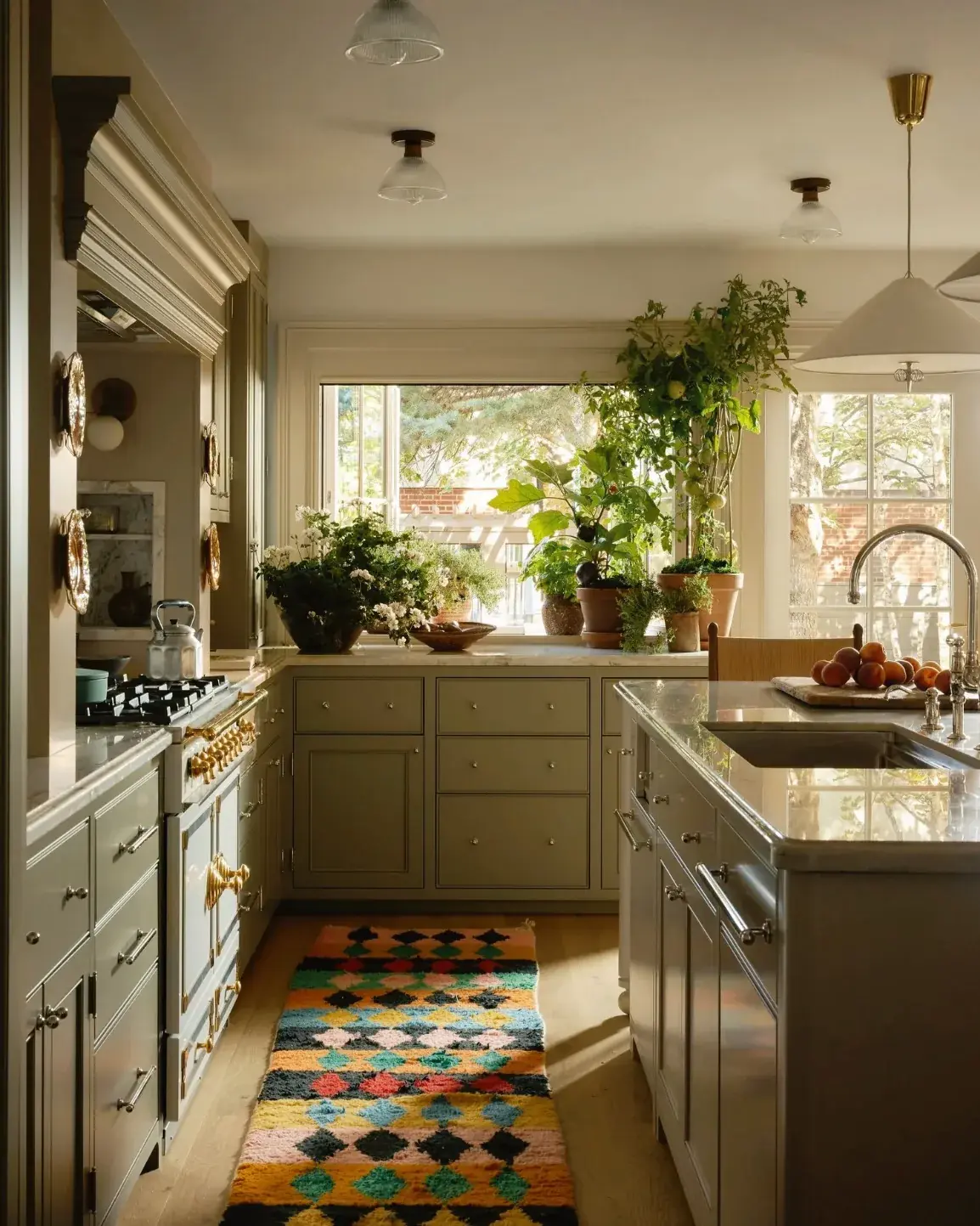
The same kitchen, read for the joinery
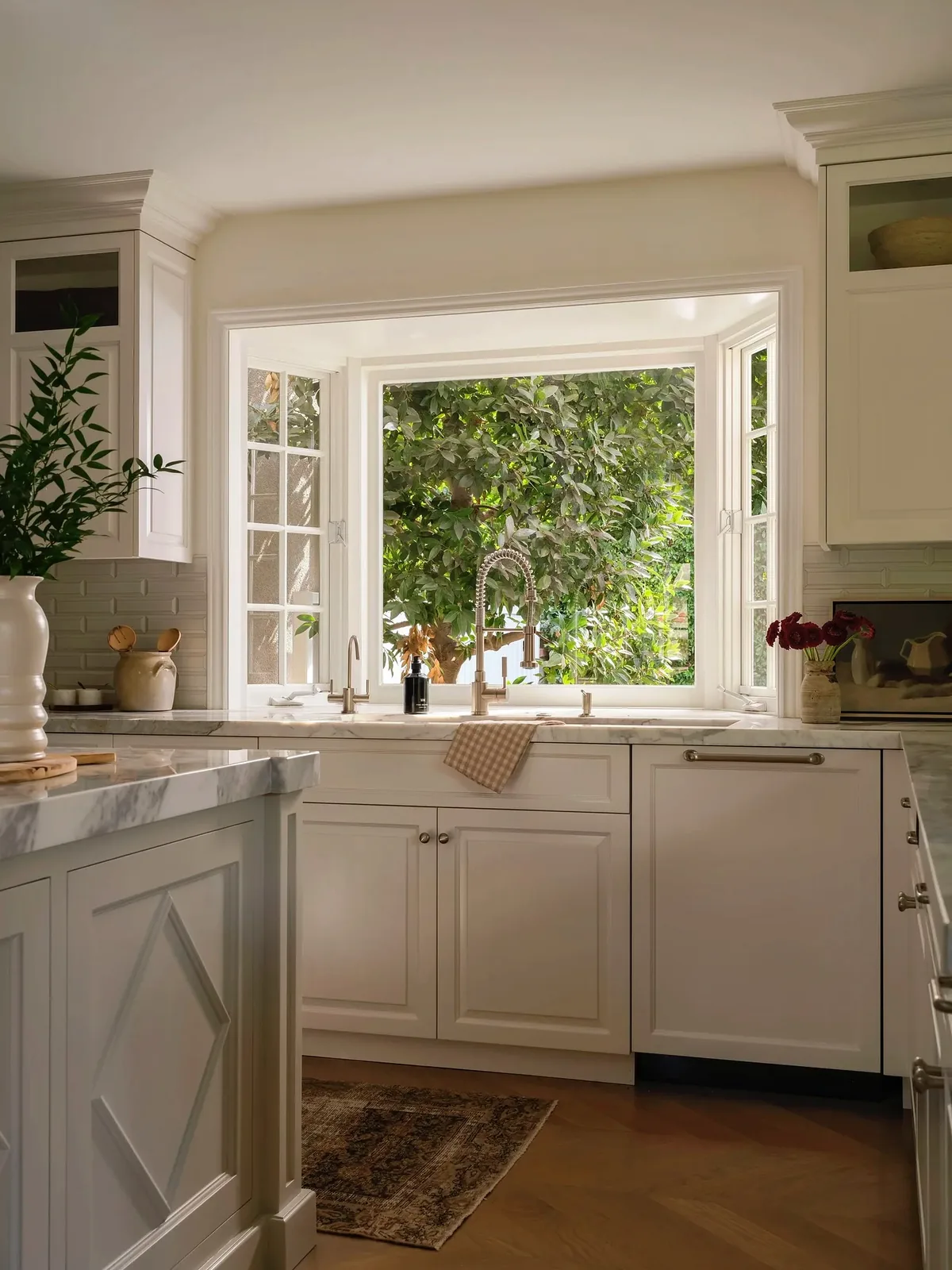
This is the white bay-window kitchen seen earlier, photographed again, so the woodwork gets the reading this time. The drawer fronts line through unbroken, the knobs repeat at even centres, and the panelled island end closes the view with a proper piece of joinery.
That unbroken line is exactly why this kitchen keeps its basin hidden. An apron panel would cut the run and shorten two doors, turning a calm elevation into a construction project. In that space, discretion costs nothing and alteration costs joinery.
The drawer line under the window runs dead level across the whole wall, which tells you the cabinets were fitted as one piece rather than assembled round a feature sink. The flagstone-toned floor and the faded runner keep the white from going clinical.
Retrofitting an apron here means face carpentry, shorter doors and a recut stone top, realistically £1,000 and upward in 2026 before the sink itself. Anyone committed should budget the joinery first and fall for the basin second.
A second sink for flowers and boots
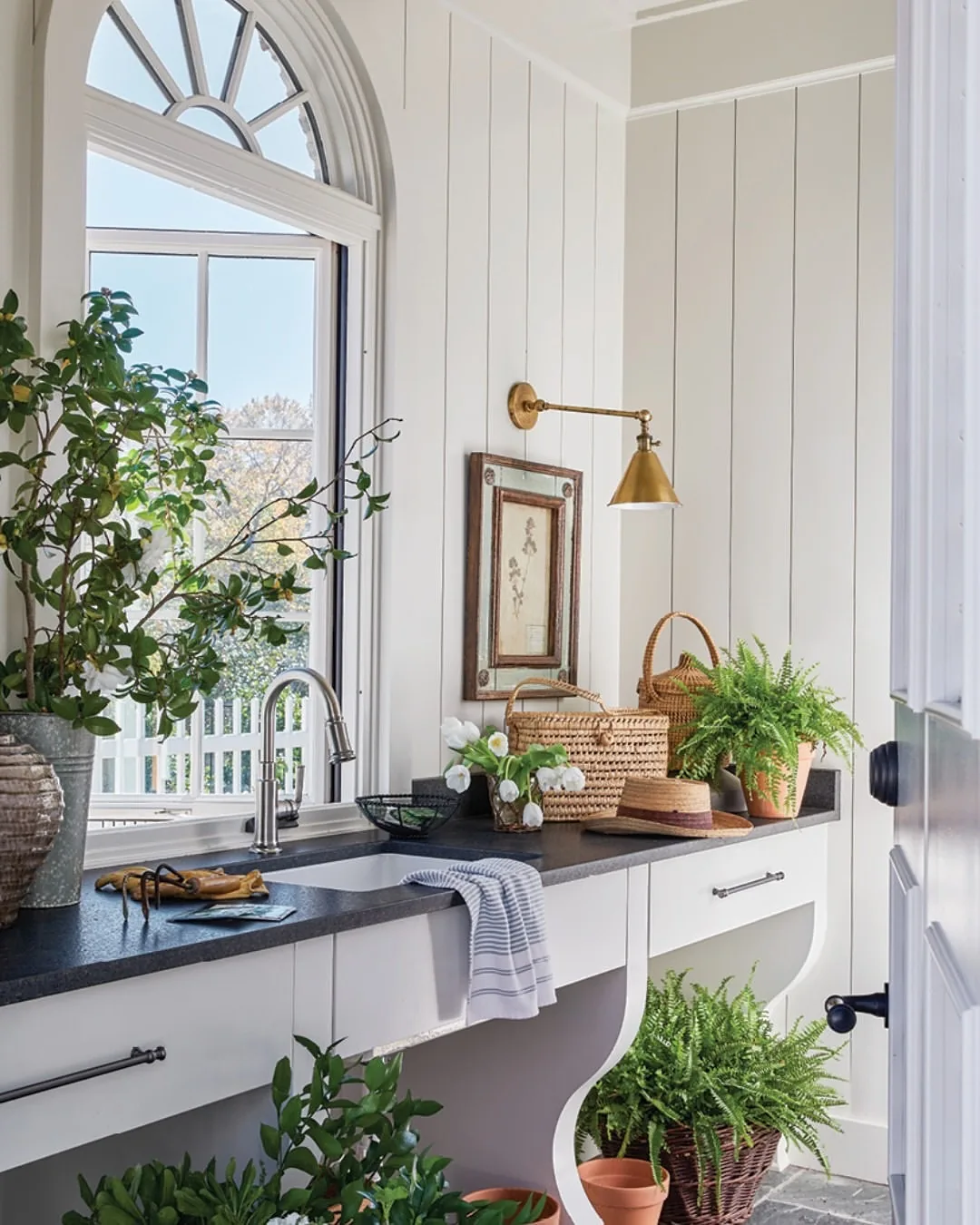
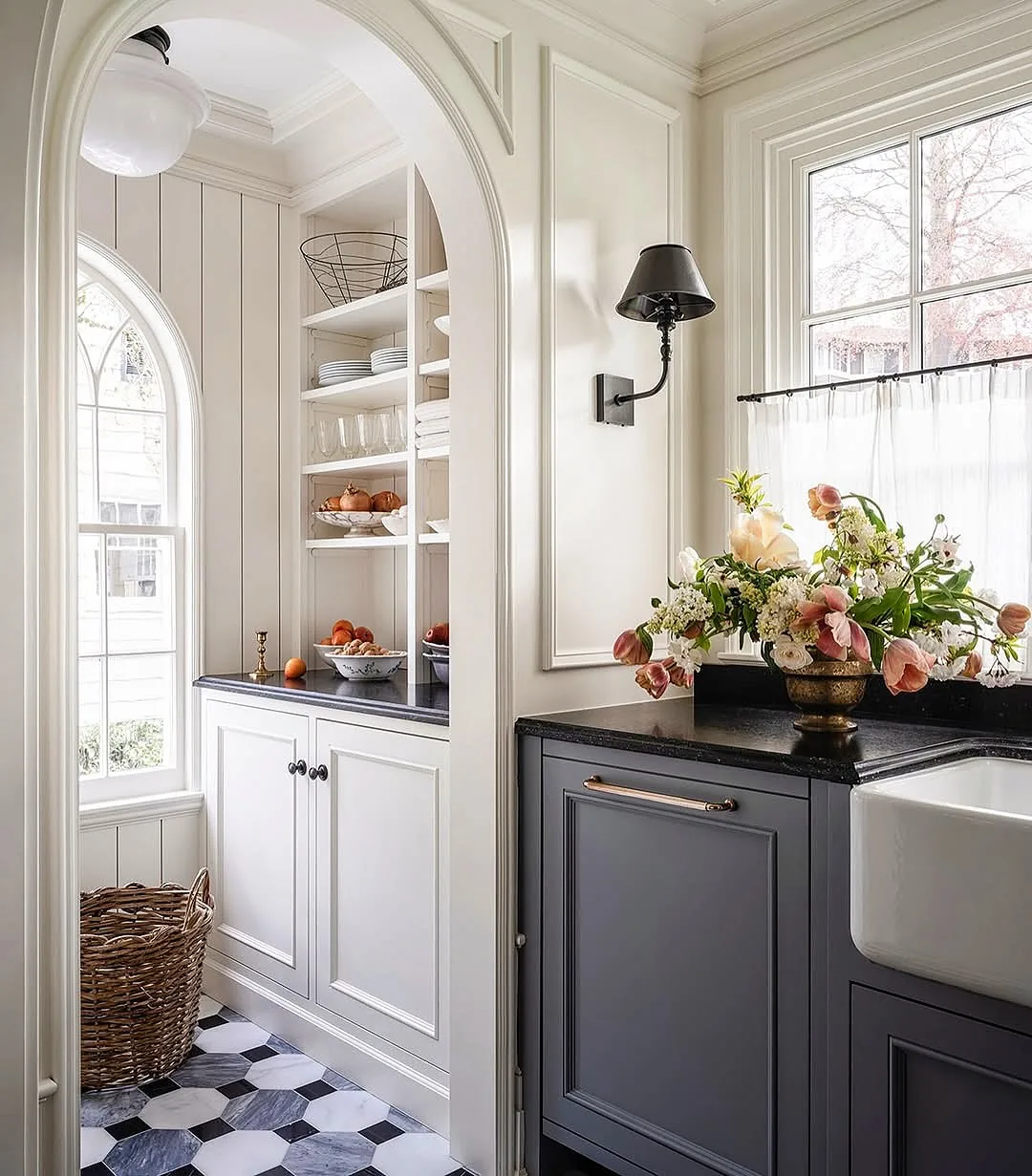
Not every sink cooks. This one arranges flowers, rinses boots and fills watering cans under an arched window, with shiplap walls and a brass task light above. Judged as a utility, it passes on cleanability and reach.
See how the cabinet steps back into a knee recess instead of running doors to the floor. That opening takes a stool or a bucket, which is what a flower room needs and what a kitchen never gets. The dark stone top hides soil and compost that would stain a pale one within a month.
Soil rings show fast on white enamel, though white at least shows grit before it scratches the base.
Pull-out rinse taps of this type cost £100 to £260 in 2026, and the task light above wants an IP-rated fitting this close to water. Plants on the sill suit the humidity; anything paper-backed does not belong here.
Oak and brass around a white apron
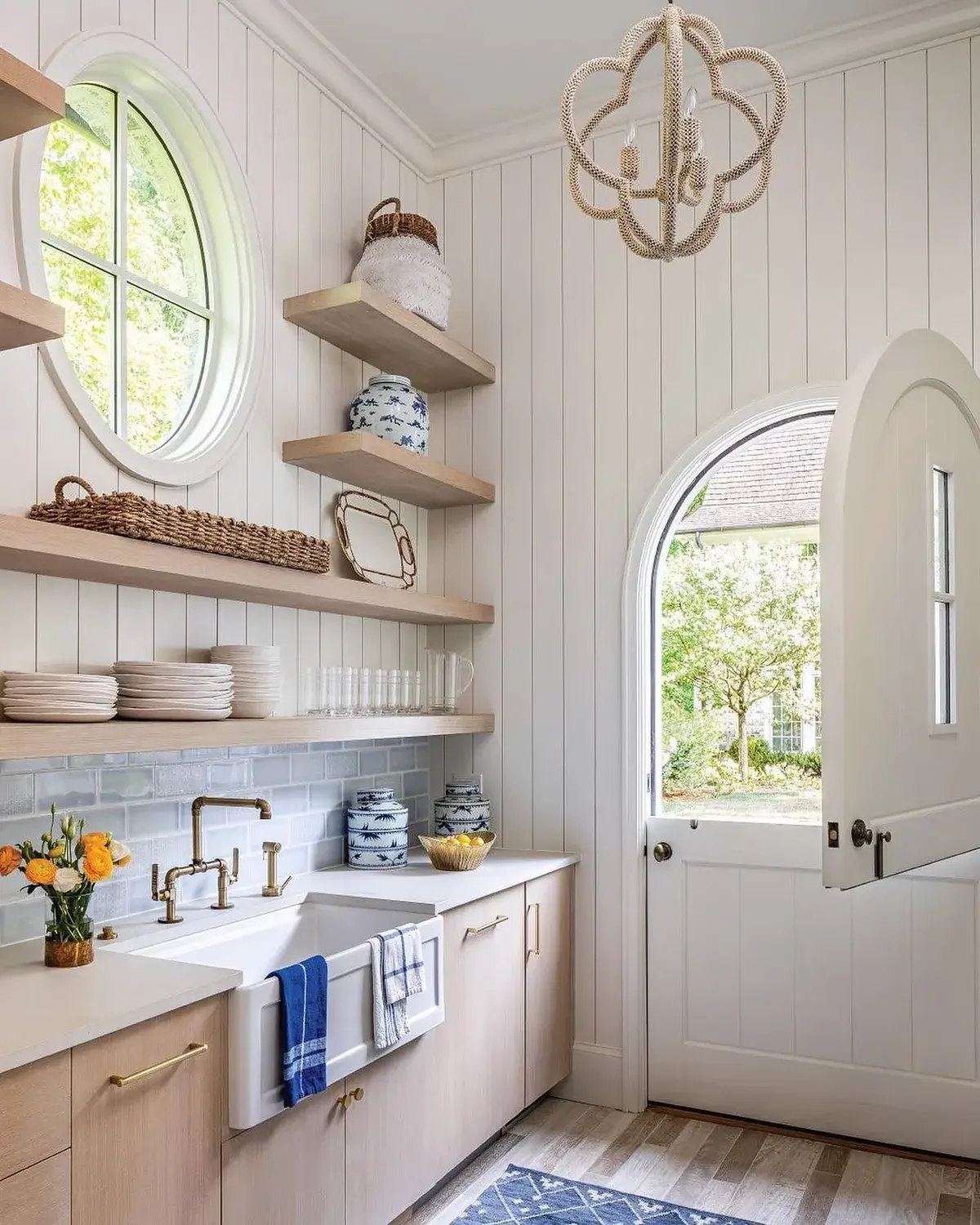
Light oak, chalky white and aged brass divide this wall into even thirds, and the calm comes because the white stays chalky instead of blue. A blue-white apron would fight the oak all day; this one shares its warmth.
The Belfast bowl sits between oak drawer stacks under open oak shelves, with a brass bridge in crossheads behind it and an arched garden door pulling daylight across the top. Look at the shelf brackets. The daily bowls and jugs live nearest the tap, inside the splash zone, because those pieces get washed regardless. The door keeps the light coming from the side instead of from behind the tap, so nobody works in their own shadow.
That rug is doing quiet work on a hard floor, warming the standing spot and catching the drips that every deep sink throws. A washable cotton runner is the correct textile here, since wool and standing water never reconcile.
Joiner-made oak shelving of this run costs £150 to £350 in 2026, and the citrus bowl on the sill is the cheapest styling on the page. Farrow & Ball Shadow White No.282 on surrounding paintwork would hold the same chalky note.
Frequently Asked Questions
How heavy is a full fireclay sink, and what holds it up?
A large fireclay bowl weighs 40 to 60kg on its own, and water plus crockery pushes the total past 100kg. That load needs a purpose-built sink base or a timber cradle that carries down to the floor, agreed before the kitchen is ordered. Caulking and clips alone will sag within a few seasons.
Which base unit fits a Belfast bowl?
Belfast bowls are generally made in 595mm and 795mm widths to drop into 600mm and 800mm bases. Trust the maker sheet over the shop title, since nominal sizes hide the true footprint. The front of the unit is cut down and the doors below are shortened, so this suits a planned refit.
What sort of tap suits a deep apron bowl?
Tall pillar, bridge or wall-mounted spouts all work, provided the outlet clears the tallest pot with room to spare. Bridges spread their fixings across two holes, which steadies them on thick stone decks. Match the finish to the cabinet hardware so the wall keeps a single metal.
Does a copper front stain and darken over time?
It changes from the first week, spotting where acids land and brightening where cloths rub. Sealed finishes slow that evolution, while living finishes record it. Anyone wanting a permanently bright basin will be happier with brass or enamel.
Can an apron bowl go in without changing the worktop?
Rarely, because the stone is templated to the exact basin and the reveal is cut into it. New fronts, a rebuilt base and usually a recut top make up the true price. A tall mixer on the current sink is the cheaper comfort while funds gather.
Is one large chamber better than a divided pair?
One deep chamber takes trays flat and hides a day of dishes below the rim. Halved bowls suit homes where two people wash up side by side each evening. A loose bowl beside the tap recovers the soaking spot without surrendering the full width.
Before ordering
- Check bowl depth first; 220mm or more for a kitchen that gets cooked in.
- Specify a sink base built for the weight before the kitchen is ordered.
- Choose the tap at the same time, since a deep bowl needs a tall spout.
- Buy a sink mat with a fireclay sink, on day one.
- Measure the worktop you will lose either side before committing.
This article may contain affiliate links. We may earn a commission at no extra cost to you.