8 Breakfast Nook and Kitchen Window Ideas: Mount the Blind Above

Add us as a preferred source to see more stories on Google.
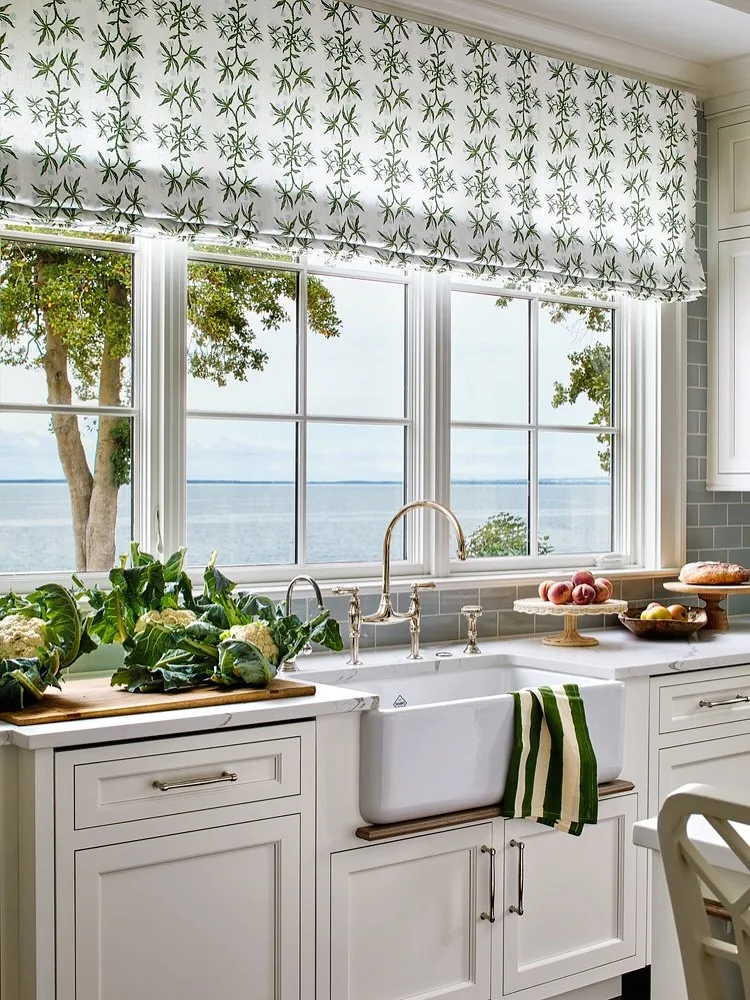
There is a sea outside the window below, and the blind is not covering any of it.
Look at where it is fixed. Well above the window frame, up near the ceiling, and wider than the opening on both sides. When it is up, the whole stack of folded fabric sits on the wall rather than on the glass.
Fit the same blind inside the reveal and roughly 200mm of folded fabric would sit permanently across the top of that view. Every time. Forever.
The measurement to take first
Clear wall between the top of the window frame and the ceiling or cornice.
| Drop | Approximate stack | Clear wall needed |
|---|---|---|
| 1.0m | 120 to 150mm | 150mm |
| 1.5m | 180 to 200mm | 200mm |
| 2.0m | 240 to 280mm | 280mm |
If you have less clear wall than the stack, a Roman blind will not fully clear the glass wherever you mount it. That is not a fitting problem; it is a geometry problem, and the answer is a different window treatment.
Roller blinds stack to almost nothing, typically a 50 to 70mm tube, so they suit windows with no headroom. A cafe curtain on a rod across the middle of the sash is the other good answer in a kitchen, since it gives privacy at eye level and leaves the top of the window open entirely.
Wider as well as higher
Extend the blind 75 to 100mm past the window on each side.
It costs very little extra in fabric and it does two things. The window reads as being the width of the whole blind, which is a free gain in apparent size. And the edges of the glass are properly covered when it is down, instead of leaving a light gap either side.
The same principle as hanging curtains wide, and it applies just as strongly to a blind.
Getting it right over a sink
Kitchen windows over a sink have their own problems, and the blind is usually the least of them.
Keep the fabric out of splash range. Mounted high, a Roman blind at half drop still sits well above the taps. A blind fitted in the reveal hangs closer to the water.
Choose something washable. Cotton or linen cotton in a print instead of a pale plain, because a kitchen blind collects cooking film whatever happens. Removable linings and detachable rod pockets make cleaning possible instead of theoretical.
Avoid blackout lining. It stiffens the folds, it is unnecessary in a kitchen, and it makes the stack considerably deeper, which is the thing being minimised.
The pattern decision
That blind is the only pattern in the room, and it is above eye level.
That placement matters. Pattern high on a wall frames a view and reads as decoration. The same fabric on a chair at seated height competes with everything on the table.
In a kitchen with a strong view, one patterned blind and nothing else is usually the right amount. In a kitchen looking at a fence, the blind can carry more, because it is what is being looked at.
Block prints and botanicals suit this position particularly well, since they read as texture from a distance instead of as a specific motif.
What to do with the sill
The sill is the most commonly wasted surface in a kitchen.
A deep sill over a sink holds two or three things well and eight things badly. The window above carries almost nothing on it, which is why the view survives.
If the sill is deep enough to be useful, a single row of herbs in matching pots or one large bowl works. A collection of assorted bottles, sponges and washing liquid is what most sills become, and it is visible from outside as well as in.
Paint the architrave, not the wall
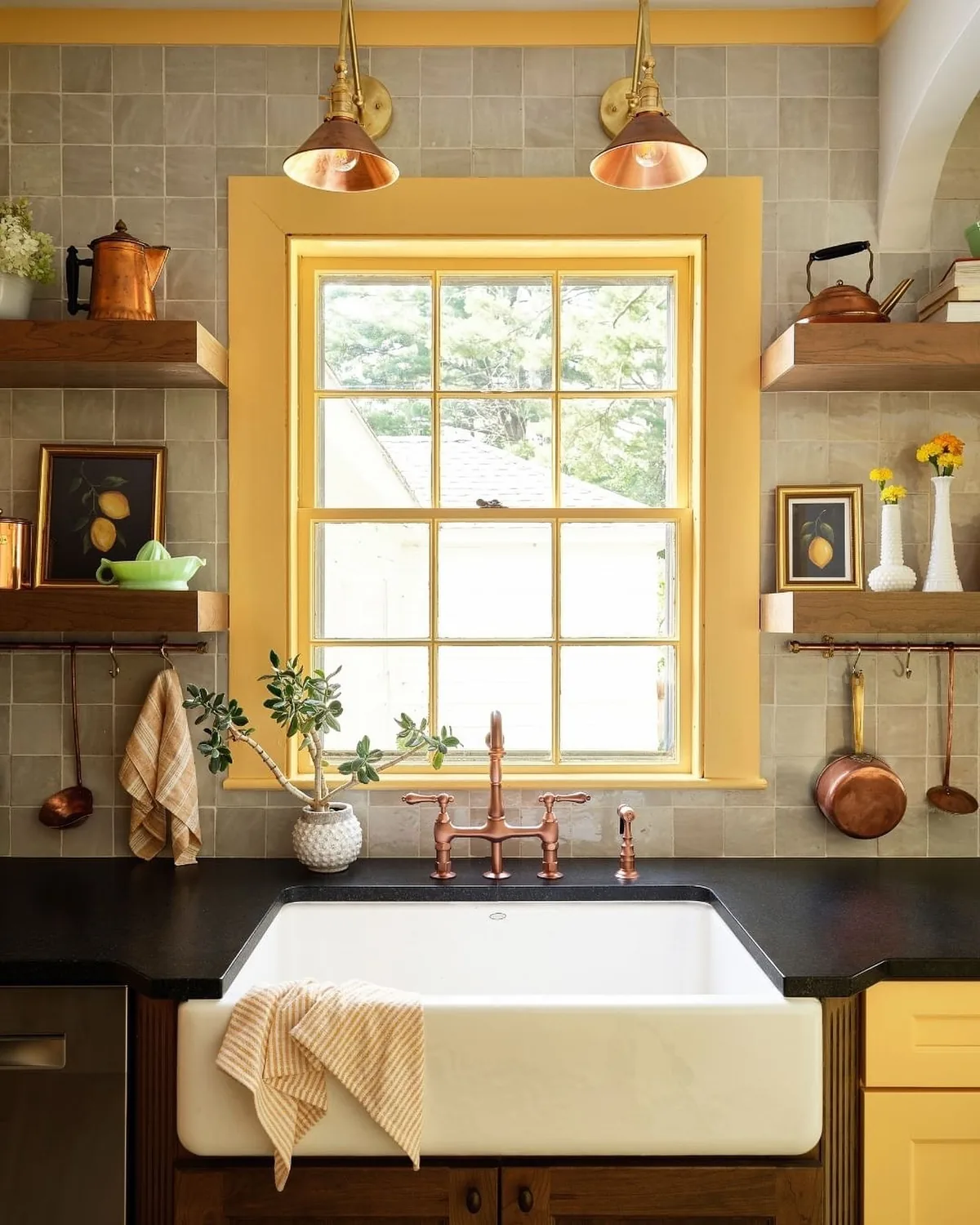
The principle here is older than any of the fittings. Colour in a working kitchen belonged on the joinery, because walls were tiled where they got wet and shelved where they were useful, while the painted timber around the opening framed the outlook all day. That is exactly what has happened in this room, where a single band of mustard around the sash does the decorating for the whole wall.
Look at the sequence from the centre outward. Green trees through twelve panes, then the yellow frame, then square grey tiles, then thick oak shelves carrying copper and lemon prints and small pictures. The eye stops at the yellow first, which is the point, since everything else within reach is deliberately quieter.
The metalwork follows the same temperature. A copper bridge tap, copper pans on a rail, copper shades on brass arms above, all sitting comfortably against that yellow because both have real warmth in them. Against a blue white this collection would argue. Against the grey tile it settles, since the tile is doing very little except staying out of the way.
To get near that yellow, Farrow and Ball India Yellow No.66 or Little Greene Mister David give the same baked warmth, and both need a proper kitchen eggshell over them, £45 to £70 per 2.5 litres in 2026. A general rule for painted architraves near a sink is washable eggshell over primer, never matt emulsion, because steam finds every porous inch within a year.
Let full height curtains stack off the glass
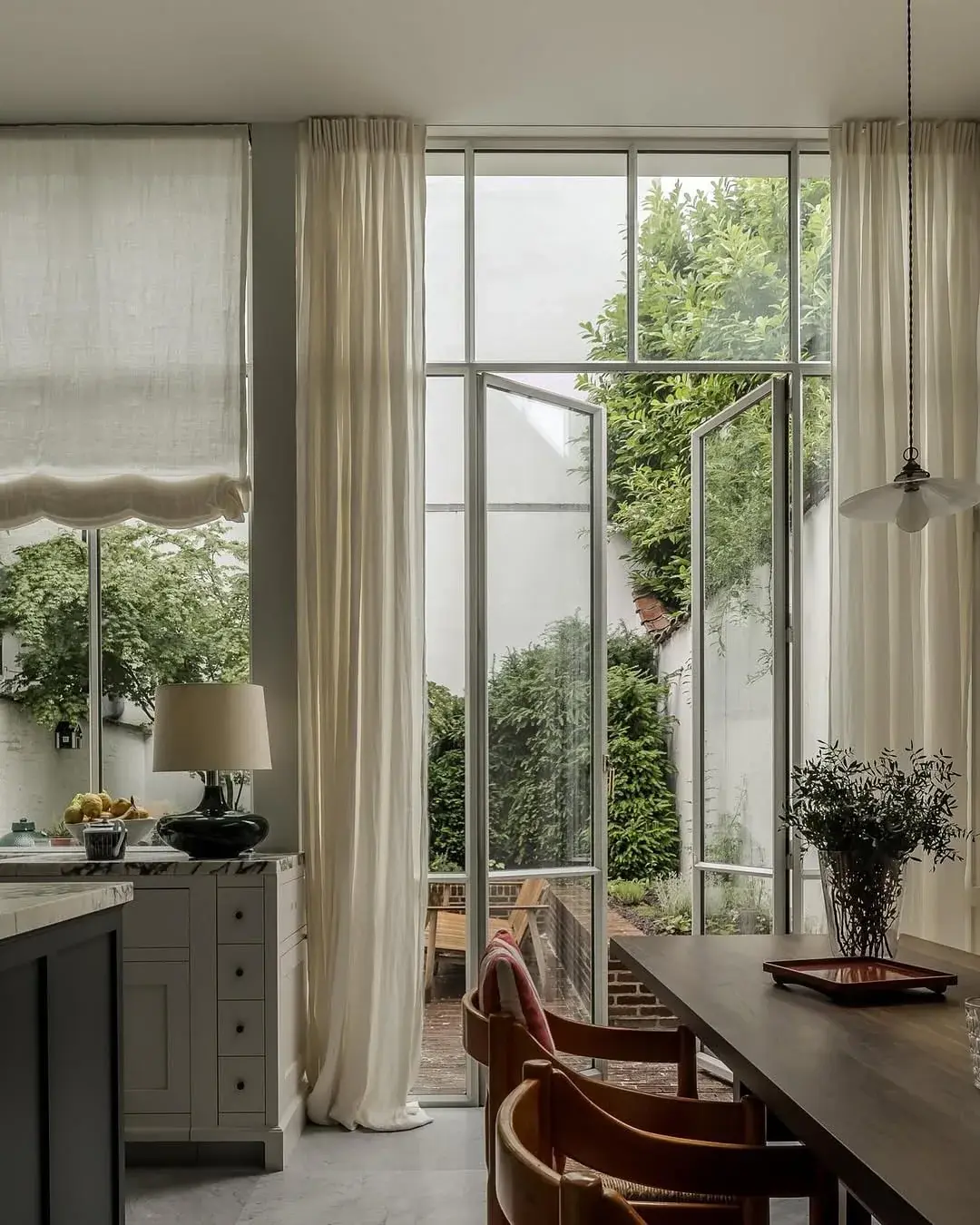
This is the hero argument at room scale, which is why it belongs in this piece. A window wall this tall cannot take a blind at all, since the stack would hang permanently across the upper panes, so the curtains have been hung from the ceiling and pulled entirely clear of the frame. Glass does the work while fabric waits at the sides, which is the whole arrangement.
The curtains in this room run from ceiling track to stone floor without a break, and that unbroken drop is doing something structural. It makes the opening read taller than it is, because the eye measures the fabric, not the frame, while short curtains would cut that wall in half.
Notice too what has been left alone. The doors stand open onto brick and planting, the marble island behind carries a lamp and a bowl of pears, and the timber table in the foreground holds almost nothing. Here the planting is the pattern, so the textiles stay plain, since a print beside leaves would be competing with them.
Plain linen union in off white, lined but never blackout lined, is the texture to ask for, and made curtains in that cloth run £180 to £450 per panel in 2026 depending on lining and heading. The track wants ceiling level and 150 to 200mm past the frame either side, so gathered fabric never covers glass when open.
Keep the run low under a wide window
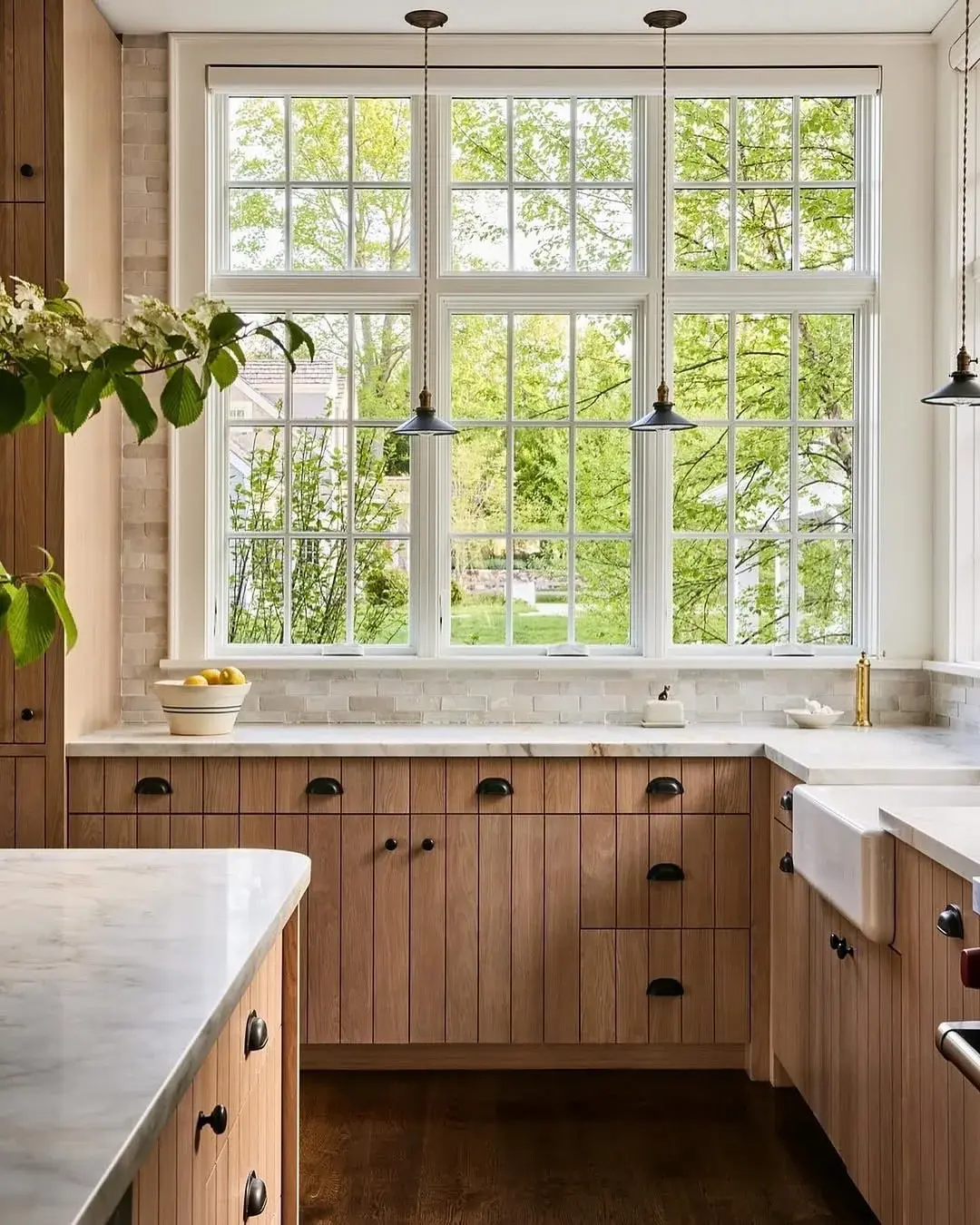
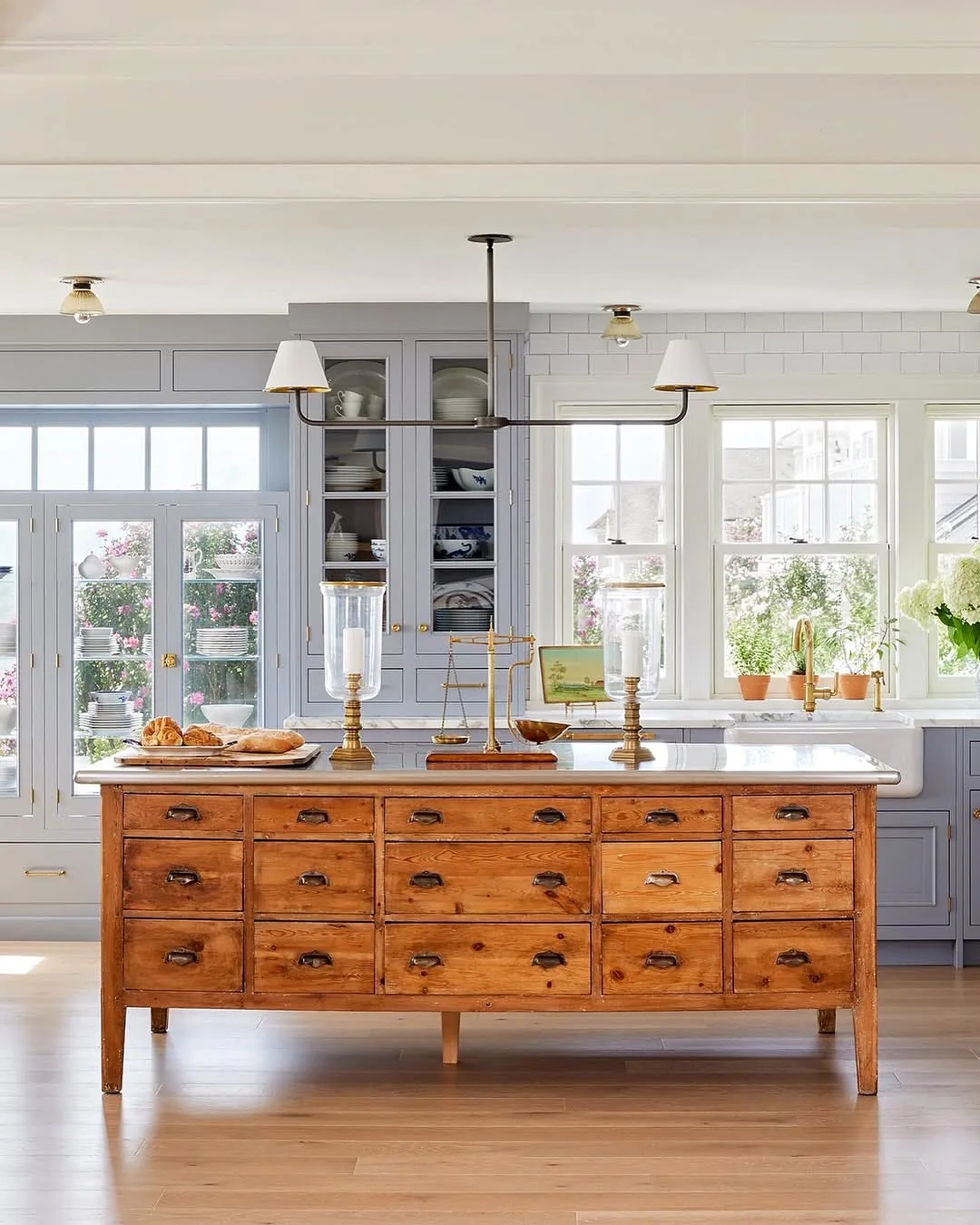
The governing decision here is restraint below the sill. Three wide glazed sections sit over one continuous run of pale oak, with no tall unit and no shelf interrupting the horizontal, and the room feels calm for that reason. The window is allowed to be the whole upper half of the wall.
That sill carries almost nothing. A striped bowl of lemons at one end, a small dish and a brass object at the other, and a long clear stretch between them. Given how hard most households find an empty surface, this discipline is half the design, and it is what lets the green outside read as the colour scheme.
Two small dark pendants hang in front of the glass on long flexes, which divides opinion and works here because the shades are tiny against the scale of the glazing. Lights in front of a window want small shades hung high, so they read as jewellery instead of obstruction, with drops kept well above standing eye level.
For the timber, a clear matt lacquer or Osmo Polyx Oil keeps oak that pale without the orange that varnish brings, £30 to £60 per litre in 2026. Cup pulls in aged bronze, 75 to 100mm centres as a rule, suit tongue and groove fronts of this kind, since a knob would be lost in the boarding.
Serve through the wall when the garden is the nook
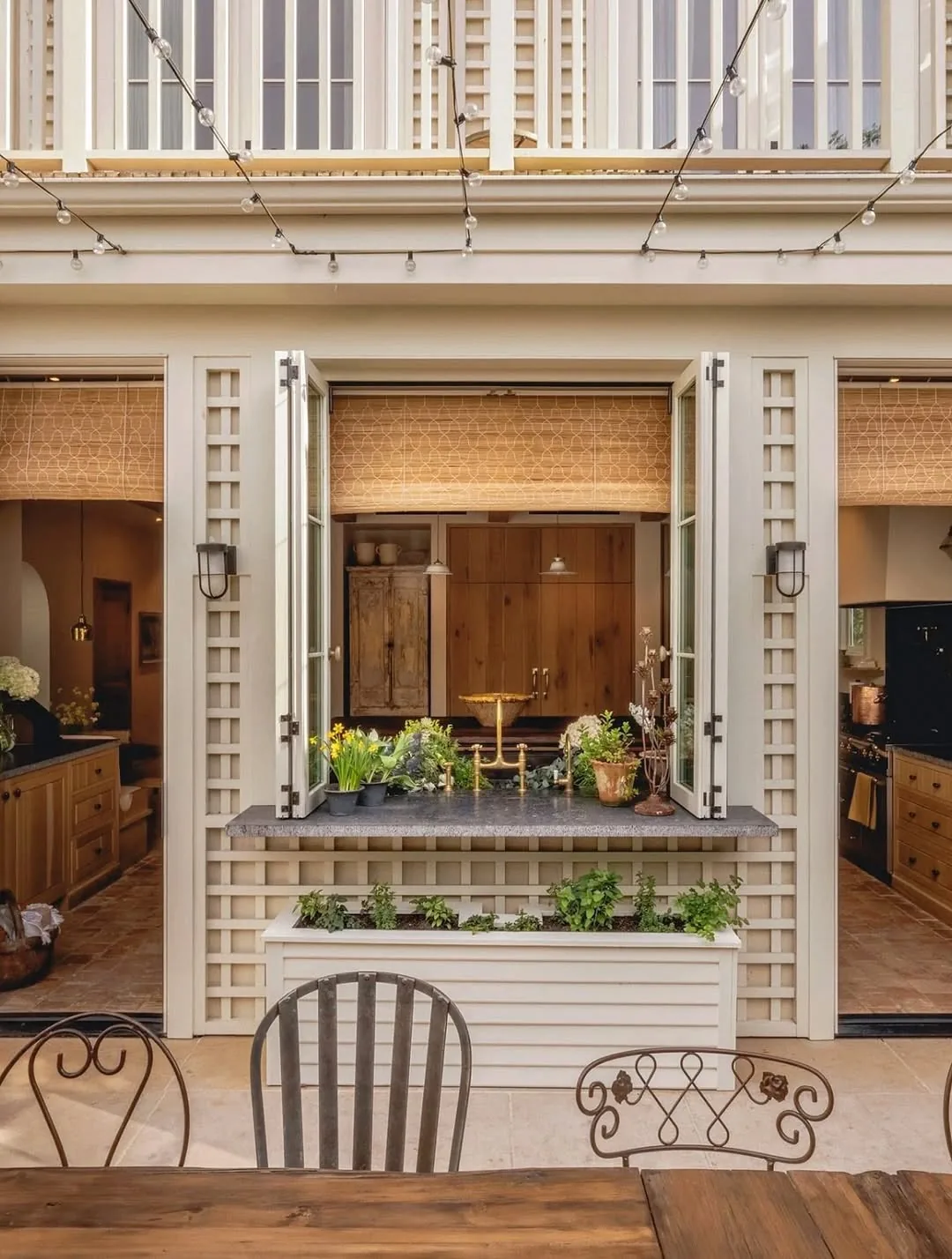
Some houses have no room for a bench indoors, and this is the honest alternative. The casements fold back, the sill becomes a counter in stone, and breakfast happens outside under festoon lights with the kitchen doing the serving, which means the nook has moved through the wall.
Above the opening hangs the right blind for the position. Woven bamboo on a roller, which tolerates sun and shrugs at uneven light in a way fabric never does, and which drops only as far as needed to cut glare on the worktop inside. In that kitchen the brass rail and timber cupboards behind it glow precisely because the hatch shades them for part of the day.
The planting below does quiet work. A white trough of herbs sits at knee level under the sill, close enough to pick while standing at the counter, and pots crowd the stone either side of the opening. Small things, easily moved, carrying most of the welcome.
Woven wood rollers made to measure run £60 to £160 per blind in 2026 through suppliers such as Blinds 2go and Swift Direct Blinds. Outdoors, the rule is festoon cable fixed taut on proper wall eyes. A pass through of this kind suits households that eat outside from spring onward. Where summers are short, the same money is better spent inside.
Put the bench where the morning lands
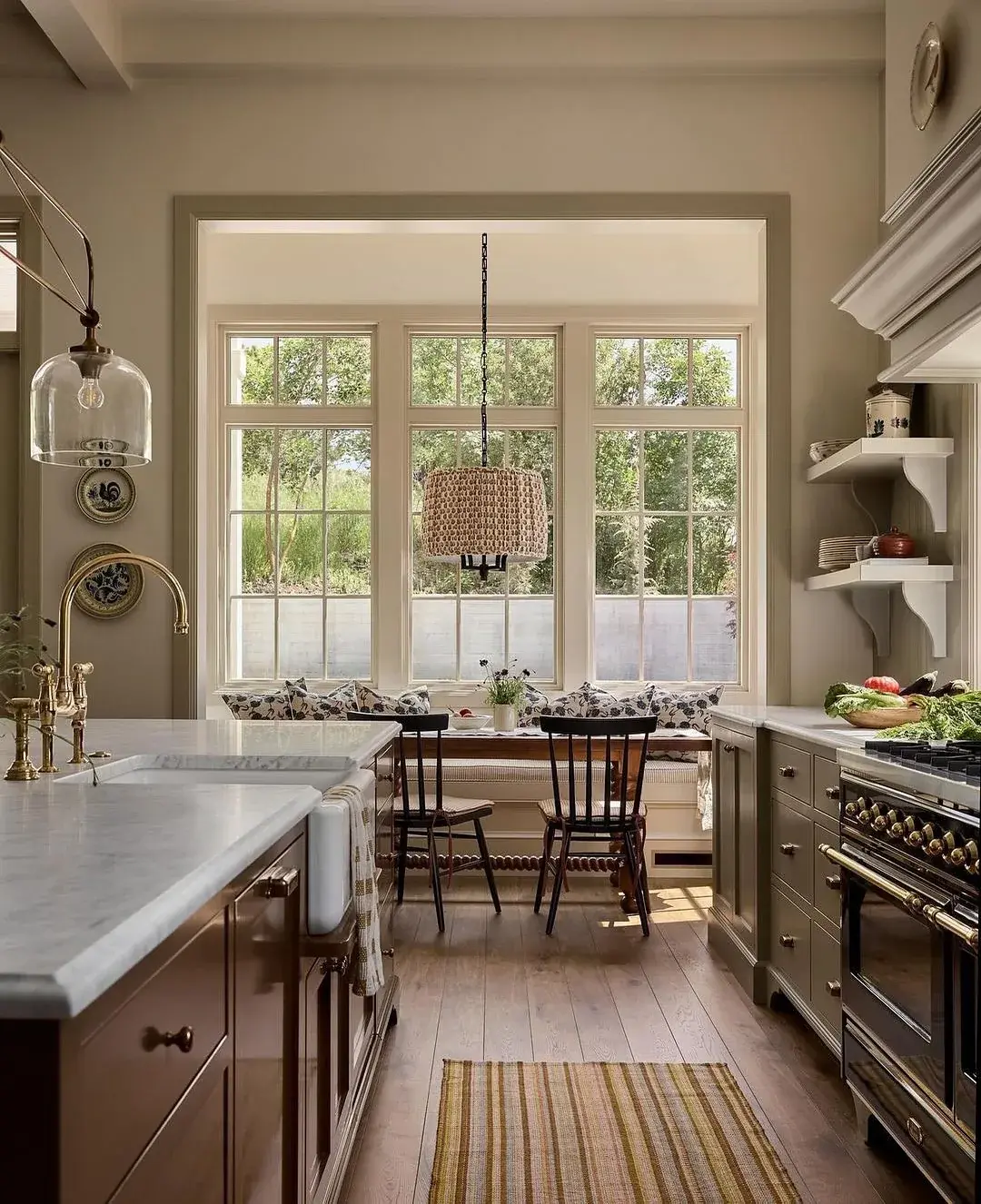
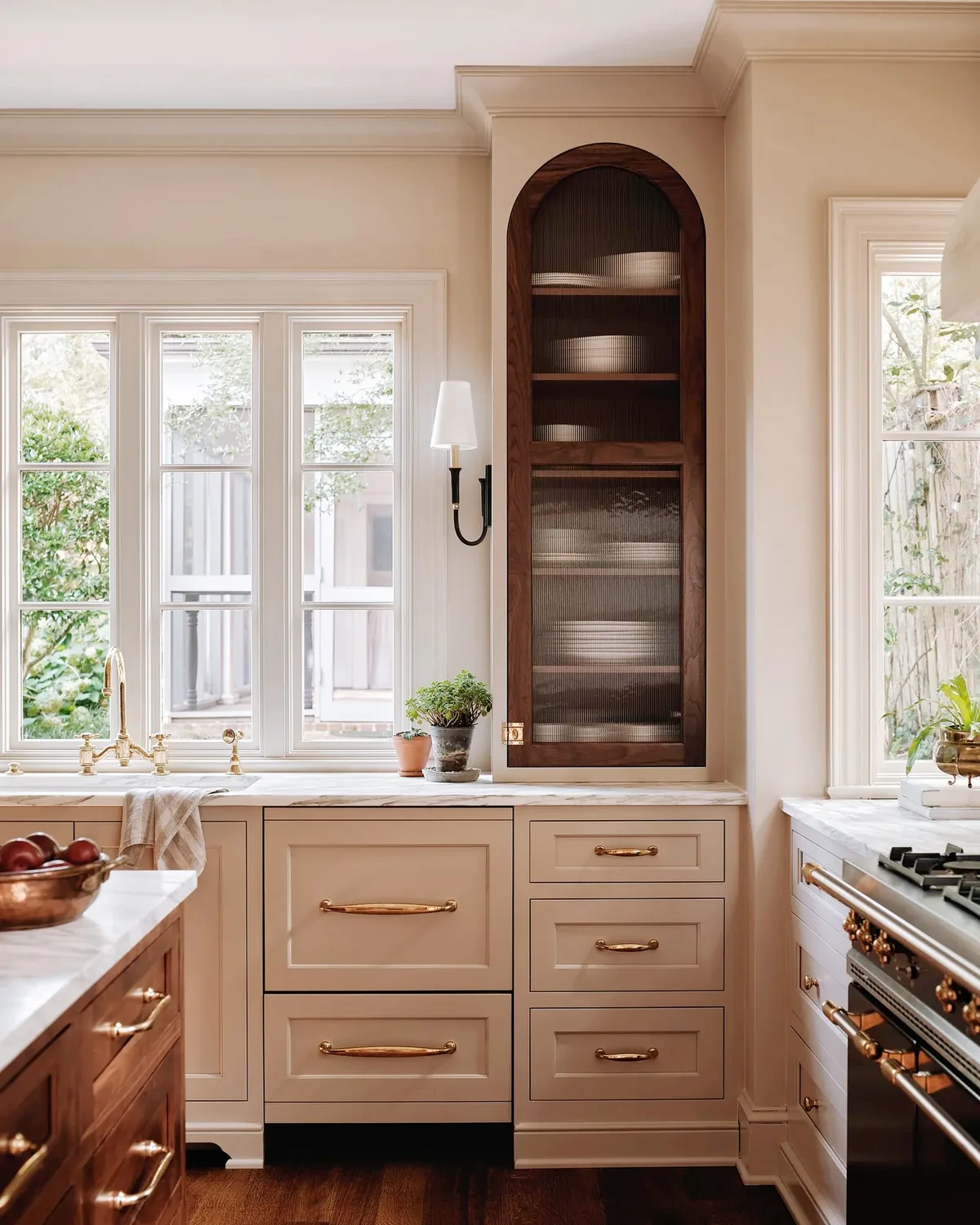
Here at last is the actual nook, and it obeys the oldest rule for one. The bench sits at the far end of the room inside a shallow bay, facing back up the kitchen, so sitters get daylight on their faces and cooks get somebody to talk to. Nobody crosses behind the bench to reach anything, which is why it gets used.
The architecture helps enormously. Three tall windows with thin glazing bars, a deep sill, frosted lower panes that blur the fence without losing sky, and patterned cushions along the banquette that carry the only strong motif in the space. That frosted band gives privacy at seated eye level while leaving the tops clear, exactly the job the cafe curtain does in another section below.
Light from above is a single woven drum on a dark chain, hung low enough to pool over the table after dark. The shade wants roughly half the table width, with its base kept well above standing sightlines so it never blocks the room. Pairs would fuss here, so one is enough for the table.
Banquettes of this kind want a seat depth around 450 to 550mm as a general rule, with indoor outdoor fabric on the cushions, £35 to £80 per metre in 2026 from Weaver Green or John Lewis. Delicate weave has no place within crumb range of toast.
Dress the middle of the glass
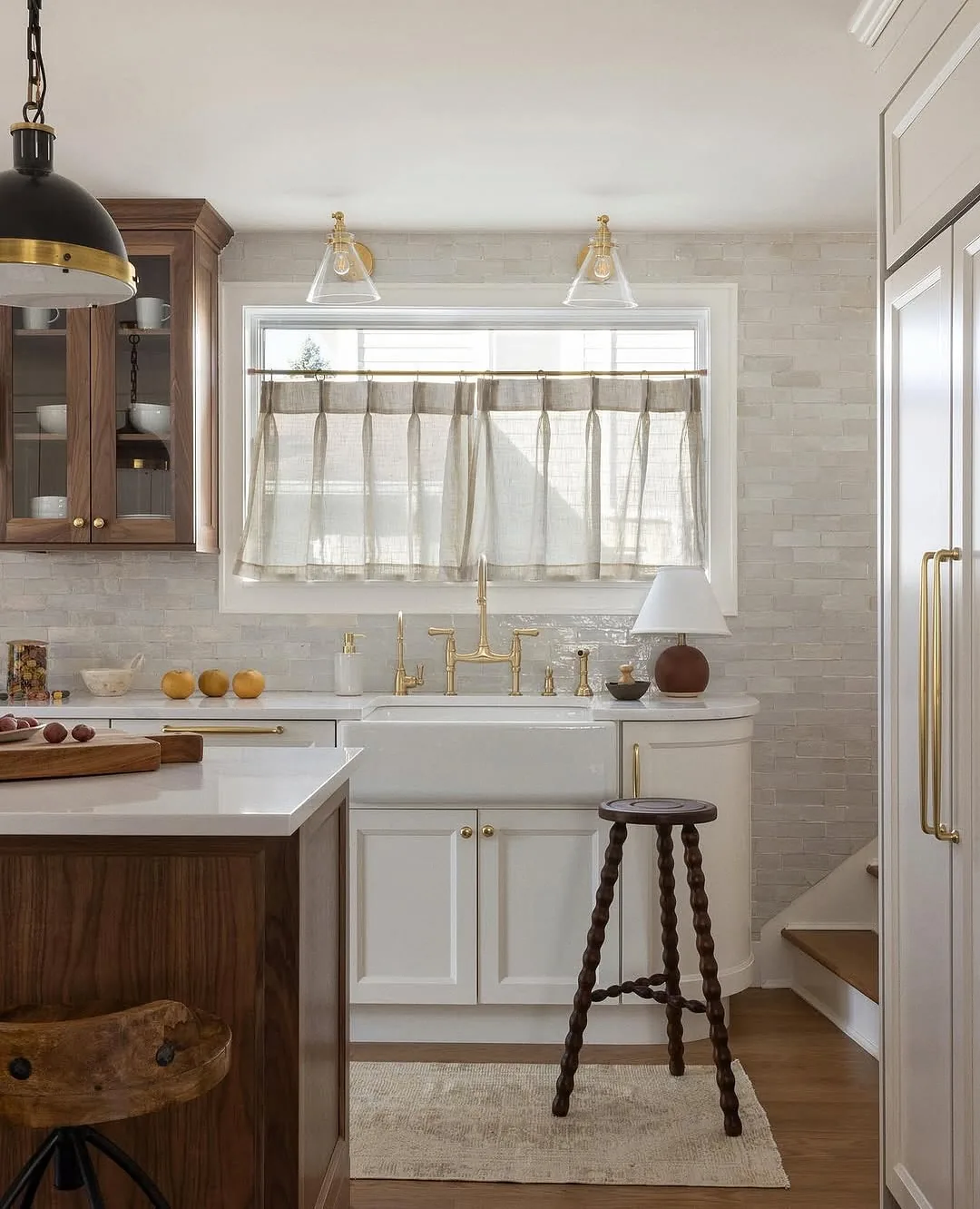
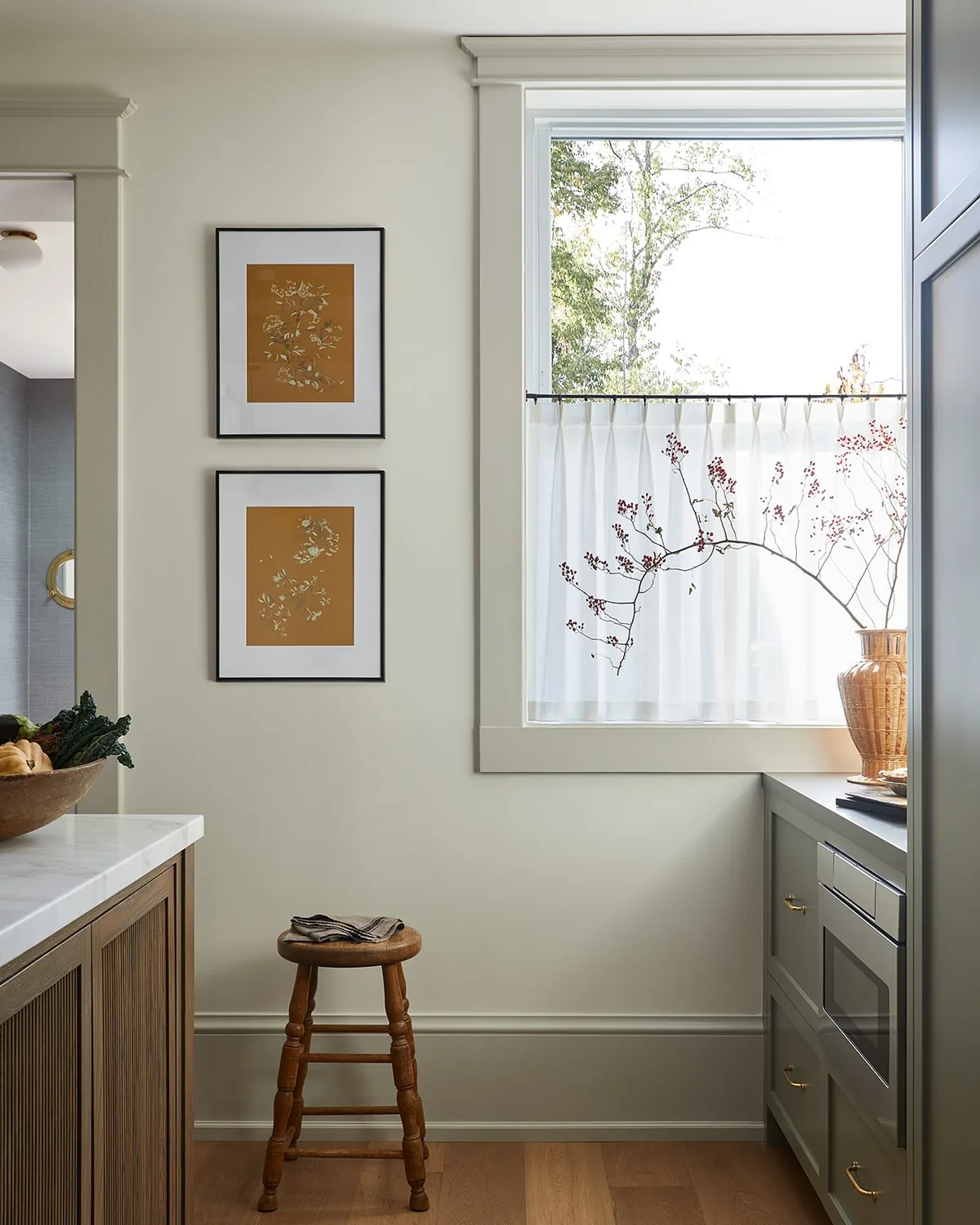
This section is the exception the earlier measurement table promised. Where there is no clear wall above the frame, a Roman blind cannot stack, so the curtain moves down the window. A brass rod crosses at mid height, a sheer hangs from it, and the top of the glass stays open to the sky all day.
That placement solves the overlooked window problem neatly. Privacy holds at standing eye level from the street or the neighbours, plants and sky remain visible above, and the fabric never approaches the taps because it hangs only to the sill. Without headroom it is often the only treatment that leaves the light intact.
The detailing repays a look. Pinch pleat linen voile in white, two slim glass pendants above the frame, a brass bridge tap echoing the rod, walnut island and glass fronted wall cupboards warming the white tile. Unlacquered brass will dull and blotch within a year, which suits this room, while lacquered brass stays bright and suits nobody who dislikes polishing.
Sheer cafe pairs made to measure run £40 to £110 in 2026, and a slim brass rod with end brackets runs £25 to £70 in 2026. The rod sits at roughly half the glazed height, or a fraction above, with the sheer cut to kiss the sill instead of puddling on it.
A chair and a ledge still count
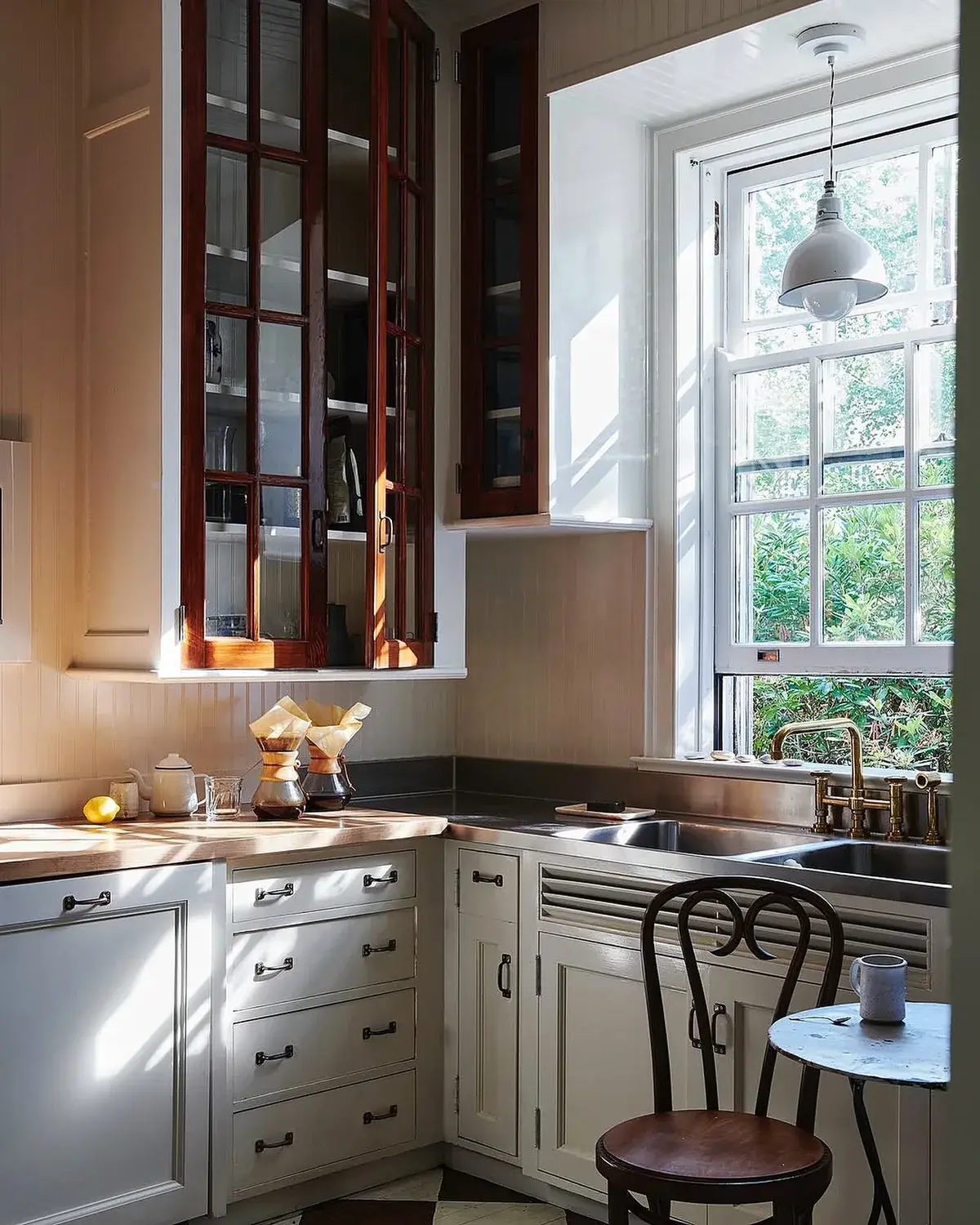
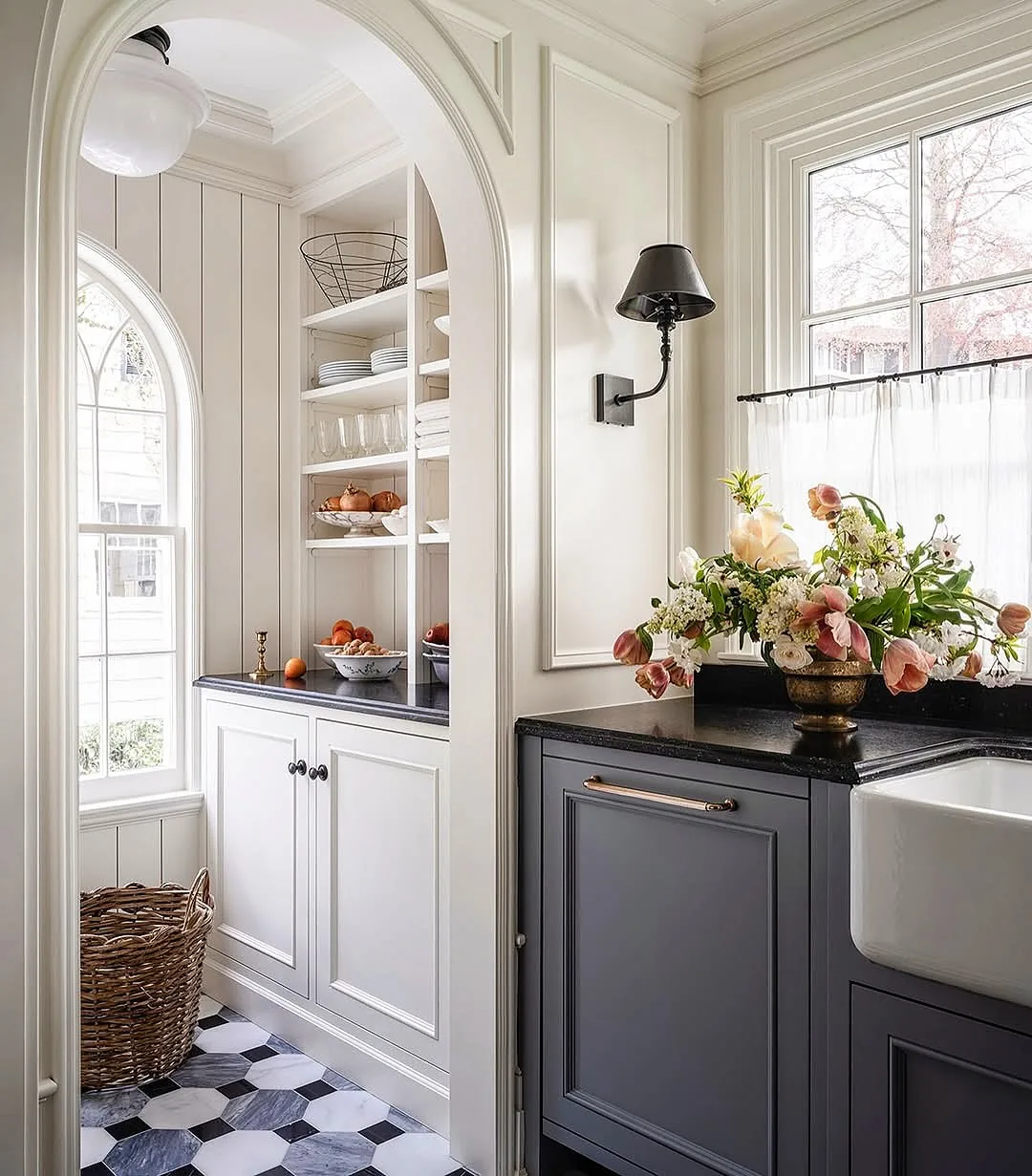
Not every kitchen has space for a bench, and this corner refuses to pretend otherwise. A single bentwood chair at a small marble topped table tucks against the worktop run under a tall sash, where one person can sit with tea while something simmers. One seat used daily beats four seats used never.
The cupboards above explain why this corner feels settled. Tall mahogany glazed fronts run to the ceiling beside the window, their dark timber warming the white boarding, and a coolie pendant hangs in front of the glass to give the seat its own pool of light after dark. Dark wood beside bright glass is an old pairing, and it still works because the contrast flatters both.
Morning sun does most of the decorating here. Glazing bars throw shadows across the timber top, the steel sink and brass tap catch it, and a lemon and a coffee brewer are all the styling the surface needs. Clutter would destroy this in a day, so the rule for a ledge this small is brutal. Three objects, never more.
Bentwood chairs of this pattern run £90 to £250 each in 2026, with vintage Thonet pieces above that when the cane is sound. A perch of this kind wants a table no deeper than a tea tray across, since anything larger blocks the cupboard below.
Before ordering
- Stack blinds on the wall above the frame, never inside the opening where fabric covers glass for good.
- Paint timber around the window when walls are tiled or shelved, since the frame carries the colour.
- Run full height curtains from ceiling track and park them clear of tall glazing.
- Leave the run beneath a wide window low and keep the sill nearly empty.
- Fix cafe sheers at mid glass where headroom is short, with tops left open to the sky.
- Set built in bench seats deep enough to lounge on and cover them in washable cloth.
- Give a one person corner a chair, a small table and its own light, then stop.
Frequently Asked Questions
Can a Roman blind work when no bare wall sits above the frame?
Rarely, since folded fabric must park somewhere and glass is the only place left. Pick a roller that winds to a slim tube, or dress the middle of the pane with a sheer and keep the upper half open.
Which paint finish lasts on kitchen architraves?
Washable eggshell over primer, in a mid sheen that wipes down. Matt emulsion marks within months near steam and hands, while gloss shows every repair. Farrow and Ball and Little Greene both sell kitchen grades for this purpose.
Do sheer mid height curtains suit a window facing the street?
They do, because the veil covers standing sightlines while the open top keeps daylight and sky. Set the rail near the centre of the glazing and cut the drop to meet the sill.
How deep does a built in window seat need to be?
Around sitting bone depth plus a cushion, which in practice means a base in the mid forty to mid fifty centimetre band. Shallower perches feel like a ledge, while far deeper ones need scatter cushions behind backs.
What cloth survives beside hobs and kettles?
Tight weave cotton, linen union, or indoor outdoor fabric, all washable and unlined or lightly lined. Avoid loose weaves that trap grease, pale plains that show every mark, and heavy blackout sandwich linings that stiffen folds.
Is one chair by the glass enough for a morning spot?
It is, provided the chair has daylight, something to lean an elbow on, and a light of its own after dusk. A tiny table and a pendant turn dead worktop corners into places people actually sit.
This article may contain affiliate links. We may earn a commission at no extra cost to you.