15 Sunroom and Sitting Room Ideas: Trim the Leading Edge of Curtains

Add us as a preferred source to see more stories on Google.
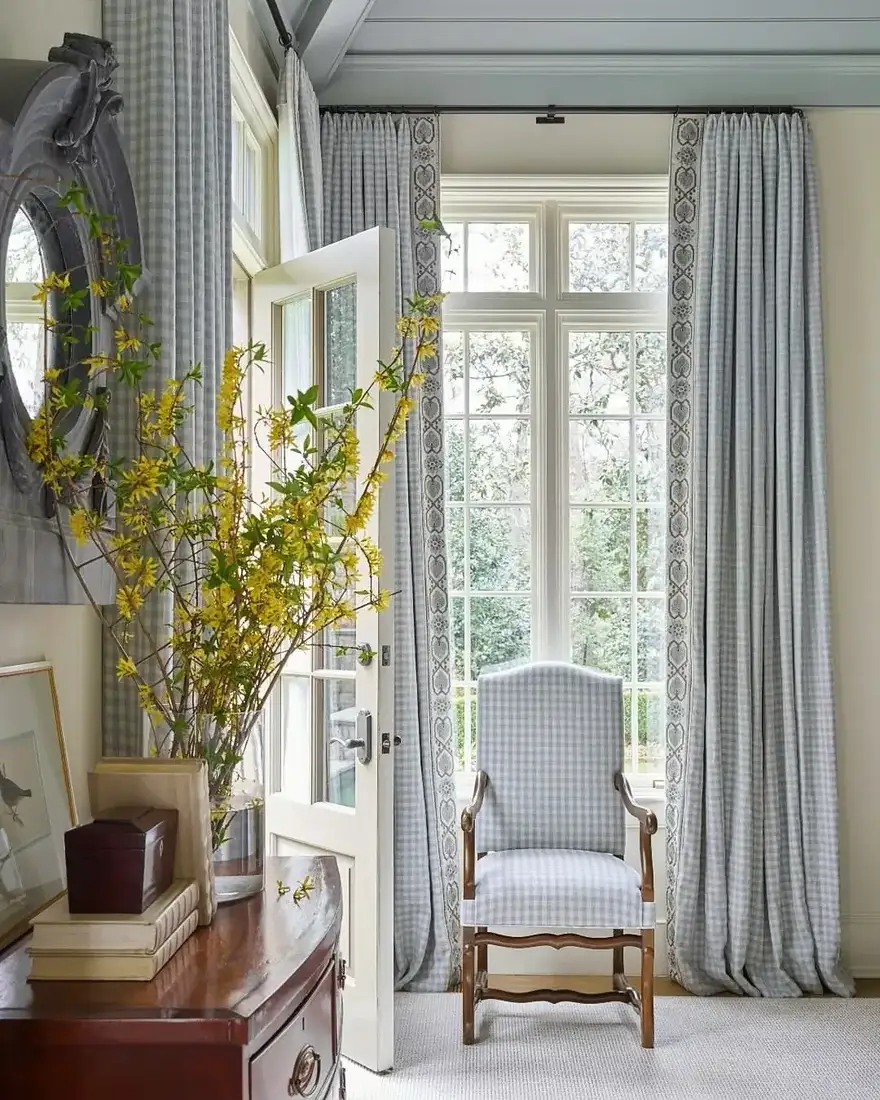
The curtains below are gingham, which is about the plainest fabric there is, and they look considerably more expensive than they are.
Look down the inside edge of each one. There is a band of patterned tape applied a little way in from the edge, running the full drop.
That is a trimmed leading edge, and it is doing three things at once. It gives a plain fabric somewhere to be interesting, it draws a vertical line that makes the window read taller, and it signals that somebody made these rather than ordered them.
What to use, and where to put it
Trim comes as braid, tape, fan edging or a simple contrasting fabric strip. Woven tape in a pattern is the most forgiving, because it hides a slightly imperfect line.
Sources: Samuel & Sons and Houlès at the top, from roughly £30 a metre; Vanessa Arbuthnott and Ian Mankin in the middle at £8 to £20; and plain contrasting fabric cut into strips, which costs almost nothing and works perfectly well.
For a pair of curtains with a 2.5 metre drop you need around 5 metres of tape. Even at the premium end that is a fraction of what the curtains cost.
Position it on the leading edge only, meaning the inside edge that meets in the middle when closed. Running it round all four sides reads as a frame and is considerably busier.
A border along the bottom hem is the other traditional placement, and it works particularly well on curtains that are slightly too short, since it lengthens them honestly.
Use the fabric twice
The armchair in that room is upholstered in the same gingham as the curtains.
Modern advice usually warns against matching, and in a relaxed room that is fair. In a formal sitting room the opposite holds: repeating one fabric is what ties the room together and makes it read as a scheme rather than as a collection of separate purchases.
Twice is the number. Three appearances of the same fabric starts to feel like a hotel, and once is not a repetition.
The second use should be smaller than the first. Curtains and a chair, or curtains and a pair of cushions. Two large uses of the same fabric is a lot of one thing.
Paint the ceiling
The ceiling in that room is a pale blue, and it is the difference between a sitting room and a corridor with chairs in it.
A painted ceiling closes a room. It stops the eye travelling upwards into a white void, it reflects a faint colour back onto everything below, and it makes a room feel considered in a way that white never does.
Pale blue is the traditional choice in a sunroom or garden room, for the same reason porch ceilings are painted blue. A very pale version of the wall colour is the safer general answer, and pink-toned whites are the reliable trick for making a north-facing room feel warmer.
Hang the curtains properly
Worth repeating because it undoes everything else if it is wrong.
High, wide and long. The rod above the window frame rather than inside the reveal, extending past the glass on both sides, and the fabric reaching the floor.
Those curtains break slightly on the floor, which is deliberate and reads generous. A curtain finishing 50mm above the floor reads as a mistake, and one pooling 100mm on the ground collects dust and gets kicked.
Fullness of at least two times the track width, and two and a half is better. A curtain that looks flat when closed is an under-filled one, and no amount of trim fixes it.
A pelmet that hides the glare line
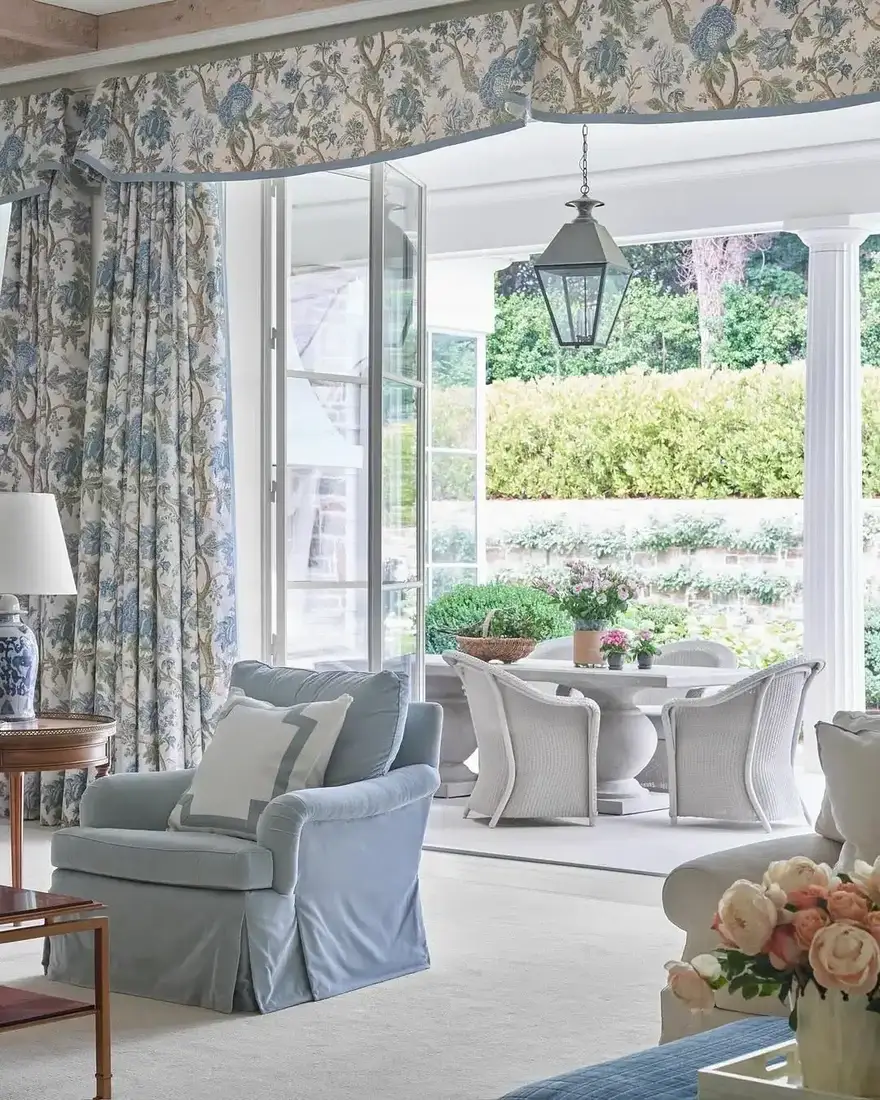
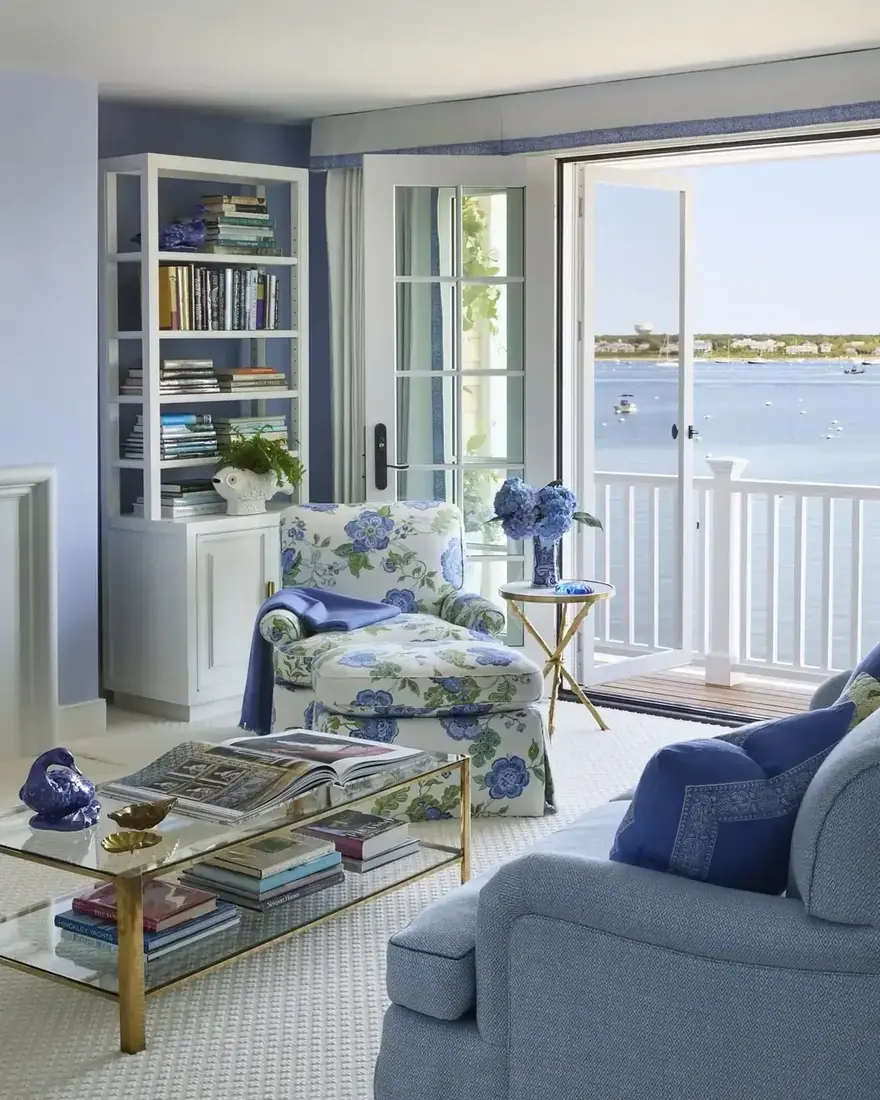
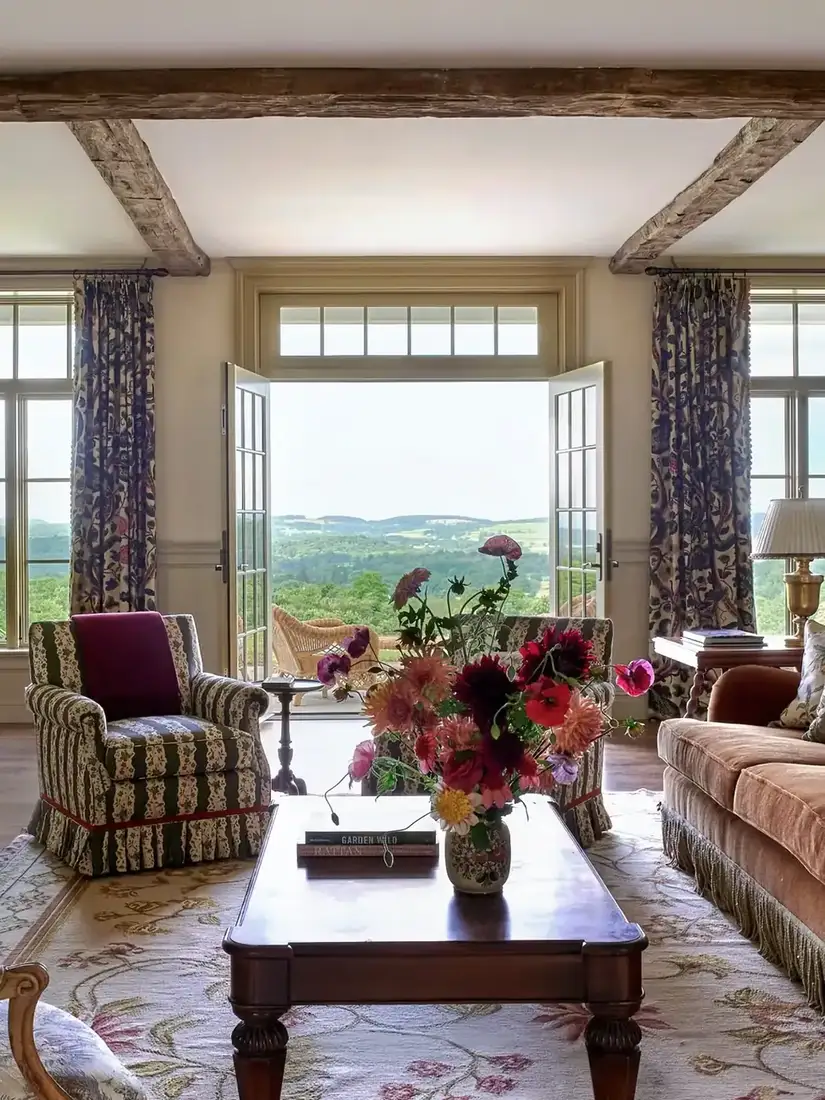
In this room the eye goes first to the top of the window, because that is where glass rooms usually fail. A bare track leaves a hard line of daylight above the curtains, which reads as glare even at eight in the morning. The pelmet here covers that junction completely, and the floral runs over it in one piece, so the wall reads as fabric, not as a gap.
That is the principle: control daylight at its edge before controlling it in the middle. A pelmet or a fixed valance does the work that a second lining cannot, because it stops the bounce off a white ceiling. The curtains beneath are full length and interlined, which is what allows them to sit against folding doors without flapping.
The terrace beyond makes the point about heat. Folding doors left open through a summer afternoon vent a glass room faster than any blind. For similar made to measure curtains in a cotton chintz, allow £180 to £320 a pair in 2026 from John Lewis or Hillarys, with interlining adding roughly a third. Sanderson Chiswick Grove and GP & J Baker Nympheus sit in the same visual family, small blue botanicals on pale ground, and both hold their colour well behind glass.
Dark timber that soaks up midday brightness
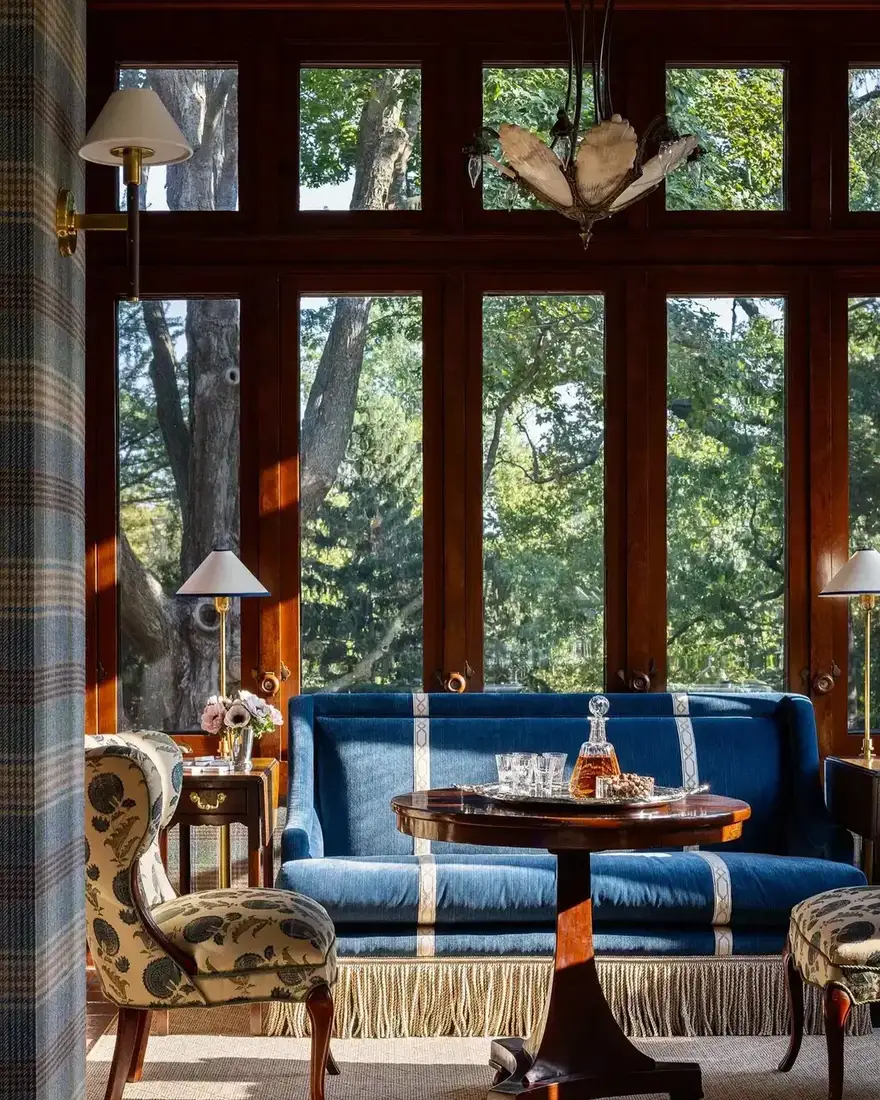
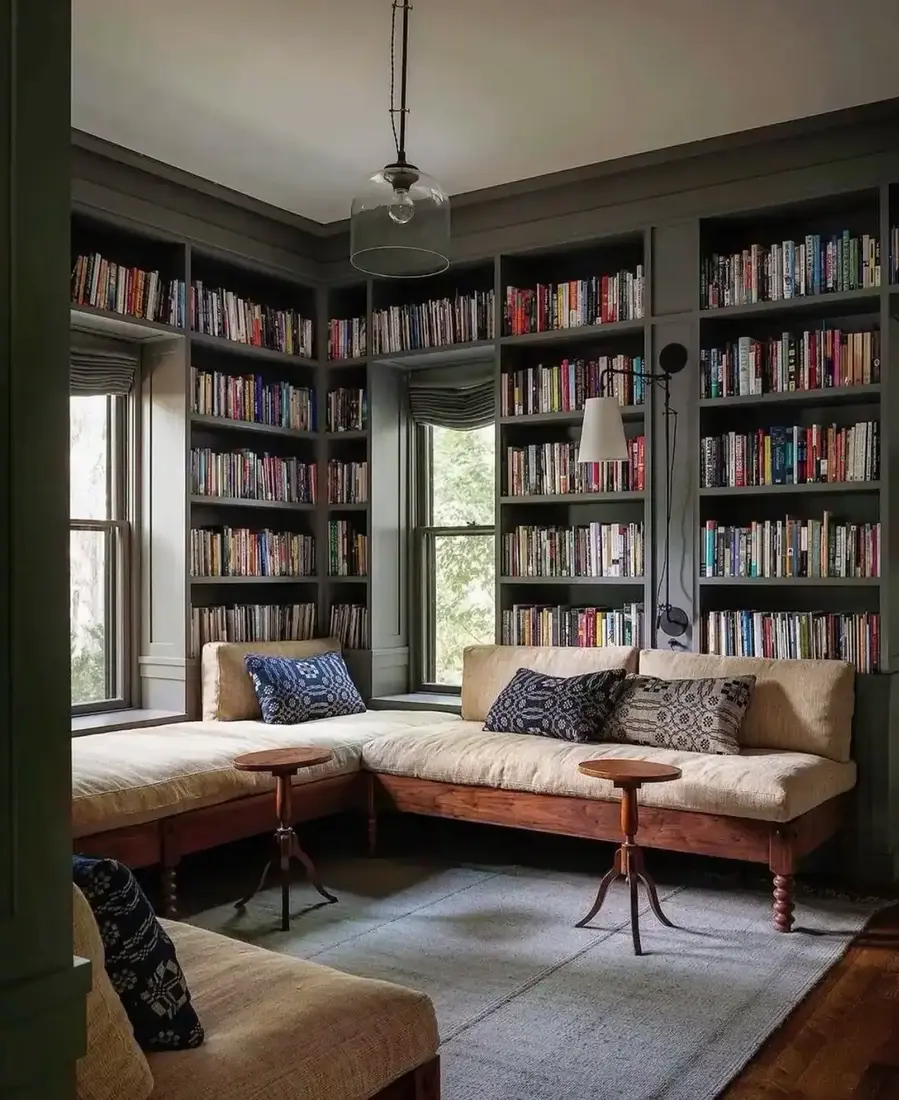
The reason this corner works at noon is not the sofa. It is the timber around it. Dark stained frames absorb the contrast that white frames throw back, so the garden outside stops bleaching and the blue inside stays legible. The eye registers the window as a picture, which is why the decanter and glasses on the round table still catch light instead of disappearing.
That dark surround is doing the same job as a painted ceiling in the opening room, only vertically. Because the frames are dark, the white tape on the sofa reads crisp against the timber. The fringe at the base, a full bullion edge, keeps the blue from floating above a pale carpet.
For the colour, think Farrow & Ball Hague Blue No.30 or Little Greene Royal Navy 257, both of which stay inky under strong daylight. A small velvet two seater in that tone runs £1,200 to £2,000 in 2026 from makers such as Soho Home and OKA. The brass wall light with a parchment shade, £60 to £140 in 2026 from Jim Lawrence or Pooky, gives the 2700K pool that glass rooms need after dark.
Rattan that lets light pass through
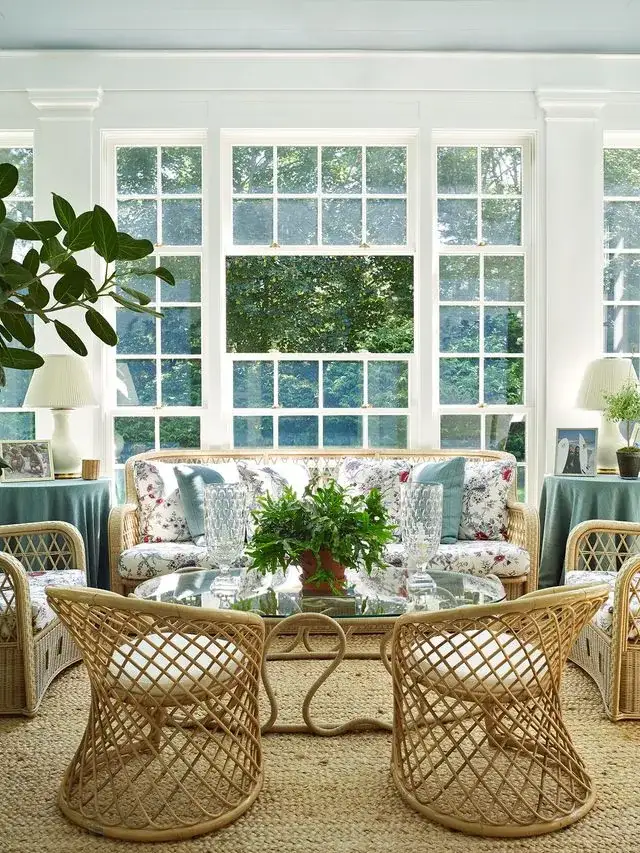
A white glass room glares because every surface returns light to the next one. The cane chairs in this room interrupt that circuit. Light passes through the open weave instead of bouncing off it, which lowers the overall brightness without darkening the palette. The glass coffee table does the same thing in the middle, and that is why the floral cushions still read.
The jute rug matters more than it looks. A pale fitted carpet under strong sun turns chalky by August. A textured natural rug in the centre absorbs sound and sun together, and it can be rolled up when the doors stand open. Similar chambered cane swivel chairs run £350 to £650 each in 2026 from OKA and Anthropologie, while plain jute in a similar size costs £120 to £260 in 2026 at Dunelm or Armadillo.
Paint discipline holds the rest. The walls sit close to Farrow & Ball Wimborne White No.239, a warm white with enough yellow to sit with timber and cane. Skip brilliant white in a room like this. It photographs cleanly and lives coldly, because the blue daylight from the glass turns it faintly grey by late afternoon.
A woven blind for filtered privacy
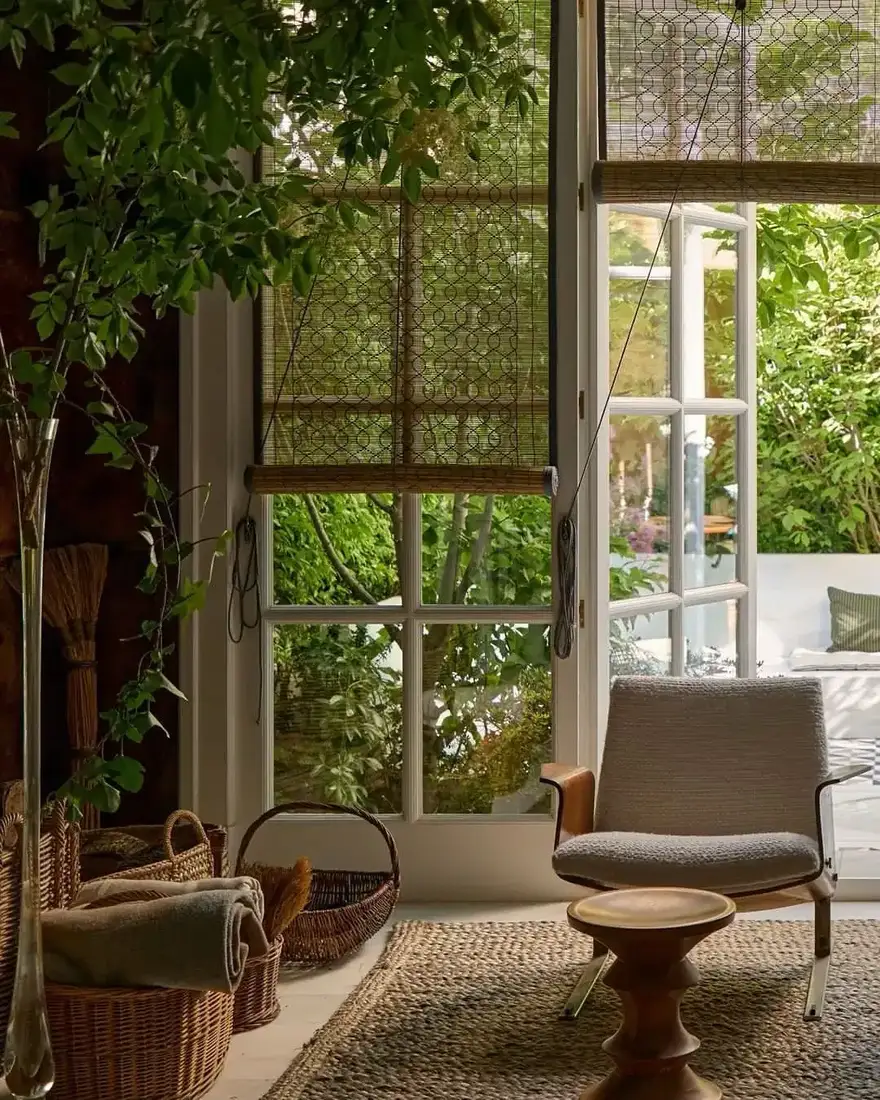
This corner solves privacy without curtains, which suits a door that opens fifty times a day. The woven roller sits half down, filtering the low view while leaving the top open to trees. From outside, the texture reads as a screen. From inside, the garden stays visible, only softened.
That filtering is the principle for overlooked glass. A sheer or a loose weave lowers the contrast between inside and outside, so eyes outside stop at the fabric instead of travelling in. Heavy lined curtains would be warmer in January, and this room will feel that in winter, but they would also block a doorway that needs to stay clear.
Woven rollers in jute or split bamboo run £45 to £95 in 2026 from Blinds 2go and Hillarys, made to measure. The bouclé chair with solid arms, £400 to £800 in 2026 from Habitat and Nkuku, earns its place because nubby wool does not show sun fade the way flat cotton does. Baskets and folded throws add the soft storage that glass rooms lack, and they cost less than any joinery.
Dark panelling that steadies a glass link
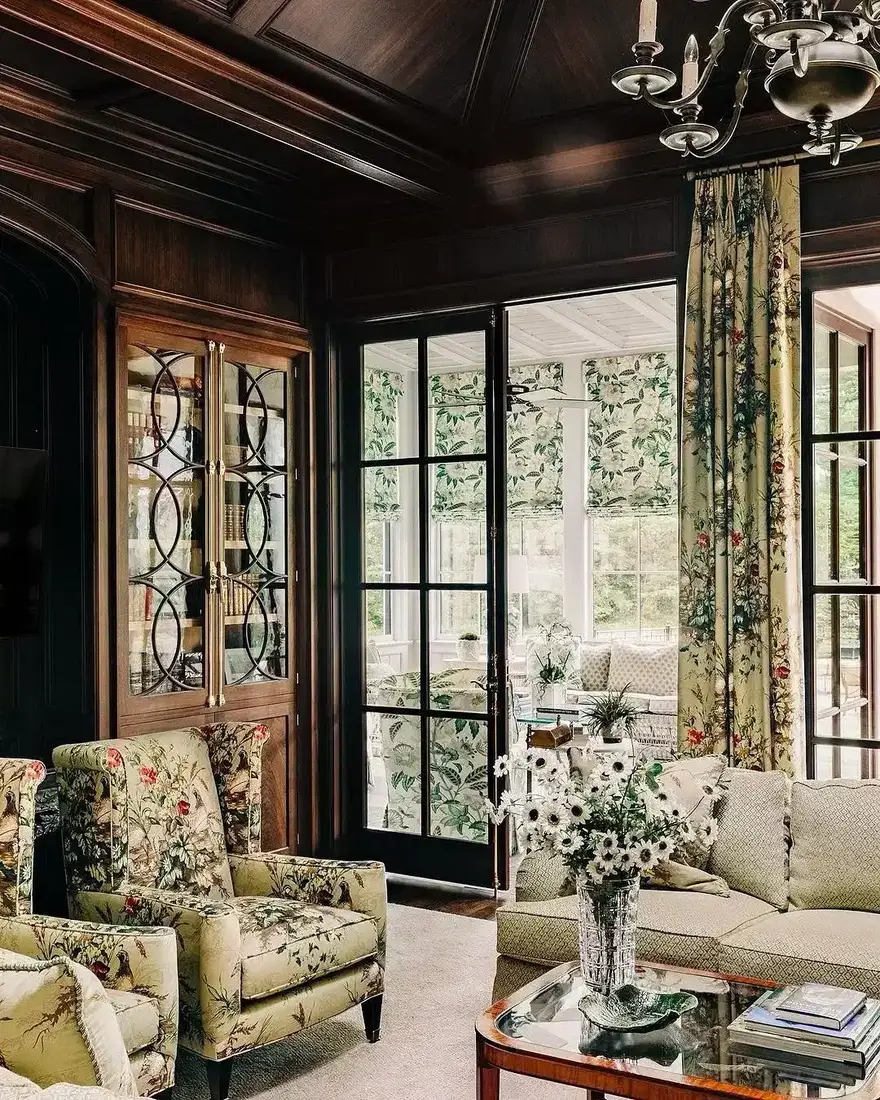
The glass doors show the contrast clearest. The next room is almost all glass with a leafy blind, and it is very bright. This room stays calm because the timber around it is dark enough to hold the contrast. The eye rests on the chintz chairs first, then moves outwards, which is exactly the sequence that makes a link between house and garden feel gradual.
That is why dark joinery suits glass better than white does. White next to bright glass pushes the brightness higher. Dark timber lowers it, so patterned upholstery keeps its detail. The glass coffee table keeps the centre light, and the daisies in a cut crystal vase give a sharp focal point at seat height.
For the panelling, Little Greene Dark Brunel 301 and Farrow & Ball Mahogany No.36 give the same depth without full gloss. A pair of wing chairs in a modern chintz, Colefax and Fowler Bowood or Linwood Ashfield, runs £900 to £1,600 each in 2026 re-covered. Skip a matched suite here. One floral pair against plain walls is composed. More pattern would argue with the garden.
Two layers for a narrow sitting nook
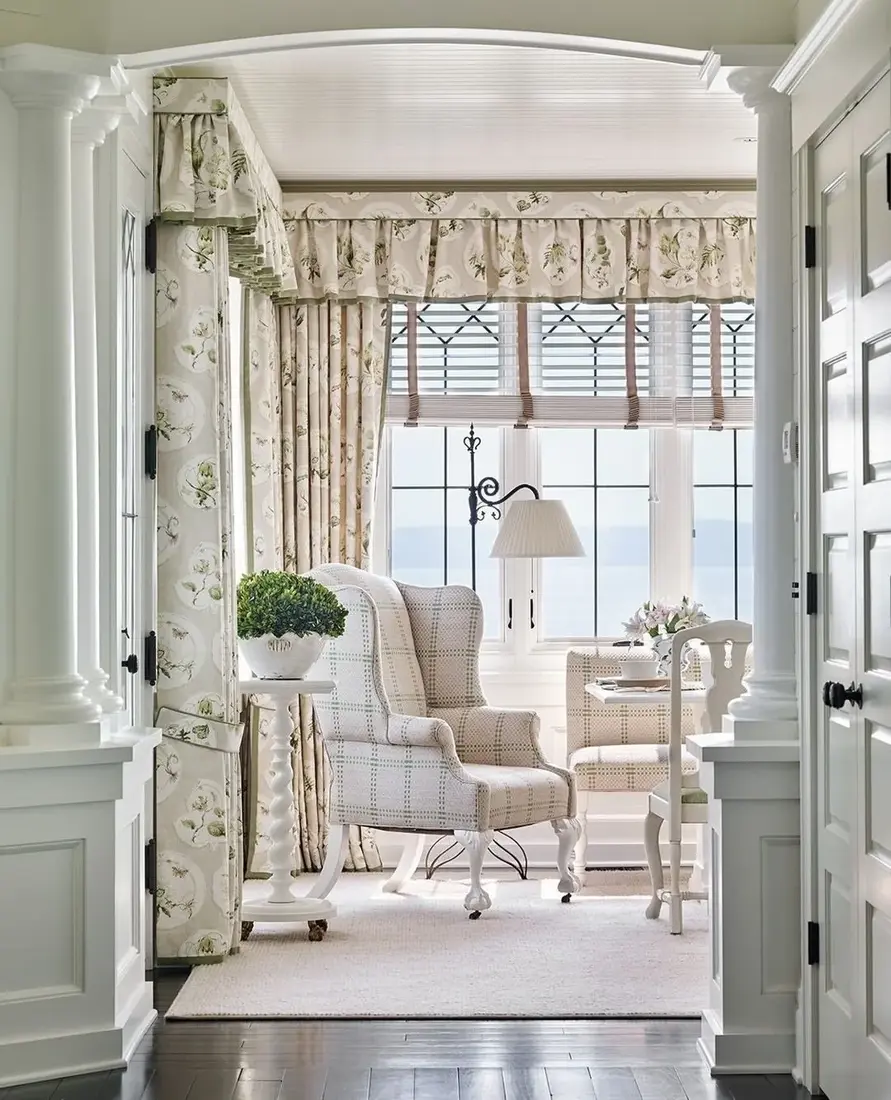
Small glass ends overheat and chill faster than large ones, because there is less air to buffer the change. This nook answers with two thin layers instead of one heavy one. The roman blind with brown tapes handles daytime glare and can be lowered in sections. The full curtains close at night, when single glazing loses heat fastest.
The tapes down the blind echo the leading edge trim in the opening room, and they do the same visual work. They give a plain neutral blind a vertical structure, so it reads tailored with a clear edge. The checked wing chair repeats the scale logic: small pattern on the chair, larger botanical on the curtains and valance, plain rug beneath.
Made to measure roman blinds in linen union run £140 to £280 in 2026 from John Lewis and Blinds 2go, with tapes adding a modest extra. The floor lamp with a parchment shade supplies the evening pool at 2700K, warm enough to make ivory fabrics read creamy. Without it, this passage would be a corridor after six.
A timber ceiling that cuts ceiling bounce
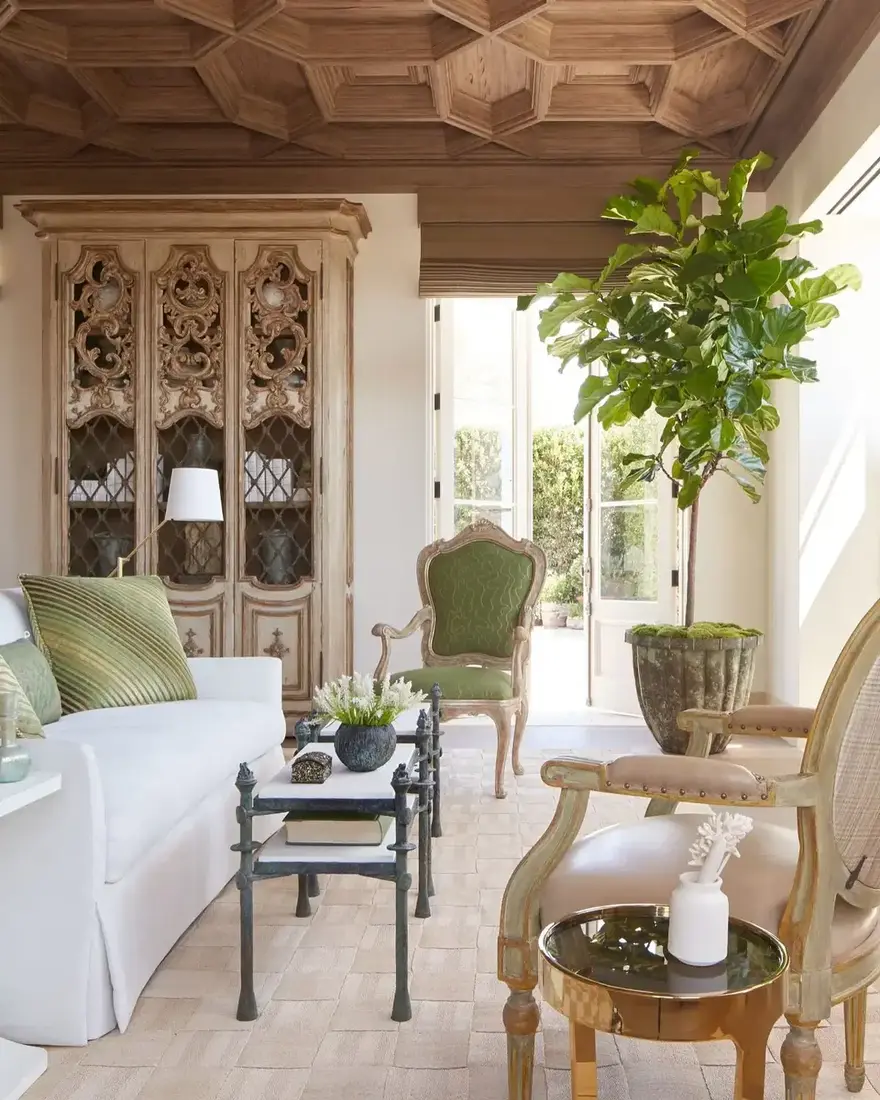
Most sunrooms have a white lid that throws daylight straight back down. This timber coffer does the opposite. The honeyed coffers break the surface into shadowed compartments, so the brightness drops before it reaches the seating. The room feels lower and calmer, even though the doors are full height.
Stone underfoot completes the tempering. The pale flags stay cool through warm afternoons and release that cool slowly, which is why tiled garden rooms feel comfortable barefoot when timber floors feel sticky. The limed armoire with carved doors adds the aged layer that new glass always needs, and its mirrored panes borrow light without adding glare.
To borrow the effect without joinery, try a natural pendant with a deep shade or beadboard painted in Farrow & Ball French Gray No.18. Limestone flags run £60 to £110 per square metre in 2026 from Mandarin Stone and Quorn Stone, plus laying. The fig in a mossed stone pot, £80 to £160 in 2026 from conservatory nurseries, tolerates bright filtered positions and dislikes cold draughts through open doors.
Lined curtains plus sheer for low sun
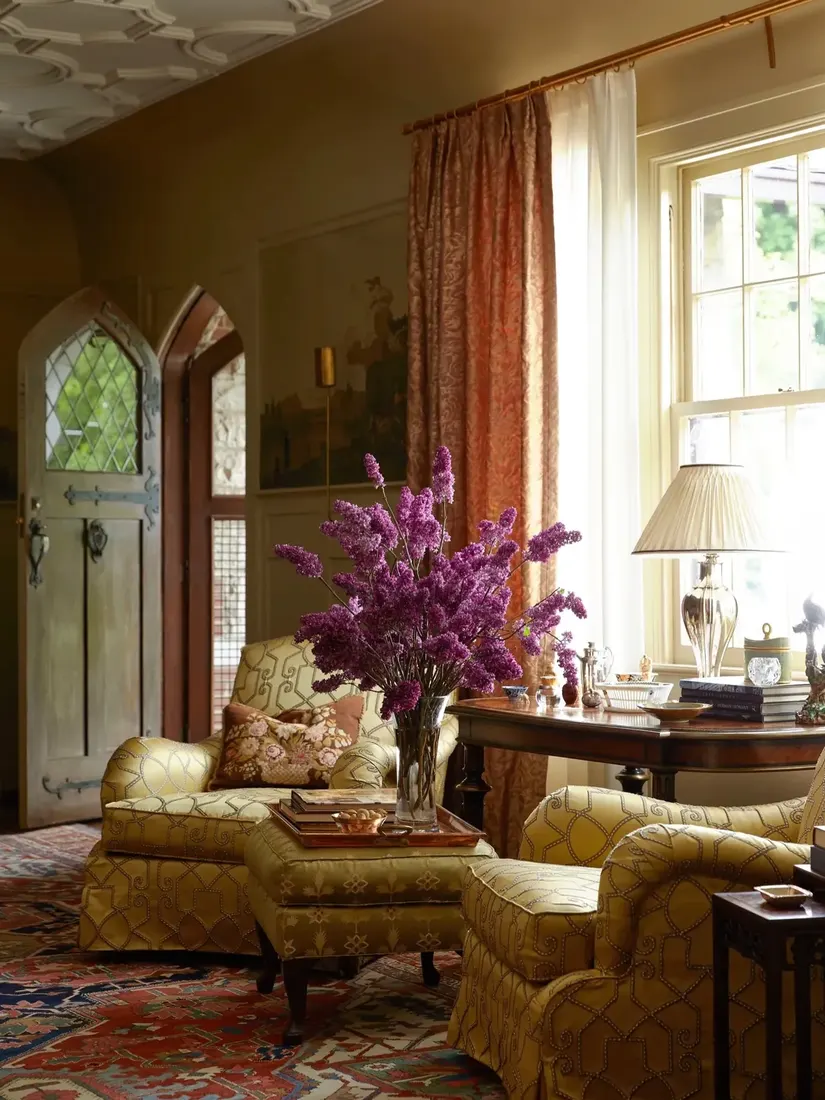
Low western sun is the hardest light to manage, because it arrives almost horizontally and searches out every pale surface. This room meets it with weight. The rust curtains are lined and full, so they can be drawn across the sash when the sun drops. The sheer behind stays closed through the day for privacy, diffusing the view without losing it.
The gothic doors with diamond leaded panes help more than they appear to. Small panes with lead cames break sunlight into fragments, which is kinder to velvet and needlepoint than one clear sheet. That is why the olive pattern on the chairs still looks even, with no pale shoulder where sun lands daily.
For similar lined curtains in a damask or small botanical, allow £200 to £380 a pair in 2026 from Stitchroom and John Lewis, with thermal lining adding insulation for winter evenings. The silvered table lamp with a pleated shade gives the low warm light that tall windows cannot, and lilacs in a tall vase mark the season without any permanent commitment.
Pale green that calms white glare
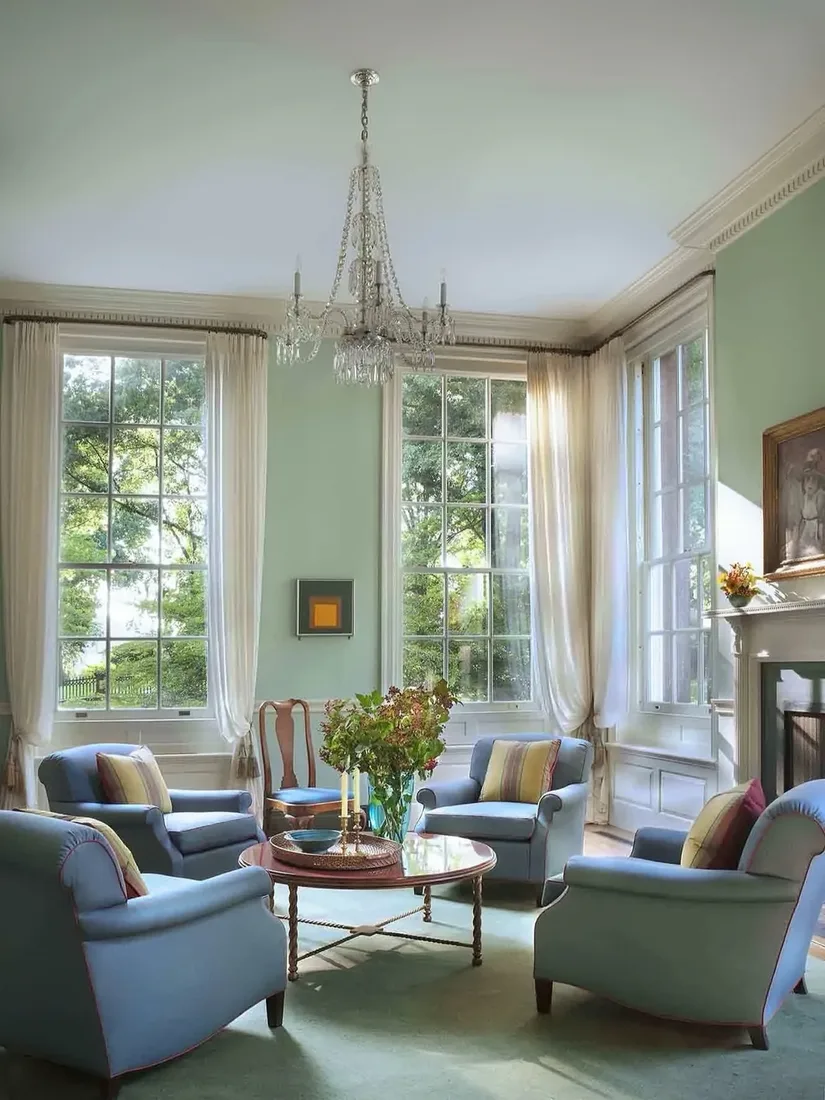
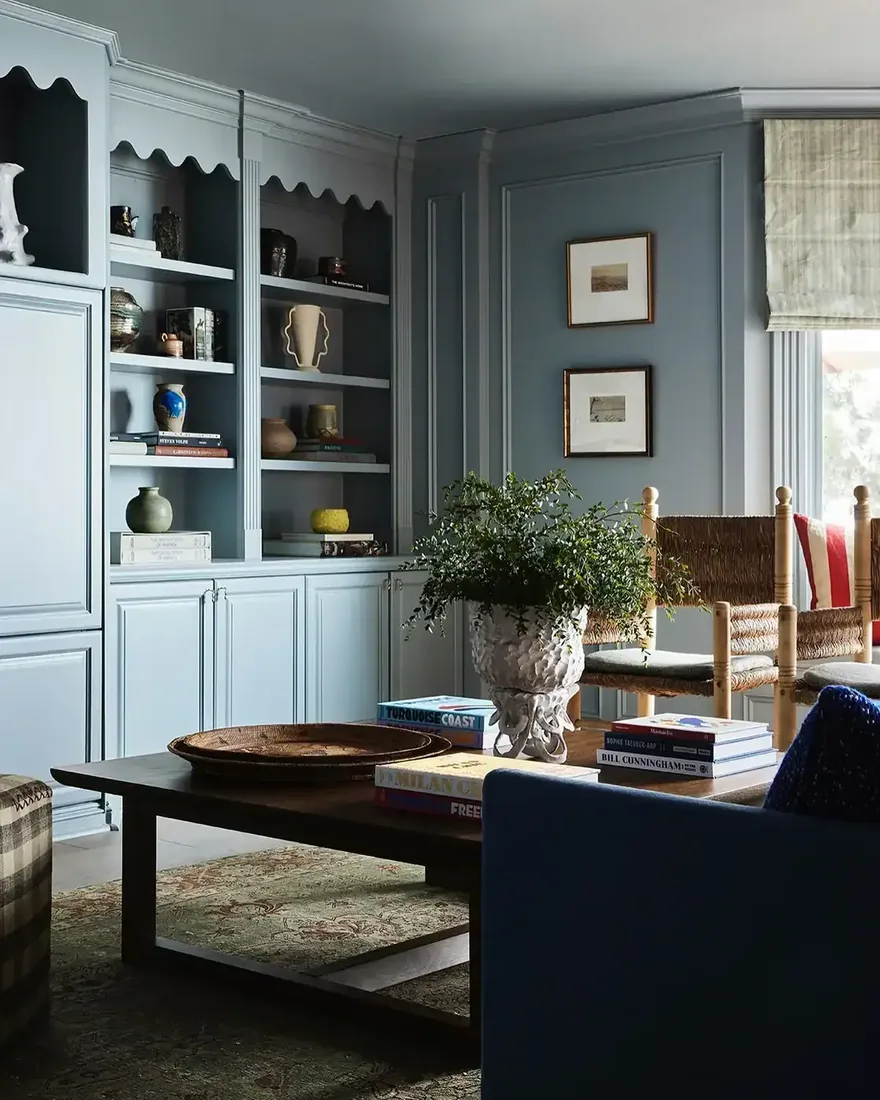
The principle here is that wall colour is a light filter. Pale green grey takes the edge off south light without darkening the room, because it absorbs the warm end of the spectrum that makes white walls shout. The four blue armchairs then read dusty, with the brightness taken off, and the striped cushions hold their bands.
Sheers run full height on slim rods, and they are doing the daytime work. They soften the trees into shapes, cut the contrast at the glass, and allow the sashes to stand open behind them for air. The crystal chandelier supplies the evening centre, which matters in a room with four aspects of glass and no obvious place for a pendant.
Colours close to this sit at Farrow & Ball Cromarty No.285 and Little Greene Aquamarine 138, both greyed greens that stay green in sun. Ivory sheers in a linen mix run £25 to £60 a metre in 2026 from IKEA and Habitat, and they wash well. The mahogany circular table in the middle anchors four light chairs, which would otherwise drift on a plain carpet.
Sheers that do the daytime work
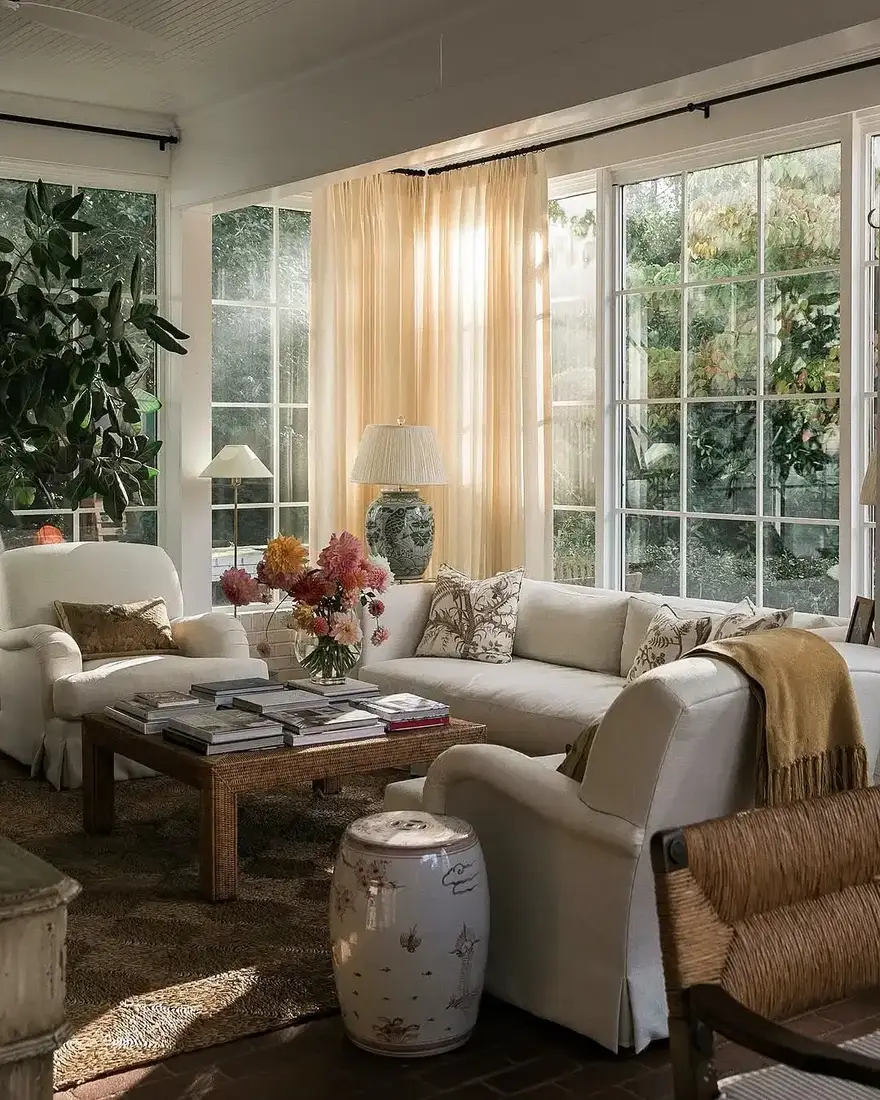
This is the most honest glare solution on the page, because it admits that a glass room needs a daytime layer and a night-time layer. The ivory sheers stay drawn while the sun moves round, lowering brightness and giving privacy from the garden. After dark, heavier curtains would be needed for warmth, and their absence tells us this room is used hardest from spring to autumn.
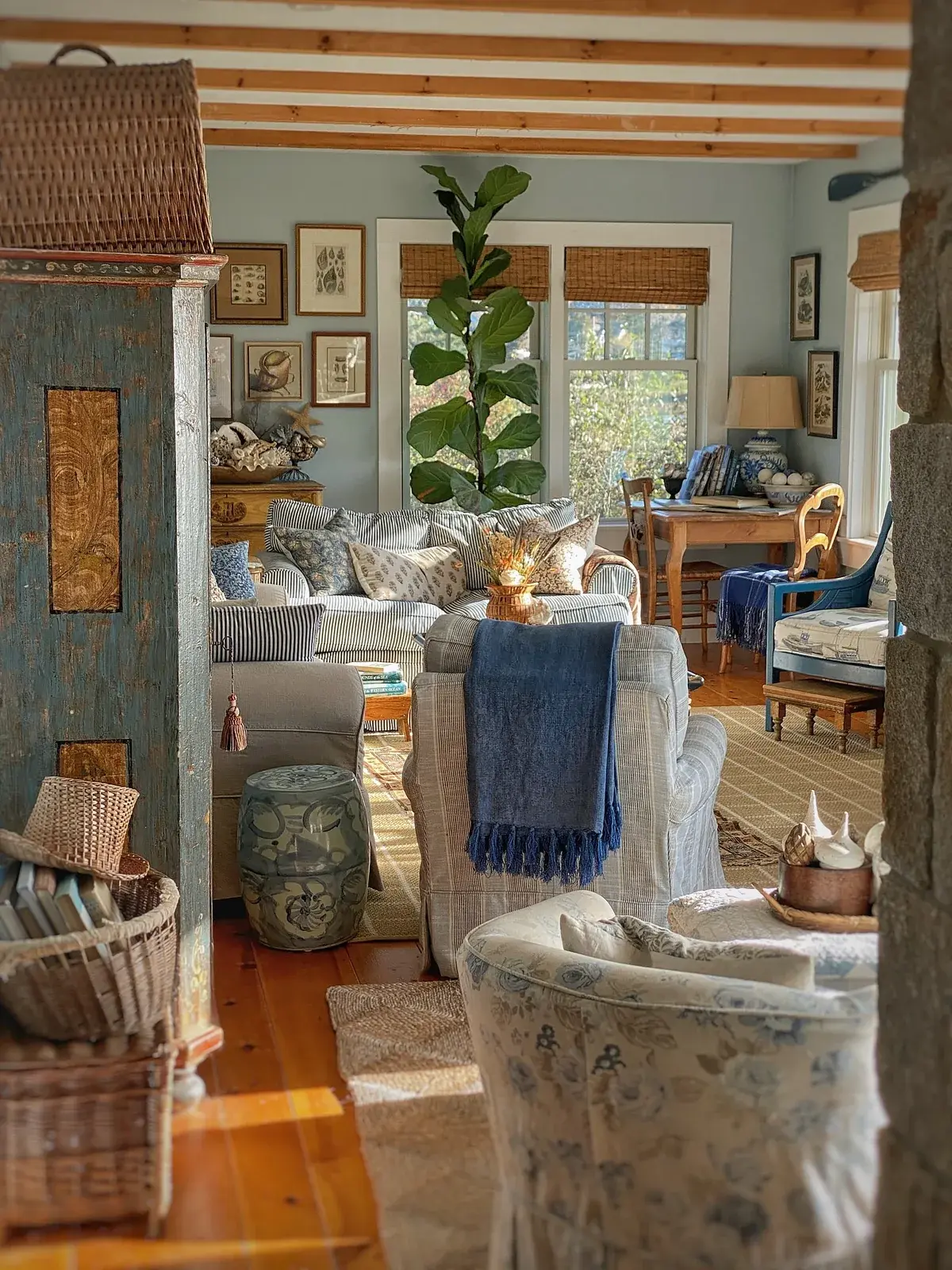
Slipcovers make that seasonal use practical. Sun bleaches the shoulders of fixed upholstery first, and the only cure is re-covering. A loose cover in performance linen can be removed, washed, and bleached gently, so the white stays white. The rattan coffee table and ceramic garden stool keep the centre light enough to move for extra chairs.
For the palette, Benjamin Moore White Dove OC-17 and Farrow & Ball Pointing No.2003 both sit warm without yellowing under 2700K lamps. Washable linen union for loose covers runs £35 to £70 a metre in 2026 from Ian Mankin and Vanessa Arbuthnott. The blue and white jar lamp, £90 to £180 in 2026 from OKA and Pooky, gives the warm side light that overhead spots cannot.
| Layer | Glare | Heat and privacy | Guide band in 2026 |
|---|---|---|---|
| Ivory sheer, linen mix | Softens contrast, keeps view | Little insulation, good daytime privacy | £25 to £60 a metre |
| Interlined linen curtain | Blocks low sun when drawn | Best night warmth, full privacy | £180 to £320 a pair |
| Woven roller blind | Filters without curtains | Good for doors, modest insulation | £45 to £95 made to measure |
| Thermal lining, added | Darkens slightly, steadies fade | Adds winter warmth behind any fabric | £30 to £70 a pair extra |
A game table kept out of direct sun
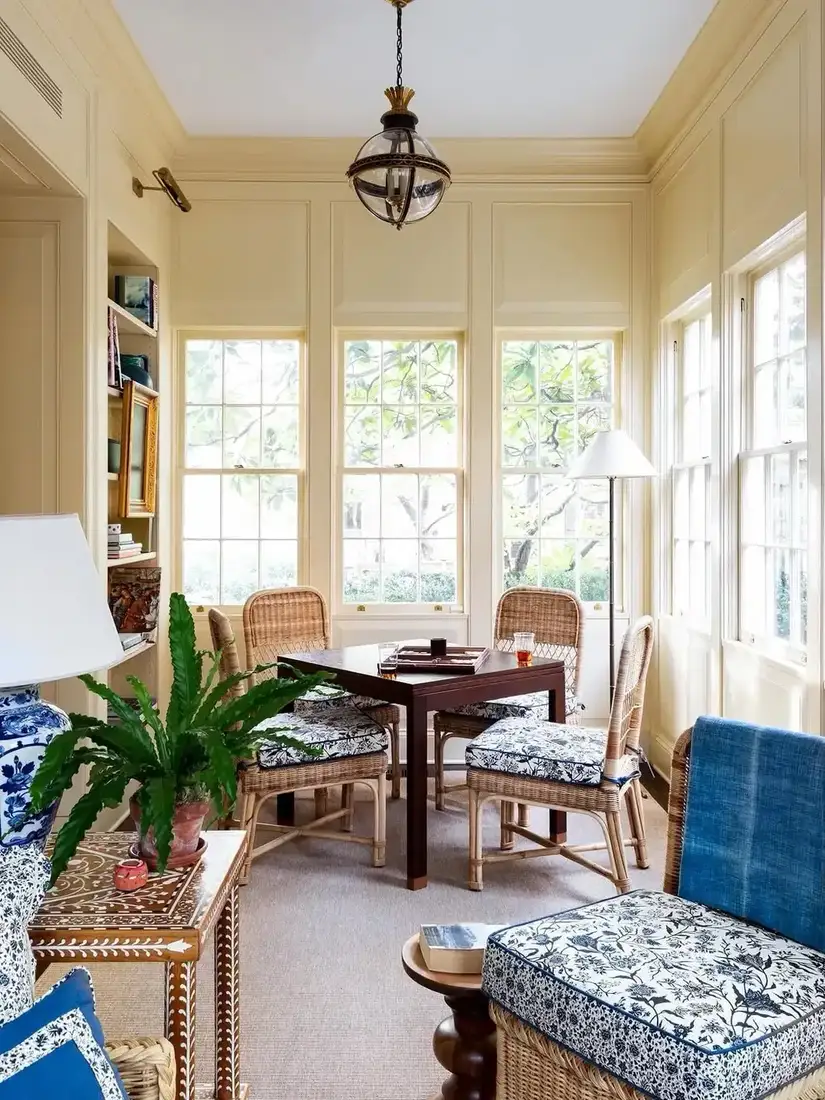
Small glazed rooms heat quickly because the volume is low and the glass is high. Placing a dark timber table in the middle, away from the windows, keeps it out of the strongest patch. The cane chairs around it stay cooler to touch than upholstered ones, and their open backs allow air to move.
Blue and white holds in this brightness because the contrast is contained. Cushions in a dense botanical sit on natural cane, with one solid indigo throw to steady them. The inlaid side table with a fern and a blue porcelain lamp gives a second focal point at the edge, so the room does not read as chairs around a void.
Walls close to Farrow & Ball Hay No.37 and Little Greene Stone Pale 231 keep yellow rooms from turning acidic in sun. Cane dining chairs with loose cushions run £150 to £320 each in 2026 from Soane and OKA. Skip pale leather here. It fades unevenly and feels hot after an hour in direct light, which shortens the game.
Dense chintz that hides sun fade
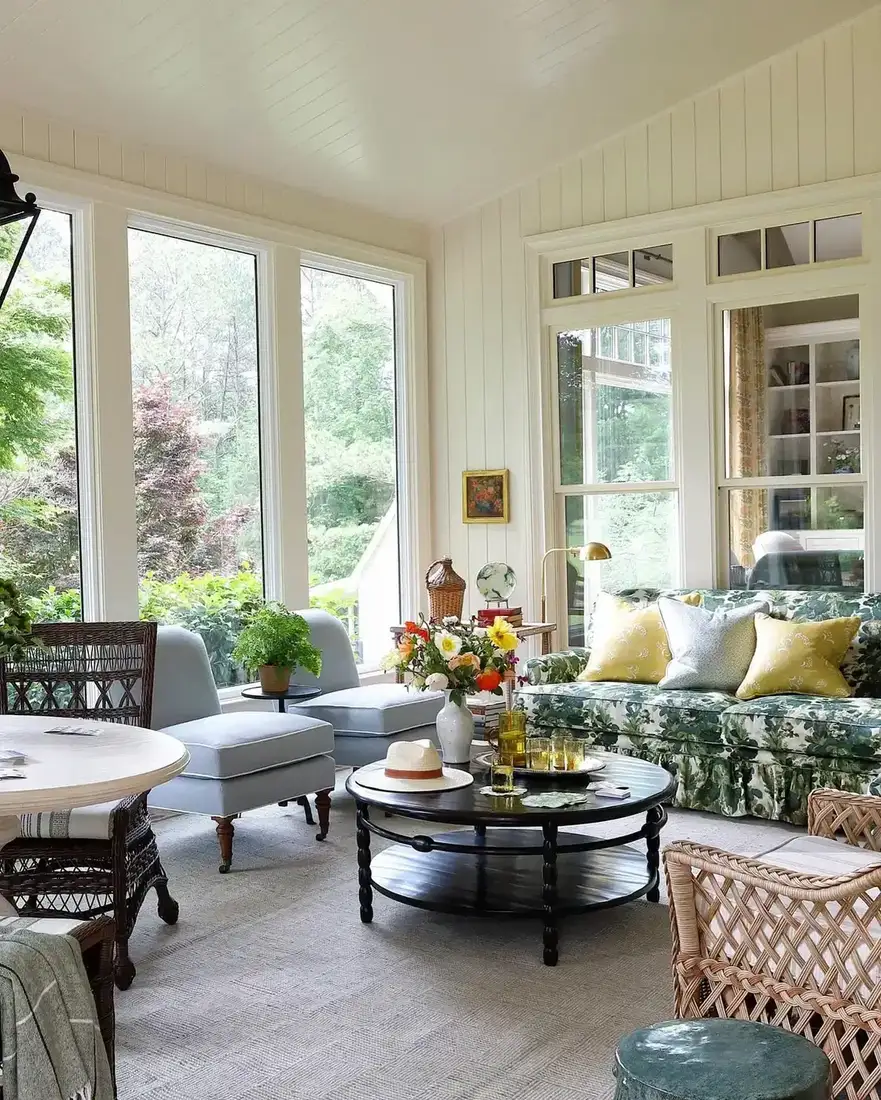
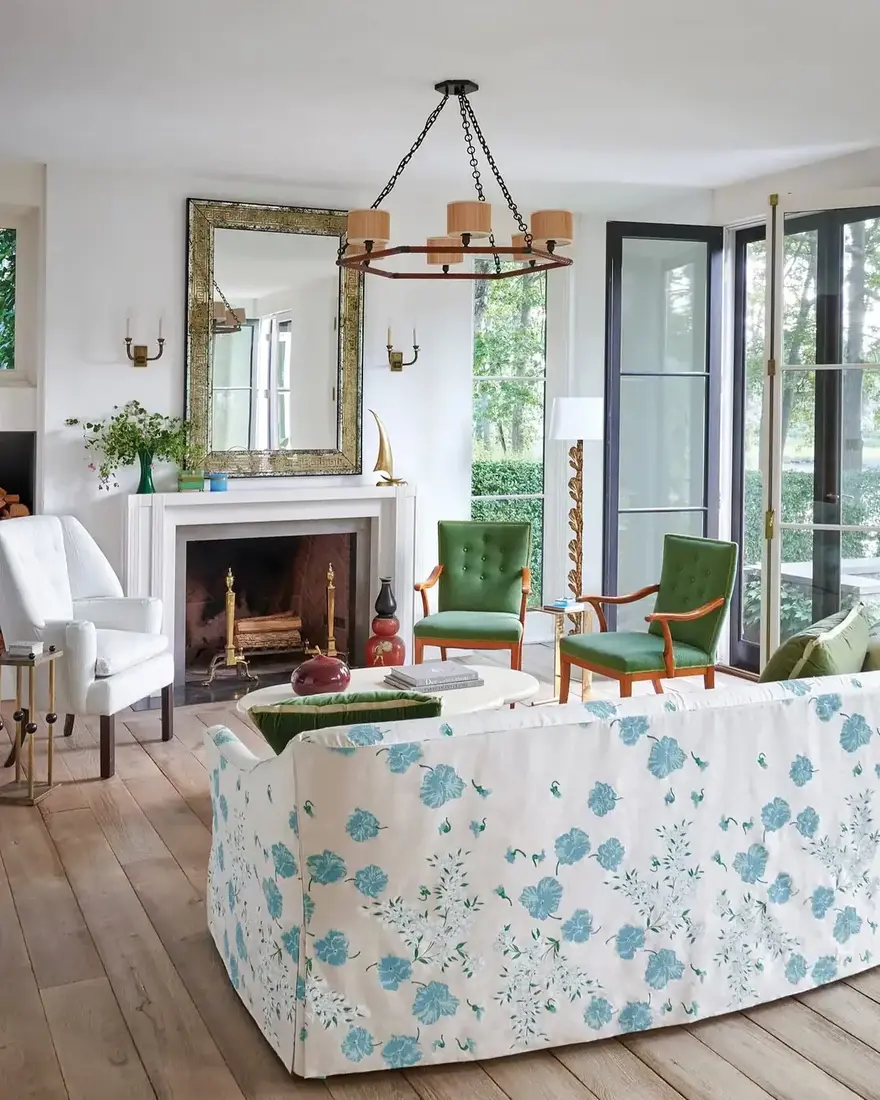
Sun fade shows first on flat colour and last on dense pattern, which is why chintz suits glass. The green botanical on this skirted sofa breaks light into leaves and stems, so any softening reads as patina. The pale slipper chairs beside it will fade faster, and that is the correct hierarchy: the expensive patterned piece lasts, the plain ones are cheaper to recover.
The dark oval table steadies a room that could float. In a white beadboard space with tall glazing, everything pale rises. One low black or mahogany form gives the eye a base, and the hat, flowers, and yellow glass on it give scale. The sisal rug beneath adds the coarse texture that glazed walls lack.
A three seater in a glazed chintz such as Colefax and Fowler Bowood runs £1,400 to £2,400 in 2026 made to order, with plain linen slipper chairs roughly half that. Keep the curtains plain when the sofa carries pattern. Two florals in one glass room argue all afternoon, and the garden is already the second pattern.
Grey trusses that break a vaulted glare
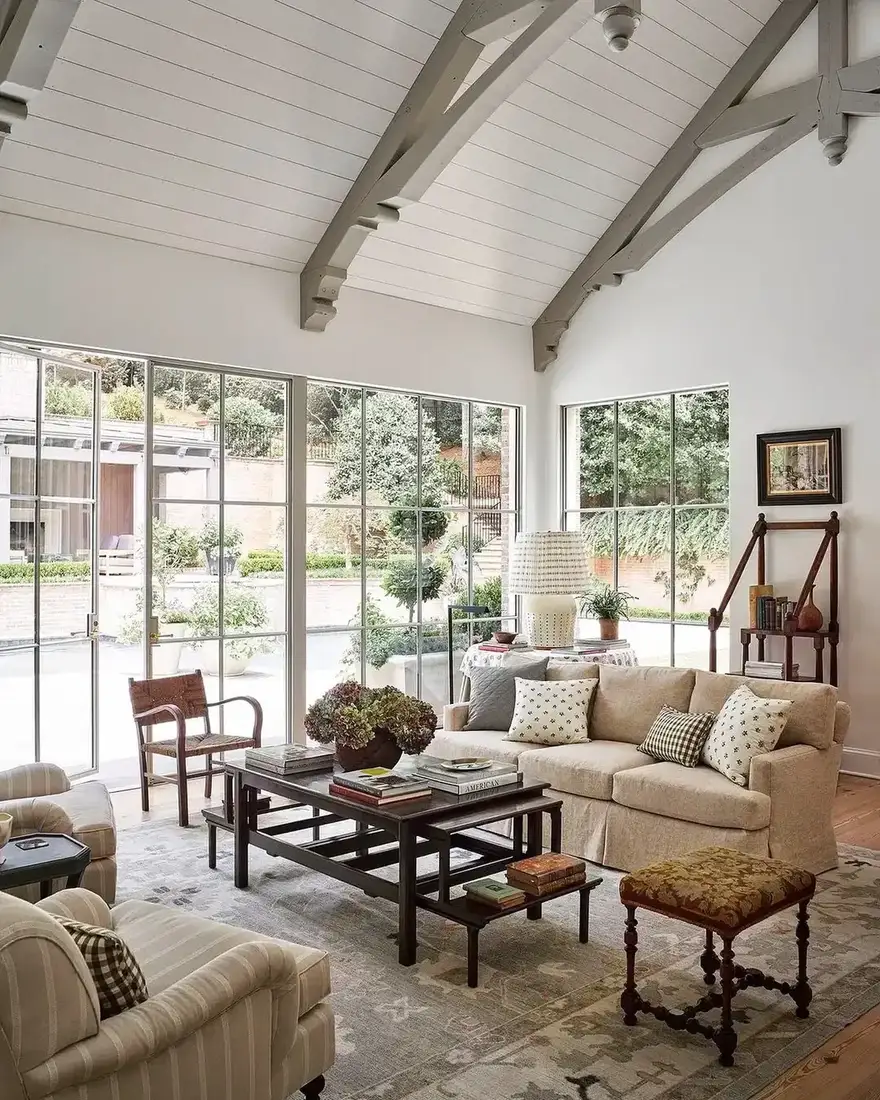
Height raises brightness, because there is more glass and more white ceiling to bounce it. The grey trusses here lower both. They divide the white lid into bays and give the eye a cool line to follow, so the volume reads structured with the height held in check. Painted the same white, they would disappear and the glare would rise.
Furniture stays low for the same reason. The linen sofa, striped chairs, and open dark coffee table all sit below the window transoms, leaving the glass clear. The large patterned rug zones the seating, which is what stops a vaulted wall feeling like a hallway. Books stacked low on the table add weight without height.
For the woodwork, Little Greene Slaked Lime 105 on walls with Farrow & Ball Pavilion Gray No.242 on trusses holds the balance. A wool rug in this scale runs £200 to £450 in 2026 from Armadillo and Weaver Green, the latter in recycled yarn that tolerates sun. The ceramic table lamp with a checked shade repeats the 2700K rule: warm pools below eye level after dusk, never a cold downlight from the ridge.
Black frames that give white walls an edge
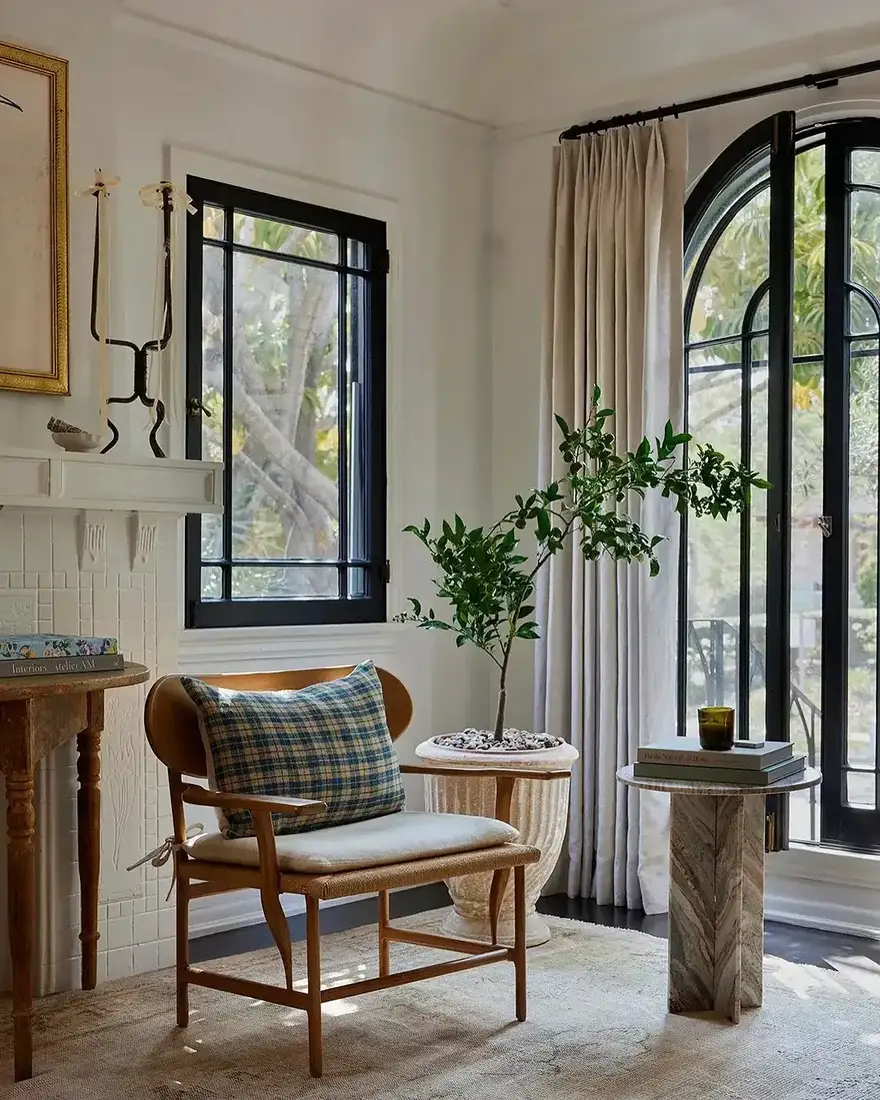
White rooms beside glass often look washed rather than calm, because there is no shadow line to stop the brightness. The black steel arch and the black window frame here supply that line. They hold the view the way a mount holds a print, and the white walls suddenly read intentional.
The linen curtain on a black rod does the night work. Drawn, it covers the largest heat loss in the room. Open, it stacks clear of the arch and leaves the curve visible, which is the correct courtesy to an arch: never cut it halfway. The citrus in a fluted stone pot softens the geometry without blocking light, and its height marks the scale better than any small houseplant.
Walls sit near Farrow & Ball All White No.2005, which stays neutral under both daylight and 2700K lamps. Steel-look doors run £800 to £1,500 per leaf in 2026 from Crittal-style suppliers, plus fitting. The rush-seated chair with a plaid cushion, £250 to £480 in 2026 from Howe and Neptune, stays comfortable in sun where foam and velvet grow hot.
Frequently Asked Questions
How do I calm a bright glass room that feels stark?
Introduce one deep tone to absorb bounce. Dark timber, walnut, or a slate rug lowers contrast so paler fabrics settle. Pale green grey walls also soften noon brightness.
Which coverings preserve the view while screening neighbours?
Sheers in ivory linen and loose weave rollers diffuse overlooking without blackout. They blur movement outside yet keep treetops visible, then heavier drapes close after dusk.
What textiles last where afternoon sun lands daily?
Dense botanicals, solution dyed linen, and nubby bouclé disguise softening best. Loose covers that launder extend life further, while flat cottons and pale leather mark sooner.
Can a glazed sitting area stay comfortable beyond summer?
Yes with layered warmth. Full length lined drapes drawn at night, a deep rug underfoot, and low 2700K lamps create an evening pool. Stone or tile underfoot still feels cool, so add wool underfoot.
Why do whites turn chalky or grey in sunrooms?
Strong daylight plus reflected sky cool bleaches warm pigment and flattens chalk finishes. Warmer whites with a drop of yellow, such as Pointing or White Dove, remain creamy under both sun and lamplight.
Where do lamps work best when glazing dominates?
Keep pools low around seating rather than overhead. A jar lamp beside the sofa, a reading shade by the chair, and a small table light together define the corner used after sunset.
In order
- Apply a contrasting tape down the leading edge, set in from the edge.
- Use the same fabric a second time, smaller, on a chair or cushions.
- Paint the ceiling a pale version of the wall colour.
- Hang curtains above and wider than the window, breaking slightly on the floor.
- Use at least two times fullness, and two and a half where the budget allows.
- Filter daylight at the glass with sheers or woven rollers before adding weight.
- Anchor brightness with one dark timber, stone, or patterned piece per room.
- Light evenings low and warm, with 2700K pools around the seats used most.
This article may contain affiliate links. We may earn a commission at no extra cost to you.