9 Kitchen Flooring Ideas: Bold Floors Belong in Small Rooms

Add us as a preferred source to see more stories on Google.
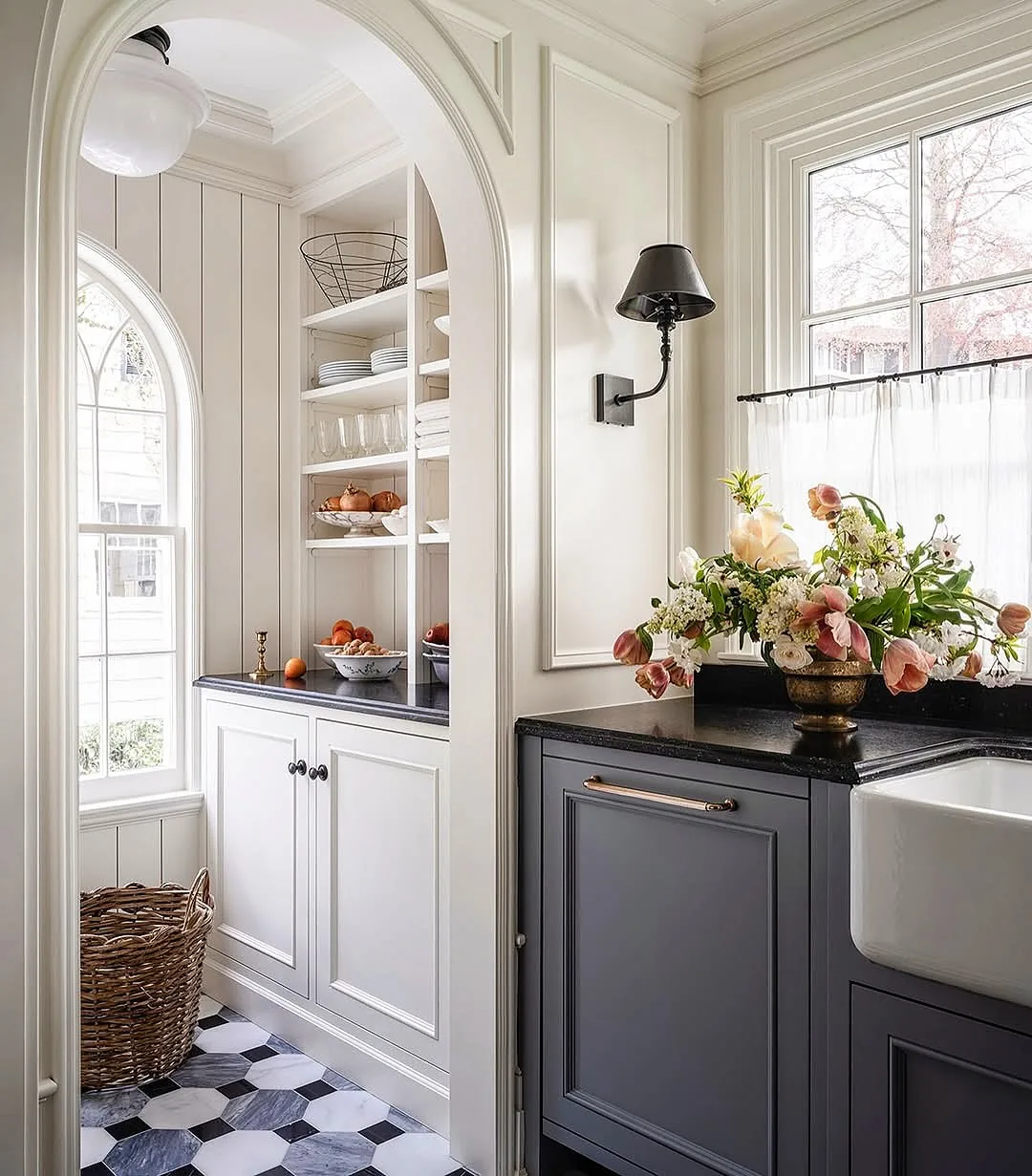
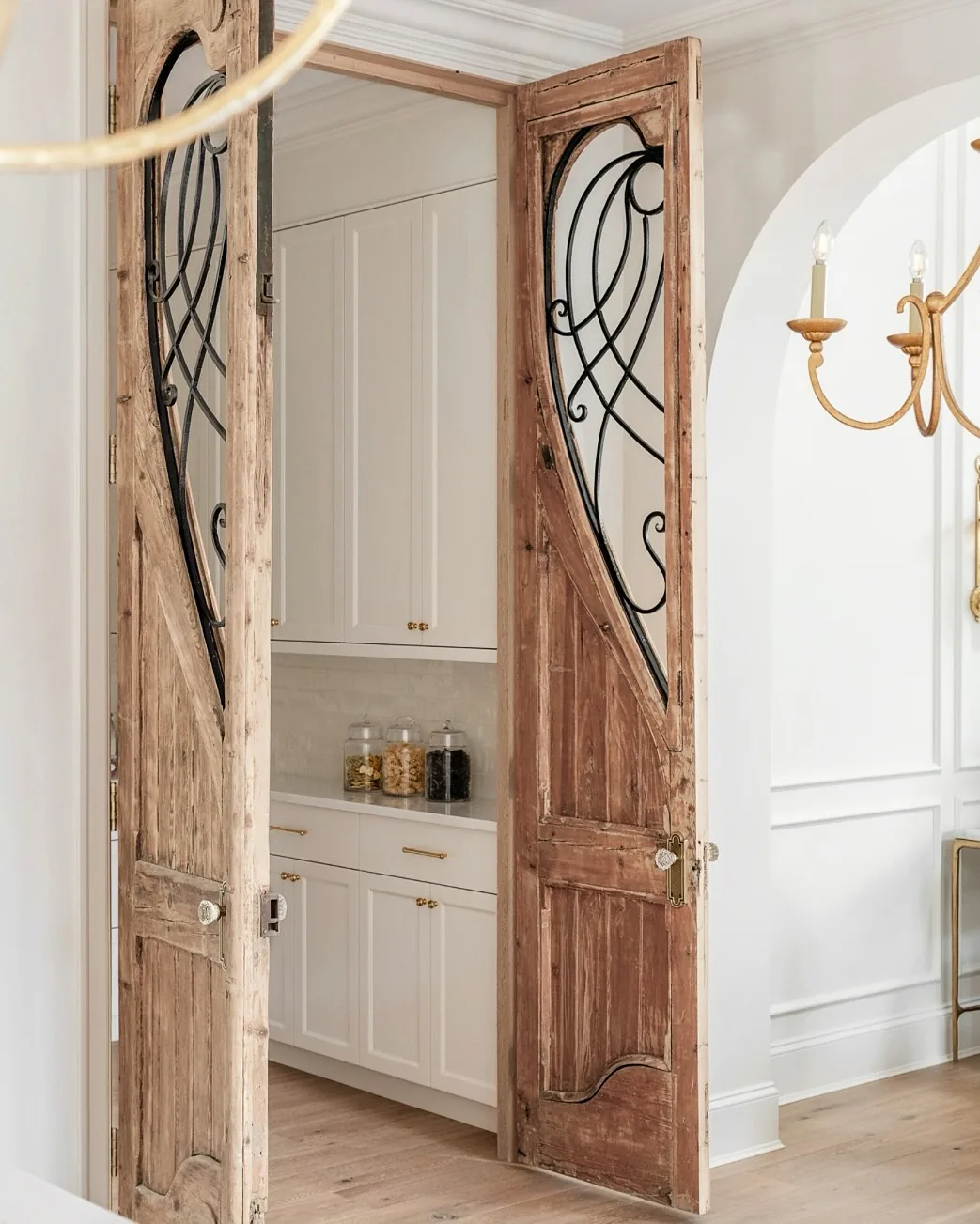
The floor below is lovely, and the important thing about it is where it stops.
White marble hexagons with small dark square insets at the junctions, in a pattern usually called cabochon. It runs through the pantry beyond the arch and nowhere else. The main kitchen, out of frame, has something quieter.
Run that same floor across a large open kitchen and it stops being charming. Pattern is a small-room material: in a space you pass through, it is a pleasure; in a space you stand in for two hours a day, it is loud.
Why small rooms take pattern
Two reasons, and the second is the one that decides it.
A small room shows less of the pattern at once, so the repeat never becomes obvious. Notice how little of that floor is actually visible through the arch: perhaps two square metres, which is exactly enough to register as charming. In a large room you see thirty repeats and the eye starts reading the grid rather than the floor.
And you are not in it for long. A pantry is a thirty-second room. Standing at a hob for an hour on a strongly patterned floor is a different experience, and it is the reason so many bold kitchen floors get covered with runners within two years.
The detail that makes the pattern
Those small dark squares are doing all of it. Look at where they sit: one at each junction where three hexagons meet, so they fall into a regular diamond grid across the floor. Cover them and you have a plain white hexagon floor, which is quiet and slightly institutional. Add them back and it becomes a graphic.
It is also a very cheap decision. The insets are a small fraction of the tile order, and most suppliers sell the hexagons and the squares as a set.
The same principle runs through most classic patterned floors: a plain field plus a small contrasting element. Chequerboard is the exception and the one that most needs a small room, because there is no quiet ground in it at all.
Marble or porcelain
| Real marble | Porcelain | |
|---|---|---|
| Etching from acids | Yes, permanently | No |
| Staining | Yes, needs sealing | No |
| Ages | Beautifully | Not at all |
| Underfloor heating | Excellent | Excellent |
| Cost | High, plus fabrication | Moderate |
Lemon juice, vinegar, wine and most descalers all etch marble, which means a dulled patch that no amount of cleaning removes. In a pantry where things get carried through, that is a manageable risk. At a kitchen sink it is close to a certainty.
Porcelain in hexagon and cabochon format has improved enormously and most people should choose it for a working kitchen. Ask for the shade variation rating, because a V1 porcelain marble-look repeats visibly and reads fake. V3 is the number to want.
If the room is genuinely small and you want real stone, honed rather than polished. Honed marble still etches; it simply does not show it as sharply.
Where to buy the pattern
| Budget | Where | Roughly |
|---|---|---|
| Premium | Mandarin Stone, Artisans of Devizes, Ca’ Pietra | £90 to £180 per m2 in marble in 2026 |
| Mid | Original Style, Topps Tiles porcelain ranges | £45 to £80 per m2 in 2026 |
| Budget | Tile Mountain, Walls and Floors hex and cabochon | £25 to £45 per m2 in 2026 |
For grout, Mapei Ultracolor Plus in a grey matched to the cabochon rather than to the field. A white grout with a dark inset draws a second grid over the first and undoes the pattern.
The rest of the kitchen floor
Whatever goes in the main space, the useful rule is that it should be quiet, warm and hard-wearing, because it is the largest single surface in the room and it has to sit under everything else.
Engineered oak in a wide board is the most popular answer and the most forgiving, provided it is properly finished and the kitchen does not flood regularly. Large-format porcelain in a stone look is the practical alternative and takes underfloor heating better. Terracotta and reclaimed brick both suit old houses and both need sealing.
What rarely works is a busy floor under busy cabinets. If the kitchen has pattern anywhere else, the floor should be plain.
Terracotta hexagons that hide the mopping
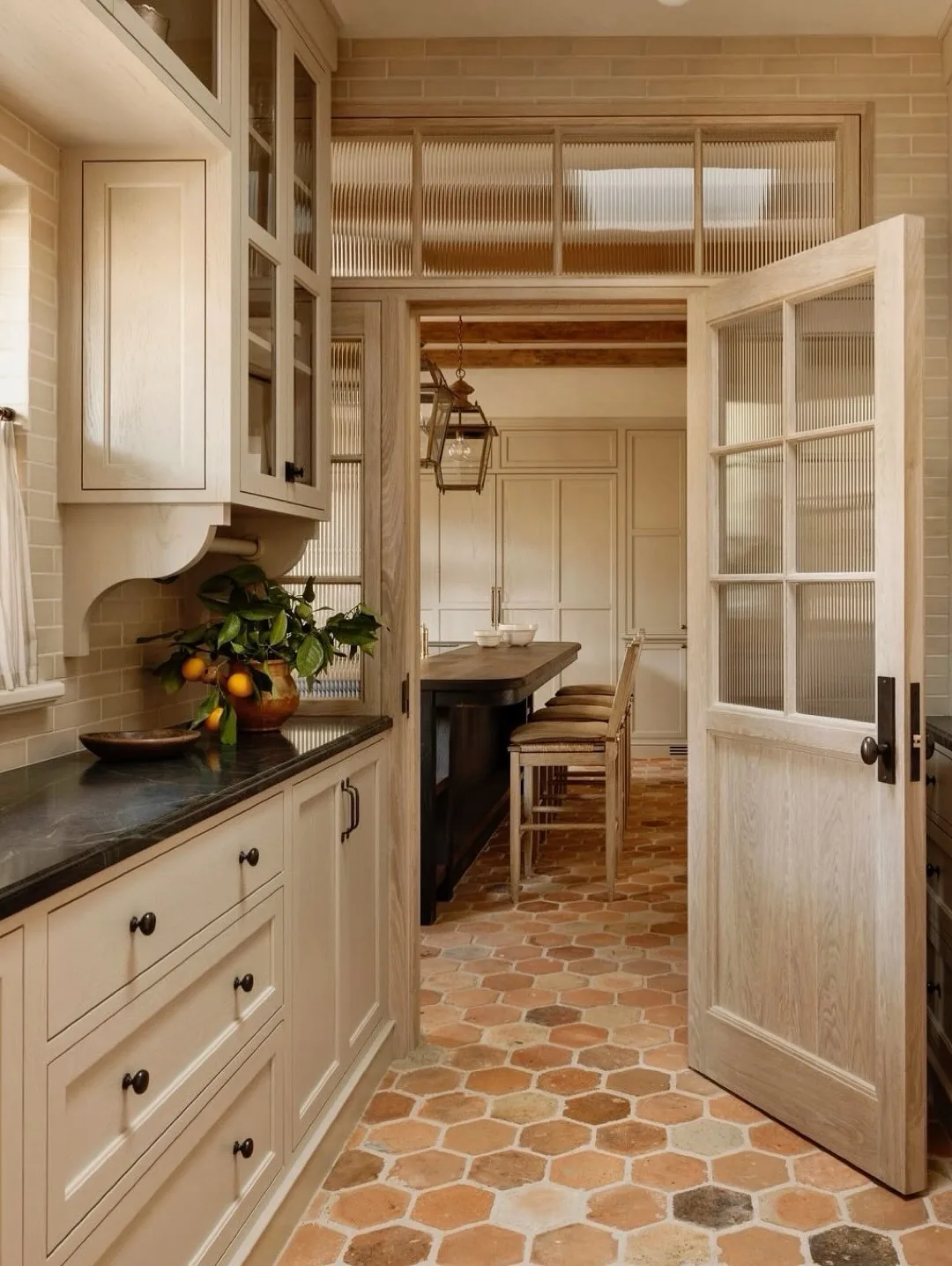
In this kitchen the floor is doing the quiet work while the joinery takes the credit. Small terracotta hexagons run from the cream cupboards under the dark worktop straight through the glazed doors to the dining space beyond, and the colour shifts from honey to rust to pale clay across a few steps. That variation is the reason crumbs and mop marks barely register, because the eye already expects unevenness. Hexagons of this kind are commonly sold at 150mm across the flats, which keeps the scale tight in a narrow run.
Look at the grout lines around that tile. They are wide and pale, which is the detail to copy, because handmade clay edges are never perfectly straight and a tight rectified joint would emphasise every wobble. A forgiving sanded joint absorbs the irregularity, and the pale colour keeps the small format from reading as a net across the floor.
Dropped jars chip less visibly on unglazed clay than on glazed porcelain, and a single hexagon can be lifted and replaced without disturbing the field, which is the practical advantage of a small format. Seal with a penetrating sealer such as Lithofin Stainstop or Fila MP90, then mop with a pH neutral cleaner. In 2026 Ca’ Pietra and Marlborough Tiles list handmade-look hexagons around £55 to £95 a square metre, while porcelain copies through Topps Tiles sit near £35 to £65.
A large chequer that steadies a tall room
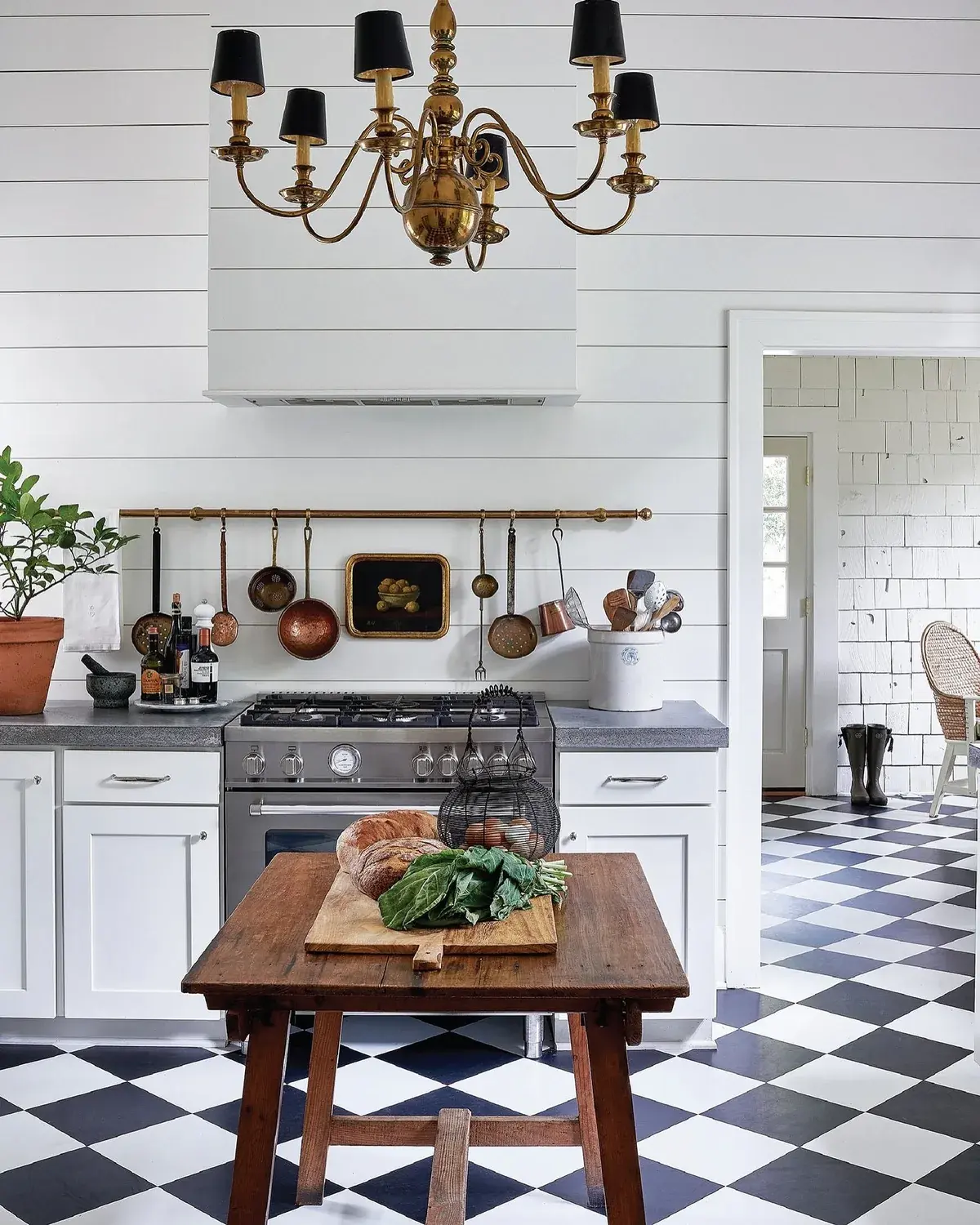
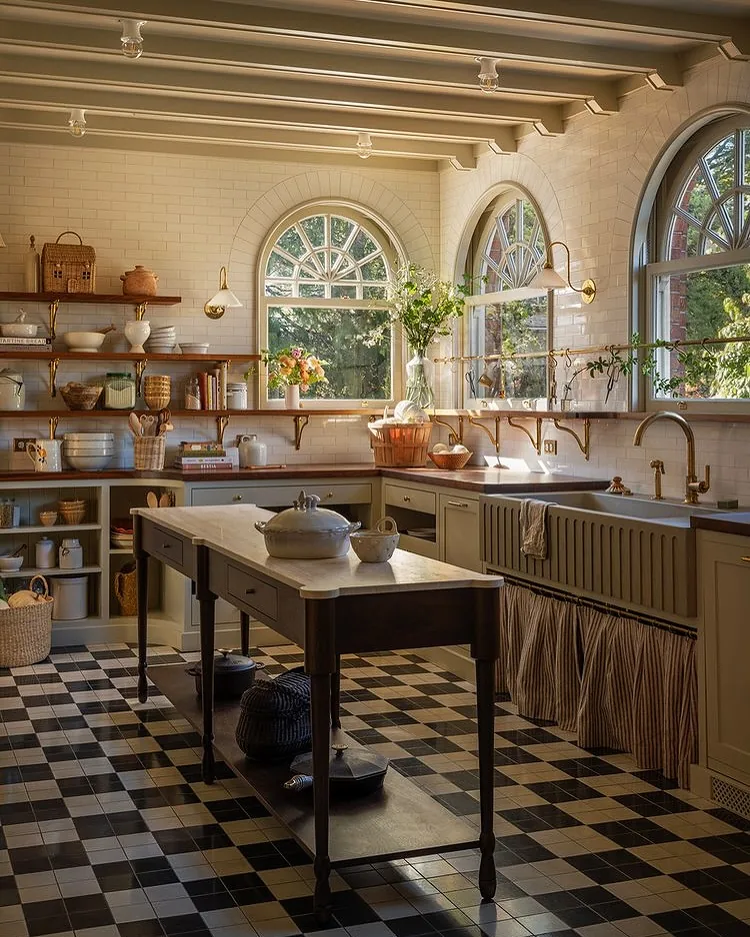
In that kitchen the floor is two colours and one scale decision. Large black and white squares run on the diagonal from the range to the doorway, and the size is doing the calming work in a room with wall boards and a tall ceiling, under a brass chandelier with black shades. Small mosaic would fizz against the shiplap, while these generous squares give the eye a slower rhythm, which is why the copper rail and the timber trestle table sit so easily on top. The common chequer of this type arrives as 300mm squares, laid square or diamond, and the diamond here stretches the run towards the door.
That tile wants a matt finish in a kitchen, because gloss plus water turns a chequer into a slide, and daylight from two sides would glare off polish. Rectified porcelain takes a 3mm joint that stays a hairline, while handmade ceramic needs a wider sanded joint and more sealing. A flat mop with a little detergent keeps it clean, since string mops leave dirty water in the joints.
Porcelain chequers shrug off standing water and dropped tins, and the black squares hide scuffs that would mark a plain pale floor. Budget £40 to £85 a square metre for Victorian-style porcelain by Original Style, and nearer £90 to £160 for handmade ceramic by Bert and May, both 2026 prices. Skip gloss ceramic where dogs run, since claws skate and the glaze shows every scratch within a year.
Brick laid tight for a modern shell
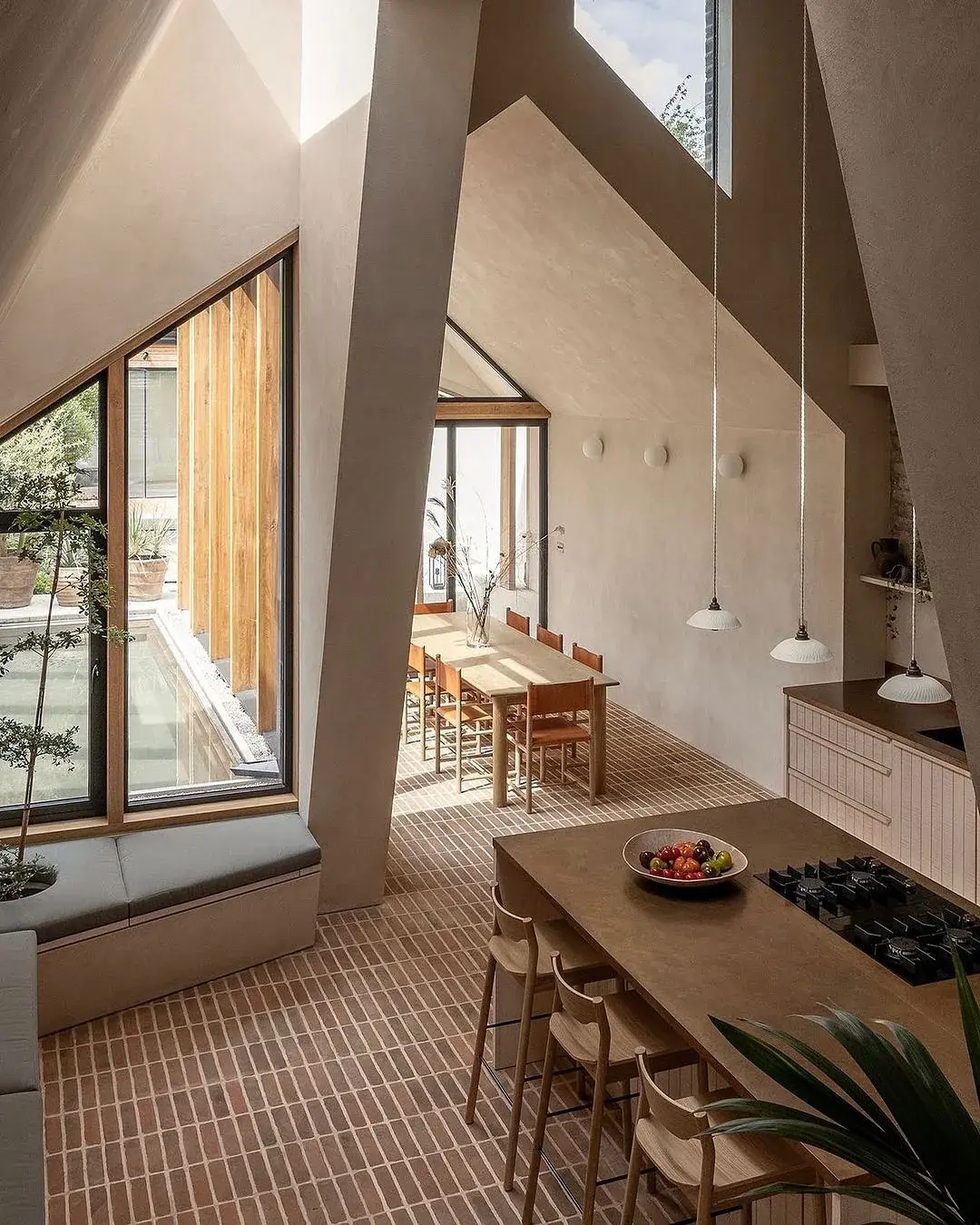
In this space the floor reads as texture, not pattern. Narrow brick slips in pinkish buff run in a tight grid from the island with its hob to the oak dining table by the glass wall, and the small unit suits a room with angled plaster fins and a high rooflight. Large slabs would argue with the angles, while small slips let the architecture stay loud and the floor stay quiet, which is the correct hierarchy here.
The joints are the practical point. A tight cement joint in a colour close to the brick keeps crumbs from lodging and lets a flat mop run clean, while a contrasting grout would draw a grid over the whole floor and fight the plaster. Real clay slips feel softer underfoot than porcelain copies and vary more from batch to batch, so order a spare box and mix across it. Porcelain brick looks stay flatter and need less sealing, which suits a hob zone where oil spatters.
Allow £50 to £110 a square metre for clay brick slips at Ca’ Pietra in 2026, with Mandarin Stone on a similar level. Porcelain brick looks through Topps Tiles cost nearer £35 to £70. Laying in a tight grid costs less in labour than herringbone, and a penetrating sealer such as Fila MP90 keeps oil from marking the field. Skip unsealed handmade brick around a hob, since fat spatters soak in within weeks.
Stone setts that take mud and water
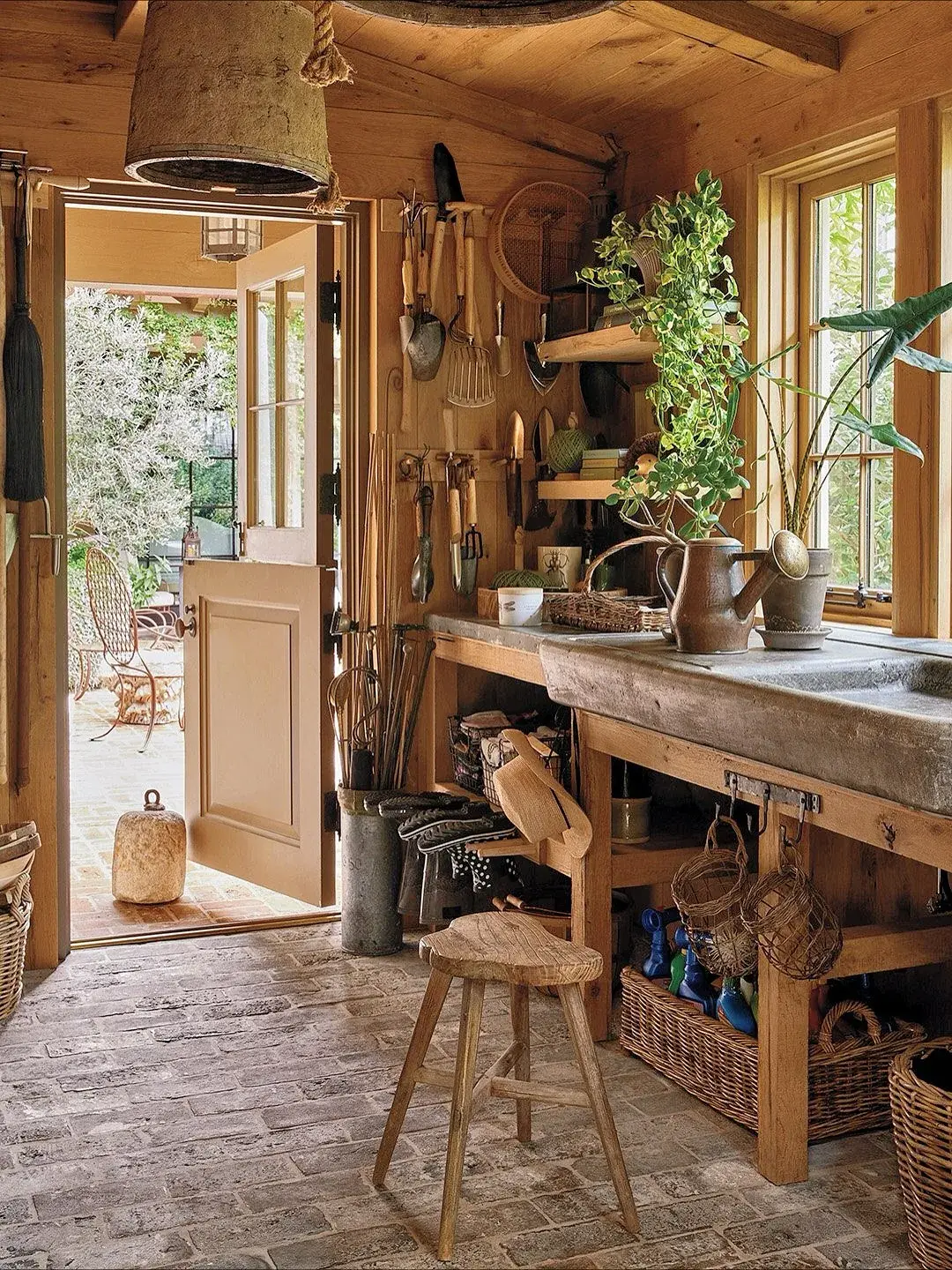
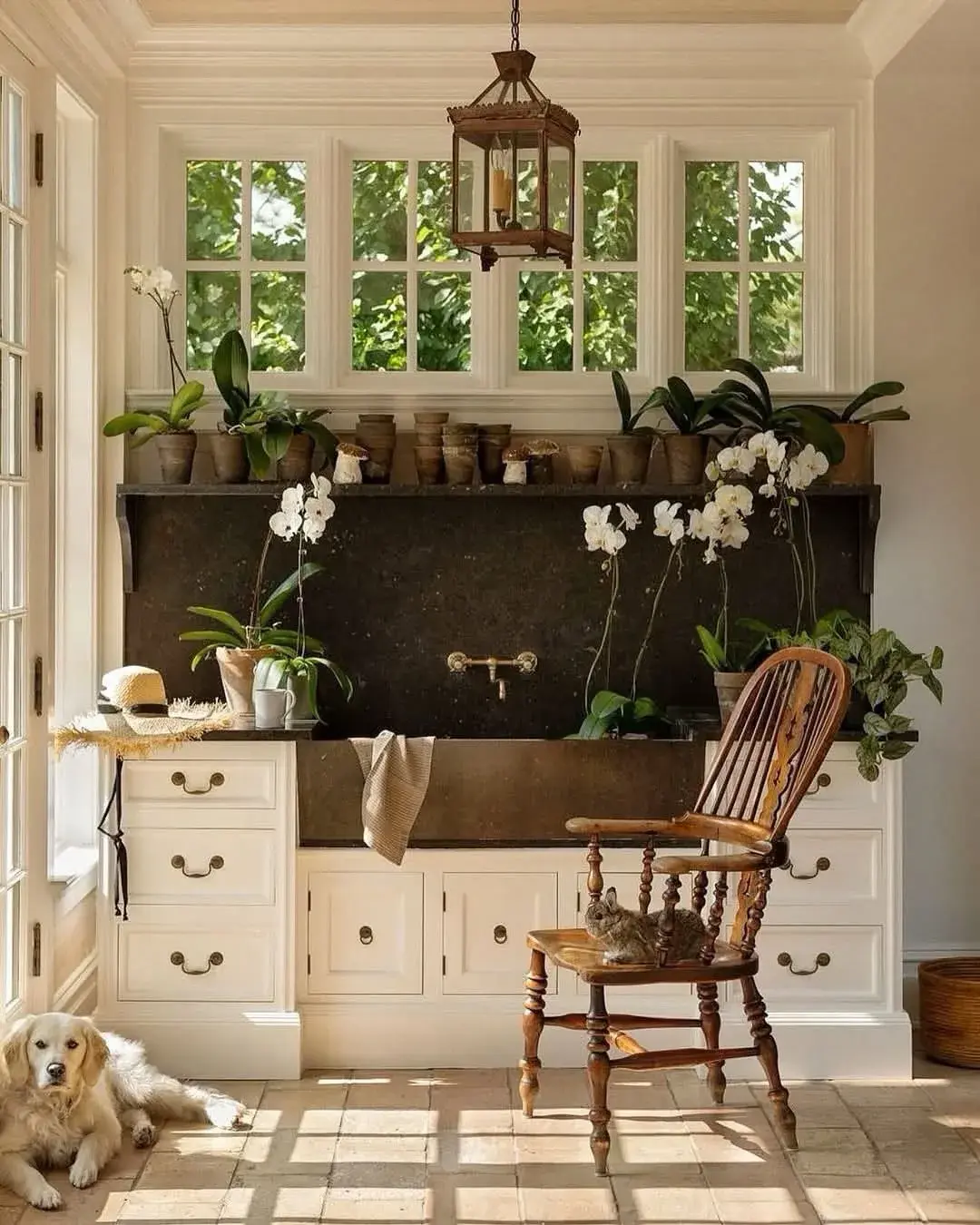
The one detail that decides this floor is the doorway. A stable door stands open to the garden, with dust and leaves on the threshold, and grey stone setts run inside in a running bond to meet it. The room is a potting shed with a stone trough on a timber trestle and tools across the wall, and the floor is chosen for boots and buckets, not bare feet. That honesty is what to copy in a boot room or scullery, where water arrives daily.
Look at the surface variation across the image. Some setts read pale grey and others dark, with softened edges and joints that take shadow, so mud and compost disappear between cleans. The texture grips wet soles where polished stone would slide, and cement joints tolerate standing water that would lift a timber floor. It is cold and hard, which is why it belongs in a pass-through utility and not where people stand to cook.
Westminster Stone lists reclaimed-look sandstone setts near £60 to £120 a square metre in 2026, while Mandarin Stone sits in the same band. New sawn setts through a local stone merchant come in nearer £45 to £90. Sweep with a stiff brush and wash with plain water and a little pH neutral soap, since acids dull the surface. Skip this hardness in a main kitchen where long prep sessions punish joints, because comfort there matters more than mud tolerance.
Square terracotta under dark timber
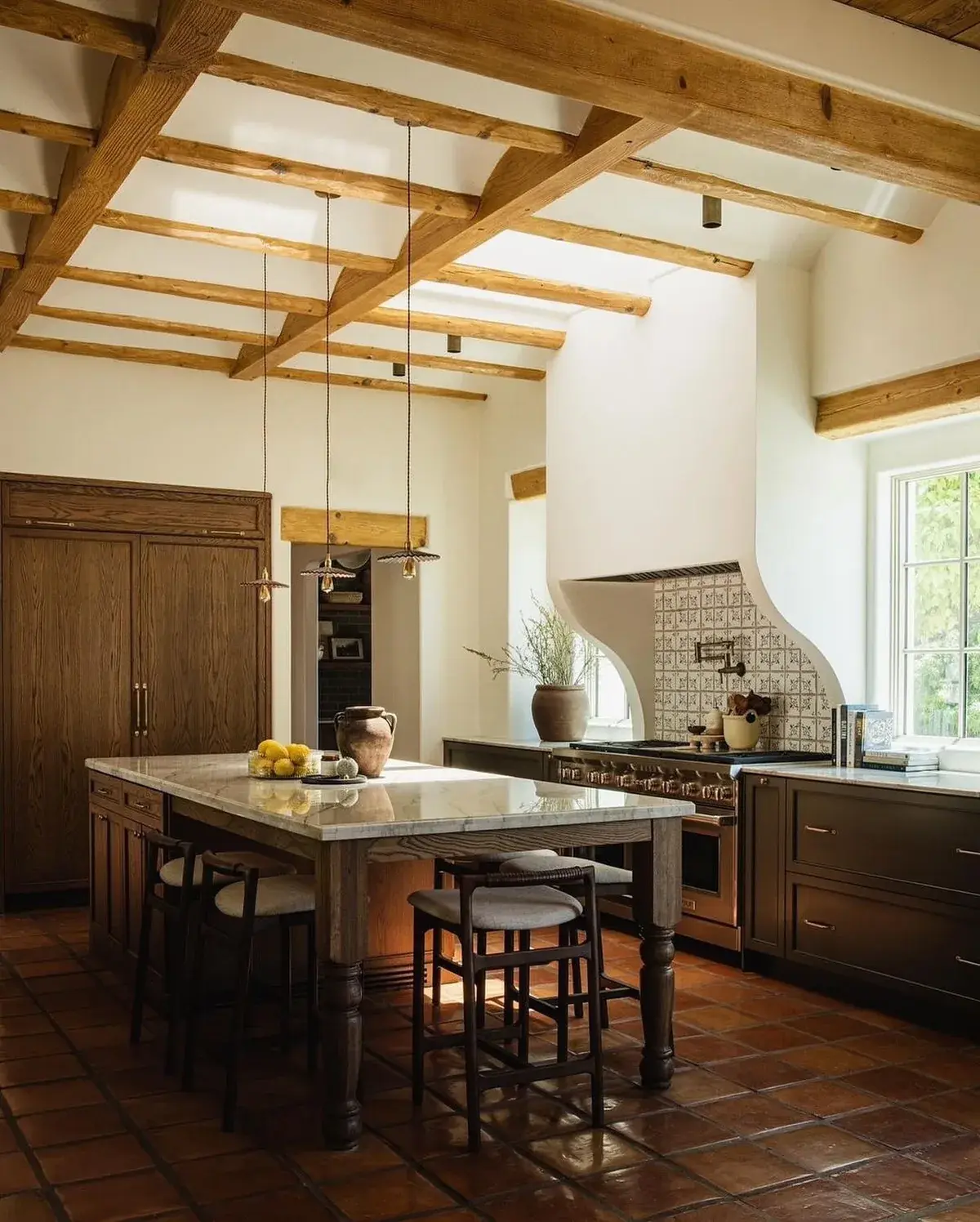
That colour on the floor is carrying the room. Deep burnt orange squares with dark joints run under a dark stained island and perimeter, and the warmth stops the joinery from reading heavy under white plaster and honey beams. The marble top and the patterned splash sit cool on top of it, which steadies the contrast between dark timber and pale walls. Gloss on the tile bounces the rooflight back, so the floor glows in the middle of the day.
The square format matters here. Large squares with a dark sanded joint hide crumbs and grout staining that would show on a pale small tile, and the grid lines up with the island legs so the furniture sits calmly. Handmade squares usually want 5mm sanded joints to absorb size variation, and getting that joint right before sealing decides the whole floor. Drop a mug and the tile chips instead of shattering, and the chip reads as patina on this colour where it would read as damage on white porcelain.
Fired Earth prices genuine terracotta squares around £60 to £130 a square metre in 2026, and Ca’ Pietra holds a similar band. Porcelain copies at Tile Mountain change hands nearer £30 to £60. Seal twice at installation with Lithofin Stainstop, then reseal the lanes in front of the sink and range when water stops beading. Skip polished terracotta look porcelain where oil flies, since the sheen shows every mark.
Herringbone brick in a cottage corner
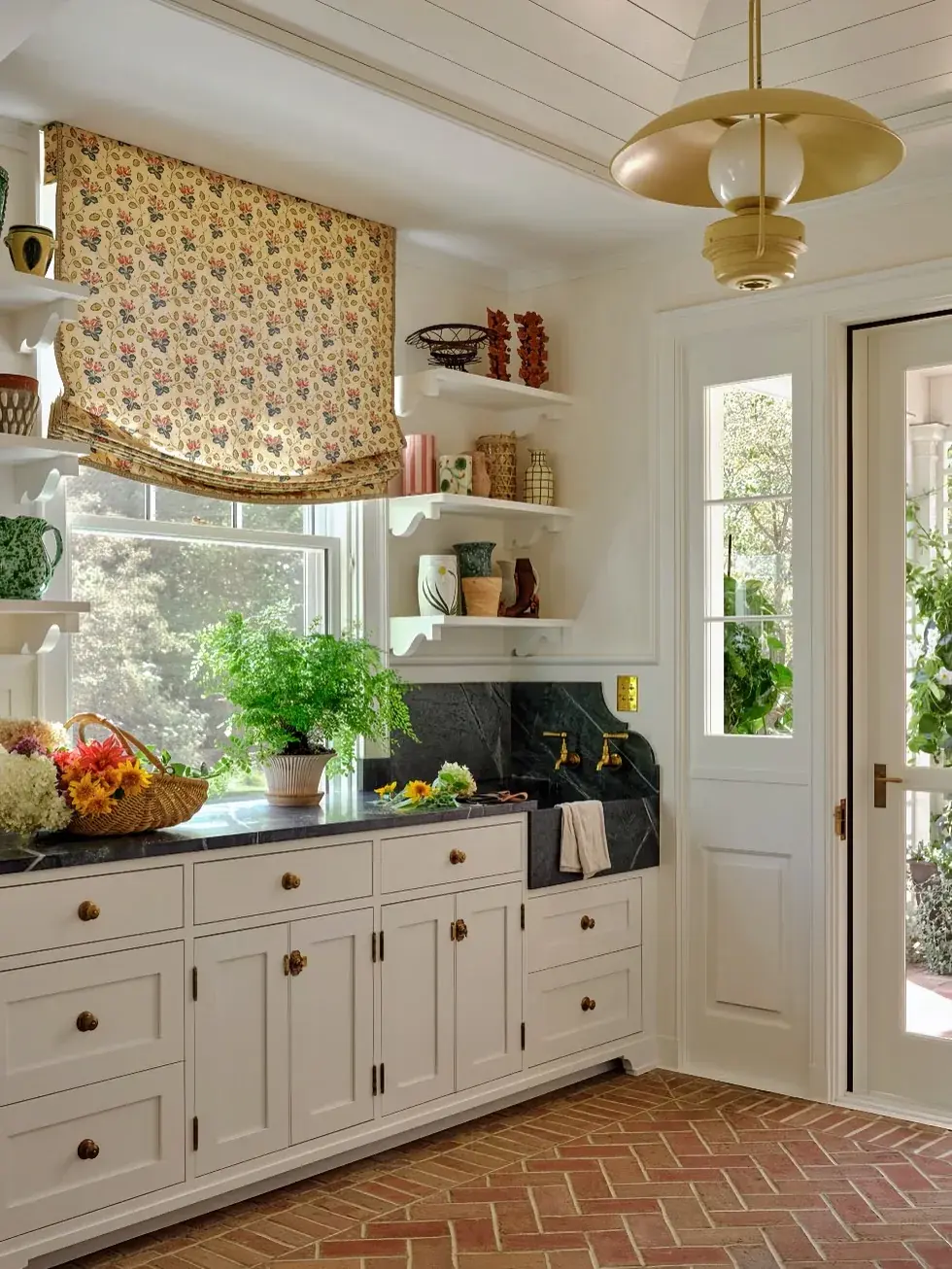
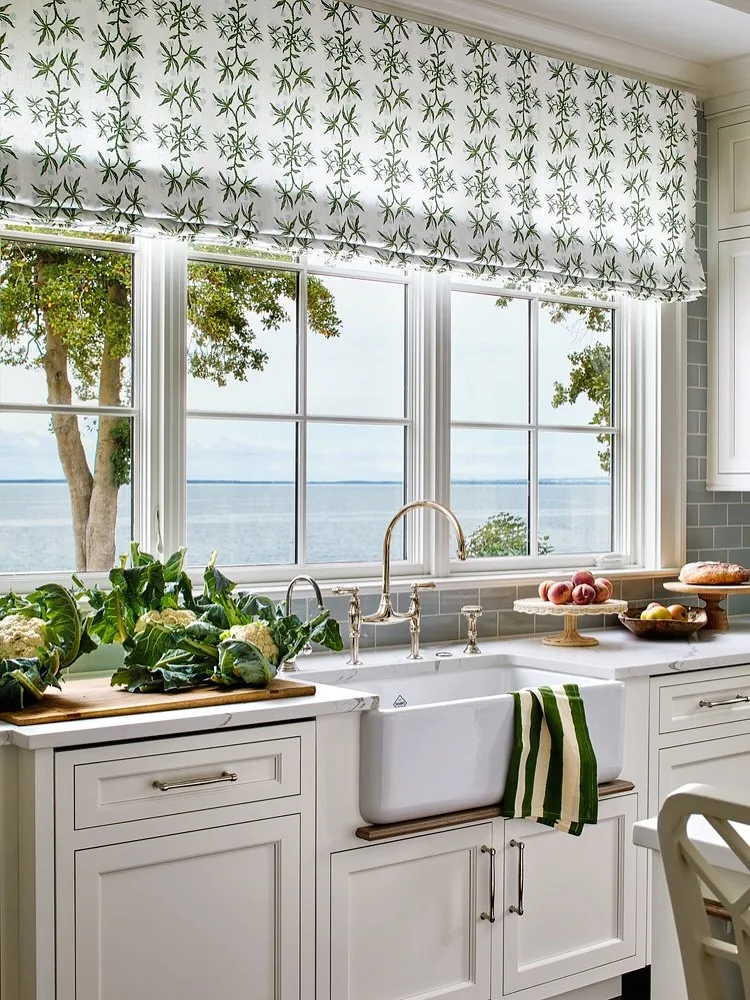
In this kitchen the pattern is movement without a second colour. Narrow brick slips in warm reds run in herringbone under white shaker units and a black marble worktop, and the zigzag keeps a small corner lively while the palette stays calm. A floral blind and open shelves carry the decoration, which leaves the floor to add energy through lay instead of hue. That restraint is why the brass taps and the black stone sit so quietly on top.
The bricks shown here need a steady hand. Herringbone asks for careful setting out and more cuts at the edges, so labour runs higher than for a straight grid, and dry laying a panel first saves arguments. The joints are tight and the colour close to the brick, which lets a vacuum and a damp flat mop do the work. Oil and tea wipe off sealed clay, while unsealed clay drinks them in.
For thin clay slips in herringbone, allow £55 to £115 a square metre in 2026 at Bert and May, with Mandarin Stone close behind. Fitting often adds a third on top of a straight lay price in the same year. Porcelain herringbone looks at Original Style sit nearer £35 to £75 and need less sealing. Keep a spare box for repairs, since dye lots shift and a future batch never quite matches.
A small chequer kept beyond the doorway
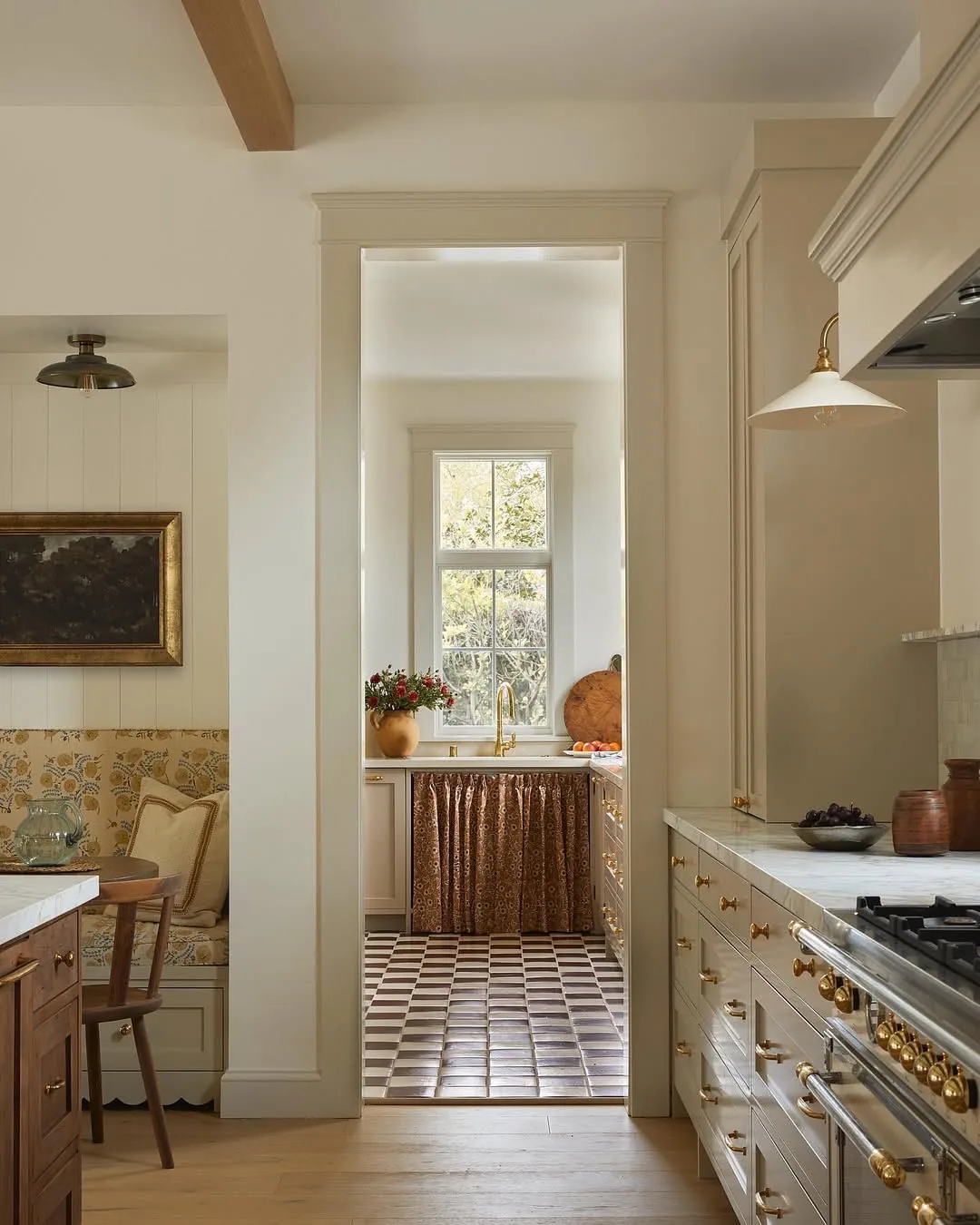
In this kitchen the smart move is the junction. Pale timber boards run to the doorway and stop, and a small brown and cream chequer takes over in the scullery beyond where the sink wears a fabric skirt. The glimpse through the opening shows just enough pattern to delight, exactly as a pantry should, while the main space keeps calm timber underfoot. It is the same principle as the marble cabochon at the top of this page, applied with timber and ceramic.
That tile is small enough to grip. Small squares with a mid tone grout give shoes purchase where large polished squares would slide, and the brown squares hide tea marks that would shout on white. Engineered boards commonly arrive 180 to 220mm wide with a brushed and oiled surface, which is the finish to want where stockinged feet cross daily. Lacquered boards look tidier for a month and show scratches sooner, while oil can be patched locally.
Meshed sheets keep fitting of small chequer porcelain straightforward, and 2026 shelf prices sit near £38 to £80 a square metre at Original Style. Brushed and oiled engineered oak through Havwoods changes hands around £60 to £140, finished with Osmo Polyx-Oil which allows local repairs, while Ted Todd holds a similar level. Mop timber damp, never wet, and keep a washable runner at the sink where drips land.
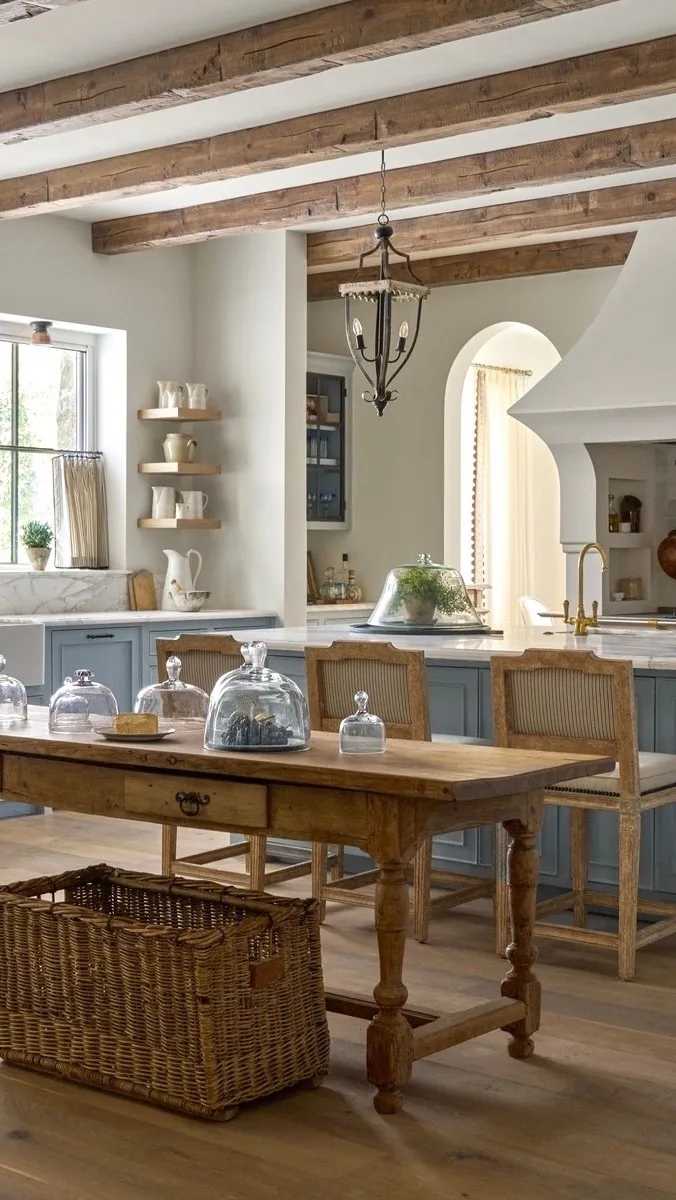
Wide boards with a washable rug
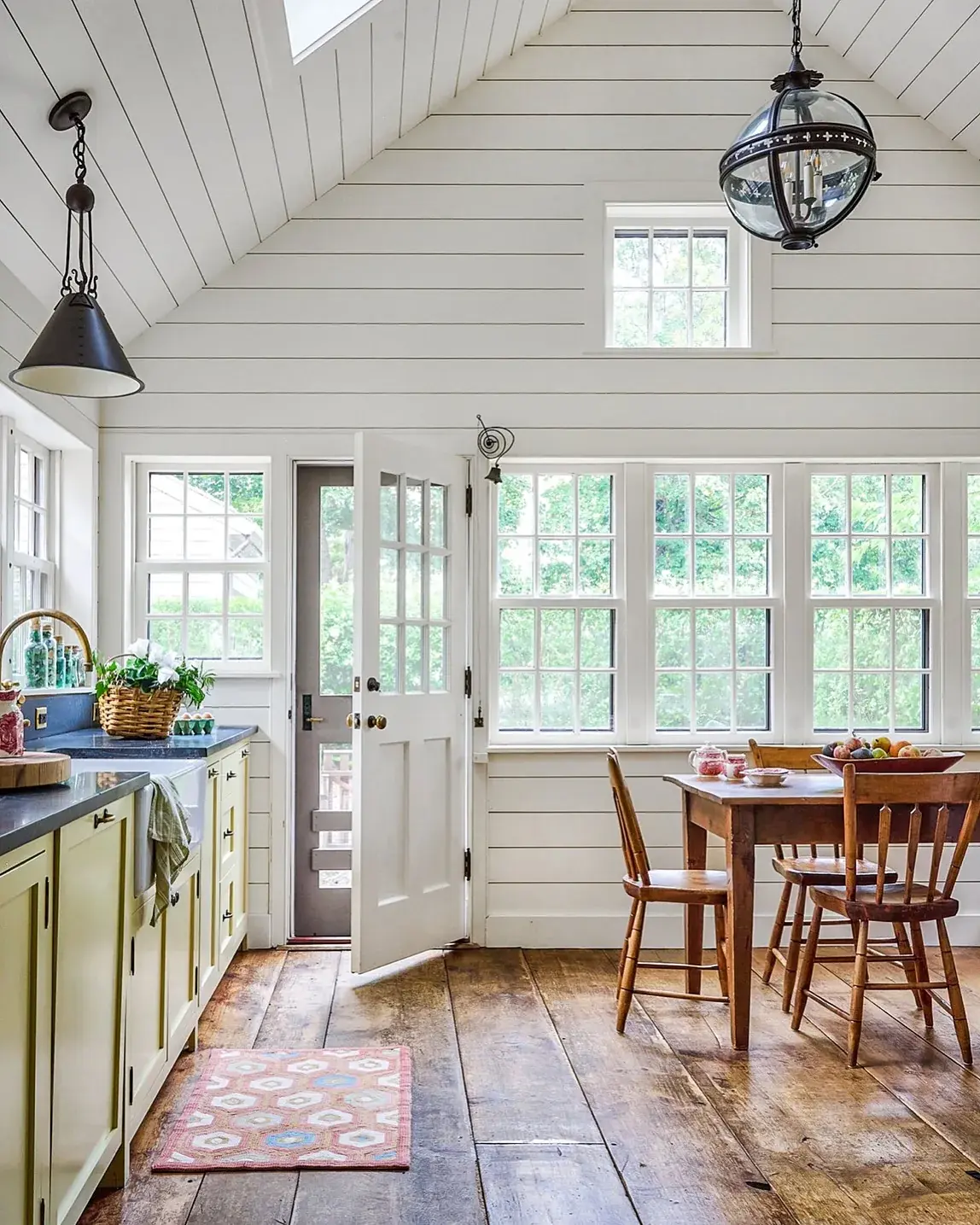
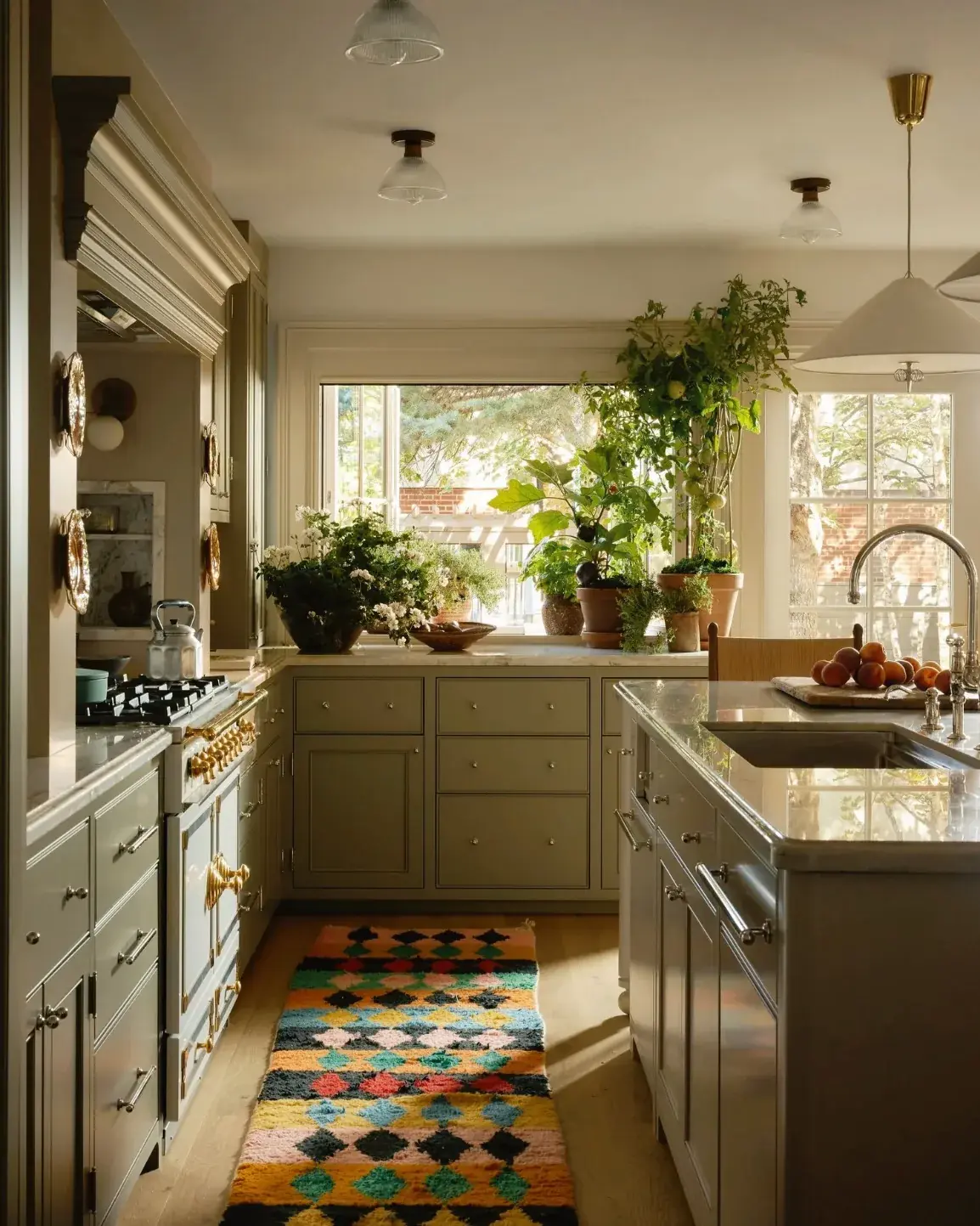
The floor in this image is the warmest in the set. Wide honey boards run from sage green units with dark worktops to a timber dining set by tall windows, and the grain with its gaps gives the vaulted white room its ease. Boards move with the seasons, which is why a flatweave rug sits by the sink: it takes the splashes and goes in the wash, while the timber beneath stays drier. The one thing to copy is that pairing of vulnerable timber with a sacrificial textile.
The finish decides how the boards age. A matt hardwax oil such as Osmo Polyx-Oil or a waterborne lacquer such as Bona Traffic HD keeps the honey tone without a plastic look, and both tolerate a well wrung mop. Floods with dishwasher leaks remain the limit, since standing water darkens joints and lifts boards, which is why timber suits wipe quick households. Dropped glasses break less often on timber than on porcelain, and heels dent instead of cracking, which most families prefer.
Wide board engineered oak with a brushed surface changes hands around £65 to £150 a square metre in 2026, with Woodpecker and Havwoods the obvious counters to visit. Solid boards sit higher and fussier about moisture in the same year. A washable flatweave runner of the type pictured costs £45 to £120 in 2026 at Weaver Green, which reuses plastic bottles for a fibre that shakes clean. Skip timber where a washing machine has flooded twice, since the third flood is already on its way.
Frequently Asked Questions
Which floor copes best with dogs and daily mopping?
Matt porcelain with a tight joint takes claws, bowls and constant washing without complaint. Textured brick slips also grip well, while gloss glaze turns slick and pale cement joints stain fast. Put feeding mats on tile even when the rest of the ground is timber.
Does timber make sense in a hardworking kitchen?
Oiled engineered boards suit cooks who wipe spills straight away and mop with a wrung head. Standing leaks swell joints and dishwashers punish the boards by the plinth, so flood prone rooms should stay with tile or sealed clay. A washable runner by the sink spreads the wear, and it can be lifted and washed when the boards beneath cannot.
Will a bold pattern overwhelm a large kitchen?
Strong repeats tire the eye when they cover the main work zone day after day. Keep chequers and cabochons for pantries, utilities and sculleries glimpsed through a door, then lay something plain and warm where meals get made. A doorway or an arch gives the change a reason, which a straight line across open floor never does.
How do I keep kitchen grout from looking grubby?
Match the joint to the darkest tile and seal cement grout at installation, then clean with a flat mop instead of a soaking string head. Epoxy joints from Mapei or Ardex resist stains far longer in 2026, though fitting costs more. Pale wide joints around handmade clay need most care, so seal them well and expect to scrub those lines first.
What takes the chill off cold tile?
A rug runner at the sink and range helps, along with lined curtains and upholstered stools that soften echo. Electric mats beneath porcelain warm the morning path and suit stone and ceramic well, while timber nearby needs a compatible system. Thick socks remain the cheapest fix, and they work in every house without a tradesperson.
Can I join timber to tile without an ugly strip?
Butt the two at a doorway with a slim brass or oak threshold that sits flush, and let the door casing mark the change. Keep levels equal by bedding tile to meet the board height, and seal the timber end well. The eye accepts the shift when architecture explains it, which is why a casing reads better than a metal strip.
In order
- Keep bold pattern in the pantry, boot room or scullery, not the main run.
- Change flooring at a doorway or arch, never in open floor.
- Pick small and varied tiles where crumbs and mop water show most.
- Choose matt porcelain or sealed clay where spills sit.
- Match grout to the darkest tile to keep joints quiet.
- Finish oak with hardwax oil and mop it damp, never wet.
- Pair timber with a washable runner at the sink and range.
- Buy V3 variation for stone looks and keep a spare box.
This article may contain affiliate links. We may earn a commission at no extra cost to you.