Living Room Rug and Textile Ideas: Your Rug Is Almost Certainly Too Small

Add us as a preferred source to see more stories on Google.
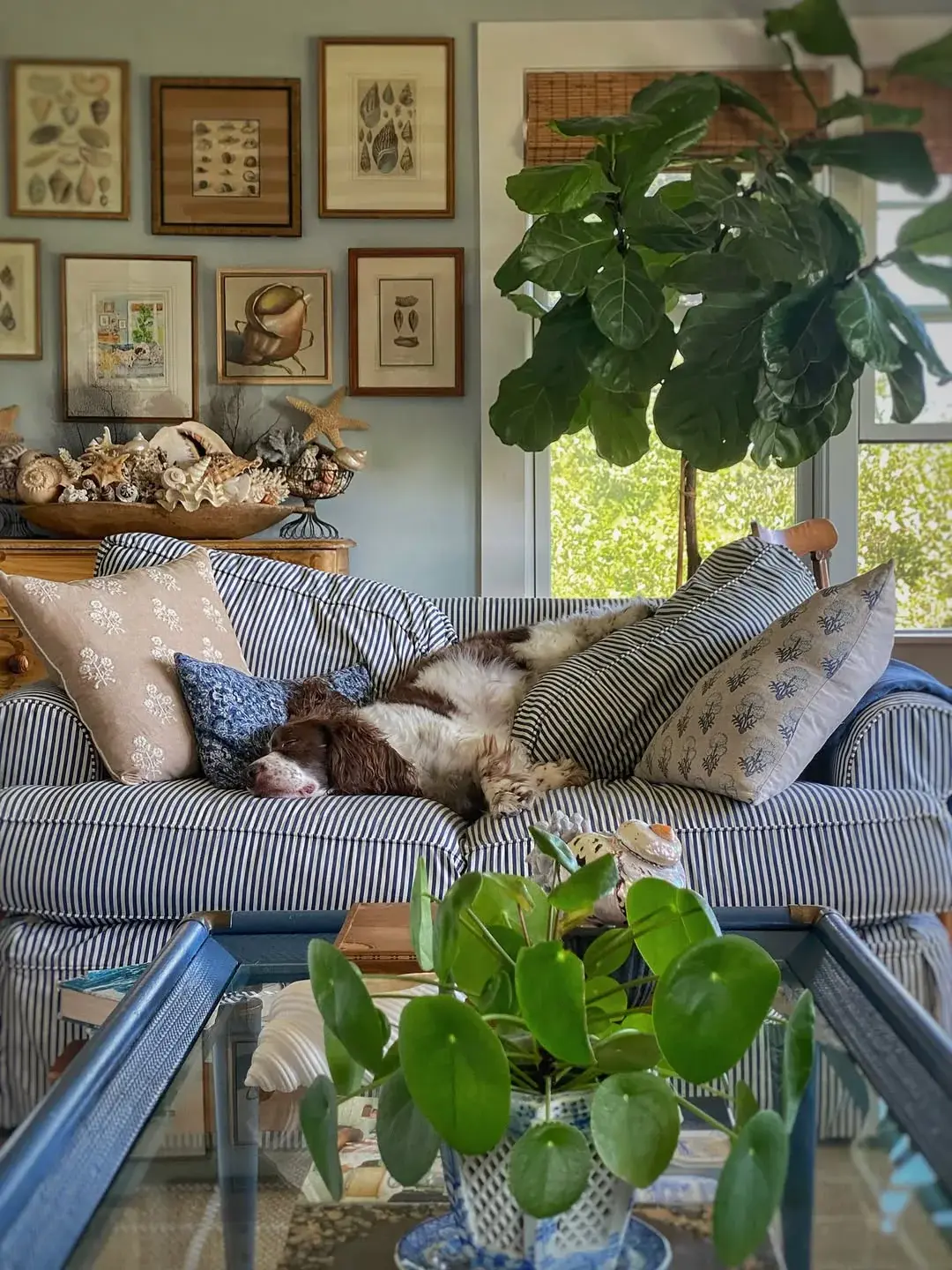
There are four patterns on the sofa below and it is not a busy room.
The sofa is a narrow ticking stripe. One cushion is a small indigo block print. Another is a large open botanical. A third is a scattered cream embroidery.
The usual advice, to combine a stripe with a floral and a geometric, gets close to why this works and stops short of the actual mechanism. What is doing it is that every one of those four is a different size.
A working set
| Role | Scale | Examples |
|---|---|---|
| The ground | Fine, almost a texture | Ticking, herringbone, small check |
| The medium | Readable from across the room | Block print, small floral, ikat |
| The large | One or two motifs per cushion | Botanical, open chintz, palm |
| The scatter | Small, irregular | Embroidery, sprig, dot |
You do not need all four. Look at the sofa again: the ticking is the ground, the indigo block print is the medium, the coral botanical is the large, and the cream embroidery is the scatter. Three of those would have been comfortable, and two would have been perfectly sufficient.
The rule that matters is the gap between them. A medium block print beside a medium floral is two patterns of the same size shouting at each other, and no amount of shared colour fixes it.
Let the biggest one be the quietest
The large botanical cushion in that photograph is the palest thing on the sofa, printed in soft blue on cream.
That is deliberate and it is the part people get backwards. A large pattern in a strong colour takes over a room, because it is both big and loud. A large pattern in a soft colour reads as texture at a distance and rewards you when you look closely.
If something has to be strong, make it the small one. A saturated block print on a 40cm cushion is a full stop; the same intensity on a large-scale print is a shout.
One blue in four places, at dusk
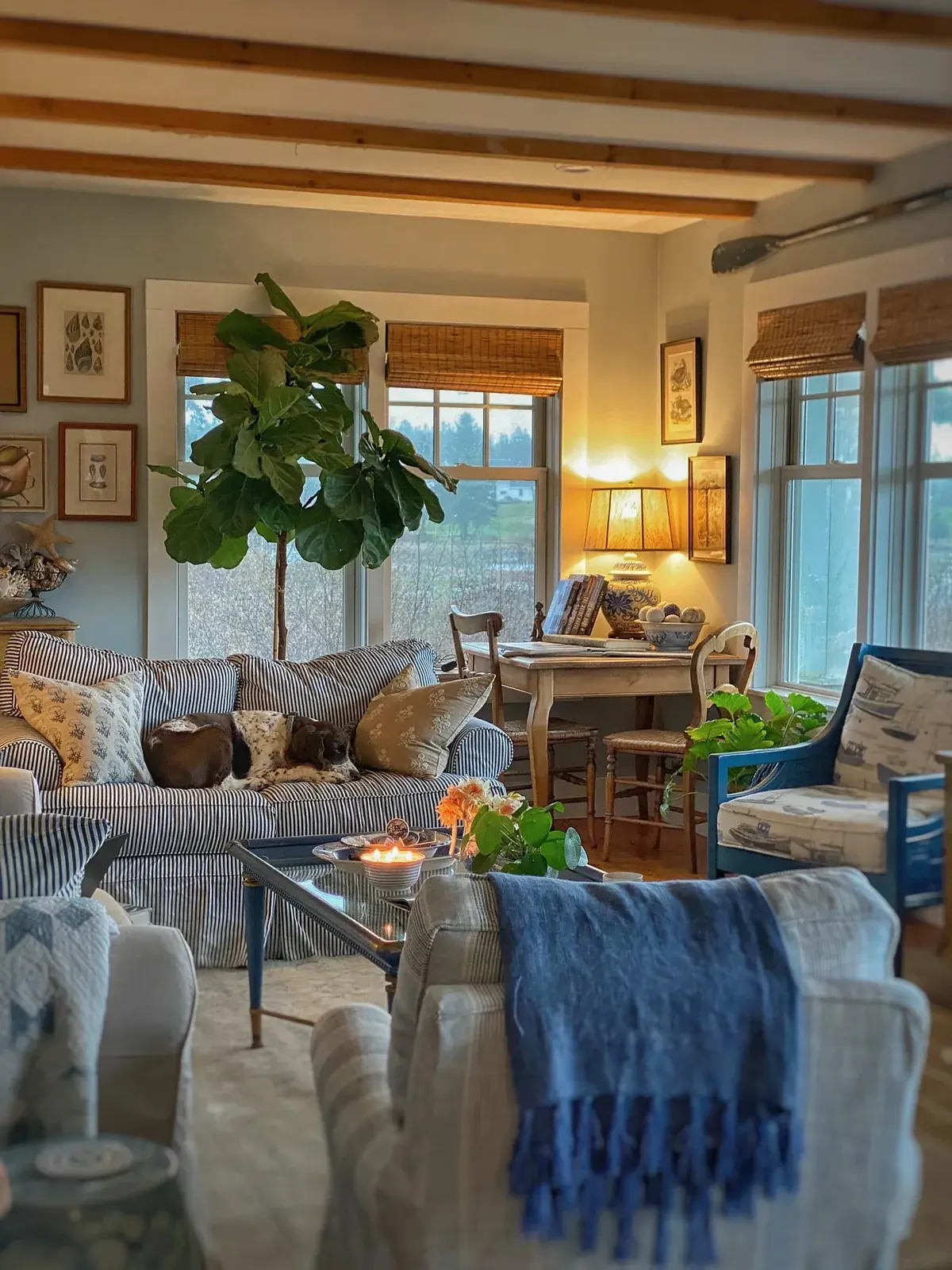
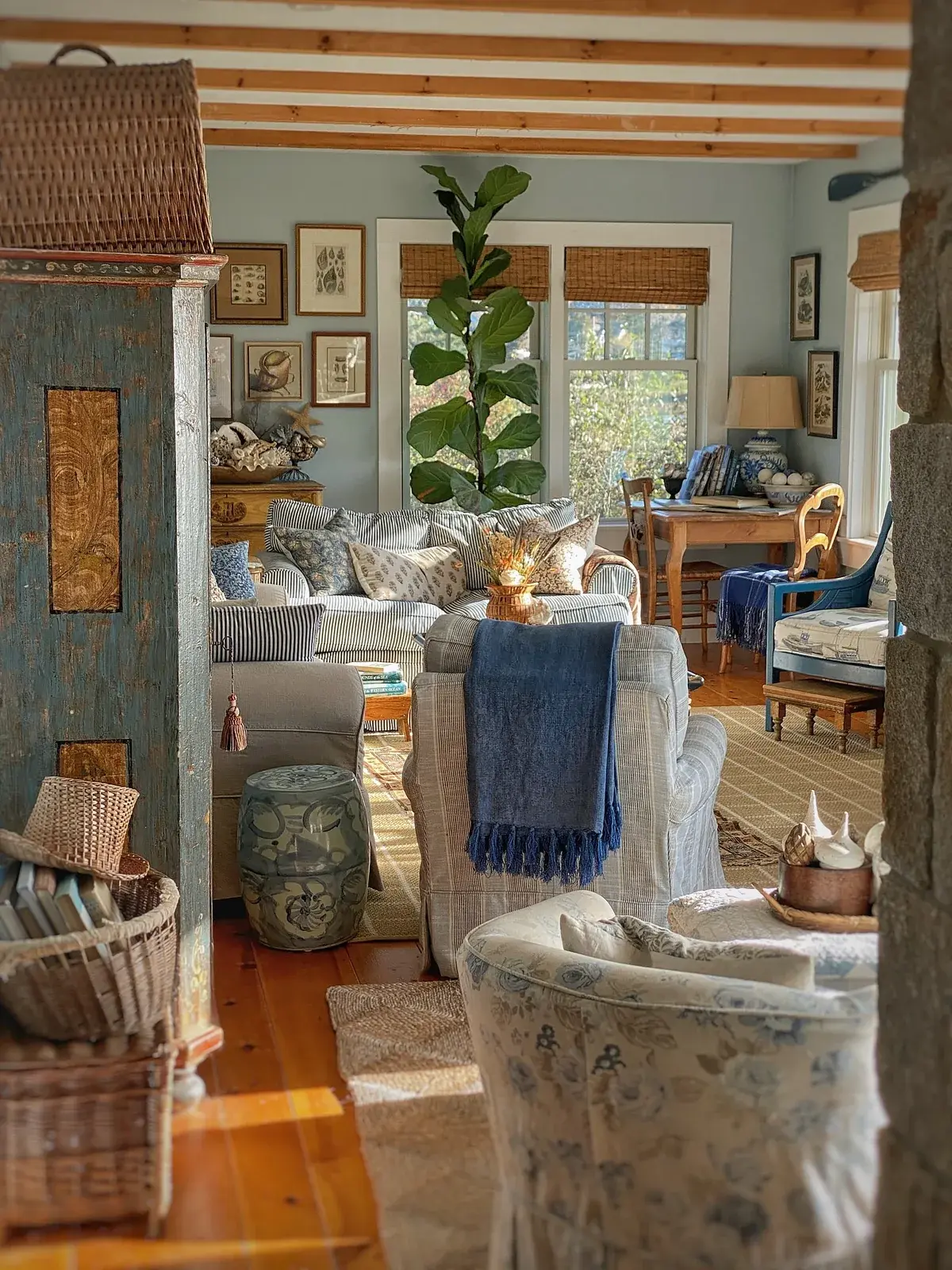
The same room, wider, and later in the day. The woven blinds are down to a strip, the lamp on the scrubbed pine table has taken over from the window, and the ceiling beams have gone from pale oak to honey. Nothing in the frame has been rearranged; only the hour has changed, and the whole palette has moved with it.
The blue is what holds the room together, and it turns up in four places at four different scales: the fine ticking on the sofa, the painted frame of the armchair by the window, the ship print on that chair’s linen cushion, and the fringed throw over the chair in the foreground. One colour, four weights, four materials. A colour that appears once is a purchase; the same colour at several scales, in different weaves, is a scheme.
Two decisions in the frame are doing that work. Bamboo blinds filter daylight on the way in, which is why the windows read warm rather than blue at the hour this was taken, and a 2700K bulb in the table lamp continues it after dark. The painted chair is a mid blue with grey in it, close to Farrow & Ball St Giles Blue No.280 or Little Greene Hicks’ Blue 208. If you want the blue to appear one more time, a wool fringed throw in the same family costs £60 to £150, and it should be the last appearance of it in the room.
Fabrics worth knowing
| Role | Premium | Mid | Budget |
|---|---|---|---|
| Ticking | Ian Mankin, Cabbages & Roses | Vanessa Arbuthnott | Any cotton ticking by the metre |
| Block print | Molly Mahon, Penny Morrison | Pooky, Nkuku | Fabindia, or vintage |
| Botanical | Colefax & Fowler, GP & J Baker | Sanderson, Morris & Co | Laura Ashley |
| Plain linen | Volga Linen, Libeco | Merchant & Mills | IKEA AINA by the metre |
Ian Mankin ticking is the one most of these rooms are actually wearing, at roughly £40 to £60 a metre. A block print cushion cover from a good maker runs £50 to £90; the same effect from a vintage textile or an Indian import runs £10 to £25.
Ticking is the ground that survives two spaniels
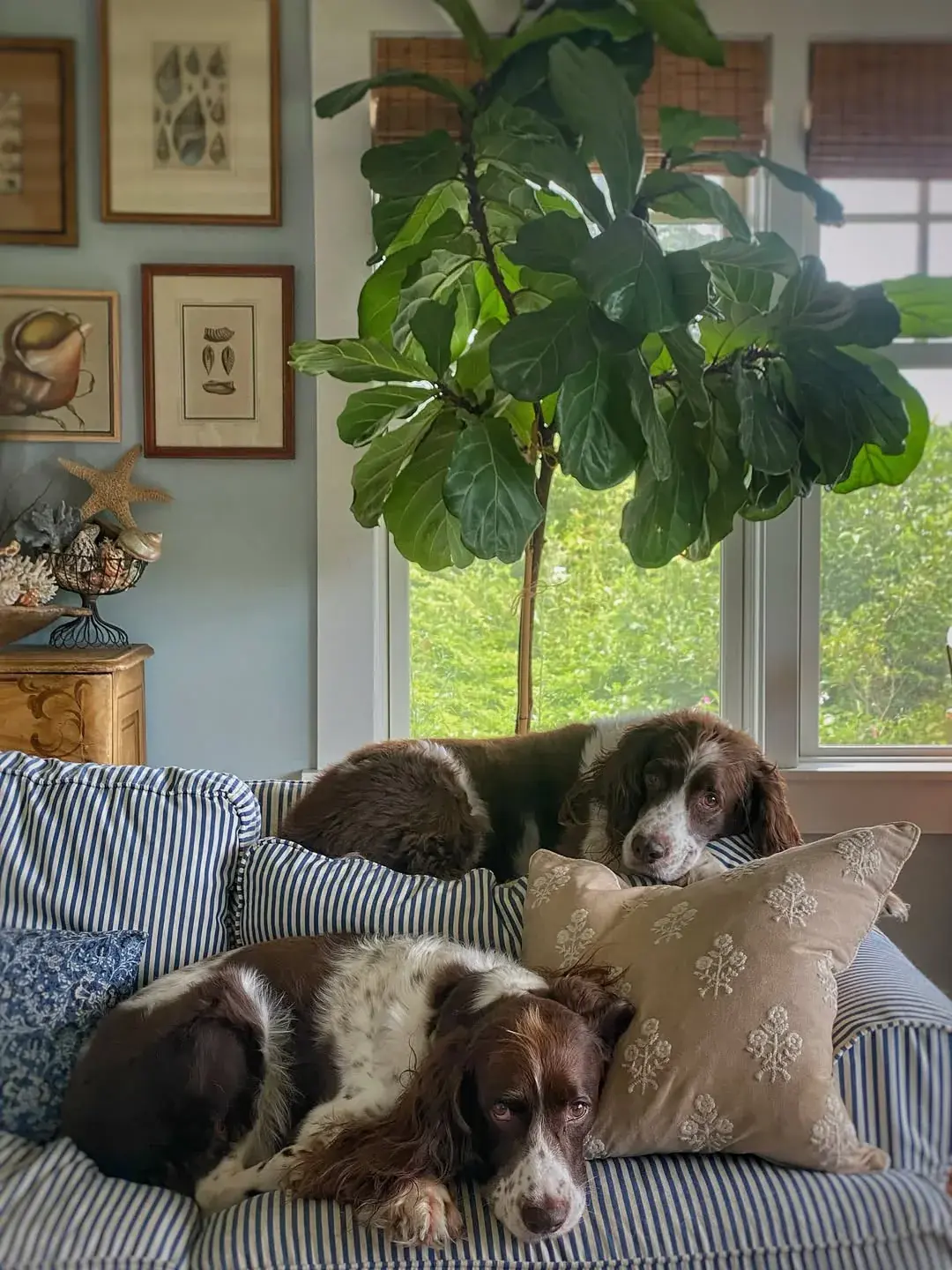
Two springer spaniels, both asleep, and neither of them has been given a throw to lie on. The cushions around them run fine to large: the small indigo block print at the back left, the oatmeal cushion with the big white embroidered motif at the front right, and the ticking underneath both of them.
Ticking is doing something a solid cream linen cannot. It is a fine, dense repeat, so mud, hair, and the residue of a wet walk break up inside the stripes instead of sitting on a flat field, and a woven cotton ticking takes a machine wash at 30 degrees without losing its body. A plain pale fabric in a house with two working dogs would be showing every paw mark by the second week, which is the argument for choosing your ground fabric before you choose your cushions.
A spare set of covers, ordered at the same time as the sofa, is the cheapest insurance in the room. The seat cover fails long before the frame does, and a discontinued ticking cannot be matched six years later. Ask for pre-shrunk or washed fabric when you order, because a cotton cover that has not been washed before it was cut will not fit after the first hot wash.
Slipcovers, honestly
That sofa is loose-covered, and there is a springer spaniel asleep in the middle of it.
Those two facts are connected. A pale patterned sofa in a house with a dog is only possible if the covers come off and go in the machine, and slipcovers are the difference between a room you use and a room you protect.
They cost more than fixed upholstery at the outset and considerably less over ten years, because the frame outlives several sets of covers. They also let you change a room seasonally without buying furniture.
Two practical notes. Ask for pre-shrunk or washed fabric, because cotton and linen both shrink and a cover that no longer fits is useless. And order a spare set of the arm covers, which wear first.
The rug, which should be the quiet one
Not visible in that photograph, and worth saying anyway: in a room with patterned textiles, the rug is almost always the wrong place for more pattern.
An antique or faded rug works because age has muted it into a texture. A new, strongly patterned rug under patterned upholstery gives the room two competing grounds and nowhere for the eye to rest.
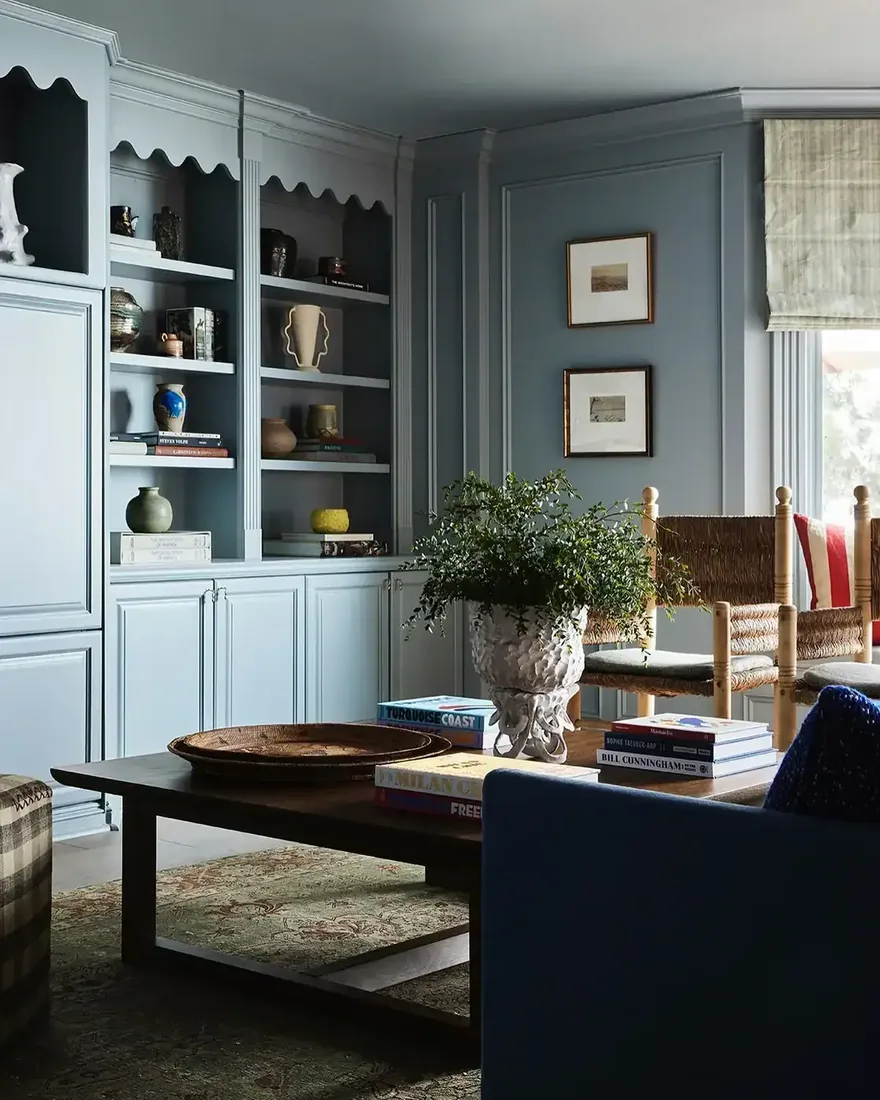
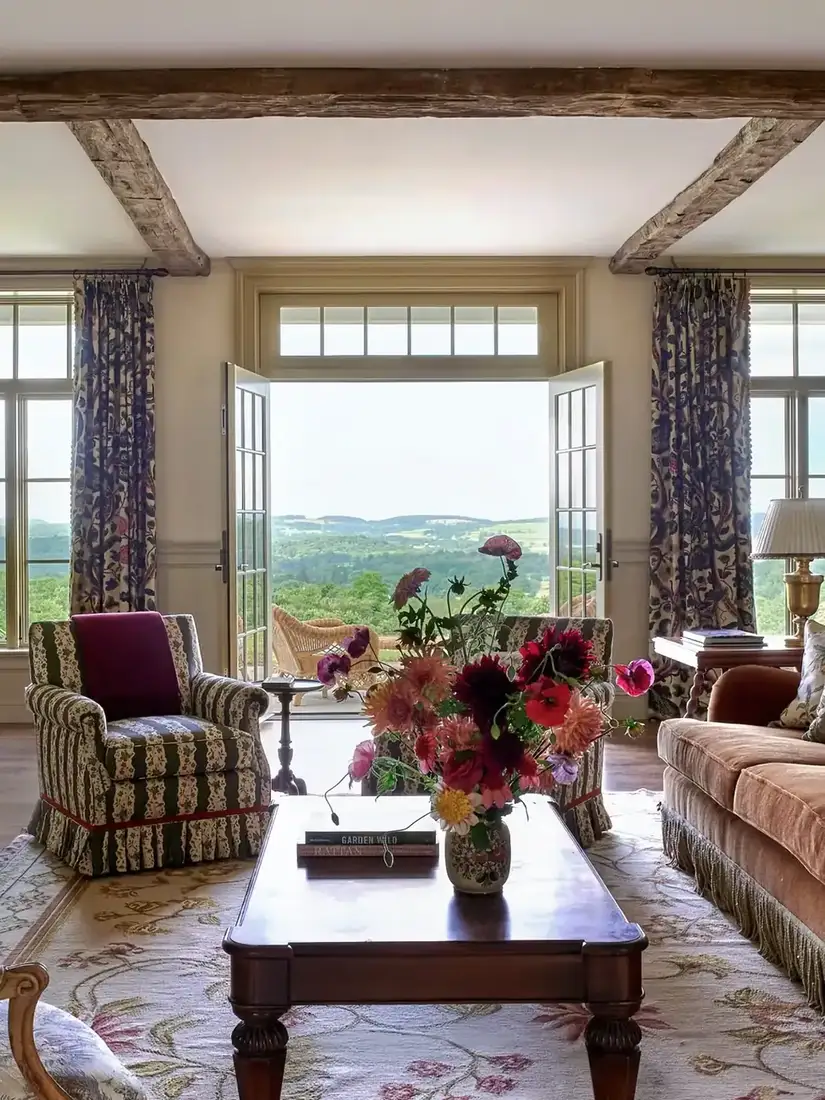
See what is under that coffee table: an old rug, faded into a texture rather than a pattern. Natural fibre, a flat weave in one colour, or something genuinely aged. Those are the three that reliably sit under pattern.
In an open plan, the rug draws the line
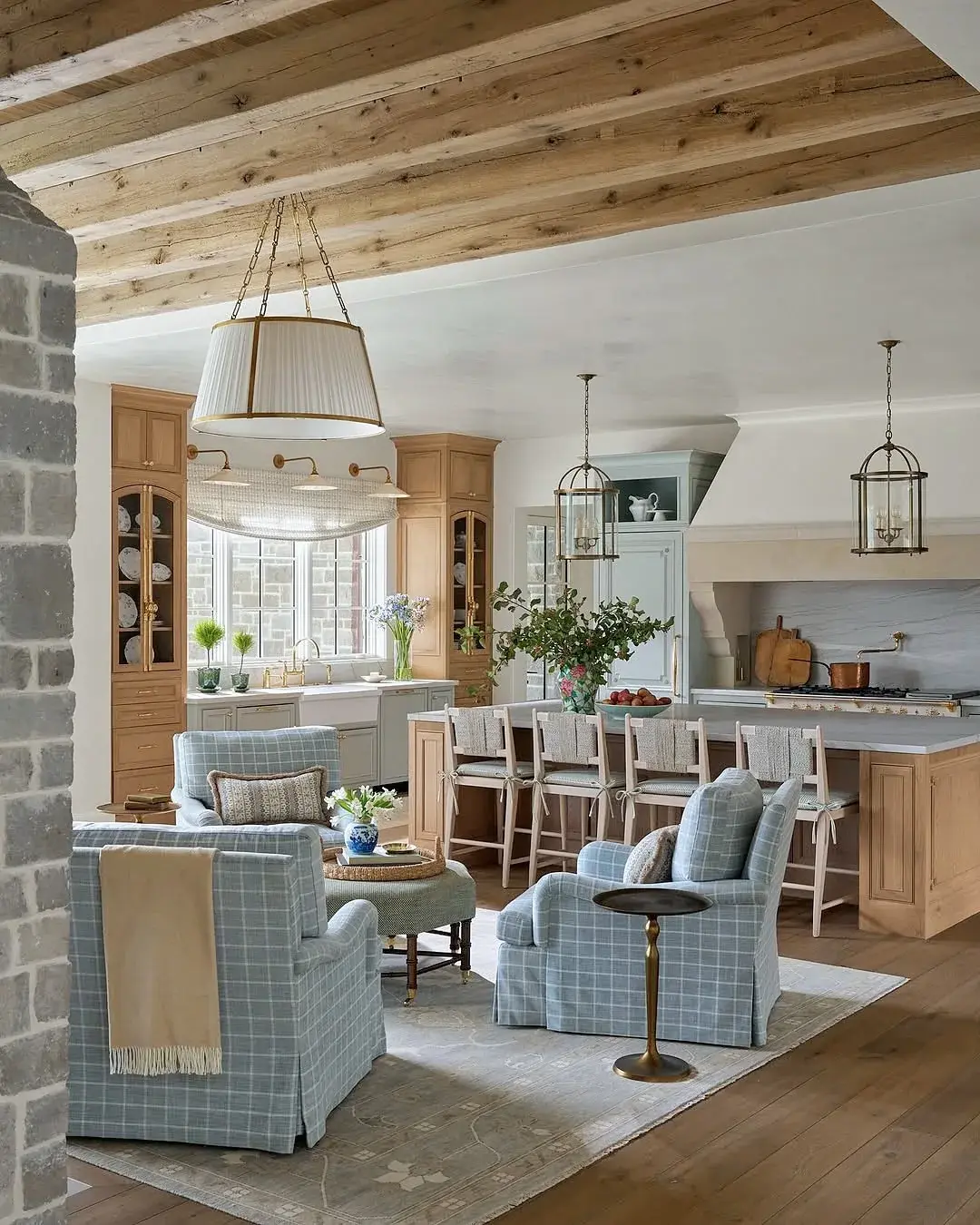
The rug here stops short of the kitchen, and the strip of pale oak floor between its edge and the island is doing more than any wall could. Both checked armchairs stand entirely on it, the woven ottoman sits between them, and the boundary with the cooking end is a change of floor covering. The chairs are skirted to the floor, which hides where their legs are and lets the rug edge pass beneath them without a visible break.
That strip is the number to hold on to. You want 200mm to 300mm of bare floor between the rug edge and whatever it is separating from, which is roughly a hand’s width to a dinner plate, and the rug then reads as a placed decision. Run it hard against the island plinth and it reads as carpet that ran out of money.
The patterns are sorted by scale as well. The windowpane check on the chairs is large and pale, the rug’s pattern is worn almost to a texture, and the kitchen joinery is plain. One pattern per sightline, which is why the room carries four stools, a marble splashback, and a wall of glazed cupboards without any of it arguing.
The rug reaches the chairs, and stops short of the wall
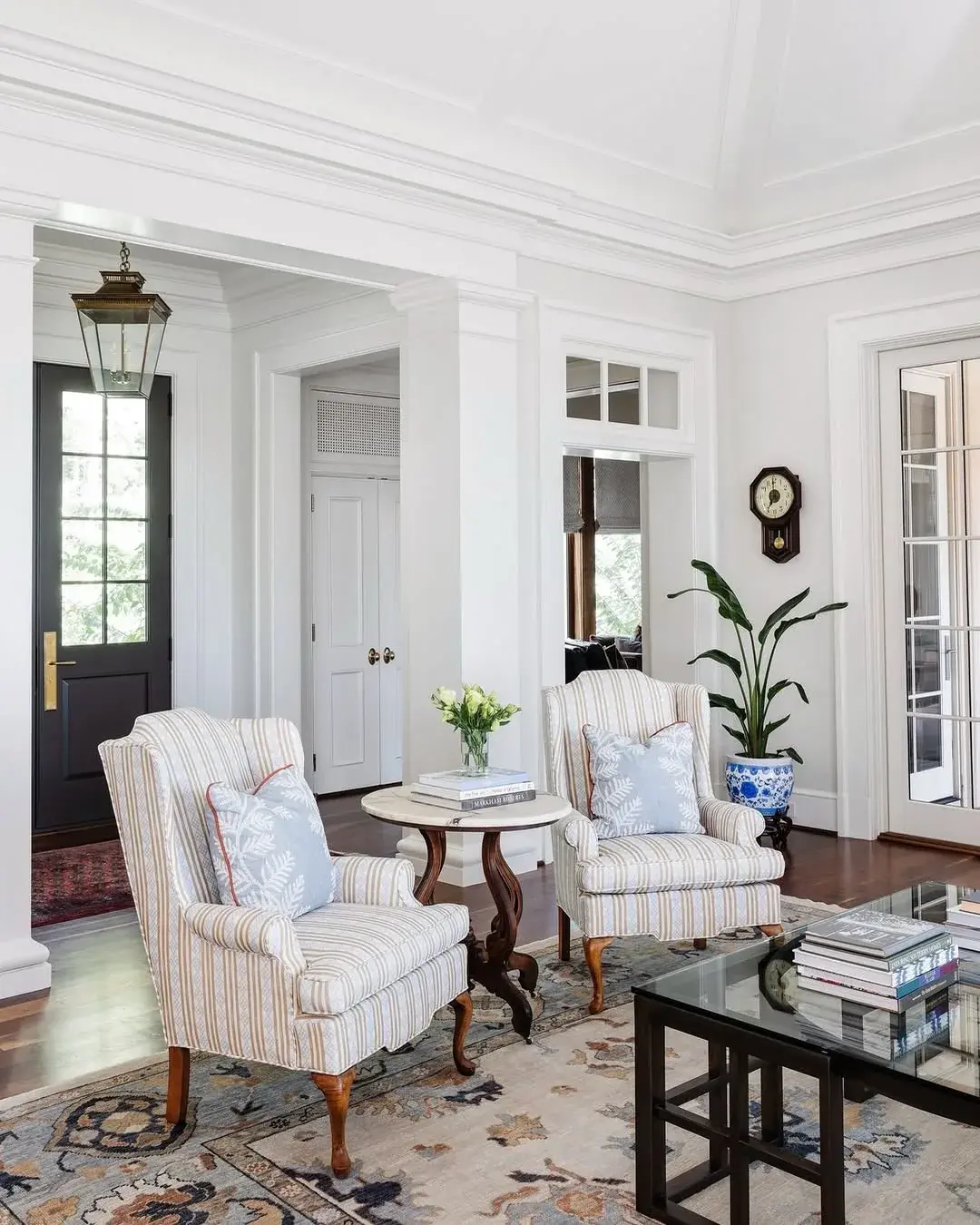
Both armchairs stand on the rug, front legs and back, and the little ebonised pedestal table between them stands on it too. That is the arrangement to aim for, and it is a size larger than most people order, which is the part nobody mentions before you measure.
| Seating | Smallest rug that works | What it catches |
|---|---|---|
| Two chairs facing each other | 1700 by 1200mm | Front legs of both |
| Sofa plus two armchairs | 2400 by 1700mm | All four legs of the sofa, front legs of the chairs |
| Two sofas, or a sofa and a chaise | 2900 by 2000mm | Everything, including the coffee table |
2400 by 1700mm is the size that works in most British living rooms, and it is why the 1600 by 2300mm rugs sold as large so often end up floating under the coffee table instead. In a small room, take the rug out to within 300mm of the skirting, because a rug that stops half a metre short of the wall shrinks the floor rather than framing it.
The rest of the specification is invisible and decides how long the rug lasts. Pile in this room reads low, around 6mm to 8mm, which is the right depth where a door swings across the edge. Underneath should sit a felt-and-rubber underlay of 8mm to 10mm, at roughly £6 to £12 per square metre, which holds the rug still and roughly doubles the life of the wool above it. Wool knotted onto a cotton warp outlasts polypropylene because the wool fibre springs back after it has been walked on, and the cotton warp holds the knot when a section finally wears. Polypropylene mats down, pills at the surface, and has nothing to be repaired into.
Where this does not apply
Rooms where you want one thing to be the event: a single dramatic fabric at the window, or one strong sofa in a plain room. That is a different and perfectly good approach, and mixing four patterns into it undoes the drama.
The scale rule is for rooms that are meant to look collected. It is not a requirement.
Frequently Asked Questions
What is the smallest rug that works in a living room?
For a sofa and two armchairs at ordinary spacing, 2400 by 1700mm. Go narrower and either the chairs or the back legs of the sofa end up on bare boards, and the group stops reading as one arrangement. Measure the seating rather than the room.
Do all the legs need to sit on the rug?
Front legs are the minimum; all four is the ideal. A rug that takes the front legs alone already ties the furniture together, and one that takes every leg plus the coffee table makes the arrangement look deliberate. Where the room or the budget will not stretch, take the front legs and go up one size anyway.
How much floor should be left around the edges?
Between 200mm and 300mm on the open sides. That gap is what separates a rug from fitted carpet, and it frames the seating instead of the walls. A small room is the exception, and there the rug runs close to the skirting, no more than about 300mm short, so the floor reads wider.
Is underlay really necessary under a rug?
It is the cheapest thing you can do for a wool rug. A felt-and-rubber pad, 8mm to 10mm thick, costs about £6 to £12 per square metre, holds the rug still, cushions it, and takes years off the wear. Without one, a thin rug on boards will creep at the corners and flatten along the edges.
Why does a wool rug cost more than a polypropylene one?
Because it can be repaired. Wool fibre springs back after it is walked on, and a wool pile knotted onto a cotton warp can be re-knotted where a section wears thin. Polypropylene is a plastic filament that mats down, pills on the surface, and offers nothing to repair into, so the rug is replaced instead of mended.
What pile height should I choose?
6mm to 8mm anywhere a door swings across the edge, and up to about 15mm underfoot in a room without that problem. A deep shag looks generous in a photograph, is difficult to keep clean, and will not let a door pass over it.
To start
- Size the rug to the seating before anything else: front legs at minimum, all four legs where the room allows.
- In most British living rooms, 2400 by 1700mm is the smallest rug that reaches the seating.
- Leave 200mm to 300mm of bare floor at the room edges, and go closer to the walls only in a small room.
- Keep patterns at clearly different scales, and let the largest one be the palest.
- Repeat one colour at several scales and in different materials; a colour used once is a purchase, not a scheme.
- Put performance fabric where paws and children land, and keep the delicate textiles above knee height.
- Choose wool over polypropylene: the fibre springs back and the cotton warp can be re-knotted.
- Add a felt-and-rubber underlay, and keep the pile to 6mm to 8mm where a door swings.
This article may contain affiliate links. We may earn a commission at no extra cost to you.