10 Fireplace Built-In Ideas: Two Cupboards, Not Built-Ins

Add us as a preferred source to see more stories on Google.
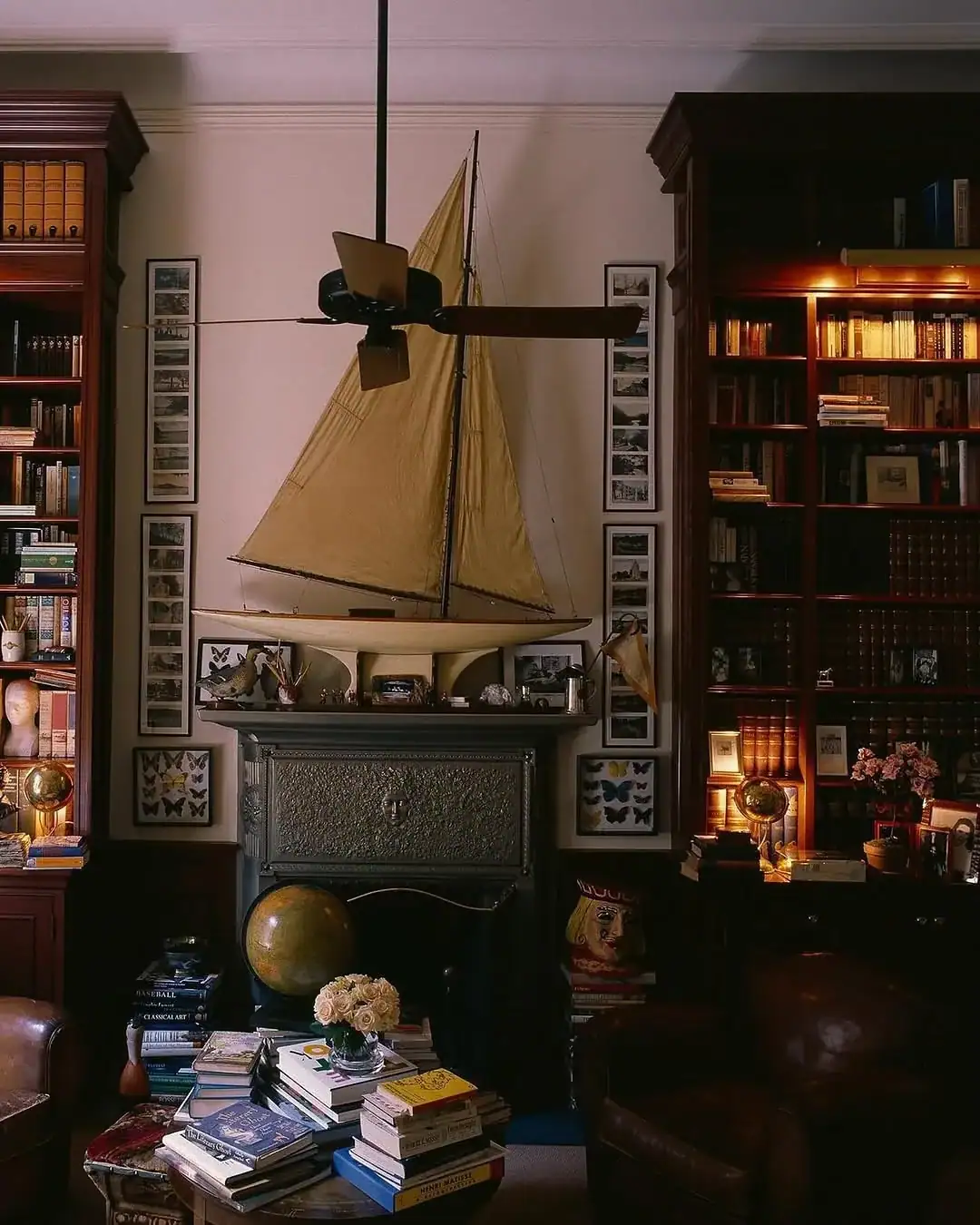
The bookcases below look built in and are not.
Look at the edges. Each one has its own cornice, its own plinth, and a visible gap of wall between it and the chimney breast. They are two antique cupboards standing either side of a fireplace, and the room reads as a library.
Joinery for a pair of alcoves typically starts around £1,500 to £2,500 each in the UK. A pair of secondhand bookcases of this kind runs a few hundred at auction, arrives next week, and goes in the van when you move.
Light the shelves
Look closely at the shelving in that photograph and you can see warm light coming from inside it, glowing on the spines and the objects.
That is doing an enormous amount. Deep shelving is a recess, and a recess is darker than the wall it sits in. In dark-stained timber it is darker again. Unlit, the same two bookcases would read as two black rectangles either side of the fireplace, and the room would feel closed rather than warm.
The options, cheapest first:
Battery LED strips stuck under the front lip of each shelf. Around £15 to £30 for a set, no wiring, and they need charging or replacing.
Plug-in strips run down the back corner of the carcass to a socket. Tidier, needs a socket nearby.
Picture lights on the front of the case, one per bay. Around £60 to £200 each, and they read as furniture rather than as lighting.
Warm, 2700K, and dimmable if the wiring allows. The point is a glow rather than illumination.
The narrow strips beside the breast
Between the chimney breast and each bookcase there is a strip of wall perhaps 200mm wide, and it is carrying vertical columns of small framed images.
Those strips exist in almost every room with a chimney breast and almost nobody uses them. They are too narrow for a picture of any normal size, so they get left blank or given something that overhangs awkwardly.
A vertical stack of small frames is the answer, and it works because the proportion of the arrangement matches the proportion of the wall. Postcards, botanical prints, small photographs, specimen boxes. Uniform frames make it read as one object rather than as several.
The same strips take a narrow mirror, a single sconce or a row of hooks perfectly well.
Choosing the cupboards
Match them, or match them closely. A genuine pair is best. Two similar pieces of the same height and roughly the same period work. Two obviously different cupboards read as improvisation.
Height matters more than width. They should relate to the chimney breast: either finishing at the same height as the mantel shelf, or running considerably taller. Landing a few centimetres off the mantel line is the one arrangement that looks wrong.
Closed below is worth having, for the same reason it is in joinery. A pair of glazed or open cases with nothing solid at the bottom gives a room nowhere to put the things rooms accumulate.
Fix them to the wall. A tall cupboard full of books is a serious weight and a genuine hazard with children in the house; a single bracket and screw into the masonry at the top takes ten minutes.
Closed cupboards below, books above
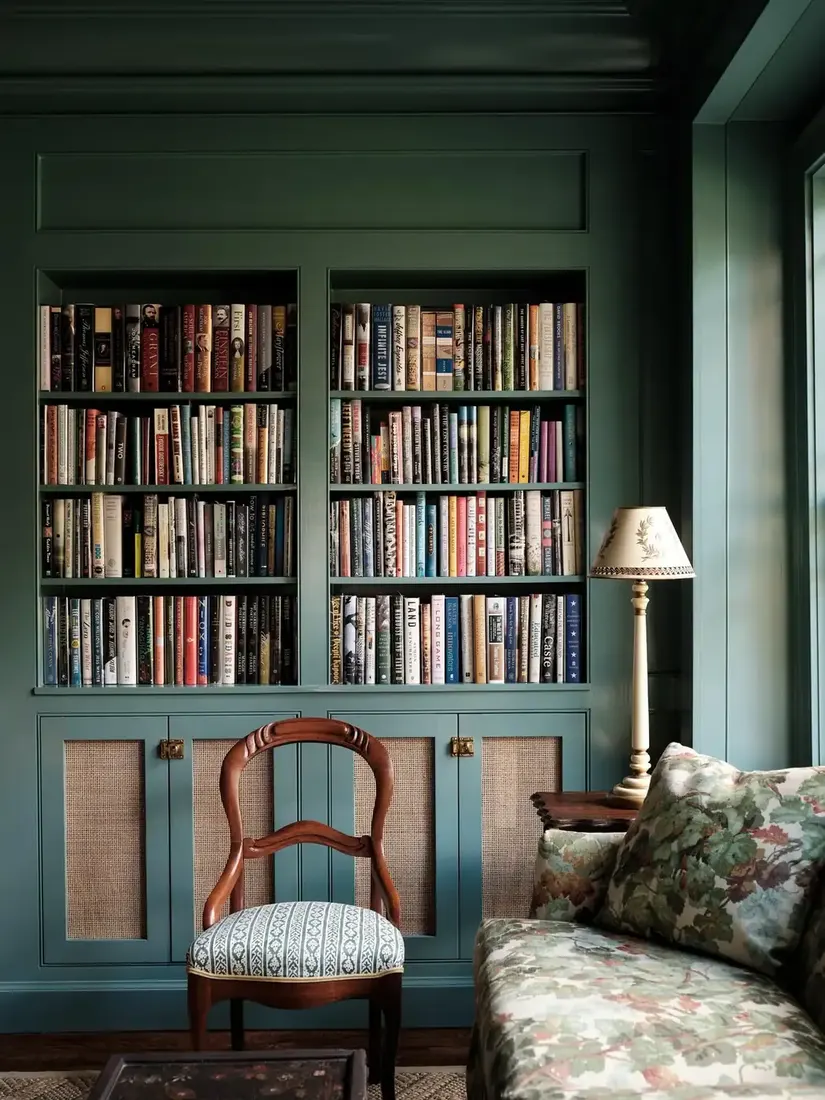
There is no chimney in this photograph, and that is useful, because the proportion lesson is identical. A fitted bookcase runs from skirting to cornice in one face, and the eye accepts it as architecture for that reason. The moment a shelf front steps forward or back, the trick fails, which is why commissioned alcove joinery is measured against the breast face and not against the skirting.
The arrangement follows the rule that governs every chimney wall. Open shelves above, closed doors below, so the visual weight sits near the floor where it grounds the composition. Four cane fronts close the base here, and the weave keeps a full wall of joinery from feeling solid. Behind those doors goes everything a living room accumulates and nobody photographs.
Colour discipline does the rest. The back panels are painted the same deep green as the frame, because a pale back inside a dark case would fragment every shelf into stripes. A greyed green along the lines of Farrow and Ball Green Smoke No.47, or Little Greene Ambleside No.304, gets you close in 2026. Dark paint drinks light, so the tall lamp beside the chair is working, not decorating. In a dim alcove, warm strips at 2700K inside the bays, around £15 to £30 a set in 2026, stop the shelves reading as holes after dark.
Symmetry flatters any centre line
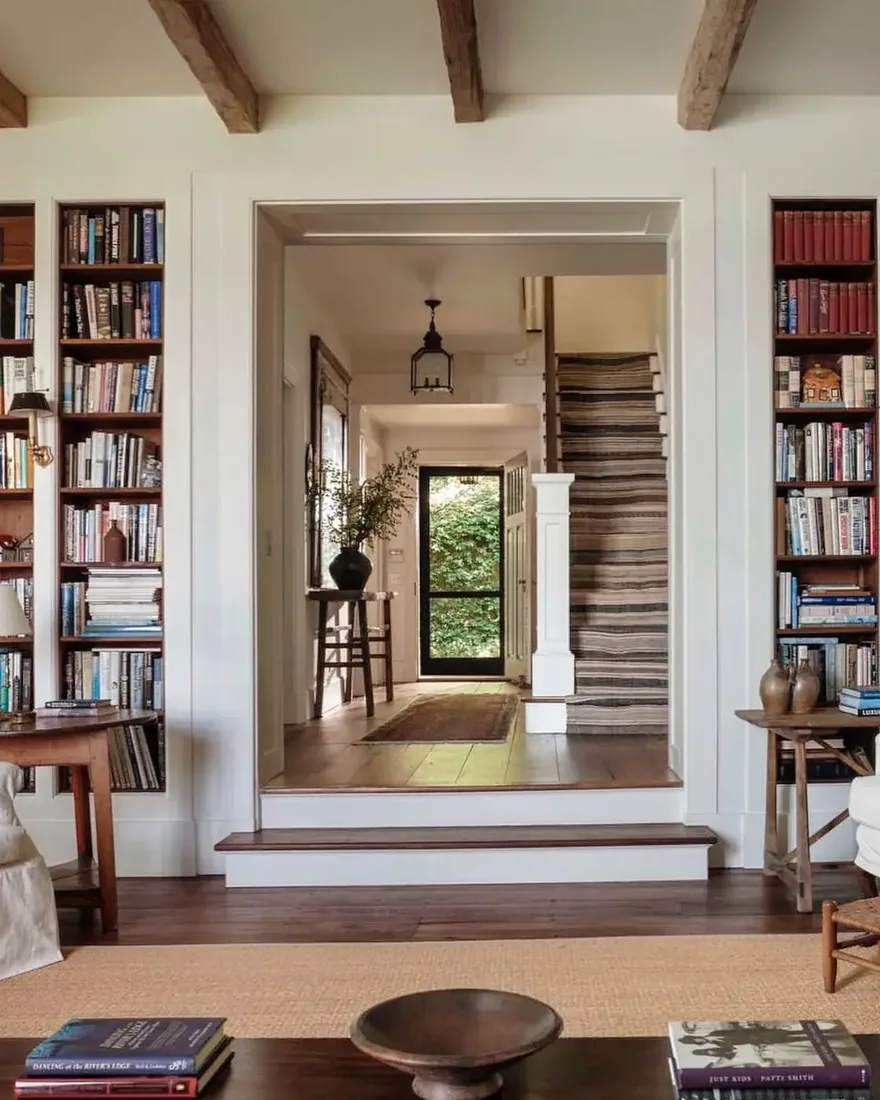
No fire here either. A wide cased opening does the centring instead, with stairs and a glazed door beyond it, and the pair of narrow shelves behaves exactly as alcove joinery should beside a breast. Same height, same width, same top line. The contents differ from one side to the other, which is allowed, because the joinery itself holds the symmetry and the objects supply the variety.
The shelves sit shallow and level with the wall face, so the opening keeps its emphasis and the wall reads as a single surface. White on white keeps it calm: a soft chalky white with a little yellow in it, Farrow and Ball Pointing No.2003 or Wimborne White No.239, gets you close. The small tables beneath each stack do the job closed storage would do in a chimney wall, holding the lower half down. Beams cross overhead, and the room needs nothing else dark to lean against.
Skip this arrangement if the opening is off centre in the wall, because a lopsided centre line makes matched joinery look like a measuring error. That is the honest disqualification, and it applies to chimney breasts too.
The same discipline at double height
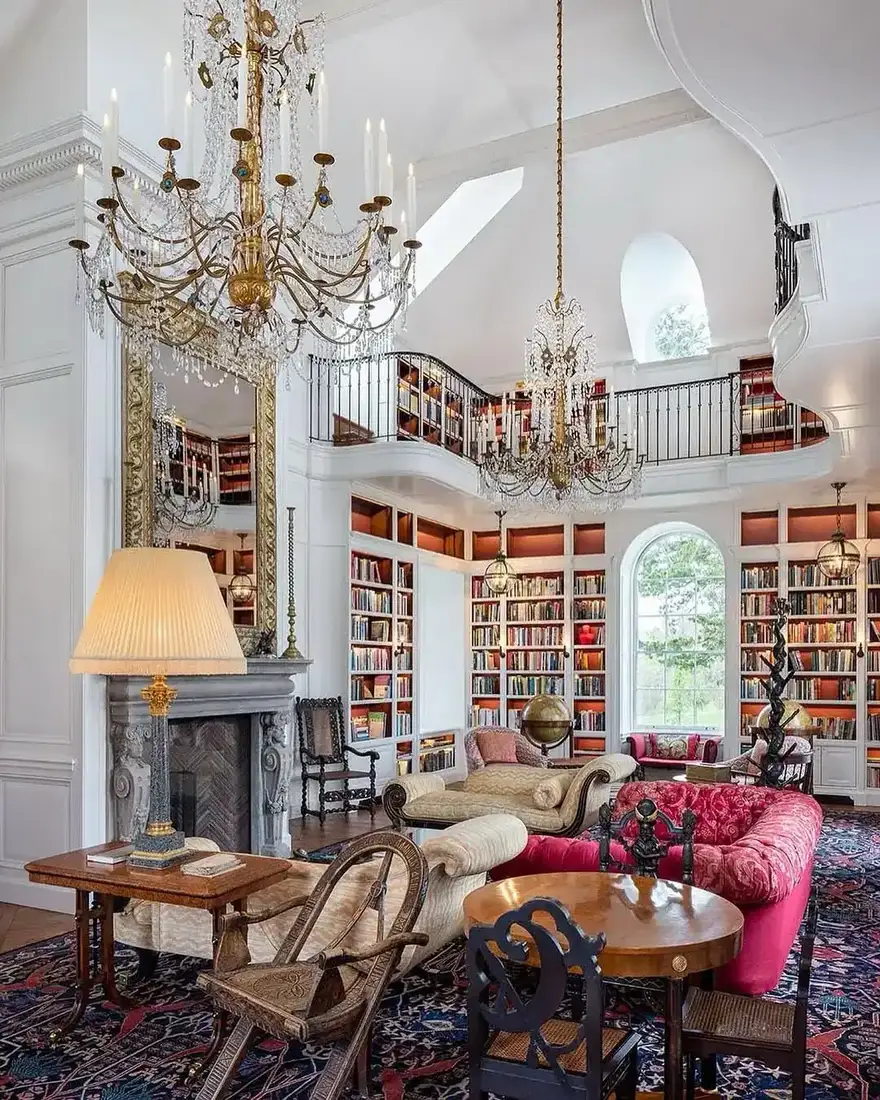
Scale changes nothing about the principle, which this room proves at double height. Shelves run continuously around the window, along the gallery, and down to the fireplace, all in one white face with one cornice logic. The wall reads as a single piece of architecture because no bay steps forward of its neighbours, and the chimney breast stays the centre of the composition even with a gallery competing for attention.
The mantel carries a tall gilt mirror and almost nothing else. Marble of that kind is texture enough on its own, and the hearth below is left an empty field, which matters near a working fire. Keep timber, books, and fabric clear of the opening, and treat your local requirement on combustible clearance as the deciding document, not a blog post. A clear hearth also happens to look better, since nothing crowds the one material in the room that needs no dressing.
Books supply all the colour here, and mixed spines look intentional against white because the shelves themselves stay quiet. A warm white keeps the room from going clinical under glass this tall: Pointing or Wimborne White, as before, instead of anything blue-white. The price of getting this exact room is beside the point. The lesson is free, and it fits an ordinary alcove: one face, one colour, the hearth left alone.
A ladder makes height honest
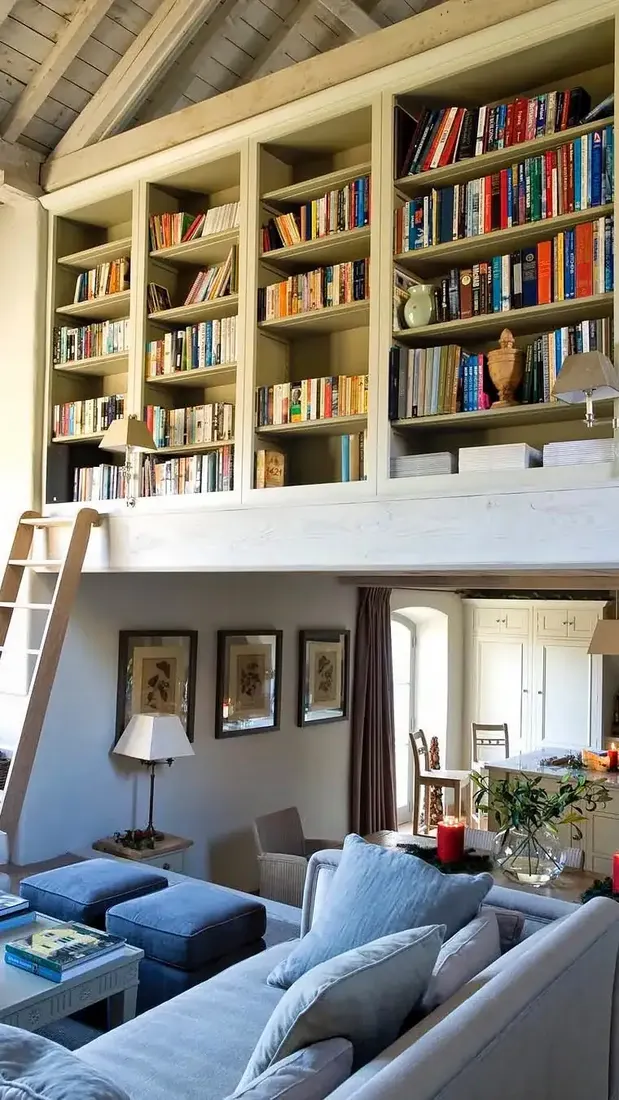
Shelves that run to the ridge only work if somebody can reach them, and the leaning timber ladder on the left is what makes this wall believable. Without it the top three rows would be decoration, and rooms know when they are being decorated at. A ladder turns height into storage, which justifies taking the joinery all the way up instead of stopping at picture rail level and leaving a stranded band of plaster.
The face stays flush across the full width, with the cornice of the room doing the top edge, so the shelves read as the wall, not as furniture. Below, the seating keeps deliberately quiet: pale blue linen, plain ottomans, three matching prints in a row. Somebody understood that the books are the pattern here and everything else should murmur. Three framed botanicals, evenly spaced, give the lower wall its own rhythm without arguing with the grid above.
Rolling and leaning ladder kits run around £300 to £700 in 2026 depending on timber and ironmongery, and they need a rail fixed to something structural. Fix the rail and the case into masonry or studs, the way any tall loaded bookcase wants fixing, on the day the joinery goes in.
One deep colour, wall to window
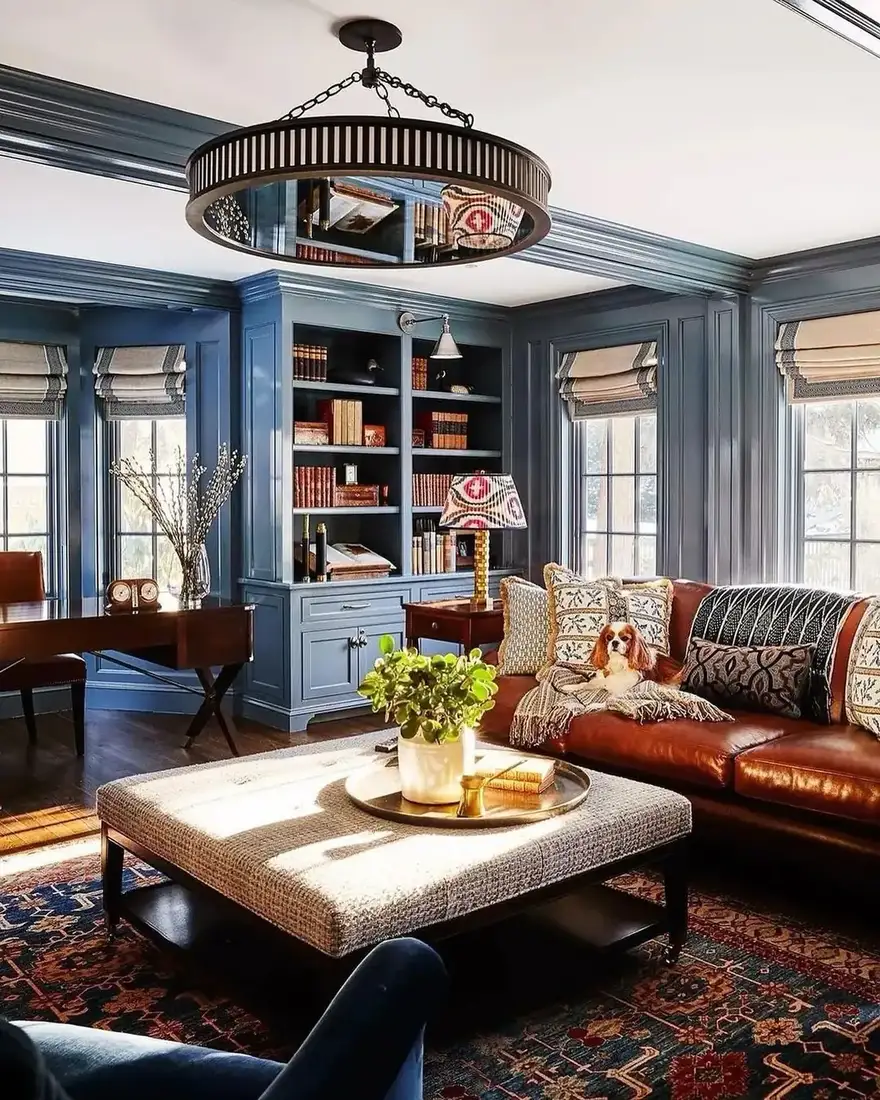
This is the contrast decision made properly, and the thing to study is how far it extends. The slate blue covers the bookcase, the window surrounds, the skirting, and the cornice, so the whole wall reads as one deliberate piece of furniture. A single blue bookcase against white walls would look like an event; blue everywhere reads as the room. That is the difference between calm and feature decided once, then committed to.
The weight sits low again. Drawers close the base, open shelves hold the books above, and the case is centred between two windows so the symmetry holds even though the room is busy. Dark paint absorbs light, so a small adjustable wall light is mounted over the shelves, and the table lamp with the patterned shade warms the corner the shelves cannot reach. Leather, walnut, and a wool rug do the warming that cool paint always needs: blue goes chalky and remote without something animal or timber beside it.
Hague Blue No.30 from Farrow and Ball, or Dock Blue No.252 from Little Greene, sits in the right family. Roman blinds in a plain oatmeal linen, around £80 to £200 per window made to measure in 2026, keep the windows quiet so the joinery leads.
Style a single bay with air
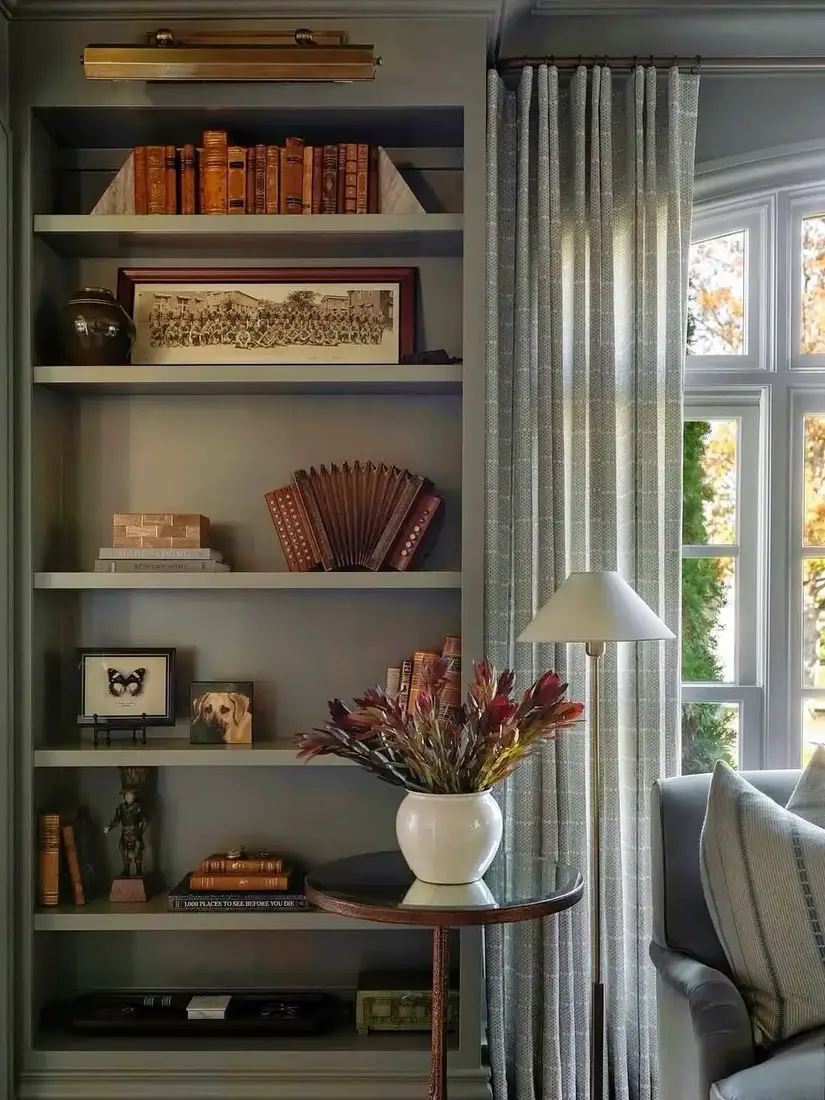
A single bay repays close attention because it shows the ratio most shelves get wrong. Old leather bindings stand across the top between two stone bookends. A long framed print anchors the second row. The middle shelf holds one sculptural object, a fan of timber slats, with empty back showing on both sides. Small frames gather in pairs lower down, and the bottom row stacks books flat. Roughly a third of the whole bay is empty, and the objects read as objects for exactly that reason. Shelves filled edge to edge read as storage whatever the objects cost.
The brass picture light above is structural to the effect, not an extra. Grey green paint at this depth swallows daylight, and without the light the top rows would sink. Back and frame share the colour, so each shelf reads as one box, not boards nailed to a wall. Beside the bay, a curtain in a small grey check, a floor lamp with a conical shade, and a side table with a jug of proteas show the supporting cast: plain textiles, one stem, nothing competing.
Copy the ratio in a chimney alcove; leave the objects themselves behind. Books, one large frame per bay, small things in pairs, and air everywhere else.
Run the shelves over the door
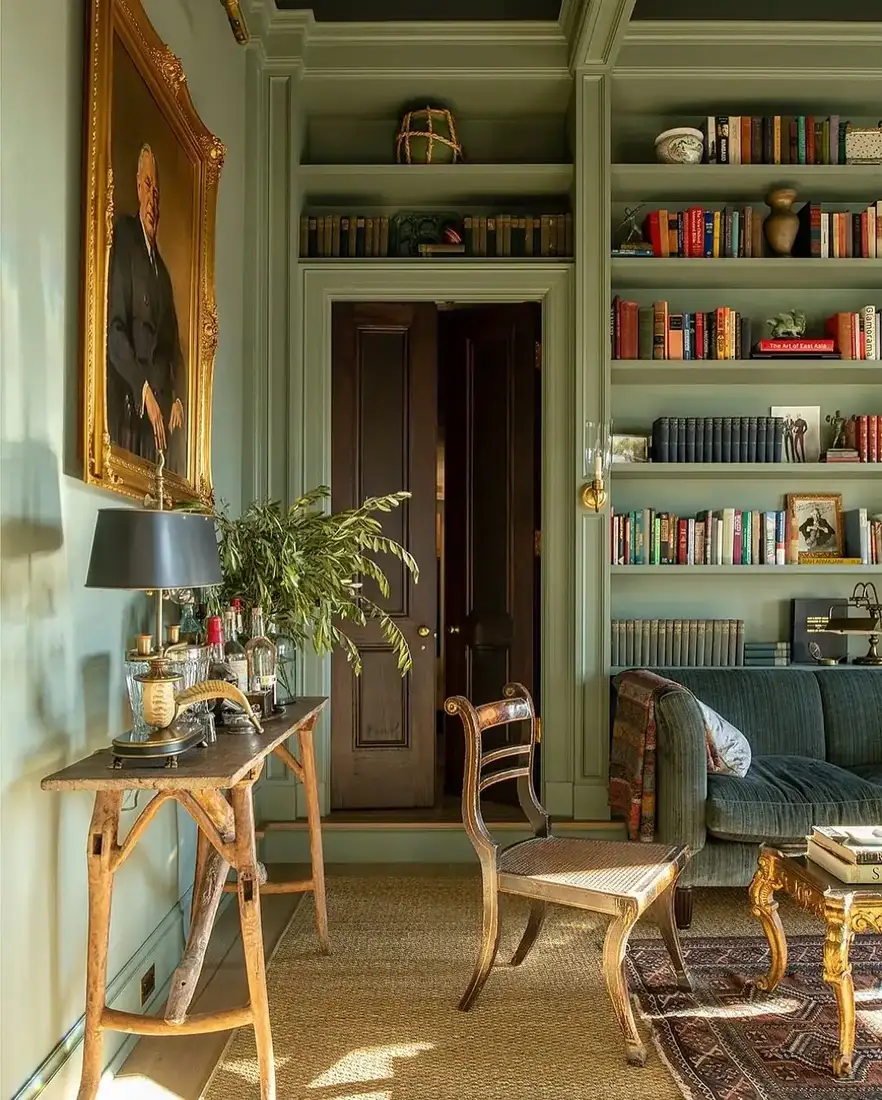
The clever move in this room is overhead. Shelves bridge straight across the dark timber door, so the joinery runs wall to wall without a break and the door becomes an event inside the joinery, not a hole in it. That continuity is the whole lesson for a chimney wall: one face, no steps in and out, and the eye travels across instead of stopping at every edge. Pilasters frame the doorway on both sides, which keeps the bridge looking structural instead of improvised.
High shelves suit overspill, the books consulted rarely, while the rows at hand height hold the everyday stock. Brass meets timber at the wall light, and the gilt portrait frame on the left repeats the metal so the brass never appears once, which would look accidental. Sage at this greyed depth stays calm in sun and lamplight alike; Lichen No.19 from Farrow and Ball is close. The dark door supplies all the contrast the room needs, and the brass wall light repeats the portrait frame so the two dark notes read as a pair.
Joinery bridged over an opening costs more than two separate runs, since the header needs proper support and scribing. Expect commissioned alcove work to start around £1,500 to £2,500 per side in 2026, with bridging, lighting, and decorating on top.
Let one dark thing carry the contrast
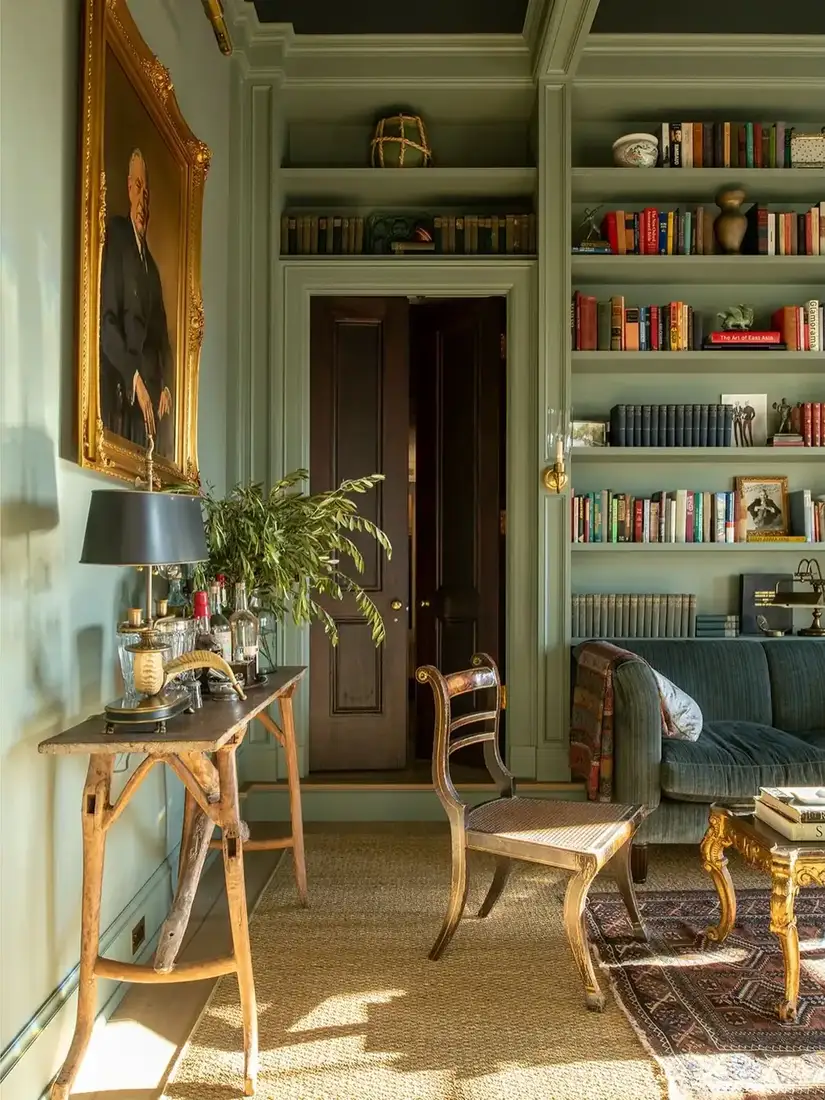
The same view teaches the colour principle from the opposite direction. Everything fitted is one sage, walls and shelves together, and the room stays quiet because of it. All the contrast comes from two dark notes: the open timber door and the gilt-framed portrait. One of those would be enough; two is plenty. Nothing else in the room needs to perform, which is why the cane chair, the twig console, and the green sofa can all be plain and textural without the room going flat.
This is the calm-or-contrast decision with the work delegated. The joinery chose calm, and a separate element carries the dark. Beside a chimney breast the same delegation works: paint the alcoves the wall colour, then let the firebox, a dark mantel beam, or one framed piece supply the depth. What fails is the middle, joinery almost matching the wall but not quite, which reads as a miss from the doorway.
Daylight does heavy lifting here, raking across the rug and the chair, and dim corners would want the warm interior strips described earlier.
Group colour loosely, never strictly
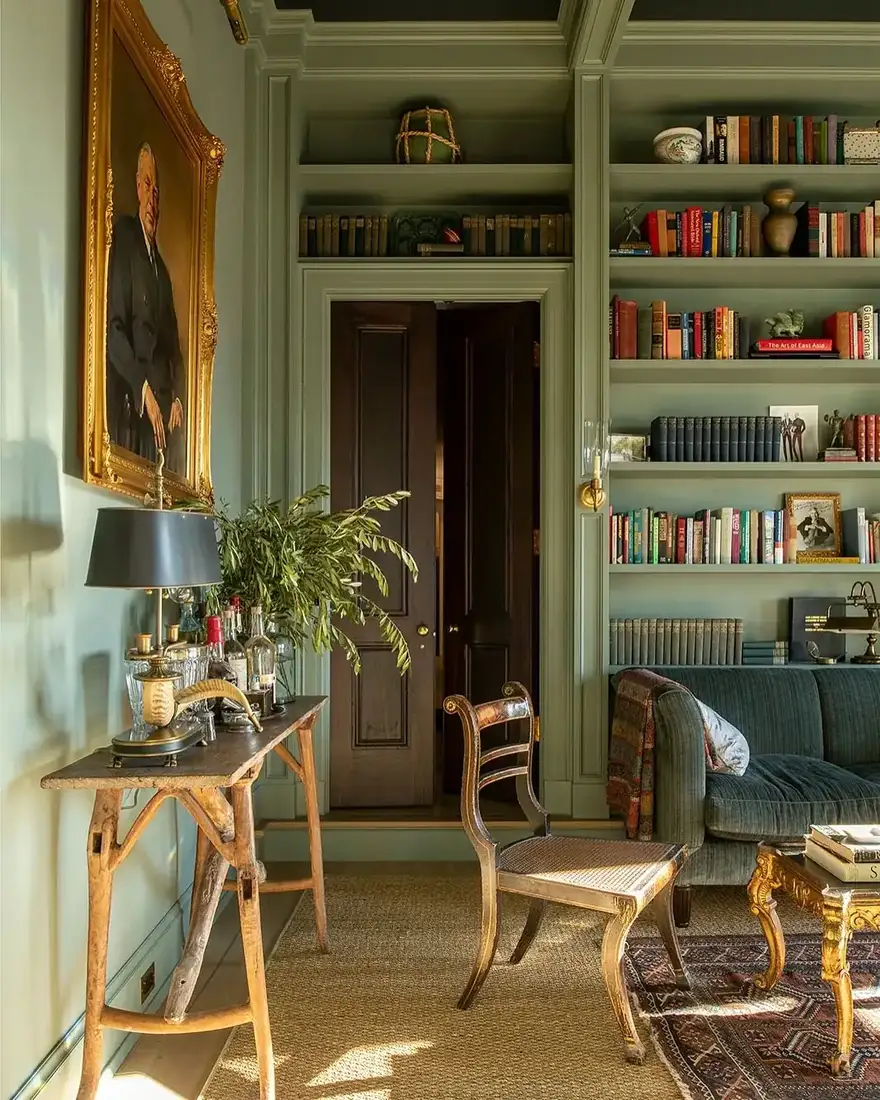
The same shelves a third time, because the styling deserves its own reading. Spines gather in loose colour bands, rust beside cream, teal beside ochre, without any strict rainbow order. Horizontal stacks break the vertical rows at intervals, and the shelves breathe at the ends. Mixed spines look collected on dark paint, where the same jumble on white can look cluttered, because shelf shadow and paint sit close in value and the books supply the light.
Small frames and a brass object or two punctuate the rows, each given space, and the bottom run of uniform bindings steadies the whole bay like a plinth. The gilt side table at the edge shows admirable restraint: one ornate thing in the view is plenty, and two would start a theme. Nothing here was bought as a set, which is why it reads collected across generations rather than delivered on one van.
In a dimmer alcove than this sunlit one, the same arrangement wants warm light inside the bays at 2700K, dimmable where the wiring allows, so the dark paint glows instead of sinking.
Decisions that keep a chimney wall flat
| Decision | Calm reading | Restless reading |
|---|---|---|
| Shelf face against the breast | Level with the breast, one face | Proud of the breast, three boxes |
| Pair across the centre line | Same heights and top lines | Contents matched instead of joinery |
| Weight above and below | Open and light over the mantel line, closed doors low | Heavy boxes high, open clutter low |
| Paint choice | Wall colour for quiet, or one deep tone everywhere | Almost matching, neither calm nor contrast |
| Hearth and firebox | Clear field, local clearance honoured | Books and fabric crowding the opening |
When joinery is worth it
Alcoves that are genuinely irregular, which is most of them in an old house. A freestanding piece leaves a tapering gap down one side that you will notice permanently, where joinery is scribed to the wall.
And rooms where the alcove is unusually shallow or narrow, where nothing standard will fit.
The honest middle route is a freestanding pair with a scribed filler strip painted the wall colour, which costs very little and closes the gap.
To start
- Buy a pair of freestanding cases before commissioning joinery.
- Measure the alcove at top and bottom; old walls are rarely parallel.
- Light the inside of the shelves, warm and dim.
- Use the narrow wall strips for a vertical stack of small frames.
- Fix anything tall to the wall, on the day it arrives.
Frequently Asked Questions
Must alcove shelving sit level with the chimney breast face?
Yes, wherever the wall allows it. Fronts aligned with the breast turn two alcoves and a stack into a single surface, while shelves standing proud chop the wall into boxes. Shallow recesses that fall slightly behind the breast still look settled, since set back reads as shadow rather than bulk.
Can secondhand bookcases stand in for bespoke joinery?
A matched pair often can. Pick two cases of equal height that clear the mantel line or run well above it, anchor both into masonry, and add warm interior light so dark timber glows. The compromise shows at uneven walls, where a scribed filler painted to match closes the taper.
Why do my painted shelves look gloomy after dark?
Deep colour soaks up lamplight, and an unlit recess goes murky whatever the shade. A warm strip beneath each shelf front, or a small brass light above the bay, lifts spines and objects back out. After dark the wiring does the work, with a dimmer on the circuit to keep the glow adjustable.
Which paint finish belongs on alcove woodwork?
Eggshell or satin, with backs coated to match the frame so each bay reads whole. Gloss marks every brush stroke across a broad flat, and a pale interior inside a dark case cuts stripes through the display. Pick wall colour for quiet or one deep tone for drama, then stop.
How much room should timber leave around a working fire?
More than feels necessary. Keep wood, paper, and cloth well back from the opening, leave the hearth an open field, and let your local clearance rules settle the exact gap. The mantel stays sparse, since stone, brick, or iron carries the texture alone.
Do shelves over the mantel take books or objects?
Fewer books and more air than the rows below. Eye level storage near the fire suits a long print, a pair of small frames, and space around each, while dense rows and shut cupboards stay low where their mass anchors the wall.
This article may contain affiliate links. We may earn a commission at no extra cost to you.