Lake House Living Room Ideas: Warm Neutrals Against Dark Water

Add us as a preferred source to see more stories on Google.
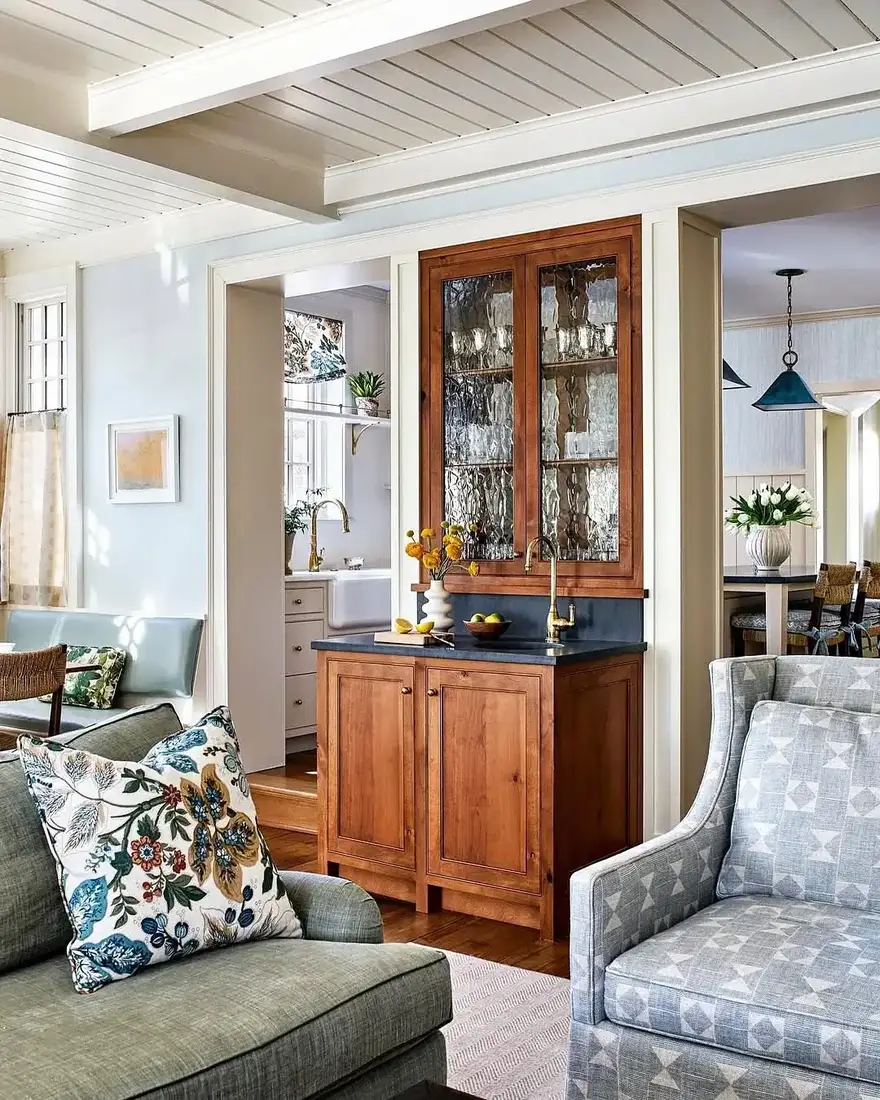
Water seen from a sofa is not the colour of water. At the shallow angle a lake is viewed from indoors, the surface stops behaving like a blue object and starts behaving like a mirror, and what arrives in the room is a reflection of the far shore: dark conifers, dark rock, dark silt. The lake in a photograph taken from a boat is a completely different colour from the lake in a photograph taken from an armchair, and the second one is the one the room has to answer to.
That is why a coastal scheme, chosen carefully and correctly, can fail so badly here. Bleached driftwood, sandy linen, and a pale sky blue are three colours selected to sit against bright sand and a hard white glare. Moved to a room above dark water, they lose the light that was making them work, and a pale blue that looked calm on a paint chart goes grey.
The room at the top of this page is the version that survives. The hutch is honey-coloured pine, waxed, not bleached, and it is the warmest object in the frame by a wide margin. Its counter is dark slate, which repeats the value of the water outside. The walls are a pale blue-grey, but they are surrounded by warm things: the pine, the green linen sofa, the woven chair, the dark floor. Nothing in that room is trying to be the sea.
Pale only works when the water is bright
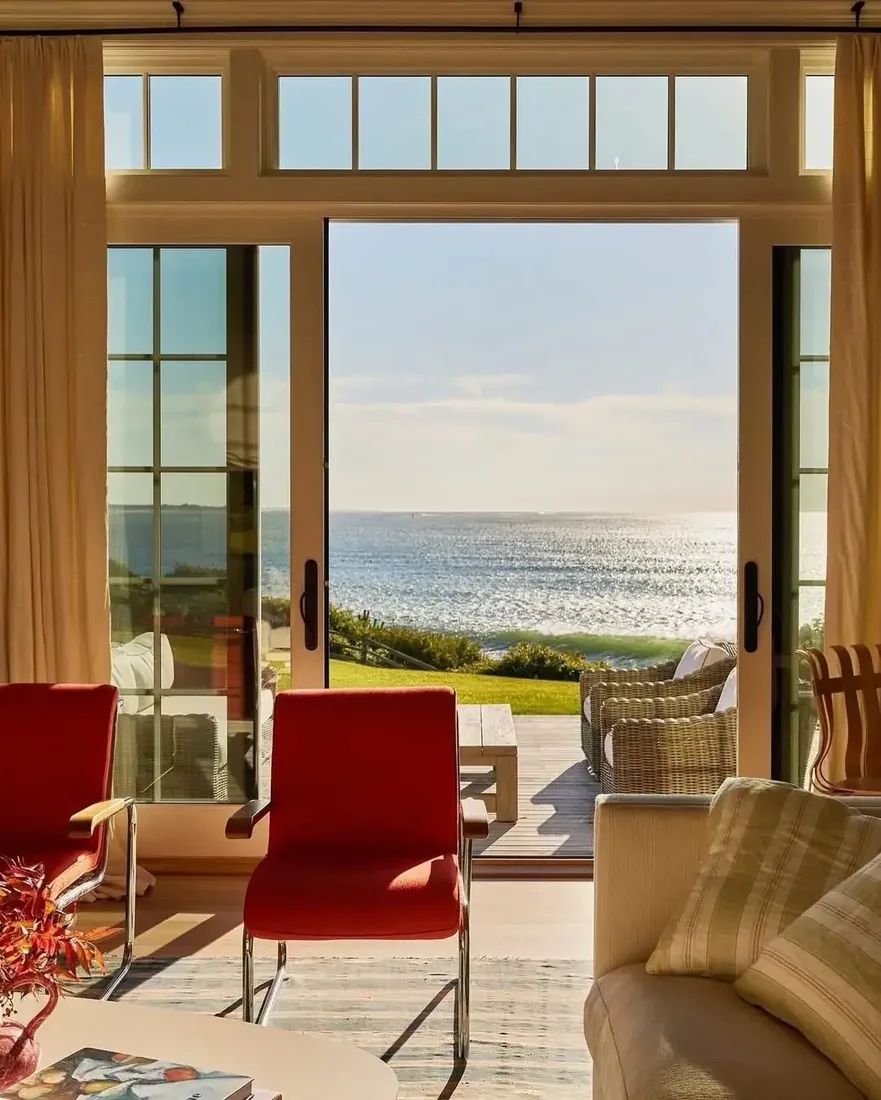
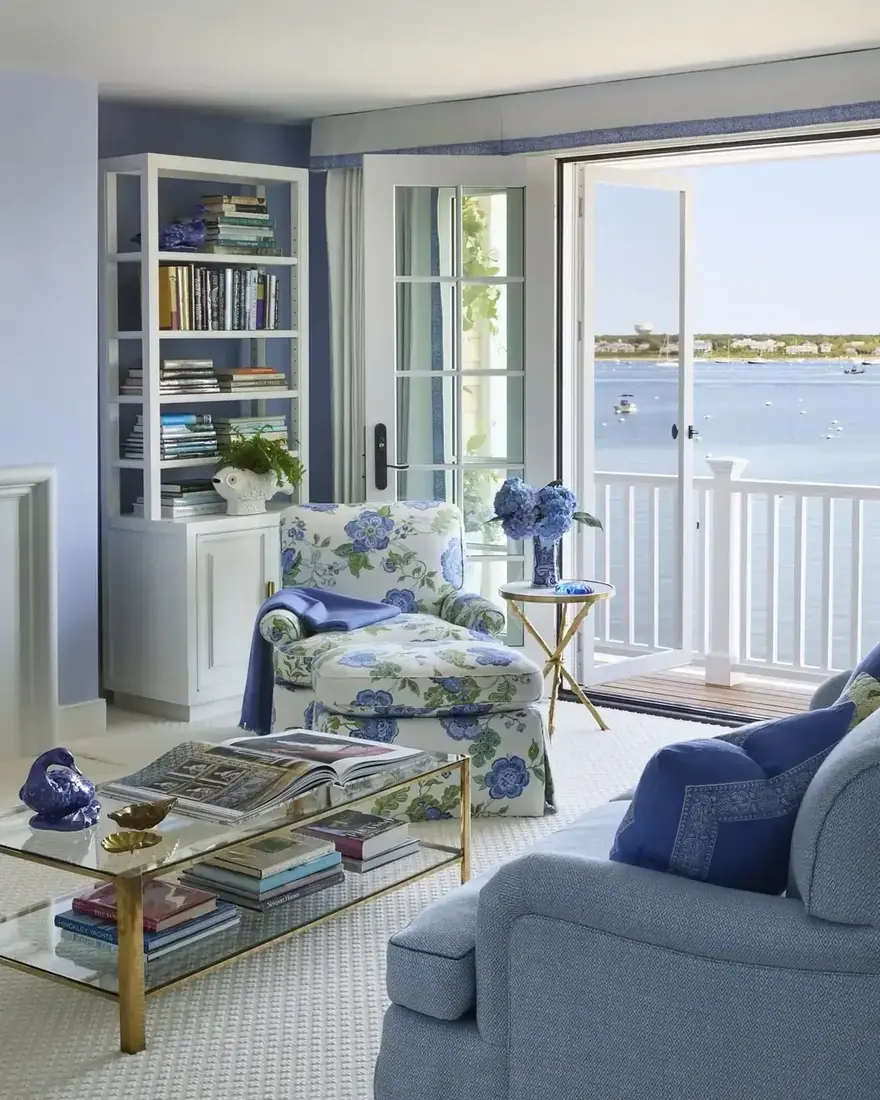
There is no pale blue in this room at all. The walls are cream, the sofa is oatmeal, the throw is a soft check, and the colour has been left entirely to the water outside, which is in full sun and blown out to roughly the value of the ceiling. The only saturated thing inside the frame is the pair of red chairs, and they are doing the job a warm neutral does in a darker room: giving the eye somewhere to stop.
That is the condition under which a pale scheme works. Bright water at the window is a light source in its own right, and it will carry an interior with almost no colour in it. Take the same room, same cream walls, same oatmeal sofa, and put it above a lake on a grey afternoon, and there is nothing left. The room has no light of its own, no colour of its own, and nothing to reflect.
If a version of this room is tempting, the red is where the money goes. A chrome-framed chair with a red upholstered seat runs £400 to £900 each; Farrow & Ball Blazer No.212 or Little Greene Atomic Red 190 gets the colour onto a cheaper frame.
Ticking stripe, and a view with its own pattern
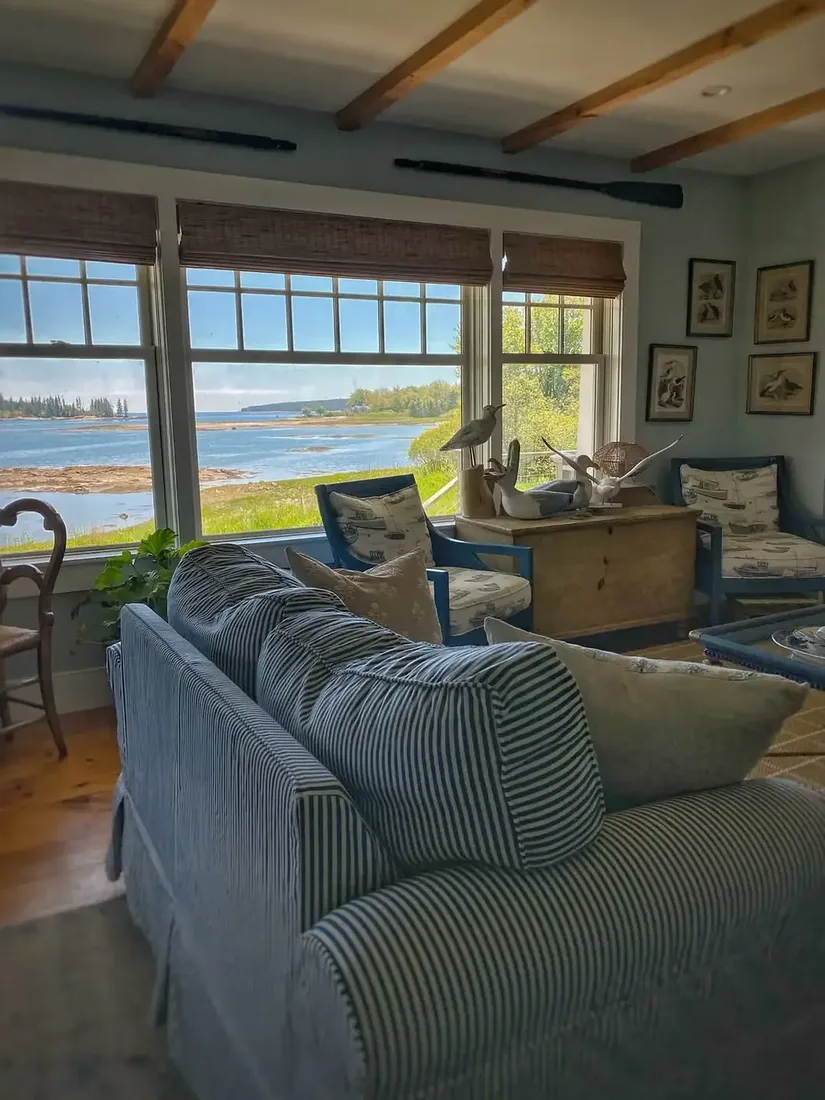
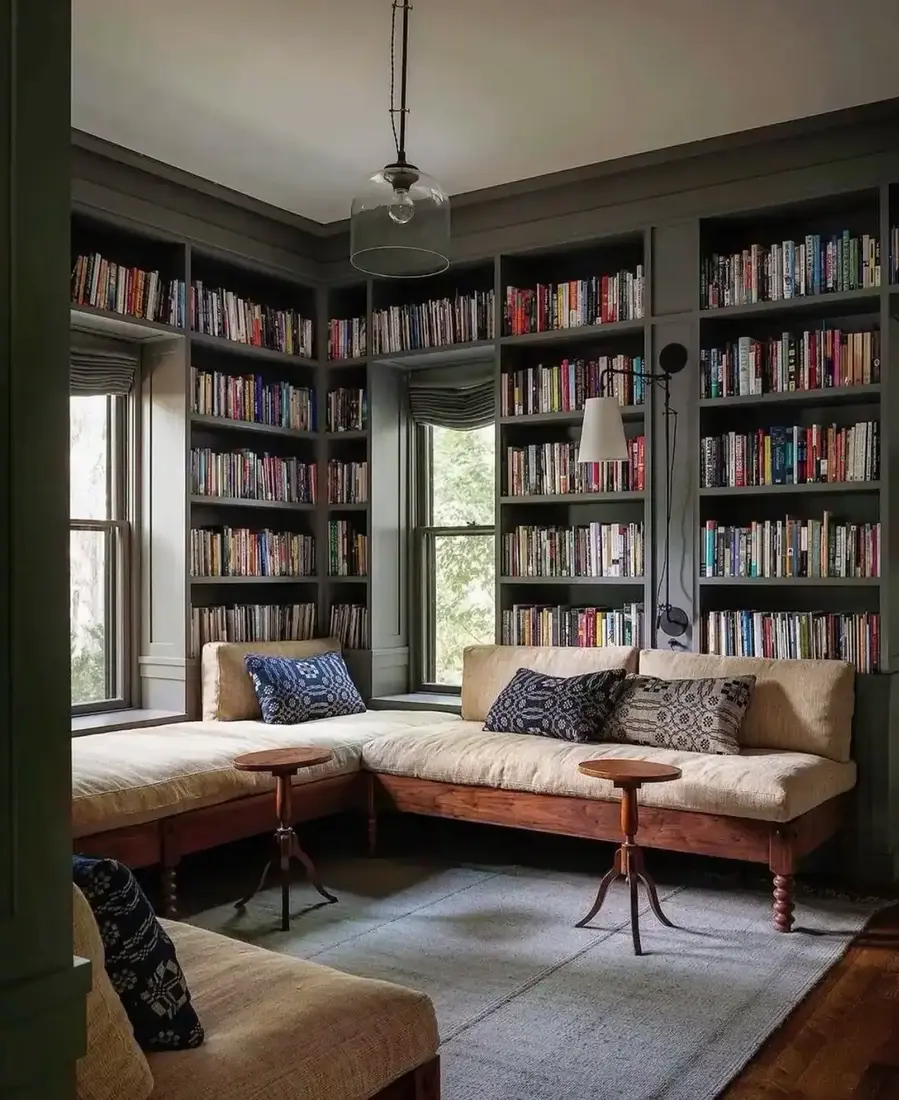
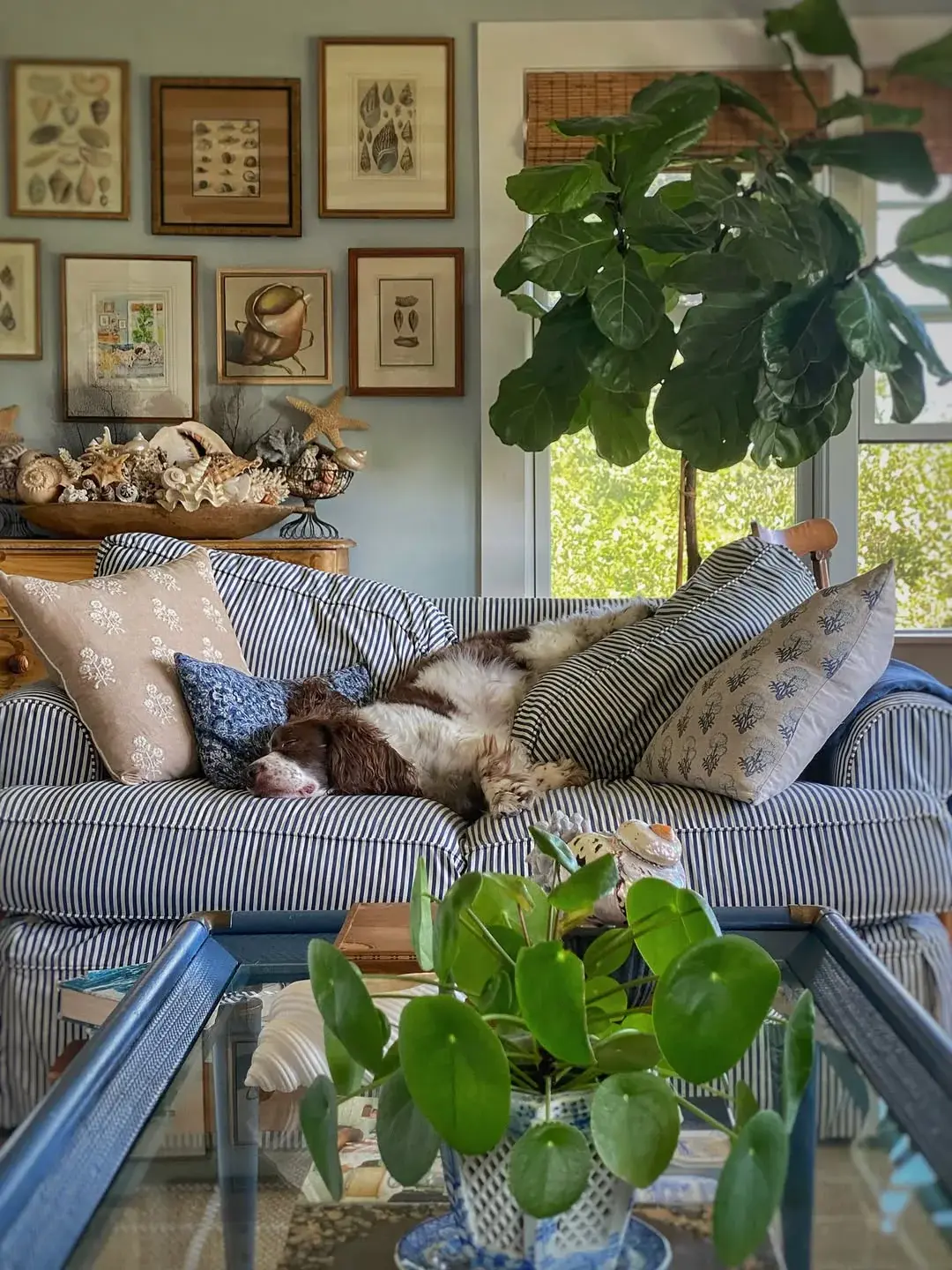
The view through those three windows is busy. There is a green marsh, a spit of dark conifer, a band of water, and a wide sky, all stacked in horizontal layers. A view like that is already a pattern, which sets a limit on what the room can wear. The sofa is a blue-and-white ticking, and a ticking is about a 6mm stripe: small, regular, and quiet from across the room. A large floral on the same sofa would have fought the marsh and lost.
The blinds matter more than they appear to. They are a dark woven wood, mounted inside the reveal, and they run almost the full height of the glass. That gives every window a dark edge, so the view is framed instead of bleeding sideways into the wall. Where a window has no reveal deep enough to take a blind, a dark painted architrave does a similar job for the price of a tin of paint. Woven wood blinds at this size run £40 to £90 each.
The floor is wide pine, boards of roughly 200mm, and it is the second warm element after the timber chest. Wide boards read older and warmer than narrow strip; the wider the board, the fewer the joints, and the fewer the joints, the less the eye is interrupted.
The decoys on the chest are the small move. There are two of them, they are dark, and they are the same brown-black as the water at the far bank. That is enough.
One dark thing, and it should be big
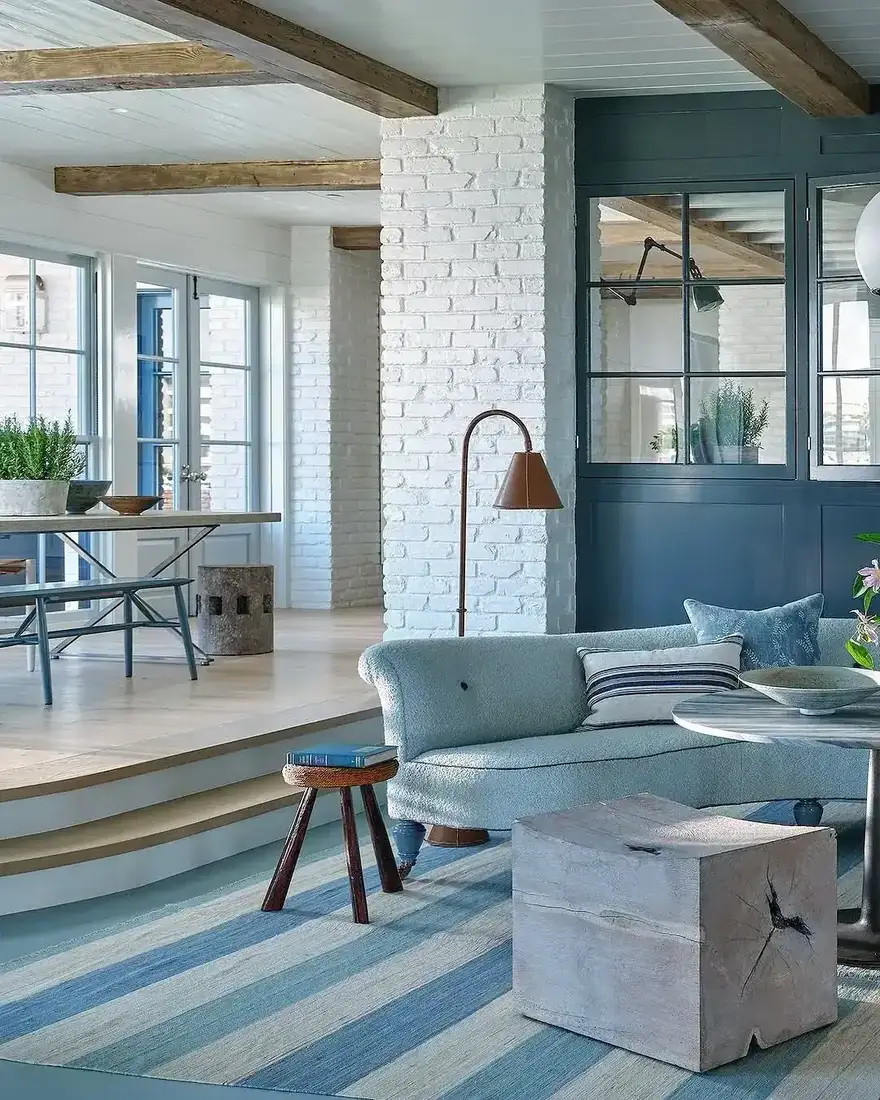
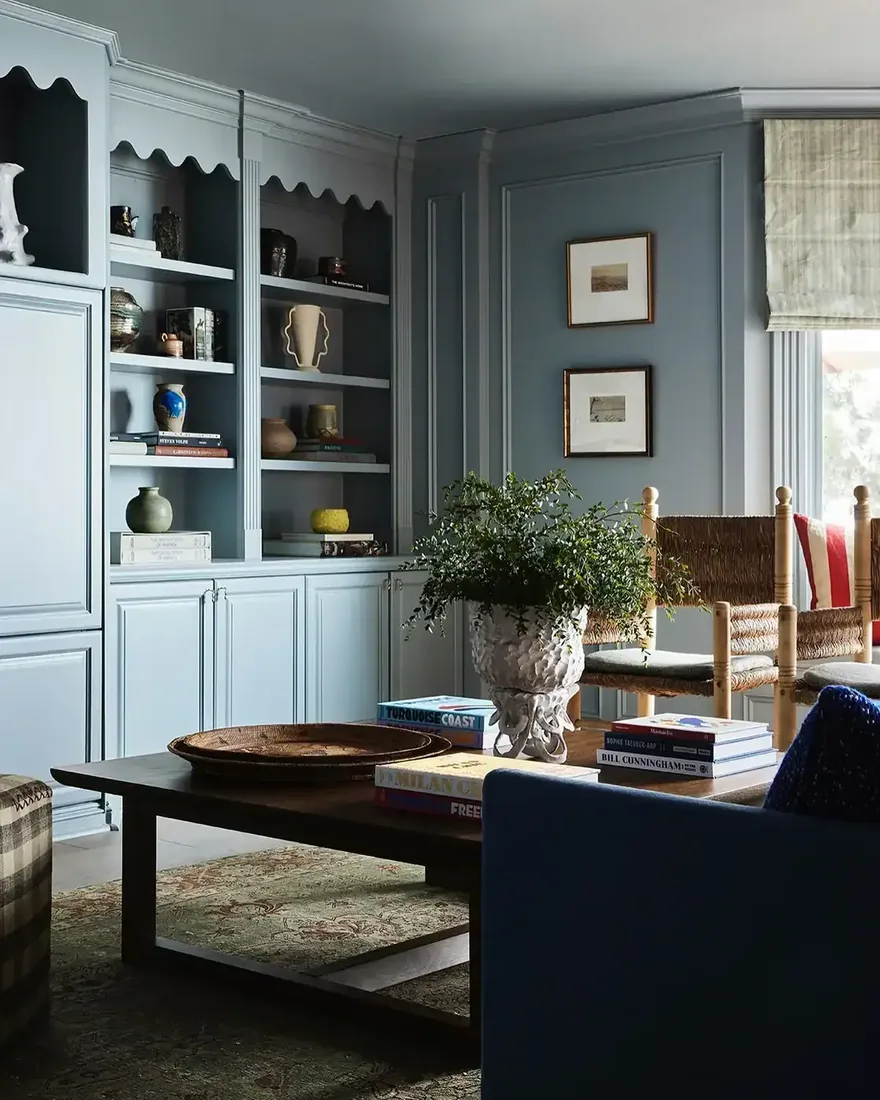
The deepest colour in this room is on the largest single surface in it: the panelled screen painted a slate blue, about 2.1m tall, running the width of the opening. Everything else is whitewashed brick, pale upholstery, and a striped flatweave, with a curved copper lamp for a bit of warmth.
That is the principle to take away. One dark object at scale reads as a decision; three dark objects at small scale, a black lamp, a black frame, a black stool, read as clutter. A room with a dark view needs somewhere dark to look indoors, or the window stays the only heavy thing in the frame.
The blue here is neither navy nor cobalt. It is a greyed blue with a good deal of black in it, and the family to look at is Farrow & Ball Stiffkey Blue No.281, Little Greene Dock Blue 252, or Benjamin Moore Hale Navy HC-154. Anything cleaner and brighter will read as a feature wall, which is a different idea entirely.
The brick has been limewashed, not painted, and the texture survives because of it. A limewash such as Bauwerk runs £45 to £70 for 5kg, which covers about 12 square metres, and it dries lighter than it looks in the bucket.
Three blues at three values, not one blue repeated
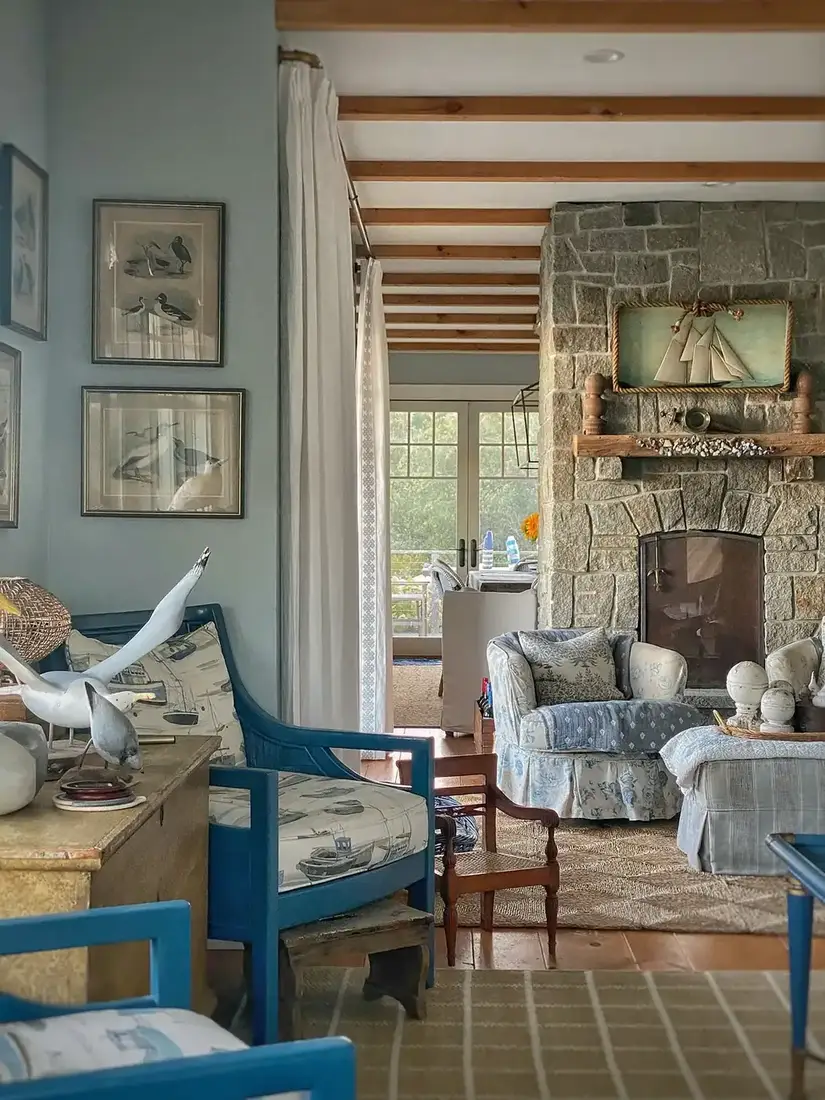
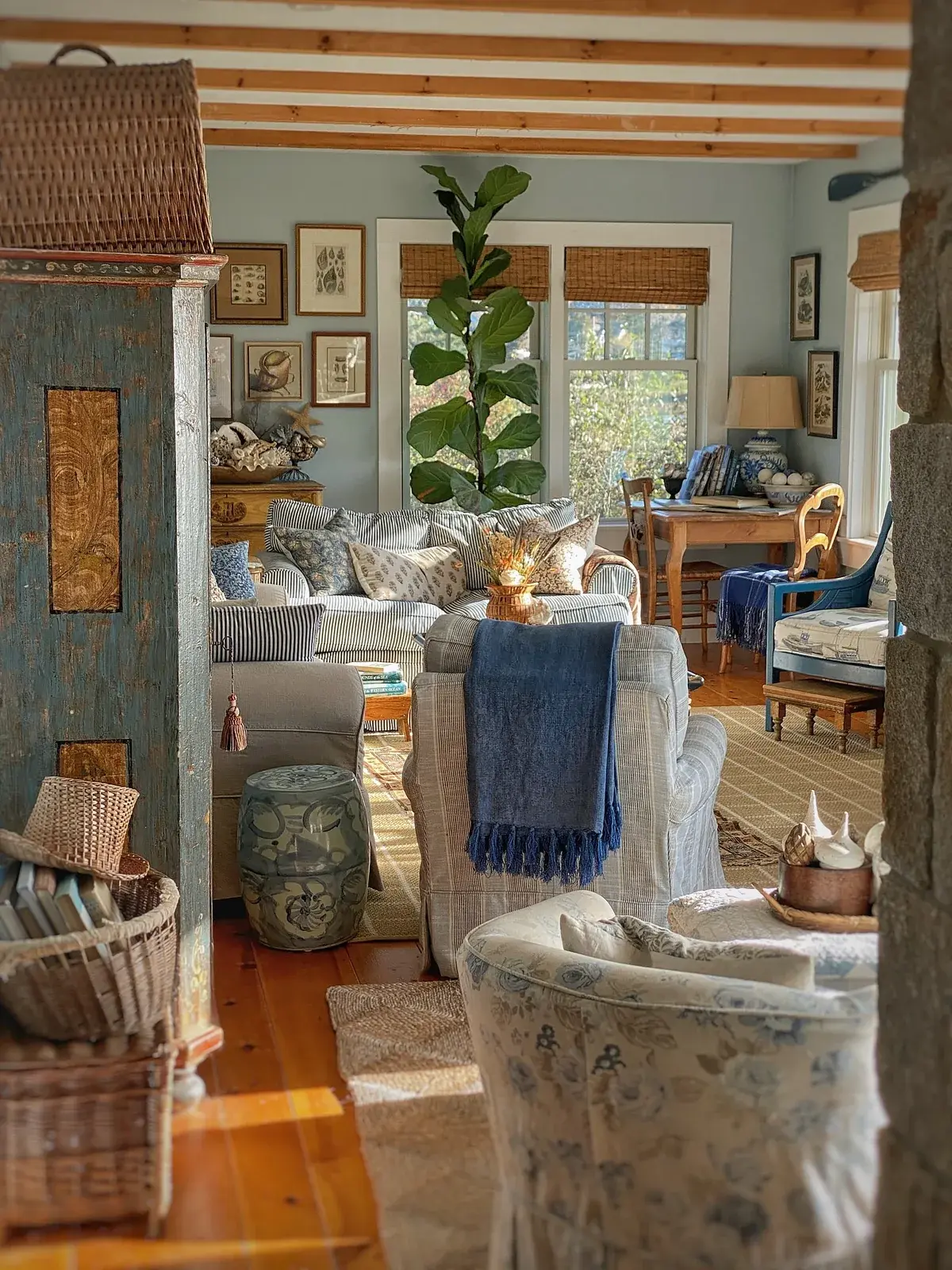
Count the blues here and they are not the same blue. The wall is a pale grey-blue, the painted armchairs are a mid cobalt, and the printed upholstery is a blue line drawing on cream. That is a value spread of perhaps 30 points between lightest and darkest, and it is why a blue room can look layered instead of flat. Farrow & Ball Lulworth Blue No.89 for the wall, St Giles Blue No.280 for the chairs, and Drawing Room Blue No.253 where a deeper note is wanted covers the whole range.
The common failure is one blue repeated: walls, cushions, and a rug all bought from the same card, all at the same value. That is how a room ends up looking like a paint chart with furniture on it.
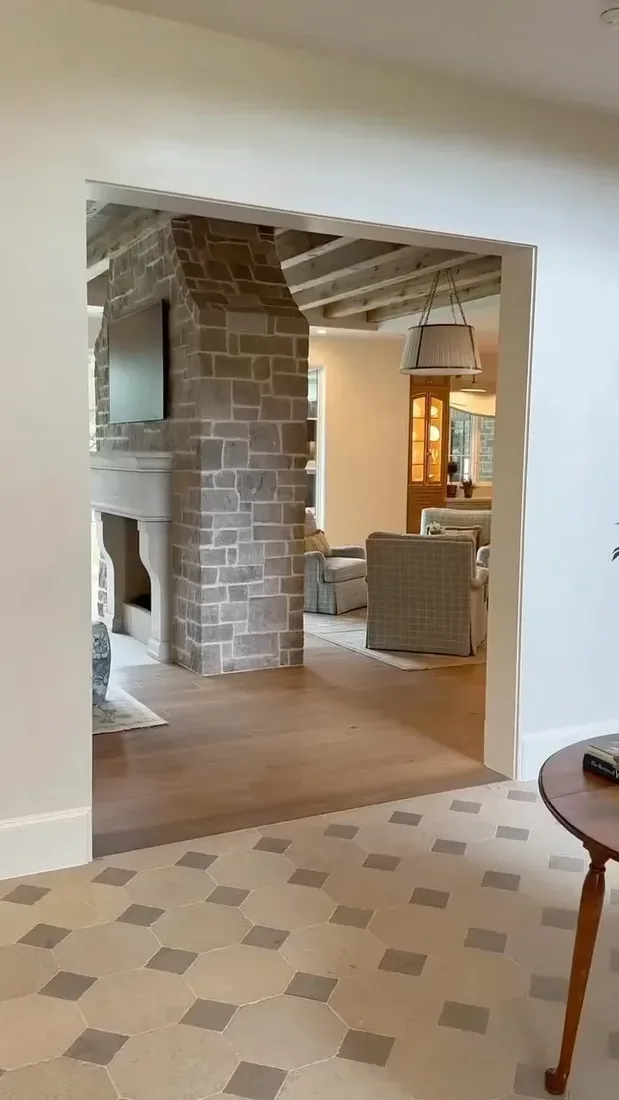
The fieldstone chimney is doing the warming. Grey-brown stone with plenty of mid-tone is the only surface in the frame that is neither blue nor white, and it does the job a honey oak floor does in a room without stone. Take it out and the scheme goes cold, which is worth knowing before anyone decides to paint a stone chimney white.
The rug is a plain woven jute, roughly 2m by 3m, and it costs £120 to £400 depending on the weave. It is the right floor for this room because it is the colour of dried reed, so it belongs to the view as much as to the interior.
Warm paper on a cool wall
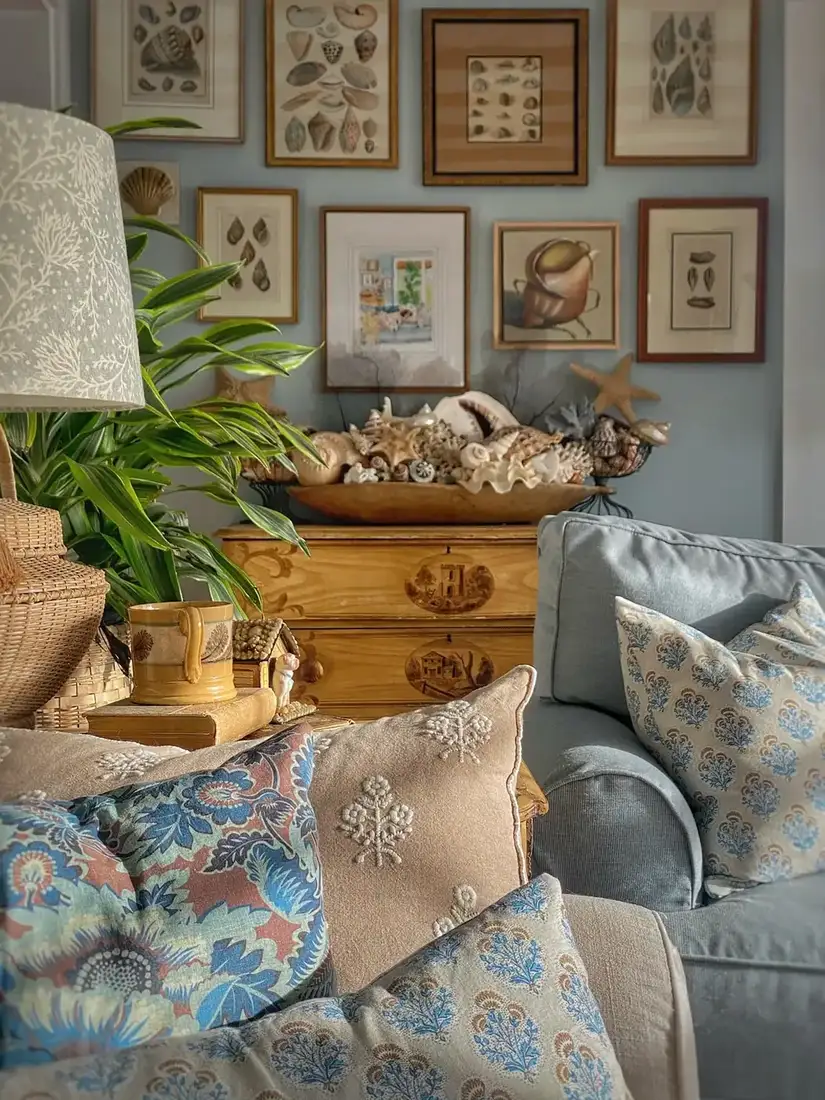
The wall behind this collection is a cool grey-blue, and every print on it is warm: cream paper, brown ink, a pale oak frame here, a dark stained one there, and one gilt. Warmth has arrived as paper instead of paint, and it has cost almost nothing.
The frames do not match, which is the part that matters. A row of identical frames turns a collection into merchandise and flattens the wall into a grid. Mixed frames let each print sit at its own weight, and the eye reads the whole arrangement as something assembled over years.
The shell engravings are the cheap end of the market. Etched and engraved shell plates from the 18th and 19th centuries turn up at auction and in junk shops for £8 to £40 each, and a plain oak frame from a local framer costs £25 to £60 for a 500mm by 400mm print with a cream mount. Buy the print first, then have the frame made to fit it.
Transferware, and the cheapest warmth there is
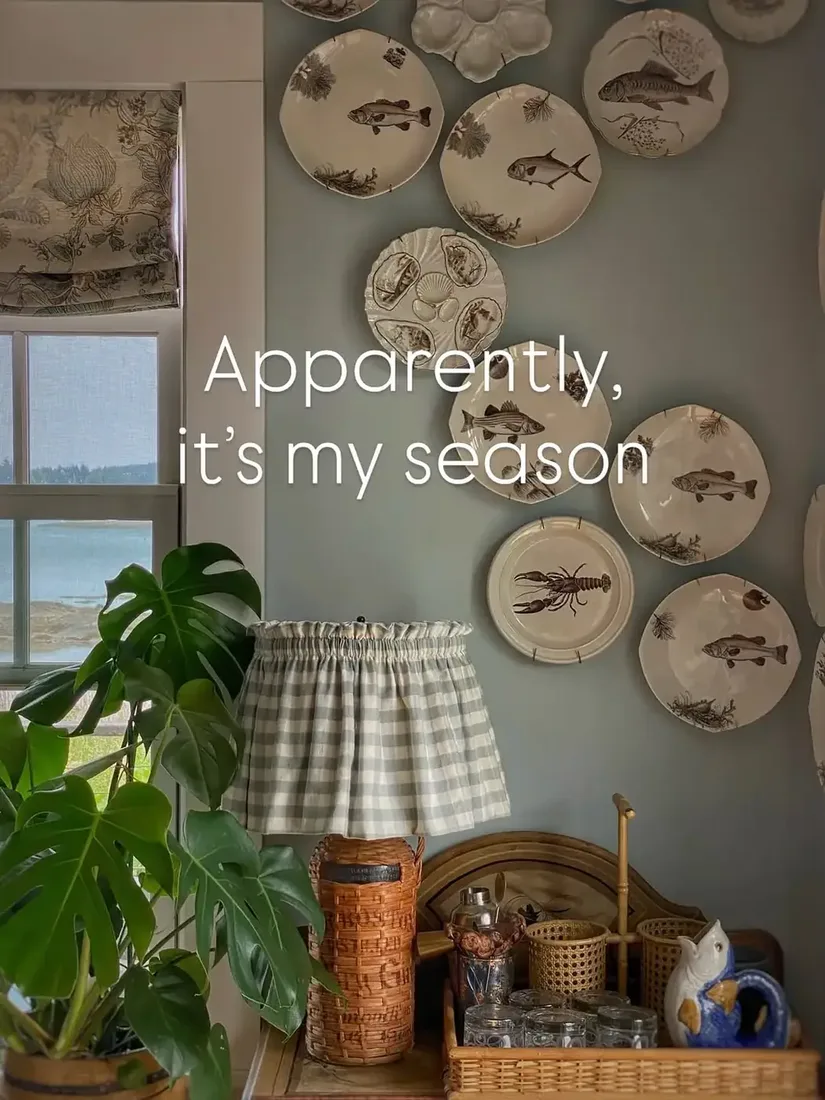
A wall of brown transferware fish plates on a grey-blue ground, with pale water beyond the window. That combination is not an accident. Brown on cream is warm, and a cool wall gives it something to be warm against, so the plates do the work a coat of paint would otherwise have to do, at £5 to £25 a plate.
The lamp is the detail I would keep. A pleated checked shade in grey and white, sitting on a woven base, and the check repeats the grid of the window muntins at a smaller scale. That is why the corner looks considered instead of assembled: one pattern is a quieter echo of another, and the eye reads the relationship without being told about it.
Two practical notes. A plate wall needs proper hangers, wire spring clips at £2 to £4 each or adhesive discs, and both leave the plate undamaged; drilling a plate is how a £20 plate becomes a £2 plate. This is also a wall that wants dusting monthly, a fair trade for the effect and a poor one in a room where people eat.
Distress buys warmth that colour cannot
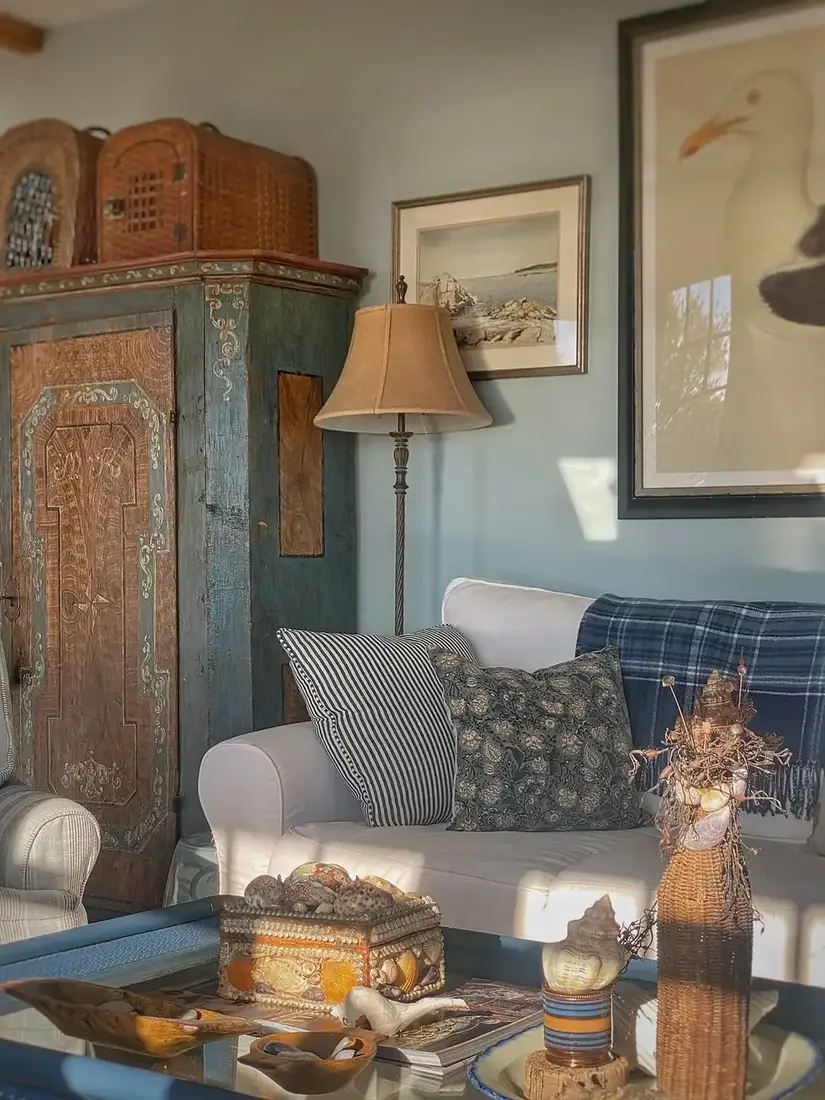
This cupboard is blue, and blue beside dark water is what this page has spent a while arguing against. It works anyway, and the reason is the finish. The paint is uneven: where light rakes across the panels the blue lifts, and in the recesses it settles into a grey-green, so the average value sits close to the water outside. A flat factory blue at the same nominal colour would read cold and faintly cheap.
The lesson generalises. On a large surface, an uneven finish buys warmth that no change of colour can. Chalk paint at £25 to £30 a litre brushed thin over a dark base gives that variation, and a limewash on brick or plaster gives it faster. If the surface is going to be big, the finish matters more than the shade.
The sofa is white, and it should stay white. A room needs one light value as much as it needs one dark, and a linen slipcover runs £300 to £700.
The frame over the view should not be a grid
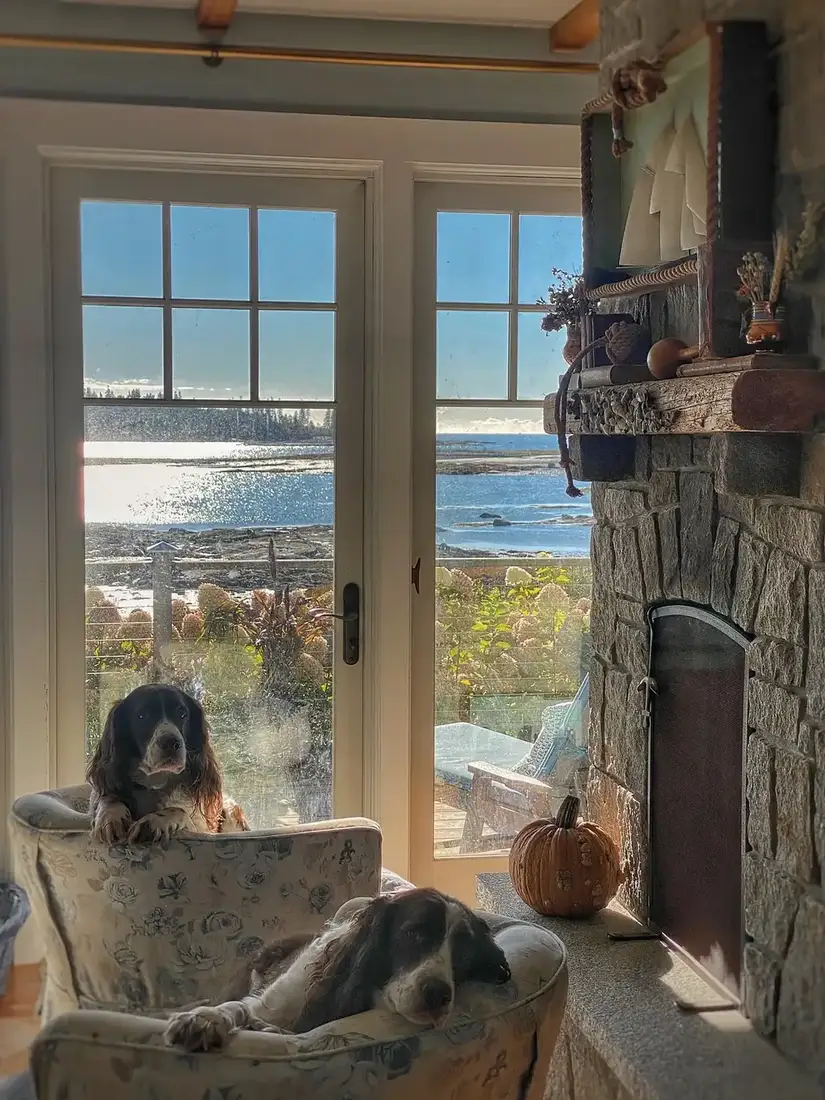
The water in this view is dark: deep blue-grey with a rock shelf showing through it, and a lawn of hydrangeas in front. The door frames are white, which puts the brightest line in the room across the darkest thing in it. It survives because there are only two wide panes and a transom. Had the same opening been divided into six lights, the view would be read through a cage.
The number of glazing bars matters more than the colour of them. Where a frame has to stay pale, keep the panes wide and few, and let the horizontal transom do the work. Where the frame can be changed, take it to within a step or two of the water’s value: RAL 7016 anthracite, or Farrow & Ball Railings No.31, both of which sit back against dark water. Painting a window costs £150 to £400 in materials and labour for a standard opening, and it alters the room for nothing but time.
The stone surround on the right is the warm anchor on that side of the room, and the dark timber mantel over it repeats the value of the water, so the glazing has somewhere to sit between the two. A pumpkin on the hearth and two spaniels in a floral chair cannot be specified and should not be tidied away.
Warm neutrals, one dark, and a fire
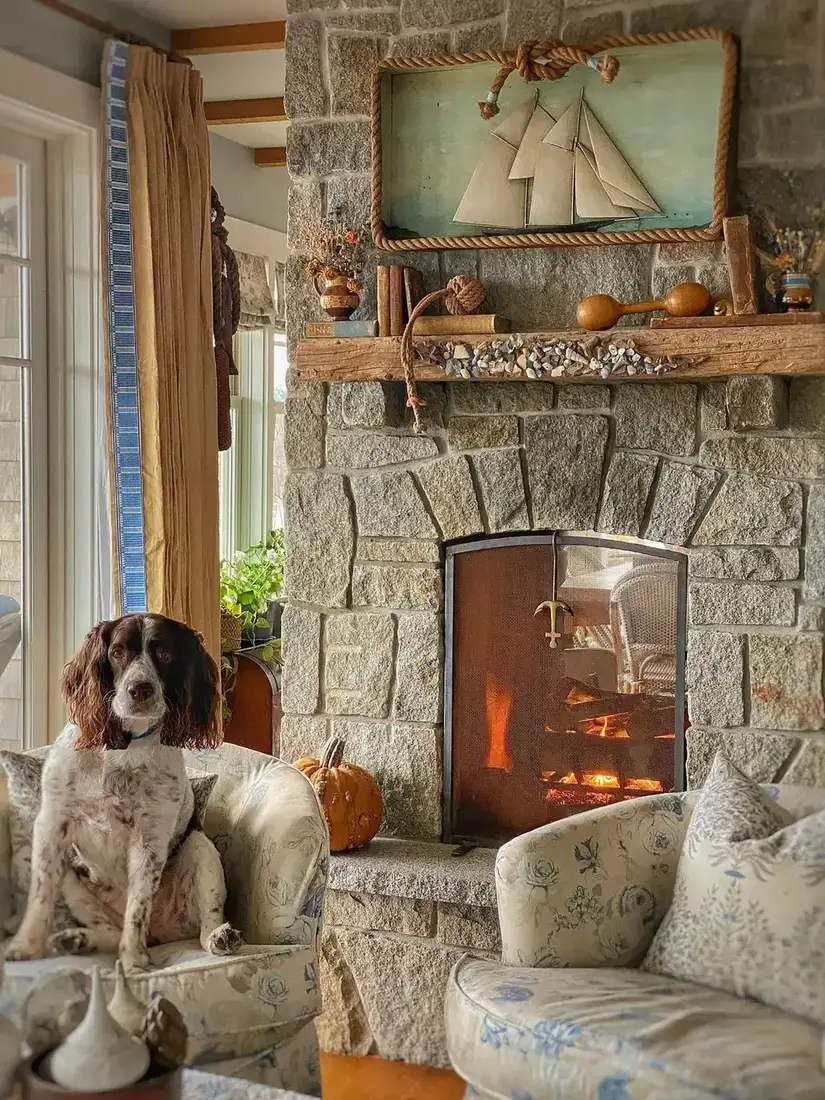
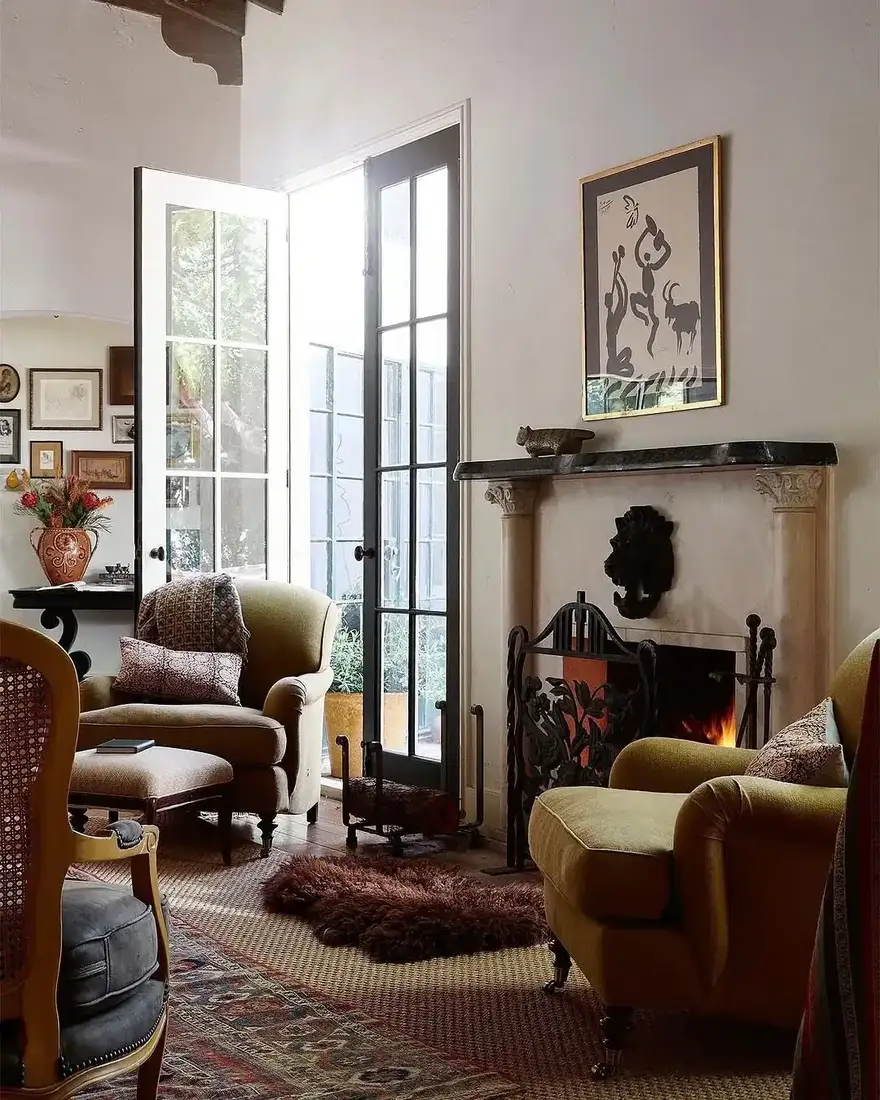
Here is the whole scheme in one frame. The fireplace is rough granite with a curved lintel; the mantel is dark timber; the curtains are a tan wool and a blue-and-white print; the chairs are chintz on an oatmeal ground; the fire is lit behind a mesh screen with a brass anchor for a handle. Almost every surface is a warm neutral, and the cool colour is confined to one curtain panel and the blue in the floral.
That is the ratio to aim for. Warm neutrals across the bulk of the room, one strong dark for weight, and cool colour in small amounts where it can be looked at rather than lived in. Get the proportions the other way round, with cool colour across the bulk and warm accents sprinkled through it, and the room will feel like a holiday let in February.
The light is the other half of it. A fire is a warm source, somewhere near 1,500K, and it flatters granite and timber. Where there is no fire, a lamp at 2700K does the same work, and a 4000K LED undoes it: the granite goes blue, the timber goes grey, and the water outside looks blacker than it is. Bulbs at 2700K and 90 CRI cost £6 to £12 each, which is the cheapest improvement available in this article.
What the water does to a beach scheme
| Beach choice | Beside dark water | Lake house answer |
|---|---|---|
| Bleached driftwood and limed pine | Loses its warmth and reads grey | Waxed honey pine or quarter-sawn oak |
| Pale sky blue on the walls | Shifts grey-green against the far shore | A greyed blue, a warm grey, or a mid green |
| Cool white 4000K bulbs | Flattens timber and hardens granite | 2700K at 90 CRI |
| Six-light white glazing | Reads as a cage across the view | Two wide panes, or a frame within a step of the water |
| Pale blue linen on everything | Nothing for it to sit against | Oatmeal linen, tan wool, and a ticking stripe |
The swap list, with prices
| Change | Cost |
|---|---|
| Limewash a brick chimney breast, about 12 square metres | £45 to £70 for 5kg, plus a day |
| Repaint a window frame in a dark colour | £150 to £400 an opening |
| Swap four bulbs to 2700K, 90 CRI | £24 to £48 |
| Re-cover two lampshades in a warm neutral | £30 to £80 each |
| Hang six vintage plates with spring hangers | £12 to £24 in hangers, £30 to £150 in plates |
| One wool throw and two warm cushions | £60 to £180 |
Frequently Asked Questions
Why does a pale blue room look grey beside a lake?
The water outside is not the blue of the paint card. At the angle anyone sits at, the surface throws back the far bank, so the room is lit by a dark green-brown field. A desaturated blue loses most of its colour against that, and what remains is grey.
What colours should a lake house living room be?
Warm ones, and mostly quiet. Honey oak, waxed pine, oatmeal linen, tan wool, and brick or stone left alone. Then one genuinely dark element, sized to the room instead of dotted about, at about the value of the water on a dull day.
Do dark window frames make a room feel darker?
Not in a room facing water. A frame close in value to the view stops drawing attention to itself, so the glass reads as one large opening instead of a series of outlined panes. The room feels calmer, though the daylight coming through is unchanged.
Is white or bleached furniture wrong in a lake house?
It is wrong in quantity. One light value gives a dark room somewhere to rest, so a white slipcovered sofa is fine. A whole scheme of limed pine, bleached boards, and chalky whites has no weight to it, and the water outside will look heavier than everything indoors.
What bulbs suit a room with a dark water view?
2700K, and as close to 90 CRI as the budget allows. Warm light makes granite and timber look the way they look by firelight. Anything up near 4000K turns the same surfaces blue-grey and makes the water outside read as a black hole.
How much does it cost to warm up a coastal scheme?
Less than replacing the furniture. Four warm bulbs, two recovered lampshades, a wool throw, and a tin of greyed blue paint come to roughly £150 to £350, and they change the reading of a room more than a new sofa does.
In order
- Look at the water from where the sofa will sit, not from the door. That angle decides the palette.
- Keep the bulk of the room in warm neutrals: waxed pine, honey oak, oatmeal linen, terracotta.
- Choose one strong dark at scale, at roughly the value of the water, and leave everything else quiet.
- Ration pale blue. Keep it to a textile or two unless the view outside is bright.
- Keep glazing bars few and panes wide, or take the frame to within a step of the water’s value.
- Warm the artificial light to 2700K at 90 CRI before changing a single surface.
- Prefer an uneven finish on any large surface: limewash, chalk paint brushed thin, distressed timber.
- Add warmth as paper and textile, with prints, lampshades, throws, and a rug in the colour of dried reed.
This article may contain affiliate links. We may earn a commission at no extra cost to you.