Floral Chintz Living Room Ideas That Let One Pattern Lead

Add us as a preferred source to see more stories on Google.
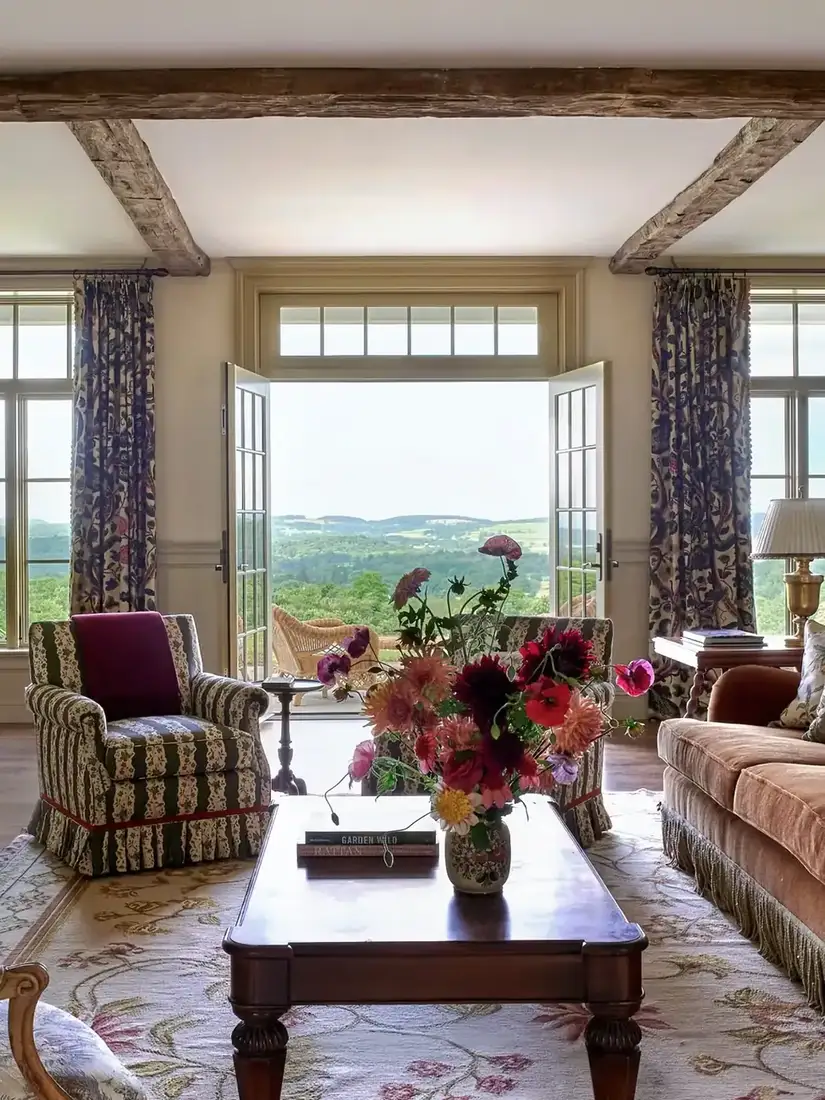
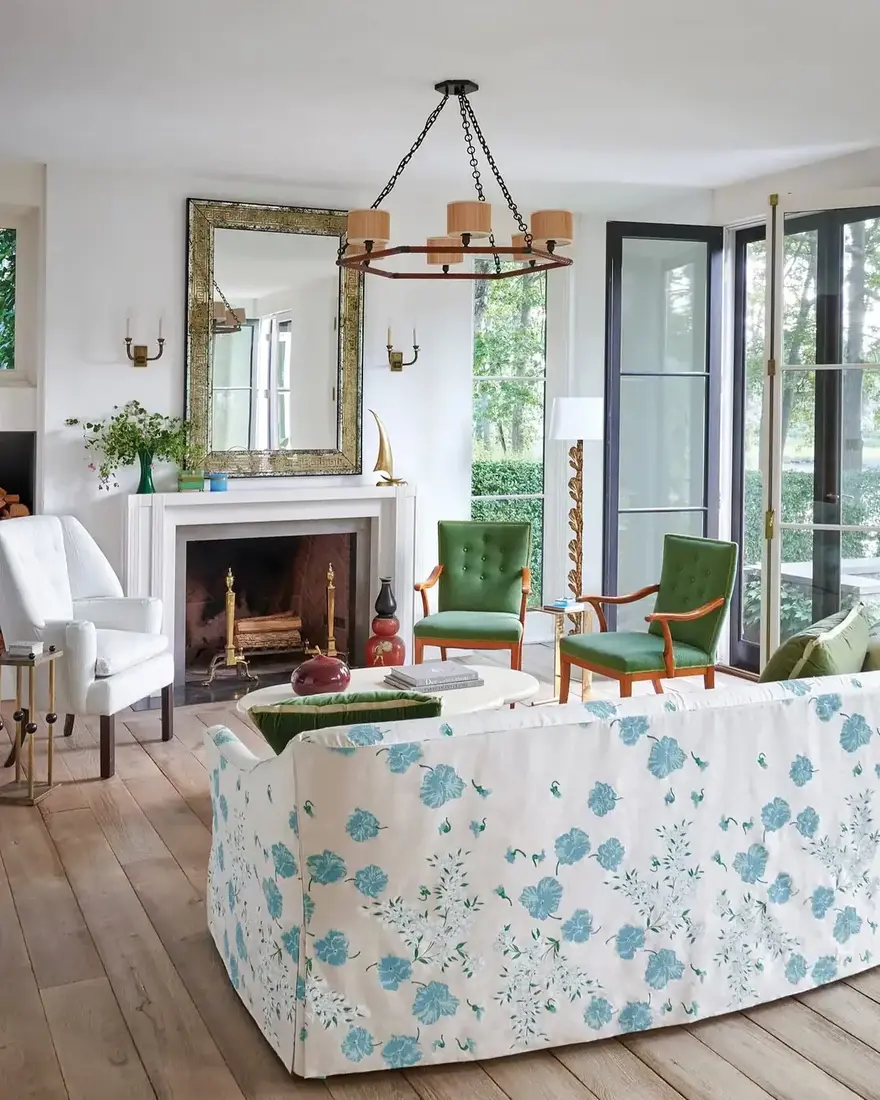
The room below succeeds for a reason that has little to do with taste. One floral clearly leads, and everything around it has agreed to stay quiet.
The trouble is rarely the print itself. It is the number of prints sharing one scale, which is why three pretty medium florals read as a fabric shop while one large motif reads as confidence. You feel the difference before you can name it, which is usually the point.
What follows reads the rooms through that lens, with the measurements that let you hold each one together.
Gallery wall that lets the floral keep the wall
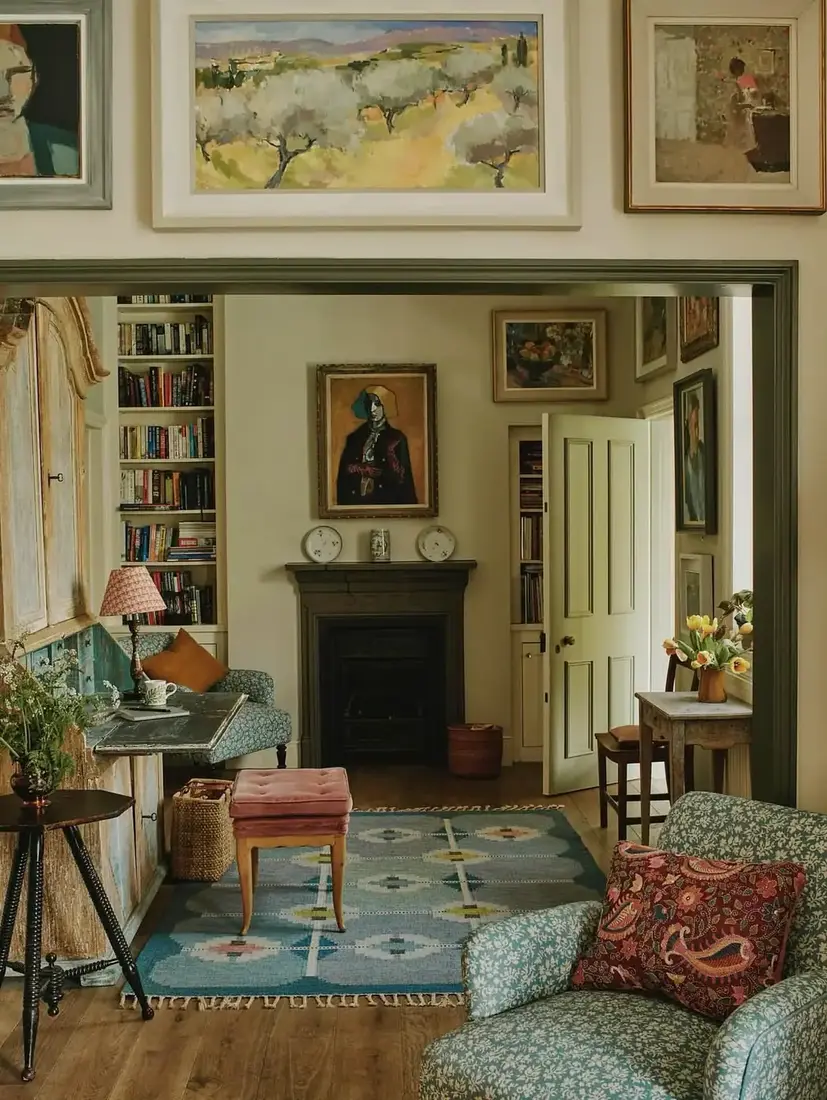
Look at the frames before the flowers, because the wall explains why the pattern below feels composed. The prints hang with narrow even gaps of around 50mm, and the frames share one dark timber tone, so a dozen small pictures read as a single quiet panel above your sofa. That discipline matters, since chintz beside a scattered wall would have two busy surfaces arguing. Your eye settles upstairs first, then drops to the floral with relief.
The principle is scale separation, and this room applies it twice over. The lead floral carries blooms of 150mm and more across the seating, while the wall holds motifs at postage-stamp size inside wide mounts. Nothing in between competes at middle scale, which is the range where fussiness breeds. A mount of 60mm to 80mm around each small print gives the same breathing room that plain linen gives a sofa.
Lamplight does the rest. Table lamps at 2700K warm the reds and creams after dark, while daylight alone would keep the palette honest but cooler. Shades of around 300mm diameter throw pools that stop your corners going flat. Simple dark wood frames of this type run £15 to £40 each in 2026 at John Lewis or Dunelm, and linen drum shades run £35 to £90 in 2026. Farrow & Ball Pointing No.2003 on your walls would get you close to that warm paper ground.
Pink ottoman that behaves as a plain
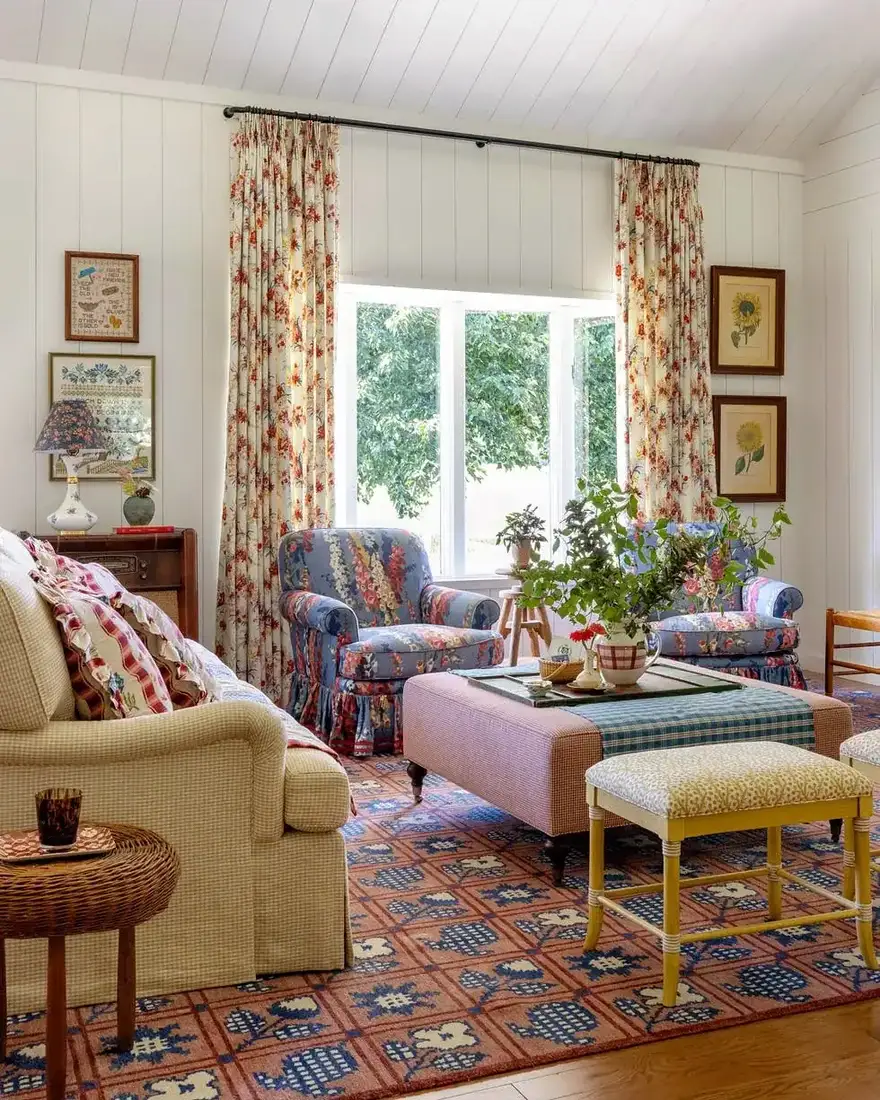
The ottoman shows how a solid colour earns its place beside chintz. Its pink velvet holds no motif at all, so it functions as a plain even though the colour is assertive. That is the distinction clients miss: plain means unpatterned, not colourless. A block of dusty rose between two florals gives your eye somewhere to rest without introducing a third repeat.
Proportion governs the arrangement. The ottoman top sits 20mm to 40mm below the sofa seat, roughly 400mm against a 440mm seat, which lets it tuck in as a footrest without breaking the seat line. Its width runs about two thirds of your sofa length, so it reads as an accessory to the seating instead of a second centre. Velvet at this scale forgives creasing, and cotton velvet from suppliers such as Linwood or GP & J Baker runs £70 to £140 per metre in 2026.
Cushions on the sofa repeat the pink in small doses, which ties the ottoman back to the seating instead of leaving it stranded. Two cushions carry the link back to your sofa; a third would start a new theme. A buttoned ottoman of this size from Loaf or Sofa.com runs £450 to £950 in 2026, so measure your sofa first. Little Greene Blush No.267 on a side table nearby would echo the velvet without matching it exactly.
Bay window where daylight edits the mix
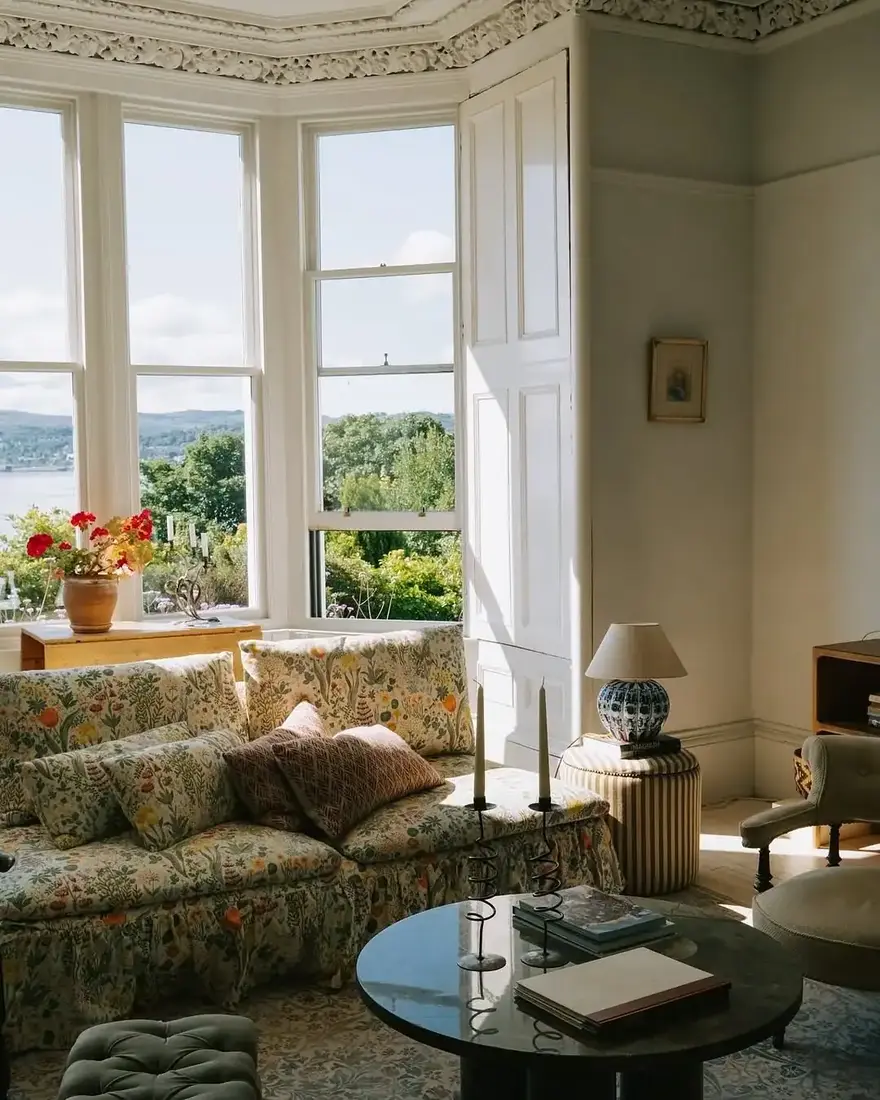
Daylight is the strictest editor a floral will ever meet, and the bay gives this sofa the full test. Morning sun exposes every clash of undertone in your fabric, which is why the companions here stay in plain stone linen with a single narrow stripe. In that room the curtain rod runs around 150mm above the frame and extends 120mm past each side, so the open curtains stack back onto wall instead of glass. The window then reads at full width while the floral keeps the middle.
The hanging principle is simple: fabric should clear the floor by 10mm to 15mm or pool deliberately, never hover at skirting height. A break at the skirting reads as a measuring error, while a clean just-clearing hem reads as intention. Full-length floral curtains in a print of this scale need around 2.2 times your track width in fabric to gather properly. Made-to-measure floral curtains of that fullness run £280 to £650 per pair in 2026 from John Lewis or Hillarys.
Notice how the blind layer stays plain, which keeps your options open for winter lining. A striped roman beneath the curtains would add a second rhythm at the same window, so plain voile or plain linen does the filtering instead. Farrow & Ball Borrowed Light No.235 on your bay woodwork would sit close to that pale blue grey ground. Roller blinds in plain linen run £60 to £140 per window in 2026 from Blinds 2go.
Formal room where the ceiling sets the scale
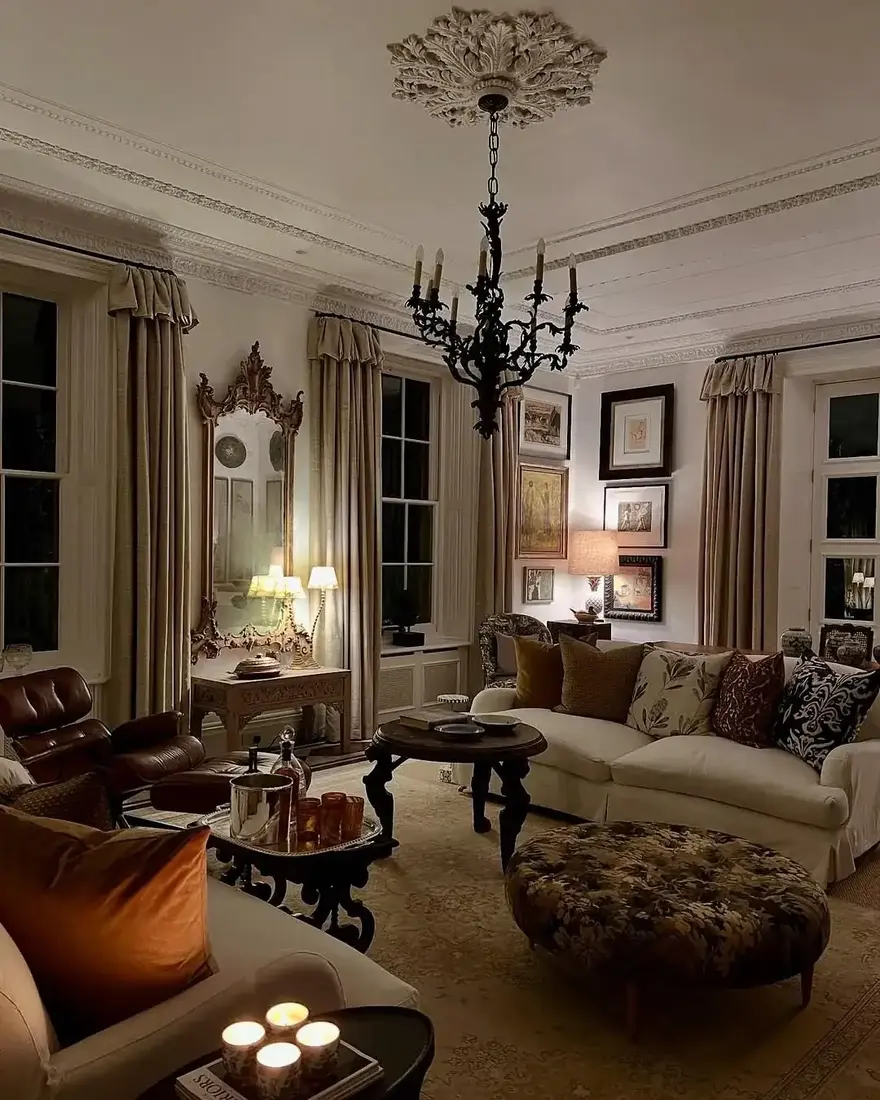
In that room the ceiling speaks first, which changes what the floral is allowed to do. A medallion of around 500mm diameter centres a formal arrangement, and the seating answers with symmetry: a pair of chairs, a centred table, lamps in matching pairs. Chintz inside symmetry reads as tradition rather than clutter, because the mirror-image layout supplies the order the pattern lacks. Without that frame, the same fabric would feel twice as busy in your room.
Ceiling height is the governing measurement here. With 2700mm or more overhead, a large floral on generous upholstery looks proportionate, since the volume absorbs the motif. In a room under 2400mm the same print would press down on you, which is why cottage chintz runs smaller in repeat. The pendant hangs with its base around 1900mm from the floor, high enough to clear sightlines while keeping light in the lower half where your guests sit.
Formality also means restraint in count. Two lamps, one mirror, one rug: each category appears a set number of times and then stops. Table lamps with ceramic bases of that height run £90 to £220 each in 2026 at Pooky or Dunelm. Farrow & Ball Green Smoke No.47 on an accent wall behind would deepen the formality, while Wimborne White No.264 keeps the ceiling bright.
| Surface | Lead print bloom width | Companion rule |
|---|---|---|
| Sofa or full curtains | 150mm and above | Plain or narrow stripe only |
| Armchair | 100mm to 150mm | One plain cushion, no second floral |
| Cushions and shades | 40mm to 80mm | May carry a second small motif |
| Walls beside lead floral | No print | Colour pulled from print background |
Gilt mirror that needs quiet around it
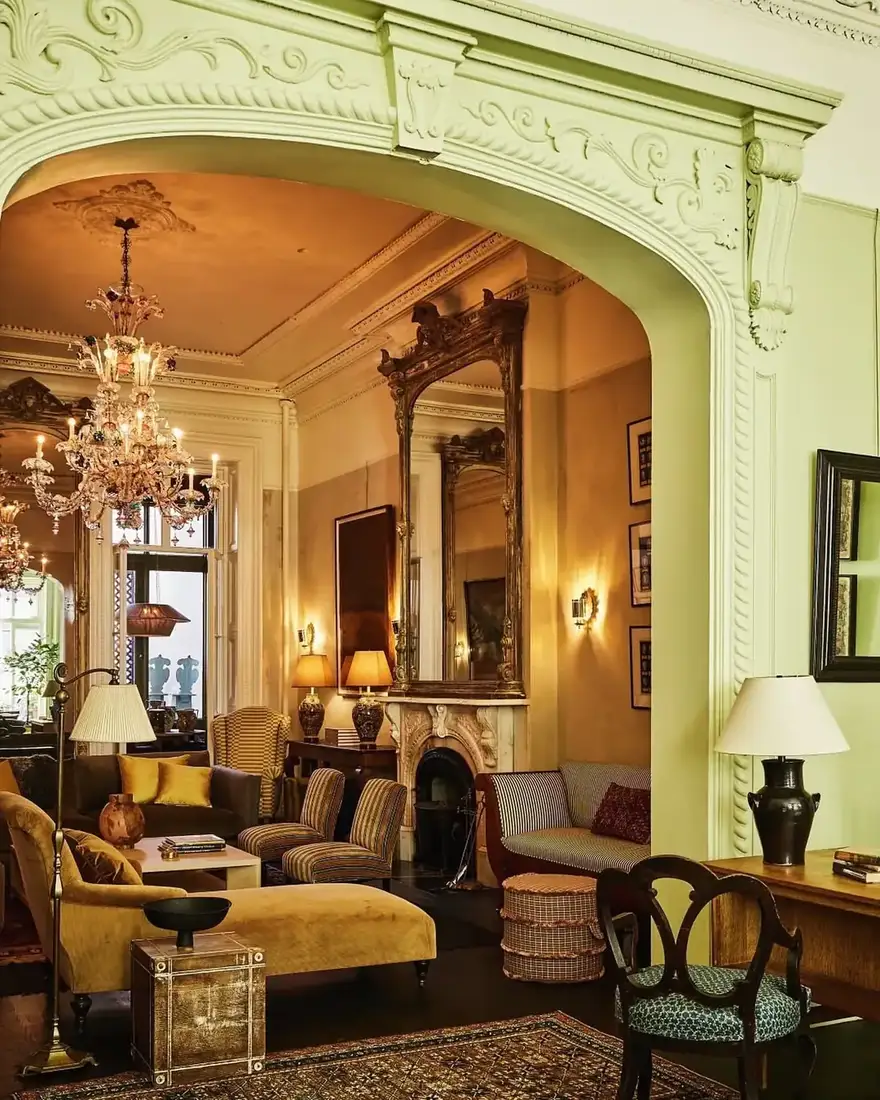
The mirror is the loudest object in that room, louder even than the floral, so everything else negotiates with it. Gilt at that scale reflects lamplight in shards, which adds a glitter the fabric cannot match. The room compensates by keeping the surrounding surfaces plain: a calm wall, a simple mantel line, seating in a single floral. Ornament plus pattern works only when each gets a bodyguard of plain.
Scale keeps the peace. The mirror spans roughly two thirds of the mantel width, the classic proportion that anchors without overhanging. A glass that ran edge to edge would dominate the chimney breast, while a small glass would look lost above your seating. Your mantel shelf holds three objects at most, since gilt plus chintz plus a crowd of china would tip the whole breast into display cabinet territory.
That gilt tone wants warm light to justify it. Cool 4000K bulbs turn gold brassy and flatten the reds in the fabric, while 2700K lamps let both glow for you in the evening. Reproduction gilt mirrors of that presence run £350 to £900 in 2026 on Wayfair or at Dunelm, and mantel-height table lamps run £70 to £160 in 2026. Little Greene French Grey Pale 161 on the breast would calm the gold without greying the floral.
Striped wallpaper that acts as texture
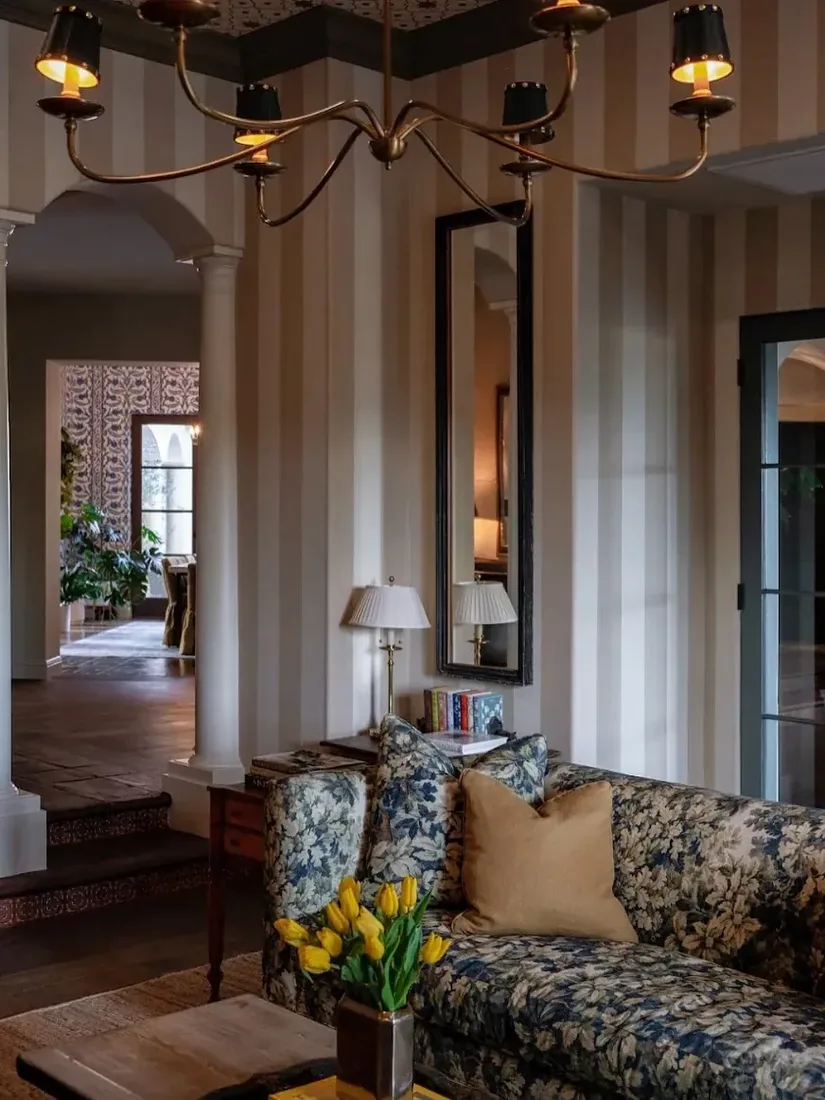
Stripes beside florals succeed because the eye files them under texture, and that wall proves the point. The paper carries a narrow ticking of perhaps 20mm repeat, far below the 150mm blooms on the sofa, so the two never compete for the same attention. Scale separation does the work that colour matching cannot: even a stripe in a contrasting tone would sit quietly at that size difference. You may want the stripe to match the floral, though it only needs to stay small.
The woodwork between them stays plain and pale, which stops the two patterns touching directly. A white or putty skirting of 150mm to 180mm depth draws a clean line around your floor, and the door frames repeat it. Farrow & Ball School House White No.291 on that woodwork would give the warm paper edge the room already shows. Striped papers in this family from Sanderson or Morris & Co run £65 to £130 per roll in 2026, with a 10 metre roll covering roughly 5 square metres.
Your cushions do the bridging here. One cushion picks up the stripe, one picks up the floral ground, and the sofa itself carries the lead motif. Two bridges are enough; a third cushion in a new print would reopen the argument. Cushion covers in GP & J Baker or Linwood prints run £45 to £95 each in 2026.
Wicker chairs that lighten a floral corner
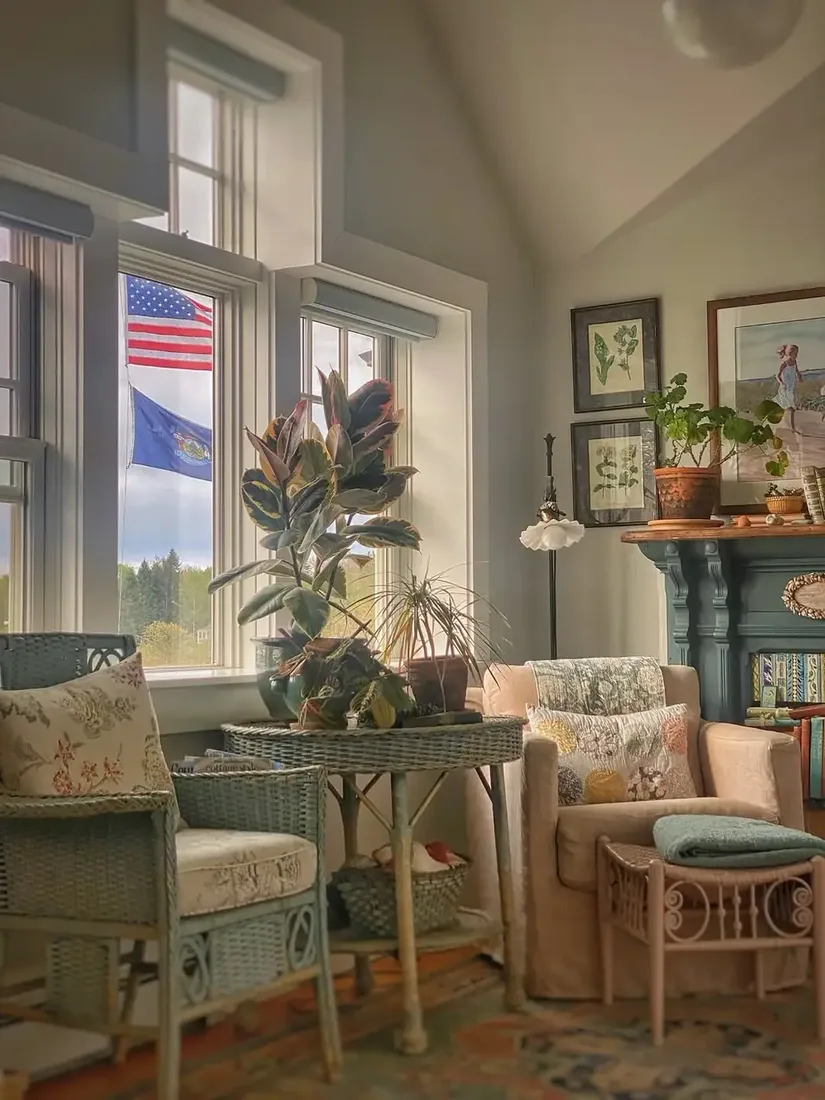
Wicker changes the register of chintz from formal to cottage, which suits a smaller repeat. The open weave lets light through the chair backs, so two chairs occupy less visual weight than one upholstered armchair. That matters beside florals, where every solid surface adds to the sense of fullness you feel on entering. The eye passes through the weave and the corner breathes.
The floral here runs deliberately small, with motifs under 80mm on cushions and a chair pad. Small prints at close quarters stay legible instead of dissolving into noise, which is the reverse of the sofa rule. Seat pads tie with simple strings, the cottage detail that costs nothing and signals the register. A flatweave rug in oat or stone grounds the group, since bare boards plus wicker plus floral would skate too lightly under your feet.
Natural fibre needs protection from the sun a south window sends in. Strong daylight fades chintz unevenly and dries cane until it creaks, so a plain linen blind at your window earns its keep. Rattan conservatory chairs of that sort are £120 to £280 in 2026 at John Lewis or Dunelm. Jute rugs around 160cm by 230cm run £90 to £220 in 2026 from Weaver Green or Armadillo.
| Print ground | Lookalike wall paint | 2.5 litres in 2026 |
|---|---|---|
| Warm putty ground | Farrow & Ball Pointing No.2003 | £55 to £75 |
| Pale blue grey ground | Farrow & Ball Borrowed Light No.235 | £55 to £75 |
| Soft sage ground | Little Greene French Grey Pale 161 | £52 to £70 |
| Deep botanical ground | Farrow & Ball Green Smoke No.47 | £55 to £75 |
Red floral that demands the most restraint
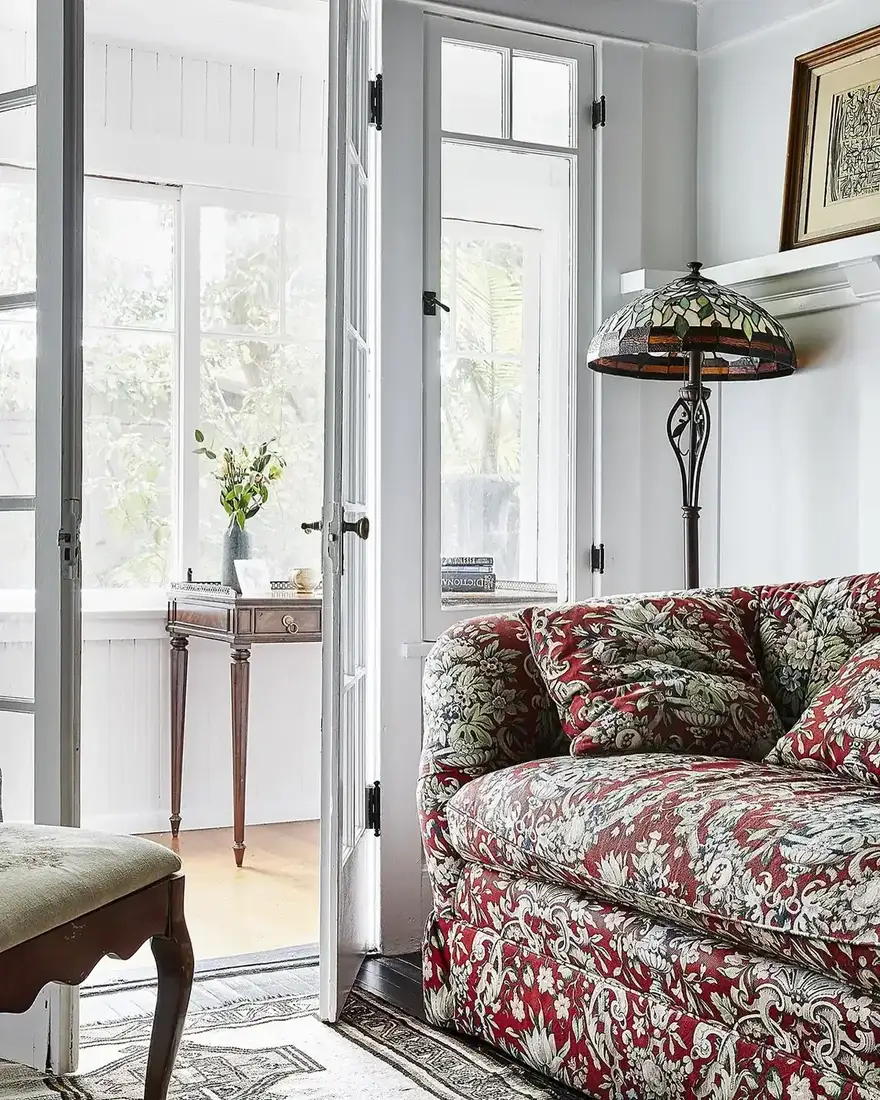
Red grounds ask the most discipline of any chintz, because the colour advances toward the viewer while the pattern also moves. That sofa meets you from across the threshold, which is exactly the effect to plan around rather than fight. Walls stay pale, curtains stay plain, and the floor keeps to one calm texture. The red then reads as generosity instead of noise.
The background principle matters most here. A red floral usually sits on a cream or putty ground, and that ground colour should supply the walls, not the red. Matching walls to the bloom doubles the reddest square metres in your room, while matching the ground lets the sofa float on a related calm. Woodwork a half tone deeper than your walls frames the paleness without introducing a new hue. Farrow & Ball Wimborne White No.264 on walls with Pointing No.2003 on skirting would get you close.
Texture balance completes the restraint. Small amounts of leather and aged timber sit around the sofa, each matte or aged, never polished, so nothing outshines the fabric. A red floral beside chrome would argue with you all evening. Wool throws in oat tones run £60 to £150 in 2026 at John Lewis, and a plain wool rug near 200cm by 290cm runs £250 to £600 in 2026.
Frequently Asked Questions
Can a small room take chintz at all?
It can, if the repeat shrinks with the footprint. Keep the largest blooms under 80mm, confine the motif to cushions and one chair, and leave walls and curtains plain so your eye has somewhere to rest.
How do stripes help a floral scheme?
A narrow ticking reads as texture from across the room, so it adds rhythm without adding imagery. Keep the stripe repeat well below the largest bloom and let cushions link the two.
Which paint should sit beside a busy print?
The background tone of the fabric, not its brightest flower. Take the putty, cream or pale grey behind the motif onto your walls and woodwork, going a half tone deeper on skirting for definition.
Does every floral need gilt or antiques nearby?
No, and the cottage rooms here prove it. Wicker, plain oak and jute sit happily with small prints, while gilt suits the formal large-repeat rooms with higher ceilings.
What lamp colour flatters chintz after dark?
If you lamp a chintz room, choose warm bulbs near 2700K, since they deepen reds and creams the way daylight cannot. Cool white light turns gold brassy and makes botanical greens look flat.
Where should money go first in a chintz room?
The lead fabric and full-length curtains, because they cover your largest square metres. Frames and shades can follow from high street suppliers, with secondhand timber beside them, without harming the result.
In order
- Choose the lead floral first, with blooms of 150mm or more for your sofa.
- Pull wall and woodwork colour from the print background, not the bloom.
- Keep companions plain or narrowly striped, with no second floral at middle scale.
- Hang curtain rods 150mm above your frames and size hems to clear the floor by 10mm.
- Light with 2700K lamps in 300mm shades so reds and gilt glow after dark.
- Confine small prints to cushions and shades where the repeat stays legible.
- Leave one surface in every sightline completely plain for your eye to rest.
This article may contain affiliate links. We may earn a commission at no extra cost to you.