15 Window Seat and Reading Nook Ideas: A Chair, a Lamp, a Surface

Add us as a preferred source to see more stories on Google.
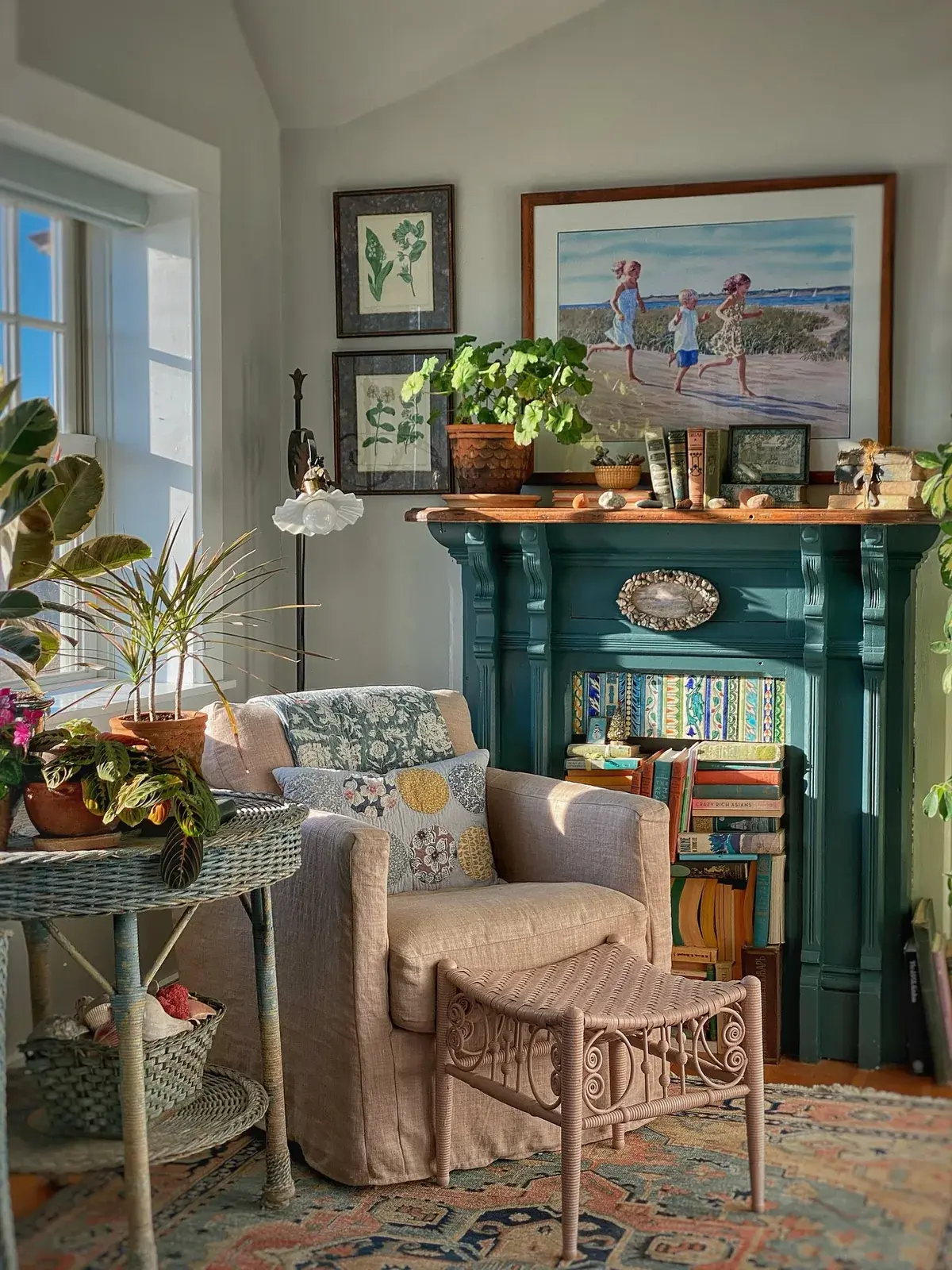
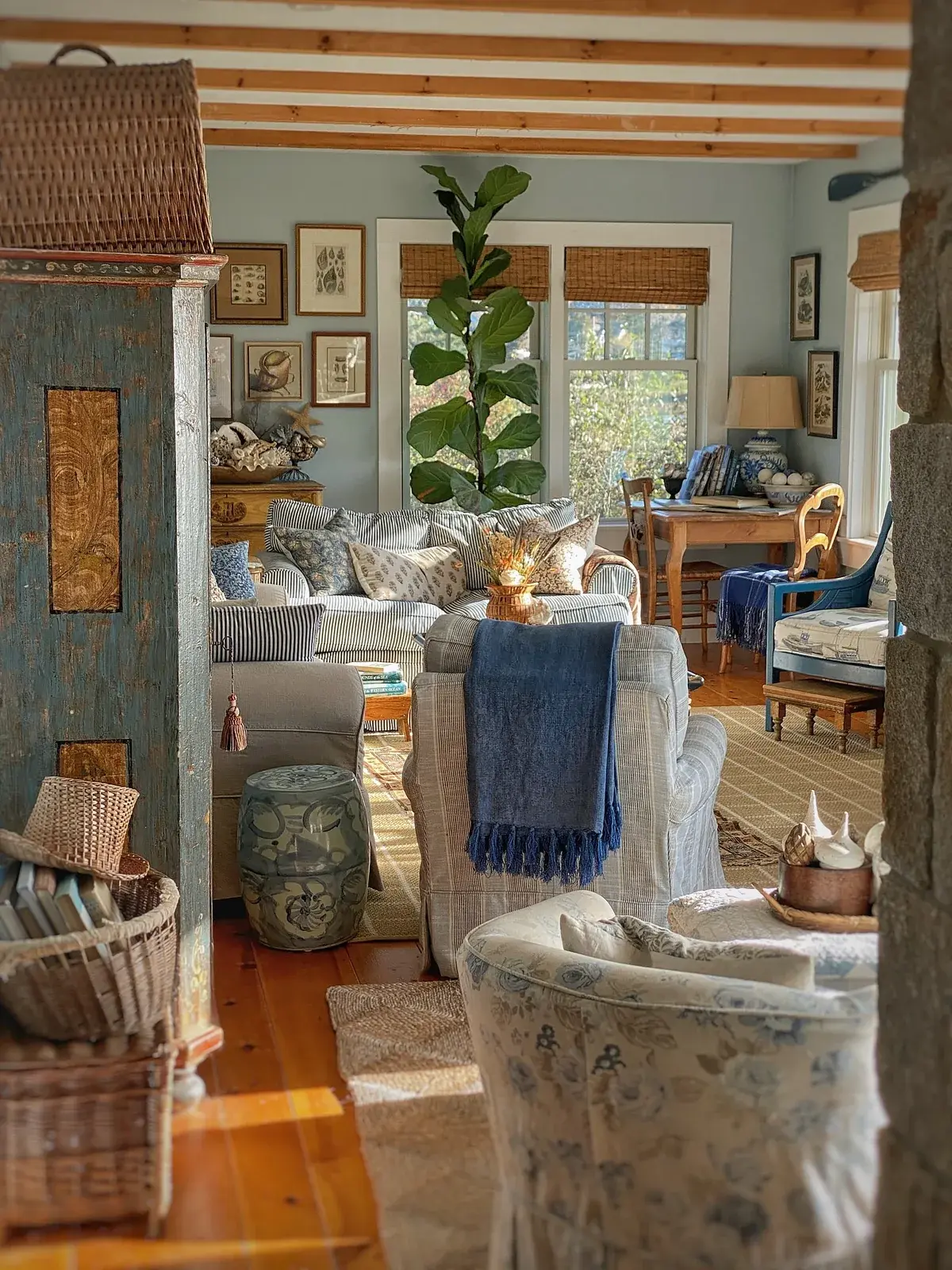
There is no window seat in the corner below. There is a chair.
A slipcovered armchair beside a window, a wicker footstool in front of it, a floor lamp behind one shoulder, and a wicker table within reach. That is the entire arrangement, and it cost a fraction of building anything in.
Window seats are lovely and they are joinery, which means a joiner, a quote and a wait. Most people who want a reading nook want somewhere comfortable to read, and a corner gives them that this afternoon.
The light, which is the whole thing
Behind you and slightly to one side, at roughly the height of your shoulder when seated.
From there the light falls onto the page and your body casts no shadow on it. From overhead, your own head shades the book. From in front, the lamp is in your eyes and the page is lit from the wrong side.
That is it, and it is the reason most nooks quietly stop being used: the chair is comfortable, the light is wrong, and nobody works out why they keep reading in bed instead.
A floor lamp with an adjustable arm, or a swing-arm wall light, both solve it. A table lamp works if the table is tall enough, which most side tables are not; the bottom of the shade wants to be above shoulder height.
Warm, 2700K, and bright enough to actually read by. This is the one place in a sitting room where a dim atmospheric bulb is the wrong choice.
The chair
Higher and firmer than a sofa. Reading is done sitting up, and a deep soft chair pitches you backwards into a position that is comfortable for twenty minutes and uncomfortable for an hour.
Arms matter more than people expect, because that is where your elbows go. A chair with low or splayed arms leaves you holding a book unsupported.
A footstool rather than a recliner. It costs less, it takes less space, and you can push it away when somebody else wants to sit down.
Books in a disused fireplace
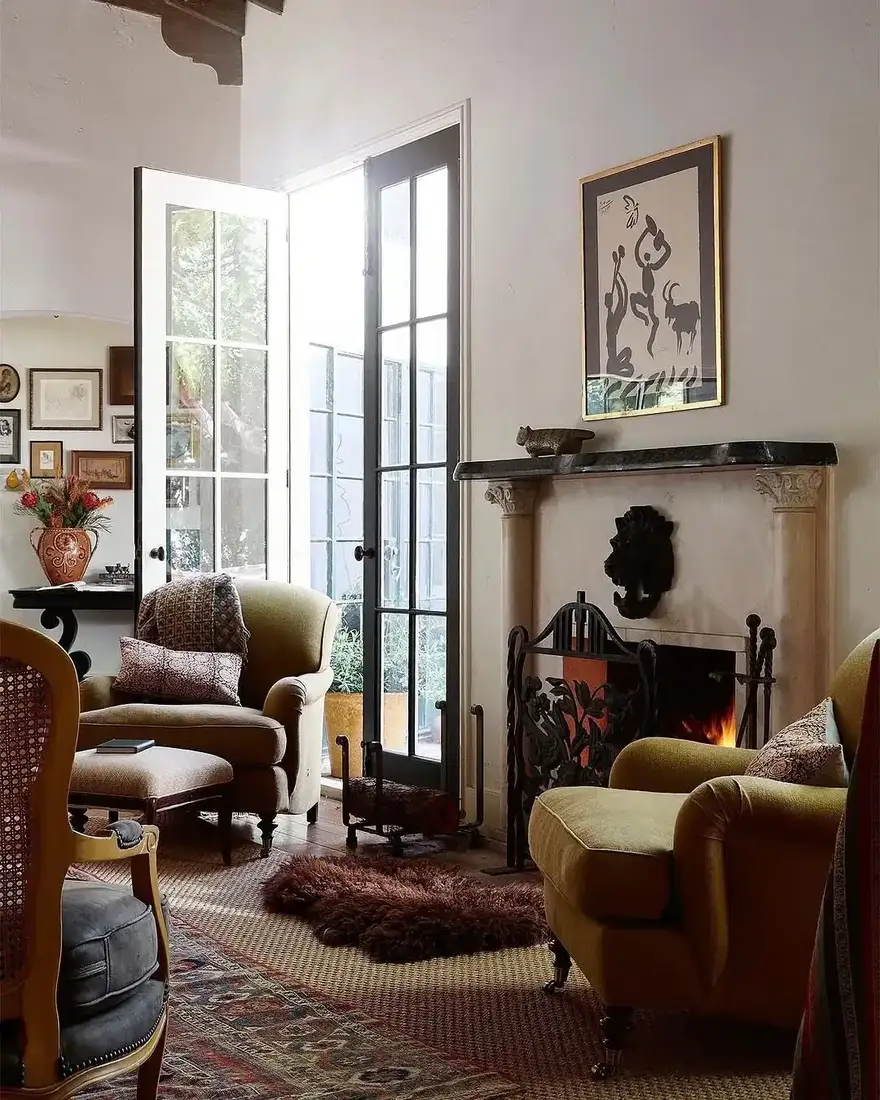
Look at what is in the opening in that photograph. Stacked books, spines out, filling it completely.
A disused fireplace is dead space in an enormous number of houses, and the usual solutions are a fake fire, a basket of logs nobody burns, or a black hole. Books fill it, use it, and look considerably better than any of those.
Two conditions. The flue needs to be either properly capped at the top and ventilated at the bottom, or genuinely open; a sealed unventilated flue develops damp and the books will find it. And if the flue is open, expect soot, so this suits a capped chimney rather than a working one.
The opening behind those books is lined in patterned paper, which is a nice touch and completely optional.
What it costs
| Item | Premium | Mid | Budget |
|---|---|---|---|
| Armchair | Howard Chairs, George Smith, £2,000+ | Loaf, Sofa.com, £700 to £1,400 | Secondhand, reupholstered, £200 to £500 |
| Floor lamp, adjustable | Original BTC, Anglepoise, £250+ | Pooky, Industville, £90 to £180 | IKEA RANARP or similar, £35 to £60 |
| Footstool | £300+ | £100 to £200 | Wicker or vintage, £20 to £60 |
| Side table | £200+ | £60 to £150 | Any small table you already own |
The lamp is the one worth money, because it is doing the job. A £45 adjustable floor lamp in the right position beats a £300 one in the wrong one, and an old chair recovered beats a new chair of the same price.
Where to put it
Corners, and specifically corners that are already slightly out of the traffic route.
A nook in a walkway is a chair people edge past. A nook in a corner, angled towards the room rather than facing the wall, is somewhere you can sit without feeling either exposed or banished.
Near a window is pleasant and not essential. A north-facing corner with a good lamp is a better reading spot than a sunny window with glare on the page.
Where a window seat does earn its place
Deep bays, where the recess is otherwise unusable, and rooms short of floor space, where seating that takes no floor is genuinely valuable.
There, the things to get right are depth of at least 500mm, a cushion of at least 100mm on a proper foam rather than a thin pad, and storage underneath that opens from the front rather than the top, because a lift-up seat is one you have to clear before you can open it.
The window seat with somewhere for the back
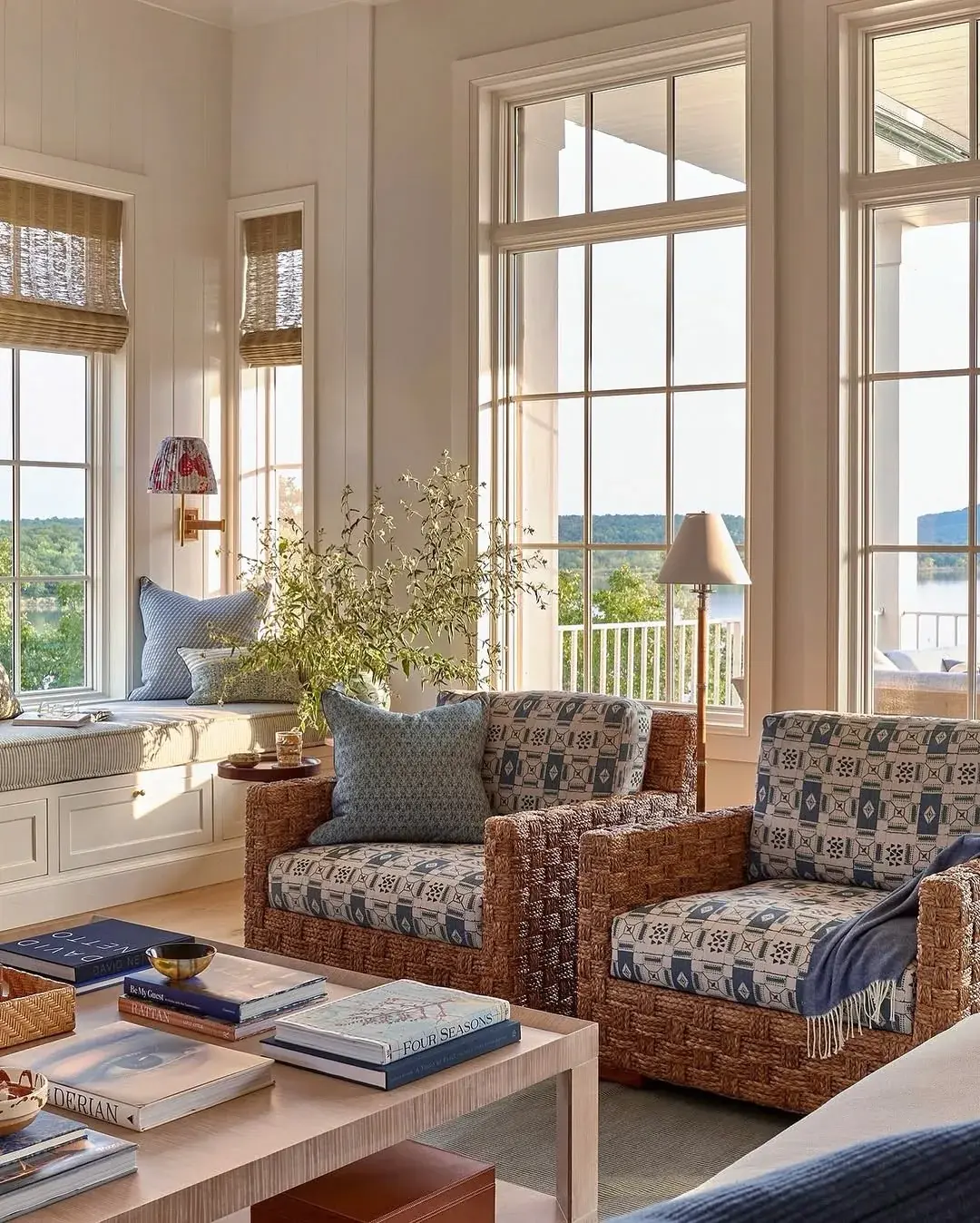
The principle here is that a flat wall never supported anyone. The eye sees a long window seat under low windows, and the reason it looks usable is the row of loose back cushions bringing the sitter forward off the glass.
In this image the base cushion is striped cotton, the backs are a blue block print, and the timber base below carries cupboards with small brass pulls. That combination matters because the seat can be deep enough to curl sideways while the backs return the sitting depth to something upright. Short.
A seat without backs invites perching. A seat with a full row of firm backs invites an hour, which is why joiners who build these without allowing for the thickness of the backs always produce a perch.
The rattan chairs opposite show the same idea in miniature. Their backs are high, their upholstery is patterned cotton in indigo, and the floor lamp behind one of them puts light over a shoulder after dark. Rattan armchairs of that type run £250 to £600 each in 2026, with Pooky linen shades from £90 to £180 in 2026 for the lamp beside them.
The olive chair that faces the garden doors
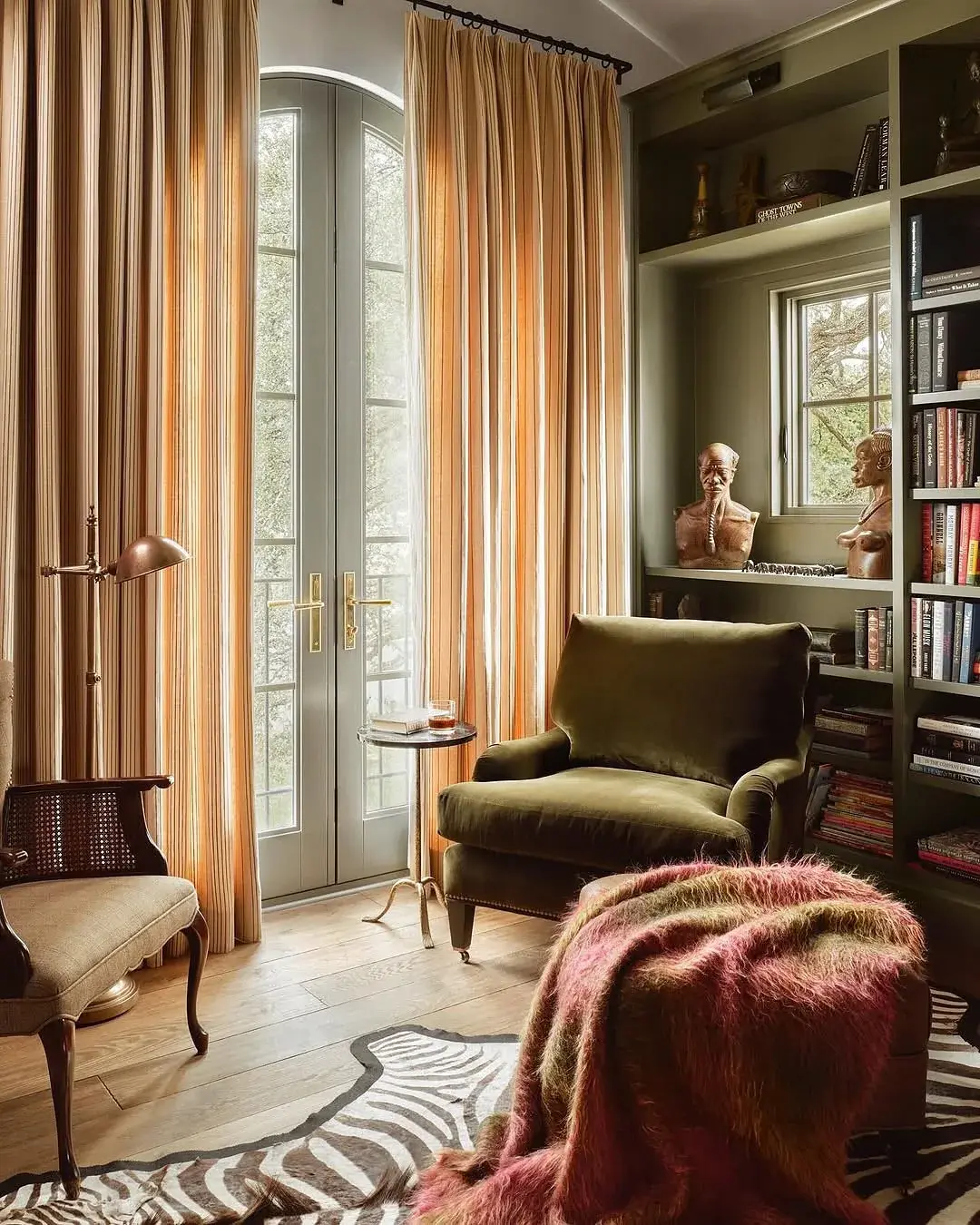
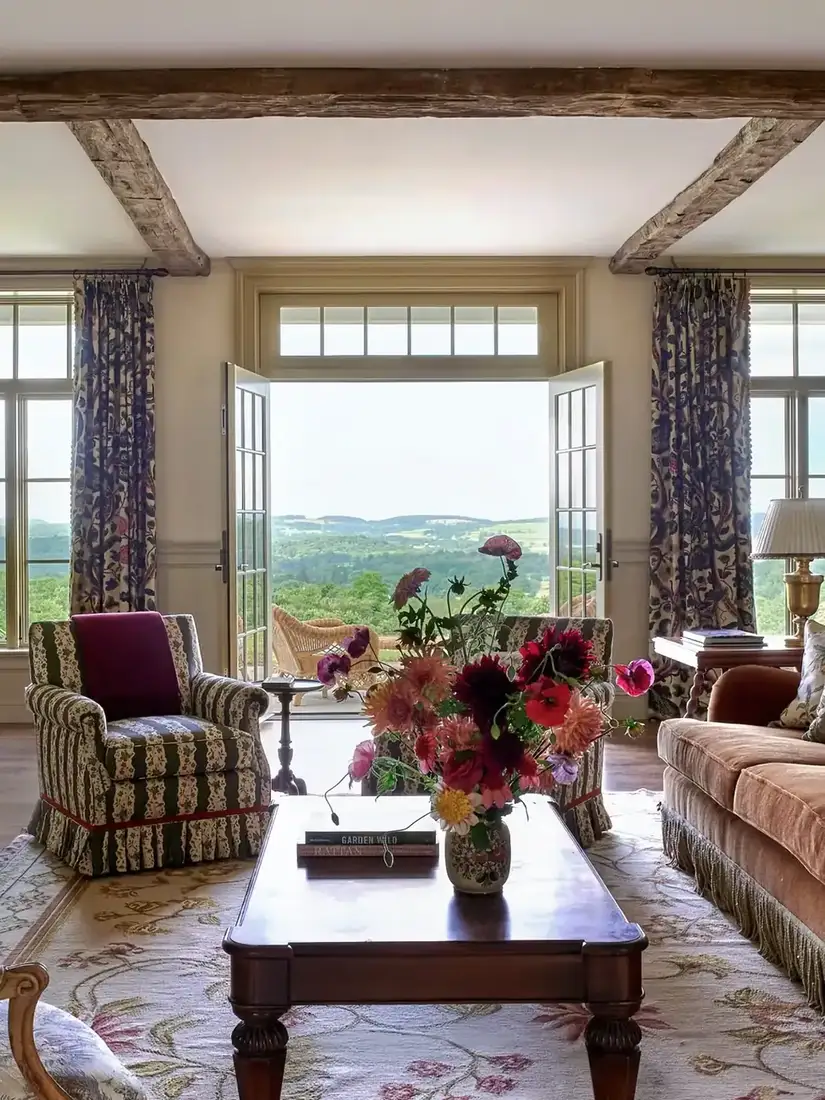
Proportion decides this corner, because the chair is generous but the space around it is tight. The olive velvet armchair sits close to tall French doors, flanked by full length striped curtains that enclose the side without closing the light.
The small round table is the detail that makes it function. It holds a book and a glass within a forearm reach, so the sitter never has to stand, and the brass pharmacy lamp behind the other chair throws a pool of warm light from above shoulder height. That lamp position is doing more work than the daylight, because daylight leaves at four in winter.
Velvet reads luxurious and behaves practically if the colour is mid depth. Olive hides wear, which cream never does, and a cotton velvet from John Lewis or Lewis and Wood runs £45 to £95 per metre in 2026, with reupholstery of a chair of this size at £600 to £1,200 in 2026. The pink mohair throw on the stool will shed, and that is the correct throw to own because it can be shaken outside.
The patterned chair between the shelves
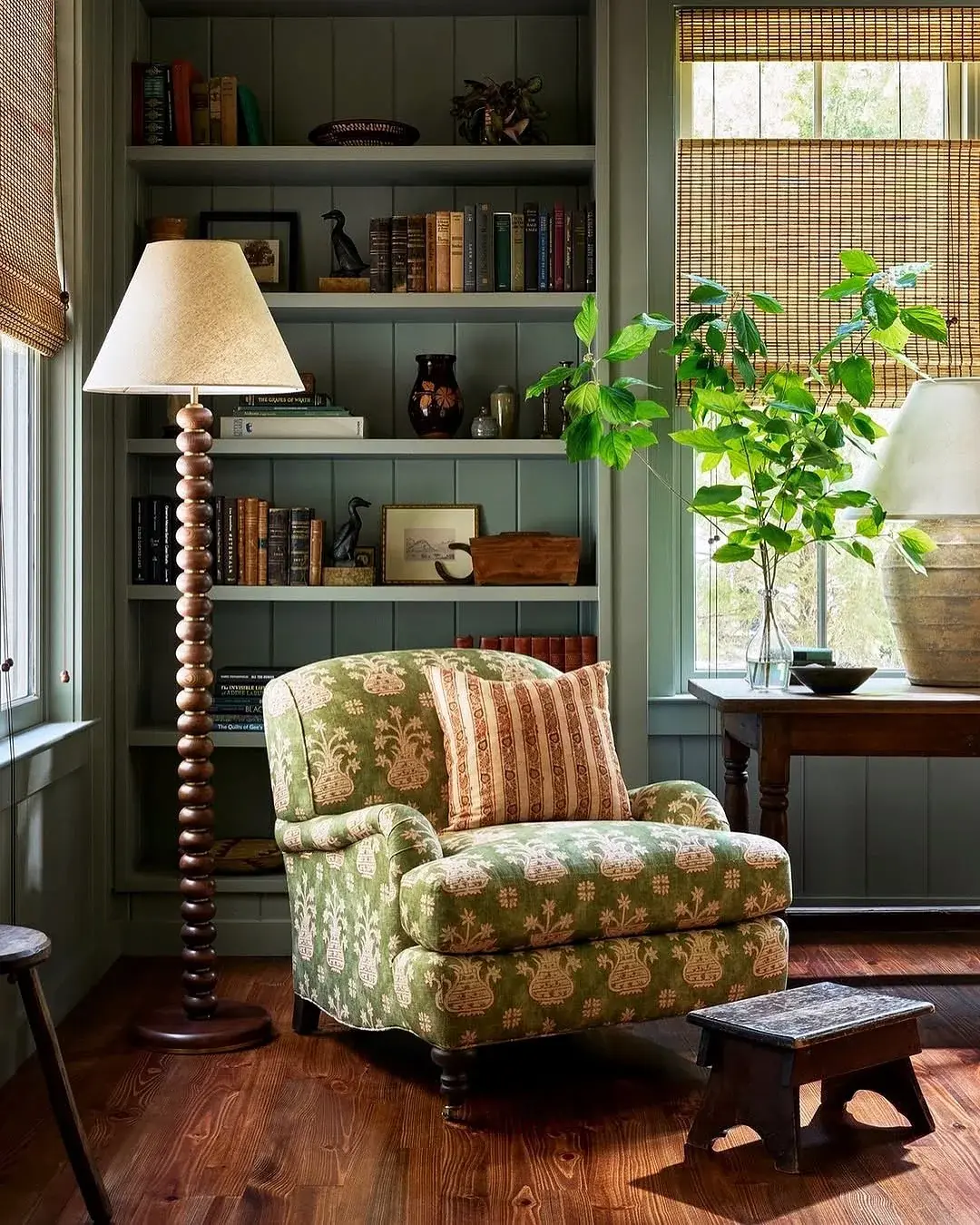
The room is the subject here, not the chair alone, because the sage painted shelves wrap two sides and give the sitter the shelter a corner usually provides. The eye settles first on the tall bobbin lamp, which is the tallest vertical in the frame, and then drops to the floral armchair tucked beneath the shelves.
That lamp placement is exact. It stands to the left and slightly behind the chair, with a natural linen shade at head height, so the light arrives over one shoulder and the shade itself never enters the eyeline. A similar turned timber floor lamp costs £180 to £420 in 2026, with High Street copies in bamboo and ash from £90 to £160 in 2026.
The chair upholstery is doing quiet work. A green ground with a cream motif hides fading near glass, which a plain linen never does, and the rust stripe cushion gives lumbar support where the chair back curves away. Farrow and Ball French Gray No.18 or Little Greene Aquamarine Mid 284 get close to that shelf colour, at £52 to £68 for 2.5 litres in 2026.
The chair that watches the water
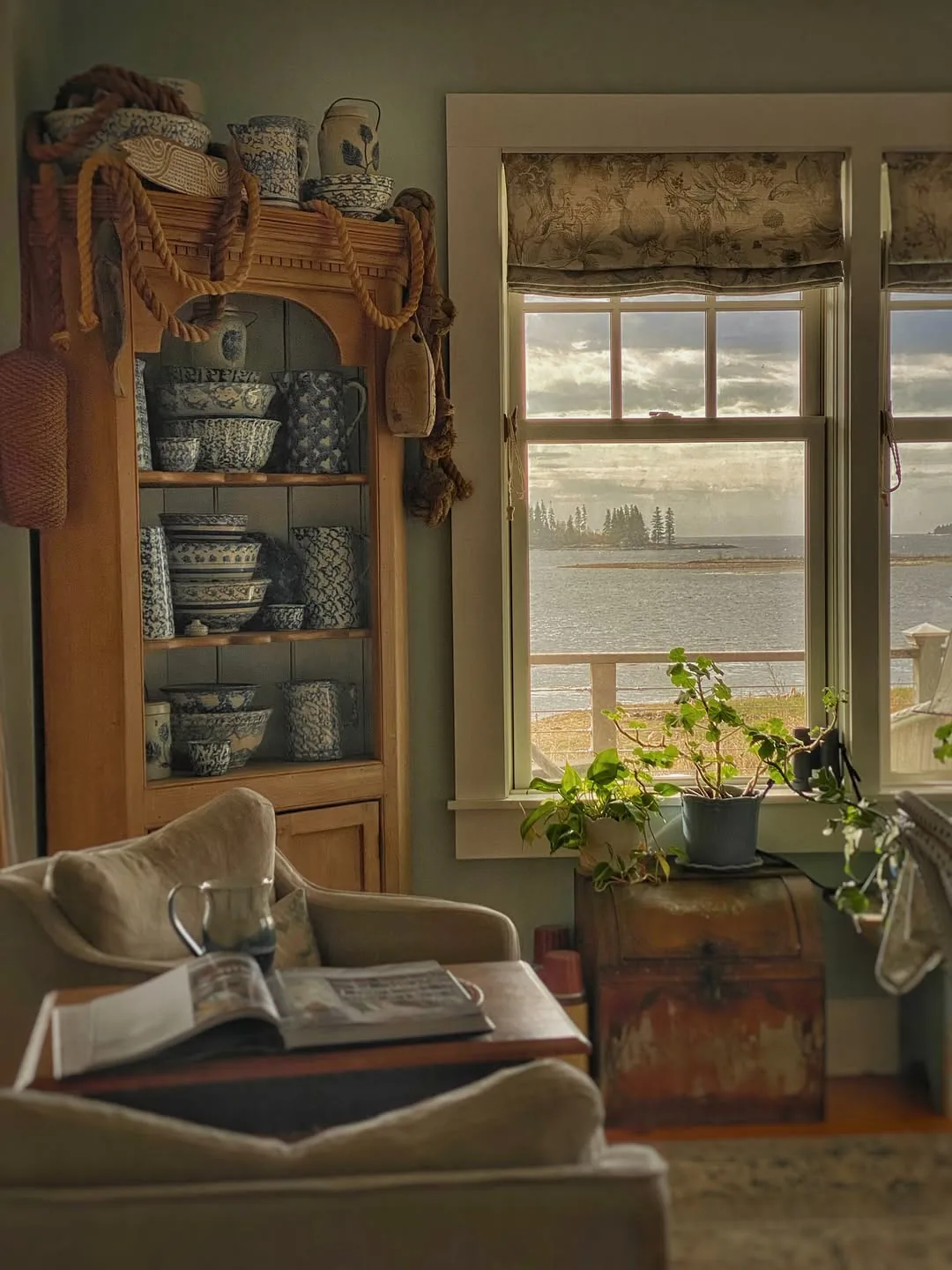
Light direction is the argument in this photograph, because the window faces the sea and the chair faces sideways to it. The sitter gets brightness on the page without glare on it, which facing the glass head on never allows.
Pictured is a deep beige armchair with a hinged reading tray across the arms, holding an open illustrated book. That tray is the side table in another form, and it works because it removes the lean and the stand that break concentration. Lap trays in oak or walnut run £30 to £75 in 2026, with Nkuku mango wood versions near the top of that band.
The pine dresser beside the window holds blue and white bowls, rope, and buoys, which tell the coastal story without asking the seat to do it. The old trunk under the sill carries plants and candles, and a trunk of that age with flaking paint sells for £120 to £300 in 2026. The blind is a small floral roman, half raised, which softens the top of the glass while leaving the view intact.
The pair of loungers that share the daylight
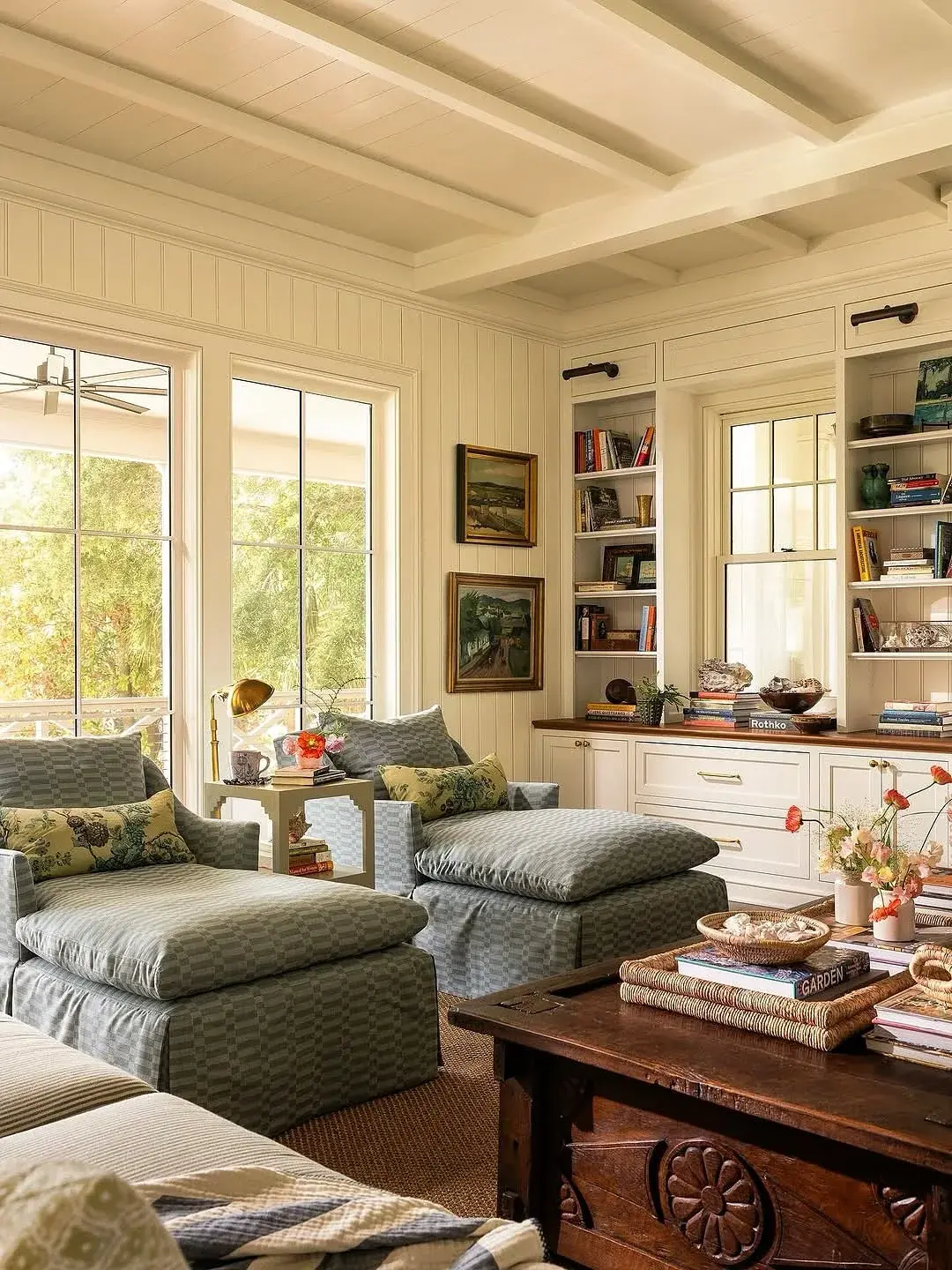
Scale is what makes two loungers work where one armchair would look lost. The room is wide, panelled, and beamed, so a single small chair would read as an afterthought, while two deep chaises with a shared side table read as intentional.
Each chaise is essentially a daybed cut in half. The base is deep enough for legs to stretch, the back is low, and the large floral lumbar pillow supplies the upright support the low back withholds. That split is comfortable because the body can shift between reclining and sitting without leaving the seat, which a fixed upright chair never permits.
The side table between them carries a brass reading lamp, a mug, and flowers, all within reach of either sitter. Brass pharmacy lamps of that shape cost £110 to £260 in 2026, with Industville aged brass versions near the middle of the band. The bookcases around the inner window give the storage, with cupboards below for throws, so the seats themselves stay clear.
The white seat in full afternoon sun
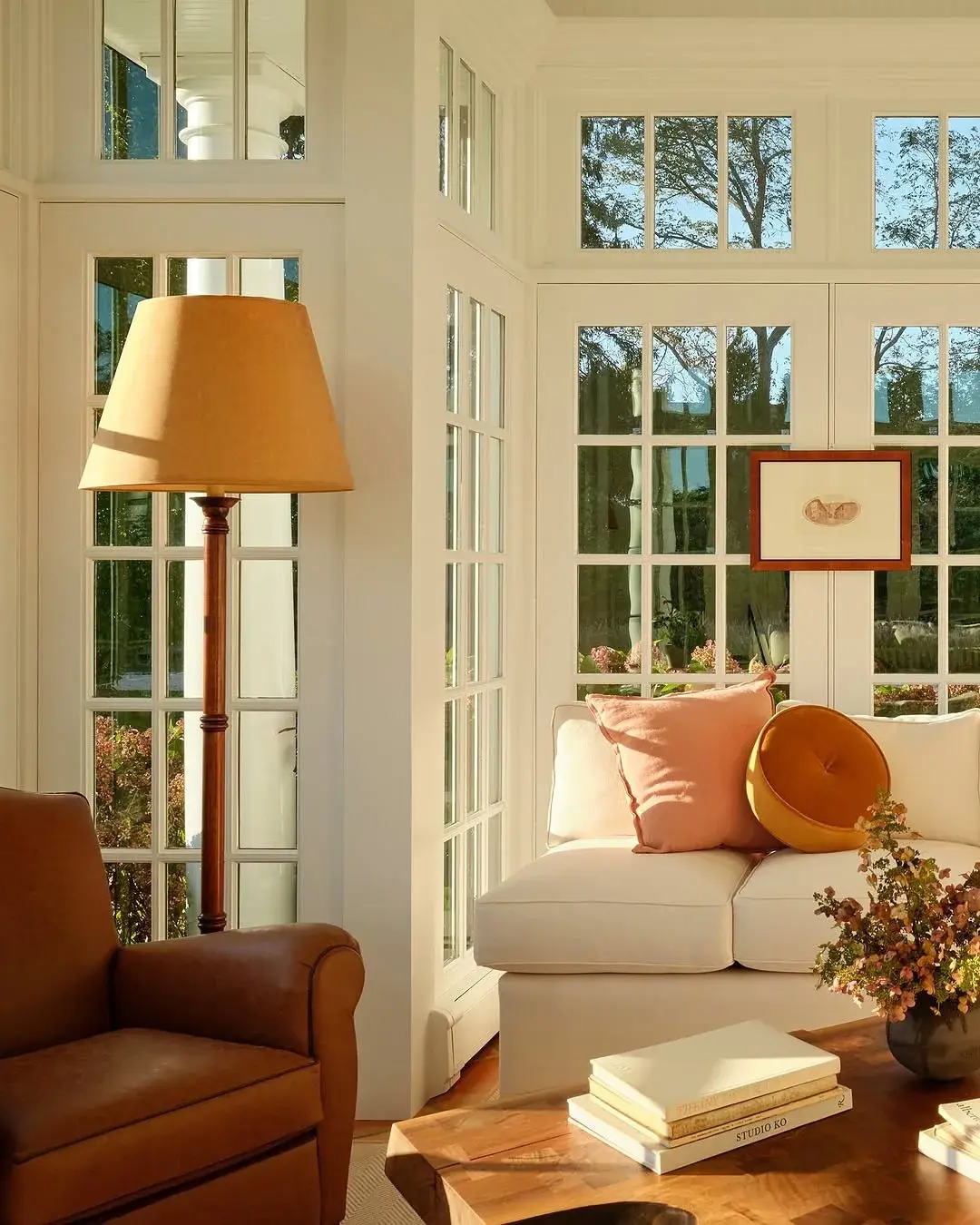
The problem with a glass corner is not lack of light but excess of it. The white window seat below sits between French doors on two sides, and at midday the sun lands directly on the cushions, which is why the blush and ochre pillows look pale in the photograph.
Cushion thickness rescues it as a seat. The base looks deep and tightly upholstered, the loose backs are plump enough to lean against timber mullions without feeling them, and the leather armchair alongside gives the alternative for evenings when the glass goes dark. Leather chairs of that shape, secondhand and polished, run £300 to £800 in 2026.
After dark the tall timber floor lamp takes over, standing behind the leather chair with a cream shade that throws warm light sideways across both seats. Floor lamps with solid timber stems cost £140 to £320 in 2026, with Pooky and Vaughan Glasshouse versions at the upper end of that range, and the shade wants to sit clear of the eyeline.
The slipcovered corner that forgives
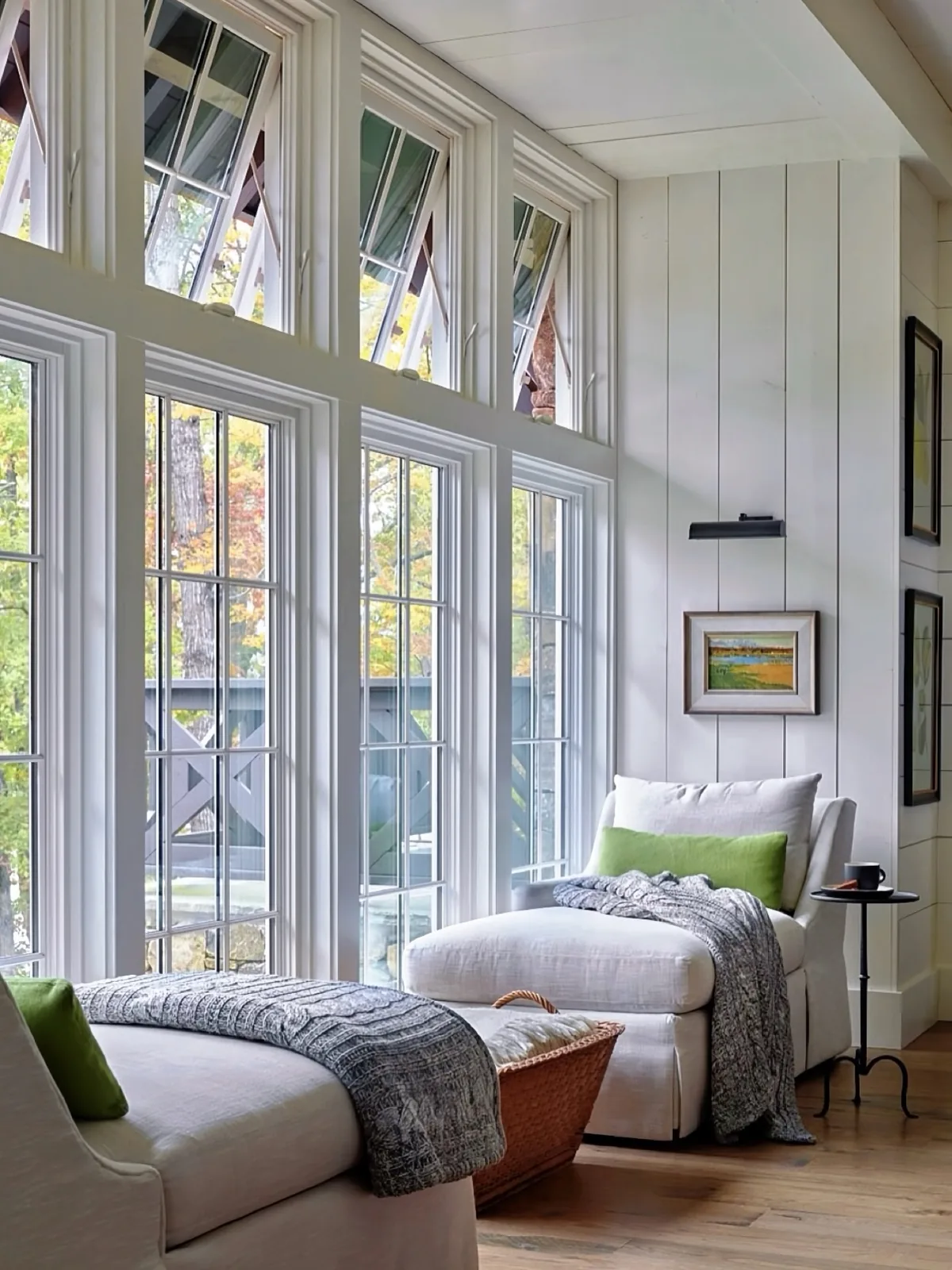
Washability is the principle that decides whether white seating survives a household. The two chaises in this image are slipcovered, which means the covers can be removed and laundered, and the green lumbar cushions are the only saturated colour in the frame.
That green matters visually because white on white without a contrasting note reads as unfinished. The eye goes first to the apple green rectangle, which anchors both chaises, and then to the grey knit throws folded over the seats. Throws in lambswool or a wool blend run £60 to £140 in 2026, with The White Company brushed versions near the top.
The wicker basket between the chaises holds a folded sheepskin, which is storage in its simplest form. Baskets of that size in rattan or seagrass cost £25 to £60 in 2026, and they keep the spare layer where it is needed. The small black iron side table carries a mug, close enough to reach without shifting the legs.
The same corner read for its wall light
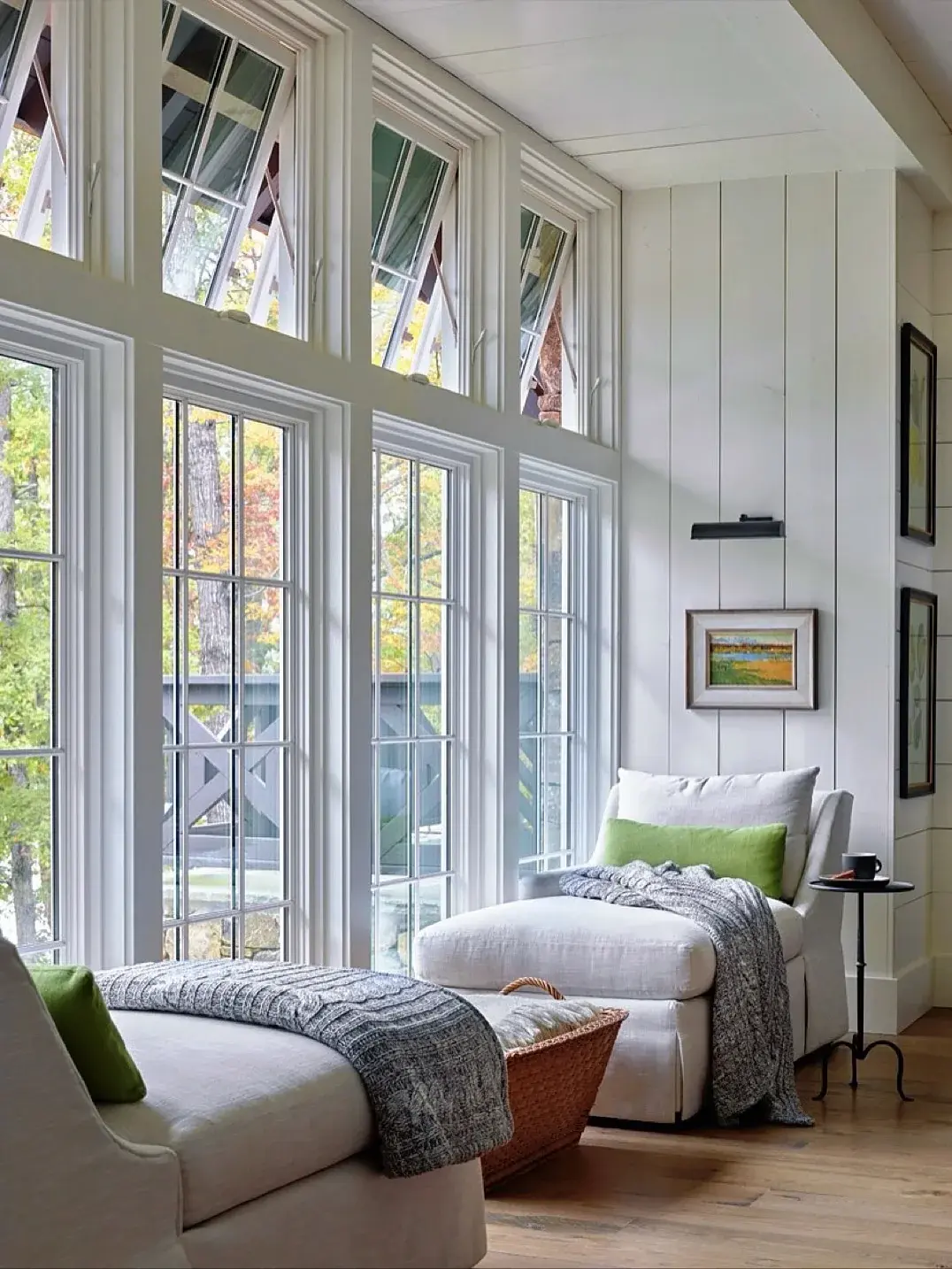
From this tighter crop the wall above the chaise carries the interest. A small gilt landscape hangs under a black picture light on white tongue and groove, flanked by tall divided windows with the top sashes tilted open.
Daylight does the work until evening, arriving from the left across the page, while the picture light is strictly for atmosphere. That separation is correct, because a picture light never reads by, and conflating the two leaves both jobs half done. Battery picture lights in black metal run £40 to £110 in 2026, with Holloways wired versions from £120 in 2026.
The seat itself shows why a chaise suits a window wall. Legs extend, the back stays upright against the end cushion, and the grey throw breaks the expanse of white upholstery that would otherwise glare in sun. The autumn trees outside give moving colour without entering the room, which is the gentlest form of decoration available.
The daybed set in a dark timber bay
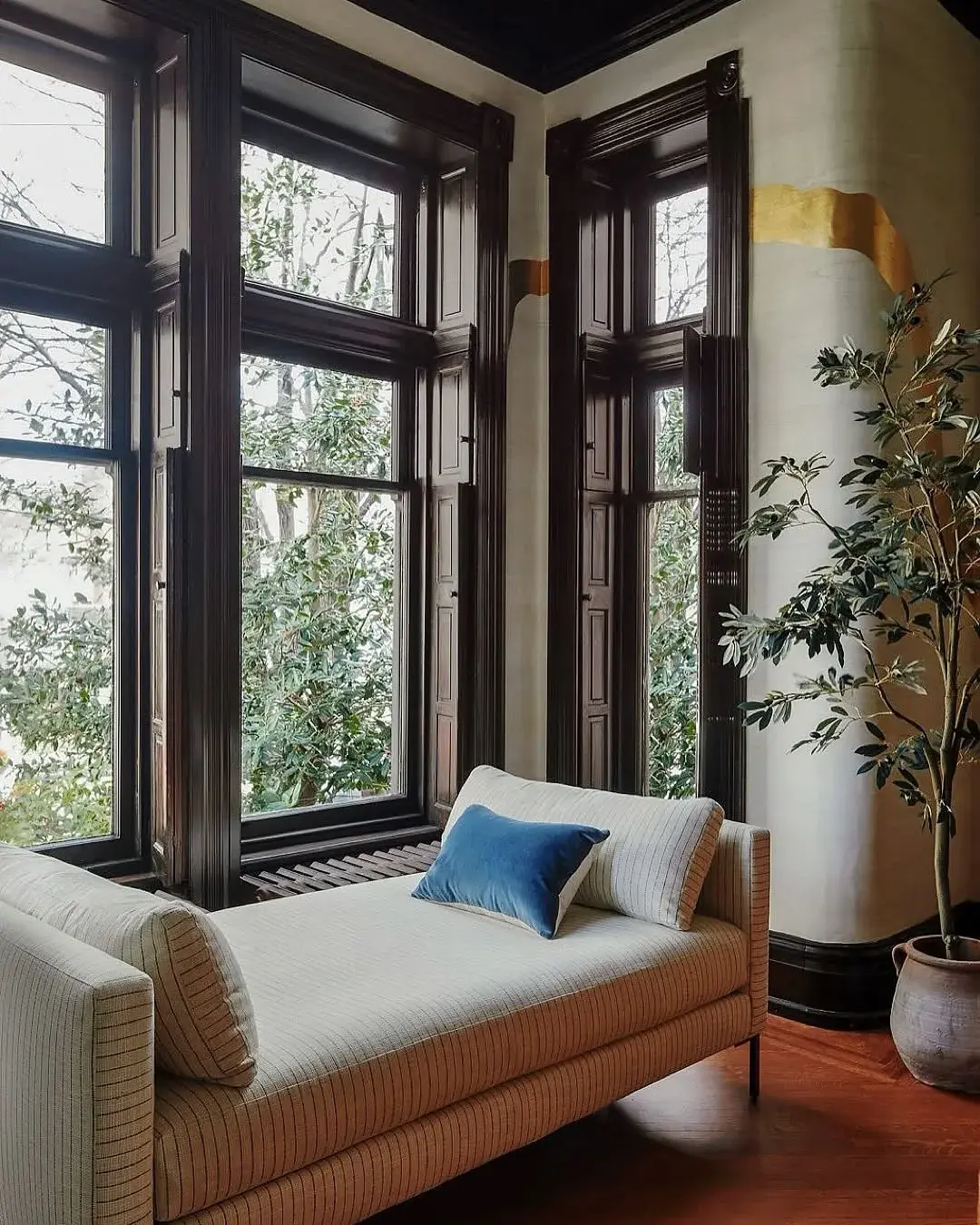
Enclosure comes from the architecture here, because the daybed sits in a bay framed in near black timber with shutters folded back. The contrast between the dark frame and the pale striped upholstery is what makes the seat read as shelter.
The blue velvet cushion works as back support, placed where the lumbar curve meets the bolster, and without it the sitter would be leaning against a flat bolster that pushes the spine upright without filling its curve. Cushions in cotton velvet run £35 to £85 in 2026, with William Yeoward and Claremont versions above that band.
Light arrives from three sides through the bay, which flatters the plaster walls and keeps the dark timber from feeling heavy. A seat in that much glass needs the mattress to be firm, because softness plus sun induces sleep instead of reading, and daybed mattresses in firm reflex foam with a cotton tick run £200 to £450 in 2026.
The wing chair against black glass
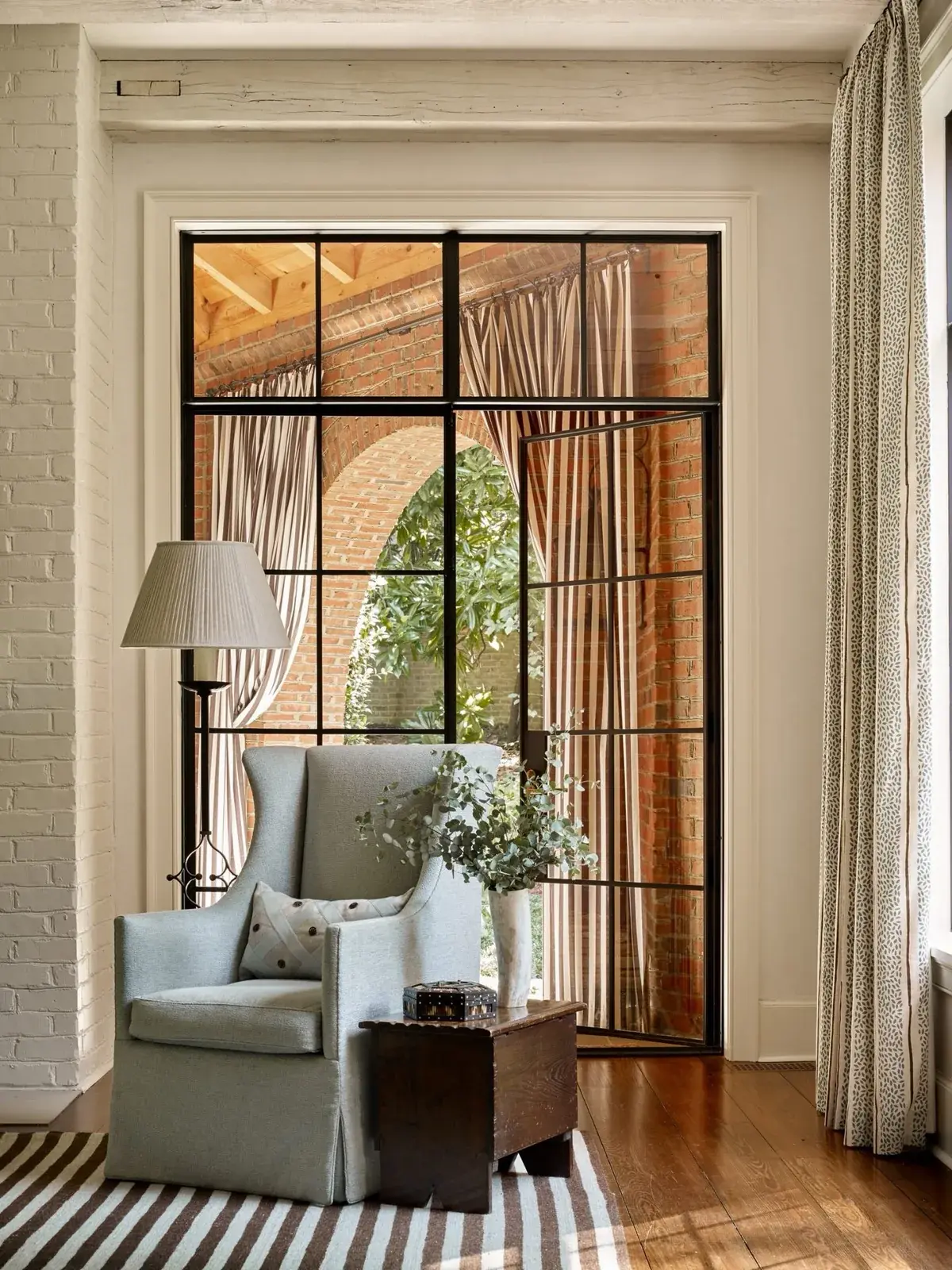
A wing chair creates its own three sides, which is why it works in front of glass where there is no corner to borrow. The high back and cheeks cut peripheral movement, so the sitter feels held even though the steel windows behind are entirely open to a brick loggia.
The spotted lumbar cushion repeats the support logic. The chair back is tall and flat, the cushion fills the gap behind the lower back, and the seat stays usable for an hour because the spine is not doing the work. Wing chairs in linen union run £800 to £1,800 in 2026, with Soane and George Smith showroom pieces above that level.
Beside it stands a black floor lamp with a pleated shade, and the dark timber box that serves as a table holds a vetiver vase and a small patterned box. That box table is exactly the right height for a hand to find without looking, and boxes of that type in stained oak sell for £80 to £200 in 2026. The striped rug declares the zone on dark timber.
The pine seat beside the old cupboard
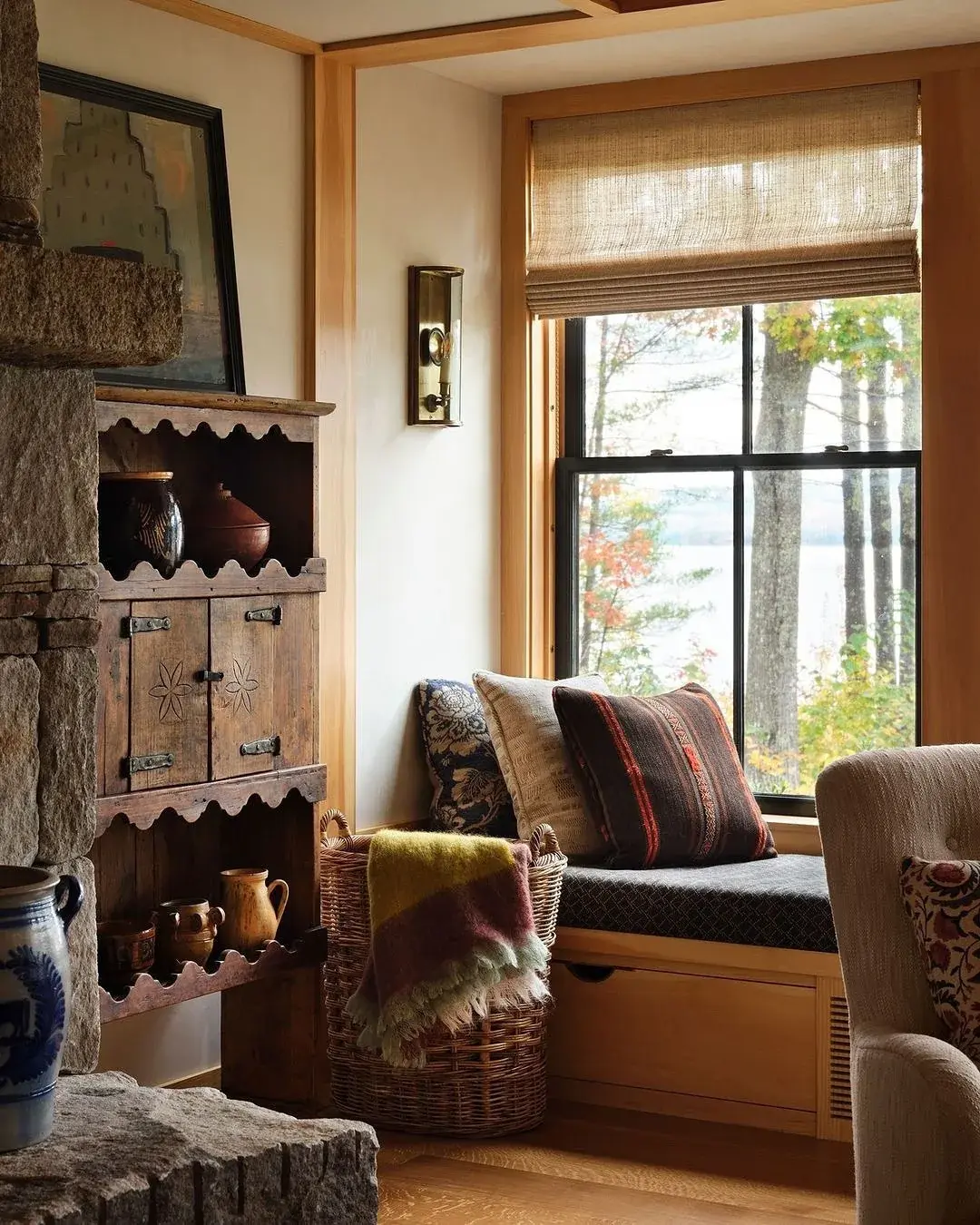
Layering is the method on this pine window seat, because the base is a dark quilted pad and the backs are three different patterned cushions in rust, cream, and indigo. No single cushion has to do all the work, which is why the seat looks comfortable from across the room.
Above the seat a brass sconce on a mirror plate throws light down and sideways over the reading shoulder. That position is the evening equivalent of the daylight from the window opposite, and it runs on its own switch so the corner can stay lit while the room goes dim. Sconces of that type from Jim Lawrence or Vaughan run £90 to £240 in 2026.
The antique cupboard to the left, with scalloped shelves and iron hinges, holds stoneware that never moves, while the wicker basket in front holds the throw that moves daily. Woven wood blinds soften the top of the black window, with made to measure versions from Blinds 2go at £60 to £140 in 2026, and the drawer below the seat opens from the front on a cutout pull.
The banquette that looks at the sea
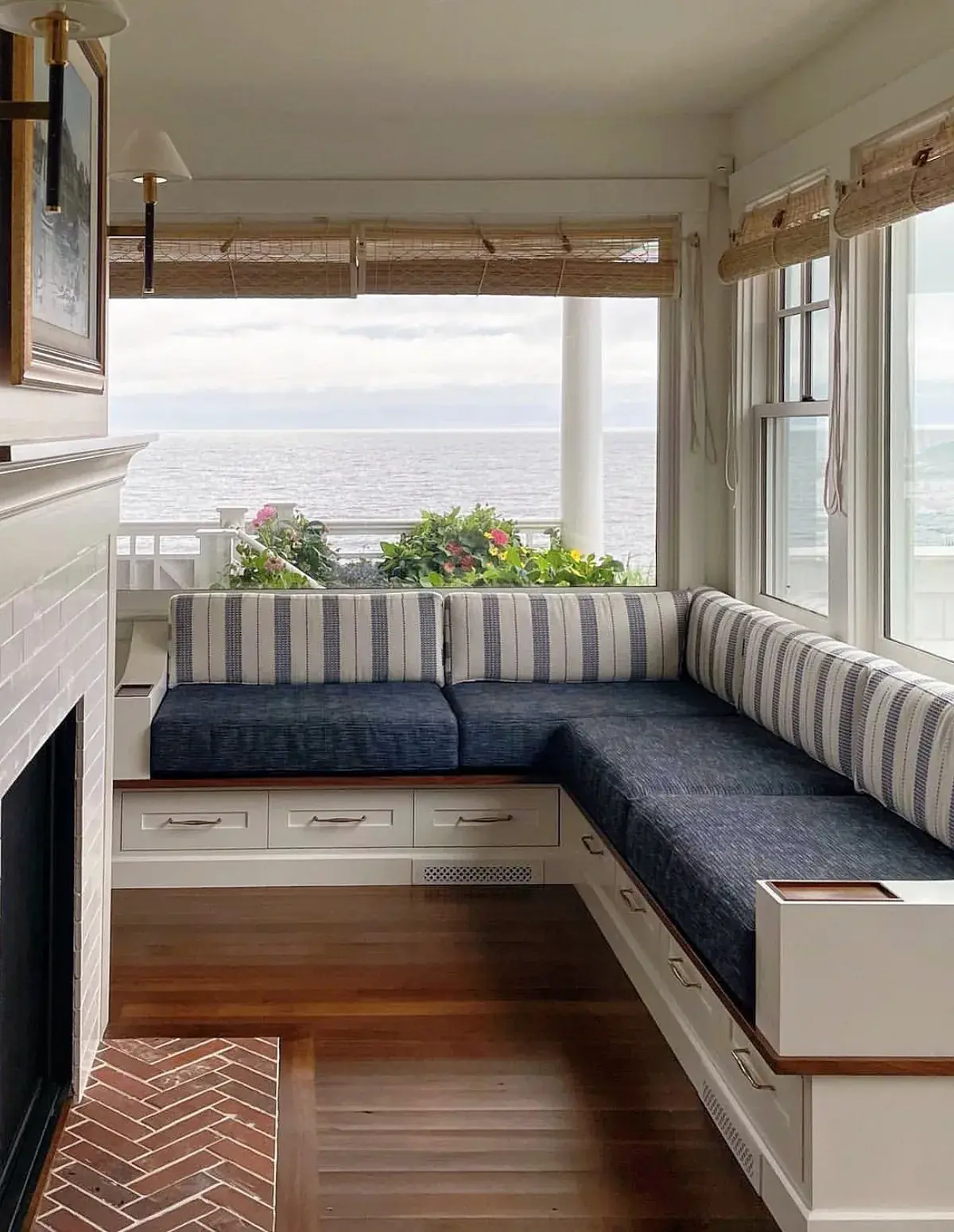
Orientation is the decision that makes this L shaped banquette succeed. It faces the water on two sides, with low bamboo blinds raised clear, so the view is shared by everyone seated and nobody reads against glare bouncing off the page.
Comfort comes from the split between base and back. The bases are deep navy cotton, firm enough to sit on for a meal, while the tall backs are a grey ticking stripe that gives way at the shoulders. That give is essential, because a banquette back that is too upright forces the neck forward within twenty minutes.
Storage sits below in white shaker drawers with brass pulls, opening from the front so the cushions never need lifting. Joinery of this type, painted in Farrow and Ball Pavilion Gray No.242 or Little Greene Slaked Lime 105, costs £900 to £2,200 per linear metre fitted in 2026, with freestanding versions from Neptune near the top of that range.
The cushion detail against stone
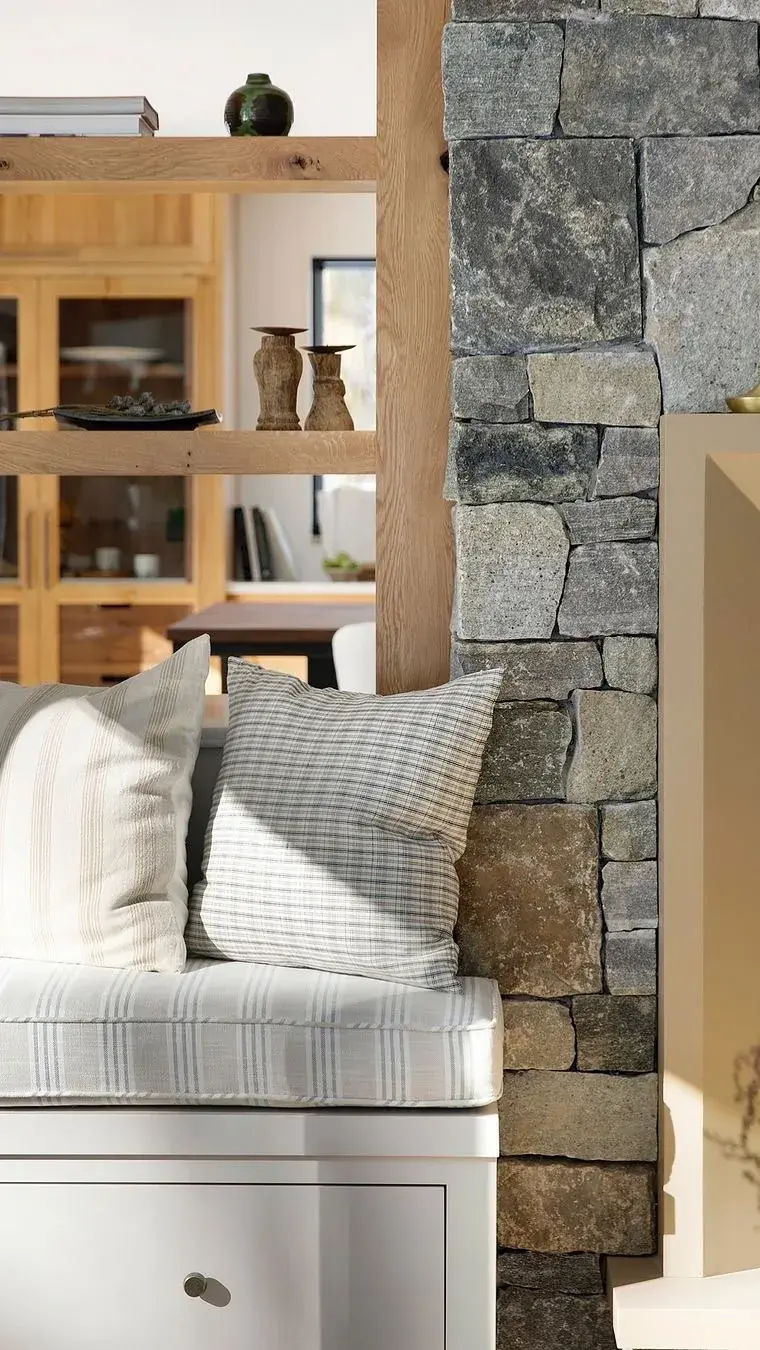
This close crop shows the junction that decides whether a stone seat gets used. A rough granite wall runs directly behind a white painted base, and the only thing between the sitter and cold masonry is a thick striped seat pad with two loose cushions.
Thickness is doing thermal work as well as comfort work. Stone holds cold long after the heating starts, and a thin pad transmits it within minutes, while a deep pad with a fibre wrap breaks the contact. Made to measure seat pads in a grey stripe, with Ian Mankin ticking or Weaver Green recycled weave, run £120 to £280 in 2026.
The drawer below, with a single brass knob, holds the current book and the reading glasses, which keeps the seat surface clear. Sun falls sideways across the cushions here, which shows the weave without bleaching it unevenly, and the oak post to the side gives the eye a warm vertical against the grey stone.
The long daybed under lattice glass
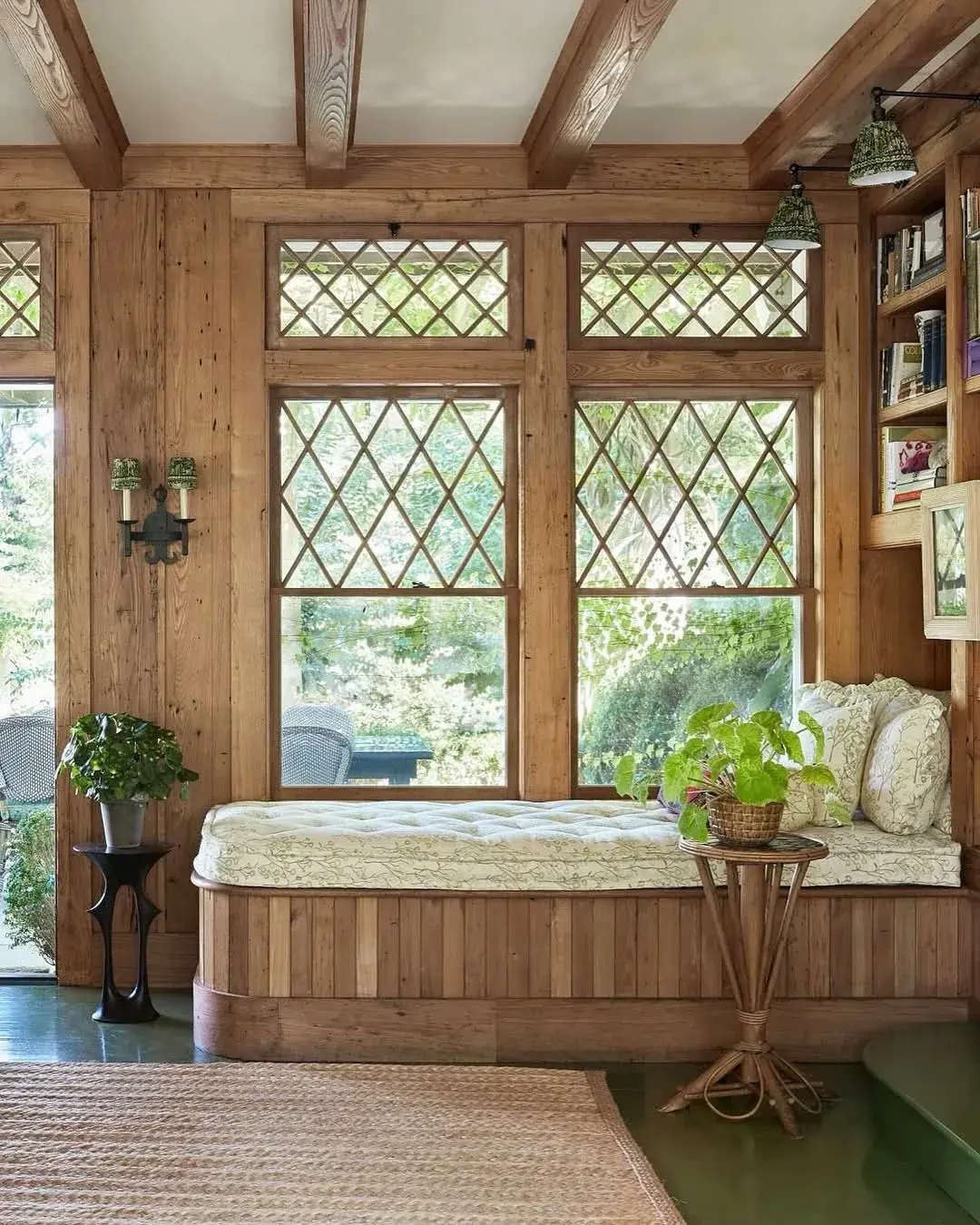
Length changes how a seat is used, because a daybed this long seats two facing the garden or one lying flat. The pine base is panelled, the mattress is buttoned cotton with a faint botanical print, and the matching bolsters run along the wall to support backs at any point.
Two small tables serve it, one black sculptural disc with a fern and one tall rattan stand with a trailing plant. That pairing matters more than it appears, because a long seat needs a landing spot at both ends, or one sitter is always reaching. Rattan plant stands of that height run £40 to £95 in 2026, with Nkuku versions near the top.
Evening light comes from green enamel wall lights and a double sconce, all mounted high on pine boarding, which throw pools of light down across the shoulders, so glare stays out of the eyes. Enamel shades of that type cost £70 to £160 each in 2026, and the jute rug below, from Alternative Flooring, runs £90 to £220 in 2026 for the size shown.
Frequently Asked Questions
Can a normal armchair work as a reading spot?
Yes, when the back is upright and firm, the arms sit at elbow level, and a lamp throws light from behind one shoulder. Add a stool for the feet and a ledge for a mug. The built in option costs more and often sits less comfortably.
Where should the lamp go for evening chapters?
Set the shade just behind the shoulder and slightly above head level when seated, so the page glows without shadows. A swing arm or tall floor base both do the job. Keep the bulb warm and strong enough for print.
How do I stop a window ledge feeling hard and chilly?
Pile on a deep pad with a dense insert, then add loose backs that pull the sitting zone forward off the glass or masonry. A throw kept in a basket nearby deals with cold evenings. Washable mid tone covers hide daily wear.
What keeps cups and books inside the corner?
A tiny surface at elbow height, either a stool sized table or a wall fixed shelf, plus a front opening drawer or a basket beneath the seat. Once the mug and the next volume live there, the habit sticks.
Does the seat have to face the outlook?
Only when the outlook repays attention. A sea or garden view earns a forward chair, while a car park or blank wall suits an inward turn toward lamplight and enclosure. Comfort decides use more than scenery.
Why does my pretty corner sit empty?
Usually the glow arrives from the wrong quarter, the spine gets no shaped backing, or the sides stay open so the body never settles. Adjust the lamp, add a lumbar cushion, and close one flank with a plant or screen. Styling alone never fixes it.
To start
- Put the lamp behind your shoulder, with the shade above seated head height.
- Choose a firm, upright chair with arms rather than a deep soft one.
- Add a footstool and a surface within arm’s reach.
- Angle the chair into the room, out of the walking route.
- If there is a disused fireplace, check the flue and fill it with books.
This article may contain affiliate links. We may earn a commission at no extra cost to you.