11 Wood Kitchen Cabinet Ideas: The Cut Matters More Than Oak

Add us as a preferred source to see more stories on Google.
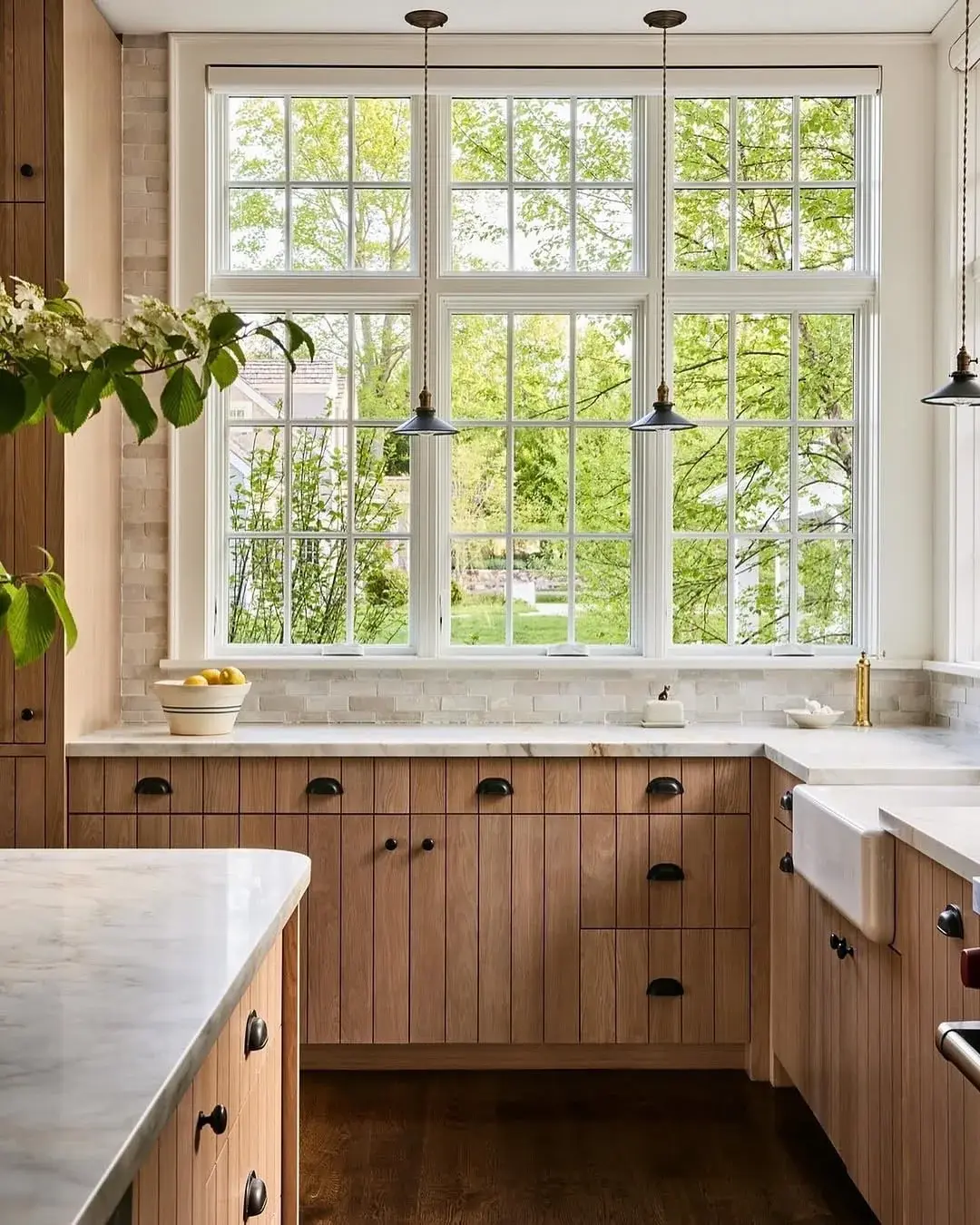
Look along the run of cabinet doors below and notice what the grain is doing. Almost nothing.
The lines run straight up each door, parallel and even, with no loops and no arches. That is rift-sawn white oak, cut radially from the log so the growth rings meet the face nearly edge-on.
Plain-sawn oak, which is the cheaper and far more common cut, gives you the wide cathedral arches most people picture when they think of oak. On one door it is handsome. On twenty doors in a row it is busy, and it is what makes a wood kitchen look like it was fitted in a particular decade.
The three cuts
| Cut | Grain | Cost | Movement |
|---|---|---|---|
| Plain-sawn | Cathedral arches, varied | Lowest | Most; cups across the width |
| Rift-sawn | Straight, very consistent | Highest | Least |
| Quarter-sawn | Straight, with flecking in oak | High | Low |
Rift is the calmest and the most expensive, because the cutting pattern wastes the most of the log. Quarter-sawn is close behind and in oak brings the medullary ray flecking, those short silvery flashes across the grain, which some people love and others find fussy.
The stability difference is real as well as visual. Plain-sawn timber moves more across its width with humidity, which on a wide cabinet door means more seasonal movement and more stress on the finish.
Expect rift-sawn to add meaningfully to a cabinet quote. On a small kitchen it is worth asking the price; on a large one it may be the difference between wood and paint.
Make the floor a different value
The floor in that kitchen is considerably darker than the cabinets, and that gap is deliberate.
The commonest failure in a wood kitchen is oak cabinets on an oak floor in a similar tone. Everything merges into one continuous beige field, the cabinets stop reading as objects, and the room goes flat.
Two workable arrangements: pale cabinets with a dark floor, as above, or dark cabinets with a pale floor. What does not work is both at mid tone.
If the floor cannot change, that decides the cabinet colour rather than the other way round.
Hardware, and why black here
Matt black cup pulls and knobs on light oak.
Brass is the reflexive choice with timber and on pale white oak it can go slightly sickly, because both are warm and yellow-leaning and neither gives the eye a boundary. Black holds the line between the hardware and the door.
On darker timber, walnut or stained oak, brass works beautifully and black can disappear. The rule is contrast rather than a fixed pairing.
Antique nickel and pewter are the quiet third option and suit rift-sawn oak particularly well.
The door front
Those doors are V-grooved vertically, a shallow bead running up each one. It is a small detail doing a great deal: it adds a shadow line, it emphasises the vertical grain, and it stops a flat slab door looking like laminate.
The alternatives: a plain slab, which needs excellent timber to carry it; a shaker frame, which is traditional and reads busier on wood than on paint; and a reeded or fluted front, which is the fashionable version and collects dust in every groove.
For a wood kitchen, plain or lightly grooved, almost always. Wood already has pattern in it, and adding profile on top gives the eye two things to read at once.
Makers worth knowing at each level: deVOL, Plain English and Naked Kitchens at the top, where rift-sawn oak is standard rather than an upgrade; Pluck, Husk and Sustainable Kitchens in the middle; and for a DIY route, IKEA carcasses with oak fronts from Naked Doors, Holte or Reform, which typically runs £2,500 to £6,000 for a medium kitchen against £20,000 upward for bespoke.
Finish, and what it costs to live with
Hardwax oil such as Osmo or Fiddes gives a natural matt finish, is repairable in patches, and needs refreshing every few years on the doors that get handled. Lacquer is harder, more water-resistant, and is repaired by refinishing the whole door.
For a kitchen, lacquer is the practical choice around the sink and oil is nicer everywhere else, which is why many makers use both.
Whichever, ask what happens to the colour. Most oaks darken and go warmer over the first couple of years, particularly in sunlight, and a kitchen that looked pale and grey on installation may not stay that way.
Pale oak that stays pale
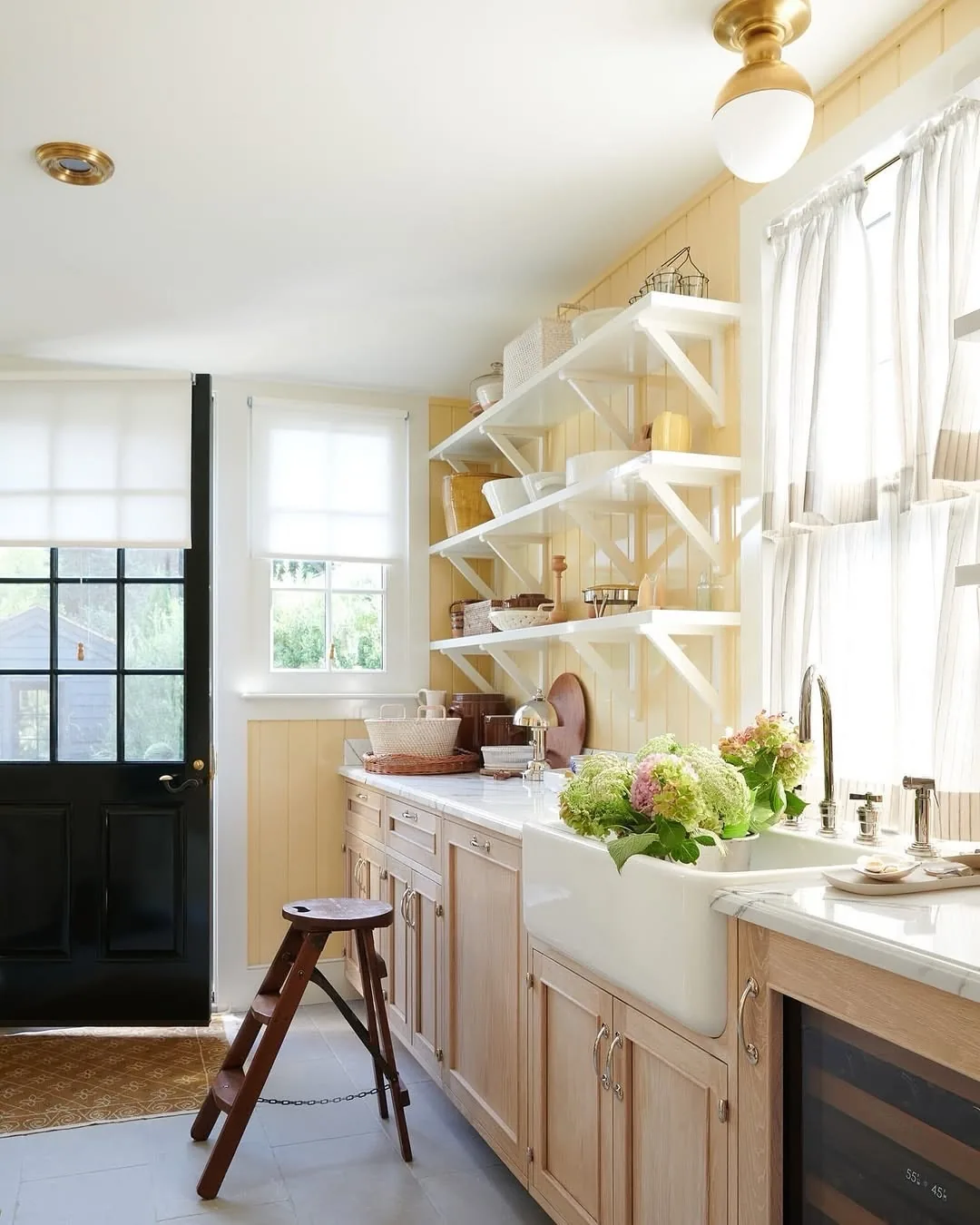
In that narrow room the base units are pale oak with almost no figuring, set under thick white shelves on a pale straw wall. The floor is a cool stone grey. That cool floor is doing quiet work, because pale oak in a warm room goes yellow within two winters.
The principle is simple: pale timber needs a cool neighbour or it reads as one warm box. Here the shelves are a clean white, Farrow and Ball Pointing No.2003 gets close, and the wall behind carries a little yellow which the white keeps in check. Because the eye has white to measure against, the oak looks pale instead of sallow.
See what the light is doing. Daylight from two sides keeps the oak honest at midday, while a 2700K ceiling spot will push it honeyed after dark. That shift is normal. A matt lacquer holds the pale tone longer than oil, which deepens from the first year. Osmo Polyx-Oil 3044 Raw was made for this exact complaint, and a 750ml tin runs around £38 to £58 in 2026. The small dark stool in the corner helps too, since one dark object stops pale on pale going bland across a whole wall.
Dark timber under a sea view
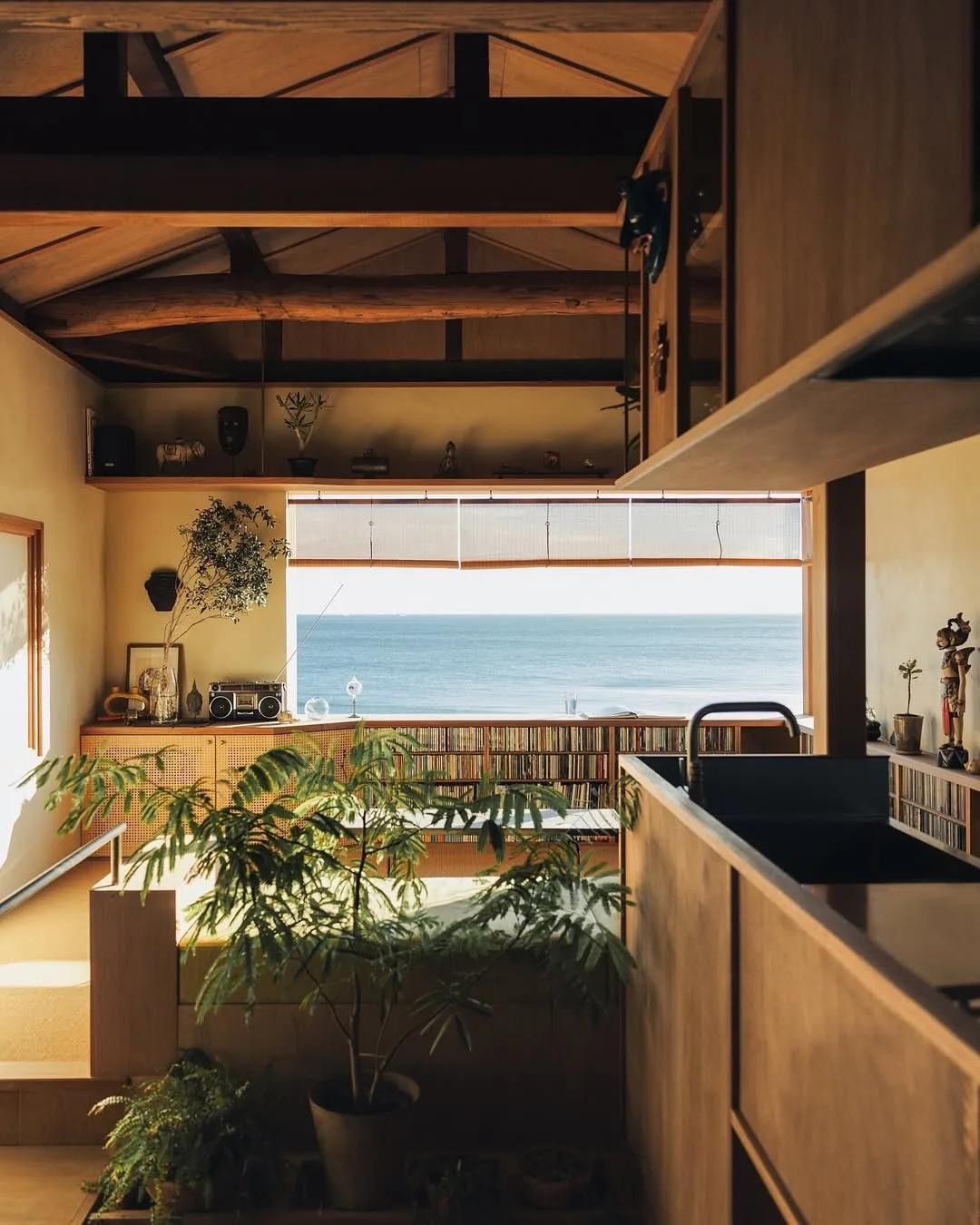
This one is almost all timber, stained deep and lit low, with the sea running bright behind it. The base units are low and long, with woven cane fronts that break the dark mass. Overhead the beams are nearly black. It works because the brightest thing in the room is not wood at all.
Dark stain adds gravity, which is why it suits a low room facing a big view. The eye goes past the cabinets to the water, then comes back to timber that feels like shadow. In a town kitchen without that view the same stain can feel heavy by November, which is the practical reason to sample dark boards at home for a week first.
That finish on the cabinets is matt, almost flat, which matters more on dark timber. Gloss on walnut or stained oak shows every wipe. A hardwax oil from Fiddes, their Matt Lacquer runs £28 to £46 per litre in 2026, keeps the surface soft and lets the grain show without shine. Cane panels like those cost roughly £90 to £180 per door from a joiner in 2026, which is far cheaper than refronting in walnut.
Beams spend the wood budget first
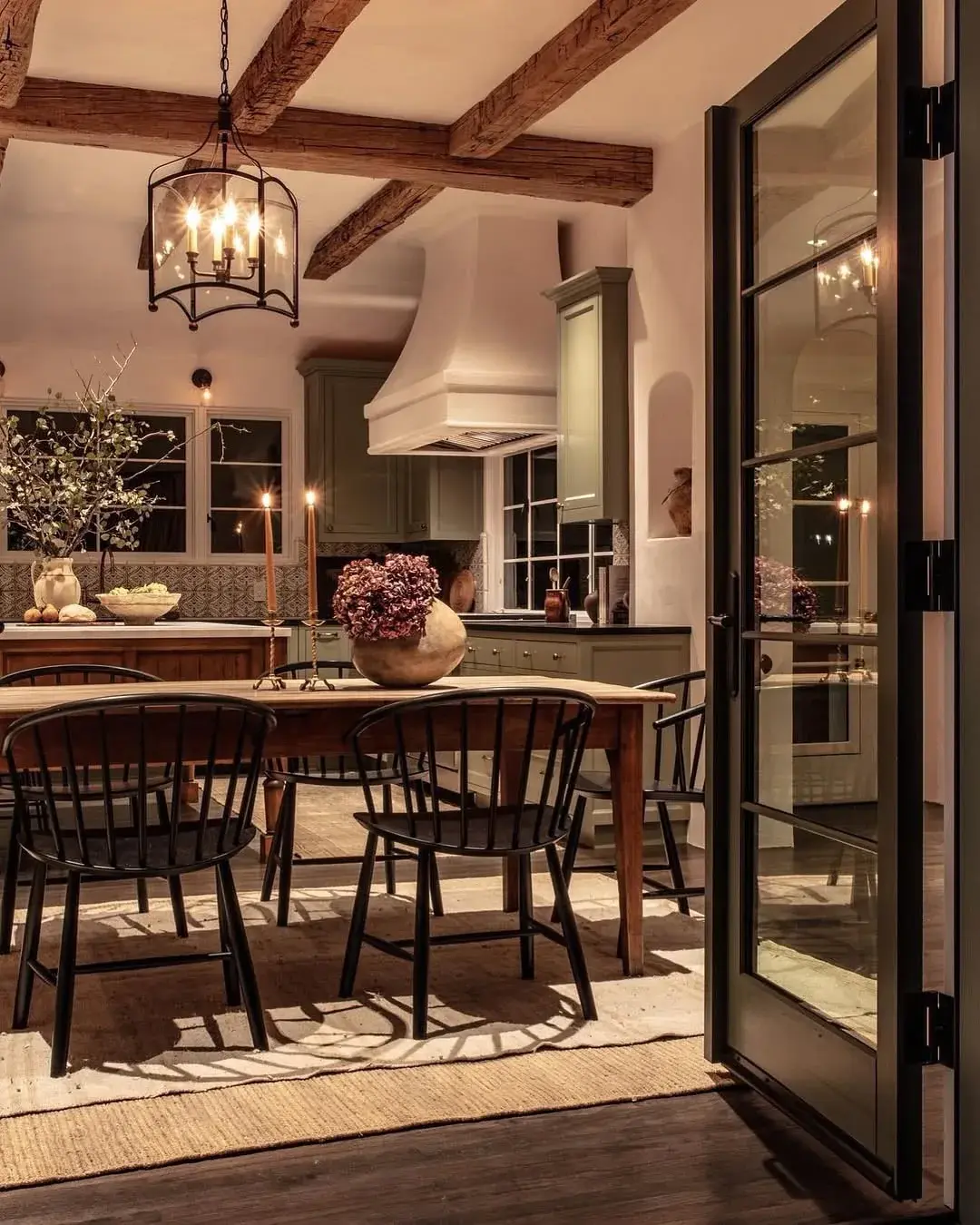
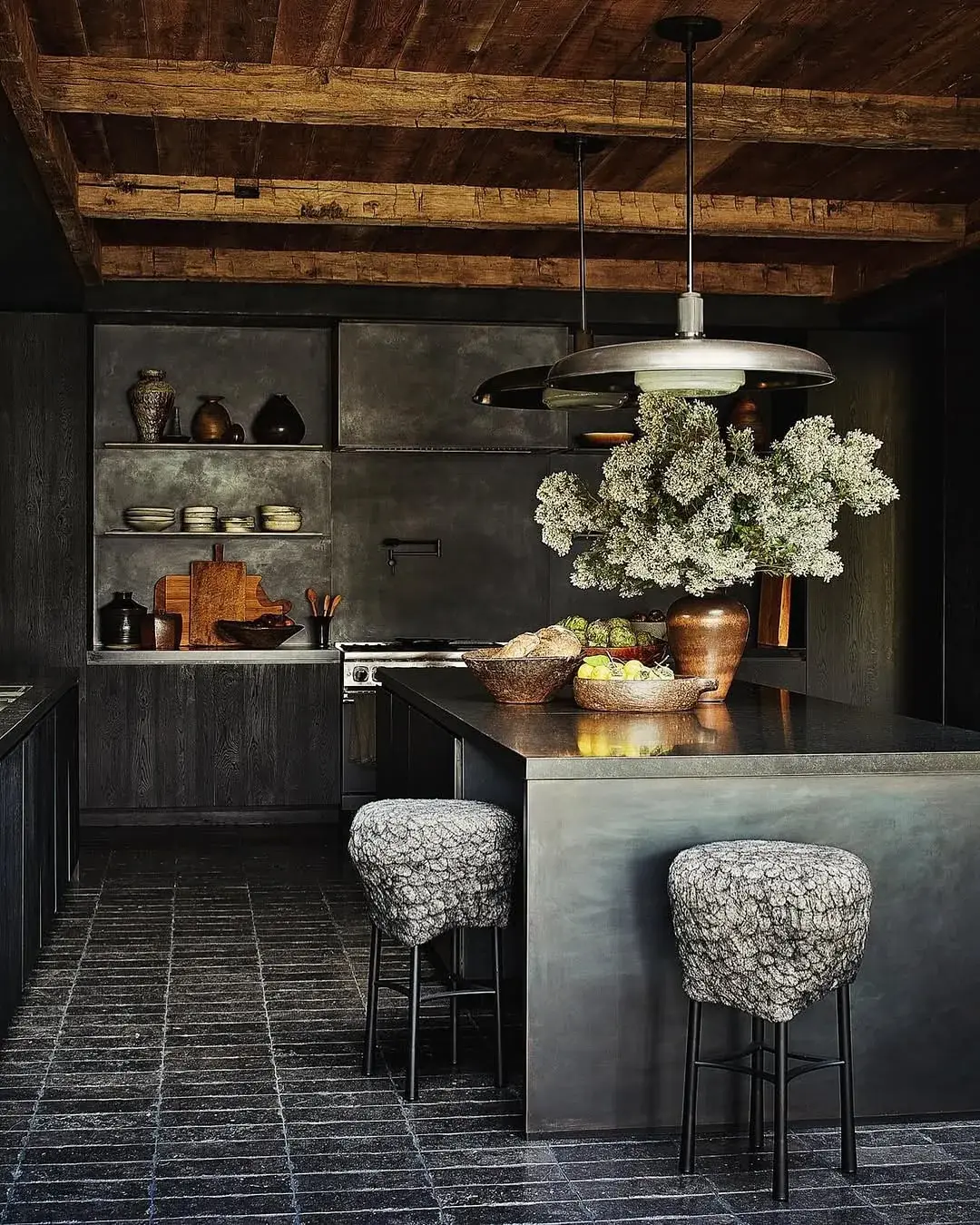
Look at the ceiling before the cabinets. Four rough beams run dark across white plaster, and they are the loudest timber in the photograph. The table below answers them in mid oak. The perimeter units behind stay painted a dusty green, Farrow and Ball Green Smoke No.47 is near enough, with a dark stone top.
Because overhead timber dominates, everything else wooden must stay quiet or go painted. That is the governing rule with beams. Two wood tones in the room is plenty, and here they are beams plus table. The floor is dark and plain, which lets both read.
The lantern over the table is the light to copy. Candle bulbs at 2700K flatter old oak, while a cool downlight turns it grey. Iron lanterns of that size run £180 to £420 in 2026, from Jim Lawrence or Vaughan depending on finish. The chairs are black, which gives the eye a boundary between table and floor that the browns alone would not hold.
Whitewashed pine calms a low room
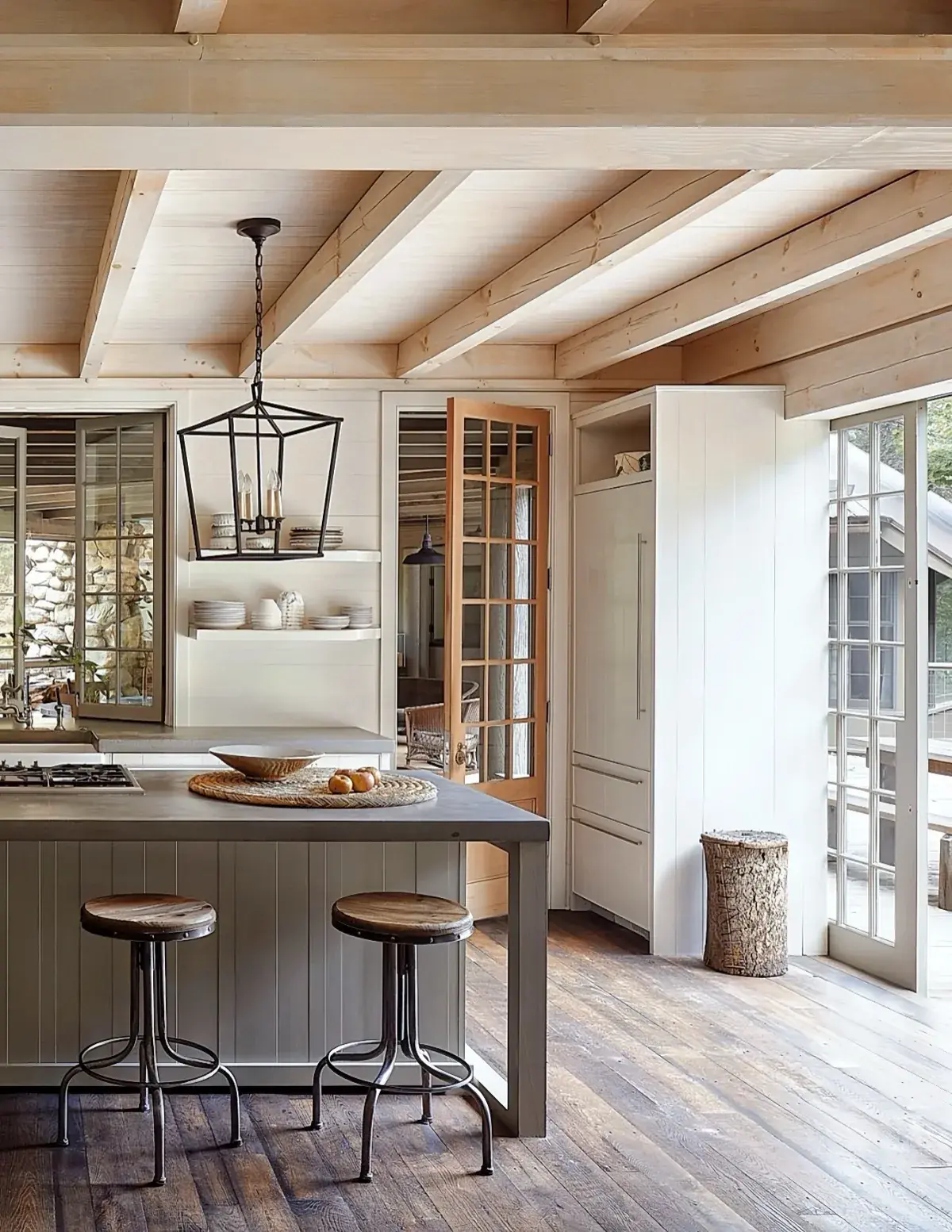
The beams here are pine washed almost white, which is a different decision from the dark beams above. The room is low and the ceiling does not take light well, so the wash lifts it. Underneath sits a grey panelled island with a concrete top, then a very dark plank floor.
Pine yellows faster than oak, particularly in sun, which is why a whitewash or lye treatment earns its keep on a ceiling. Left clear, pine goes honey within a few years. Washed, it stays pale and lets the floor carry the depth. The island paint is a mid grey with warmth in it. Little Greene Slaked Lime 105 or French Grey 113 would sit close.
The two stools show how to mix timber without adding a tone. Their seats are dark stained wood, near enough to the floor to read as one thing. Steel framed stools of that type run £140 to £320 each in 2026. In that kitchen they matter because they link island to floor. The concrete top stays cool grey, which stops the washed pine going creamy.
Two old oaks in one elevation
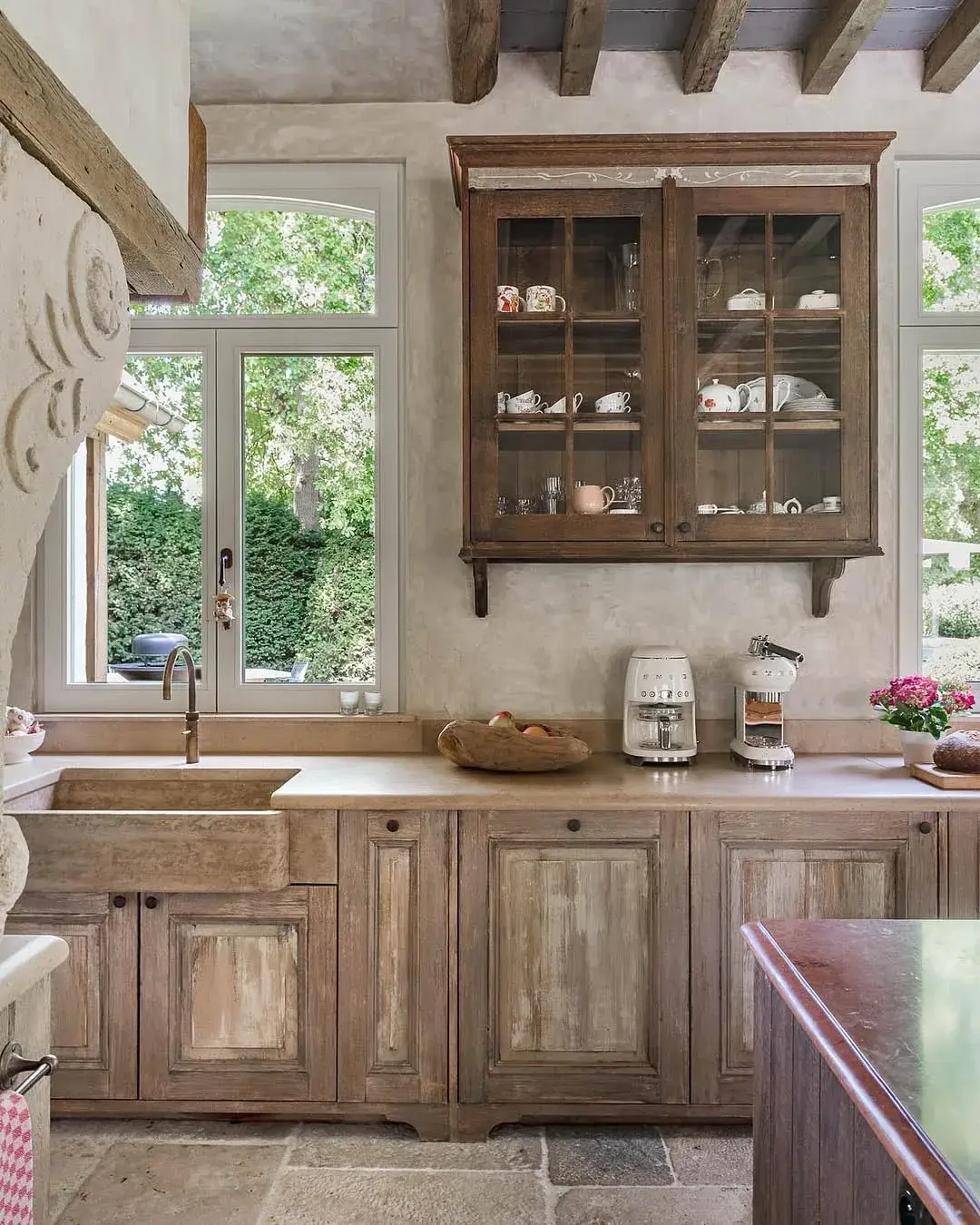
This French corner puts two different oaks on one wall. Below the worktop the doors are weathered and limed, grey with the grain showing through. Above, a glazed cabinet is stained almost walnut dark, with small panes and brackets. Between them sits a limestone sink and a plain stone top.
It should clash and it does not, because both timbers share a grey cast. The pale ones have been scrubbed back, the dark one has age in it, and neither is orange. That shared coolness is the whole trick. When two browns share an undertone they read as collected. When one is honey and one is grey they argue.
The stone around them helps enormously. Lime plaster, a stone floor, a deep Belfast style bowl: all matt and uneven, so the timber looks calm by comparison. Unlacquered brass on the tap, around £220 to £480 for a bridge mixer in 2026, suits because it dulls down instead of shining. A polished chrome tap in that room would look cold against the limed doors.
Three timber values in one open room
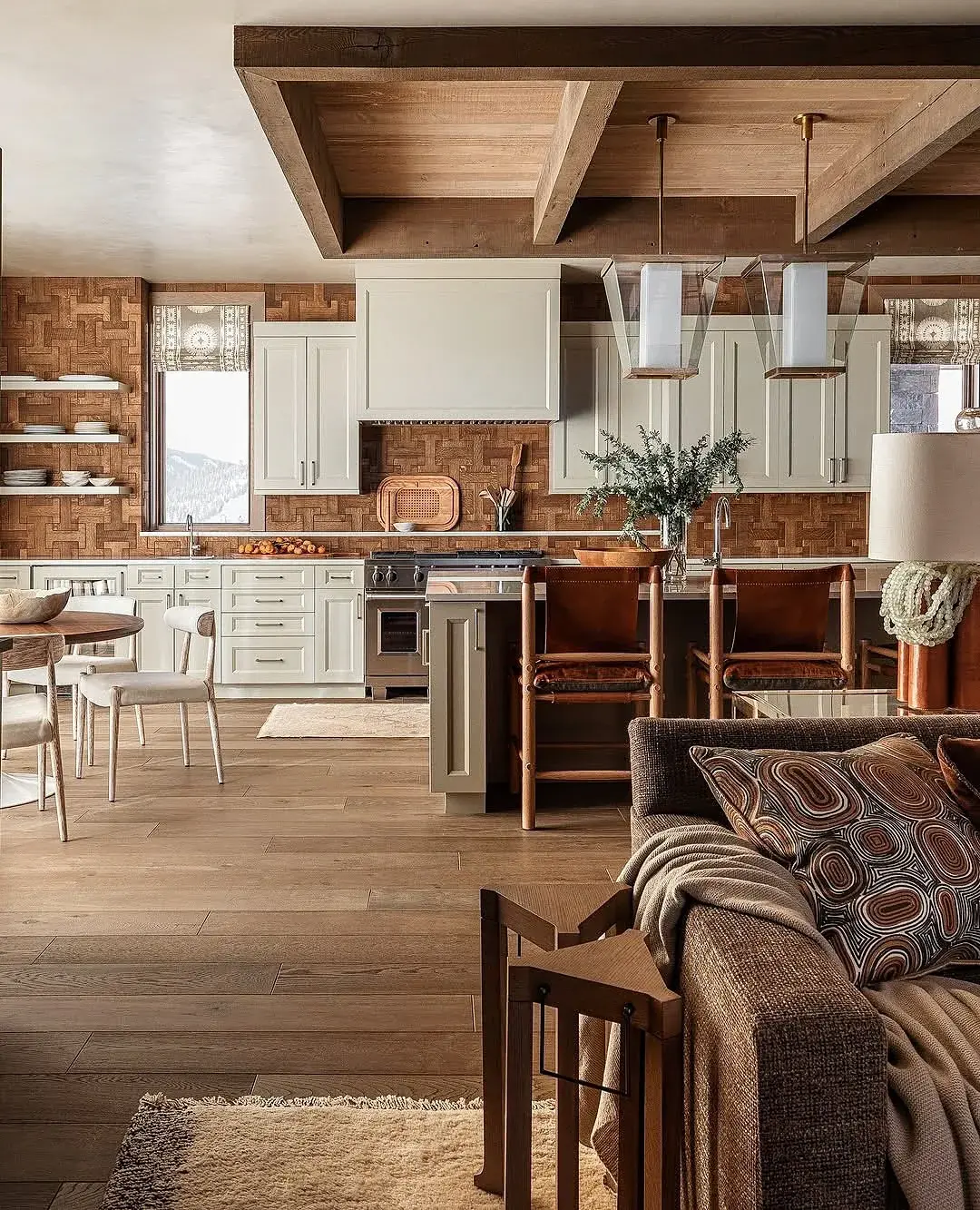
Count the woods in that open room. Dark stained beams frame a pale pine ceiling, white shaker units line the back wall, and the floor runs mid oak from kitchen to sofa. Three values, light and dark with a middle, plus paint. It holds because each owns a plane: dark overhead, white on the walls, mid underfoot.
The splashback behind the range is the detail to study. Small end grain blocks in mixed browns form a woven pattern, which could easily fight the floor. It does not, because it is small and high, read at a glance instead of walked on. Benjamin Moore White Dove OC-17 on the units keeps the white warm enough to sit with oak. A blue white would fight it.
Wide plank oak floors of that grade run £70 to £140 per square metre supplied in 2026, with fitting on top. Leather seated stools at the island, £250 to £550 each in 2026, add a fourth brown in small doses, which is the limit. Any more timber on the furniture and the room would tip from layered to busy.
Knotty pine needs calm surfaces
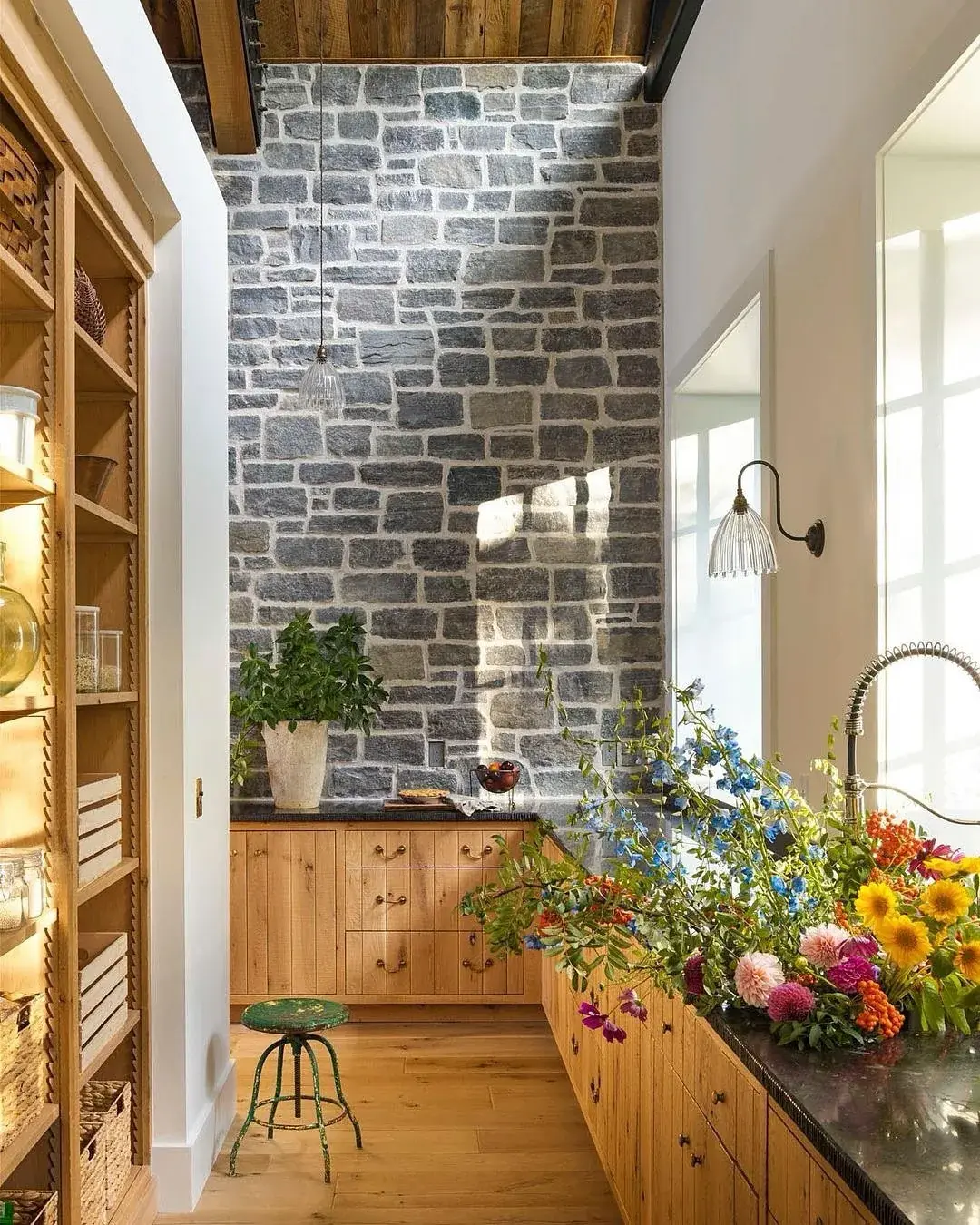
That tall stone chimney takes half the picture, grey and rough, with pine units tucked against it. The pine is knotty, full of dark ovals and streaks, finished clear so every knot shows. The worktops are near black stone. The wall of stone is doing the calming.
Knotty pine is honest grain at full volume, which is why the surfaces around it must be plain. Here there is no tile pattern, no veined marble, no busy blind. Just stone, black, pine, flowers. Because the pine already carries pattern, anything else patterned would compete. The eye reads knots as decoration, so the room needs little else.
Pine moves more than oak across seasons, and knots can weep resin in heat near a range. A matt lacquer seals better than oil for that reason. Freestanding pine dressers to match those units run £700 to £1,800 in 2026 depending on size. In a room like this the pine suits because the stone is permanent and cool. In a new plaster box the same pine can look orange, while against old stone it settles because the masonry absorbs the colour.
Dark oak where lamplight lands
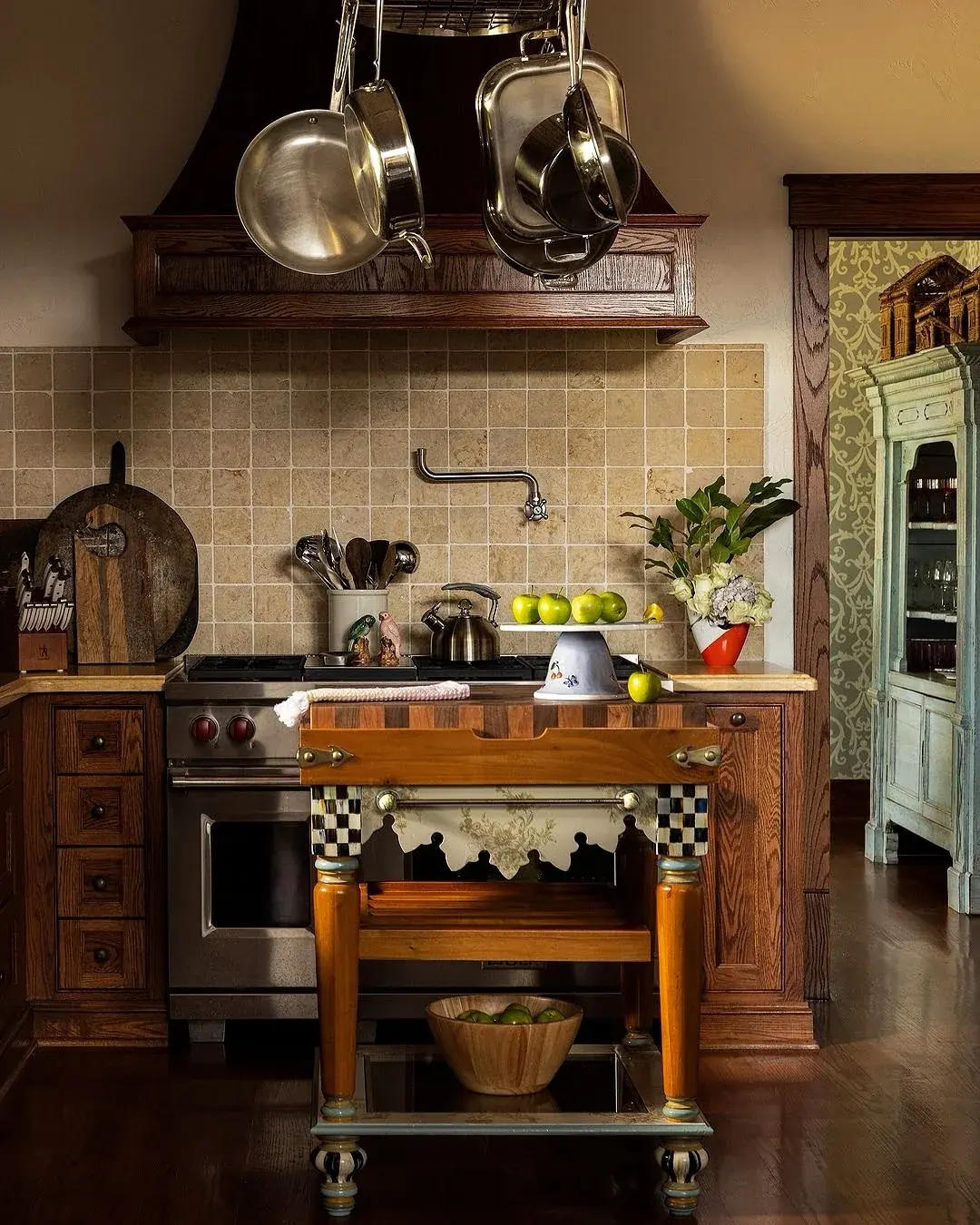
The range wall in that picture is dark oak, almost walnut in tone, with a tiled splash and a steel range set into it. In front stands a small butcher block table on turned legs, its top striped from end grain. Pans hang above. The light is low and warm.
Dark stain belongs where eyes rest and lamplight falls. Here it frames the cooker, the natural anchor of the room, while the little table glows honey under the pendants. If the whole room were that dark it would flatten. Concentrated on one wall, it gives depth.
End grain block of that thickness runs £260 to £480 per square metre in 2026, and it needs oil twice a year to stay honeyed. A 2700K bulb over it keeps the tone rich; a 4000K tube would turn it flat and grey. The chequered cloth on the table edge is a warning. Fussy textiles fight strong grain. Plain linen would have been calmer, which is why the room feels slightly dated despite good timber.
One oak island in a white vault
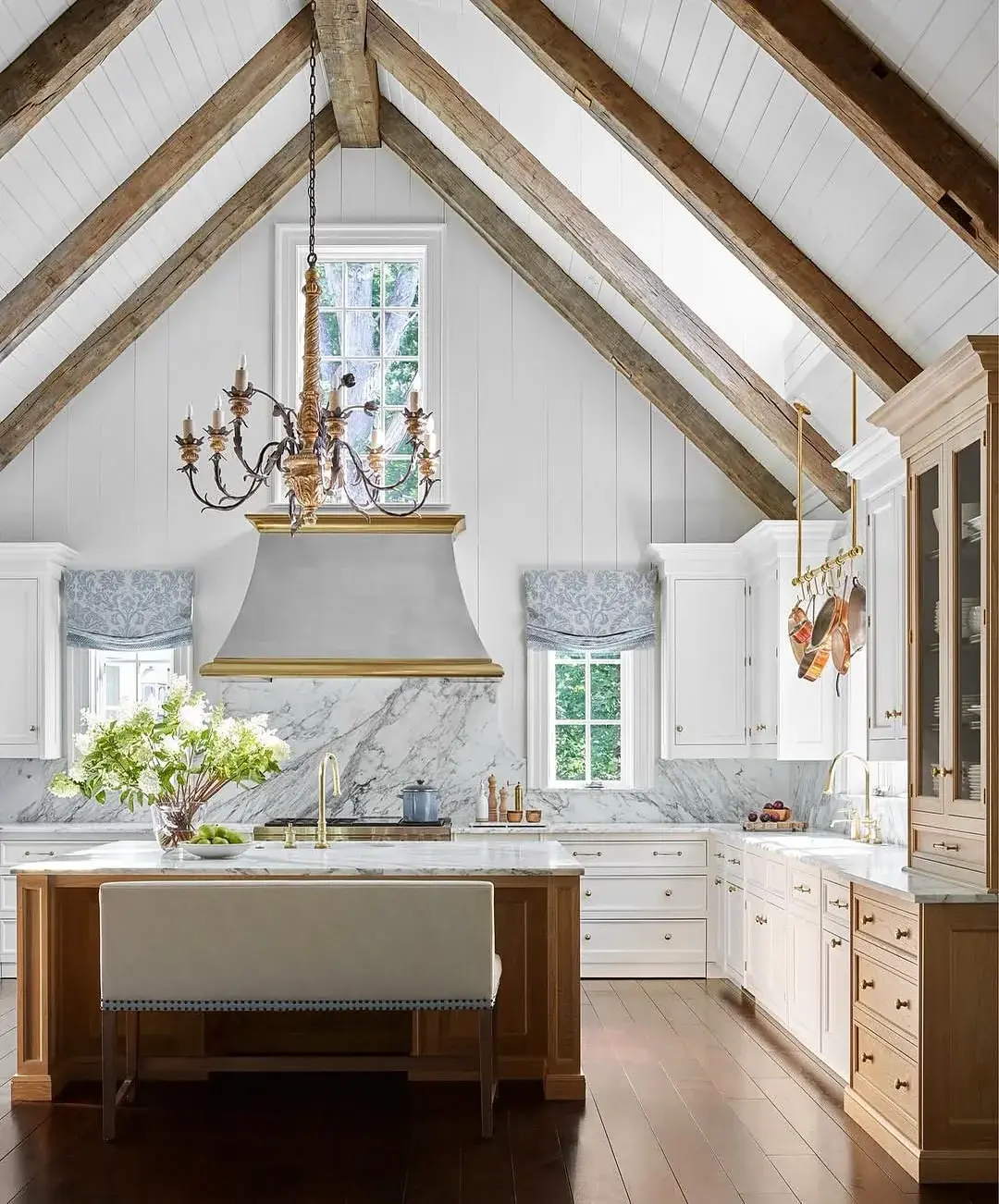
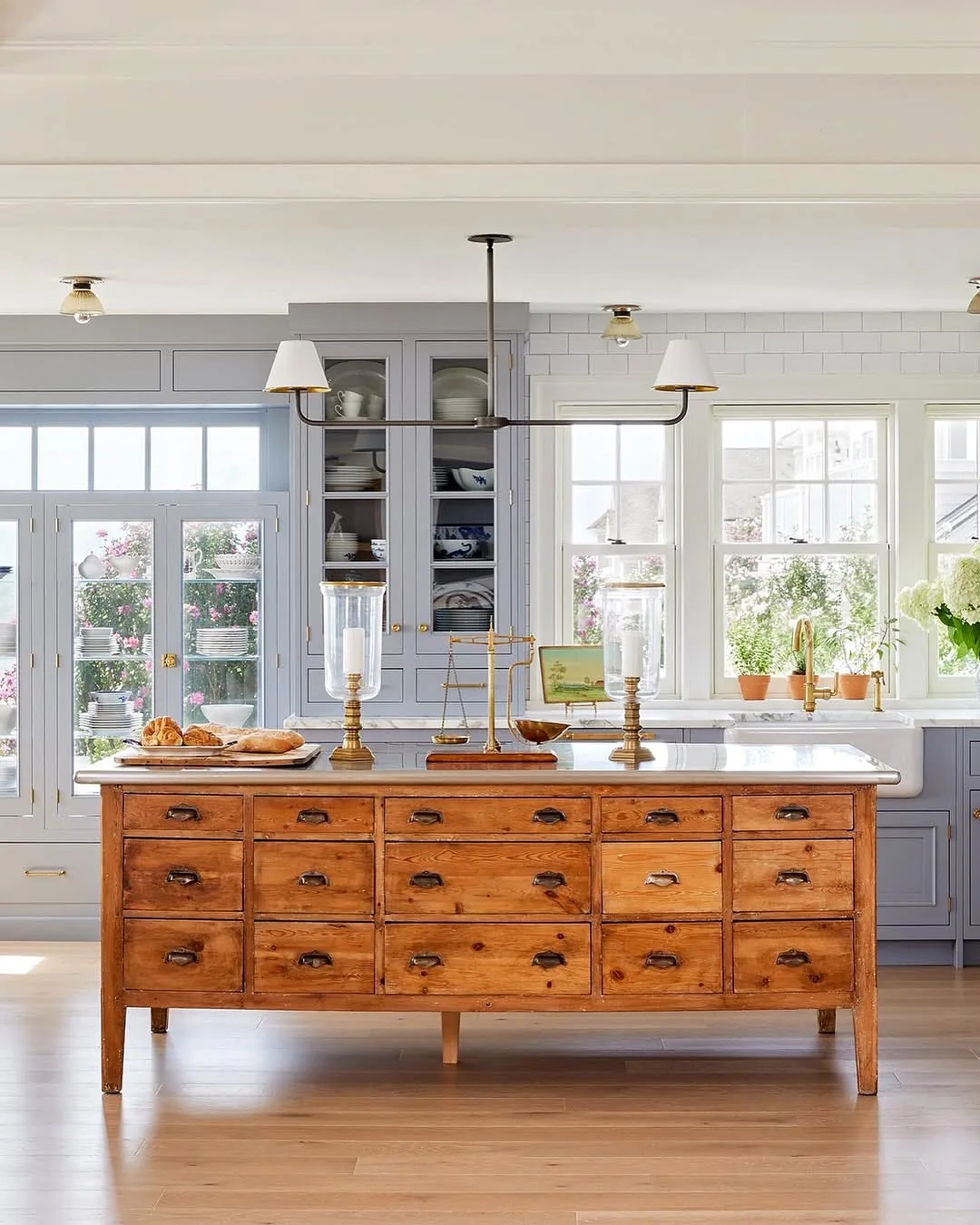
A white vault with reclaimed beams, white units to the walls, and one oak island in the middle. The island is plain panelled oak, mid honey, with a white marble top. That single block of timber carries the whole wood story, which is why the room feels calm despite a big ceiling.
The principle: in a tall white room, one timber object grounds it. Without the island the space would float. With beams plus island plus floor in oak, the count is technically three, but the beams are high and weathered grey while the island and floor share a honey tone, so the eye groups them. Farrow and Ball Wimborne White on the walls would get that warm white.
Look at where the brass sits. A rail with pans hangs to the right of the range, the tap is unlacquered brass, the picture light over the hood is brass. On mid oak brass glows; on very pale oak it can merge. Honed Carrara for tops like those runs £420 to £780 per square metre fitted in 2026. The blue roman blinds are the only cool note, and the room needs that small coolness to stop the honey going sweet.
A scrubbed table instead of more cabinets
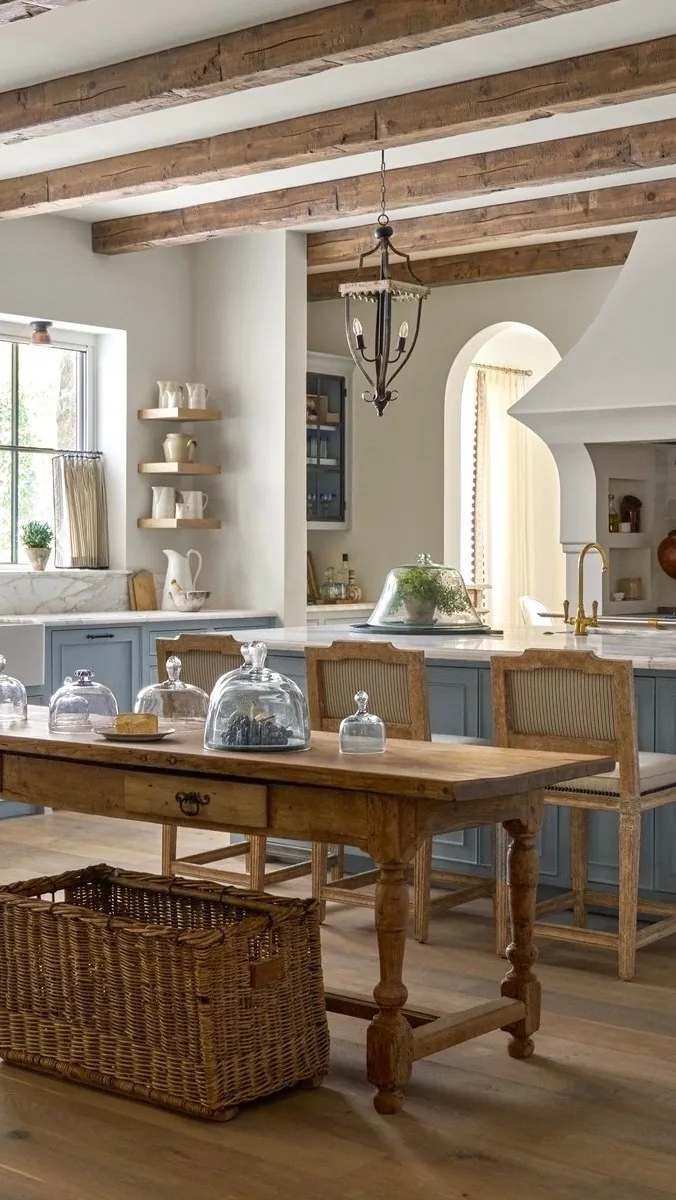
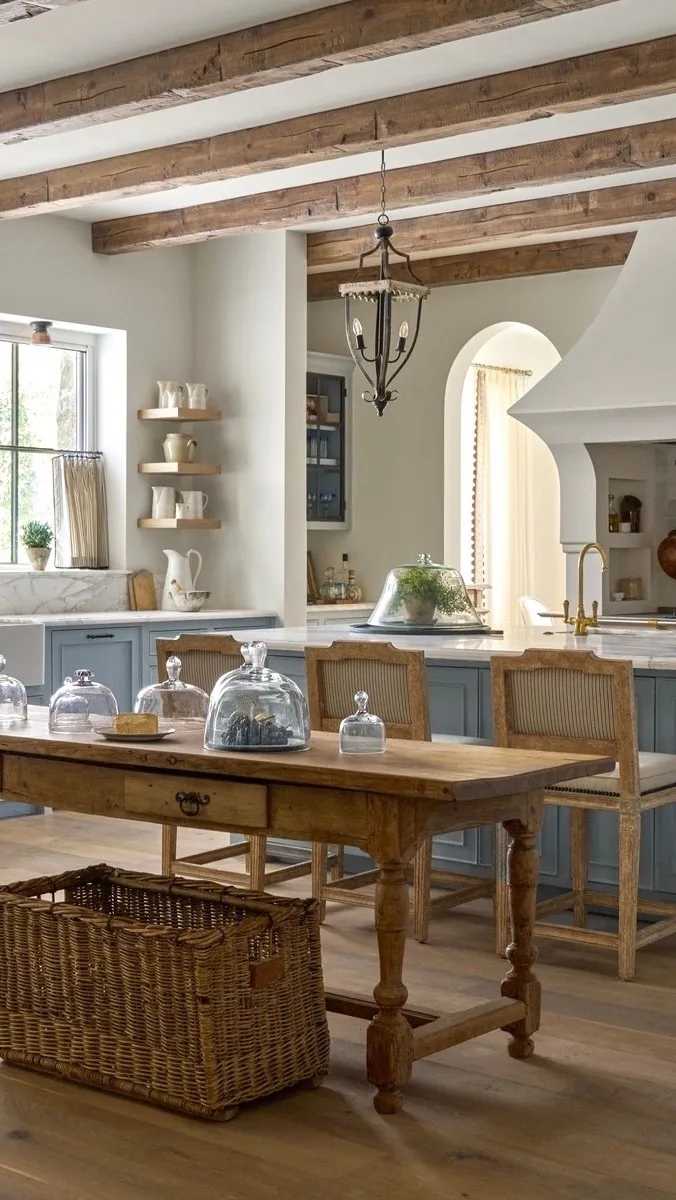
The last room barely shows its cabinets at all. A scrubbed oak farm table stands in front of a dusty blue island, with chunky beams above and a wicker hamper below. The table is the wood event, not the cabinetry.
That swap suits a kitchen where fitted timber would overwhelm. A farm table adds grain, age and a work surface without committing twenty doors to oak. Because it stands clear of the floor on legs, light passes under and the room breathes. A fitted island in the same spot would block.
Tables like that, 2m of old oak with turned legs, run £900 to £2,400 in 2026 from salvage yards, with reproductions dearer. The blue on the island, Little Greene Dock Blue 252 is close, works because blue and honey oak sit opposite without fighting. Glass domes on the table are the styling to copy. They add height without weight, and two domes leave the table usable where three would crowd it.
Frequently Asked Questions
Which timber stays palest longest in a kitchen?
White oak holds its tone better than pine, which turns honey quickly in sun. A matt lacquer slows the shift more than oil, and a cool floor or white shelf alongside stops the paleness going sallow. Expect all pale boards to deepen a little over two winters.
Does walnut or stained oak suit a dim room?
Deep brown units absorb daylight, so they need a bright outlook or strong warm bulbs to avoid gloom. Keep the finish flat, place the darkness on one wall or an island, and let paler walls or stone do the lifting elsewhere.
How do beams change the cabinet choice?
Overhead boards count as a wood finish, so painted units often sit better beneath them. Match at most one other timber to the ceiling, keep floors plain, and light the room at 2700K so old beams do not turn grey.
Can old and new oak sit together?
Yes when both share a cool or grey cast rather than one honey and one ash. Lime washing, scrubbing back, or a smoked stain can pull them into one family. Stone, lime plaster and dull brass help bridge the gap.
What top suits knotty pine units?
Something plain and dark, such as honed granite or slate, since the knots already supply pattern. Avoid veined marble or figured tile next to busy grain. Seal pine near heat with lacquer, as knots can bleed.
Is a timber table better than a fitted island?
For many rooms, yes. A table on legs lets light through, adds age without committing every door to wood, and can be removed. Count on around £900 upward second hand in 2026, and keep styling sparse so the top stays usable.
In order
- Ask how the timber is cut; specify rift or quarter-sawn for a calm run.
- Ask for a full sample door rather than an offcut.
- Keep cabinets and floor in clearly separate tones, light against dark.
- Choose hardware for contrast: black on pale oak, brass on dark.
- Keep the door front plain or lightly grooved; the timber is the pattern.
- Count beams as a wood tone and paint units beneath dark timber.
- Finish pale oak in matt lacquer and budget oil care for dark tops.
This article may contain affiliate links. We may earn a commission at no extra cost to you.