10 Modern Living Room Ideas With Organic Texture, Low Light and One Soft Move

Add us as a preferred source to see more stories on Google.
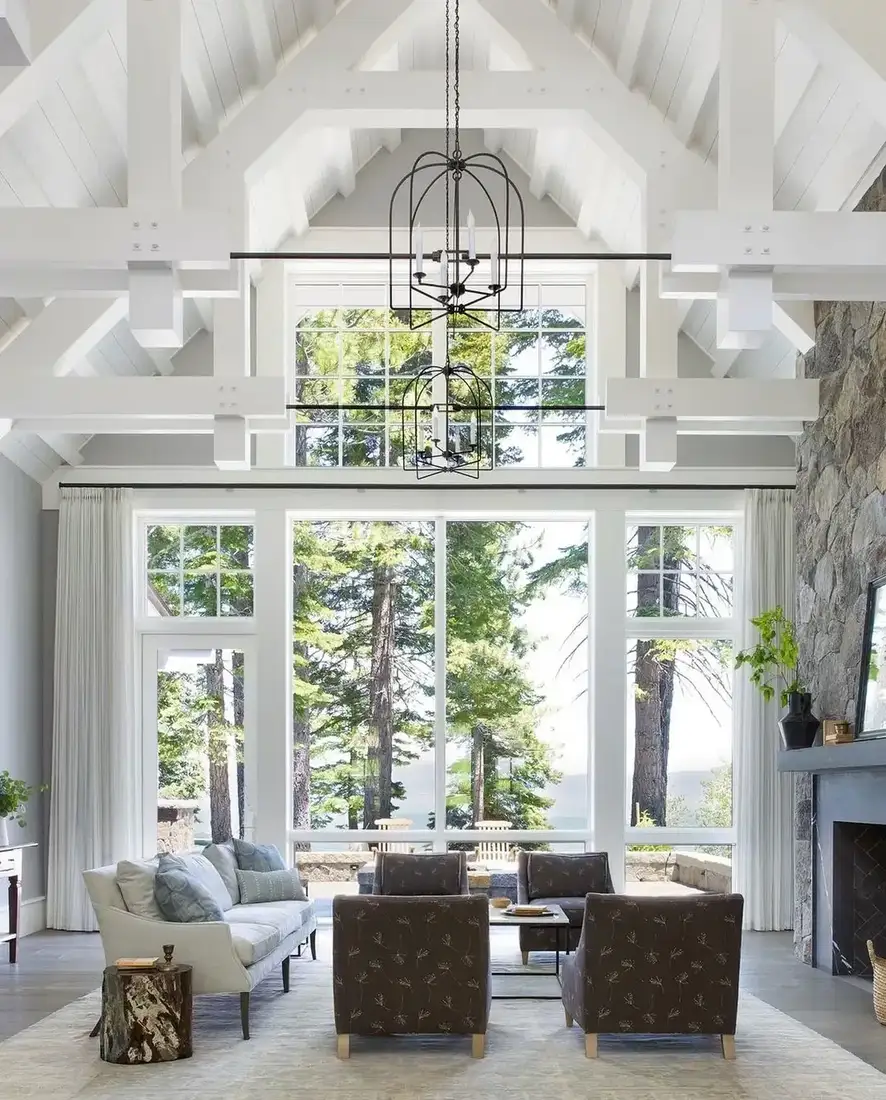
A modern room goes cold for a reason that has very little to do with style.
The shell is hard: glass, steel, white plaster, pale oak. The light is high: spots in the ceiling, sun off white walls. And everything the hand meets sits at roughly one height, because low modern seating with low modern tables makes a single flat plane. The eye reads that plane as empty even when the pieces are expensive, which is why so many modern rooms photograph as galleries and live as waiting areas.
The correction is not more objects. It is one organic texture brought down to sitting height, with the light lowered to meet it.
A vault needs something rough at the bottom
Look at the volume before the furniture. White trusses rising two storeys, a wall of glass onto pines, a stone chimney running full height. That much hard pale surface in one room should feel like a hall, and the reason it does not sits at the left edge of the frame: a bark side table beside a linen sofa.
The principle is vertical distribution. When height is all smooth, roughness must live low, because the eye spends its time at sitting level, not at the ridge. Bark, hide and undyed wool read as warm precisely where the architecture reads as cool, and one piece is enough since two would start an argument about rusticity.
The seating proportion governs the rest. Sofa seat height around 420mm, chairs facing it at the same level, rug large enough that front legs stand on wool, not stone. Linen slipcovers in off white, such as lanolin rich Belgian weaves from Weaver Green or Neptune, run £800 to £2,500 for a three seater in 2026 and survive washing far better than cotton.
Steel goes soft when the sofa disappears into it
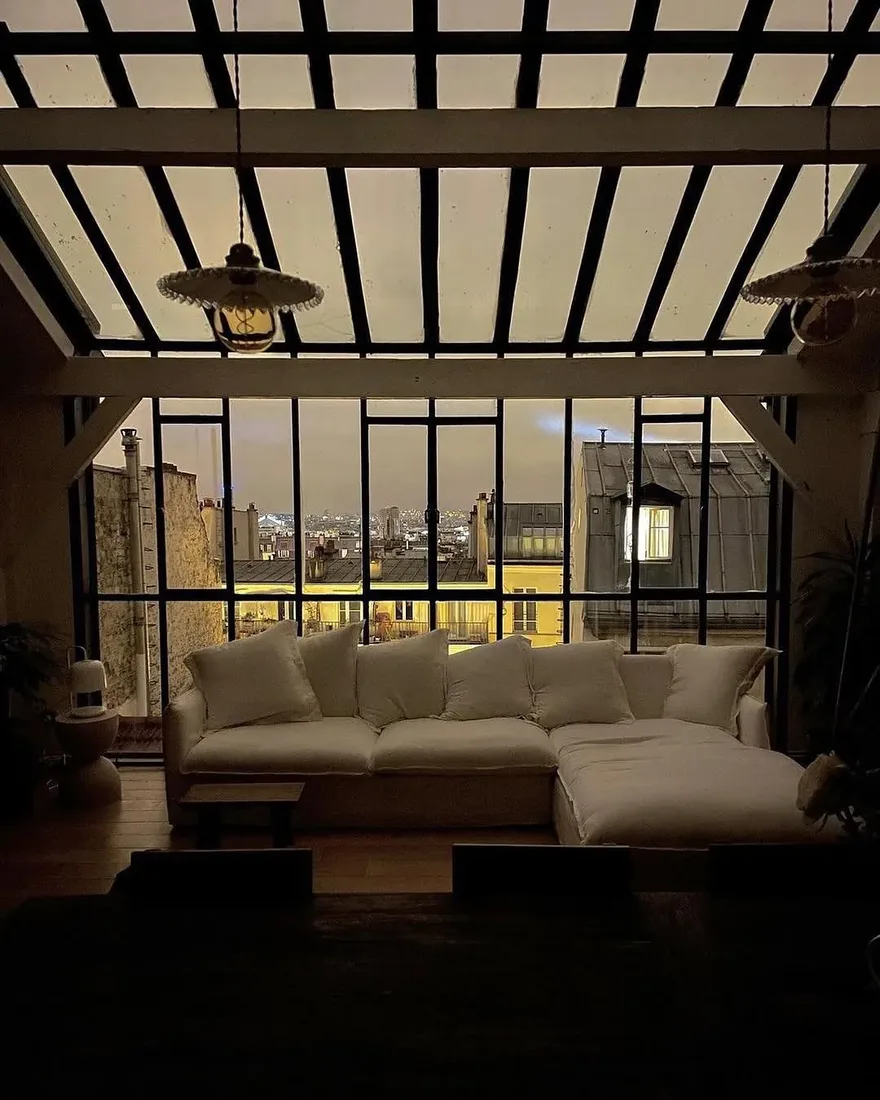
This frame is almost entirely line: black glazing bars, black roof ribs, a pale sectional low enough to read as bedding. Photographed at night with the city lit beyond, it should feel hard, and the reason it does not is that the sofa has no legs, no arms worth naming, and cushions deep enough to swallow a person.
Reframe the problem, because it is not the steel that is wrong in cold lofts but the seating that fights it. A tailored upright sofa against industrial glazing doubles the number of hard edges. A low loose covered sectional removes half of them, which is why the same glazing reads calm here, not commercial.
Light temperature decides the evening. The pendants hang at roughly 2100 to 2700K, which turns black steel bronze, not grey. Anything at 4000K would turn this room into an office. Dim to warm LEDs, such as Philips WarmGlow or Tala Gaia, cost £15 to £40 per bulb and are the cheapest correction a loft can buy.
One rug can carry three brown woods
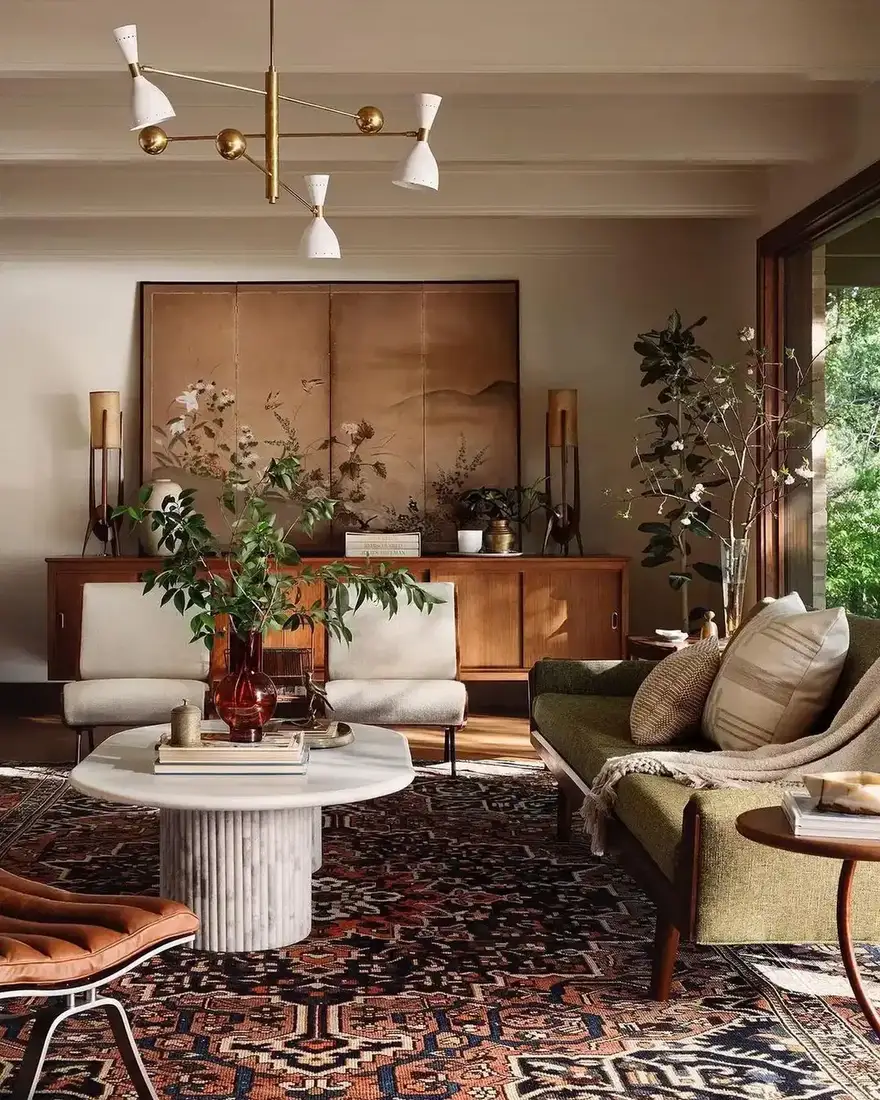
Look at the floor before the furniture. A large tribal rug in rust, indigo and cream runs wall to wall under teak, leather and cane. Three brown woods meet in this room, which should clash, and the reason they do not is that the rug contains all three, so the eye takes them as quoted, not competing.
That containment is the governing measurement. A rug that stops short of the front legs divides the room into islands. One that runs at least 300mm beyond each seat frame joins them, and in a room of mixed vintage pieces that joining is doing more work than any single chair. Buy 280 by 360cm where the budget allows; 200 by 300cm crowds a three seat arrangement.
The screen behind the sideboard deserves a sentence. A four panel gilt landscape, roughly 1800mm wide, hangs the full width of the teak unit beneath it, which is the proportion that makes it settle. Art narrower than the piece below it always looks borrowed.
The odd frame out, read honestly
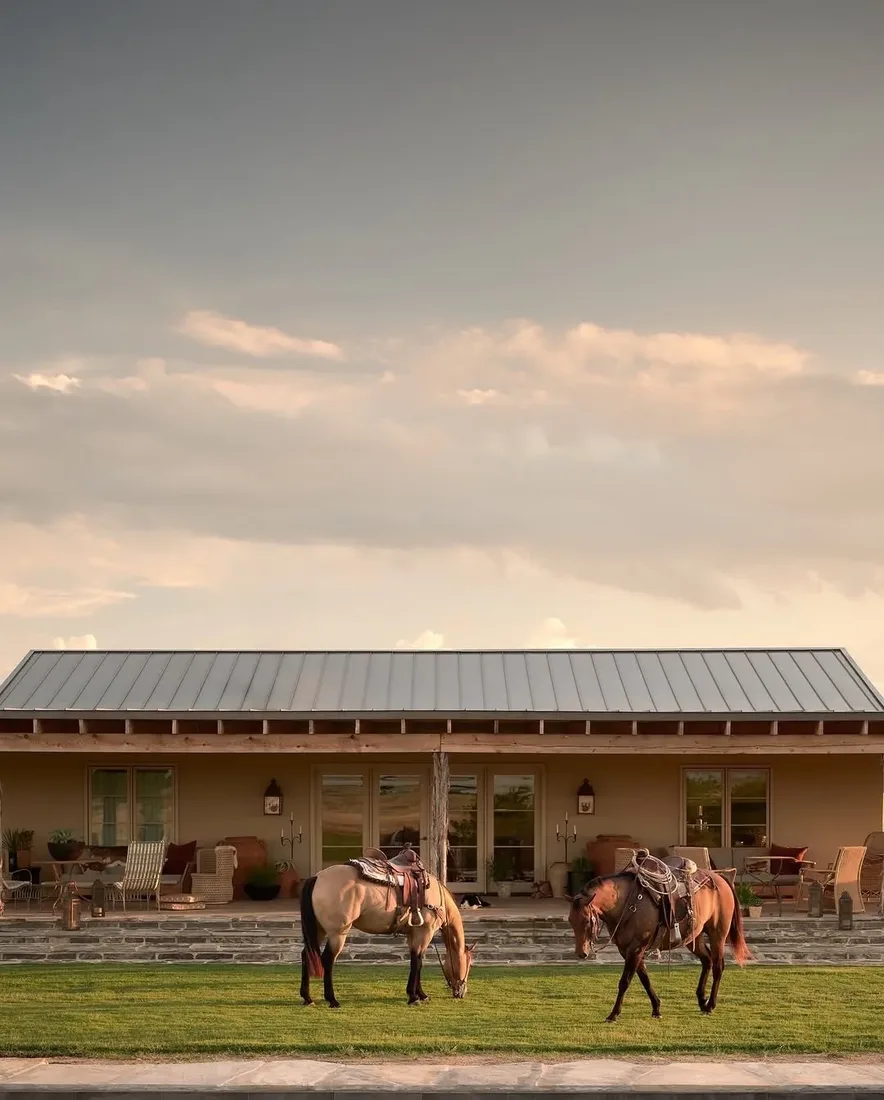
This photograph shows no living room at all, which is worth saying plainly. A standing seam ranch porch with two saddled horses grazing beyond, photographed at dusk. Its filename promises an interior it does not contain.
Read it for what it does show, because the porch logic still belongs to the argument. Deep shade, timber posts, layered seating in stripes and wicker, lanterns hung at head height, not overhead. That is the same low warm light the interiors use, moved outside. Modern houses that open to a porch this deep need less correction indoors, since half the evening happens under cover.
If this room were being shopped honestly, the money would go to outdoor wicker and stone, not another cushion. Polished concrete or stone flags at 600 by 600mm, deep seated teak or powder coated aluminium frames with quick dry foam, £400 to £1,200 per chair in 2026. Cheap rattan lookalikes fray within two summers; buy once.
Arches let a hard table go quiet
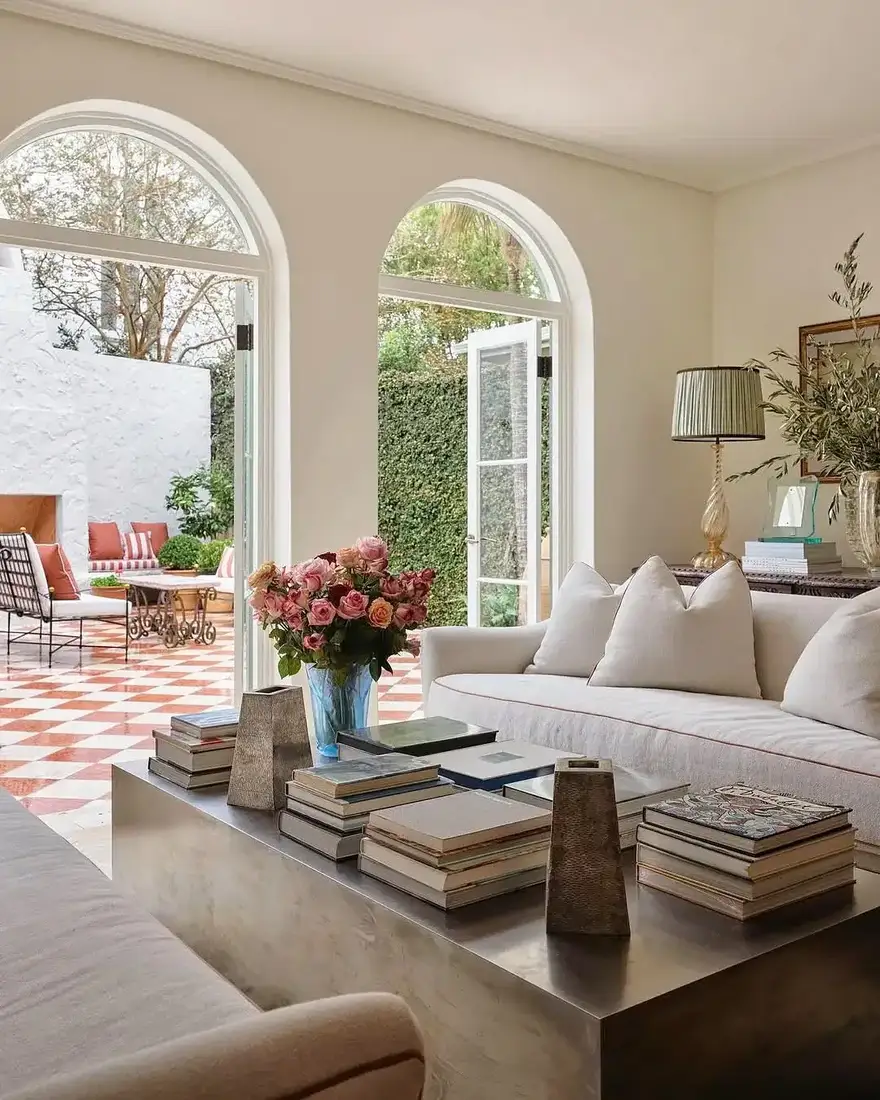
Look at the table before the view. Brushed steel, nearly 2000mm long, stacked with books and stone objects. Against square openings it would read as a desk. Between two arches it reads as a plinth, because the curve does the softening that no styling could.
That is the mechanism worth copying. Where the architecture supplies a curve, the furniture can stay rectilinear. Where it does not, the furniture must supply one, which is why square rooms full of square tables feel so unrelenting. One arch is worth a room of cushions.
The terrace beyond doubles the palette. Terracotta and cream checks, iron chairs with rust cushions, clipped green behind white render. Checked floors of encaustic or concrete tile run £60 to £140 per square metre laid in 2026. Keep the grout pale; dark grout would grid the view.
Glass walls need weight at the skirting
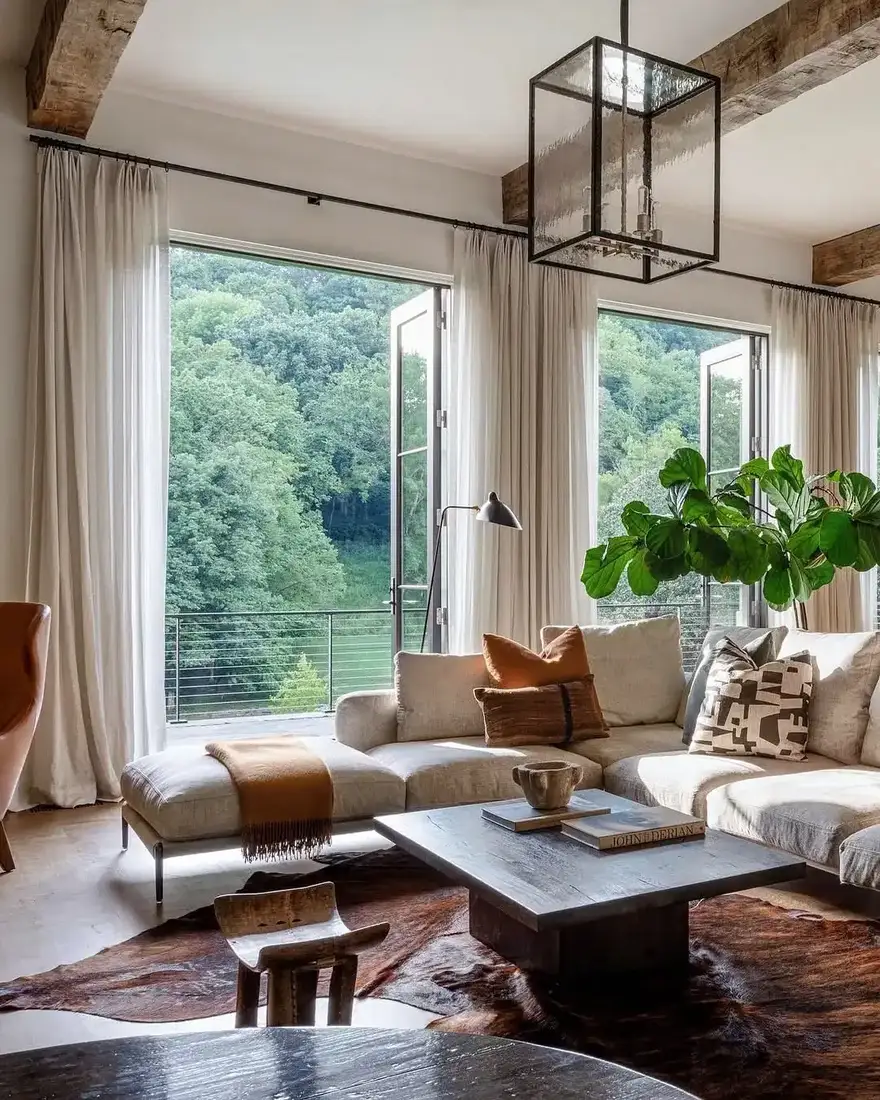
This room is mostly view: floor to ceiling glass on two sides, pale linen sectional, valley and trees beyond. The move that stops it floating away sits on the floor, a dark hide rug running under the coffee table and out past the sofa on all sides.
Weight low is the rule wherever glass runs to the floor. Without it the furniture reads as clouds and the eye keeps travelling out. With it the seating claims territory, because dark hide against pale oak holds the way a plinth holds sculpture. Cowhide rugs in this scale run £300 to £900, and vegetable tanned pieces age better than chemically finished ones.
Curtains here are doing quiet structural work. Linen sheers on blackened steel rails, hung at least 200mm above the frame and 300mm wider each side, so the stack never covers glass by day. That clearance is the difference between draught proofing and decoration. Linen at 250gsm filters without blacking out; anything heavier would need a double track.
A barn this large needs baskets, not art
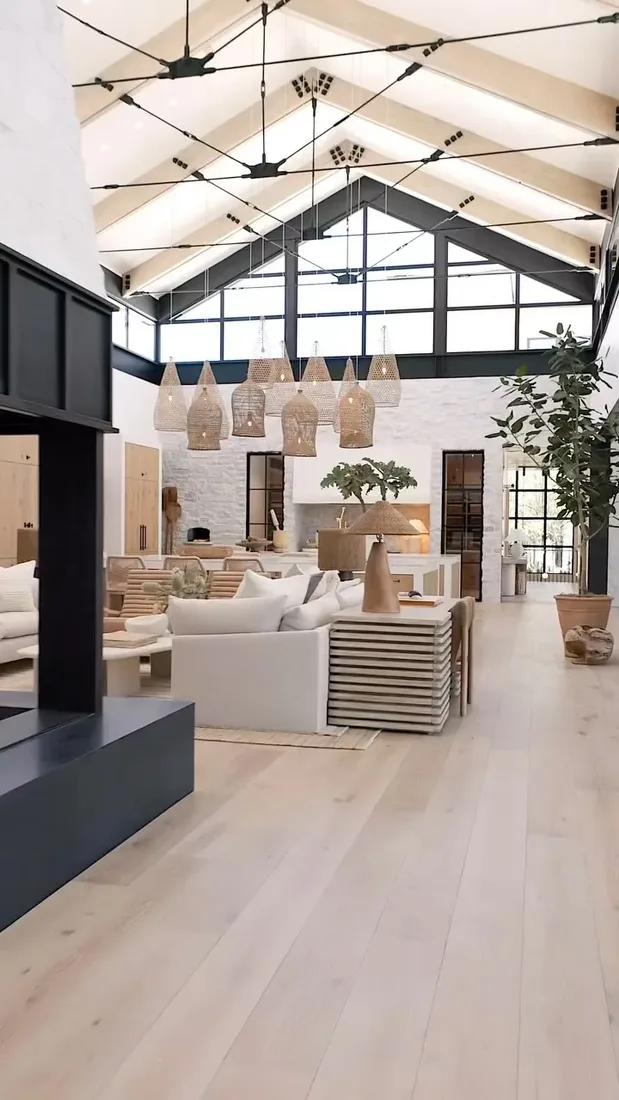
Count the pendants before anything else. Nine rattan baskets hung in a loose grid over a room the size of a tennis court. That repetition at high level is what brings a 6 metre ridge down to human scale, because the eye stops at the weave instead of travelling to the steel.
The governing ratio is pendant drop to floor area. One basket over a dining table is decoration. Nine over 100 square metres is architecture, and spacing them unevenly matters as much as number: a strict grid would read as a shop fit, while this loose constellation reads as gathered. Rattan pendants of this type run £80 to £250 each; buy the same weave in two sizes, not nine identical shades.
Underfoot, pale oak boards run unbroken for 15 metres, which risks glare. The correction sits beside the sofa: a slatted oak side table with a ceramic lamp at 2700K, throwing warm light sideways across timber, not down onto it. Side light flatters boards; downlights stripe them.
| Move | What to buy | 2026 guide |
|---|---|---|
| Lamp glow, warm | Dim to warm LED 2700K and below, Philips or Tala | £15 to £40 per bulb |
| Rug that joins seats | Wool or hide, 280 by 360cm minimum | £400 to £1,500 |
| Throw at arm height | Undyed wool or mohair, Weaver Green | £80 to £200 |
Sunlight is a material, so give it something to hit
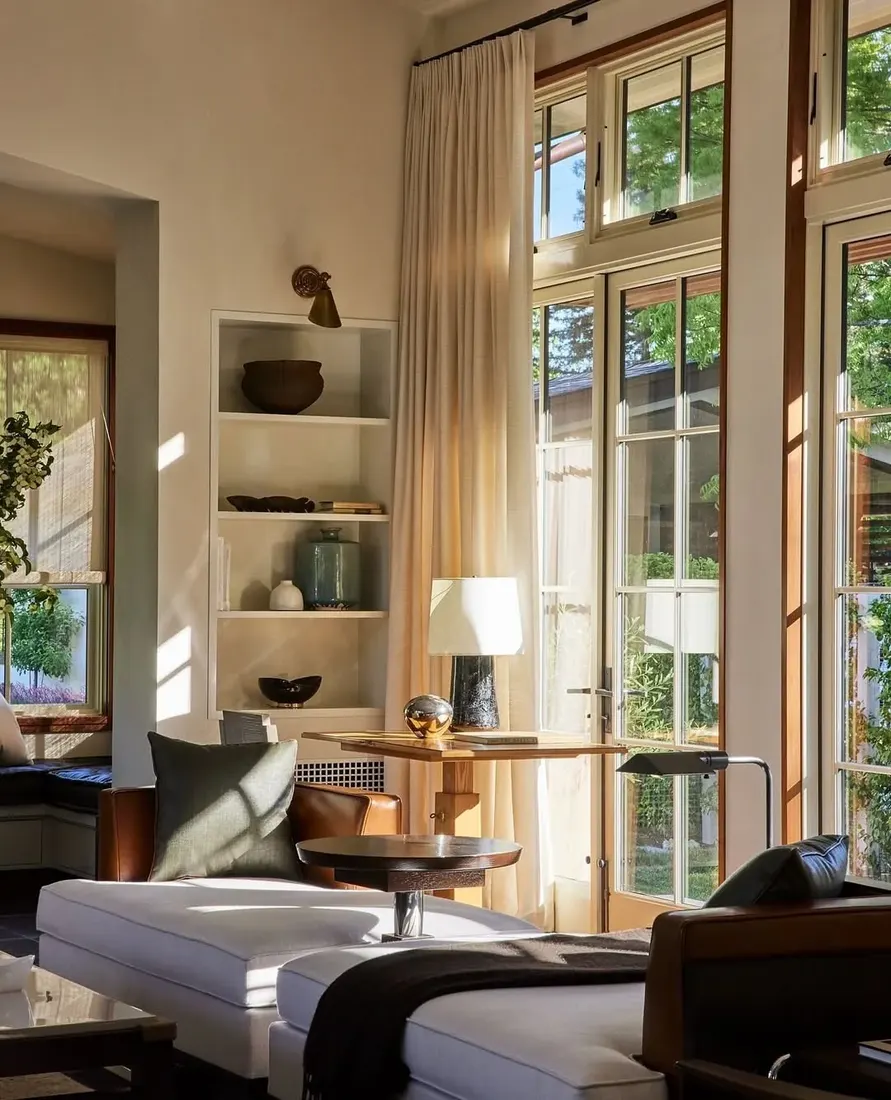
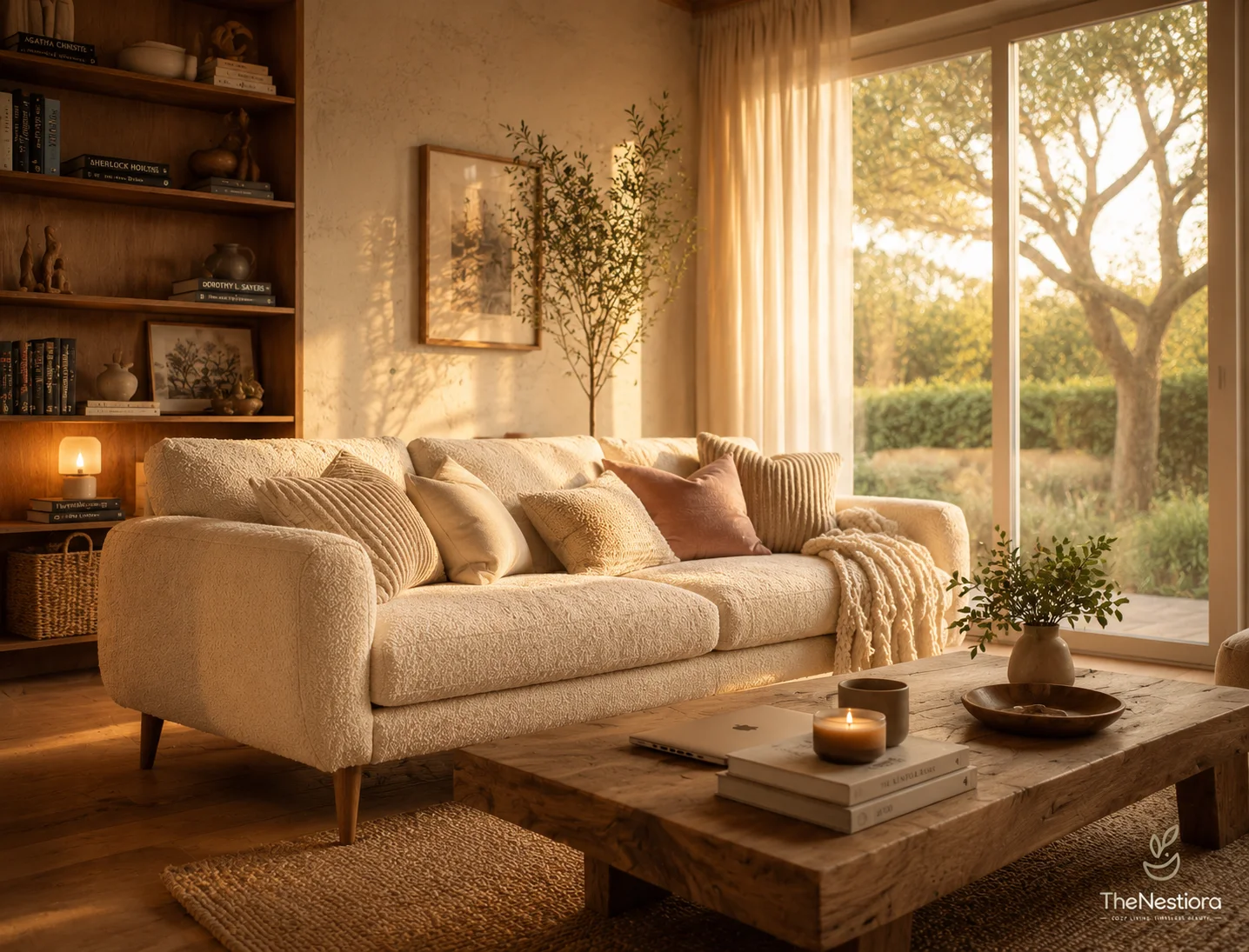
Look at where the sun lands, not the window it comes through. Across white bouclé, cognac leather, oak, and a pottery bowl on open shelves. That warmth is not in the palette so much as in the pile and grain the light strikes, which is why the same white room would read cold on a north facing wall.
This reframes the usual advice about aspect. South facing modern rooms do not need warming; they need something worth warming, since bare plaster bounces light without holding it. Bouclé at 400gsm plus, oiled oak, leather that darkens: each stores sun differently, and the mix is what photographs as glow.
Shelving here obeys the one depth rule. Objects sit in a single layer with air between them, the large dark bowl high, small pale pots low. Two deep reads as storage. One deep with space reads as display. Edit to eleven objects and stop; the twelfth is what tips it.
Black frames want one fire and one fleece
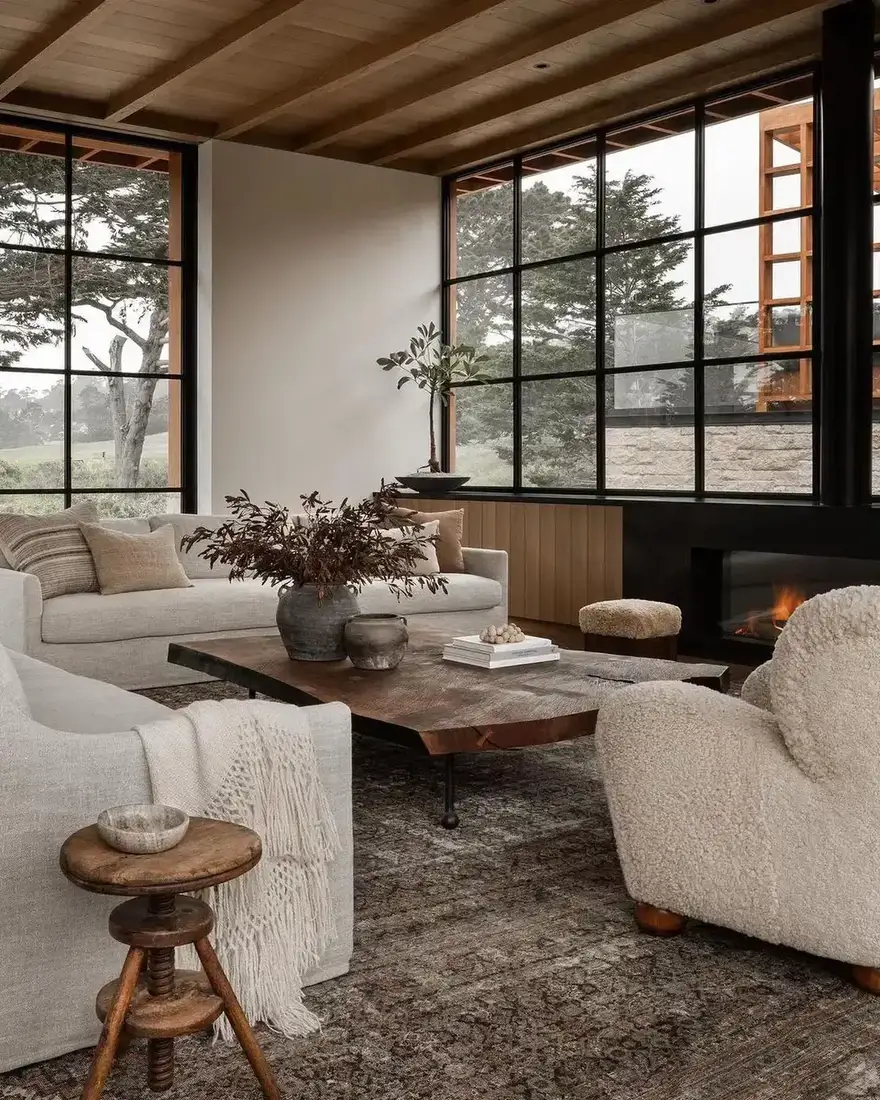
The hardest shell in the set closes the piece: black framed glass on two sides, concrete floor, live edge timber table. Two warm things answer it. A linear gas fire at skirting level and ivory bouclé chairs with the pile of sheep.
Fire placement is the decision. Set 300 to 400mm off the floor, not at standing height, it warms feet and throws moving light across the rug, which is where people look when seated. High fires warm pictures. Low fires warm people. Flueless gas or bioethanol units of this type run £1,500 to £4,000 fitted with the correct ventilation gap; anything cheaper usually means the flame picture suffers first.
The table needs a sentence because live edges divide opinion. Here the edge faces the fire, not the chairs, so hands meet a straight cut while eyes get the wobble. That orientation is what makes it livable. Turn it round and sleeves catch for the life of the piece.
Frequently Asked Questions
Why does my modern room feel cold despite good furniture?
Light usually sits too high and every surface matches in smoothness. Bring one lamp below eye level and one rough textile to arm height. The shell can stay as it is once the touch varies.
Which single texture warms fastest?
Wool at sitting level, whether a throw, rug or loose cover. It holds lamplight instead of bouncing it. Hide and rattan help, but neither forgives like wool after dark.
What bulb colour suits modern plaster and glass?
2700K and below, dimmed warmer still in the evening. Cooler sources turn white walls blue grey and black frames hard. Warm sources turn both honeyed.
How large should the rug run?
Past the front legs of every seat by at least 300mm. Smaller sizes island each chair. One generous wool plane joins them into a single sitting group.
Can mixed woods sit together?
Yes when a rug or textile already contains their tones. Three browns without a link compete. With a patterned link they sit together instead of clashing.
What should I skip in a glass walled room?
Tall pale storage that reflects the view back at itself. Low dark pieces anchor instead. Height belongs to the glazing; weight belongs near the floor.
In order
- Bring one organic texture to sitting height before buying anything else.
- Drop the light to lamps below eye level at 2700K and below.
- Run the rug 300mm past every front leg so seats join.
- Let curves come from architecture or furniture, never neither.
- Weight glass walls with dark hide or wool near the floor.
- Hang curtains wide and high so stacks never cover glass.
- Repeat pendants loosely in large volumes, never in strict grids.
This article may contain affiliate links. We may earn a commission at no extra cost to you.