12 Garden Decor Ideas: What Holds the Lights Up, and Where the Light Points

Add us as a preferred source to see more stories on Google.
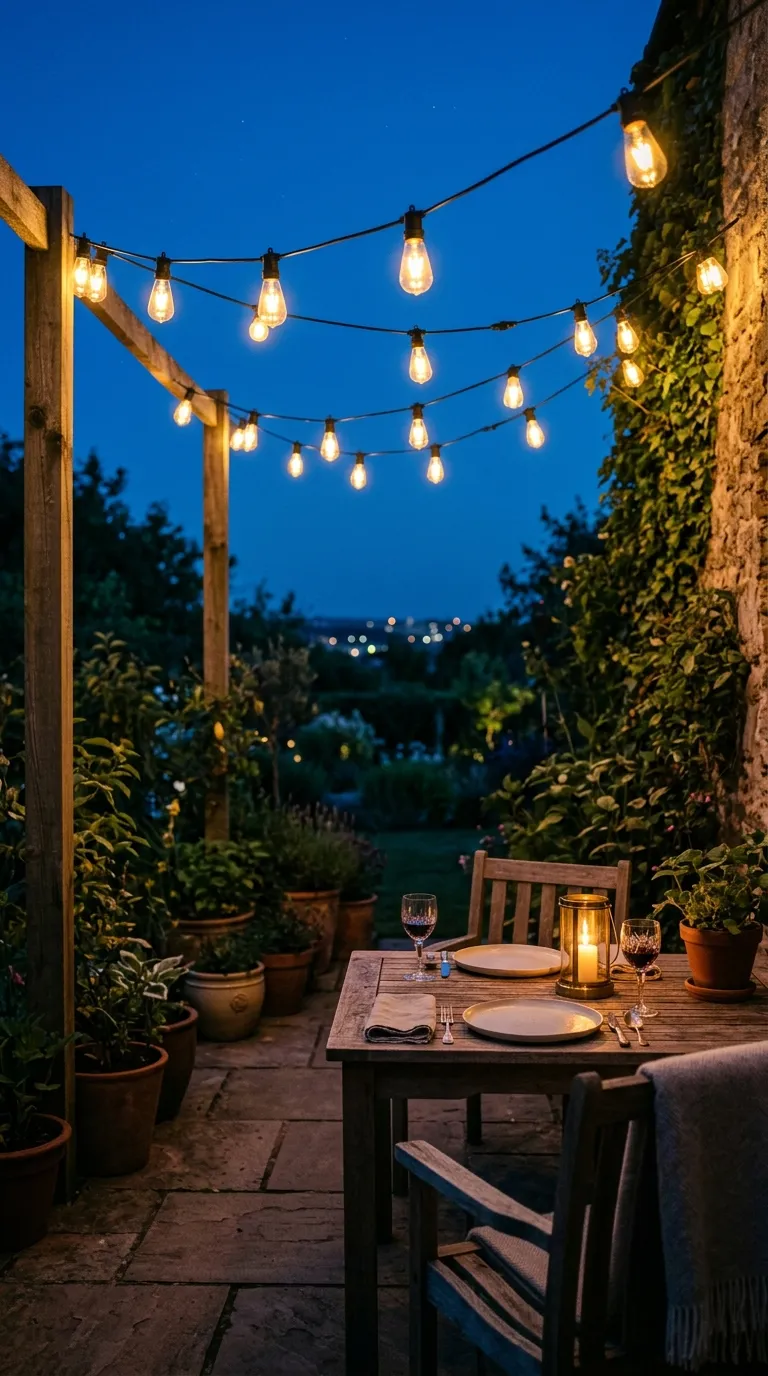
The lights below are doing something specific, and it is not simply being pretty.
They run across the space, from a post on one side to the wall on the other, in three sagging catenaries. Look up from that table and there is something over your head.
Run the same lights along the fence instead and they trace the boundary. The eye follows the line, arrives at the corner, and the garden announces exactly how big it is. A ceiling does the opposite: it defines a room within the garden and leaves the edges vague.
The load, which is larger than it looks
A run of festoon lights across a garden is a sail. In wind it pulls hard and it pulls sideways, and the forces at the fixing points are considerable.
Fence panels will not hold it. A standard panel is held in slotted concrete posts and is designed to resist wind across its face, not a point load pulling along its length. The usual failure is either the light cable stretching until the lights hang in the shrubs, or the fence itself moving.
Proper supports are either posts set in concrete, 100mm square minimum and buried at least 600mm, or eye bolts resin-fixed into solid masonry. The posts in that photograph are substantial and clearly set in the ground rather than bolted to something.
Stainless catenary wire at 3 to 4mm, with turnbuckles to tension it, costs around £30 to £50 for a domestic run and is the difference between a temporary arrangement and a permanent one.
Allow for sag. A wire pulled bar-tight will eventually fail at a fixing; a wire with a deliberate curve in it absorbs movement. The sag also looks considerably better, and you can see it in the photograph.
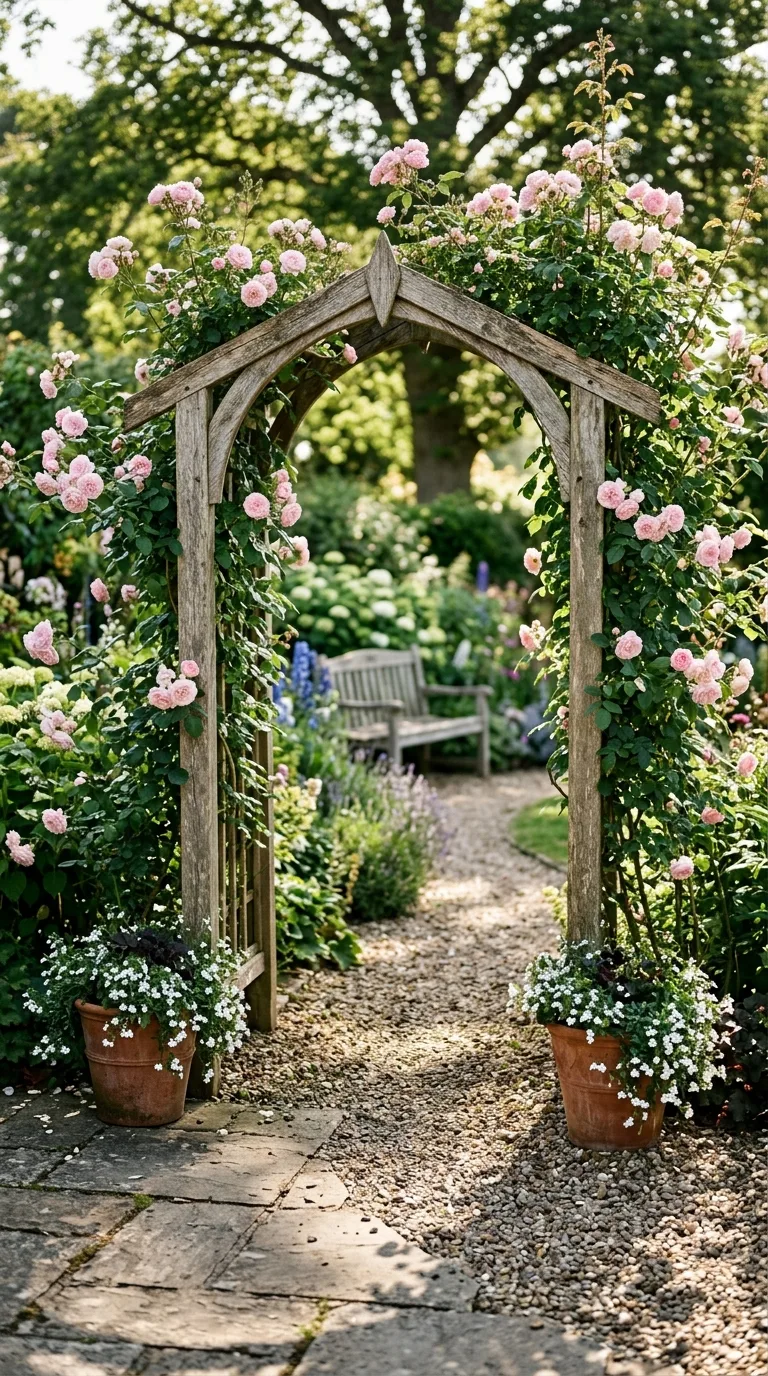
An arch is a post-and-beam job, and the rose is the load
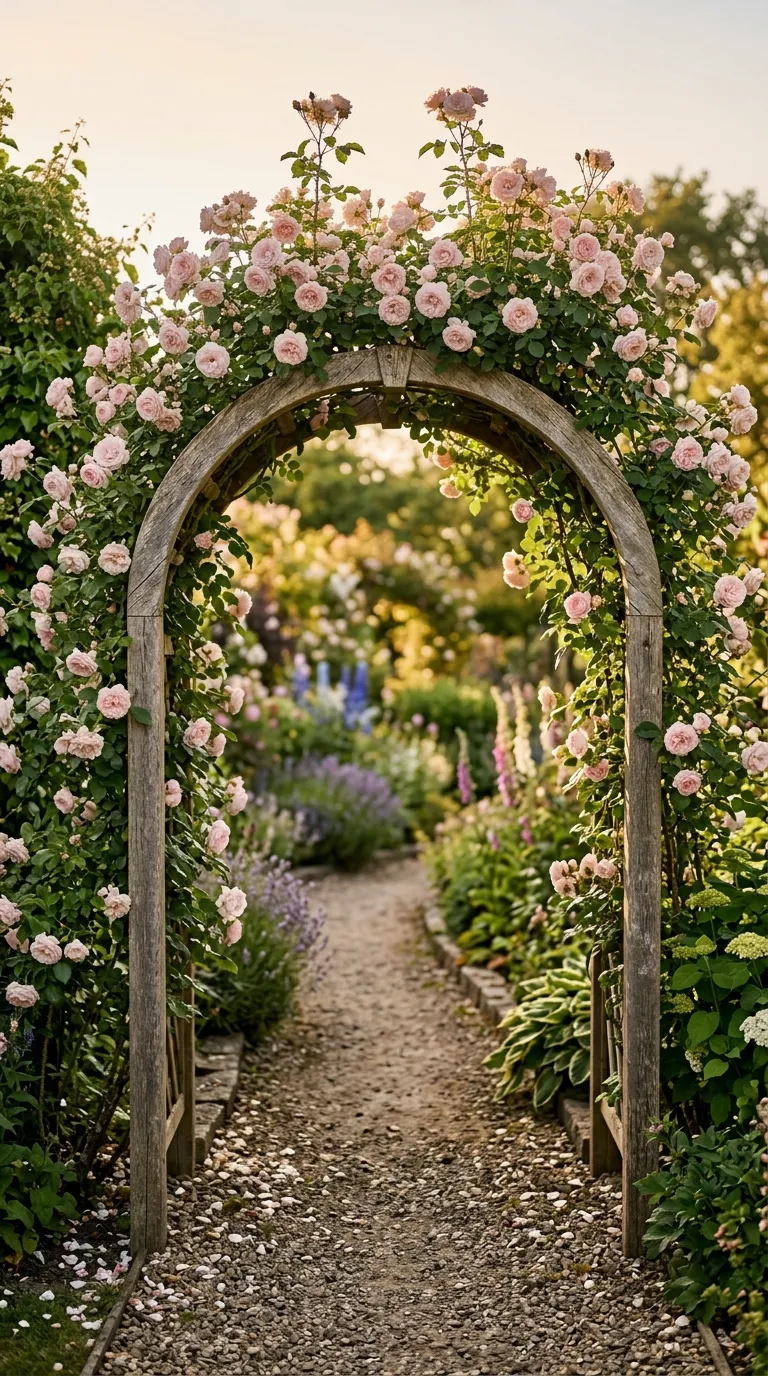
That arch is a two-piece timber frame, roughly 2m to the crown, with its feet in the ground either side of the path. A climbing rose in full flower has taken the whole top and most of both uprights.
The weight in it is mostly water, not timber. A rose in full leaf after rain holds a great deal, and the load lands at the two shoulders where the uprights meet the curve. That joint is where these arches fail: a lap and two screws will hold the timber, and then one winter the crown sags and never comes back.
It is also the one part you can no longer inspect once the rose has covered it.
Stainless screws, or a galvanised strap over the joint, settle the question for a few pounds. Oak is worse, because its tannic acid eats zinc plating and leaves black stains down the timber within a year.
The feet matter as much as the joint. Set them 300mm into the ground in concrete, or on metposts, and the arch stops moving in wind. An arch standing on paving will walk. On an exposed site, a timber arch under a heavy climber is a two-year structure, so grow something lighter on it.
A pergola carries the same load in compression
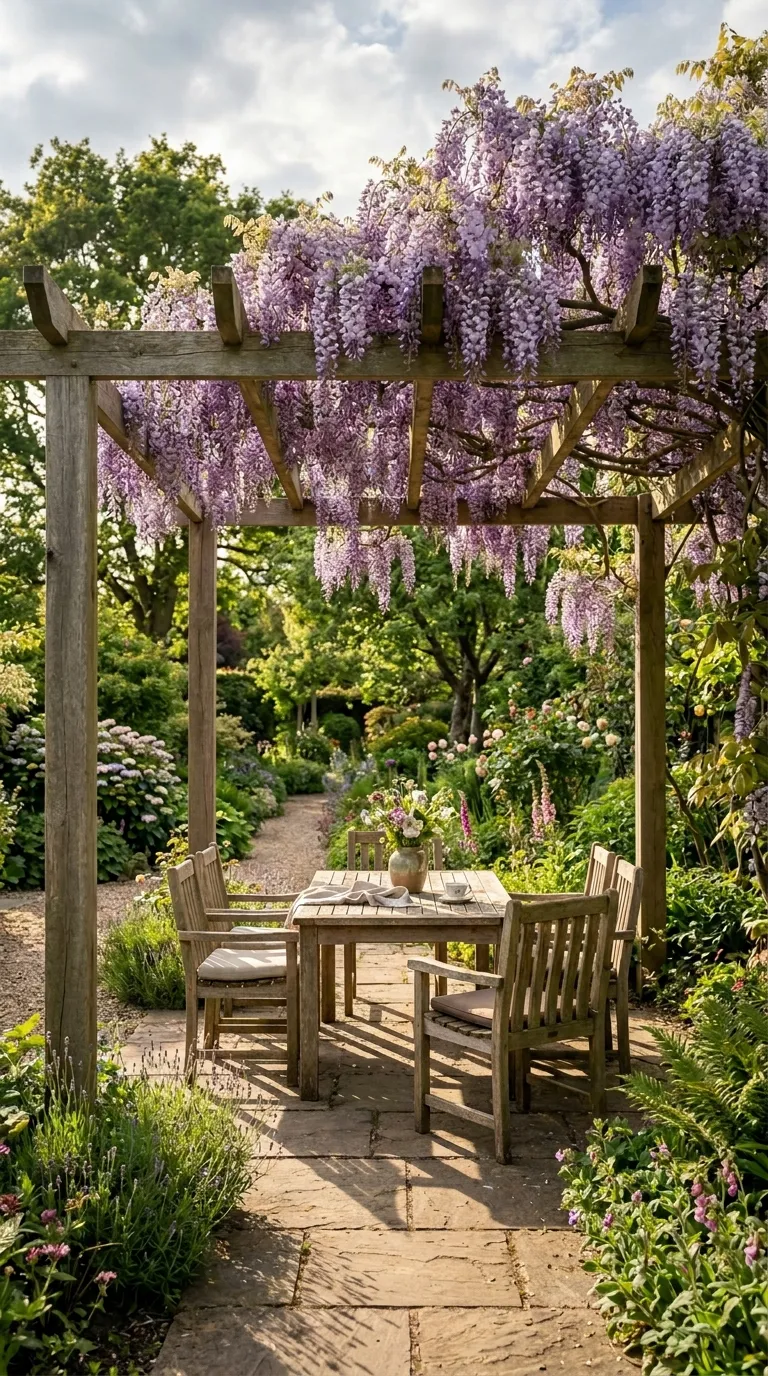
Wisteria over a pergola is the rose arch turned the right way up. The frame pushes down, the posts take it in compression, and the ground does the rest. That is the easy direction, and it is why a pergola forgives more than an arch does.
The hard direction is sideways. Once a wisteria has covered the rafters the roof is a sail, and a post bolted only to a paving slab will lift and rack in a winter gale. Either the posts go into concrete footings, or the frame gets diagonal bracing at the top corners. Most kits include neither.
The pruning decides whether the structure outlives the plant. Wisteria flowers on short spurs of last year’s wood, so the long whips want cutting back to about five buds in late summer and again to two or three in January. Skip the summer pass and the growth goes into leaves and rope, and the load on the rafters doubles.
The honest part: a wisteria can sit for five years before it flowers, and it will not flower at all if it is pruned at the wrong time or fed hard. Surviving is not the same as flowering.
Height, spacing, colour
| Decision | Sensible |
|---|---|
| Height above ground | 2.4 to 2.8m, clear of heads with a bit of ceremony |
| Bulb spacing | 300 to 500mm; wider looks sparse |
| Colour temperature | 2200 to 2700K |
| Rating | IP44 minimum, IP65 if fully exposed |
| Number of runs | Three or more; one line reads as a washing line |
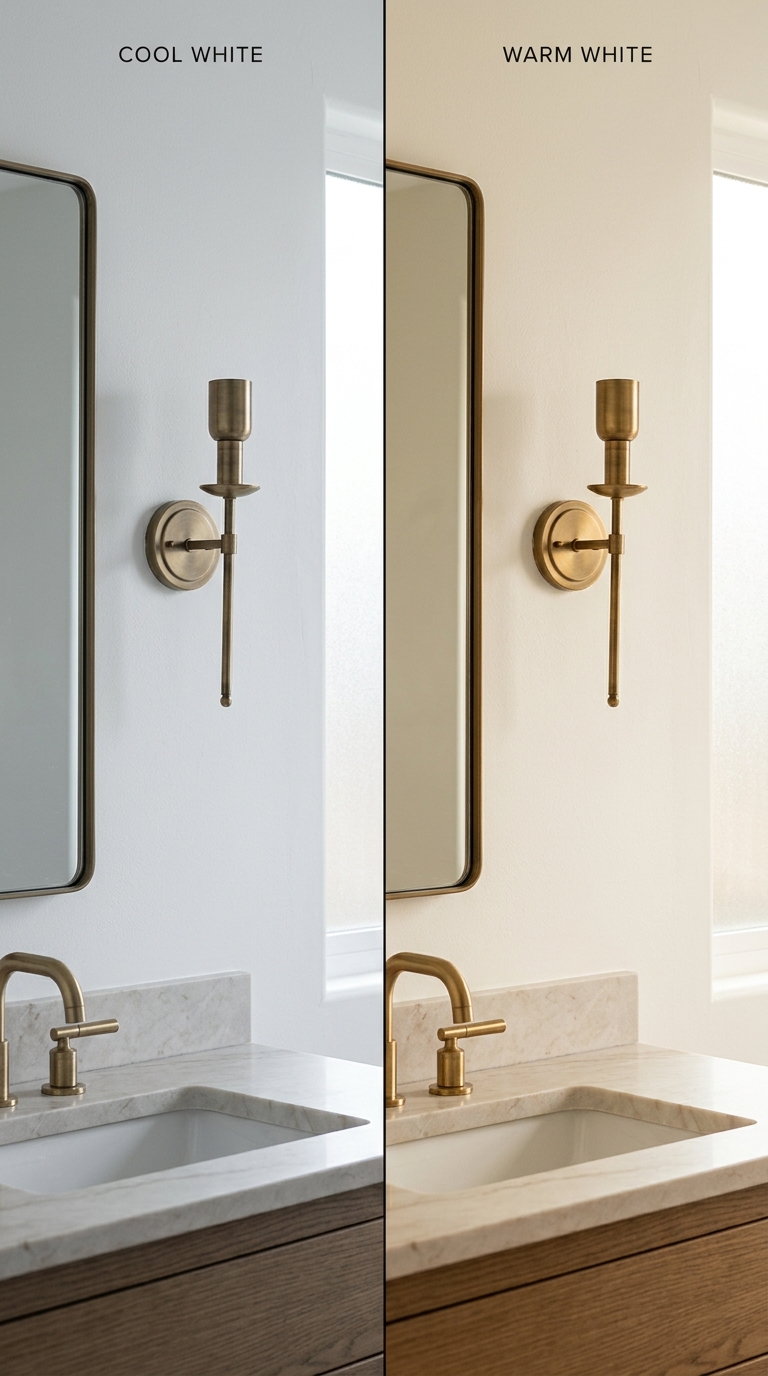
Colour temperature is the thing that separates a warm terrace from a car park. Anything at 3000K and above reads cold outdoors, where the surrounding darkness gives the eye nothing warm to compare against. The lights above are clearly at the warm end and it is most of why the picture works.
Filament-style LED bulbs give the best of both: the look of a tungsten festoon with the running cost and lifespan of LED. Expect £30 to £80 for a 10 to 20 metre commercial-grade festoon; the very cheap sets fail at the sockets within a couple of seasons.
Solar is the honest disappointment here.
In British light levels it delivers a fraction of the stated output, and the panel charges least in exactly the season you most want the lights. By October a solar festoon is typically dimming by nine in the evening. Mains or a low-voltage transformer is worth the extra trouble, and the difference in output is not subtle.
Aim the fitting, then hide it
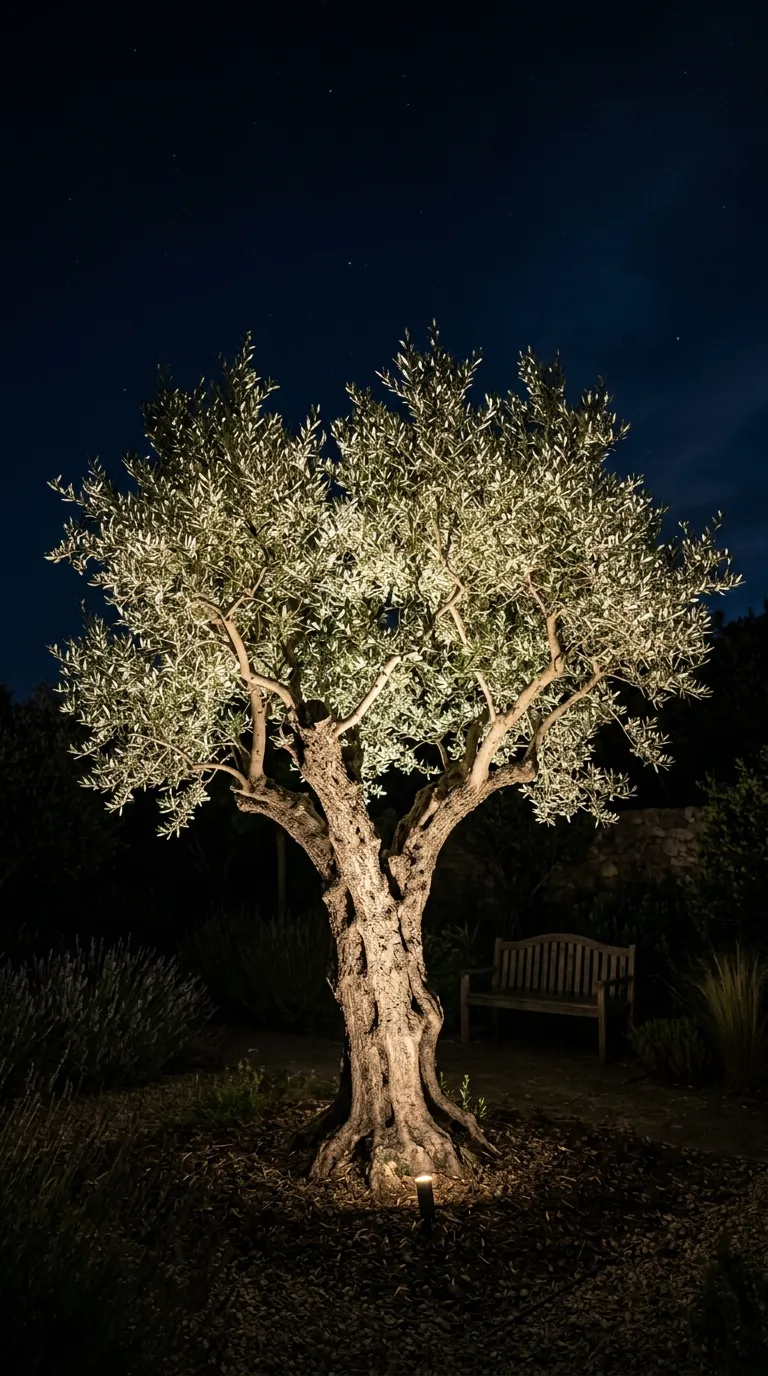
One olive, one fitting, and the canopy does the work. The light comes from the ground a little way out from the trunk and aims up through the branches, which is why the trunk reads as gnarled and the leaf as silver.
Notice the fitting itself, sitting in the mulch at the base of the trunk. Once the source can be seen the eye goes to the lamp instead of the tree, and the effect thins out. A glare shield, or setting the fitting 300mm further back under the bark, fixes it in an evening.
Aim matters more than wattage. Pointed straight up the trunk the light is symmetrical and flat. Moved 200 to 300mm to one side it rakes across the bark and throws the branch shadows up into the canopy, which is the part that looks expensive.
Not every tree takes to this. An olive, a maple or a multi-stem birch has a trunk that takes light and a canopy open enough to pass it through. A dense conifer lights as a green cone and nothing else, because the light stops at the outer needles. I would not spend the money there.
6W at 2700K is ample for a tree that size. On a 12V run, cable size decides whether the far fitting arrives at full brightness or slightly dim.
One finish, three heights
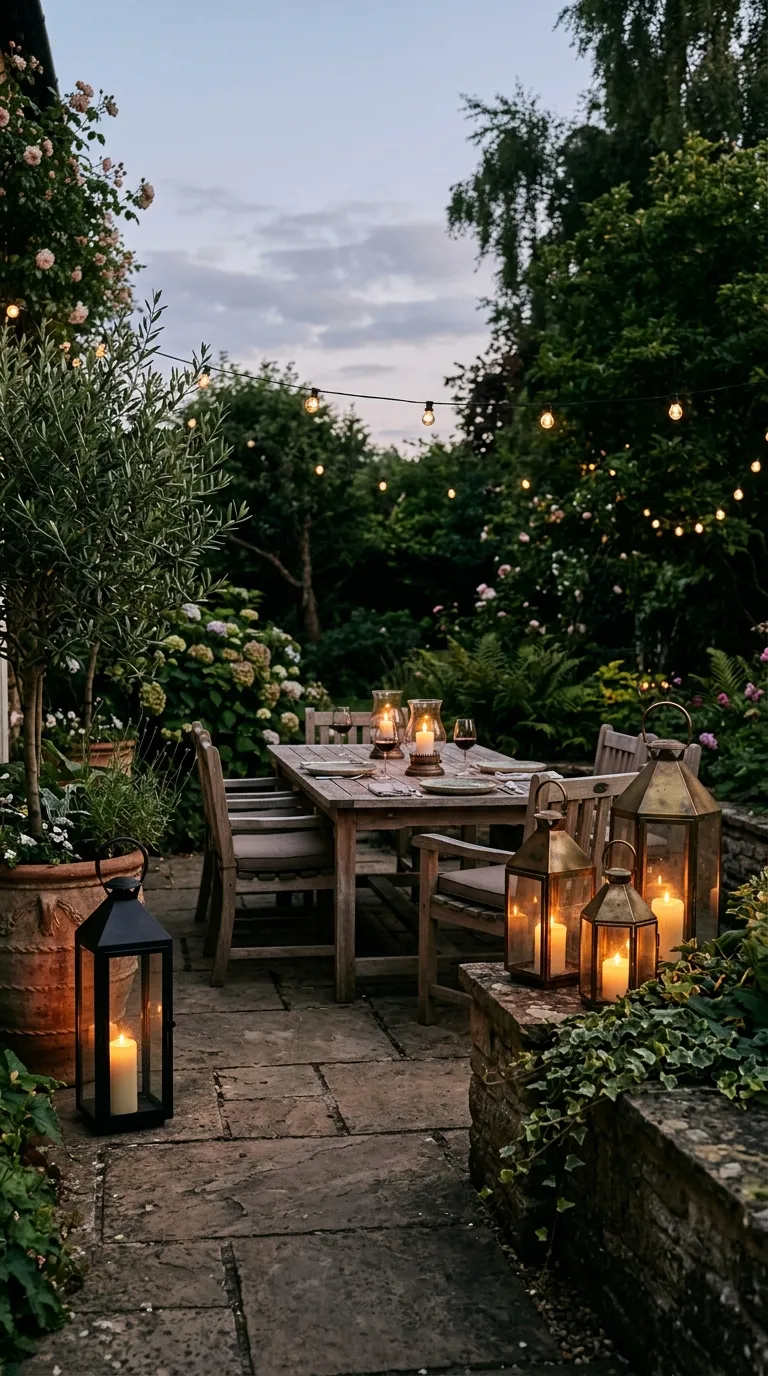
There are five lanterns in that frame: two small ones on the table, three brass ones on the wall to the right, and a tall black one standing on the paving at the left. Above them the festoon runs away towards the trees.
What makes the group work is the heights. Five lanterns at one level would leave a garden lit at the top and dark in the middle, which is where people are.
The two finishes are the interesting part, because the usual advice is to repeat one. Brass on the wall and black on the paving still read as one family here, and the reason is that the shapes match: same square frame, same glass, same candle inside. Get the shape right and the metal matters much less.
Battery candles on a timer do everything a real candle does in that setting, and they are still doing it in October. In a lantern standing on gravel, a real flame is one gust from the border. Expect £15 to £60 each.
A fire does the job a festoon cannot
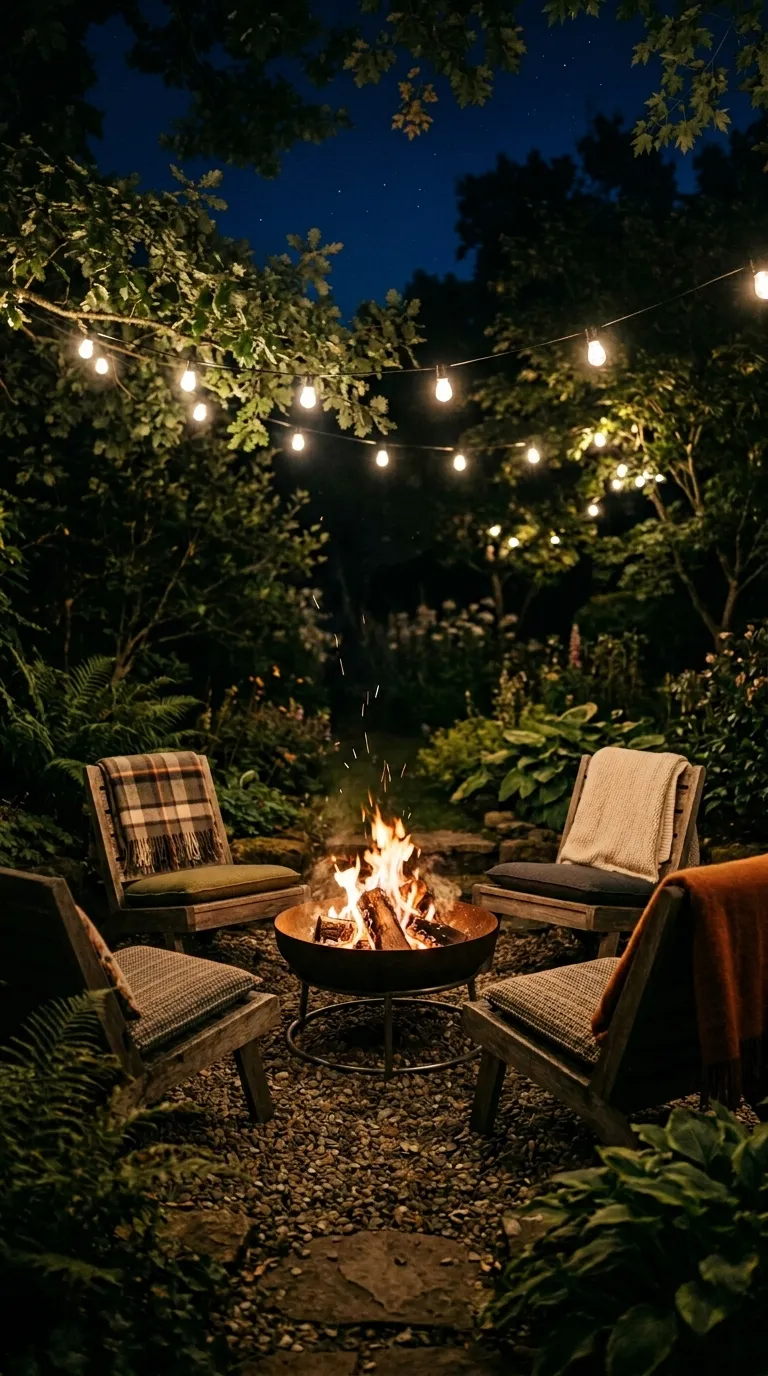
Four chairs, all turned towards the same bowl, with string lights running overhead through the branches. The fire is doing something the festoon cannot: it lights the people, not the ground.
That is why a fire pit holds a group together after dark. A run of lights overhead makes a room; a fire gives that room a floor to sit around, and it is the only warm light in a garden that moves. Sit the bowl on a stand or a paving slab, because one set straight on gravel over a weed membrane will scorch the membrane beneath it, and you will smell it before you see it. Keep the nearest chair 1m back from the rim, further than most people put them. Softwood spits; kiln-dried hardwood throws far fewer sparks onto the blankets.
Smoke is the catch. It follows whoever minds it least, and in a small garden with neighbours on two sides a fire pit is often the thing that stops a terrace being used, because the one evening you light it is the evening the wind turns.
The electrical bit
Anything permanent outdoors needs an RCD-protected supply and an outdoor-rated socket, and in the UK fixed outdoor wiring is notifiable work under Part P.
A plug-in festoon running from an existing outdoor socket is not, which is why most people go that route. Use an IP-rated socket and a proper outdoor extension rather than an indoor lead through a window, which is the most common and worst arrangement.
The honest bit about the photograph
That image was taken during the blue hour, and the blue hour lasts about twenty minutes.
At that moment the sky still holds deep colour, the lights read warm against it, and everything looks like the picture. An hour later, in full dark, the same lights against a black sky look considerably more ordinary, because there is nothing for them to be warm against.
This is not a reason to skip them. It is a reason to know that the very best of it is a short window each evening, and to plan the seating so you are outside during it rather than coming out at ten.
Low-level light helps a great deal at full dark: a lantern on the table, candles, a couple of spike lights up into planting. Those give the eye something at eye level once the sky has gone.
The path needs an edge before it needs a curve
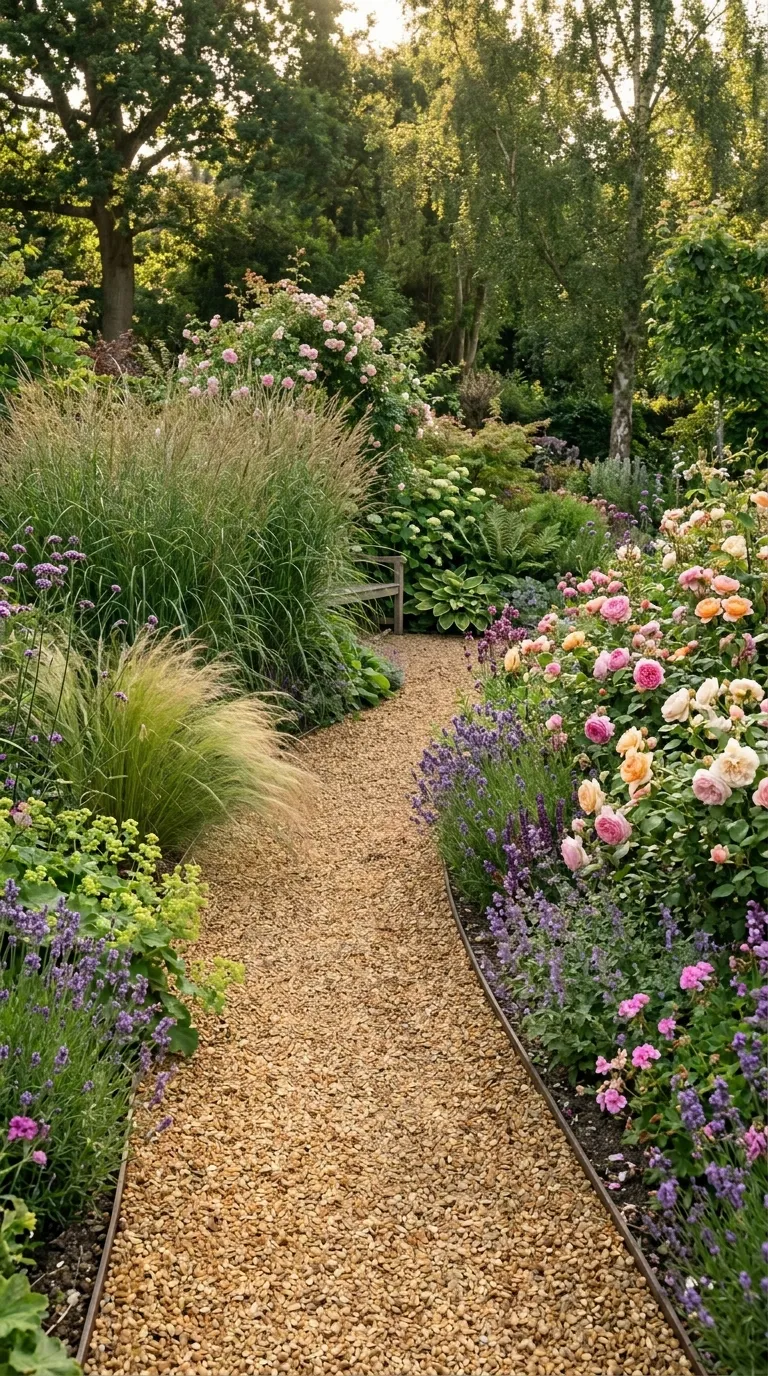
Look at the two thin lines running along both sides of that path. That is metal edging, and it is the part of the photograph to copy. The bend is the pleasant bit; the edge is the bit that keeps working.
Gravel without an edge does not stay on a path. It migrates into the border over a season, the border soil creeps back the other way, and by the second spring the line between them has gone. A 100mm steel or aluminium edge, set with its top a few millimetres above the stones, stops both movements at once.
| Surface | Build-up | Width |
|---|---|---|
| Pea gravel path | 40 to 50mm of 10mm gravel over a geotextile | 900mm for one person |
| The same path on clay | 75mm of compacted MOT Type 1, then geotextile, then gravel | 1.2m where two people pass |
| The edge, either way | 100mm steel or aluminium strip, top just above the stones | both sides, always |
On the curve itself, a bend laid out with a hose and tightened by eye usually ends up too tight, and a tight bend reads as a mistake. Walk it before you dig, and loosen it until the far end is out of sight. The bench in the frame sits where the path turns, which is what hides the rest of it.
The bubbling stone hides its works
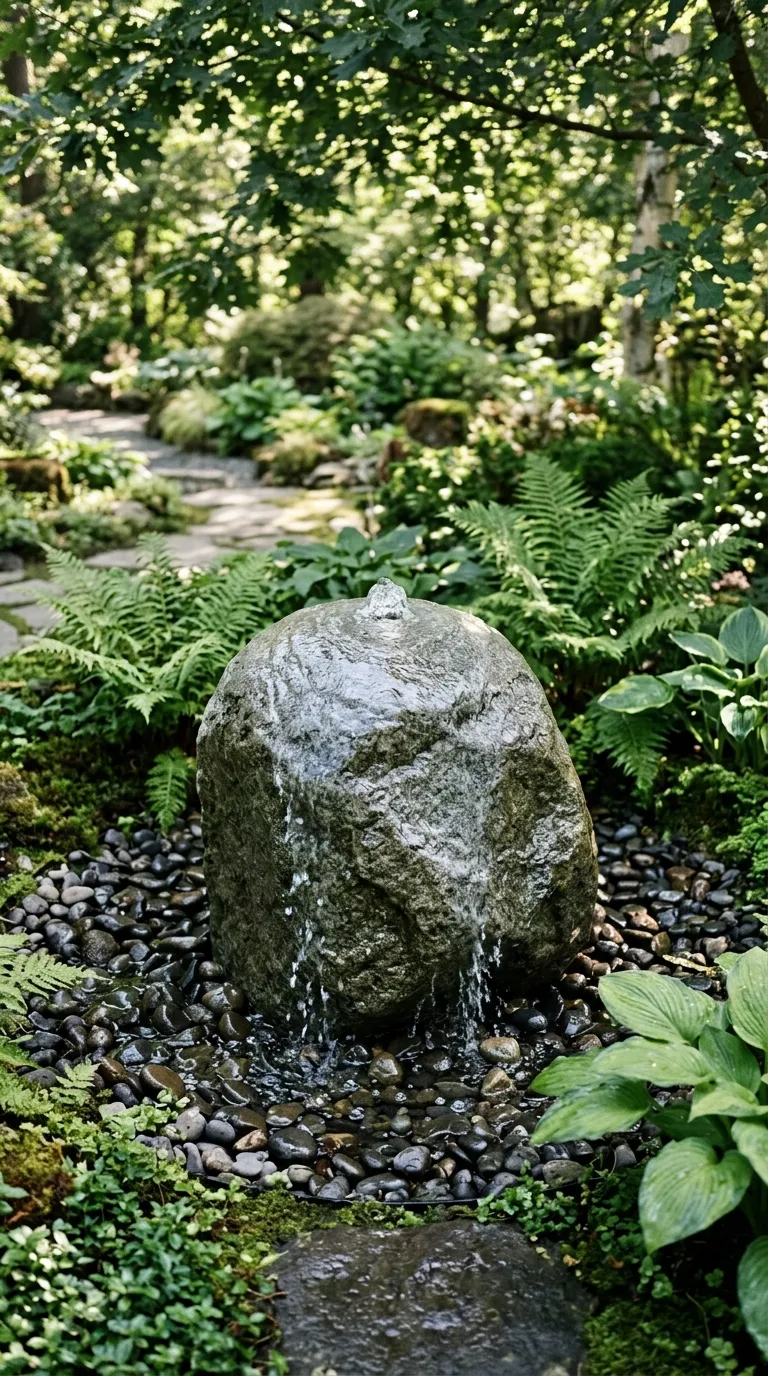
Water wells out of a hole in the top of that boulder and vanishes into the pebbles at its base. Notice how there is no rim to see. The stone looks as though it has always been there, which is the whole trick.
What happens below is unglamorous. A pump sits in a reservoir sunk beneath the pebble bed, a pipe runs up through the stone, and the water returns through the pebbles and a filter sponge. The pebbles cover the rim, so there is no edge to disguise.
That arrangement has two costs, both seasonal. In summer, evaporation and splash take the reservoir down by more than a watering can a week, and a pump that runs dry burns out within an hour. In a hard frost, water left in a full reservoir freezes and splits it, so drain the thing in November or keep it running.
Siting is what people get wrong. The sound is at its best within about 3m of where you sit; further off it becomes background, and you have paid for a pump nobody hears.
The table goes where the lights already are
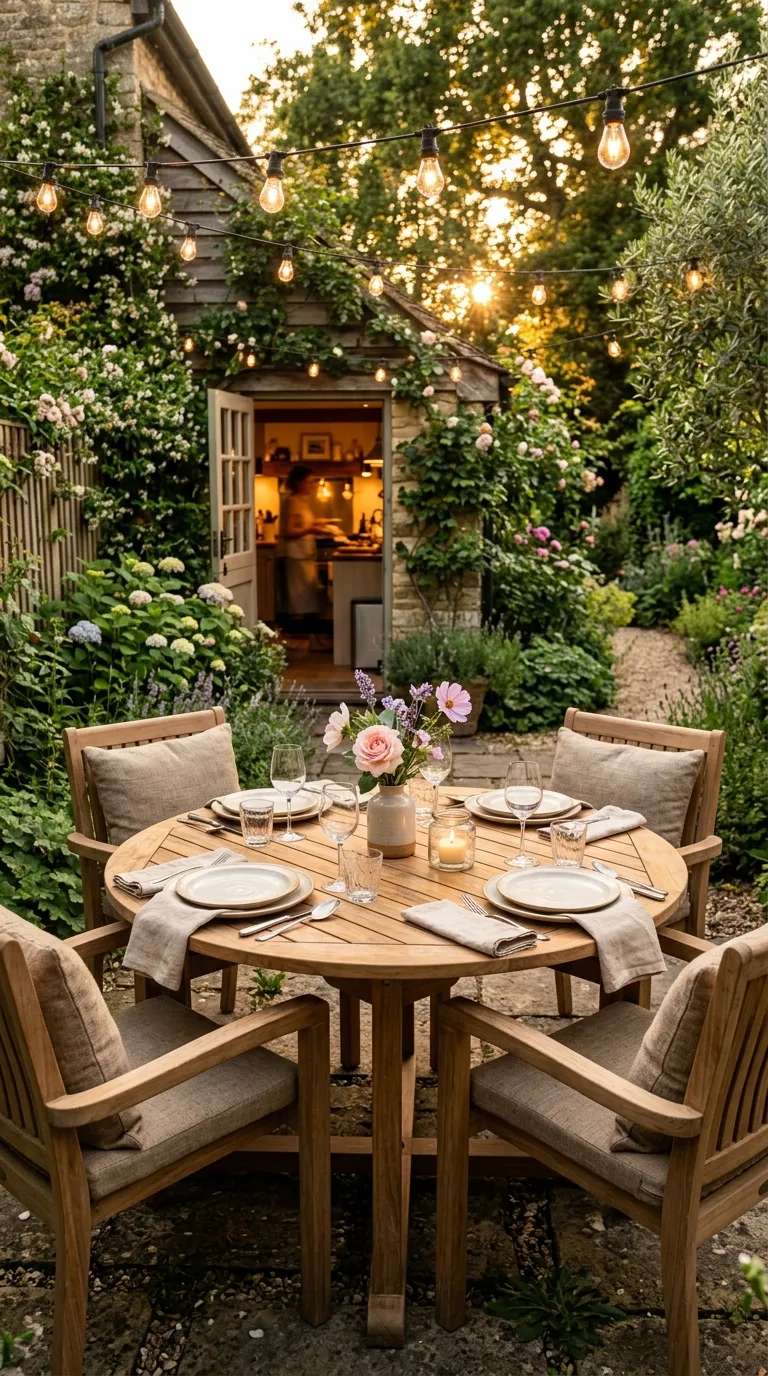
The table in that photograph sits directly under the lowest part of the festoon run, and that is not a coincidence. The lights decide where the table goes. A run across a terrace makes a room, and the table is the floor of it.
Which is why the order of work matters. Hang the lights first, find where the lowest bulbs sit and the sag is deepest, and put the table under it. Done the other way round, the lights usually end up running past the table instead of over it.
A round table 1.2m across seats four with room for elbows. Allow 750mm from the edge to the back of each chair, and 1m of gravel behind the chair so somebody can walk past a seated person.
Teak left out all year goes a soft silver-grey within about 12 months, and that is the finish in the frame. Oiled teak keeps its honey colour and wants re-oiling twice a year, which is a job most people do once.
The other thing in the frame is the open kitchen door. A table 3m from the kitchen gets used four evenings a week; the same table at the end of the garden gets used on the evenings somebody volunteers to carry things.
The wall is the shelf
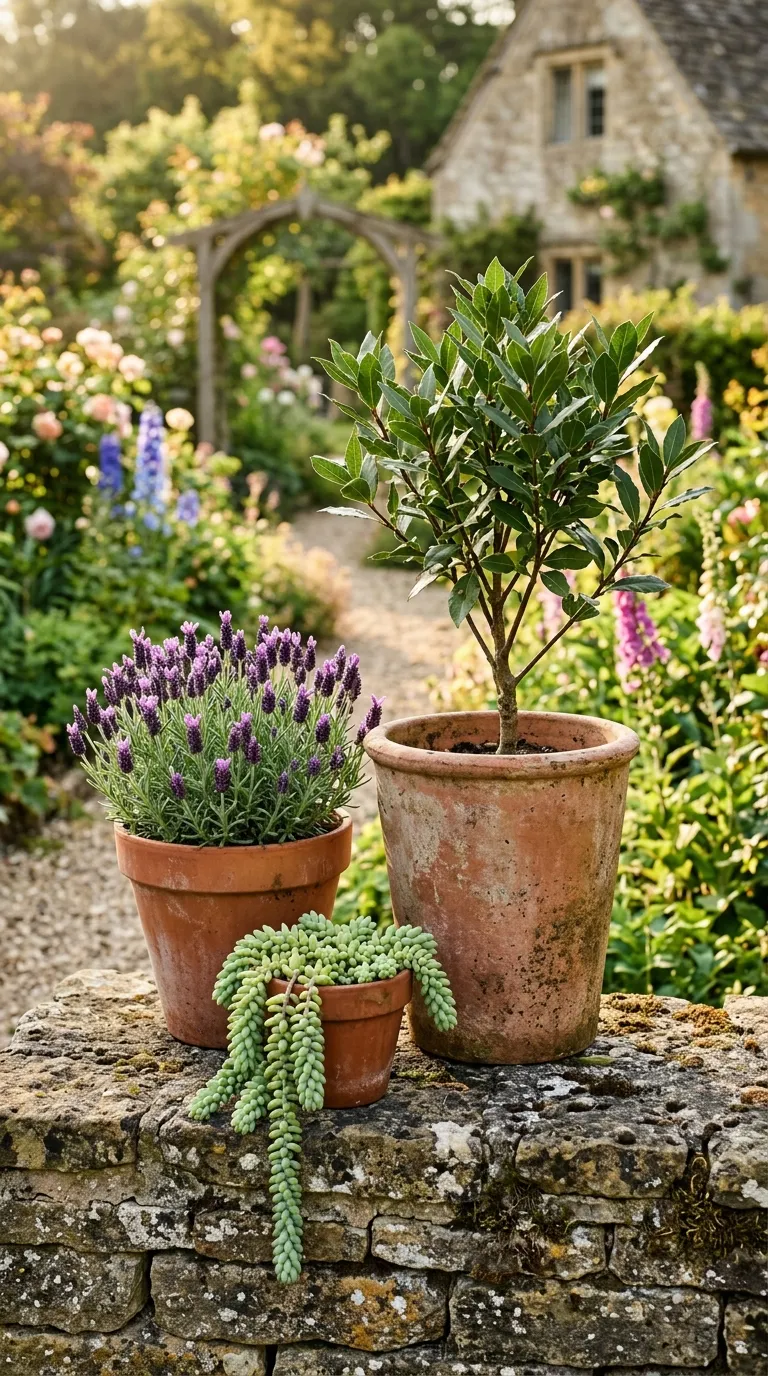
Three terracotta pots on top of a drystone wall: a small one with a trailing sedum spilling over the edge, a middle one of lavender in flower, and a large one holding a small standard tree. Behind them, a stone cottage and a border.
What lifts that group is the wall underneath it. The pots sit at about waist height, which is where a group of objects is read from across a garden. The same three on the ground would be lost among the planting, because the eye looks down on them. It is the same reason the lanterns earlier in this piece sit on a wall and not on the paving.
If you try it, level the bed first. A drystone wall top is uneven, a pot that rocks will go over in wind eventually, and it is always the largest one. A paving offcut bedded flat under each pot is enough.
The trailing sedum is doing more than the other two. A row of upright pots on a wall top reads as a display; the one that hangs over the edge breaks the line.
The position has one drawback. A wall top is the driest place in a garden, because rain runs off it in both directions, so whatever goes up there will want water when nothing else does.
A mirror is aimed, like a light
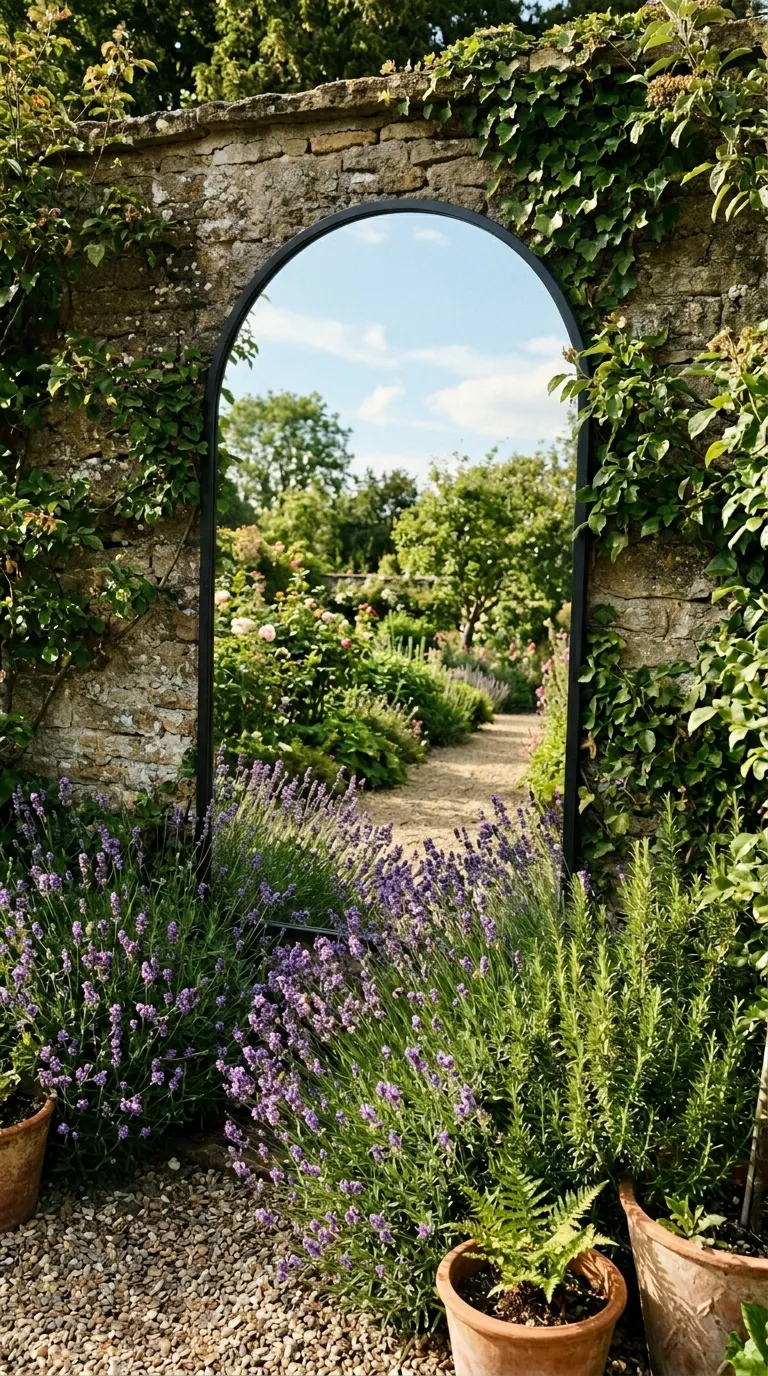
What is in that mirror is not what is in front of it. The glass reflects the path further down the garden, the lavender along it, the trees, and the sky above the wall. The lavender in the foreground is real; everything inside the arch is somewhere else.
That is why a mirror has to be aimed. It does not double a garden. It shows a part of the garden the eye cannot see from where it is standing, which is exactly what the spike light does with a tree. Turned towards a fence, it shows you a fence.
Outdoor mirrors come in two sorts: glass on a sealed backing board, and acrylic. Glass gives the truer reflection. Acrylic bends instead of shattering, which is the safer choice where a ball is likely to reach it.
Fix it properly. A French cleat screwed into masonry plugs takes the weight and holds the mirror flat against the wall, and stainless screws are the right choice on a wall that is damp for much of the year. A mirror leaned against a wall needs its base restrained, or it will slide in the first storm.
After dark a mirror is a black rectangle. Put it where you look in the daytime, and put the lantern there for the evening.
Repetition is what makes a long axis work
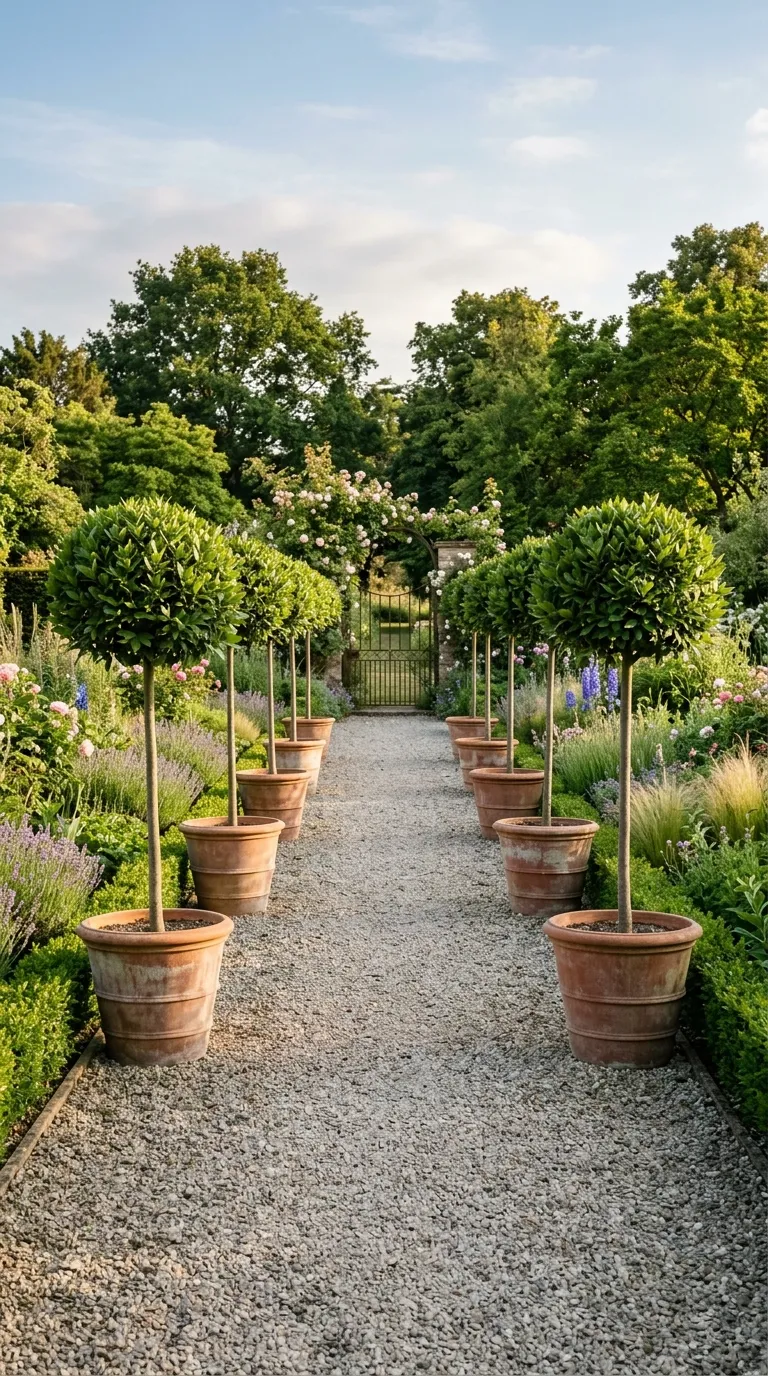
12 standard bays in terracotta pots, two rows, a straight gravel path, and a green gate at the end with a rose over it. The whole length of that path is visible from the first step, and it still works. The pots give the eye something to move along; the gate gives it somewhere to arrive.
A straight line with nothing on it is a corridor. The same line with one object repeated at an even spacing is a procession, and the eye counts as it walks. The spacing here looks like about 2m, close enough that the rhythm holds and far enough that the pots read as separate things.
The standard is the point. A bay clipped into a ball on a clear stem of 800mm to 1m needs a 400mm pot, and it needs clipping twice a year, in late spring and again in late summer, or the ball goes oval. Bay in a pot also suffers in a hard winter: the rootball freezes solid and the plant dies from the roots up, while the same bay in open ground comes through untouched.
Where this does not hold: on a plot under about 8m, a double row of standards reads as a nursery. One row, or none. Every pot also has to match, because one different size breaks the run.
Frequently Asked Questions
How do I stop festoon lights sagging into the shrubs?
Tension a steel wire between two solid anchors and clip the light string to it loosely, so the string carries no load of its own. A wire that keeps a little curve in it rides out wind far better than one pulled dead straight.
Can one spike light light a whole tree?
For a small tree with a clear trunk and an open canopy, yes. The fitting needs to sit low, aim upward at a slight angle, and be hidden behind a shield or a tuft of planting, because a visible lamp competes with the tree it is meant to light.
What is the point of a mirror in a garden?
It shows you a piece of the garden you cannot see from where you stand, which reads as more space. The reflection is only convincing when it holds planting and sky, so it has to be aimed at something with both in it.
Does a bubbling stone need much maintenance?
Two jobs. Top the hidden reservoir up weekly in summer, since splash and evaporation empty it faster than expected, and rinse the pump sponge when the flow starts to falter. In a hard winter, drain the reservoir or leave the pump running.
How wide should a garden path be?
900mm carries one person comfortably. Where two people will meet, or where a wheelbarrow goes, plan on 1.2m. Gravel also wants an edge on both sides, or it will not stay where you put it.
Will standard bay trees survive winter in pots?
Often not. A rootball in a container freezes harder than soil in the ground, and a cold snap can kill a bay that would shrug off the same weather in a border. Wrap the pot, or accept that the run is seasonal.
Before you buy anything
- Cross the lights over the space and carry them on a tensioned wire.
- Set posts and arch feet in concrete, and check the joint at the crown of an arch.
- Choose 2200 to 2700K bulbs and IP44 as a minimum.
- Aim an uplight off centre and shield the fitting, so the tree is the object.
- Put light at three heights: paving, wall, and table.
- Edge a gravel path before you lay it, and keep it 900mm wide.
- Site a bubbling stone within a few metres of the seating, and top it up weekly.
- Repeat one pot at even spacing to turn a long path into a procession.
This article may contain affiliate links. We may earn a commission at no extra cost to you.